
A complete issue · 20 pages · 1900
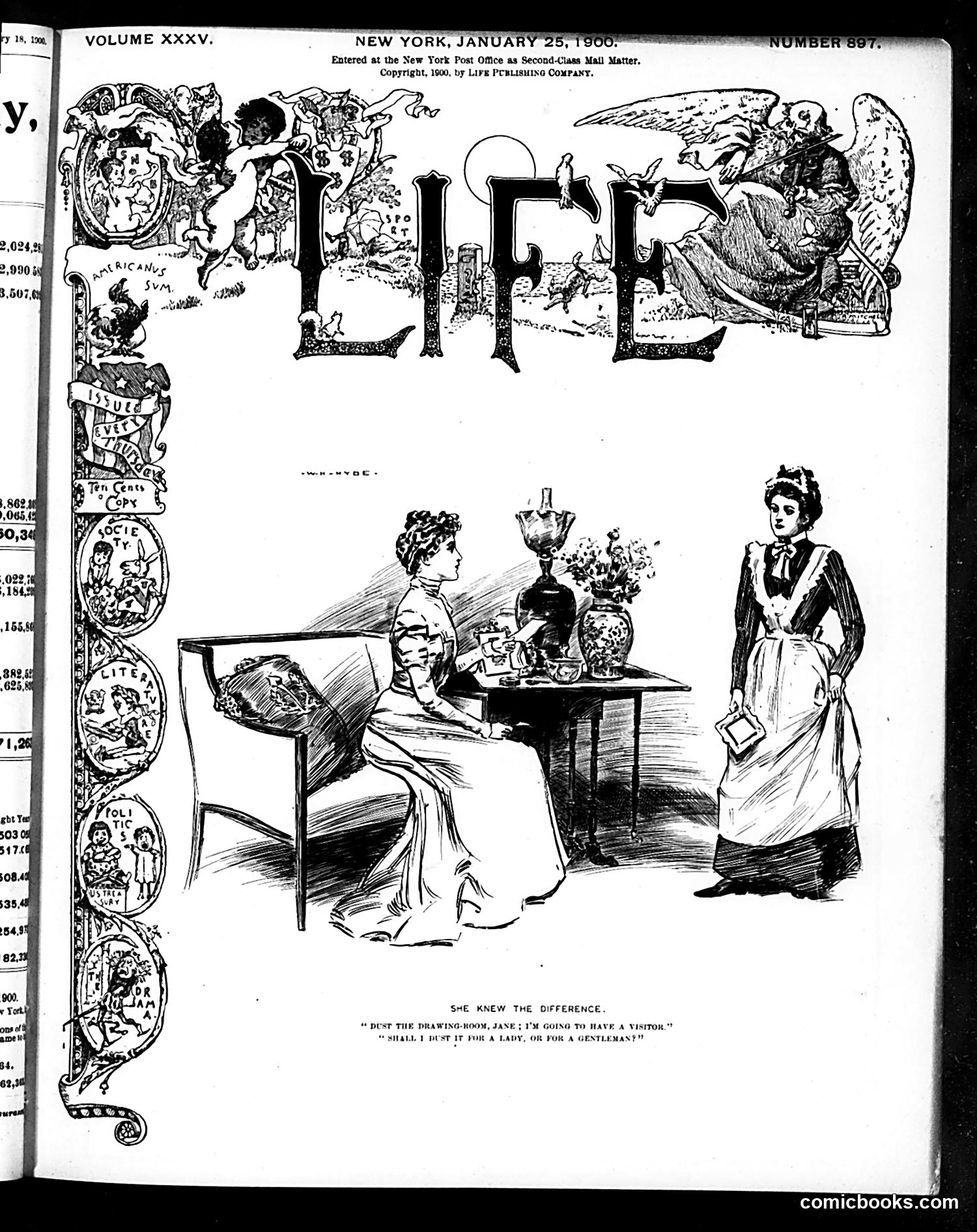
Life — January 25, 1900
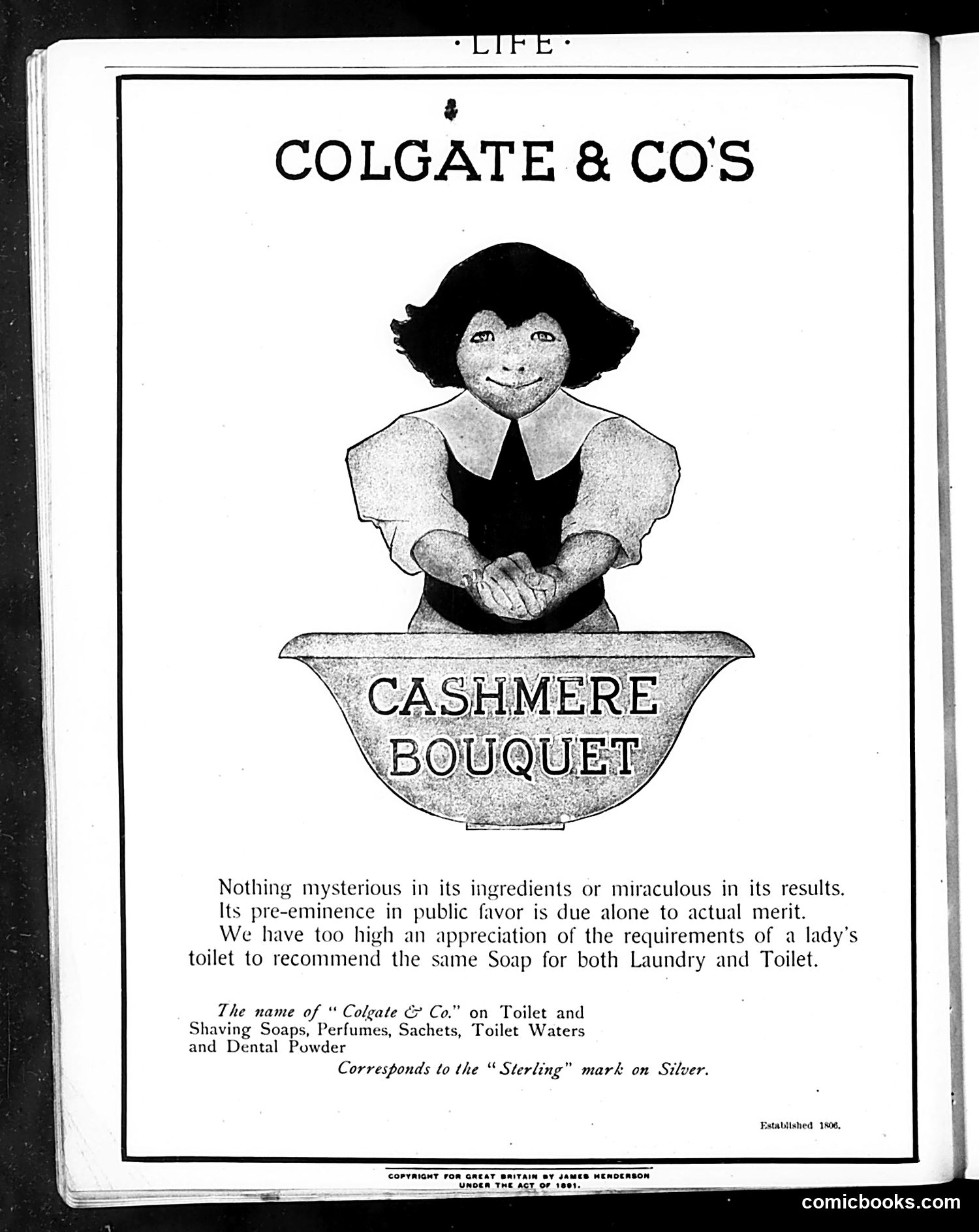
This appears to be **an advertisement rather than satire or political commentary**. It's a Colgate & Co. product ad for "Cashmere Bouquet" soap, published in Life magazine. The illustration shows a smiling woman with 1920s-style bobbed hair and period clothing, positioned above a basin labeled "Cashmere Bouquet." The ad emphasizes that the soap's popularity stems from "actual merit" rather than marketing mystery, and notably claims the product is suitable for both laundry and toilet use—a practical selling point for the era. The text references Colgate & Co.'s reputation (comparing it to sterling silver quality) across multiple product lines including soaps, perfumes, and dental powder. This is straightforward commercial advertising reflecting early-twentieth-century consumer product marketing conventions, not satirical commentary.
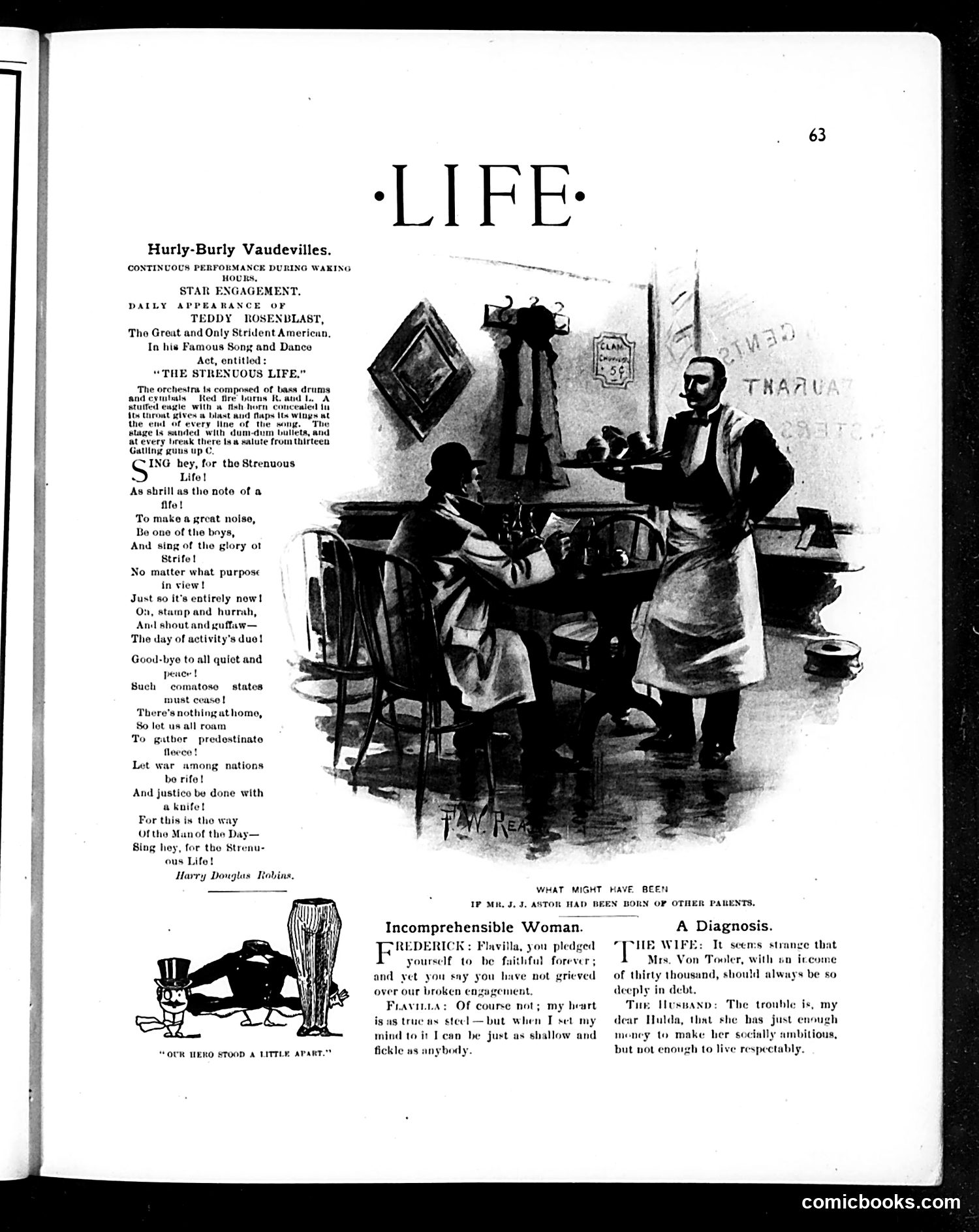
The main cartoon depicts "Hurly-Burly Vaudevilles" featuring Teddy Rosenblast performing "The Strenuous Life"—an apparent parody of President Theodore Roosevelt's famous philosophy emphasizing vigorous activity and moral duty. Below are two brief satirical dialogues. "Incomprehensible Woman" mocks a woman who claims faithfulness while admitting infidelity—exposing contradictory female behavior. "A Diagnosis" jokes about a wealthy but socially anxious woman, suggesting money alone cannot buy confidence or respectability. The accompanying illustrations use caricature and exaggeration typical of early 20th-century satire. The overall page satirizes contemporary social pretensions, relationship hypocrisy, and the limitations of wealth—common themes in Life magazine's humor targeting middle and upper-class American society.
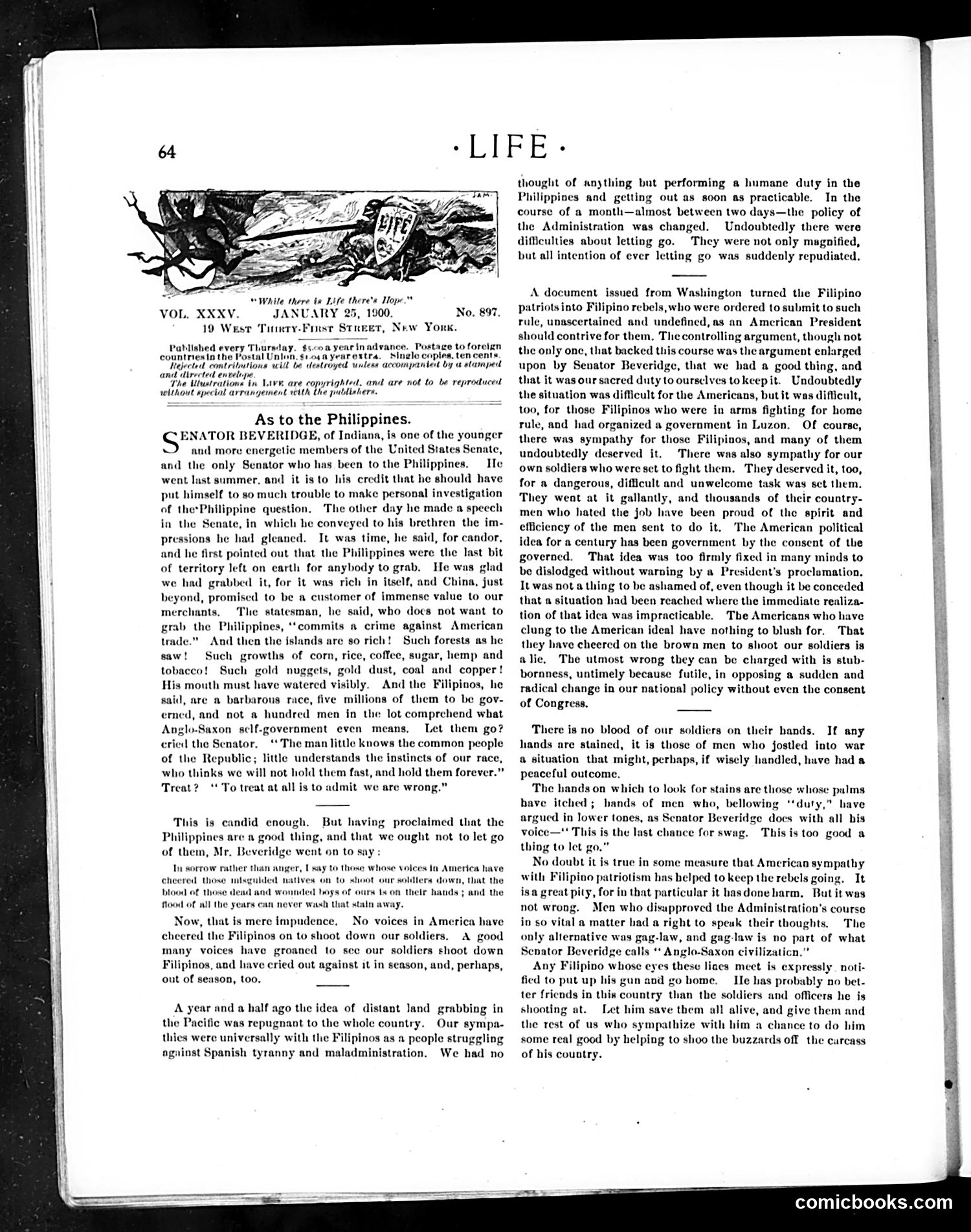
The cartoon titled **"While there is LIFE there's Hope"** depicts a skeletal or dying figure, likely representing the **Philippine-American conflict** of 1899-1900. The article "As to the Philippines" criticizes **Senator Beveridge**, who had recently returned from the Philippines advocating American control. The writer sarcastically quotes Beveridge's pro-imperial arguments about acquiring territory and resources ("hemp and coconuts"). The piece attacks American justifications for the occupation, arguing that Filipino rebels fighting for independence are being unfairly portrayed. It defends Filipino patriots while criticizing U.S. policy for suddenly abandoning earlier promises of independence—a shift the author finds morally indefensible. The satire targets American imperial ambitions masked as benevolent governance.
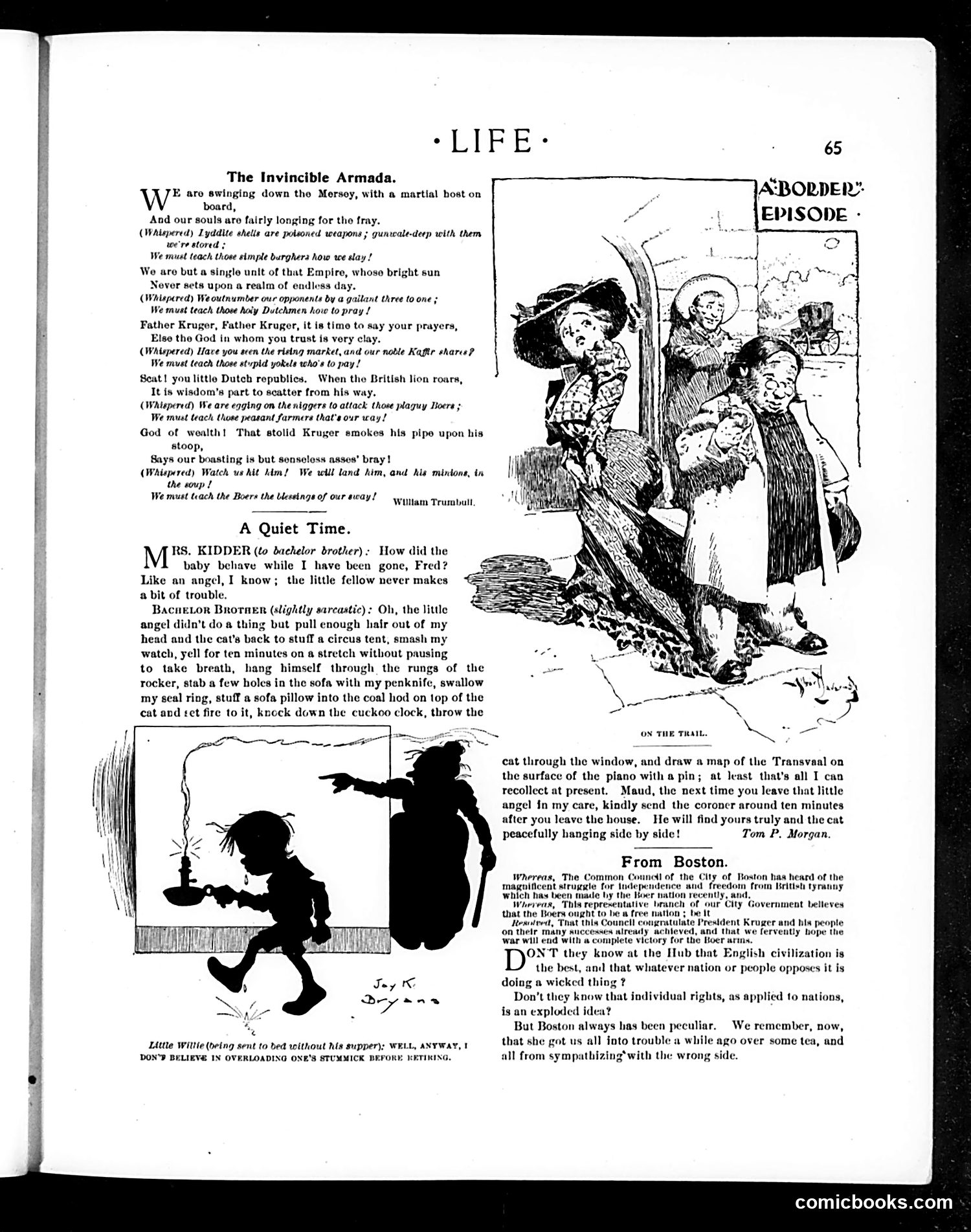
This page contains two distinct sections: **"The Invincible Armada"** — a poem by William Trumbull celebrating British naval superiority, likely referencing the historic defeat of Spain's Armada. The context suggests this was written during a period of British imperial confidence, possibly late 19th or early 20th century. **"A Quiet Time"** — a humorous domestic sketch where Mrs. Kidder describes her baby's mischievous behavior to Bachelor Brougham, detailing property damage (hair-pulling, furniture destruction, etc.). The accompanying silhouette illustration shows a child creating havoc indoors. **"From Boston"** — political commentary questioning Boston's recent pro-Irish independence stance, criticizing the city for sympathizing with "the wrong side" regarding British tyranny. The cartoons employ satirical humor about child-rearing and mild political critique typical of Life's editorial approach.
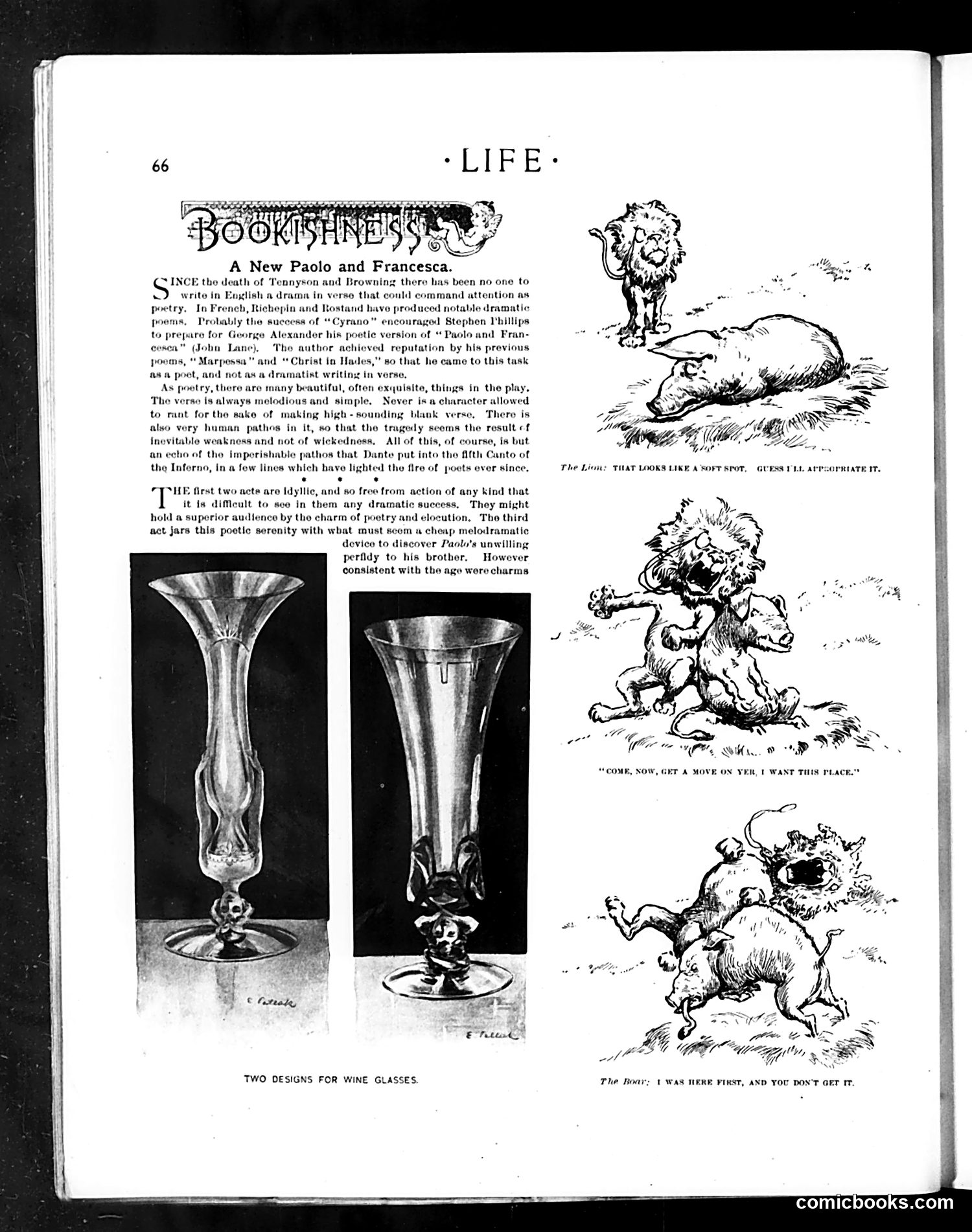
This page combines literary criticism with whimsical illustrations. The main article discusses "A New Paolo and Francesca"—a dramatic poem by Stephen Phillips adapting Dante's famous tragic lovers. The text critiques the work's poetic merit, noting that while the verse is "melodious and simple," it lacks dramatic force and relies on cheap melodrama rather than genuine tragedy. The two wine glass designs shown are decorative objects, likely contemporary advertisements or design features. The three cartoon illustrations on the right appear to be unrelated comic vignettes—possibly humorous scenes involving animals (lions, bears) with witty captions about territorial disputes and social dynamics. These serve as visual breaks in the page's literary content, typical of Life's mixed satirical format.
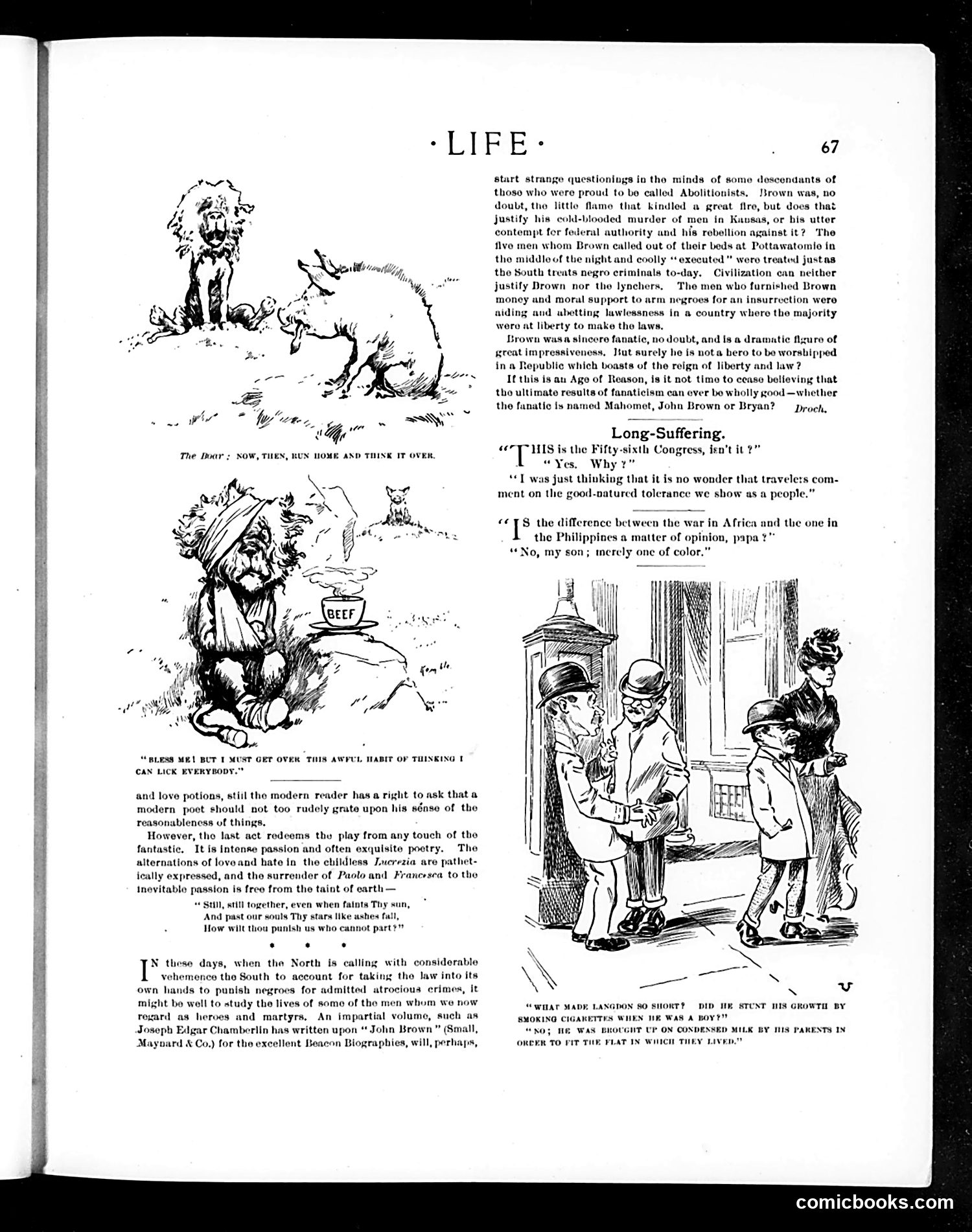
This page contains satirical commentary on American violence and fanaticism, particularly regarding John Brown's raid on Harpers Ferry (referenced in the text). The top cartoon shows a bear labeled "The Bear: Now, Then, Run Home and Think It Over" — likely representing aggressive expansionism or violence as an untamed force. The lower illustration and accompanying dialogue mock American tolerance for brutality. A conversation between a father and son questions the moral consistency of America's professed values of liberty while tolerating lawlessness and racial violence. The final cartoon depicts men smoking, with a caption about ghosts and condensed milk — a lighter joke about commercialism. Overall, the page critiques American hypocrisy: preaching democratic ideals while permitting vigilante violence and racial atrocities.
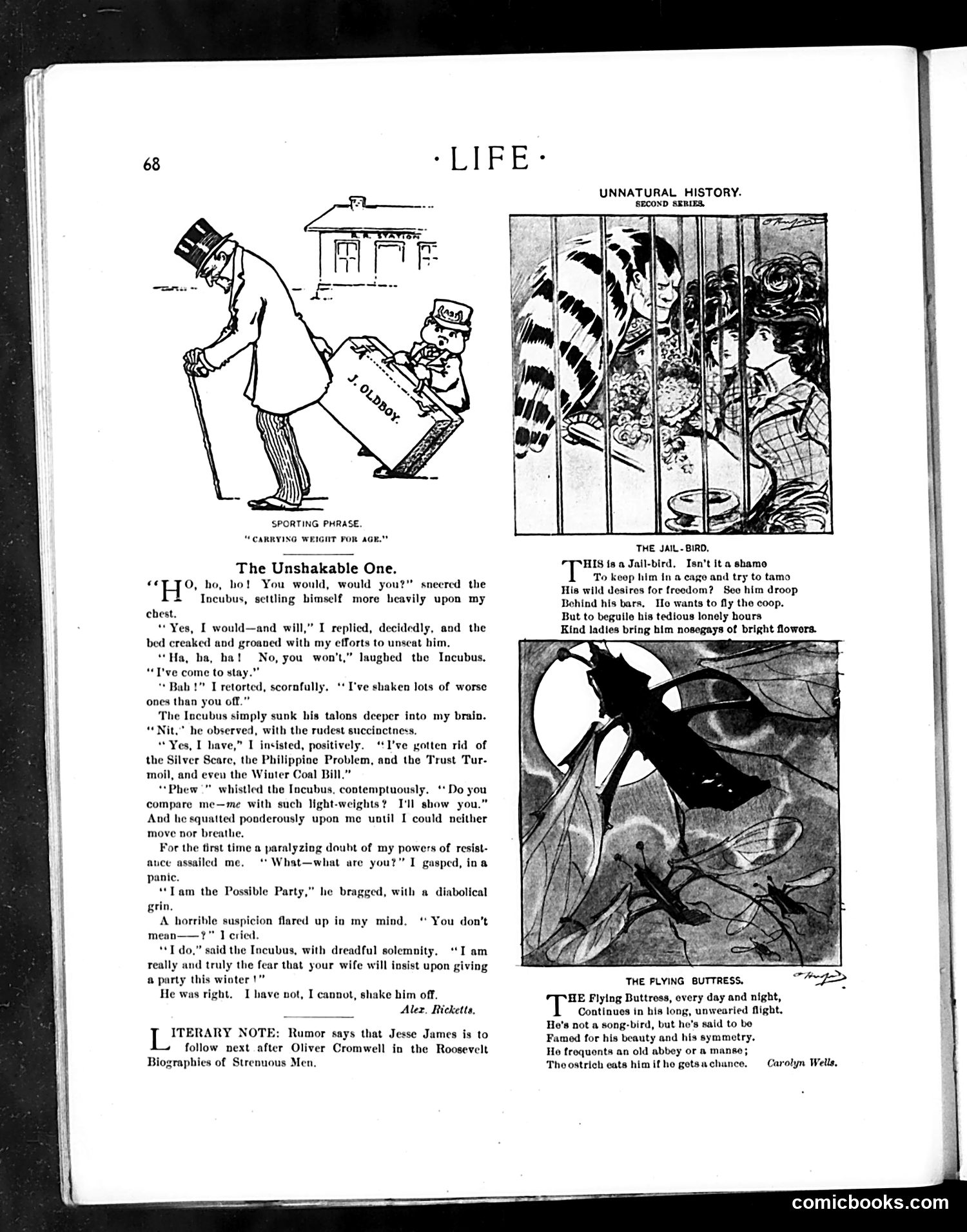
**"The Unshakable One"** cartoon (top left) depicts a tall, thin figure labeled "Incubus" sitting heavily on a smaller man's chest. The dialogue suggests political weight—the seated figure claims he's "shaken lots of worse ones than you," referencing past political crises ("the Silver Scare, the Philippine Problem, and the Trust Turmoil"). This appears to satirize how politicians or the public endure recurring political scandals without lasting impact. The right side contains two nature illustrations titled "Unnatural History, Second Series"—"The Jail-Bird" and "The Flying Buttress"—with humorous poetic descriptions anthropomorphizing animals. These are light satirical pieces comparing birds to human conditions (imprisonment, wandering). The page blends political commentary with naturalist humor typical of Life magazine's satirical approach.
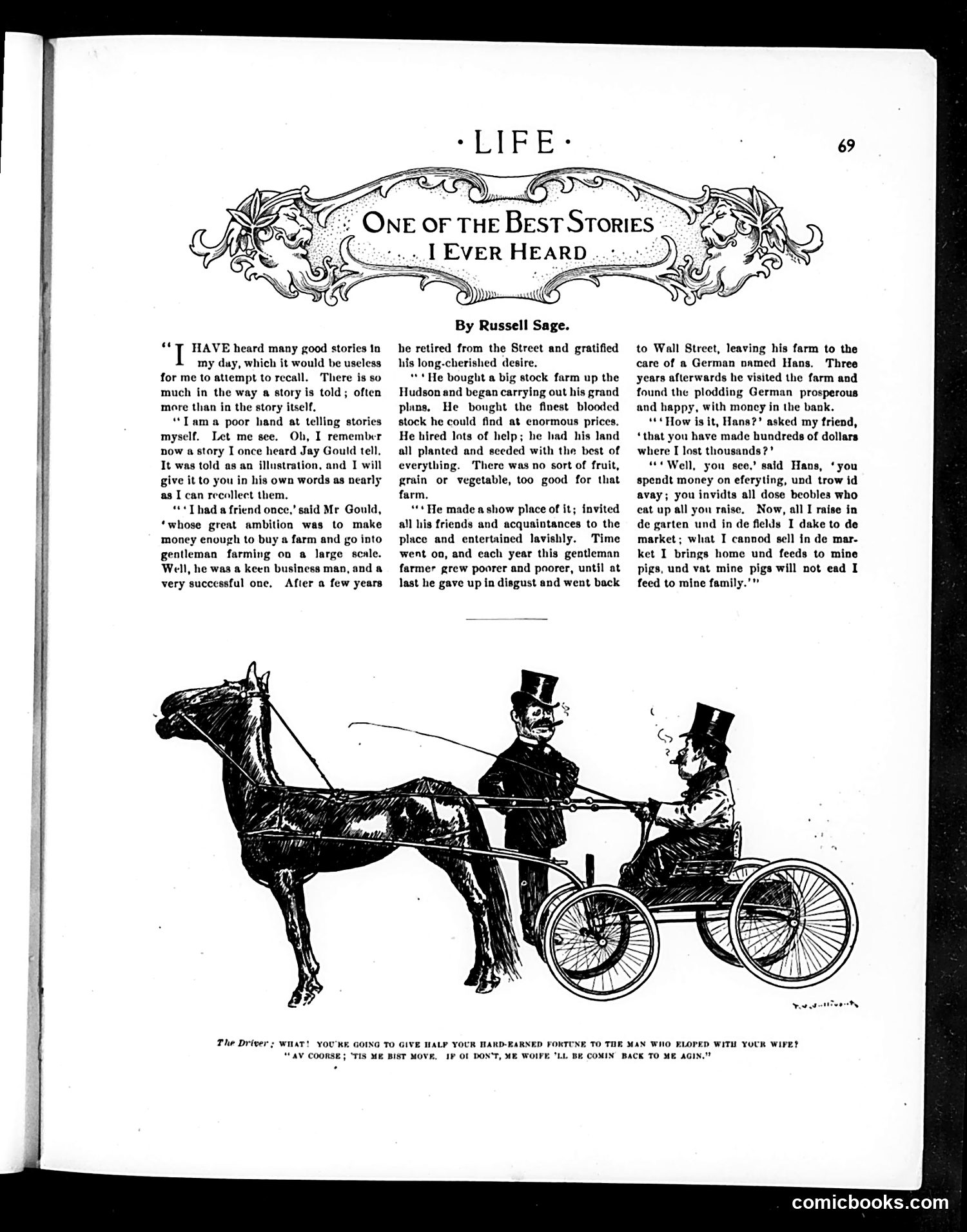
This page presents a humorous anecdote about a wealthy farmer who became prosperous through smart livestock breeding and farming. The story critiques wealth inequality: despite his success feeding the community, the farmer grew "poorer and poorer" as others profited from his labor and generosity. The cartoon below illustrates the story's moral lesson. It depicts a man in a top hat (representing wealth or authority) driving a horse-drawn cart while confronting another well-dressed figure on a bicycle. The caption suggests a domestic dispute—one man accuses the other of giving money to someone who eloped with his wife, threatening that if the money isn't returned, "we'll be comin' back to me again." The satire mocks wealthy men's entitlement and hypocrisy regarding money and relationships.
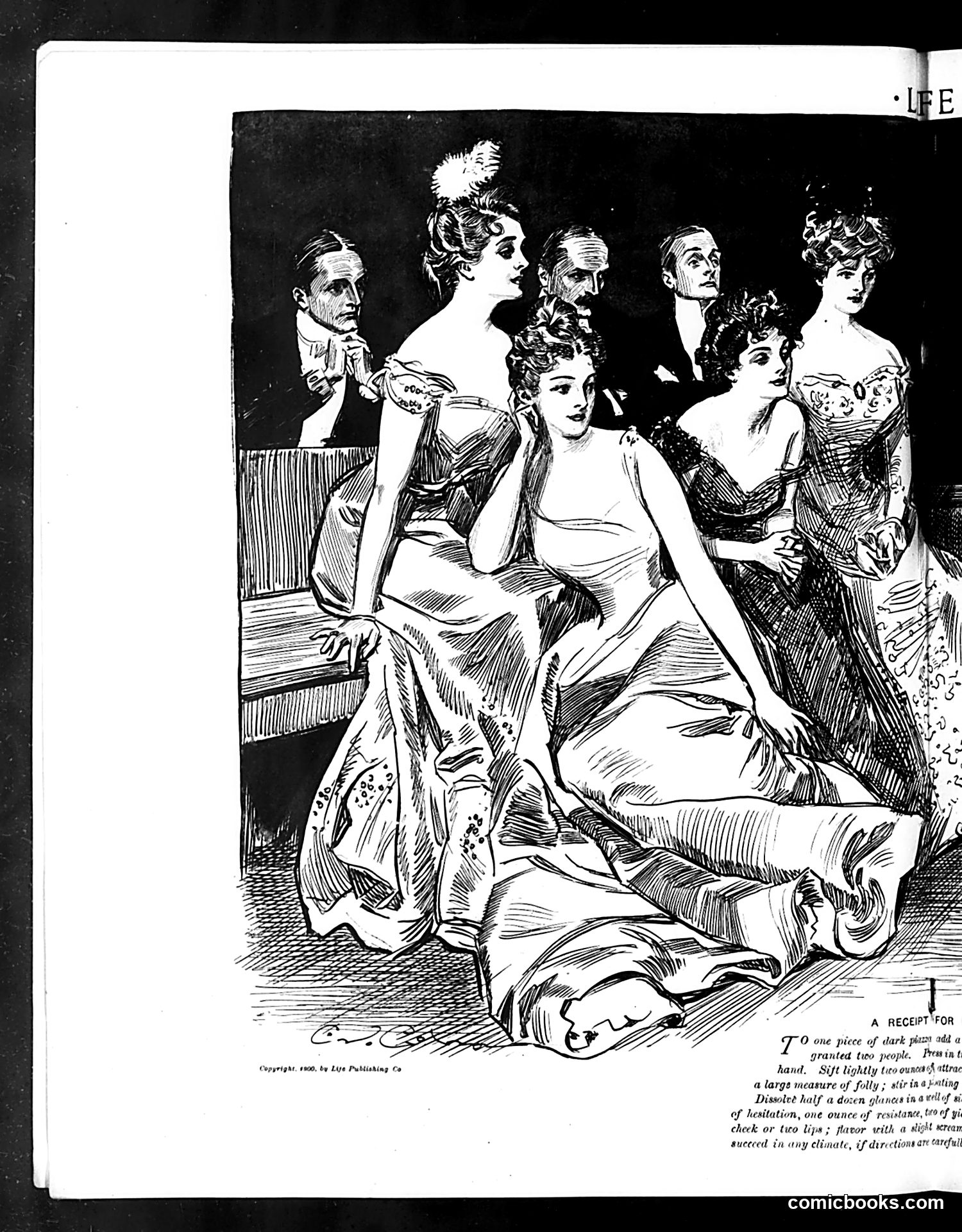
This appears to be a satirical illustration from *Life* magazine (copyright 1908, per the visible mark) depicting a fashionable social gathering or reception. The sketch shows well-dressed figures in Edwardian-era formal wear—men in tuxedos and women in elaborate gowns with detailed fabric patterns and styling typical of the period. The partial recipe text visible at bottom ("To one piece of dark plush add a grated two people...") suggests this is satirizing high society's superficiality or the artificiality of fashionable gatherings, treating them as something one might "construct" like a recipe. The artist's signature appears present but is difficult to read clearly. Without the complete caption or text, the specific social critique remains somewhat unclear, though the tone suggests mockery of Edwardian upper-class pretension or social rituals.
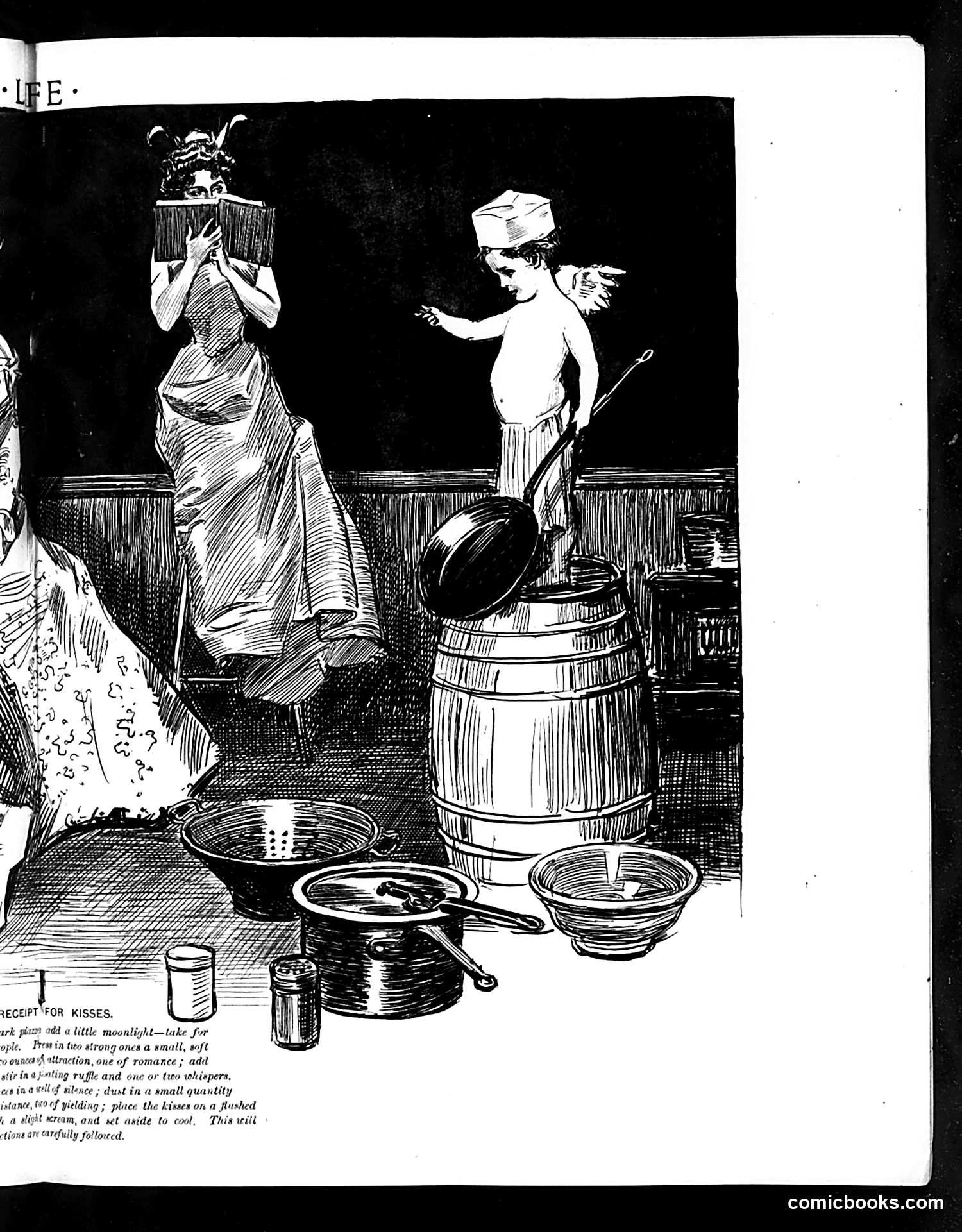
This page contains an illustration titled "A RECEIPT FOR KISSES" depicting a domestic kitchen scene. A winged cherub (Cupid) appears to be instructing or supervising a woman in the preparation of what looks like a romantic dessert or confection. The woman is shown with her head covered, working with various cooking vessels and ingredients. The accompanying text (partially visible) describes a recipe involving ingredients like "mountainmilk," butter, eggs, and other components, with instructions about "kisses" being placed on a "flashed" or glazed surface. This appears to be a humorous recipe—a common genre in satirical magazines—using romantic or flirtatious language as double entendre for actual cooking instructions. The overall tone suggests turn-of-the-century genteel humor about domestic life and courtship.
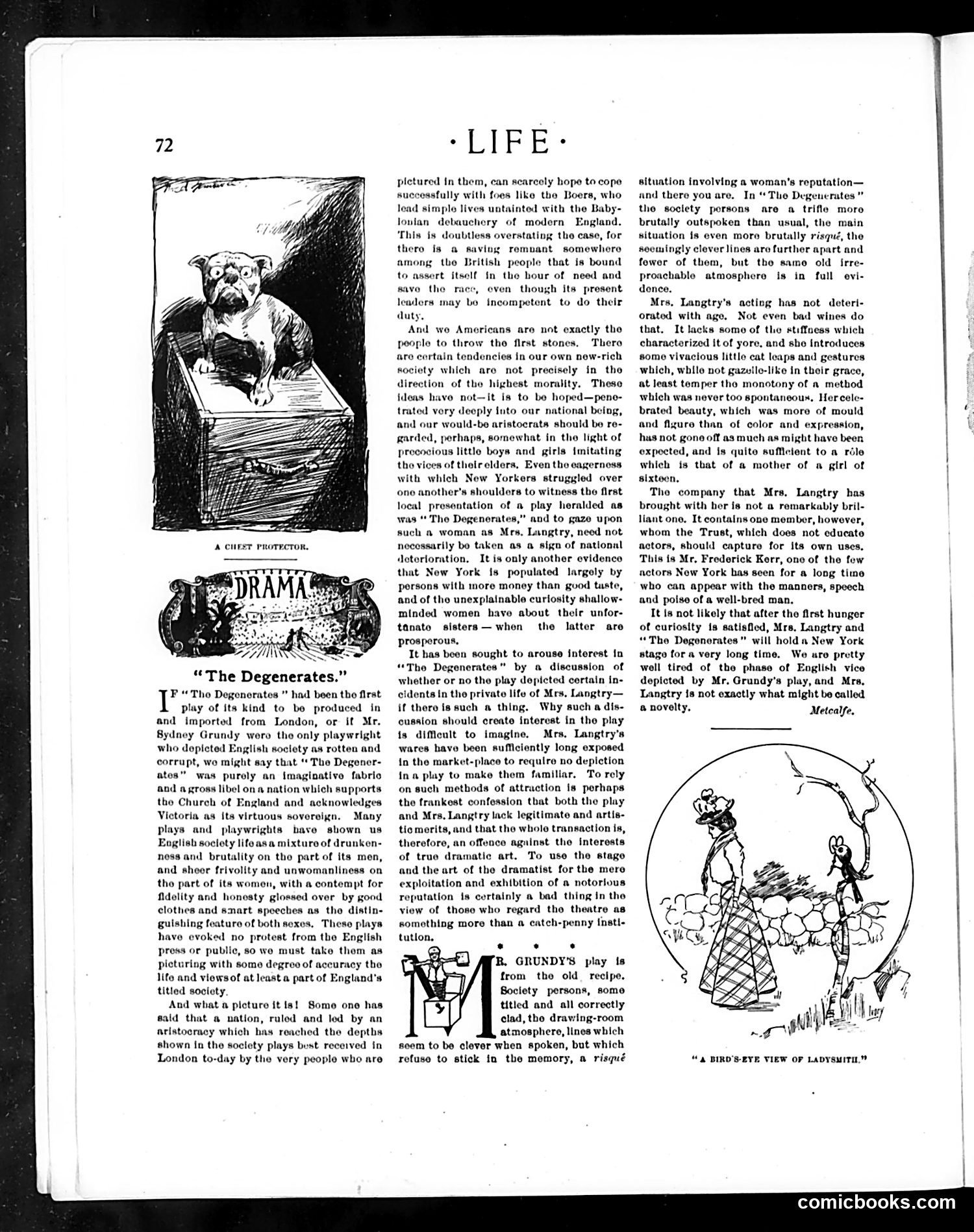
This page reviews a London play imported to Sydney called "The Degenerates," written by Sydney Grundy. The article criticizes the play for depicting scandalous private affairs of a wealthy woman (Mrs. Langtry) to attract audiences through sensationalism rather than artistic merit. The cartoon "A Chief Protector" (left) shows a bulldog, likely symbolizing British moral authority or protective values being compromised. The illustration "A Bird's-Eye View of Ladysmith" (right) appears unrelated to the main review. The satire targets both the play's exploitation of a real woman's reputation and New York society's appetite for such scandalous entertainment, suggesting this reflects poorly on national character and artistic standards.
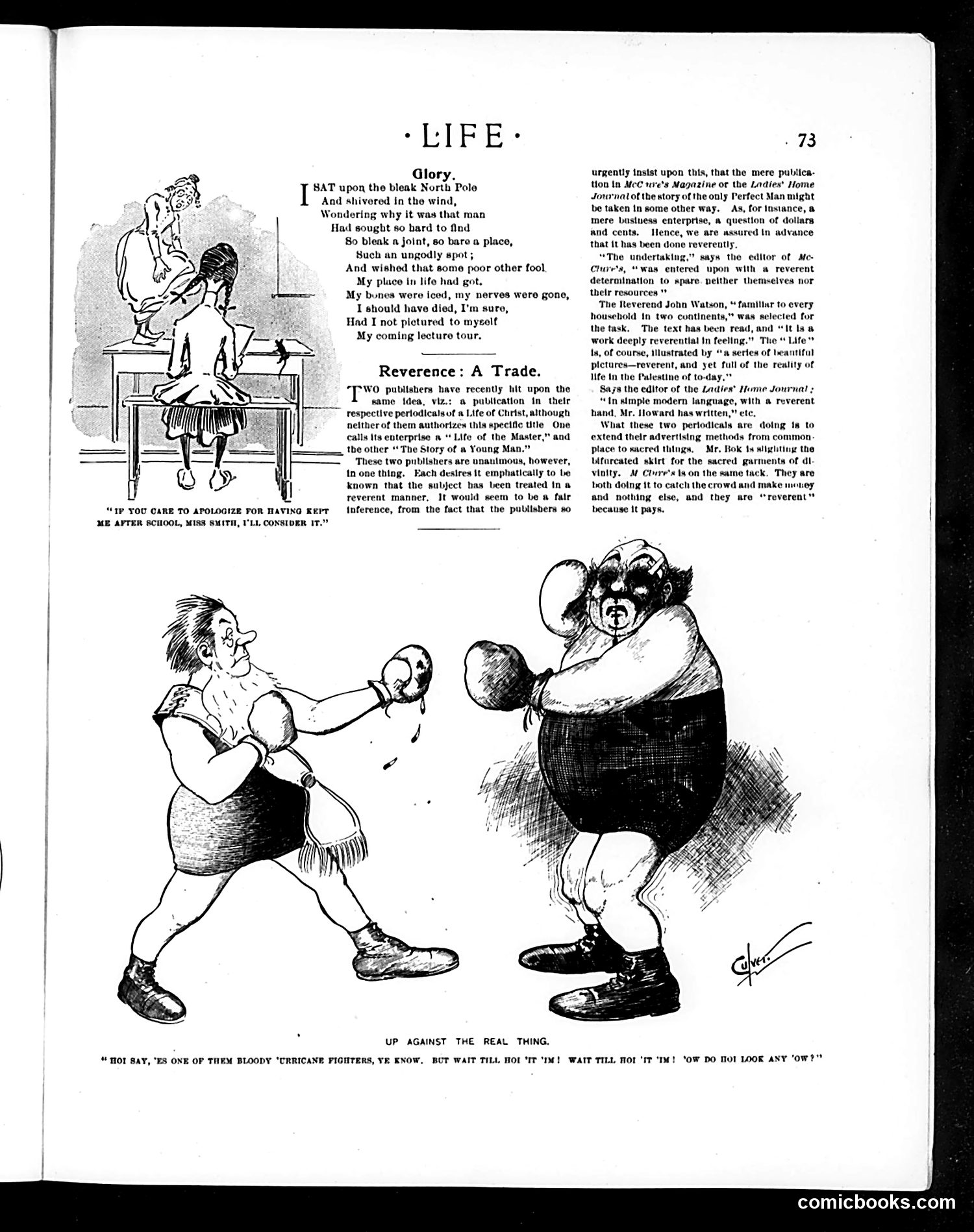
This page contains two distinct satirical pieces: **"Glory"** (top): A poem mocking Arctic exploration's pointlessness. The speaker, freezing at the North Pole in an "ungodly spot," survives only by fantasizing about giving paid lectures afterward—satirizing how explorers monetize their suffering through lecture tours. **"Reverence: A Trade"** (center): Critiques two major publishers (McClure's Magazine and Ladies' Home Journal) who simultaneously published competing "Lives of Christ"—one titled "Life of the Master," the other "Story of a Young Man." The satire exposes their repeated insistence on "reverent" treatment as commercial posturing: they're treating sacred subject matter as advertising vehicles to attract crowds and profit, not from genuine religious conviction. The piece argues their reverence is merely marketing strategy. **"Up Against the Real Thing"** (bottom): A boxing cartoon showing two fighters, with dialogue in working-class dialect. The context suggests commentary on prizefighting, though the specific reference is unclear without additional historical context. All three pieces share a theme: debunking false sincerity and exposing commercial self-interest masquerading as principle.
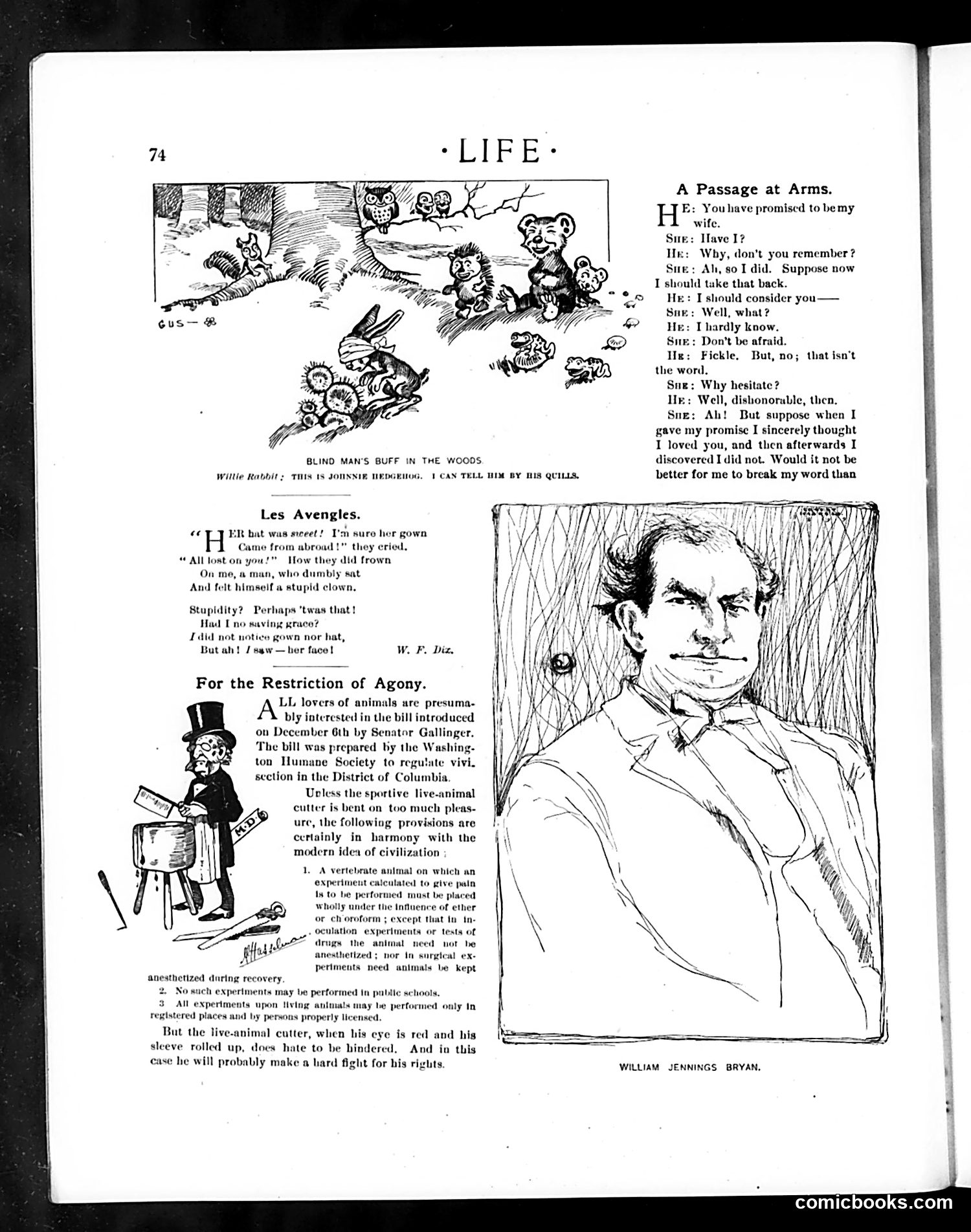
This page contains three distinct satirical pieces: **"A Passage at Arms"**: A dialogue between a man and woman about breaking an engagement. She argues her changed feelings justify breaking her promise; he calls this dishonorable. The satire mocks romantic rationalization—her justifications for betrayal versus his moral stance. **"Les Avengles"**: A poem about a man at a social gathering who, noticing no one else's clothing or appearance, notices only a woman's face. The French title ("The Blind") suggests ironic "blindness" to superficial details while seeing what truly matters. **"For the Restriction of Agony"**: An article supporting Senator Gallinger's bill to regulate vivisection (animal experimentation) in Washington D.C. The accompanying caricature of **William Jennings Bryan** satirizes opposition to animal-protection laws. The text mocks those who would "fight for his rights" to perform painful experiments, suggesting such resistance reveals cruelty masked as scientific freedom.
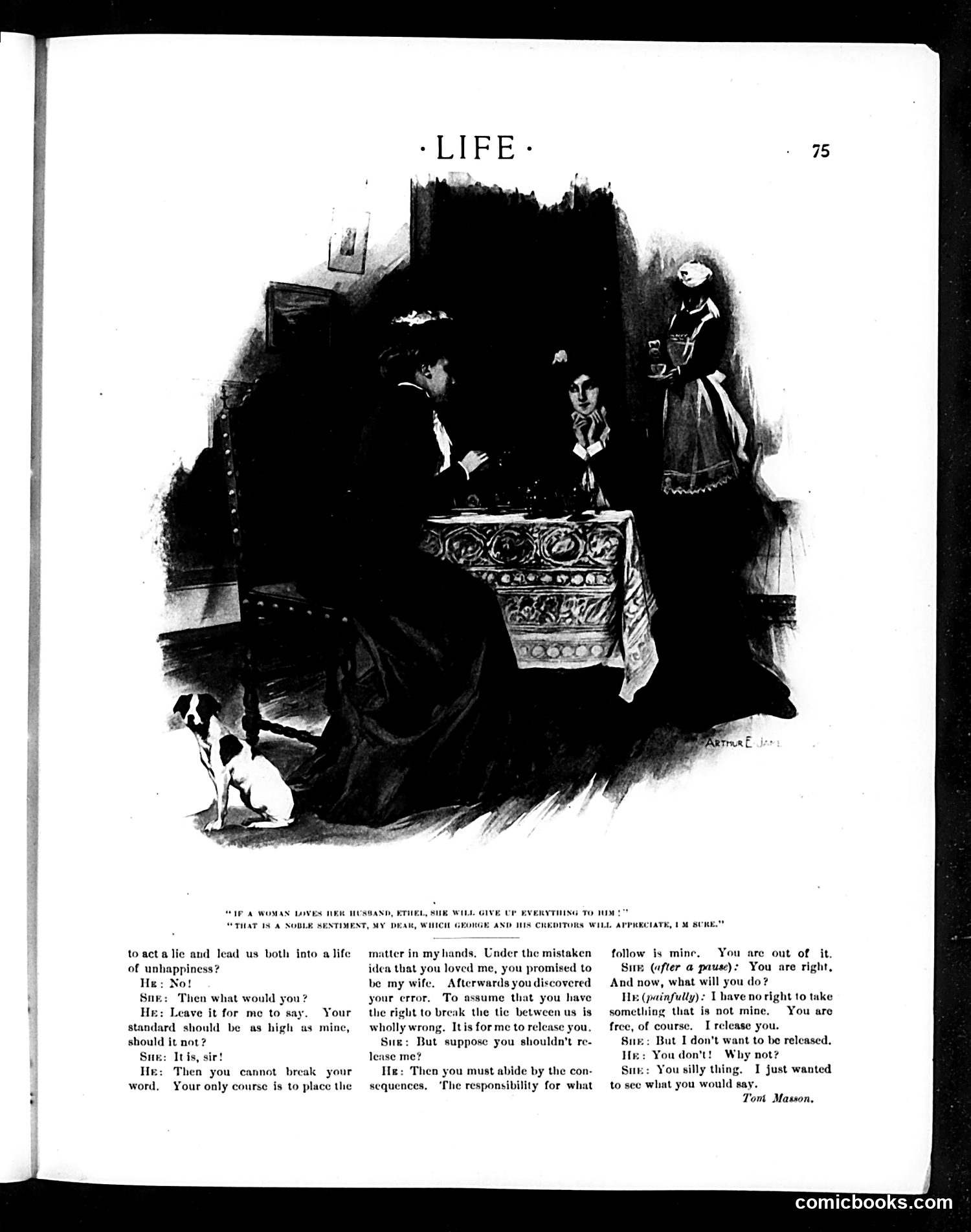
This page presents a dialogue-driven comedy sketch by Tom Masson satirizing **marital obligation and emotional manipulation** circa early 20th century. The setup: A woman (Sue) threatens to break her marriage vow, claiming she mistakenly accepted the husband's proposal. The husband responds with rigid Victorian morality—she promised, so she must keep the promise; he alone can decide whether to "release" her. **The satire's target**: The husband's self-righteous invocation of duty and his own authority to judge the marriage's fate. He claims moral high ground while essentially imprisoning his wife through obligation. **The punchline's twist**: Sue reveals she was testing him—she wanted to see if he'd cling to his "rights" or act generously. When he finally releases her voluntarily, she admits she never wanted freedom at all; she was manipulating his conscience. The cartoon mocks both rigid male authority in marriage and female emotional manipulation, suggesting early-century marital disputes were characterized by power plays disguised as principle. The dog in the illustration observes this human drama with apparent bemusement.
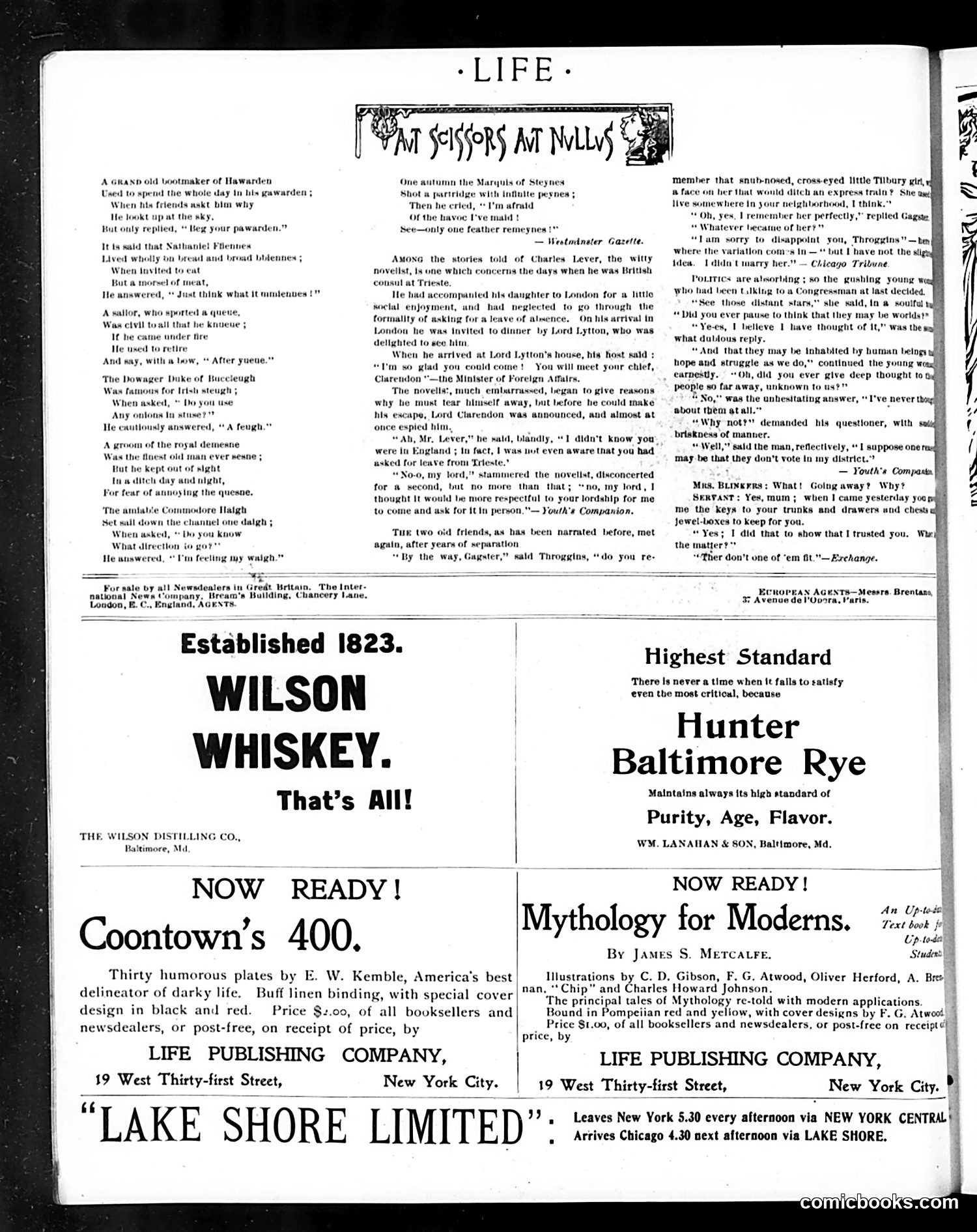
This page presents a collection of humorous anecdotes in verse form, likely parodying Victorian-era etiquette literature. The jokes employ absurdist logic: characters give ridiculous explanations for peculiar behavior (a bootmaker hiding in his garden, a sailor wearing a quilt, a duke pronouncing "steugh" repeatedly). The humor relies on wordplay and non-sequiturs rather than political satire. The opening title "I'm Scissors at Mullus" appears to be nonsensical itself, setting the tone for deliberately silly content. The remainder of the page features prose anecdotes about notable figures like novelist Charles Lever, involving social embarrassment and misunderstandings in formal settings—typical drawing-room comedy of the period. **The advertisements** (Wilson Whiskey, Hunter Baltimore Rye, Coontown's 400, Mythology for Moderns) are period-appropriate commercial matter, not satirical content. This is primarily **light humor and advertising**, not political commentary.
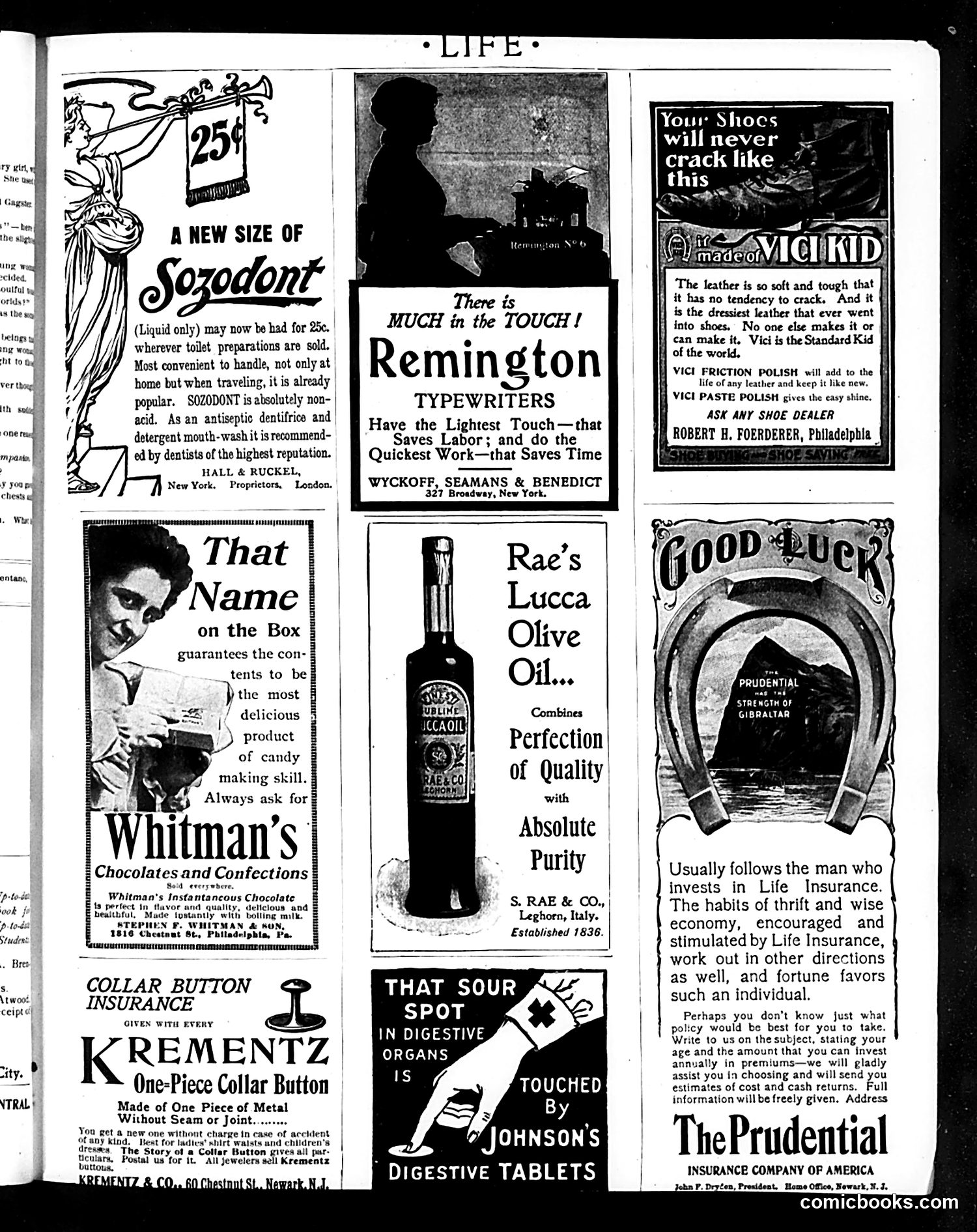
This is primarily an **advertising page** with no political cartoons or satire. It contains nine product advertisements typical of early 20th-century American magazines. The ads reflect period concerns and products now obsolete or infamous: - **Sozodont** (toothpaste): Marketed as antiseptic and non-acid - **Whitman's Chocolates**: Emphasizes quality and brand-name guarantee - **Remington Typewriters**: Highlights "light touch" for efficiency - **Vici Kid Leather shoes**: Promotes durable, crack-resistant material - **Rae's Lucca Olive Oil**: Italian import claiming purity - **Krementz Collar Buttons**: One-piece metal design (collar buttons were essential detachable garment parts) - **Johnson's Digestive Tablets**: Patent medicine for stomach complaints - **The Prudential Insurance**: Links life insurance to personal virtue and success The page demonstrates early advertising's emphasis on product quality claims, practical home utility, and how consumer goods supposedly reflected character and social status—now largely recognized as marketing tactics.
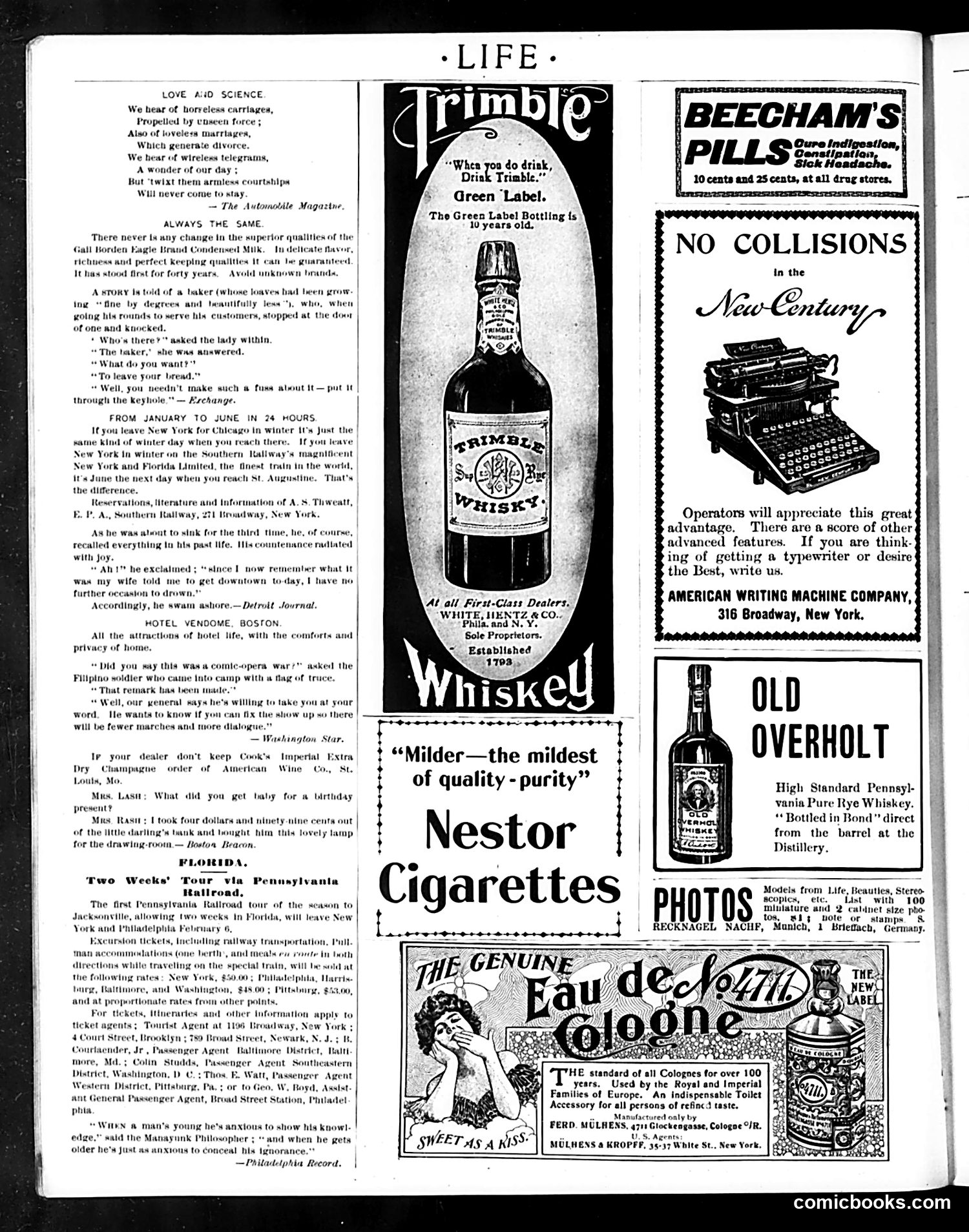
This page consists primarily of **advertisements and humorous anecdotes** rather than political cartoons. The ads are for period products: Trimble whiskey (Green Label established 1793), Nestor cigarettes, Beecham's Pills (a patent medicine), an American typewriter claiming "no collisions," Old Overholt rye whiskey, and Eau de Cologne cologne. The text humor is lightweight social commentary typical of early 1900s magazines—jokes about wireless technology and "loveless marriages," a baker's joke, a swim anecdote, and observations about young men showing off. One anecdote references a "Filipino soldier" and a "comic-opera war," likely alluding to the Philippine-American War (1899-1902). The "ALWAYS THE SAME" section advertises Gail Borden's condensed milk, emphasizing product consistency. **This is primarily a commercial/advertising page** designed to generate revenue, with filler humor and travel promotion rather than satirical political commentary.
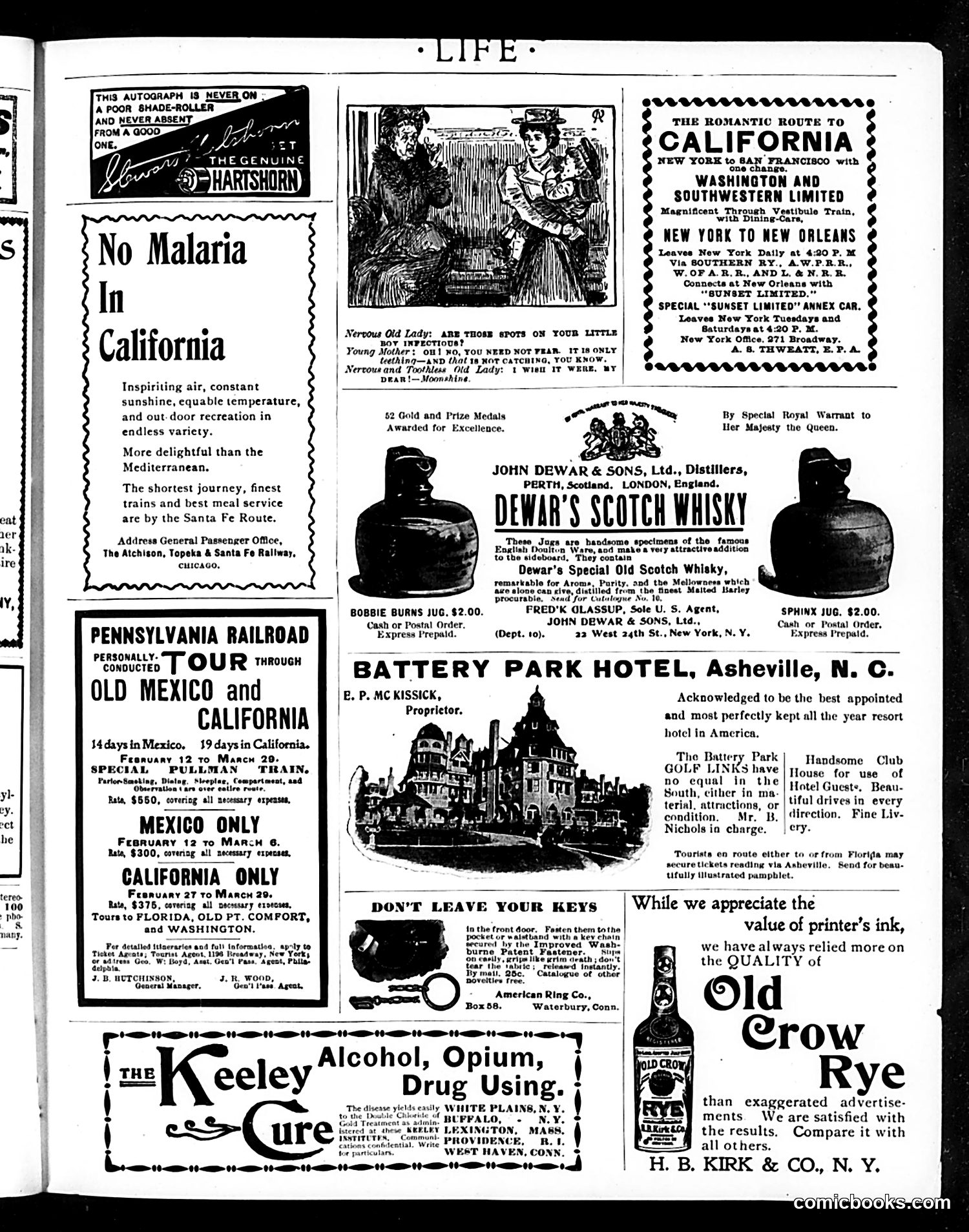
This is primarily an **advertising page** from an early 20th-century issue of Life magazine, with one small cartoon. The cartoon ("Nervous Old Lady") is a simple joke: an elderly woman asks a young mother if spots on a child are infectious. The mother reassures her—it's only teething, not contagious. The old lady replies she *wishes* it were contagious, implying she'd like to avoid further social obligations with children. The page is dominated by travel and product advertisements typical of the era: railroad tours to California and Mexico, the Battery Park Hotel in Asheville, Dewar's Scotch Whisky, Old Crow Rye, and a patent key-holder. One ad promotes California's health benefits ("No Malaria"), reflecting period anxieties about disease and the era's belief in therapeutic travel and climate cures. The Keeley Cure ad addresses addiction treatment—a serious public concern of the time. The advertisements reveal contemporary consumer culture and the class assumptions of Life's readership: leisure travel, luxury goods, and patent remedies marketed to affluent Americans.
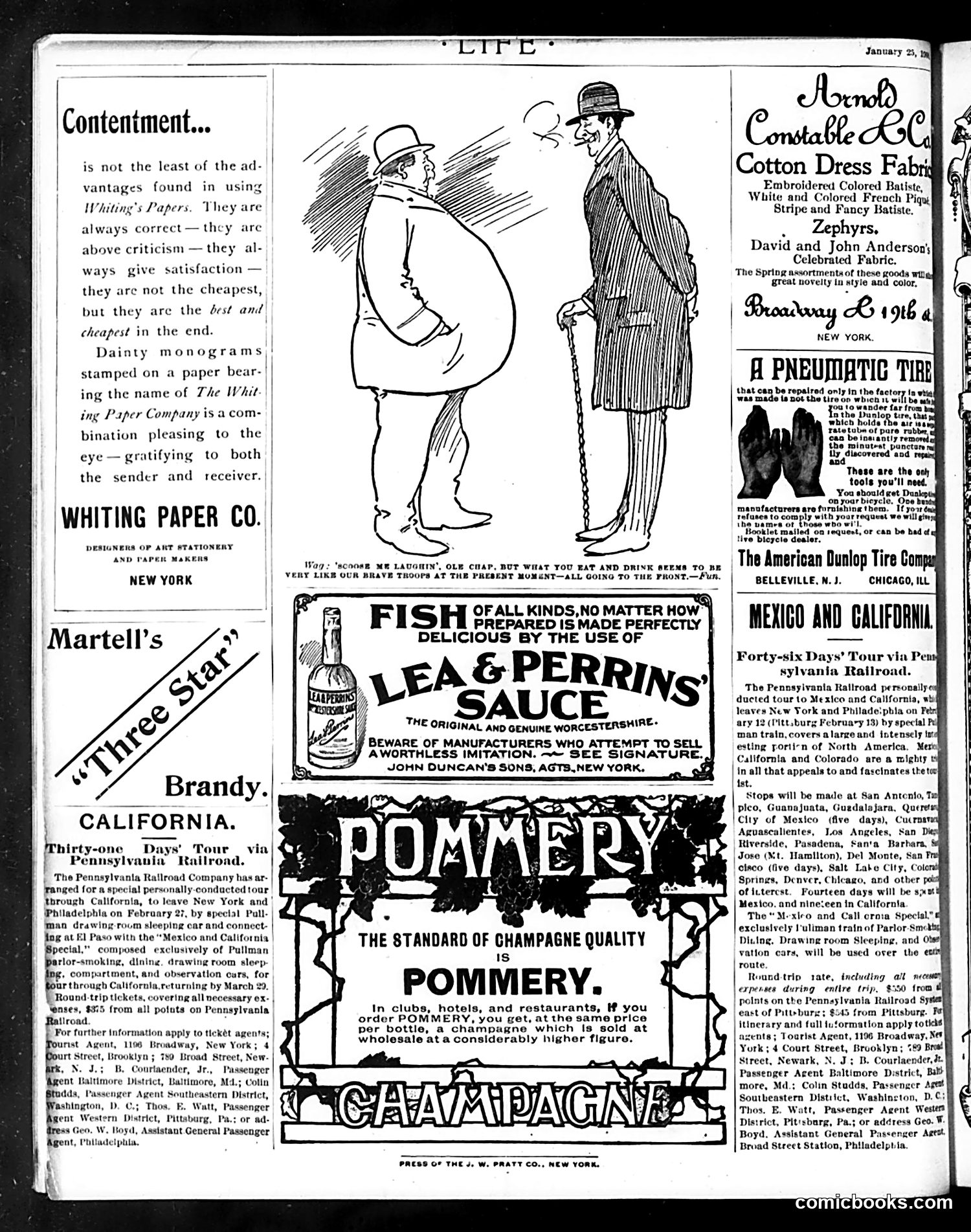
This is primarily an **advertising page** with one small cartoon, not a political commentary. The lone cartoon (captioned from "Fun" magazine) depicts two well-dressed men in conversation. The joke concerns **wartime rationing or shortages** (the caption references "what you eat and drink" resembling soldiers' rations "going to the front"). This suggests the page dates from WWI era, making sense given the "January 25" date visible in the header—likely 1916 or later. The page is otherwise dominated by **period advertisements** for luxury goods: Lea & Perrins sauce, Pommery champagne, cotton fabrics, railroad tours to California and Mexico, Dunlop tires, and Whiting stationery. The ads emphasize quality and exclusivity. The irony is subtle: while the cartoon jokes about wartime scarcity, surrounding ads hawk expensive luxuries—a typical Life magazine contrast between commentary and commerce.