
Life, 1900-01-25 · page 4 of 20
Life — January 25, 1900 — page 4: what you’re looking at
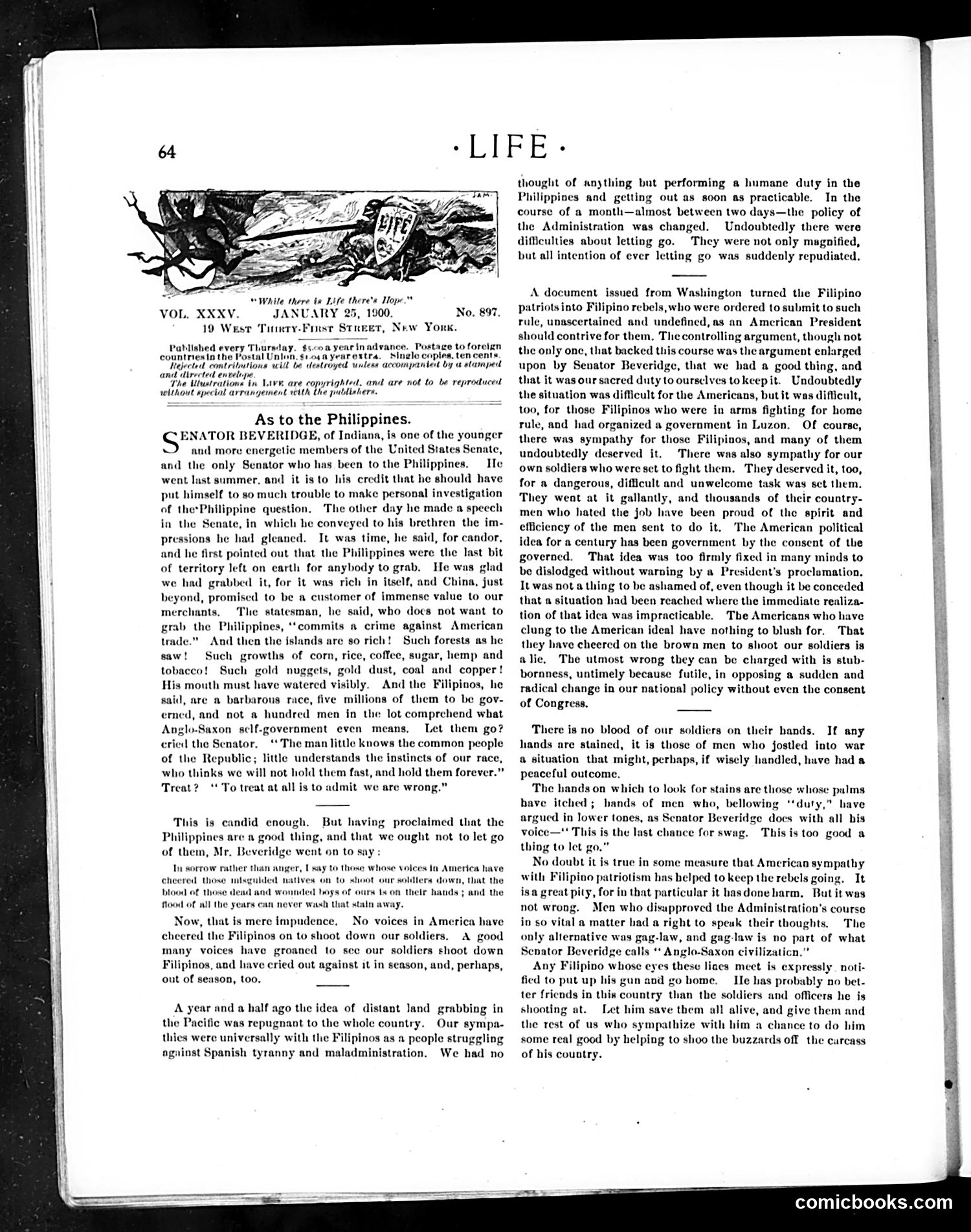
What you’re looking at
The cartoon titled **"While there is LIFE there's Hope"** depicts a skeletal or dying figure, likely representing the **Philippine-American conflict** of 1899-1900. The article "As to the Philippines" criticizes **Senator Beveridge**, who had recently returned from the Philippines advocating American control. The writer sarcastically quotes Beveridge's pro-imperial arguments about acquiring territory and resources ("hemp and coconuts"). The piece attacks American justifications for the occupation, arguing that Filipino rebels fighting for independence are being unfairly portrayed. It defends Filipino patriots while criticizing U.S. policy for suddenly abandoning earlier promises of independence—a shift the author finds morally indefensible. The satire targets American imperial ambitions masked as benevolent governance.
📄 Transcribed text from this page (OCR, searchable)
Machine-transcribed from the original scan — historical spelling and the odd misread are preserved.
Pablished every Thursda countries ia the Postal U Hejected contritutions wi anil directed envelupe ‘The illustrations in Lave are copyrighted. anit are not to be reproduce without speclal arrangement with the putlishers, ele copies, ten cents ompantet by a stamped eatroyed unless a As to the Philippines. S ENATOR BEVERIDGE, of Indiana, is one of the younger and more energetic members of the United States Senate, and the only Senator who has been to the Philippines. IIc went lust summer, and it isto his credit that he should have put himself to so much trouble to make personal investigation of the:Philippine question. The other day he made a speech in the Senate, in which he conveyed to his brethren the im- pressions he had gleaned. It was time, he said, for candor, and he first pointed out that the Philippines were the last bit of territory left on earth for anybody to grab. He was glad we had grabbed it, for it was rich in itself, and China, just beyond, promised to be a customer of immense value to our merchants, The statesman, he said, who docs not want to grab the Philippines, “commits a crime against American trade.” And then the islands are so rich! Such forests as he saw! Such growths of corn, rice, coffee, sugar, hemp and tobacco! Such gold nuggets, gold dust, coal and copper! His mouth must have watered visibly. And the Filipinos, he said, are a barbarous race, five millions of them to be gov- erncd, and not a hundred men in the lot comprehend what Anglo-Saxon self-government even means. Let them go? cricd the Senator, ‘ The man litle knows the common people of the Republic; little understands the instincts of our race, who thinks we will not hold them fast, and hold them forever.” Treat? ‘ To treat at all is to admit we are wrong.” This is candid enough, But having proclaimed that the Philippines are a good thing, and that we ought not to let go of them, Mr. Beveridge went on to sa: Tn sorrow rate: Tsay to thoxe whose volces in America have che 1 those to shoot our soldiers down, that the blood of th «1 boys of ours Ison thelr hands ; and the food of all the years can never wash that stain away. Now, that is mere impudence, No voices in America have cheered the Filipinos on to shoot down our soldiers. A good many voices have groaned to sce our soldiers shoot down Filipinos, and have cried out against it in season, and, perhaps, out of season, too. A year and a half ago the idea of distant land grabbing in the Pacific was repugnant to the whole country. Our sympa- thies were universally with the Filipinos as a people struggling against Spanish tyranny and maladministration. We had no «LIPE - ight of anything but performing a humane duty in the pines and getting out as soon as practicable. In the course of a month—almost between two days—the policy of the Administration was changed. Undoubtedly there were diMculties about letting go. They were not only magnified, but all intention of ever letting go was suddenly repudiated. A document issued from Washington turned the Filipino patriots into Filipino rebels, who were ordered to submit to such rule, unascertained and undefined,as an Amcrican President should contrive for them. The controlling argument, though not the only one, that backed this course was the argument enlarged upon by Senator Beveridge, that we had a good thing, and that it was our sacred duty to ourselves tokeepit. Undoubtedly the situation was difficult for the Americans, but it was difficult, too, for those Filipinos who were in arms fighting for home rule, and had organized a government in Luzon. Of course, there was sympathy for those Filipinos, and many of them undoubtedly deserved it. There was also sympathy for our own soldiers who were set to fight them. They deserved it, too, for a dangerous, difficult and unwelcome task was sect them. They went at it gallantly, and thousands of their country- men who hated the job have been proud of the spirit and efficiency of the men sent to do it, The American political idea for a century has been government by the consent of the governed, That idea wus too firmly fixed in many minds to be dislodged without warning by a President’s proclamation. It was not a thing to be ashamed of, even though it be conceded that a situation had been reached where the immediate realiza- tion of that idea was impracticable. Tbe Americans who have clung to the American ideal have nothing to blush for. That they have cheercd on the brown men to shoot our soldiers is alic, The utmost wrong they can be charged with is stub- bornness, untimely because futile, in opposing a sudden and radical change in our national policy without even the consent of Congress, There is no blood of our soldiers on their hands. If any hands are stained, it is those of men who jostled into war a situation that might, perhaps, if wisely handled, huve had a peaceful outcome. The hands on which to look for stains are those whose palms have itched; hands of men who, bellowing ‘duty,” have argued in lower tones, as Senator Beveridge docs with all bis voice—"* This is the last chance for swag. This is too good a thing to let go.” No doubt it is true in some measure that American sympathy with Filipino patriotism has helped to keep the rebels going, It isa great pity, for in that particular it hasdone harm, But it was not wrong. Men who disapproved the Administration's course in so vital a matter had a right to speuk their thoughts. The only allernative was gag-law, and gag-law is no part of what Senator Beveridge calls ‘* Anglo-Saxon civilizaticn.”” Any Filipino whose eyes these lines meet is expressly. noti- fied to put up his gun and go home. He has probably no bet- ter friends in this country than the soldiers and officers he is shooting at. Let him save them all alive, and give them and the rest of us who sympathize with him a chance to do him some real good by helping to shoo the buzzards off the carcass of his country. comicbooks.com