
A complete issue · 20 pages · 1899
Life — March 9, 1899
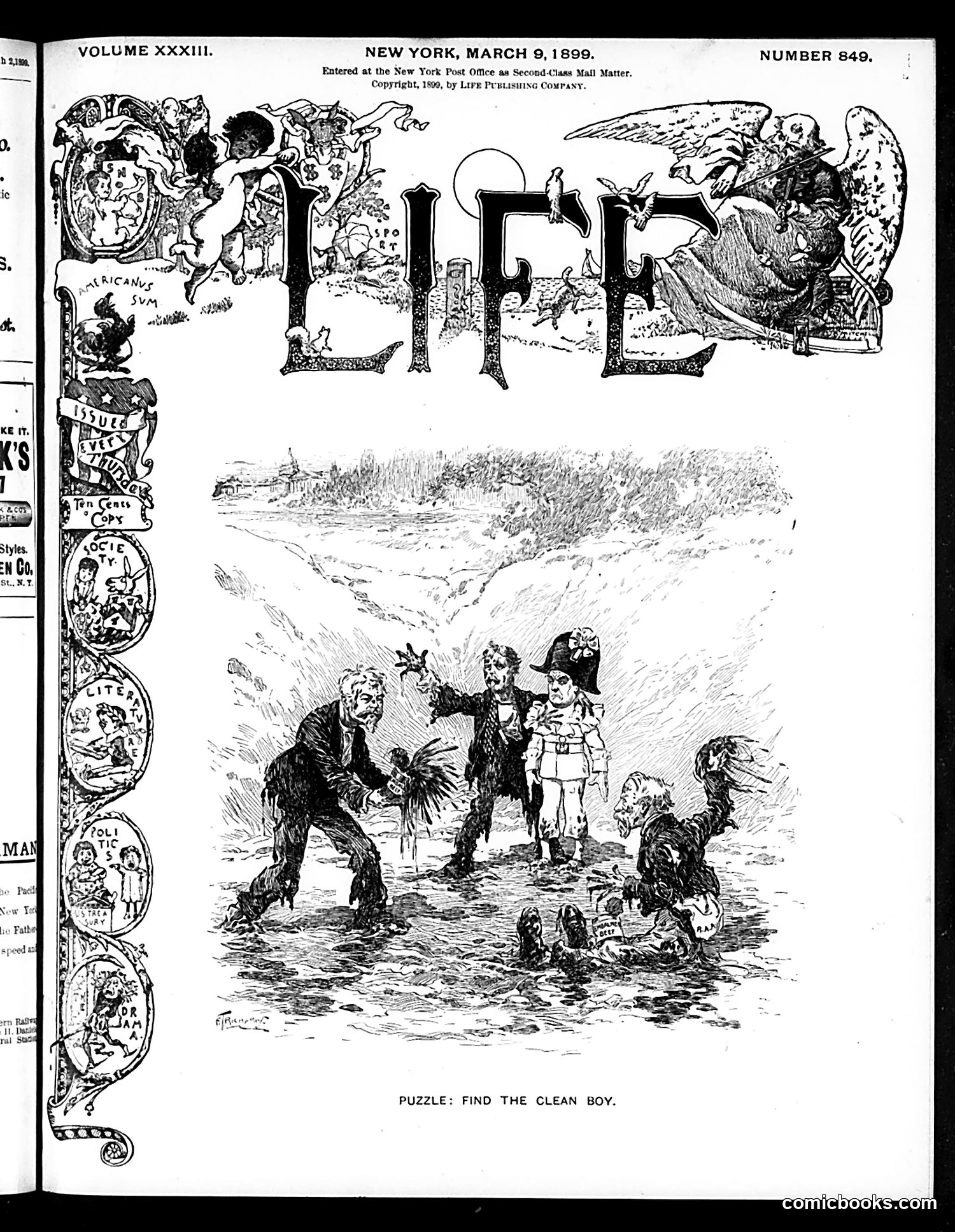
This page features a puzzle cartoon titled "Find the Clean Boy." The illustration depicts a muddy scene where several figures—adults and children—are wading or playing in water and mud. The joke appears to be a visual puzzle challenging readers to identify which child, if any, remains clean despite the muddy environment. The satirical humor likely comments on childhood behavior and cleanliness standards of the Victorian era, when maintaining proper appearance was considered important. The exaggerated dirt and chaotic scene mock both children's inevitable messiness and perhaps adult expectations of maintaining pristine conditions—a relatable domestic humor for Life's middle-class readership in 1899.
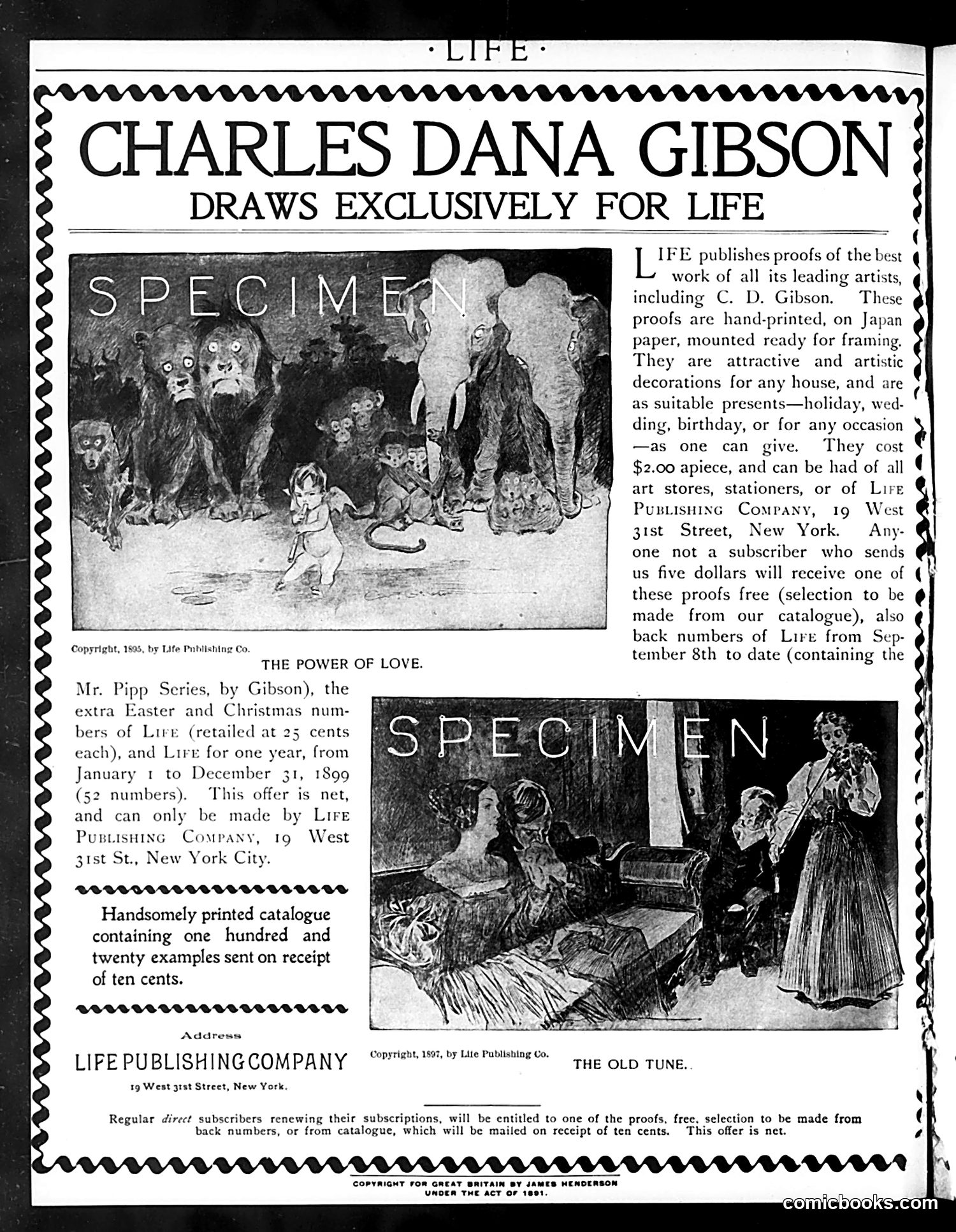
This is primarily **advertising copy** promoting Charles Dana Gibson's artwork and Life Publishing Company's offerings, rather than political satire. The two illustrations labeled "SPECIMEN" showcase Gibson's distinctive drawing style. "The Power of Love" depicts animals and figures in a domestic scene; "The Old Tune" shows what appears to be a social/domestic interior scene with figures in period dress. The text advertises: - Art proofs ($2 each) hand-printed on Japan paper, suitable as gifts - A subscription offer providing free proofs to non-subscribers sending $5 - The "Mr. Pipp Series" by Gibson (Easter/Christmas issues) - A catalog containing 120 examples for ten cents **The "satire" here is commercial rather than political**—the page markets Gibson's popular illustrative work to consumers as both art and gifts.
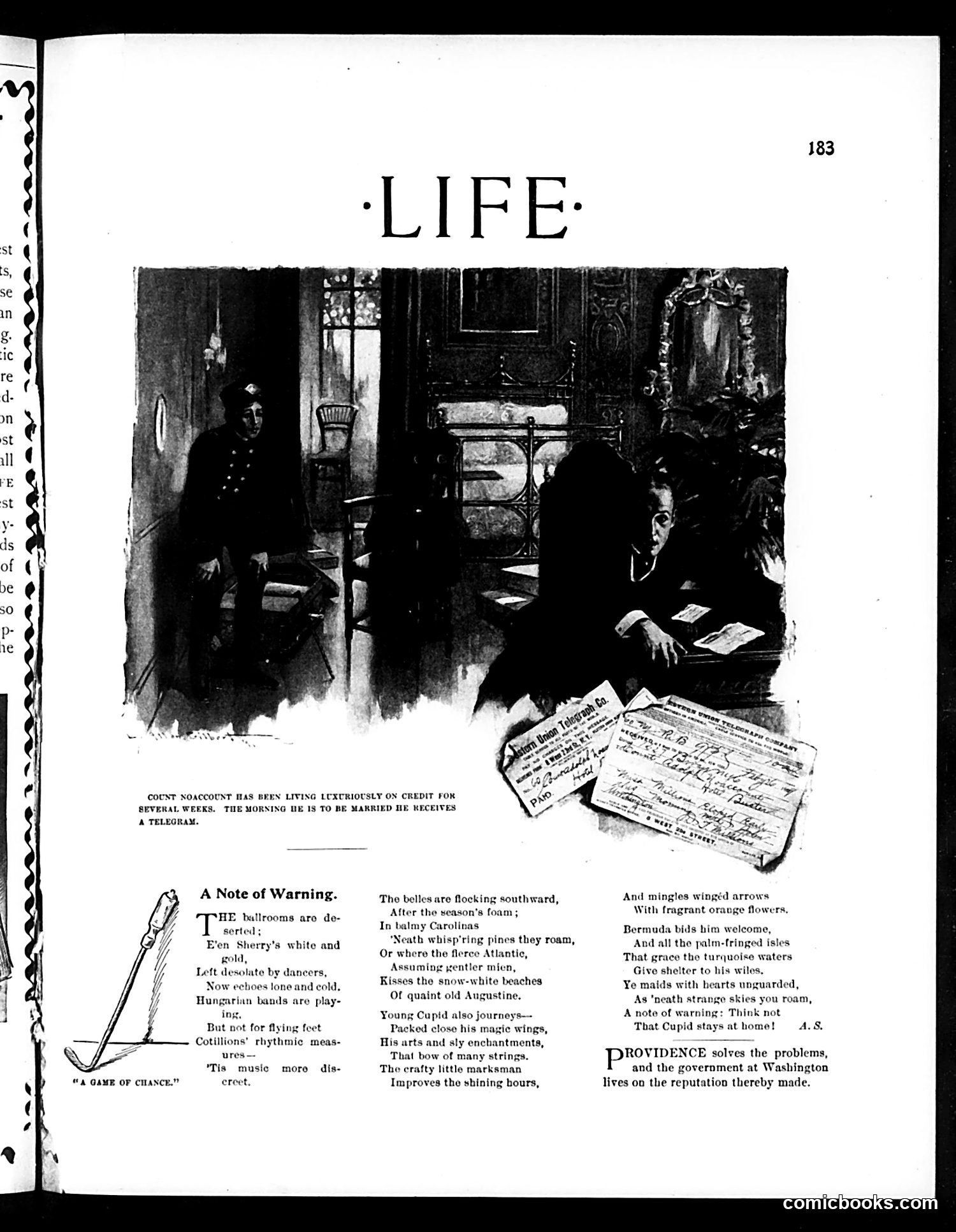
**Main Illustration:** Shows a domestic scene where a count appears to be living luxuriously on credit. The caption states: "Count Noaccount has been living luxuriously on credit for several weeks. The morning he is to be married he receives a telegram." This satirizes European nobility who live beyond their means on borrowed money, with the implication that marriage (possibly for financial reasons) disrupts their precarious situation. **"A Note of Warning"** poem references seasonal migration ("belles are flocking southward") and includes romantic/cautionary themes about young people and Cupid. **Bottom section** mentions Providence and government reputation at Washington, though context is unclear. The page primarily mocks aristocratic financial irresponsibility—a common satirical target in Gilded Age American humor.
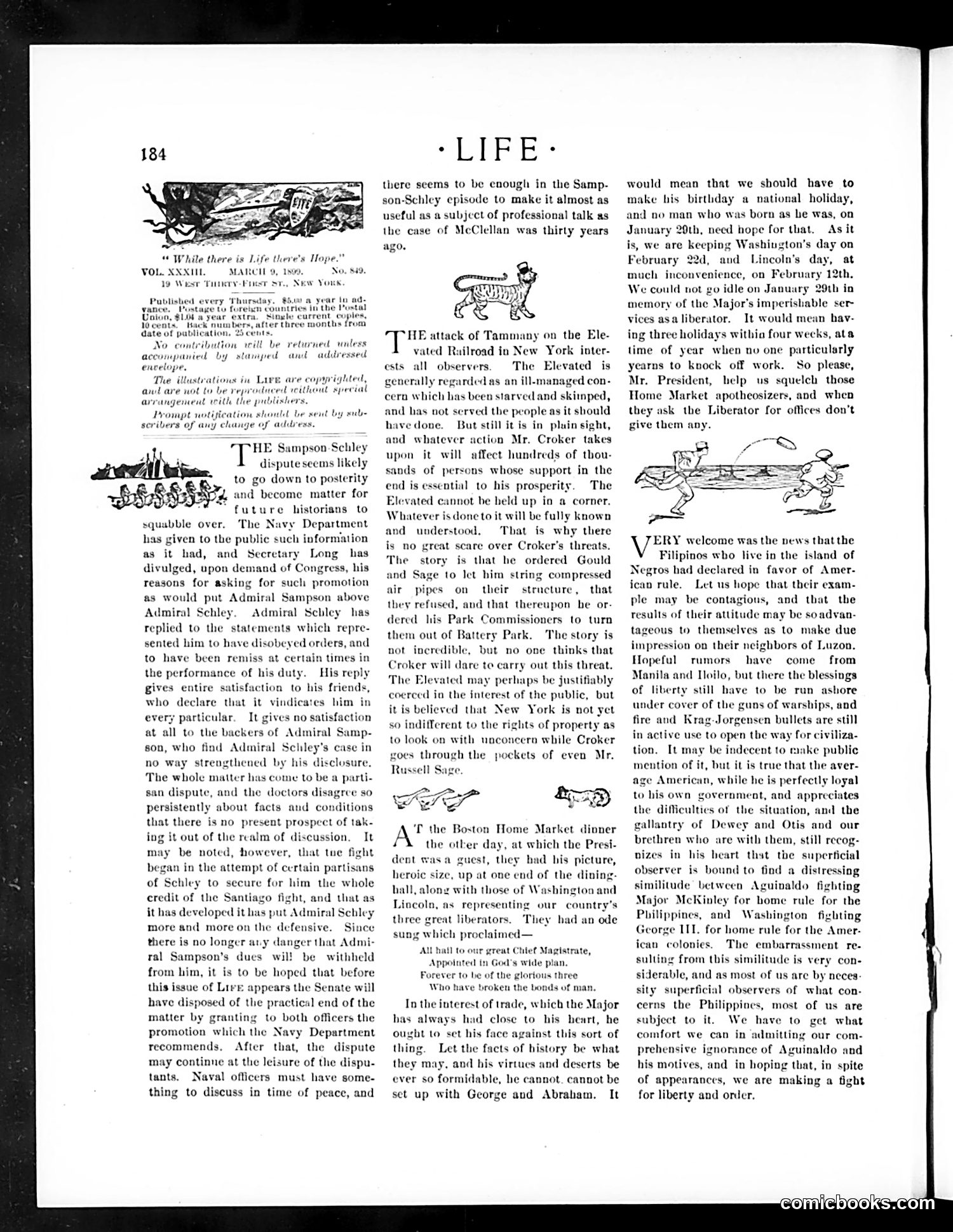
This page discusses contemporary political controversies circa 1900. The main article addresses **Admiral Sampson and the Sampson-Schley dispute**—a naval controversy over credit for victories in the Spanish-American War. Schley allegedly threatened to resign if not properly credited. The text also covers **the Elevated Railroad in New York**, critiquing its poor management and neglect of passengers, with concerns about Mr. Croker's threats affecting the system's future. A third section mentions a **Boston Home Market dinner** where portraits of Washington and Lincoln were displayed, with commentary on American patriotism and comparing the Philippines situation to historical governance. The small illustrations appear to be decorative vignettes rather than pointed political cartoons. This is primarily a news-commentary page rather than satirical cartooning.
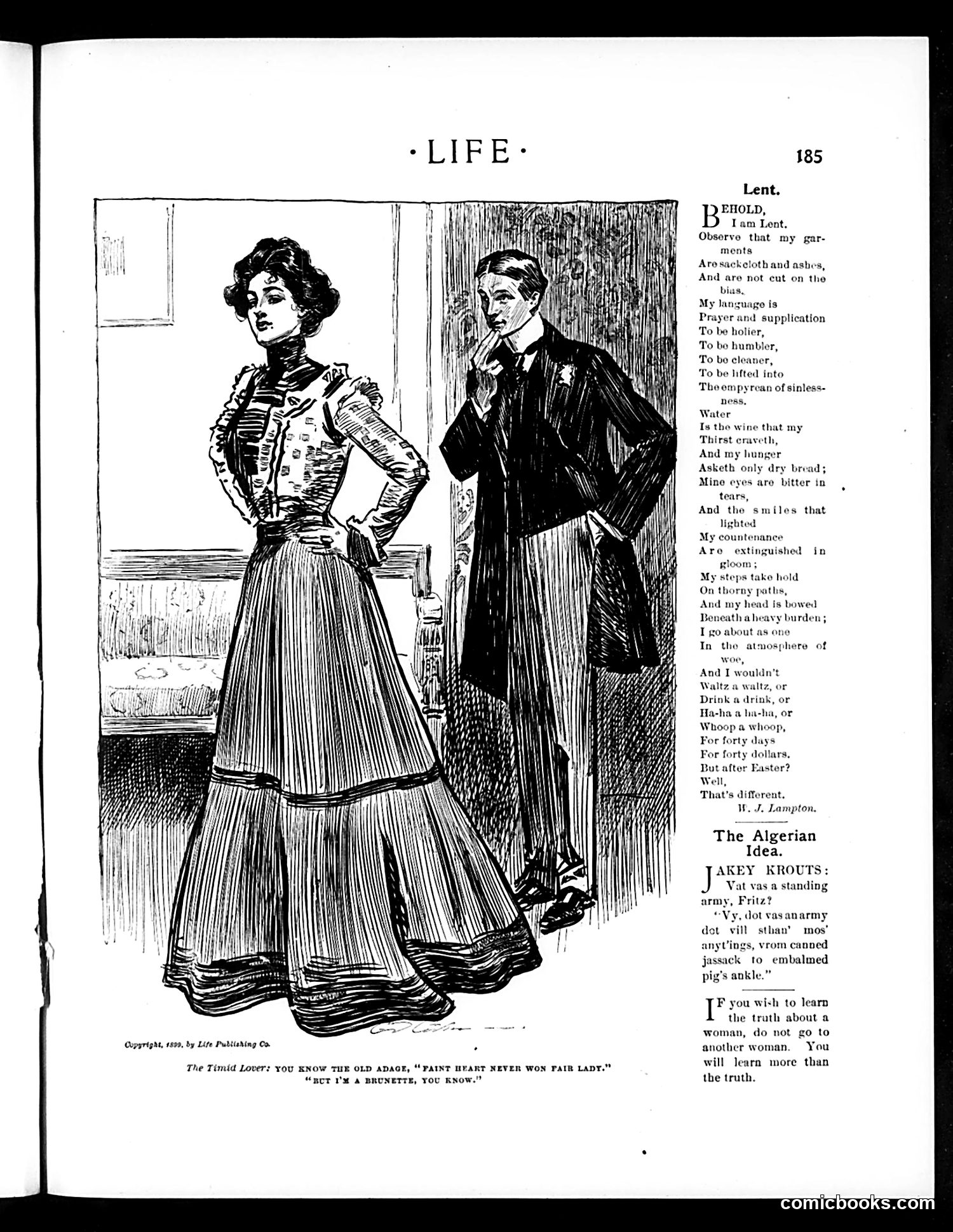
The main illustration depicts two figures in what appears to be a domestic confrontation. The caption reads: "The Timid Lover: you know the old adage, 'Paint Heart Never Won Fair Lady.' 'But I'm a Brunette, you know.'" This is a flirtation-themed cartoon playing on the contrast between the traditional saying and the woman's self-identification as a brunette. The joke appears to suggest that brunettes (stereotyped as bolder or more assertive) don't need the courting tactics implied by "faint heart." The page also includes poetry titled "Lent" and a piece called "The Algerian Idea" featuring dialogue between characters named Behold and Jakey Krouts, though the specific satirical context of these pieces is unclear from the visible text alone.
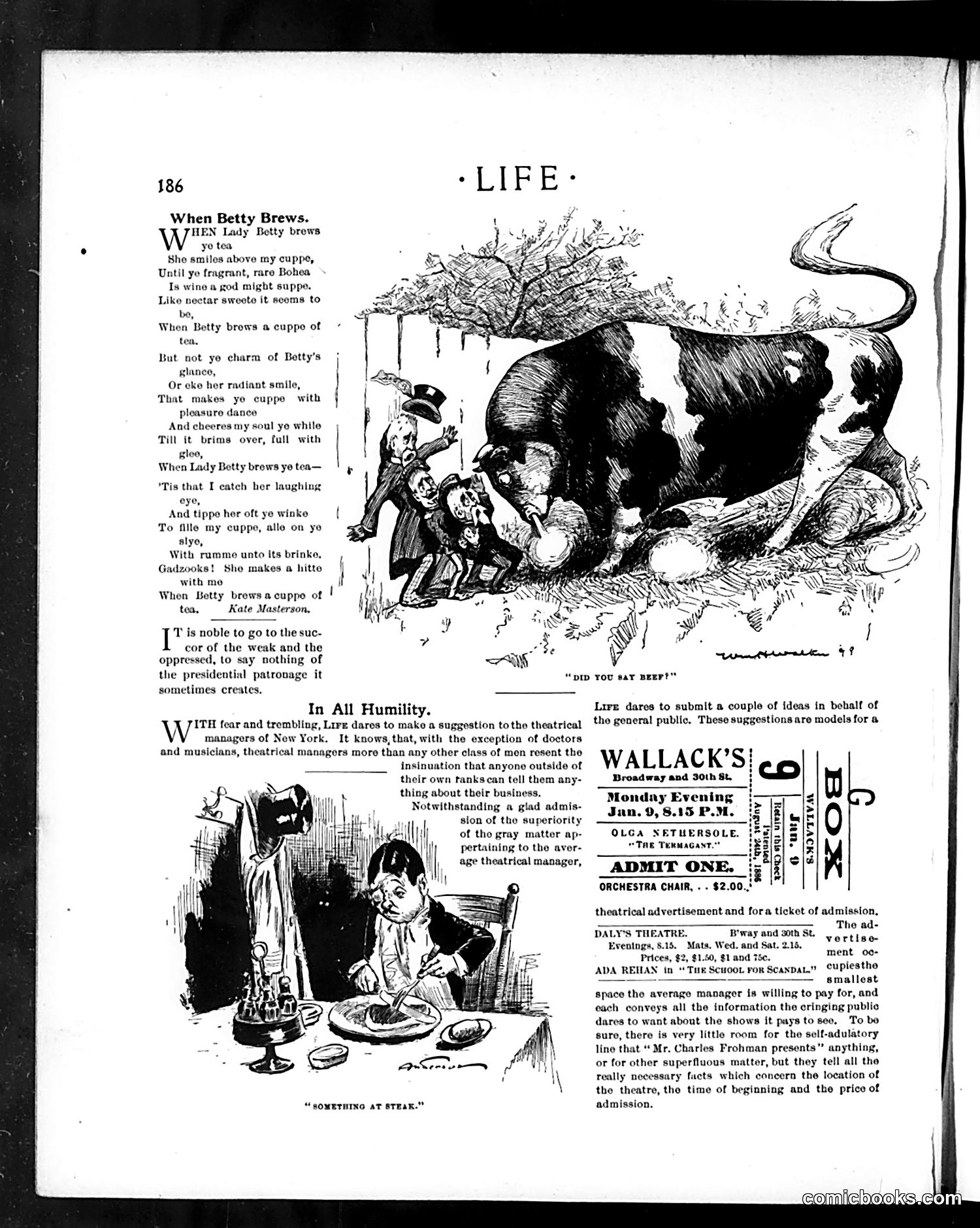
**Top Cartoon ("Did You Say Beer?"):** A large cow is being milked by two small figures. The satirical point plays on the phrase "beer" sounding like the cow's sound, creating a visual pun. This likely references Prohibition-era anxieties about milk as a substitute for alcohol, mocking the absurdity of such replacements. **Bottom Cartoon ("Something at Steak"):** Shows a formal dinner scene with a waiter presenting food to diners. The title puns on "stake" versus "steak," suggesting uncertainty or risk in dining choices—possibly satirizing restaurant quality or pricing concerns. **Lower Section:** Contains theater advertisements (Wallack's, Daly's Theatre, Ada Rehan) and editorial commentary about theatrical managers' reluctance to discuss their business publicly, presented as a humorous social observation about professional secrecy in entertainment.
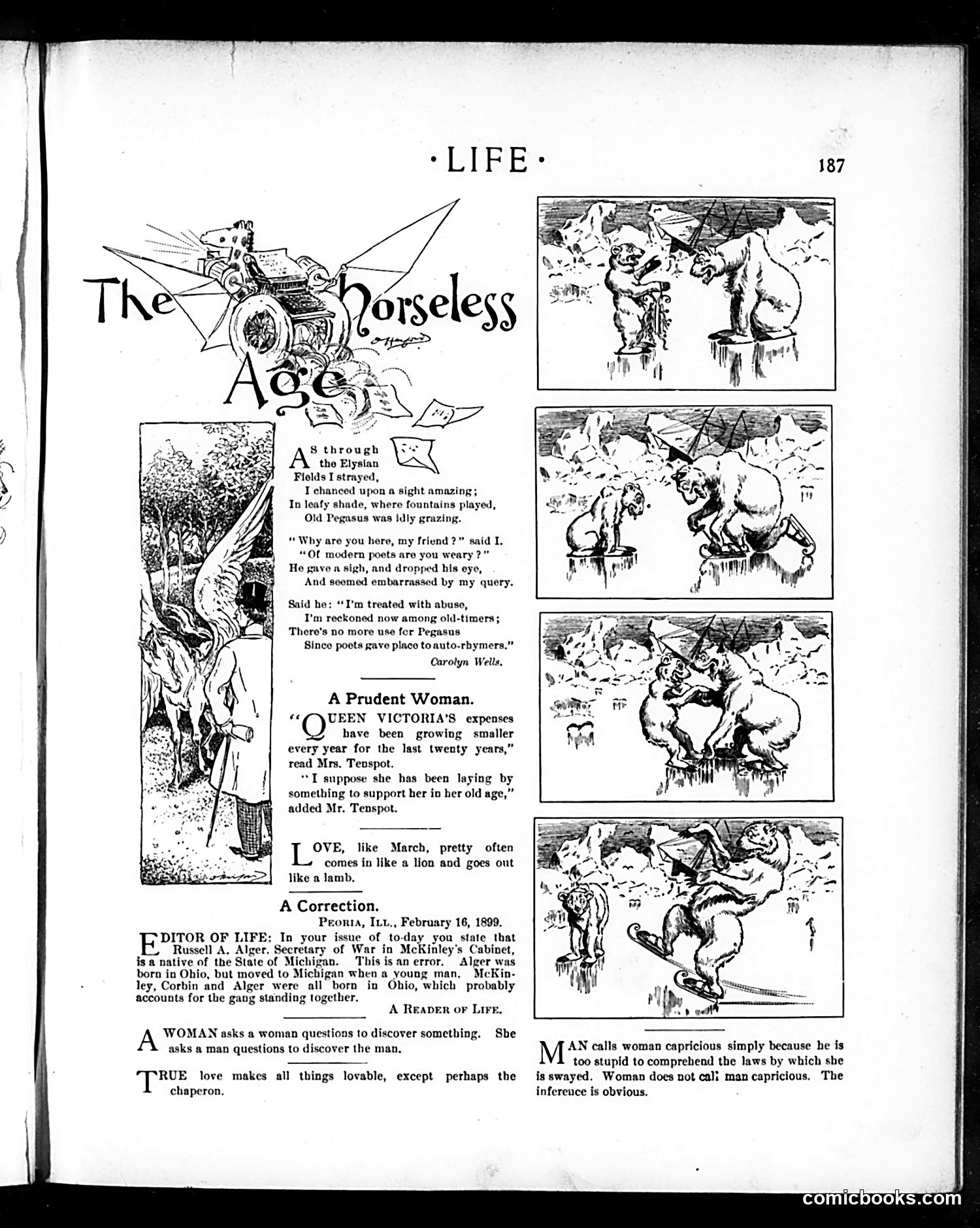
This page satirizes the emerging automobile era through several pieces: **Main cartoon**: "The Horseless Age" depicts Pegasus (the mythical winged horse) as obsolete, displaced by motorized transportation. The accompanying poem by Carolyn Wells laments that poets now have "no more use for Pegasus / Since poets gay a place to auto-rhymers." **Comic strip** (right): Shows bears repeatedly attempting to operate or ride in automobiles, humorously suggesting that even animals are adopting this new technology. **Below**: Brief satirical quotes mock contemporary society—one about women's expenses, another about love's unpredictability. The overall message: the automobile is rapidly replacing traditional horse-based transportation and culture, making even classical mythology obsolete. This reflects early 1900s anxiety about technological disruption.
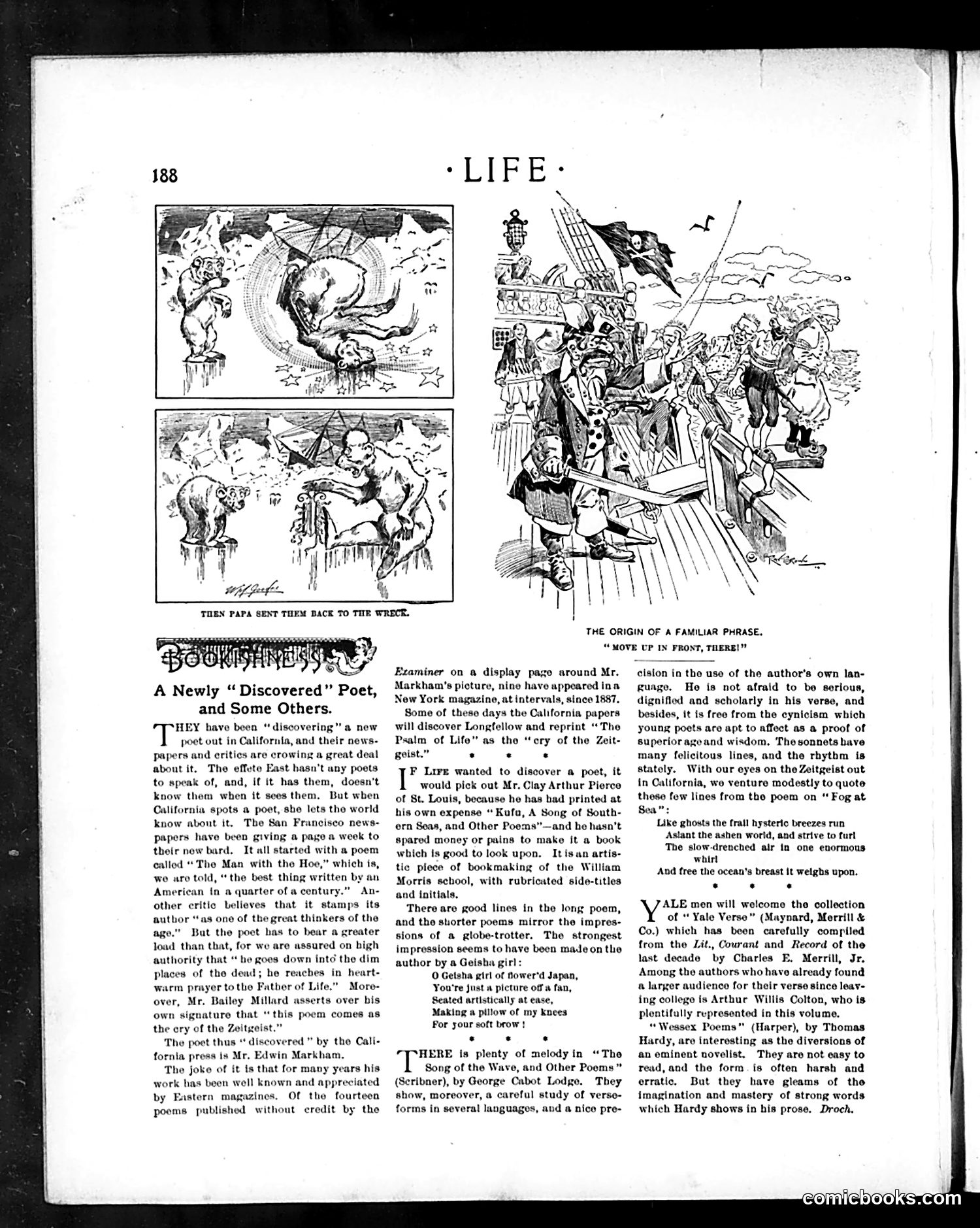
The right-side cartoon depicts a chaotic ship scene with sailors and passengers, illustrating the phrase "Move up in front, there!" The caption suggests this is meant to explain the origin of a common expression—implying it originated from sailors crowding together on ship decks. The left-side illustrations appear to be unrelated satirical drawings, likely depicting acrobatic or circus performers. The text below discusses "newly discovered" poets in California and literary collections, mentioning Clay Arthur Pierce and George Cabot Lodge. This appears to be a literary criticism section rather than political satire. The page primarily concerns 19th-century American poetry and publishing rather than political commentary.
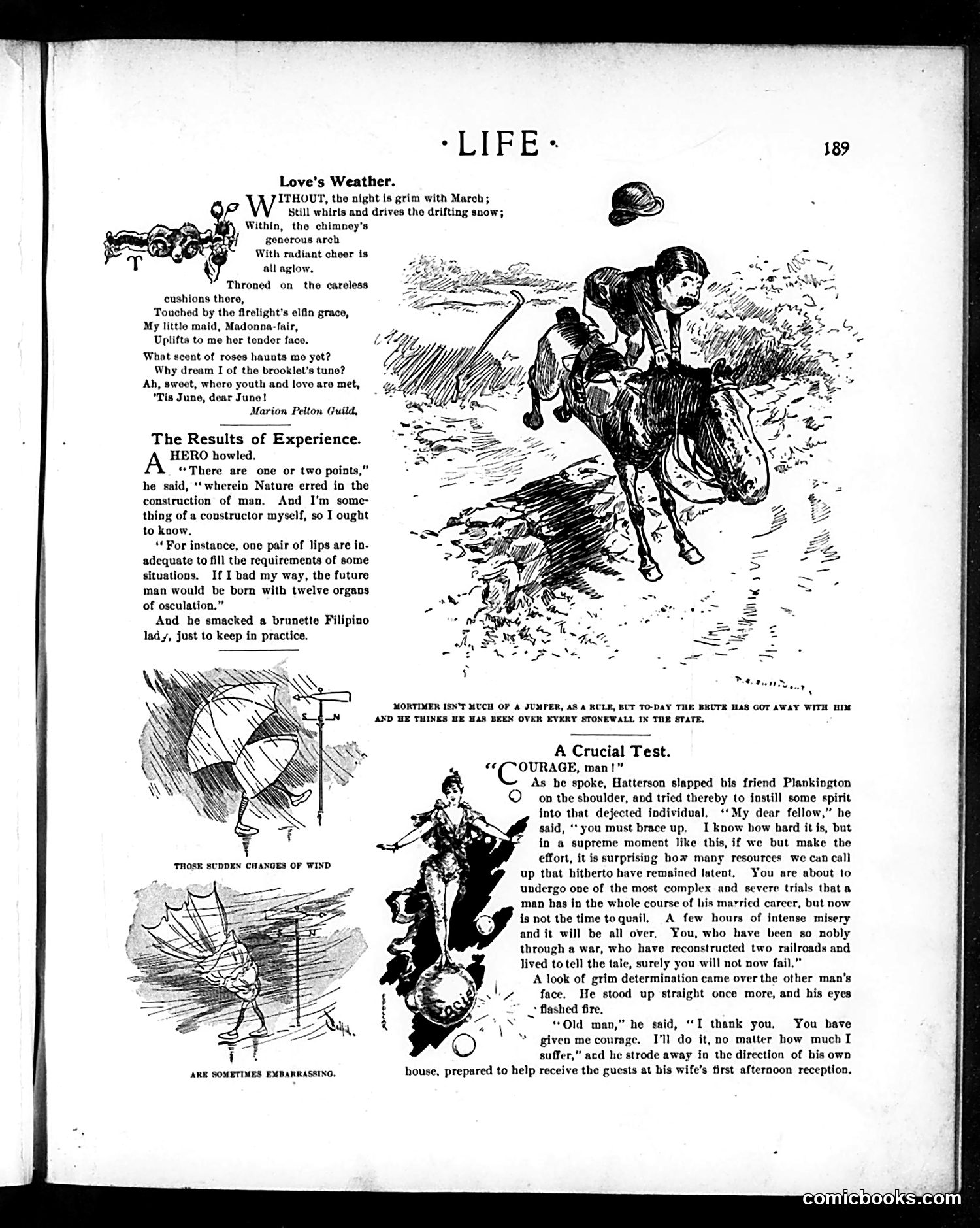
This page contains three separate pieces of humorous content: 1. **"Love's Weather"** — A romantic poem by Marion Felton Gulld about a couple meeting in spring weather, illustrated with a sketch of young lovers outdoors. 2. **"The Results of Experience"** — A brief satirical story where a character named Hero describes flaws in human design (specifically inadequate lips), illustrated with humorous sketches about wind and embarrassment. 3. **"A Crucial Test"** — A narrative about a man named Hatterson receiving encouragement from a friend before what appears to be a significant social trial—specifically preparing to help receive guests at his wife's first afternoon reception. The satire mocks social anxiety around formal entertaining. The illustrations are typical period ink drawings accompanying light social satire focused on romance, human nature, and Victorian-era social conventions.
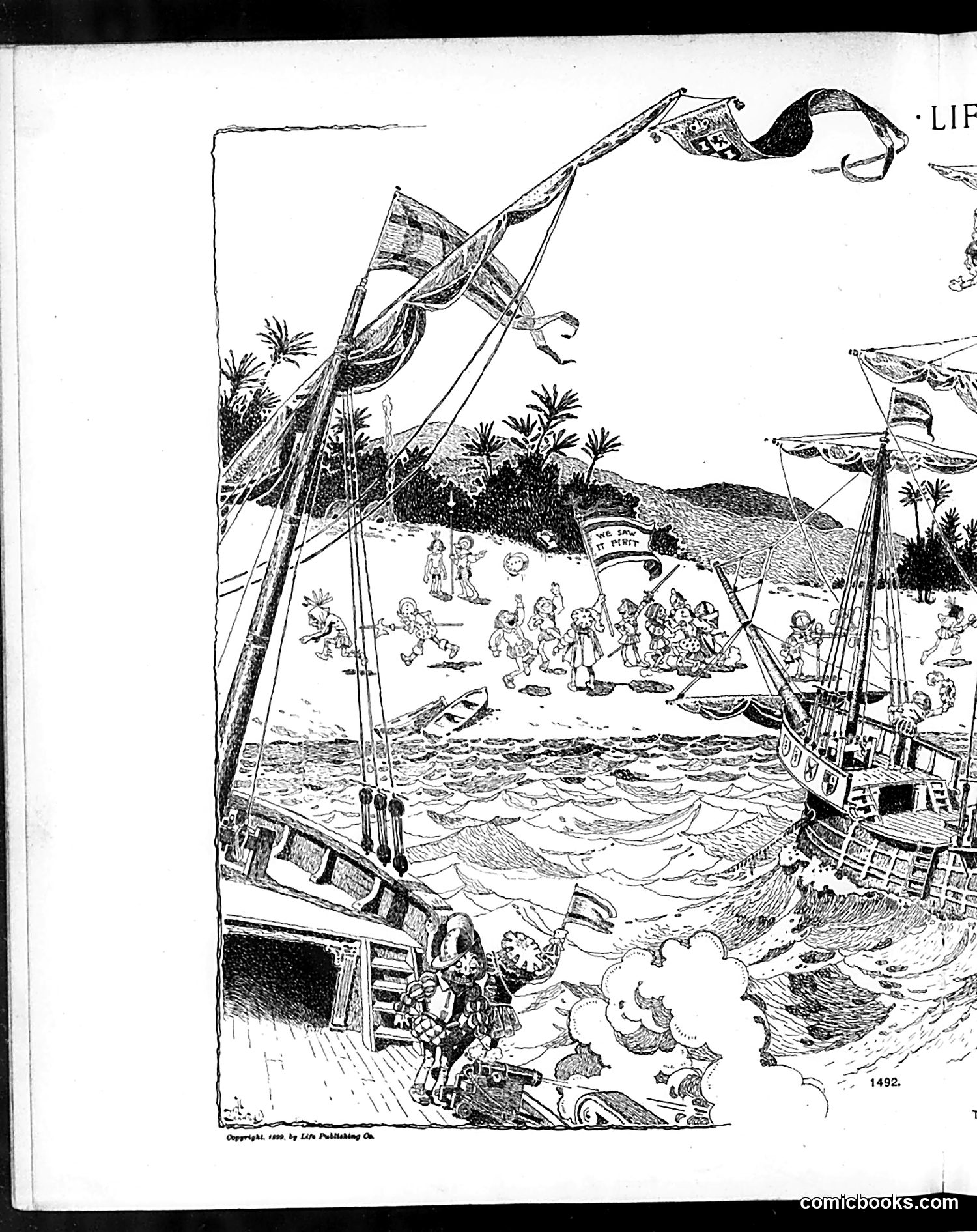
This appears to be a satirical illustration from Life magazine (copyright 1899, per the footer) depicting a colonial encounter scene. The image shows European ships arriving at a tropical shore with palm trees, while indigenous people gather on the beach. Figures in the foreground appear to be European colonizers or traders, possibly engaged in commercial or diplomatic exchange. The satire likely critiques European colonialism and the "civilizing mission" narrative—presenting the arrival of Western ships and traders as a dramatic, consequential moment while depicting indigenous populations as passive observers. The elaborate sailing ships and tropical setting suggest this references historical colonial expansion, though without visible text identifying specific figures or events, the exact historical reference remains unclear.
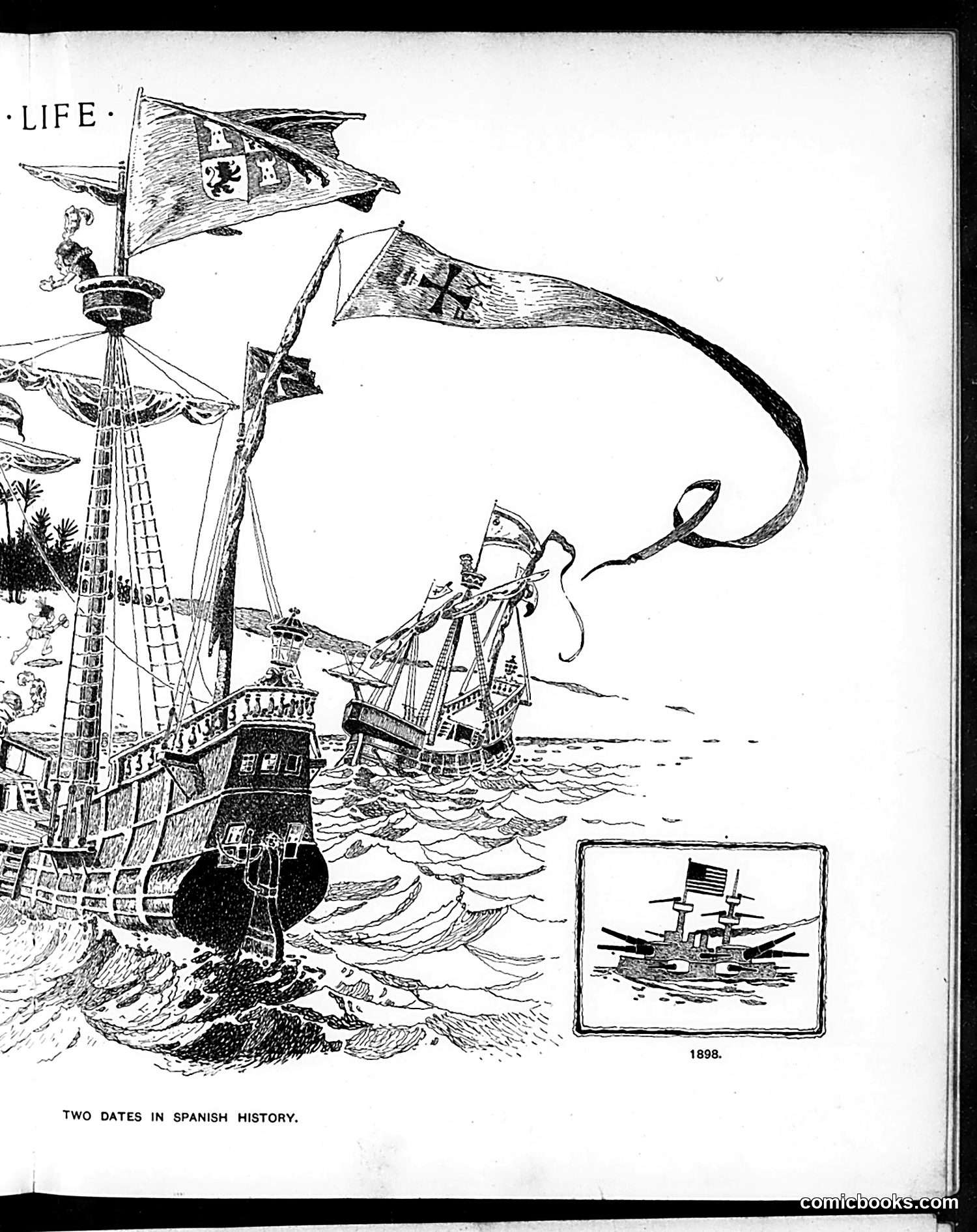
This satirical illustration from *Life* magazine contrasts two pivotal moments in Spanish naval history. The large left image depicts a Spanish galleon from the Age of Exploration—representing Spain's former maritime glory and imperial power. The small inset labeled "1898" shows a modern warship, likely representing the Spanish-American War. The satire's point is clear: Spain's naval dominance has dramatically declined. Once commanding vast ocean-going fleets that projected imperial power globally, Spain by 1898 possessed a comparatively diminished navy. The Spanish-American War of 1898 further demonstrated this decline—Spain lost colonies including Cuba, Puerto Rico, and the Philippines, marking the effective end of its empire. The contrast emphasizes Spain's fall from superpower to declining regional power.
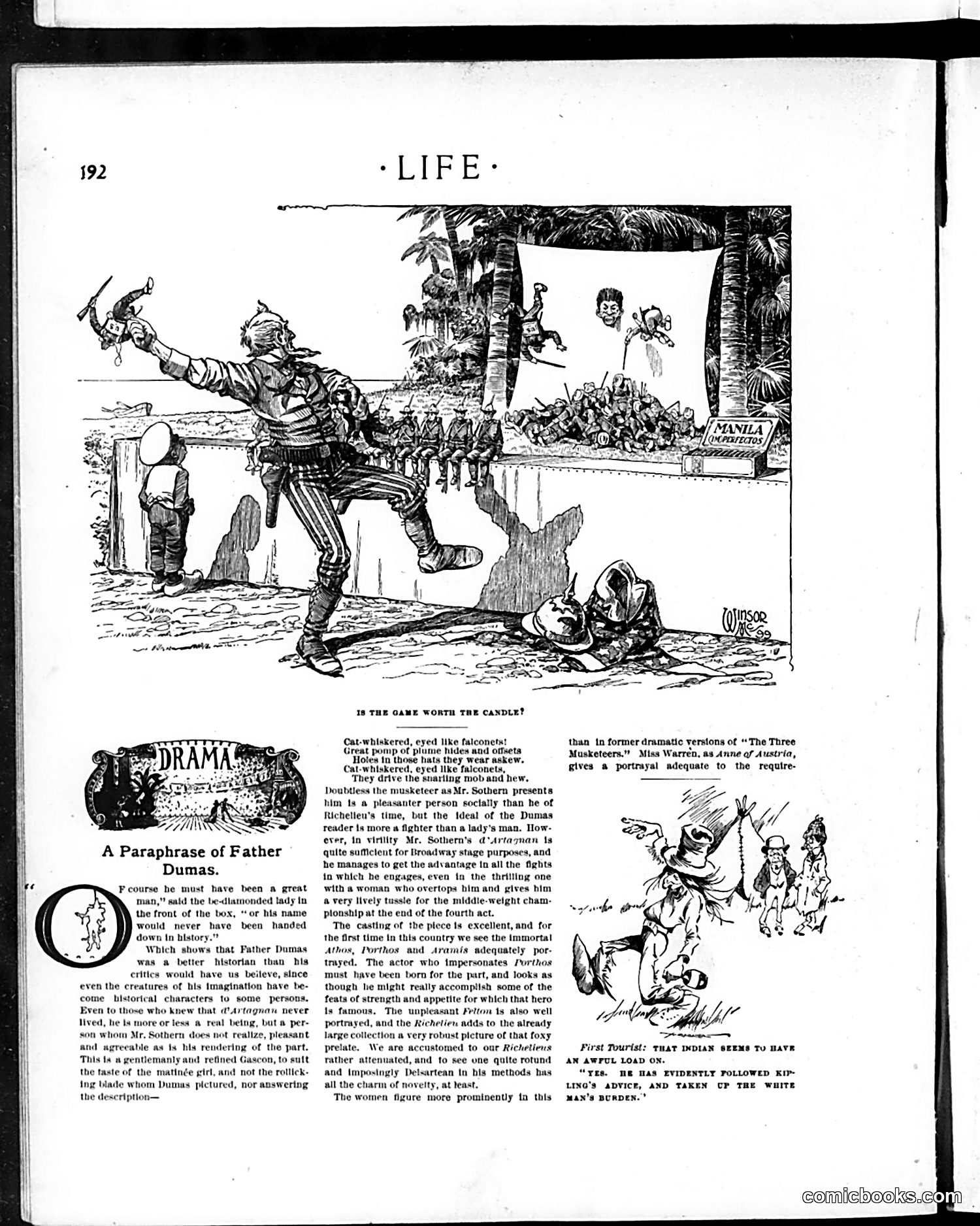
The main cartoon depicts a theatrical scene titled "Is the Game Worth the Candle?" showing an actor in period costume performing what appears to be a dramatic duel or combat scene on stage. The illustration critiques a theatrical production, likely a dramatization of Alexandre Dumas' work (referenced in the article "A Paraphrase of Father Dumas"). The accompanying article discusses the casting and performance quality of a stage adaptation, praising the musketeer character but critiquing other performances as overly theatrical or poorly executed. The satire targets both the production's artistic choices and actors' interpretive decisions. The smaller cartoon on the right, captioned "First Turret! That Indian Seems to Have an Awful Load On," appears to be a separate humor piece about colonial or military themes. The page satirizes Broadway theatrical productions and acting quality of the era.
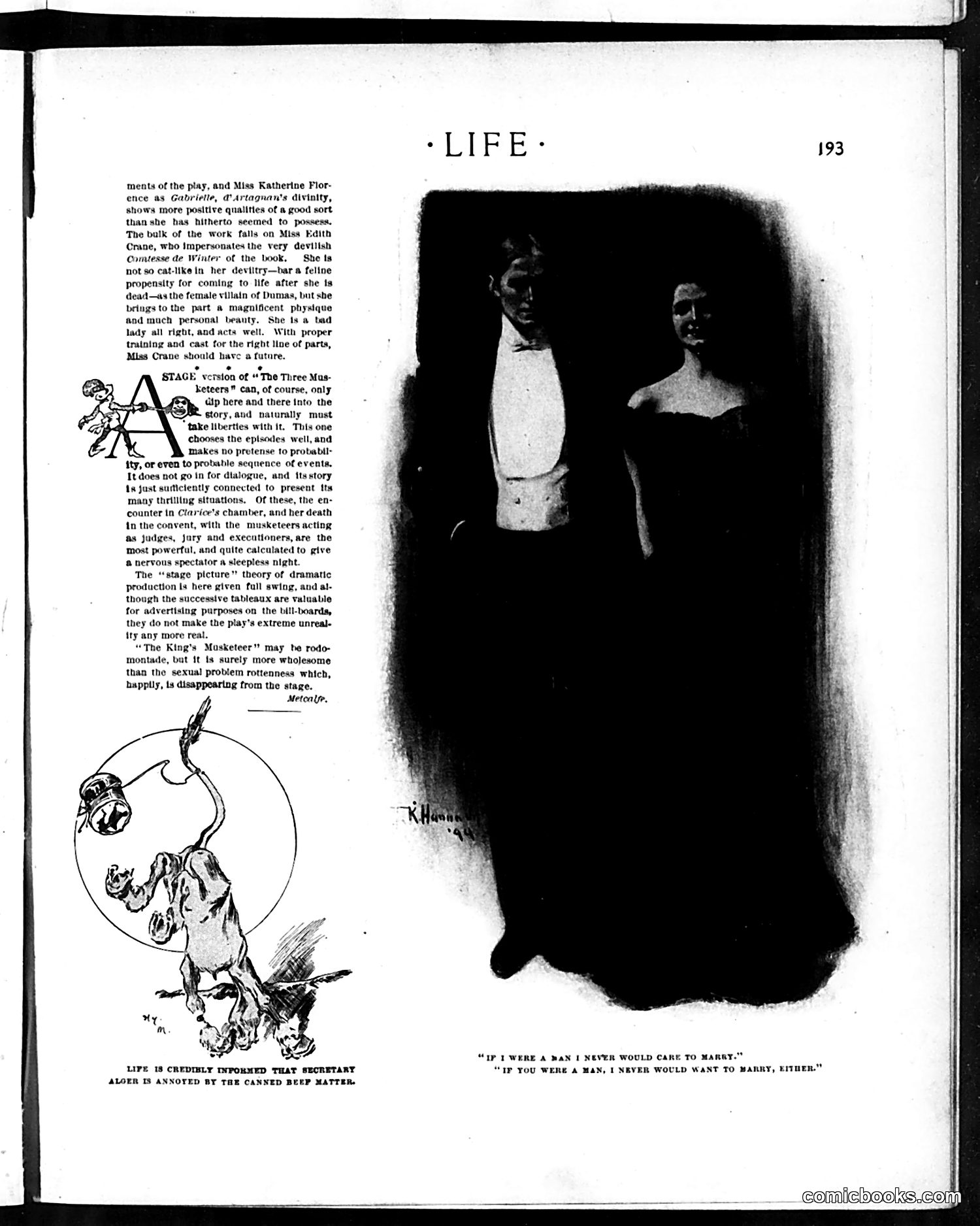
This page reviews a stage adaptation of *The Three Musketeers*, praising the production's visual spectacle while critiquing its theatrical liberties with Dumas's novel. The critic (Metcalf) particularly commends actress Edith Crane's portrayal of the villainous Comtesse de Winter, though notes she lacks the original character's cat-like cunning. The review acknowledges the play prioritizes dramatic "picture theory" (visual tableaux for advertising) over narrative coherence or realism. The bottom cartoon satirizes Secretary Algir (unclear which Secretary), mocking his annoyance at "canned beef" matters through dialogue suggesting masculine incompatibility with marriage—a gendered jab at bureaucratic ineffectiveness. The accompanying illustration depicting tangled figures appears to reinforce this critique of administrative confusion.
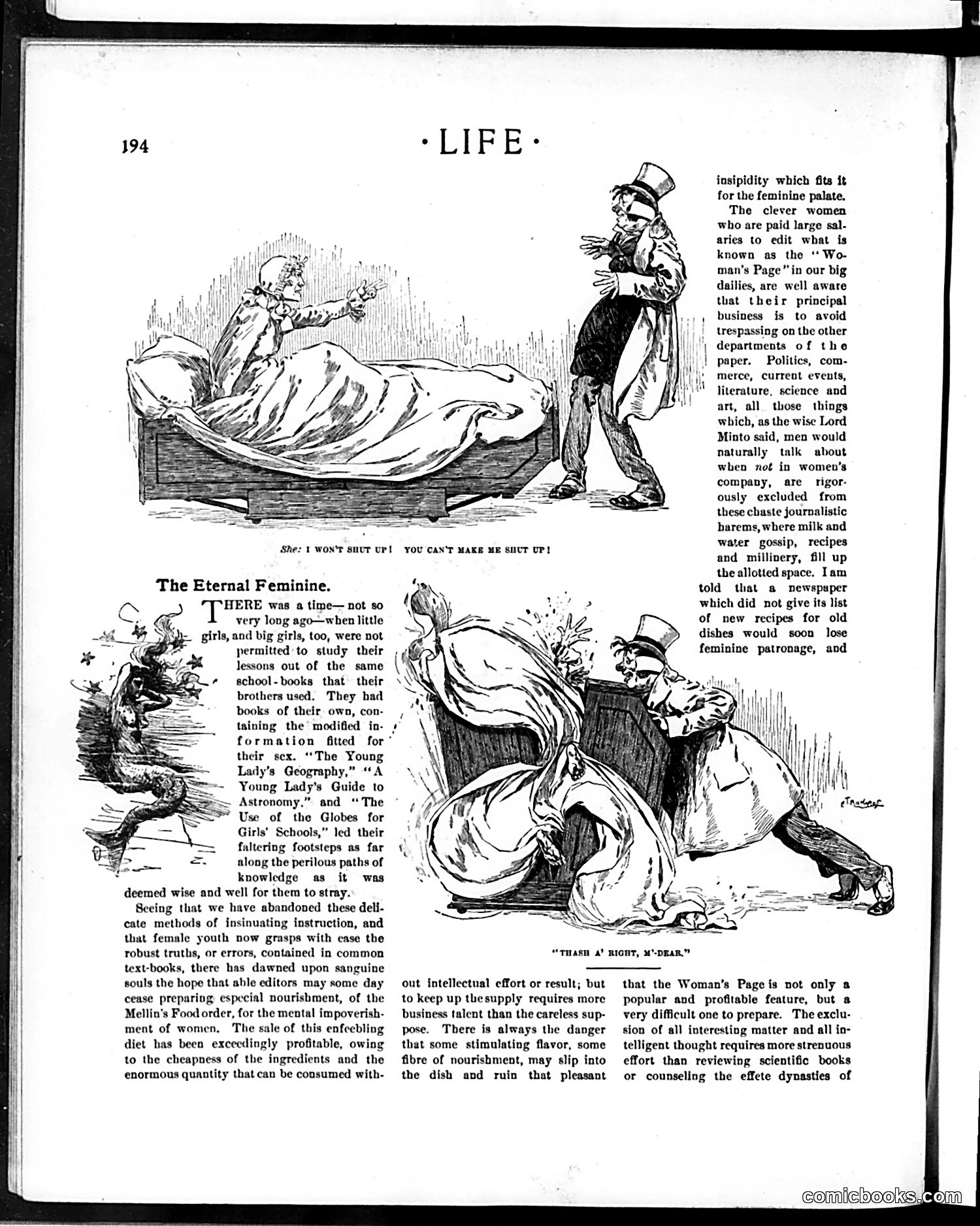
This article satirizes the restrictive "Women's Pages" in major newspapers and the broader condescension toward female intellect in the late 19th/early 20th century. **The cartoons** show a woman insisting "I won't shut up!" to a man demanding silence—illustrating the tension between women's growing education and their enforced exclusion from serious discourse. **The satire's targets:** - Historically, girls received deliberately dumbed-down textbooks ("Young Lady's Geography") - Newspapers now exclude women from politics, literature, science, and current events - "Woman's Pages" contain only recipes, gossip, and fashion—treated as intellectually "safe" content - Female editors are complicit, deliberately avoiding substantive material to maintain feminine "insipidity" **The bitter joke:** Preparing such vapid content requires *more* effort than serious journalism—yet this intellectual suppression is profitable and popular. The piece critiques both institutional sexism and women's internalized acceptance of intellectual limitation, using the metaphor of "Mellin's Food" (infant formula) to mock the "mental impoverishment" being fed to women readers.
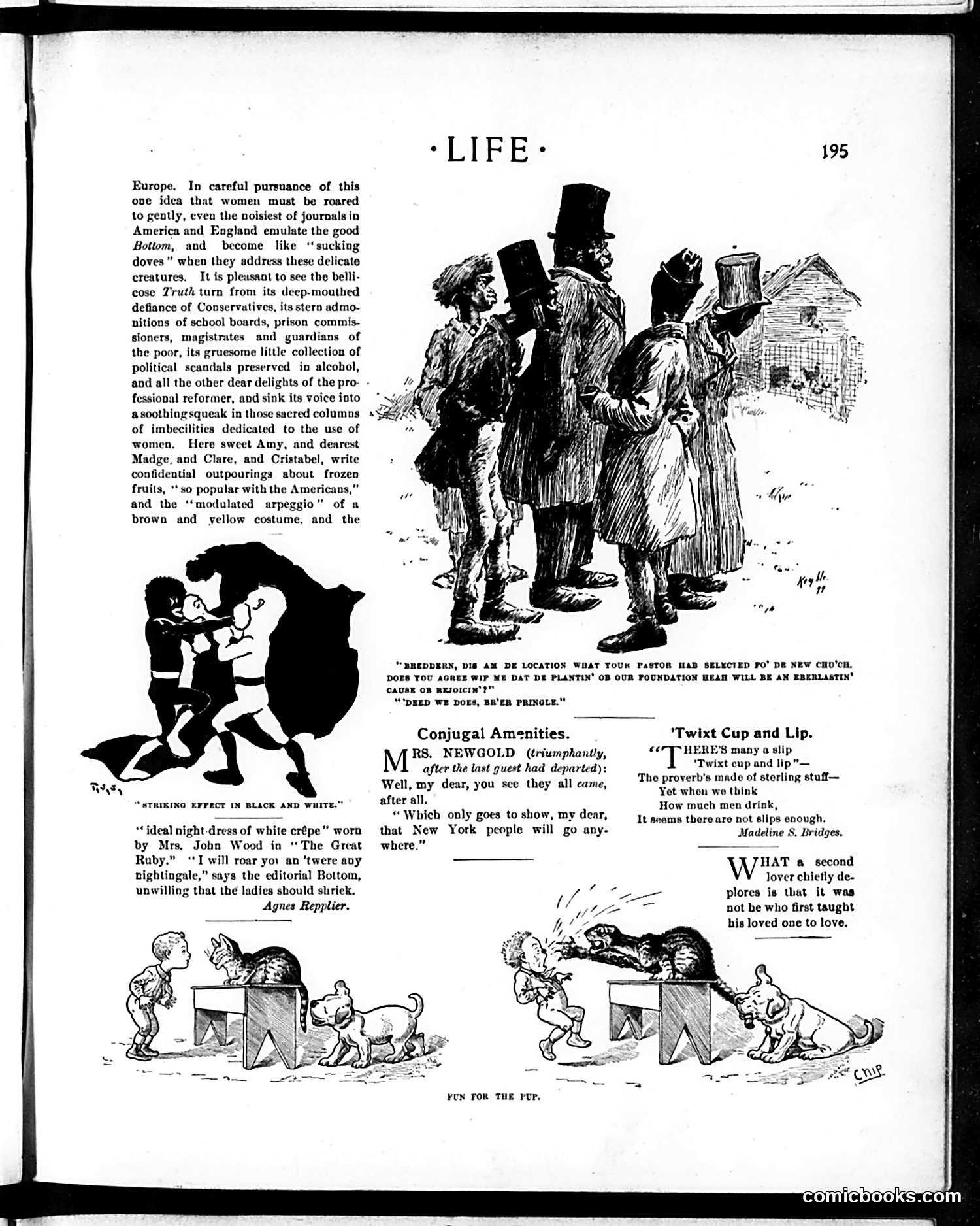
This page contains multiple satirical pieces reflecting turn-of-the-century attitudes: **Main Essay (Agnes Repplier):** Critiques how serious reform journals like *Truth* adopt an overly genteel tone when addressing female readers, treating women as delicate creatures. The author mocks that these journals soften their normally aggressive criticism of government corruption and social ills, instead publishing trivial "women's content" about frozen fruit and fashion. **Top Cartoon:** Depicts what appears to be a church-building discussion using exaggerated dialect speech ("Dis am de location"), satirizing African American speech patterns—reflecting the racist caricature conventions standard to the era. **Lower Cartoons:** Two domestic humor pieces—one about a wife noting guests only attended because New York society is obligatory, and another joking that men drink too much to experience the old saying "many a slip 'twixt cup and lip." The overall page reflects period attitudes toward women as frivolous consumers and racist depictions standard to early 1900s American humor magazines.
This page from Life magazine (appears to be early 1900s based on typography and advertising) contains **four humorous anecdotes** rather than political cartoons: 1. **The Castle Story**: An Irish lord finds his ancestral castle has been completely dismantled by peasants who used its stones to build a wall around it—the agent literally built the enclosure *out of* the castle itself. 2. **Professor Loomis's Trick**: A Yale astronomy professor who regularly impresses students by shooting three perfect bullet holes in a target is momentarily shocked when students fire first, making him think he's finally missed—then realizes they were just testing him. 3. **The Volunteer Captain**: A newly appointed military captain brags about his promotion; his friend admits people just laugh at his pretensions. 4. **The Husband's Cigar**: A woman boasts her husband has minimal vices, not understanding why others laugh when she mentions he smokes after every meal. Each joke targets human vanity, pomposity, or self-delusion. The page is primarily **satirical humor content** with period advertising.
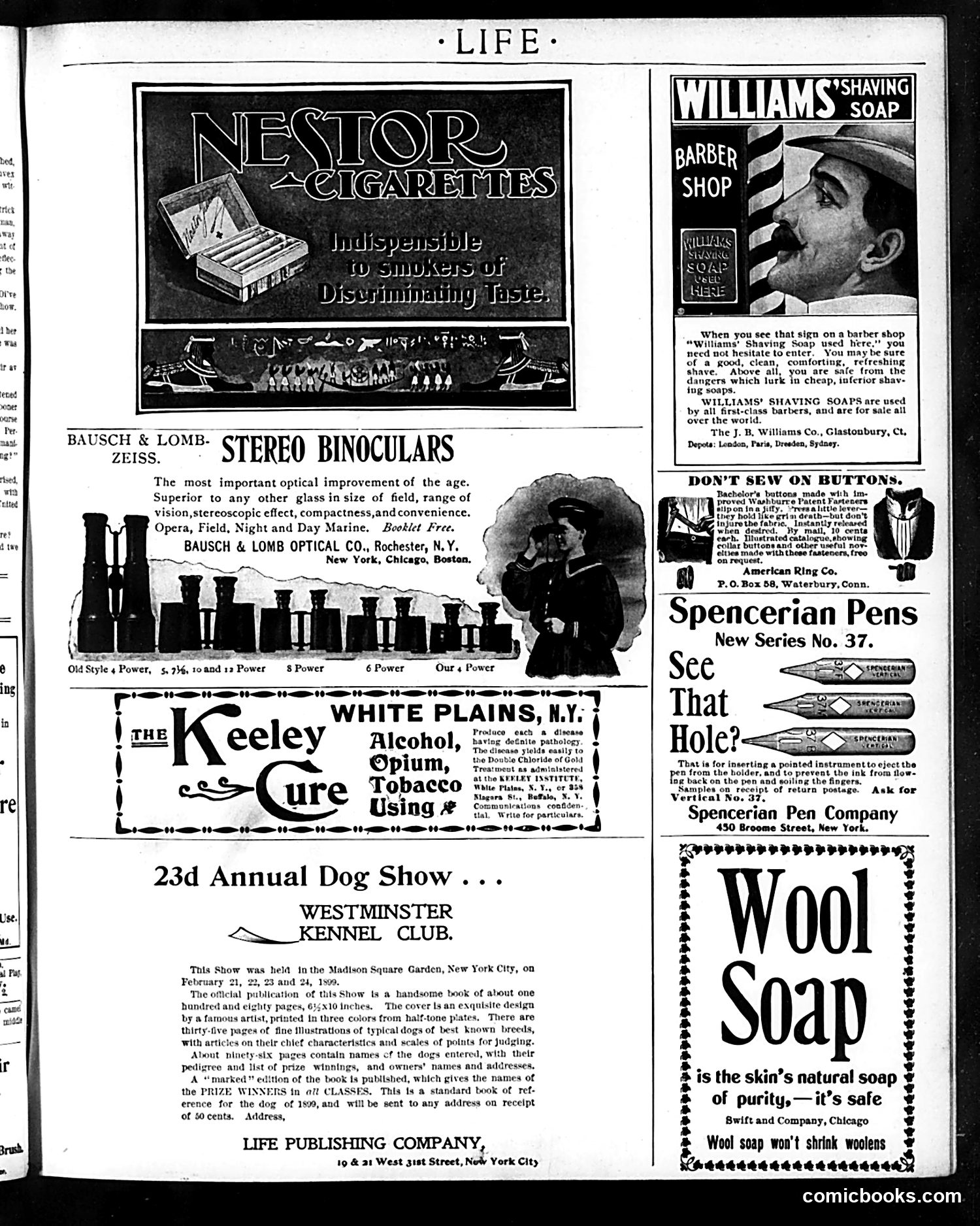
This page is primarily **advertisements** rather than satirical cartoons. The ads reflect late-19th century consumer products and concerns: **Notable advertisements include:** - **Nestor Cigarettes**: Promises "indispensible to smokers of Discriminating Taste"—typical tobacco marketing before health warnings - **Williams' Shaving Soap**: Appeals to barber shop hygiene standards, suggesting cheap soaps posed health "dangers" - **Bausch & Lomb Binoculars**: Promotes optical technology as "the most important improvement of the age" - **The Keeley Cure**: Advertises treatment for alcohol, opium, and tobacco addiction—reflecting period concerns about these substances - **"Don't Sew On Buttons"**: Bachelor's buttons eliminate manual sewing—targeting unmarried men - **Wool Soap**: Emphasizes it won't shrink woolens, addressing practical laundry concerns The page also announces the **23rd Annual Dog Show** at Madison Square Garden, New York City, February 1899. These ads reveal turn-of-century anxieties about hygiene, substance abuse, bachelor life, and textile care.
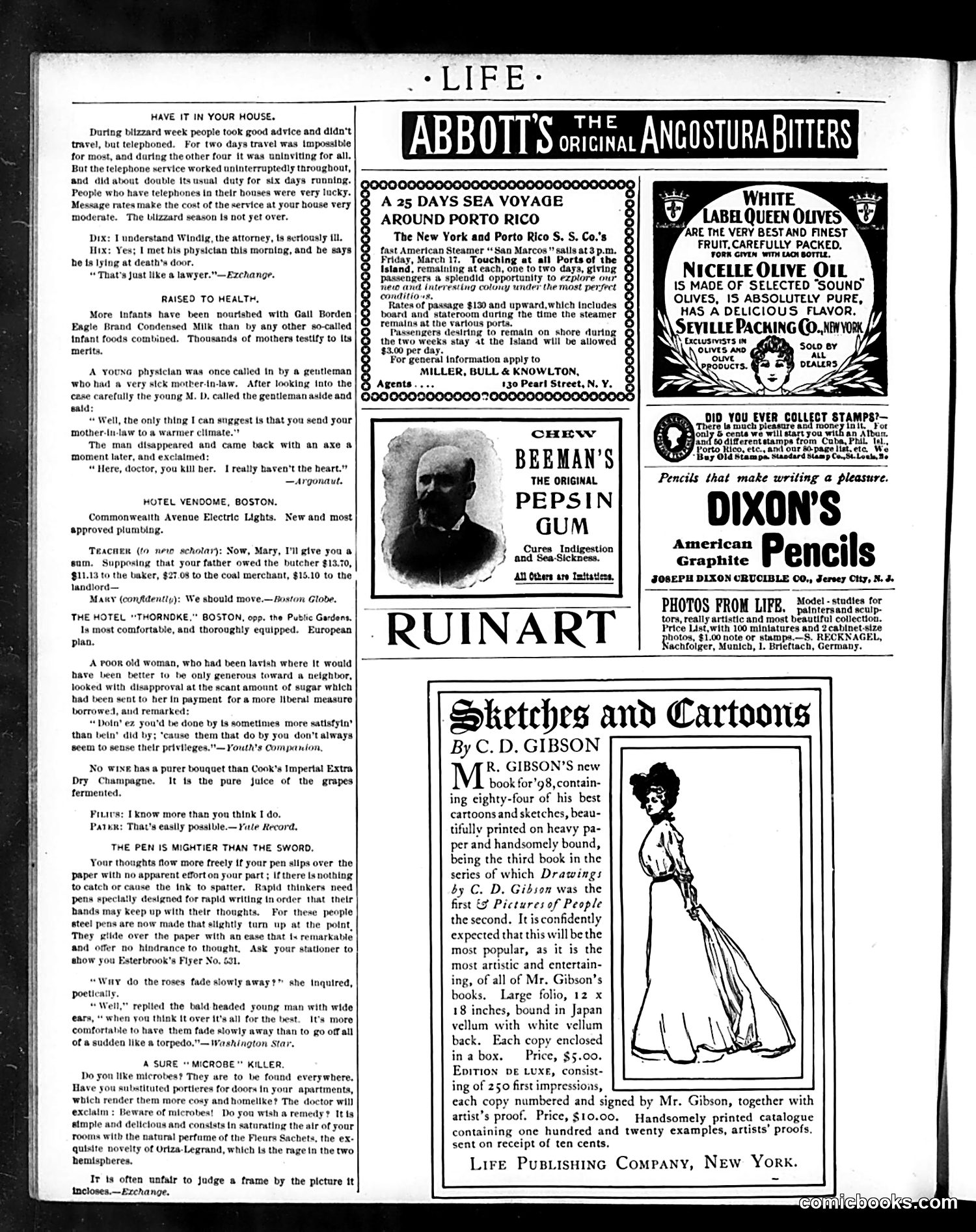
This page is primarily **advertising and humorous filler content**, not political cartoons. The advertisements showcase early 20th-century consumer products (Pepsi gum, pencils, champagne, telephones) alongside light comedic anecdotes. The visible humor pieces are gentle social satire: - A joke about a man calling a doctor for his sick mother-in-law, then asking the doctor to kill her instead—mocking sons-in-law's frustrations - A schoolteacher's math problem about debts that a student solves by suggesting the family "move"—satirizing poverty - Wordplay about roses fading and microbes—typical period newspaper humor The page includes an advertisement for **C.D. Gibson's "Sketches and Cartoons"** book, featuring his illustrated drawing of a fashionable woman. Gibson was Life's primary cartoonist known for the "Gibson Girl" ideal. **No clear political commentary** appears on this page. It's representative of Life's mixed content model: light satire, domestic humor, and advertising targeting middle-class readers during the early 1900s.
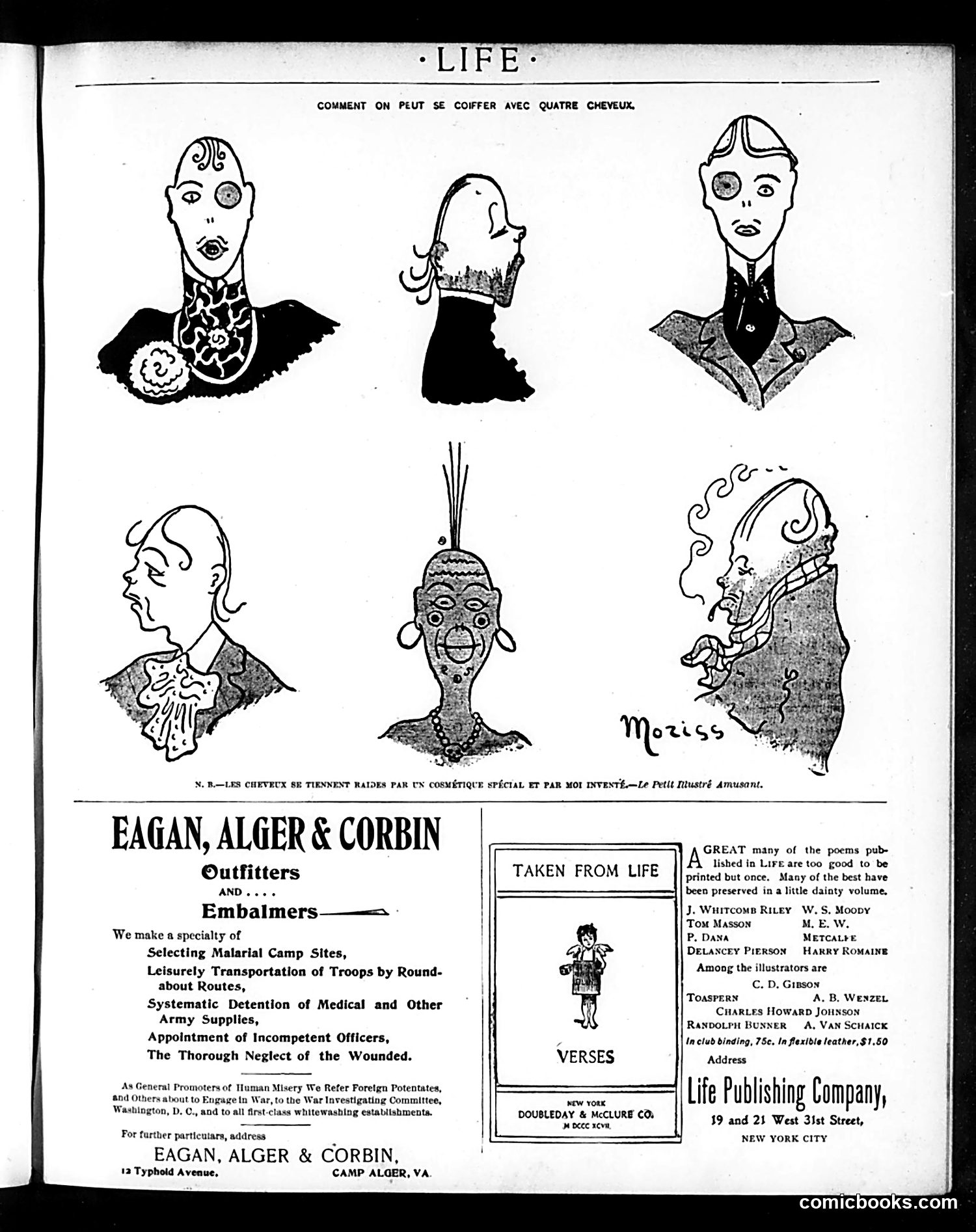
**The Main Cartoon:** The top illustration satirizes absurd French beauty treatments, captioned in French: "How to style hair with four hairs" using a special cosmetic invention. This mocks European vanity and pretentious fashion culture—a common target of American satirical magazines. **The Advertisement (Primary Content):** The bulk of the page is a scathing fake ad for "Eagan, Alger & Corbin," presented as "Outfitters and Embalmers." It's viciously attacking U.S. military incompetence during what appears to be the Spanish-American War era (references to "Camp Alger" and malarial camp sites suggest the 1898 conflict). The satirical "services" list incompetence: selecting disease-ridden camp locations, transporting troops inefficiently, neglecting wounded soldiers, appointing incompetent officers. It positions the company as "General Promoters of Human Misery." This reflects genuine public anger over documented military mismanagement, poor sanitation, and preventable deaths during the Spanish-American War—a major scandal that prompted congressional investigations.
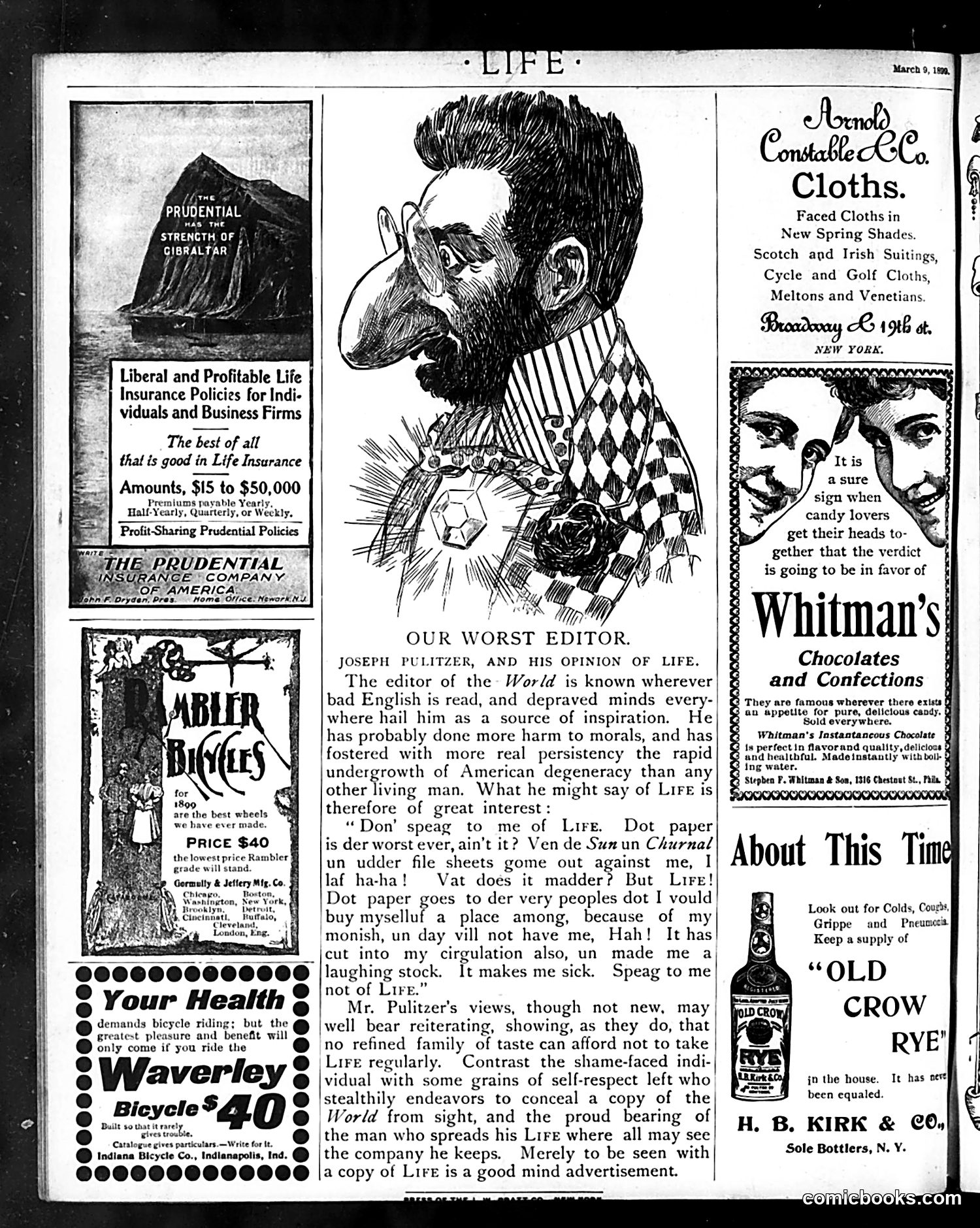
This satirical piece attacks **Joseph Pulitzer**, editor of the *New York World*, one of Life magazine's rival publications. The caricature exaggerates Pulitzer's accent and coarse language to portray him as vulgar and vindictive. The text mocks Pulitzer by claiming he has "done more harm to morals...than any other living man" and that he uses sensationalism to degrade American culture. The article then performs an ironic reversal: it presents Pulitzer's (fictional) bitter complaint that *Life* magazine has harmed his circulation—using his own words against him. The satire's point: reading *Life* signals refinement and respectability, while reading Pulitzer's *World* marks you as someone lacking taste. This was typical **magazine war** content of the 1890s, when competing publications attacked each other mercilessly. The exaggerated dialect and accent emphasize class contempt alongside the editorial rivalry.