
Life, 1899-03-09 · page 8 of 20
Life — March 9, 1899 — page 8: what you’re looking at
What you’re looking at
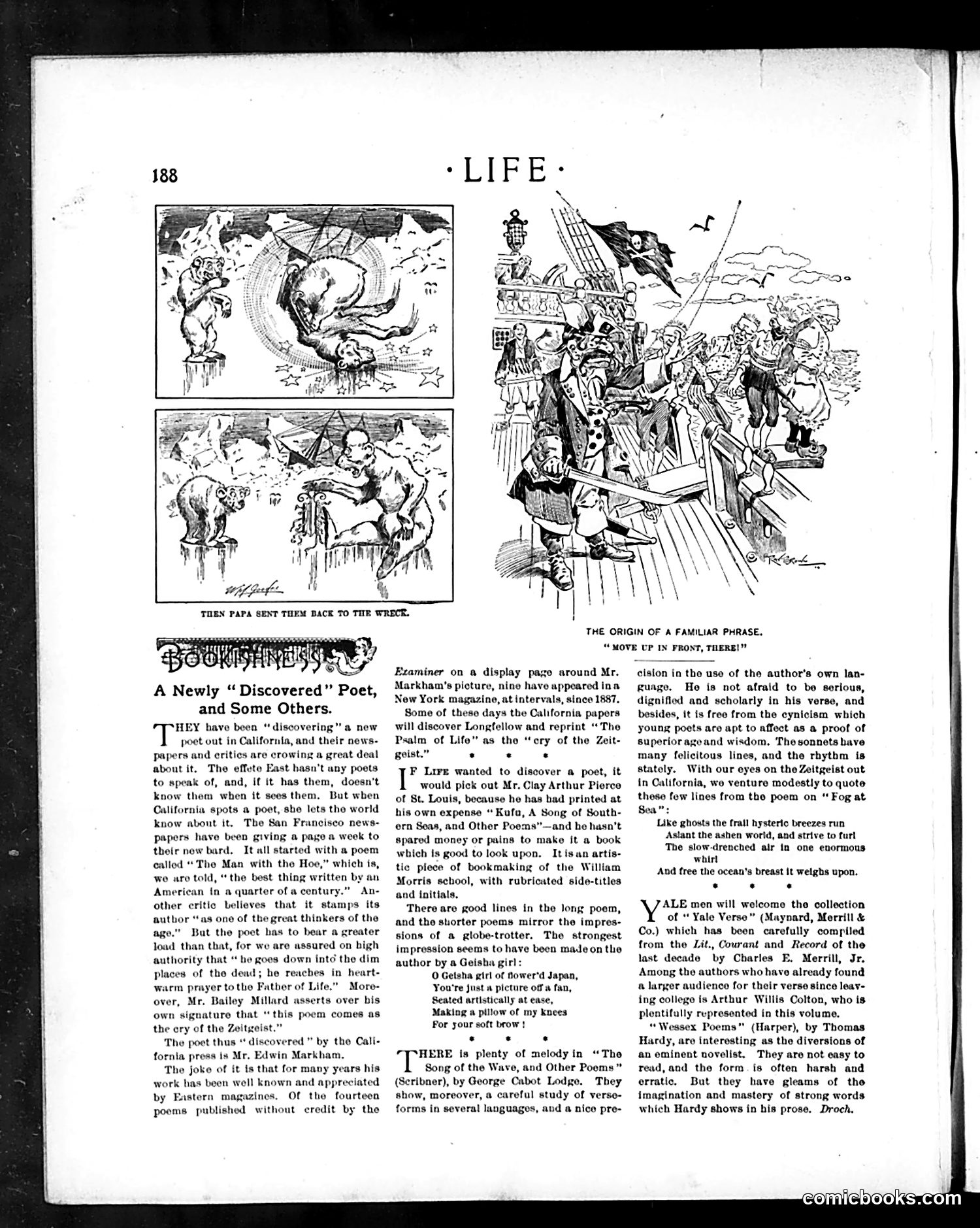
The right-side cartoon depicts a chaotic ship scene with sailors and passengers, illustrating the phrase "Move up in front, there!" The caption suggests this is meant to explain the origin of a common expression—implying it originated from sailors crowding together on ship decks. The left-side illustrations appear to be unrelated satirical drawings, likely depicting acrobatic or circus performers. The text below discusses "newly discovered" poets in California and literary collections, mentioning Clay Arthur Pierce and George Cabot Lodge. This appears to be a literary criticism section rather than political satire. The page primarily concerns 19th-century American poetry and publishing rather than political commentary.
📄 Transcribed text from this page (OCR, searchable)
Machine-transcribed from the original scan — historical spelling and the odd misread are preserved.
A Newly “ Discovered” Poet, and Some Others. HEY have been “discovering” a new poet out in California, and their news- papers and critics are crowing a great deal about it. The effete East hasn't any poets to speak of, and, if it has them, doesn’t know them when it sees them. But when California spots a poet, she lets the world know about it. The San Francisco news- papers have been giving a pago a week to their now bard. It all started with a poem called “Tho Man with the Hoe,” which is, wo uro told, “the best thing written by an American in a quarter of a century.” An- other critic believes that it stamps its author “as one of the great thinkers of the age.” But the poet has to bear a greater load than that, for we are assured on bigh authority that “be goes down into the dim places of the dead; ho reaches in heart- warm prayer to tho Father of Life.” More- over, Mr. Bailey Millard asserts over bis own signature that “this poem comes as the cry of the Zeitgeist. ‘The poet thus “ discovered ” by the Cali- fornia press is Mr. Edwin Markham. Tho joke of it ts that for many years his work has been well known and appreciated by Eastern magazines. Of the fourteen poems published without credit by the THE ORIGIN OF A FAMILIAR PHRASE. “MOVE UP IN FRONT, THERE!” Examiner on a display pago around Mr. Markham’s picture, nine have appeared ina Now York magazine, at intervals, since 1887. Some of theso days the California papors will discover Longfellow and reprint “Tho Psalm of Life” as the “cry of the Zeit- geist.” . . . F Lire wanted to discover a poet, it would pick out Mr. Clay Arthur Pierce of St. Louis, because he has had printed at his own expense “Kufa, A Song of South- ern Seas, and Other Poems”—and he hasn’t spared money or pains to make it a book which Is good to look upon. It isan artis- tic plece of bookmaking of the William Morris school, with rubricated side-titles and initials, There are good lines in the long poem, and tho sorter poems mirror the impres- sions of a globe-trotter. The strongest impression seems to have been made on tho author by a Geisha girl: 0 Getsha girl of fower'd Japan, You're Just a picture off a fan, Seated artistically at ease, Making a pillow of my knees For your soft brow ! . . * TTPHERE is plenty of melody in “Tho Song of the Wave, and Other Pooms” (Scribner), by George Cabot Lodge. They show, moreover, a careful study of verso- forms in several languages, and a nico pre- cision in tho uso of the author's own lan- guago. Ho is not afraid to bo serious, dignified and scholarly in his verae, and besides, it {s freo from the cynicism which young poets are apt to affect as a proof of superior agoand wisdom. The sonnets bave many felicitous lines, and the rbythm is stately. With our oyes on tho Zeitgeist out in California, wo venture modestly to quote those few lines from tho poem on “ Fog at Sea”: Like ghosts the frail hysteric breezes run Asiant the ashen world, and strive to furt The slow-drenched alr in one enormous whirl And free the ocean's breast it welghs upon. . . . ALE men will welcome tho collection of “Yale Verso” (Maynard, Merrill & Co.) which has been carefully compiled from the Lit., Courant and Record of the last decade by Charles E. Merrill, Jr. Among tho authors who have already found a larger audienco for their verso since leay- ing collego is Arthur Willis Colton, who is plentifully represented in this volume. “Wessex Poems" (Harper), by Thomas Hardy, aro interesting as the diversions of an ominent novelist, They aro not casy to read, and the form. is often harsh and erratic. But they have gleams of tho imagination and mastery of strong words which Hardy shows in bis prose. Droch.