
A complete issue · 20 pages · 1898
Life — November 17, 1898
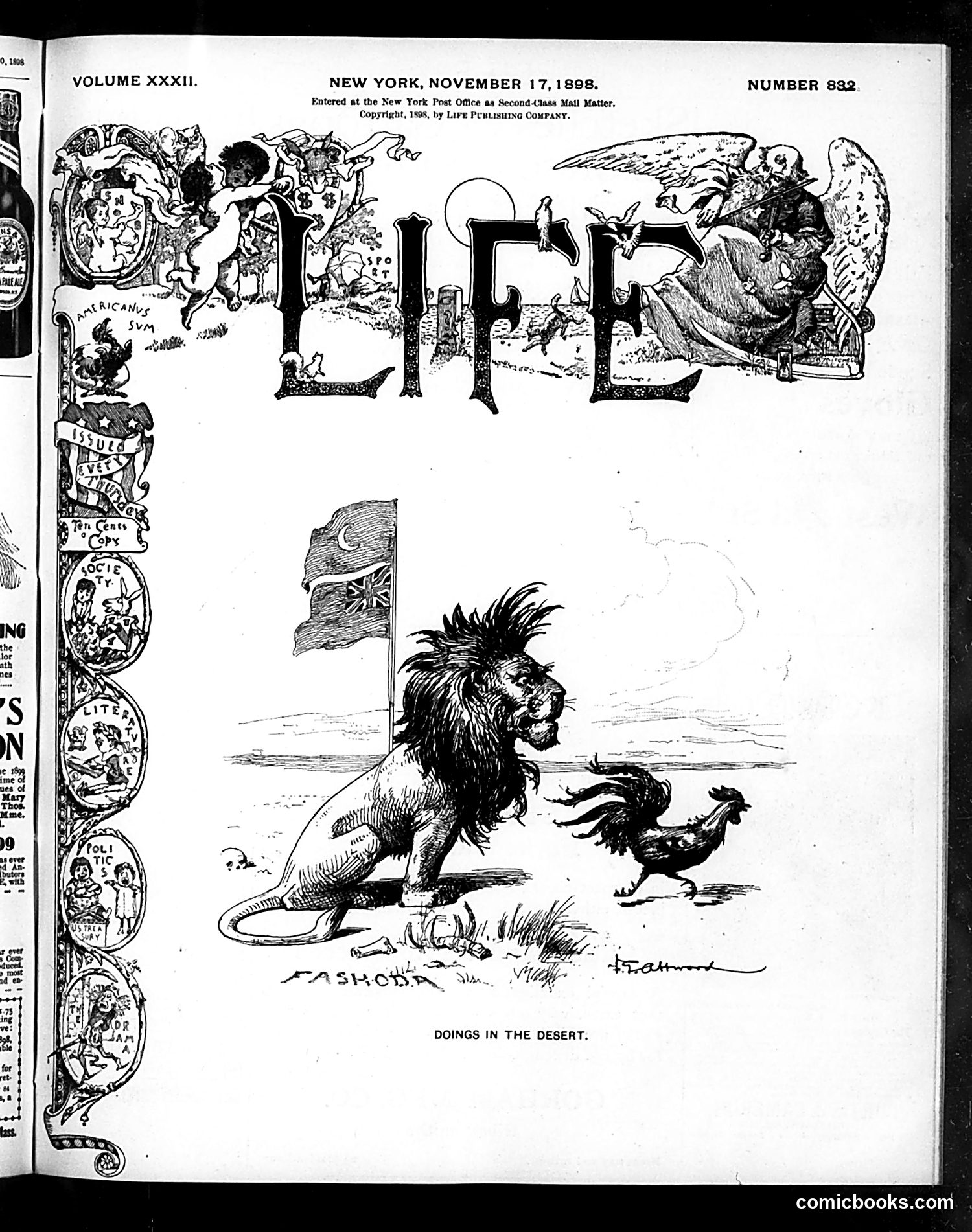
This cartoon depicts a lion (labeled "Ashoka") with a British flag, confronted by a small rooster. The satire likely references the Boer War (1898-1902), where British imperial power faced unexpected resistance. The lion traditionally represents British strength and empire, while the small rooster—possibly representing the Boers or another underdog opponent—boldly challenges it. The title "Doings in the Desert" suggests colonial conflicts in arid regions. The cartoon's humor derives from the visual incongruity: a tiny bird confronting a mighty lion, inverting expected power dynamics. This reflects contemporary American satirical commentary on British imperial overconfidence, suggesting that even small adversaries could threaten Britain's dominance. The composition mocks British assumptions of inevitable victory.
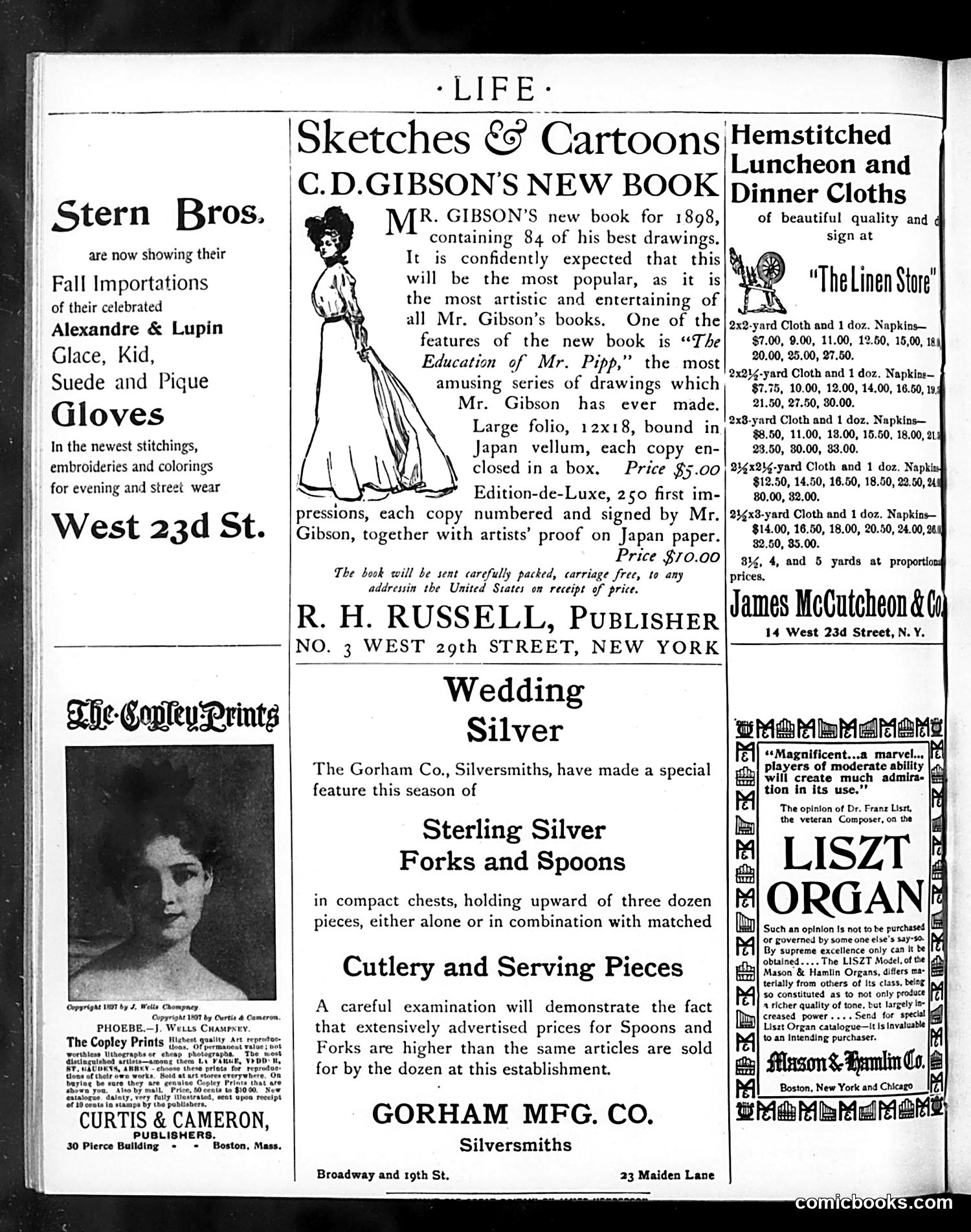
This page is **primarily advertising** rather than satirical content. It contains advertisements for: - Stern Bros. gloves (West 23rd St.) - C.D. Gibson's new book of sketches and cartoons - The Linen Store (hemstitched tablecloths) - James McCutcheon & Co. (linens) - The Gorham Co. (sterling silver forks and spoons) - Liszt Organ (by Mason & Hamlin Co.) - The Cooley Prints (art reproductions) There is **no political cartoon or satire evident** on this page. The only illustration of a person appears to be a portrait accompanying The Cooley Prints advertisement. The page reflects early 1900s consumer culture, featuring luxury goods marketed to affluent readers, with prices listed in dollars ranging from $7 to $70.
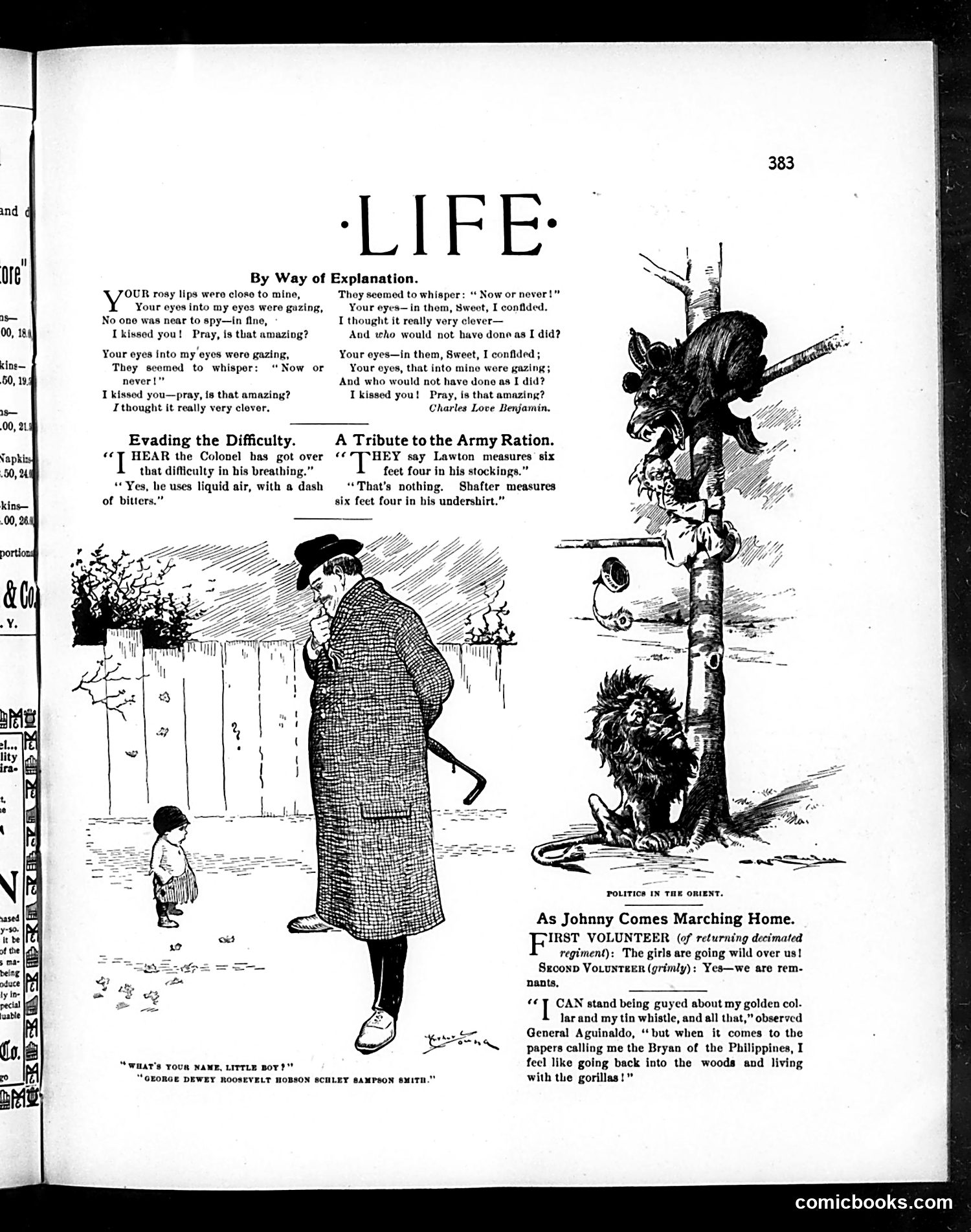
This page contains three unrelated humor pieces typical of Life magazine's satirical format: 1. **"Life: By Way of Explanation"** — A sentimental poem about romance, with the speaker defending kissing as "amazing." 2. **"Evading the Difficulty"** — A brief joke about a Colonel using "liquid air, with a dash of bitters" to manage breathing difficulties. The humor relies on wordplay about alcohol consumption. 3. **"As Johnny Comes Marching Home"** — A cartoon dialogue between returning soldiers discussing military life. One soldier references General Aguinaldo and the Philippines, suggesting this references the Philippine-American War. The joke involves comparing returning to civilian life unfavorably to jungle warfare—likely satirizing the contrast between military hardship and domestic tedium. The cartoons use exaggerated illustrations typical of early 20th-century satirical journalism.
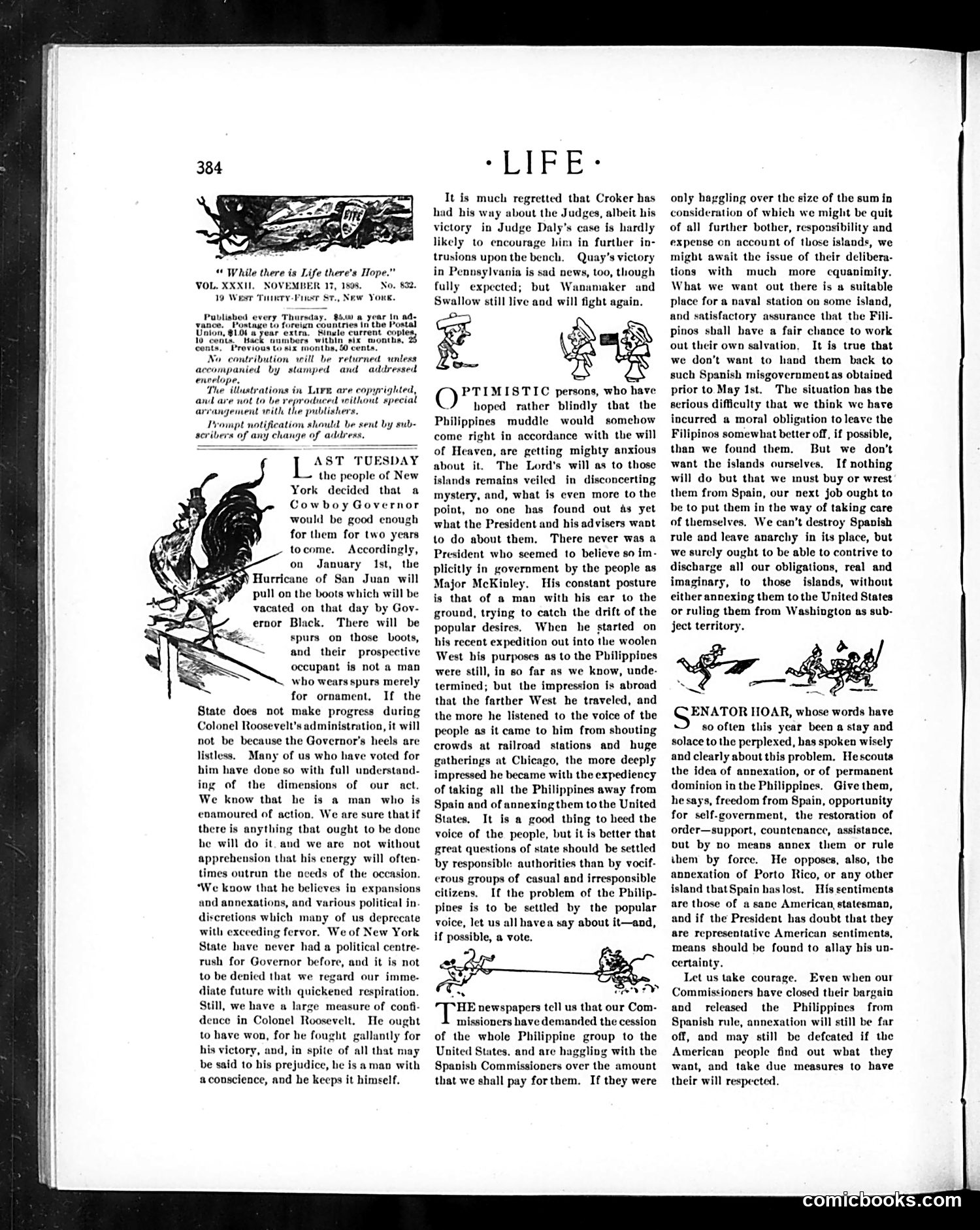
This page from Life magazine contains editorial commentary on the Philippine-American War and debates over Philippine independence. The text discusses President McKinley's administration and the ongoing conflict, arguing that the U.S. should support Filipino self-governance rather than continue Spanish-style colonial rule. The cartoons (small illustrations scattered through the text) appear to depict political figures debating or discussing the Philippines issue, though their specific identities are unclear from the image quality. The satire targets what the editors view as inconsistent American policy: the U.S. fought Spain partly to free the Philippines, yet may annex them instead. The piece criticizes expansionist impulses and advocates for respecting Filipino autonomy—a significant anti-imperialist position for the period.
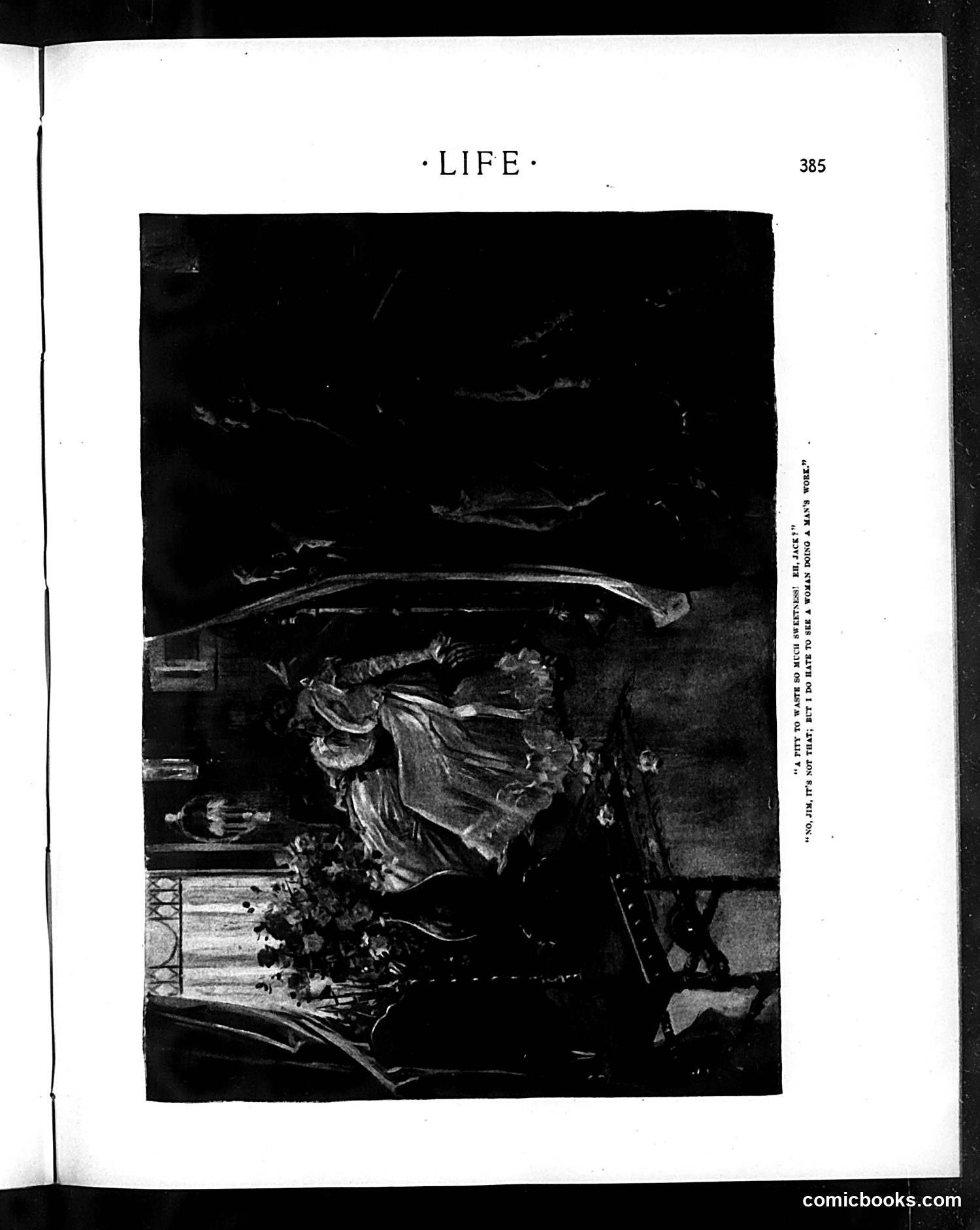
I can see this is page 385 from Life magazine, but the image quality is too poor for me to make out clear details of the cartoon or illustration. The photograph appears to show figures in what looks like a dramatic or theatrical scene with draped fabric and possibly period clothing, but I cannot discern enough detail to identify specific characters, caricatures, or political references with confidence. The OCR text is minimal and doesn't provide context about the cartoon's subject matter or satirical intent. Without being able to read any accompanying caption or clearly identify the figures depicted, I cannot reliably explain what social or political commentary this page was making to its original readers.
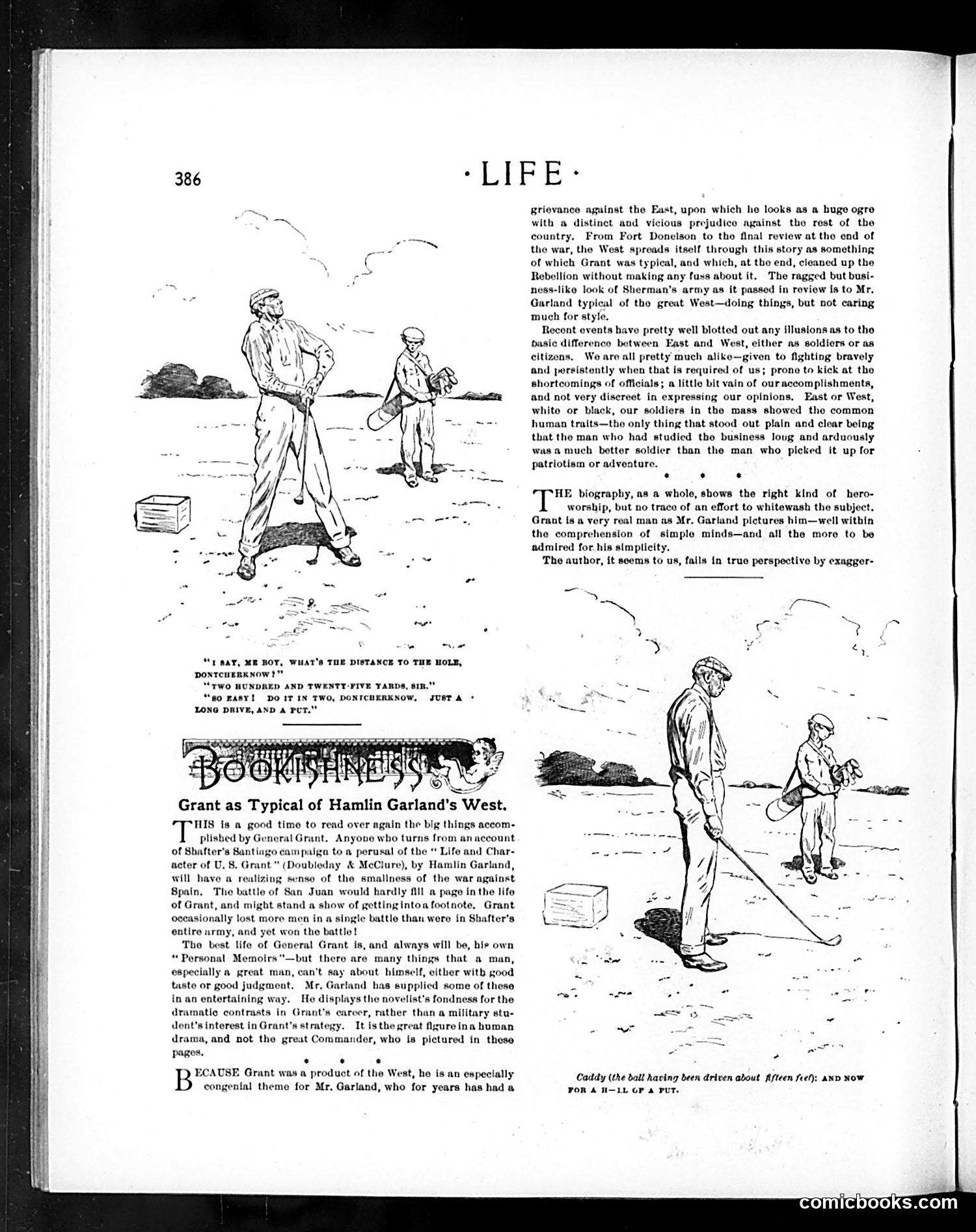
This page critiques Hamlin Garland's biography of Ulysses S. Grant. The text argues Garland's portrayal fails to capture Grant's true character—particularly his Western roots and practical military mind. The illustrations show soldiers in field conditions, likely depicting Grant during his Civil War campaigns. The satire targets Garland's supposed oversimplification of Grant's life, suggesting the biography prioritizes making Grant palatable to "simple minds" rather than presenting him authentically. The article defends Grant as a product of the West, implying Garland misunderstands or misrepresents this essential aspect of his identity and achievement. The golf scene caption appears unrelated—likely accompanying advertising or a separate humor piece.
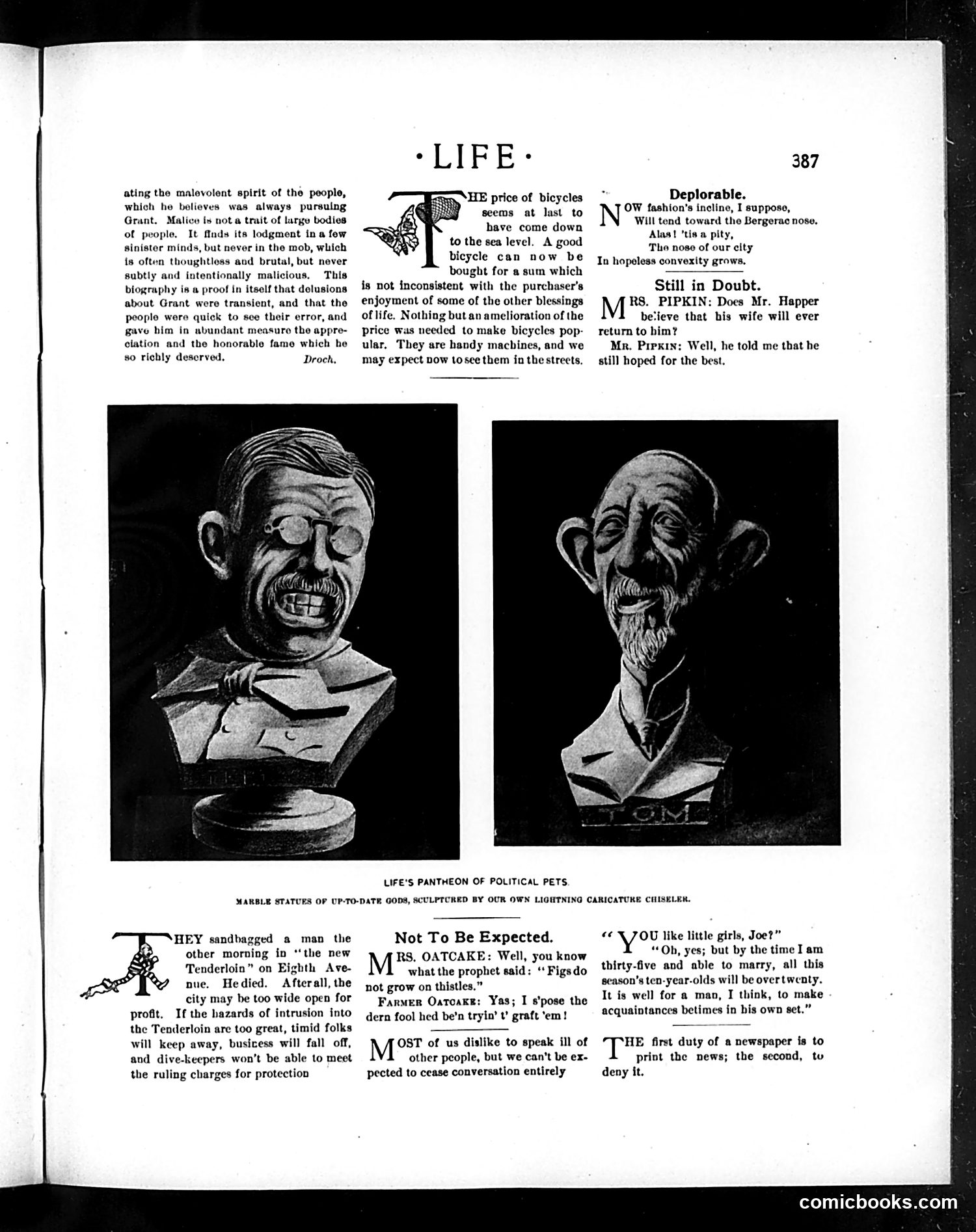
This page features two marble busts titled "Life's Pantheon of Political Pets," described as "marble statues of up-to-date gods, sculptured by our own lightning caricature chiseler." The caricatures depict two prominent political figures of the era, though the OCR'd text doesn't identify them by name. The exaggerated facial features—pronounced teeth, wrinkles, and distinctive facial hair—are typical of Life magazine's satirical style. The accompanying text discusses bicycle prices becoming affordable and includes unrelated humor about marriage and newspaper duties. The "political pets" title suggests these are figures the magazine viewed as tools or favorites of particular interests—a common satirical trope mocking politicians' perceived lack of independence or integrity during this period.
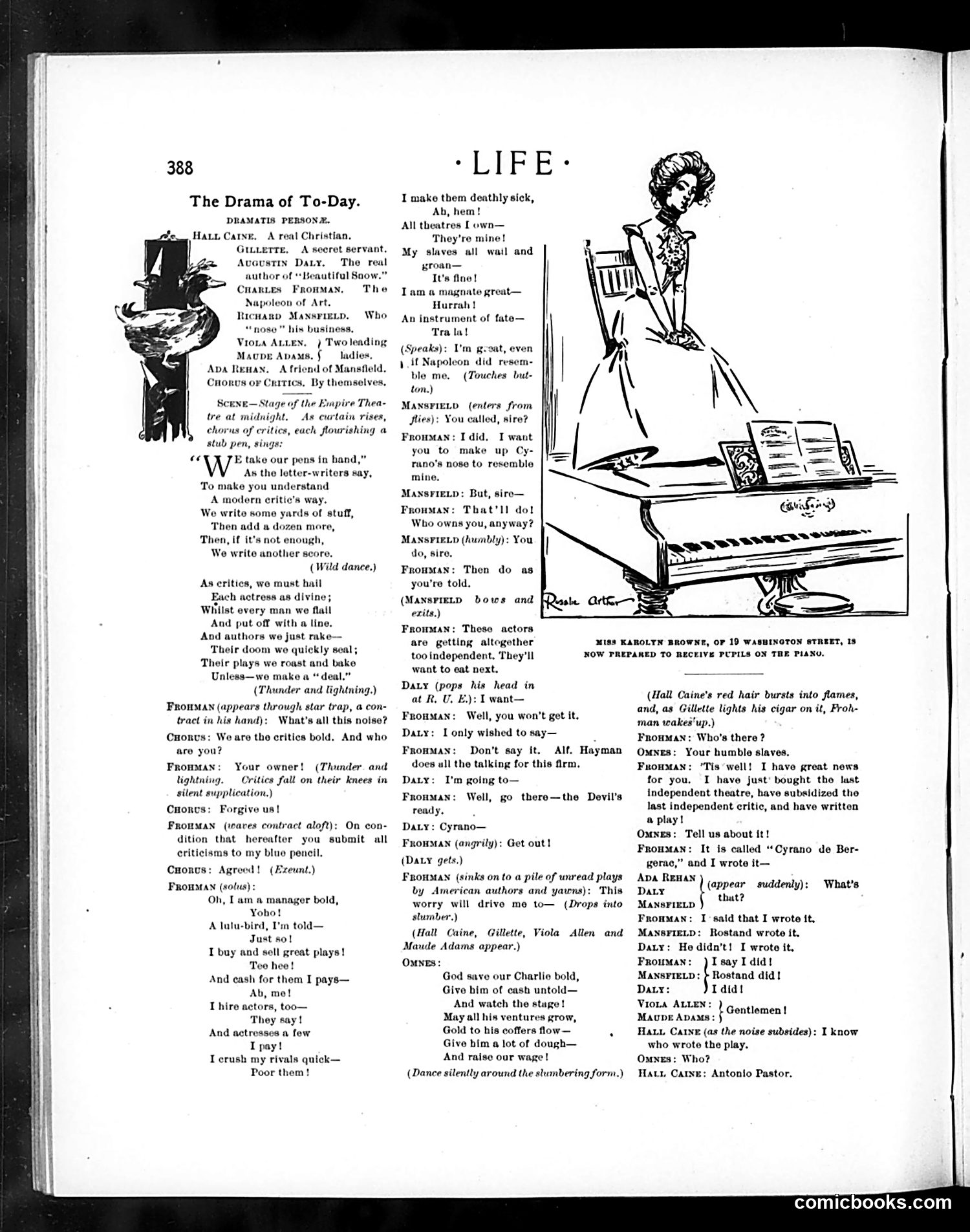
This is a satirical play script mocking contemporary theater critics and playwrights. The left side features caricatured figures representing theater industry types: Hall Caine (a "real Christian"), Augustus Daly (author of "Beautiful Snow"), Charles Forman ("Napoleon of Art"), and Richard Mansfield. The script ridicules how critics operate—they "take our pens in hand" and write theater reviews to appear sophisticated, sometimes inventing substance where none exists. The satire suggests critics are self-important arbiters who pretend to divine talent. The right illustration shows a woman at a piano with theatrical scripts, captioned about Mrs. Carolyn Browne receiving a title role. The overall joke critiques the pretentiousness and artificiality of late-19th-century American theater criticism and its gatekeeping power.
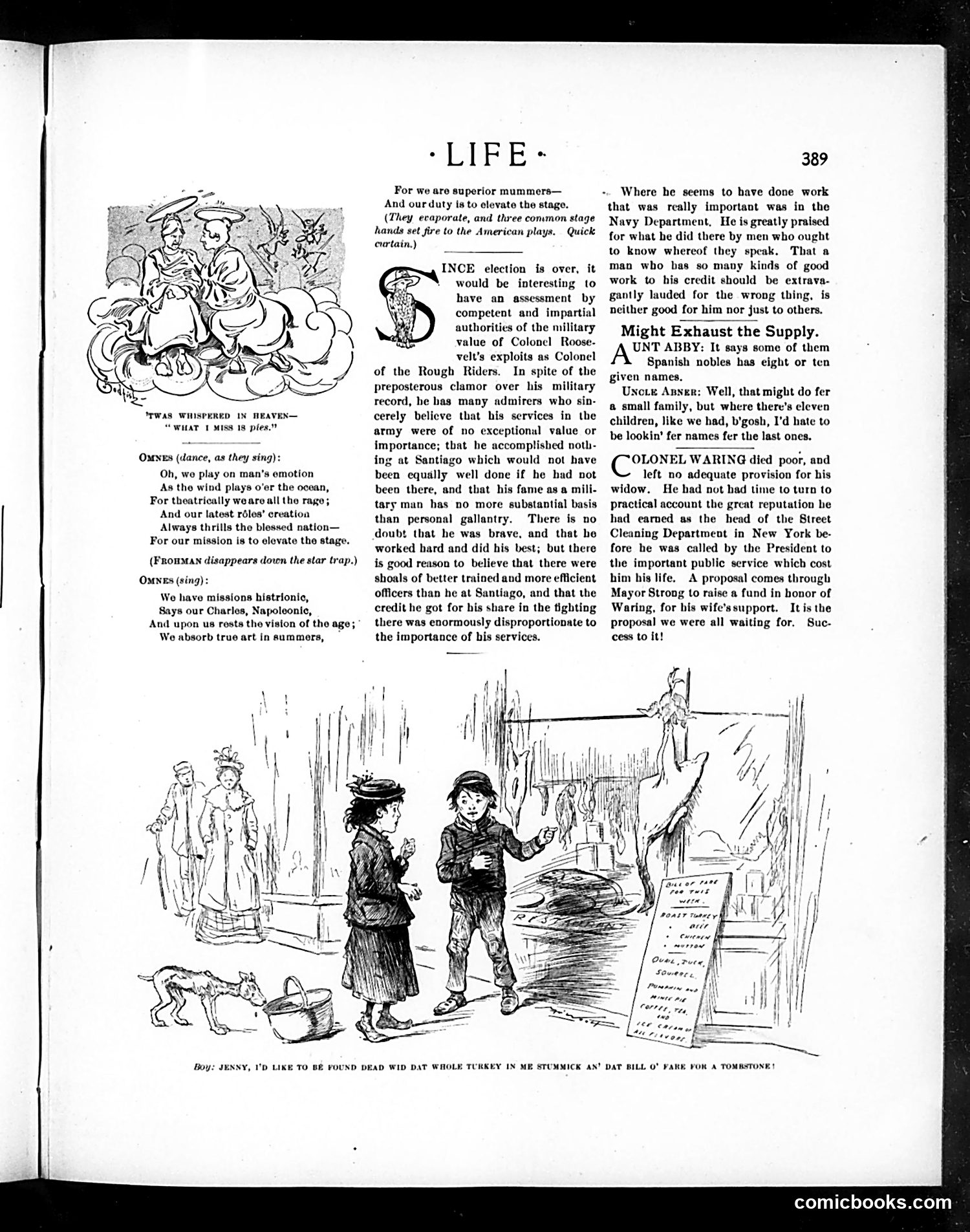
This *Life* magazine page contains editorial commentary on Colonel Roosevelt's military record, particularly his service at Santiago during the Spanish-American War. The text argues that while Roosevelt earned admirers and became famous as a Rough Rider, his actual military accomplishments were less significant than his reputation suggested—there were better officers at Santiago whose contributions were disproportionately overlooked. The lower cartoon depicts a street scene with a poor boy and woman, apparently referencing urban poverty. The caption suggests dark humor about finding a dead turkey for Thanksgiving dinner—satirizing economic hardship and desperation among the working poor during this period. The page represents *Life*'s satirical examination of both military celebrity and social inequality in early 20th-century America.
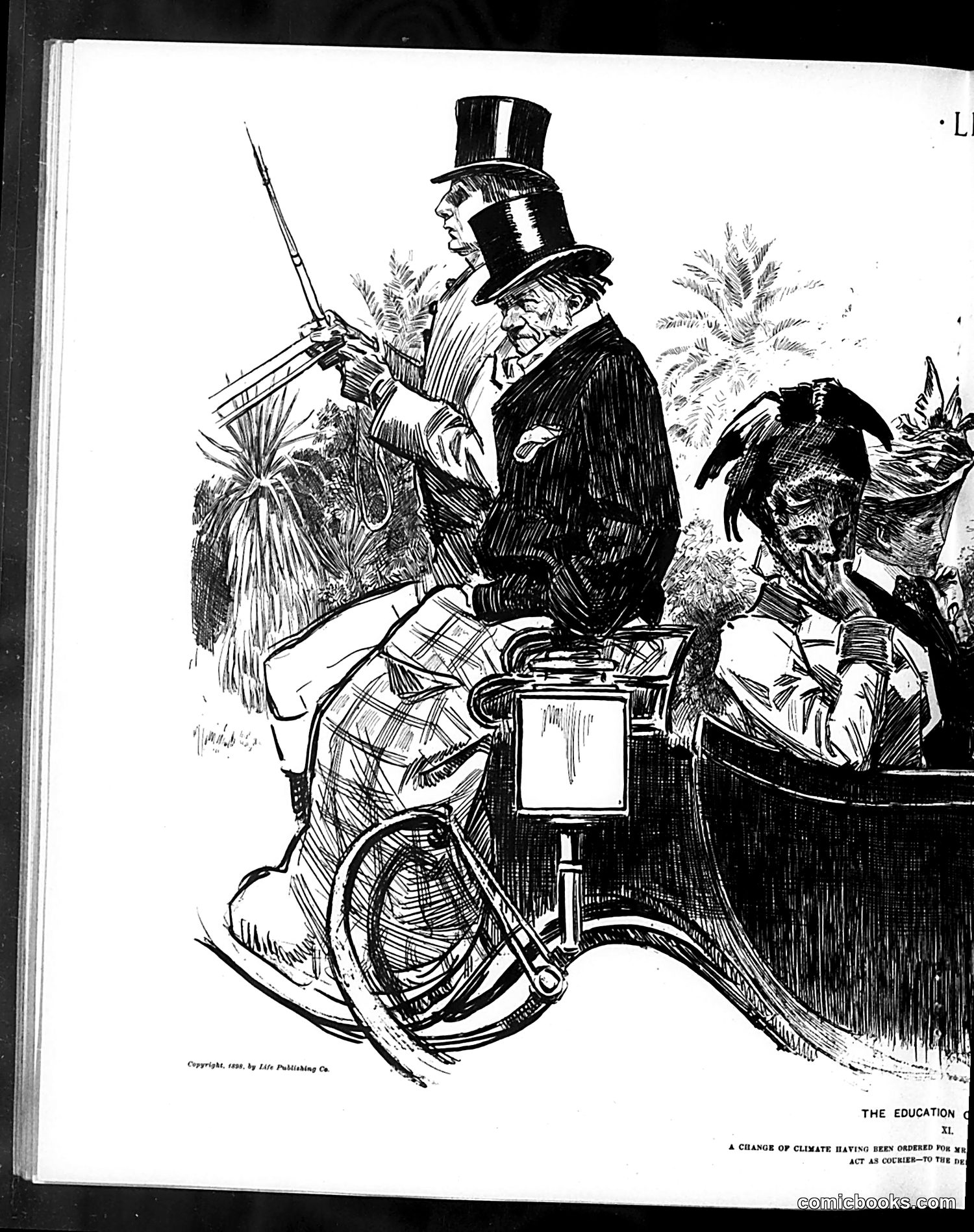
This is a satirical cartoon titled "The Education of..." (text cut off), likely from Life magazine's early 20th-century run. The image shows two figures in top hats - one tall and thin, one shorter and stockier - riding in what appears to be a carriage or vehicle through tropical vegetation (palm fronds visible). The caption at bottom reads: "A CHANGE OF CLIMATE HAVING BEEN ORDERED FOR..." (text incomplete), suggesting the cartoon comments on someone being sent elsewhere for health or political reasons. Without the complete caption and title, I cannot definitively identify the specific figures or historical event referenced. The formal dress and tropical setting suggest diplomatic or colonial-era politics, but the exact satire target remains unclear from the visible text alone.
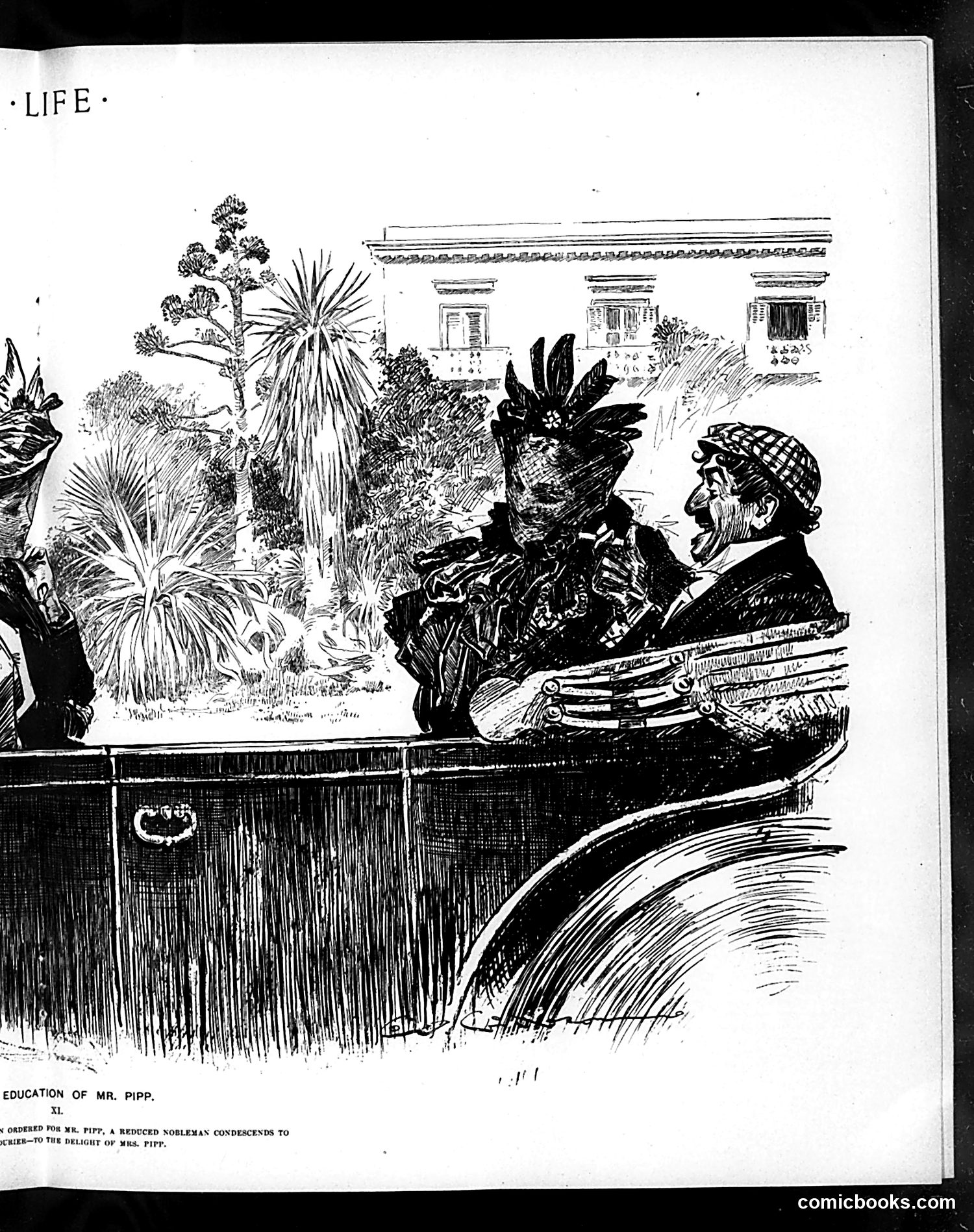
This satirical cartoon depicts a scene where two figures in a boat are engaged with tropical vegetation and a classical building in the background. The caption indicates "A REDUCED NOBLEMAN CONDESCENDS TO URCHINS—TO THE DELIGHT OF MRS. PIPP." The satire appears to target social pretension and class dynamics. "Mr. Pipp" likely represents a character of modest means or social standing, while the "reduced nobleman" suggests an impoverished aristocrat. The humor hinges on this nobleman's condescending interaction with street children, apparently performed for Mrs. Pipp's amusement or approval. The scene satirizes both the nobleman's reduced circumstances and the social climbing or status-consciousness of the Pipp household—mocking how ordinary people were impressed by aristocratic gestures, however hollow or performative.
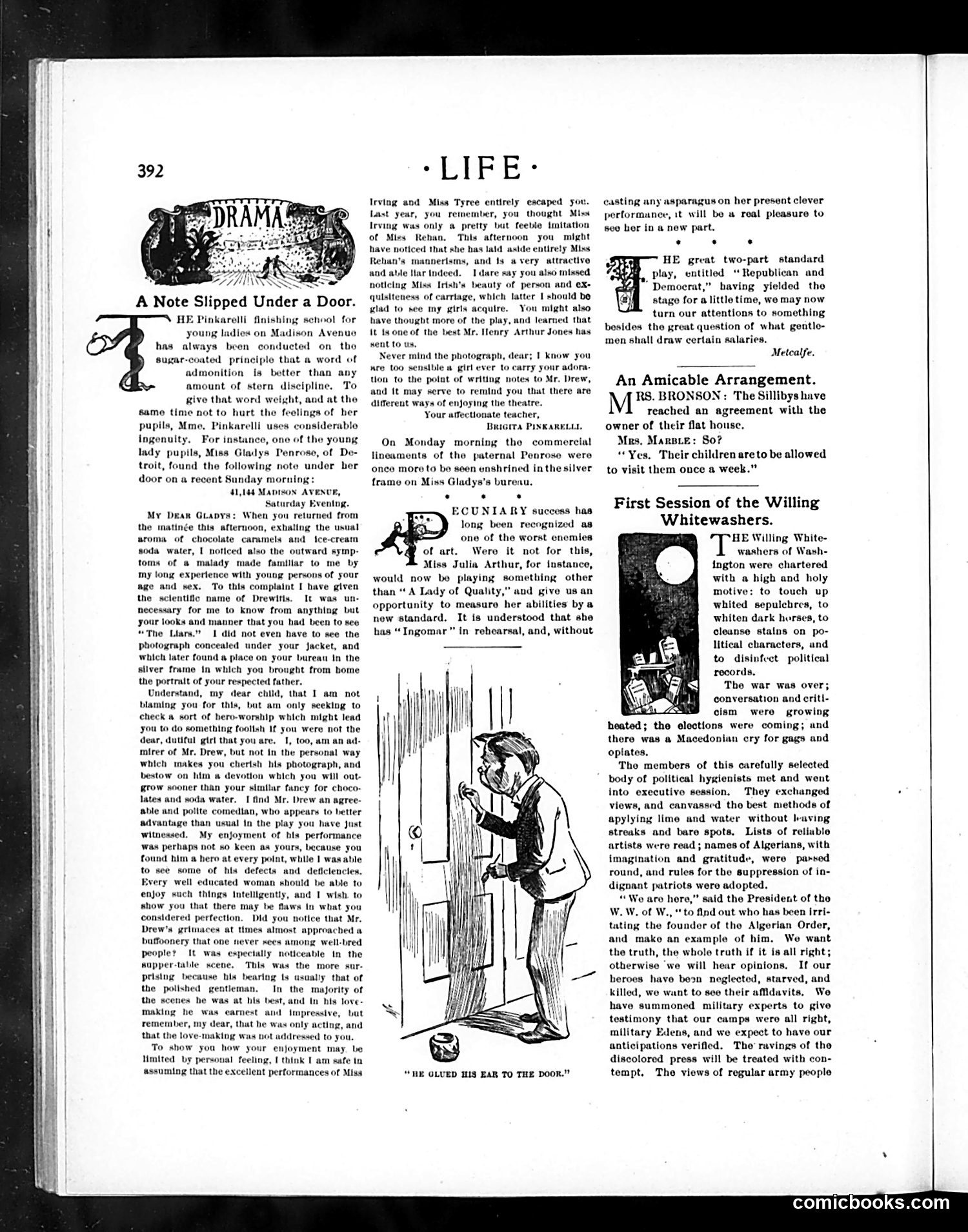
This page contains three separate pieces of social commentary: 1. **"A Note Slipped Under a Door"**: A letter from a theater teacher (Birrotta Pinkarelli) praising a student's performance, particularly noting Miss Gladys Penrose's natural talent and beauty in a recent Sunday matinee. 2. **"An Amicable Arrangement"**: A brief domestic joke about the Sillsbys' agreement with their flat-house owner allowing their children weekly visits. 3. **"First Session of the Willing Whitewashers"**: Satirizes post-WWI political hygienists discussing suppression of "indignant patriots" and press control. The cartoon (showing a figure at a door) mocks establishment efforts to manage dissent and control narratives about wartime conduct and military performance. The overall tone critiques institutional authority and sanitization of uncomfortable truths.
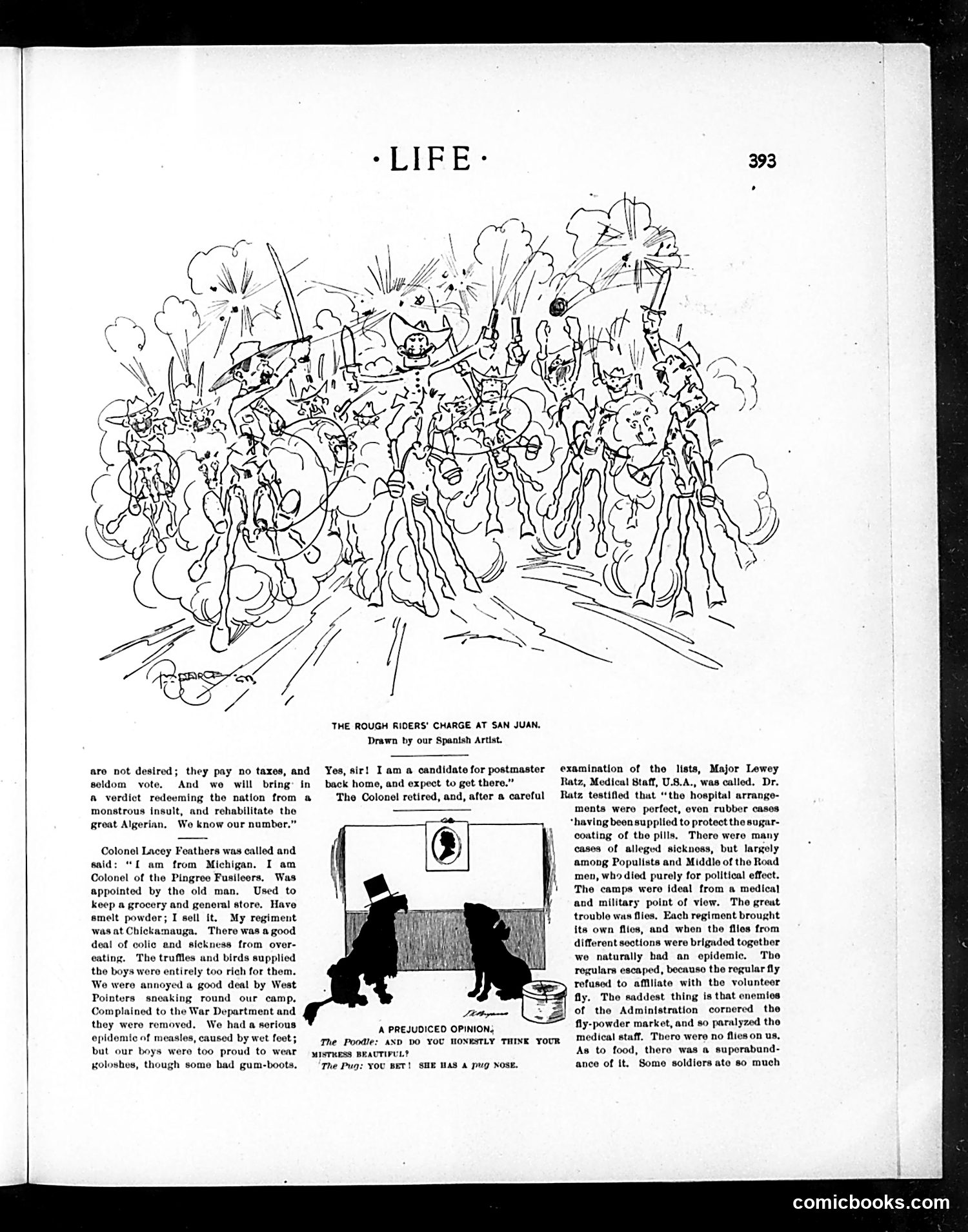
This page satirizes the Spanish-American War (1898) and the subsequent Philippines conflict through two pieces: **Top cartoon** ("The Rough Riders' Charge at San Juan"): A chaotic battle scene drawn in exaggerated style, mocking the famous charge associated with Theodore Roosevelt's Rough Riders regiment. **Bottom section**: A mock congressional hearing where a Colonel Lacey Feathers testifies about his regiment's conditions. His account is absurdly self-serving—claiming measles resulted from soldiers being "too proud to wear goloshes" and that only "Populists and Middle of the Road men" died for "political effect." The testimony satirizes how military officials downplayed problems (disease, poor conditions) and blamed critics for politicizing soldier deaths. **The small cartoon** (two dogs) jokes about beauty being subjective—a poodle asks a pug's honest opinion, receiving flattery based on shared characteristics. The page mocks official military explanations for disease and casualties as politically motivated propaganda, suggesting incompetence was being covered up through partisan blame-shifting.
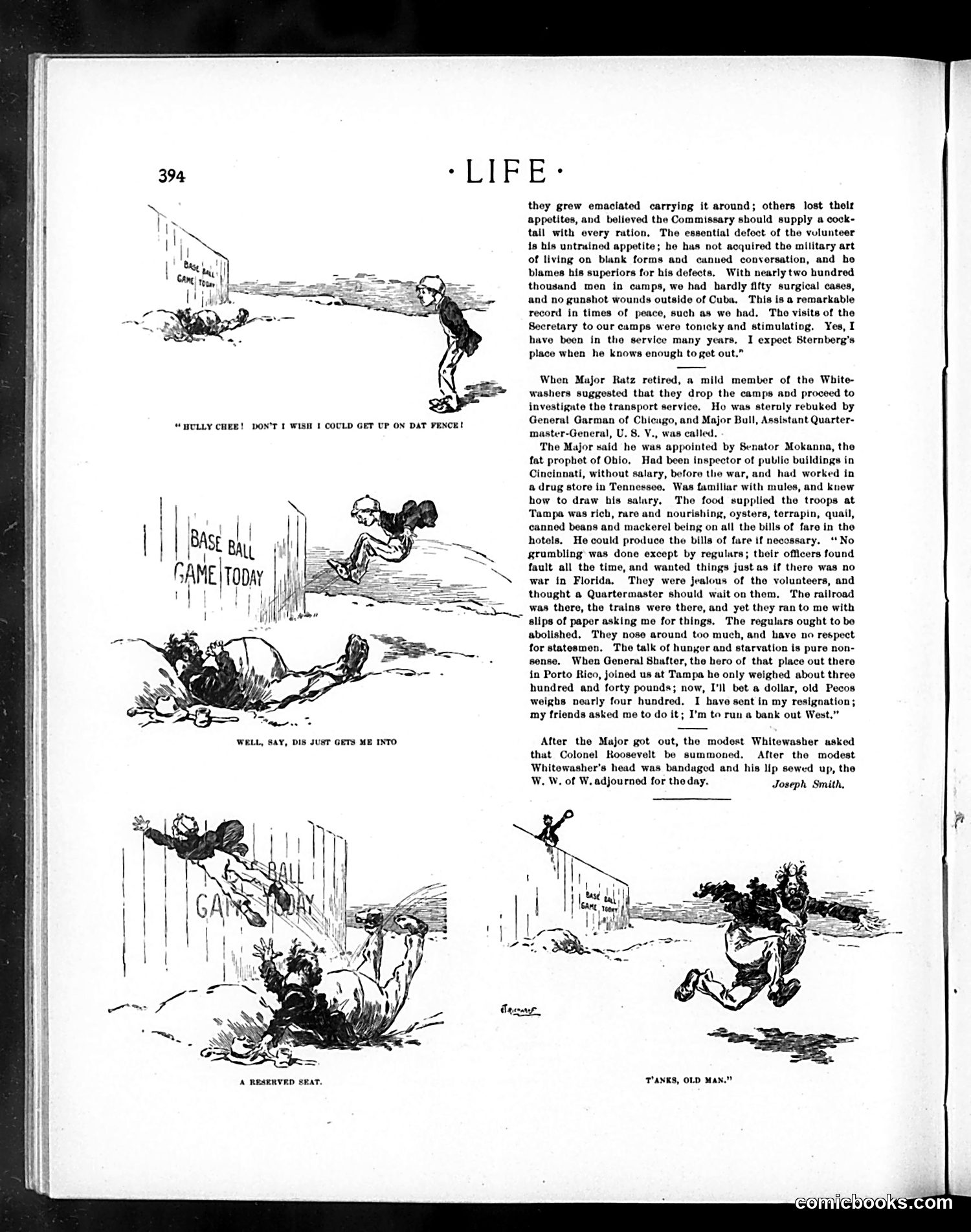
This page satirizes incompetence and corruption in the U.S. military during the Spanish-American War (circa 1898). The text mocks Major Bull, a quartermaster appointed through political patronage by Senator McKanna of Ohio, who claims to have supplied troops lavishly at Tampa despite complaints of poor conditions. The cartoons depict a soldier repeatedly trying to watch a baseball game but being knocked down—a visual metaphor for how ordinary soldiers were obstacles to officers' self-interest. The humor targets Bull's absurd defense that troops ate oysters and terrapin, and his dismissal of regulars' complaints as jealousy of volunteers. The final reference to "Colonel Roosevelt" (likely Theodore Roosevelt) suggests even prominent military figures couldn't escape this bureaucratic chaos. The satire exposes how political appointees prioritized their salaries and reputations over actual soldier welfare, a common Progressive-era critique of government waste and cronyism.
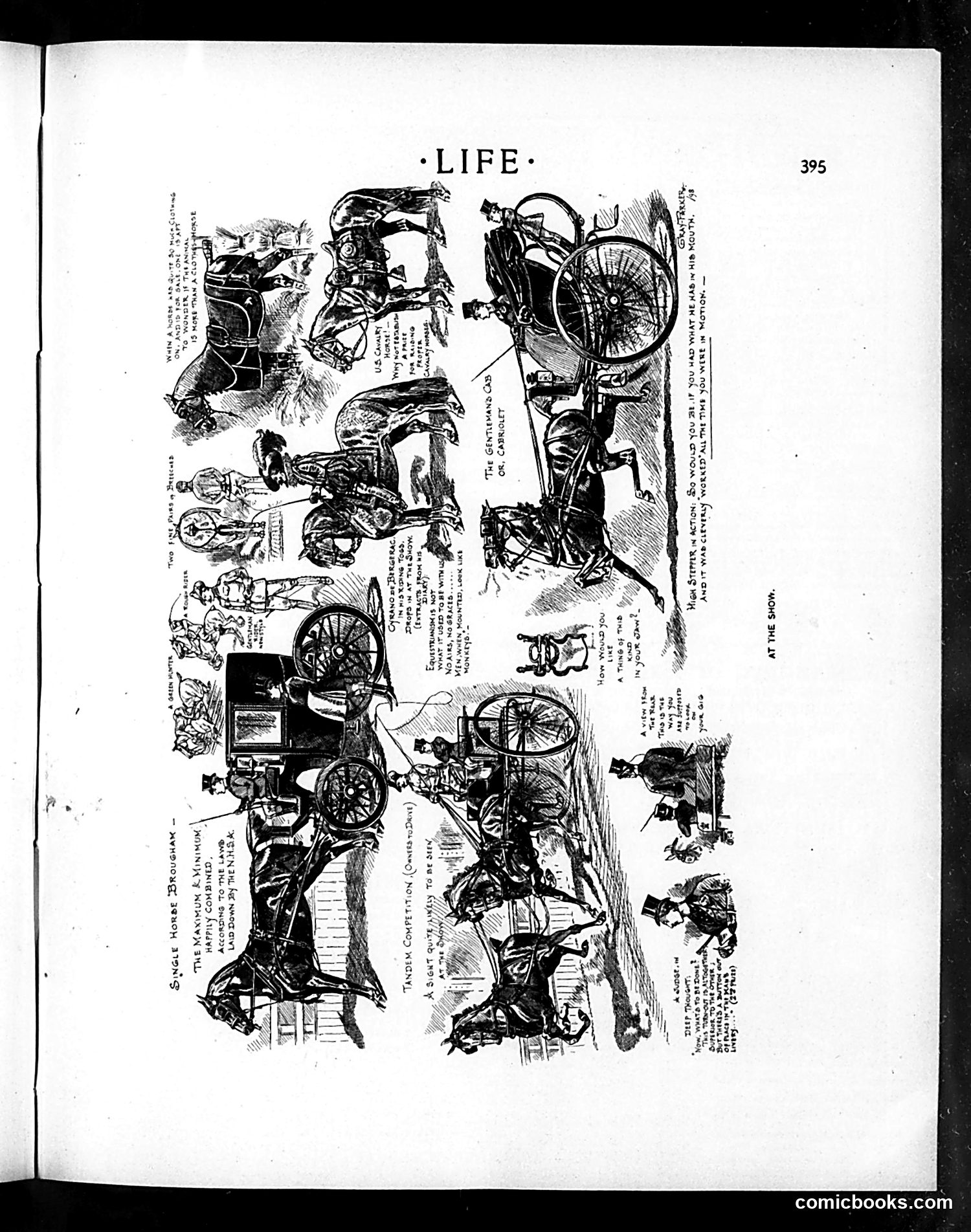
I cannot reliably interpret this page. The OCR text is severely corrupted and unreadable, making it impossible to identify specific figures, references, or satirical points. While the image shows multiple ink sketches of what appear to be motorcycles, riders, and possibly related scenes typical of early 20th-century Life magazine satire, without legible captions or text I cannot accurately explain the political or social commentary intended. To provide accurate historical context, I would need either a clearer OCR transcription or the original source material. I cannot responsibly guess at the meaning.
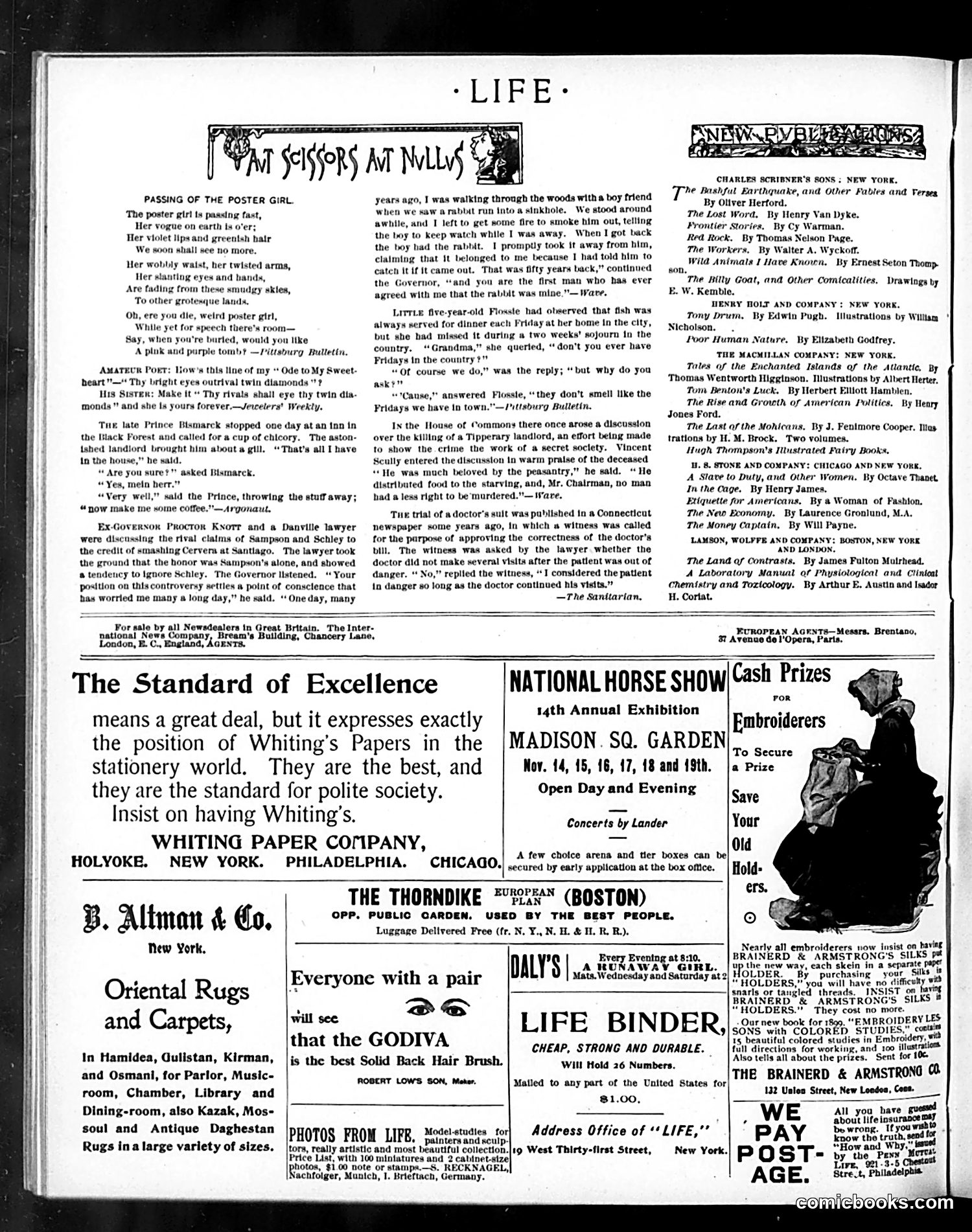
This page contains several humorous short pieces satirizing contemporary life and social foibles, rather than a focused political cartoon. **"Passing of the Poster Girl"** mocks the declining fashion for exaggerated, stylized artistic depictions of women popular in advertising—characterized by "violet lips," "greenish hair," "wobbly waist, twisted arms, staring eyes." The satirist suggests this aesthetic is dying. **Other pieces** satirize pretension and moral hypocrisy: an amateur poet seeking validation, Prince Bismarck demanding proper coffee, a governor defending decades-old rabbit theft through circular reasoning, and a politician praising a murdered landlord's generosity while obscuring class violence. The final anecdote about a doctor's medical necessity is perhaps darkly comedic. The humor relies on absurdity and ironic undercutting of authority figures and artistic pretension—typical of Life's satirical approach in this era. The page primarily features miscellaneous humor columns rather than focused visual satire.
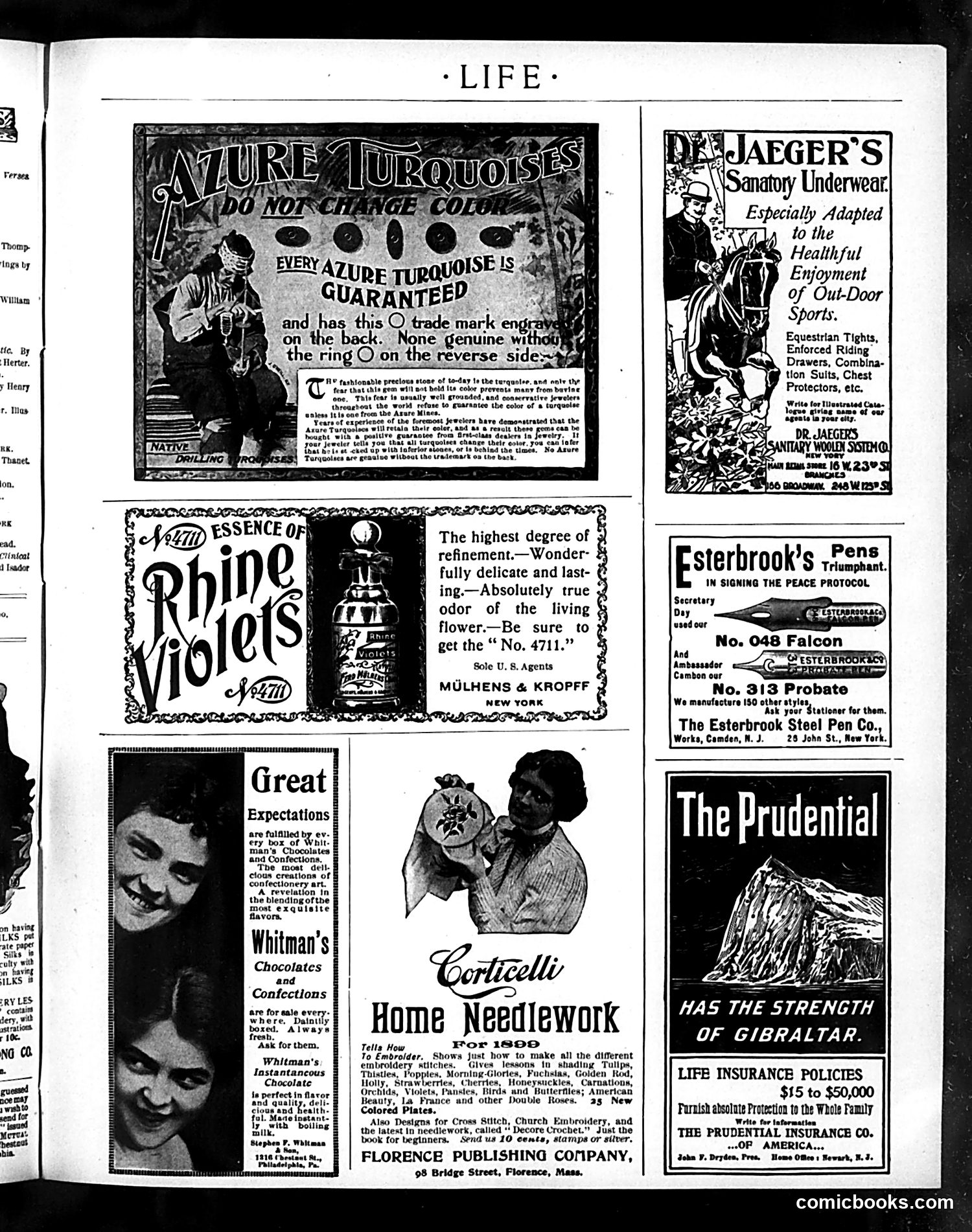
This page is **primarily advertising**, not editorial content or satire. It contains product advertisements from the 1890s era, including: **Notable ads:** - **Azure Turquoises** (top left): Markets genuine turquoise jewelry with a trademark guarantee—addressing consumer fraud concerns about counterfeit stones - **Whitman's Chocolates**: Emphasizes quality and freshness ("always fresh") - **Corticelli Home Needlework**: A how-to manual for embroidery, reflecting late-Victorian domestic crafts culture - **Jaeger's Sanitary Underwear**: Marketed for outdoor sports, showing the era's emerging athletic wear industry - **The Prudential Insurance**: Uses "strength of Gibraltar" as a metaphor for financial security The ads collectively reflect 1890s consumer culture: concerns about authenticity/fraud, domestic feminine crafts, emerging sportswear, and the growth of modern insurance and financial services. There is no apparent political cartoon or satire on this particular page.
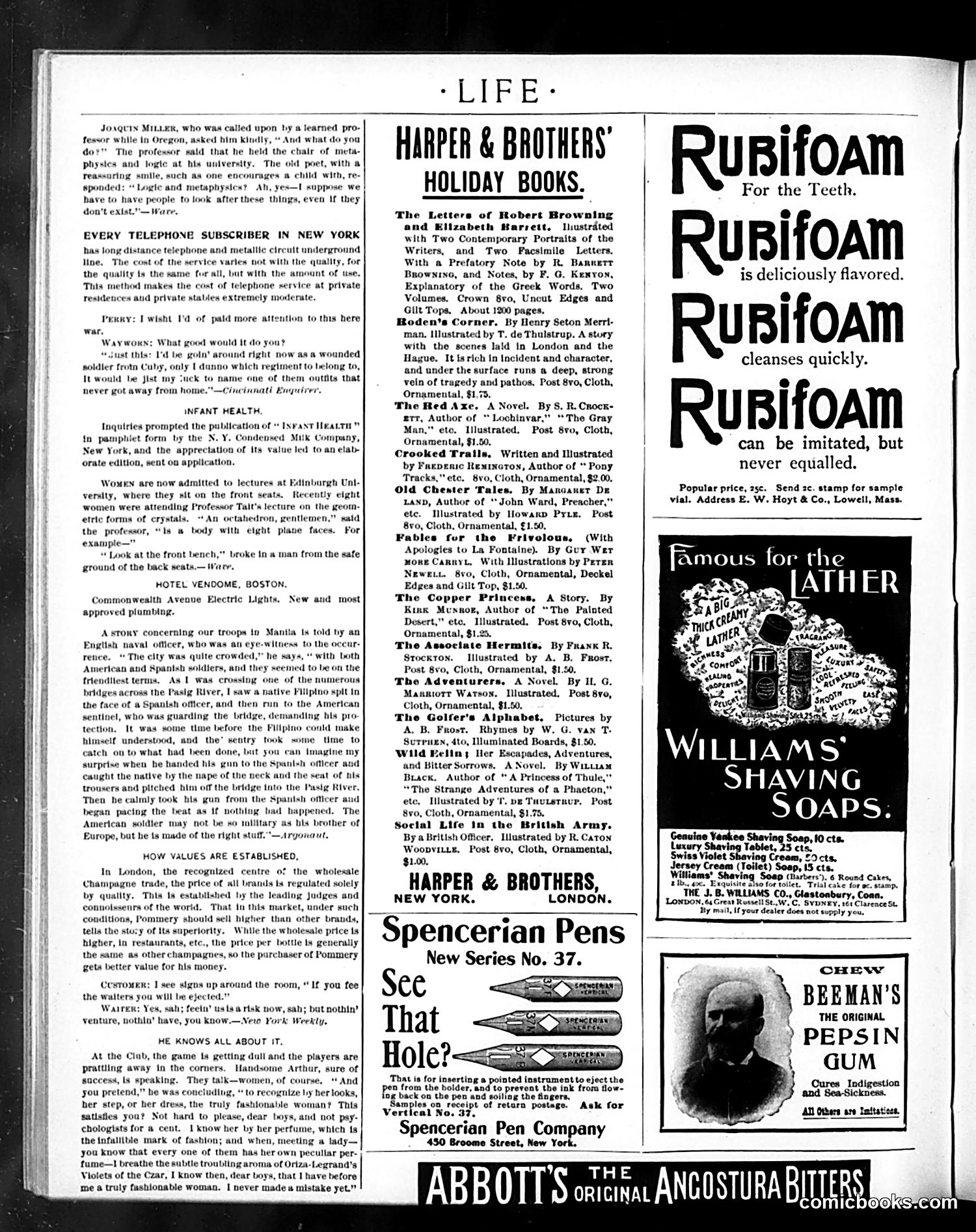
This page is primarily **advertisements and book listings** from *Life* magazine, not political satire. The content includes: **Main Features:** - Harper & Brothers book advertisements (literary works by Browning, Stockton, etc.) - Product advertisements (Rubifoam toothpaste, Williams' Shaving Soaps, Beeman's Pepsin Gum, Abbotts Bitters) - Spencerian Pens advertisement **Satirical Content** (minor): Several short humorous anecdotes appear: - A joke about a soldier uncertain which regiment to join (mocking Spanish-American War confusion) - A joke about women attending university lectures, with a professor using geometric analogies—likely satirizing contemporary debates about women's education - A story about American and Filipino soldiers' friendliness in Manila (post-Spanish-American War period) The page reflects **turn-of-the-century American life**: commercial culture, imperial expansion, and emerging debates about women's roles. The satire is gentle social humor rather than sharp political commentary.
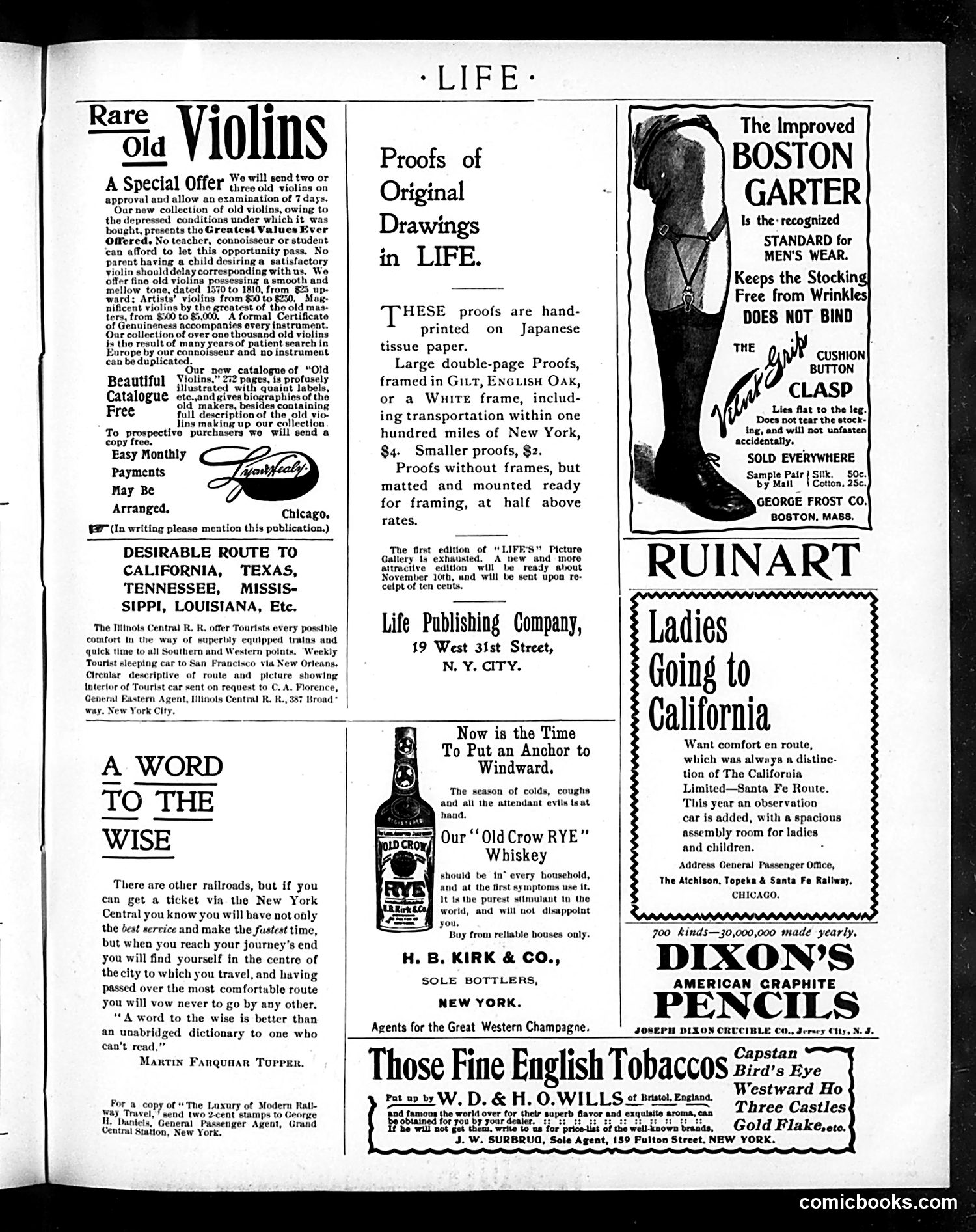
This is primarily an **advertising page**, not a satirical cartoon page. It contains multiple product advertisements typical of early 1900s American magazines: **Notable ads include:** - **Rare Old Violins**: A dealer offering antique instruments from 1570-1810, priced $23-$5,000, with certificates of authenticity - **Life Publishing Company**: Selling hand-printed proofs of original drawings from the magazine - **Railroad ads**: Illinois Central and New York Central promoting tourist routes to the American South and West - **Old Crow Whiskey**: Marketing rye whiskey as a medicinal remedy for colds and coughs - **Boston Garter**: Men's hosiery advertised as wrinkle-free and non-binding - **Dixon's Pencils**: American graphite pencils The page reflects period consumer culture—selling luxury goods (violins, art proofs), transportation, patent medicines marketed as health solutions, and everyday products. There is **no visible political satire** on this page.
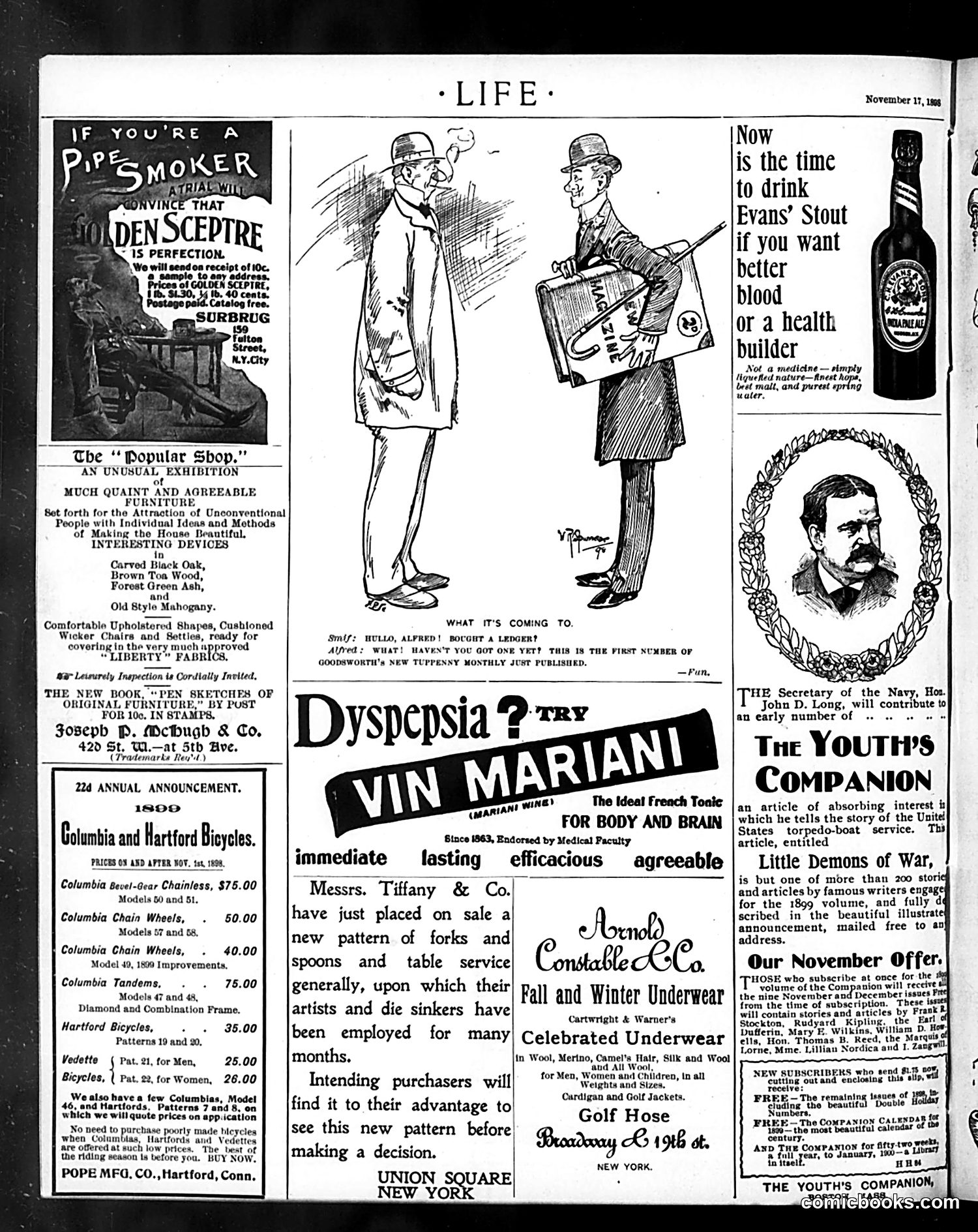
This single-panel cartoon satirizes the proliferation of consumer publications in the 1890s. Two well-dressed men discuss a new "Goodsworth's New Tuppenny Monthly" ledger publication. One character, Alfred, has apparently just purchased it; the other expresses mock surprise that he doesn't already own one. The satire targets the explosion of specialized magazines and trade journals emerging during this era—suggesting that the market is becoming absurdly oversaturated with publications for every conceivable niche interest. The joke hinges on the casual assumption that owning such a ledger/business magazine is now so commonplace that not having one is noteworthy. The cartoon reflects genuine anxiety about 1890s consumer culture and the proliferation of print media competing for readers' attention and money.