
Life, 1898-11-17 · page 4 of 20
Life — November 17, 1898 — page 4: what you’re looking at
What you’re looking at
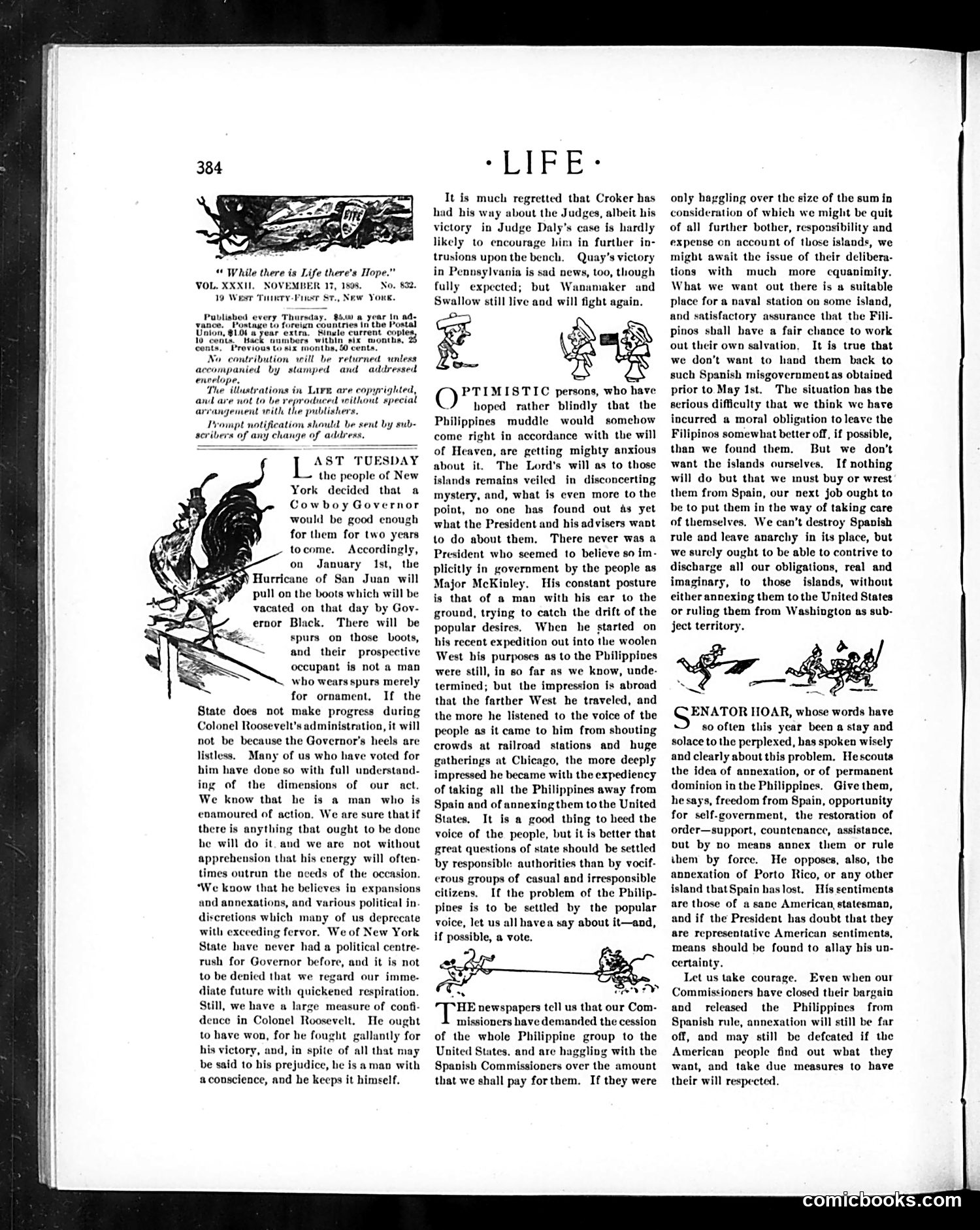
This page from Life magazine contains editorial commentary on the Philippine-American War and debates over Philippine independence. The text discusses President McKinley's administration and the ongoing conflict, arguing that the U.S. should support Filipino self-governance rather than continue Spanish-style colonial rule. The cartoons (small illustrations scattered through the text) appear to depict political figures debating or discussing the Philippines issue, though their specific identities are unclear from the image quality. The satire targets what the editors view as inconsistent American policy: the U.S. fought Spain partly to free the Philippines, yet may annex them instead. The piece criticizes expansionist impulses and advocates for respecting Filipino autonomy—a significant anti-imperialist position for the period.
📄 Transcribed text from this page (OCR, searchable)
Machine-transcribed from the original scan — historical spelling and the odd misread are preserved.
OVEMBER 17, 1898, w Yous. Shu a year In ade ign countries In the Postal ‘tra. Ninwle current coptes, bers within six months, 23 x months, 0 cents, No contribution will be returned unless companied by stamped and addressed envelope. The illustrations in Live are copyrighted, and are not to be reproduced without special arrangement with the publishers, Tompt notification should be sent by sub- soribers of any change of aitress L*} ST TUESDAY the people of New York decided that a Cowboy Governor would be good enough for them for two years tocome. Accordingly, on January Ist, the Hurricane of San Juan will pull on the boots which will be vacated on that day by Gov- eroor Black. There will be spurs on those boots, and their prospective occupant is not a man who wears spurs merely for ornament. If the State does not make progress during Colonel Roosevelt's administration, it will not be because the Governor's heels are listless. Many of us who have voted for him have done so with full understand- ing of the dimensions of our act. We know that he is a man who is evamoured of action, We are sure thatif there is anything that ought to be done he will do it. and we are not without apprehension that his energy will often- times outrun the oceds of the occasion. “We know that he believes in expansions and annexations, and various political in discretions which many of us deprecate with exceeding fervor. We of New York State have never had a political centre- tush for Governor before, and it is not to be denied that we regard our imme- diate future with quickened respiration. Still, we have a large measure of confi- dence in Colonel Roosevelt. He ought to have won, for he fought gallantly for his victory, and, in spite of all that may be said to his prejudice, he is aman with aconscience, and he keeps it himself. LIFE It is much regretted that Croker has had his way about the Judges, albeit his victory in Judge Daly’s case is hardly likely to encourage him in further in- trusions upon the bench, Quay’s victory in Pennsylvania is sad news, too, though fully expected; but Wanamaker and Swallow still live and will fight again. x ane (On IMISTIC persons, who have hoped rather blindly that the On muddle would somehow come right in accordance with the will of Heaven, are getting mighty anxious about it. The Lord's will as to those islands remains veiled in disconcerting mystery, and, what is even more to the point, no one has found out 4s yet what the President and his advisers want to do about them, There never was a President who seemed to believe so im- plicitly in government by the people as Major McKinley. His constant posture is that of a man with his car to the ground, trying to catch the drift of the popular desires. When he started on his recent expedition out into the woolen West his purposes as to the Philippines were still, in so far as we know, unde- termined; but the impression is abroad that the farther West he traveled, and the more he listened to the voice of the people as it came to him from shouting crowds at railroad stations and huge gatherings at Chicago, the more deeply impressed he became with the expediency of taking all the Philippines away from Spain and of annexingthem tothe United States, It is a good thing to heed the voice of the people, but it is better that great questions of state should be settled by responsible authorities than by vocif- erous groups of casual and irresponsible citizens. If the problem of the Philip- pines is to be settled by the popular voice, let us all havea say about it—and, if possible, a vote. HE newspapers tell us that our Com- missioners have demanded the cession of the whole Philippine group to the United States, and are haggling with the Spanish Commissioners over the amount that we shall pay forthem. If they were only haggling over the size of the sum in consideration of which we might be quit of all further bother, responsibility and expense on account of those islands, we might await the issue of their delibera- tions with much more equanimity. What we want out there is a suitable place for a naval station on some island, and satisfactory assurance that the Fili- pinos sball have a fair chance to work out their own salvation, It is true that we don’t want to hand them back to such Spanish misgovernment as obtained prior to May Ist. The situation has the serious difficulty that we think we have incurred a moral obligation to leave the Filipinos somewhat better off, if possible, than we found them. But we don’t want the islands ourselves, If nothing will do but that we must buy or wrest them from Spain, our next job ought to be to put them in the way of taking care of themselves. We can’t destroy Spanish rule and leave anarchy in its place, but we surcly ought to be able to contrive to discharge all our obligations, real and imaginary, to those islands, without either annexing them tothe United States or ruling them from Washington as sub- ject territory. ENATOR HOAR, whose words have so often this year been a stay and solace to the perplexed, has spoken wisely and clearly about this problem. Hescouts the idea of annexation, or of permanent dominion in the Philippines. Give them, he says, freedom from Spain, opportunity for self-government, the restoration of order—support, countenance, assistance, but by no means annex them or rule them by force. He opposes, also, the annexation of Porto Rico, or any other island thatSpain has lost, His sentiments are those of a sane American, statesman, and if the President has doubt that they are representative American sentiments, means should be found to allay his un- certainty. Let us take courage. Even when our Commissioners have closed their bargain and released the Philippines from Spanish rule, annexation will still be far off, and may still be defeated if the American people find out what they want, and take due measures to have their will respected. icbooks.com