
A complete issue · 20 pages · 1898
Life — January 27, 1898
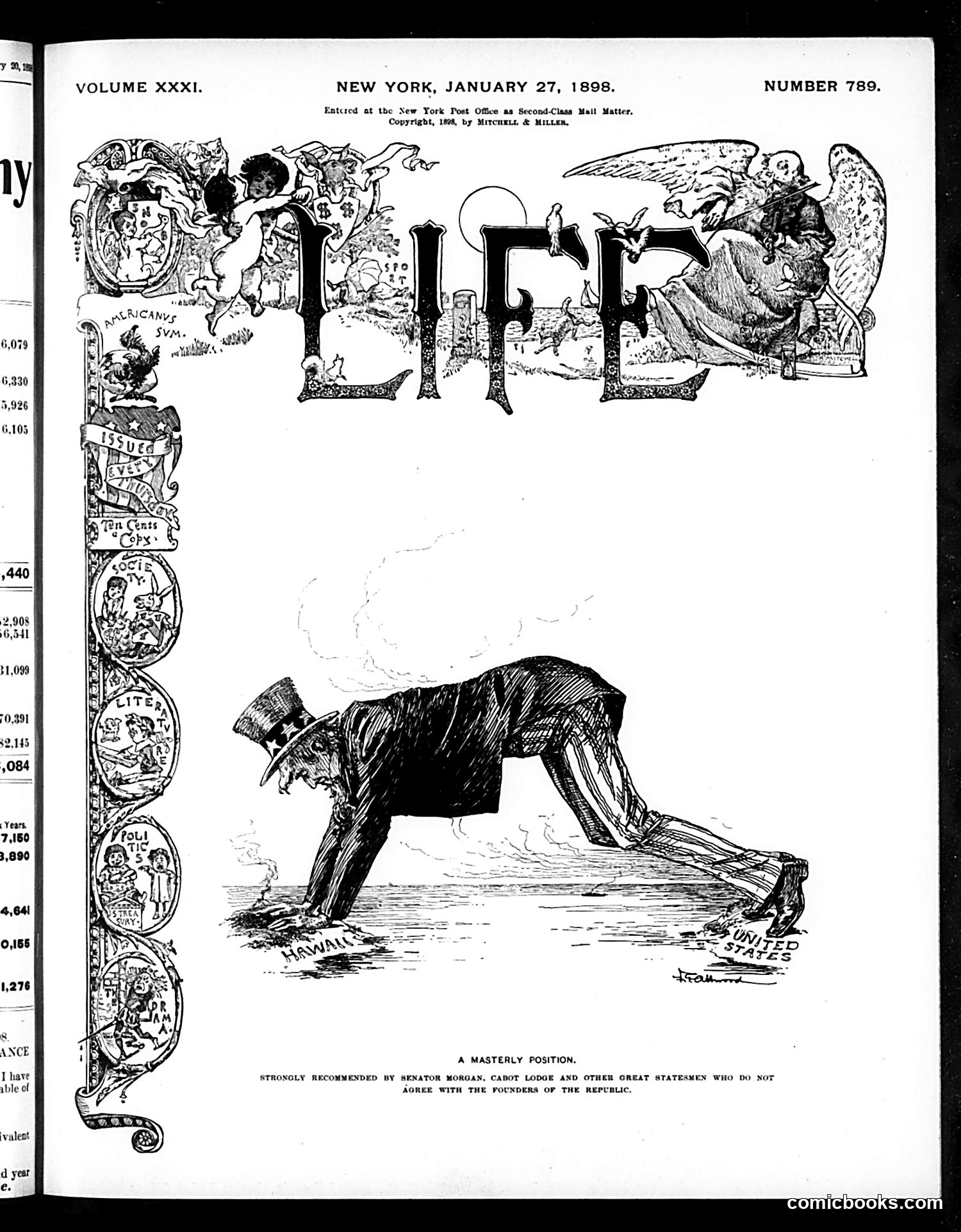
This is the cover of *Life* magazine from January 27, 1898 (Volume XXXI, Number 789). The main cartoon, titled "A Masterly Position," depicts a man in formal dress bent over in an awkward, submissive posture near water labeled "Hawaii" and "United States." The caption states it was "strongly recommended by Senator Morgan, Cabot Lodge and other great statesmen who do not agree with the founders of the Republic." This satirizes the annexation of Hawaii, which occurred in 1898. The cartoon mocks pro-annexation politicians (Morgan and Lodge were imperialist Republicans) by showing the compromised position America adopts through imperialism—visually suggesting that pursuing overseas expansion contradicts American founding principles. The bent figure represents America's departure from its democratic ideals.
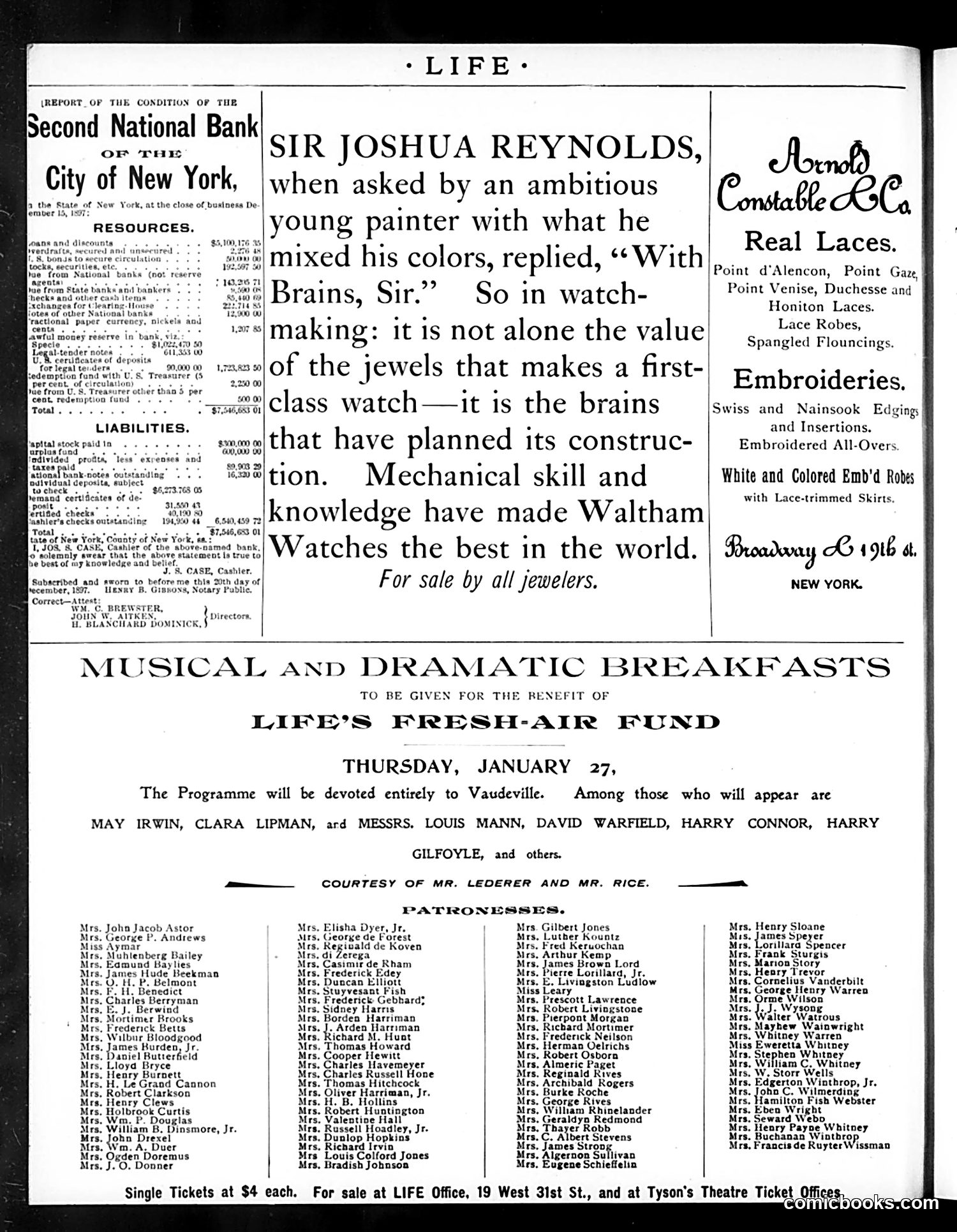
This page contains **no political cartoons or satirical illustrations**. Instead, it consists primarily of: 1. **Financial reporting** (left column): Bank statement for the Second National Bank of New York 2. **Advertisements** (right side): Arnold Constable & Co. luxury lace and embroidery goods; Waltham Watches 3. **Event announcement** (center/bottom): Musical and dramatic breakfasts benefiting Life's Fresh-Air Fund, scheduled for January 27, featuring performers like May Irwin and Clara Lipman 4. **Patroness list** (bottom): Extensive names of prominent society women supporting the fundraiser The only potentially meaningful content is the Waltham Watches ad, which features a quote attributed to Sir Joshua Reynolds about craftsmanship—a standard advertising appeal to quality and refinement rather than satire.
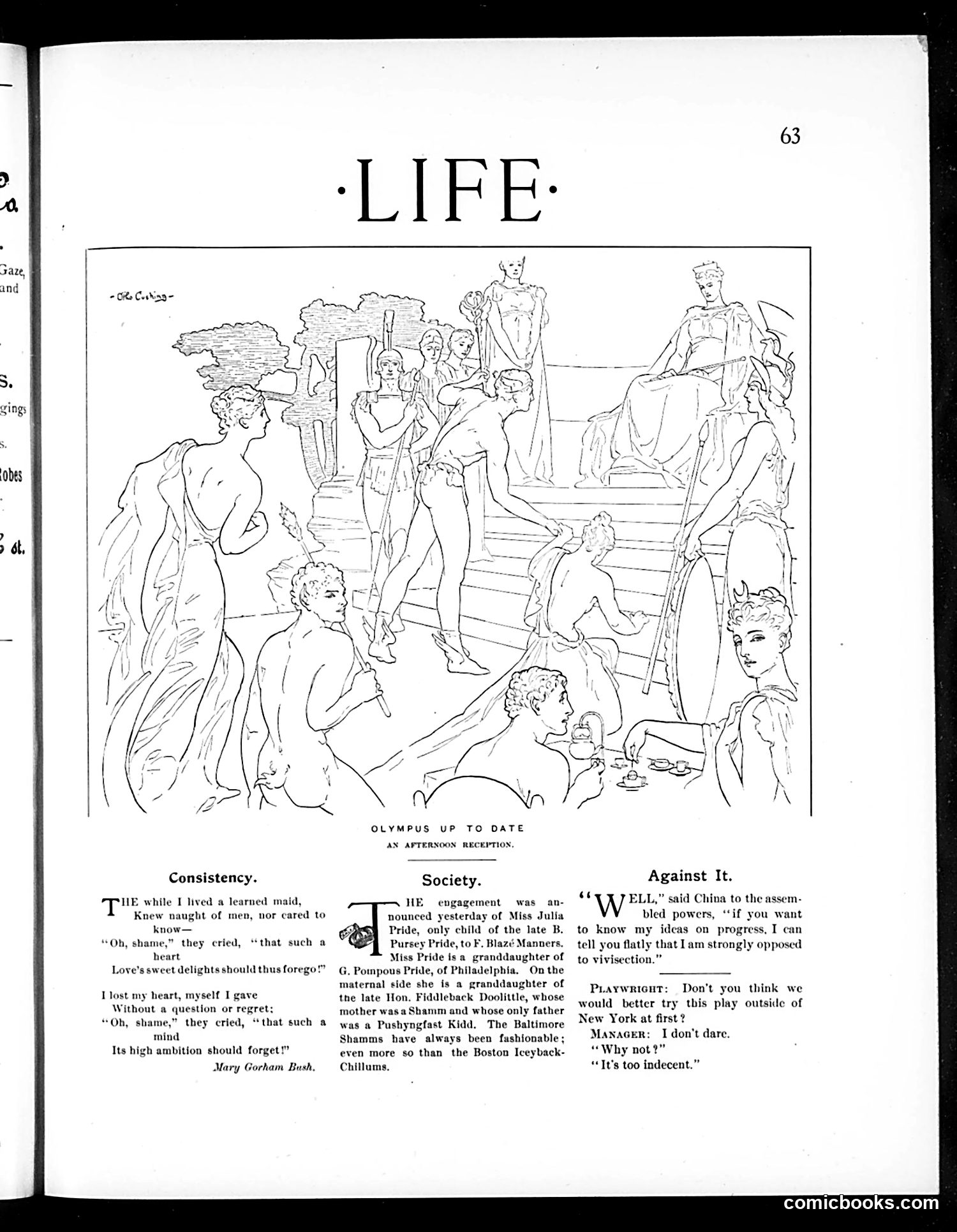
This satirical cartoon depicts classical Greek gods and goddesses attending a modern social gathering, presented as an "afternoon reception." The image juxtaposes ancient mythology with contemporary (early 20th century) high society customs. The accompanying text discusses social etiquette, including a mention of "Miss Julia Pride" and references to Philadelphia's prominent Pursey and Doolittle families. The three short pieces address consistency in love, proper society behavior, and objections to theatrical presentations. The satire likely mocks the pretensions of elite society—suggesting that even mythological figures, if transported to modern times, would engage in the same shallow social conventions and gossip as contemporary high society. The classical aesthetic mixed with modern social commentary was typical of *Life* magazine's humor.
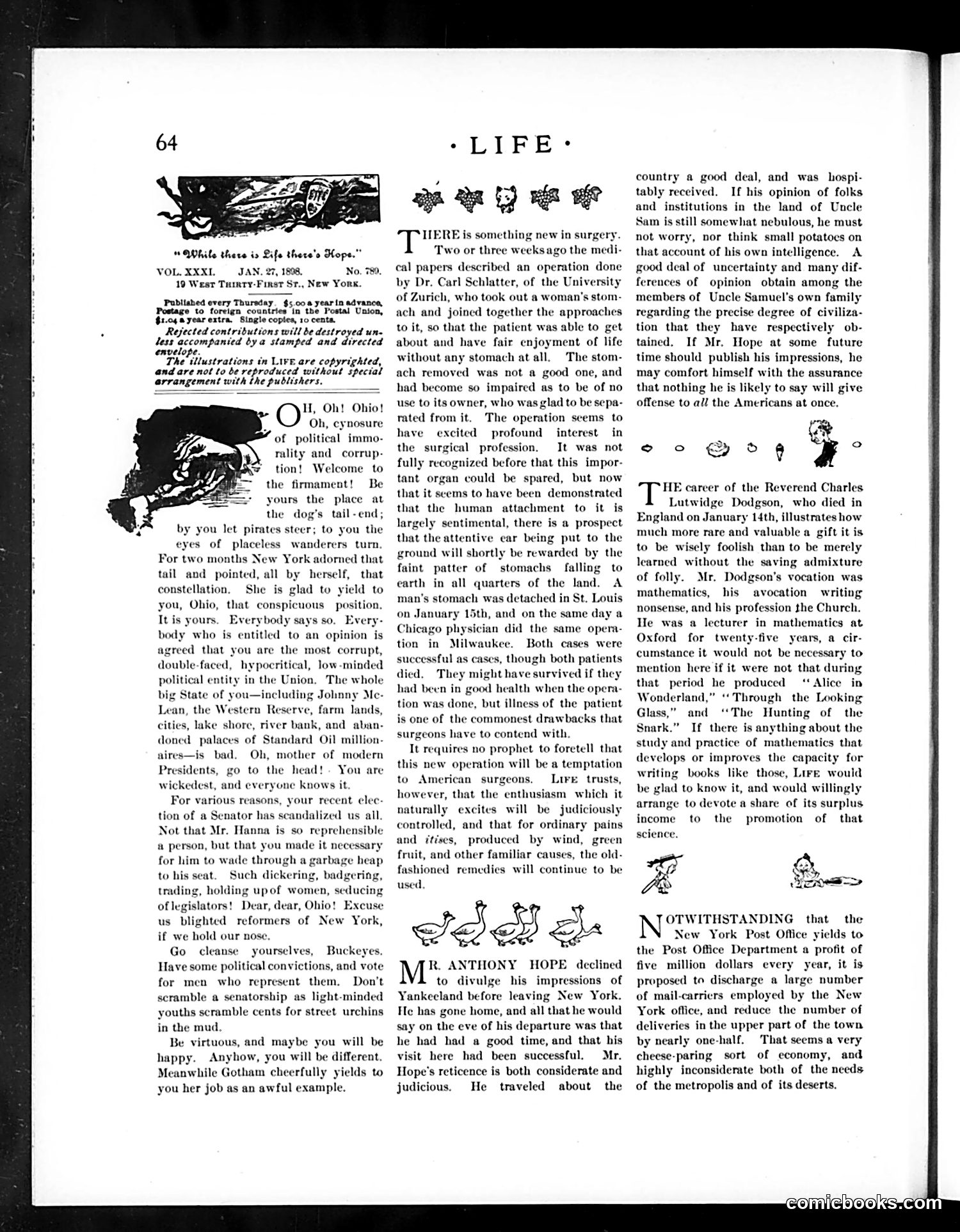
The page contains two distinct political cartoons: **"While there is Life there's Hope"** (top): A satirical attack on Ohio political corruption. The cartoon depicts a figure labeled as representing Ohio politics, criticized for widespread corruption and graft. The accompanying text scorns Ohio as "the wickedest" state, accusing its politicians of embezzling public funds and manipulating elections. The satire calls Ohio's political establishment hopelessly corrupt and urges reform. **"Oh! Oh! Ohio!"** (bottom left): Uses a caricatured dog's tail to represent Ohio's political corruption. The text mocks Ohio's recent senatorial scandal, suggesting the state is so morally compromised that reform seems impossible. Both cartoons target Ohio as emblematic of American political corruption during this Gilded Age period, presenting the state as hopelessly compromised by venality and graft.
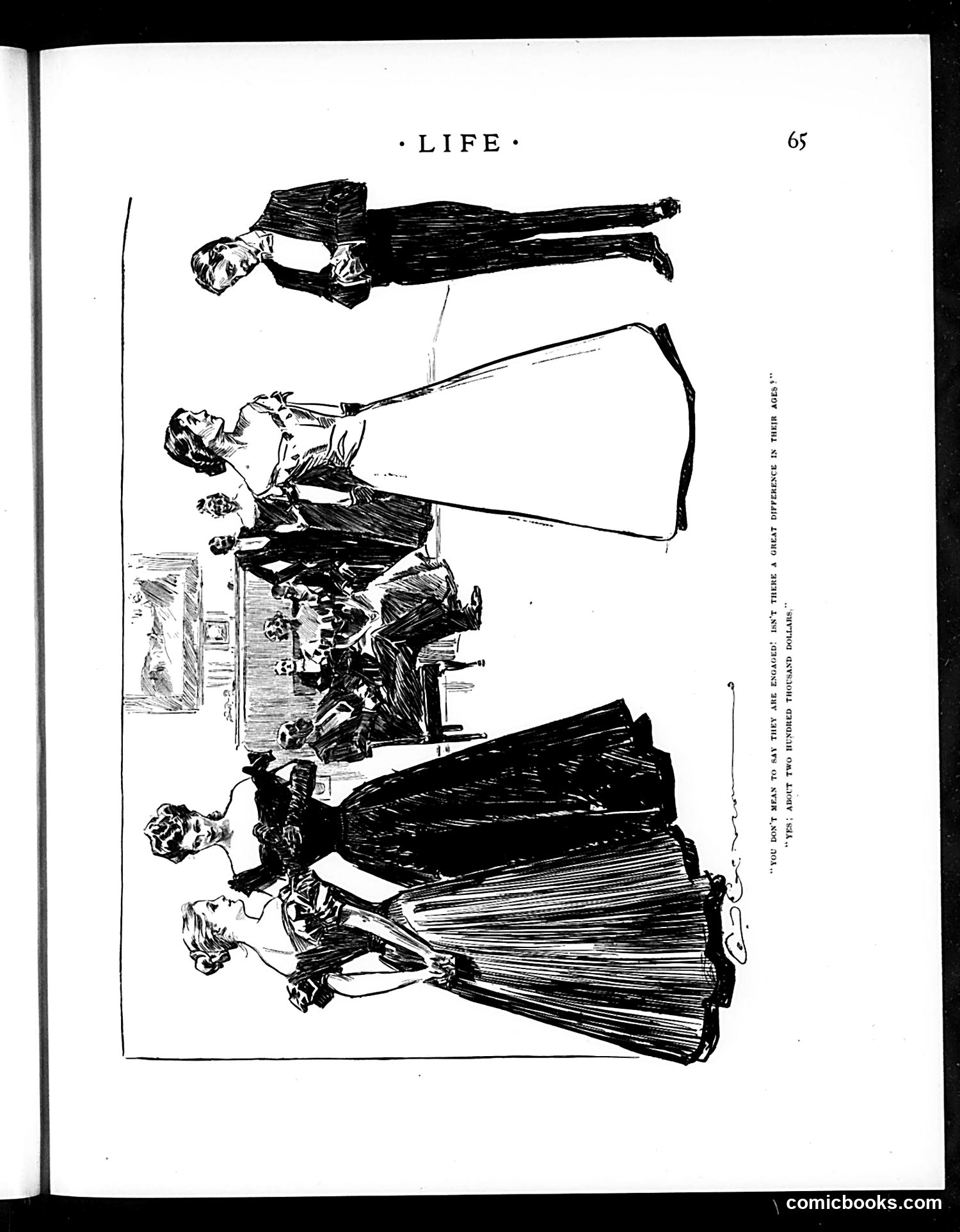
This page presents a satirical illustration turned sideways, depicting what appears to be a social or political scene. The image shows multiple figures in formal dress arranged around a central female figure in an elaborate ball gown, suggesting a society event or formal gathering. The caption (partially visible on the right margin) references "a make-believe in this life" and mentions "two prominent wrinkles." Without clearer text visibility, the specific satire targets remain unclear—likely critiquing either high society pretensions, fashion absurdities, or a particular social scandal contemporary to Life magazine's publication period. The figures' exaggerated proportions and expressions suggest mockery of vanity or superficiality in elite circles.
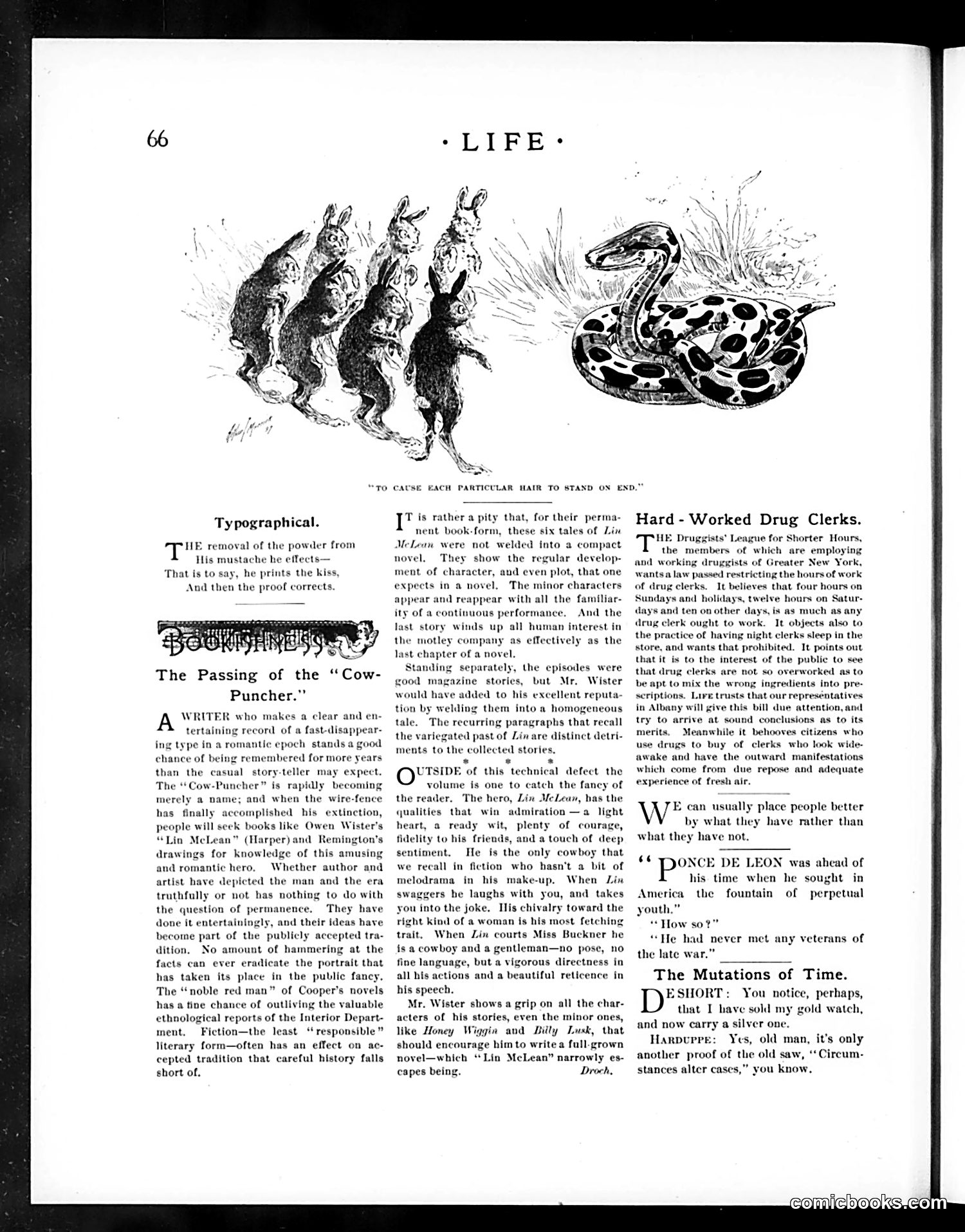
The page contains two distinct illustrations: **Top cartoon**: Shows rabbits in a line (appearing to demonstrate something) alongside a patterned snake. The caption reads "TO CAUSE EACH PARTICULAR HAIR TO STAND ON END." This appears to be a visual pun about fear or fright—the rabbits' reaction to the snake exemplifies the expression "making one's hair stand on end." **Text content**: The remainder discusses literary criticism of works by Lin McLean and other stories. Articles include "Typographical" (about punctuation/editing), "The Passing of the Cow-Puncher" (examining a fictional character type), and "Hard-Worked Drug Clerks" (advocacy piece about working conditions). The page primarily consists of book reviews and social commentary rather than political satire. The cartoon serves as a simple visual joke illustrating an idiom.
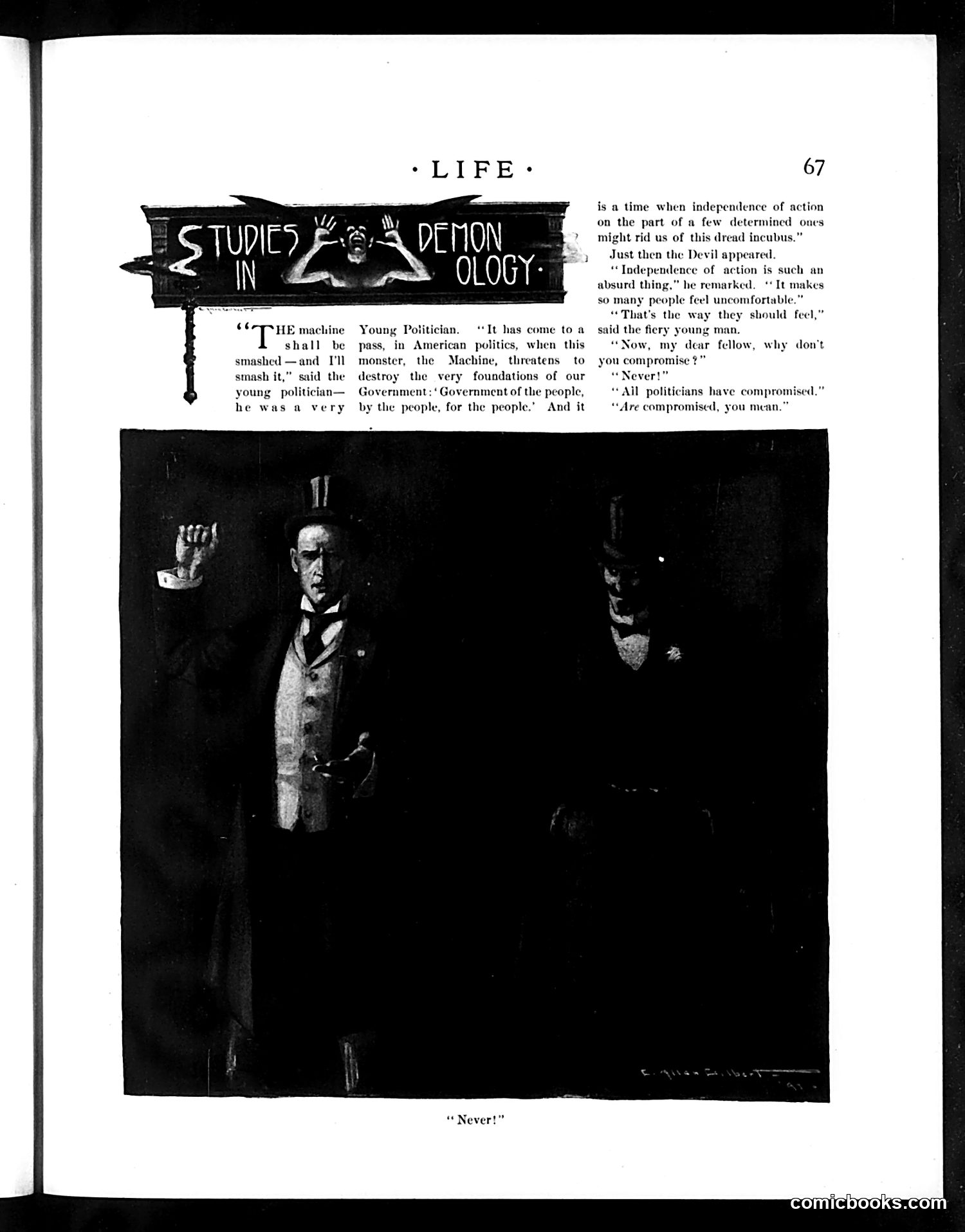
This satirical piece depicts a confrontation between a young politician and what appears to be the Devil (indicated by the horns visible above). The young politician declares the machine will be "smashed" to destroy the foundations of government—specifically rejecting the idea that government exists "of the people, by the people, for the people." The Devil responds that such "independence of action" is absurd and makes people uncomfortable. When the politician insists he'll never compromise, the Devil counters that "all politicians have compromised." The cartoon's satire mocks idealistic young politicians who claim they'll reform the system while remaining unmoved by practical realities. It suggests political corruption is so fundamental that even the Devil knows compromise is inevitable.
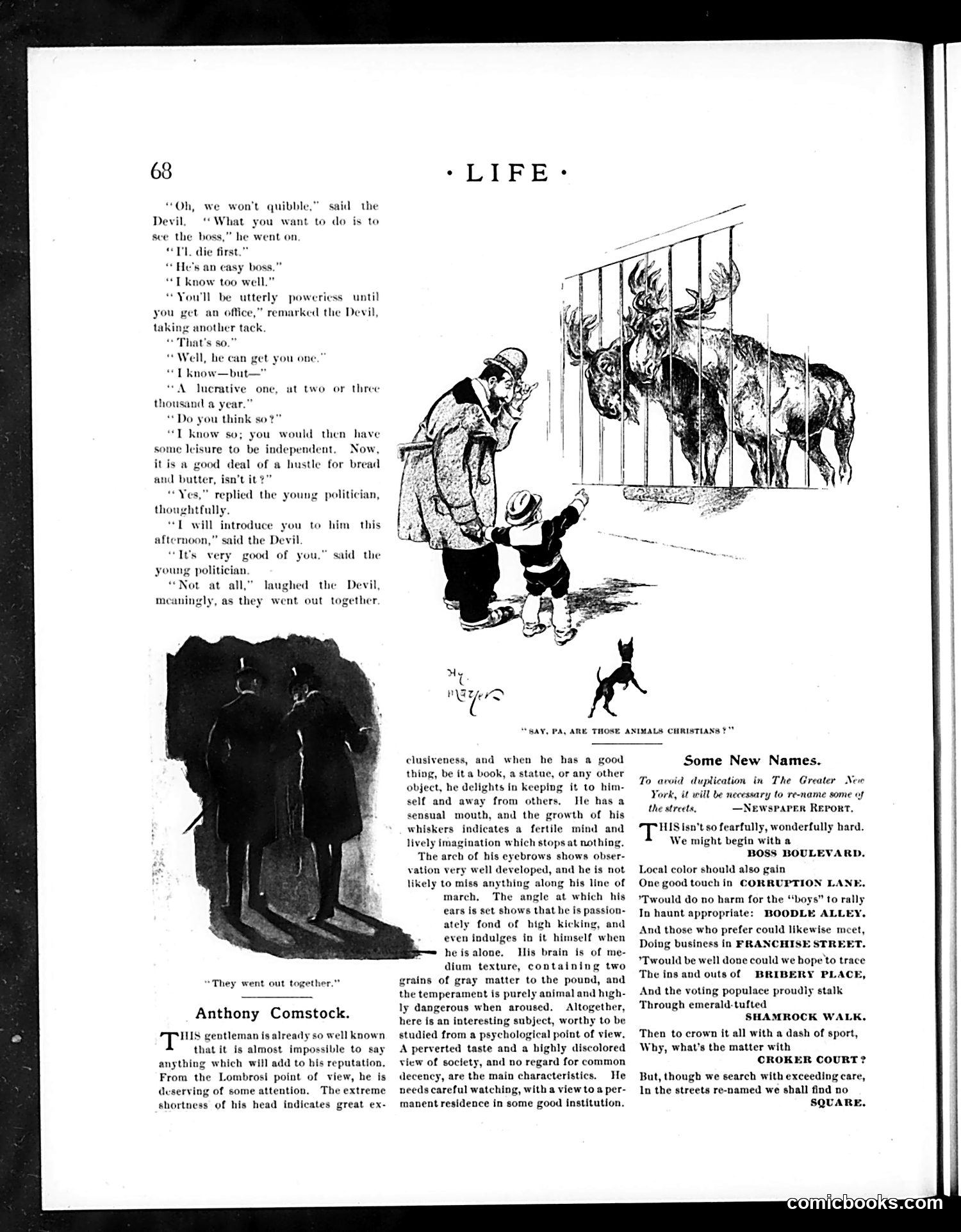
The main cartoon depicts a dialogue between the Devil and a young politician about obtaining wealth. The Devil suggests the politician needs an office and leisure income (from bread and butter money) to gain independence—a satirical commentary on political corruption and graft. The phrase "I'll introduce you to him this afternoon" implies the Devil will connect the politician to someone who can facilitate this corrupt arrangement. The secondary cartoon shows what appears to be a donkey or mule in a cage being viewed by figures outside, with the caption "SAY, PA, ARE THOSE ANIMALS CHRISTIANS?"—likely satirizing hypocrisy in religious communities regarding animal treatment or broader moral failings. The "Some New Names" section proposes humorous street name changes for New York locations, mocking urban political corruption and vice districts through wordplay.
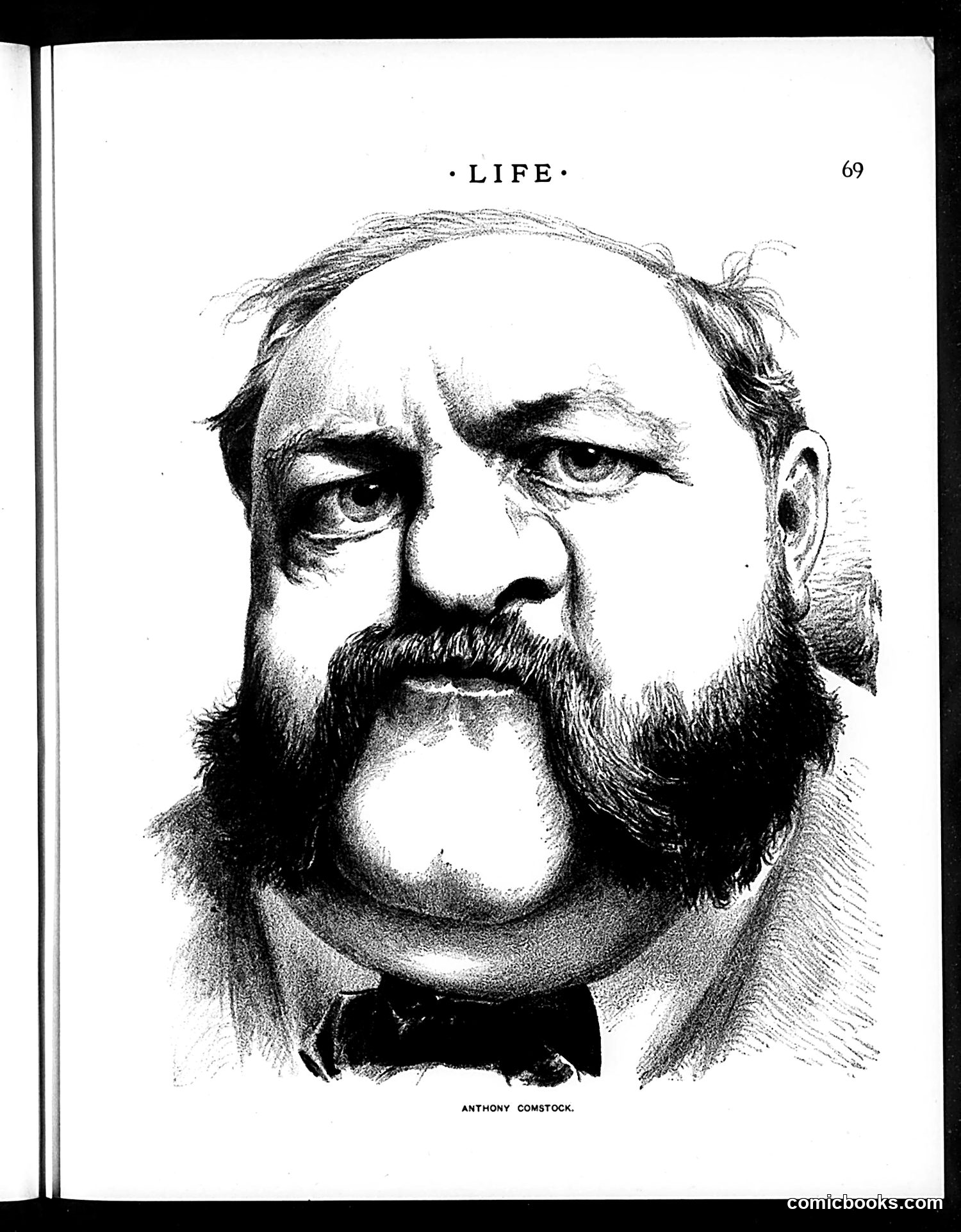
This page from *Life* magazine (page 69) features a detailed engraved portrait of **Anthony Comstock**, identified by the caption below the image. Comstock was a prominent American moral crusader and anti-obscenity activist who founded the New York Society for the Suppression of Vice. The portrait emphasizes his stern, bearded appearance and serious expression, which reflects his public image as an uncompromising enforcer of Victorian morality. Given *Life*'s satirical nature, this portrait likely accompanied commentary critiquing Comstock's aggressive censorship campaigns and his influence on American culture during the late 19th century. The dignified rendering contrasts ironically with *Life*'s typically mocking editorial stance toward such figures.
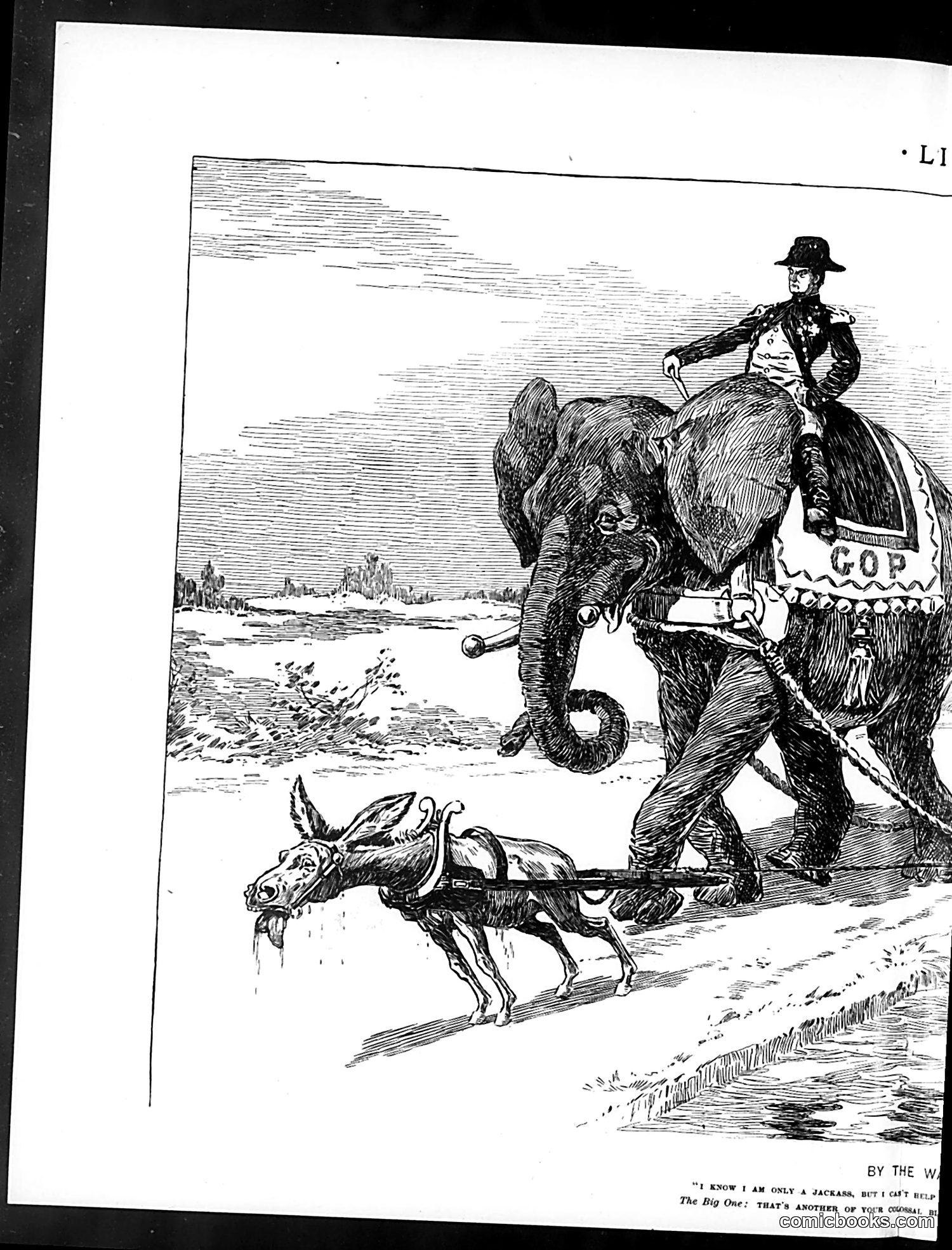
This is a satirical cartoon showing a man riding an elephant labeled "COP" (likely referring to a police force or constabulary), with a donkey pulling alongside. The caption reads: "I KNOW I AM ONLY A JACKASS, BUT I CAN'T HELP..." The satire appears to critique colonial or imperial administration—possibly British rule in India, given the elephant imagery. The "jackass" (donkey) represents someone of lesser status or intelligence, while the elephant represents institutional power or authority. The joke suggests that even someone of humble capability is compelled to participate in or support an oppressive system. The landscape in the background suggests a colonial setting. This likely comments on how ordinary people become complicit in larger power structures, even unwillingly.
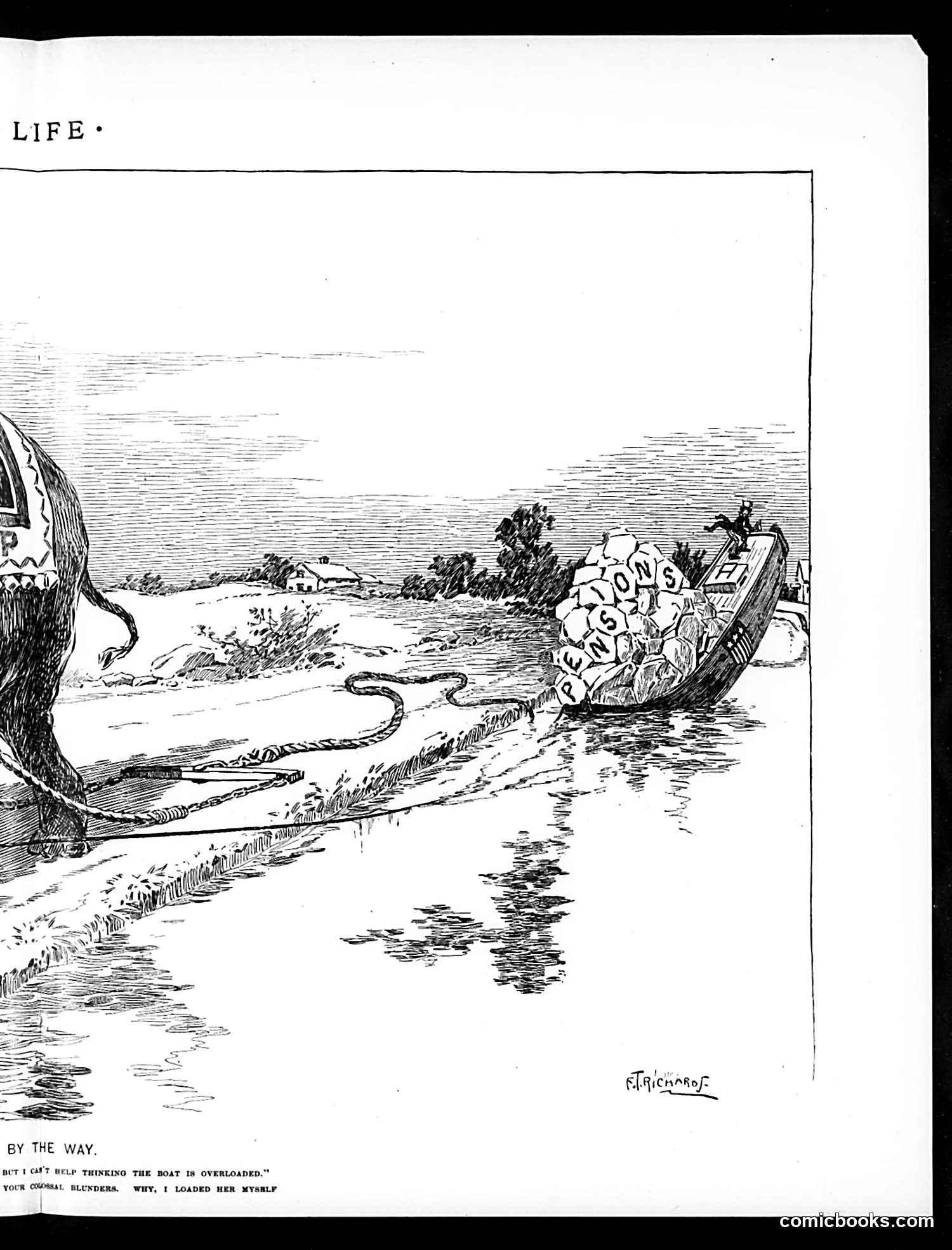
This is a satirical cartoon titled "By the Way" from *Life* magazine. It depicts an oversized, menacing octopus on the left side of the image, with a boat labeled "POLITICIANS" capsizing in water to the right, laden with what appear to be logs or cargo. The caption reads: "BUT I CAN'T HELP THINKING THE BOAT IS OVERLOADED," YOUR COLONIAL BLUNDERER. WHY, I LOADED HER MYSELF." The octopus appears to represent a colonial power (likely Britain, given the reference to "colonial blunderer"), while the overloaded boat represents politicians or government leadership. The satire suggests that those in power have overextended themselves or made poor decisions, creating an unstable situation—ironically, the very authority figure responsible for the overloading claims innocence when disaster strikes.
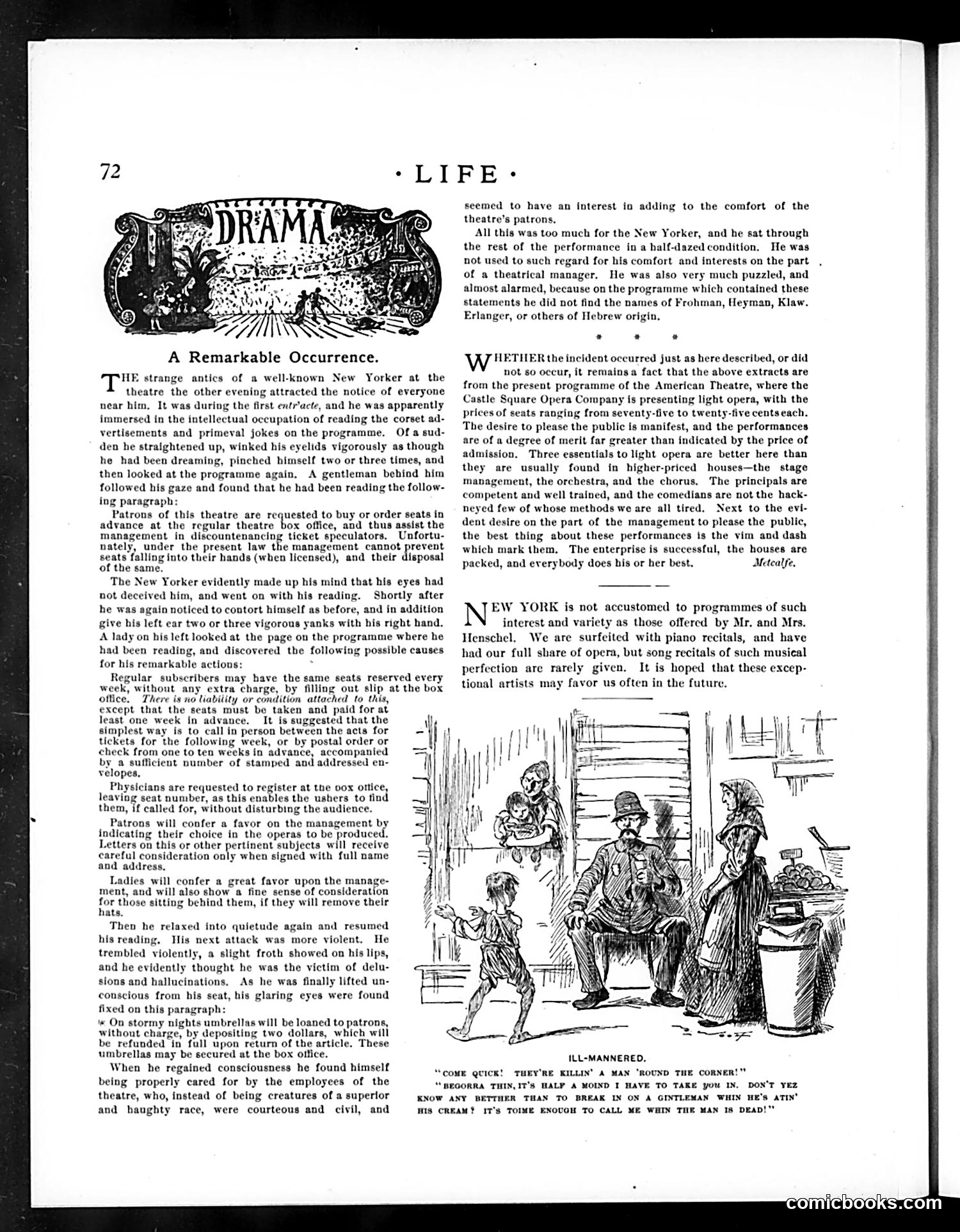
This page contains a drama column titled "A Remarkable Occurrence," discussing a New Yorker's disruptive behavior at a theater. The man apparently grew agitated during a performance, winked vigorously, and knocked his eyeglasses off while reading the program—seemingly unable to find the names of performers he expected (Frohman, Heyman, Kiaw-Erlanger, or others of "Hebrew origin"). The accompanying sketch, captioned "Ill-Mannered," depicts this same man creating a scene. The satire targets both his antisemitic expectations about theater management and his disruptive public conduct. The column criticizes his behavior while also noting the theater's actual merit in presenting quality performances, suggesting the man's prejudices were unfounded and his conduct embarrassing.
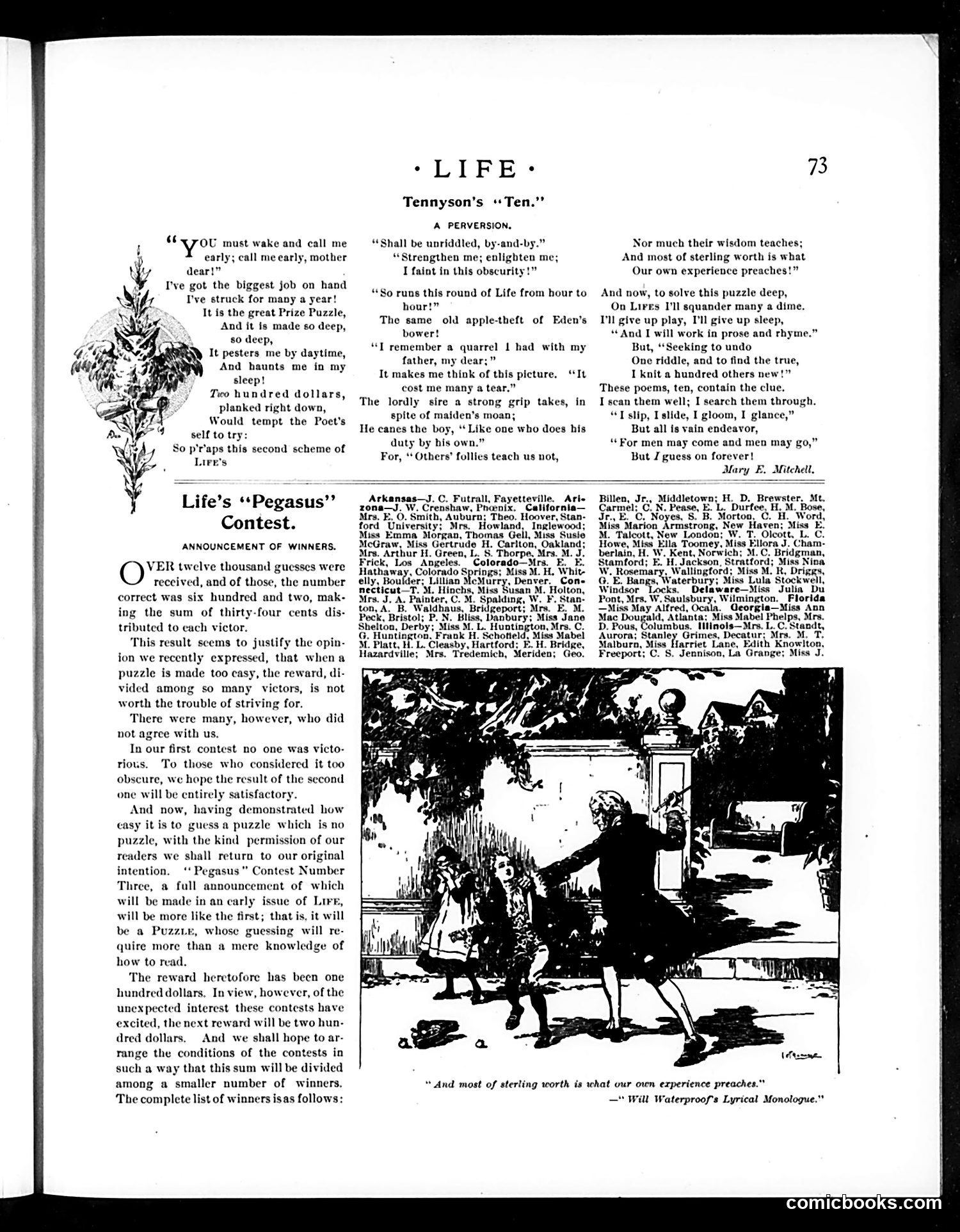
This page announces results of Life magazine's "Pegasus" puzzle contest—a creative competition where readers submitted solutions to a riddle. The main content includes: **Contest Results:** Over 12,000 entries were received, but only 602 were correct. Life editors comment that dividing the $200 prize among so many winners (about 34 cents each) made the effort worthless—demonstrating that when puzzles are too easy, the reward becomes trivial. **The Satire:** The editors mock the contest's mediocrity and announce they'll make the next puzzle genuinely difficult, worthy of actual effort. **Accompanying Poem:** "Tennyson's Ten" (a parody of Tennyson's poetry) humorously depicts someone obsessively struggling to solve puzzles, referencing the literary effort involved. **Bottom Image:** An illustration, likely depicting puzzle-solving frustration or domestic chaos. The page primarily documents this contest outcome and announces future plans—it's essentially administrative content dressed up with literary humor typical of Life's satirical style.
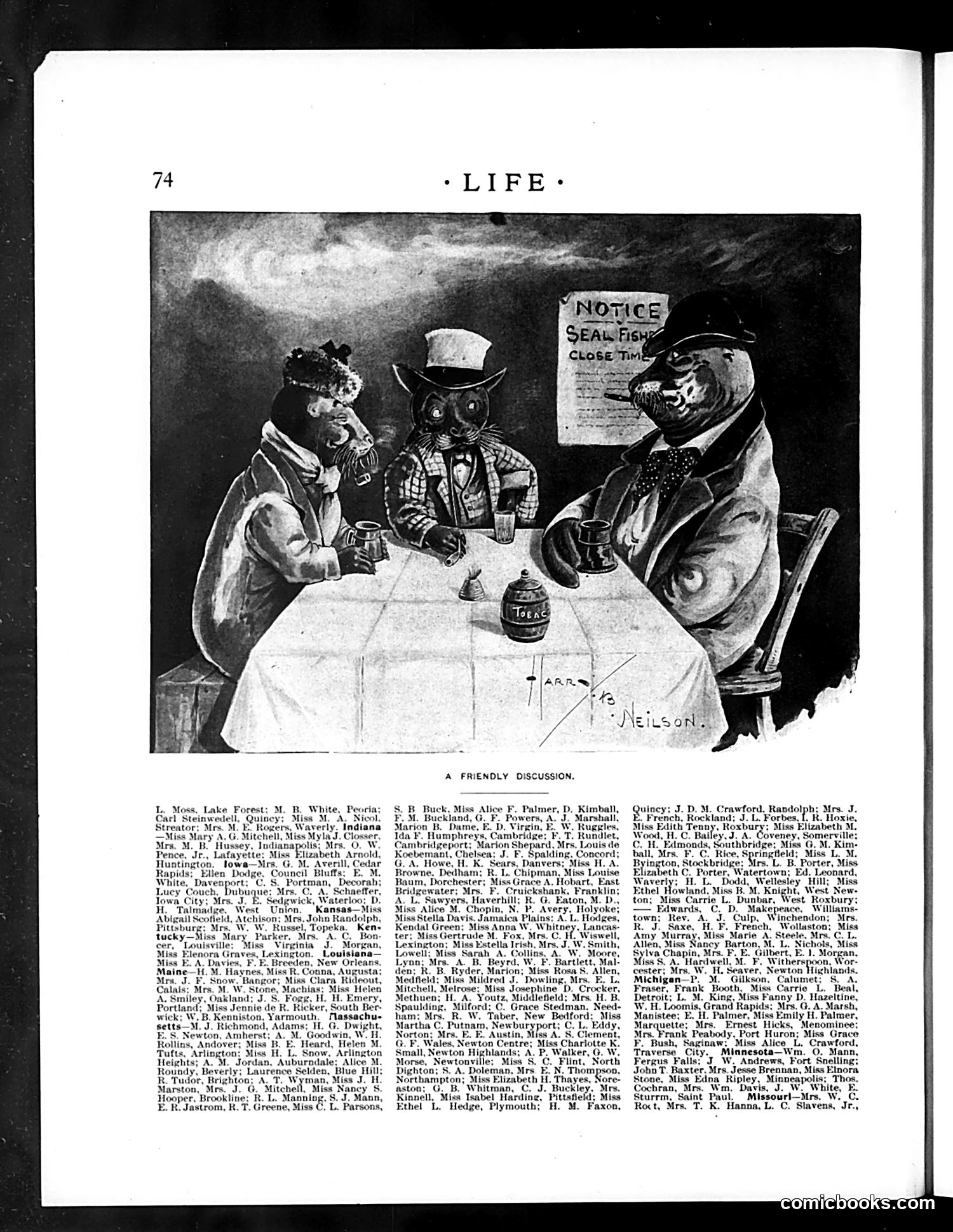
This cartoon depicts anthropomorphized animals—appearing to be a beaver, owl, and bear—seated around a table in what looks like a tavern or meeting place. A "Notice" about "Seal Fish Close Time" hangs on the wall behind them, and a bottle (marked "BEER") sits on the table. The satire likely comments on **game and fishing regulations** of the era, with the animals ironically discussing conservation laws while apparently violating them through their gathering and drinking. The title "A Friendly Discussion" suggests these competitors or regulated parties are meeting to negotiate or conspire around the very restrictions meant to govern their activities. The cartoon appears to be social commentary on how regulated industries or resource users respond to government restrictions—through informal discussion and potential circumvention rather than compliance. The extensive list of names below represents attendees at what Life magazine presented as a real social event.
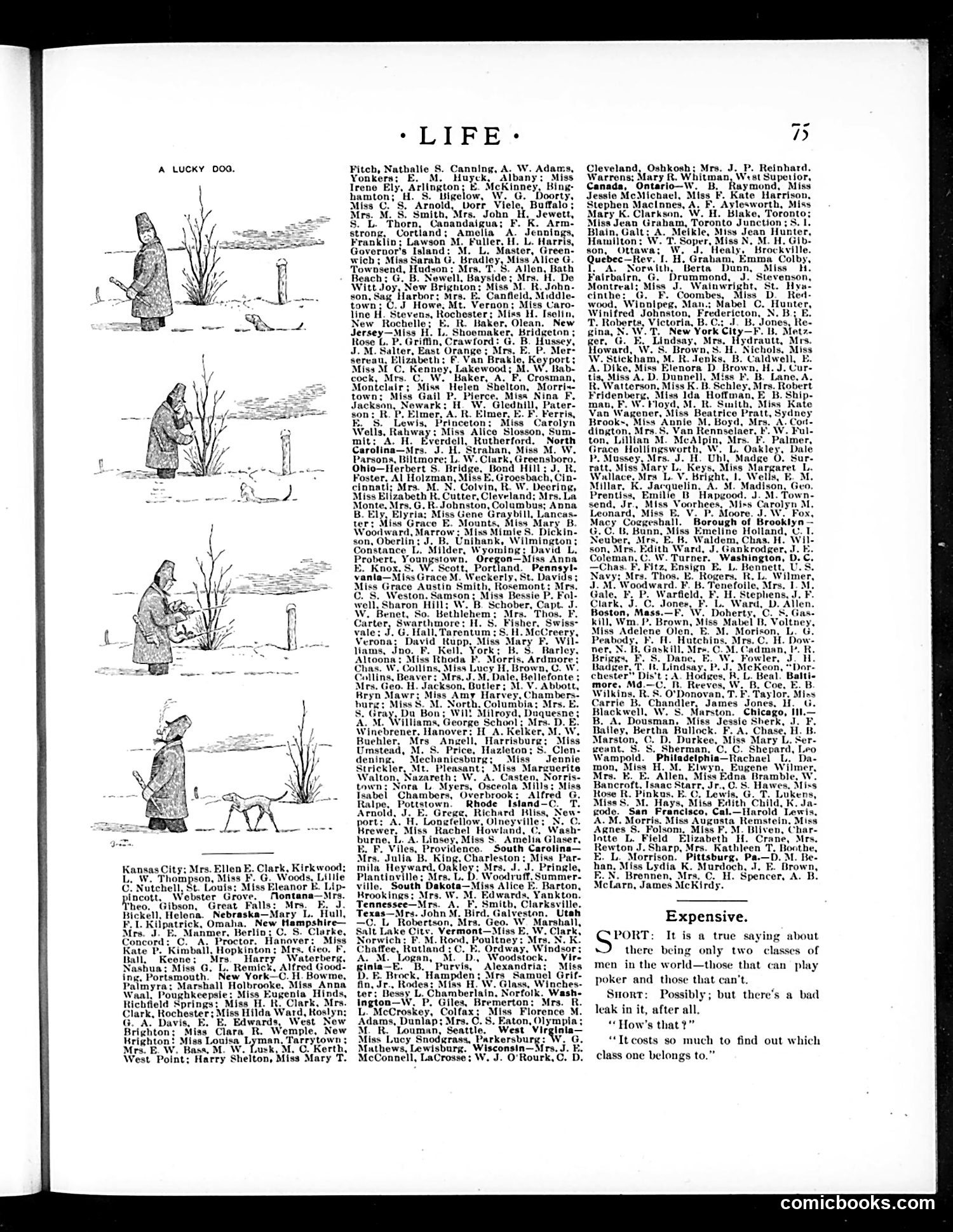
This page features four similar cartoon panels showing a woman repeatedly encountering a dog near a fence post. The humor appears to rest on visual repetition and the dog's apparent "luck" in the encounter. The bulk of the page is a subscriber directory listing names and towns across American states (Kansas through Rhode Island visible here), indicating this is from Life's subscription records. The cartoon's joke likely plays on period comedy conventions—possibly suggesting the woman is unlucky while the dog is fortunate, or vice versa, though the specific satirical point is unclear without additional context. The simple, repetitive staging was typical of Life's humorous illustrations of everyday domestic scenes. The page itself serves primarily as a directory record rather than political or social commentary.
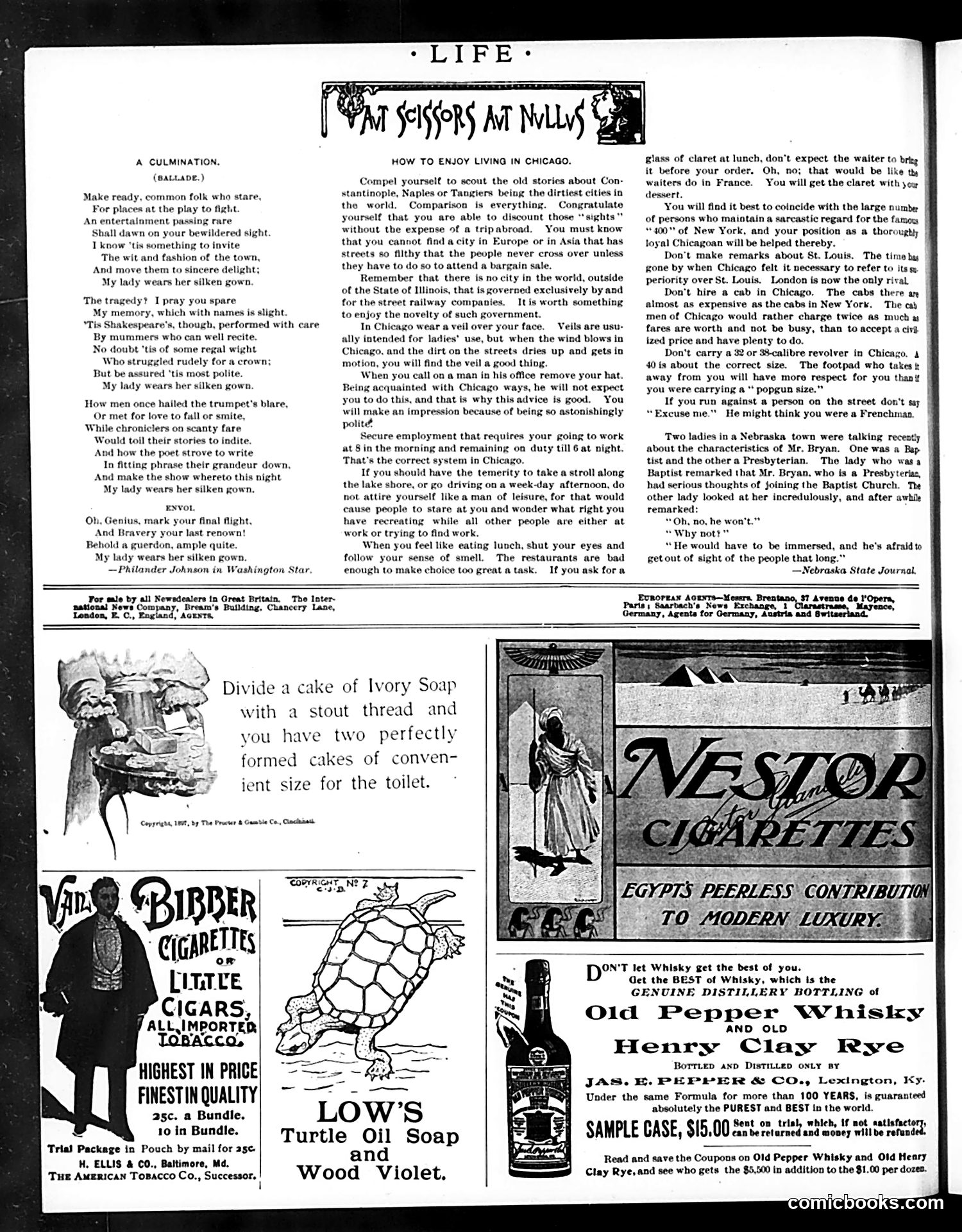
This page contains **primarily literary and advertising content** rather than political cartoons. The main text features **"A Culmination,"** a satirical poem by Philander Johnson mocking pretentious theater-goers. It ridicules affluent Chicagoans attending Shakespeare performances mainly to display fashion ("My lady wears her silken gown"), while admitting ignorance of the actual plot. The satire targets shallow materialism masquerading as cultural sophistication. **"How to Enjoy Living in Chicago"** is sarcastic commentary on the city's poor conditions—filthy streets requiring veils, oppressive work schedules, inferior restaurants, and corrupt railway-company governance. The "advice" is deliberately ironic: Chicagoans should accept these hardships as normal. The page also contains period **advertisements** for Ivory Soap, Vada Bibber Cigarettes, Nestor Cigarettes, Low's Turtle Oil Soap, and Old Pepper Whisky—standard early-1900s commercial content. The overall tone mocks urban American materialism and civic dysfunction through sardonic humor.
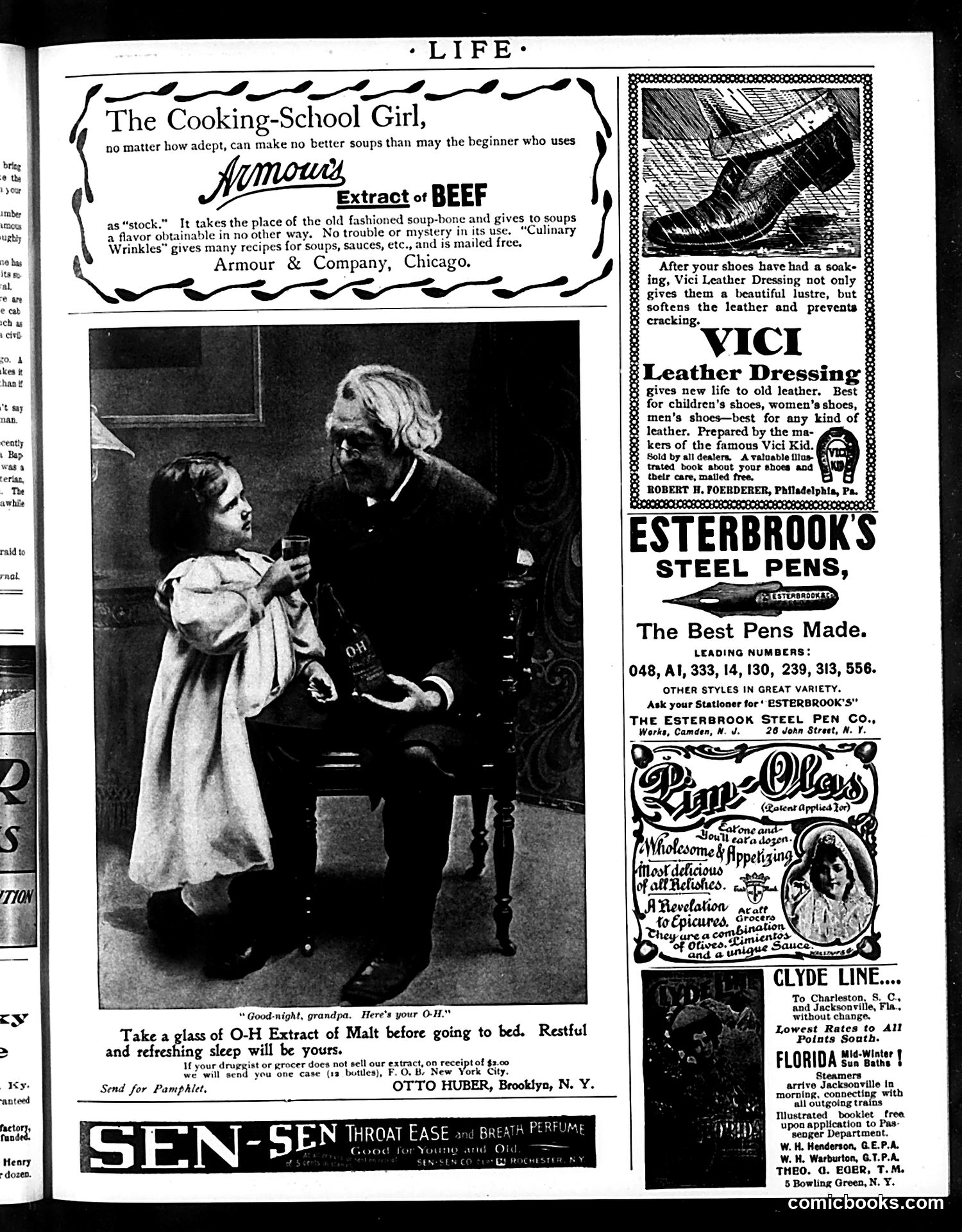
This page is primarily **advertising**, not political satire. It contains multiple commercial promotions typical of early 20th-century magazines. The central image shows a domestic scene captioned "Good-night, grandpa. Here's your O-H"—depicting a young girl giving her elderly grandfather a glass of malt extract before bed. This illustrates the advertising copy below promoting O-H Extract of Malt as a sleep aid. The surrounding ads promote various consumer products: Armour's beef extract for cooking, Vici leather dressing for shoes, Esterbrook steel pens, Sen-Sen throat lozenges, Pim-Ola food product, and Clyde Line steamship service to Florida. The "Cooking-School Girl" headline references contemporary domestic education trends, suggesting even beginners could cook well using commercial products like beef extract—a marketing appeal to modernizing American households embracing convenience foods and branded goods.
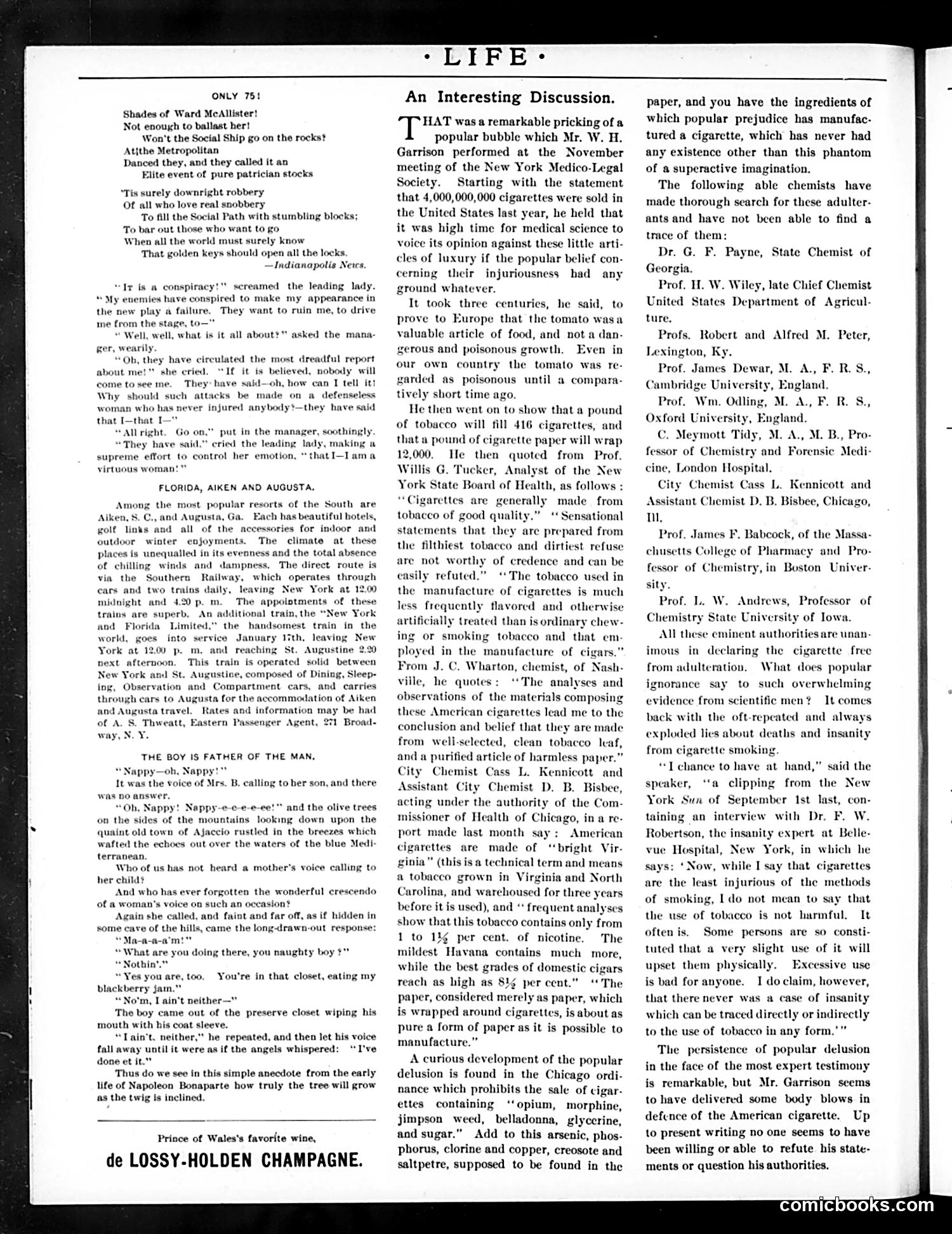
This page contains three distinct pieces of satire: **"Shades of Ward McAllister"** (top): A poem mocking New York high society's snobbery. Ward McAllister was a real arbiter of elite social standing. The joke ridicules society women concerned that admitting 75 new members to their exclusive club dilutes its prestige—the implication being that truly aristocratic circles shouldn't worry about such trivial numbers if their status is genuine. **"The Conspiracy"** (middle): A theatrical anecdote where an actress fears rumors will destroy her career, but the punchline reveals her real scandal: she's being called *virtuous*—shocking for an actress of the era, when the profession carried disreputable associations. The humor plays on inverted social expectations. **"The Boy is Father of the Man"** (bottom): A humorous retelling of young Napoleon Bonaparte's childhood, ending with him caught stealing jam. It's a joking "origin story" explaining how his youthful character flaws foreshadowed his later ambitions. The page also includes travel advertising and a serious article about cigarette chemistry and health debates.
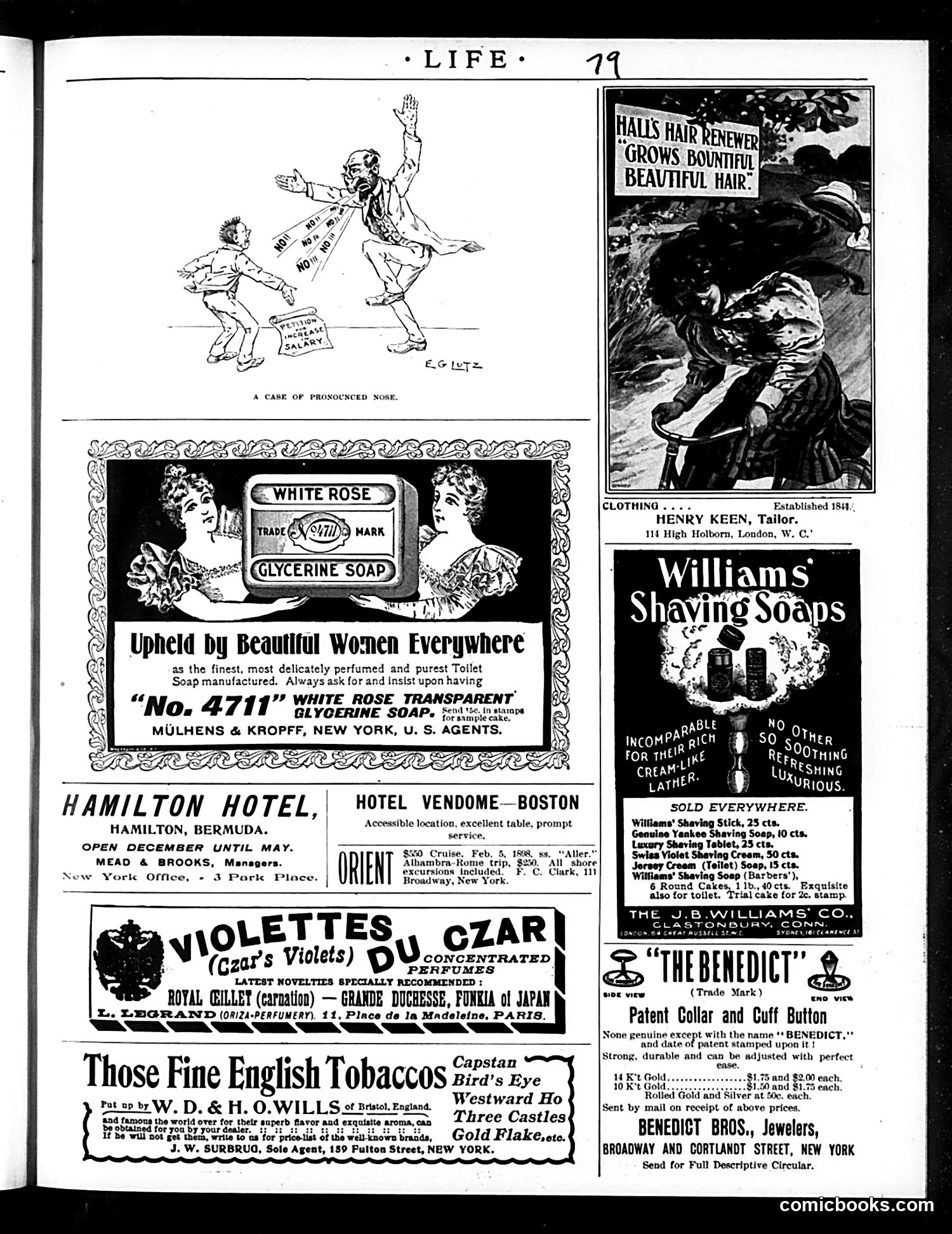
The top cartoon satirizes **labor disputes over wages**. It depicts a man (likely representing an employer or manager) juggling coins while a small figure (worker) below holds a sign reading "POSITION" and "SALARY." The title suggests the employer has a conspicuous problem: he's unwilling to pay adequate wages despite workers' demands. The cartoon reflects early 20th-century labor tensions when workers fought for fair compensation. The "pronounced nose" metaphor suggests the employer's obvious greed or dishonesty about wages is as evident as a prominent facial feature—something impossible to ignore. The rest of the page consists of period advertisements for soap, hotels, tobacco, shaving products, and jewelry—typical of *Life* magazine's commercial content from this era.
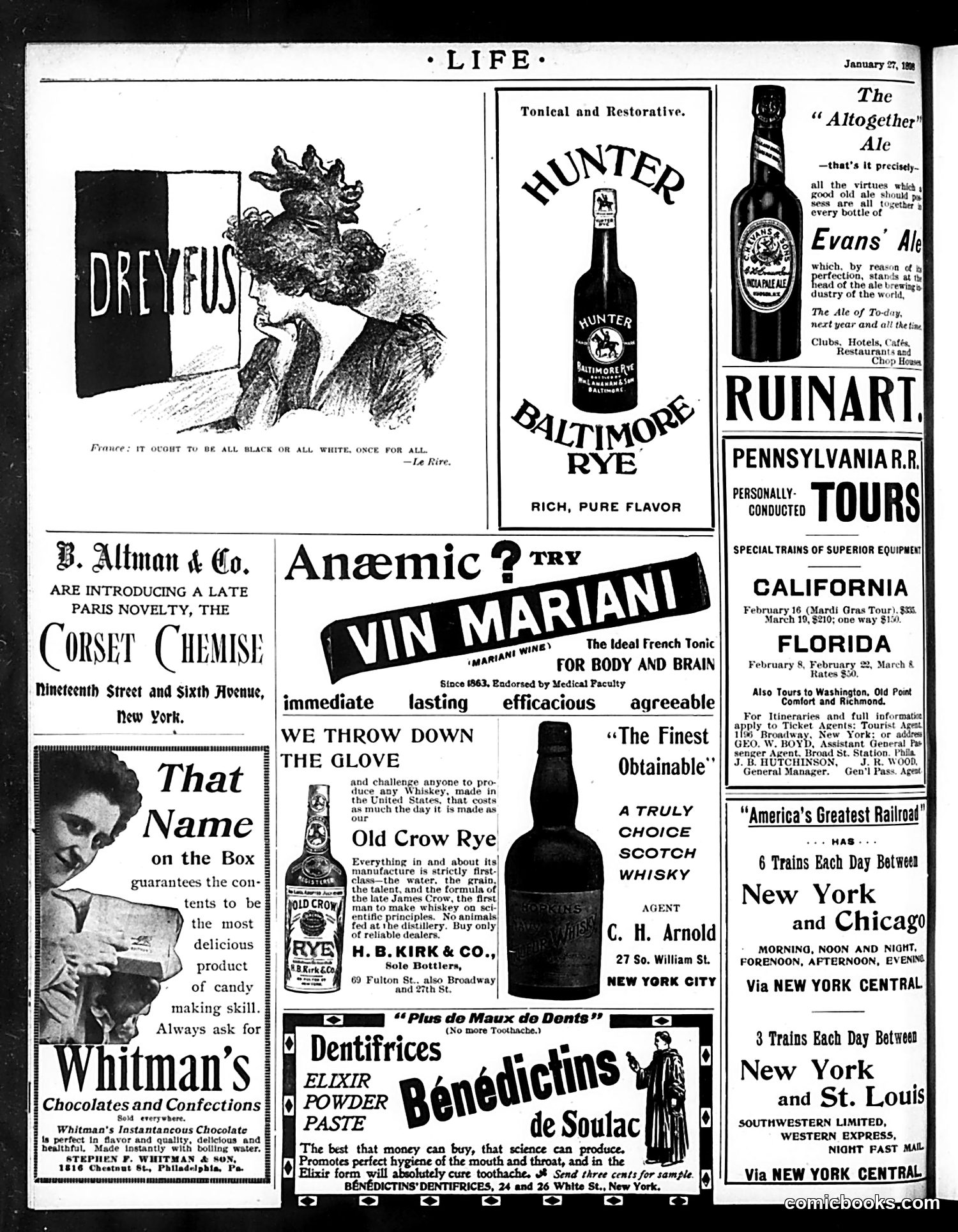
**The Main Cartoon:** The left page features a political cartoon titled "DREYFUS" showing a figure's head with an elaborate, messy crown or headdress. The caption reads: "France: it ought to be all black or all white, once for all." — *Le Rire*. This references the **Dreyfus Affair**, France's major political scandal (1894-1906) involving Alfred Dreyfus, a Jewish military officer wrongly convicted of treason. The cartoon suggests France remains divided—some supported Dreyfus, others opposed him—and the quote advocates for resolving this bitter national split permanently. Even by 1920, the wound hadn't fully healed. **The Page Otherwise:** The remainder consists entirely of period advertisements (whiskey, ale, trains, chocolate, dental products), typical for LIFE magazine, which relied heavily on advertising revenue.