
Life, 1898-01-27 · page 6 of 20
Life — January 27, 1898 — page 6: what you’re looking at
What you’re looking at
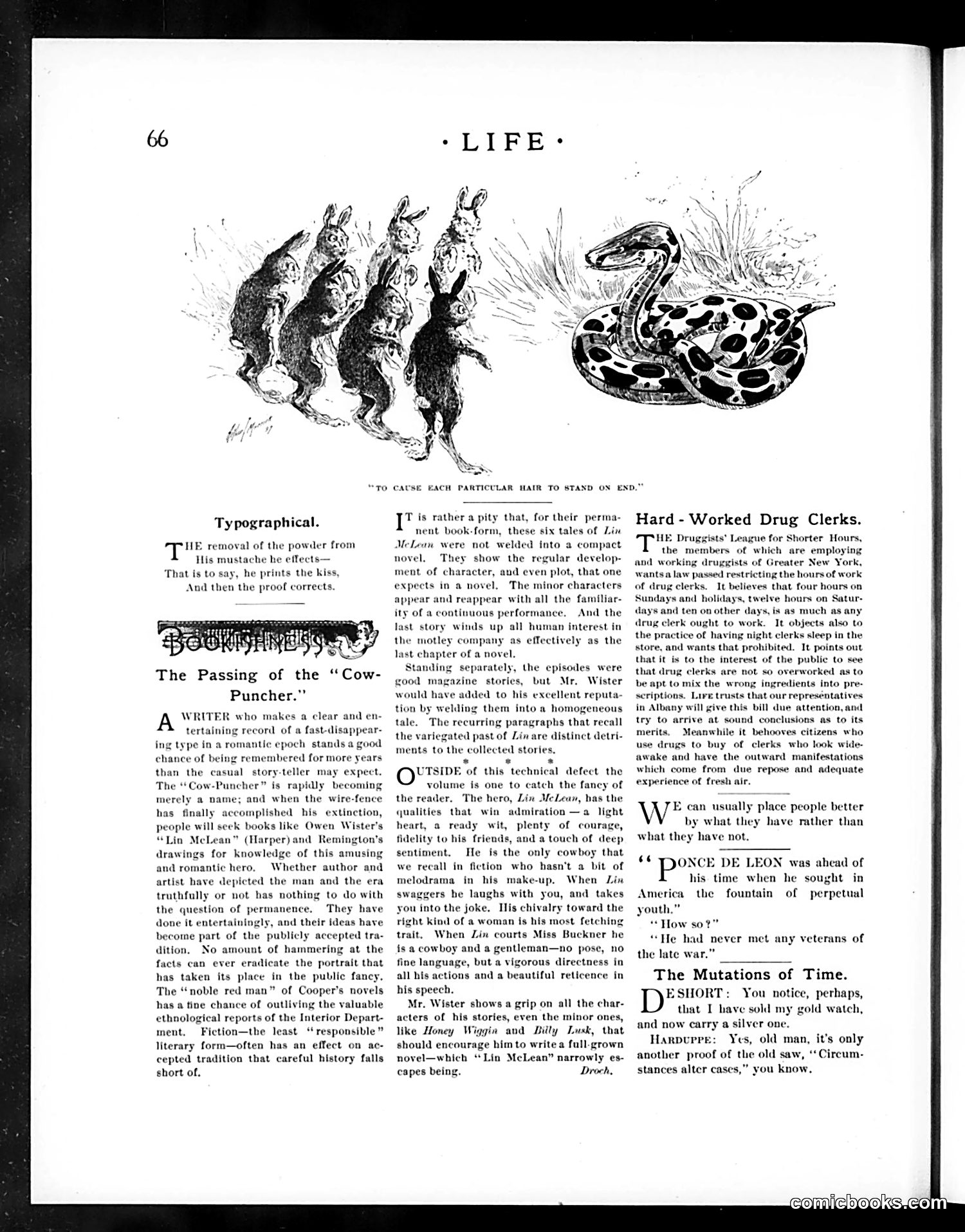
The page contains two distinct illustrations: **Top cartoon**: Shows rabbits in a line (appearing to demonstrate something) alongside a patterned snake. The caption reads "TO CAUSE EACH PARTICULAR HAIR TO STAND ON END." This appears to be a visual pun about fear or fright—the rabbits' reaction to the snake exemplifies the expression "making one's hair stand on end." **Text content**: The remainder discusses literary criticism of works by Lin McLean and other stories. Articles include "Typographical" (about punctuation/editing), "The Passing of the Cow-Puncher" (examining a fictional character type), and "Hard-Worked Drug Clerks" (advocacy piece about working conditions). The page primarily consists of book reviews and social commentary rather than political satire. The cartoon serves as a simple visual joke illustrating an idiom.
📄 Transcribed text from this page (OCR, searchable)
Machine-transcribed from the original scan — historical spelling and the odd misread are preserved.
“TO CAUSE EACH PARTICULAR HAIR TO STAND ON END.” Typographical. HE removal of the powder from Ilis mustache he effects— That is to say, he prints the kiss, And then the proof corrects. The Passing of the “Cow- Puncher.” WRITER who makes a clear and en- tertaining record of a fast-disappear- ing type in a romantic epoch stands a good chance of being remembered for mo ars than the casual story-teller may expect. The “Cow-Puncher” is rapid oming merely a name; and when the wire-fence has finally nplished his extinction, people will seek books like Owen Wister’s “Lin McLean” (Harper) and Remington's drawings for knowledge of this amusing and romantic hero, Whether author and artist have depicted the man and the era truthfully or not has nothing to do with the question of perm They have done it entertainingly, and their ideas have become part of the publicly accepted tra- dition. No amount of hammering at the facts can ever eradicate the portrait that has taken its place in the public fancy, The “noble red man” of Cooper's novels has a tine chance of outliving the valuable ethnological reports of the Interior Depart- ment. Fiction—the least ‘“ responsible” literary form—often has an effect on ac- cepted tradition that careful history falls short of. aced nence, I" is rather a pity that, for their perma- nent book: of Lin McLean were not welded into a compact novel, show the regular develop- ment of character, and even plot, that one cts ina novel, The minor characters ar and reappear with all the familiar. ity of a continuous performance. And the last story winds up all human interest in the motley company as effectively as the last chapter of a novel. Standing separately, the episodes were good magazine stories, but Mr, Wister would have added to his excellent reputa- tion by welding them into a homogeneous The recurring paragraphs that recall the variegated past of Lin are distinct detri- ments to the collected stories, * * * UTSIDE of this technical defect the volume is one to catch the fancy of the reader. The hero, Lin McLean, has the qualities that win admiration —a light heart, a ready wit, plenty of courage, fidelity to his friends, and a touch of deep sentiment. He is the only cowboy that we recall in fiction who hasn't a bit of melodrama in his make-up. When Lin swaggers he laughs with you, and takes you into the joke. lis chivalry toward the right kind of a woman is his most fetching trait. When Zin courts Miss Buckner he is a cowboy and a gentleman—no pose, no fine language, but a vigorous directness in all his actions and a beautiful reticence in his speech. Mr. Wister shows a grip on all the char- acters of his stories, even the minor ones, like Honey Wiggin avd Billy Lusk, that should encourage him to writea full-grown novel—which “Lin McLean” narrowly es- capes being. Droch, tale, Hard - Worked Drug Clerks. HE Druggists' League for Shorter Hours, the members of which are employing and worki druggists of Greater New York, wantsa law passed restricting the hours of work of drug clerks. It believes that four hours on Sundays and holidays, twelve hours on Satur- days and ten on other days, is as much as any drug clerk ought to work. It objects also to the practice of having night clerks sleep in the store, and wants that prohibited. It points out that it is to the interest of the public to see that drug clerks are not so overworked as to be apt to mix the wrong ingredients into pre- scriptions. Live trusts that our representatives in Albany will give this bill due attention, and try to arrive at sound conclusions as to its merits, Meanwhile it behooves citizens who use drugs to buy of clerks who look wide- awake and have the outward manifestations which come from due repose and adequate experience of fresh air, V E can usually place people better by what they have rather than have not. what the 6 FQONCE DE LEON was ahead of his time when he sought in America the fountain of perpetual youth, “How so?” “He had never met any veterans of the late war.” The Mutations of Time. SHORT: You notice, perhaps, that I have sold my gold watch, and now carry a silver one. Harpurre: Yes, old man, it's only another proof of the old saw, ‘‘Circum- stances alter cases,” you know,