
A complete issue · 20 pages · 1897
Life — December 16, 1897
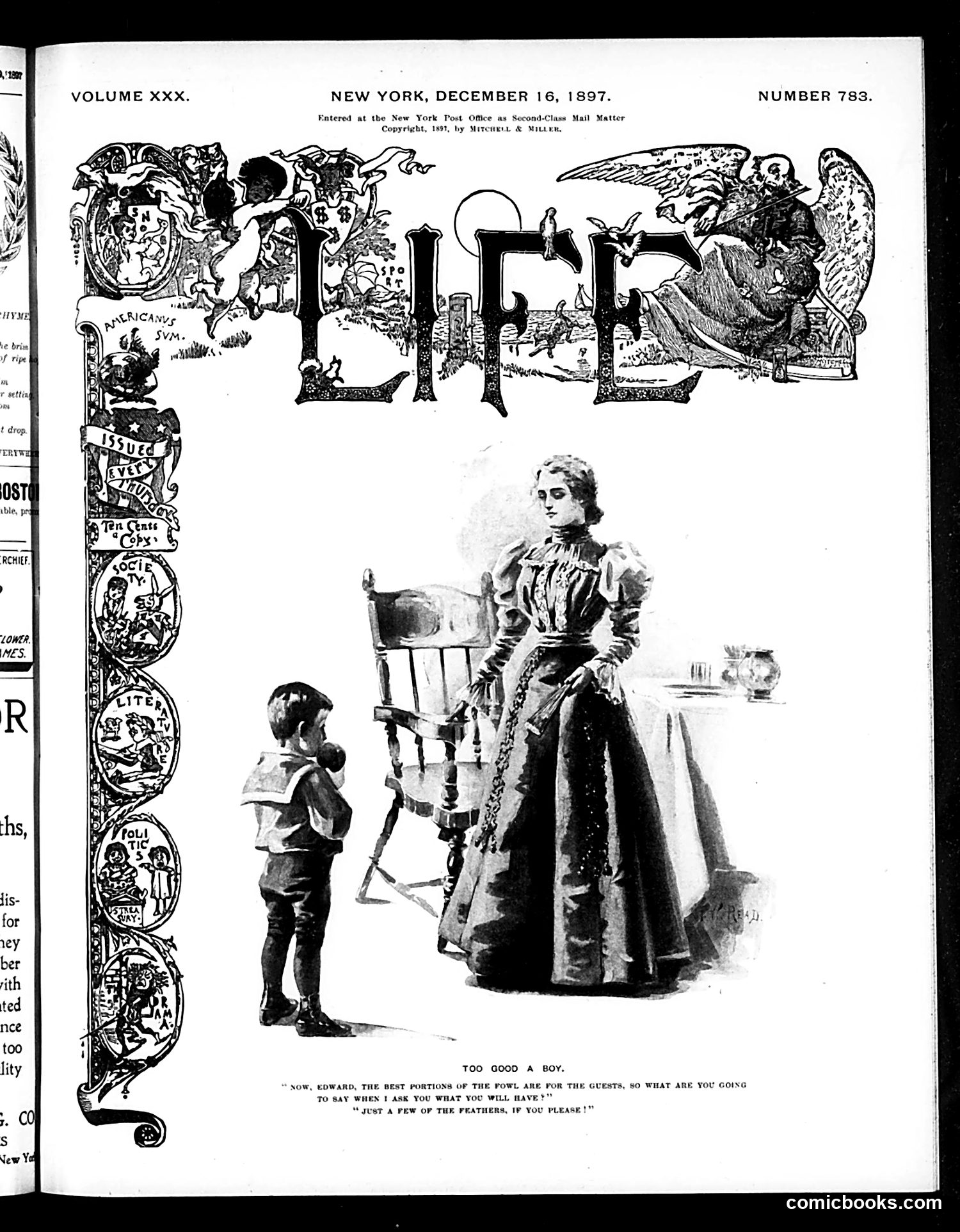
This page features a cartoon titled "Too Good a Boy" depicting a domestic scene between a woman and young boy. The dialogue reveals the satire's target: the boy asks what will be served at dinner, and the woman responds that the best portions of fowl are for guests—asking what he'll eat, he replies "just a few of the feathers, if you please!" The humor satirizes Victorian-era class consciousness and social pretension. The cartoon mocks wealthy households' practice of prioritizing guest entertainment over their own children's comfort, exposing the absurdity of such misplaced values. The ornate decorative border on the left is typical of Life's elaborate design aesthetic from this period.
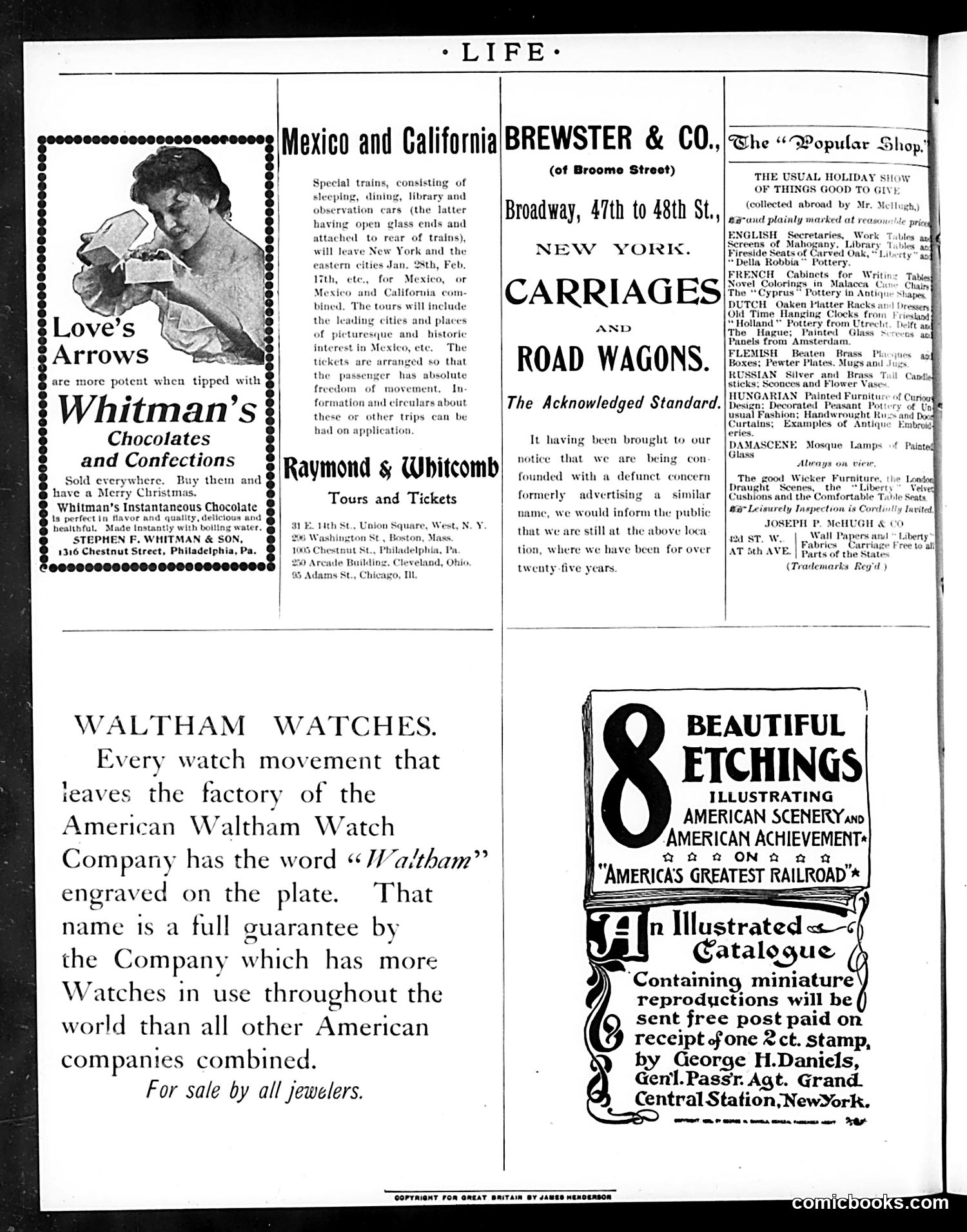
This LIFE magazine page is **primarily advertising**, not satire or political commentary. The left side features an ad for Whitman's Chocolates using "Love's Arrows" imagery—a cupid-like figure—to market holiday gifts. The copy emphasizes the product's quality and suggests chocolate as a romantic present. Other advertisements include: - Raymond & Whitcomb Tours (travel services) - Brewster & Co. (carriages and wagons in New York) - The Popular Shop (holiday goods) - Waltham Watches (emphasizing American manufacturing) - An illustrated catalogue of railroad etchings There is **no political cartoon visible** on this page. It represents typical early 20th-century Life magazine advertising, mixing commercial pitches with decorative typography and illustrations.
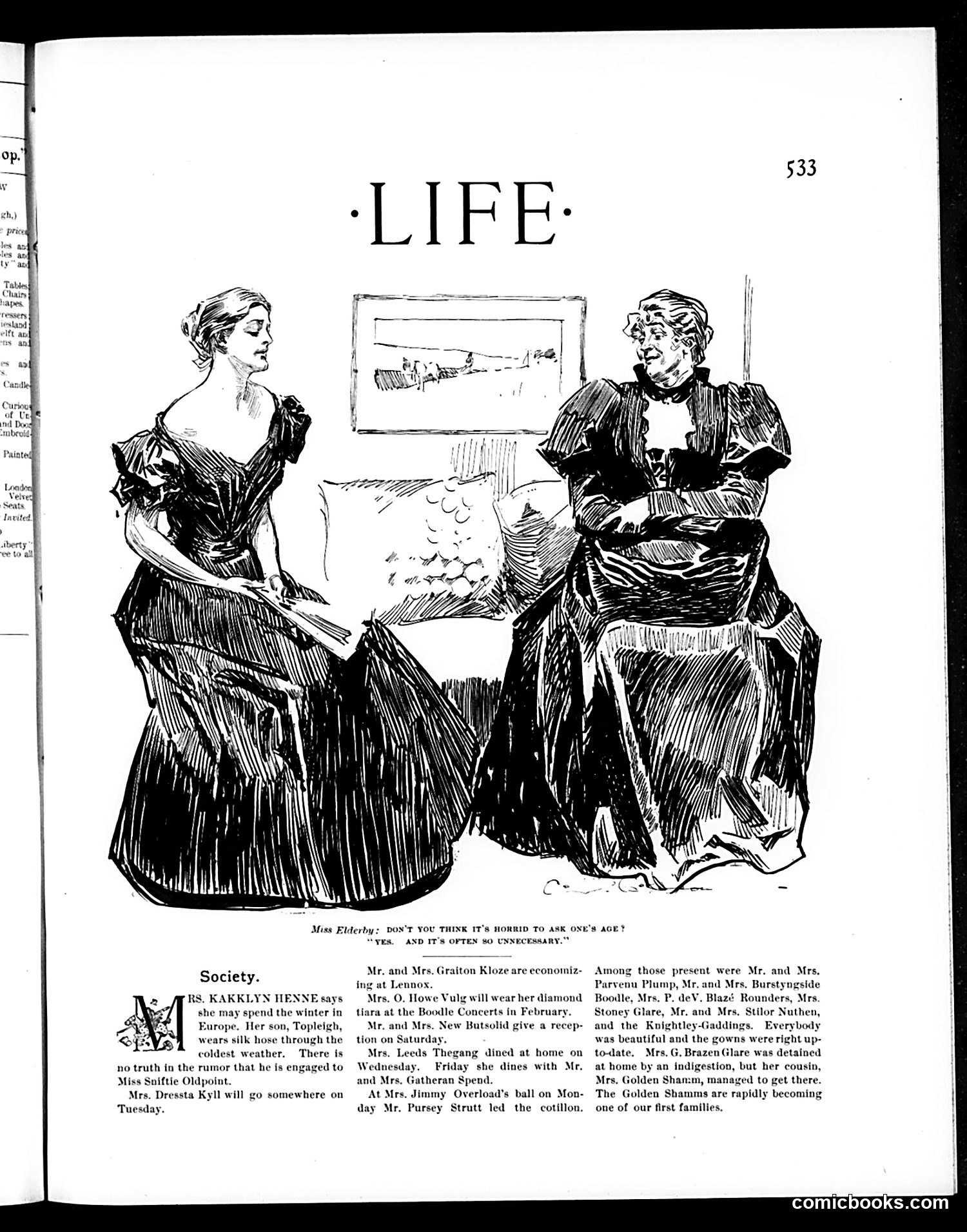
This page contains a satirical cartoon and society gossip column. The main illustration shows two women in conversation, with the caption: "Miss Etherly: 'DON'T YOU THINK IT'S HORRID TO ASK ONE'S AGE?' 'YES. AND IT'S OFTEN SO UNNECESSARY.'" **The Joke:** The humor relies on a double meaning. Miss Etherly criticizes asking a woman's age as rude, but her companion's response—"it's often so unnecessary"—implies that Miss Etherly's appearance already reveals her advanced age, making the question pointless. The "Society" column below documents upper-class social activities (dinners, concerts, balls) among named individuals, typical of Life's satirical coverage of wealthy American society during this era. The page mocks both personal vanity about aging and the trivialities of high-society life.
This page contains several satirical articles rather than political cartoons. The main pieces discuss: 1. **Kentucky women and Secretary Herbert** — satirizing Secretary of State Herbert's apparent unsuitability for office, questioning why Kentucky hasn't produced a "top-sawyer poet" despite its resources. 2. **Major McKinley** — praising McKinley as a "lucid and agreeable writer" whose recent Congressional address gained wide circulation, though the author humorously suggests McKinley's ideas about currency reform are impractical. 3. **Captain Dreyfus and airships** — mocking American newspapers for overlooking Dreyfus's recent interview while obsessing over airship rumors. 4. **Georgia football death** — criticizing a mother's opposition to a football bill after her son's injury, sarcastically noting her "wise" letter deserved consideration. The page employs humor through ironic commentary on contemporary political and social figures rather than visual caricature.
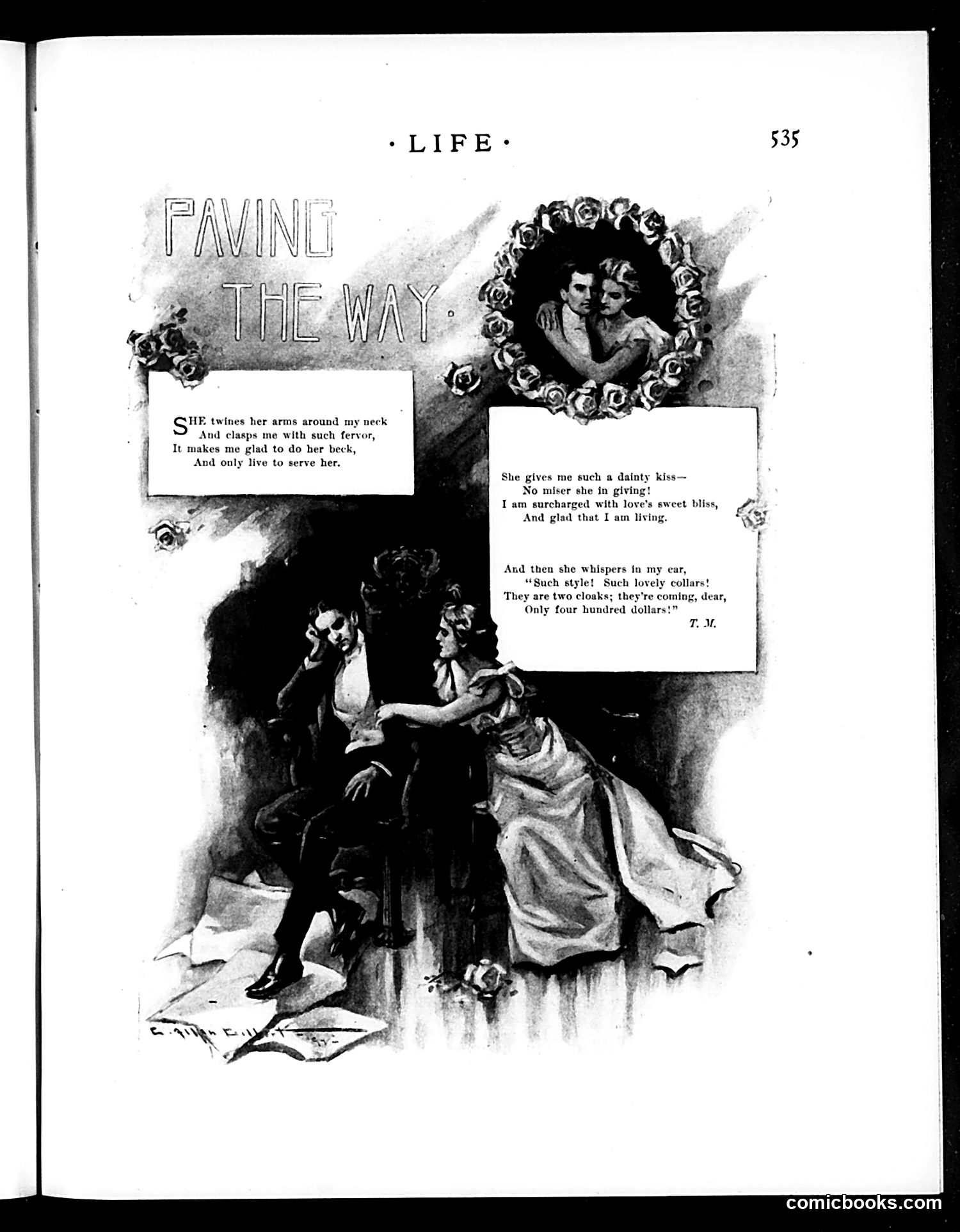
This page presents a romantic/domestic satire. The title "Paving the Way" appears to reference courtship and preparation for marriage. The upper circular vignette shows an intimate embrace between a couple. Below, the poetry and illustration depict a woman playfully manipulating her suitor—she clasps him affectionately while he remains oblivious to her true intentions, which the text humorously reveals: she's more interested in his money ("Only four hundred dollars!") than his romantic devotion. The satire mocks the mercenary nature of courtship and engagement, suggesting women strategically "pave the way" to marriage by feigning emotional investment while calculating financial gain. The humor targets both genders—the man's gullible romanticism and the woman's materialistic scheming. This reflects early 20th-century anxieties about marriage as financial transaction rather than love match.
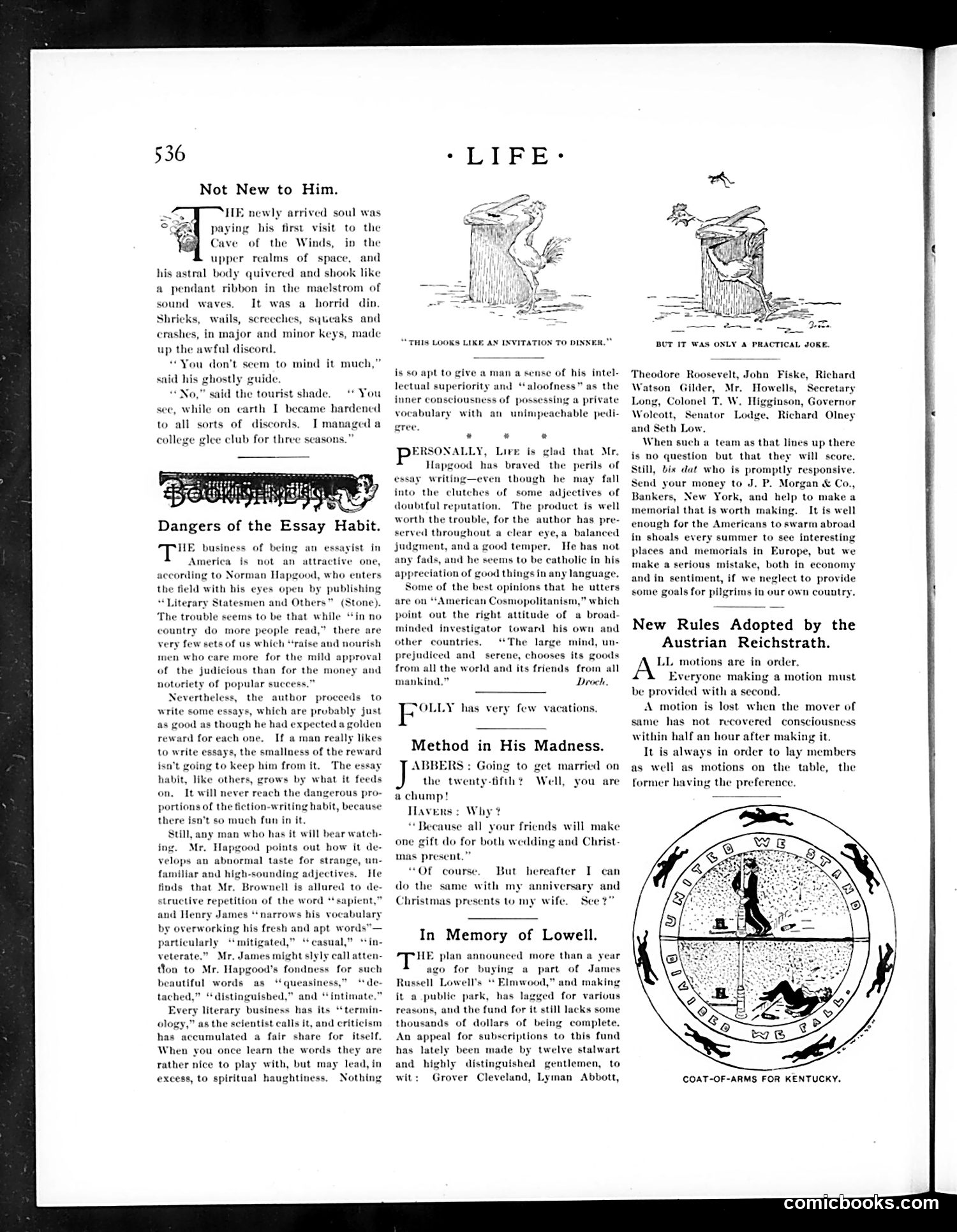
This page contains several satirical pieces and illustrations typical of Life magazine's humor: **"Not New to Him"**: A cartoon about a newly arrived soul visiting the Cavern of the Wrecks, where discordant musical sounds torment the visitor. The joke appears to be that the soul finds this unremarkable—implying the torment resembles something familiar from life. **"Dangers of the Essay Habit"**: Satirizes American essayists who produce verbose, padded work for publication. The text mocks the tendency to overwrite and use unnecessarily complex language to appear intelligent. **"Method in His Madness"**: A brief humorous dialogue about wedding gifts. **"In Memory of Lowell"**: Announces a fundraising effort for James Russell Lowell's "Elmwood" property. The page also includes a decorative coat-of-arms for Kentucky and mentions notable figures like Theodore Roosevelt and John Fiske, reflecting the magazine's intellectual readership.
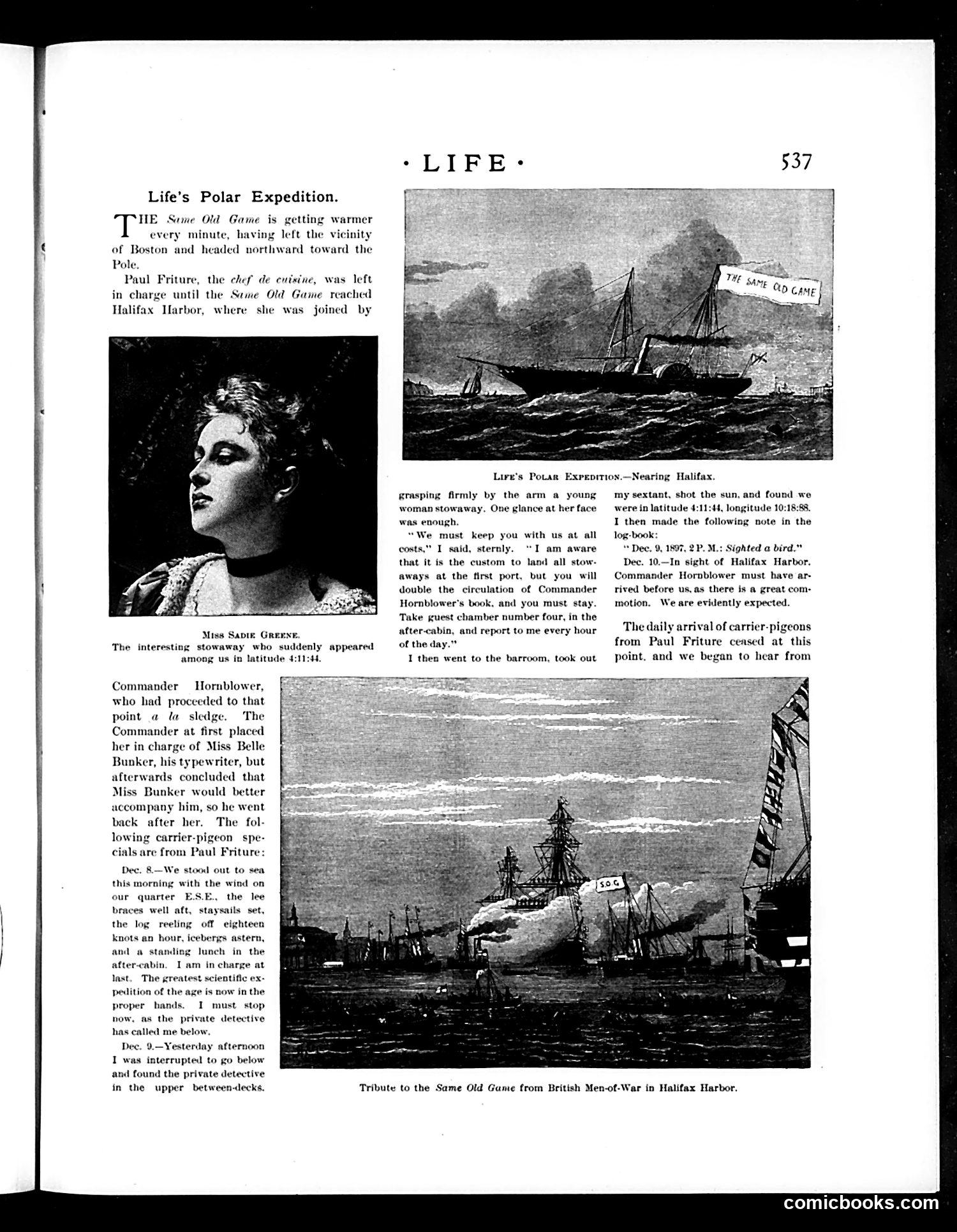
This page documents an expedition aboard the ship *Same Old Game* heading toward the North Pole. The narrative centers on a stowaway, Miss Sadie Greene (shown in the portrait), who was discovered aboard. Commander Hornblobee places her under Miss Belle Bunker's supervision rather than confining her separately. The page includes dated ship's log entries from December 8-9, documenting weather conditions, ice observations, and the discovery of a private detective hidden in the upper between-decks—apparently sent to investigate the stowaway. The two illustrations show the ship at sea and a tribute scene in Halifax Harbor. This appears to be satirical fiction using polar exploration as a framing device for comedic incidents involving stowaways and detective work.
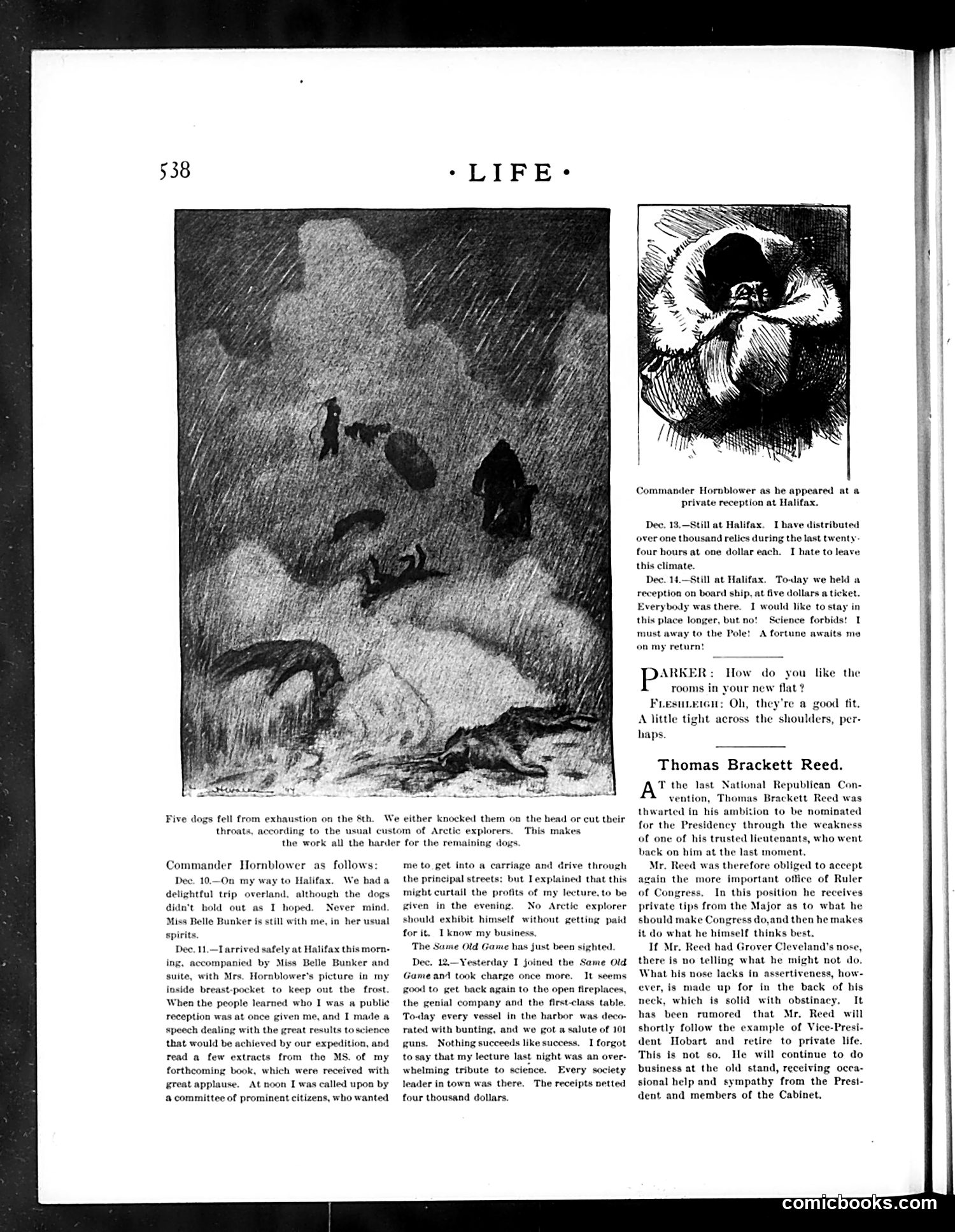
The left image depicts five dogs collapsing from exhaustion in Arctic snow, with caption explaining they "fell from exhaustion on the 8th" during an Arctic expedition. The right side contains dialogue and a section titled "Thomas Brackett Reed." The cartoon appears to satirize an Arctic exploration expedition (referenced as the "Same Old Game" in the text), critiquing both the hardship involved and the public spectacle around such ventures. Commander Hornblower's diary entries describe distributing "relics" at high cost and holding receptions to fund the expedition—suggesting satire of how Arctic explorers commercialized their adventures through lectures and merchandise sales to finance continued exploration. The Thomas Brackett Reed section discusses his political ambitions, likely satirizing his pursuit of the presidency at a recent Republican convention. The overall page juxtaposes failed exploration with political ambition as parallel examples of human overreach.
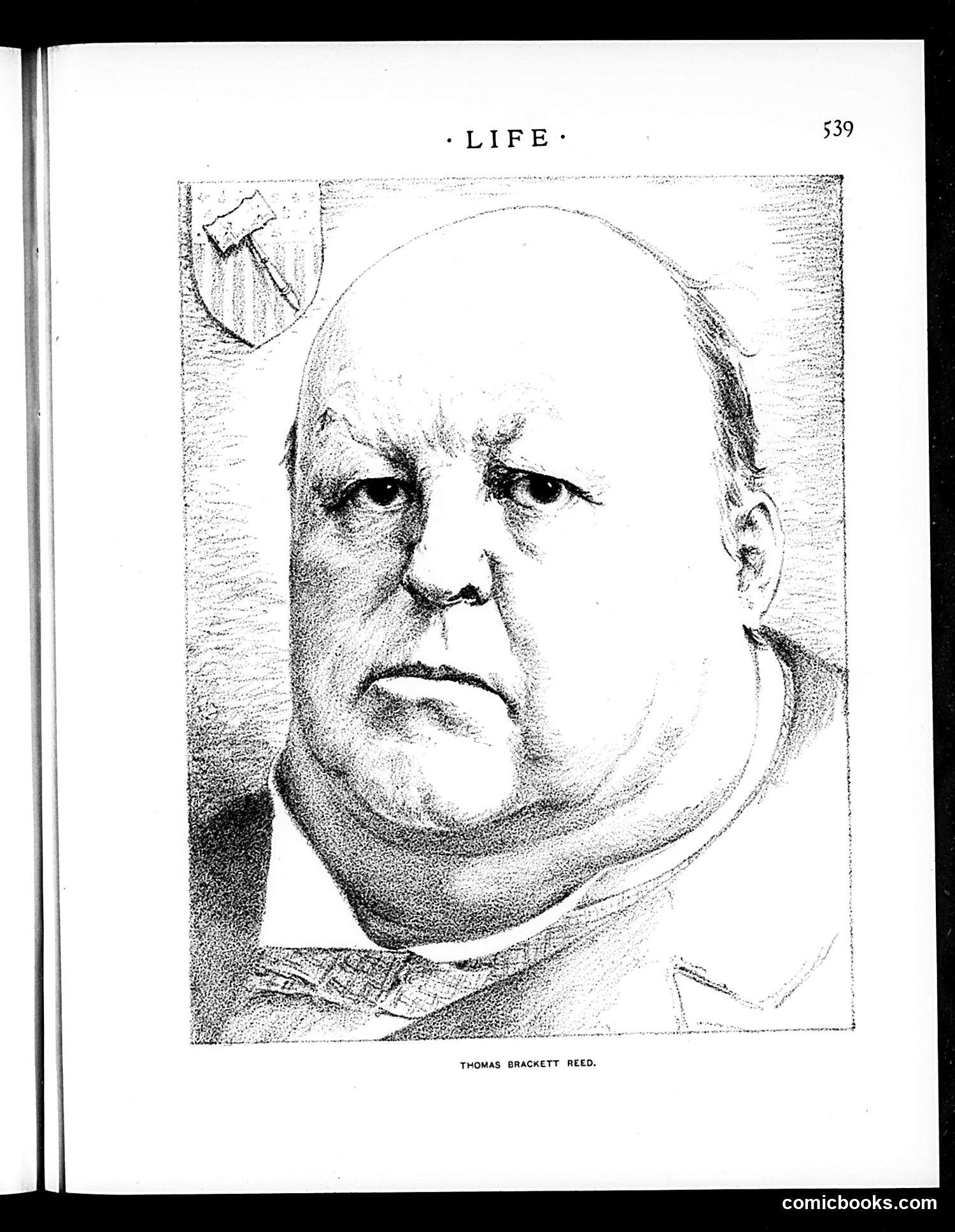
This page from Life magazine (page 539) features a portrait labeled "THOMAS BRACKETT REED." The image is a stippled sketch showing a heavyset man with a stern expression, prominent mustache, and receding hairline. Thomas Brackett Reed was a prominent late 19th-century Republican politician who served as Speaker of the House. Life was known for satirical portraits of public figures, often emphasizing physical features for comic effect. The small inset in the upper left corner appears to show some kind of tool or implement, though its specific satirical meaning is unclear without additional context from the surrounding article or caption. The portrait's unflattering rendering of Reed's substantial frame was typical of Life's approach to political caricature during this era.
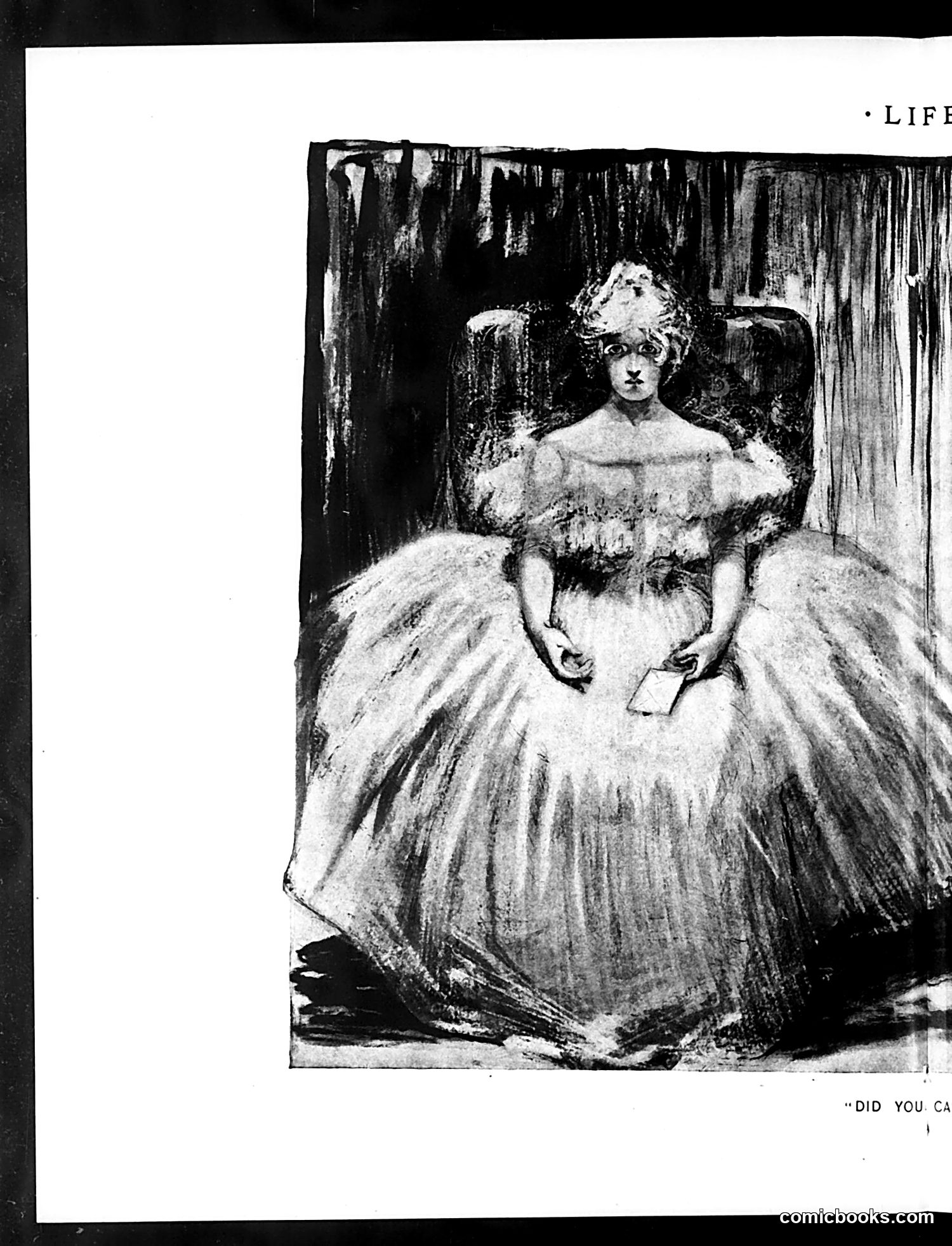
This appears to be a fashion illustration rather than a political cartoon. The image shows a woman in an elaborate, voluminous ball gown with dramatic puffed shoulders and a fitted bodice, seated in an ornate chair. She wears an elaborate headdress and appears fashionably dressed in what seems to be late 19th or early 20th-century style. The partial caption at bottom reads "DID YOU CA[LL]..." suggesting this accompanied a humorous article or caption about fashion or social situations. Without the complete text and given the magazine's satirical nature, this likely mocked either contemporary fashion excess or social pretension. The exaggerated silhouette—particularly the enormous skirt—may satirize the impracticality or absurdity of women's formal wear of that era. The image quality and style suggest this is from Life's early decades as a humor publication.
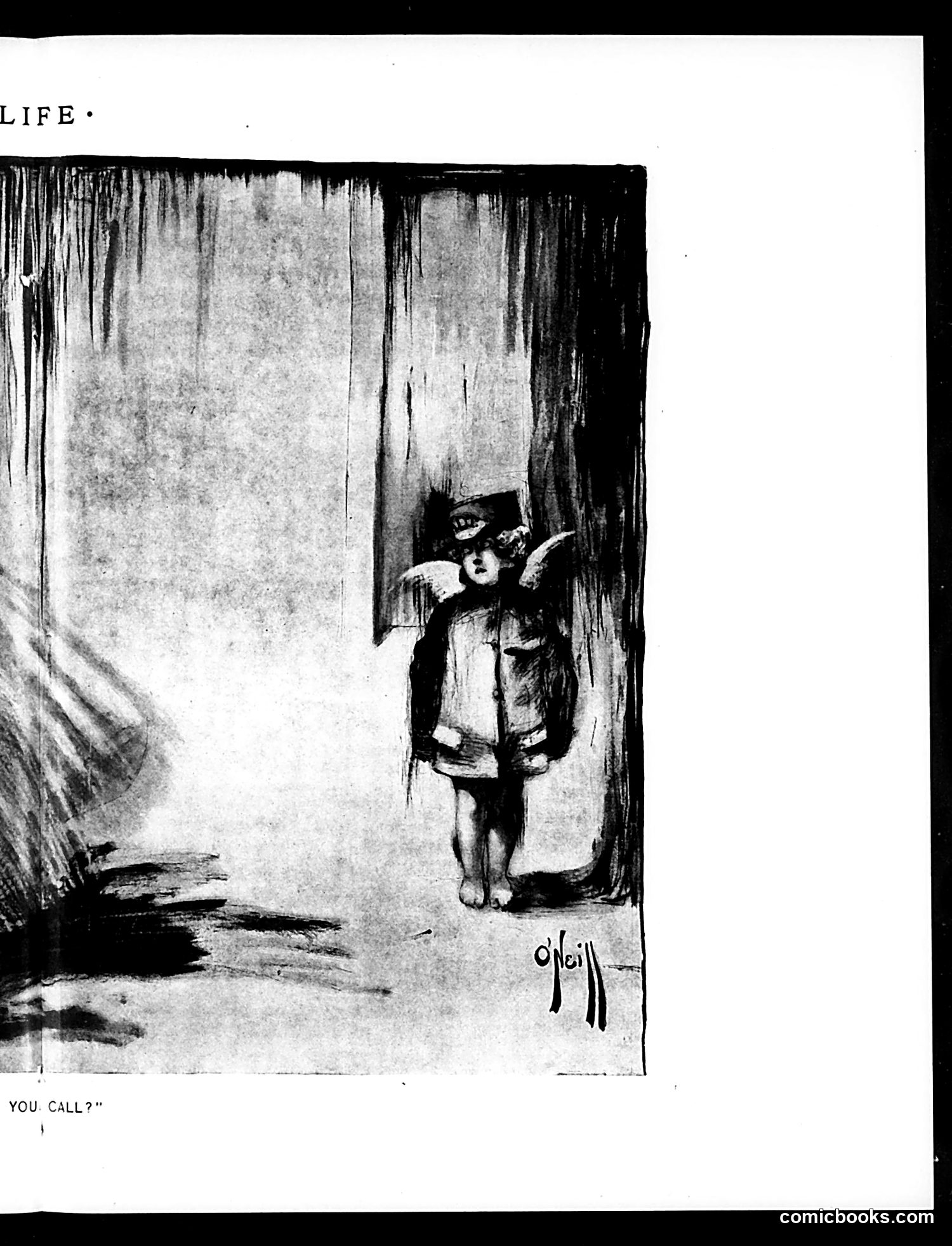
This is a single-panel cartoon by O'Neill showing a small child standing in a doorway, appearing fearful or uncertain. The child is barefoot and lightly dressed. The stark, sketchy style emphasizes shadows and an ominous atmosphere created by heavy curtains or drapes. The caption reads: "YOU CALL?" The satire likely addresses child labor or exploitation—the child's vulnerable appearance and hesitant demeanor suggest they've been summoned for undesirable work. The vague, foreboding setting and the child's apprehensive response imply some darker purpose. The cartoon appears to critique the social conditions or practices that placed children in precarious, uncomfortable situations during the early-to-mid 20th century when *Life* magazine was active.
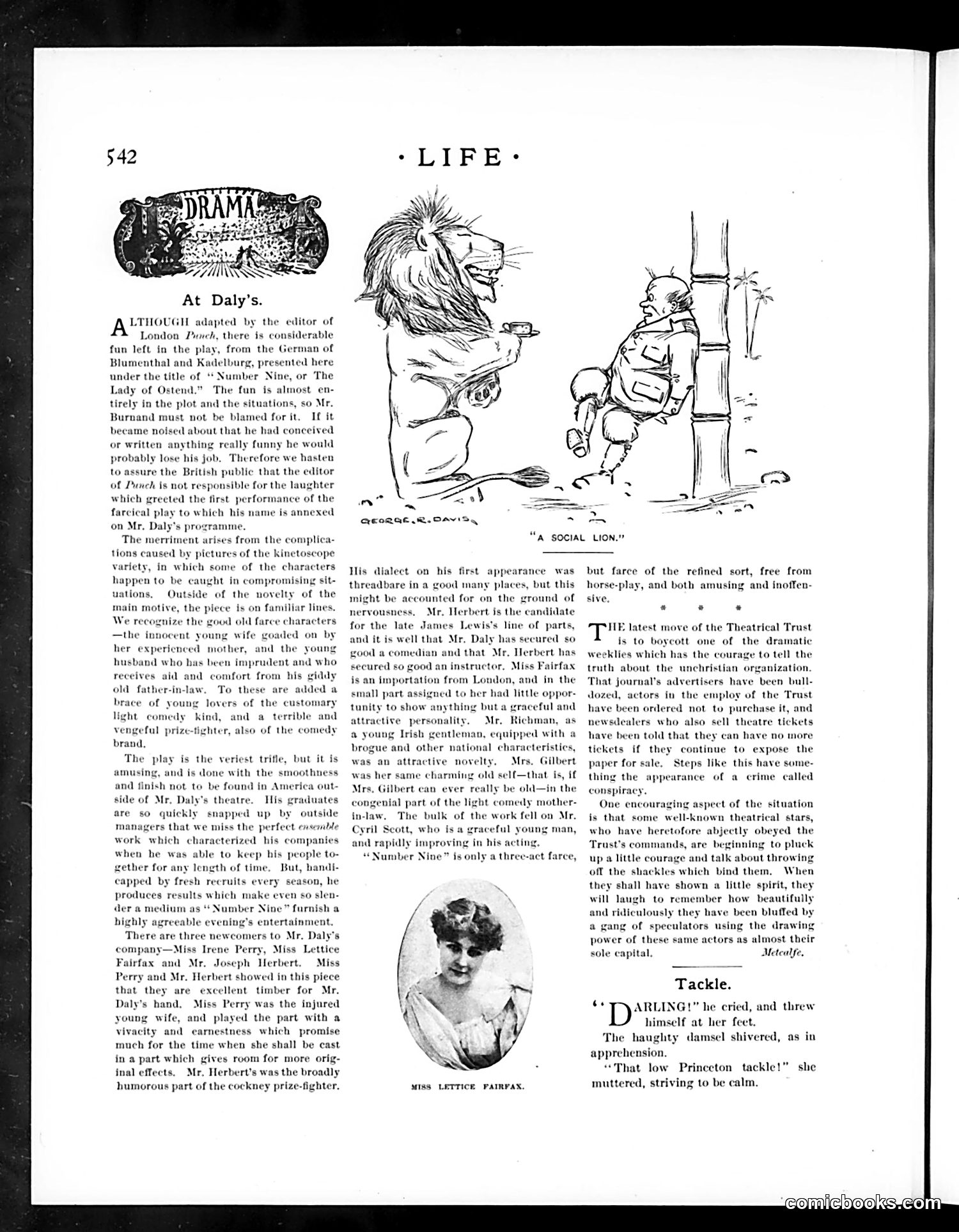
This page contains a theater review section titled "At Daly's" discussing a play adaptation, alongside a cartoon labeled "A Social Lion" showing a large lion holding what appears to be a gun or implement, confronting a small human figure near a ladder. The review discusses Mr. Daly's theatrical production and its cast, including mentions of Miss Lettice Fairfax (whose photograph appears on the page). The text emphasizes that the play succeeds through its humor despite being adapted from foreign sources. The cartoon's meaning is unclear without additional context—it appears to satirize either social climbing, pretension, or perhaps an absurd encounter between human and animal. The "social lion" metaphor likely refers to a prominent society figure, though the specific reference or joke is not evident from the image alone.
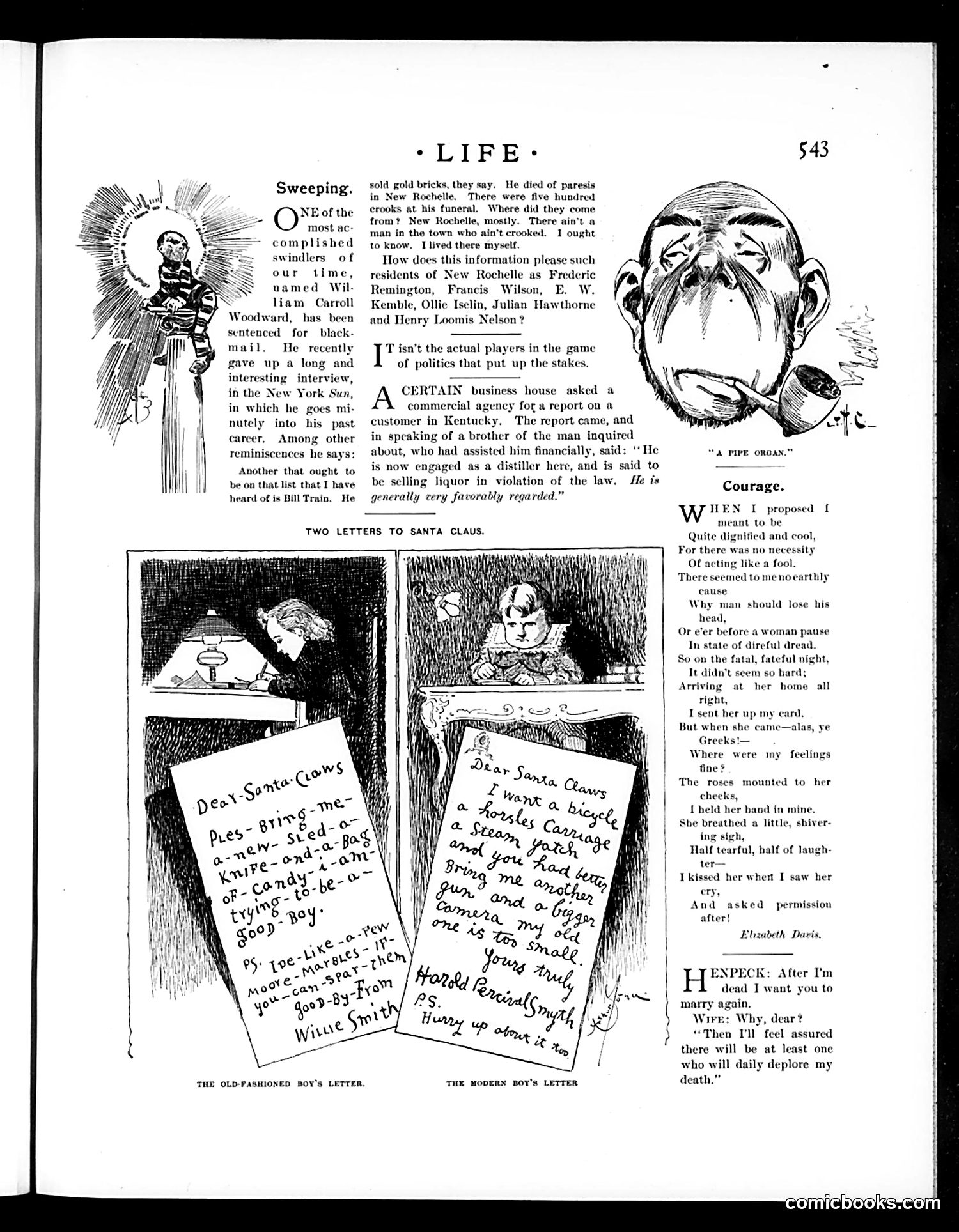
This Life magazine page satirizes **swindlers and moral hypocrisy** in early 20th-century America. The upper section mocks William Carroll Woodward, a convicted blackmailer who gave a newspaper interview boasting about criminals he knew in New Rochelle. Life's editors sarcastically note that prominent New Rochelle residents—naming real figures like artist Frederic Remington and writer Julian Hawthorne—might appreciate this unflattering publicity about their town. The middle section ridicules a business report describing a Kentucky distiller engaged in illegal liquor-selling, yet rated "generally very favorably regarded"—highlighting the absurd contradiction of praising someone for lawbreaking. The bottom section contrasts two Santa letters: an old-fashioned boy requesting simple items versus a modern boy's materialistic demands, suggesting societal moral decline. The sidebar poem "Courage" and the domestic joke about remarriage reinforce themes of changing social values and behavior.
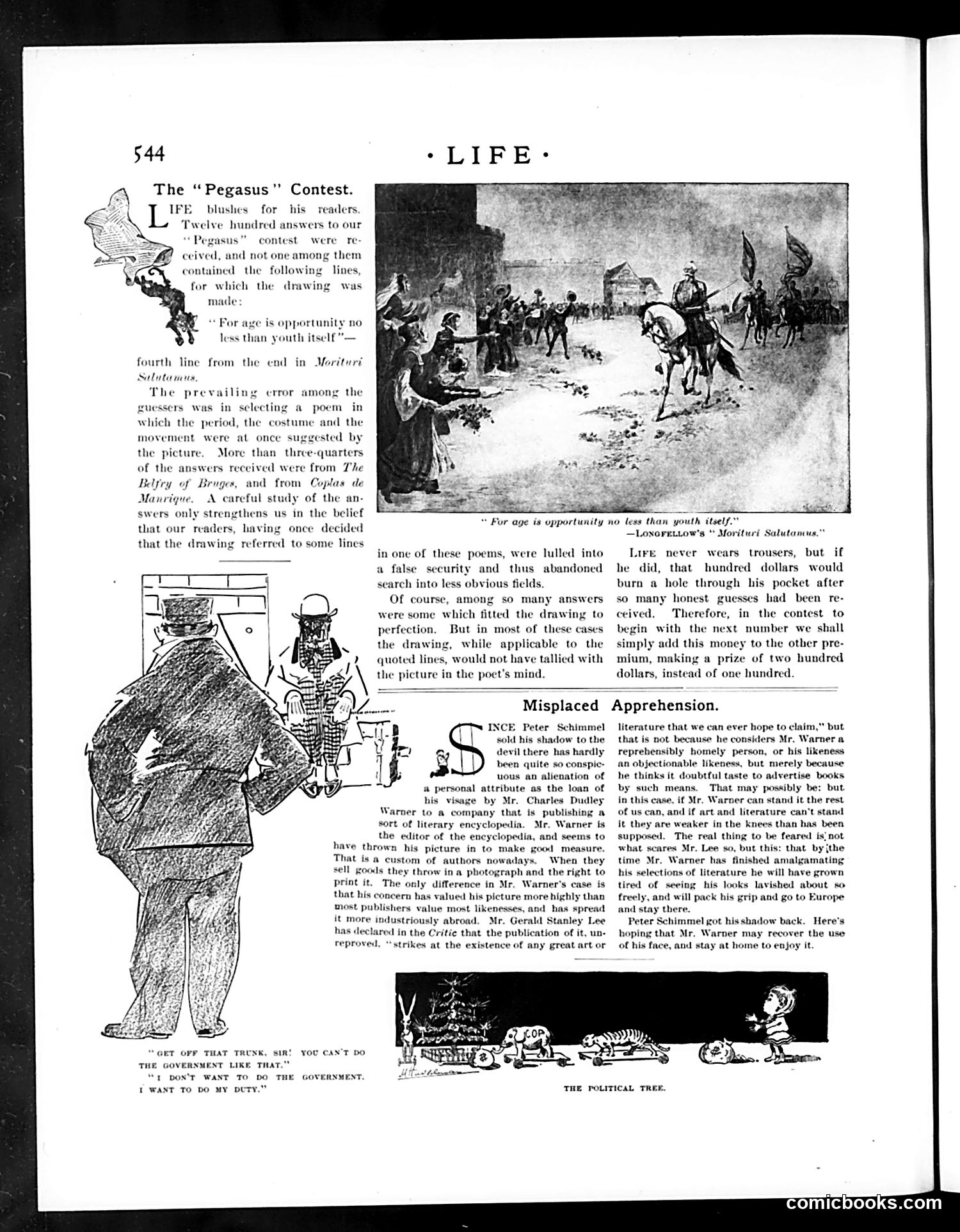
This page contains two distinct satirical pieces: ## The "Pegasus" Contest Life announced a poetry-guessing contest where readers identified lines from classic poems based on a drawing. Of 1,200 entries, most incorrectly matched the image to poems from *The Bury of Bruges* or *Coplas de Manrique*—falling into a "false security" trap. The joke: readers assumed the drawing matched their first guess rather than searching "less obvious fields." Life humorously notes they'll add unclaimed prize money to the next contest's reward, suggesting many honest guesses were received but went unclaimed. ## "Misplaced Apprehension" Charles Dudley Warner, editor of a literary encyclopedia, lent his photograph to the publisher for promotional use. Gerald Stanley Lee criticized this in *The Critic* as striking "at the existence of any great art." However, Life defends Warner, arguing the real concern isn't his appearance but that he might eventually tire of seeing his face advertised, pack his bags, and move to Europe—a humorous, tongue-in-cheek conclusion.
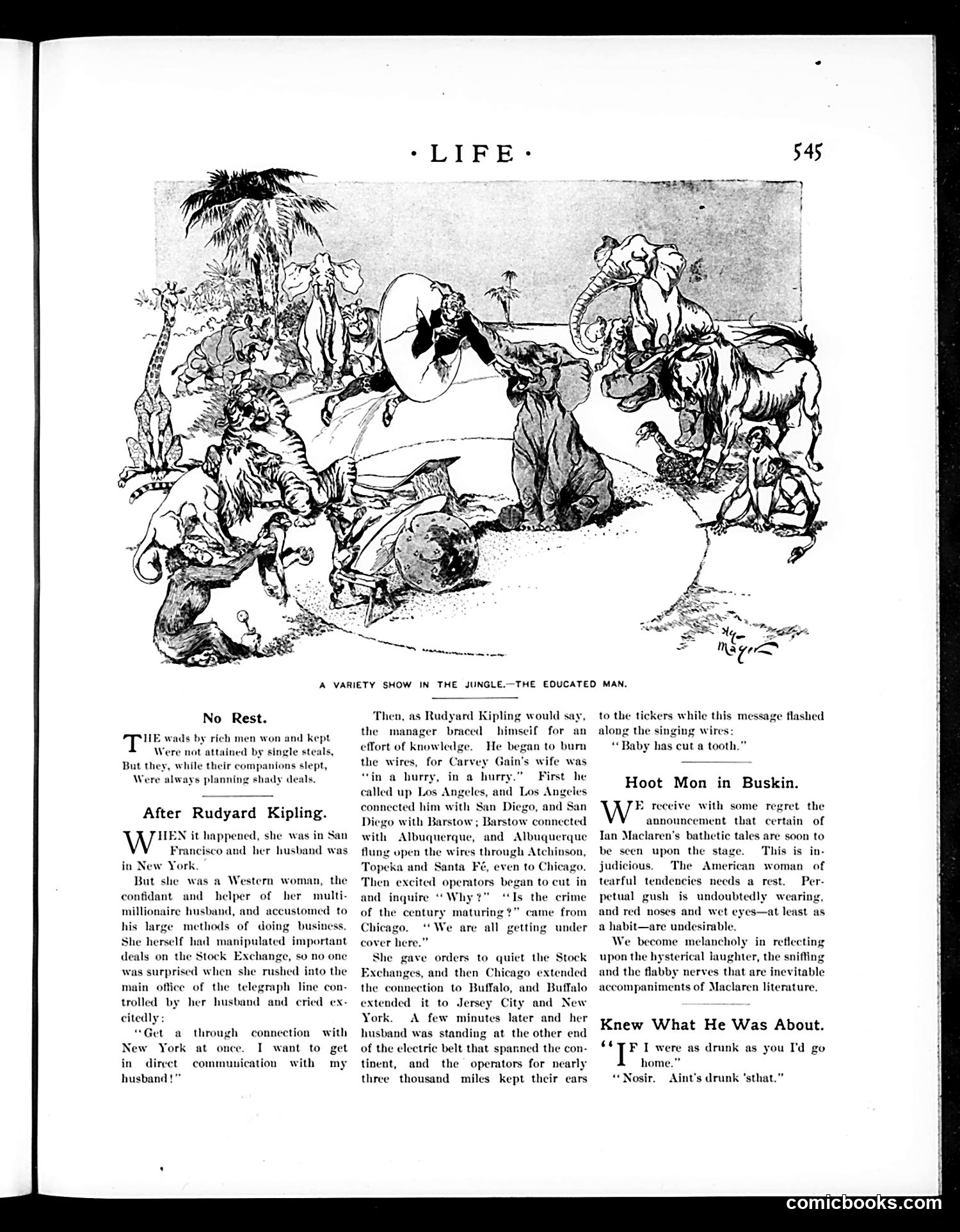
This page contains three separate satirical pieces: **"A Variety Show in the Jungle"** (top illustration): A chaotic cartoon depicting an "educated man" surrounded by various animals and figures in a jungle setting—likely satirizing pretension or the absurdity of civilized behavior in "uncivilized" contexts. **"No Rest"** (main story): Mocks the nouveau riche and their wives. A wealthy businessman's wife orchestrates a cross-continental telegraph relay (Los Angeles to New York) to urgently communicate through three thousand miles of operators—only to announce her baby cut a tooth. The satire ridicules both the excessive wealth that enables such frivolous spectacle and the triviality of what wealthy women occupy themselves with. **"Hoot Mon in Buskin"**: Briefly criticizes Ian Maclaren's sentimental Scottish literature as emotionally exhausting for readers. **"Knew What He Was About"**: A short joke playing on drunkenness and self-awareness. The page's overarching theme mocks American wealth, technological excess, and sentimental Victorian literature.
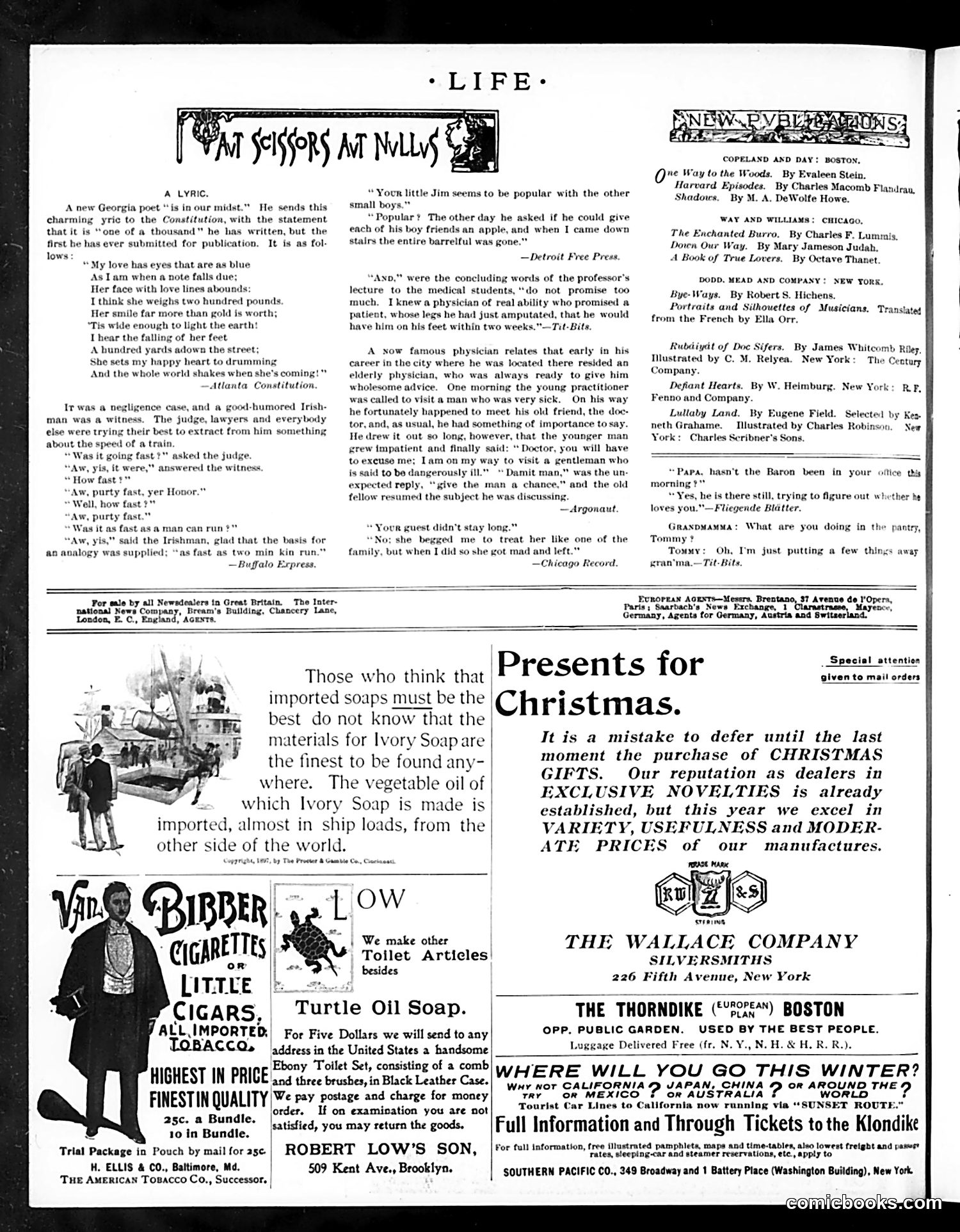
This page is primarily **text-based satirical content and advertising**, not political cartoons. The "LYRICS" section mocks a self-proclaimed Georgia poet through his earnest but absurdly unflattering love poem—humorous because he compares his beloved's weight ("two hundred pounds") and loud presence to positive qualities, revealing poor poetic judgment. The three short anecdotes are ethnic humor typical of the era: - An Irish witness uses faulty logic about train speed, playing on stereotypes of Irish simplicity - A father brags about his son's popularity through food theft - A seasoned physician interrupts a younger doctor's patient call with unsolicited advice The page also contains **book advertisements** from publishers like Copeland and Day, and commercial ads for Bibber Cigarettes and Turtle Oil Soap—the latter's "Low Prices" aimed at Christmas gift-buyers. The humor relies on character types and everyday situations rather than political satire. These brief comedic pieces were common filler content in *Life* during this period.
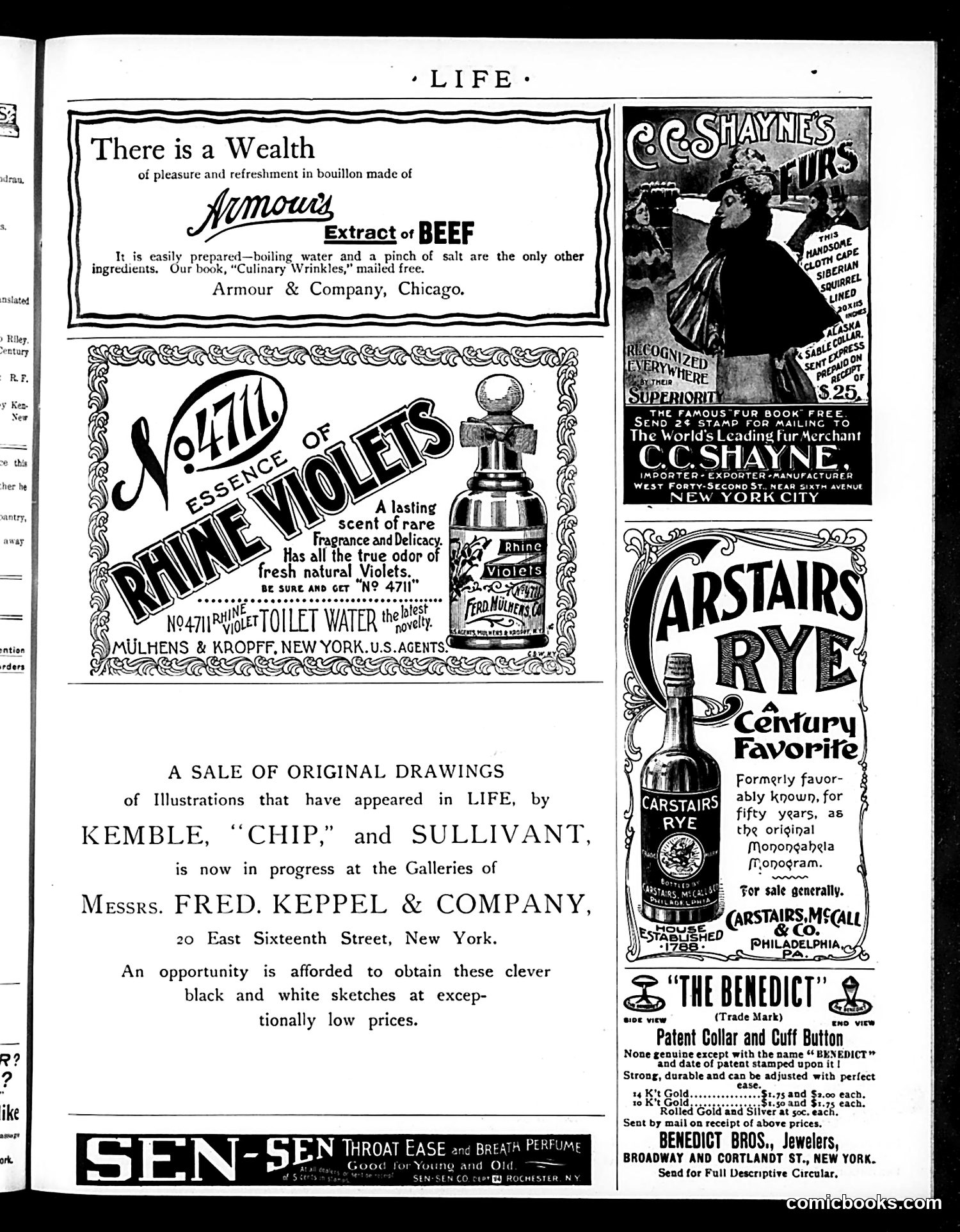
This is primarily an advertising page from *Life* magazine, not a political cartoon page. It contains several vintage product advertisements from roughly the early 1900s: **Main content:** Ads for Armour beef extract bouillon, Cologne No. 4711 (toilet water), and Carstairs Rye whiskey. **Notable editorial content:** An announcement of a sale of original drawings by cartoonists Kemble, "Chip," and Sullivant—illustrators whose work appeared in *Life*—available through the Keppel galleries in New York at "exceptionally low prices." This suggests the magazine valued its visual contributors enough to promote sales of their original artwork. **Other ads:** Include C.C. Shayne's Furs, Benedict patent collar buttons, and Sen-Sen breath perfume. The page reflects early 20th-century consumer culture and the prominent role advertising played in magazines of the era.
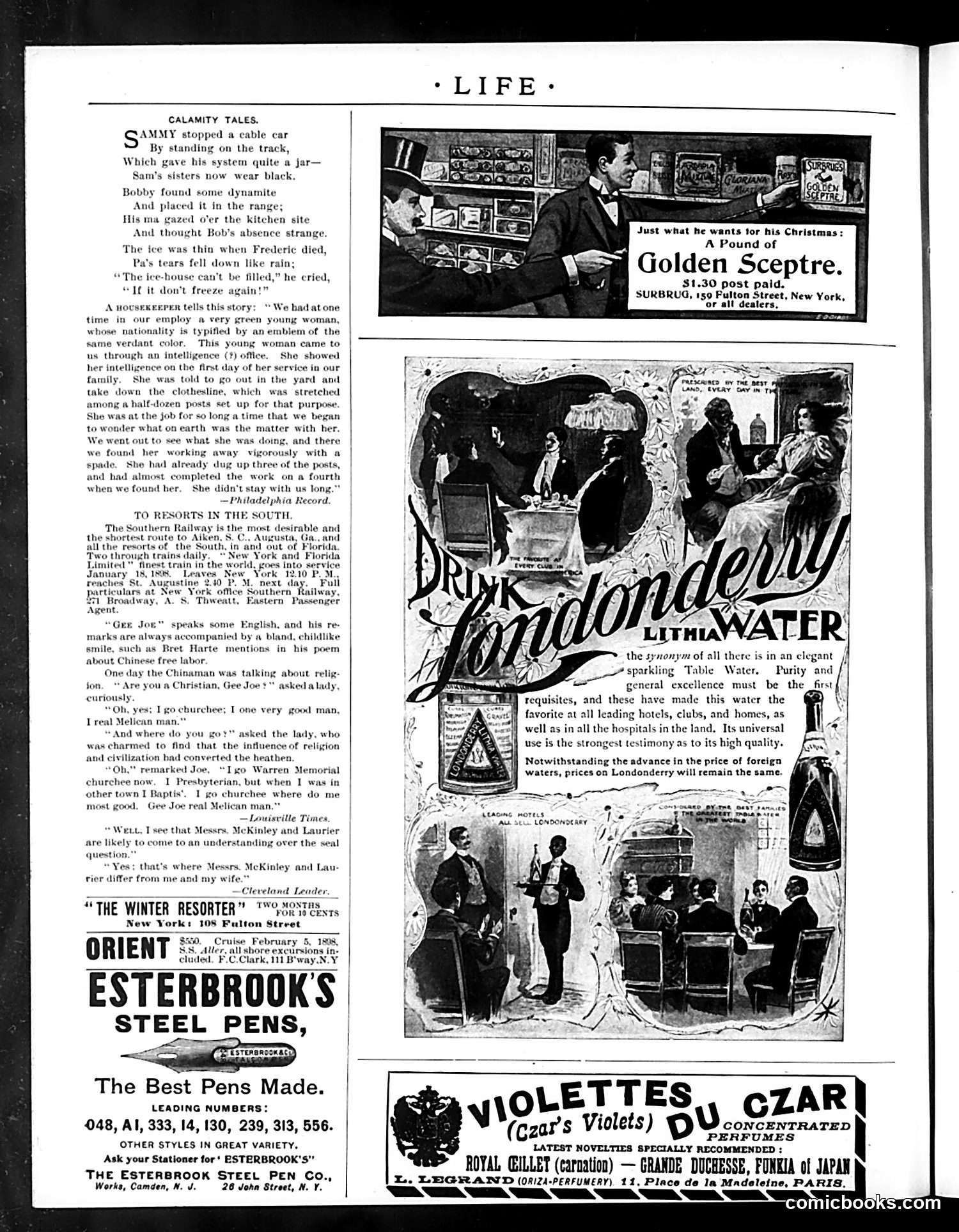
This page from *Life* magazine contains several satirical pieces: **"Calamity Tales"** consists of darkly humorous short verses mocking immigrant foolishness and parental indifference. The jokes feature children dying from preventable accidents (standing on cable car tracks, playing with dynamite, thin ice) while parents respond with self-interested concern rather than grief. One anecdote mocks a "green" immigrant woman (identified by national "emblem of the same verdant color") hired through an employment agency who literally digs up clothesline posts rather than understanding how to remove clothesline from existing posts—satirizing immigrant labor's perceived incompetence. **"Gee Joe"** mocks Chinese immigrant speech patterns and assimilation, presenting stereotypical dialect humor about a Chinese worker's confused understanding of religious practice and American citizenship. The remaining content consists of period advertisements for luxury goods (cigars, perfumes, steel pens, travel) and resorts, typical of *Life's* marketing to affluent readers. The political references appear minimal; the satire targets working-class and immigrant populations rather than specific political figures or events.
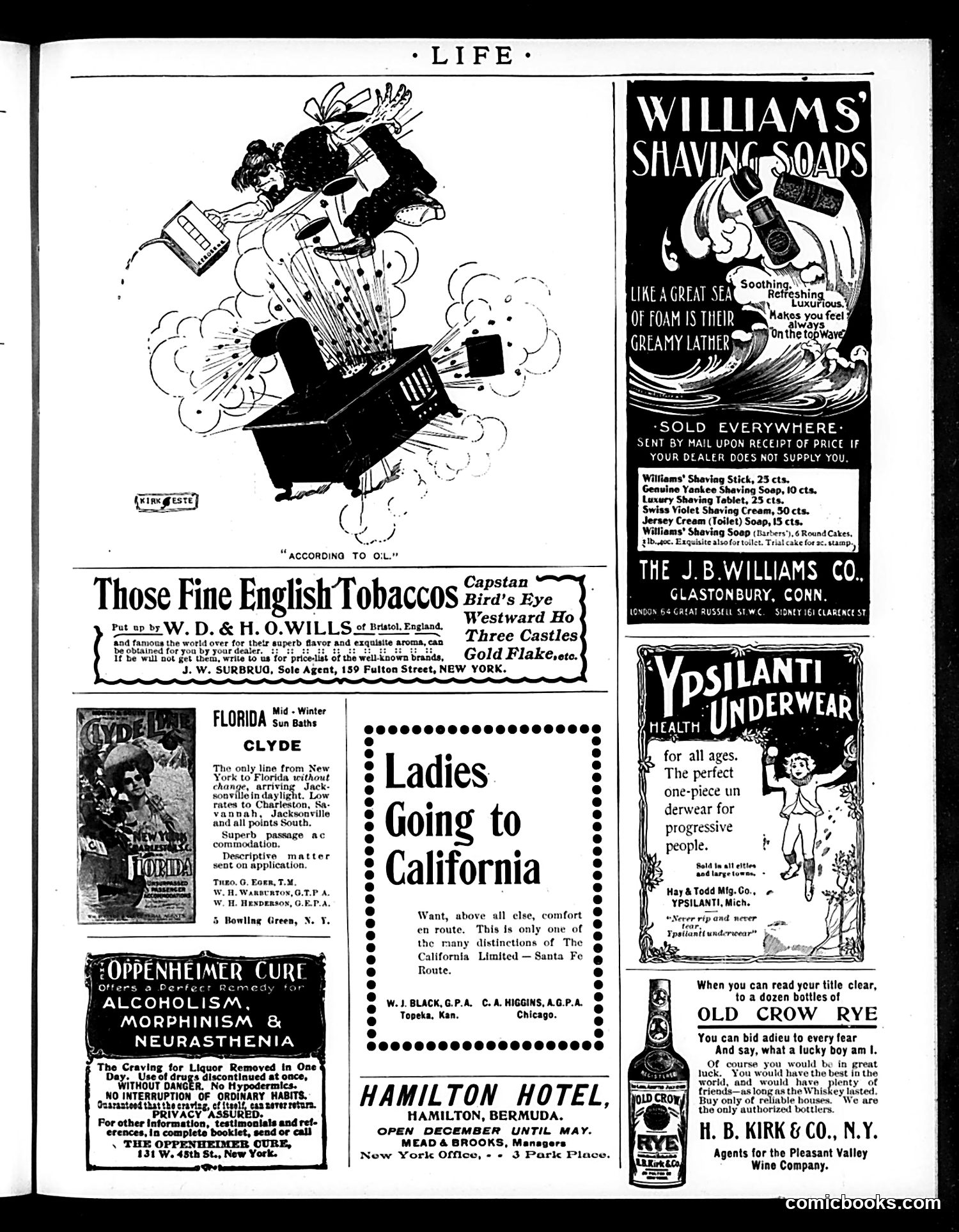
This page is primarily **advertising** for various consumer products and services, with one cartoon at the top. ## The Cartoon The illustration labeled "According to Oil" depicts a figure being explosively launched upward amid clouds and debris—likely a visual pun on the phrase "according to oil" (possibly referencing oil speculation or market volatility). The chaotic imagery suggests financial chaos or unexpected consequences, though the specific reference remains unclear without additional historical context. ## Advertisements The page features typical early 20th-century ads: English tobaccos, Florida steamship travel, medical treatments for addiction and "neurasthenia" (a Victorian-era diagnosis for nervous exhaustion), railroad travel to California, shaving products, underwear, and whiskey. These reflect period consumer culture and contemporary attitudes toward remedies for social problems like alcoholism.
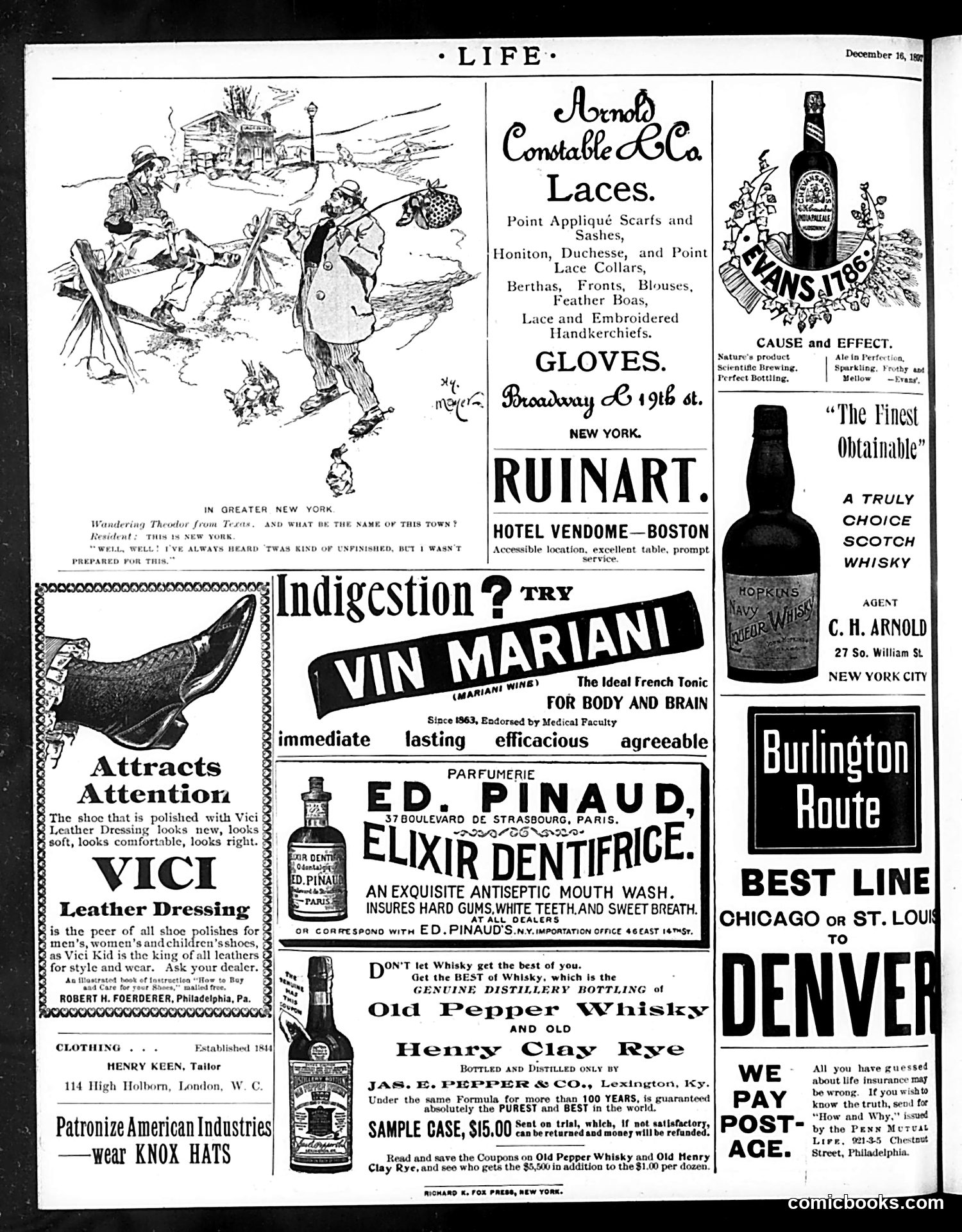
The main cartoon depicts a bewildered rural figure ("Theodor from Texas") encountering New York City's complexity. A resident explains that the town is "unfinished"—a satirical jab at New York's perpetual construction and urban chaos. The cartoon mocks the contrast between rural simplicity and metropolitan confusion, playing on the stereotype of unsophisticated out-of-towners overwhelmed by the city's disorder and scale. The humor relies on the visitor's naïveté and the New Yorker's resigned acceptance of civic dysfunction as normal. This reflects early-20th-century attitudes about urbanization and the cultural gap between America's hinterland and its major cities. The page is otherwise dominated by period advertisements for luxury goods (laces, whisky, dental products), establishing the magazine's affluent readership.