
A complete issue · 20 pages · 1896
Life — September 24, 1896
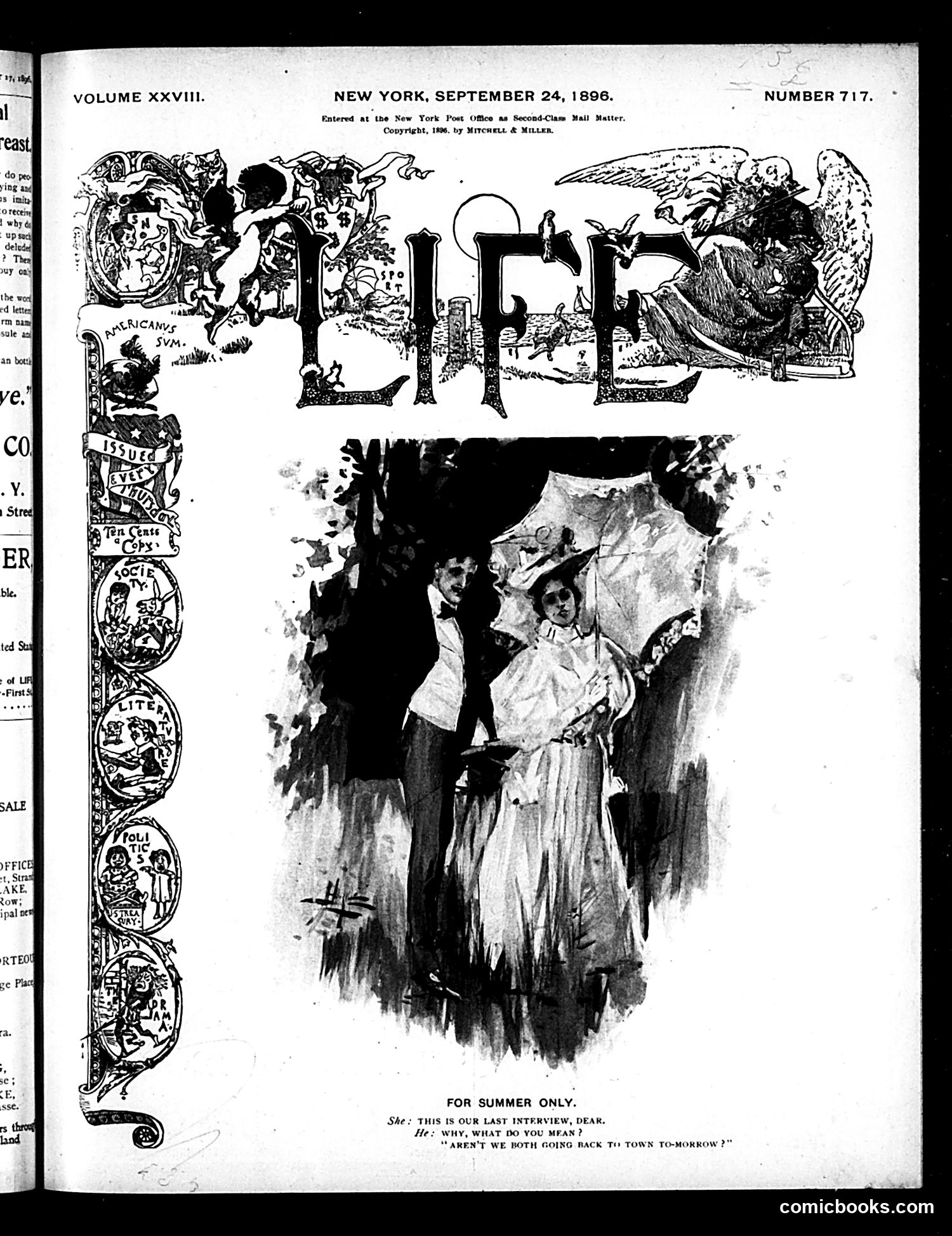
The cartoon depicts two figures under a large umbrella during what appears to be a rainstorm. The caption reads: "She: 'This is our last interview, dear.' / He: 'Why, what do you mean? / Aren't we both going back to town tomorrow?'" The satire concerns a summer romance—a temporary relationship confined to the summer season. The couple's farewell, despite both returning to the city the next day, satirizes the shallow nature of seasonal flirtations. The "summer only" caption emphasizes that such romantic entanglements were understood as temporary arrangements, existing outside normal social life. This reflects Victorian-era social commentary on leisure-class behavior and the performative nature of resort romances.
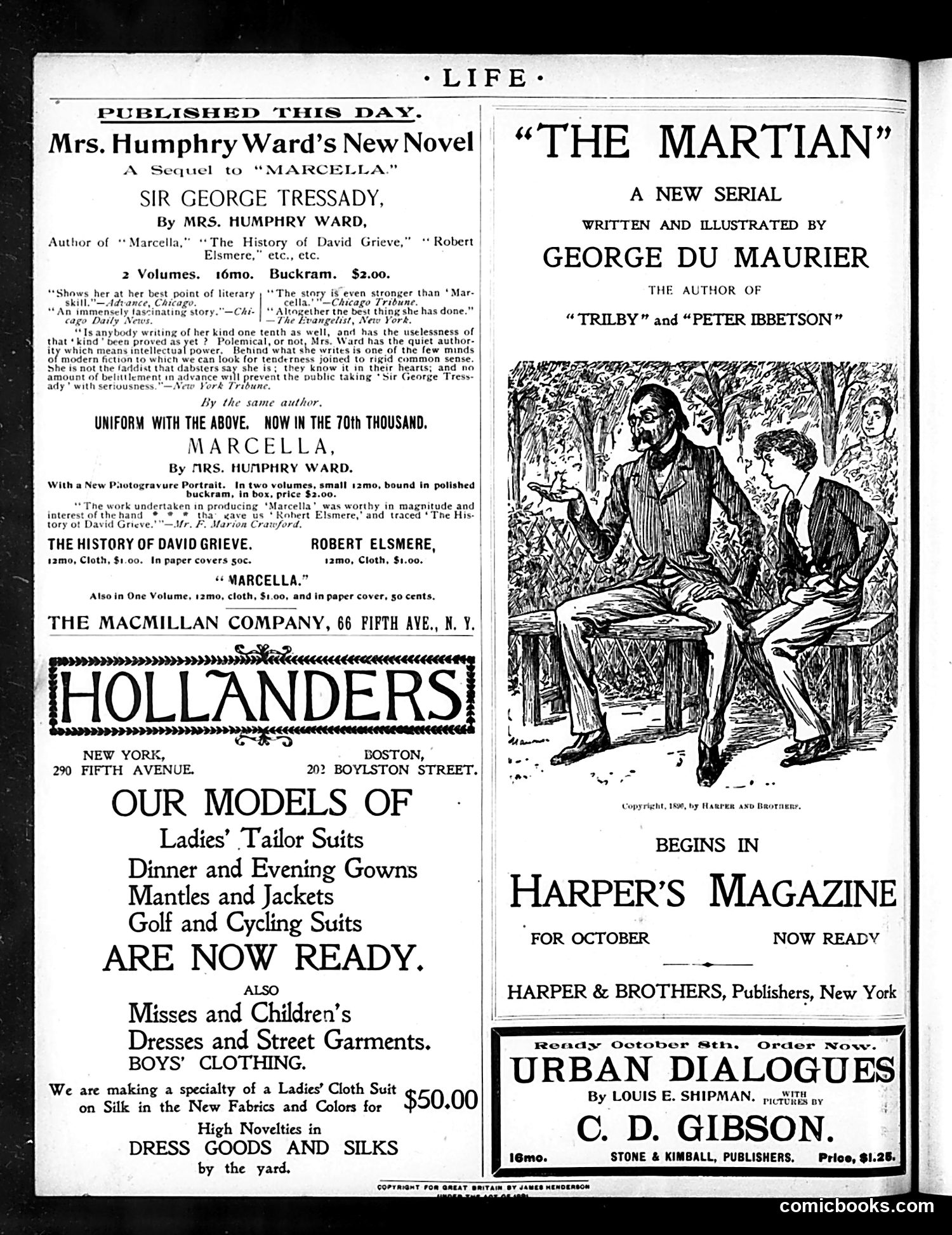
This page is primarily **advertising** rather than political satire. The right side promotes a new serial titled "The Martian," written and illustrated by George Du Maurier (author of "Trilby" and "Peter Ibbetson"), beginning in Harper's Magazine for October. The accompanying illustration shows three men in what appears to be a Victorian-era outdoor setting, examining or discussing something together—likely depicting a scene from the serial itself. The left side advertises books from The Macmillan Company and fashion/clothing from Hollanders department store, plus "Urban Dialogues" by Louis E. Shipman with pictures by C.D. Gibson. The page reflects late-19th-century consumer culture rather than political commentary.
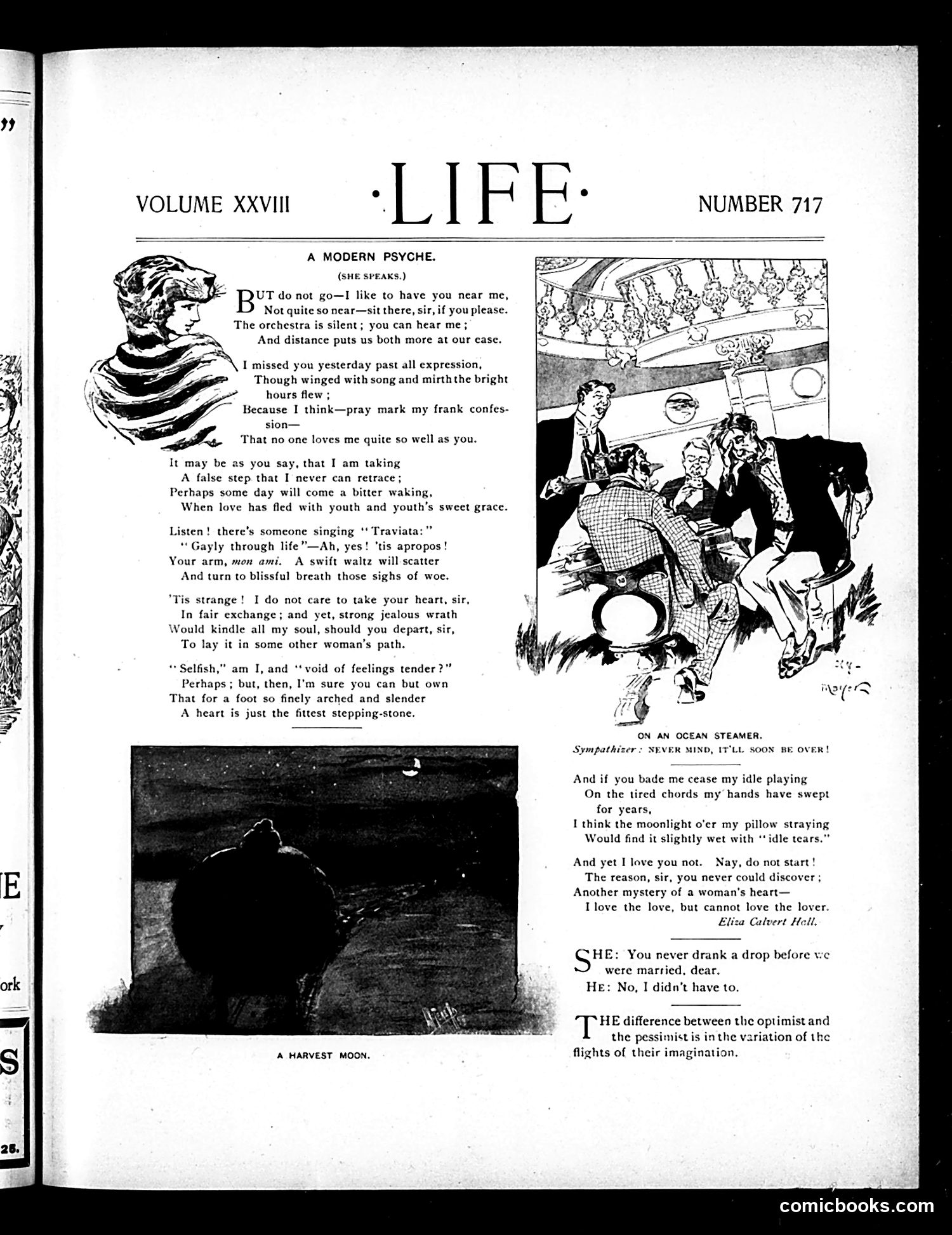
This page contains literary and artistic content rather than political satire. "A Modern Psyche" is a romantic poem about romantic tension and jealousy between lovers, featuring dialogue about distance, missed connections, and emotional conflict. The accompanying illustrations—a woman's portrait, a scene of people at what appears to be a social gathering or theater, and "A Harvest Moon" landscape—complement the poem's themes of love and longing. The page also includes a brief comedic dialogue between a man and woman about drinking before marriage, and a final aphorism contrasting optimists' and pessimists' imaginations. These are entertainment and humor pieces rather than political commentary.
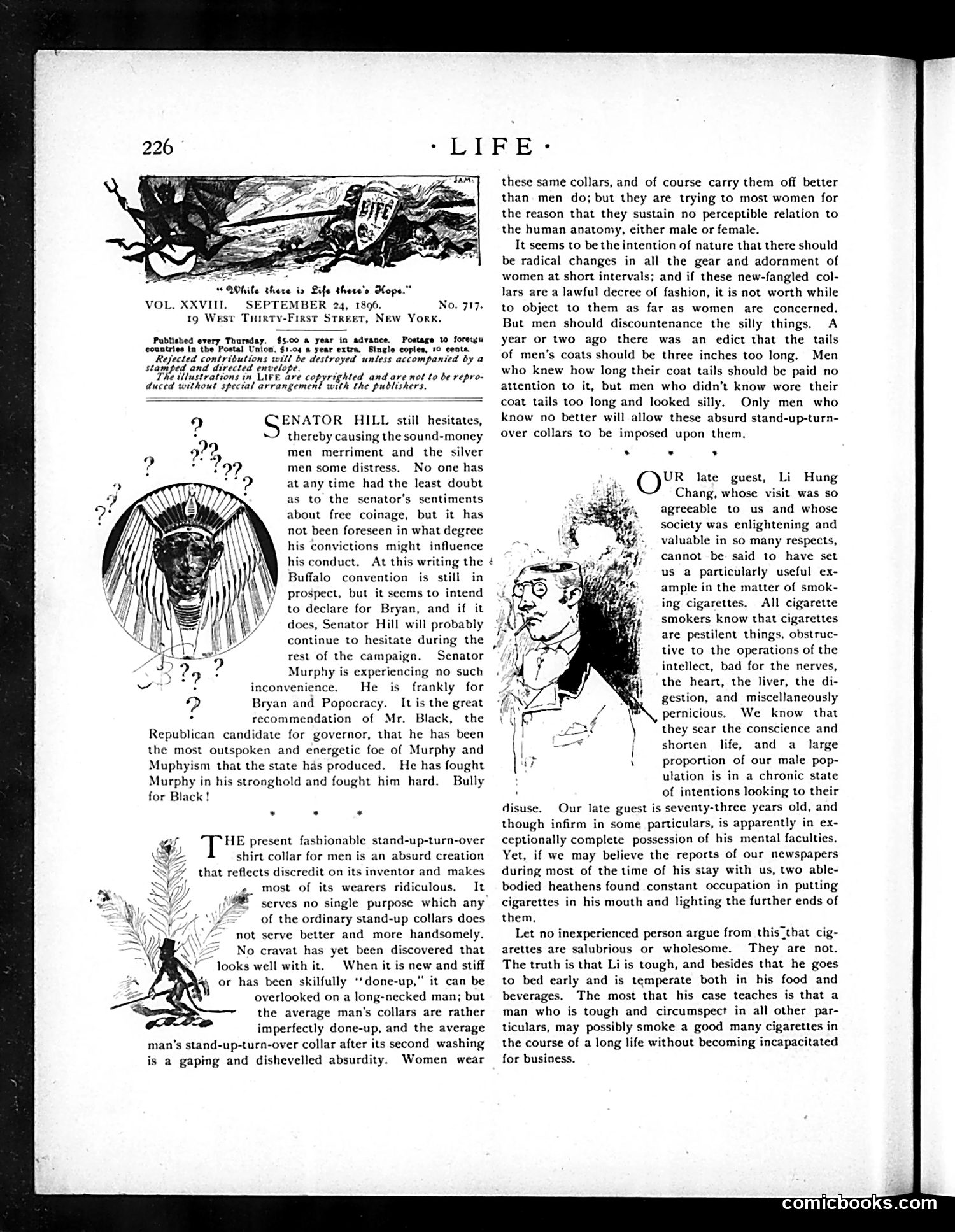
The page contains two distinct satirical sections: **Upper cartoon**: A confused figure surrounded by question marks, likely depicting Senator Hill's bewilderment over free coinage currency debates. The text indicates this relates to Republican gubernatorial politics, mentioning candidates Murphy and Black competing against Hill's influence. **Lower section**: Critiques the fashionable stand-up collar, calling it "an absurd creation" that serves no practical purpose. The satire mocks how men's collars appear poorly fitted and uncomfortable compared to women's fashion choices. **Right column**: Discusses their guest Li Hung Chang, praising his mental faculties while defending cigarette smoking against contemporary health concerns—arguing that moderate smokers may live long lives without "incapacity for business." The page exemplifies *Life*'s style: political commentary, fashion critique, and social observation combined.
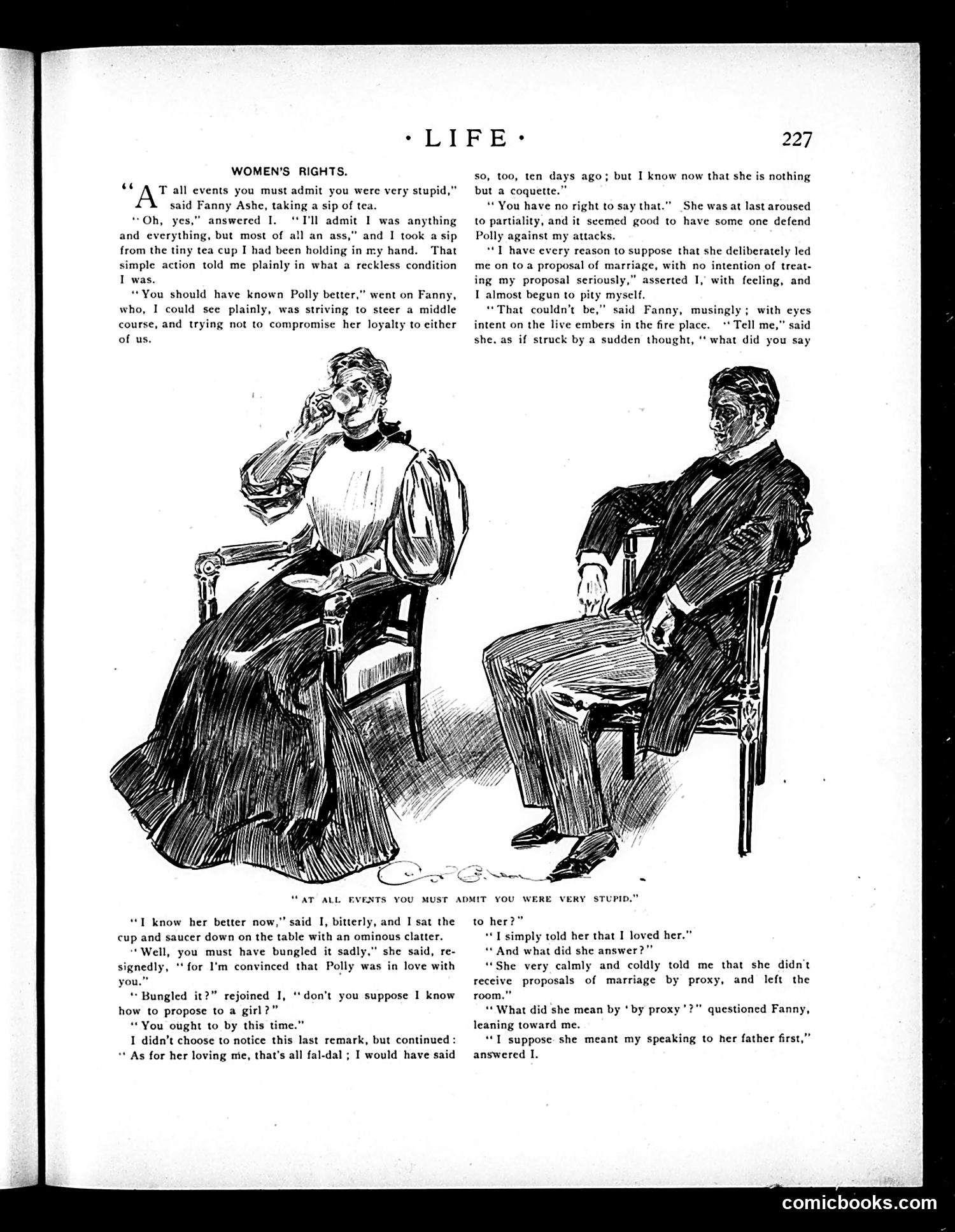
This page satirizes early women's rights advocacy through a dialogue between Fanny Ashe and an unnamed male narrator. The cartoon depicts a woman (Fanny) confronting a man about his botched marriage proposal. The satire mocks both the woman's rights movement and male incompetence: Fanny criticizes the man for proposing "by proxy" rather than in person, suggesting women deserve direct, respectful treatment. However, the overall tone suggests the magazine views women's rights claims as overwrought—the woman is portrayed as hypersensitive and quarrelsome over reasonable matters. The illustration's formal Victorian setting emphasizes the era's rigid social conventions the debate addresses. The satire cuts both ways: ridiculing clumsy male behavior while also dismissing female grievances about their limited agency and rights.
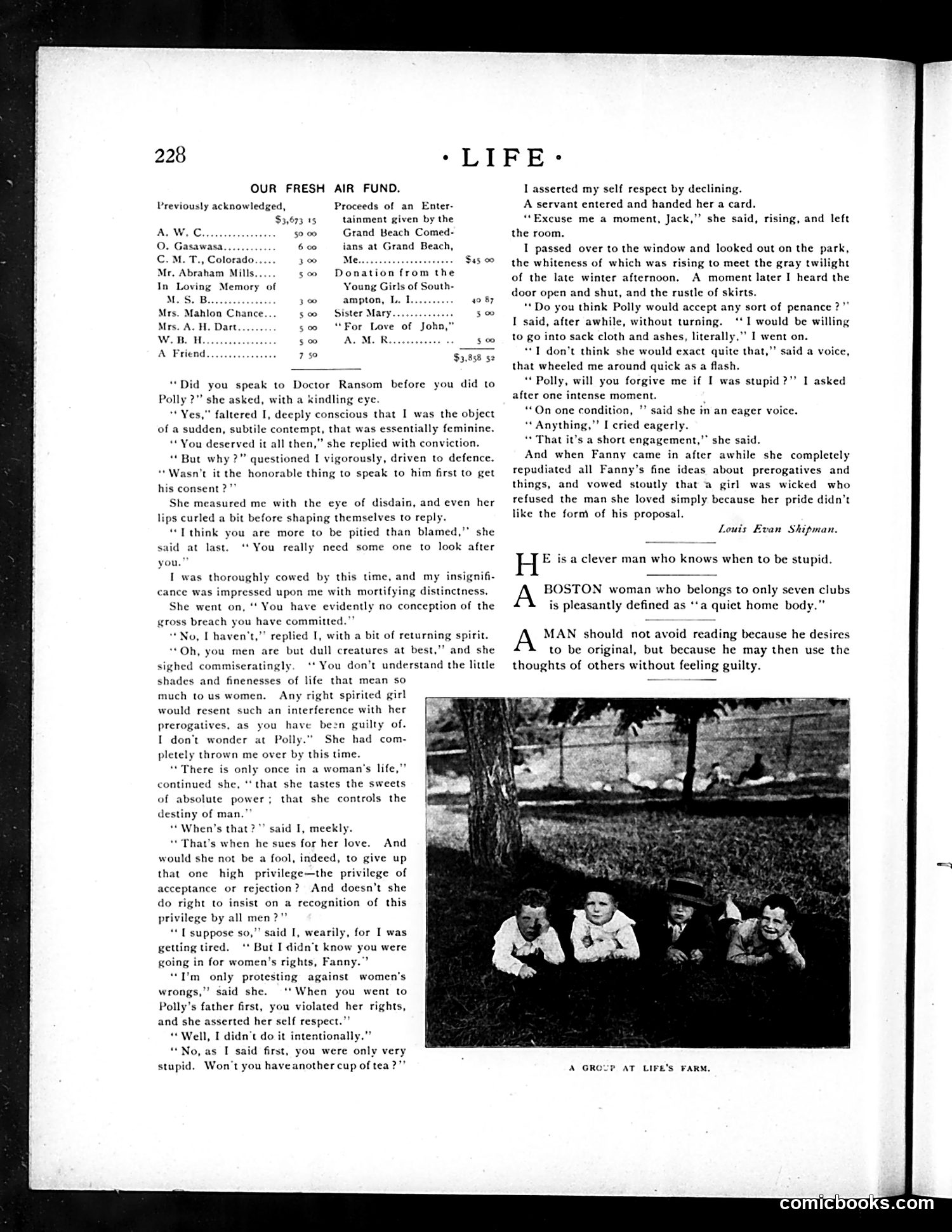
This page contains a narrative story titled "Our Fresh Air Fund" rather than political cartoons. The text describes a conflict between a woman named Polly and the narrator over Doctor Ransom, with themes of women's rights and autonomy central to the debate. The photograph captioned "A GROUP AT LIFE'S FARM" shows what appears to be children outdoors—likely related to Life magazine's charitable "Fresh Air Fund," which provided poor urban children country vacations. The three quoted aphorisms at bottom ("He is a clever man...," "A Boston woman...," "A man should not avoid reading...") appear to be unrelated social commentary, typical of Life's satirical format offering brief observations on contemporary manners and society.
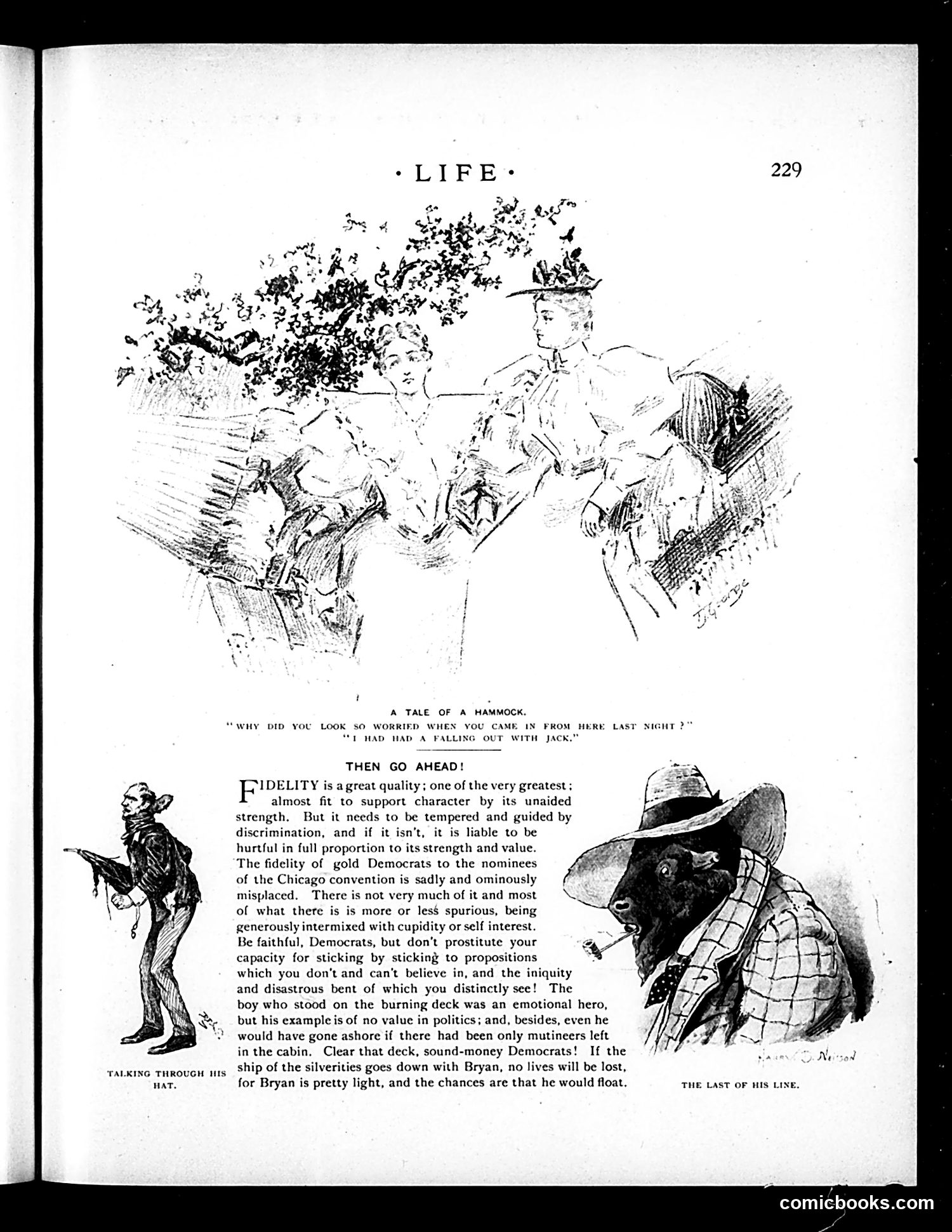
This page contains political satire critiquing Democratic fidelity during the 1896 presidential era. The top cartoon shows a domestic dispute about a "falling out with Jack," likely referencing a political betrayal. The main article "Then Go Ahead!" attacks Democrats who abandoned sound-money principles. It specifically mocks the party's nominee (William Jennings Bryan, referenced by name) for his free-silver advocacy, claiming such infidelity to traditional Democratic fiscal conservatism is disastrous. The text argues that even "mutineers" Democrats should not compromise core values. The illustrations—"Talking Through His Hat" (left) and "The Last of His Line" (right)—depict politicians as foolish or doomed, reinforcing the message that abandoning principle leads to political destruction. The satire targets what the magazine viewed as Democratic betrayal of fiscal responsibility.
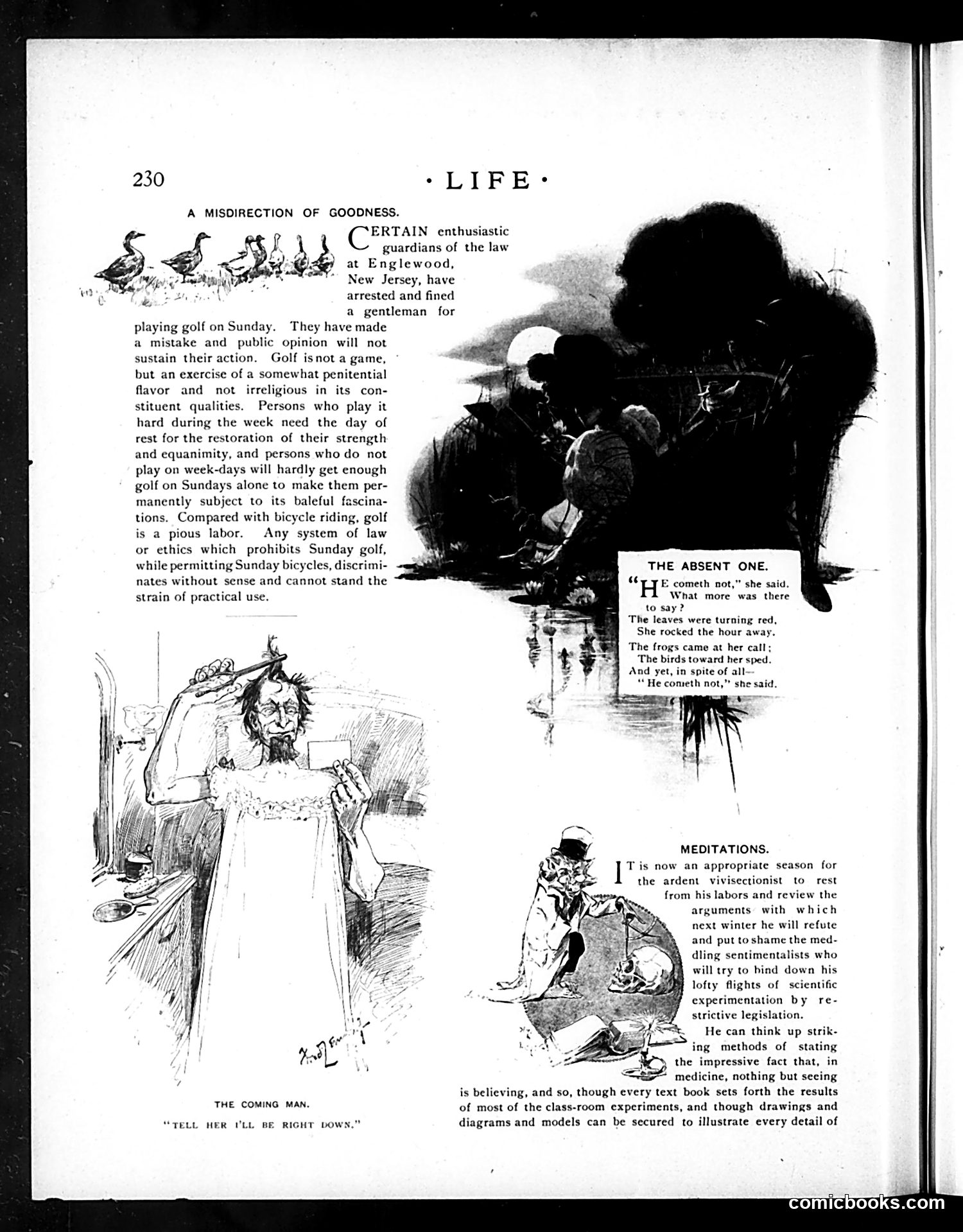
This page contains three satirical pieces from *Life* magazine (page 230): 1. **"A Misdirection of Goodness"** (top left): An editorial arguing that Sunday golf should be legal. It criticizes authorities in Englewood, New Jersey who arrested a golfer, arguing that golf is morally equivalent to other Sunday activities like bicycle riding—not inherently sinful. 2. **"The Coming Man"** (bottom left): A sketch showing a man telling a woman "Tell her I'll be right down's"—likely satirizing the perpetually absent suitor or the changing social dynamics of courtship. 3. **"The Absent One"** (right): An illustrated poem about a woman waiting for someone who never arrives, accompanied by melancholic nature imagery (turning leaves, frogs, birds). The page reflects early 20th-century debates over Sunday observance laws and changing social norms.
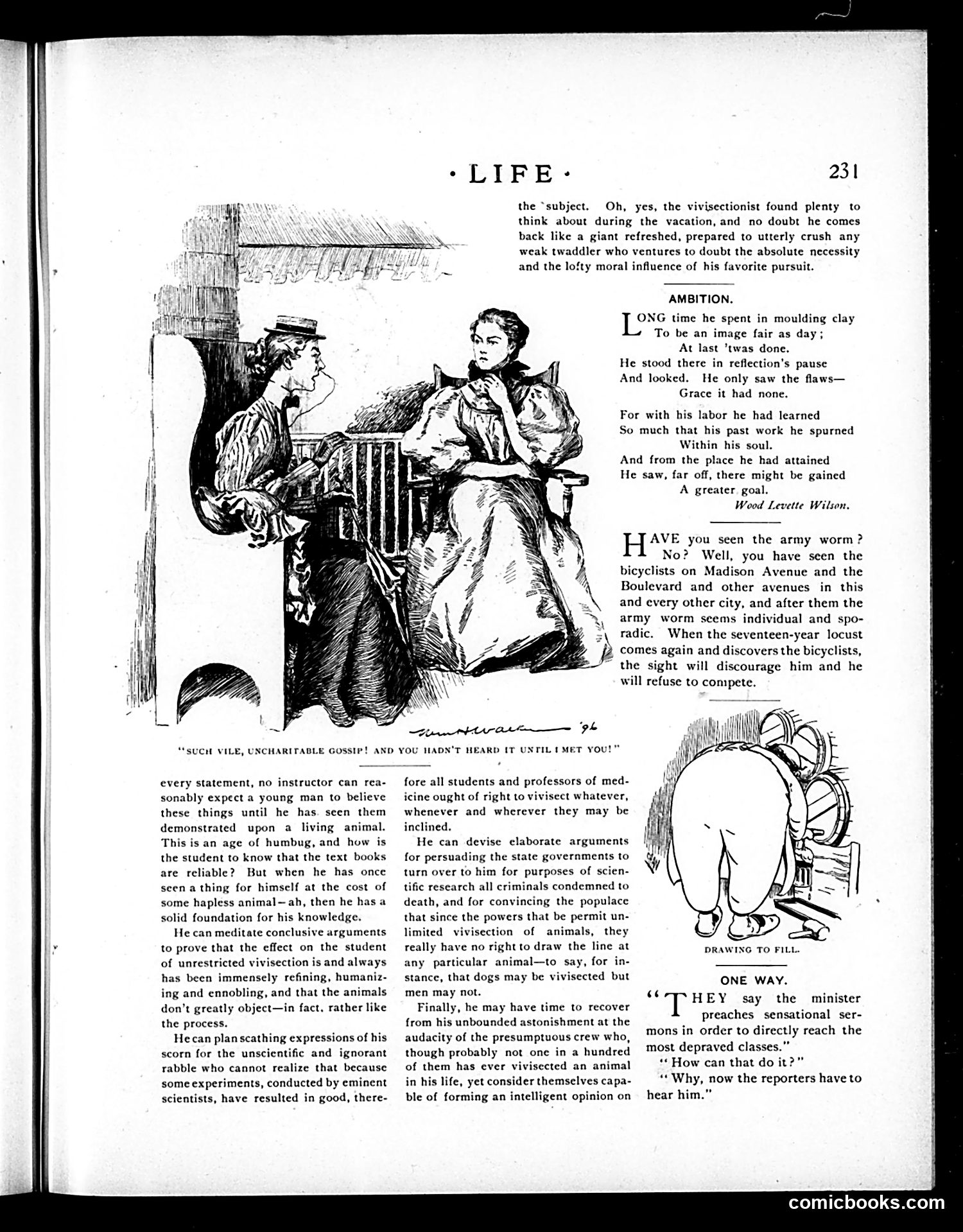
The main illustration depicts two figures in conversation, with one appearing to gossip to the other. The caption reads: "Such vile, uncharitable gossip! and you hadn't heard it until I met you!" This is satirizing **hypocrisy in gossip-spreading**—the speaker claims moral superiority while simultaneously spreading rumors, implying they're the source rather than merely repeating hearsay. The surrounding text discusses **vivisection** (animal experimentation), criticizing students and professors who perform such procedures while claiming moral authority. The satire targets their inconsistency: they lecture about ethics while conducting practices they consider justified by science. The smaller "One Way" section mocks **sensationalist preaching**, suggesting ministers use exaggerated claims to reach poor audiences without substance. Overall, the page satirizes **moral hypocrisy across institutions**—gossips, scientists, and clergy claiming righteousness while behaving otherwise.
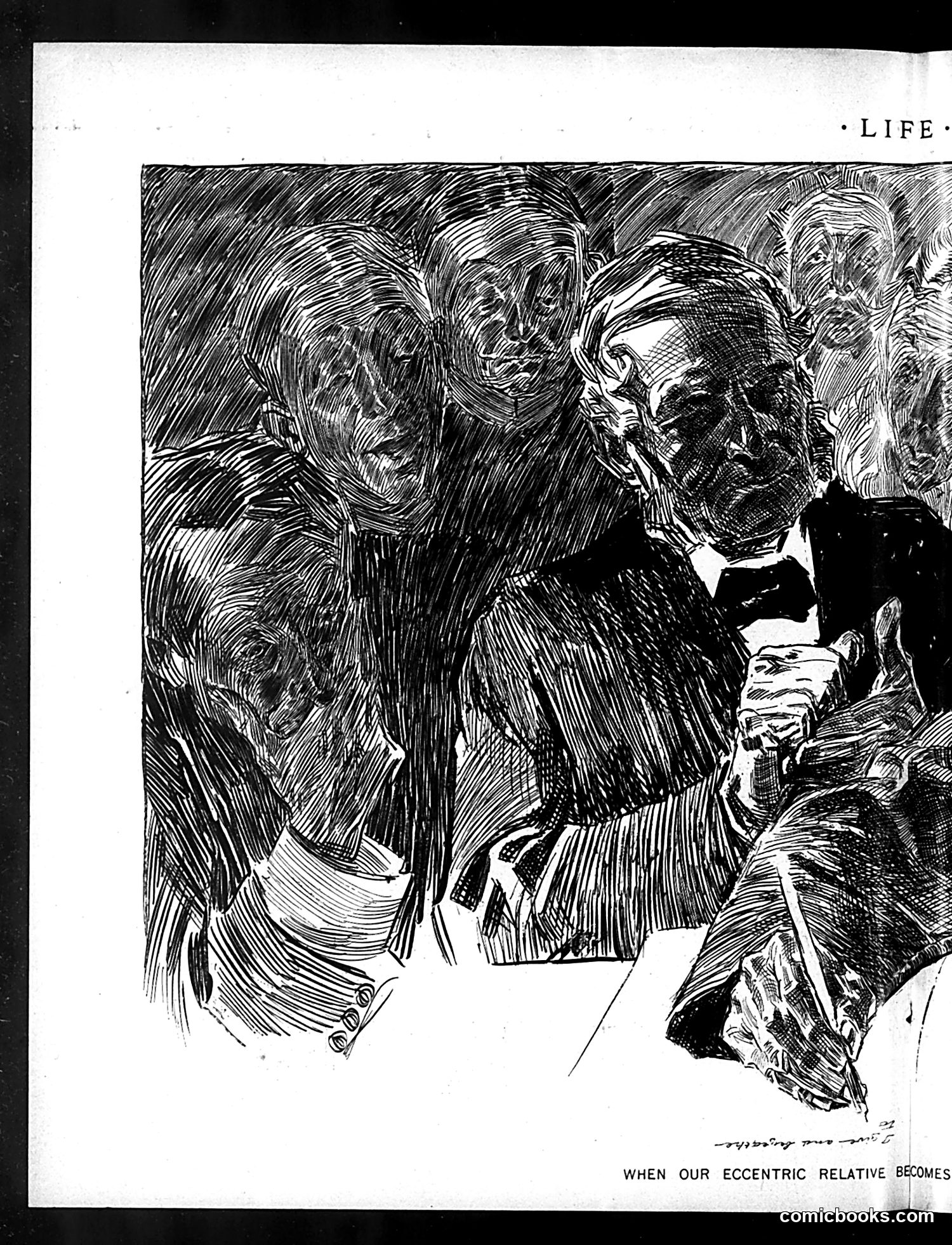
This is a satirical illustration from *Life* magazine showing a formal social gathering. The visible caption reads "WHEN OUR ECCENTRIC RELATIVE BECOMES—" (text is cut off). The cartoon depicts a well-dressed man in formal attire (tuxedo and bow tie) surrounded by fashionably-dressed women at what appears to be an elegant social event. The style and composition suggest this is satirizing social pretension or the embarrassment caused by an unconventional family member's behavior in polite society. The exaggerated crosshatching and expressive linework typical of early 20th-century satirical illustration emphasizes the tension and discomfort in the scene. However, without the complete caption, the specific target of the satire—which relative and what eccentric behavior—remains unclear from the visible text alone.
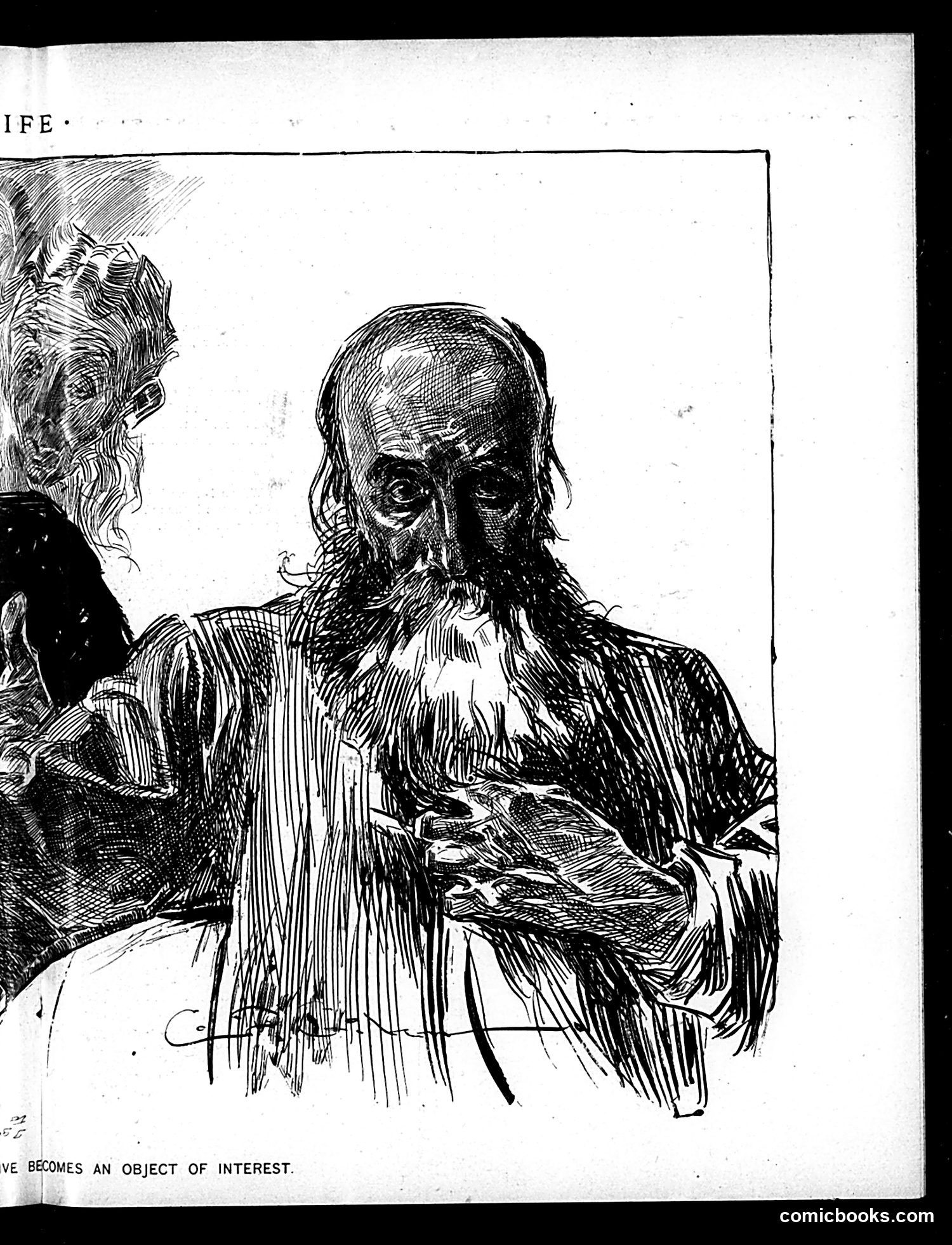
This ink sketch depicts an elderly bearded man in contemplative pose. The partial caption reads "...VE BECOMES AN OBJECT OF INTEREST," though the full context is cut off, making the specific reference unclear. The figure's appearance—long beard, aged features, formal period clothing—suggests this is a portrait of a notable 19th or early 20th-century figure, but without the complete caption or publication date visible, I cannot definitively identify who is being portrayed or what satirical point Life magazine intended. The artistic technique uses cross-hatching typical of period satirical illustration. The sketch's style and placement suggest this was likely social or political commentary, though the incomplete text prevents determining whether it mocked the subject's ideas, appearance, or circumstances.
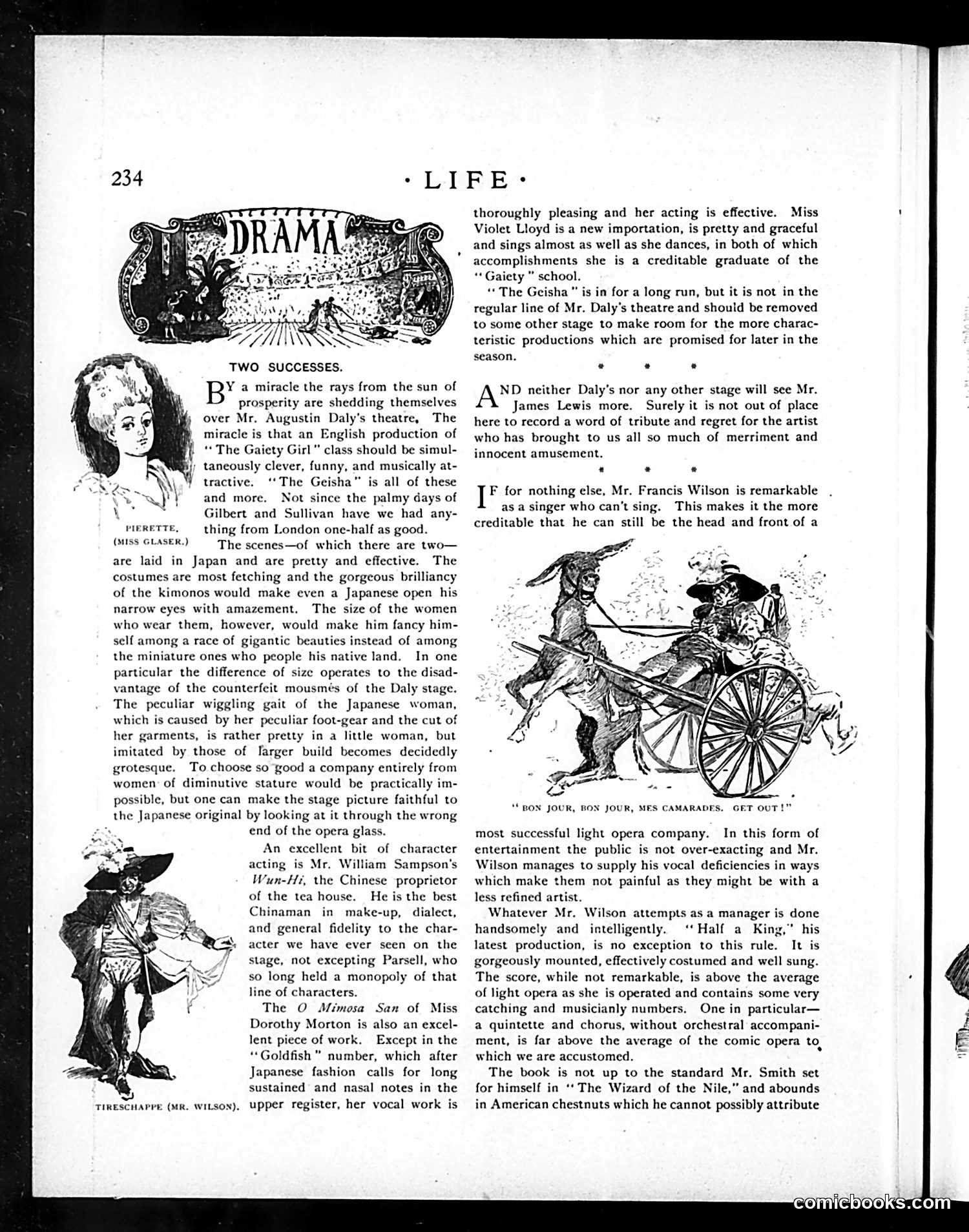
This page contains theatre criticism rather than political cartoons. The text reviews London productions at Augustin Daly's theatre, primarily praising "The Geisha." **Key satirical points:** The critic employs gentle mockery regarding the production's casting of tall American actresses in roles meant for diminutive Japanese women, noting their "wiggling gait becomes decidedly grotesque" in larger bodies. The suggestion to view the stage "through the wrong end of the opera glass" is the sharpest satire—implying one must literally diminish the perspective to accept the casting. **Notable figures mentioned:** - William Sampson (praised for authentic Chinese characterization as "Wun-Hi") - Francis Wilson (humorously described as "a singer who can't sing" yet successfully manages light opera) - James Lewis (receiving an elegiac farewell) The overall tone reflects late-Victorian attitudes: appreciation for "exotic" Japanese aesthetics combined with amusement at the incongruity of Western actresses attempting to embody them. The satire targets theatrical conventions and casting practicalities rather than politics.
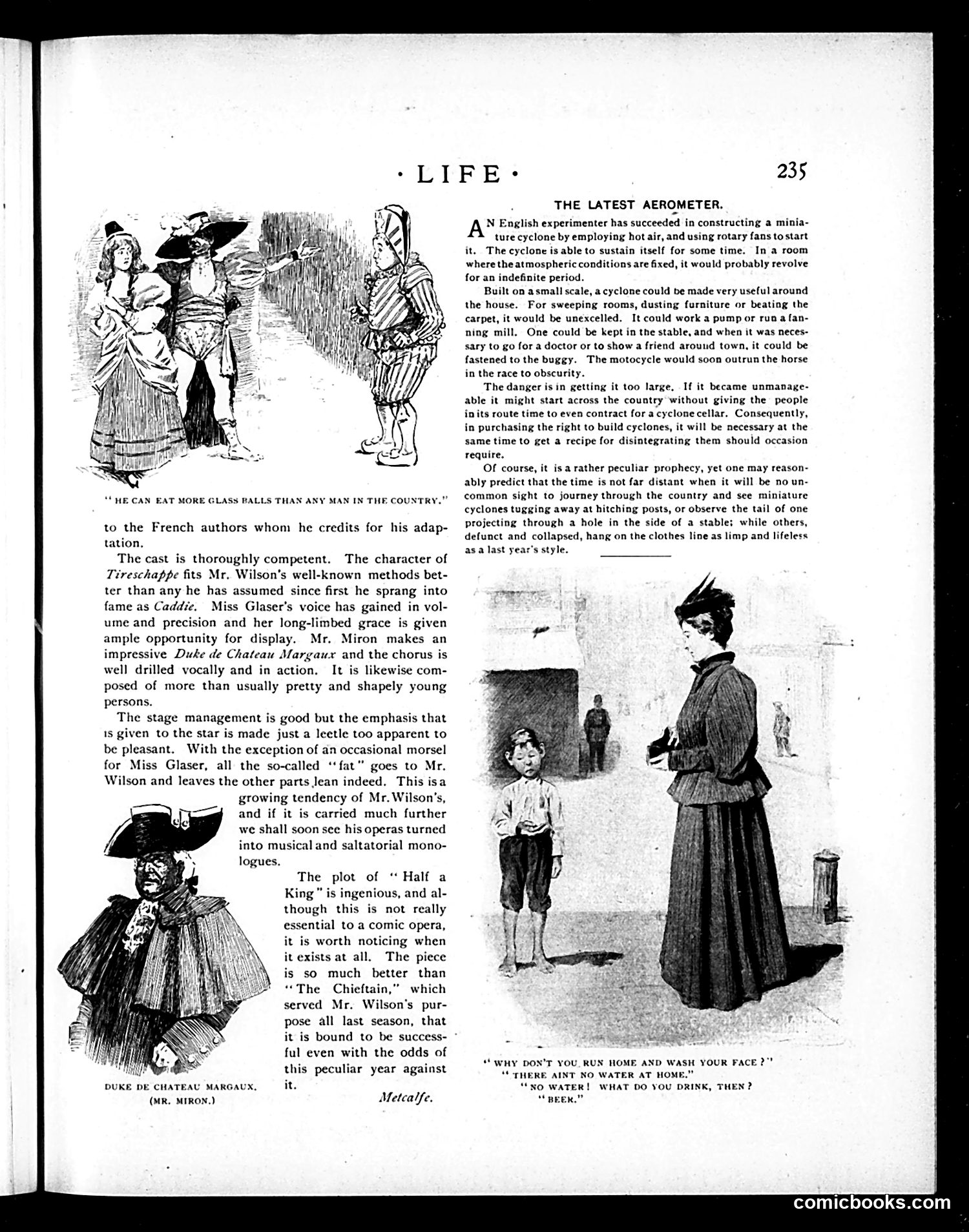
**Theater Criticism Section:** The page reviews a comic opera production, likely featuring star performer Wilson. The upper cartoons illustrate characters from "Half a King" opera—the "Duke de Chateau Margaux" (played by Mr. Miron, shown in elaborate costume) and other cast members. The critic praises the production but satirizes Wilson's ego, noting he monopolizes the "fat" (comedic material), leaving other performers undernourished roles. The opening caption about "glass balls" appears to be a vaudeville reference, mocking theatrical showmanship. **Lower Cartoon:** A street scene depicts an impoverished child, answering a well-meaning adult's question about washing. The child admits there's no water at home—he drinks "beer" instead. This satirizes urban poverty and child welfare, suggesting poor families relied on beer as safer than contaminated drinking water. It's simultaneously a class commentary and social critique: the humor comes from the incongruity between middle-class cleanliness expectations and working-class realities.
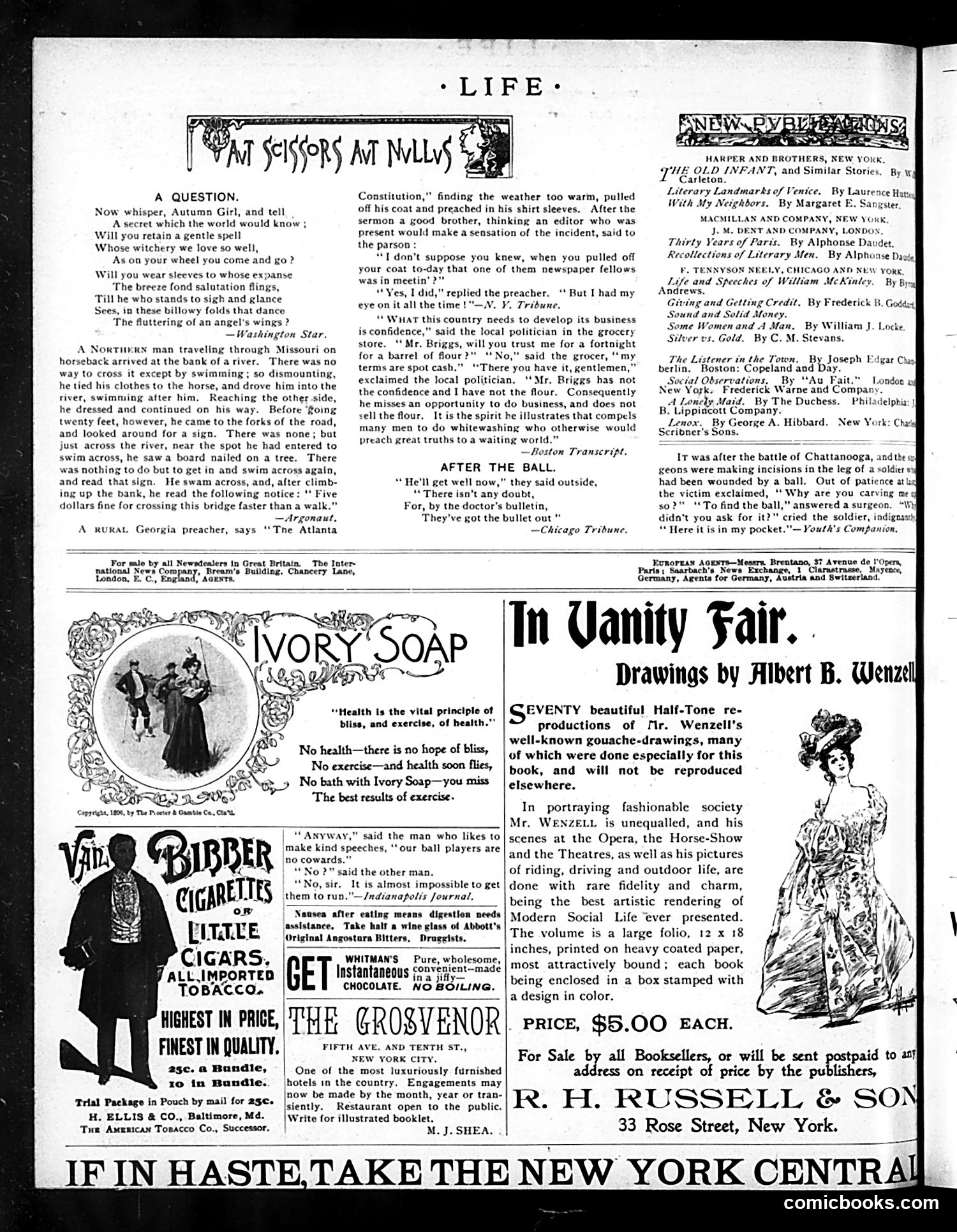
This page is primarily **advertisements and literary notices** rather than political satire. The small humorous anecdotes scattered throughout are genteel, apolitical jokes typical of late 19th-century American humor magazines. The brief comic pieces include: - **"A Question"**: A sentimental poem about autumn and women's fashion (billowy sleeves) - **The Missouri river anecdote**: A man swims across a river to read a sign prohibiting fast crossing—absurdist humor about poor planning - **The preacher's coat**: A rural Georgia minister removes his coat while preaching, pretending not to notice a newspaper reporter present—gentle mockery of affected casualness - **The grocer scene**: Local politician lectures about "confidence" while being denied credit—light social commentary on hypocrisy - **"After the Ball"**: A wounded soldier's witty response to having a bullet extracted The advertisements dominate: Ivory Soap, Valdo Gibber Cigarettes, Whitman's Chocolate, and The Grosvenor hotel. A substantial section promotes an illustrated book of Albert B. Wenzell's society drawings. **The content reflects genteel Victorian humor with no sharp political edge.**
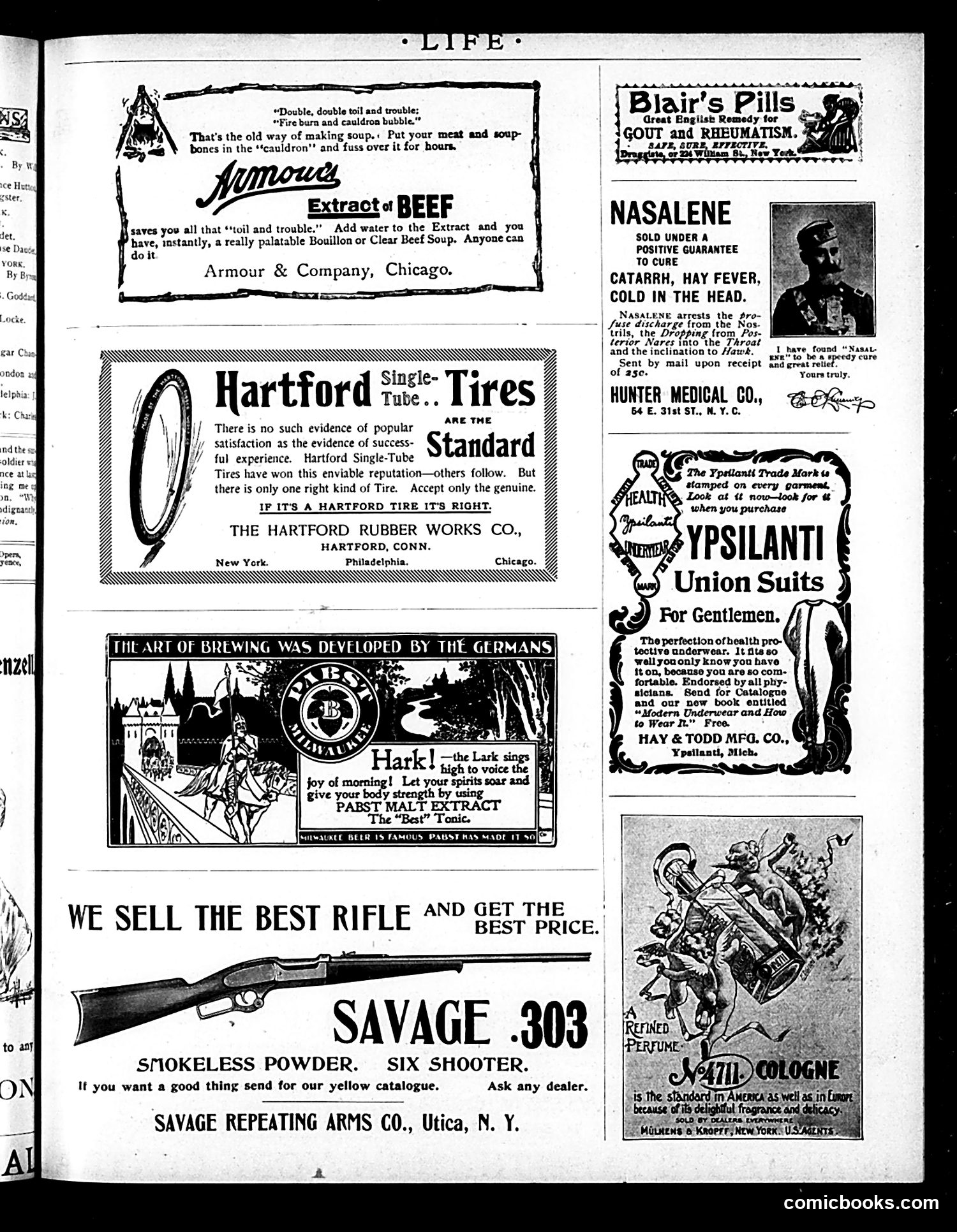
This is primarily an **advertising page** from Life magazine, not a political cartoon. The page contains multiple product advertisements typical of early 20th-century American magazines. The only illustration with potential satirical content is the **Armour Extract of Beef advertisement**, which opens with a Shakespeare reference ("Double, double toil and trouble / Fire burn and cauldron bubble" from *Macbeth*). The visual shows a witch at a cauldron, contrasting the "old way" of laborious soup-making with Armour's modern instant product—a common advertising trope mocking outdated methods. The remaining advertisements are straightforward pitches for: Hartford bicycle tires, Pabst Malt Extract tonic, Savage .303 rifles, Nasalene nasal treatment, Ypsilanti Union Suits underwear, and 4711 Cologne. **No significant political satire appears on this page.** It's a commercial products page using light humor (the witch reference) to promote convenience and modernity to consumers.
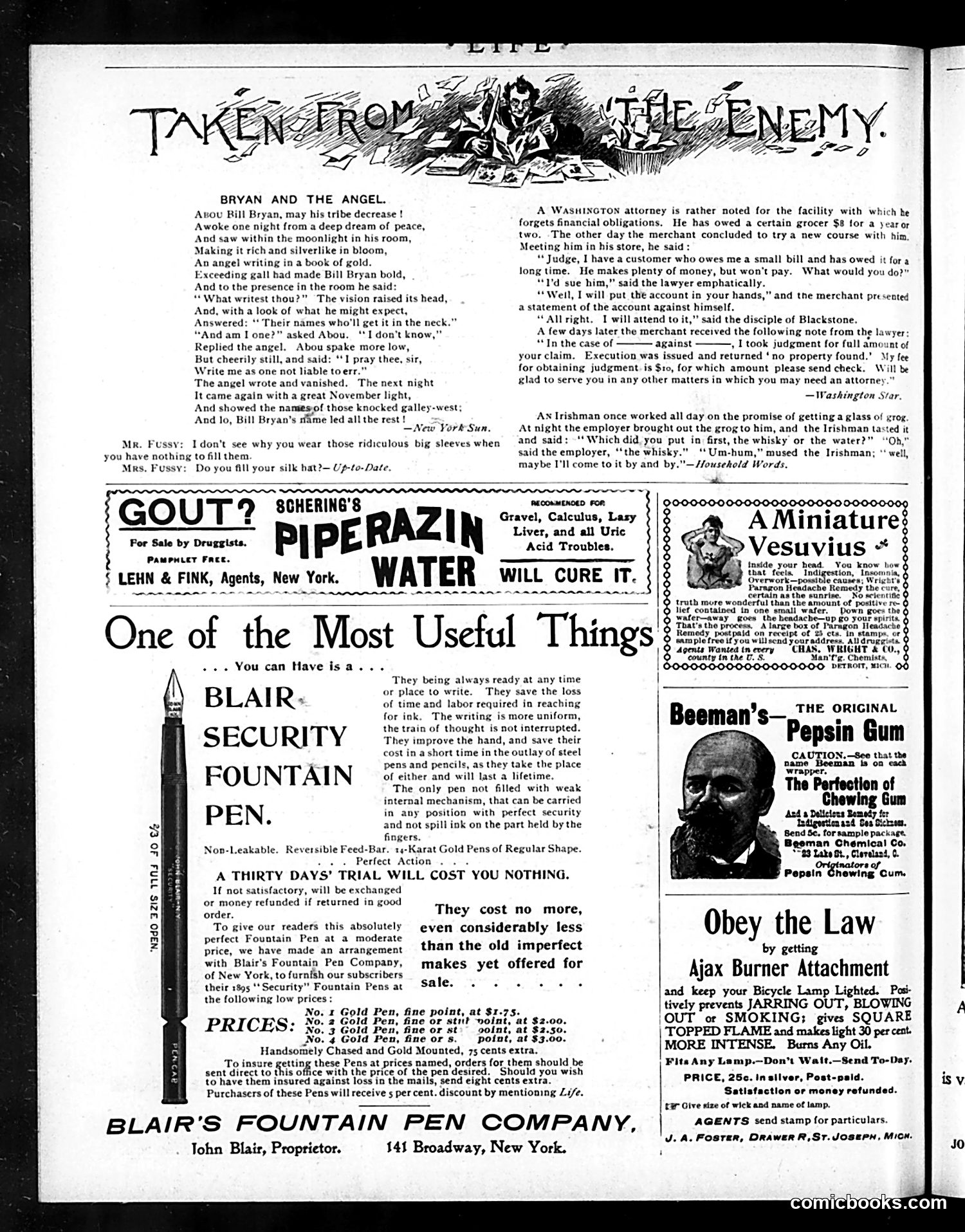
This page from *Life* magazine (a satirical weekly) contains primarily **humorous verse and social commentary** rather than political cartoons. The main feature, "Bryan and the Angel," is a satirical poem mocking **William Jennings Bryan**, the prominent Democratic politician and three-time presidential candidate. The poem, written in the style of the famous poem "Abou Ben Adhem," imagines Bryan encountering an angel who records names of those who will "get it in the neck"—with Bryan's name leading the list. This is a biting attack on Bryan's credibility or standing. Below is a lighthearted anecdote about a Washington lawyer who forgets his debts, and another joke about an Irishman and whisky. The remainder consists almost entirely of **period advertisements** for products like Schering's Piperazin Water (for gout), Blair's Fountain Pen, Beeman's Pepsin Gum, and Ajax Burner Attachment for bicycle lamps. The page is primarily **commercial**, with satire limited to the Bryan poem.
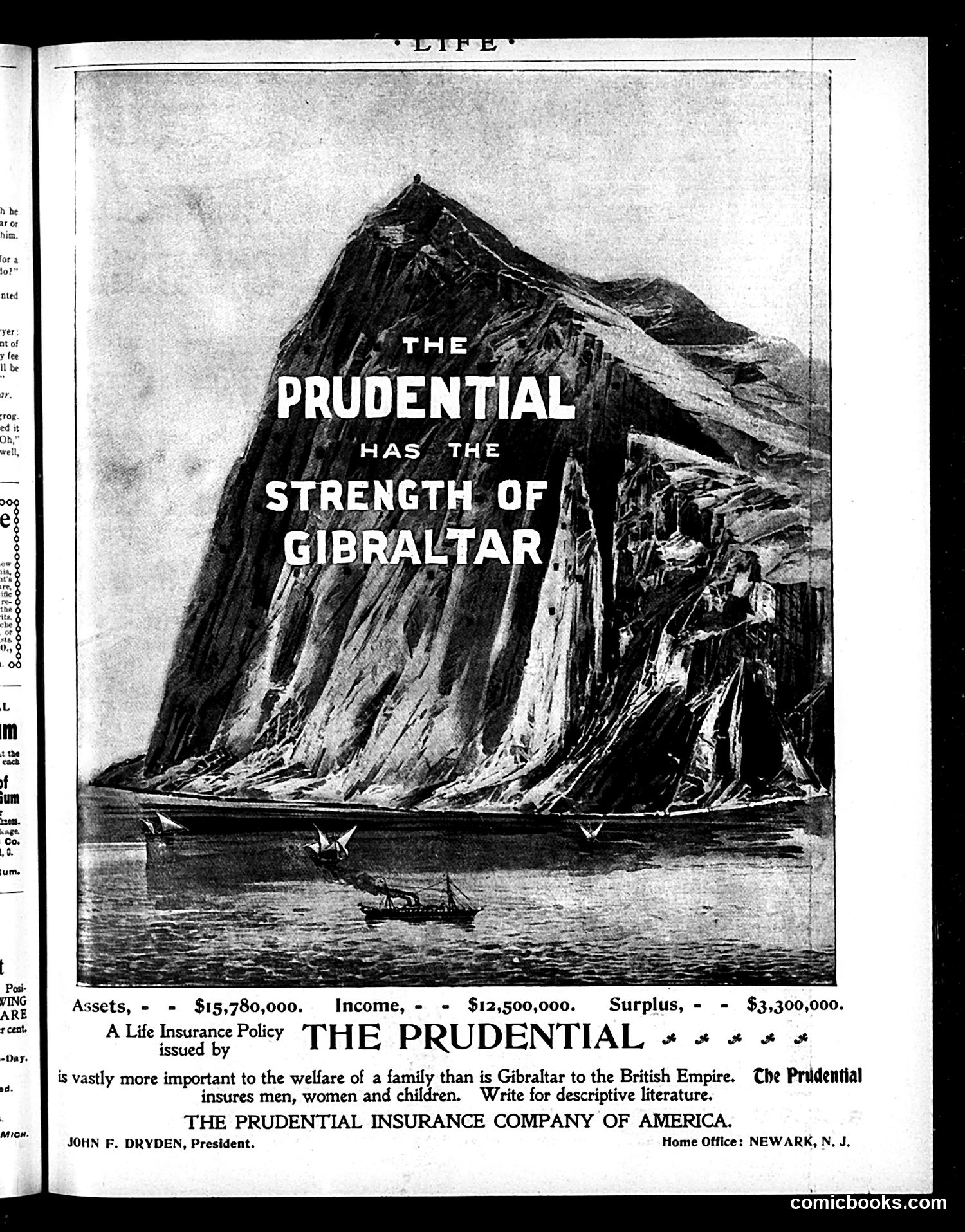
This is a **Life magazine advertisement** for The Prudential Insurance Company, not a political cartoon. The ad uses **Gibraltar**—the famous strategic British fortress—as a metaphor for strength and permanence. The dramatic engraving of the imposing Rock of Gibraltar reinforces the message that Prudential is equally solid and dependable. The comparison claims that life insurance from Prudential is "vastly more important to the welfare of a family than is Gibraltar to the British Empire"—suggesting that while Gibraltar protects a nation, Prudential protects families financially. The ad emphasizes the company's substantial assets ($15.78 million) and financial surplus to establish credibility. This is corporate advertising using nationalist imagery and military symbolism common in early 20th-century American marketing.
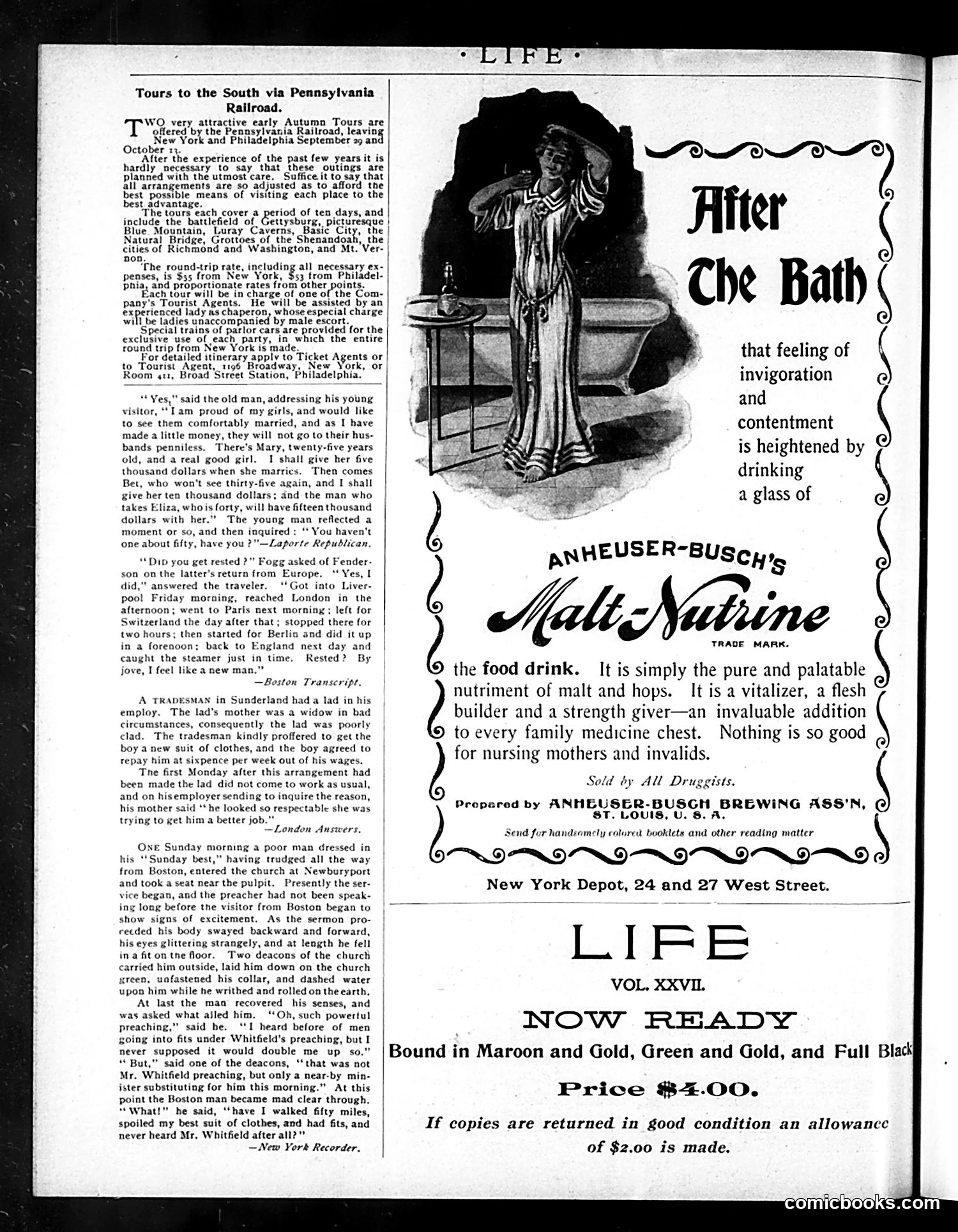
This page is primarily **advertising and anecdotal humor**, not political satire. The dominant feature is a large **Anheuser-Busch Malt Nutrine advertisement** depicting a woman in classical robes, promoting their "food drink" as beneficial for nursing mothers and invalids—typical early 1900s patent medicine marketing. The text consists of several brief humorous anecdotes unrelated to each other: 1. **Travel advertisement**: Pennsylvania Railroad tours to Southern battlefields and landmarks 2. **Marriage joke**: An elderly man offering progressively larger dowries; a suitor asks if he has a 50-year-old daughter 3. **Travel humor**: A man claims to have "rested" in Europe by rushing through multiple countries in days 4. **Employment anecdote**: A poor boy receives new clothes, becomes "respectable," and his mother tries to find him better work 5. **Church incident** (incomplete): A Boston visitor becomes emotionally overwhelmed during a sermon The page reflects **turn-of-century genteel humor** and commercial culture rather than political commentary.
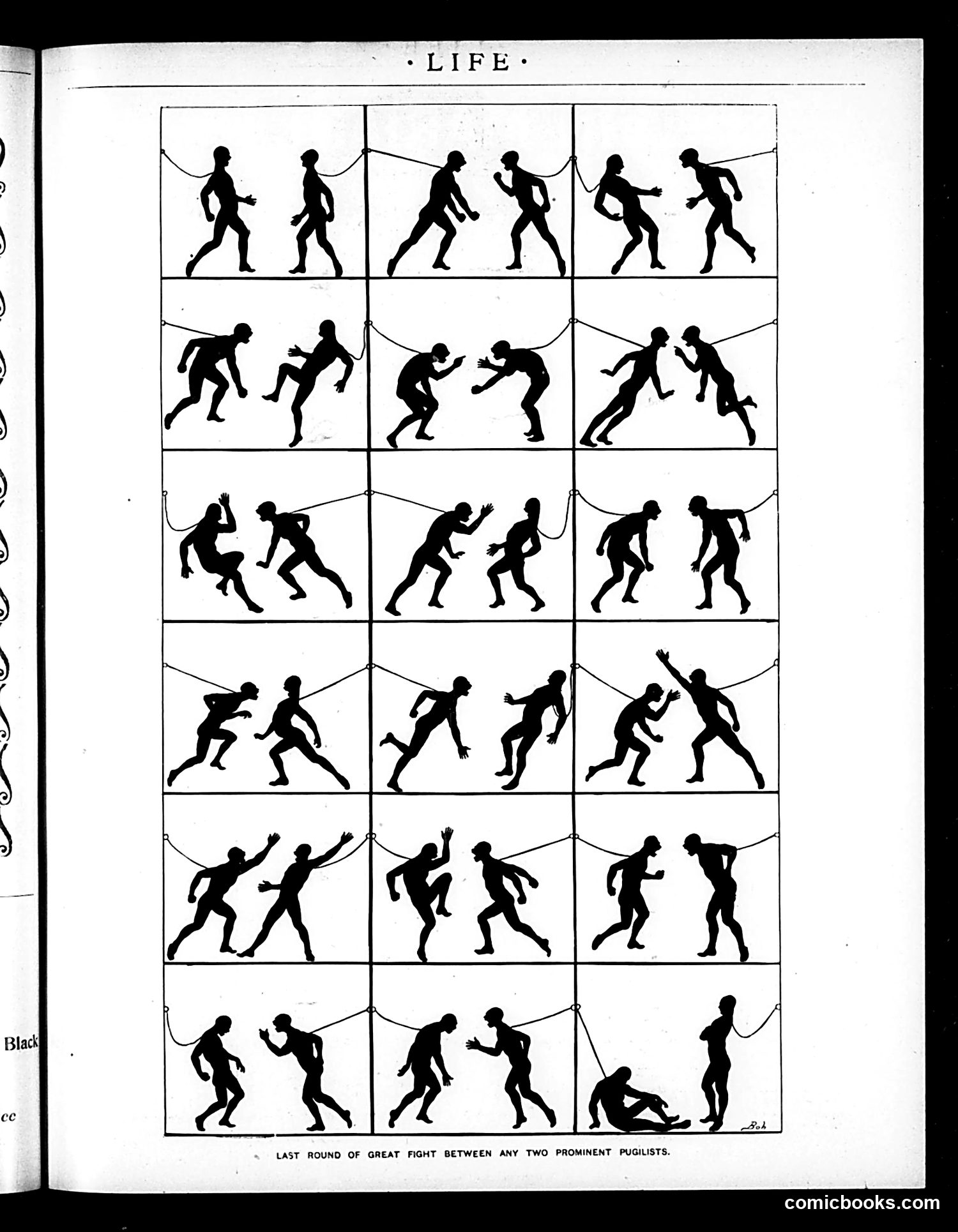
This is a satirical comic strip showing a boxing match between two unnamed fighters, presented as a sequential series of silhouettes. The caption promises "the last round of great fight between any two prominent pugilists," but the joke appears to be that the sequence degenerates into increasingly chaotic, crude, and undignified behavior—with the final panel showing one fighter defeated and sitting on the ground. The satire likely mocks sensationalized boxing coverage in newspapers and magazines of the era, suggesting that professional boxing matches (despite their sporting pretense) are fundamentally just brutal, unglamorous brawls. The progression from organized boxing stances to messy tumbling suggests the magazine is cynically commenting on the degraded nature of prizefighting and its appeal to the public.
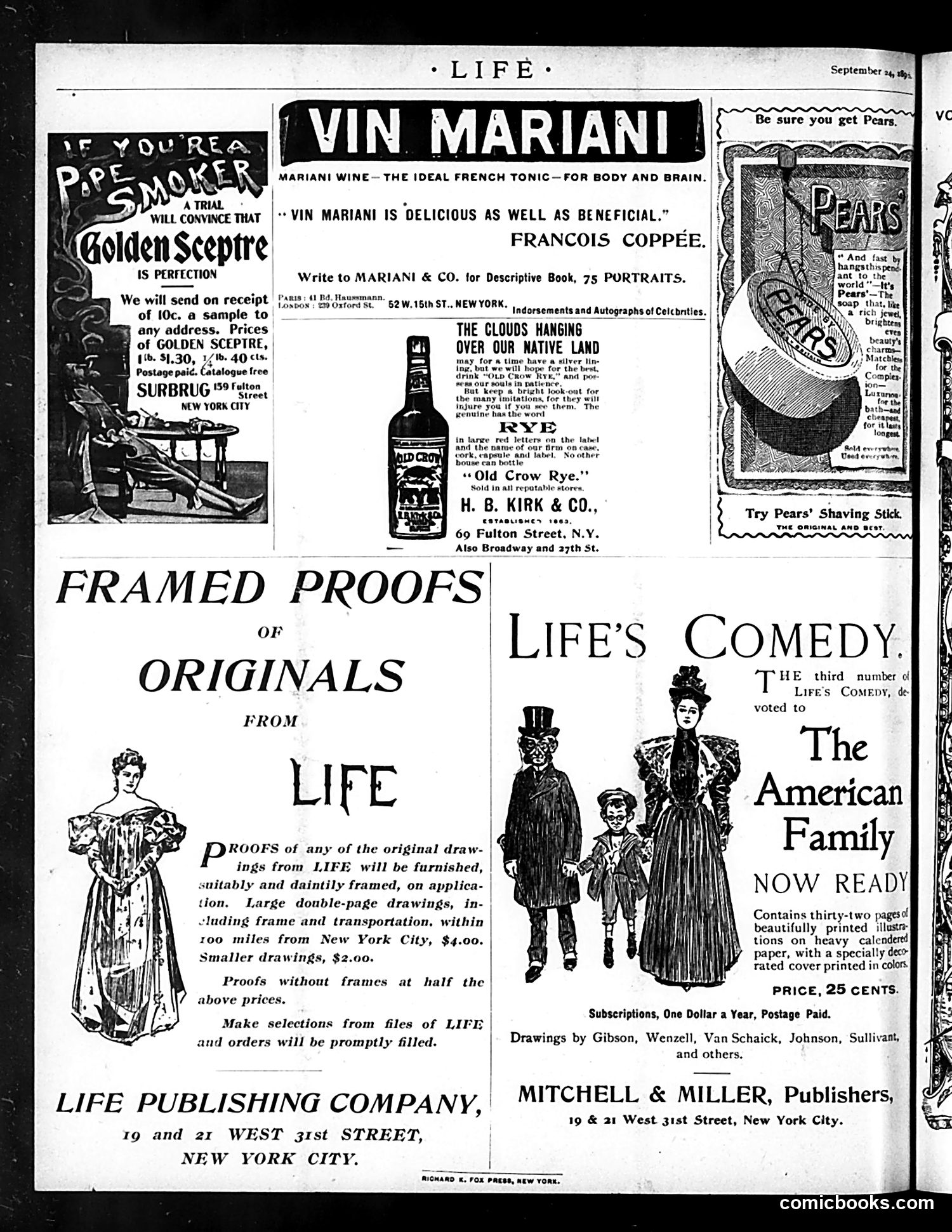
This page consists primarily of **advertisements and publisher announcements** rather than editorial cartoons. **Key Content:** The ads promote patent medicines and consumer goods typical of the era—Vin Mariani (a wine tonic marketed as beneficial for "body and brain"), Golden Sceptre pipe tobacco, Old Crow Rye whiskey, and Pears' Shaving Stick. These reflect late-Victorian advertising practices, including celebrity endorsements (François Coppée quotes Vin Mariani). **Editorial Content:** Life Publishing announces it will sell framed proofs of original artwork from the magazine, offering reproductions by notable illustrators (Gibson, Wenzell, Van Schaick, etc.). The only illustration with possible satirical intent is a small vignette captioned "The Clouds Hanging Over Our Native Land"—it advertises Old Crow Rye whiskey with a cloud/silver-lining metaphor, though the actual satirical point remains unclear from this reproduction. **Bottom section** announces Life's Comedy #3, "The American Family," a thirty-two-page illustrated publication selling for 25 cents. This is fundamentally a **commercial page**, not a political satire page.