
Life, 1896-09-24 · page 12 of 20
Life — September 24, 1896 — page 12: what you’re looking at
What you’re looking at
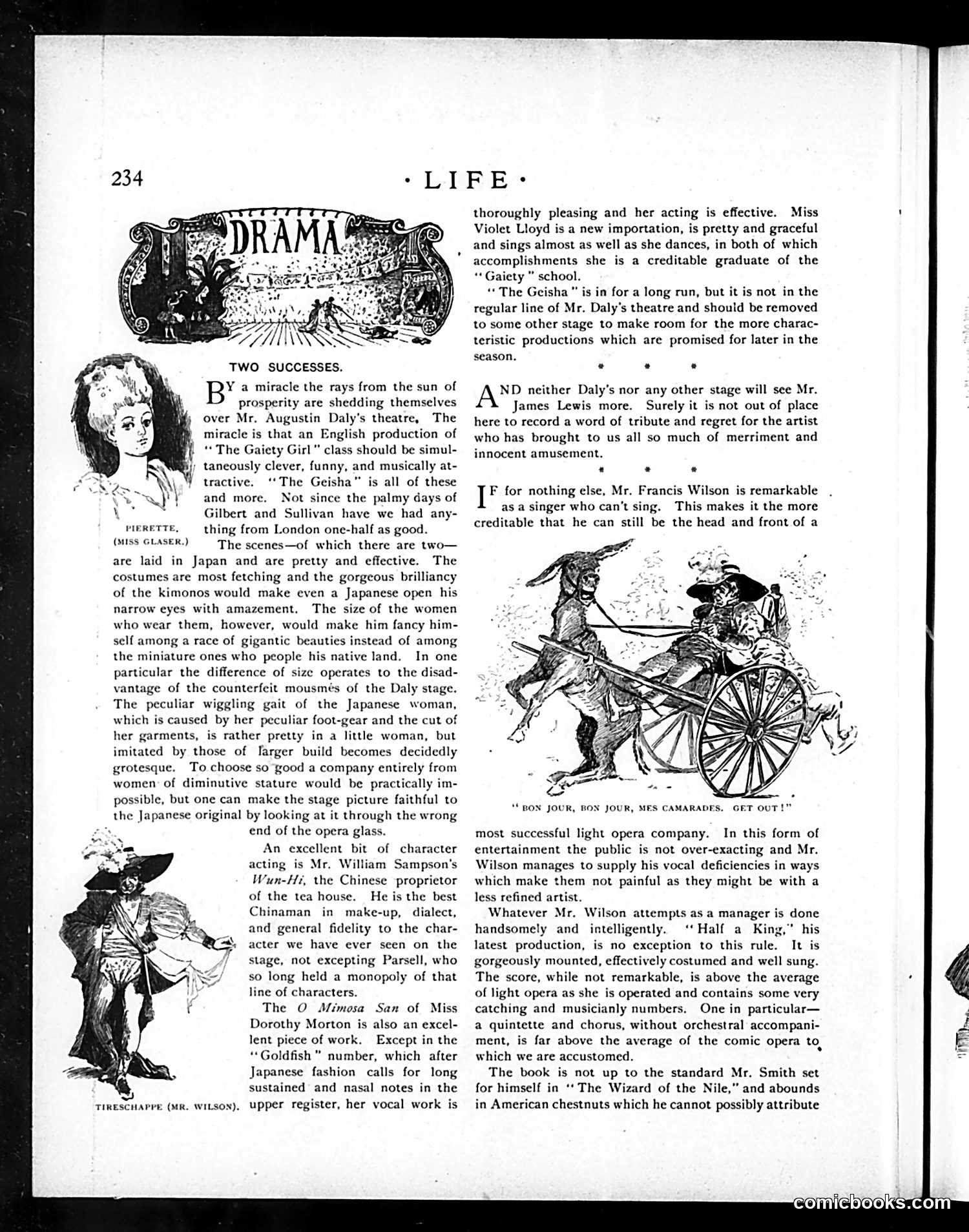
This page contains theatre criticism rather than political cartoons. The text reviews London productions at Augustin Daly's theatre, primarily praising "The Geisha." **Key satirical points:** The critic employs gentle mockery regarding the production's casting of tall American actresses in roles meant for diminutive Japanese women, noting their "wiggling gait becomes decidedly grotesque" in larger bodies. The suggestion to view the stage "through the wrong end of the opera glass" is the sharpest satire—implying one must literally diminish the perspective to accept the casting. **Notable figures mentioned:** - William Sampson (praised for authentic Chinese characterization as "Wun-Hi") - Francis Wilson (humorously described as "a singer who can't sing" yet successfully manages light opera) - James Lewis (receiving an elegiac farewell) The overall tone reflects late-Victorian attitudes: appreciation for "exotic" Japanese aesthetics combined with amusement at the incongruity of Western actresses attempting to embody them. The satire targets theatrical conventions and casting practicalities rather than politics.
📄 Transcribed text from this page (OCR, searchable)
Machine-transcribed from the original scan — historical spelling and the odd misread are preserved.
‘LIFE: TWO SUCCESSES. Y a miracle the rays from the sun of prosperity are shedding themselves over Mr. Augustin Daly's theatre, The miracle is that an English production of ‘‘ The Gaiety Girl” class should be simul- ; taneously clever, funny, and musically at- tractive. ‘‘The Geisha” is all of these and more. Not since the palmy days of Gilbert and Sullivan have we had any- thing from London one-half as good. The scenes—of which there are two— are laid in Japan and are pretty and effective. The costumes are most fetching and the gorgeous brilliancy of the kimonos would make even a Japanese open his narrow eyes with amazement. The size of the women who wear them, however, would make him fancy him- self among a race of gigantic beauties instead of among the miniature ones who people his native land. In one particular the difference of size operates to the disad- vantage of the counterfeit mousmés of the Daly stage. The peculiar wiggling gait of the Japanese woman, which is caused by her peculiar foot-gear and the cut of her garments, rather pretty in a little woman, but imitated by those of Iarger build becomes decidedly grotesque. To choose so good a company entirely from women: of diminutive stature would be practically im- possible, but one can make the stage picture faithful to the Japanese original by looking at it through the wrong end of the opera glass. PIERETTE, (MISS GLASER.) An excellent bit of c! r acting is Mr. William Sampson's Wun-H?, the Chinese proprietor of the tea house. He is the best Chinaman in make-up, dialect, and general fidelity to the char- acter we have ever seen on the stage, not excepting Parsell, who so long held a monopoly of that line of characters, The O Mimosa San of Miss Dorothy Morton is also an excel- lent piece of work. Except in the “Goldfish " number, which after Japanese fashion calls for long sustained and nasal notes in the TIRESCHAPPE (4R, WILSON). UPPer register, her vocal work is thoroughly pleasing and her acting is effective. Miss Violet Lloyd is a new importation, is pretty and graceful and sings almost as well as she dances, in both of which accomplishments she is a creditable graduate of the “Gaiety ” school. “The Geisha " is in for a long run, but it is not in the regular line of Mr. Daly's theatre and should be removed to some other stage to make room for the more charac- teristic productions which are promised for later in the season. * * * ‘AND neither Daly’s nor any other stage will see Mr. James Lewis more. Surely it is not out of place here to record a word of tribute and regret for the artist who has brought to us all so much of merriment and innocent amusement. * * * IF for nothing else, Mr. Francis Wilson is remarkable as a singer who can’t sing. This makes it the more creditable that he can still be the head and front of a “RON JOUR, BON JOUR, MES CAMARADES. GET OUT!” most successful light opera company. In this form of entertainment the public is not over-exacting and Mr. Wilson manages to supply his vocal deficiencies in ways which make them not painful as they might be with a less refined artist. Whatever Mr. Wilson attempts as a manager is done handsomely and intelligently. ‘‘ Half a King,” his latest production, is no exception to this rule. It is gorgeously mounted, effectively costumed and well sung. The score, while not remarkable, is above the average of light opera as she is operated and contains some very catching and musicianly numbers. One in particular— a quintette and chorus, without orchestral accompani- ment, is far above the average of the comic opera to, which we are accustomed. The book is not up to the standard Mr. Smith set for himself in ‘* The Wizard of the Nile,” and abounds in American chestnuts which he cannot possibly attribute ..