
A complete issue · 17 pages · 1896
Life — June 25, 1896
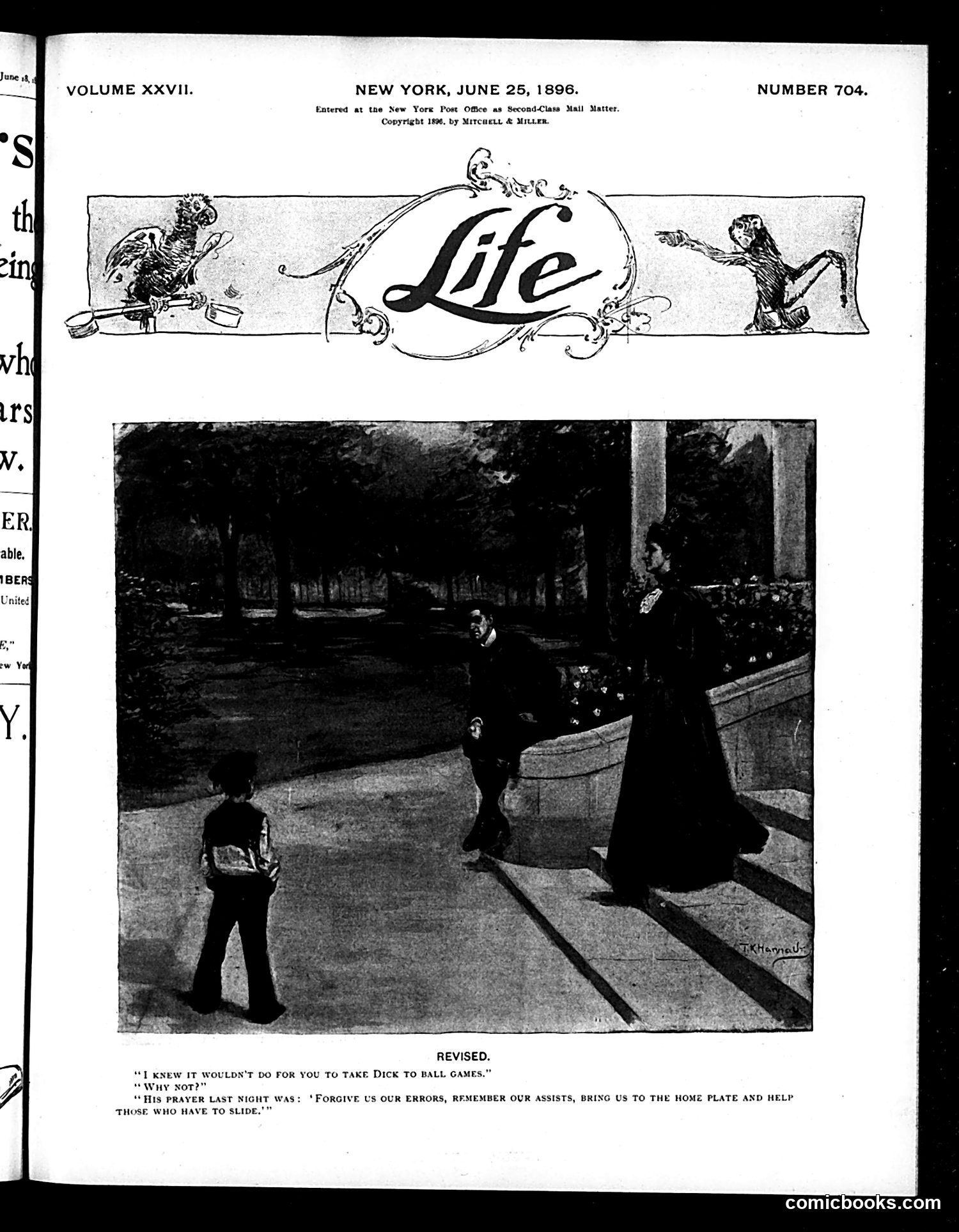
This cartoon critiques someone's (likely a public figure's) attempt to soften or "revise" a harsh prayer. The caption presents two versions: the original prayer allegedly asked God to "forgive us our errors, remember our assets, bring us to the home plate and help those who have to slide." The reference to "home plate" and "slide" uses baseball terminology as metaphor. The scene shows figures in what appears to be a formal or institutional setting. The satire suggests hypocrisy—that someone is whitewashing unethical conduct by reframing selfish language ("remember our assets") into something pious. The "Revised" title emphasizes this repackaging of morality for public consumption, mocking the gap between private ambition and public piety.
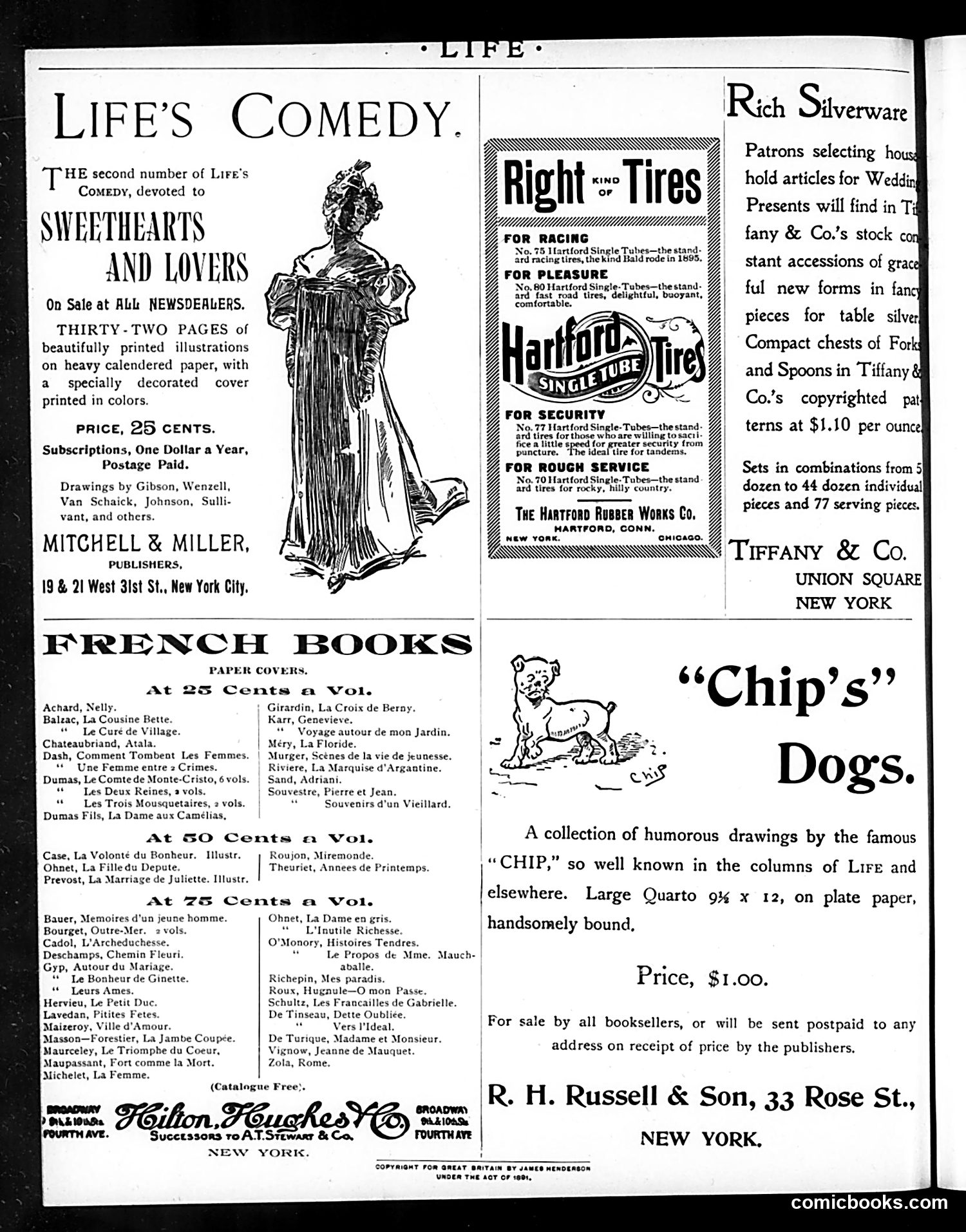
This page is primarily **advertising rather than satirical content**. The main items are: 1. **Life's Comedy #2** — an advertised publication about "Sweethearts and Lovers" with 32 illustrated pages, priced 25 cents 2. **French Books** — a catalog listing various French titles at different price points (25¢ to 75¢) 3. **"Chip's Dogs"** — a humorous illustrated book featuring drawings by "Chip," a cartoonist known from Life magazine columns. The book costs $1.00 and shows a small dog in the illustration 4. **Product advertisements** for Hartford and Right brand tires, and Tiffany & Co. silverware The page functions as a **publisher's catalog and advertising section** rather than containing political satire. The only cartoon element is the small dog illustration advertising Chip's book collection.
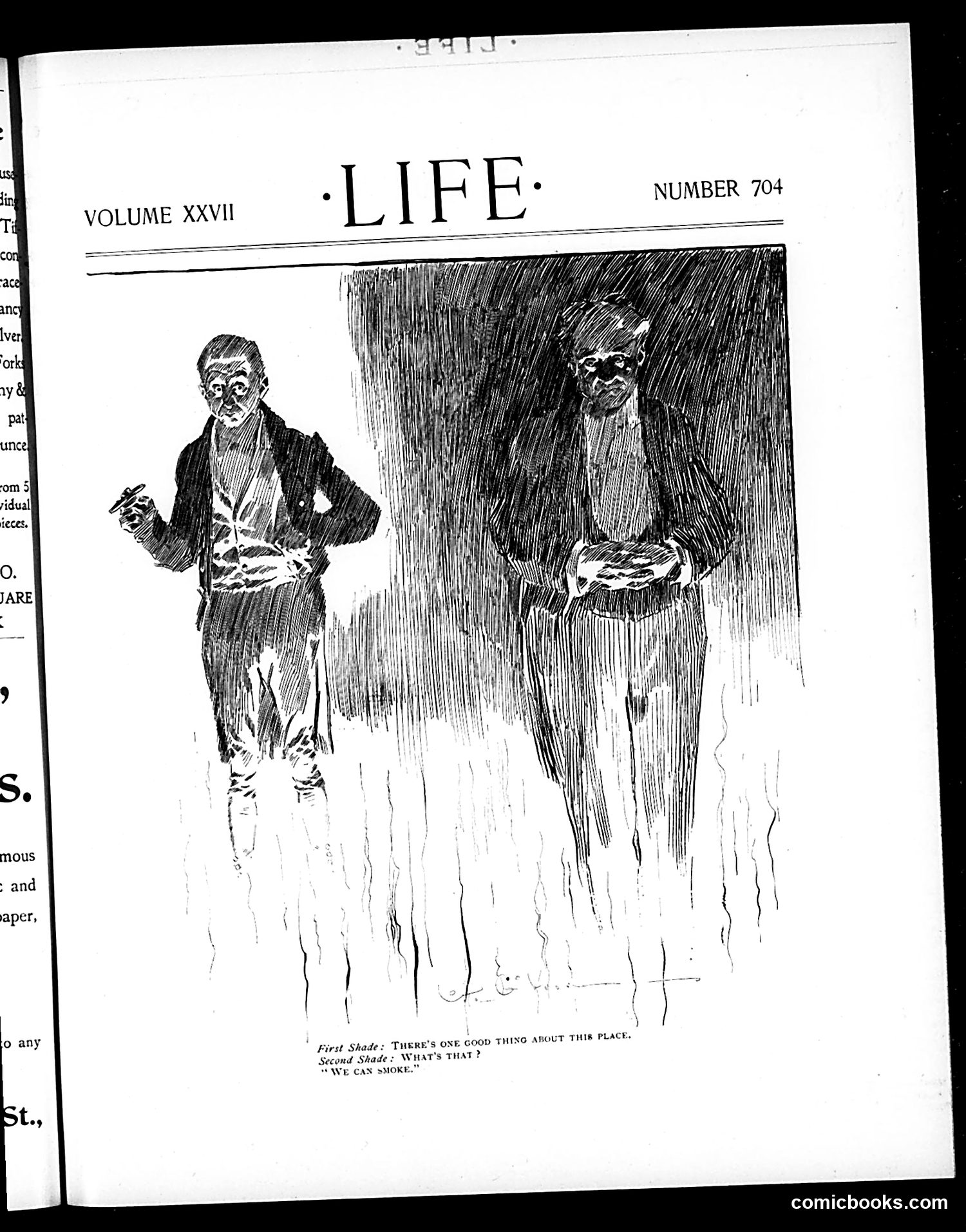
This is a two-panel cartoon from *Life* magazine (Volume XXVII, No. 704) showing two men in what appears to be a smoking room or lounge. **First Shade** (left panel): "There's one good thing about this place." **Second Shade** (right panel): "What's that?" **Response**: "We can smoke." The cartoon's humor relies on the term "shades"—a period slang term for ghosts or deceased persons. The joke suggests these are dead men in the afterlife, and their punchline is that one advantage of being dead (in this particular place, presumably Hell) is freedom to smoke without restriction. This satirizes real-world smoking restrictions or social disapproval of smoking that existed at the time, implying smokers would prefer even damnation to living under such constraints.
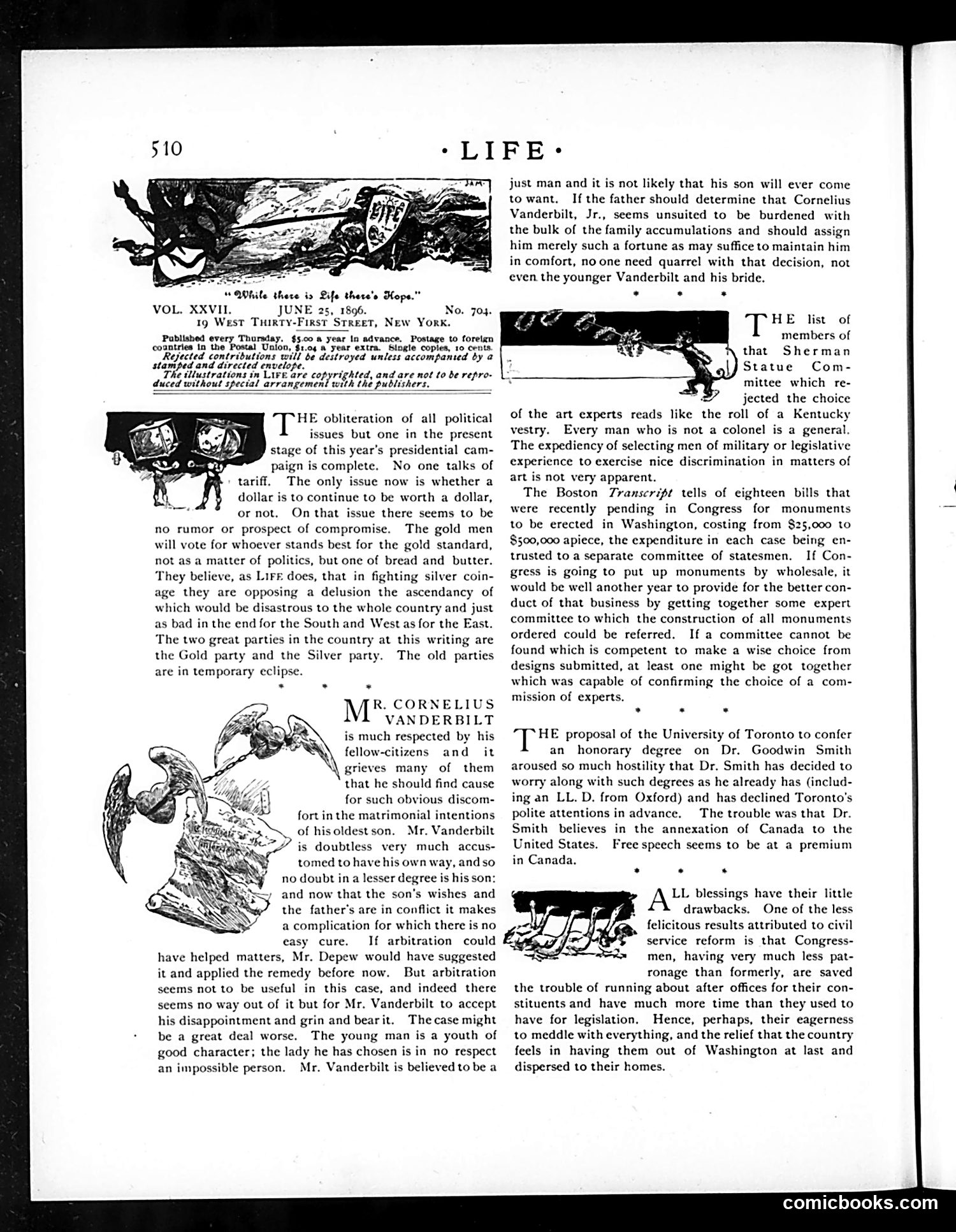
This page contains three distinct pieces of political and social commentary: 1. **Top cartoon** ("While these is Life there's Hope"): The imagery is unclear without better resolution, but appears to reference contemporary political circumstances. 2. **Main article on currency debate**: Discusses the 1896 presidential campaign's central issue—whether the dollar should remain on the gold standard. The text explains that both major parties temporarily shelved political differences over this economic question, with "Gold party" and "Silver party" factions dominating discussion. 3. **Vanderbilt family gossip**: Satirizes Cornelius Vanderbilt Jr.'s matrimonial situation, mocking wealthy families' internal conflicts and suggesting such disputes are beneath public concern. The page reflects 1896's preoccupation with monetary policy and wealthy families' domestic drama.
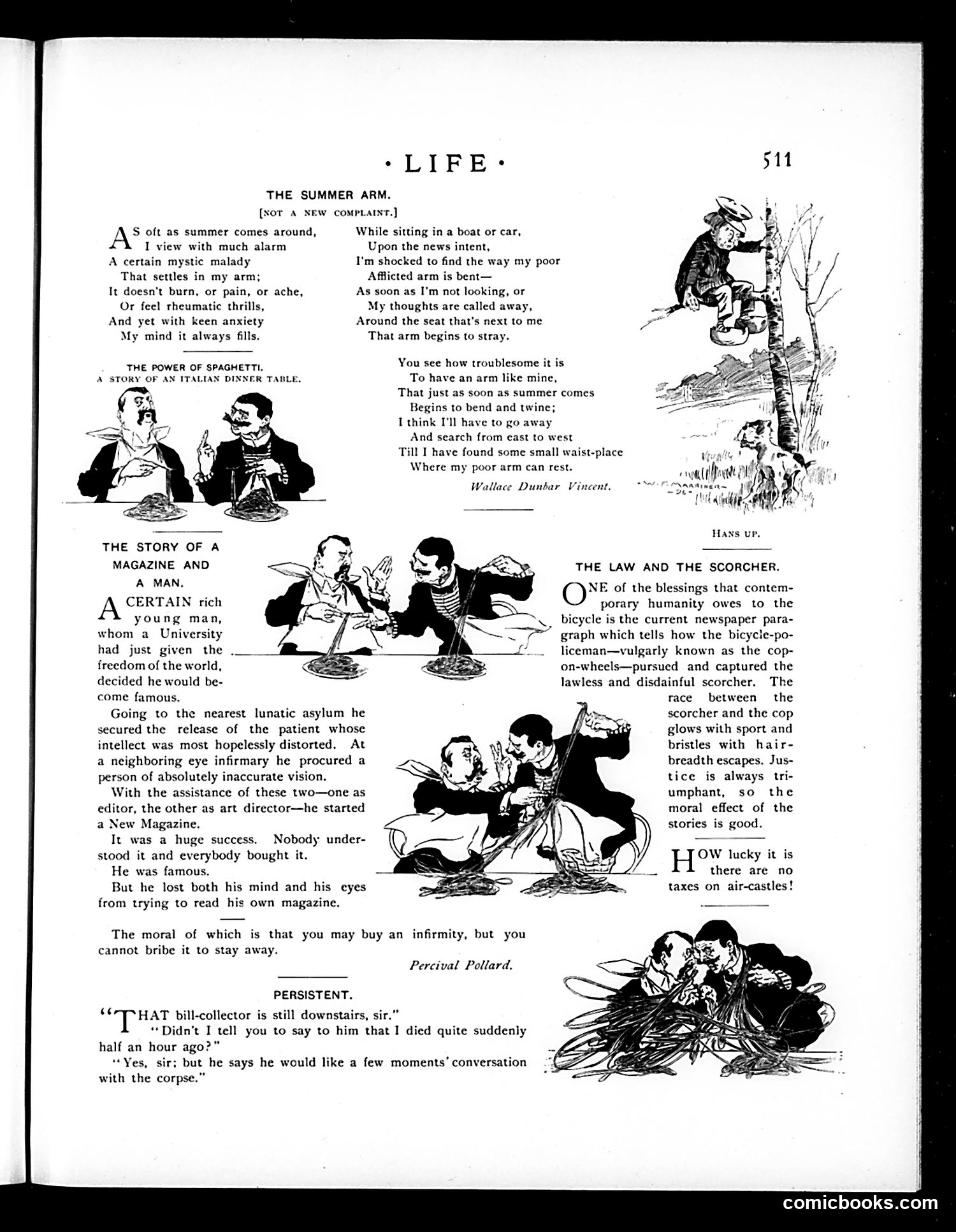
This page contains several humorous short pieces typical of early 20th-century satirical magazines: **"The Summer Arm"** — A poem by Wallace Dunbar Vincent about an arm that becomes strained or injured during summer leisure activities, causing the narrator anxiety about finding proper rest. **"The Power of Spaghetti"** and **"The Story of a Magazine"** — Brief comic anecdotes with accompanying illustrations showing men dining or in conversation, appearing to satirize social pretensions and human vanity. **"The Law and the Scorcher"** — Discusses bicycle police ("cycle-cop") pursuing reckless cyclists ("scorchers"), framed as a humorous commentary on modern law enforcement and the growing bicycle craze. **"Persistent"** — A short joke about a bill collector's persistence even after a debtor's death. The illustrations are simple line drawings typical of the era's magazine humor.
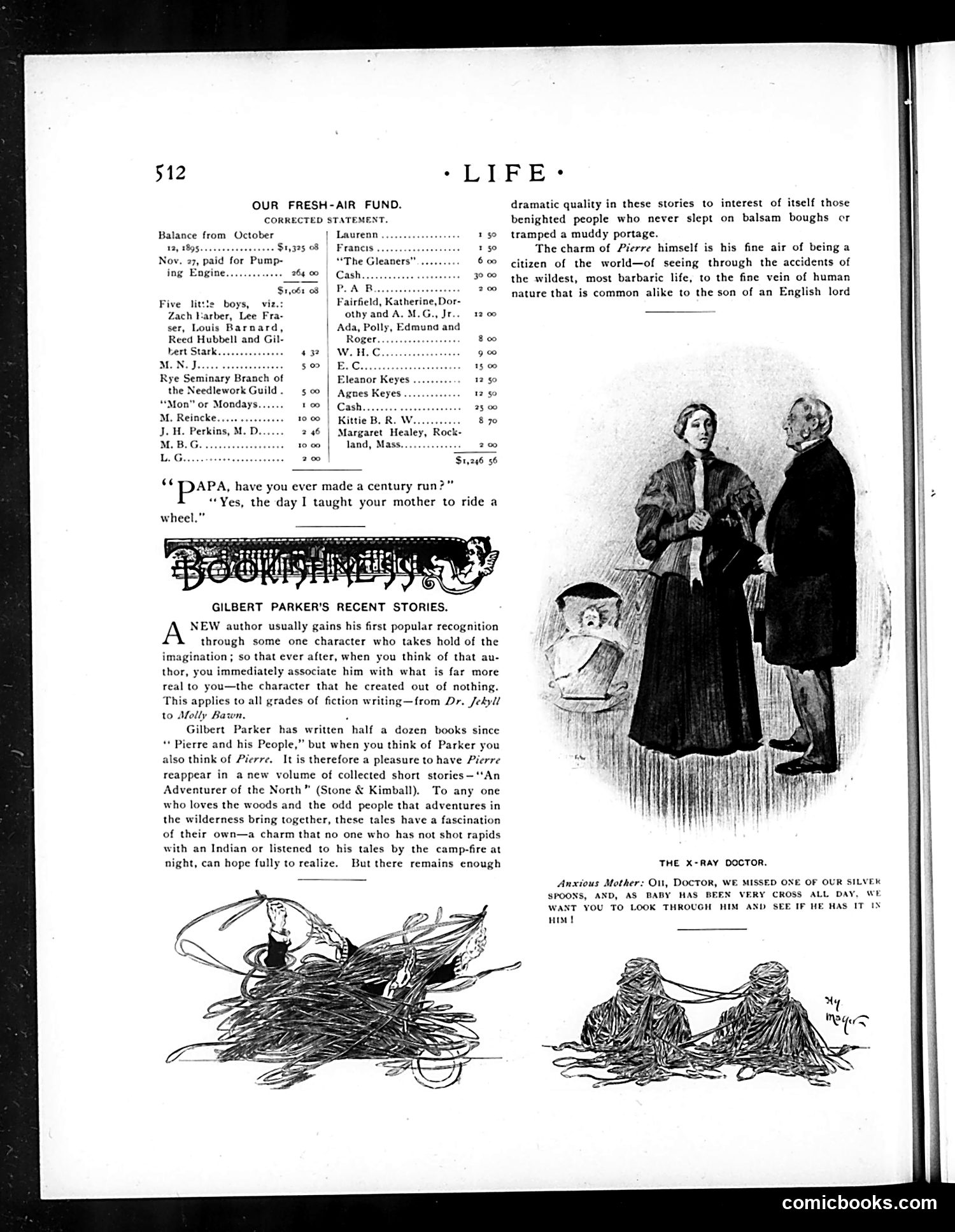
This page features Gilbert Parker's short stories and includes two main cartoons: **"The X-Ray Doctor"** (right): An anxious mother asks a doctor to x-ray her baby to find a missing silver spoon. The joke satirizes the era's fascination with newly-invented x-ray technology as a cure-all solution. The cartoon mocks both the mother's paranoia about lost valuables and the tendency to apply cutting-edge medical technology to trivial domestic problems—a common target of early 20th-century satire. **Upper cartoon** (left): Depicts a humorous exchange where a father claims he taught the mother to ride a bicycle by making a "century run"—a cycling achievement. This reflects the bicycle craze of the 1890s-1900s and playful spousal banter. The page's primary content discusses Parker's literary contributions to the magazine.
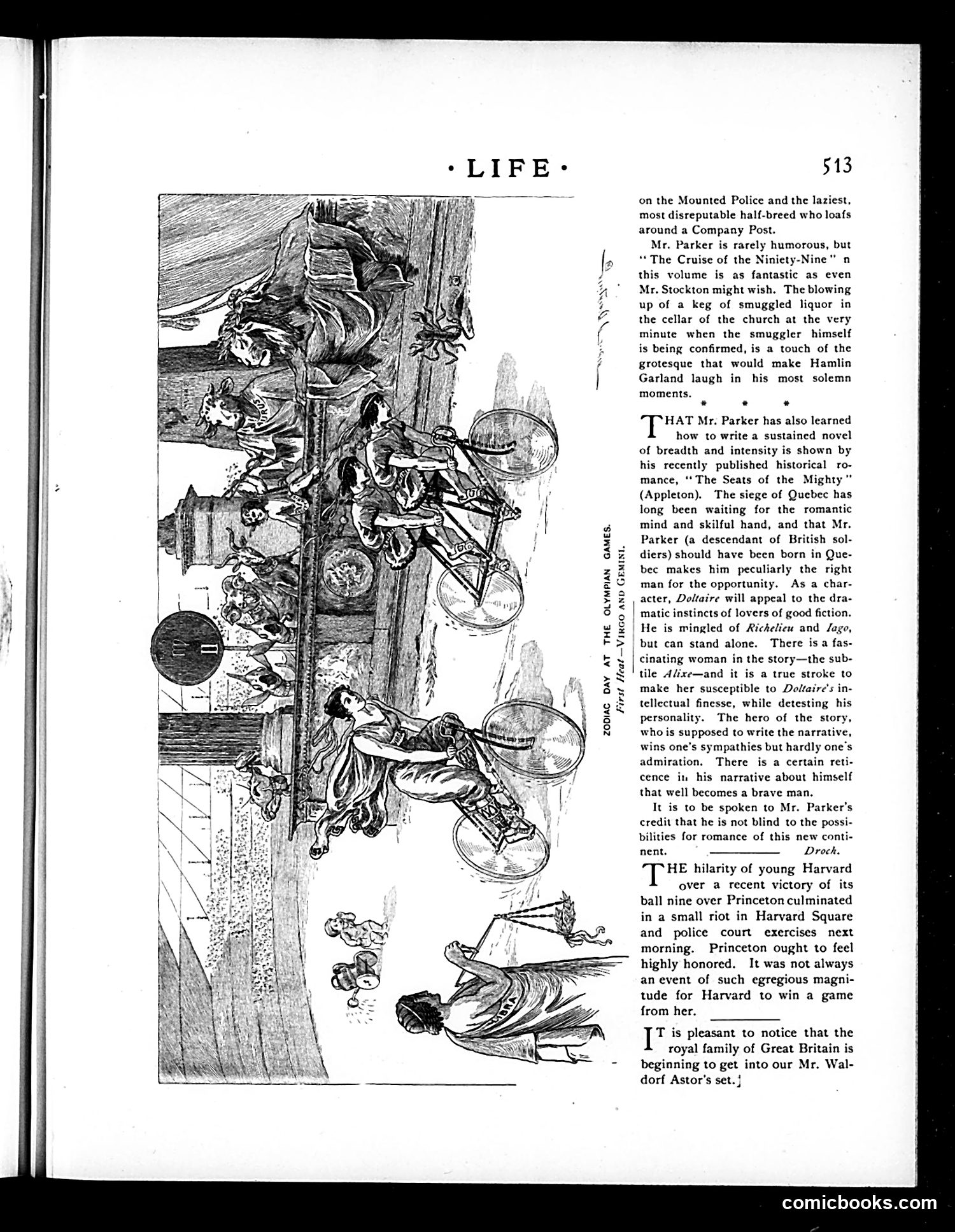
This page features a detailed satirical illustration and literary criticism. The large left-side drawing appears to depict a chaotic zodiac or astronomical scene, showing allegorical figures among celestial elements—likely referencing astrology or fortune-telling as subjects of ridicule. The text discusses Mr. Parker's literary works, praising his historical romance "The Seats of the Mighty" (set during the Quebec siege) and his novel "The Cruise of the Ninety-Nine." The passage suggests Parker successfully combines romantic storytelling with historical detail, comparing his narrative style to established authors like Dumas and Hugo. The final section humorously references Harvard's baseball victory over Princeton and notes the British royal family's presence at Waldorf Astor's social event—typical of Life's era commentary on elite American society.
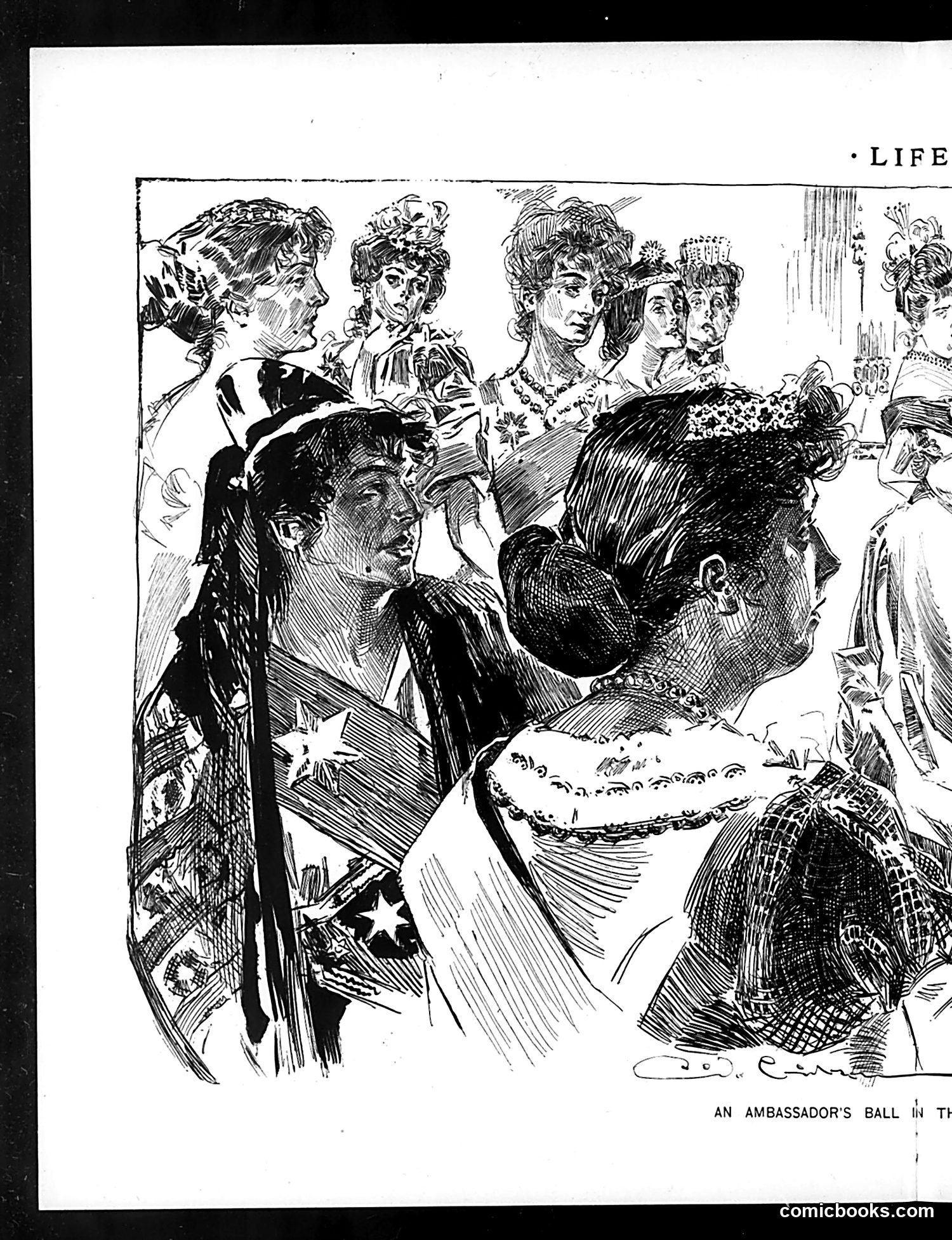
This appears to be a satirical illustration from *Life* magazine depicting a formal diplomatic ball. The sketch shows elegantly dressed figures in evening wear and formal attire at what seems to be an exclusive social event. The detailed line work captures the pretension of high society gatherings. The cartoon likely satirizes the formality, exclusivity, or social posturing of diplomatic circles during the era when this was published. The carefully rendered clothing, hairstyles, and jewelry suggest commentary on wealth display or class consciousness among the political elite. Without the full caption or publication date visible, the specific diplomatic event or political commentary remains unclear, though the artist's signature appears at the bottom of the composition.
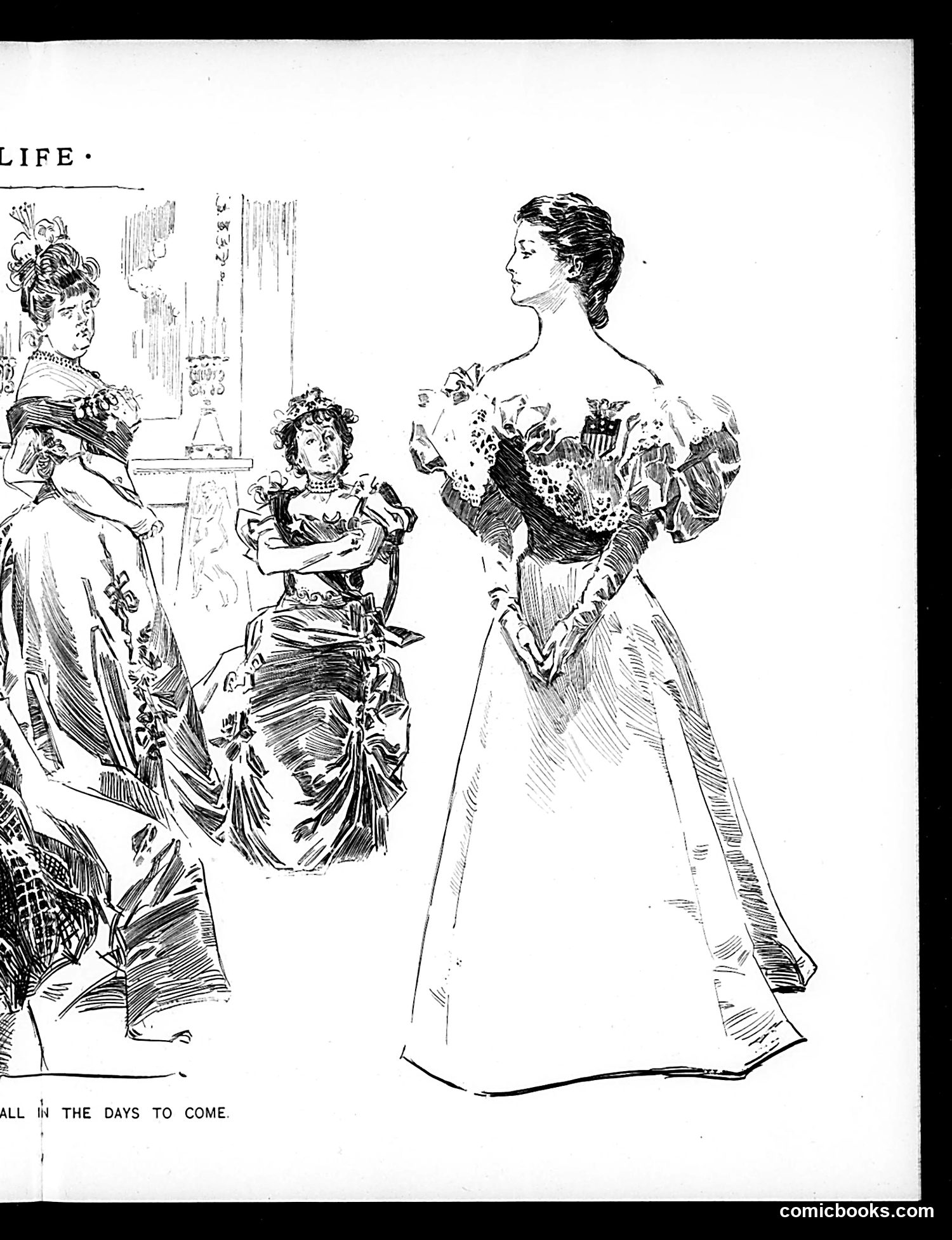
This page from *Life* magazine appears to be a fashion illustration rather than political satire. The heading "LIFE" is visible at top left, with text at bottom reading "ALL IN THE DAYS TO COME." The image shows three elegantly dressed women in what appears to be late 19th or early 1900s attire, featuring the characteristic Gibson Girl silhouette with large puffy sleeves, corsets, and elaborate gowns. The women are depicted in an interior setting with one seated and two standing. Rather than satirizing politics or specific figures, this seems to be social commentary on women's fashion and leisure culture of the Gilded Age. The caption suggests these fashions represent an idealized vision of future womanhood. The illustration exemplifies *Life's* typical content lampooning upper-class society through depictions of fashionable women and their social world.
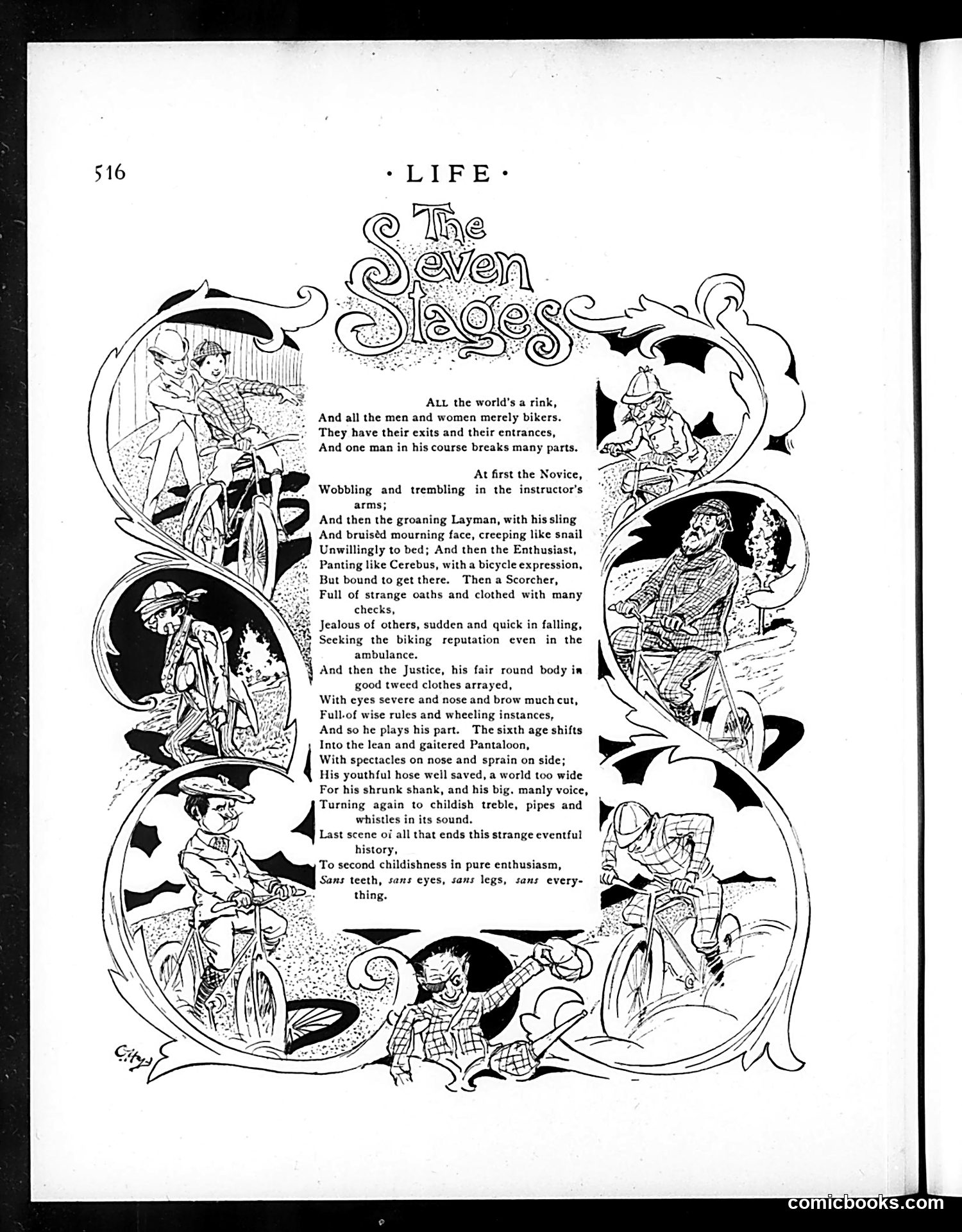
This is a satirical poem illustrated with vignettes showing different types of bicycle riders, playing on Shakespeare's "Seven Ages of Man." Each circular vignette depicts a character type during the bicycle craze—likely from the 1890s when cycling was enormously popular. The stages shown include: a nervous novice wobbling uncertainly; a groaning "Layman" struggling with pain; an enthusiastic "Scorcher" racing recklessly; a pompous "Justice" in formal attire; a "Pantaloon" elderly rider with spectacles; and others, ending with childish enthusiasm. The satire mocks how cycling affected different social classes and personality types—from anxious beginners to reckless speeders to ridiculous elderly riders. It's commentary on the bicycle's cultural impact and how various people adopted this new technology with varying degrees of grace and competence.
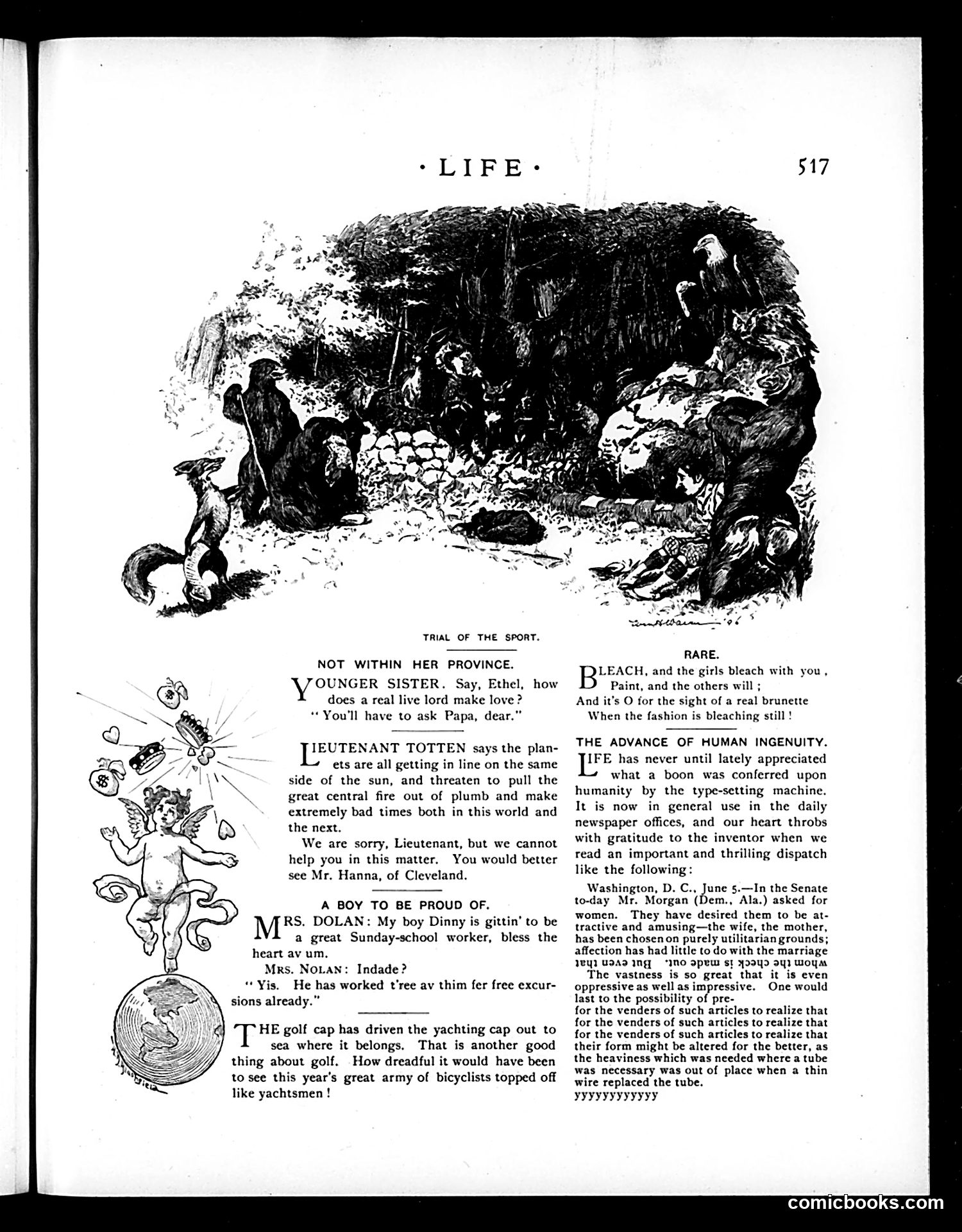
This page contains several satirical vignettes typical of Life's humor section: **"Not Within Her Province"** mocks a younger sister asking her father how "a real live lord makes love"—satirizing upper-class social pretensions and courtship rituals. **"A Boy to Be Proud Of"** presents Mrs. Dolan boasting her son Dinny is becoming a "great Sunday-school worker," with the ironic punchline that he's worked "free av thin for free excursions already"—critiquing hypocritical claims of virtue. **"The Golf Cap"** jokes about golf displacing bicycling as the fashionable sport among the wealthy. **"The Advance of Human Ingenuity"** celebrates the type-setting machine's benefits to newspaper work, using Washington Senate activity as contemporary reference. The page exemplifies Life's focus on middle-class social foibles and modern technology's cultural impact.
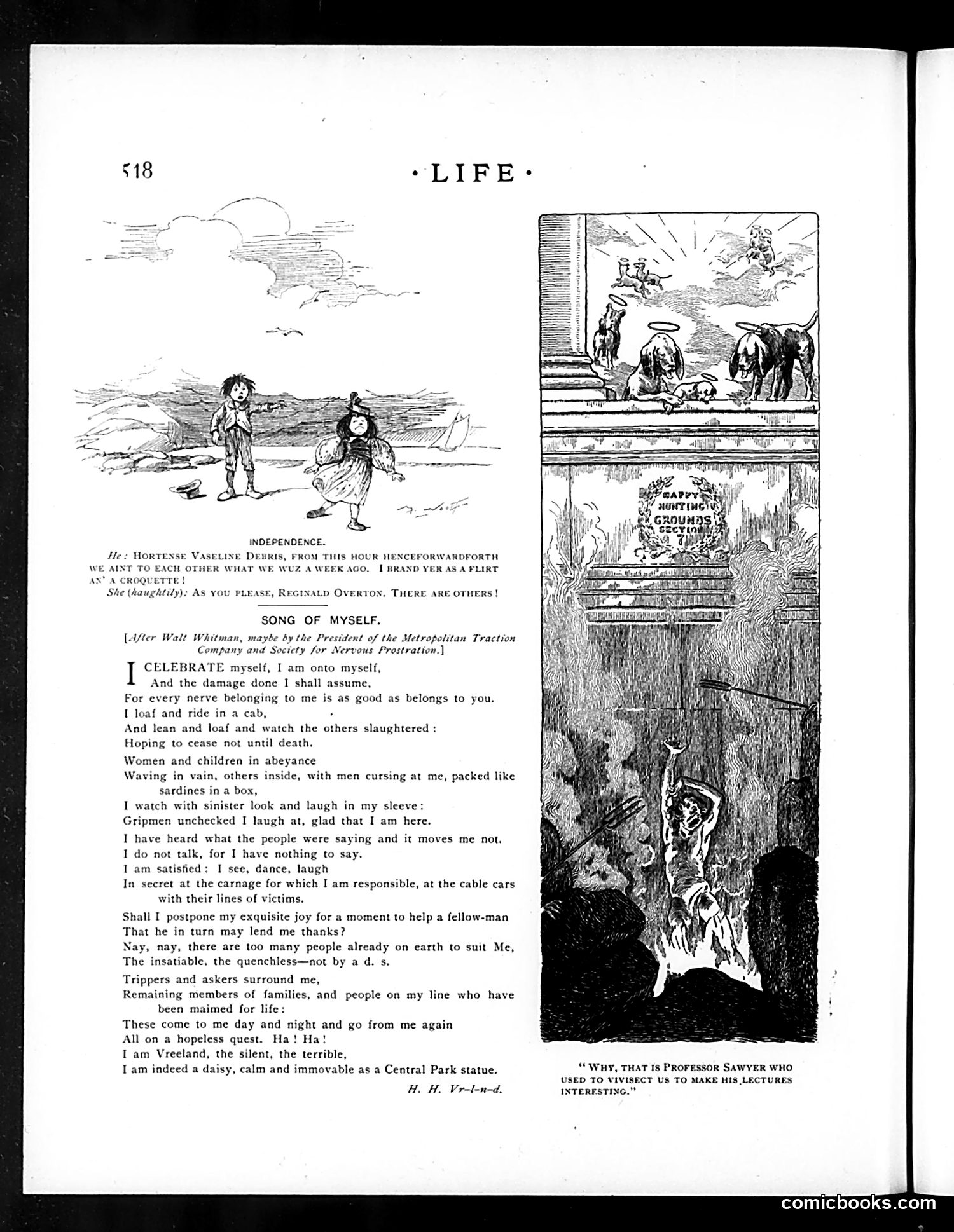
This page satirizes New York City's cable car system and its operator. The main poem parodies Walt Whitman, mocking the president of the Metropolitan Traction Company (identified as "Vreeland" in the signature). The satire attacks the executive's callous indifference to the dangers and deaths caused by cable cars—treating them as inevitable casualties he needn't address. The poem's speaker boasts of watching "slaughter" while feeling no responsibility, reflecting the era's critique of monopolistic transit operators who prioritized profit over passenger safety. The top cartoon, "Independence," appears to be unrelated domestic comedy about a couple's breakup. The bottom illustration shows passengers crammed dangerously into a cable car, visualizing the poem's complaint about overcrowding and the human cost of the system. This represents turn-of-the-century *Life* magazine's muckraking approach to corporate negligence.
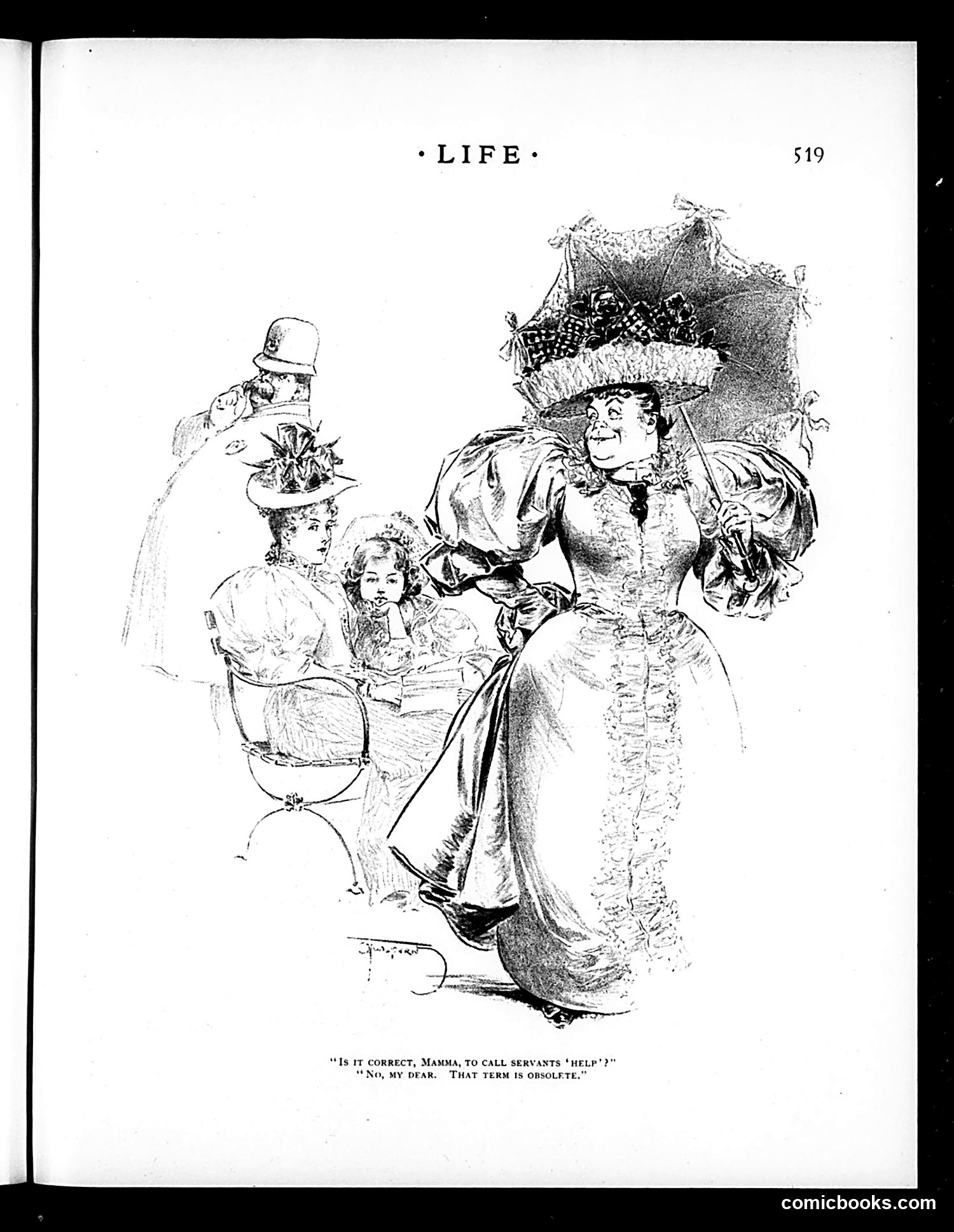
This cartoon satirizes changing social conventions and class consciousness among the wealthy. A well-dressed mother and child are shown with servants in the background. The child asks whether it's proper to call servants "help"—a common American term. The mother corrects her, declaring that term "obsolete," implying a shift toward more formal or respectful terminology. The satire targets upper-class pretension: the mother's insistence on linguistic propriety suggests anxious status-consciousness rather than genuine respect for workers. By highlighting this concern with terminology while servants remain visibly subordinate, the cartoon mocks how the wealthy adopted superficial politeness markers without addressing actual class inequalities. It's commentary on performative social reform.
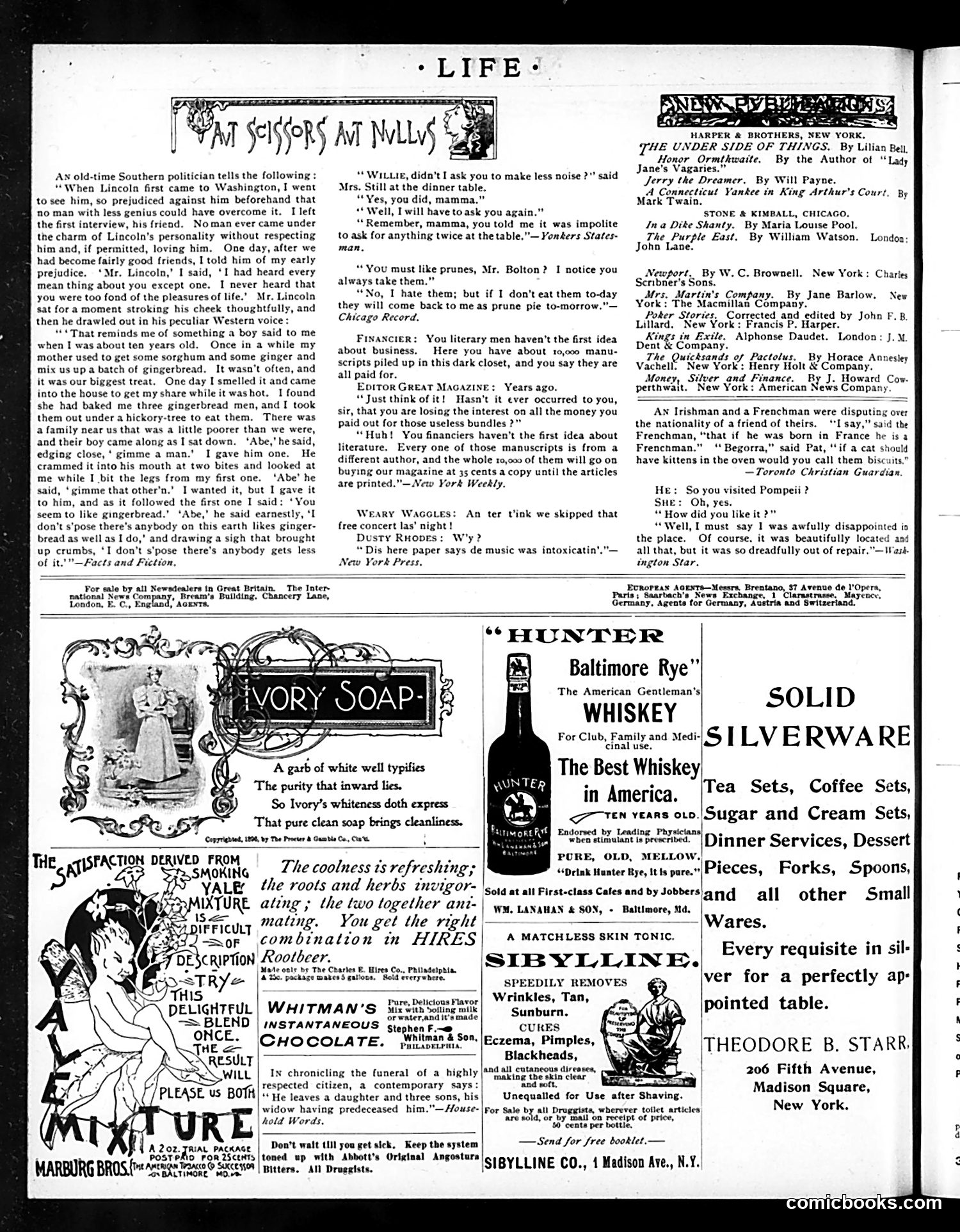
This page contains several short humorous anecdotes rather than political cartoons. The main piece is a lengthy Lincoln anecdote about his youth—a folksy story where young Lincoln gives away gingerbread to a hungrier boy, illustrating his generous nature. The narrative frames this as explaining Lincoln's admitted lack of indulgence in life's pleasures. The other jokes are lighter domestic humor: a child's logical response about rudeness, a magazine editor's paradoxical defense of unpaid manuscripts (claiming they keep authors buying the magazine), and two working-class men discussing a free concert they attended despite the newspaper calling the music "intoxicating." The page is primarily **advertisements and book reviews** rather than satire. The anecdotes appear designed to present wholesome, relatable humor about human nature and social observation—typical of Life's satirical but not overtly political content from this era.
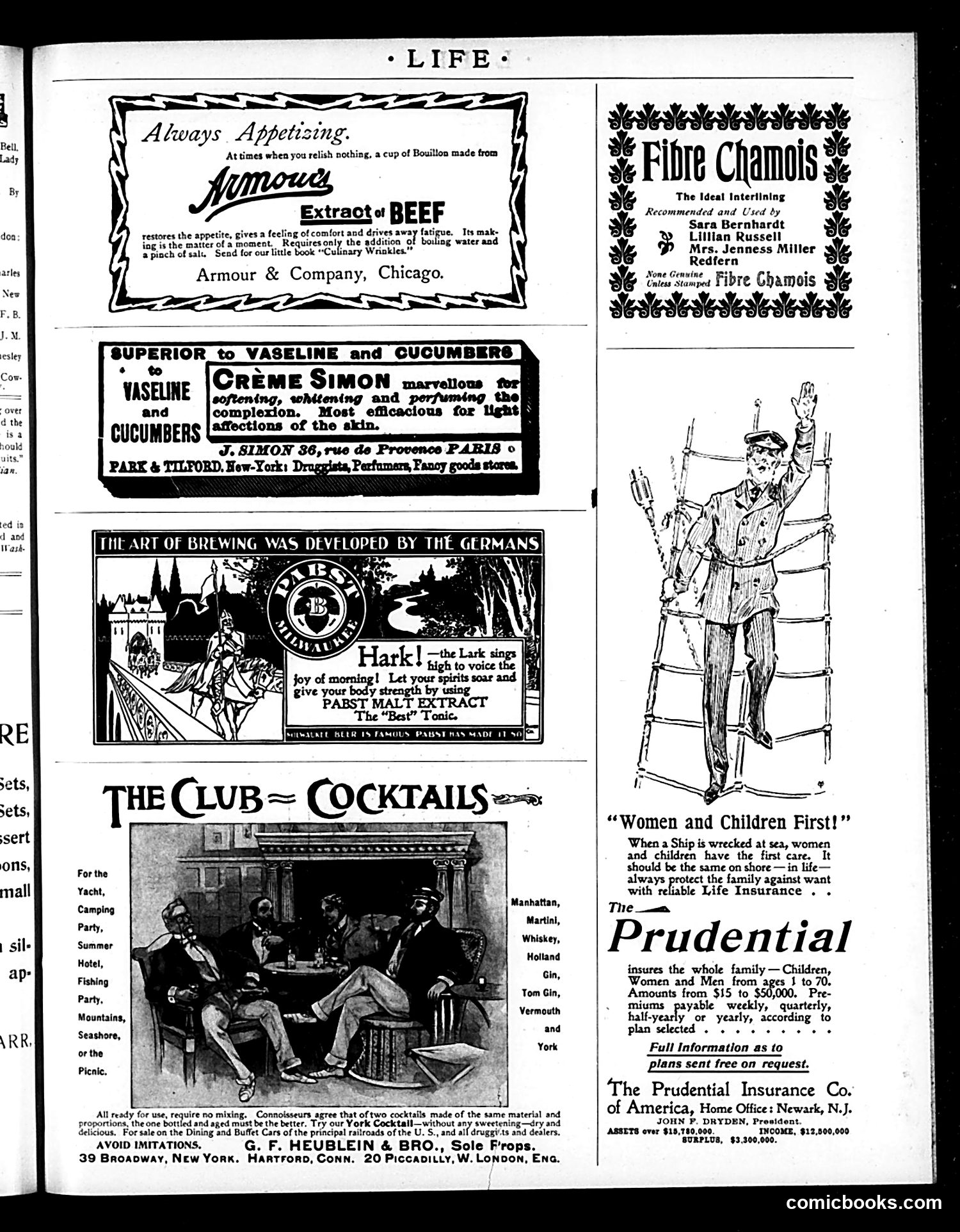
This is primarily an **advertising page** with no political cartoons. The content consists of vintage product advertisements from the early 20th century. The ads promote various items: Armour's Beef Extract (a restorative tonic), Crème Simon (a beauty product), Pabst Malt Extract (a health tonic), Fibre Chamois (an interlining fabric), Club Cocktails (spirits), and Prudential Insurance. The **only satirical element** is the insurance ad's headline—"Women and Children First!"—which invokes the maritime evacuation protocol. It cleverly repurposes this emergency principle to argue that families should protect themselves financially "on shore" through life insurance, just as ships prioritize women and children in disaster. This uses familiar cultural values (protective obligation toward dependents) to sell insurance products. The page reflects early 1900s consumer culture: health tonics, beauty treatments, and emerging insurance as solutions to modern anxieties.
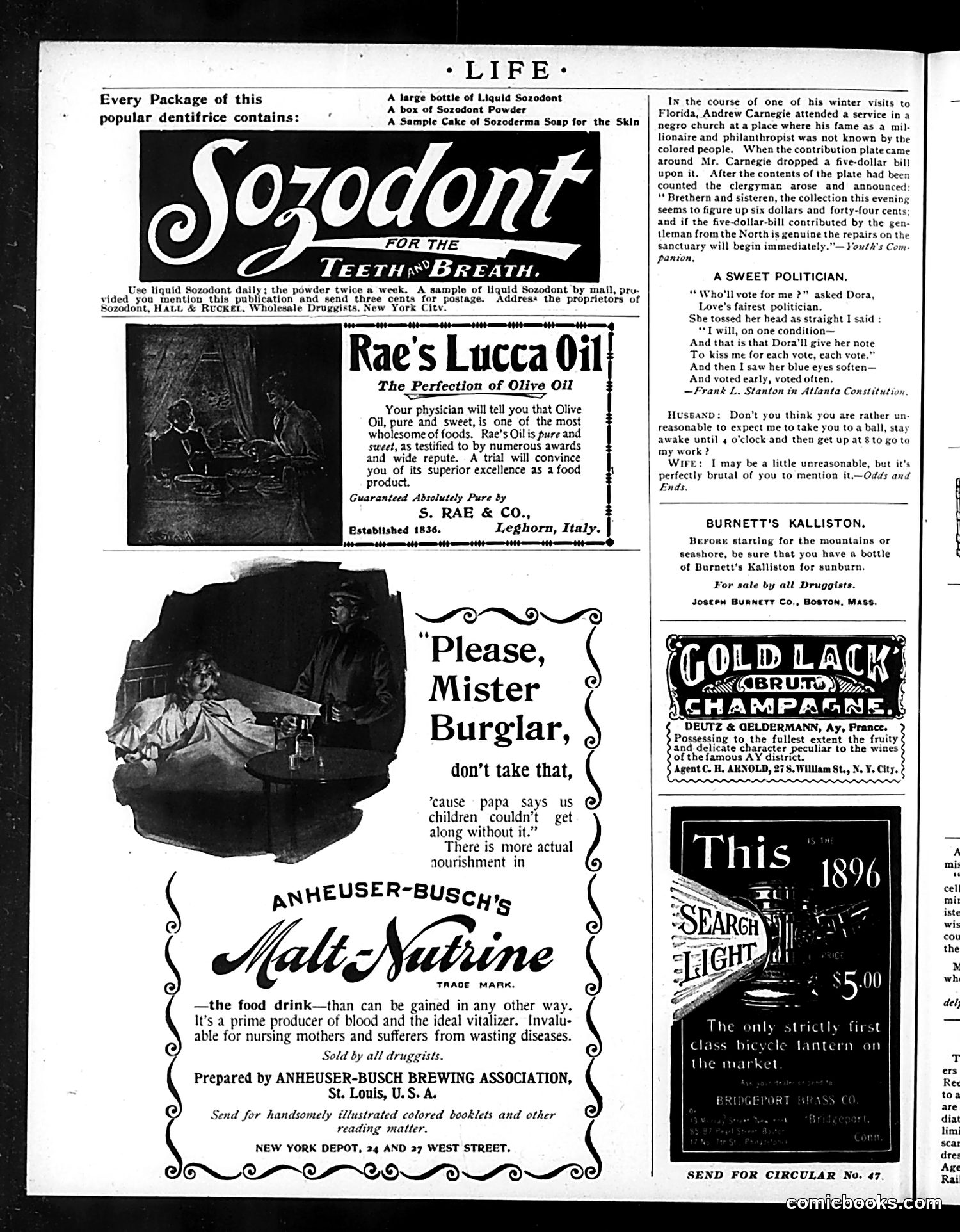
This page is primarily **advertisements** with some brief humorous text snippets, typical of late-19th-century Life magazine format. The main visual satire is the **Anheuser-Busch Malt Nutrine ad**, featuring a burglar scene where a child pleads "don't take that, 'cause papa says us children couldn't get along without it." The joke satirizes exaggerated product advertising claims—the ad absurdly presents beer as essential nutrition, so vital that even a child would beg a burglar not to steal it. This mocks both the brewing industry's inflated health claims and parental dependence on alcohol. Other content includes: - Brief anecdotes (Andrew Carnegie's church donation; a flirtation poem) - Marital humor about unreasonable wives - Period advertisements for Sozodont toothpaste, olive oil, and a bicycle lantern The page reflects Gilded Age consumer culture and advertising excess, with Life's satirical edge aimed at commercial hucksterism.
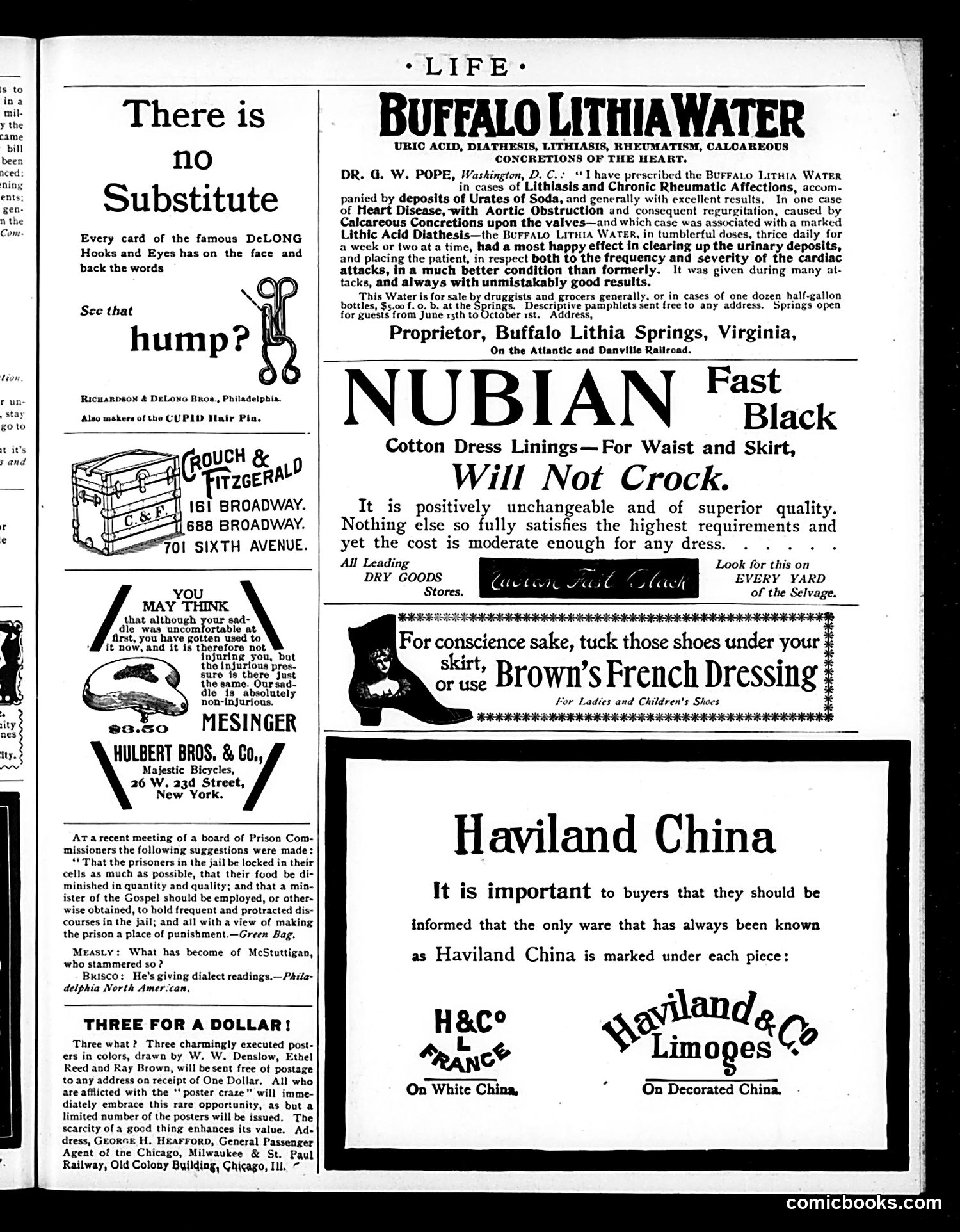
This page is primarily **advertising**, typical of early 1900s magazines. The satirical content is minimal: ## The Cartoons/Humor: **"There is no Substitute"** (top left): A visual pun on DeLong Hooks and Eyes (sewing notions). The image shows a hump-backed figure, playing on the word "hump" to suggest these products are distinctively shaped and irreplaceable. **Prison Reform Dialogue** (middle left): A brief satirical exchange mocking overly harsh prison conditions. Commissioners propose starving and isolating prisoners while forcing religious instruction—presented as absurdly counterproductive punishment. **"Three for a Dollar"** (bottom left): An offer for illustrated posters by notable artists (Denslow, Reed, Brown), satirizing the contemporary "poster craze"—wealthy collectors' obsession with art prints. ## Advertisements: The page is dominated by patent medicine ads (Buffalo Lithia Water for kidney/heart ailments), fabric products, bicycles, shoes, and fine china—typical period marketing with dubious medical claims presented as doctor endorsements. The satire is light and peripheral to the commercial content.