
Life, 1896-06-25 · page 4 of 17
Life — June 25, 1896 — page 4: what you’re looking at
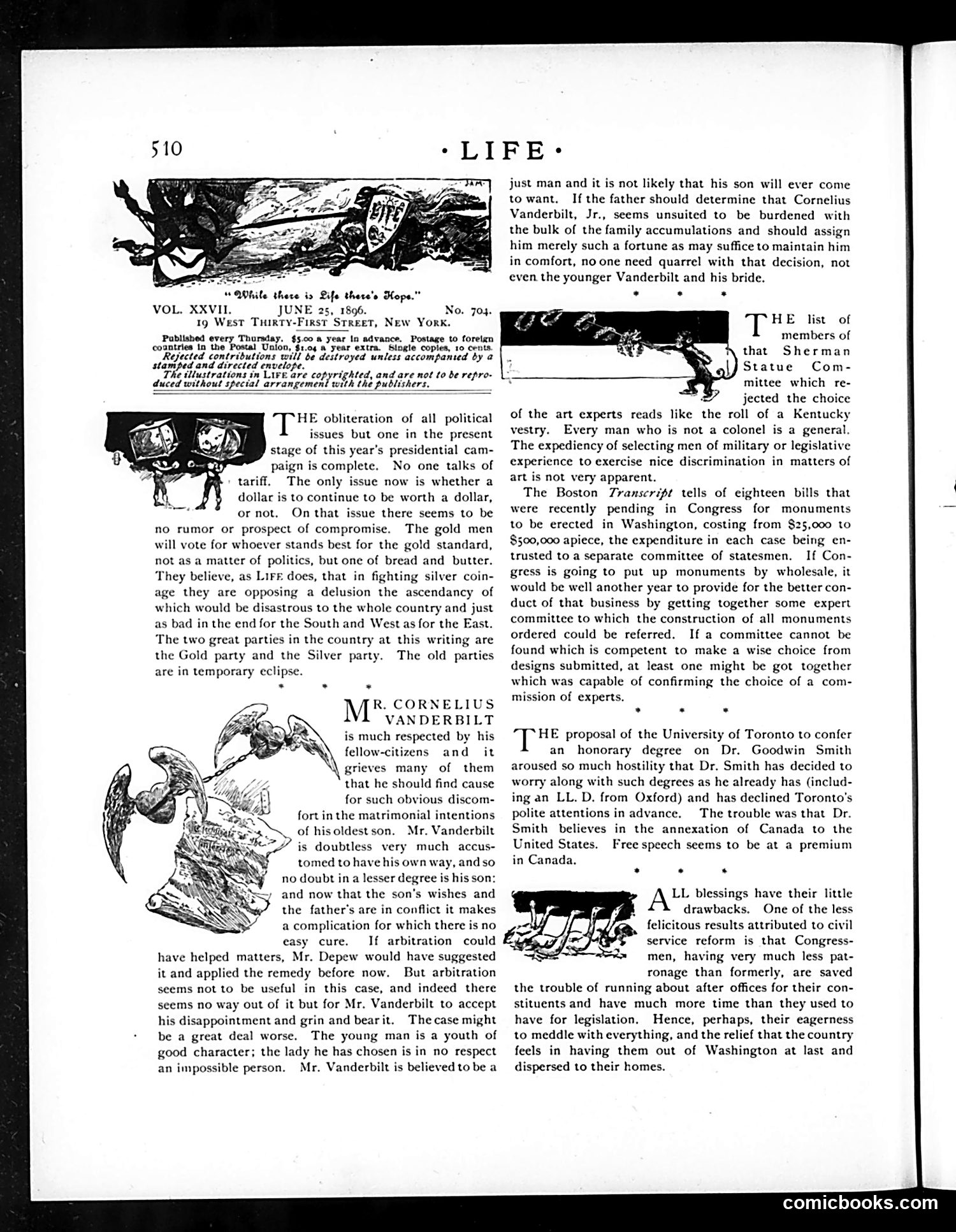
What you’re looking at
This page contains three distinct pieces of political and social commentary: 1. **Top cartoon** ("While these is Life there's Hope"): The imagery is unclear without better resolution, but appears to reference contemporary political circumstances. 2. **Main article on currency debate**: Discusses the 1896 presidential campaign's central issue—whether the dollar should remain on the gold standard. The text explains that both major parties temporarily shelved political differences over this economic question, with "Gold party" and "Silver party" factions dominating discussion. 3. **Vanderbilt family gossip**: Satirizes Cornelius Vanderbilt Jr.'s matrimonial situation, mocking wealthy families' internal conflicts and suggesting such disputes are beneath public concern. The page reflects 1896's preoccupation with monetary policy and wealthy families' domestic drama.
📄 Transcribed text from this page (OCR, searchable)
Machine-transcribed from the original scan — historical spelling and the odd misread are preserved.
“LIFE: + While there io Life there's Slope.” VOL. XXVII. JUNE 25, 1896. No. 704. 1g West Tuirty-First Street, New York. Pablished every Thursday. $5.00 @ year In advance. Postage to foreign coantries In the Union, $1.04 a year extra. Single copies, 10 cents Rejected contributions will be destroyed unless accompanied by @ stamped and directed envelope. The illustrations in LUve are copyrighted, and are not to be repro- duced without special arrangemen ers. with the publi HE obliteration of all political issues but one in the present stage of this year’s presidential cam- paign is complete. No one talks of tariff. The only issue now is whether a dollar is to continue to be worth a dollar, or not. On that issue there seems to be no rumor or prospect of compromise. The gold men will vote for whoever stands best for the gold standard, not as a matter of politics, but one of bread and butter. They believe, as Lire does, that in fighting silver coin- age they are opposing a delusion the ascendancy of which would be disastrous to the whole country and just as bad in the end for the South and West as for the East. The two great parties in the country at this writing are the Gold party and the Silver party. The old parties are in temporary eclipse. AY R. CORNELIUS VANDERBILT is much respected by his fellow-citizens and it grieves many of them that he should find cause for such obvious discom- fort in the matrimonial intentions of hisoldestson. Mr. Vanderbilt is doubtless very much accus- tomed to have his own way, andso no doubt ina lesser degree is his son: and now that the son's wishes and the father’s are in conflict it makes a complication for which there is no easy cure. If arbitration could have helped matters, Mr. Depew would have suggested it and applied the remedy before now. But arbitration seems not to be useful in this case, and indeed there seems no way out of it but for Mr. Vanderbilt to accept his disappointment and grin and bear it. Thecase might be a great deal worse. The young man is a youth of good character; the lady he has chosen is in no respect an impossible person. Mr. Vanderbilt is believed to be a just man and it is not likely that his son will ever come to want. Ifthe father should determine that Cornelius Vanderbilt, Jr., seems unsuited to be burdened with the bulk of the family accumulations and should assign him merely such a fortune as may suffice to maintain him in comfort, noone need quarrel with that decision, not even the younger Vanderbilt and his bride. HE list of members of that Sherman Statue Com- mittee which re- 4 jected the choice of the art experts reads like the roll of a Kentucky vestry. Every man who is not a colonel is a general. The expediency of selecting men of itary or legislative experience to exercise nice discrimination in matters of art is not very apparent. The Boston Transcript tells of eighteen bills that were recently pending in Congress for monuments to be erected in Washington, costing from $25,000 to $500,000 apiece, the expenditure in each case being en- trusted to a separate committee of statesmen. If Con- gress is going to put up monuments by wholesale, it would be well another year to provide for the better con- duct of that business by getting together some expert committee to which the construction of all monuments ordered could be referred. If a committee cannot be found which is competent to make a wise choice from designs submitted, at least one might be got together which was capable of confirming the choice of a com- mission of experts. . . . HE proposal of the University of Toronto to confer an honorary degree on Dr. Goodwin Smith aroused so much hostility that Dr. Smith has decided to worry along with such degrees as he already has (includ- ing an LL. D. from Oxford) and has declined Toronto's polite attentions in advance. The trouble was that Dr. Smith believes in the annexation of Canada to the United States. Free speech seems to be at a premium in Canada. . . * At blessings have their little drawbacks. One of the less felicitous results attributed to civil service reform is that Congress- men, having very much less pat- ronage than formerly, are saved the trouble of running about after offices for their con- stituents and have much more time than they used to have for legislation, Hence, perhaps, their eagerness to meddle with everything, and the relief that the country feels in having them out of Washington at last and dispersed to their homes. comicbooks.com