
A complete issue · 16 pages · 1895
Life — July 11, 1895
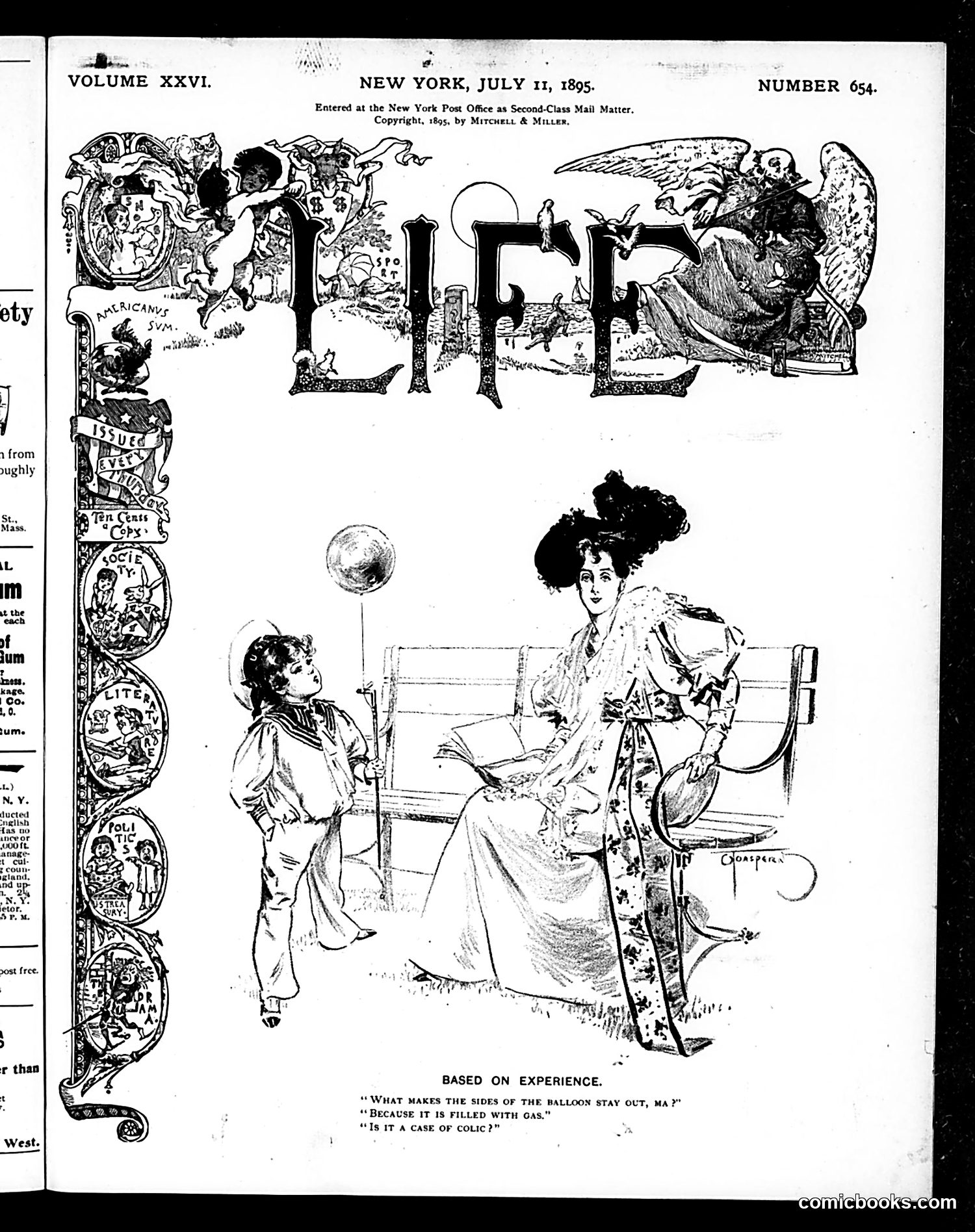
This page contains a single-panel cartoon titled "Based on Experience." It depicts a woman on a bench with a young child holding a balloon. The dialogue reads: **"What makes the sides of the balloon stay out, ma?"** **"Because it is filled with gas."** **"Is it a case of colic?"** The humor is straightforward: the child misunderstands "gas" as digestive gas (colic), comparing the balloon's inflation to infant stomach troubles—a common parental concern of the era. It's gentle domestic humor playing on innocent childhood misinterpretation, typical of Life magazine's satirical but family-friendly content. The ornate decorative border on the left is characteristic of the magazine's design.
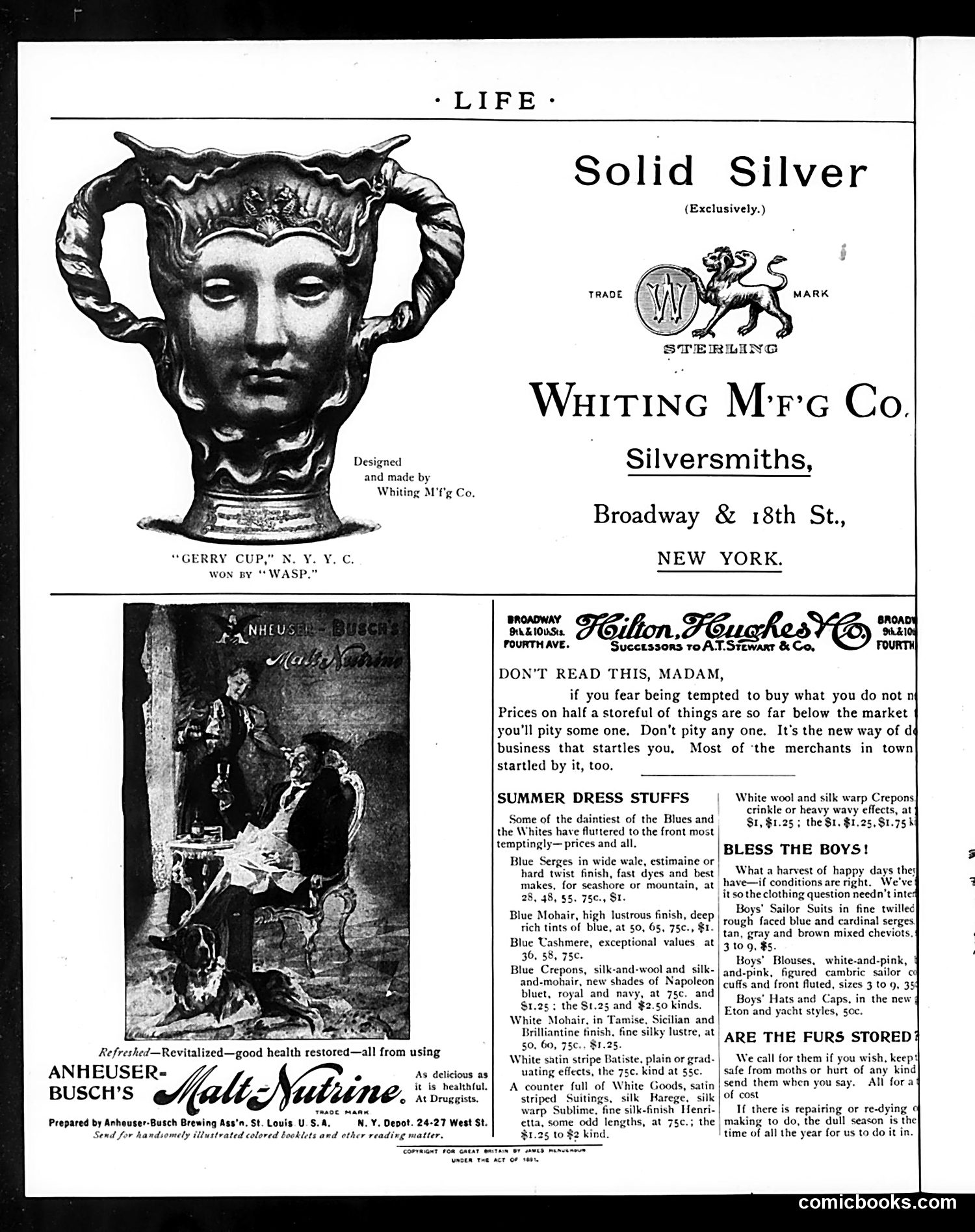
This page is predominantly **advertising rather than editorial content**. The top features an ad for Whiting Manufacturing Company's sterling silver "Gerry Cup" trophy. The lower left shows an Anheuser-Busch "Malt Nutrine" advertisement promoting health benefits. The right side contains retail ads for Hamilton-Henschel & Co. and other merchants advertising summer dress fabrics, boys' clothing, and fur storage services. **No political cartoons or satire appear on this page.** The only illustrated element—the decorative silver trophy cup—is a product advertisement, not commentary. This appears to be a standard commercial page from Life magazine's advertising section, typical of early 20th-century publication layouts mixing editorial space with paid promotions.
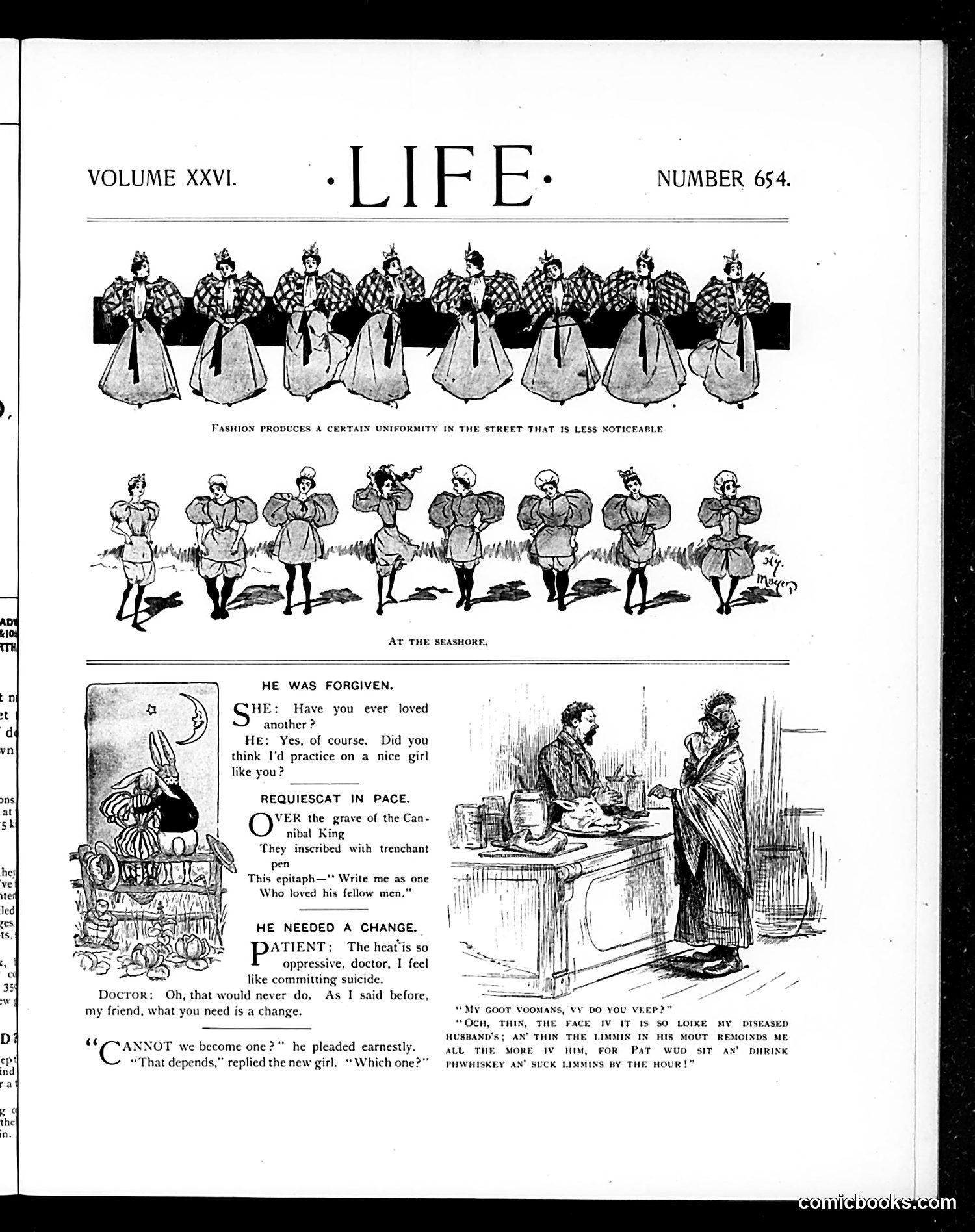
This page contains three distinct humorous pieces: **Top illustrations** satirize fashion uniformity—showing women in identical stylish outfits at the seashore and street, mocking how fashion trends eliminate individuality despite clothing's supposed purpose of self-expression. **"He Was Forgiven"** and **"Requiescat in Pace"** are romantic/sentimental comic vignettes about courtship and loss, typical of Life's lighter fare. **"He Needed a Change"** depicts a doctor advising a depressed patient that what he needs isn't medicine but a romantic change—specifically, a new girlfriend. The final dialogue ("Cannot we become one?") is the romantic punchline. The bottom illustration shows what appears to be a crude dialect joke in period dialect, though the satirical target is unclear from context alone. Overall, this reflects early-20th-century attitudes toward romance, fashion, and social humor.
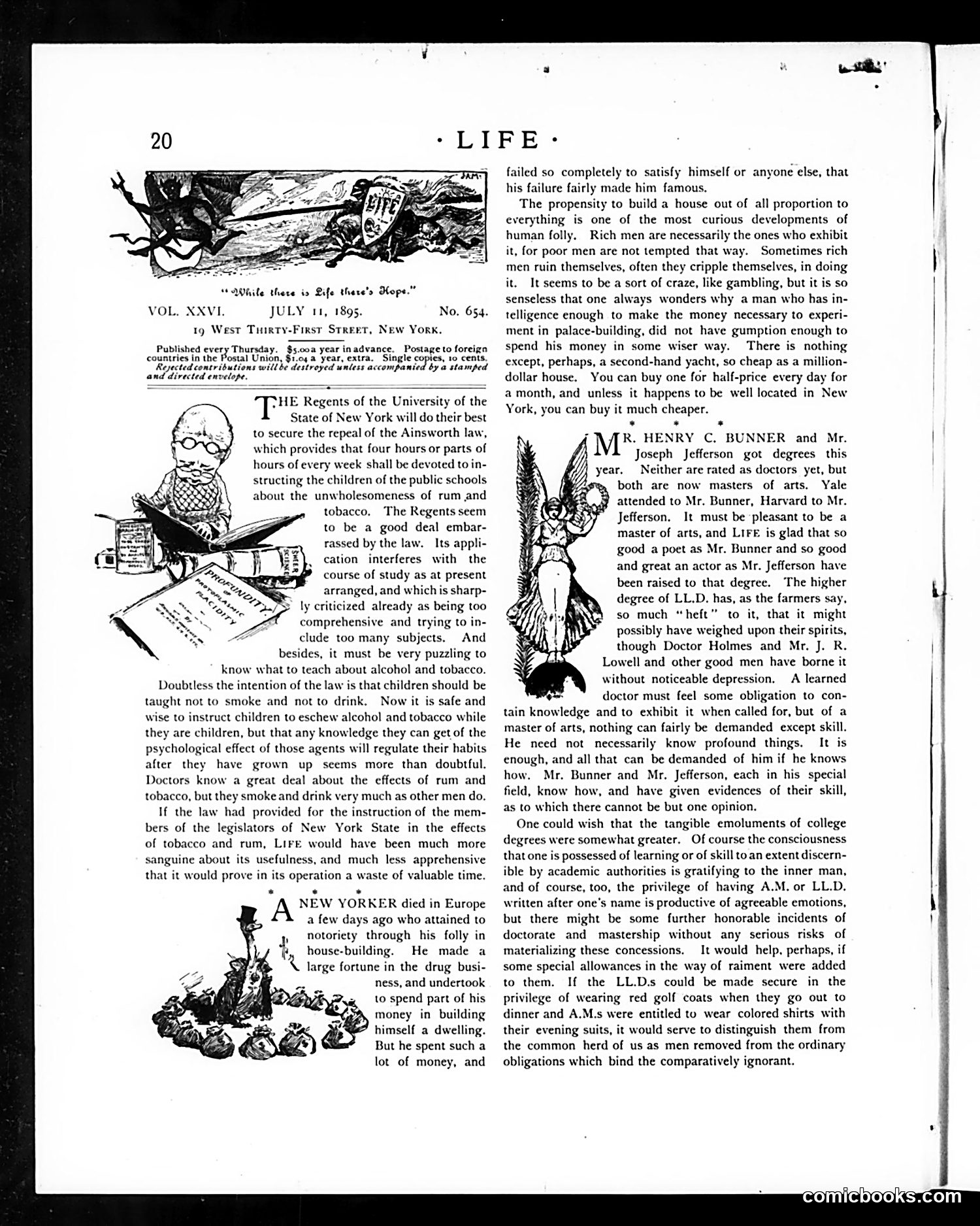
**Left cartoon:** Shows a figure surrounded by bottles labeled with various substances, appearing intoxicated or befuddled. This illustrates the article's discussion of a New York law requiring instruction about alcohol and tobacco in schools. The cartoon satirizes the irony of teaching children about these substances while the figure depicted seems to exemplify their destructive effects. **Right section:** Discusses Mr. Henry C. Bunner and Joseph Jefferson receiving honorary degrees. The text mocks the inflation of academic honors—L.L.D. degrees awarded to artists and actors who haven't necessarily earned scholarly credentials. The satire suggests that prestigious degrees have become devalued tokens rather than meaningful academic achievements, particularly when awarded to entertainers based on talent alone rather than scholarly merit.
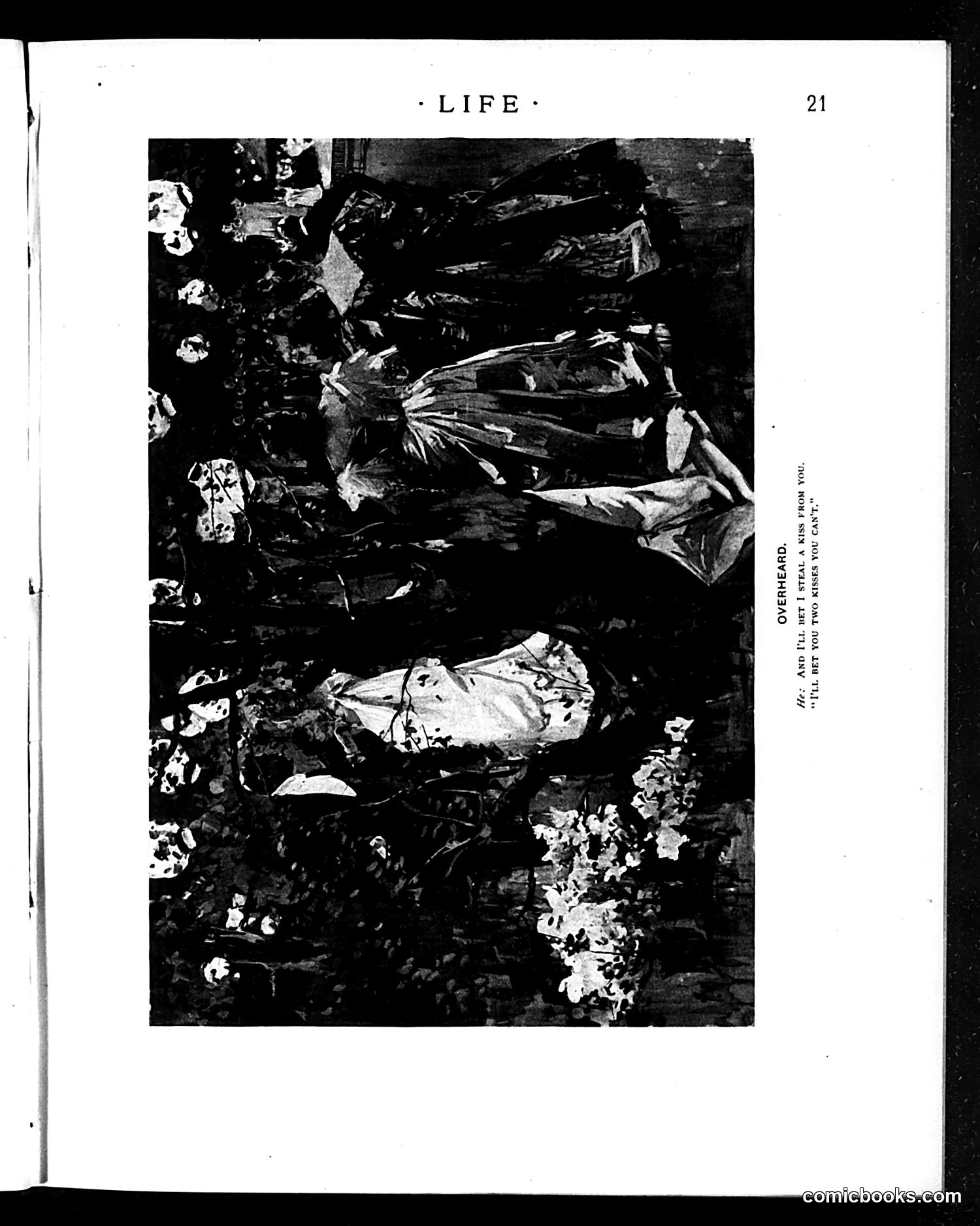
I can see this is page 21 from Life magazine, titled "OVERHEARD" with a caption mentioning "AND FULL JEST I FEAR FROM YOU; 'TIT FOR TWO AND TICKLED GENTLY.'" However, the image quality is quite poor—it's a dark, high-contrast black and white photograph showing what appears to be figures in period costume among foliage and flowers, but the specific details and identities of the figures are unclear to me. The composition suggests it may be theatrical or illustrative rather than a traditional political cartoon. Without being able to read the caption clearly or identify the specific figures and their context, I cannot reliably explain what satire or social commentary this page intended. I'd need a clearer image or additional text to provide an accurate historical interpretation.
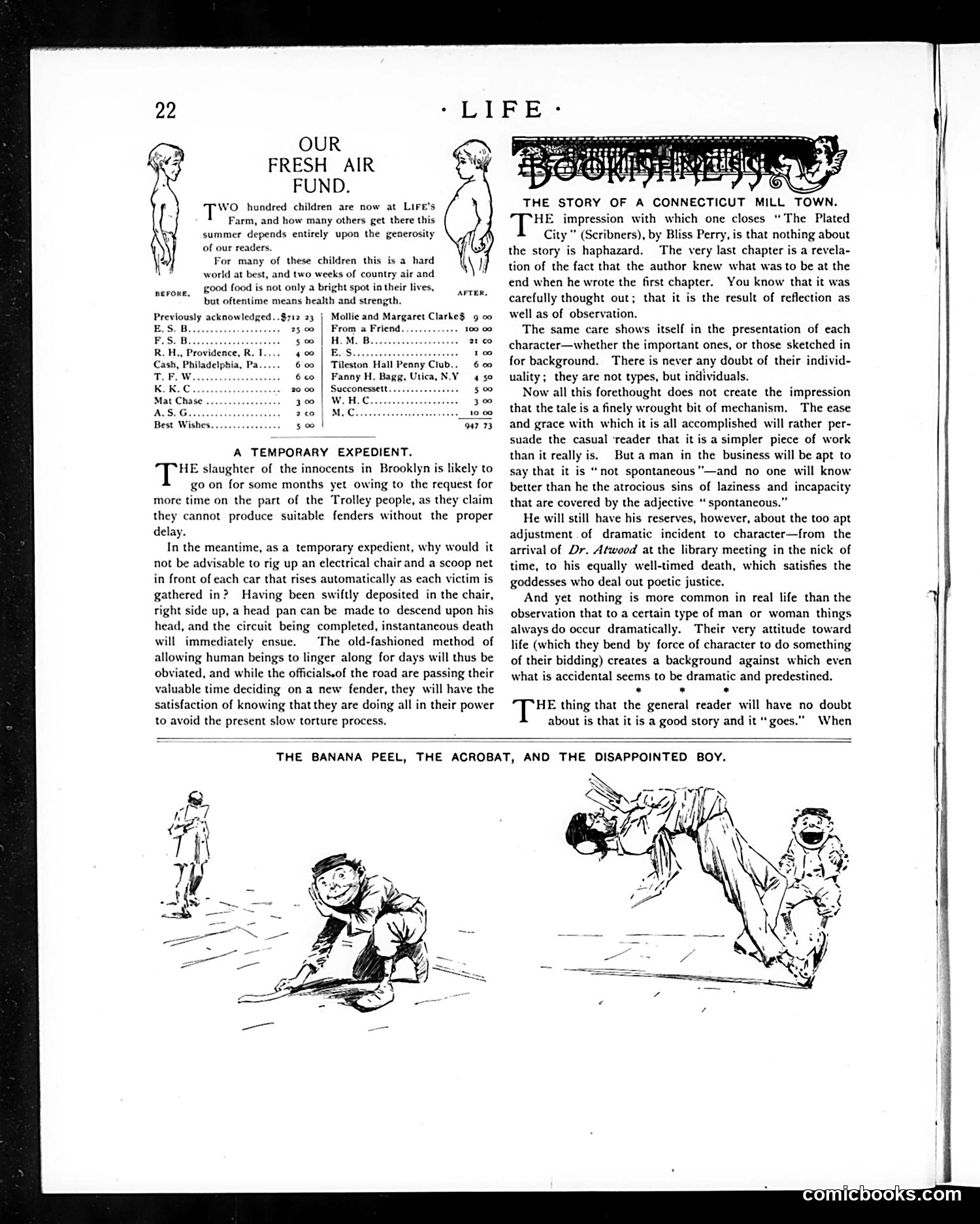
This page contains two distinct sections: **"Our Fresh Air Fund"** (top left): A fundraising appeal for children's summer camps, listing donors and amounts contributed. The small anatomical sketches show before/after physical development, suggesting the health benefits of fresh air programs for underprivileged children. **Book Review** (top right): A favorable review of "The Platted City," a Connecticut mill-town novel by Bliss Perry, praising its careful character development and narrative construction. **"The Banana Peel, The Acrobat, and The Disappointed Boy"** (bottom): Three cartoon vignettes depicting slapstick comedy—a boy slipping on a banana peel, an acrobat performing, and another child's misfortune. These are humorous illustrations typical of early 20th-century magazine comics. The page is primarily editorial and literary content rather than political satire.
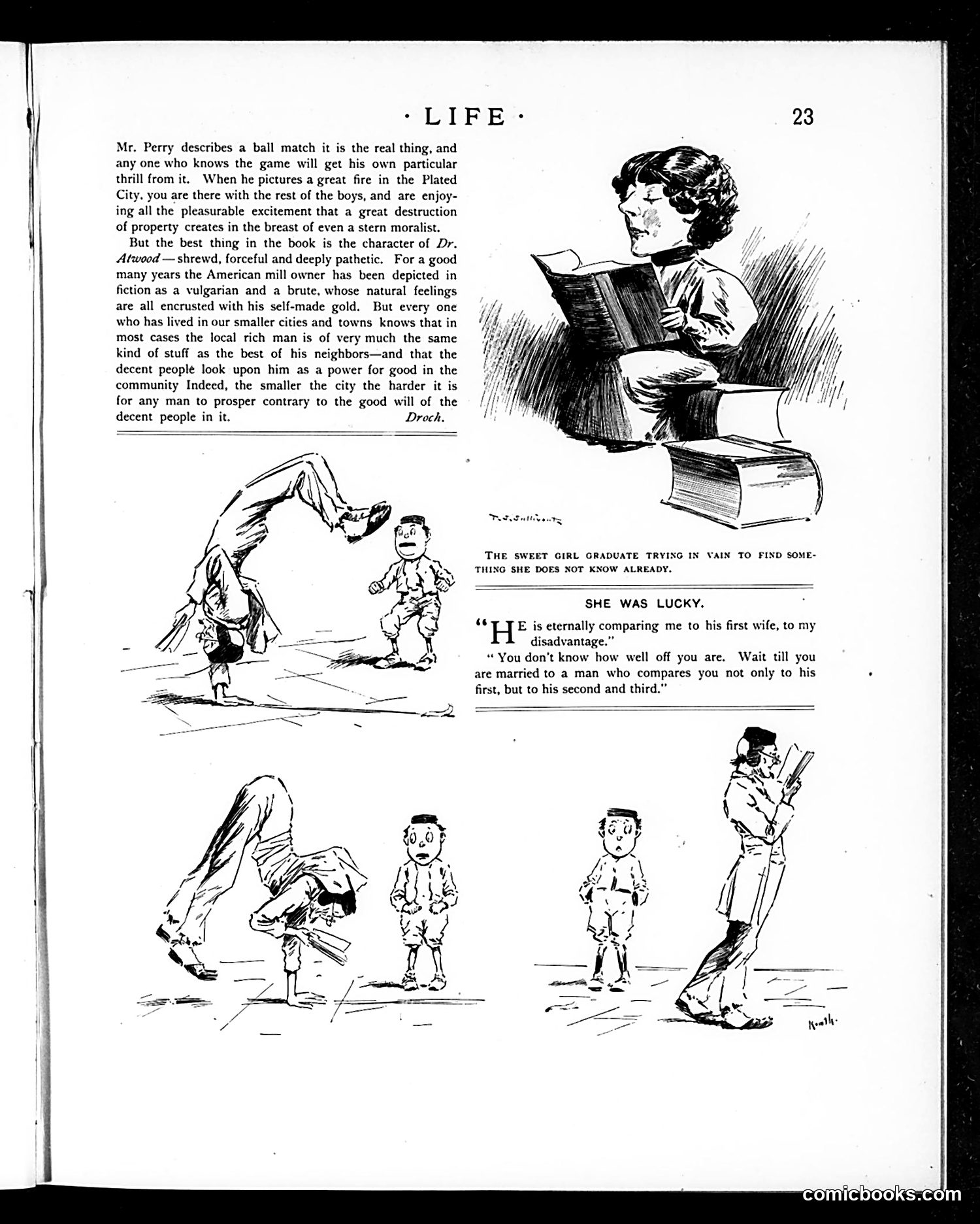
This page contains literary criticism and domestic humor rather than political satire. The upper text discusses **Dr. Atwood**, a character in American fiction traditionally depicted as a brutal mill owner with "self-made gold." The author argues that in reality, local rich men are often ordinary and viewed as community assets—making it harder for decent people to oppose them. The lower section, titled "She Was Lucky," presents a domestic joke about marriage comparisons. A woman complains her husband constantly compares her unfavorably to his first wife. Her friend responds that she's fortunate—at least he only compares her to two predecessors, implying the friend's husband makes comparisons to multiple ex-wives. The accompanying sketches humorously illustrate physical comedy involving children and adults.
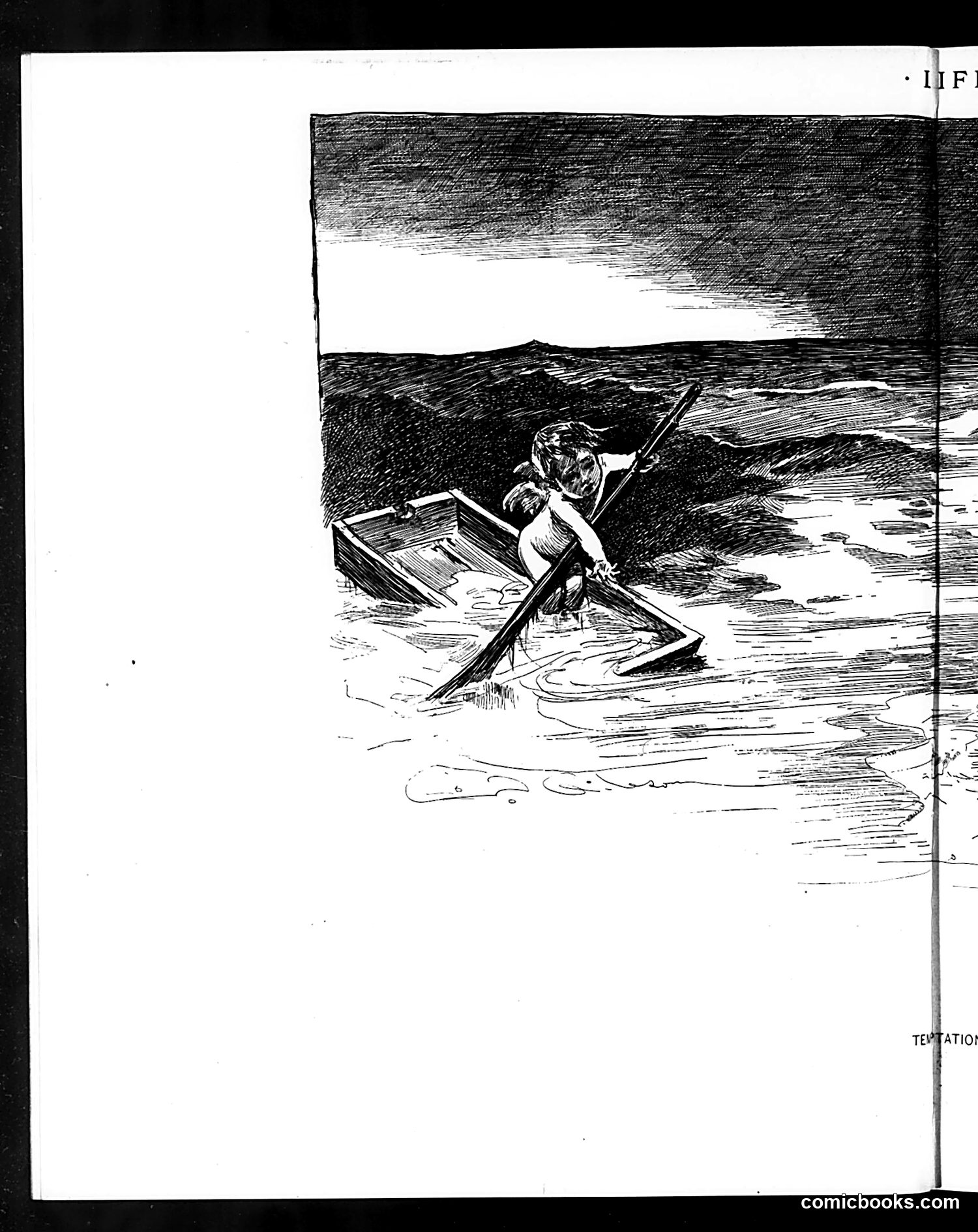
This appears to be an illustration from Life magazine showing a figure in a boat or small vessel struggling in water, with oars or poles visible. The figure appears distressed or in difficulty. Dark, cross-hatched shading dominates the composition, creating a dramatic, ominous mood. However, without visible caption text, article headlines, or date information on this page, I cannot definitively identify the specific political or social reference intended. The title fragment "TEMPTATION" appears at the bottom right, suggesting this may be an allegorical cartoon about temptation or moral struggle, but the precise historical event or figure being satirized remains unclear from the image alone. Additional context would be needed for accurate interpretation.
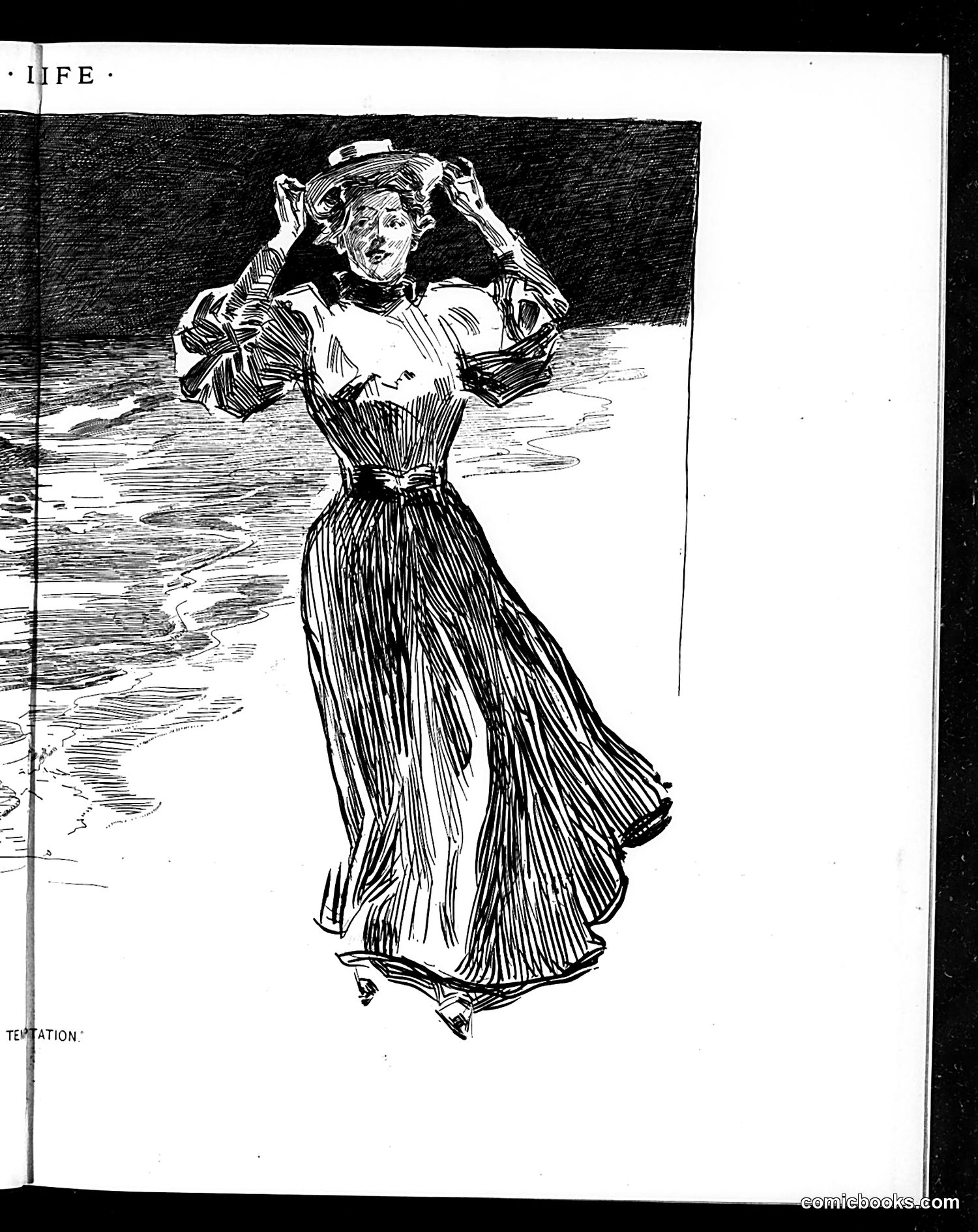
This is a pen-and-ink illustration titled "Temptation" from the satirical magazine *Life*. It depicts a fashionably dressed woman in an Edwardian-era gown, adjusting her hat while standing near water. The artistic style and subject matter suggest this is social commentary on feminine vanity or the allure of fashionable appearance during the early 1900s. The illustration uses classical visual language where water or reflective surfaces often symbolize narcissism or self-regard. The woman's absorbed focus on her appearance—adjusting her hat and hair—embodies the satire's critique of how women were preoccupied with fashion and personal presentation rather than substantive concerns. The piece likely mocked contemporary anxieties about women's consumerism and vanity during this period.
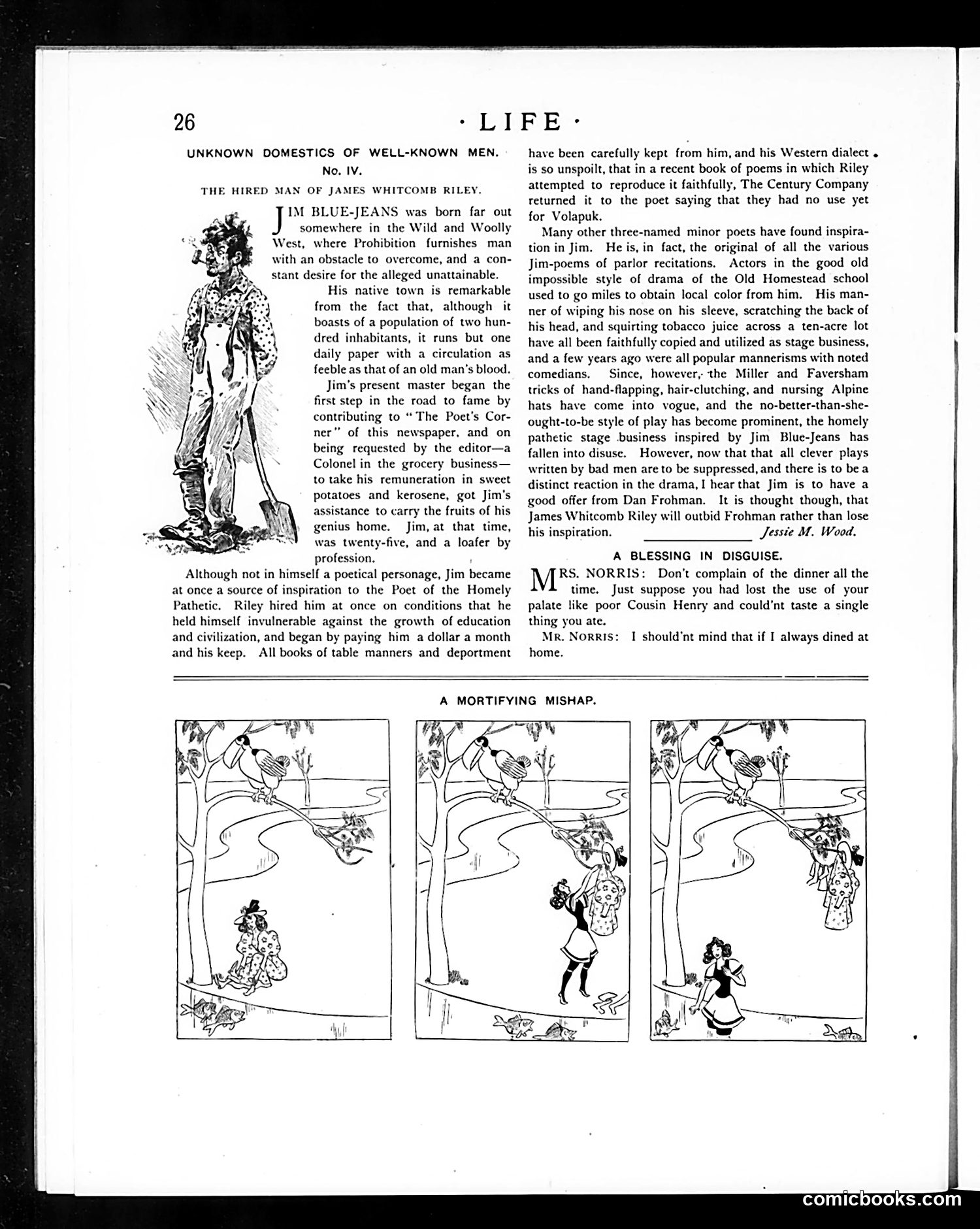
This page contains two distinct sections: **Upper Section:** A biographical article about Jim Blue-Jeans (Whitcomb Riley), describing how the poet rose from humble origins in the American West to become a celebrated figure in literature. The text emphasizes his authenticity and influence on other writers and performers. **Lower Section:** A three-panel comic titled "A Mortifying Mishap" depicting a slapstick sequence involving a woman at what appears to be a clothesline or rope. The humor relies on physical comedy—the woman's comic distress as she interacts with hanging laundry or garments, with each panel escalating the mishap. The page exemplifies Life magazine's mix of literary commentary and humorous illustration typical of early American satirical publishing.
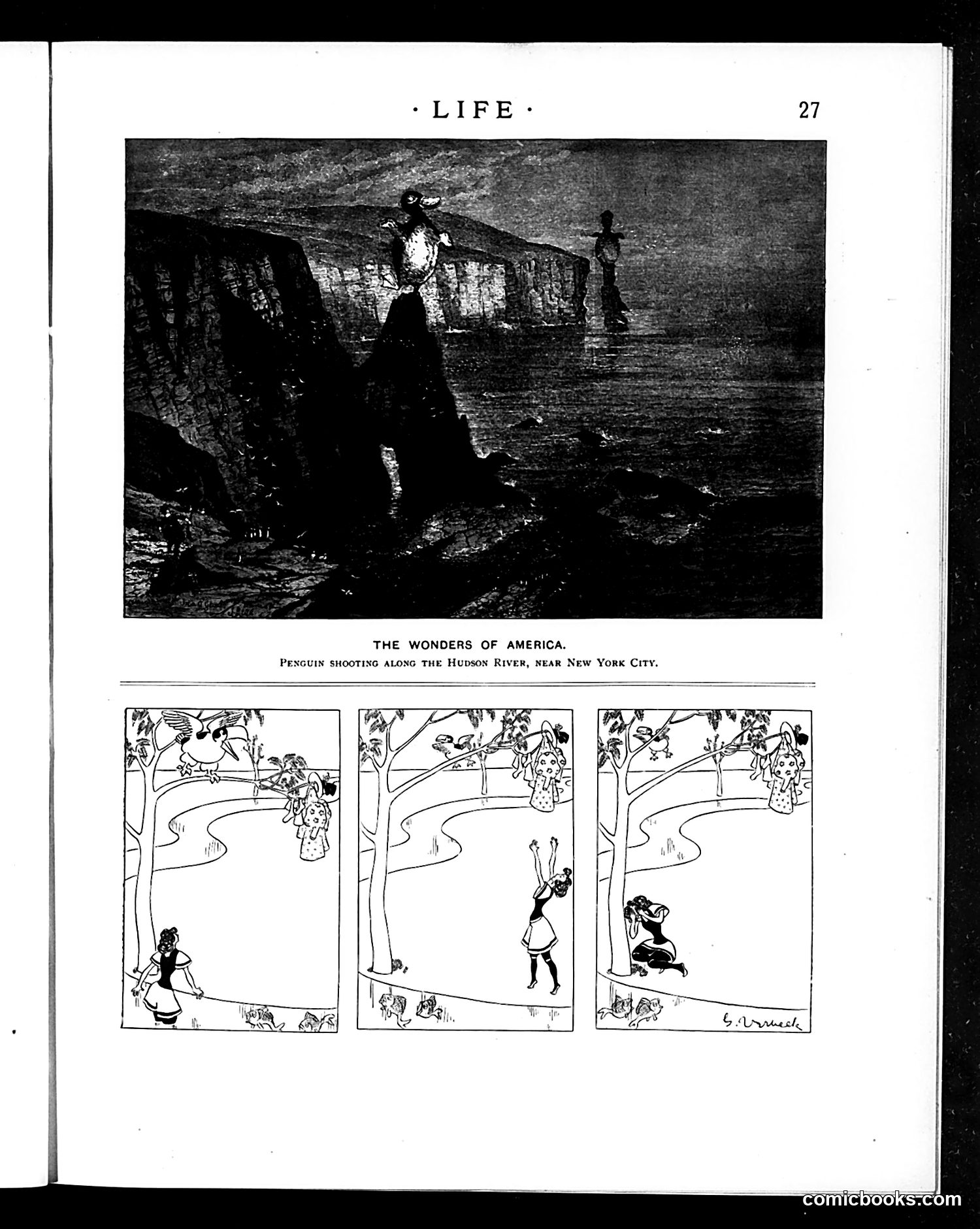
This page from *Life* magazine contains two distinct items: **Top photograph:** Labeled "The Wonders of America: Penguin Shooting Along the Hudson River, Near New York City," this appears to be a humorous fake photograph showing what looks like penguins near industrial structures by the Hudson River. This is clearly satirical—penguins don't inhabit New York waters—likely mocking either gullible readers who might believe tall tales, or parodying sensationalized "wonders" journalism of the era. **Bottom comic strip:** A three-panel sequence showing a person attempting to catch or interact with something suspended from a tree branch over water. The progression suggests escalating physical comedy or misadventure, though the specific satirical target isn't entirely clear from the image alone. Both items appear designed as humorous entertainment rather than direct political commentary.
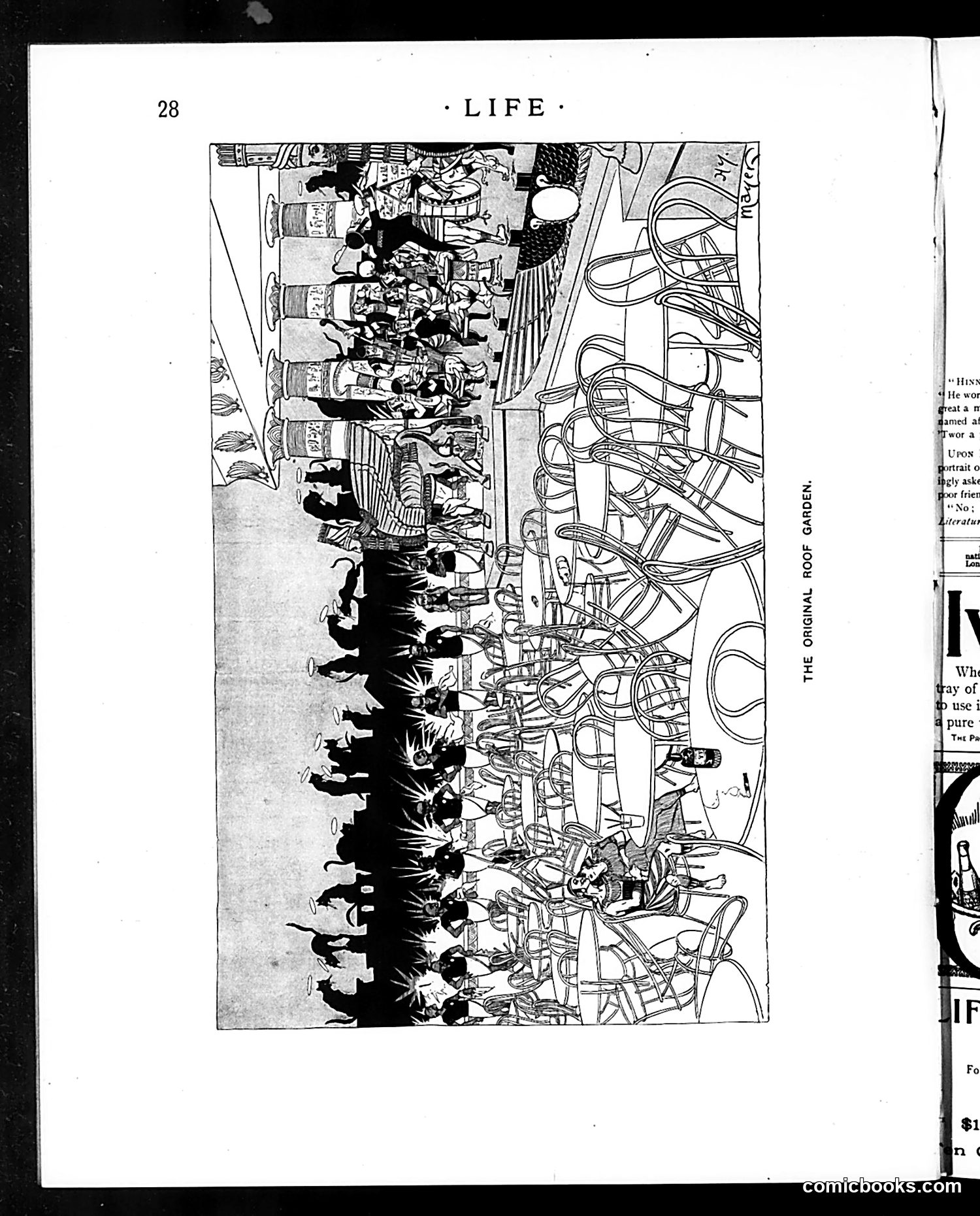
This illustration depicts what appears to be a crowded rooftop garden scene, oriented sideways on the page. The caption identifies it as "The Original Roof Garden," likely referencing a famous New York City venue. The image shows numerous figures in period dress (appearing to be early 1900s based on the illustration style) gathered on a rooftop with decorative railings and architectural details. The scene captures a social gathering or entertainment venue. Without additional visible text explaining the satirical point, the humor likely relates to the venue's historical significance or the behavior of the crowd depicted. The Life magazine context suggests social satire about upper-class leisure activities or New York society of the era, but the specific satirical target remains unclear from this image alone.
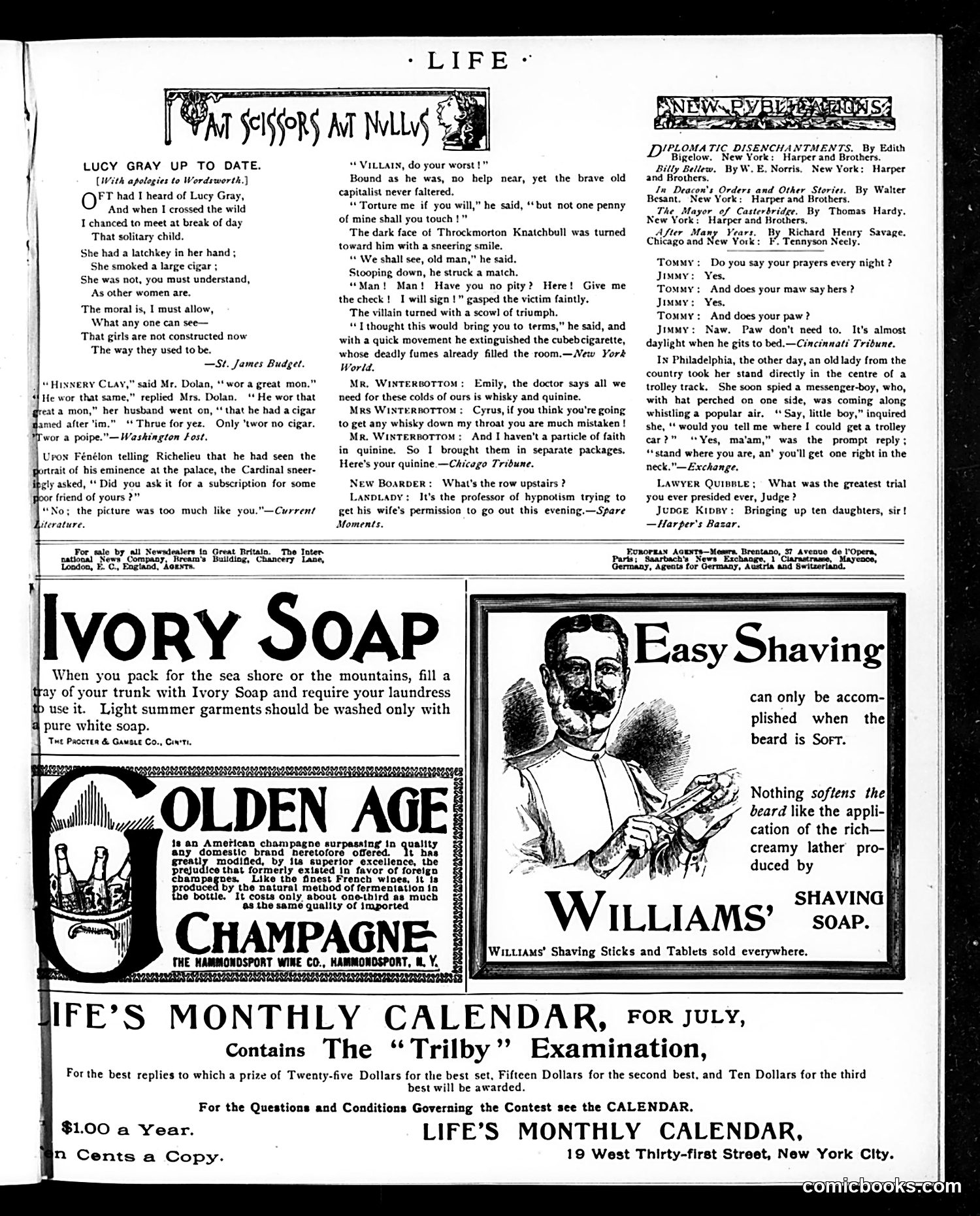
This page from the satirical magazine *Life* contains primarily **humorous fiction and jokes** rather than political cartoons, alongside period advertisements. The content includes: **"Lucy Gray Up to Date"** — a parody of Wordsworth's Romantic poem, updated to mock modern women. Instead of an innocent child, the "Lucy Gray" encountered is a cynical adult woman with a latchkey, smoking cigars—satirizing the "New Woman" of the era (early 1900s) who challenged Victorian gender norms through independence and smoking. **Various comic vignettes** depicting domestic scenes and class interactions—a husband trying to trick his wife into drinking whisky as "medicine," a country woman confused by trolleys, and hypnotism humor. The **advertisements** (Ivory Soap, Williams' Shaving Soap, Golden Age Champagne) reflect period consumer culture. The overall tone mocks social changes, particularly women's increasing independence and the pretensions of modern urban life, while maintaining the light, satirical voice characteristic of *Life* magazine.
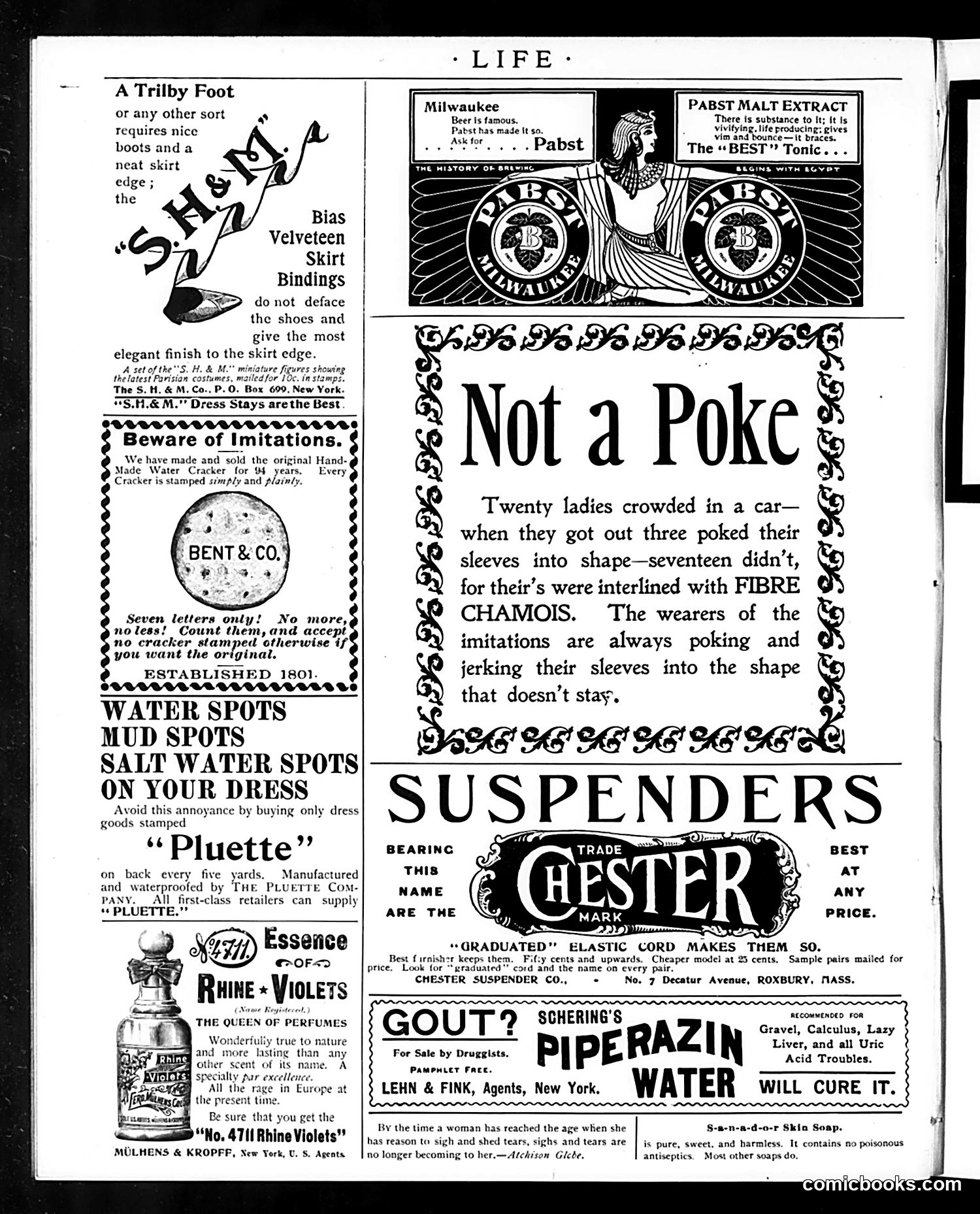
This is primarily a **advertising page** from an early 1900s issue of *Life* magazine, with one satirical piece embedded among product promotions. The main satirical content is **"Not a Poke,"** which mocks women's fashion. The joke concerns sleeve construction: twenty ladies crowded into a car—when exiting, only three needed to reshape their sleeves. The seventeen with sleeves lined with "Fibre Chamois" maintained their shape naturally, while imitation materials required constant poking and adjusting. The satire targets women who buy cheap knockoff fabrics that fail to hold their intended silhouette, forcing wearers into the undignified habit of perpetually fussing with their clothing. The surrounding ads peddle era-appropriate goods: dress stays, water crackers, fabric treatments, suspenders, patent medicines (Piperazin Water for gout), perfume, and beer extract—typical of *Life*'s mix of humor and commerce.
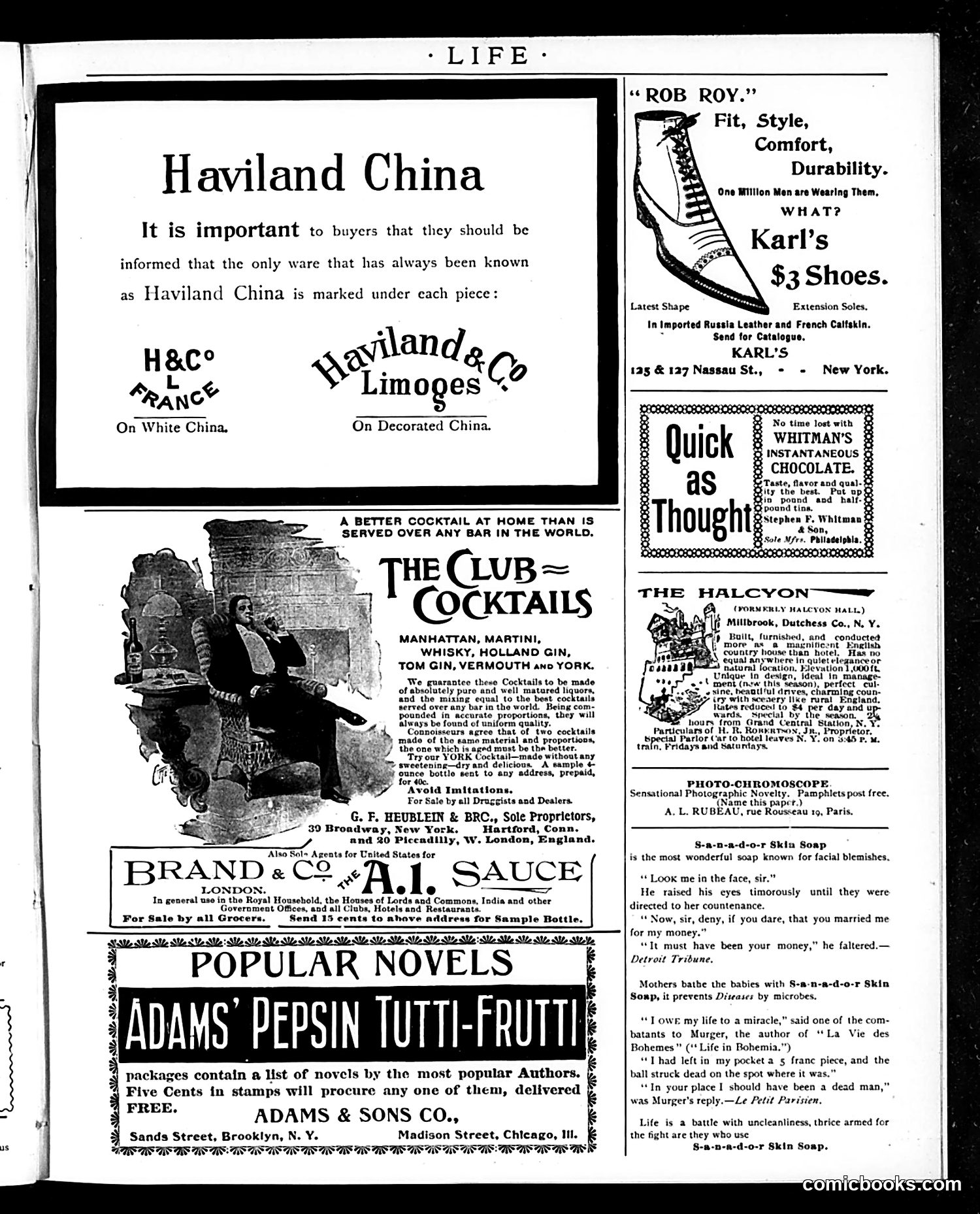
This is primarily an **advertising page** with minimal satirical content. The layout showcases various commercial products typical of early 20th-century American magazines. **Key advertisements include:** - **Haviland China**: A luxury porcelain brand distinguishing itself from imitators by trademark marks - **The Club Cocktails**: A home cocktail brand claiming superiority to bar-made drinks, likely aimed at wealthy consumers during Prohibition era - **Brand & Co. A.1. Sauce**: A condiment used in "Royal Households" - **Karl's $3 Shoes**: Emphasizing durability and style - **Whitman's Chocolate** and **S-a-n-a-d-o-r Skin Soap**: Consumer goods with testimonial quotes The small boxed anecdotes about the soap and life lessons appear to be humorous filler content rather than political satire. This page reflects the magazine's reliance on advertising revenue and appeals to middle-to-upper-class readers with disposable income for branded luxury goods.
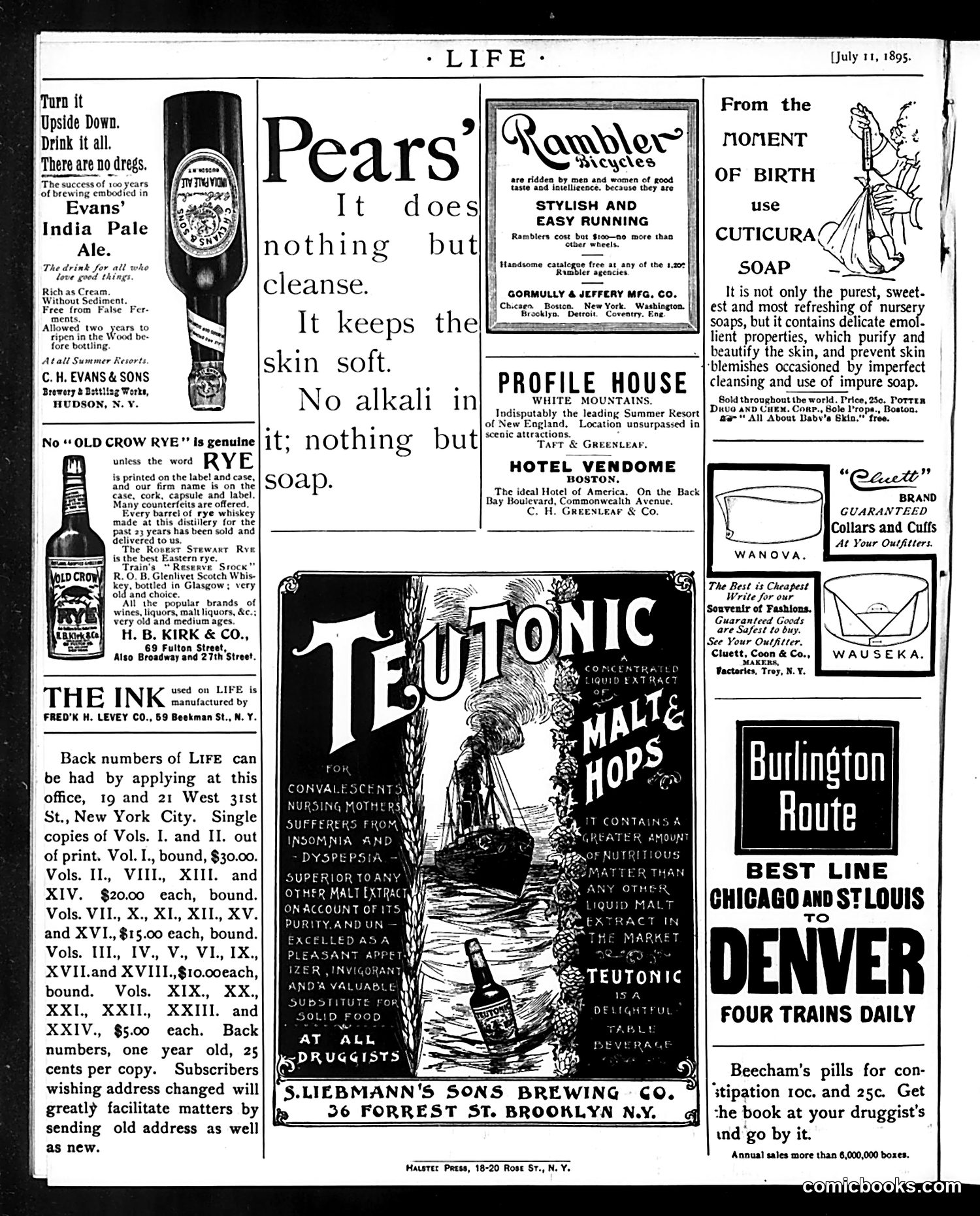
This is primarily an **advertising page** with no political cartoons or satirical content requiring historical context. The page consists almost entirely of period product advertisements: Evans' India Pale Ale, Pears' Soap, Rambler bicycles, Teutonic Malt and Hops tonic, hotels, collar brands, and patent medicines. The only notable visual element is a large decorative advertisement for S. Liebmann's Sons Brewing Company featuring an illustrated figure. The page also includes **LIFE magazine's own notices**: back issue availability and pricing (ranging from 25 cents to $30 for bound volumes), and a note that the magazine's ink is manufactured by Fred'k H. Levey Co. This reflects late-Victorian commercial culture—the prominence of patent tonics, ales, and digestive remedies suggests contemporary health anxieties. No satire or political commentary is present on this particular page.