
Life, 1895-07-11 · page 4 of 16
Life — July 11, 1895 — page 4: what you’re looking at
What you’re looking at
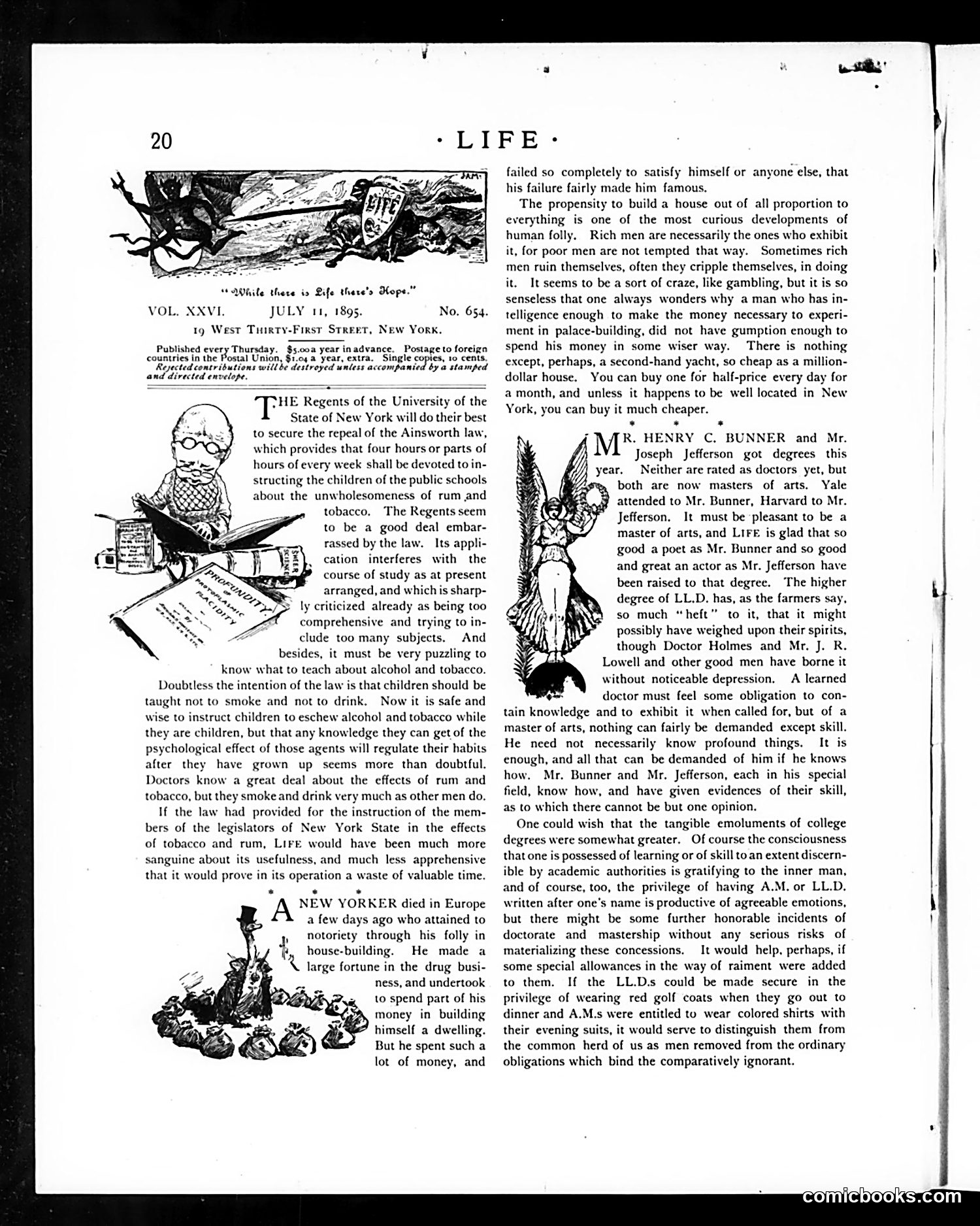
**Left cartoon:** Shows a figure surrounded by bottles labeled with various substances, appearing intoxicated or befuddled. This illustrates the article's discussion of a New York law requiring instruction about alcohol and tobacco in schools. The cartoon satirizes the irony of teaching children about these substances while the figure depicted seems to exemplify their destructive effects. **Right section:** Discusses Mr. Henry C. Bunner and Joseph Jefferson receiving honorary degrees. The text mocks the inflation of academic honors—L.L.D. degrees awarded to artists and actors who haven't necessarily earned scholarly credentials. The satire suggests that prestigious degrees have become devalued tokens rather than meaningful academic achievements, particularly when awarded to entertainers based on talent alone rather than scholarly merit.
📄 Transcribed text from this page (OCR, searchable)
Machine-transcribed from the original scan — historical spelling and the odd misread are preserved.
Day While there is Life there's Hope.” JULY 11, 1895. No. 654. 1g West Tirty-Fir Street, New York. Published every Thursday. $5.00 year inadvance. Postage to foreign countries in the Postal Union, $1.04 a year, extra. Single copies, 10 cents. Resected contributions willbe destroyed unless accompanied by a stamped and LEEDS, THE Regents of the University of the State of New York will do their best to secure the repeal of the Ainsworth law, which provides that four hours or parts of hours of every week shall be devoted to in- structing the children of the public schools about the unwholesomeness of rum and tobacco, The Regents seem to be a good deal embar- rassed by the law. Its appli- cation interferes with the course of study as at present iS arranged, and which is sharp- YS ly criticized already as being too Z comprehensive and trying to in- clude too many subjects. And besides, it must be very puzzling to know what to teach about alcohol and tobacco. Doubtless the intention of the law is that children should be taught not to smoke and not to drink. Now it is safe and wise to instruct children to eschew alcohol and tobacco while they are children, but that any knowledge they can get of the psychological effect of those agents will regulate their habits after they have grown up seems more than doubtful. Doctors know a great deal about the effects of rum and tobacco, but they smoke and drink very much as other men do. If the law had provided for the instruction of the mem- bers of the legislators of New York State in the effects of tobacco and rum, LiFe would have been much more sanguine about its usefulness, and much less apprehensive that it would prove in its operation a waste of valuable time. * . NEW YORKER died in Europe a few days ago who attained to jp Rotoriety through his folly in ii) house-building. He made a q large fortune in the drug busi- ness, and undertook to spend part of his money in building himself a dwelling. But he spent such a lot of money, and LIFE failed so completely to satisfy himself or anyone else, that his failure fairly made him famous, The propensity to build a house out of all proportion to everything is one of the most curious developments of human folly, Rich men are necessarily the ones who exhibit it, for poor men are not tempted that way. Sometimes rich men ruin themselves, often they cripple themselves, in doing it. It seems to be a sort of craze, like gambling, but it is so senseless that one always wonders why a man who has in- telligence enough to make the money necessary to experi- ment in palace-building, did not have gumption enough to spend his money in some wiser way. There is nothing except, perhaps, a second-hand yacht, so cheap as a million- dollar house. You can buy one for half-price every day for a month, and unless it happens to be well located in New York, you can buy it much cheaper. . . . R. HENRY C, BUNNER and Mr. Joseph Jefferson got degrees this year. Neither are rated as doctors yet, but both are now masters of arts. Yale attended to Mr. Bunner, Harvard to Mr. Jefferson. It must be pleasant to be a master of arts, and LIFE is glad that so good a poet as Mr. Bunner and so good and great an actor as Mr. Jefferson have been raised to that degree. The higher degree of LL.D, has, as the farmers say, so much “heft” to it, that it might possibly have weighed upon their spirits, though Doctor Holmes and Mr. J. R. Lowell and other good men have borne it without noticeable depression. A learned doctor must feel some obligation to con- tain aowledge and to exhibit it when called for, but of a master of arts, nothing can fairly be demanded except skill. He need not necessarily know profound things. It is enough, and all that can be demanded of him if he knows how. Mr. Bunner and Mr. Jefferson, each in his special field, know how, and have given evidences of their skill, as to which there cannot be but one opinion, One could wish that the tangible emoluments of college degrees were somewhat greater. Of course the consciousness that one is possessed of learning or of skill toan extent discern- ible by academic authorities is gratifying to the inner man, and of course, too, the privilege of having A.M. or LL.D. written after one’s name is productive of agreeable emotions, but there might be some further honorable incidents of doctorate and mastership without any serious risks of materializing these concessions. It would help, perhaps, if some special allowances in the way of raiment were added to them. If the LL.D.s could be made secure in the privilege of wearing red golf coats when they go out to dinner and A.M.s were entitled to wear colored shirts with their evening suits, it would serve to distinguish them from the common herd of us as men removed from the ordinary obligations which bind the comparatively ignorant.