
A complete issue · 18 pages · 1895
Life — April 25, 1895
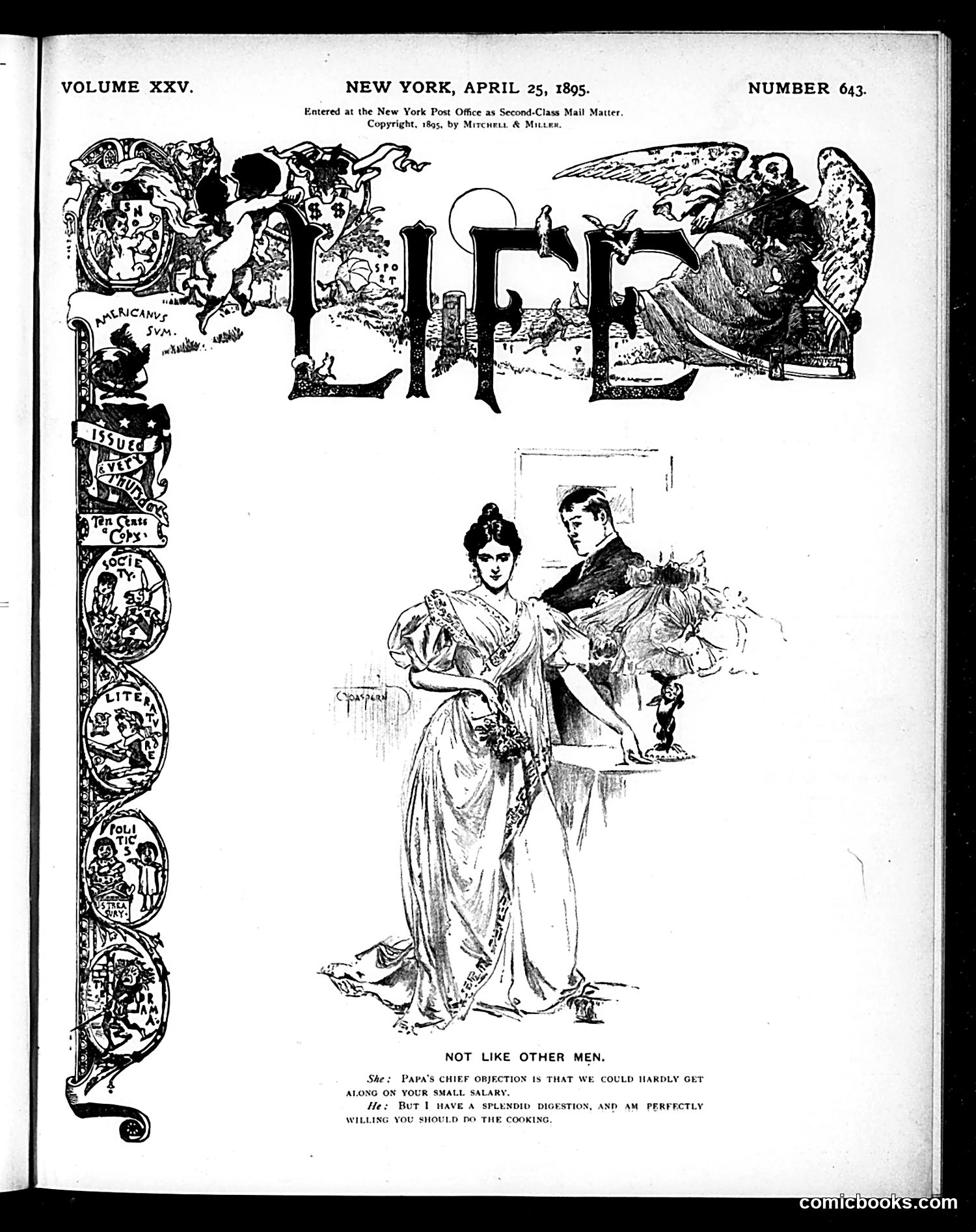
This cartoon satirizes a conflict between traditional and modern gender roles regarding domestic labor. The woman expresses concern that her father objects to the couple's modest financial prospects. The man responds that despite limited means, he possesses an unusual virtue: he's willing to do the cooking himself. The humor relies on the shocking (for 1895) idea of a man performing domestic duties—cooking specifically. This inverts Victorian expectations where housework was exclusively women's domain. The man's willingness to cook is presented as an extraordinary asset that compensates for financial inadequacy, highlighting how rigid and inflexible gender roles were in the 1890s. The title "Not Like Other Men" underscores how unusual such domestic flexibility appeared to contemporary readers.
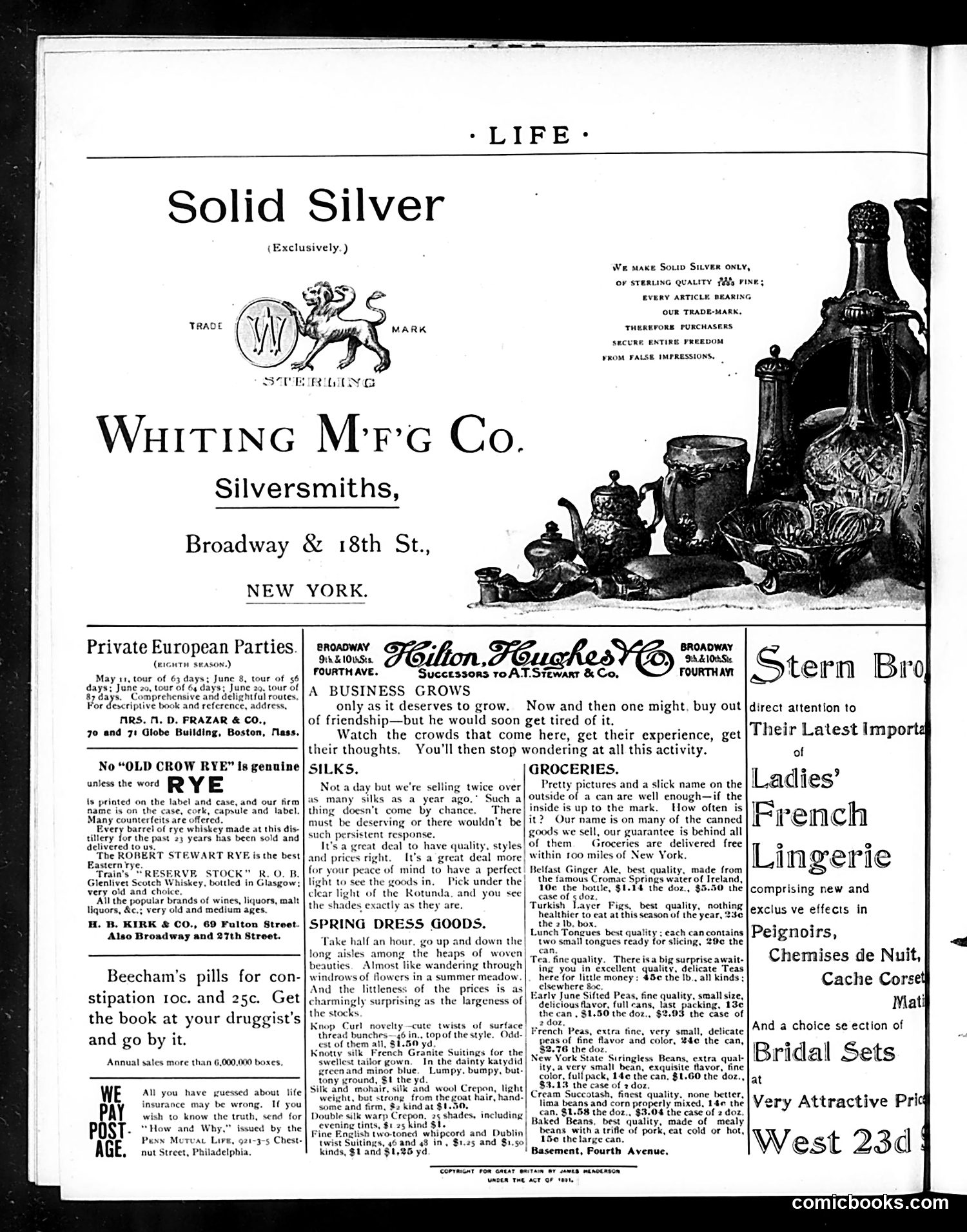
This page is primarily **advertising**, not satire or political commentary. It contains: 1. **Whiting M'fg Co.** advertisement for sterling silver goods (top left) 2. **Halton, Houokes & Co.** ad for business items and silks 3. **Stern Bros.** announcement of imported French lingerie and bridal sets 4. Various other commercial advertisements for pills, groceries, and goods The only non-advertising content appears to be a small item about "Private European Parties" travel offerings. There is **no political cartoon visible** on this page. The imagery consists entirely of product illustrations (silverware, bottles, clothing) accompanying commercial notices typical of *Life* magazine's revenue model during this era. This reflects how early 20th-century magazines sustained themselves through extensive paid advertising integrated with editorial content.
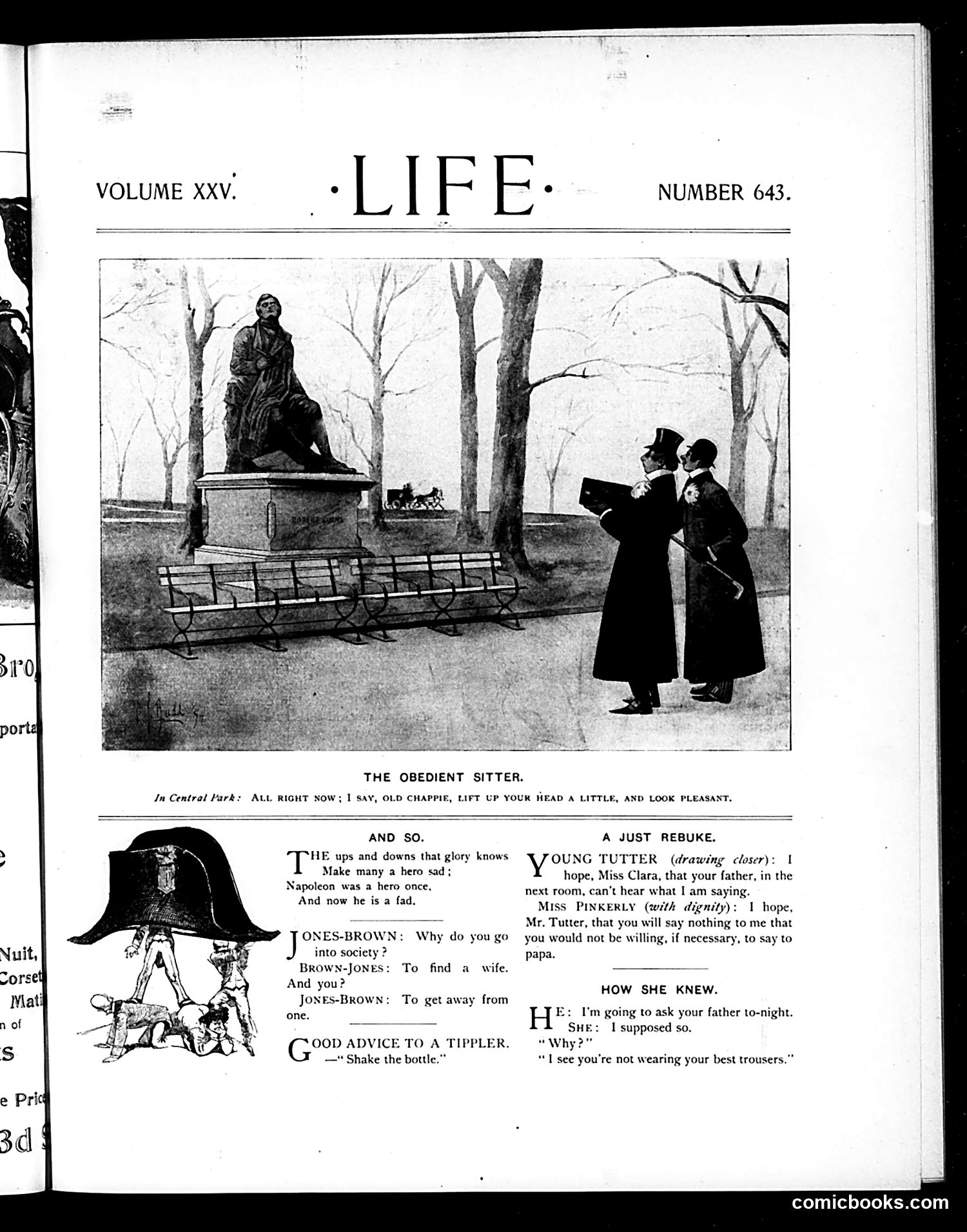
This page contains satirical humor typical of early 20th-century Life magazine. **"The Obedient Sitter"** shows a park scene with two men examining what appears to be a statue or monument, illustrating a joke about social compliance. **"And So"** mocks Napoleon's historical decline, suggesting his past glory has faded into irrelevance ("now he is a fad"). **"A Just Rebuke"** depicts a conversation between Young Tutter and Miss Pinkerly, where class expectations about proper dress are humorously addressed—the woman cleverly deduces the man's intentions from his clothing choices. **"How She Knew"** delivers a brief domestic joke about a woman's perceptiveness regarding her partner's intentions, based on observable details. The illustration of Napoleon in a bicorn hat reinforces period humor about outdated figures. Overall, the page reflects Edwardian-era social satire focused on manners, expectations, and romantic complications.
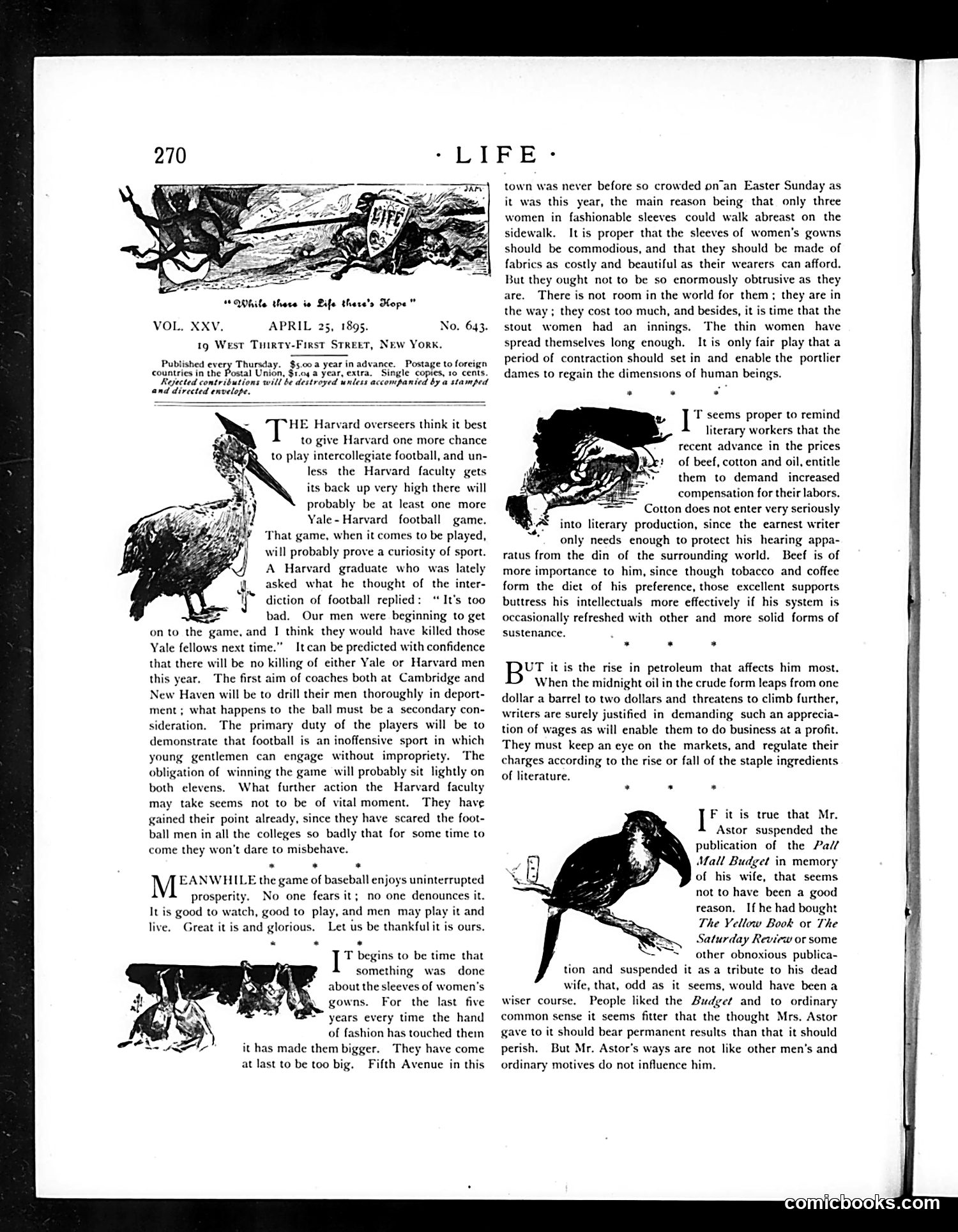
This page contains **social commentary on women's fashion** rather than political cartoons. The illustrations satirize the excessively large sleeves fashionable on women's gowns in the 1890s. The text criticizes how these voluminous sleeves obstruct public spaces—they're so wide women cannot walk side-by-side on sidewalks during Easter promenade crowds. The author argues the sleeves are wastefully expensive and impractical, using up fabric that should go to less affluent women. The accompanying woodcut illustrations (a pelican, birds, and cattle) appear decorative rather than satirical. The page also discusses **Harvard football** and **literary workers' wages** responding to rising commodity prices, but these are separate editorial pieces without illustrations.
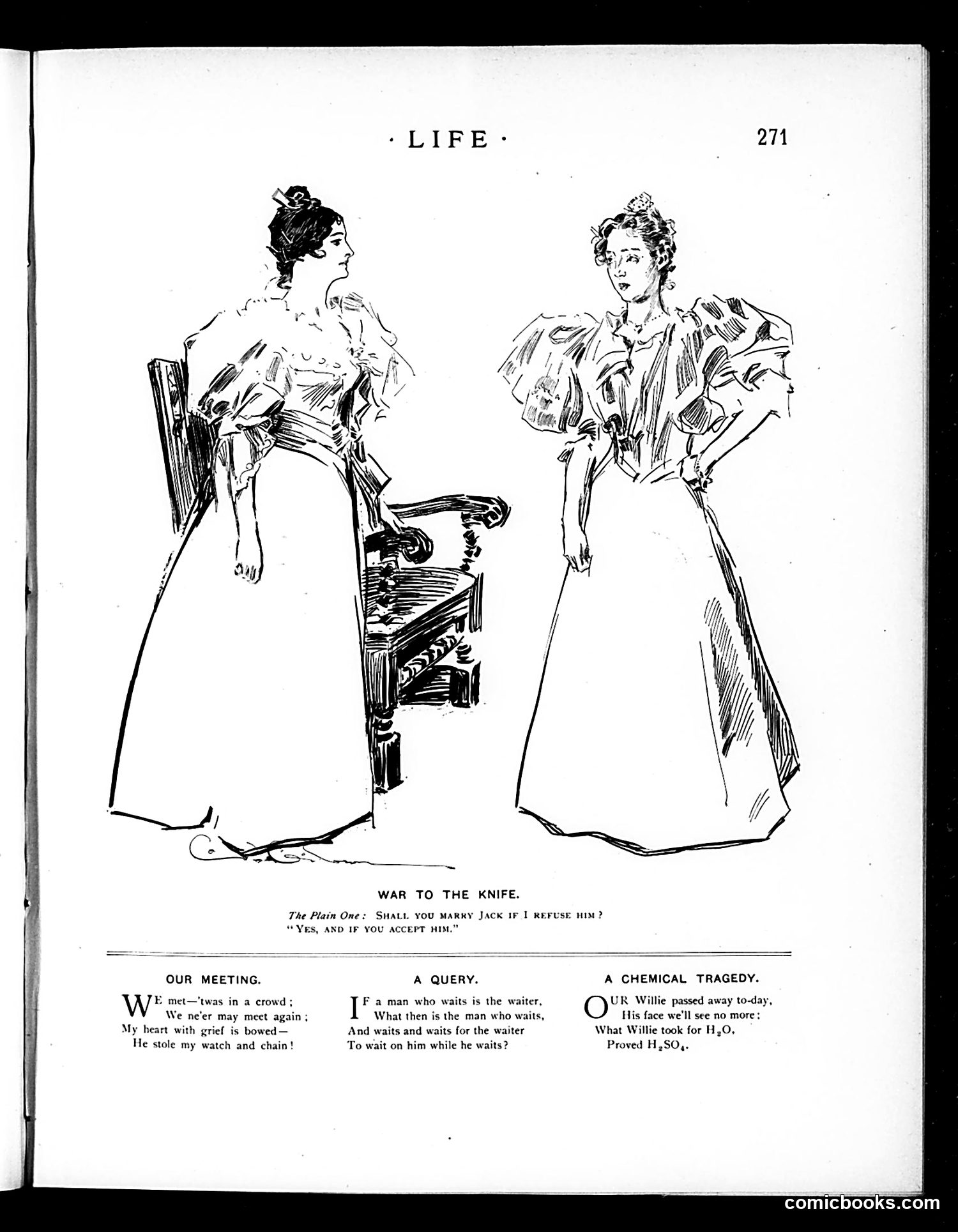
This page contains three separate pieces of light social satire typical of early 20th-century Life magazine humor. **"War to the Knife"** shows two women in Edwardian dress debating marriage. One asks if the other will marry "Jack"; the response is conditional acceptance only "if you refuse him"—suggesting competitive rivalry over suitors. **"Our Meeting"** laments a chance encounter where a man stole the speaker's watch and chain, expressing regret they may never meet again. **"A Query"** plays on wordplay about a waiter who "waits"—philosophical humor about occupational identity. **"A Chemical Tragedy"** is a dark joke: Willie died after consuming H₂O (water), with the punchline that "H₂O" was actually hydrogen peroxide (H₂O₂), a toxic substance. These represent typical period humor: romantic complications, petty crime, puns, and dark comedy.
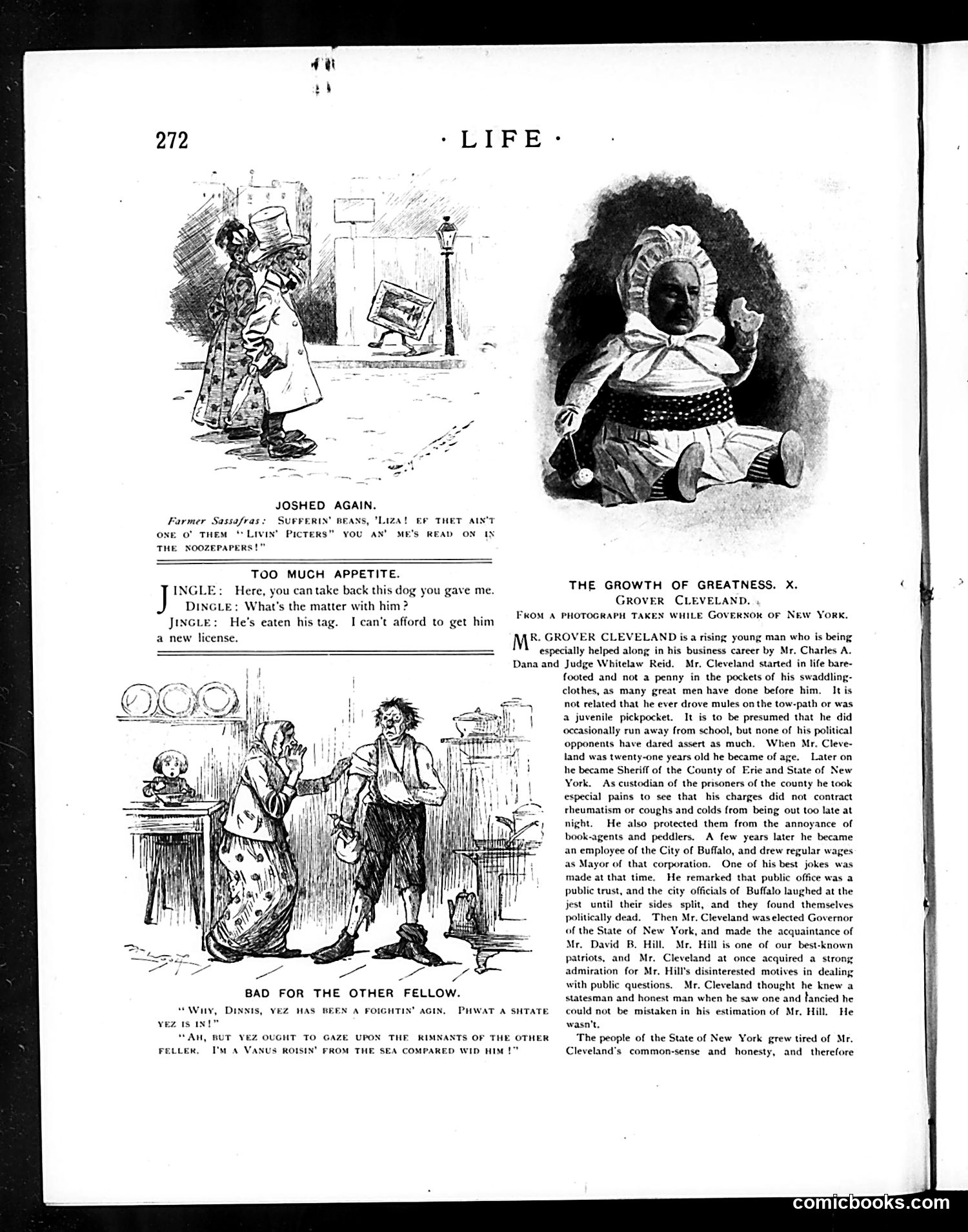
This page contains three separate satirical pieces: 1. **"Joshed Again"**: A sketch mocking a man claiming to have seen a "Living Pictures" performance, a popular theatrical entertainment of the era. 2. **"Too Much Appetite"**: A dialogue joke about a dog that has eaten its own license tag, making it impossible to afford a replacement—satirizing the costs of urban pet ownership. 3. **"The Growth of Greatness. X. Grover Cleveland"**: A biographical sketch praising Cleveland's rise from obscurity to Governor of New York, emphasizing his reputation for honesty and common sense as qualities that earned public trust and political advancement. 4. **"Bad for the Other Fellow"**: A brief comedic exchange about naval comparisons, likely referencing contemporary maritime themes. The page primarily features satirical commentary on contemporary social and political figures.
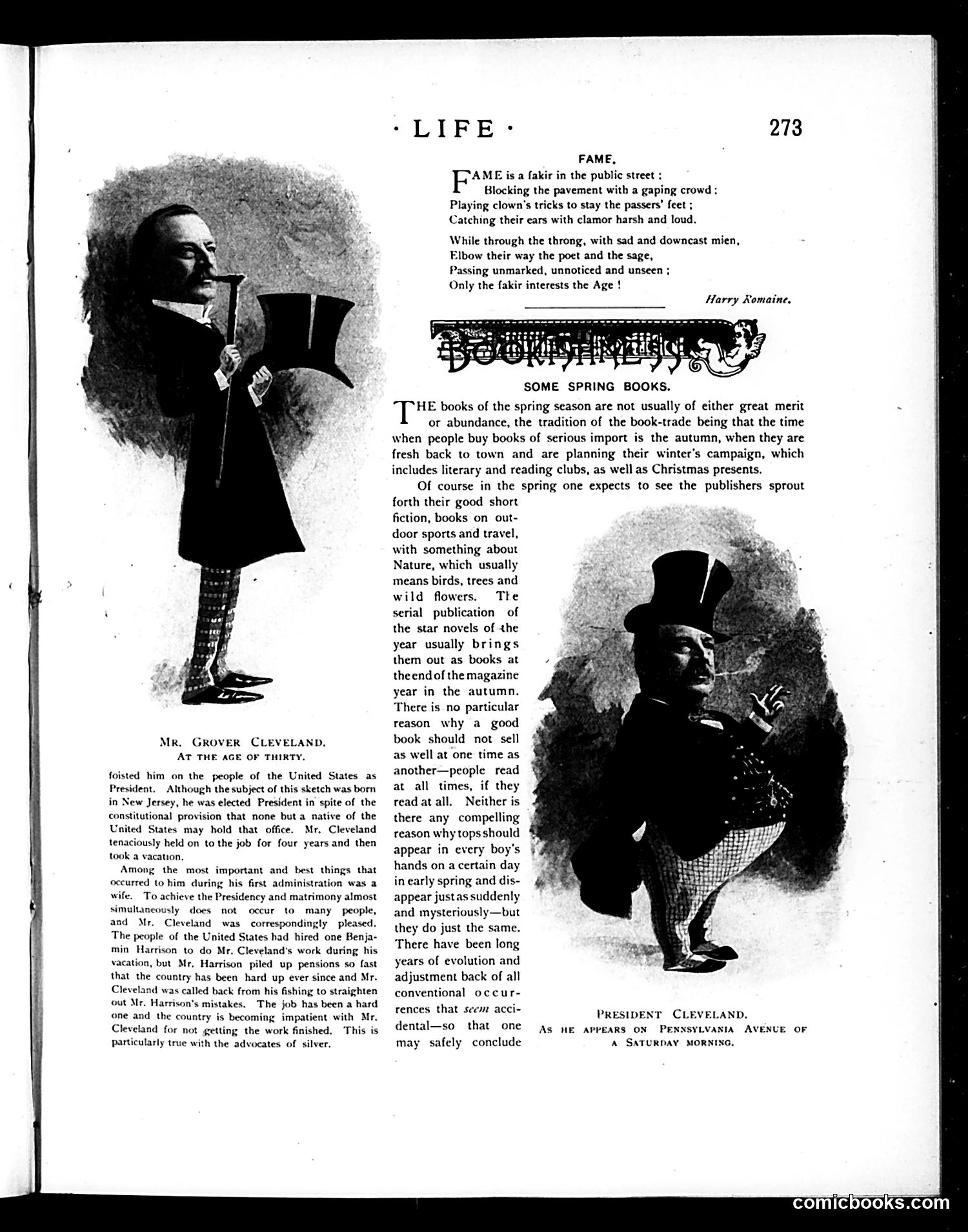
This page features two satirical illustrations of **Grover Cleveland**, identified in captions as appearing "at the age of thirty" (left) and "on Pennsylvania Avenue of a Saturday morning" (right). The text beneath the left image criticizes Cleveland's presidency, noting he was born in New Jersey yet became President despite constitutional provisions against non-natives holding office. It mentions his "hard" work during administration, references Benjamin Harrison's presidency that followed, and suggests Cleveland is being called back to "straighten out Mr. Harrison's mistakes." The satirical point appears to be mocking Cleveland's potential return to office and the political turnover between these two rivals. The grotesque caricatures exaggerate his features for comedic effect—standard practice in *Life* magazine's political satire of this era.
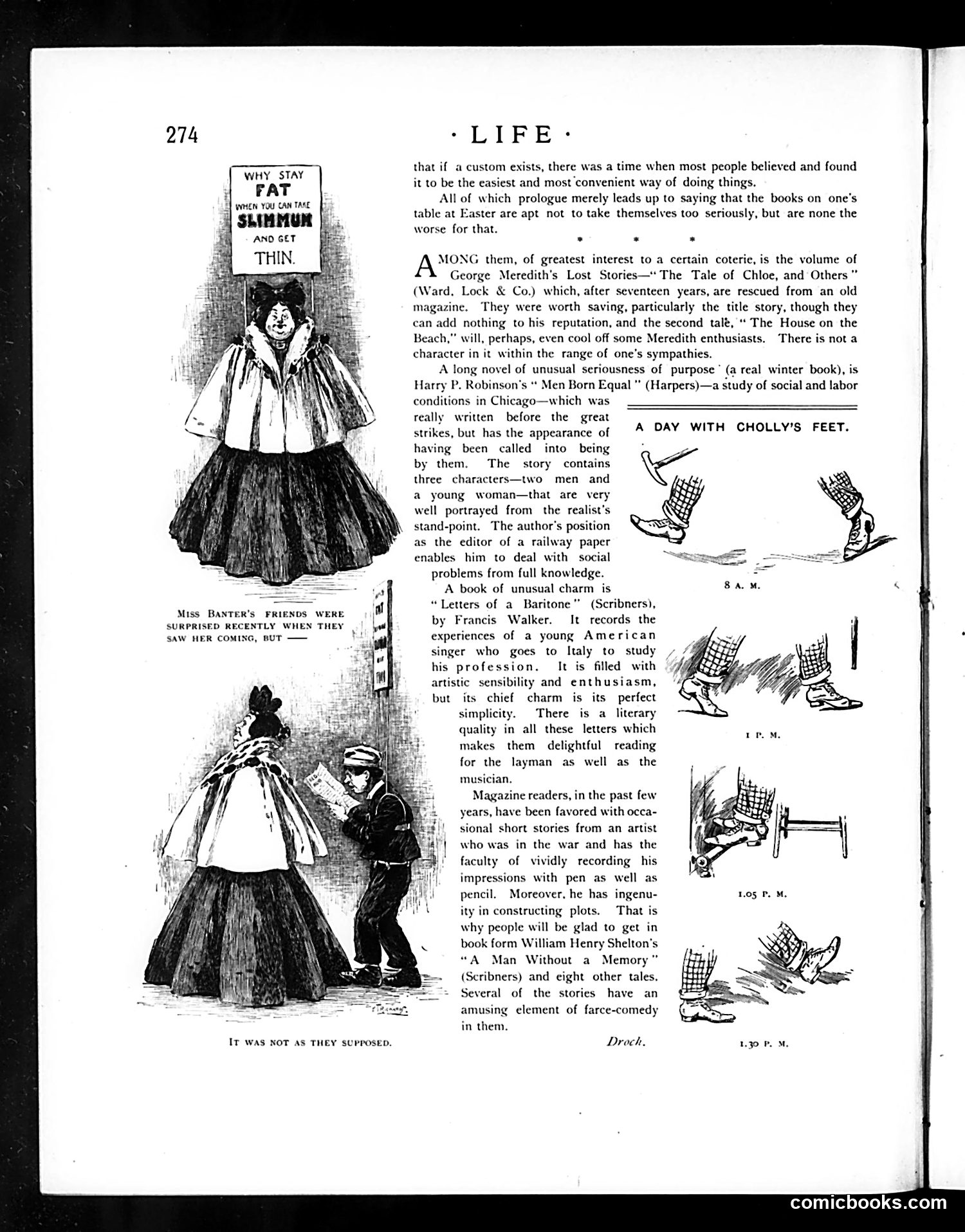
This page contains **book reviews** rather than political cartoons. The left side features two illustrations with captions about "Miss Hanter's friends" being "surprised recently when they saw her coming" and "It was not as they supposed"—likely satirizing social expectations or fashion of the era. The right side reviews several books including George Meredith's "Lost Stories," Harry P. Robinson's "Man Born Equal" (a study of Chicago labor conditions), Francis Walker's "Letters of a Baritone," and William Henry Shelton's "A Man Without a Memory." The small illustrations titled "**A Day with Cholly's Feet**" appear to humorously document a character's footwear throughout the day (8 A.M. through 1:30 P.M.), likely satirizing fashion or social pretension.
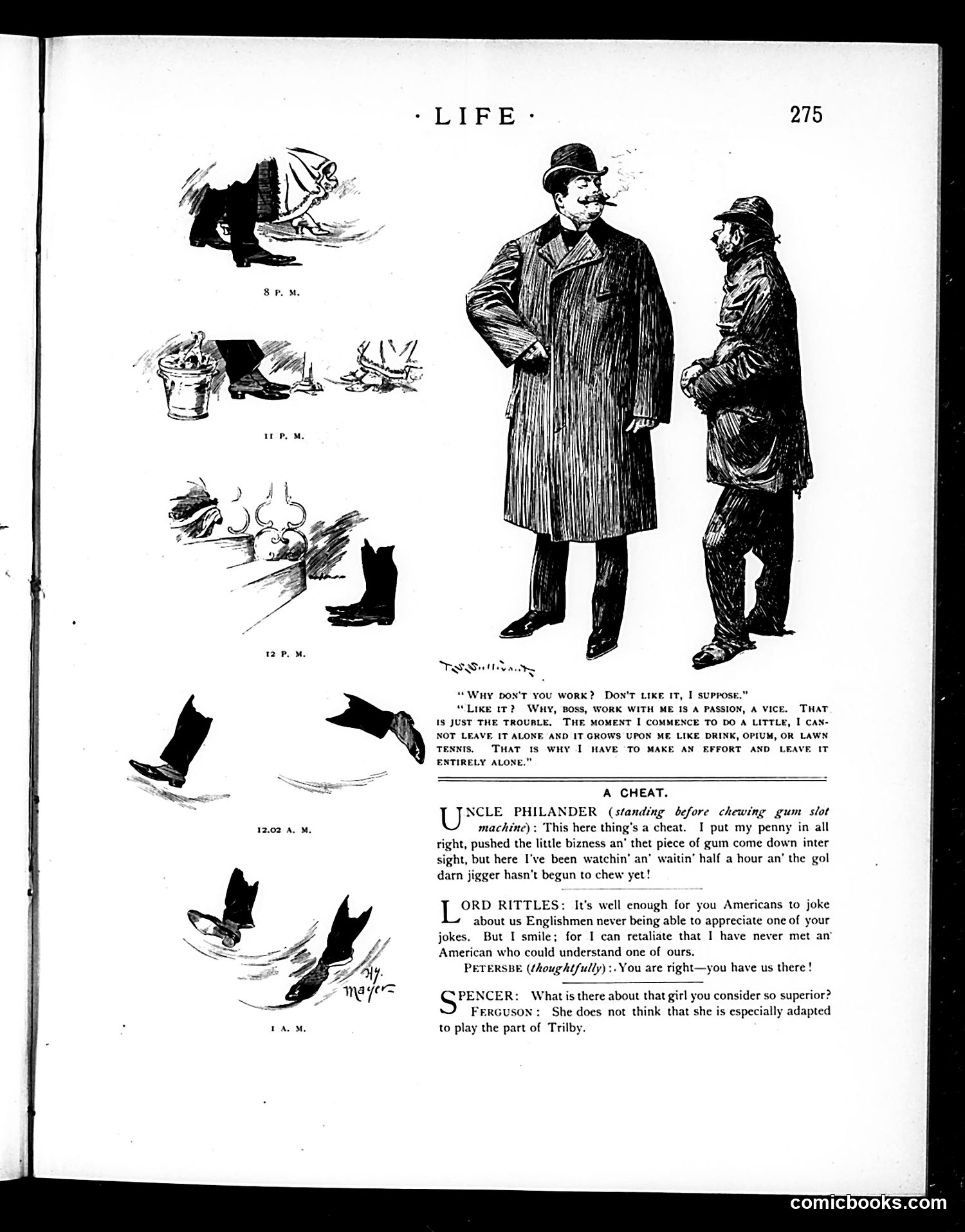
This page contains a dialogue-based cartoon about work ethic and social class. The main illustration shows two men in conversation—one well-dressed in a long coat (appearing to be an employer or man of means) speaking with a shorter, working-class man. The dialogue reveals the central satire: the working-class figure refuses employment because work has become an addictive "passion" and "vice" for him—he cannot control it and must avoid it entirely to maintain self-control. The left side shows sequential sketches depicting a man's evening deterioration (8 P.M. through 1 A.M.), humorously illustrating the destructive habits mentioned in the dialogue. The additional text snippets below discuss English versus American humor and casting choices for "Trilby" (a theatrical production). The satire mocks both excessive work culture and the stereotype of the lazy poor.
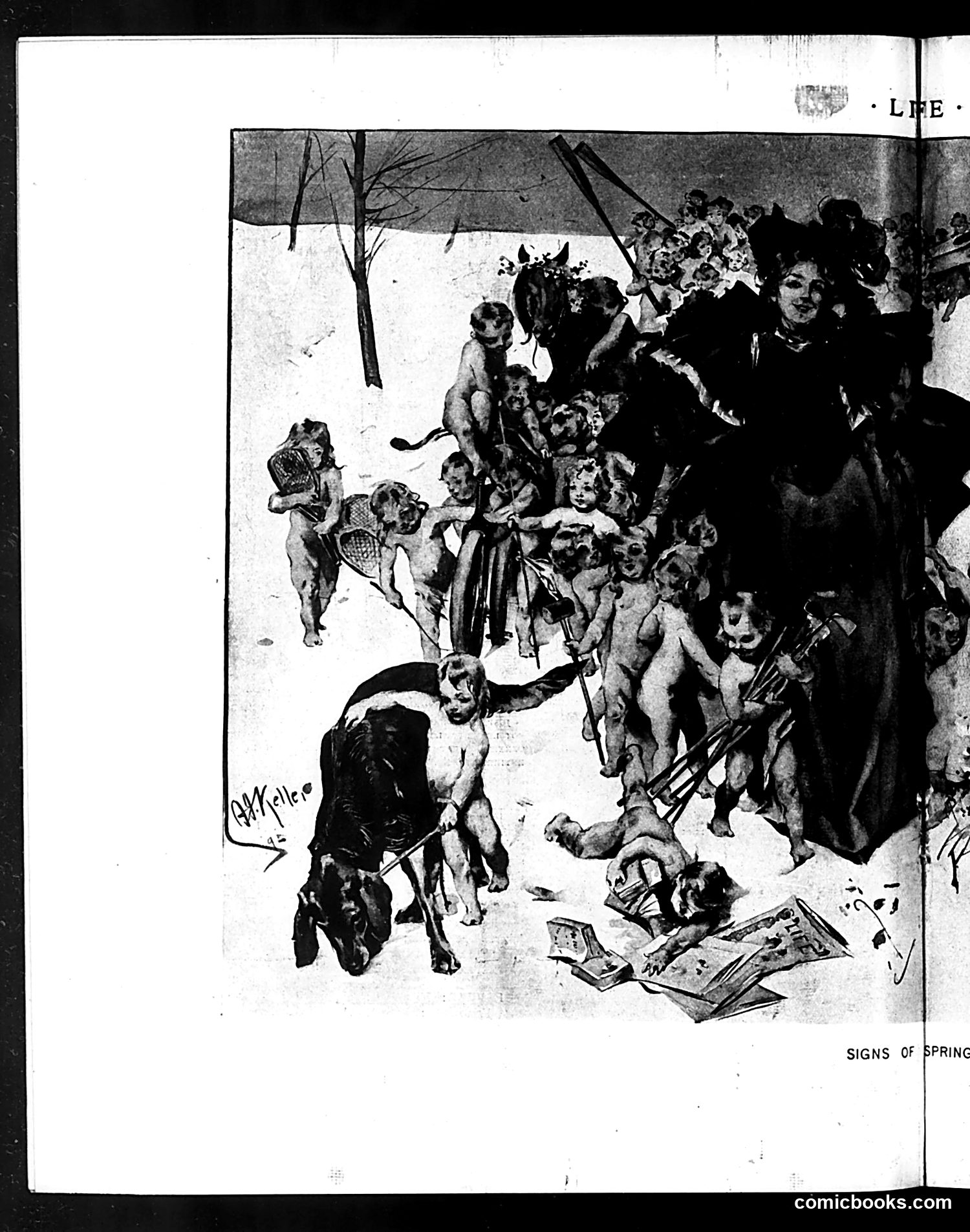
This illustration depicts a chaotic winter-to-spring transition scene with cherubs and putti (cherub figures) engaging in various spring activities. The image shows: **Visual elements:** - Multiple nude or partially-clothed cherub figures in a snowy landscape - Adults (appears to be women) observing from the right side - Musical instruments, including what appears to be a horn - Scattered papers or documents on the ground - Bare winter trees **The satire:** The cartoon humorously portrays the arrival of spring through classical allegorical imagery—using cherubs traditionally associated with Renaissance art and classical mythology. The contrast between the refined artistic tradition and the chaotic, playful scene below creates the joke. The signature appears to read "A.B. Welle" or similar. Without additional context about Life magazine's contemporary concerns, the specific satirical target remains unclear, though it appears to be a lighthearted commentary on seasonal change.
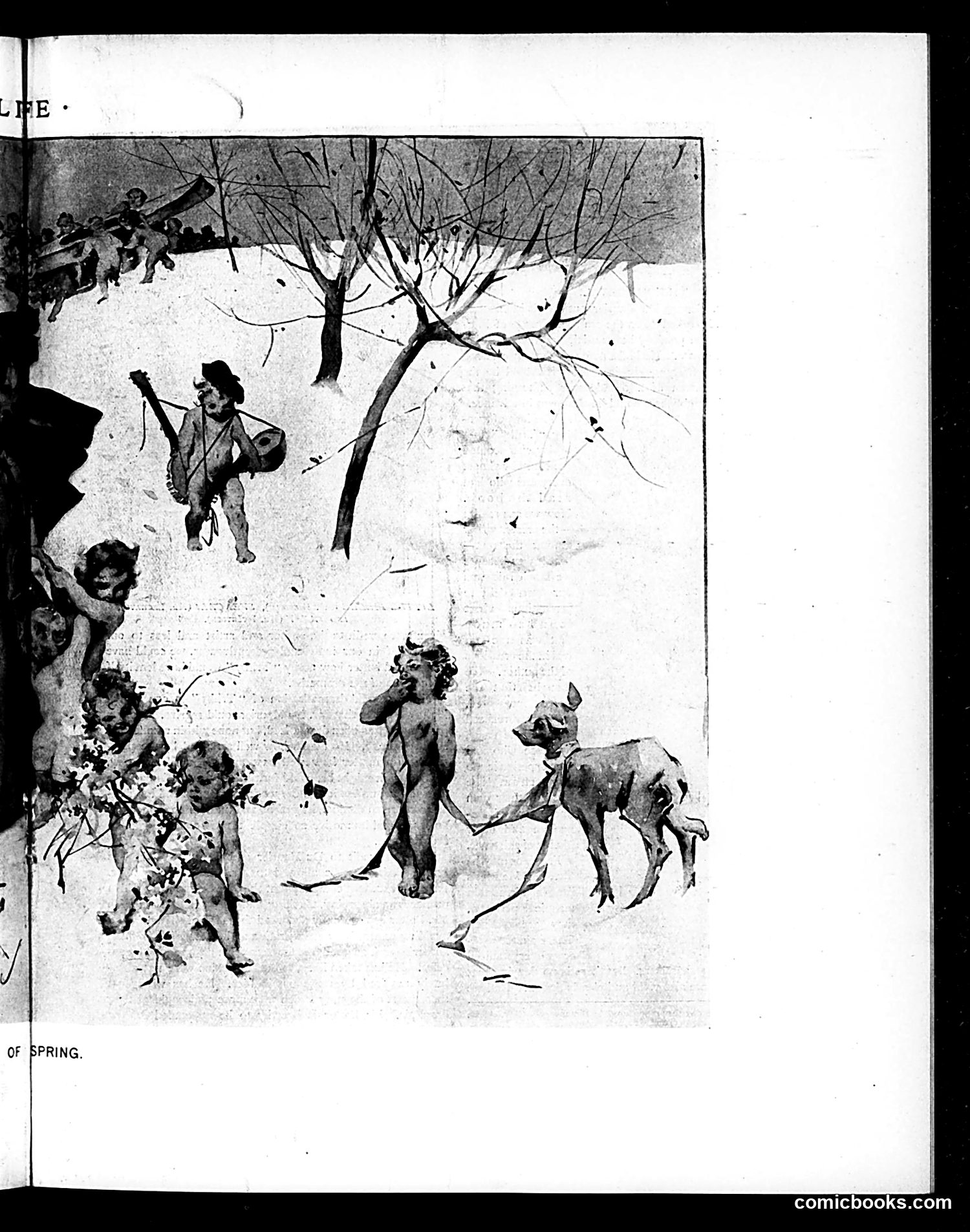
This appears to be an illustration titled "of Spring" showing a winter landscape with bare trees and snow. The scene depicts several cherubs or putti (classical cherub figures) playing in the snow alongside a dog, while additional figures appear in the background near the trees. The satire likely plays on the contrast between Spring's traditional association with renewal, warmth, and fertility (represented by the classical cherub imagery) and the harsh winter conditions actually depicted. The juxtaposition of delicate, playful mythological figures against a barren, frozen landscape creates ironic commentary—possibly mocking either false optimism about seasonal change or the disappointment of a late, harsh spring. The specific historical context and publication date would clarify the intended target of this satire.
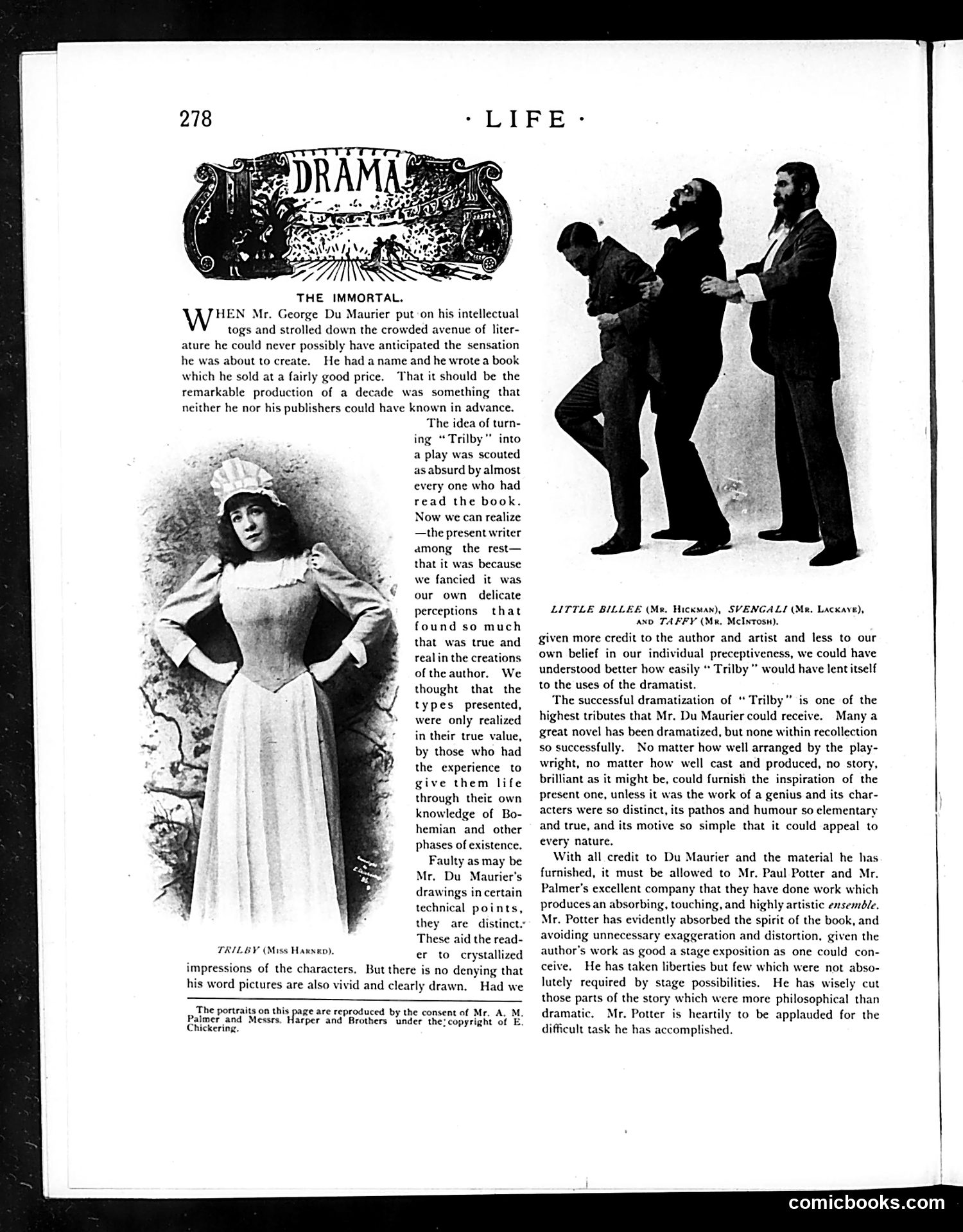
This page celebrates the theatrical adaptation of George Du Maurier's novel *Trilby*. The text discusses how skeptics doubted the book could be dramatized successfully, yet the stage production proved them wrong. The photographs show three male cast members (Little Billee, Svengali, and Taffy) and the actress playing Trilby. The article credits playwright Paul Potter and producer Palmer for skillfully translating the novel to stage—preserving its essential characters and emotional truth while making necessary dramatic cuts. The satire targets literary snobbishness: readers believed they alone appreciated the novel's merit, not recognizing Du Maurier's genius. The stage success vindicated both author and adapter, proving great literature could translate across media when handled thoughtfully. This was a genuine theatrical phenomenon of the 1890s, not political commentary.
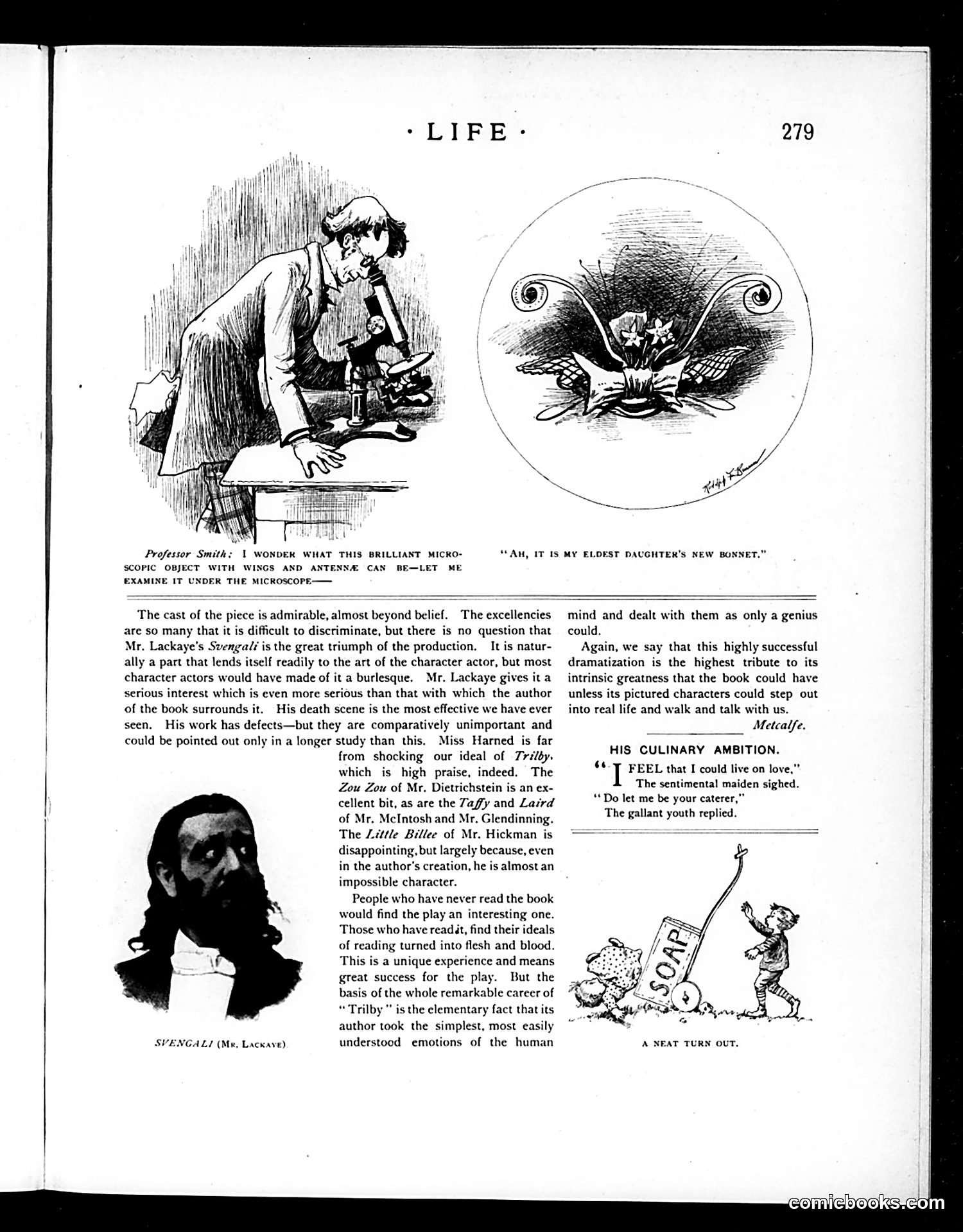
This page contains theater criticism and satirical cartoons. The top cartoon jokes about fashionable women's bonnets (hats) of the era—a professor examines a microscopic object with "wings and antennae," only to discover it's "my eldest daughter's new bonnet." The satire targets the absurdly elaborate, oversized hats women wore in this period, mocking them as bizarre creatures rather than wearable fashion. The page primarily reviews a theatrical adaptation of *Trilby*, praising actor Lackaye's performance as Svengali. The bottom cartoon, "A Neat Turn Out," depicts a young couple with a humorous double entendre: the woman expresses romantic sentiment while the man offers to be her "caterer"—a playful pun on courtship and food service. The satire reflects early 20th-century social conventions about romance and gender.
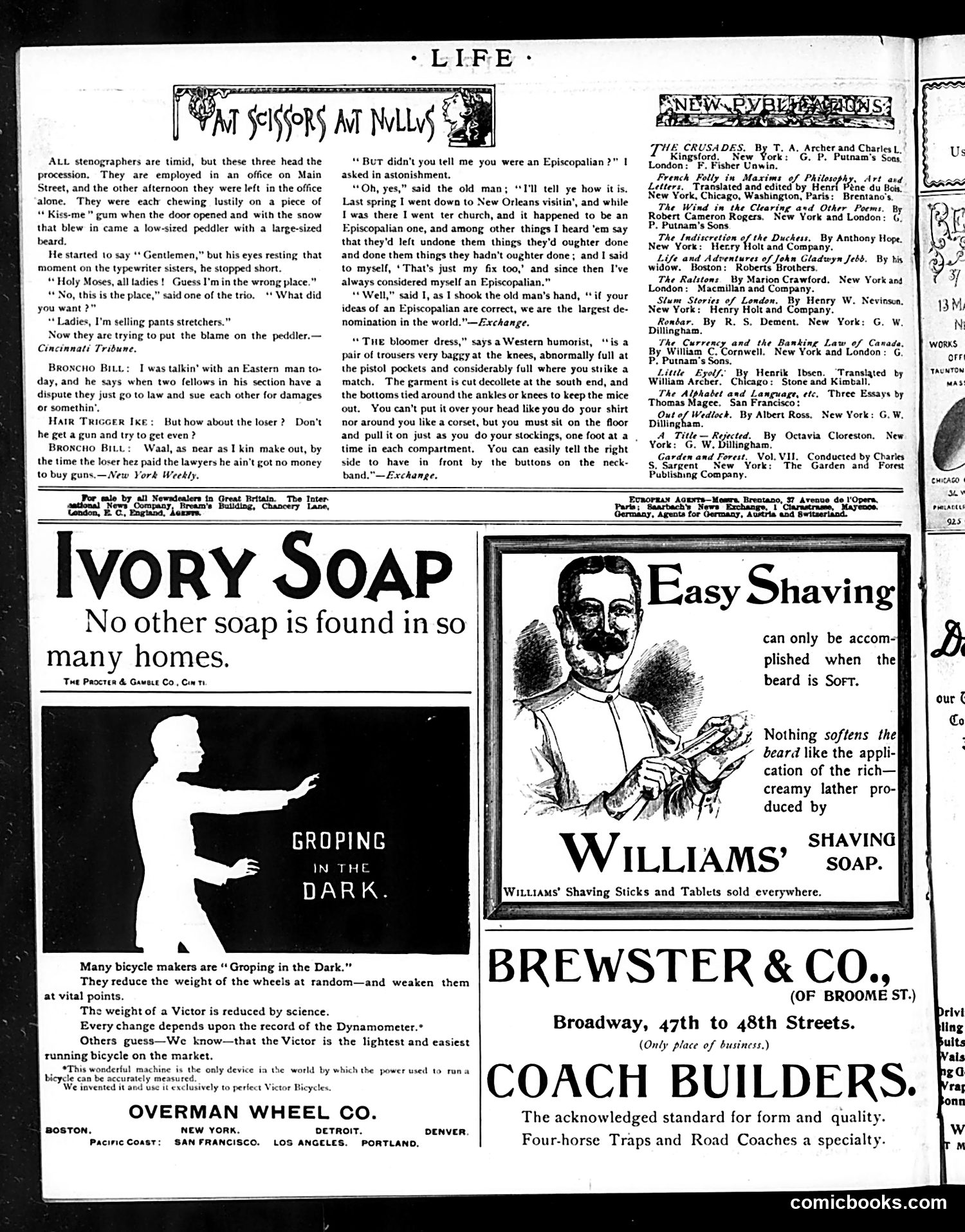
This page contains several humorous anecdotes and advertisements typical of 1890s American Life magazine. The main cartoon concerns three female stenographers alone in an office when a bearded peddler enters selling "pants stretchers." The women are embarrassed—the joke relies on the double meaning and impropriety of the situation. The punchline suggests the women unfairly blame the peddler for the awkwardness, reflecting period attitudes about propriety and gender dynamics in workplaces. Other brief jokes mock legal disputes (comparing lawsuits to actual gunfights), religious hypocrisy (a man adopting Episcopalianism after hearing a confession of sins resonated with him), and the new "bloomer dress" fashion—described humorously as awkward and impractical. The advertisements promote Ivory Soap, Williams' Shaving Soap, and coach builders—typical commercial interests of the era. The page reflects Victorian sensibilities about propriety, emerging women's roles, and consumer products.
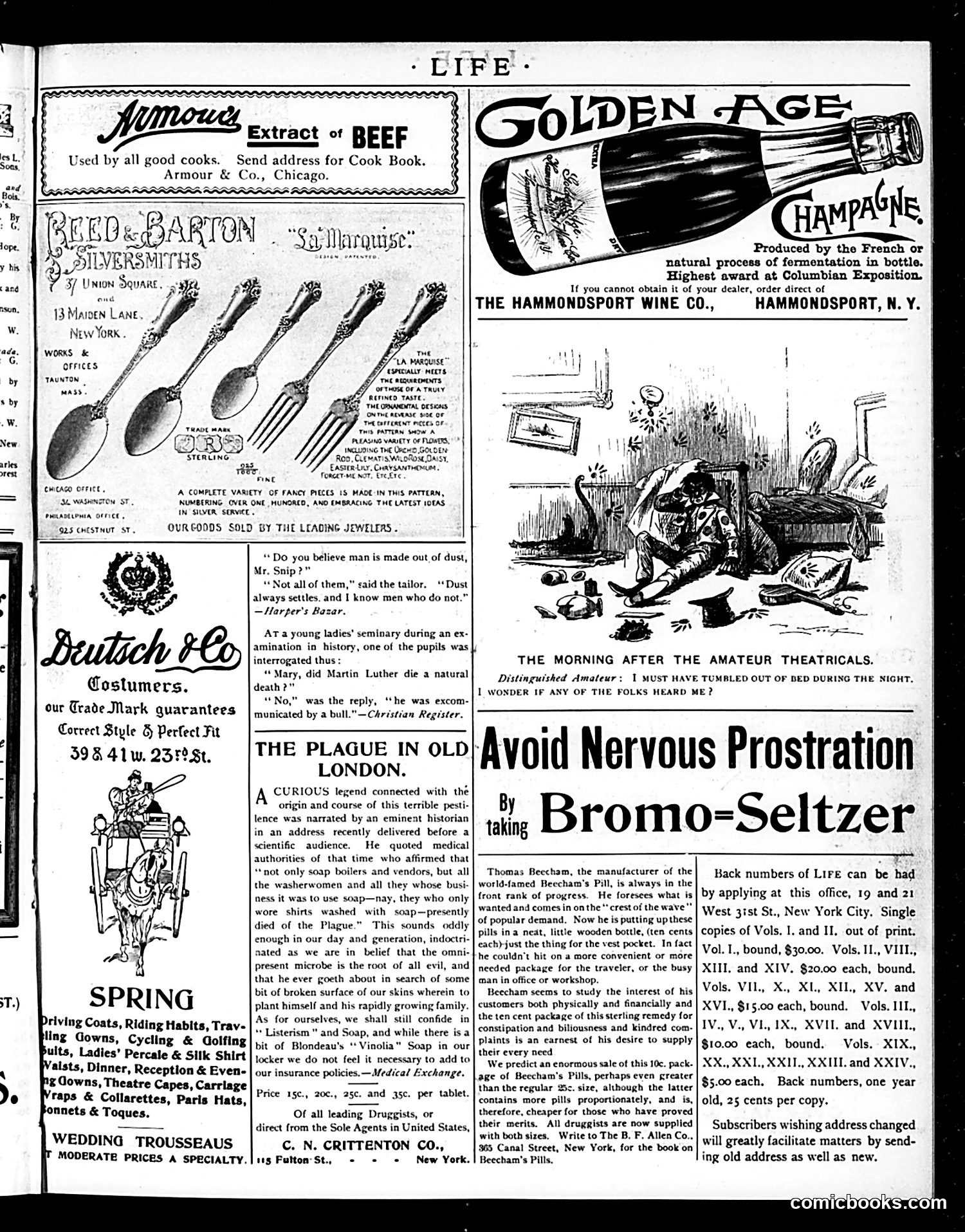
This page is primarily **advertisements and light humor**, typical of Life magazine's early format. The main cartoon depicts "The Morning After the Amateur Theatricals"—a hungover man who has apparently fallen out of bed during the night and wonders if anyone heard the noise. The humor is genteel domestic comedy: a gentleman's embarrassment at potentially being heard in an undignified state. The page includes period advertisements for luxury goods (silverware, champagne, theatrical costumes, women's clothing) and patent medicines. One notable ad promotes **Bromo-Seltzer** as a cure for "Nervous Prostration"—reflecting the era's tendency to market remedies for vague ailments, particularly nervous conditions (a common diagnosis for various complaints). The small jokes at bottom ("Do you believe man is made out of dust?") exemplify Life's style of gentle, family-friendly humor rather than sharp political satire. This appears to be an entertainment and lifestyle page rather than substantive social commentary.
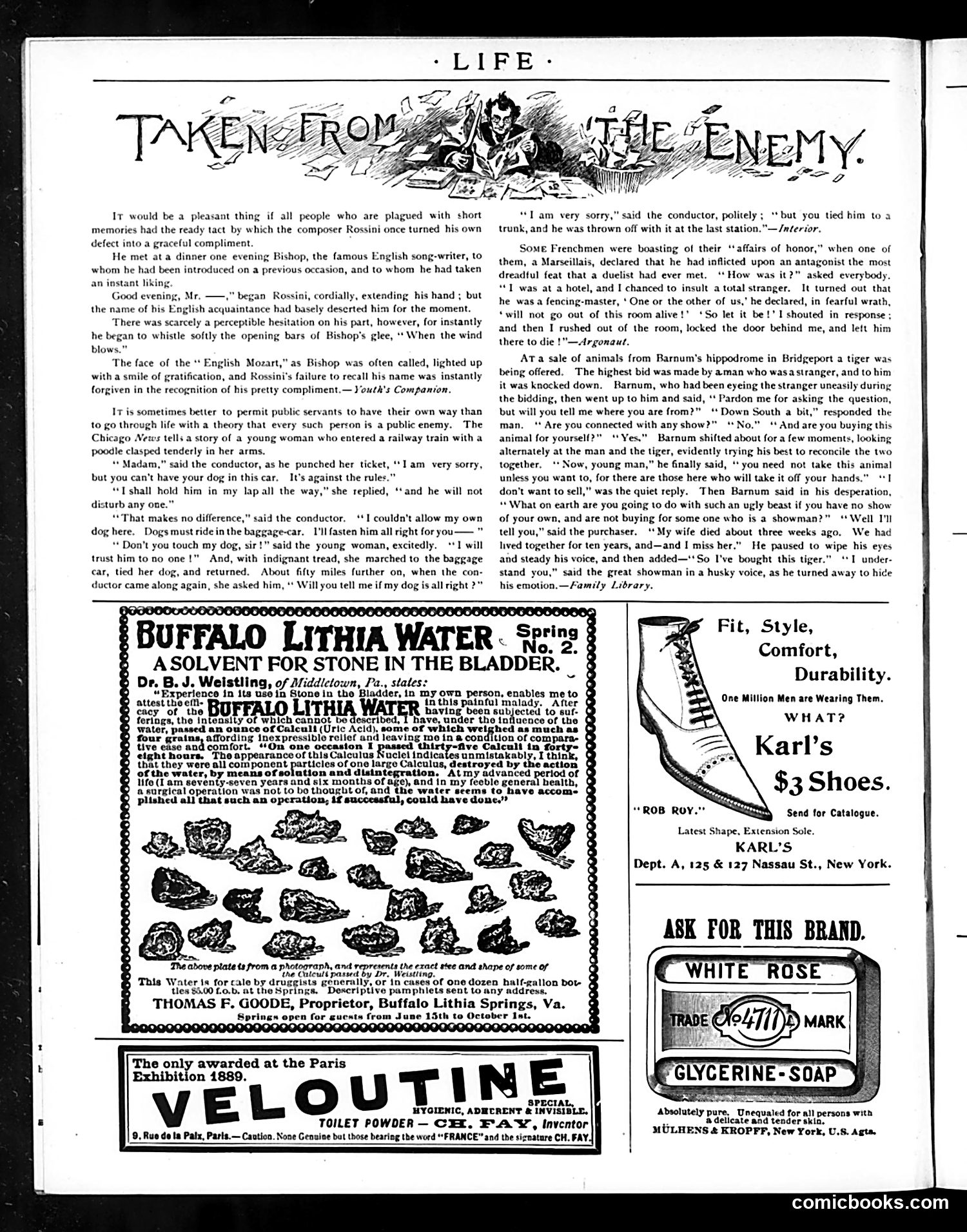
This page contains **three humorous anecdotes** rather than political cartoons, reflecting Life's satirical approach through narrative rather than visual art. The stories illustrate social awkwardness and irony: 1. **Rossini's graceful memory lapse**: The famous composer avoids embarrassment by whistling a melody to identify someone whose name he's forgotten—a witty compliment disguised as forgetfulness. 2. **The railroad conductor and the dog**: A woman insists on keeping her poodle with her despite rules, then abandons it in the baggage car. The conductor's ironic revenge: the dog gets thrown off the train at a station—she violated the rules but loses the dog anyway. 3. **The tiger buyer at Barnum's**: A stranger purchases a fierce tiger, puzzling showman P.T. Barnum, who cannot imagine why an ordinary civilian would want such a dangerous animal. Barnum repeatedly tries to convince him to refuse the purchase. The page's humor relies on **situational irony and social commentary**—illustrating human stubbornness, pride, and miscalculation. The advertisements below are period-appropriate patent medicines and consumer goods.
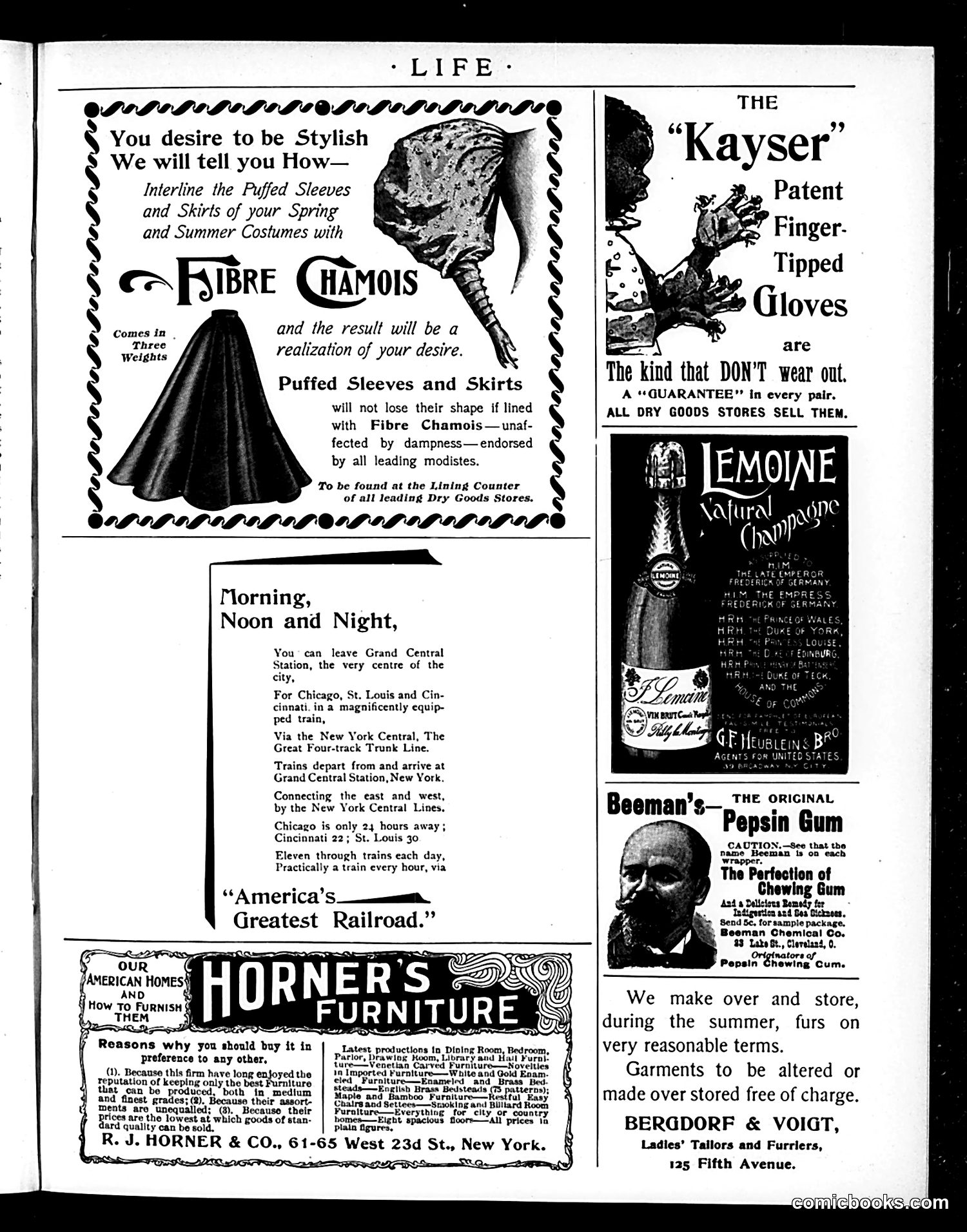
This page is primarily **advertisements** for consumer goods and services, typical of early 20th-century magazines. There are no political cartoons or satire present. The ads reflect the fashion and lifestyle concerns of affluent urban readers: - **Fibre Chamois** promotes a fabric lining for the popular "puffed sleeves" silhouette of the era, ensuring garments maintain their shape - **New York Central Railroad** advertises its dominance as "America's Greatest Railroad," emphasizing frequent service to major cities - **Horner's Furniture** lists reasons to buy from their established firm, appealing to quality-conscious consumers - **Kayser Gloves**, **Lemoine Champagne**, **Beeman's Pepsin Gum**, and **Bergdorf & Voigt** (furriers/tailors) target wealthy clientele The page reveals period consumer values: fashion sophistication, railroad travel convenience, quality furnishings, and luxury goods. There is no satirical content to interpret—this is straightforward commercial messaging.
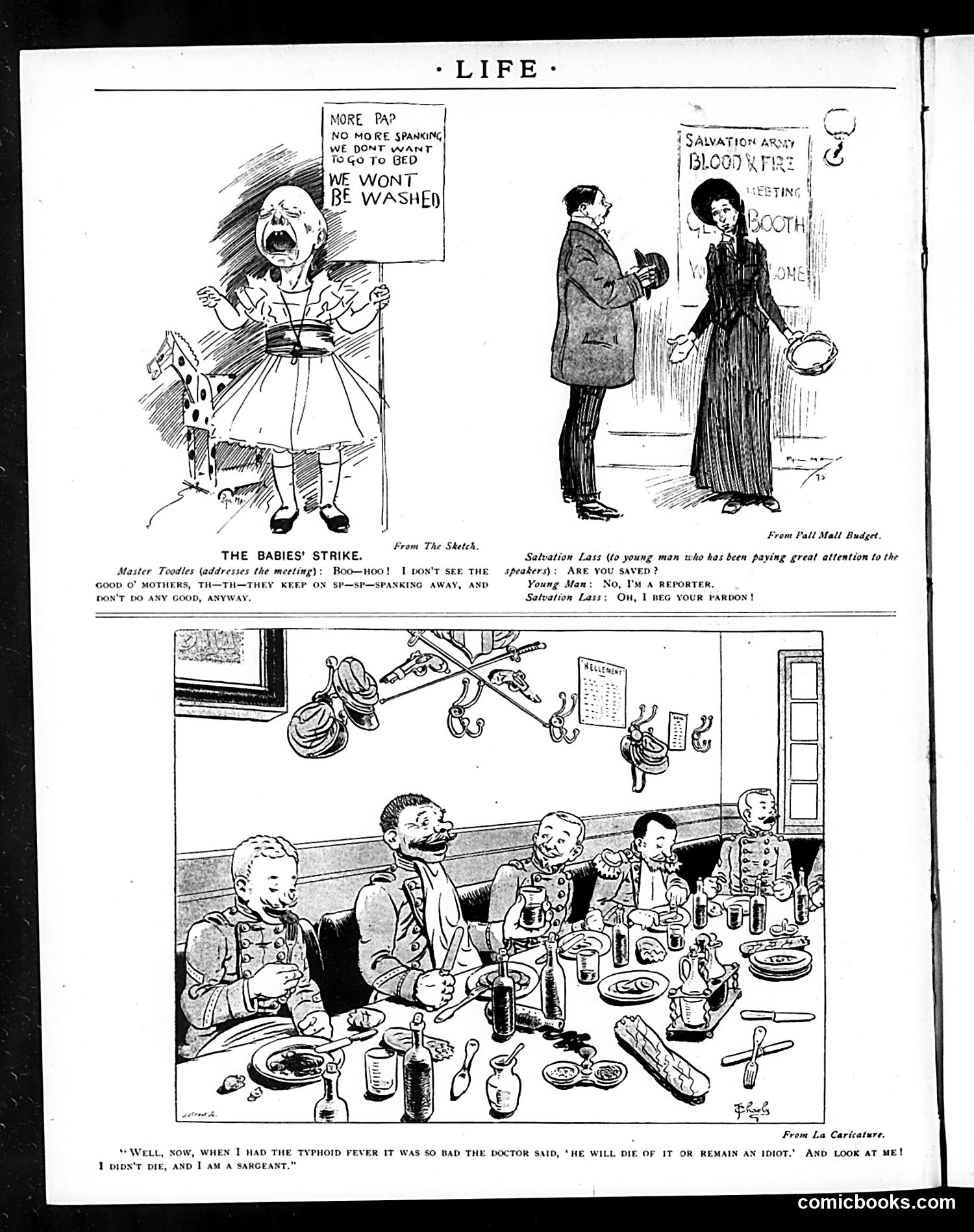
This page contains three satirical cartoons mocking social issues of the era: **"The Babies' Strike"** (top left): Infants protest ineffective parenting, with a baby addressing a meeting complaining mothers spank without achieving discipline—satirizing contemporary debates about child-rearing methods and parental authority. **Salvation Army Scene** (top right): A young man tells a Salvation Army worker he's a *reporter*, not a spiritual convert—mocking both the Salvation Army's aggressive evangelism and press sensationalism around religious organizations. **Bottom cartoon** (from *La Caricature*): A sergeant boasts that typhoid fever nearly killed him or left him an idiot, yet he survived—dark satire on military stoicism and the absurdity of taking pride in surviving near-fatal illness, possibly commenting on wartime casualties and masculine bravado. All three use exaggerated caricature and humor to critique social institutions: family discipline, religious zealotry, and military culture.