
Life, 1895-04-25 · page 4 of 18
Life — April 25, 1895 — page 4: what you’re looking at
What you’re looking at
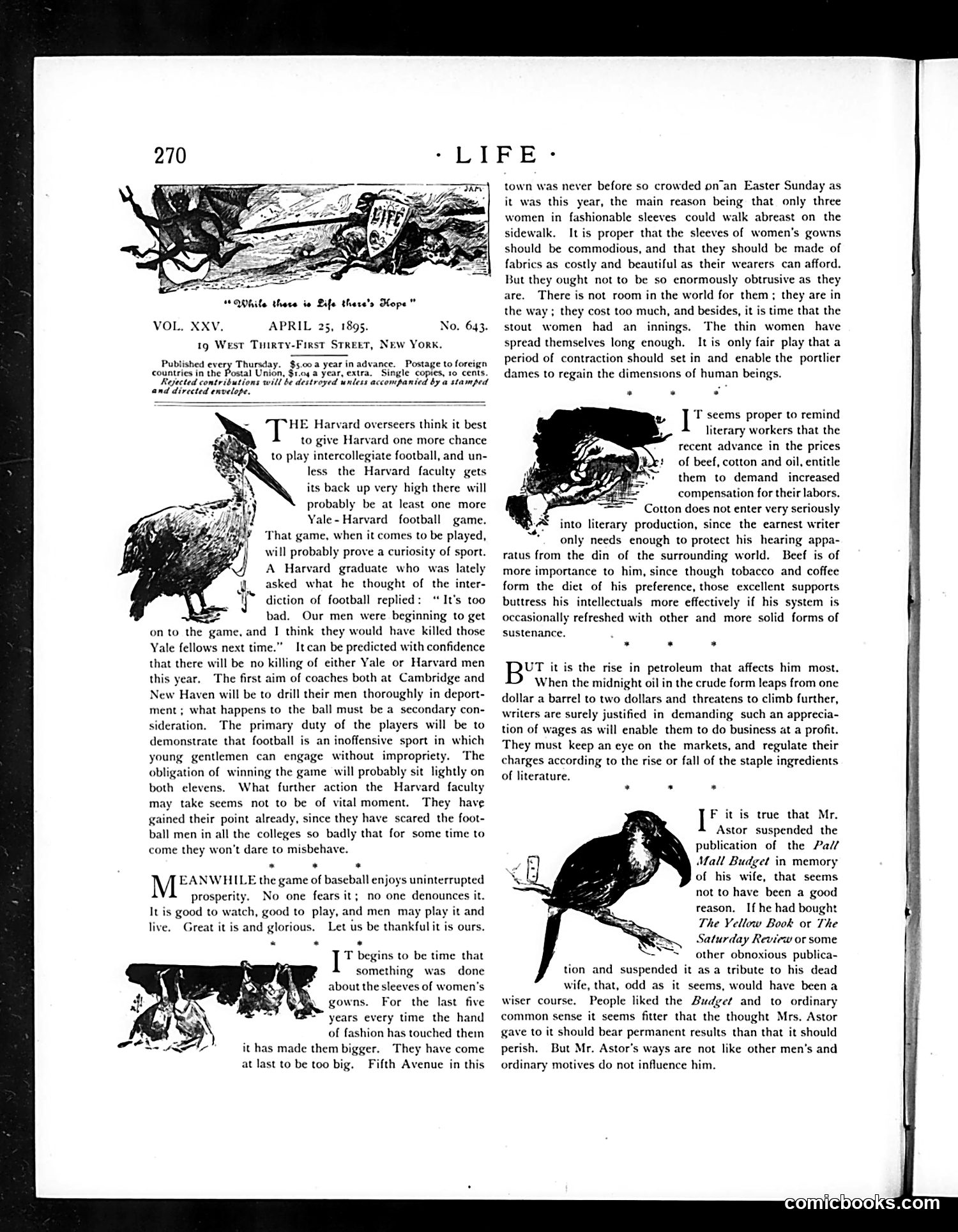
This page contains **social commentary on women's fashion** rather than political cartoons. The illustrations satirize the excessively large sleeves fashionable on women's gowns in the 1890s. The text criticizes how these voluminous sleeves obstruct public spaces—they're so wide women cannot walk side-by-side on sidewalks during Easter promenade crowds. The author argues the sleeves are wastefully expensive and impractical, using up fabric that should go to less affluent women. The accompanying woodcut illustrations (a pelican, birds, and cattle) appear decorative rather than satirical. The page also discusses **Harvard football** and **literary workers' wages** responding to rising commodity prices, but these are separate editorial pieces without illustrations.
📄 Transcribed text from this page (OCR, searchable)
Machine-transcribed from the original scan — historical spelling and the odd misread are preserved.
- LIFE: “OMhile there ie Life t XV. APRIL 25, 1895. 1g West Tuirty-First STREET, NEW York. Published every Thursday. $5.00 year in advance. Postage to foreign countries in the Postal Union, $1.04 a year, extra. Single copies, 10 cents. Rejected contributions will be destroyed unless accompanied by a stamped and directed envelope. HE Harvard overseers think it best to give Harvard one more chance to play intercollegiate football, and un- less the Harvard faculty gets its back up very high there will probably be at least one more Yale-Harvard football game. That game, when it comes to be played, will probably prove a curiosity of sport. A Harvard graduate who was lately asked what he thought of the inter- diction of football replied: “It's too bad. Our men were beginning to get on to the game, and I think they would have killed those Yale fellows next time.” It can be predicted with confidence that there will be no killing of either Yale or Harvard men this year. The first aim of coaches both at Cambridge and New Haven will be to drill their men thoroughly in deport- ment ; what happens to the ball must be a secondary con- sideration. The primary duty of the players will be to demonstrate that football is an inoffens sport in which young gentlemen can engage without impropriety. The obligation of winning the game will probably sit lightly on both elevens. What further action the Harvard faculty may take seems not to be of vital moment. They have gained their point already, since they have scared the foot- ball men in all the colleges so badly that for some time to come they won't dare to misbehave. - . . EANWHILE the game of baseball enjoys uninterrupted prosperity. No one fears it; no one denounces it. It is good to watch, good to play, and men may play it and Great it is and glorious. Let us be thankful it is ours. live. . T begins to be time that something was done about the sleeves of women’s gowns. For the last five years every time the hand of fashion has touched them it has made them bigger. They have come at last to be too big. Fifth Avenue in this Ce town was never before so crowded pn’an Easter Sunday as it was this year, the main reason being that only three women in fashionable sleeves could walk abreast on the sidewalk. It is proper that the sleeves of women’s gowns should be commodious, and that they should be made of fabrics as costly and beautiful as their wearers can afford. But they ought not to be so enormously obtrusive as they are. There is not room in the world for them ; they are in the way ; they cost too much, and besides, it is time that the stout women had an innings. The thin women have spread themselves long enough. It is only fair play that a period of contraction should set in and enable the portlier dames to regain the dimensions of human beings. " I" seems proper to remind literary workers that the recent advance in the prices of beef, cotton and oil, entitle them to demand increased compensation for their labors, Cotton does not enter very seriously Fe into literary production, since the earnest writer only needs enough to protect his hearing appa- ratus from the din of the surrounding world. Beef is of more importance to him, since though tobacco and coffee form the dict of his preference, those excellent supports buttress his intellectuals more effectively if his system is occasionally refreshed with other and more solid forms of sustenance. * * * Bu it is the rise in petroleum that affects him most. When the midnight oil in the crude form leaps from one dollar a barrel to two dollars and threatens to climb further, writers are surely justified in demanding such an apprecia- tion of wages as will enable them to do business at a profit. They must keep an eye on the markets, and regulate their charges according to the rise or fall of the staple ingredients of literature. F it is true that Mr. Astor suspended the publication of the Pal/ Mall Budget in memory of his wife, that seems not to have been a good treason. If he had bought The Yellow Book or The Saturday Review or some other obnoxious publica- tion and suspended it as a tribute to his dead wife, that, odd as it seems, would have been a wiser course. People liked the Budget and to ordinary common sense it seems fitter that the thought Mrs. Astor gave to it should bear permanent results than that it should perish. But Mr. Astor's ways are not like other men’s and ordinary motives do not influence him. a Ts