
A complete issue · 14 pages · 1894
Life — March 29, 1894
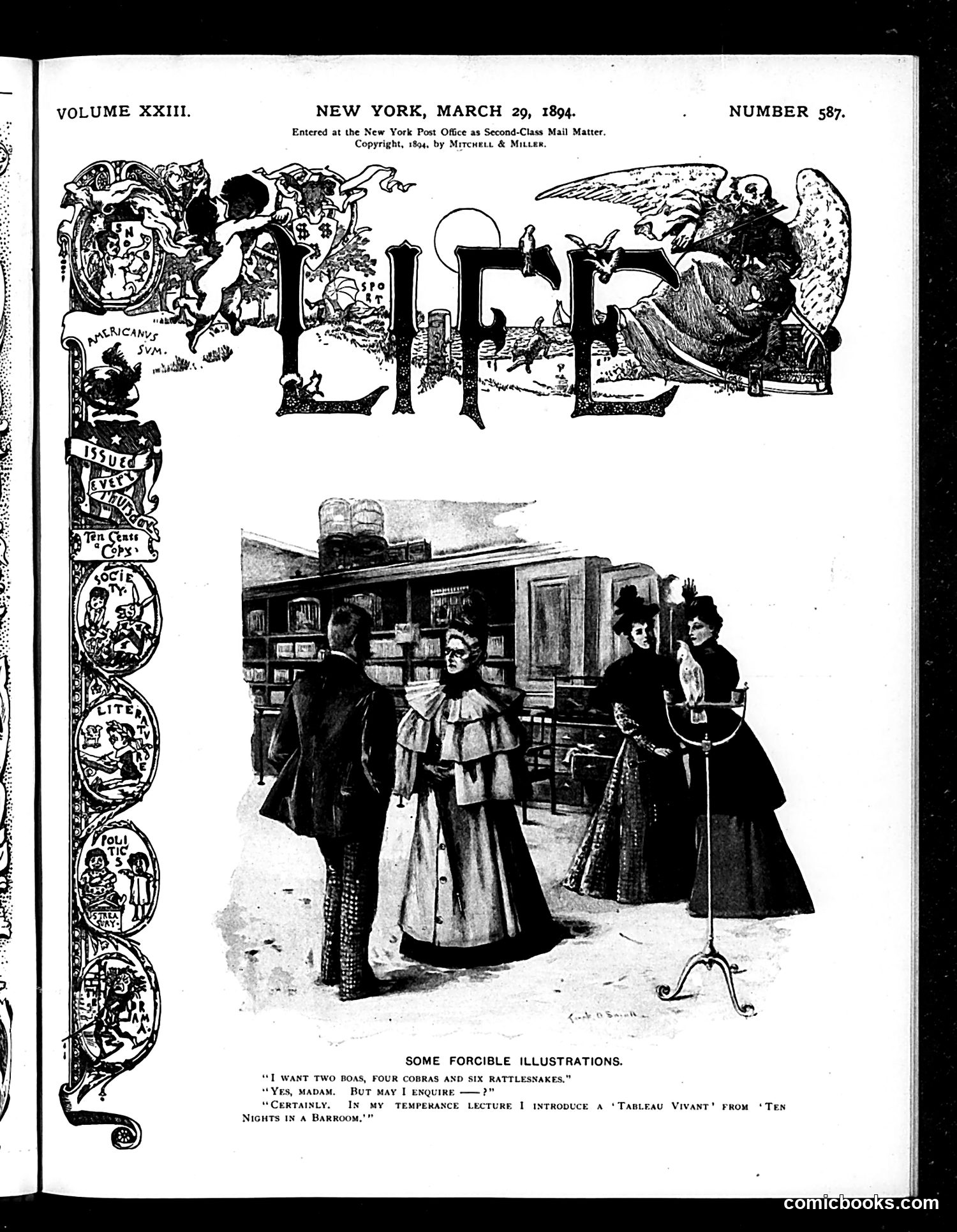
The main illustration titled "Some Forcible Illustrations" depicts a humorous scene at what appears to be a shop or business counter. Four well-dressed Victorian women are interacting with a shopkeeper, with the caption quoting a customer's demand: "I want two boas, four cobras and six rattlesnakes" followed by "Yes, madam. But may I inquire—?" and the response "Certainly. In my temperance lecture I introduce a 'tableau vivant' from 'Ten Nights in a Barroom.'" The satire appears to target temperance movement activists and lecturers of the era—likely mocking how they staged dramatic, sensational theatrical presentations (tableaux vivants were living picture performances) to illustrate moral lessons about alcohol's dangers. The absurdity of requesting actual dangerous snakes for such a lecture suggests ridicule of the movement's theatrical excess and sensationalism.
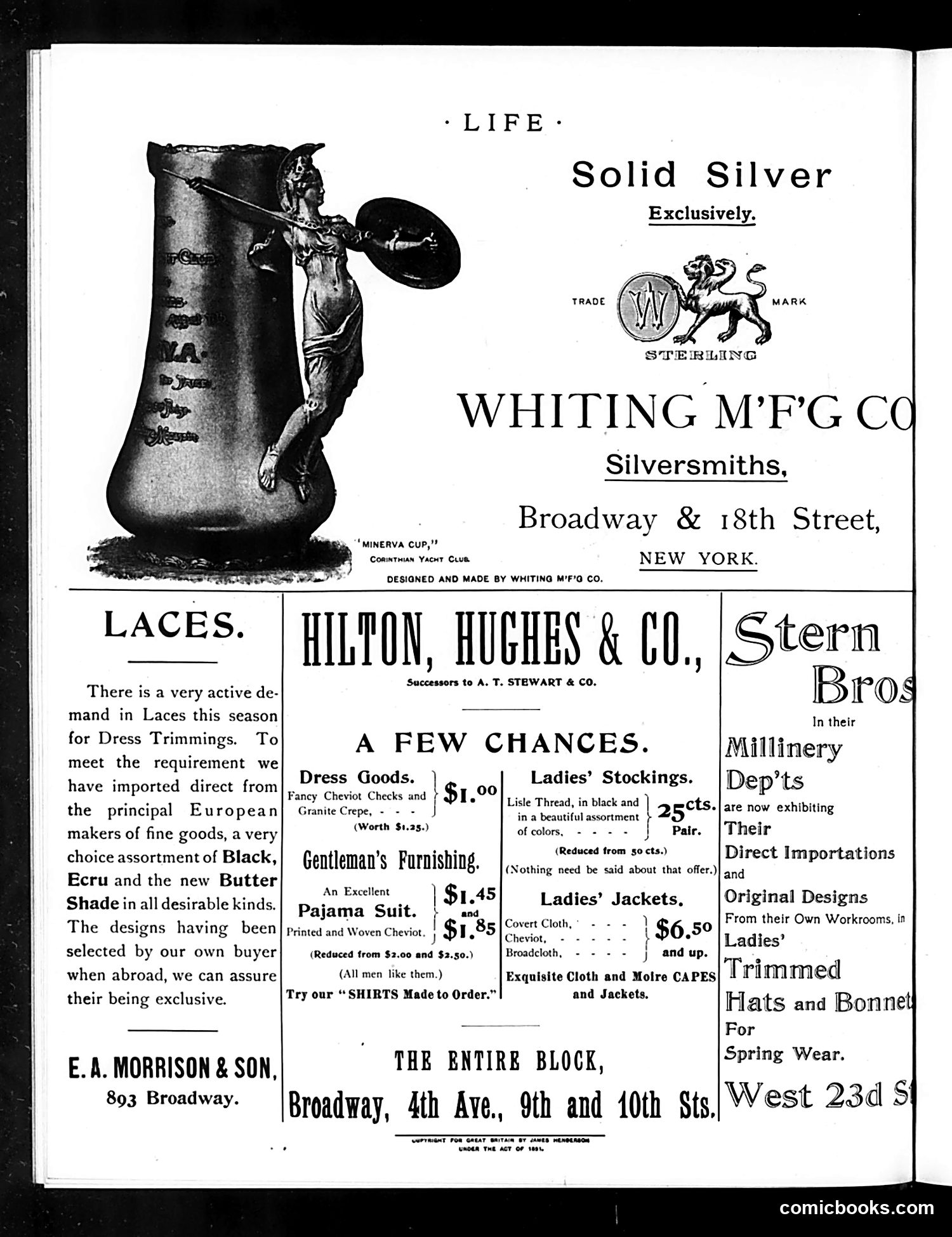
This page is primarily **advertising**, not satirical content. It contains commercial notices from late 19th/early 20th-century New York businesses: The top features **Whiting Mfg Co.**, silversmiths advertising solid silver items (showing the "Minerva Cup" from the Corinthian Yacht Club). Below are ads for: - **E.A. Morrison & Son** (laces and dress trimmings) - **Hilton, Hughes & Co.** (dress goods, stockings, pajama suits, ladies' jackets) - **Stern Bros** (millinery and imported hats) The advertisements emphasize imported European goods, reduced prices, and fashionable items for women—typical of a magazine aimed at affluent urban readers. There is **no political satire** present on this page; it serves purely as a revenue-generating commercial section common in period publications.
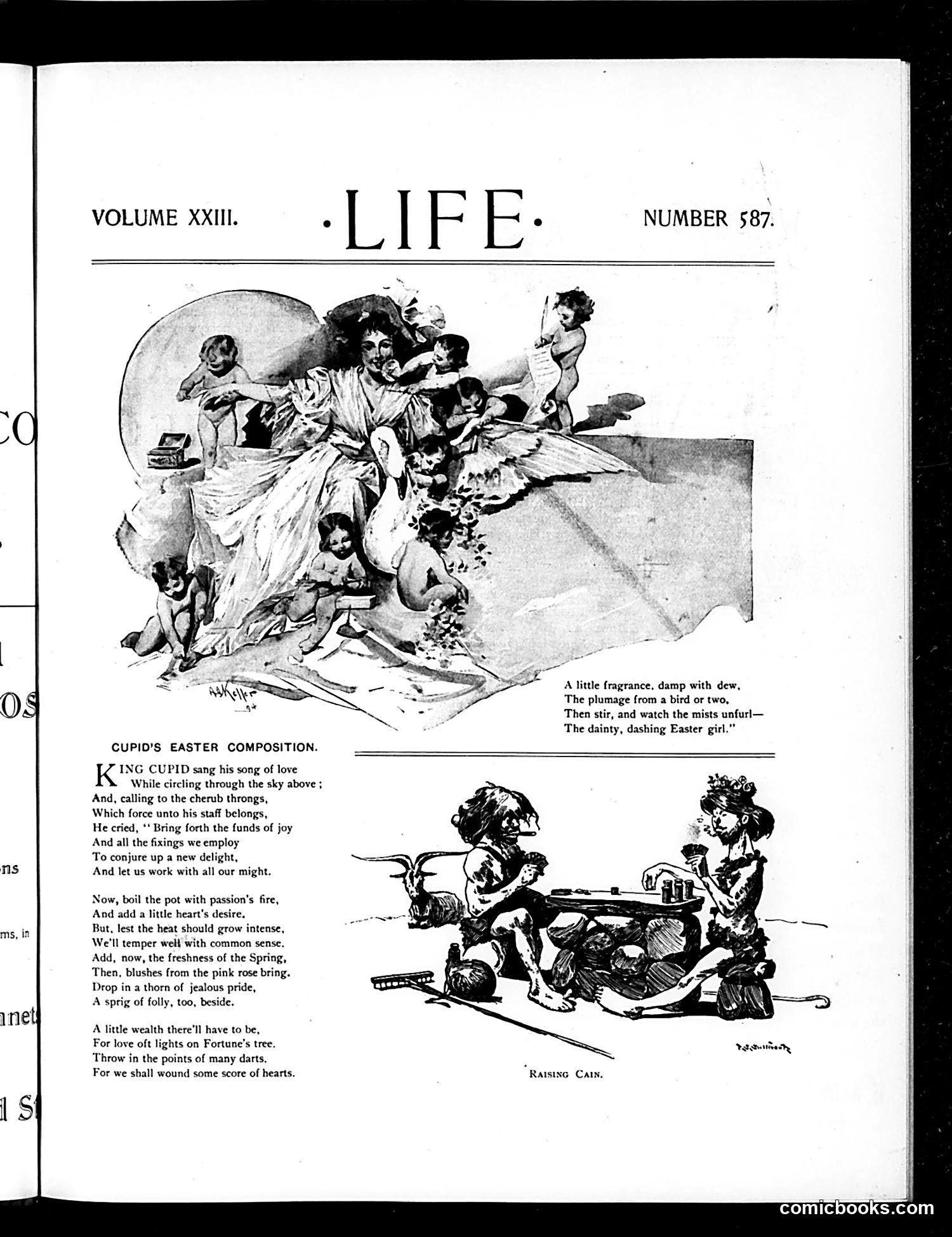
This Easter-themed page features two allegorical illustrations celebrating spring and love. "Cupid's Easter Composition" (top) depicts Cupid directing cherubs in creating spring flowers and romance—a traditional Victorian conceit pairing love with seasonal renewal. The accompanying poem invokes Cupid orchestrating passion's "new delight." "Raising Cain" (bottom) shows cherubs engaged in mischievous play, likely a visual pun on the phrase "raising Cain" (causing trouble). The cherubs appear to be playing with weapons or implements of chaos. Both illustrations employ classical allegorical imagery common to Life's satirical style. Rather than targeting specific political figures or events, this page presents sentimental holiday imagery typical of early 20th-century American magazine aesthetics, mixing classical mythology with contemporary sentimentality.
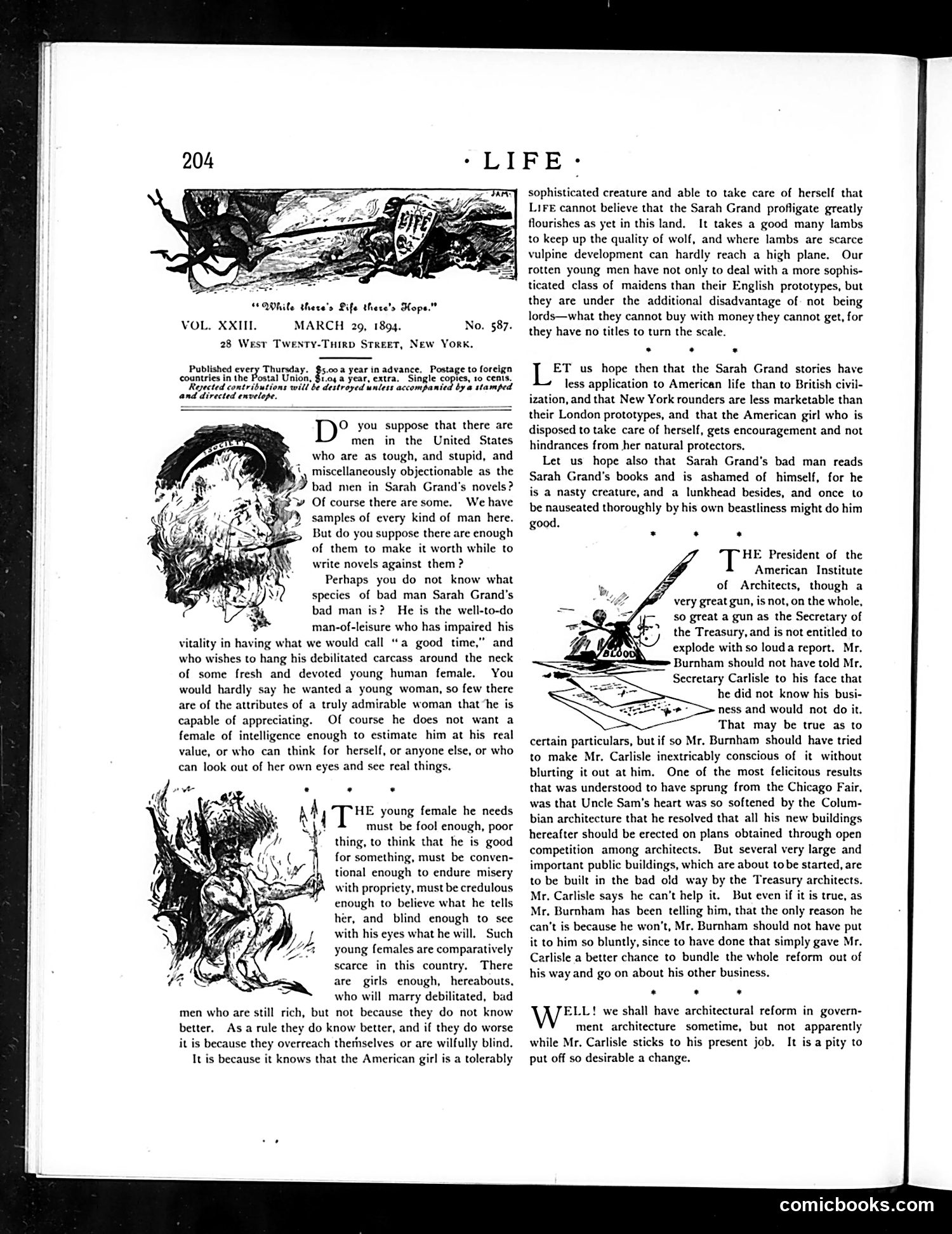
This page critiques American gender dynamics and literary criticism of the era. The text attacks Sarah Grand's novels, which depicted "bad men" in unflattering ways, arguing she exaggerates character flaws. The accompanying grotesque caricatures illustrate these supposedly exaggerated "bad men" types. The piece defends American men against Grand's portrayal, claiming American girls are too intelligent to be deceived by such characterizations. There's also commentary on architectural reform in government, criticizing Secretary Carlisle over Treasury building contracts awarded through competitive bidding. The satire targets both Grand's literary credibility and contemporary architectural/political corruption, using exaggerated illustrations to mock both the subjects being criticized and the cultural anxieties they represent about American society.
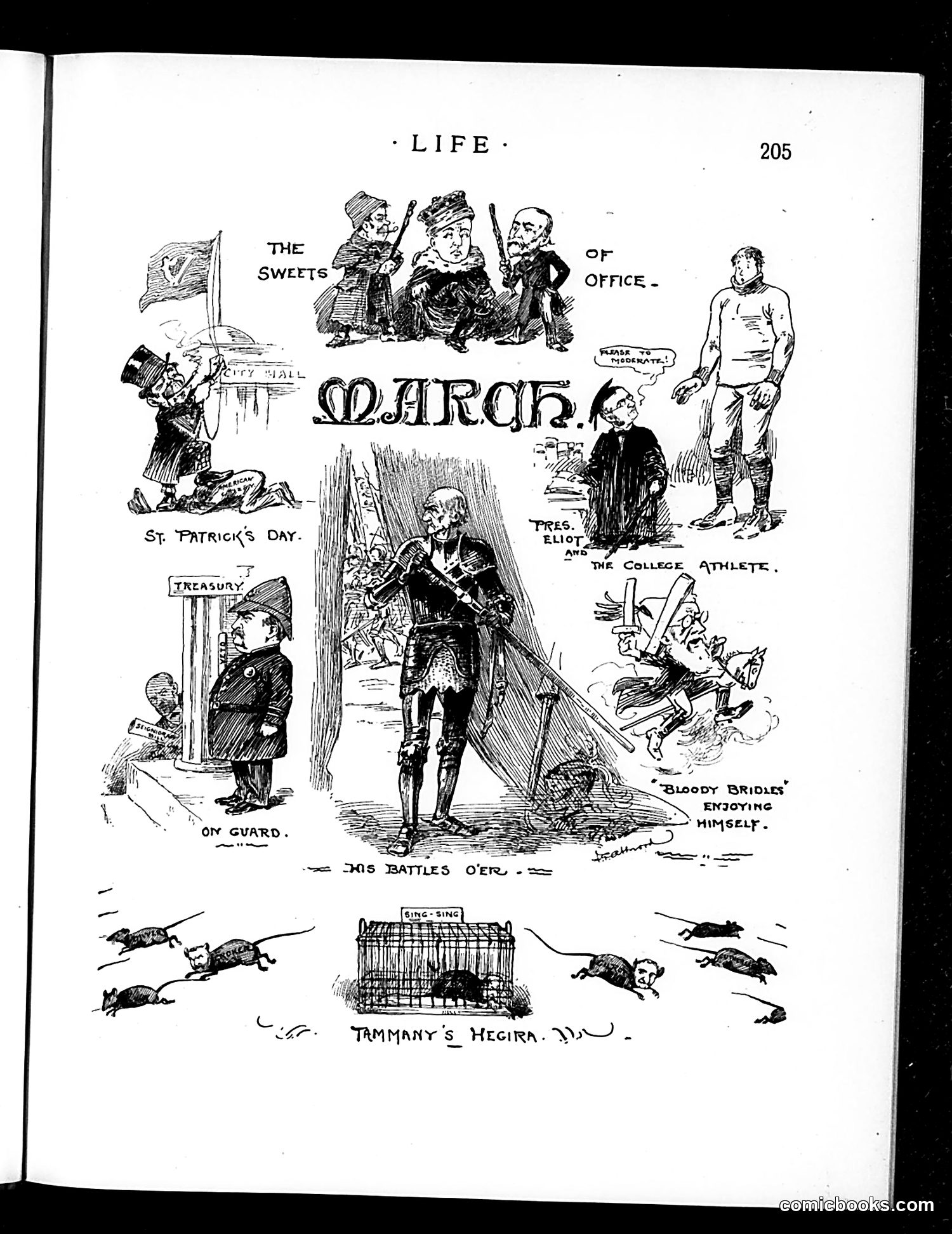
This political satire depicts various Irish and British figures enjoying or suffering from government positions during March (likely St. Patrick's Day season). The central military figure represents someone "His Battles O'er" — possibly a retired military leader or politician. The surrounding vignettes mock different aspects of office-holding: "St. Patrick's Day" shows festive chaos; "On Guard" depicts Treasury duties; "The Sweets of Office" (title) ironically presents difficulties like "Tammany's Hegira" (bottom), referencing Tammany Hall political machine scandals. "Bloody Bridles Enjoying Himself" and references to "College Athlete" suggest satirizing both military pretension and amateur politicians. The overall joke: holding office brings more trouble than reward.
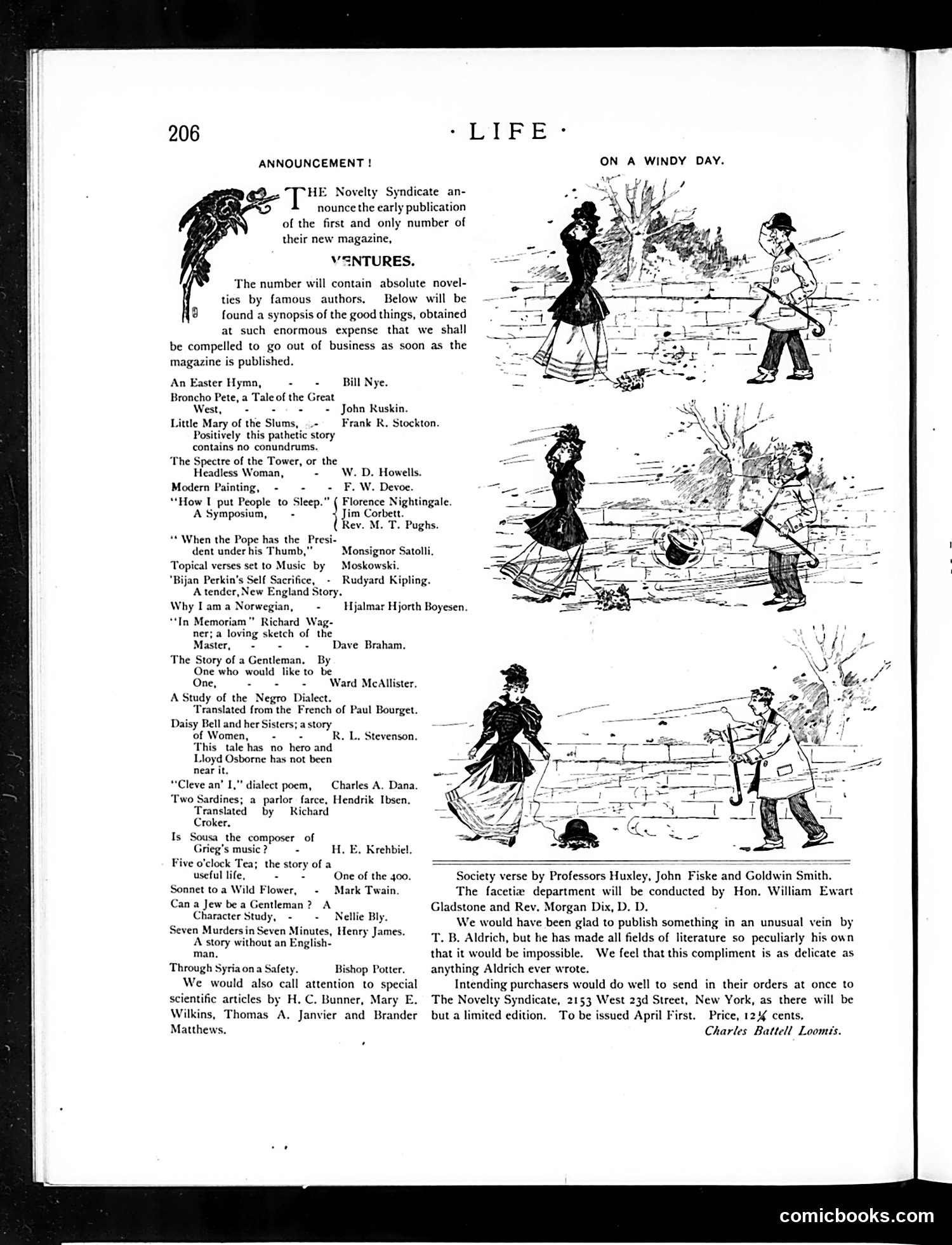
This page contains a series of comic illustrations depicting children's mishaps during windy weather. The sketches show various scenarios: a girl's hat or clothing being blown away, children struggling against wind, and what appears to be papers or items scattering. The left column is primarily an **announcement** for "Ventures," a new magazine from the Novelty Syndicate featuring fiction by prominent authors (Bill Nye, John Ruskin, Frank K. Stockton, and others). It's a straightforward publishing advertisement rather than political satire. The right side consists of humorous, non-political cartoon vignettes capturing relatable childhood experiences with weather—typical of Life magazine's lighter entertainment content from this era.
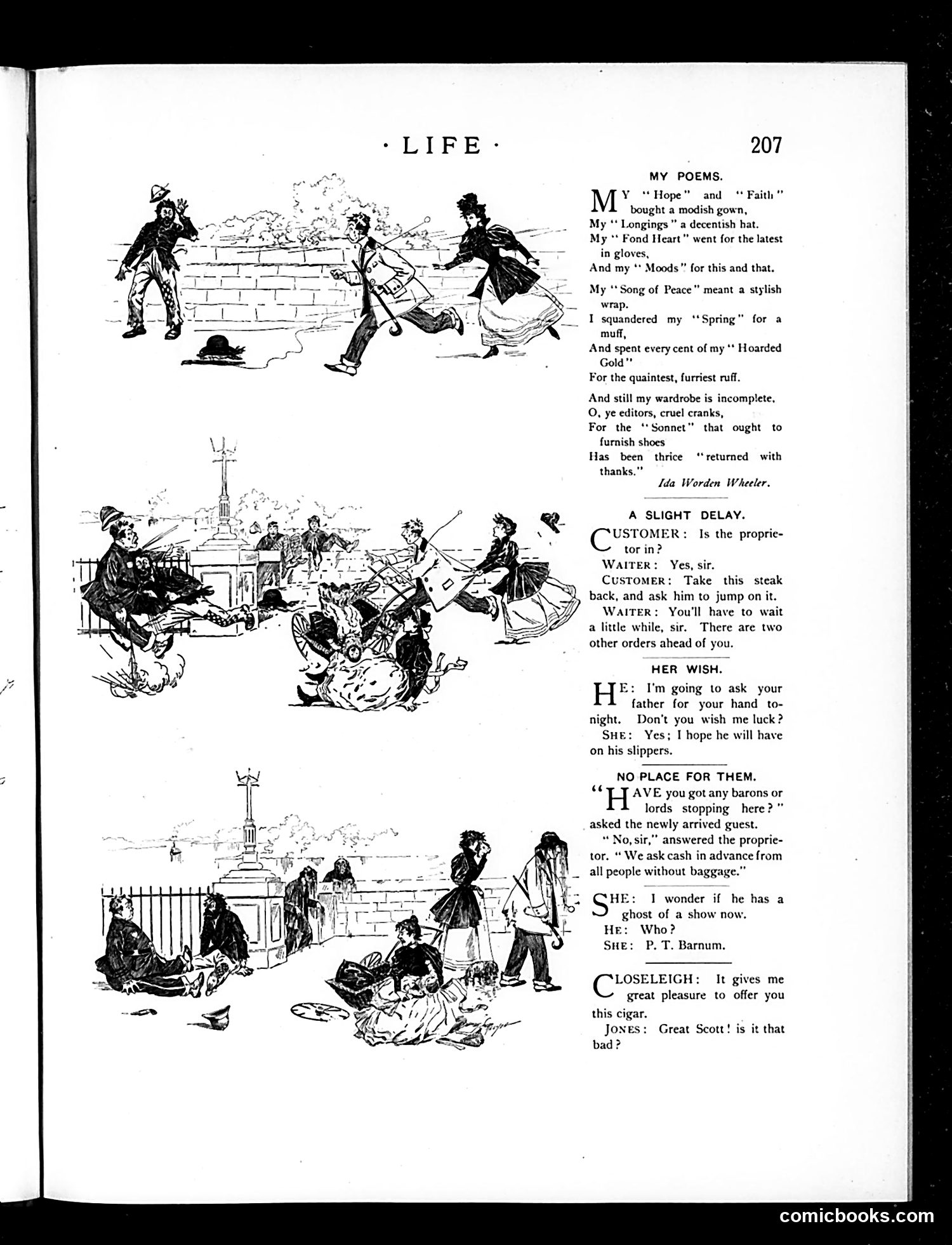
This page combines humorous short sketches with illustration. The cartoons depict everyday social situations: 1. **"A Slight Delay"** shows a restaurant scene where a waiter explains to an impatient customer that the proprietor is unavailable and other orders are ahead—a relatable complaint about slow service. 2. **"Her Wish"** depicts a romantic scenario where a woman hopes her suitor will ask her father for her hand in marriage and jokes about hoping "he will have on his slippers." 3. **"No Place for Them"** shows a hotel proprietor refusing wealthy guests ("barons or lords") without baggage, implying vagrancy concerns. 4. **"Closeleigh"** presents a brief exchange about offering a cigar. The humor targets middle-class anxieties about manners, courtship, class status, and social propriety typical of early 20th-century America.
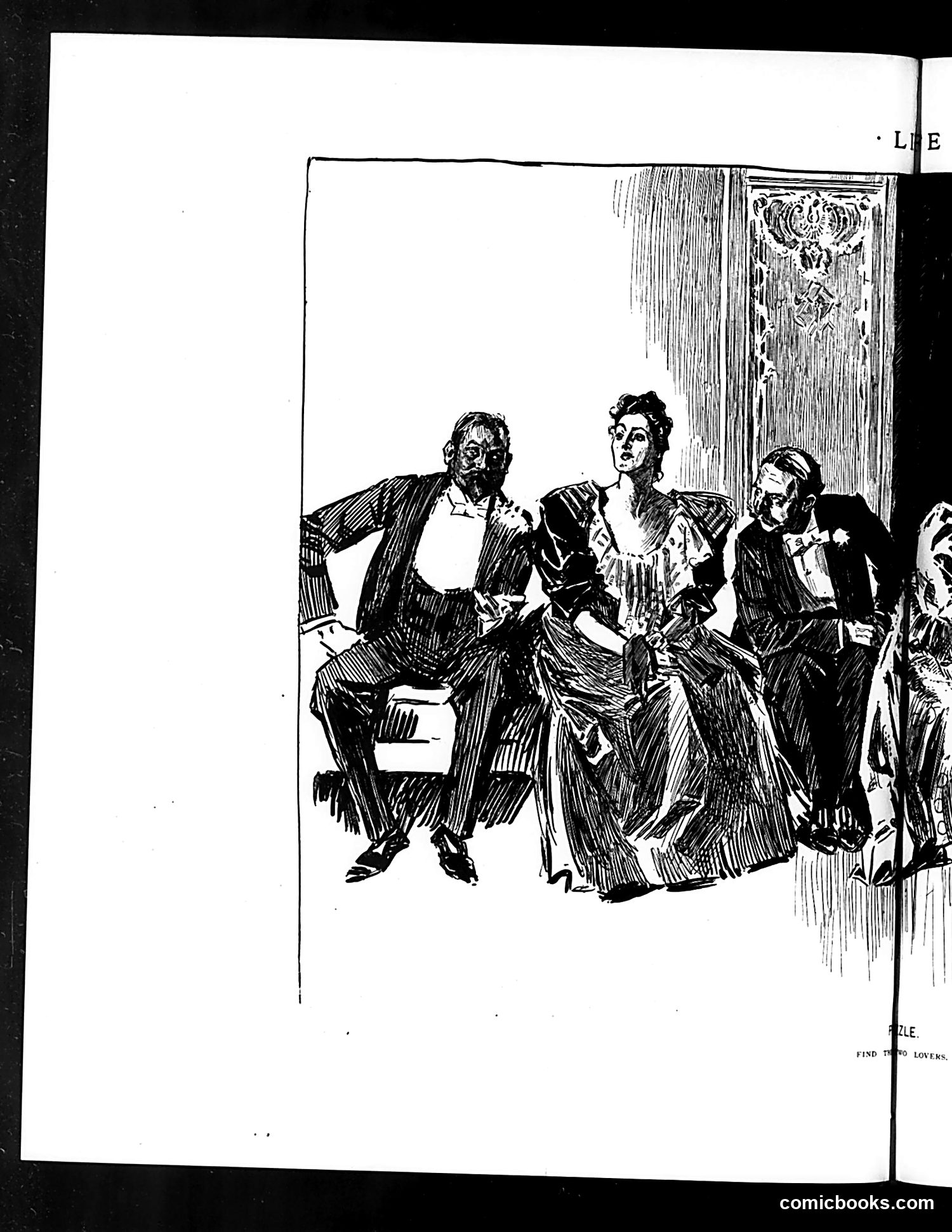
This page contains a black-and-white sketch showing what appears to be a social scene from the late 19th or early 20th century. The illustration depicts several figures in formal dress gathered indoors—a man in a suit seated prominently on the left, a woman in an elaborate dress in the center, and other figures nearby. There's a decorative door or panel visible in the background. The OCR text is largely illegible, showing only fragments ("PUZZLE," "FIND THE LOVERS"). Without clearer text or caption context, I cannot definitively identify the specific figures being caricatured or explain the satirical point. The scene suggests a comedy of manners or social commentary typical of *Life* magazine's humor, but the exact political or social references remain unclear from what's visible here.
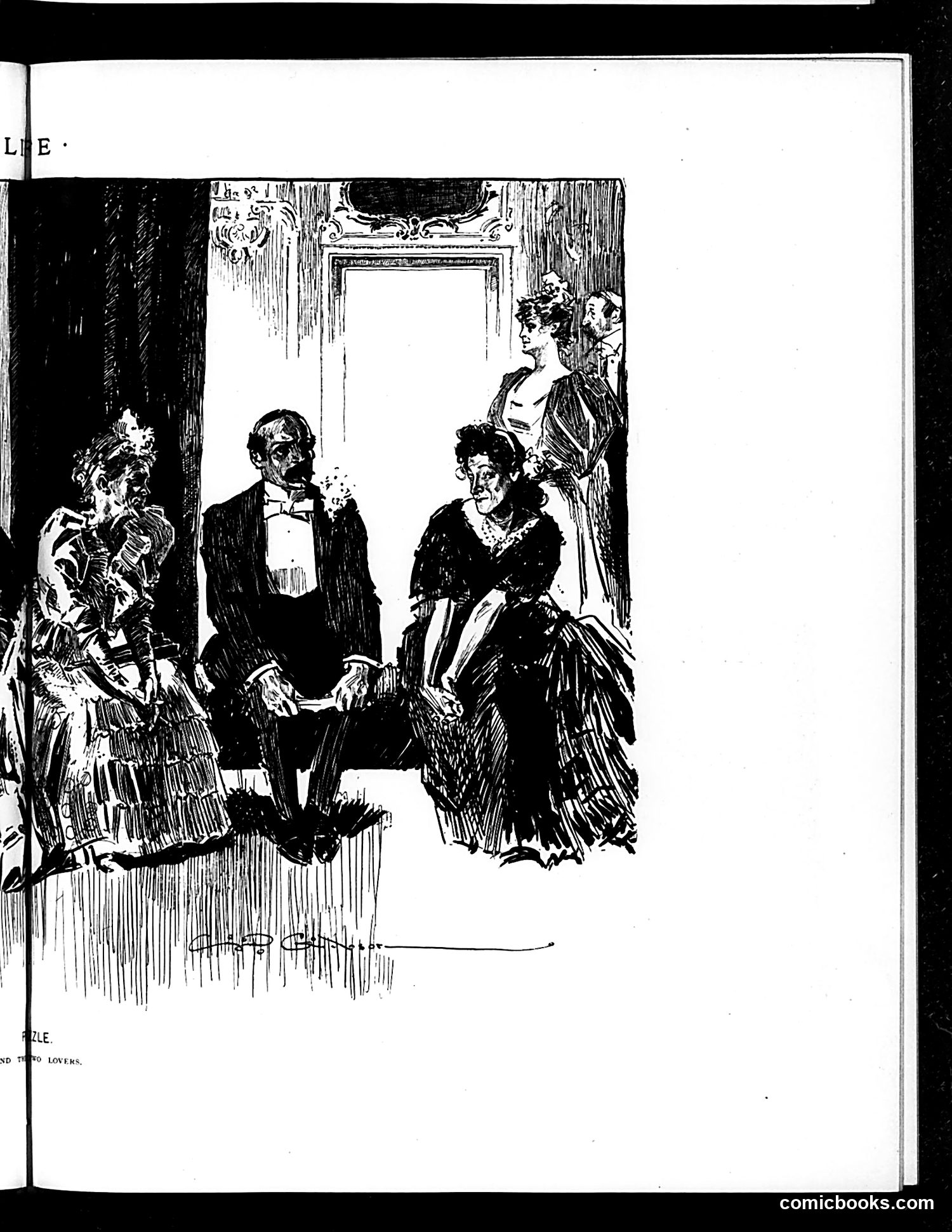
This appears to be a satirical illustration from Life magazine depicting a social scene in an elegant interior. The image shows five figures in formal attire engaged in conversation—a woman on the left in an ornate dress, a man in evening wear seated centrally, another woman in dark clothing, and two additional figures in the background near a doorway. The satirical point is unclear from the image alone, as the OCR text is incomplete and illegible. Without visible captions, dialogue balloons, or complete text identifying the figures or their social commentary, I cannot determine what specific political or social issue this cartoon addresses. It appears to be social satire involving upper-class or aristocratic figures, but the specific target and meaning remain uncertain.
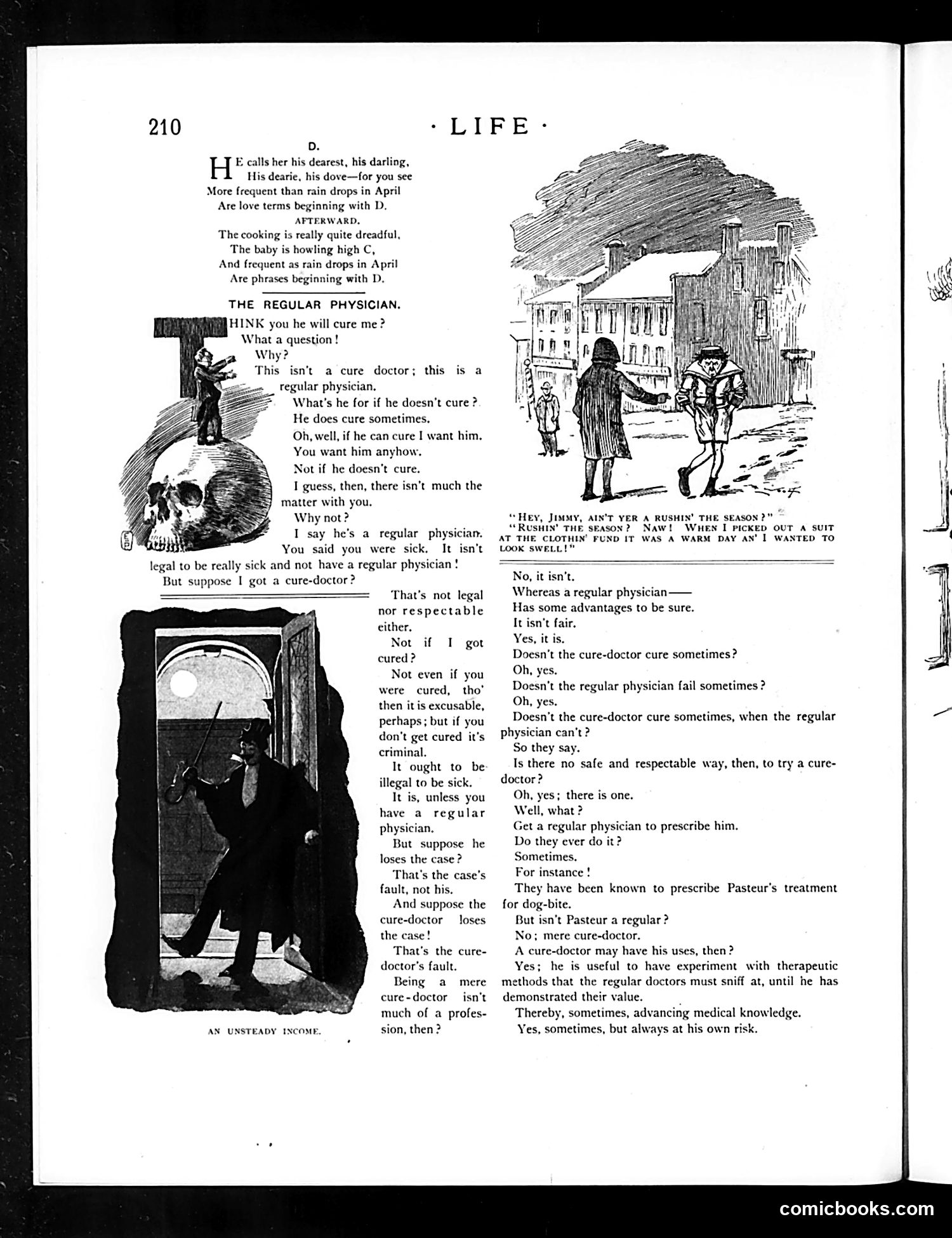
This page satirizes the debate between "regular physicians" (licensed medical doctors) and "cure-doctors" (unlicensed alternative practitioners). The left illustration shows a skeleton labeled "AN UNSTEADY INCOME," representing the financial precariousness of quack medicine. The dialogue on the right presents a logical argument: if a cure-doctor sometimes succeeds where regular physicians fail, isn't consulting one reasonable? The response argues that while cure-doctors may occasionally help through luck or experimental methods, a regular physician remains safer and more professional. The street scene depicts what appears to be a child in need of medical care, illustrating why this debate mattered practically to ordinary families choosing between legitimate and fraudulent medical providers. This reflects late 19th/early 20th-century anxieties about medical legitimacy before strict licensing standards.
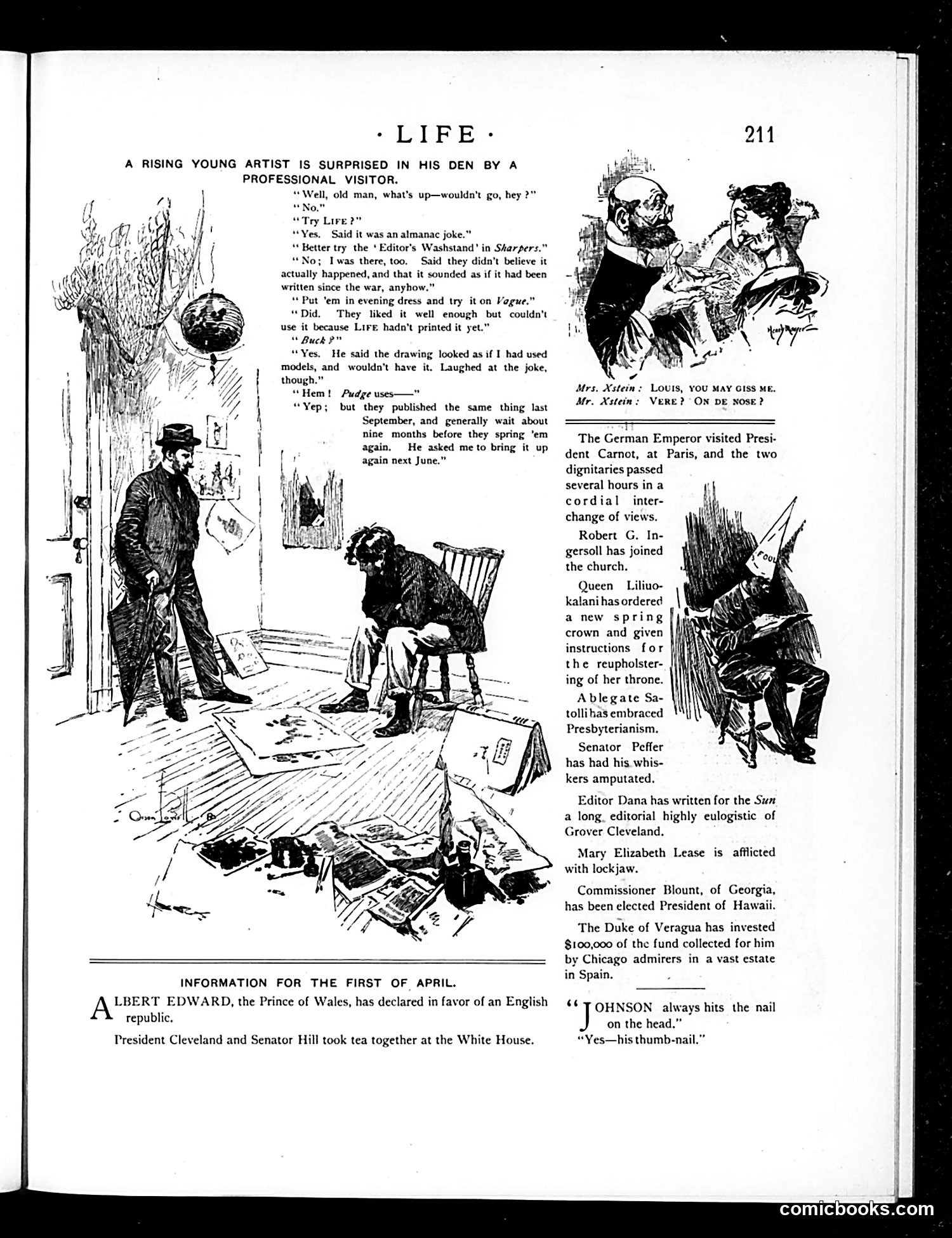
This cartoon depicts an art studio visit, likely satirizing the commercial art world of the 1890s. A well-dressed older man (the "professional visitor"—possibly an art dealer, editor, or publisher) examines the young artist's work scattered about the studio floor. The dialogue reveals the visitor's skeptical assessment: he dismissed the artist's drawings as derivative, noting they were previously rejected for publication in magazines like *Vogue* and the *Editor's Washstand*. The satire targets the precarious position of struggling young artists dependent on publisher approval, while also mocking both the artist's derivative work and the visitor's dismissive, gatekeeping attitude toward emerging talent. The messy studio and scattered rejected papers underscore professional disappointment.
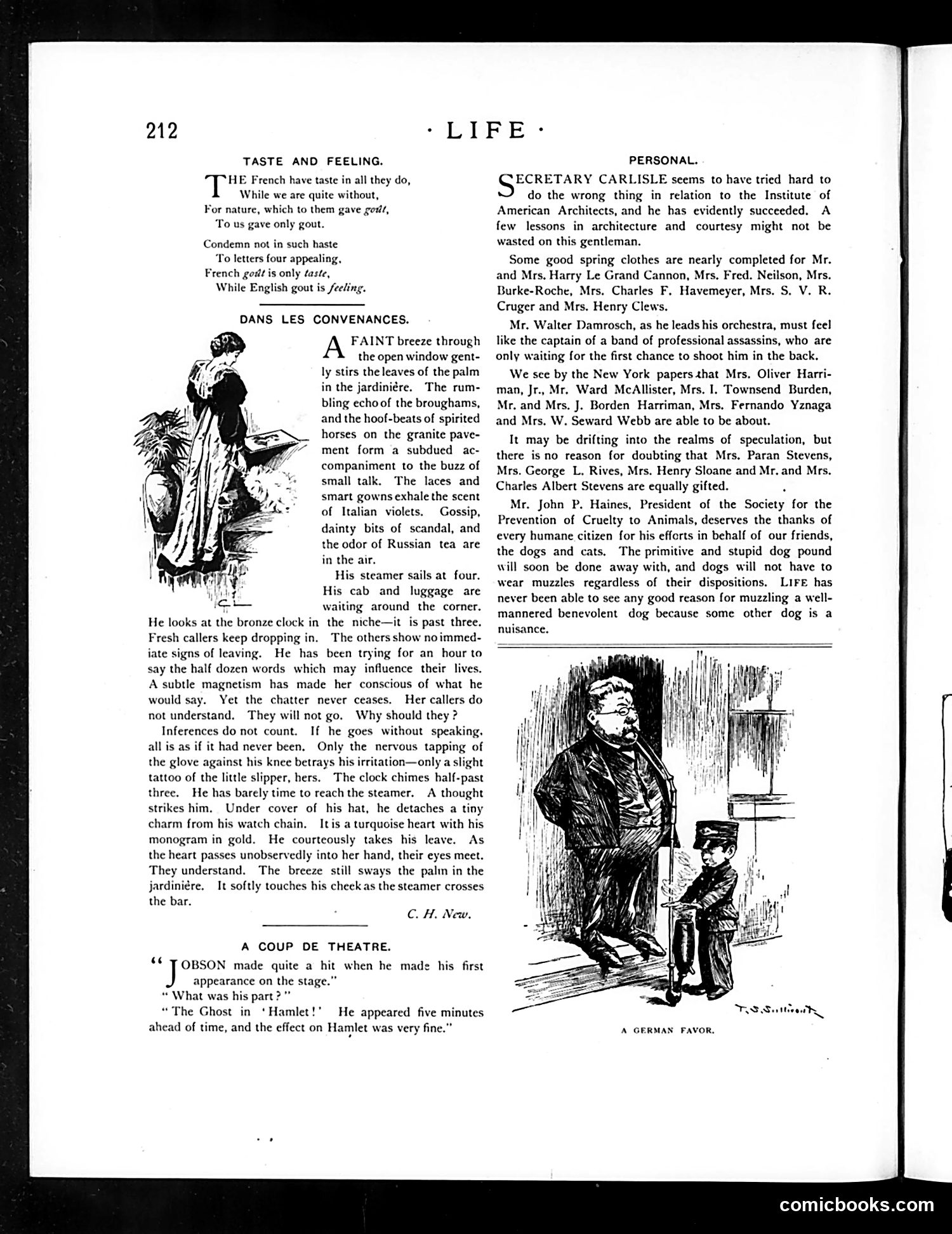
This page contains satirical commentary on contemporary social issues and society figures (likely 1880s-1890s). **"Taste and Feeling"** is a witty poem contrasting French refinement with English suffering—playing on the homophone "gout" (French taste) versus gout (the painful condition). **"Dans les Convenances"** depicts a romantic scene where a man leaving for a steamer attempts to confess feelings to a woman surrounded by oblivious callers. The satire targets social conventions that prevent genuine human connection; the woman understands his silent gesture (a turquoise charm) when words cannot be spoken. **"A Coup de Theatre"** is a joke about an actor playing the Ghost in Hamlet who appeared five minutes early, startling the lead actor—absurdist humor about theatrical mishaps. **"Personal"** mocks Secretary Carlisle's rudeness to architects, makes a cutting joke about conductor Walter Damrosch controlling his orchestra like an assassination squad, and praises John P. Haines for reforming cruel dog-pound practices by eliminating muzzles. The satire targets social pretension, bureaucratic incompetence, and animal cruelty.
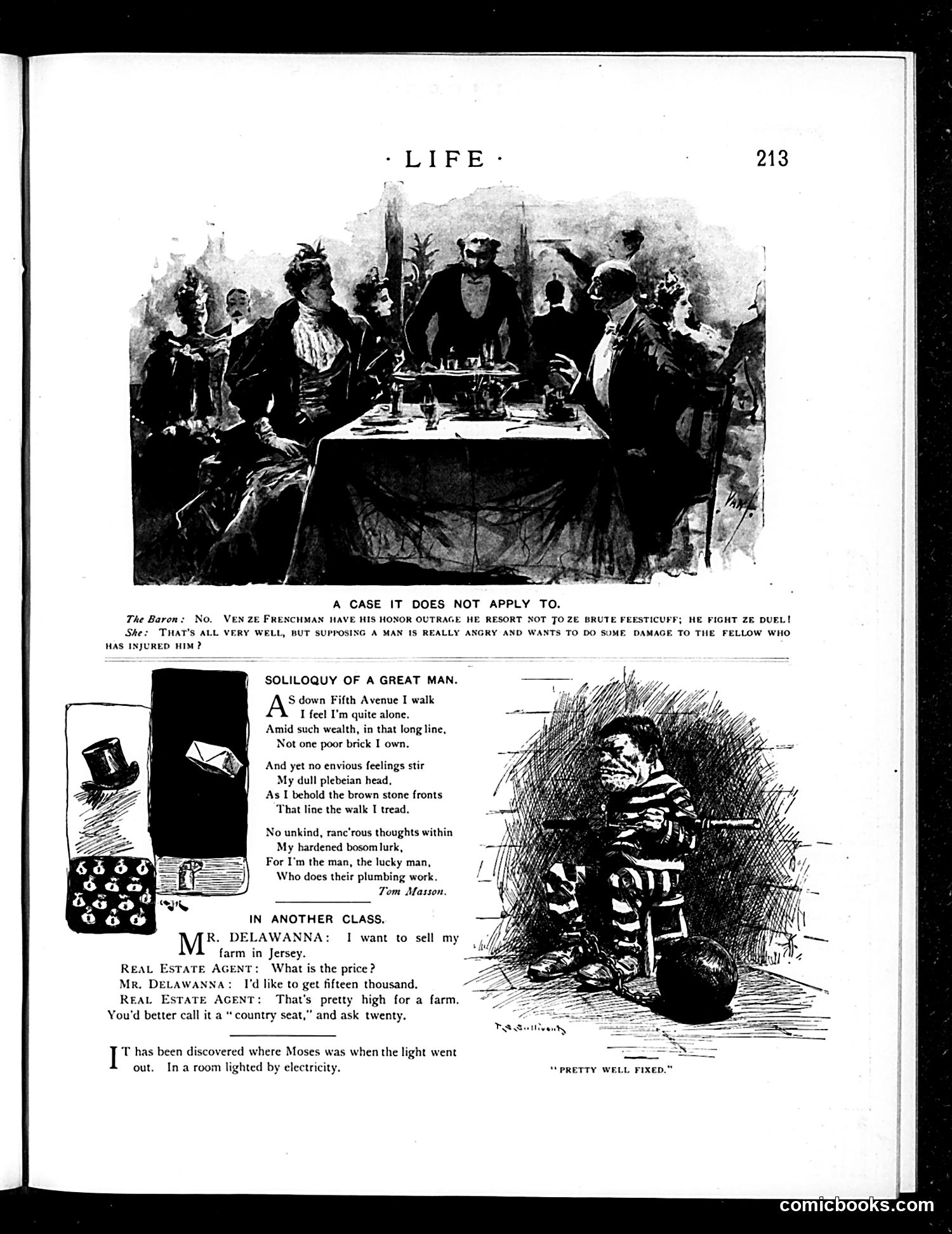
This page contains three separate satirical pieces: 1. **"A Case It Does Not Apply To"** (top): A cartoon about a Baron Von Ze Frenchman's honor, depicting a dispute over dueling etiquette—likely mocking European aristocratic codes of honor as absurd or outdated. 2. **"Soliloquy of a Great Man"** (left): A poem by Tom Masson about walking Fifth Avenue feeling alone despite visible wealth, critiquing materialism and spiritual emptiness among the wealthy. 3. **"In Another Class"** (center): A brief dialogue where a real estate agent undervalues a New Jersey farm, humorously suggesting social pretension about real estate terminology. 4. **"Pretty Well Fixed"** (right): A sketch of an impoverished person, the caption suggesting ironic commentary on class and economic disparity. The page satirizes wealth, class, and social pretension in early 20th-century America.
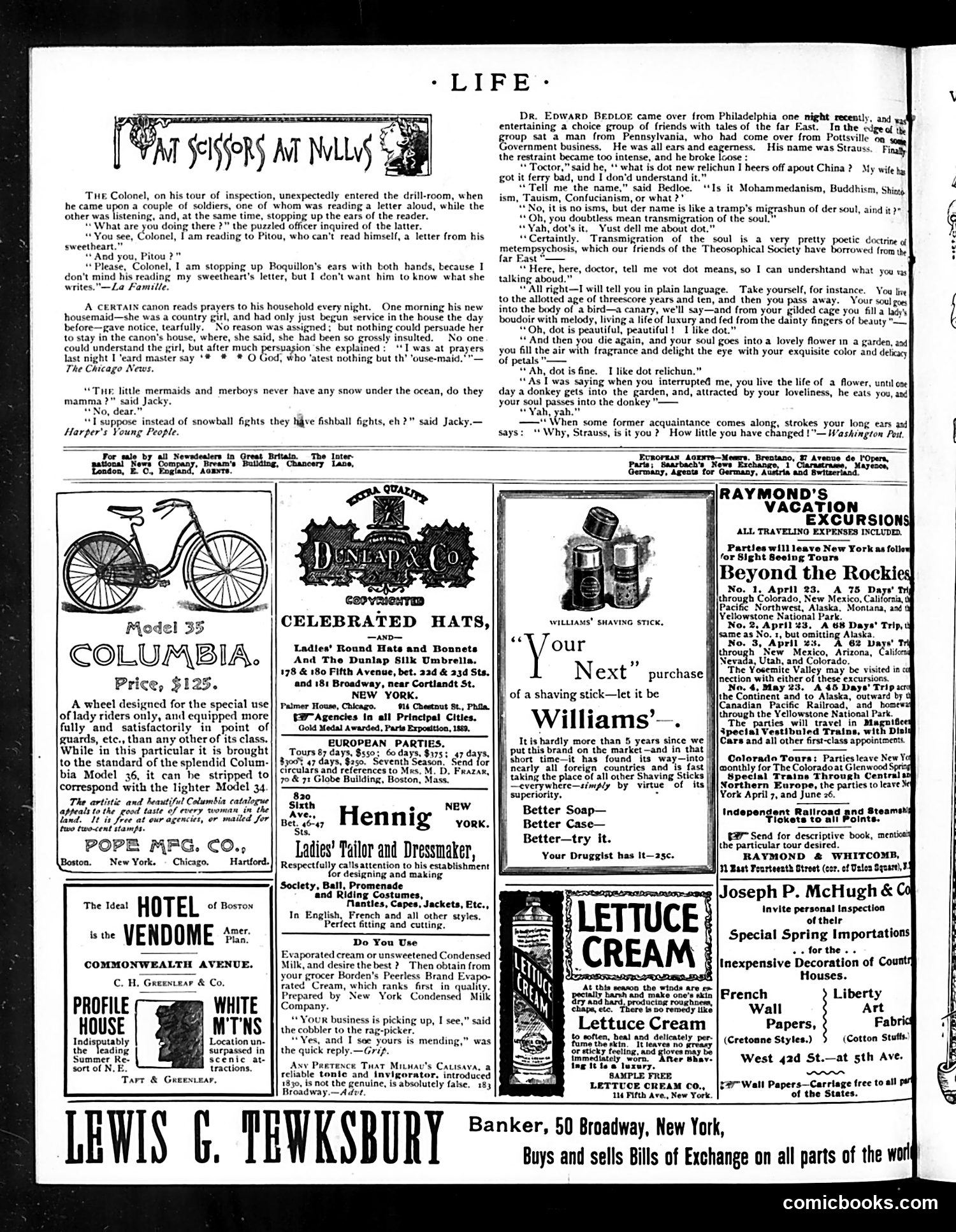
This page contains three unrelated humorous anecdotes typical of Life's satirical format: 1. **Soldiers and Letters**: A colonel discovers soldiers reading love letters aloud while one plugs his ears—illustrating the absurd logic of wanting privacy while having none. 2. **The Housekeeper's Prayer**: A country housemaid quits after hearing the canon pray "O God, who hat'st nothing but th' 'ouse-maid"—a pun on misheard religious language that insults her. 3. **Transmigration Explained**: Dr. Bedloe describes the Eastern religious concept of soul transmigration to a Pennsylvania Dutchman (Strauss), culminating in the joke that after living as a canary, then a flower, his soul becomes a donkey—and former acquaintances recognize him by his ears. The humor relies on wordplay, linguistic confusion, and cultural misunderstandings typical of early 1900s American satire. The rest of the page is primarily advertisements for bicycles, hats, hotels, and cosmetics.