
Life, 1894-03-29 · page 4 of 14
Life — March 29, 1894 — page 4: what you’re looking at
What you’re looking at
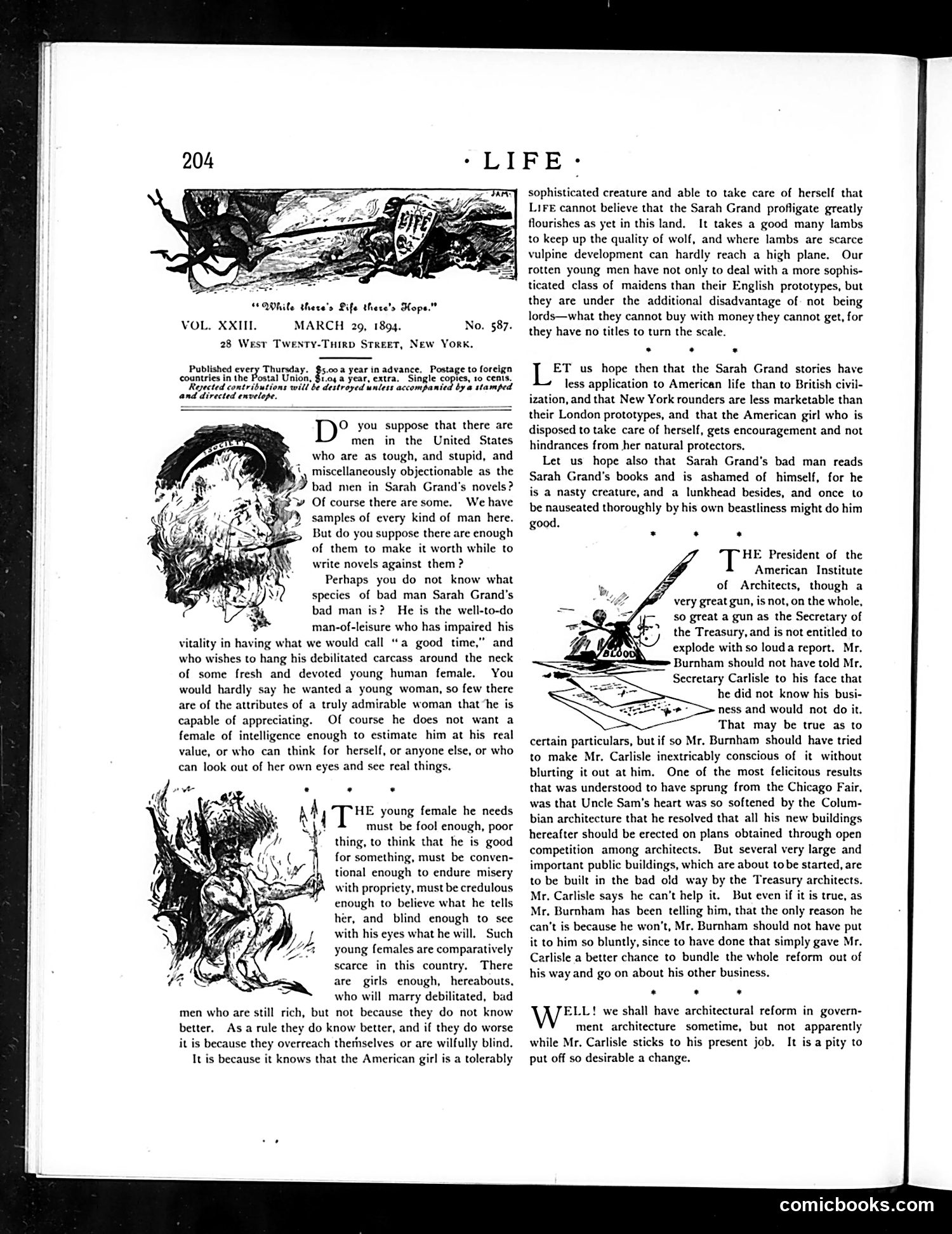
This page critiques American gender dynamics and literary criticism of the era. The text attacks Sarah Grand's novels, which depicted "bad men" in unflattering ways, arguing she exaggerates character flaws. The accompanying grotesque caricatures illustrate these supposedly exaggerated "bad men" types. The piece defends American men against Grand's portrayal, claiming American girls are too intelligent to be deceived by such characterizations. There's also commentary on architectural reform in government, criticizing Secretary Carlisle over Treasury building contracts awarded through competitive bidding. The satire targets both Grand's literary credibility and contemporary architectural/political corruption, using exaggerated illustrations to mock both the subjects being criticized and the cultural anxieties they represent about American society.
📄 Transcribed text from this page (OCR, searchable)
Machine-transcribed from the original scan — historical spelling and the odd misread are preserved.
-LIFE- “While there's Life there's Hops.” VOL. XXIII. MARCH 29, 1894. 28 West Twenty-Tiirp Street, New York. No. 587. Published every Thursday. $5.00 year in advance, Postage to foreign countries in the Postal Union, $1.04 a year, extra, Single copies, to cents. Reyected contributions will be destroyed unless accompanied bya stamped and directed envelope. O you suppose that there are men in the United States who are as tough, and stupid, and i. miscellaneously objectionable as the Z7 bad men in Sarah Grand’s novels? yp» Of course there are some. We have m7) samples of every kind of man here. +, But do you suppose there are enough of them to make it worth while to write novels against them ? Perhaps you do not know what species of bad man Sarah Grand’s bad man is? He is the well-to-do man-of-leisure who has impaired his vitality in having what we would call ‘a good time,” and who wishes to hang his debilitated carcass around the neck of some fresh and devoted young human female. You would hardly say he wanted a young woman, so few there are of the attributes of a truly admirable woman that ‘he is capable of appreciating. Of course he does not want a female of intelligence enough to estimate him at his real value, or who can think for herself, or anyone else, or who can look out of her own eyes and sce real things. . . my “= young female he needs i must be fool enough, poor thing, to think that he is good for something, must be conven- tional enough to endure misery with propriety, must be credulous enough to believe what he tells her, and blind enough to see with his eyes what he will. Such young females are comparatively scarce in this country. There are girls enough, hereabouts, who will marry debilitated, bad men who are still rich, but not because they do not know better. Asa rule they do know better, and if they do worse it is because they overreach therhselves or are wilfully blind. It is because it knows that the American girl is a tolerably sophisticated creature and able to take care of herself that LiFe cannot believe that the Sarah Grand profligate greatly flourishes as yet in this land. It takes a good many lambs to keep up the quality of wolf, and where lambs are scarce vulpine development can hardly reach a high plane. Our rotten young men have not only to deal with a more sophis- ticated class of maidens than their English prototypes, but they are under the additional disadvantage of not being lords—what they cannot buy with money they cannot get, for they have no titles to turn the scale. . . . ET us hope then that the Sarah Grand stories have less application to American life than to British civil- ization, and that New York rounders are less marketable than their London prototypes, and that the American girl who is disposed to take care of herself, gets encouragement and not hindrances from her natural protectors. Let us hope also that Sarah Grand’s bad man reads Sarah Grand’s books and is ashamed of himself, for he is a nasty creature, and a lunkhead besides, and once to be nauseated thoroughly by his own beastliness might do him good, . . 7 i ie President of the American Institute of Architects, though a very great gun, is not, on the whole, so great a gun as the Secretary of the Treasury, and is not entitled to explode with so loud a report. Mr. Burnham should not have told Mr. Secretary Carlisle to his face that he did not know his busi- ness and would not do it. That may be true as to certain particulars, but if so Mr. Burnham should have tried to make Mr. Carlisle inextricably conscious of it without blurting it out athim. One of the most felicitous results that was understood to have sprung from the Chicago Fair, was that Uncle Sam’s heart was so softened by the Colum- bian architecture that he resolved that all his new buildings hereafter should be erected on plans obtained through open competition among architects. But several very large and important public buildings, which are about tobe started, are to be built in the bad old way by the Treasury architects. Mr. Carlisle says he can’t help it. But even if it is true, as Mr, Burnham has been telling him, that the only reason he can’t is because he won't, Mr. Burnham should not have put it to him so bluntly, since to have done that simply gave Mr. Carlisle a better chance to bundle the whole reform out of his way and go on about his other business. . . . ELL! we shall have architectural reform in govern- ment architecture sometime, but not apparently while Mr. Carlisle sticks to his present job. It is a pity to put off so desirable a change. comicbooks.com