
A complete issue · 18 pages · 1893
Life — October 19, 1893
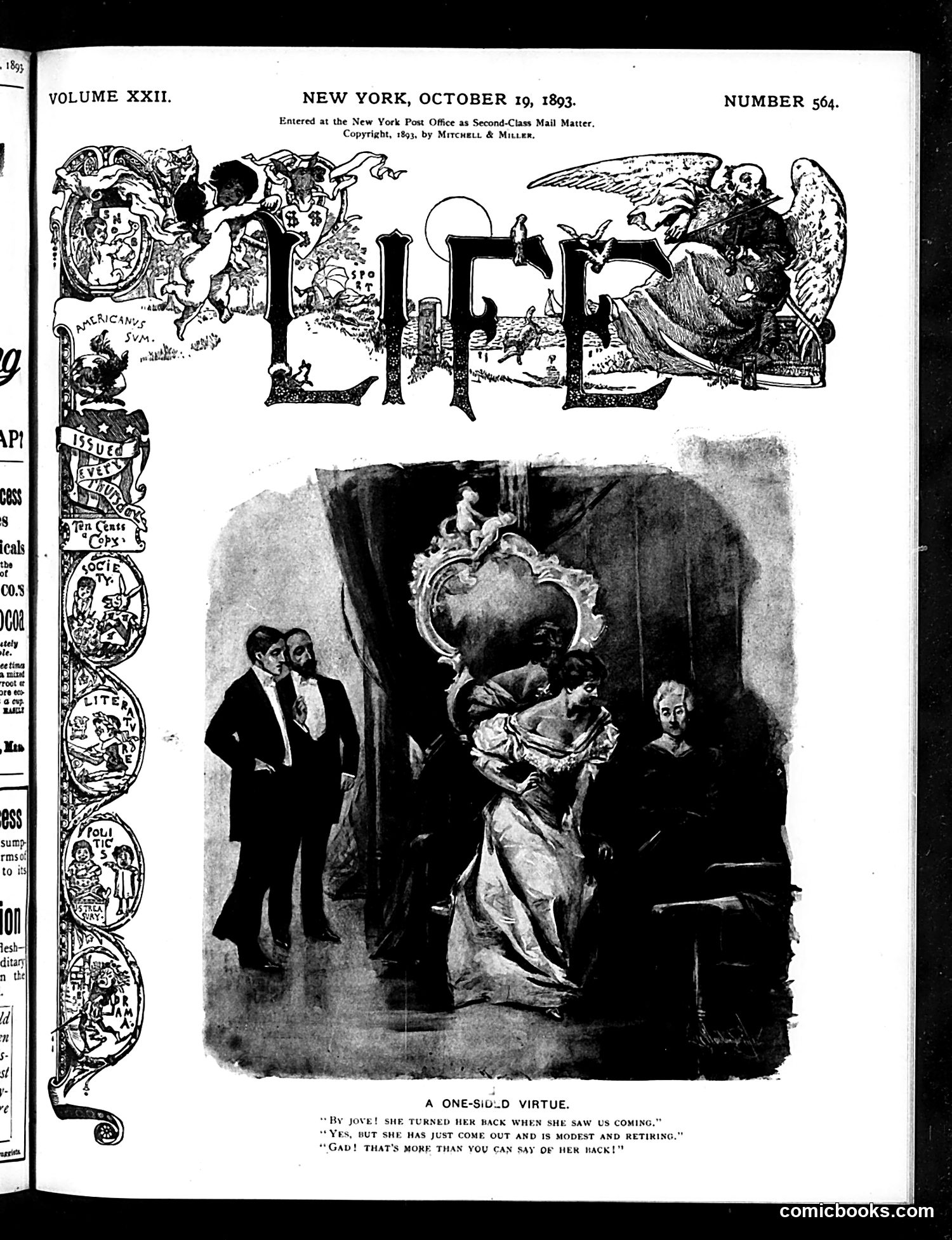
This cartoon satirizes female hypocrisy regarding modesty and propriety. The scene shows a woman in elaborate dress turning away when men approach, as if offended by their presence. The caption's dialogue mocks this performance: she claims virtue and modesty ("turned her back"), yet she has "just come out" and is "honest and retiring"—while her fashionable, attention-getting appearance contradicts her supposed desire for privacy. The joke targets late-Victorian upper-class women who performed exaggerated modesty while simultaneously displaying themselves through expensive clothing and public appearances. "One-sided virtue" suggests her morality operates selectively—modest only when convenient or for appearance's sake. The satire critiques the gap between professed values and actual behavior among society's elite.
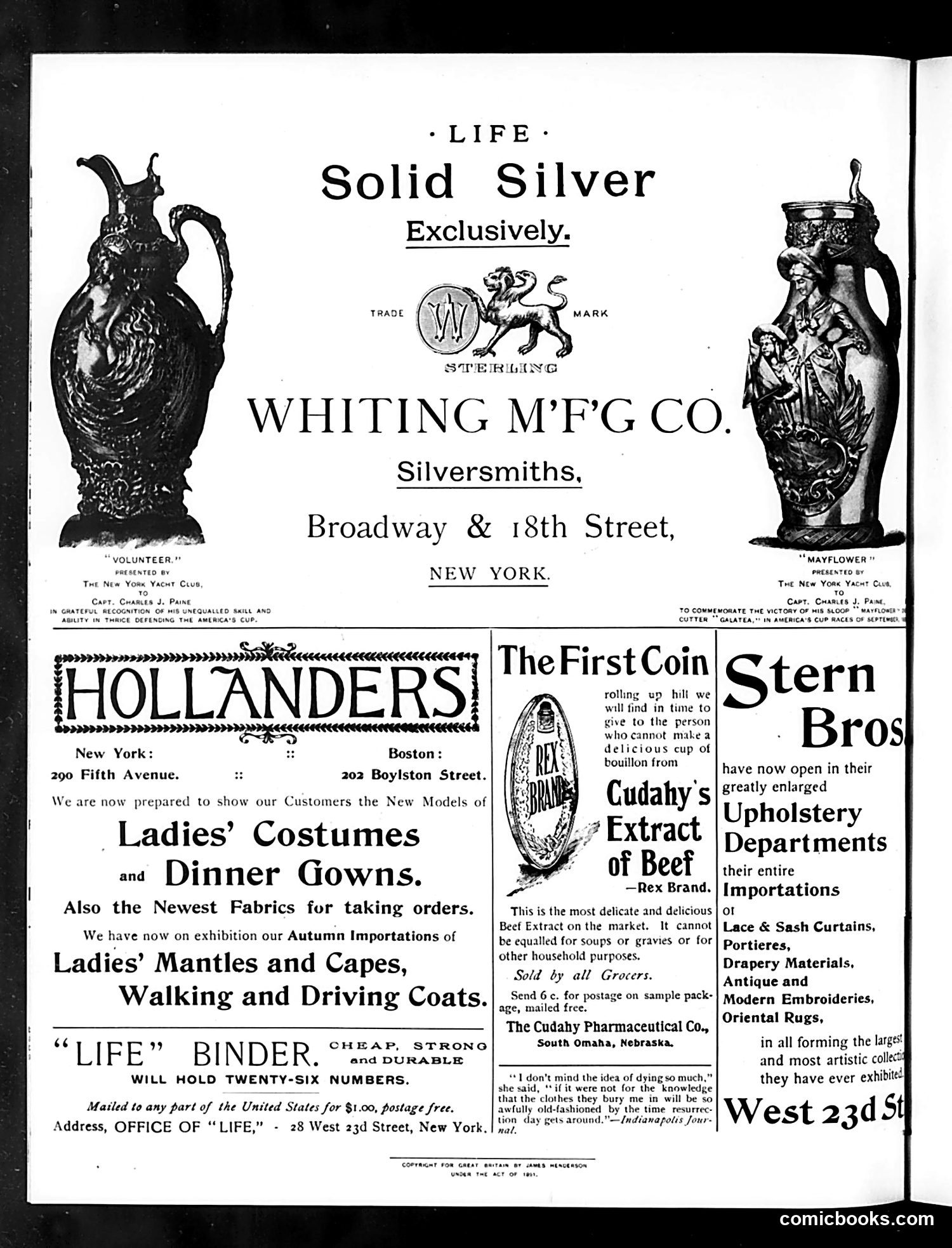
This page is primarily **advertising**, not satirical content. It contains four commercial advertisements from what appears to be an early 20th-century issue of Life magazine: 1. **Whiting Mfg Co.** - Silver serving vessels with patriotic references ("Volunteer" and "Mayflower" pitchers commemorating America's Cup yacht racing victories) 2. **Hollanders** - Women's fashion (costumes, dinner gowns, mantles, capes, coats) 3. **Cudahy's Extract of Beef** - Food product advertisement 4. **Stern Bros** - Upholstery and home furnishing imports (curtains, rugs, embroideries) 5. **Life Binder** - Magazine binding service The page reflects turn-of-the-century consumer culture, with emphasis on luxury goods, domestic fashion, and imported materials for wealthy households.
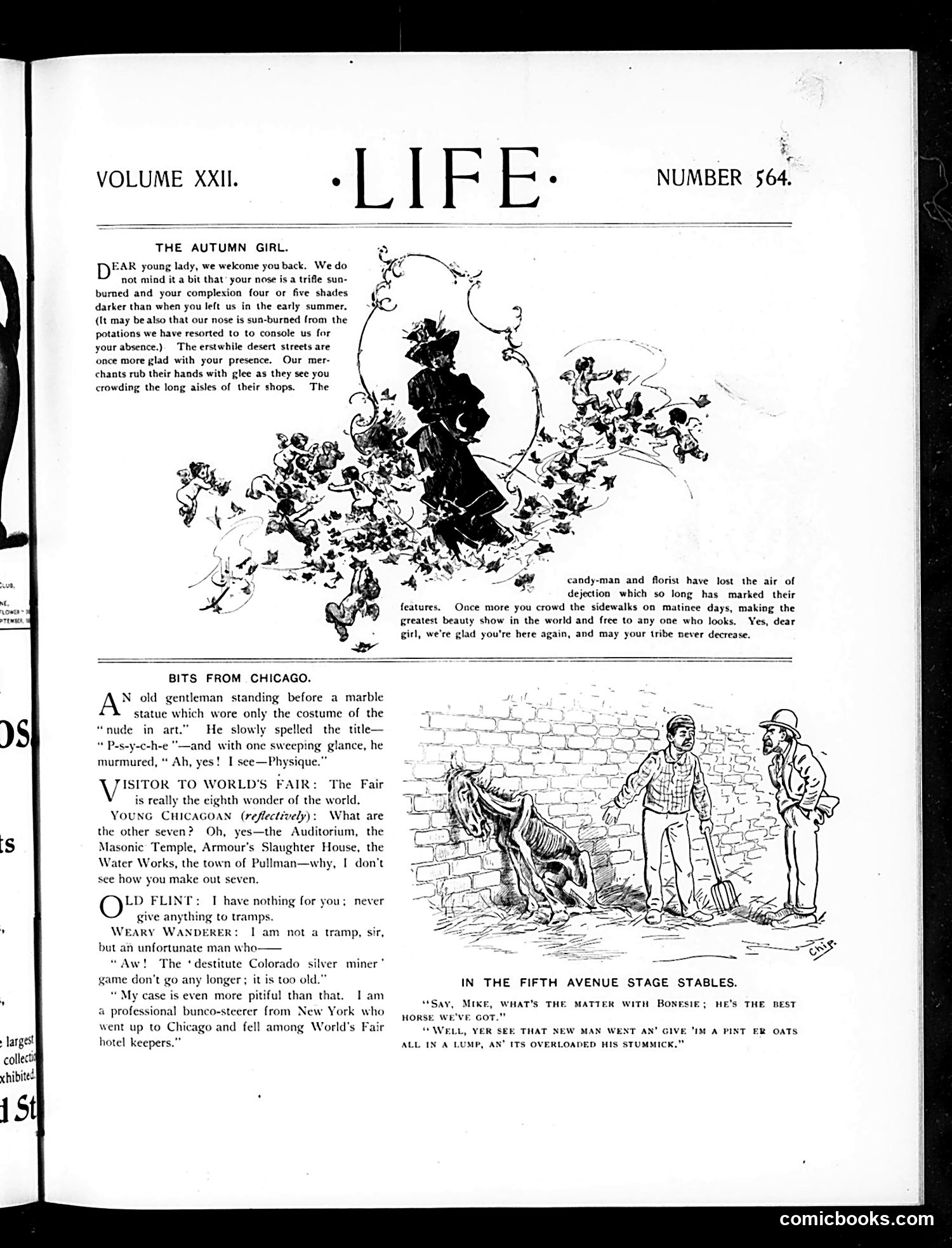
**Main Cartoon:** This illustration welcomes back "the autumn girl" after summer—a young woman with a sunburned nose and darkened complexion from outdoor activities. The text humorously addresses her changed appearance, noting that merchants and shop owners notice her presence on crowded streets. **"Bits from Chicago":** This section collects humorous observations about Chicago visitors and residents, including dialogue between tourists at the World's Fair discussing its buildings, and exchanges with various characters (an old man, tramp, and silver miner) expressing cynical or pitiable circumstances. **Bottom cartoon:** Shows two men discussing a horse in Fifth Avenue stables, with a joke about overfeeding causing intestinal distress. The page mixes social observation with light comedy typical of early-20th-century satirical magazines.
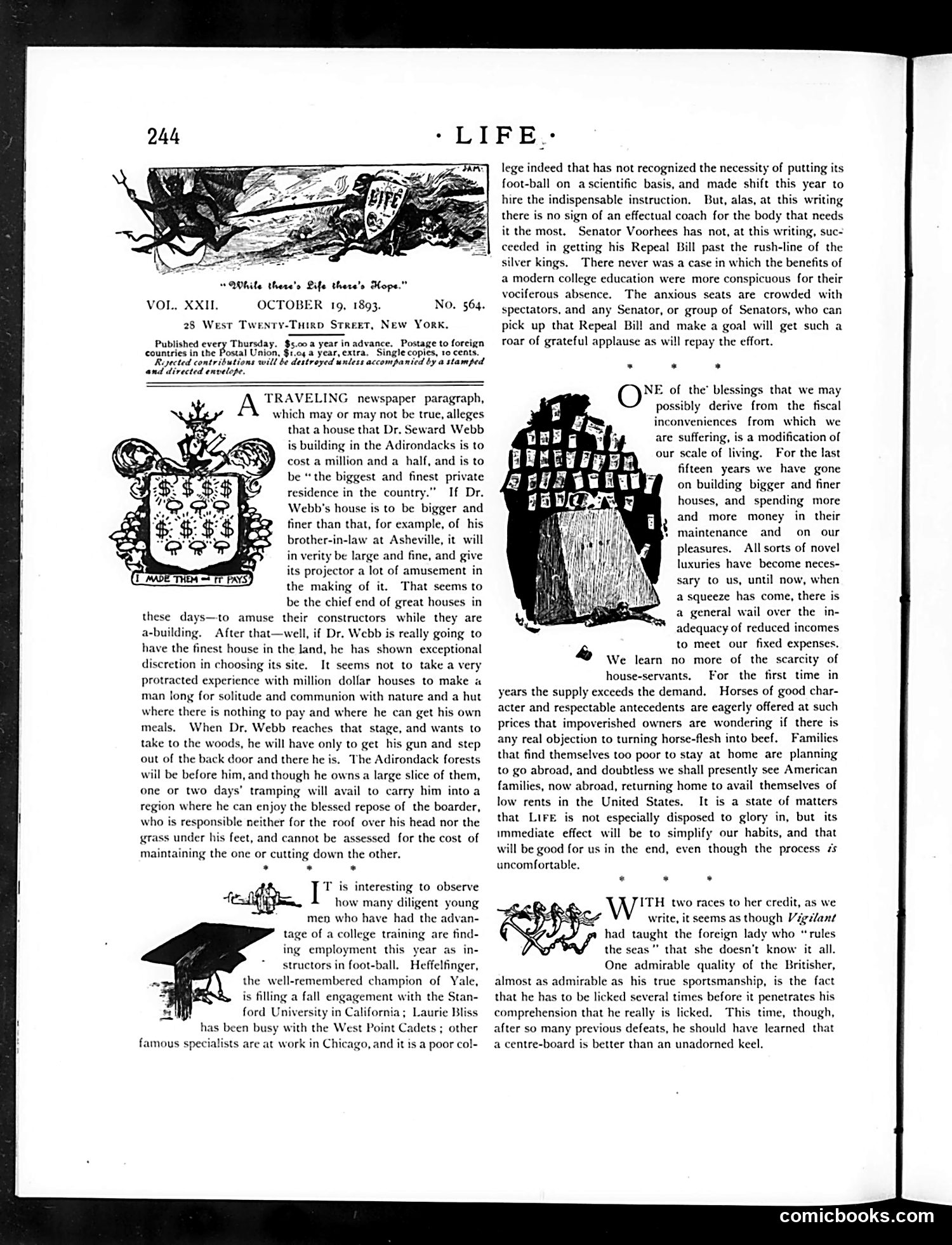
The top cartoon depicts a spider labeled "LIFE" attacking what appears to be a beetle or insect, illustrating the magazine's satirical approach to current events. The main text discusses Dr. Seward Webb's construction of a massive private mansion in the Adirondacks—a display of Gilded Age excess. The piece criticizes such extravagance while acknowledging the economic benefits of grand building projects. A secondary article mentions college-educated young men (including Yale's Heffelfinger and West Point Cadets) finding employment as instructors in prestigious institutions, reflecting debates about education and class. The final section humorously describes a British sailor's misunderstanding of being "licked" (defeated) in sports, playing on language and cultural differences between Americans and the British.
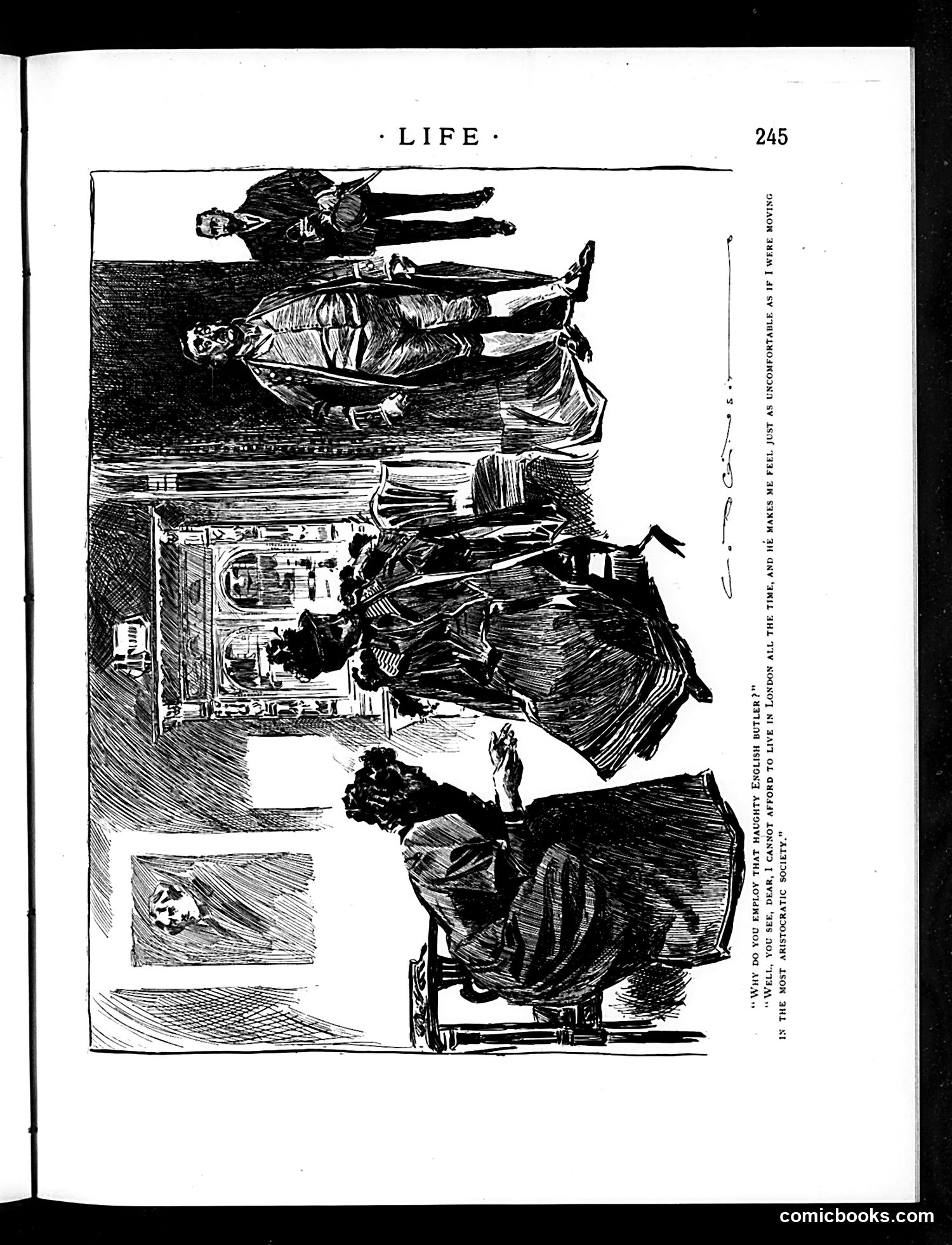
This page from *Life* magazine (page 246) contains a satirical illustration, though the image is rotated 90 degrees, making it difficult to read clearly. The OCR text appears incomplete or corrupted, providing only a partial caption about "time and men" being "fell just a incorporable at every point." The sketch uses bold black ink in an expressionist style, depicting what appears to be multiple figures in domestic or interior settings—including someone at a desk/table and figures in period clothing. Without legible text identifying specific individuals or a clear date, I cannot definitively explain the political or social satire intended. The style suggests early-to-mid 20th century commentary, but the precise target and meaning remain unclear from this reproduction alone.
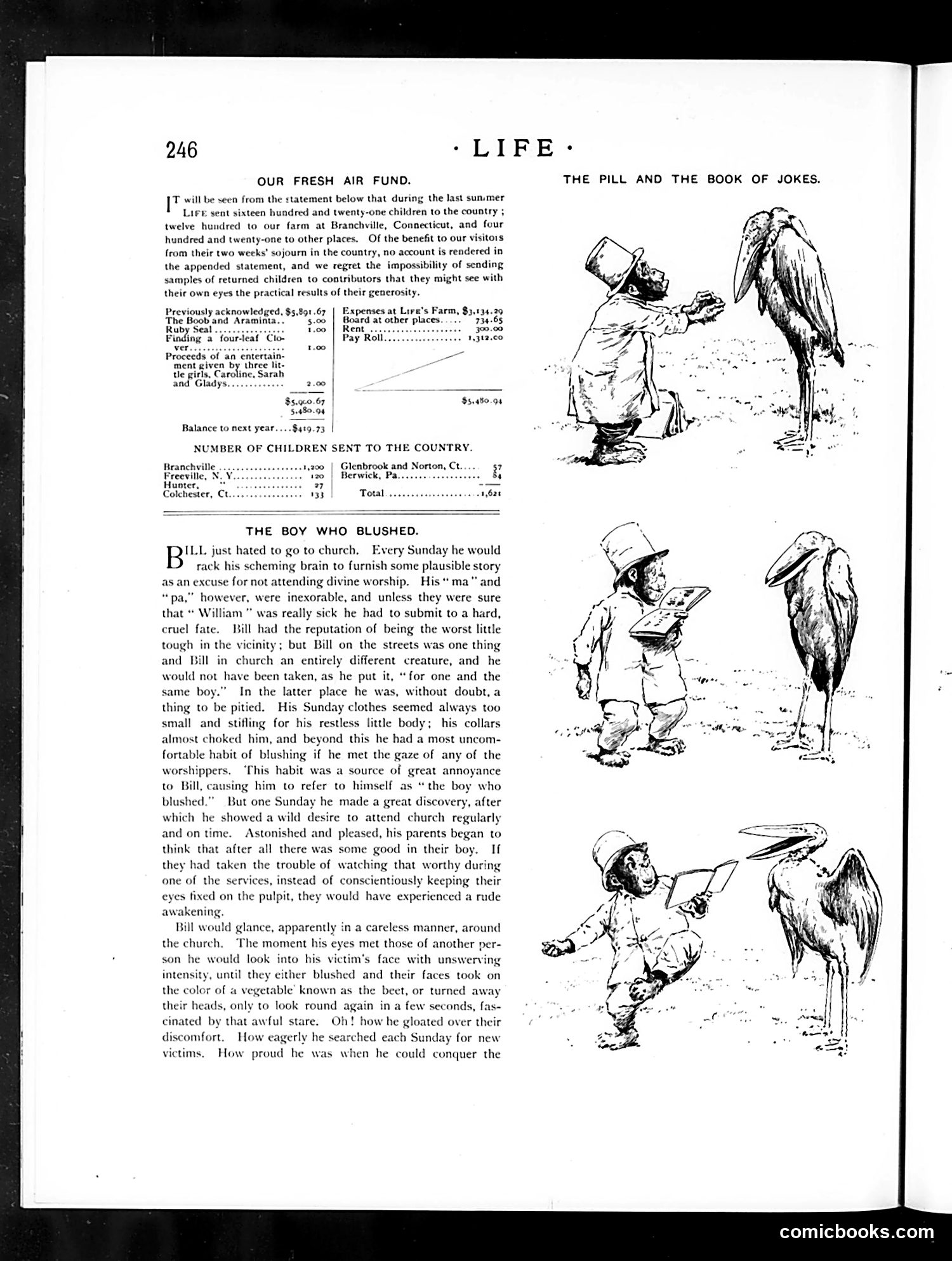
**Main Content: "The Boy Who Blushed"** This is a humorous story about a boy named Bill who habitually blushes at church, earning him the nickname "the boy who blushed." His embarrassment becomes so notorious that other parishioners deliberately try to make him blush by staring at him during services. Bill's parents initially disapprove of church attendance due to this social humiliation. The story takes a turn when Bill discovers something at church that genuinely interests him, leading him to attend willingly and regularly. His parents are pleased, relieved their son has found moral improvement. **The Illustrations:** Three sketches show Bill and a stork (likely representing a book of jokes or Bible story). The drawings humorously depict the boy's awkward interactions and blushing episodes in an exaggerated style typical of early 20th-century magazine humor.
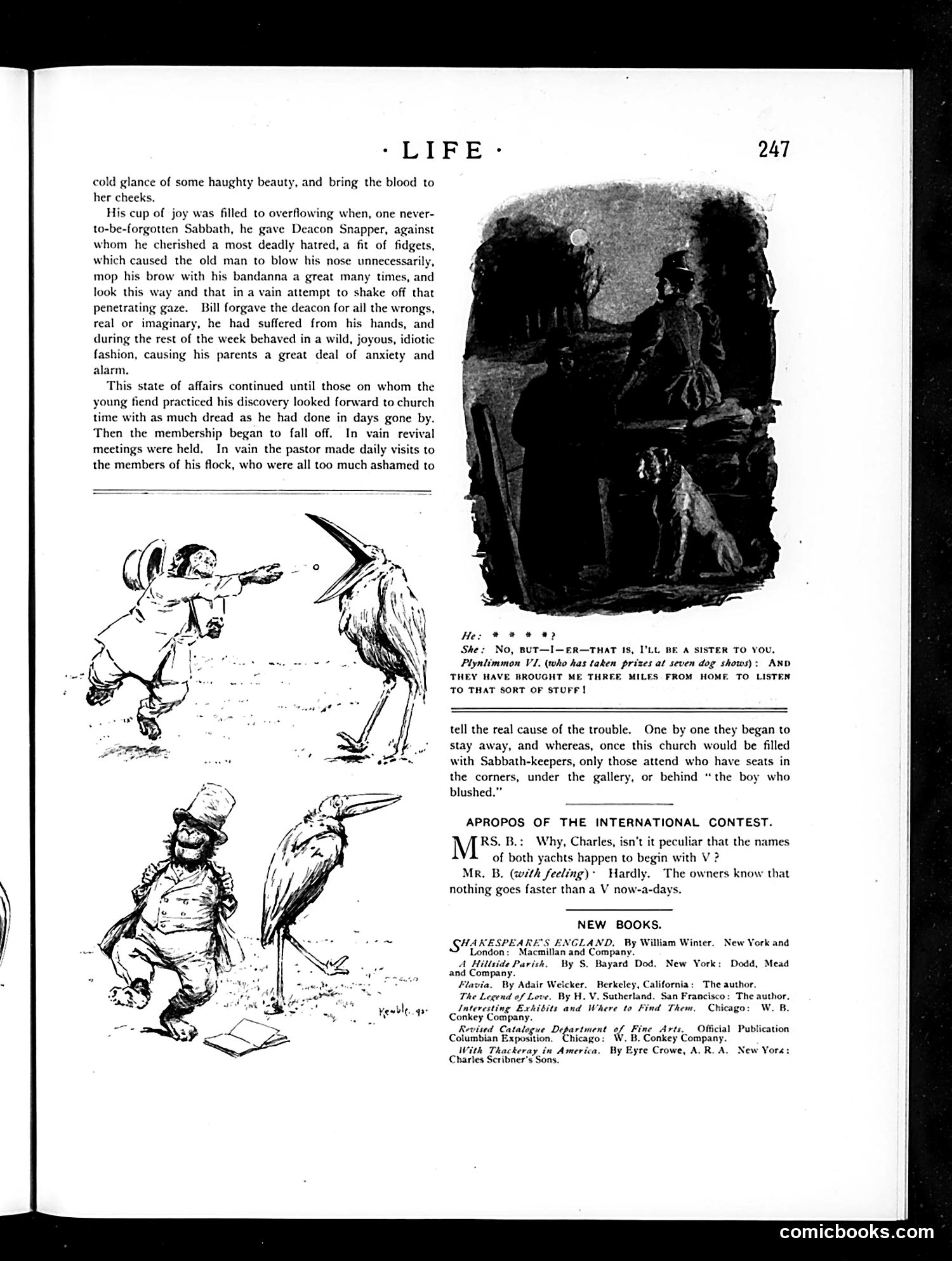
This page contains two distinct elements: **Upper section**: A narrative text about a young man's misbehavior disrupting his church community, causing membership decline and failed revival meetings. The accompanying illustration shows a grotesque caricatured figure—likely depicting the troublemaker—interacting with a stork. The crude, exaggerated drawing style suggests mockery. **Lower section**: Humorous exchanges labeled "APROPOS OF THE INTERNATIONAL CONTEST," featuring dialogue about yacht-racing and boat speeds. The accompanying cartoons show exaggerated character types (a man and woman in period dress) conversing with a stork—apparently a running visual joke. The stork imagery likely references childbirth/reproduction folklore, making this satire about social pretension or foolishness. The "New Books" section lists contemporary publications, typical of *Life* magazine's format from this era (appears early 20th century).
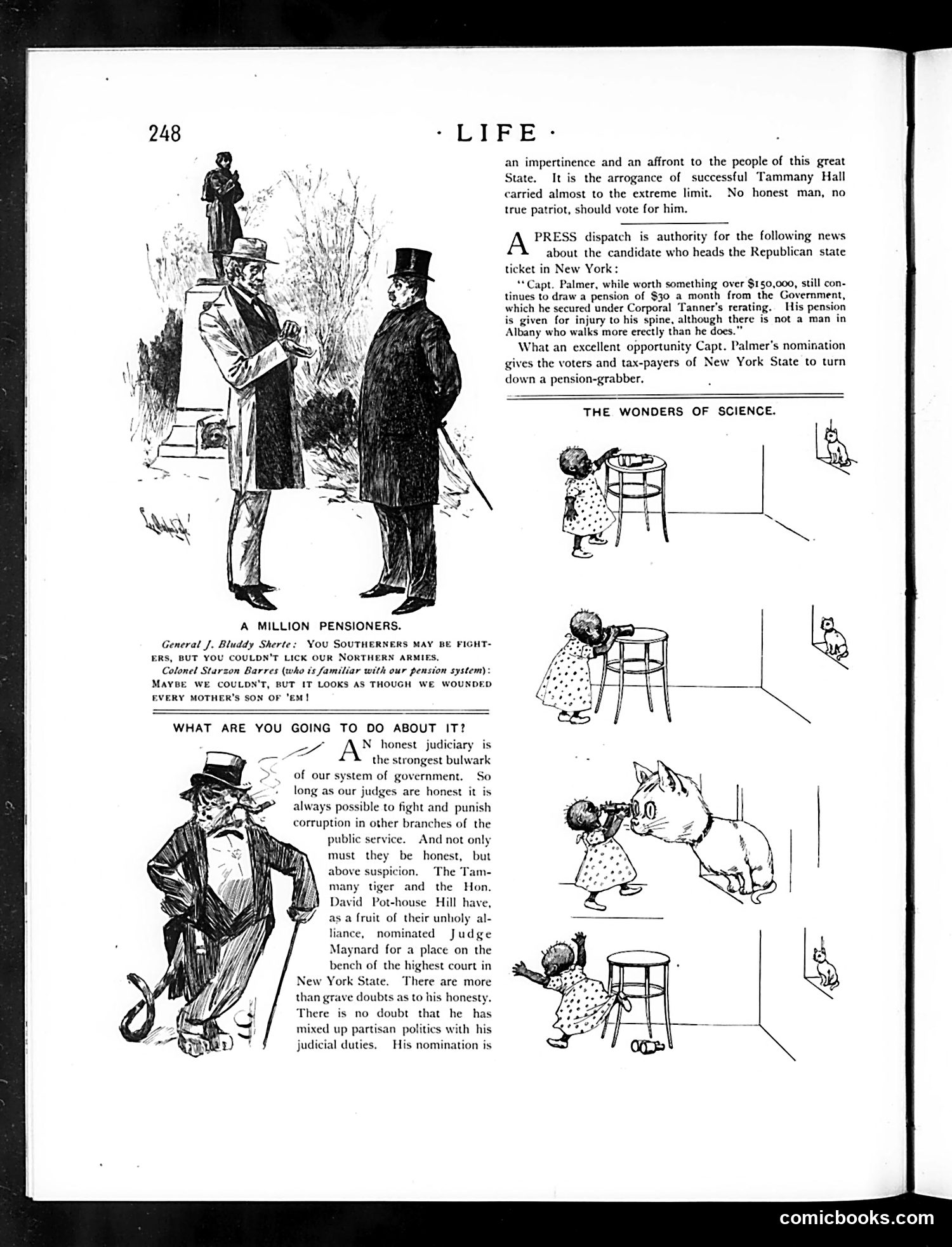
**"A Million Pensioners"** satirizes General J. Bloody Shorte's (a caricatured Southern general) claim that Northerners wouldn't fight—implying the South wounded every Union soldier. The cartoon mocks this as absurdly exaggerated pension claims. **"What Are You Going To Do About It?"** criticizes the nomination of Judge Maynard for New York's highest court. The text argues an honest judiciary is essential for fighting corruption, but Maynard—connected to Tammany Hall and David B. Hill's political machine—mixed partisan politics with judicial duties, raising serious integrity concerns about his fitness for the bench. The cartoons attack political patronage and corruption in the Gilded Age.
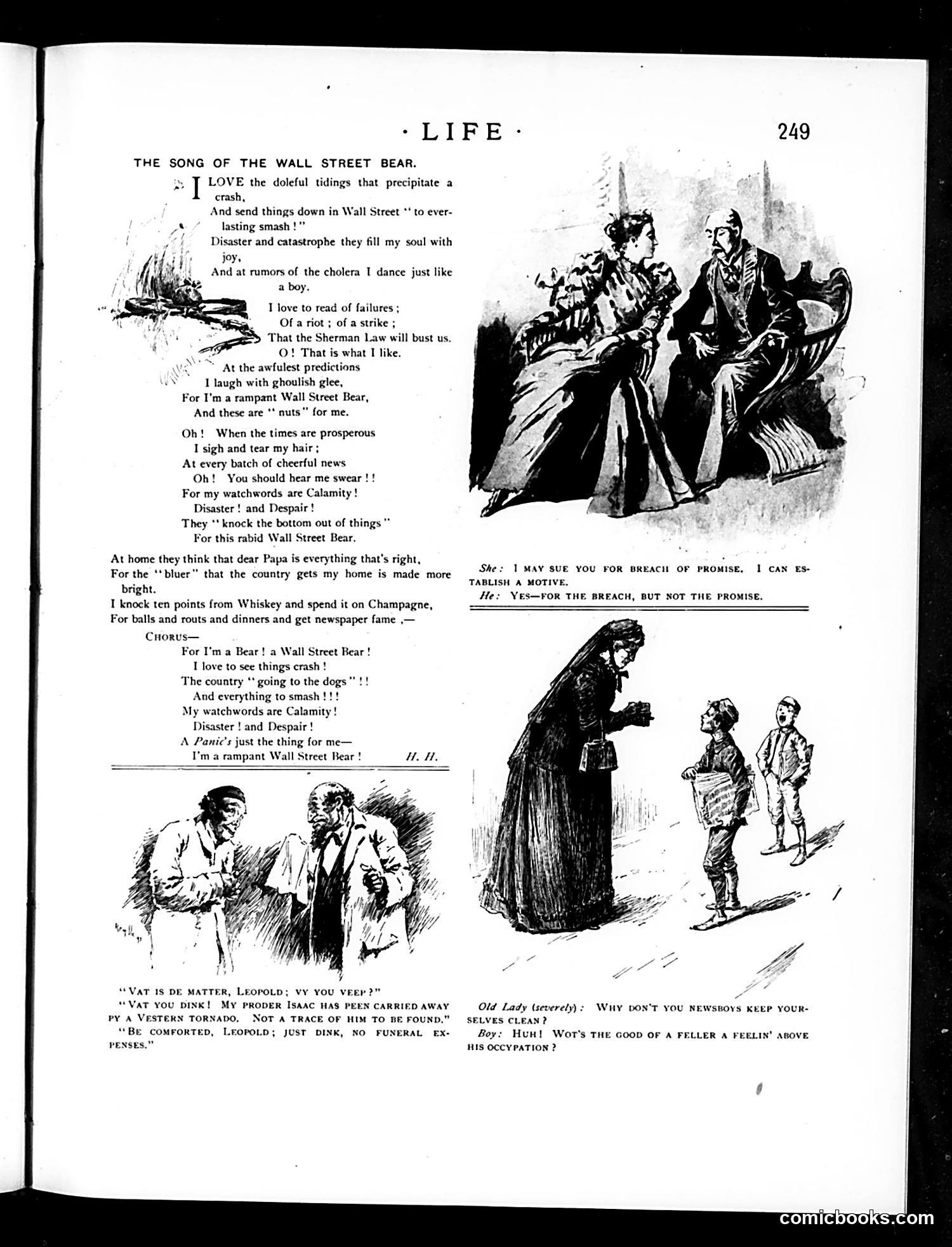
This is a satirical poem celebrating financial market crashes and economic disaster. The "Wall Street Bear" persona gleefully anticipates stock market collapses, bank failures, and economic calamity—viewing them as entertainment ("I love to see things crash!"). The accompanying illustrations depict: 1. **Upper panel**: Wealthy figures in conversation about breach of promise (likely a legal/financial dispute) 2. **Lower panels**: Street scenes with what appear to be common people affected by financial turmoil The satire targets Wall Street speculators who profit from—or relish—economic devastation that harms ordinary citizens. The bear's "watchwords" are "Calamity! Disaster! Despair," mocking how financial elites celebrate crashes while the broader population suffers consequences. This reflects early-20th-century critiques of speculative finance and wealth inequality.
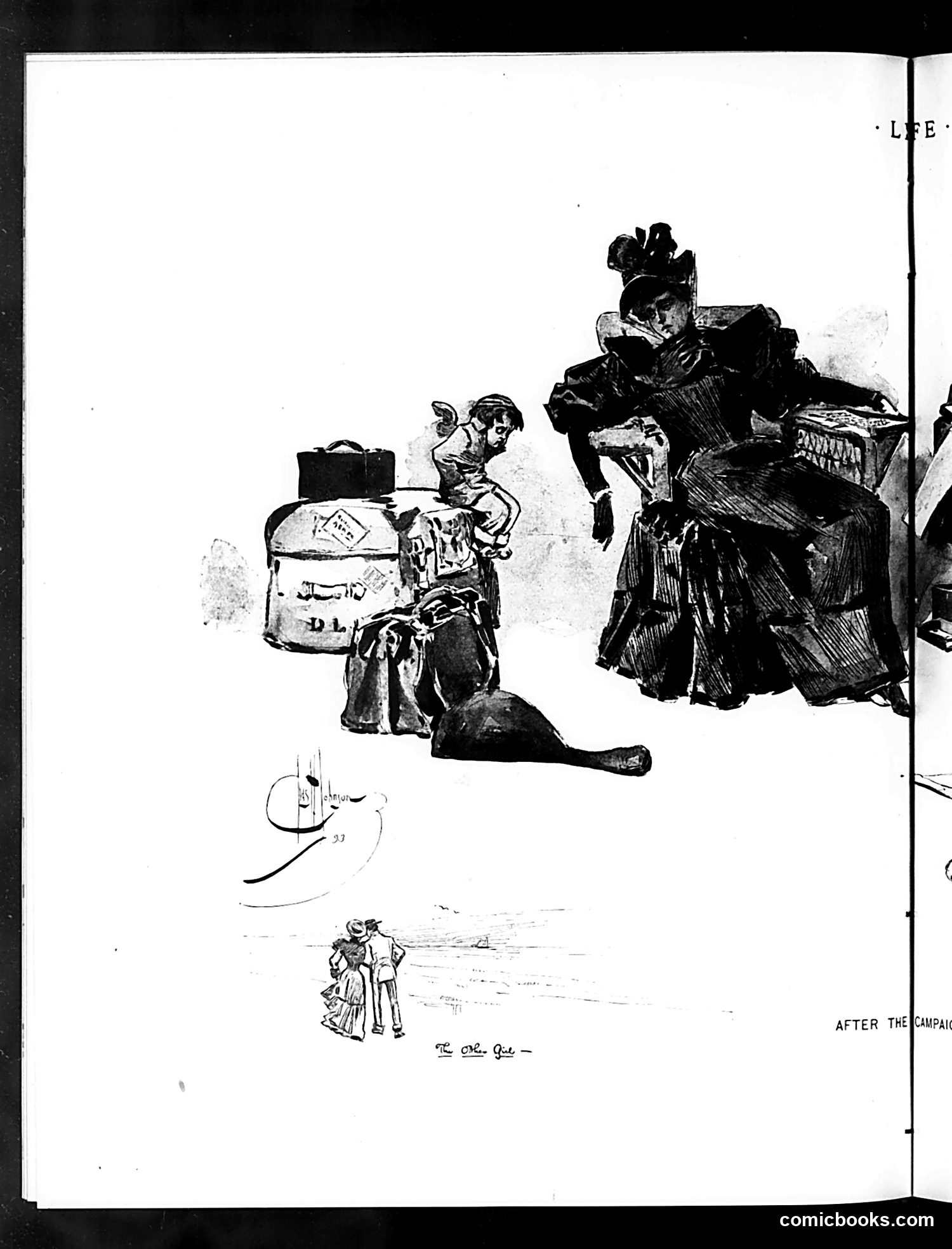
This page from *Life* magazine shows a satirical cartoon titled "After the Campaign." The image depicts a woman in elaborate, voluminous clothing (suggesting wealth or pretension) sitting exhausted with luggage, while a smaller figure stands nearby. The exaggerated styling and posture suggest fatigue from travel or social obligations. The cartoon appears to mock upper-class women's experiences during political campaigns—likely referencing the demanding schedule of wives accompanying candidates or participating in campaign social events. The oversized clothing and scattered baggage humorously emphasize the physical toll and chaos of such activities. Without clearer text or dated context, the specific campaign referenced remains **unclear**, but the satire targets the exhausting nature of campaign season society obligations for wealthy women.
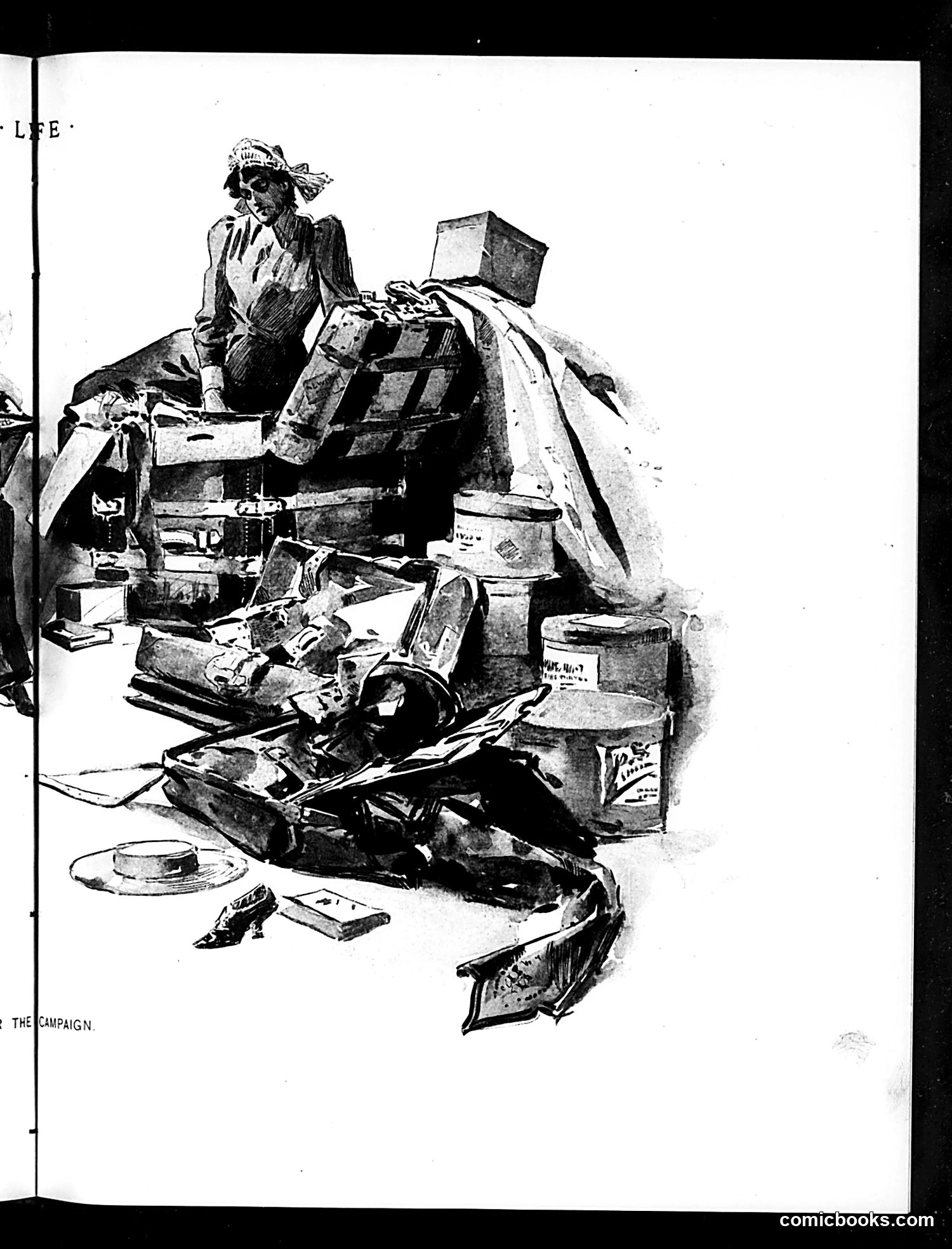
This illustration depicts a woman in early 20th-century dress examining discarded campaign materials and debris. The scattered items include boxes, cans, papers, and what appears to be political paraphernalia strewn across the ground. The cartoon's title references "THE CAMPAIGN," suggesting this critiques the messy aftermath or waste of a political campaign. The woman appears to be surveying the wreckage—literally trash—left behind, likely satirizing how campaigns generate excessive promotional material, broken promises, or general disorder. The illustration's tone suggests disillusionment with campaign excess or the contrast between campaign rhetoric and actual results. Without visible text identifying specific candidates or dates, the exact historical campaign referenced remains unclear, though the style suggests early-to-mid 20th century American politics.
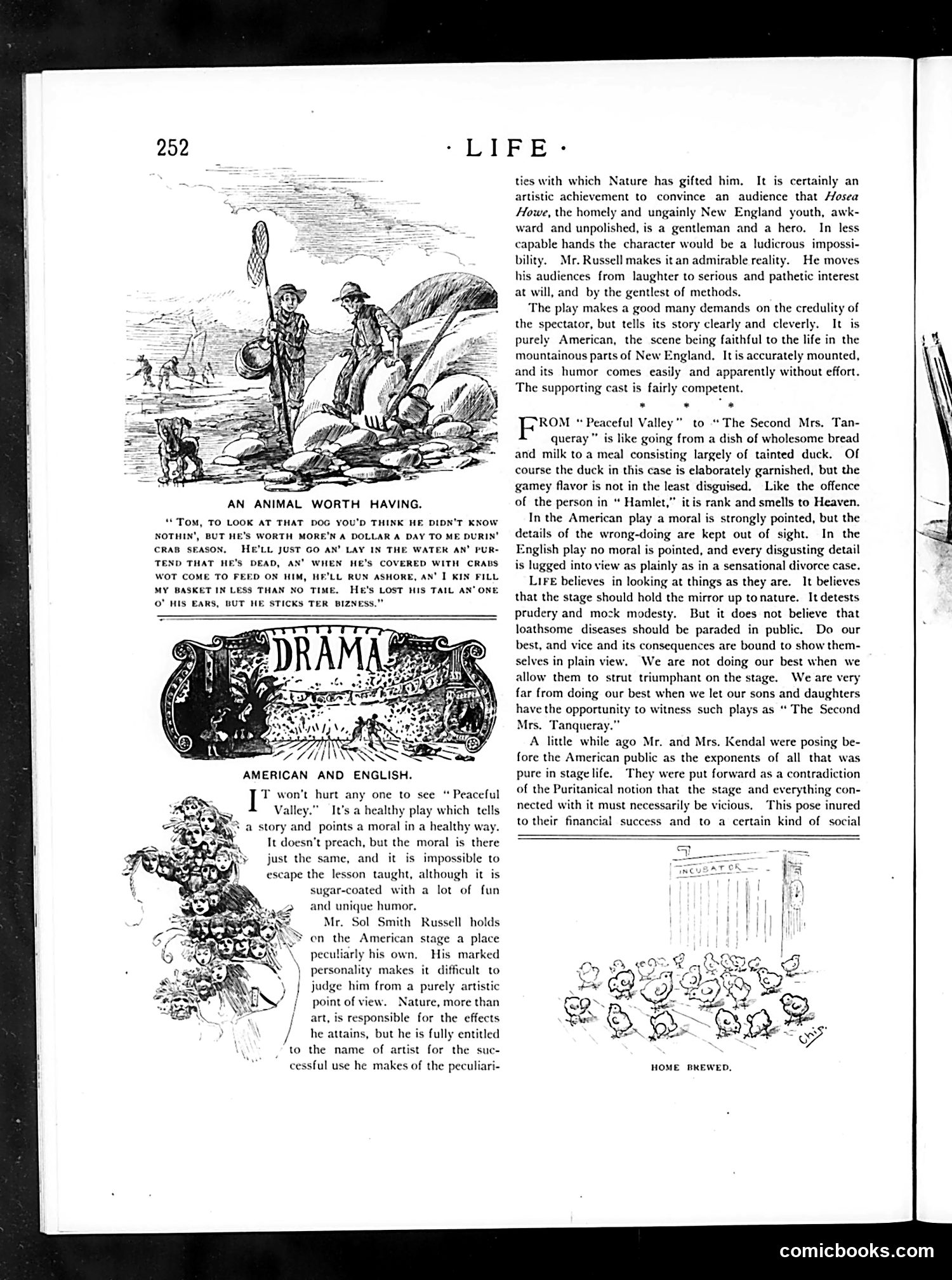
This page contains **drama criticism** comparing American and English plays, not political cartoons. The main illustrated anecdote ("An Animal Worth Having") is a humorous dialect story about a resourceful dog used during crab season—a simple rural joke with no political content. The substantive text reviews two plays: **"Peaceful Valley"** (American, starring Sol Smith Russell) and **"The Second Mrs. Tanqueray"** (English). Life praises the American play for its moral lesson delivered through wholesome humor and its accurate New England setting. It sharply criticizes the English play for graphically depicting vice and disease without moral purpose, comparing it unfavorably to the cleaner American approach. The critique reveals **Life's editorial stance**: the magazine supports theatrical realism ("hold the mirror up to nature") but opposes gratuitous depictions of immorality. It also dismisses the Kendals' claims to represent pure stage life as mere financial posturing. The "Home Brewed" illustration at bottom appears unrelated decoration. This represents **genteel American criticism** of the 1890s, contrasting Victorian American sensibilities with perceived English theatrical decadence.
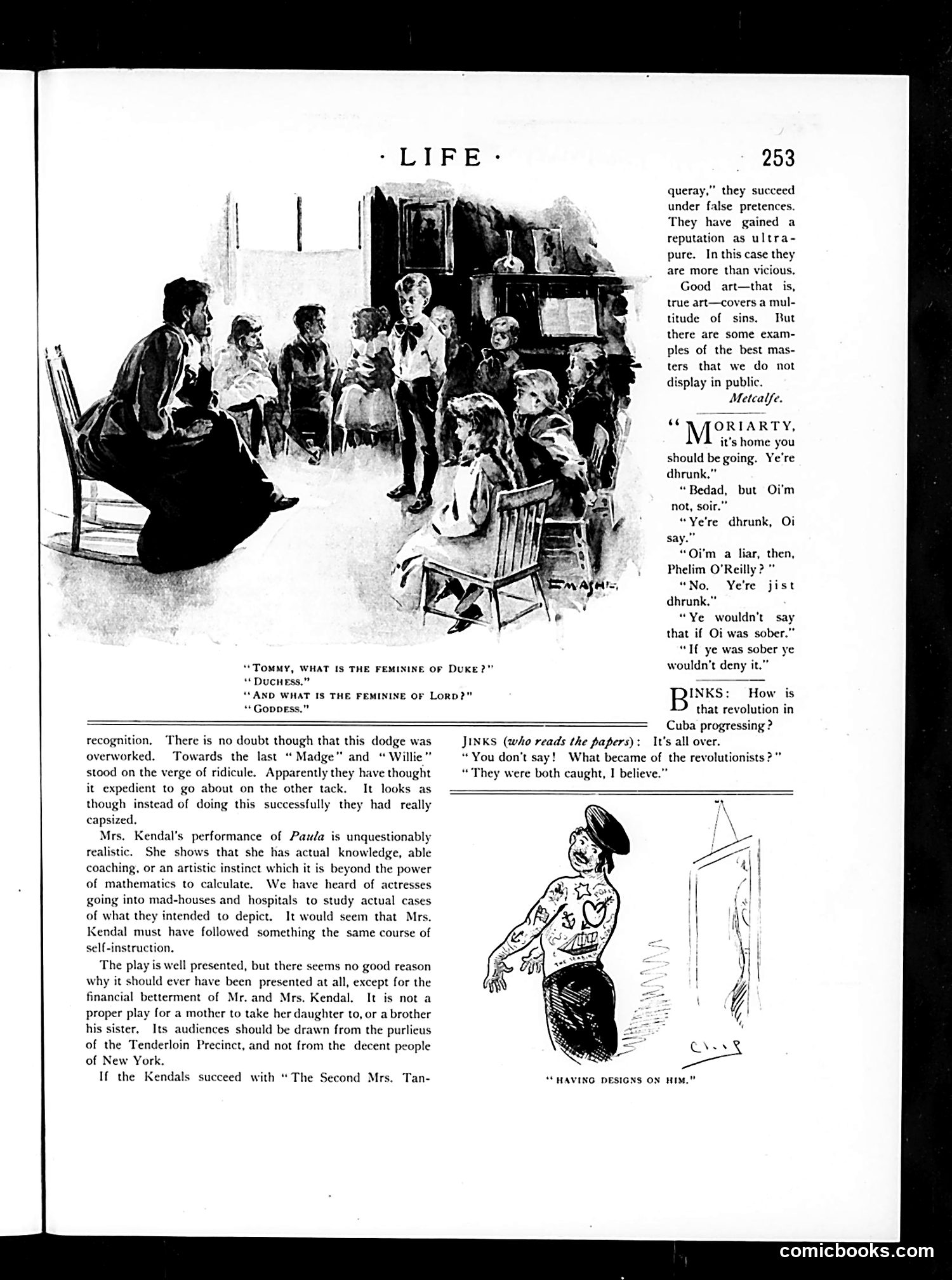
This page contains theatrical criticism and satirical humor typical of Life magazine's content. **Main cartoon (top):** Shows an adult teaching children grammar through a crude joke. When asked the "feminine" of "Duke" and "Lord," the children answer "Duchess" and "Goddess"—playing on how nobility titles have gendered forms, but the humor likely relies on innuendo about women's roles or behavior. **Irish dialect dialogue:** Features two Irish characters debating whether one is drunk, with wordplay: if sober, he'd deny being drunk; therefore his denial proves he *is* drunk. This reflects period stereotypes about Irish characters in American humor. **Cuba reference:** A brief topical exchange about a Cuban revolution being "all over" with both revolutionists caught—referencing actual Cuban independence struggles of the 1890s-1900s. **Cartoon (bottom right):** Shows a man covered in sketches/designs, captioned "Having designs on him"—a pun about literal artistic designs versus romantic intentions. The page primarily discusses theatrical reviews, criticizing a play called *Paula* while praising actress Mrs. Kendal's performance, though questioning the play's propriety.
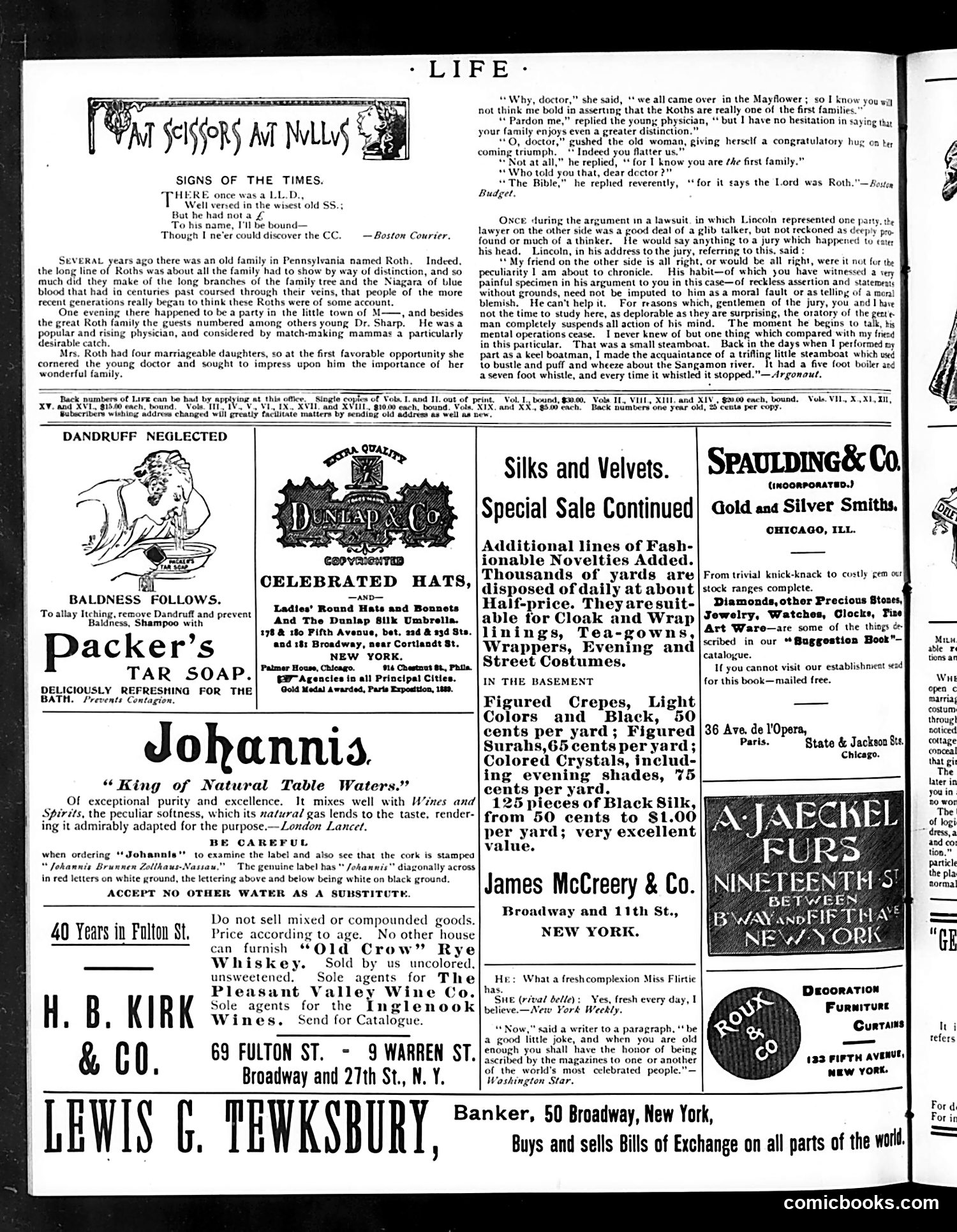
This page contains two humor pieces from Life magazine's "Signs of the Times" section: **First joke**: A Pennsylvania family named Roth prides itself on coming over on the Mayflower. When a young doctor is pressed about their importance, he replies they're "really one of the first families"—because the Bible says "the Lord was Roth" (a pun: "wroth" meaning angry). **Second joke**: Lincoln's courtroom anecdote compares his verbose opponent to a small steamboat on the Sangamon River that would stop whistling whenever it tried to whistle—suggesting constant talking prevents actual thinking. The satire mocks empty oratory and bluster without substance. Both jokes target **pretension and empty verbosity**—a recurring Life magazine theme. The first mocks genealogical snobbery; the second ridicules lawyers who talk excessively without meaning. The page is otherwise mostly **period advertisements** (soaps, silks, clothing, banking services).
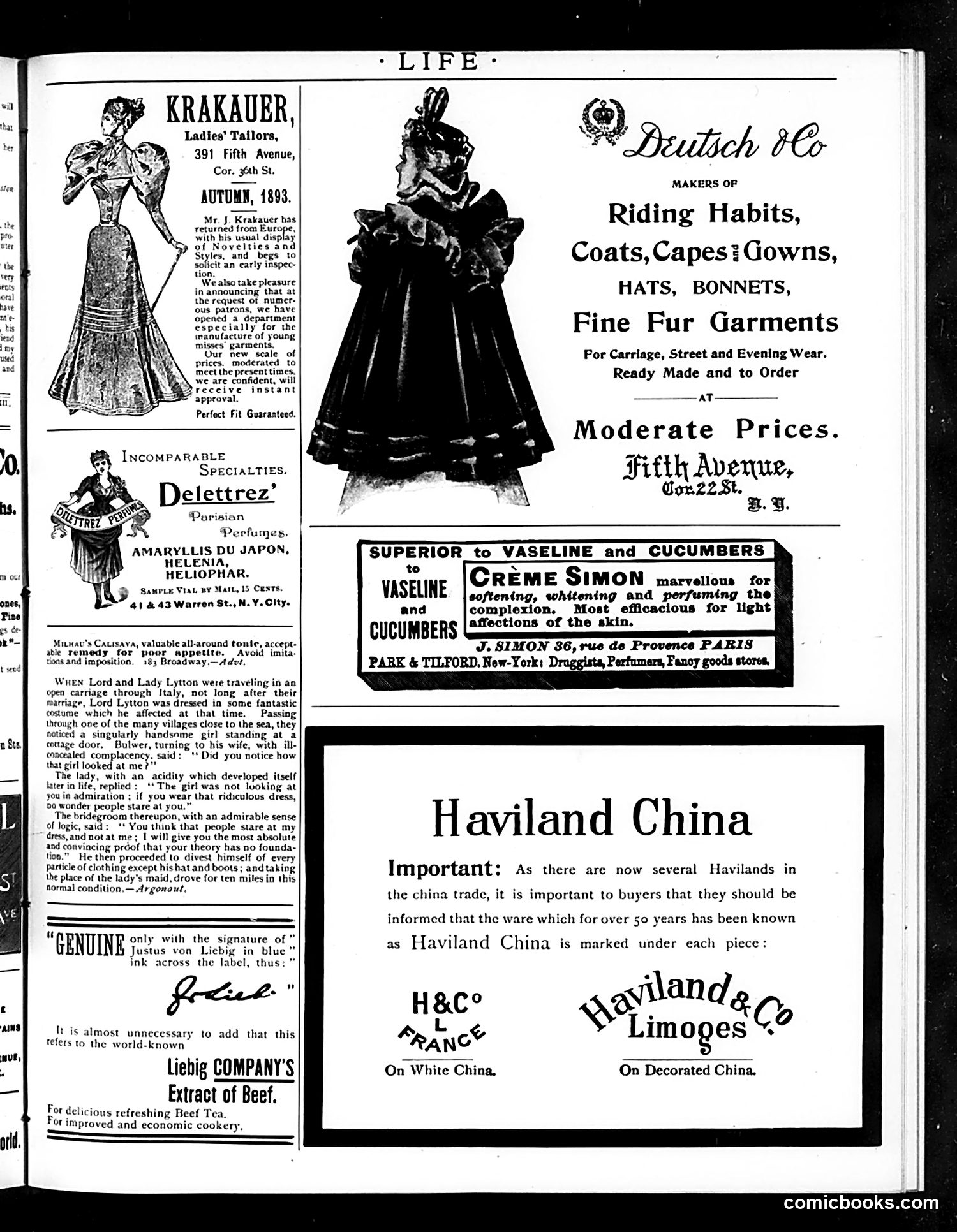
This page is primarily **advertising**, not political satire. It showcases luxury goods marketed to wealthy Americans in autumn 1893. The anecdote about Lord and Lady Lytton is a humorous story about marital vanity: Lord Lytton, wearing an eccentric costume, assumes a village girl is admiring him. His wife sarcastically suggests the girl is staring at his ridiculous outfit, not him. To "prove" her wrong, he strips naked (except hat and boots) and drives a carriage for ten miles—absurdist logic meant to entertain readers with the tale of aristocratic eccentricity and domestic wit. The advertisements reflect Gilded Age consumer culture: tailored clothing, French perfumes, china imports, and beauty products. The Haviland China notice addresses counterfeit goods—a real commercial concern of the era. These ads target upper-class readers with disposable income during the economic Panic of 1893, suggesting Life's affluent audience.
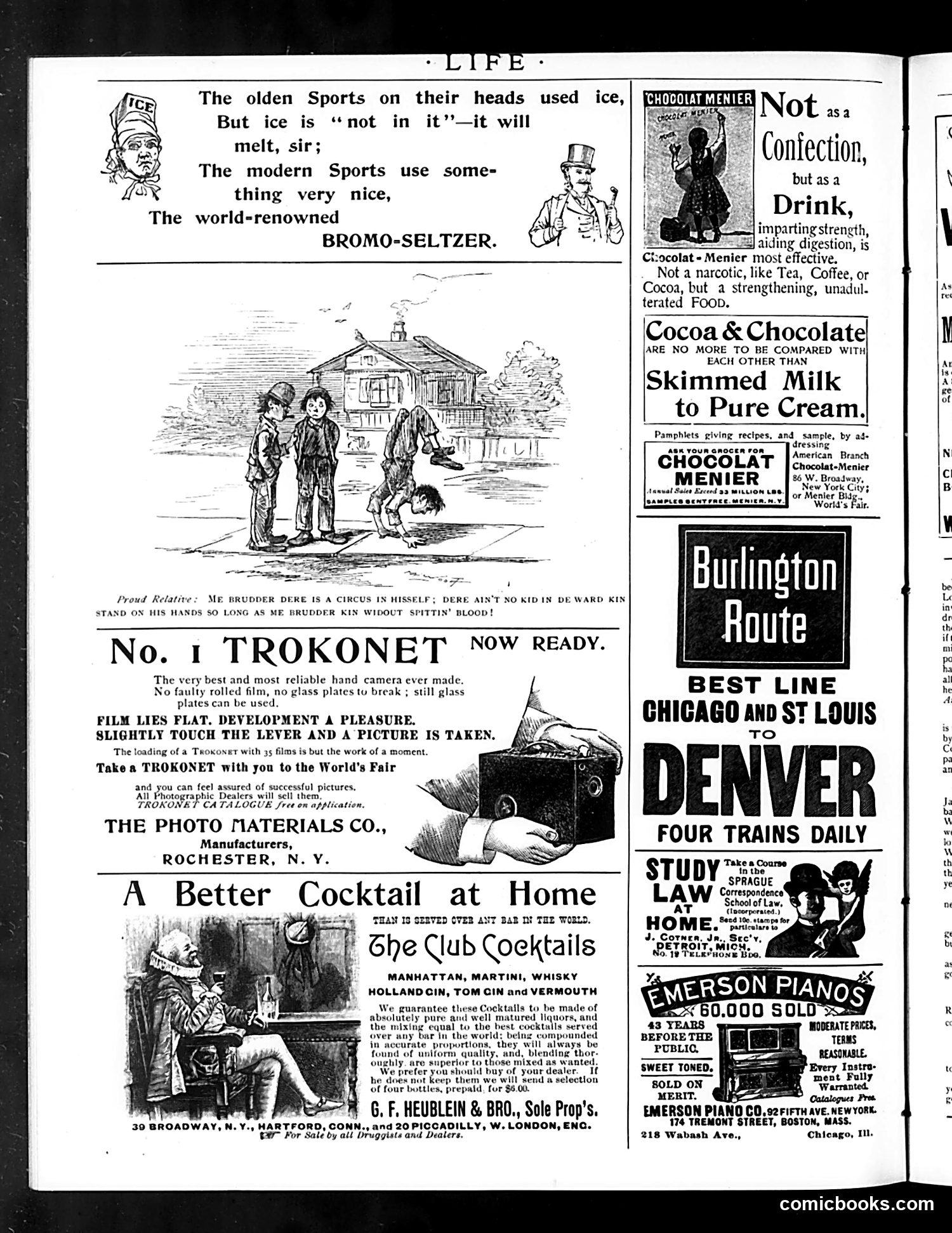
This page is primarily **advertising**, typical of early 1900s magazines. The sole cartoon is a brief ethnic humor sketch at top-left: **The Cartoon:** A "Proud Relative" (depicted with stereotypical immigrant dialect: "Me brudder dere") brags that his brother is "a circus in himself" and can hold a handstand longer than any neighborhood kid "widout spittin' blood"—implying extreme physical strain to the point of hemorrhaging. **The Joke:** The humor relies on: - Ethnic caricature (exaggerated immigrant speech patterns) - Absurd working-class machismo—equating an ability to cause oneself physical harm with accomplishment - The incongruity of a street kid's handstand being presented as a competitive feat **Context:** This reflects common early-20th-century American magazine humor that mocked immigrant communities through dialect and crude physical comedy. The page's remaining content is commercial ads for cameras, patent medicines (Bromo-Seltzer), cocktails, chocolate, trains, and pianos—targeting wealthy readers.
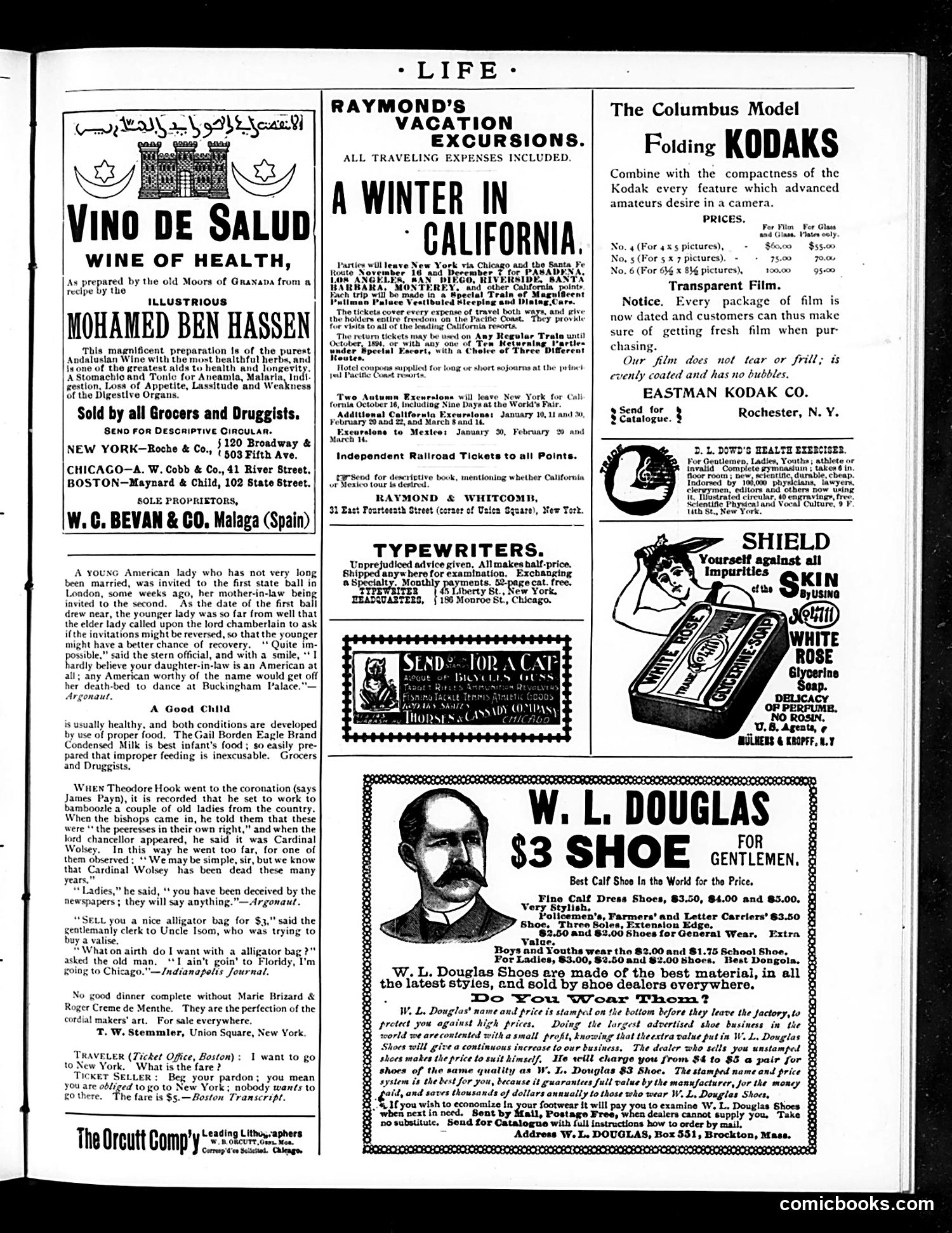
This page is primarily **advertisements and short humorous anecdotes**—not political cartoons. The content reflects late 19th-century American social attitudes: **Key advertisements:** - "Vino de Salud" (wine marketed as health tonic, attributed to "Moorish" origins—exploiting exoticized stereotypes) - W.L. Douglas shoes ($3, prominently featured with portrait) - Raymond's California vacation excursions - Kodak cameras, typewriters, Shield skin care products **Humor pieces satirize:** - American social climbing (young American woman prioritizing a London ball over health) - Class pretension and gullibility (Theodore Hook's hoax about "peeresses") - Rural/urban cultural gaps (backwoods traveler confused about train destinations) **Notable context:** The racial/ethnic marketing (Moorish wine seller) and patronizing rural humor reflect period attitudes. The emphasis on consumer products—cameras, transportation, branded goods—captures the emerging consumer culture of the 1890s-1900s era. This is essentially a **lifestyle/advertising page**, not editorial commentary.
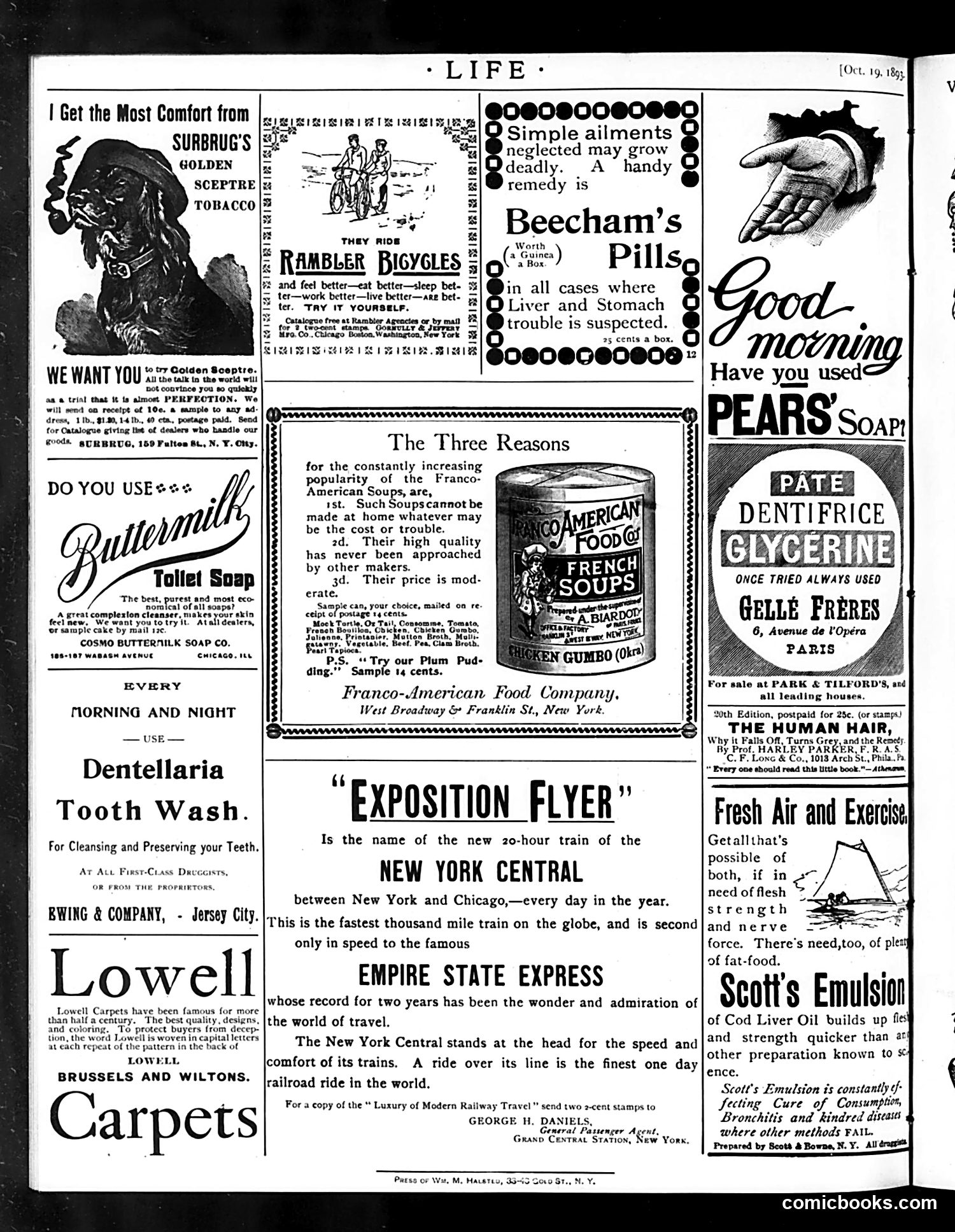
This is primarily an **advertising page** with no political cartoon or satire. The content consists entirely of commercial advertisements typical of the 1890s. Notable advertisements include: - **Surbrug's Sceptre Tobacco** and **Rambler Bicycles** (upper left) - **Beecham's Pills** for digestive complaints - **Pears' Soap** and **Scott's Emulsion** (cod liver oil tonics) - **New York Central Railroad** trains, including the "Exposition Flyer" and "Empire State Express"—promotional copy emphasizing speed and comfort for wealthy travelers between New York and Chicago - **Lowell Carpets** and **Buttermilk Soap** The page reflects Gilded Age consumer culture: patent medicines, emerging transportation technology, and luxury goods marketed to the middle and upper classes. There is no satirical content—these are straightforward product promotions typical of Life magazine's revenue model.