
Life, 1893-10-19 · page 12 of 18
Life — October 19, 1893 — page 12: what you’re looking at
What you’re looking at
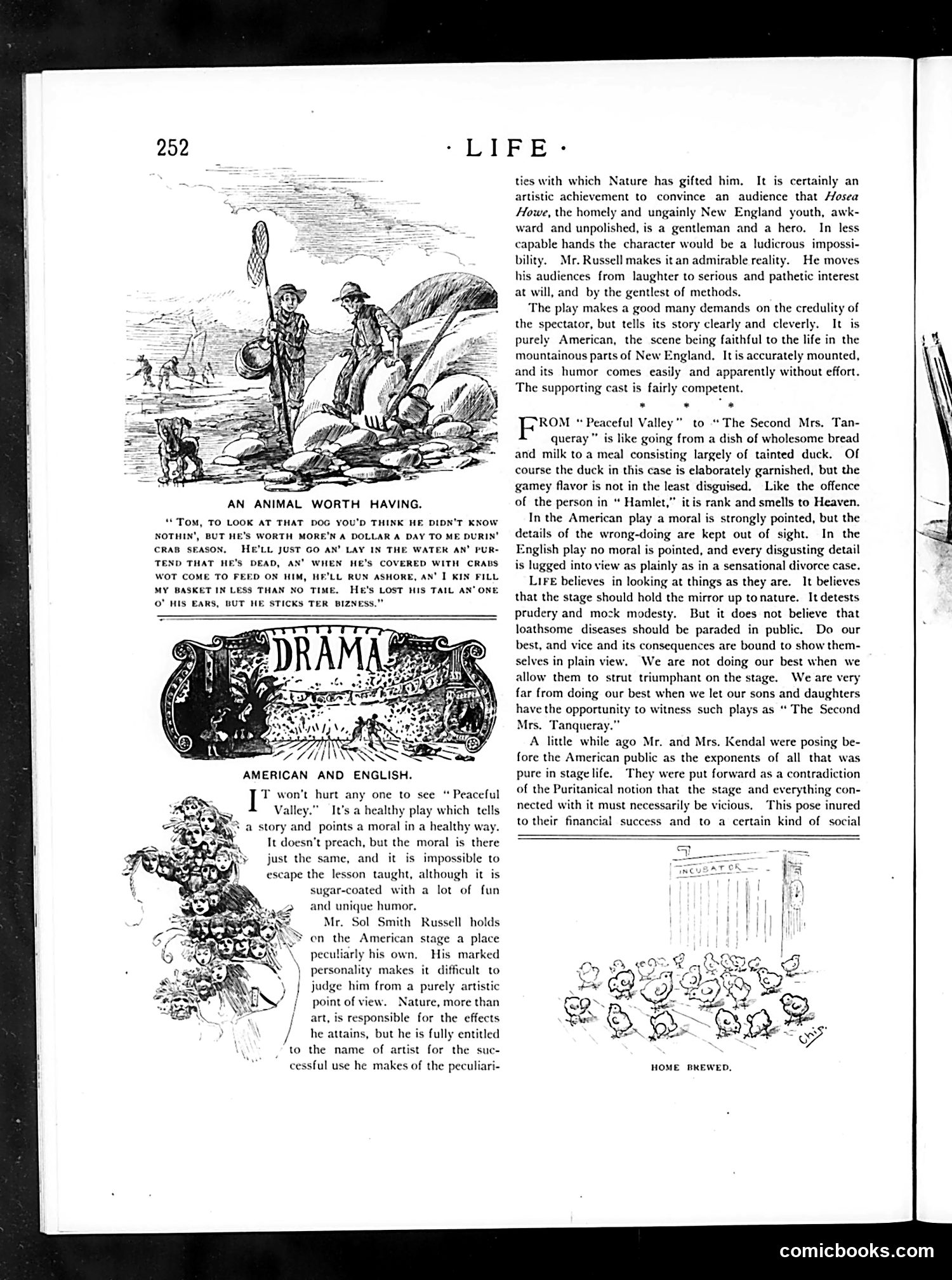
This page contains **drama criticism** comparing American and English plays, not political cartoons. The main illustrated anecdote ("An Animal Worth Having") is a humorous dialect story about a resourceful dog used during crab season—a simple rural joke with no political content. The substantive text reviews two plays: **"Peaceful Valley"** (American, starring Sol Smith Russell) and **"The Second Mrs. Tanqueray"** (English). Life praises the American play for its moral lesson delivered through wholesome humor and its accurate New England setting. It sharply criticizes the English play for graphically depicting vice and disease without moral purpose, comparing it unfavorably to the cleaner American approach. The critique reveals **Life's editorial stance**: the magazine supports theatrical realism ("hold the mirror up to nature") but opposes gratuitous depictions of immorality. It also dismisses the Kendals' claims to represent pure stage life as mere financial posturing. The "Home Brewed" illustration at bottom appears unrelated decoration. This represents **genteel American criticism** of the 1890s, contrasting Victorian American sensibilities with perceived English theatrical decadence.
📄 Transcribed text from this page (OCR, searchable)
Machine-transcribed from the original scan — historical spelling and the odd misread are preserved.
‘LIFE: AN ANIMAL WORTH HAVING. “ToM, TO LOOK AT THAT DOG YOU'D THINK HE DIDN'T KNOW NOTHIN’, BUT HE'S WORTH MORE'N A DOLLAR A DAY TO ME DURIN CRAB SEASON, HE'LL JUST GO AN’ LAY IN THE WATER AN’ PUR- TEND THAT HE'S DEAD, AN’ WHEN HE'S COVERED WITH CRABS WOT COME TO FEED ON HIM, HE'LL RUN ASHORE, AN' I KIN FILL MY BASKET IN LESS THAN NO TIME. He's LOST HIS TAIL AN’ ONE O° HIS EARS, BUT HE STICKS TER BIZNE: te AN BINS AMERICAN AND ENGLISH. T won't hurt any one to see “ Peaceful Valley.” a healthy play which tells * a story and points a moral in a healthy way. It doesn’t preach, but the moral is there just the same, and it is impossible to escape the lesson taught, although it is sugar-coated with a lot of fun and unique humor, Mr. Sol Smith Russell holds > on the American stage a place peculiarly his own, His marked personality makes it difficult. to judge him from a purely artistic point of view. Nature, more than art, is responsible for the effects he attains, but he is fully entitled to the name of artist for the suc- cessful use he makes of the peculiari- ties with which Nature has gifted him. It is certainly an artistic achievement to convince an audience that Hosea Howe, the homely and ungainly New England youth, awk- ward and unpolished, is a gentleman and a hero. In less capable hands the character would be a ludicrous impossi- bility. Mr. Russell makes it an admirable reality. He moves his audiences from laughter to serious and pathetic interest at will, and by the gentlest of methods. The play makes a good many demands on the credulity of the spectator, but tells its story clearly and cleverly. It is purely American, the scene being faithful to the life in the mountainous parts of New England. Itis accurately mounted, and its humor comes easily and apparently without effort. The supporting cast is fairly competent. » . ee ROM “ Peaceful Valley” to “The Second Mrs. Tan- queray " is like going from a dish of wholesome bread and milk to a meal consisting largely of tainted duck. Of course the duck in this case is elaborately garnished, but the gamey flavor is not in the least disguised. Like the offence of the person in “ Hamlet,” itis rank and smells to Heaven, In the American play a moral is strongly pointed, but the details of the wrong-doing are kept out of sight. In the English play no moral is pointed, and every disgusting detail is lugged into view as plainly as in a sensational divorce case. LIFE believes in looking at things as they are. It believes that the stage should hold the mirror up tonature. It detests prudery and mock modesty. But it does not believe that loathsome diseases should be paraded in public. Do our best, and vice and its consequences are bound to show them- selves in plain view. We are not doing our best when we allow them to strut triumphant on the stage. We are very far from doing our best when we let our sons and daughters have the opportunity to witness such plays as “ The Second Mrs. Tanqueray.” A little while ago Mr. and Mrs. Kendal were posing be- fore the American public as the exponents of all that was pure in stage life. They were put forward as a contradiction of the Puritanical notion that the stage and everything con- nected with it must necessarily be vicious. This pose inured to their financial success and to a certain kind of social HOME BREWED, comicbooks.com