
A complete issue · 16 pages · 1893
Life — September 21, 1893
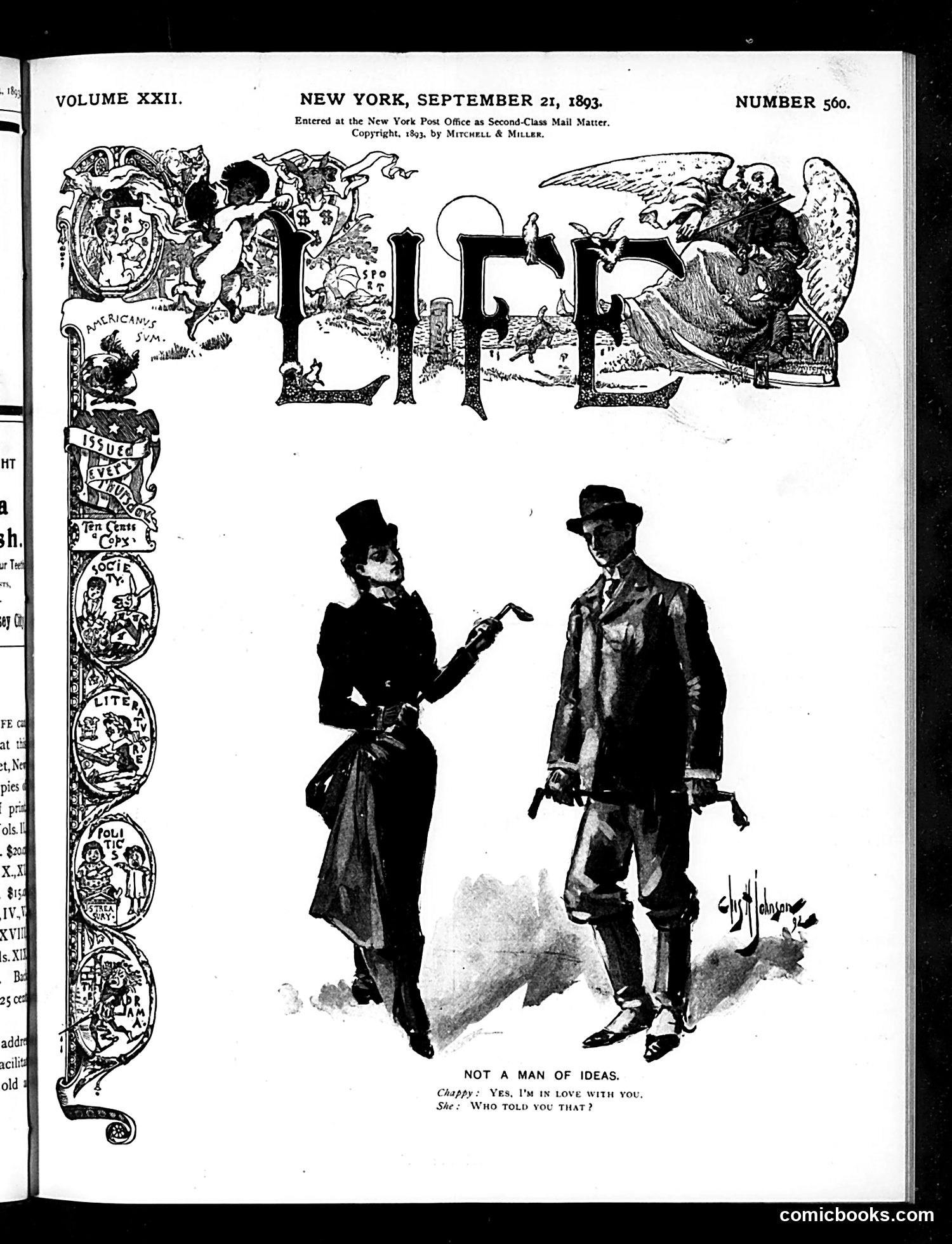
This cartoon satirizes a romantic encounter between two figures in formal 1890s dress. The title "Not a Man of Ideas" and dialogue ("Yes, I'm in love with you. / Who told you that?") suggest the male figure is intellectually unoriginal—he's merely repeating conventional romantic lines rather than expressing genuine sentiment. The humor targets the vapidity of men who rely on clichéd declarations of love without authentic thought or creativity. This reflects late-Victorian era anxieties about masculinity, sincerity, and gender relations. The woman's skeptical response ("Who told you that?") implies she recognizes his borrowed words, making him appear foolish for lacking original ideas even in matters of the heart.
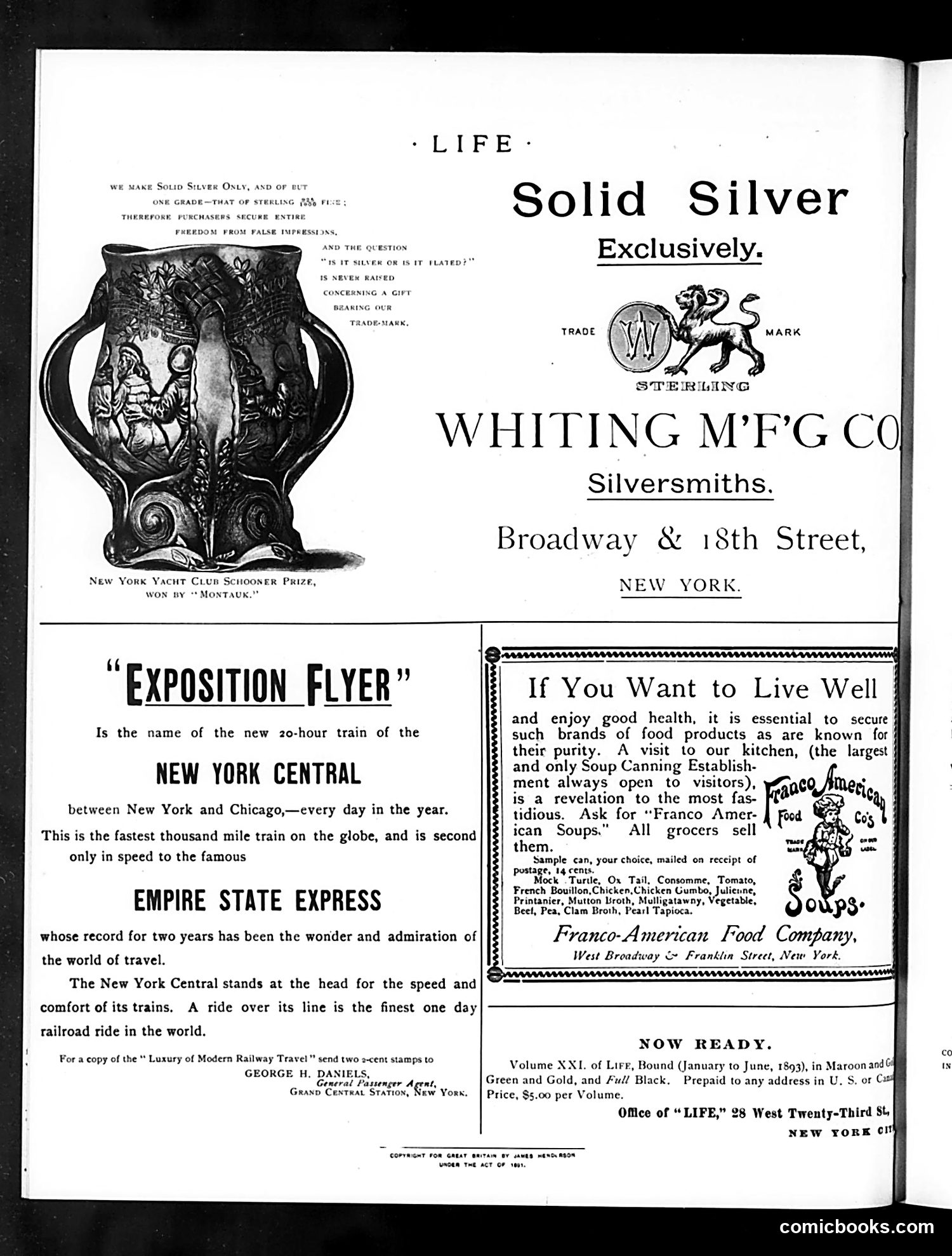
This page is primarily **advertising** rather than political satire. The main content consists of three commercial advertisements: 1. **Whiting Mfg Co** (top right): A silversmith promoting solid sterling silver goods, using an ornate trophy image as proof of quality 2. **New York Central Railroad** (center-left): Promoting two passenger trains—the "Exposition Flyer" (20-hour service between New York and Chicago) and the "Empire State Express"—emphasizing speed and comfort 3. **Franco-American Food Company** (right): Marketing canned soups and food products, emphasizing purity and kitchen convenience The page lacks political cartoons or satirical commentary. It represents typical late-19th-century magazine advertising, mixing luxury goods, transportation services, and food products aimed at middle/upper-class readers.
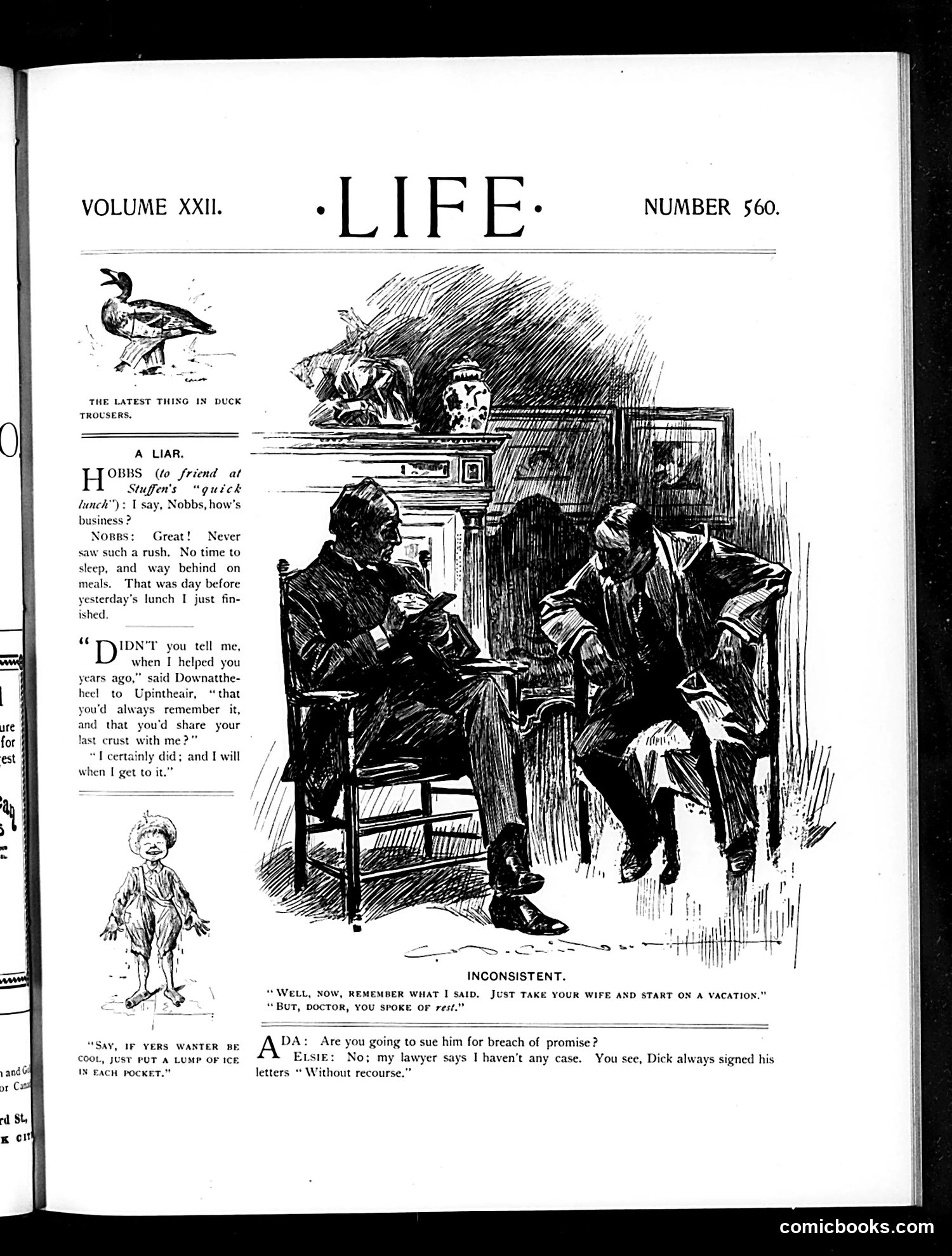
This page contains two distinct satirical pieces: **"A Liar"**: A comic dialogue where Nobbs boasts about never sleeping or resting during lunch, claiming he finished yesterday's meal only recently. His friend counters by reminding him of a past promise Nobbs made to share his last crust—which Nobbs now conveniently denies, then reverses his story. The satire mocks habitual liars who contradict themselves and lack consistency. **"Inconsistent"**: A doctor-patient scene where Ada asks Elsie if she'll sue a man for breach of promise. Elsie refuses because her lawyer says the defendant signed letters marked "without recourse"—a legal protection preventing lawsuit. The joke satirizes how people use fine print and legal loopholes to escape personal obligations, particularly romantic ones. Both pieces critique character flaws: dishonesty and legal evasion of moral responsibility.
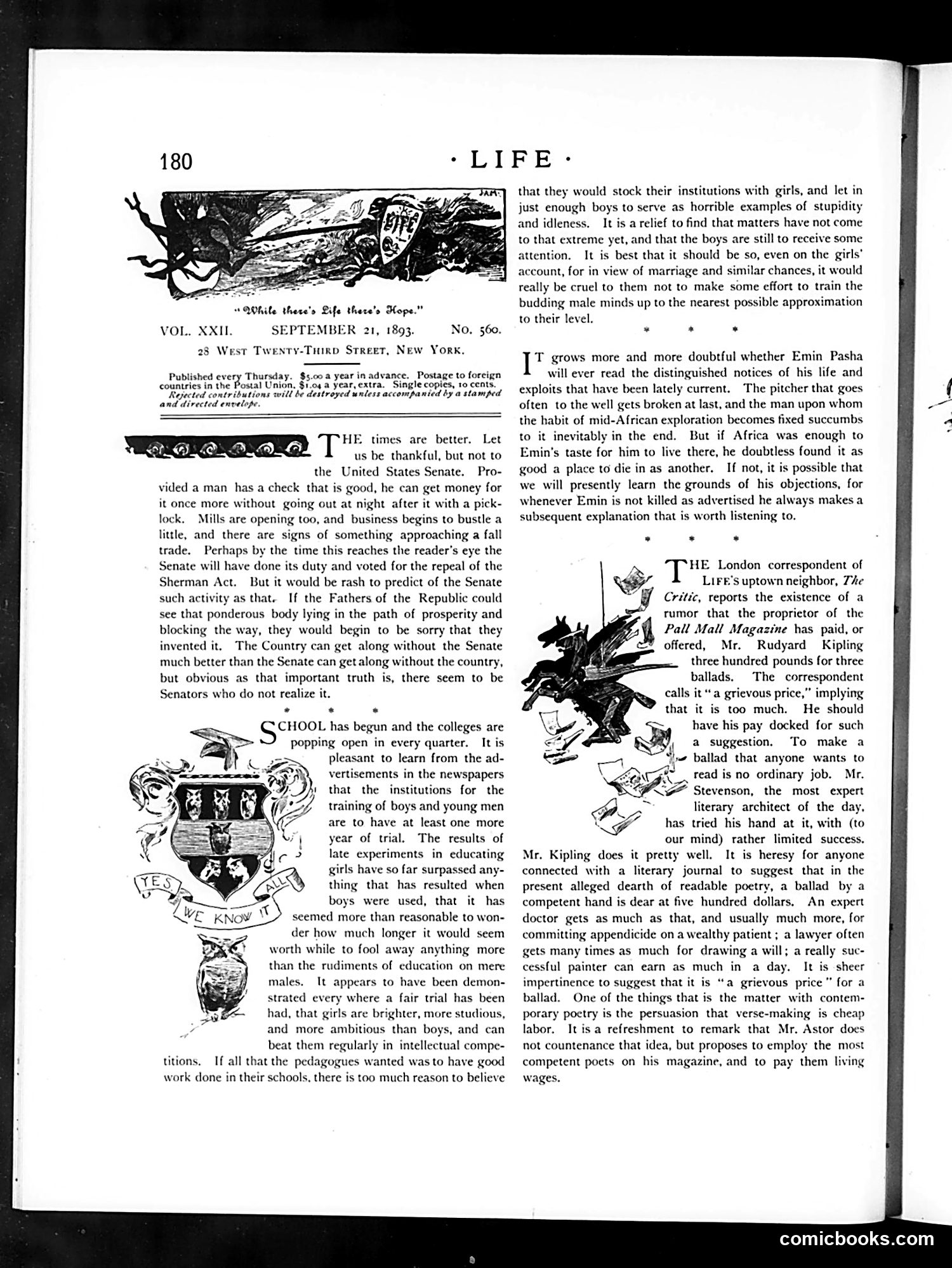
This page contains three distinct satirical pieces. The top cartoon mocks educational policy, showing a disheveled figure labeled "Where there's Life there's Hope," criticizing debates over school curriculum and gender education. The middle section argues that girls outperform boys academically and questions why education resources go primarily to male students, suggesting this represents wasted investment. The lower section discusses Rudyard Kipling's literary magazine, satirizing the "exorbitant" price he allegedly paid for poetry submissions—three hundred pounds for ballads. The satire mocks contemporary debates about proper compensation for literary work, implying Kipling overpaid for inferior verse and that contemporary poetry lacks sufficient value to justify such expense.
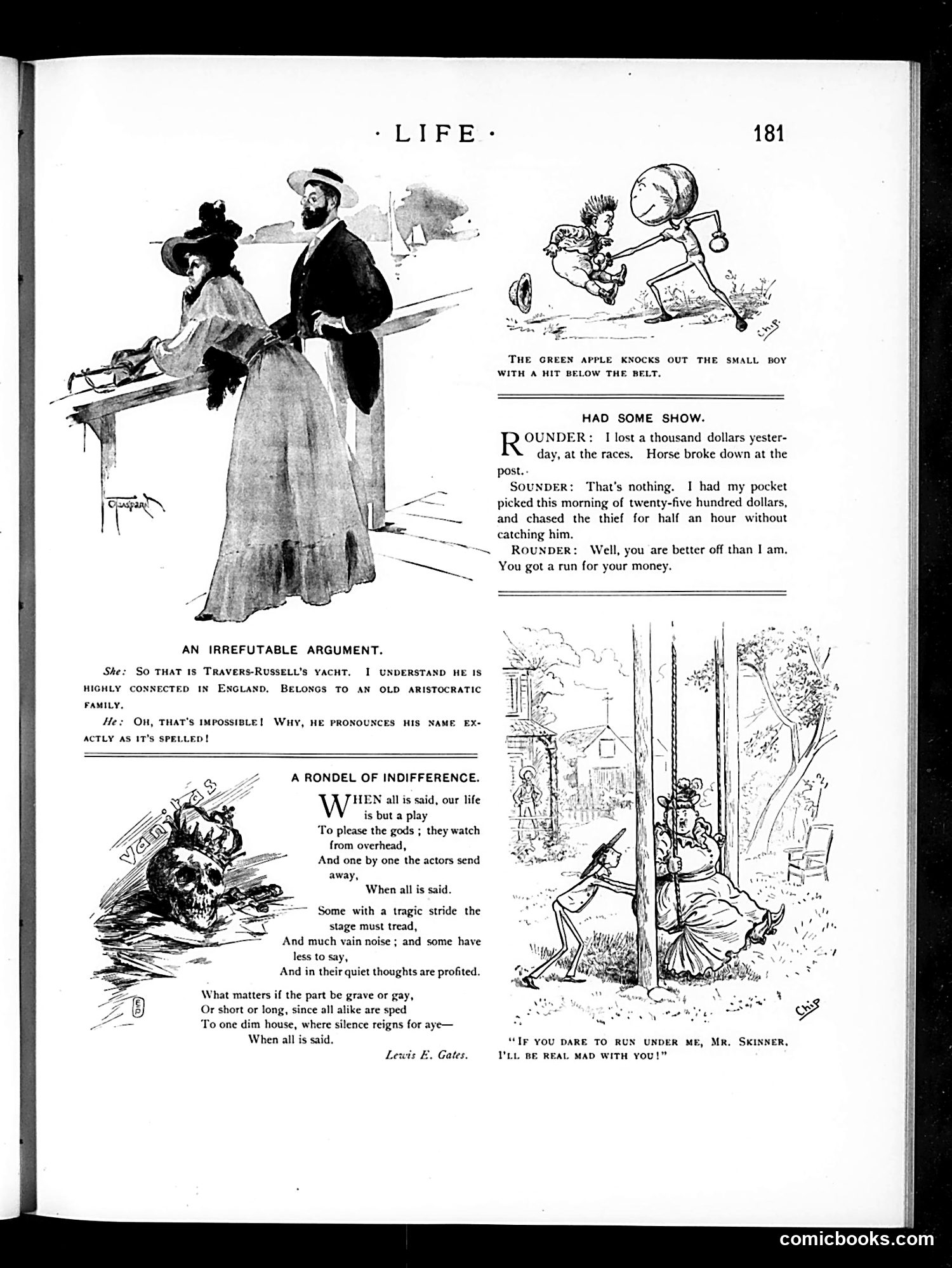
This page contains three distinct satirical pieces: 1. **"An Irrefutable Argument"**: A couple debates the pronunciation of "Travers-Russell's yacht." The woman insists it's pronounced exactly as spelled, while the man protests it's impossible. This mocks pretentious upper-class affectation and the absurdity of aristocratic naming conventions. 2. **"Had Some Show"**: A brief dialogue between "Rounder" and "Sounder" about losing money—one at horse races, one to a pickpocket. The joke emphasizes that both lost their money, making them equally unfortunate. 3. **"A Rondel of Indifference"**: A poem by Lewis E. Gates reflecting on life as theater, where all actors eventually exit. It's philosophical commentary on life's transience and human insignificance. The illustrations are period-appropriate line drawings typical of early 1900s satirical magazines.
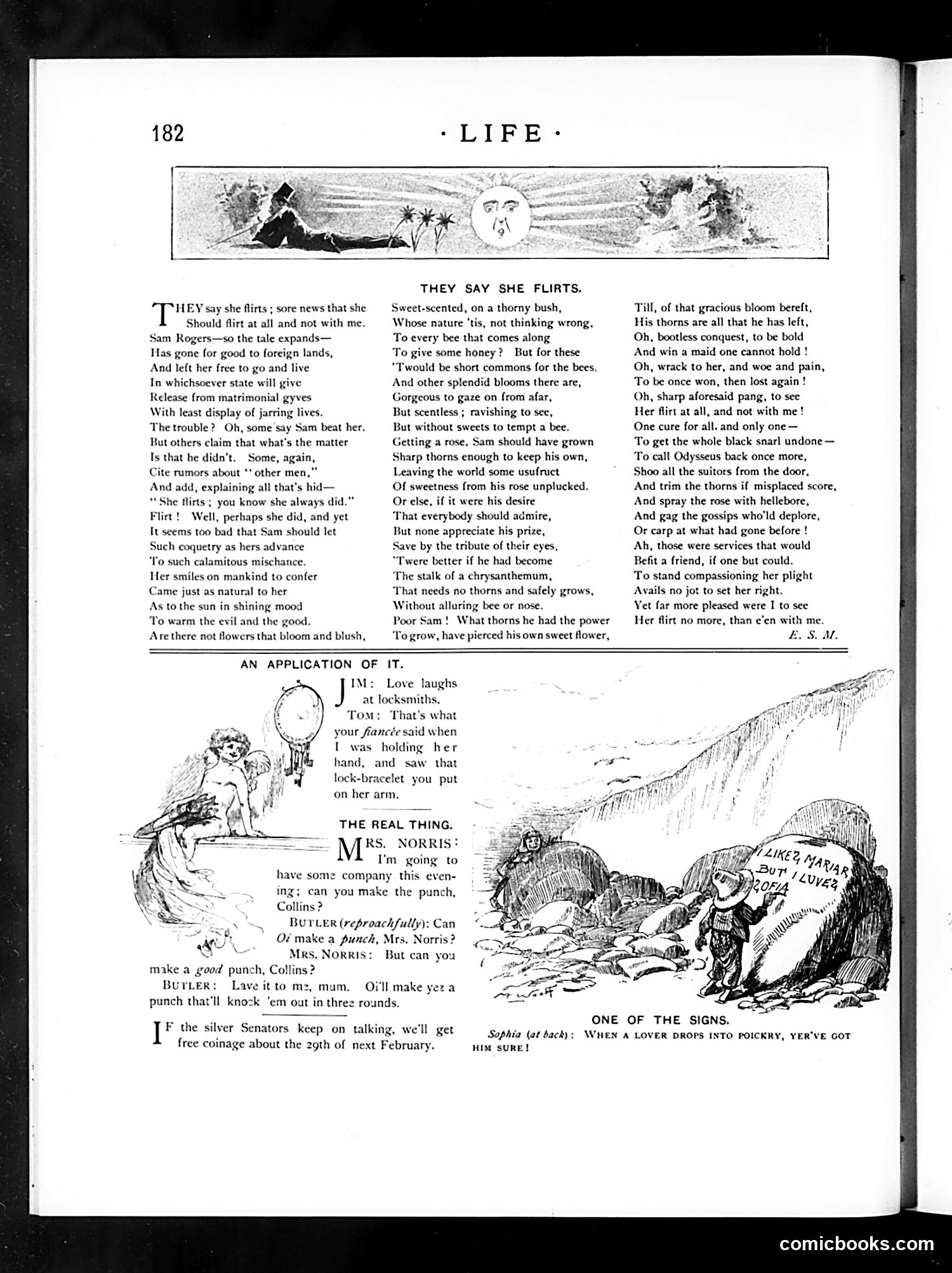
This page contains three separate satirical pieces: 1. **"They Say She Flirts"** — A poem defending a woman accused of flirtation, arguing Sam Rogers unfairly blames her for his unrequited affection. The satire critiques how women are blamed for men's romantic disappointments. 2. **"An Application of It"** — A brief comic dialogue where Tom jokes that his fiancée's "fancy" said something when holding her hand and seeing a lock-bracelet on her arm. The humor plays on supposed female superficiality regarding jewelry. 3. **"The Real Thing"** and **"One of the Signs"** — Comic sketches about relationships and romance, with the latter featuring characters labeled as lovers and references to pickpockets, using romantic mishaps for humor. The page satirizes Victorian-era courtship, gender dynamics, and romantic assumptions of the period.
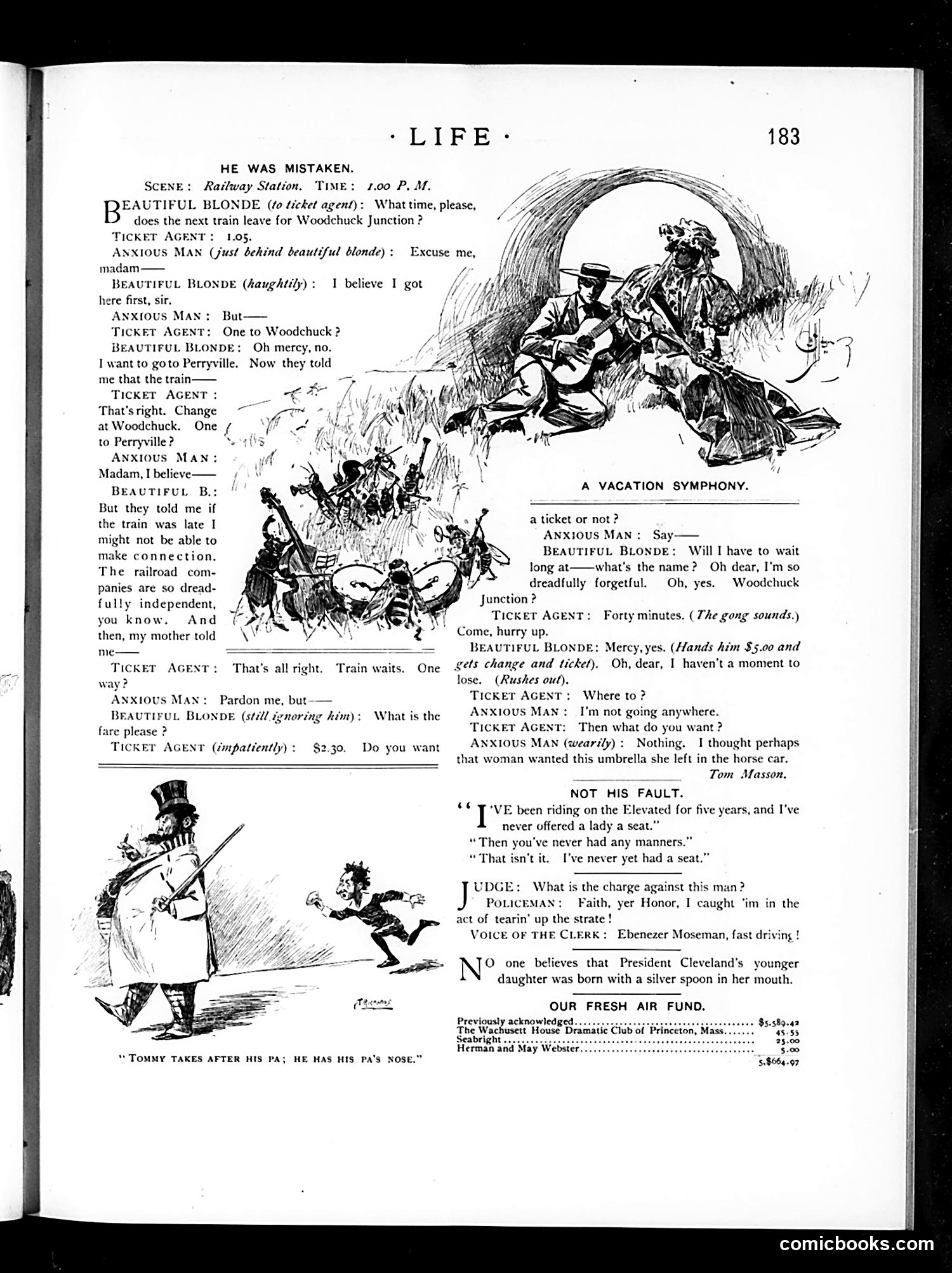
This page contains two satirical pieces: **"He Was Mistaken"** depicts a comedic railway station scene where a beautiful blonde woman mistakes which train goes to Woodchuck Junction, creating confusion with a ticket agent and anxious man. The humor relies on the woman's absent-mindedness and the ensuing misunderstanding—typical early-20th-century domestic comedy. **"Not His Fault"** presents a brief joke about an Elevated train conductor and a woman offering a seat, with class commentary about manners and entitlement. The cartoons reflect period concerns about transportation, gender relations, and social etiquette. A reference to President Cleveland's daughter appears at page's bottom, though its relevance is unclear from context alone. The illustrations use period-typical pen-and-ink style characteristic of Life magazine's satirical humor.
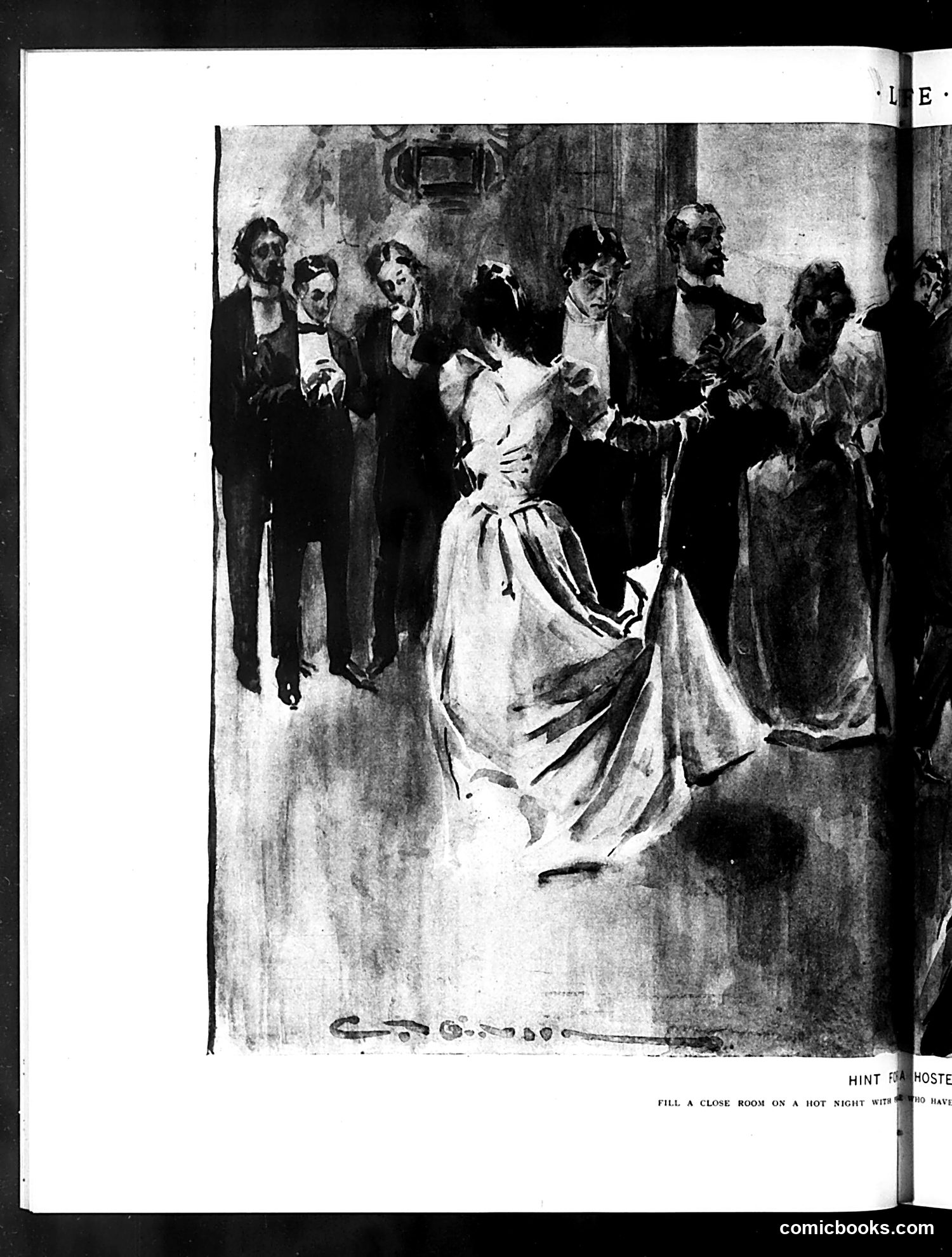
This appears to be a satirical illustration from *Life* magazine depicting a social scene in an interior setting. A woman in a light-colored dress stands prominently in the center, surrounded by formally-dressed men in dark suits. The caption at the bottom is partially legible, mentioning "HINT FOR HOSTESS" and reference to "FILL A CLOSE ROOM ON A HOT NIGHT WITH..." The satire appears to target social etiquette or party hosting practices. The crowded, uncomfortable arrangement—many figures pressed together in what seems a confined space—likely mocks either poor party planning or an exaggerated social convention of the era. The woman's central, somewhat isolated position suggests the joke may involve gender dynamics or the particular pressures on female hosts to manage social situations. Without clearer text, the specific satirical target remains uncertain, though it clearly comments on early 20th-century social customs.
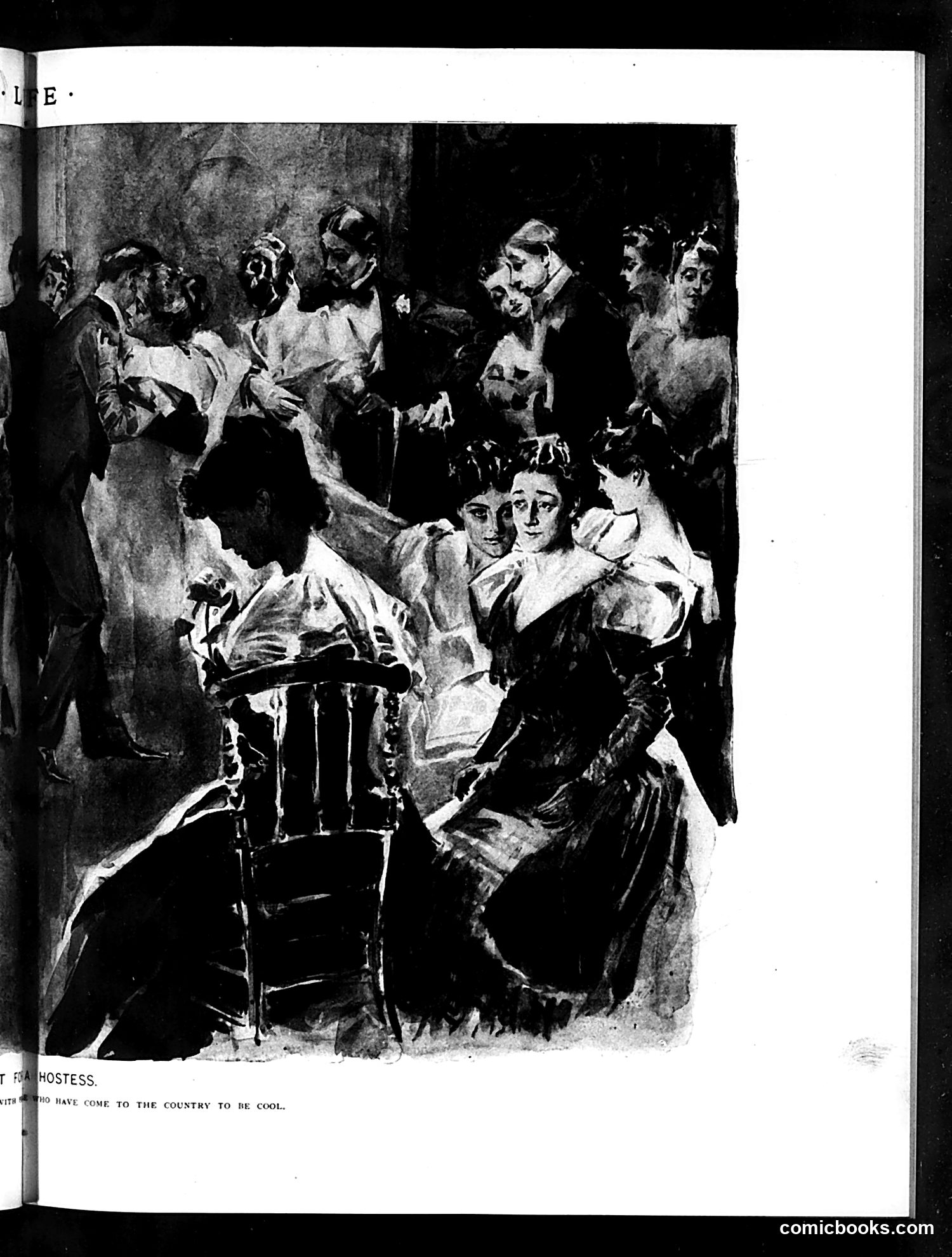
This appears to be a satirical illustration titled "A SMART HOSTESS" with the caption "SAYS WHO HAVE COME TO THE COUNTRY TO BE COOL." The image depicts a social gathering where a hostess (seated, center) entertains fashionably dressed guests in what appears to be a late 19th or early 20th-century setting. The satire likely mocks the pretensions of upper-class women who invited city guests to country estates during hot weather, presenting themselves as refined "smart" hostesses. The composition suggests social anxiety or performance—guests appear somewhat stiff or awkward, which may be the joke: despite efforts to appear sophisticated and cool (in the sense of fashionable and composed), the gathering's artificiality is exposed. The crowded, somewhat chaotic arrangement undercuts any claims to elegance or comfort the hostess wishes to project.
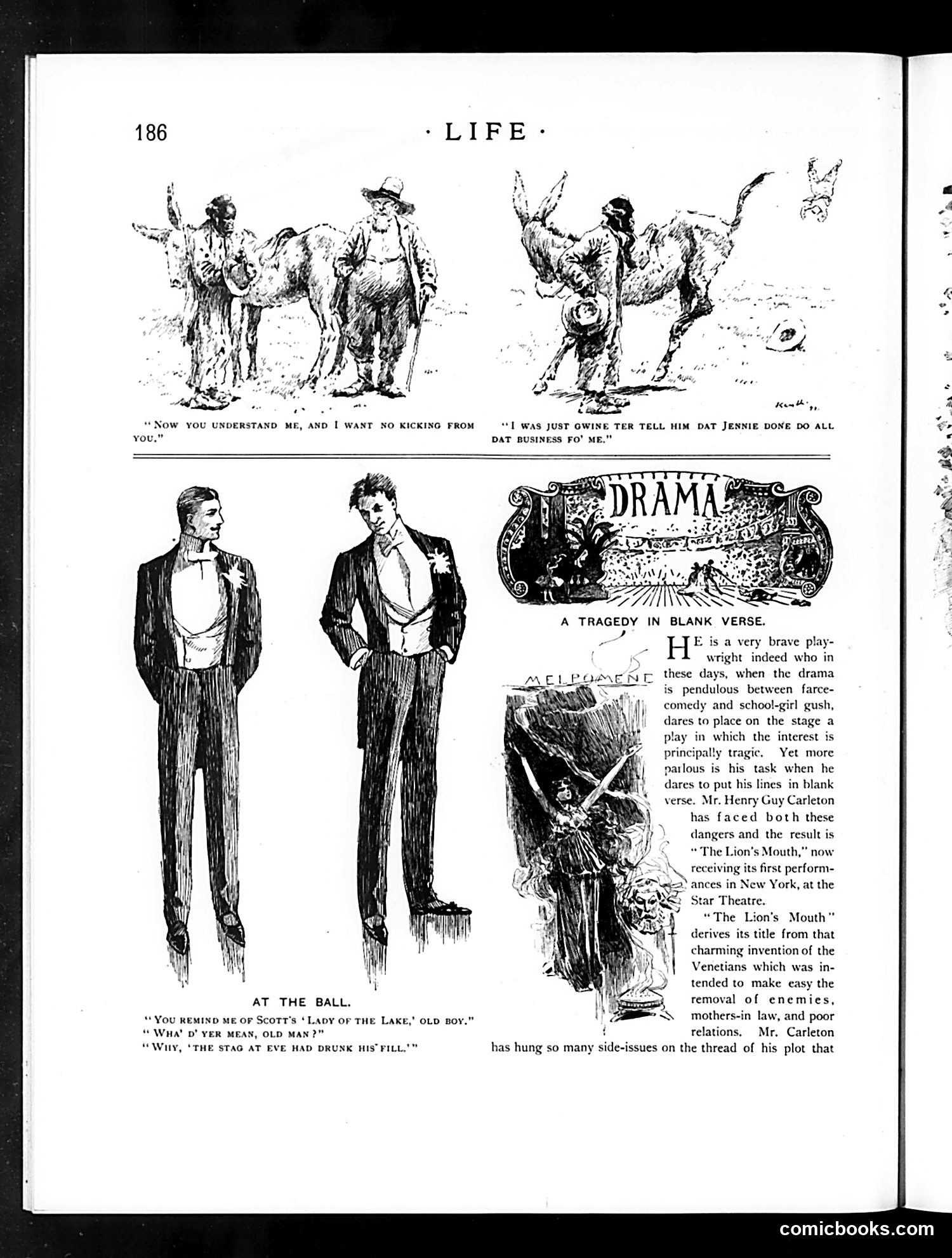
This page contains two distinct sections: **Top cartoons**: Rural/Western humor depicting disagreements between men and animals (mules). The dialogue suggests conflicts over labor and responsibility—typical frontier comedic fare about stubborn animals and exasperated handlers. **"At the Ball" section**: Two formal-dressed men in evening wear, with dialogue referencing Scott's "Lady of the Lake" and getting drunk at a ball. This appears to be social satire about upper-class men at formal events, mocking their pretentious literary references and drinking habits. **"Drama" section**: A review of Henry Guy Carleton's play "The Lion's Mouth," described as a tragedy in blank verse. The critic notes Carleton ambitiously combines tragic and comedic elements, acknowledging the play's complex plotting. This is theater criticism rather than political satire.
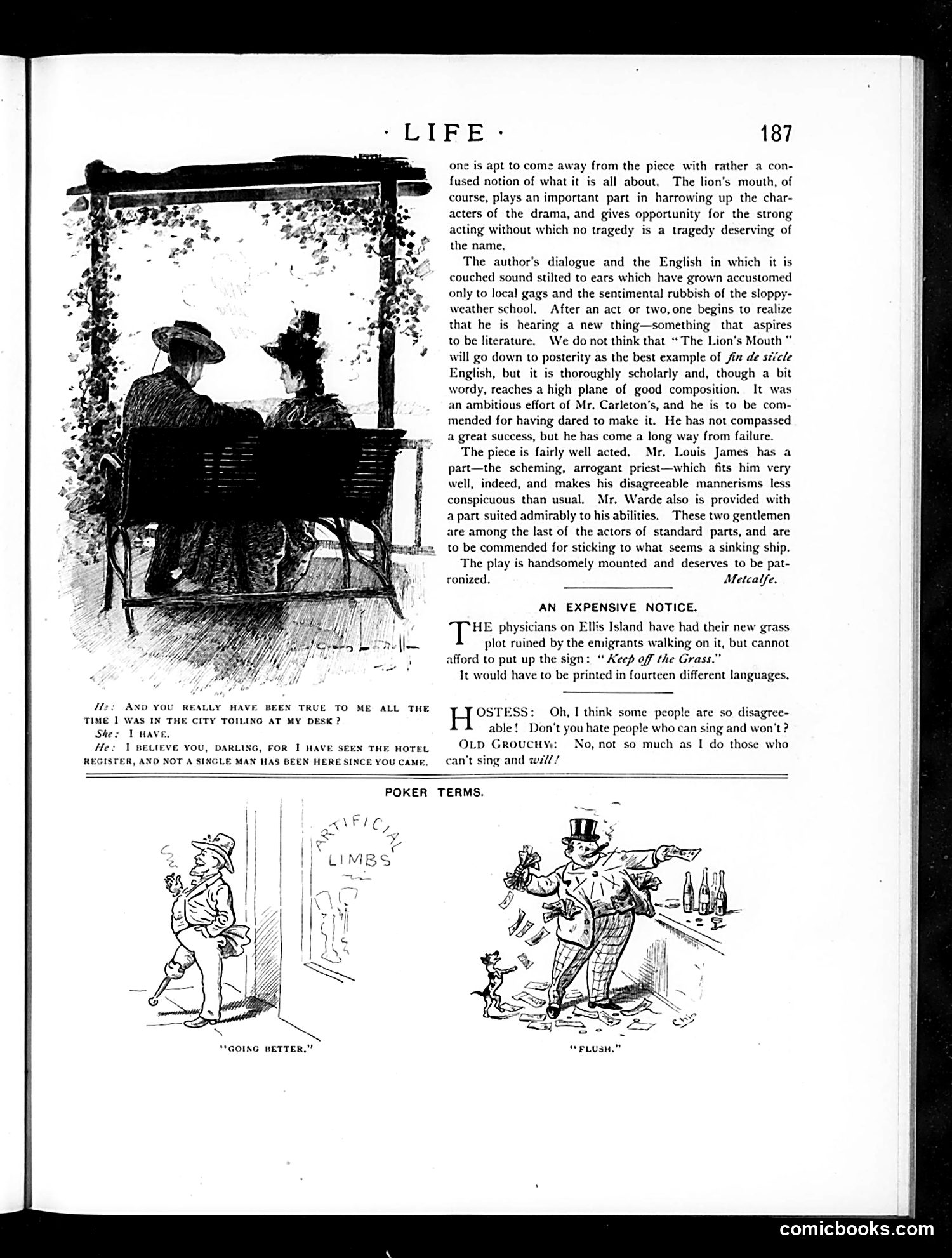
This page contains theater criticism and satirical cartoons about poker terms. The upper section reviews "The Lion's Mouth," praising the acting while noting the dialogue is "wordy" but "scholarly." The actors Louis James and Warde are specifically commended. Below are two poker-themed cartoons labeled "Going Better" and "Flush." These appear to be visual puns on poker terminology applied to social situations—likely depicting men in various states of financial or social fortune. The cartoons use gambling slang as metaphors for everyday circumstances, a common satirical device of the era. An "Expensive Notice" section jokes about immigrants at Ellis Island needing signs in fourteen languages. The humor relies on knowledge of poker terminology and period social attitudes toward immigrants and gambling culture.
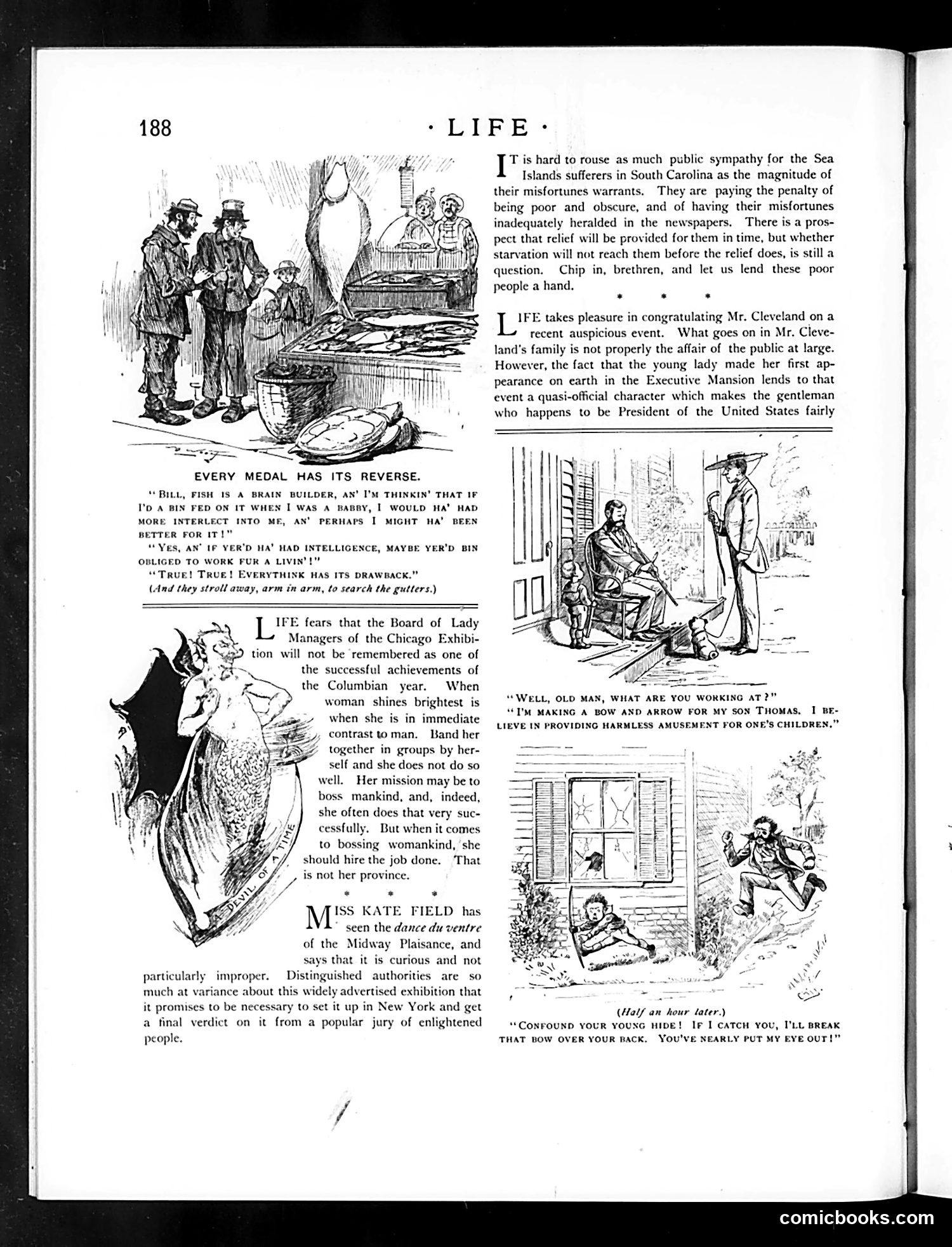
This page contains multiple satirical pieces typical of Life's social commentary: **"Every Medal Has Its Reverse"** depicts two poor men discussing fish as brain food—a working-class conversation where one ironically suggests eating fish as a baby might have made him smarter, and his companion quips that intelligence would have forced him to work for a living. The joke mocks both pseudo-scientific health claims and the ironic disadvantages of education for the impoverished. **Other editorial items** address: - Relief efforts for impoverished Sea Islands residents in South Carolina, critiquing inadequate newspaper coverage - President Cleveland's family (likely referencing his daughter's birth at the White House) - The Board of Lady Managers at the Chicago World's Fair, sarcastically questioning women's effectiveness managing other women - Kate Field's review of the "Dance du Ventre" (belly dance) at the fair's Midway Plaisance The final cartoon shows a father making a toy bow for his son, then raging moments later when the arrow nearly hits his eye—satirizing parental hypocrisy about "harmless amusement."
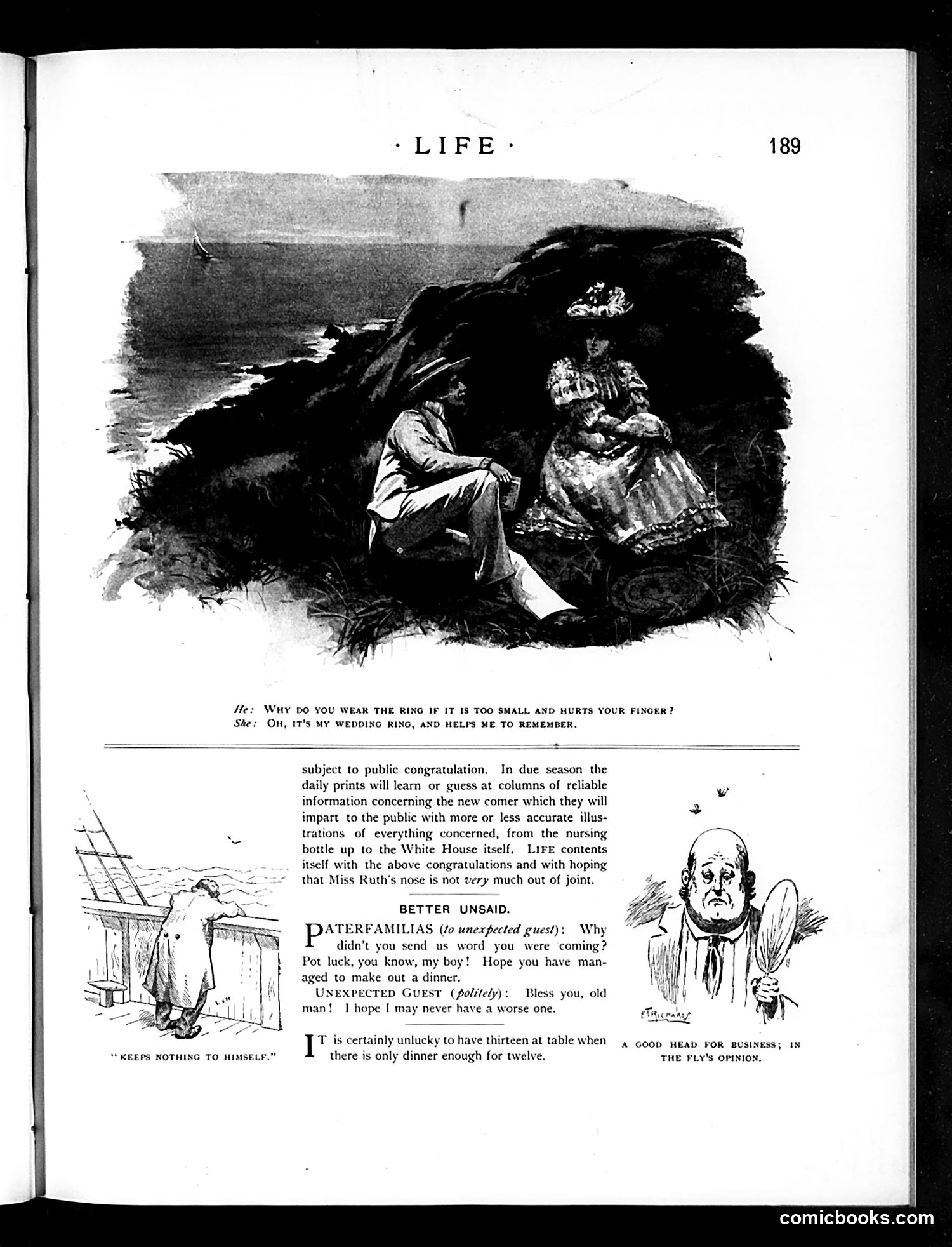
This page contains three separate satirical pieces typical of early 20th-century American humor: **Top cartoon:** A couple discusses a painfully tight wedding ring. The joke is that she wears it despite discomfort because it reminds her of marriage—satirizing the idea that matrimony itself is an uncomfortable, constraining institution one must endure. **"Better Unsaid" section:** Two brief dialogues mock social pretense. The first shows a host awkwardly caught unprepared for a surprise guest, then both parties politely lie about the inadequate meal quality. The second jokes that having thirteen dinner guests when food is meant for twelve is unlucky—but the real "luck" issue is the host's embarrassment and guests going hungry. **Bottom right:** A small illustration of a bald man with a fly, captioned as "a good head for business; in the fly's opinion"—a crude joke implying the man's head resembles an attractive breeding ground for insects. The page satirizes social embarrassment, marital discontent, and false politeness—common Life magazine targets.
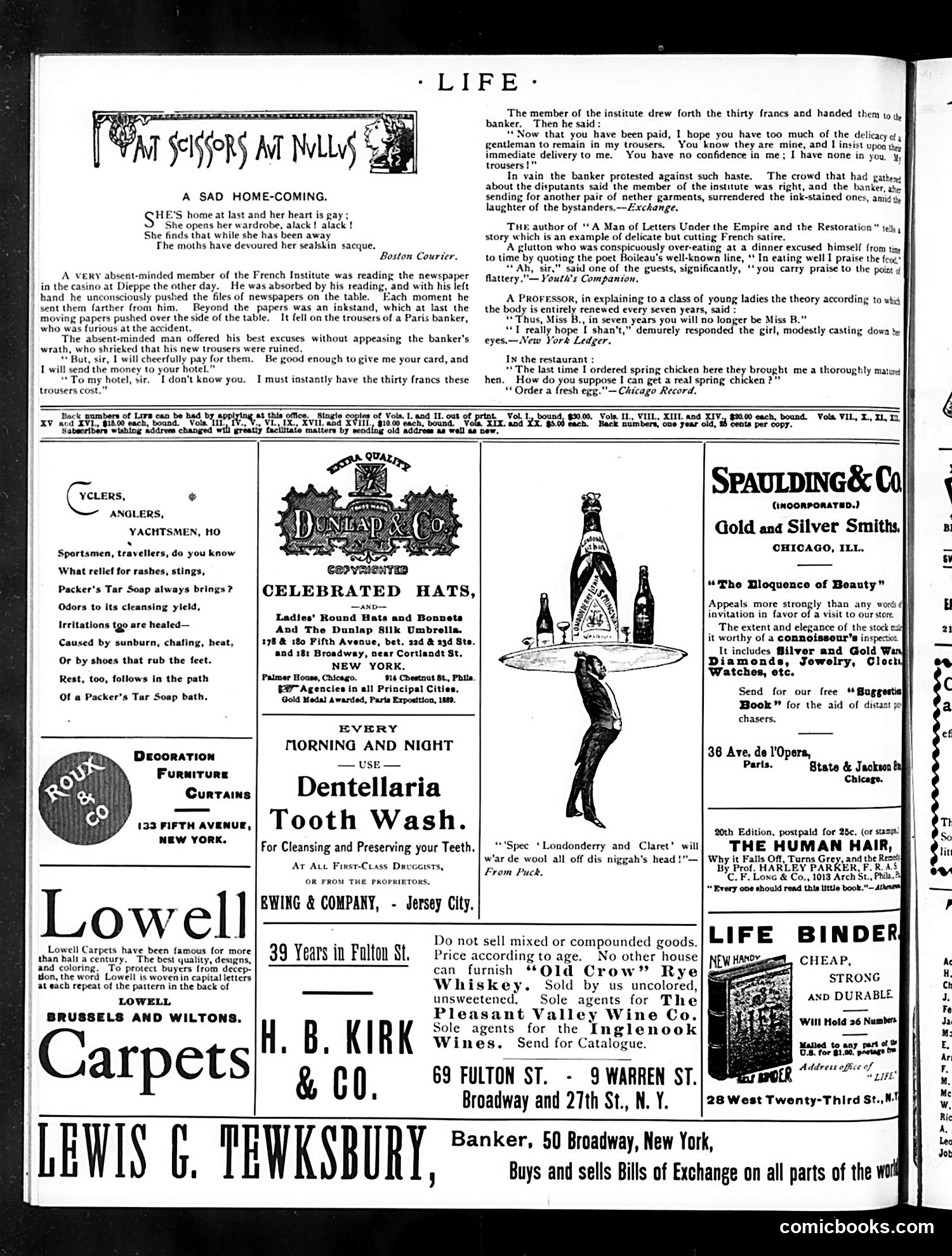
This page is primarily **advertising and humorous anecdotes** rather than political cartoons. The title section "A Sad Home-Coming" presents a light domestic joke: a woman returns home to find moths have destroyed her valuable sealskin coat—a relatable concern for wealthy households of the era. Below that are three French anecdotes demonstrating Continental wit. The most developed story involves an absent-minded French scholar who accidentally spills ink on a banker's trousers, then demands their return after paying compensation—satirizing French logic and honor codes. The remaining jokes mock gluttons and restaurants serving old poultry as "spring chicken." The bulk of the page consists of **period advertisements** for carpets, hats, tooth wash, wine, furniture, and banking services—typical of Life magazine's revenue model. There are no identifiable political figures or contemporary events referenced.
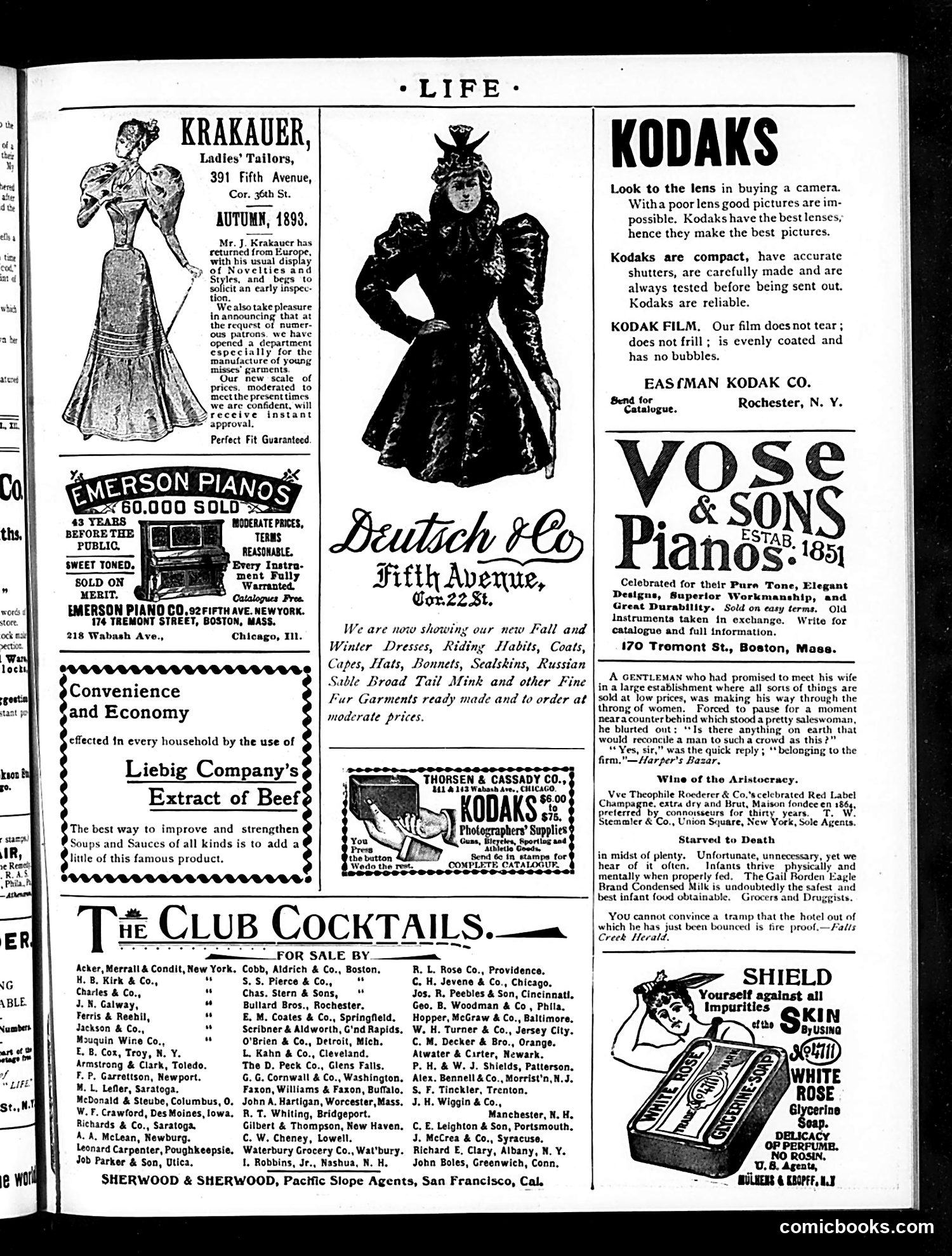
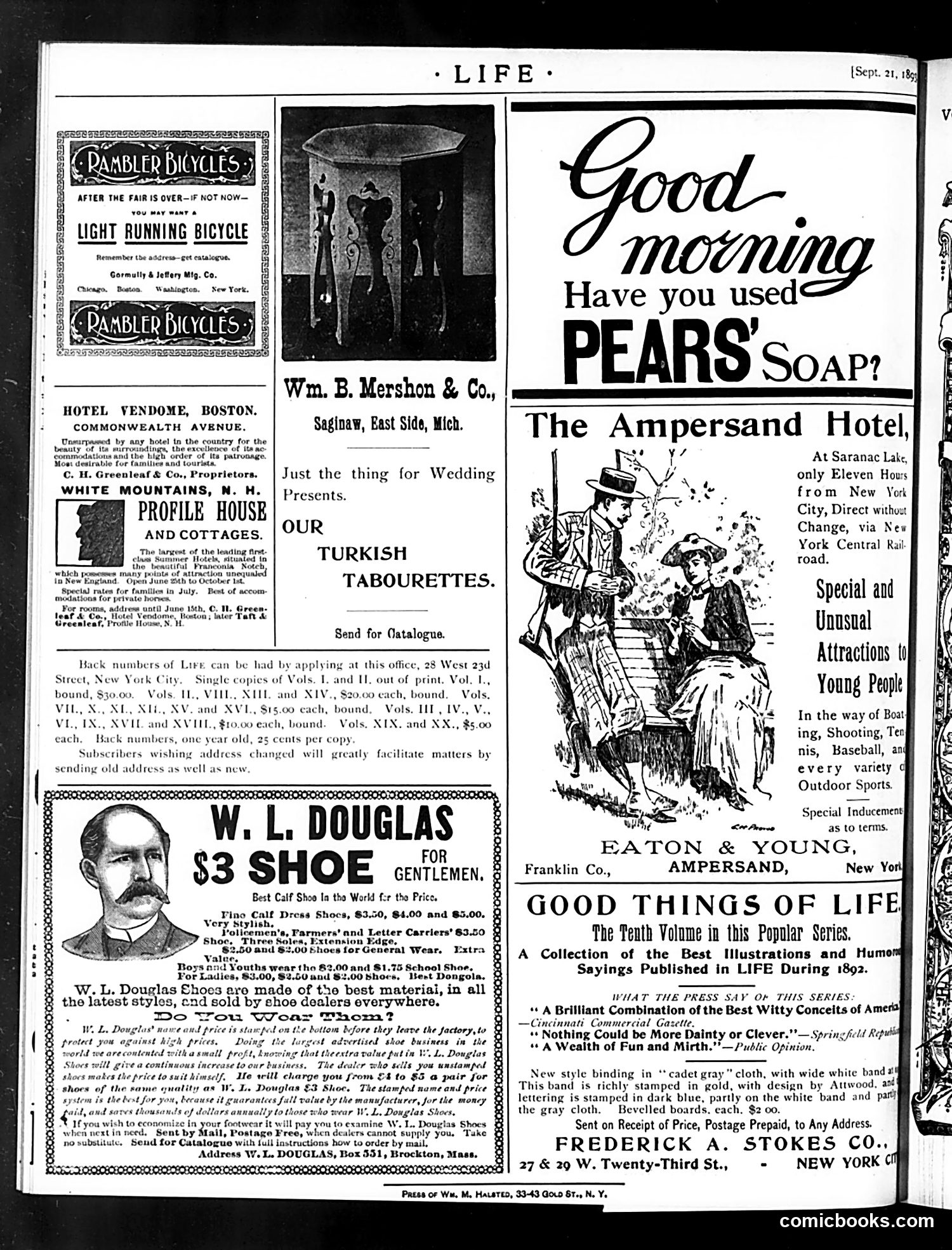
This is primarily an **advertising page** with minimal editorial content. The page contains commercial advertisements for bicycles, hotels, shoes, and soap typical of 1890s publications. The only illustration with potential satirical intent is an **unsigned sketch by "Eaton & Young"** showing a well-dressed gentleman (top hat, formal attire) distributing items to children and a woman. This appears to be a straightforward advertisement for the Ampersand Hotel in Saranac Lake, promoting recreational attractions for young people—likely depicting the hotel's owner or manager as a generous benefactor. The **W.L. Douglas shoe advertisement** features the founder's portrait and emphasizes factory-direct pricing as an anti-fraud measure—a common concern in 1890s mail-order commerce. The **"Good Morning—Have you used Pears' Soap?"** is a famous period advertisement. Overall, this page contains **no obvious political or social satire**—it's a commercial section designed to generate revenue for the magazine rather than provide editorial commentary.