
Life, 1893-09-21 · page 4 of 16
Life — September 21, 1893 — page 4: what you’re looking at
What you’re looking at
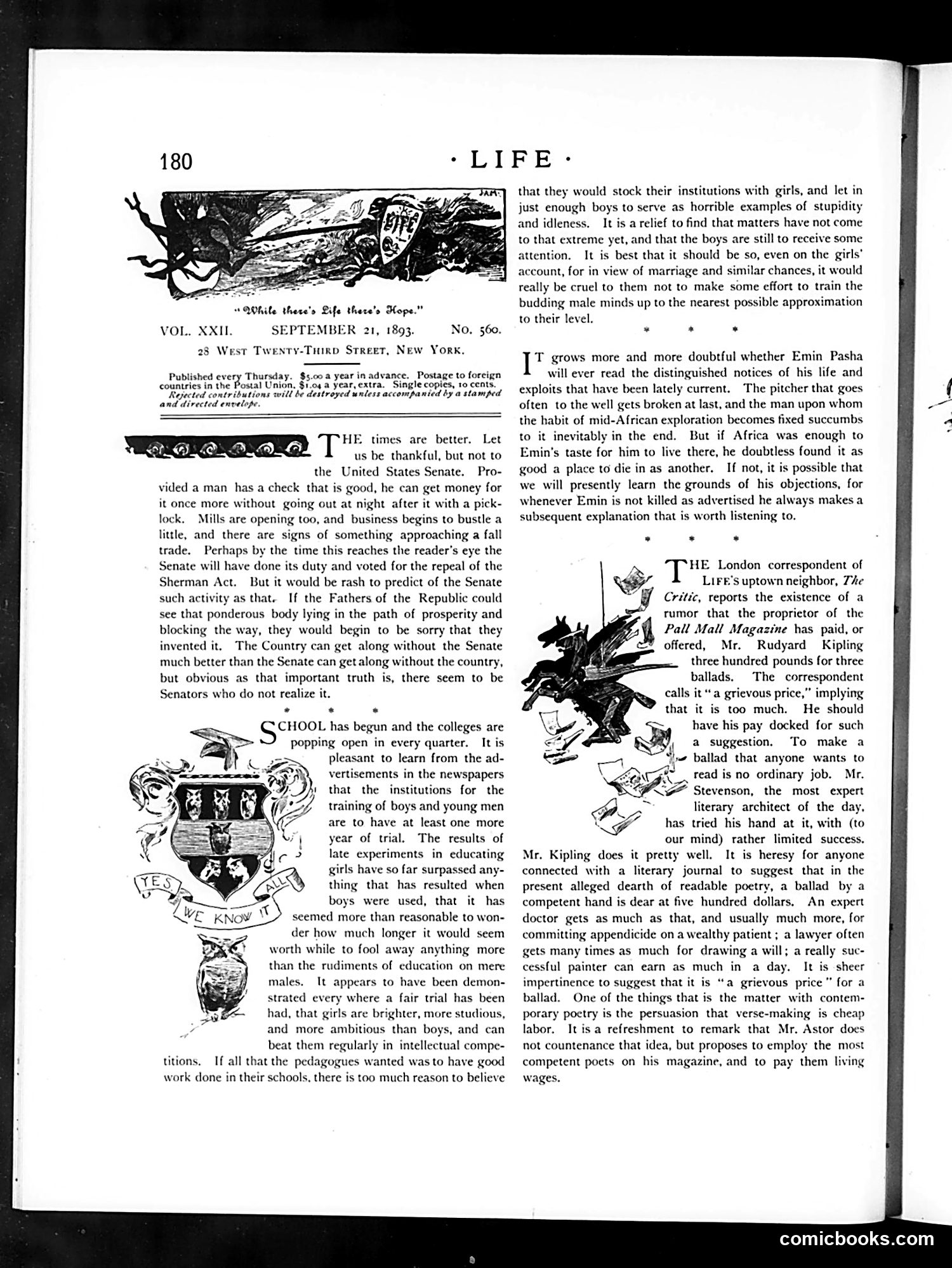
This page contains three distinct satirical pieces. The top cartoon mocks educational policy, showing a disheveled figure labeled "Where there's Life there's Hope," criticizing debates over school curriculum and gender education. The middle section argues that girls outperform boys academically and questions why education resources go primarily to male students, suggesting this represents wasted investment. The lower section discusses Rudyard Kipling's literary magazine, satirizing the "exorbitant" price he allegedly paid for poetry submissions—three hundred pounds for ballads. The satire mocks contemporary debates about proper compensation for literary work, implying Kipling overpaid for inferior verse and that contemporary poetry lacks sufficient value to justify such expense.
📄 Transcribed text from this page (OCR, searchable)
Machine-transcribed from the original scan — historical spelling and the odd misread are preserved.
* LIFE: TEMBER 21, 1893. 28 West Twenty-Tuirp Street, New York. Published every Thursday. $5.00 a year in advance. Postage to foreign countries in the Postal Union, $1.04 a year, extra. Single copies, 10 cents. Rejected contributions will be destroyed unless accompanied by a stamped and directed envelope, HE times are better, Let us be thankful, but not to the United States Senate. Pro- vided a man has a check that is good, he can get money for it once more without going out at night after it with a pick- lock. Mills are opening too, and business begins to bustle a little, and there are signs of something approaching a fall trade. Perhaps by the time this reaches the reader's eye the Senate will have done its duty and voted for the repeal of the Sherman Act. But it would be rash to predict of the Senate such activity as that. If the Fathers of the Republic could see that ponderous body lying in the path of prosperity and blocking the way, they would begin to be sorry that they invented it. The Country can get along without the Senate much better than the Senate can get along without the country, but obvious as that important truth is, there seem to be Senators who do not realize it. . . * CHOOL has begun and the colleges are popping open in every quarter. It is pleasant to learn from the ad- vertisements in the newspapers. that the institutions for the training of boys and young men are to have at least one more year of trial. The results of late experiments in educating girls have so far surpassed any- thing that has resulted when boys were used, that it has seemed more than reasonable to won- der how much longer it would seem worth while to fool away anything more than the rudiments of education on mere males. It appears to have been demon- strated every where a fair trial has been had, that girls are brighter, more studious, and more ambitious than boys, and can beat them regularly in intellectual compe- titions. If all thatthe pedagogues wanted was to have good work done in their schools, there is too much reason to believe that they would stock their institutions with girls, and let in just enough boys to serve as horrible examples of stupidity and idleness. It is a relief to find that matters have not come to that extreme yet, and that the boys are still to receive some attention. It is best that it should be so, even on the girls’ account, for in view of marriage and similar chances, it would really be cruel to them not to make some effort to train the budding male minds up to the nearest possible approximation to their level. * * * 1 grows more and more doubtful whether Emin Pasha will ever read the distinguished notices of his life and exploits that have been lately current. The pitcher that goes often to the well gets broken at last, and the man upon whom the habit of mid-African exploration becomes fixed succumbs to it inevitably in the end. But if Africa was enough to Emin’s taste for him to live there, he doubtless found it as good a place to die in as another. If not, it is possible that we will presently learn the grounds of his objections, for whenever Emin is not killed as advertised he always makes a subsequent explanation that is worth listening to. * . HE London correspondent of LiFe’s uptown neighbor, Zhe Critic, reports the existence of a rumor that the proprietor of the Pall Mall Magazine has paid, or offered, Mr. Rudyard Kipling three hundred pounds for three ballads. The correspondent calls it “a grievous price,” implying that it is too much. He should — have his pay docked for such ; a suggestion. To make a “Ime ballad that anyone wants to WZ. read is no ordinary job. Mr. ERS Stevenson, the most expert hs = literary architect of the day, 2A as tried his hand at it, with (to our mind) rather limited success. Mr. Kipling does it pretty well. It is heresy for anyone connected with a literary journal to suggest that in the present alleged dearth of readable poetry, a ballad by a competent hand is dear at five hundred dollars, An expert doctor gets as much as that, and usually much more, for committing appendicide on a wealthy patient ; a lawyer often gets many times as much for drawing a will; a really suc- cessful painter can earn as much in a day. It is sheer impertinence to suggest that it is “a grievous price” for a ballad. One of the things that is the matter with contem- porary poctry is the persuasion that verse-making is cheap labor. It isa refreshment to remark that Mr. Astor does not countenance that idea, but proposes to employ the most competent poets on his magazine, and to pay them living wages. comicbooks.com