
A complete issue · 16 pages · 1893
Life — August 24, 1893
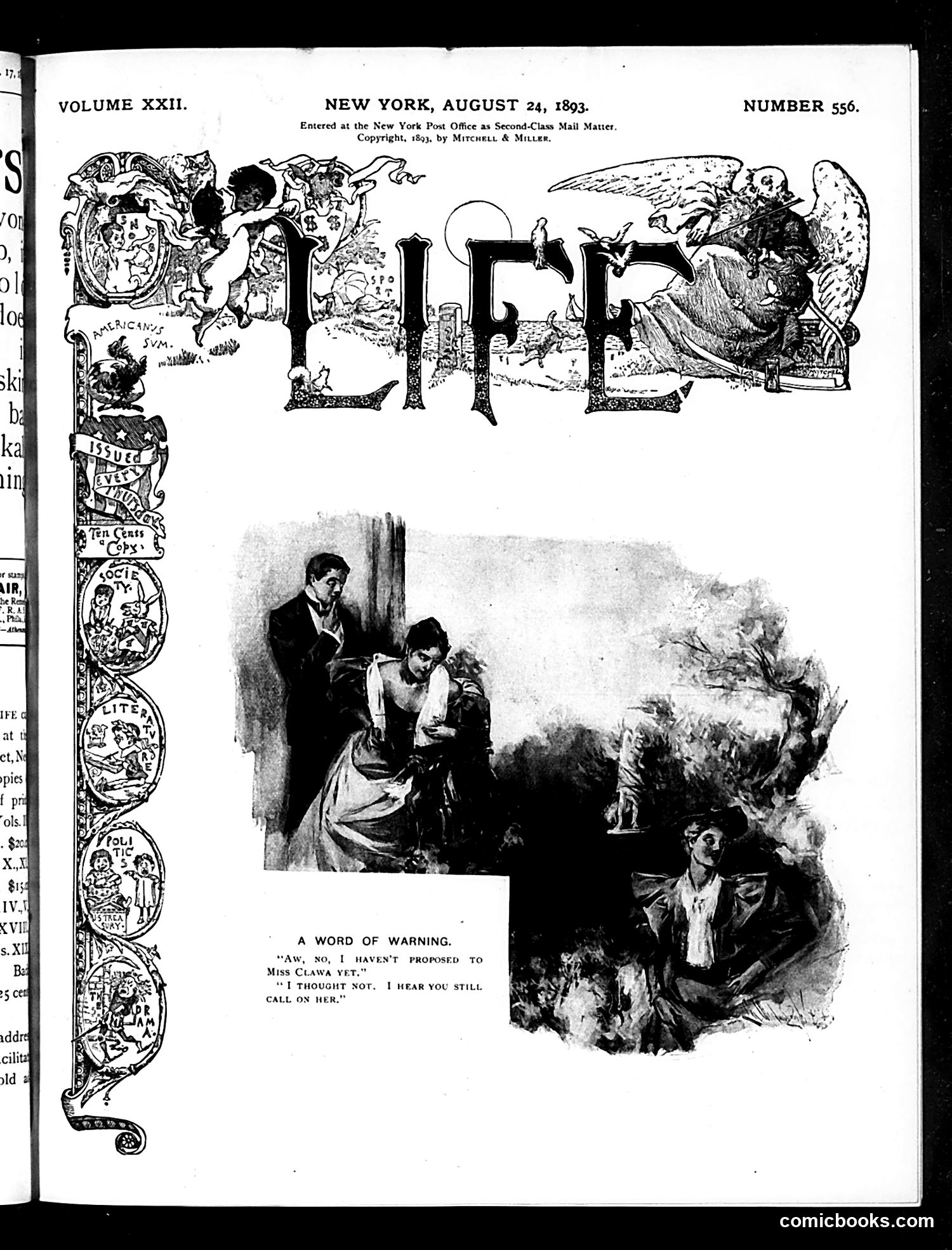
This page features an illustration titled "A Word of Warning" depicting three figures in what appears to be a dramatic domestic scene. The dialogue reads: "Aw, no, I haven't proposed to Miss Chawa yet" / "I thought not. I hear you still call on her." The satire targets courtship conventions of the 1890s. The scene suggests a woman's father or guardian warning a man about improper behavior—specifically, continuing to visit an unmarried woman without having formally proposed. The humor lies in exposing the gap between social pretense and reality: the man claims he hasn't proposed, but his ongoing visits suggest romantic intentions, which was considered compromising to the woman's reputation if marriage wasn't imminent. This reflects Victorian-era anxieties about courtship propriety and the power dynamics between suitors and families.
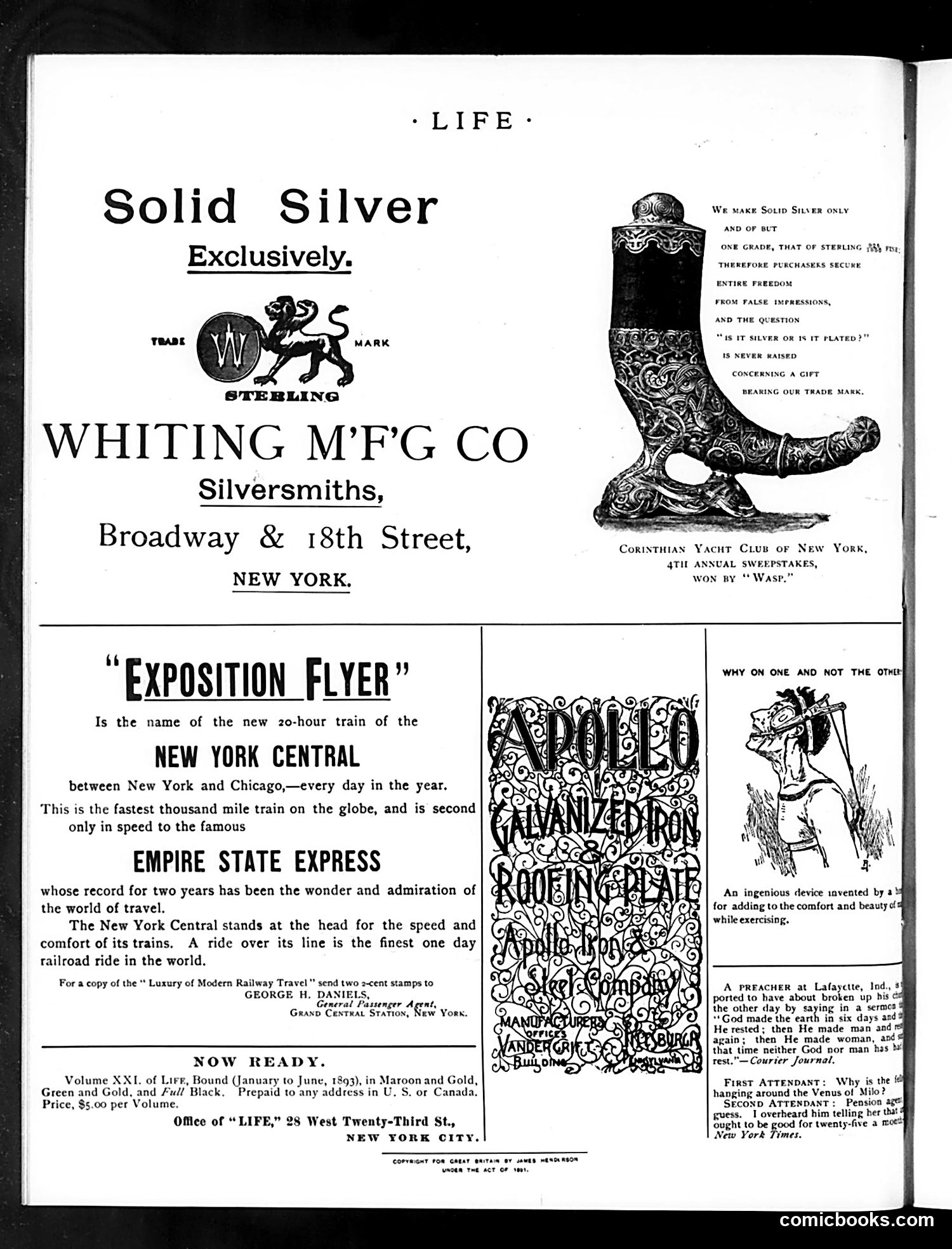
This page is primarily **advertising and product announcements** rather than political satire. The main content includes: 1. **Whiting M'F'G Co.** advertisement for solid sterling silver goods, located in New York 2. **New York Central Railroad** promotion for the "Exposition Flyer," a 20-hour train between New York and Chicago, positioned as the fastest transcontinental service 3. A decorative **ornamental vessel** (appears to be a yacht club trophy from the Corinthian Yacht Club) 4. **Life magazine promotional material** announcing new volumes available for purchase 5. **Minor illustrated snippets** on the right side, including what appears to be a humorous sketch labeled "Why on one and not the other" The page reflects late 19th-century magazine culture, mixing commercial advertising with editorial content. No significant political satire or commentary is evident.
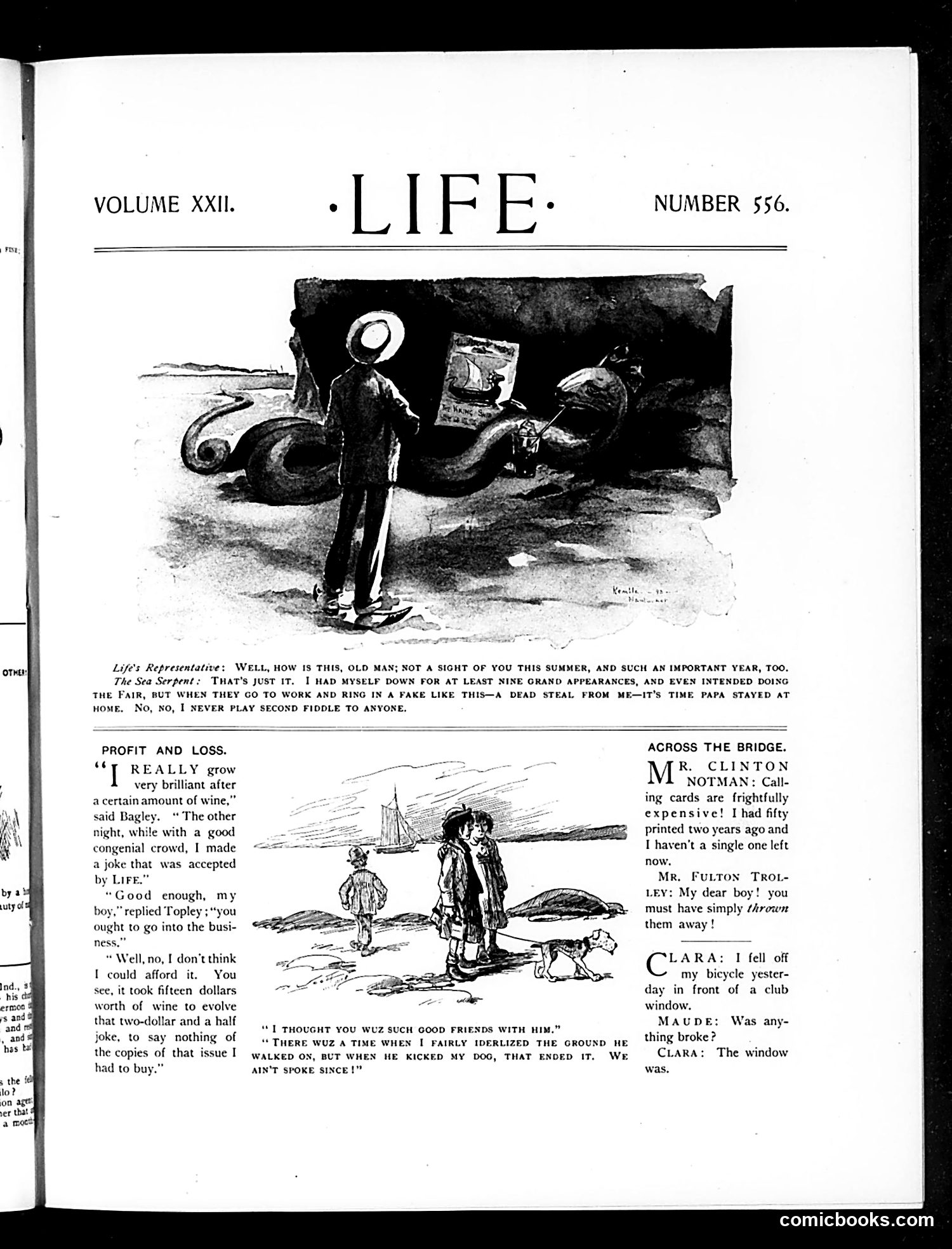
The top cartoon depicts a man in a straw hat confronting a sea serpent that's displaying what appears to be a magazine or publication. The joke seems to reference the sea serpent as a recurring hoax or fabrication—the serpent ironically hasn't appeared publicly in years, yet claims it attended nine grand appearances and was supposedly too busy for the circus fair. The lower sections contain two separate satirical pieces: "Profit and Loss" mocking wine criticism and connoisseurship, and "Across the Bridge," a dialogue about expensive calling cards and social mishaps. These appear to target upper-class pretension and the financial absurdities of maintaining social status among the wealthy. The overall theme criticizes elite affectation and commercial humbug.
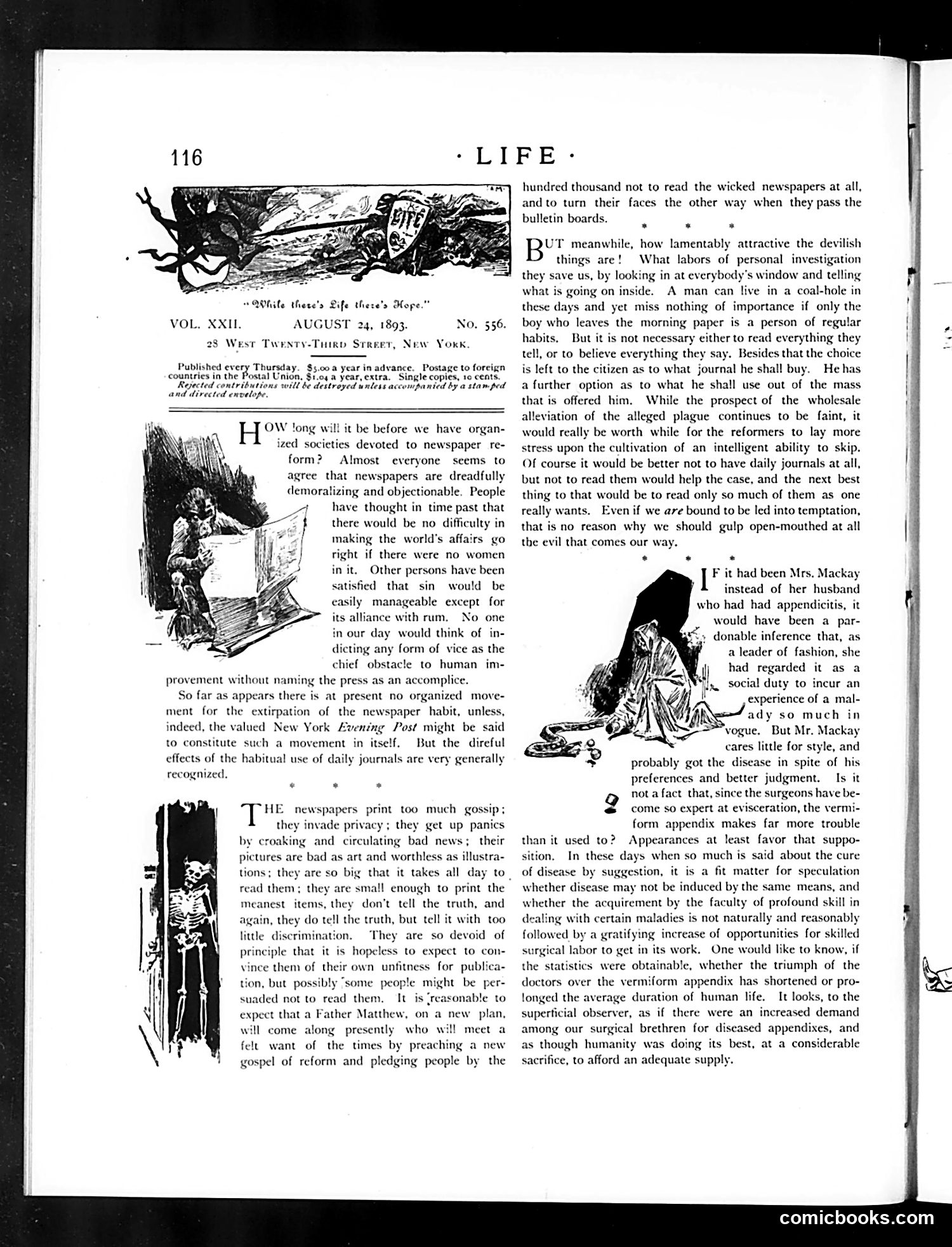
This page critiques sensationalist newspaper journalism of the 1890s. The editorial argues that newspapers print excessive gossip, invade privacy, and spread disease through suggestion—specifically referencing appendicitis diagnoses influenced by newspaper coverage. The illustrations show readers consuming newspapers compulsively. The text mocks papers for fabricating stories, circulating rumors, and using fear-mongering to boost circulation, while claiming moral authority. A notable reference mentions **Mrs. Mackay and appendicitis**, likely alluding to a prominent society figure's publicized surgery—a case where medical conditions became fodder for sensation-hungry press. The piece advocates for readers to develop "intelligent ability to skip" newspapers rather than consume everything printed, positioning editorial judgment as a citizen's responsibility against irresponsible media.
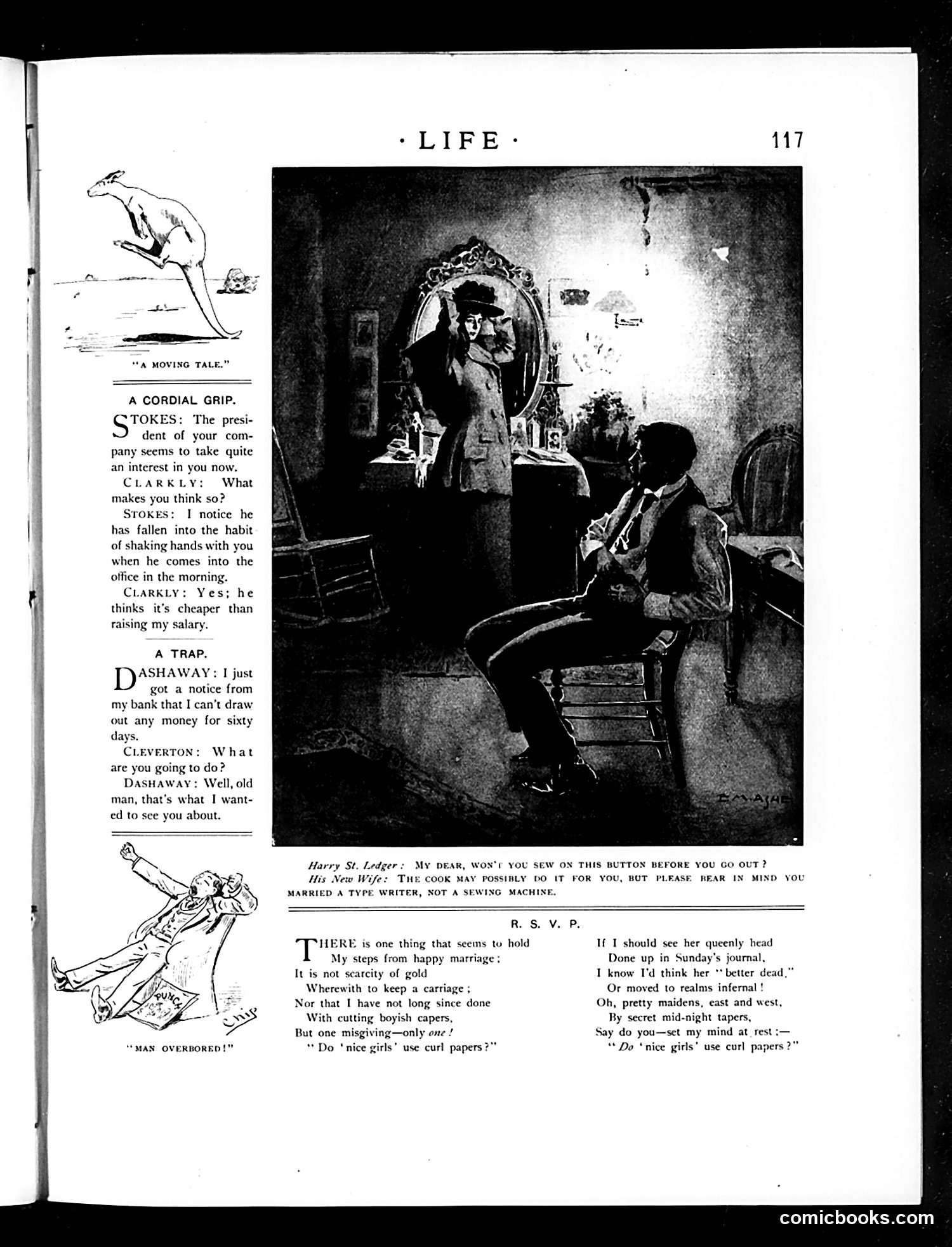
This page contains several brief comedic dialogues and illustrations typical of early 20th-century Life magazine humor. **"A Cordial Grip"** jokes about a company president's habit of shaking hands with employees—Clarkly notes the president does this as a cheaper alternative to raising salaries. **"A Trap"** depicts a man (Dashaway) who's been denied bank access for sixty days, wanting to consult someone (Cleverton) about his predicament. **"R.S.V.P."** is a poem about marriage concerns, specifically the speaker's anxiety that his wife might end up in scandal or use curling papers—contemporary domestic anxieties played for humor. The central photograph shows two men in what appears to be a bedroom scene, captioned as a marital misunderstanding about sewing on a button. The overall tone reflects period-typical office and domestic humor targeting middle-class anxieties.
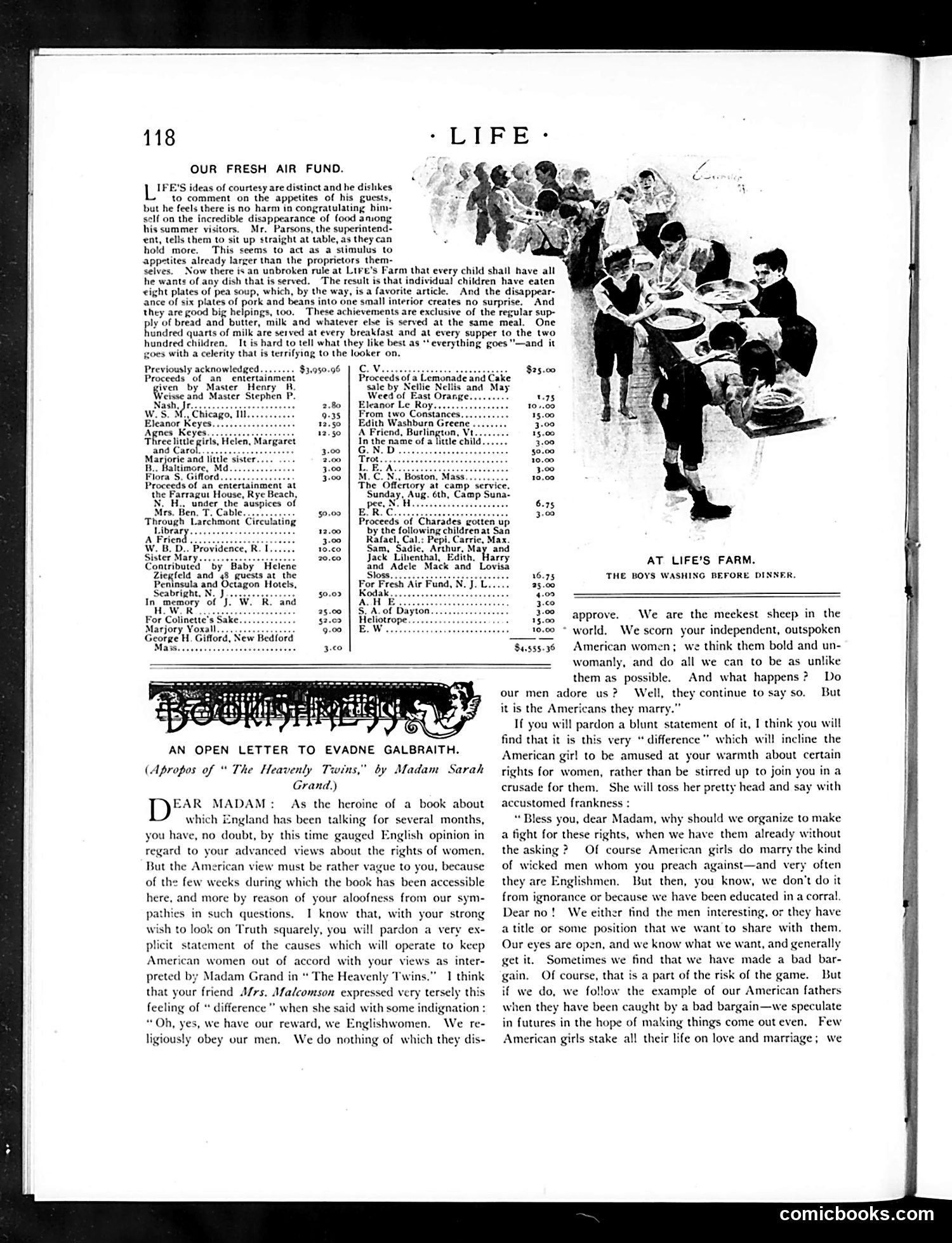
**Main Content:** This page features "An Open Letter to Evadne Galbraith," addressing the author of a book about women's rights. The letter sarcastically critiques English feminism by having an American woman defend traditional gender roles. **The Satire:** The anonymous author mocks both English suffragette ideology and American women who might adopt it. She argues American women shouldn't fight for expanded rights because they already enjoy advantages—and marriage to "wicked men" they'd need to reform isn't worth the effort. The satire targets the disconnect between English feminist activism and American women's reported contentment with domestic arrangements. **Social Context:** This reflects early 20th-century debates over women's suffrage and rights, positioning American female "contentment" against British feminist agitation. The right-side photograph shows children at Life's Farm during a meal—illustrating the magazine's charitable work.
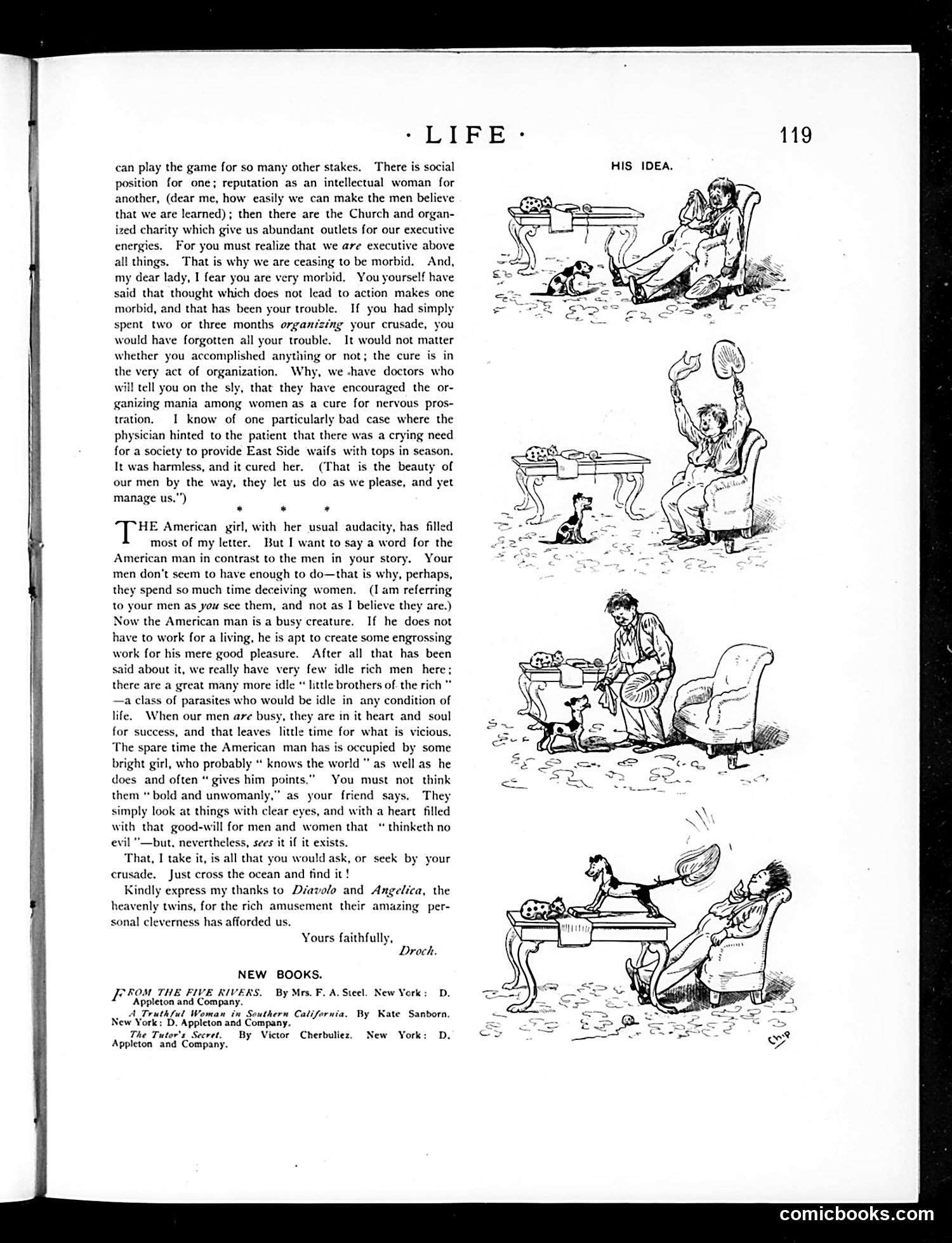
This page contains a satirical letter (signed "Droch") critiquing American men versus men in a correspondent's story. The accompanying cartoon series illustrates the letter's main point: American men are too busy and work-focused to be idle or engage in leisure. The five sequential sketches show a man attempting various forms of relaxation—sitting in chairs, playing with a dog, lounging—but appearing uncomfortable or restless in each scenario. The final image depicts him at what appears to be a desk or table with a dog, suggesting work intrudes even on leisure time. The satire targets American masculine culture's emphasis on constant productivity and the "self-made man" ideal, contrasting it with a more leisurely European lifestyle. The cartoon humorously suggests American men lack the ability to simply relax without guilt or distraction.
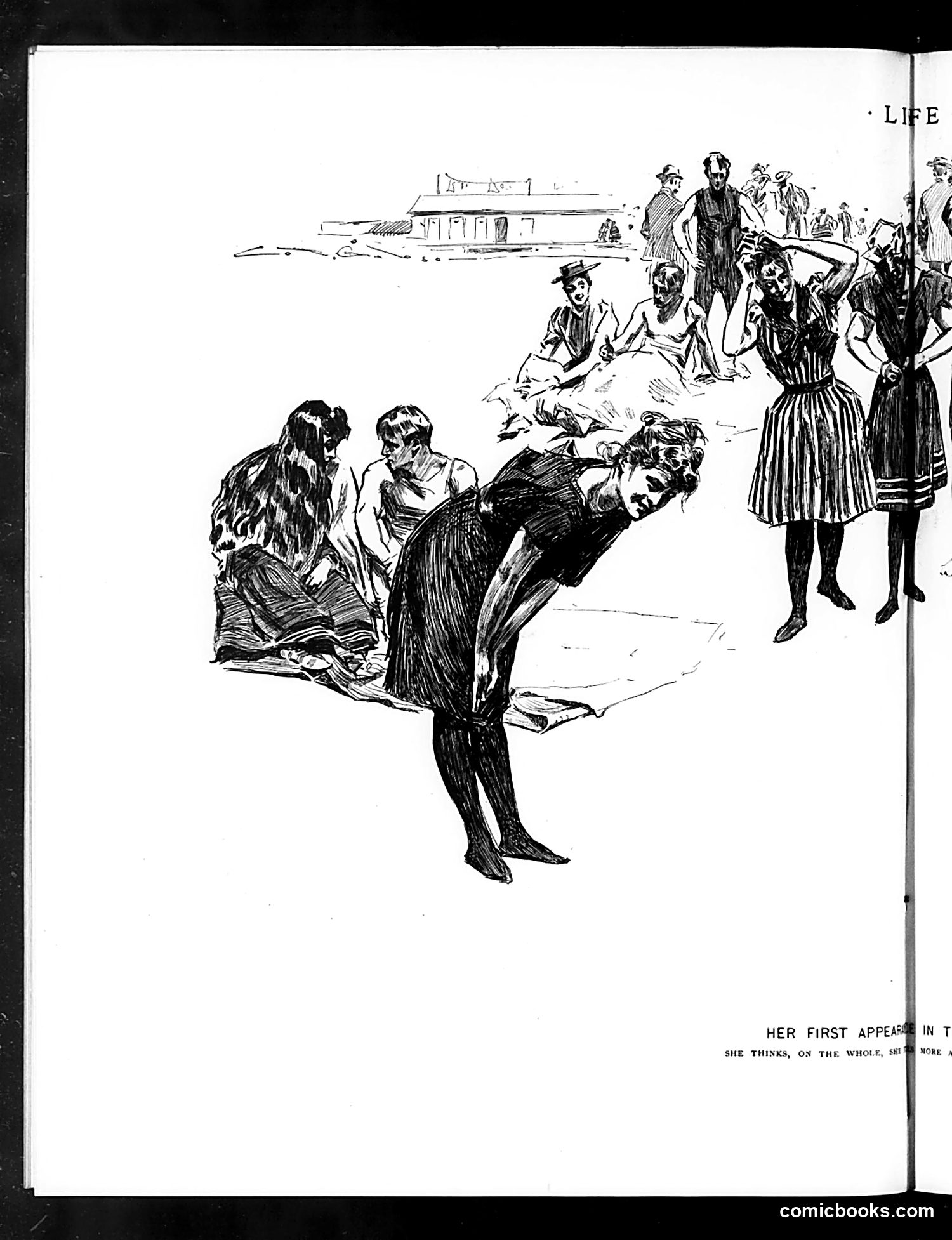
This is a satirical illustration from *Life* magazine showing a man in formal attire appearing to be startled or distressed while holding what appears to be a woman. A crowd of onlookers watches from the beach, with a steamboat visible in the background. The caption reads: "HER FIRST APPEARANCE IN THE WATER—SHE THINKS, ON THE WHOLE, SHE MORE A..." (text cuts off). The cartoon appears to satirize early 20th-century social anxieties about women's swimming attire and public beach behavior. The man's exaggerated reaction and the crowd's attention suggest the humor targets either the woman's swimwear choice (likely a daring one-piece suit for the era) or her unconventional boldness in swimming publicly. The incomplete caption prevents definitive interpretation, but the satire clearly concerns evolving social norms around women's bodies and public spaces.
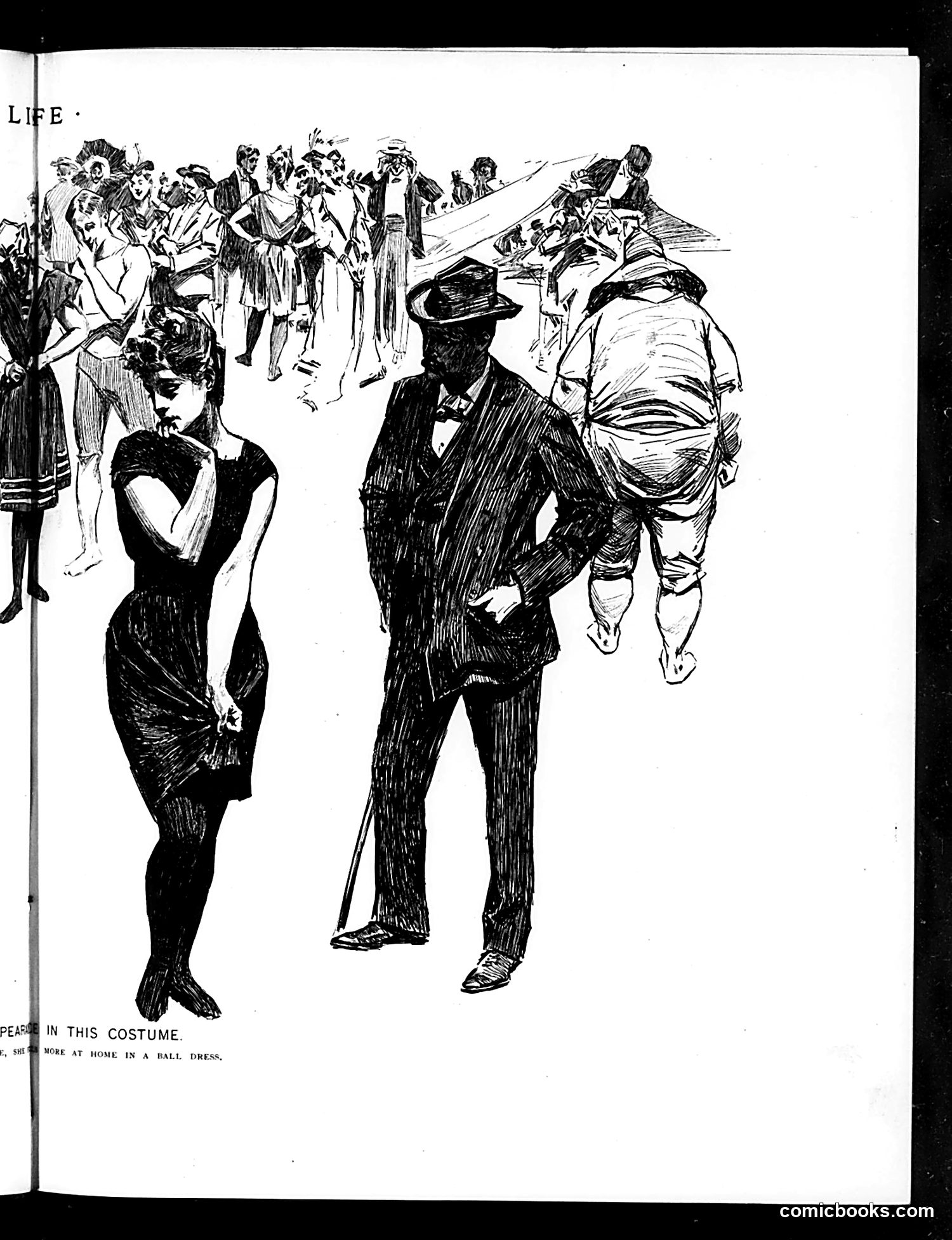
This page depicts a social satire about formal evening wear and propriety. The visible caption references "costume" and "ball dress," suggesting commentary on social conventions. The illustration shows three figures in the foreground—a woman in dark formal attire appearing distressed or uncomfortable, and two men in suits, one gesturing toward a crowd of formally-dressed people in the background. The composition appears to mock either inappropriate dress choices or social awkwardness at a formal event. The satirical point likely critiques either pretentious dress codes, class anxieties about formal occasions, or humorous social mishaps—common subjects for Life magazine's social commentary. Without the complete caption text, the specific target of the satire remains somewhat unclear, though it clearly concerns etiquette and formal social settings.
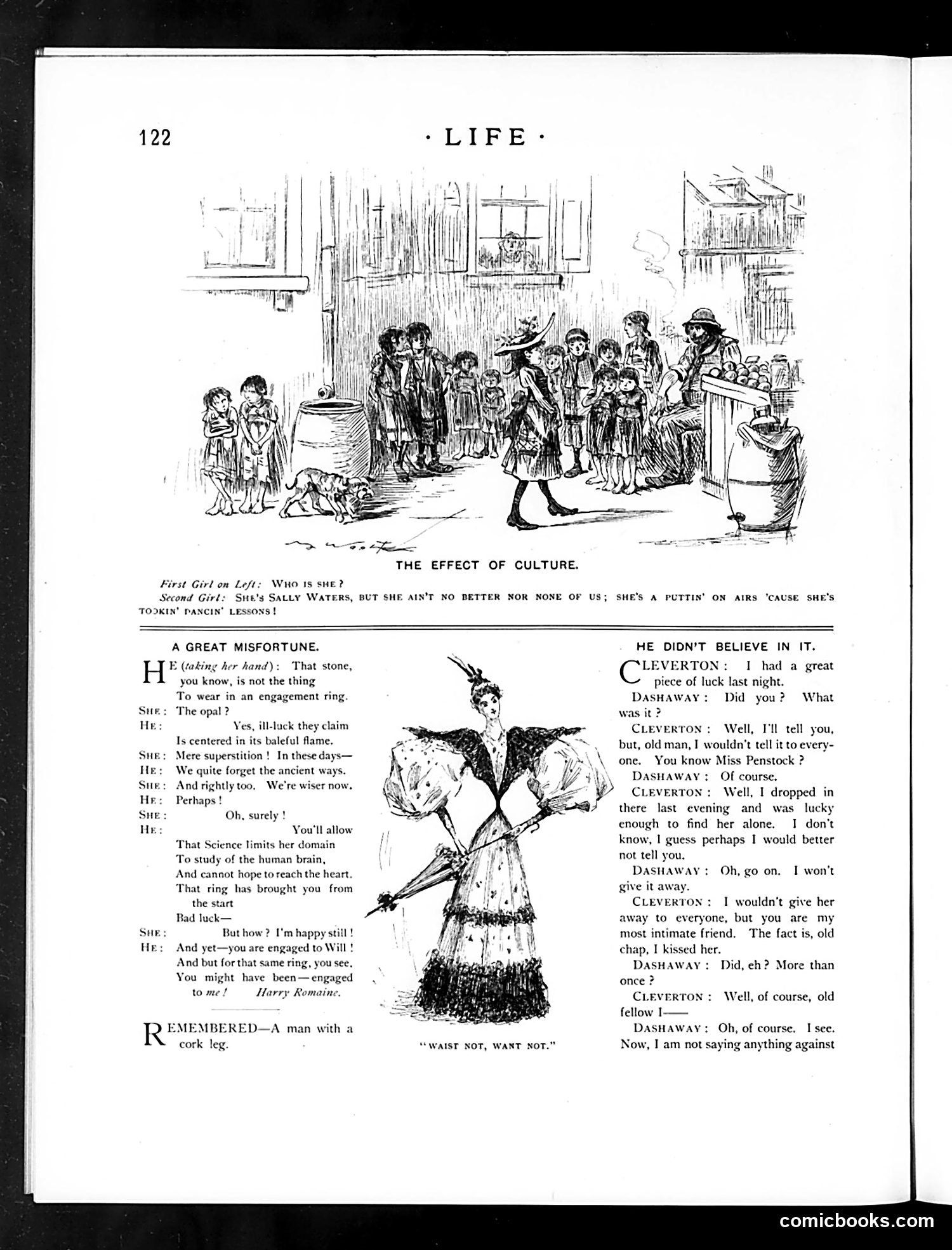
This page contains three distinct humor pieces: **"The Effect of Culture"** (top cartoon): A street scene satirizing class pretension. Two girls comment on "Sally Waters," mocking her affected manners and pretensions to sophistication despite her working-class origins ("puttin' on airs"). **"A Great Misfortune"** (left): A dialogue between a man and woman about an opal engagement ring. She questions the stone's authenticity; he defends it while she suggests they're "wiser now." The satire targets romantic disillusionment and materialistic concerns in relationships. **"He Didn't Believe In It"** (right): A conversation between Cleverton and Dashaway about kissing Miss Penstock. The humor derives from Cleverton's reluctant confession that he kissed her, presented with comedic evasion typical of Victorian-era propriety humor. The centered illustration labeled **"Waist Sot, Waist Sot"** shows a woman in an exaggerated corset, likely satirizing fashion extremes.
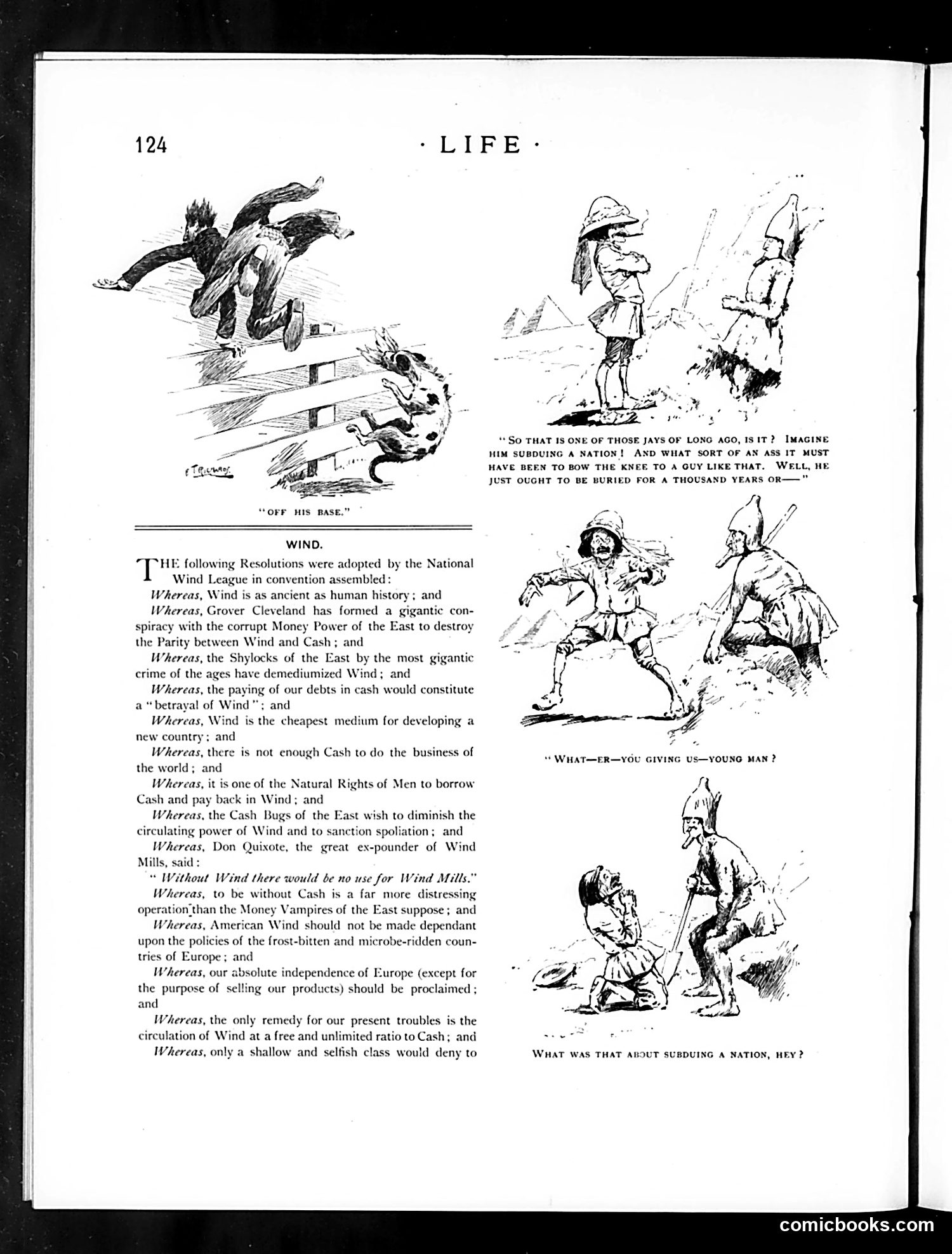
This page satirizes late-19th-century American populist and free-silver advocates, likely from the 1890s economic crisis period. **Top cartoon ("Off His Base"):** Shows a figure tumbling from a pedestal, mocking historical leaders or monuments—possibly referencing populist attacks on established authority. **Main content ("Wind"):** A mock political manifesto from a fictional "National Wind League" that parodies populist rhetoric by substituting "Wind" for "Silver." The absurdist "Whereas" clauses mock free-silver arguments: that unlimited currency circulation solves economic problems, that Eastern financial interests conspire against common people, and that borrowing in worthless currency is a "natural right." **Bottom cartoons:** Depict naive rustics discussing "subduing a nation"—visual mockery of populist voters as foolish and gullible, unable to recognize they're being sold hot air ("wind"). The satire's point: populist economic proposals are literally meaningless hot air, and their supporters are credulous rubes. Life's editors clearly opposed free-silver and populist movements.
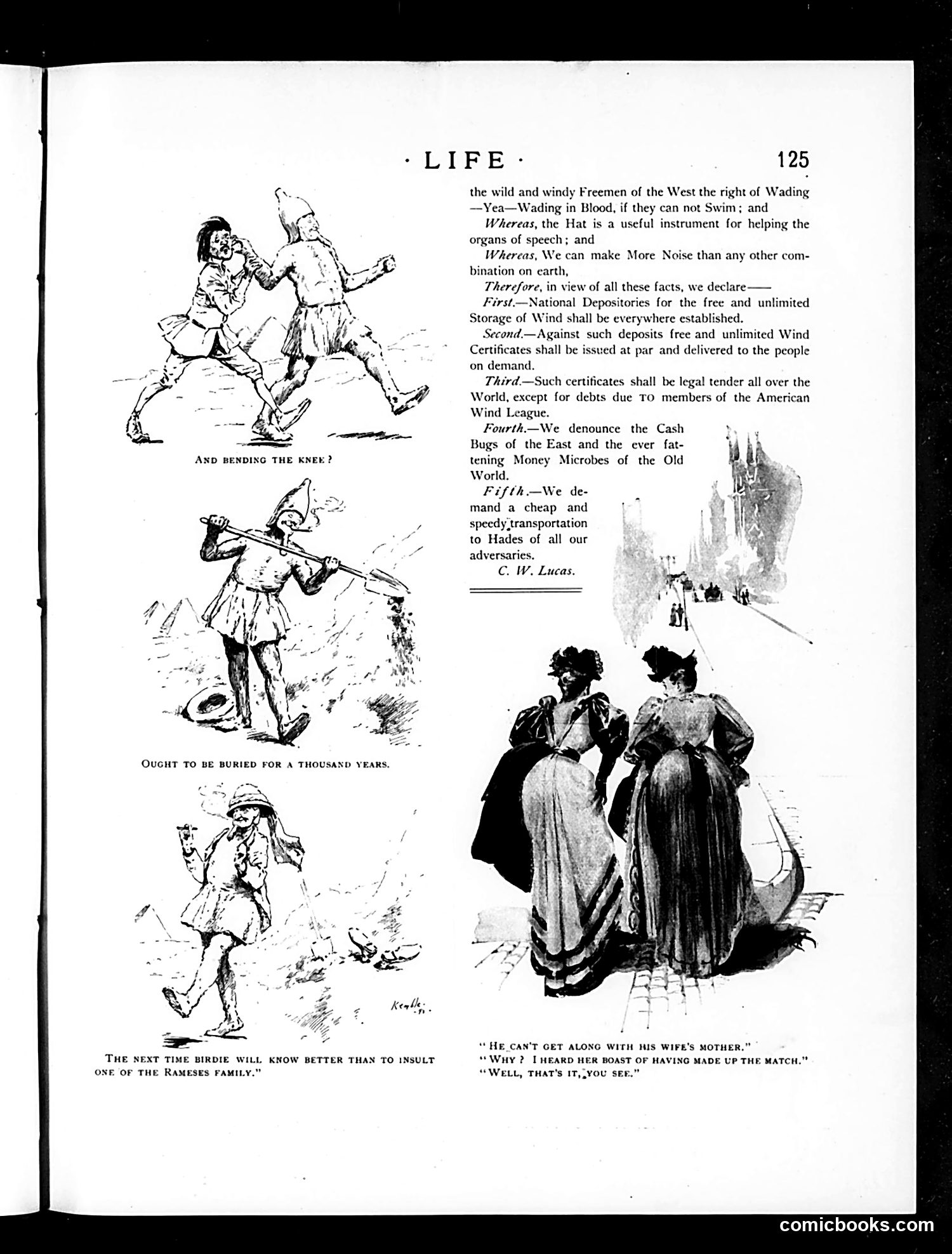
This page satirizes American populist and Western political movements of the late 19th/early 20th century. The mock "declaration" by C.W. Lucas ridicules Western politicians and agitators who made inflammatory speeches ("wild and windy Freemen") and generated excessive noise and bluster without substance. The declarations parody populist rhetoric: establishing "National Depositories for Wind" mocks politicians' empty promises, while attacking "Cash Bugs of the East" and "Money Microbes" references populist anger at Eastern financial interests and banking establishments. The cartoon figures appear to be caricatured Western politicians or agitators engaged in exaggerated posturing and combat. The bottom illustrations, unrelated to the political satire, show domestic humor about in-laws and matchmaking. The overall point: Western political movements were all noise and bluster lacking substance or viable solutions.
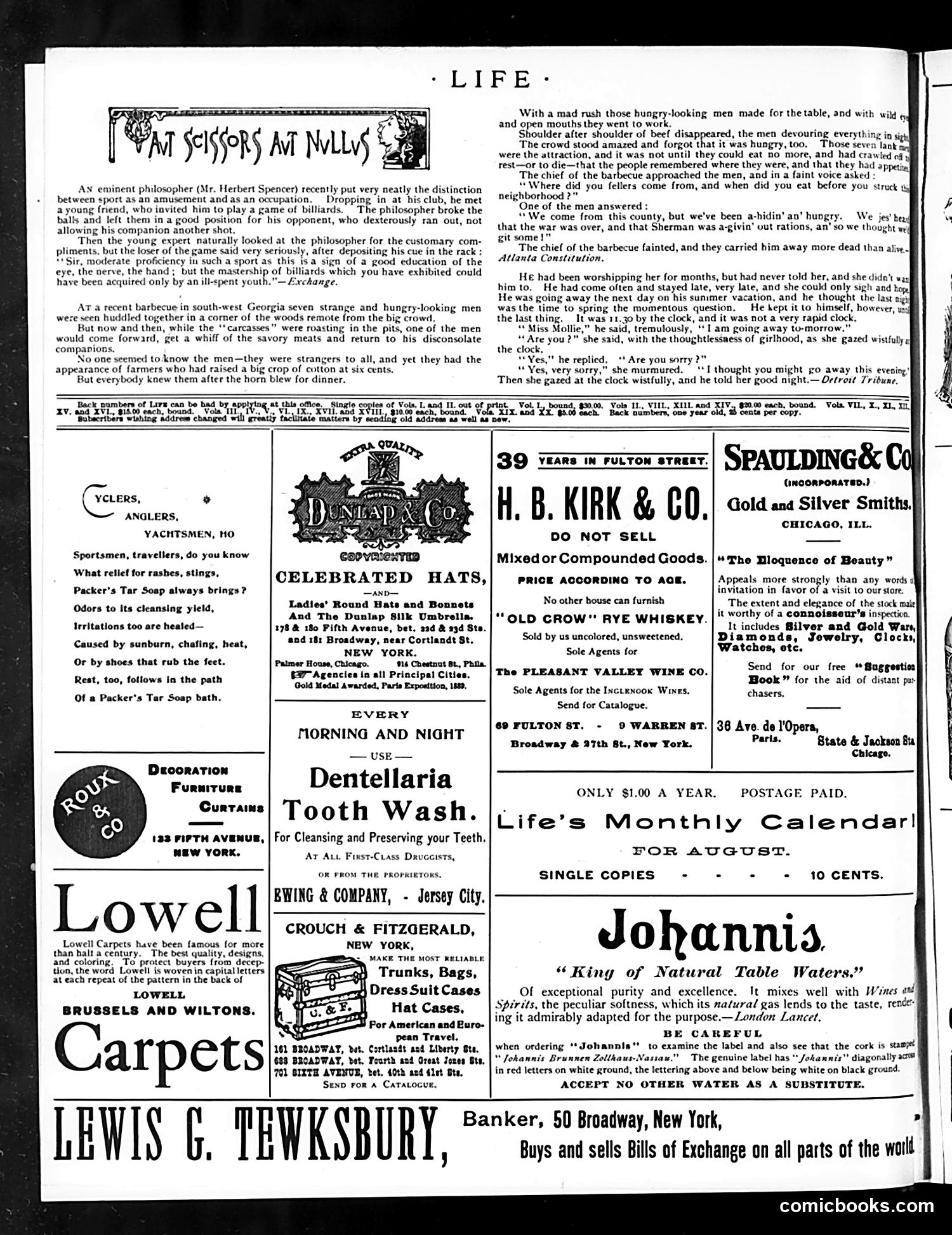
This page contains three humorous anecdotes rather than political cartoons: 1. **Herbert Spencer Billiards Story**: A philosopher critiques a young man's billiards mastery, suggesting such skill indicates a wasted youth rather than good education—satirizing the Victorian distinction between gentlemanly amateur sport and disreputable professional expertise. 2. **Georgia Barbecue Story**: Set in the post-Civil War South, seven starving men appear at a barbecue. They reveal they've been "hiding" and hungry since hearing "Sherman was a-givin' out rations"—referencing Union General William Tecumseh Sherman's destructive 1864 march through Georgia. The joke critiques the war's devastation: these men are so desperate they believed false rumors of federal rations. 3. **Romantic Rejection**: A young man hesitates confessing love to Miss Mollie until his final evening, then finally proposes—only to have her wish he'd left *that evening* instead. Dark comedy about romantic rejection. The page is primarily **advertising** for various products (carpets, tooth wash, hats, whiskey).
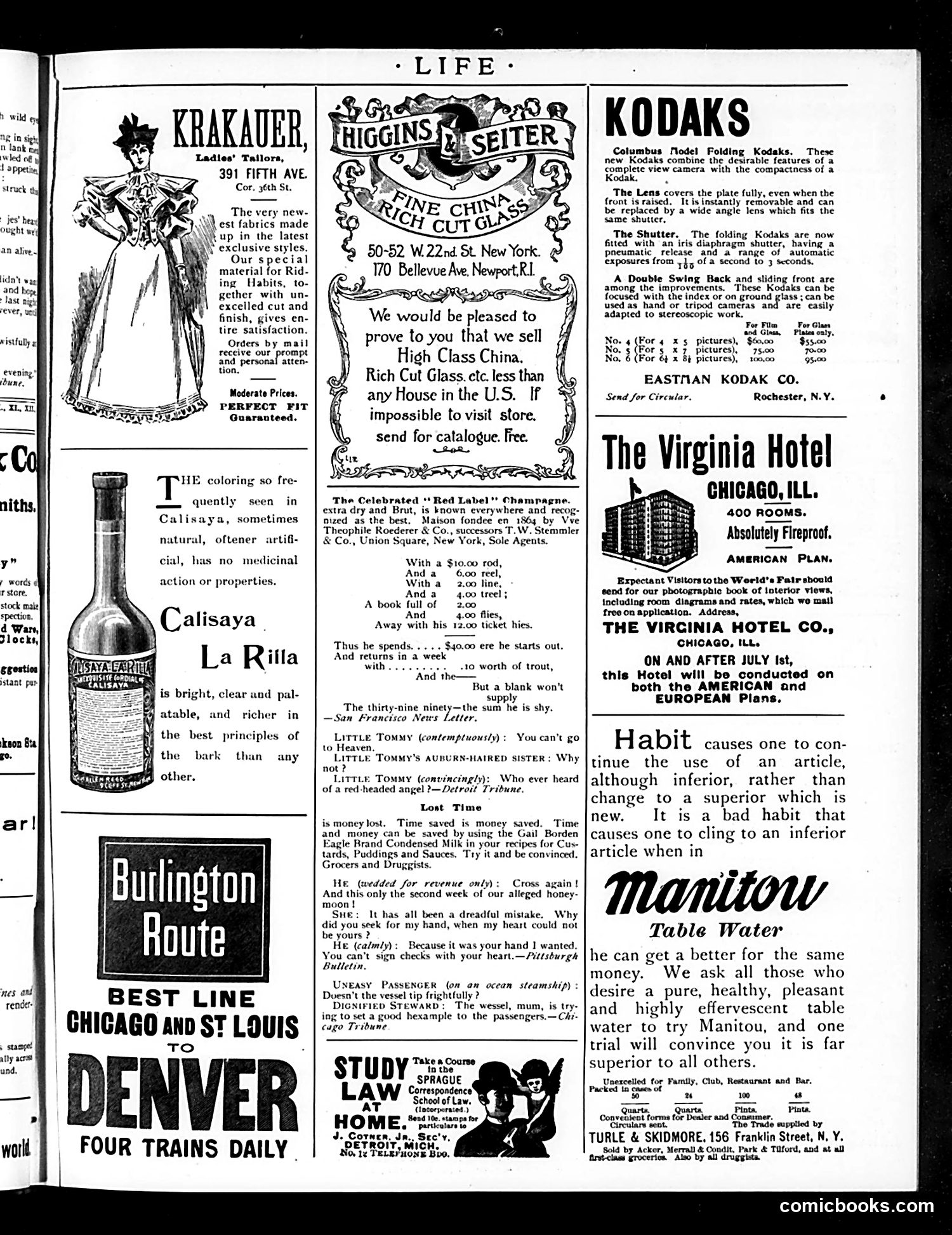
This page is primarily **advertisements and filler content** rather than political satire. It contains: **Advertisements** for: - Women's tailoring (Krakauer) - Fine china and glassware (Higgins & Seiter) - Calisaya medicinal bark - Burlington Route railroad - Kodak cameras - The Virginia Hotel in Chicago - Manitou Table Water - Study of law correspondence course **Humor sections** include brief jokes about: - A fisherman's expensive fishing trip that nets minimal trout - A child's theological observation about red-headed angels - A newlywed couple's marital discord - A ship's steward's excuse for the vessel's tilting The page reflects turn-of-the-century consumer culture and light, genteel humor typical of Life magazine's format. No significant political cartoons or satirical commentary on contemporary events appears here.
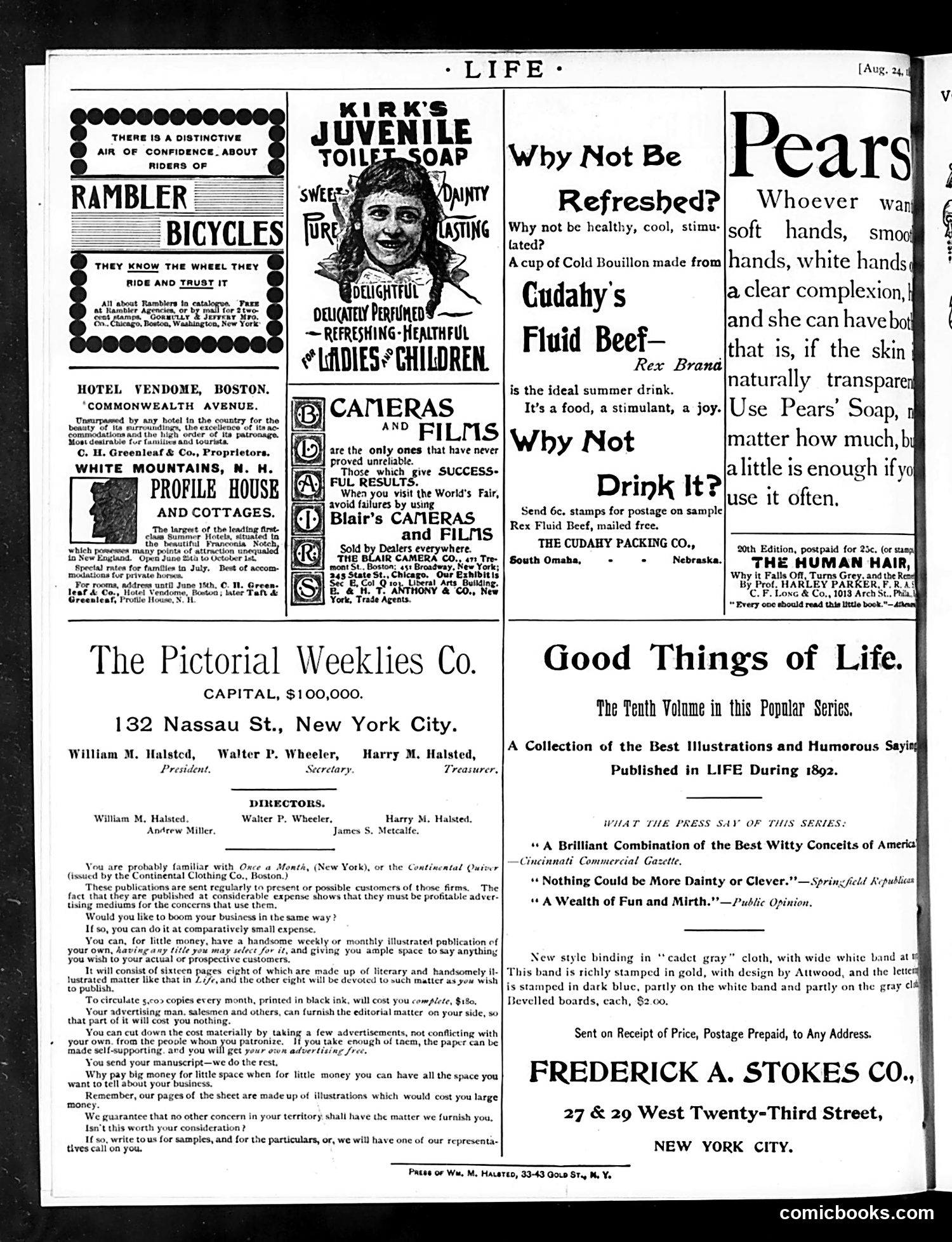
This page is primarily **advertising and corporate promotion**, not political satire or cartoons. The dominant content includes: - **Product advertisements**: Rambler bicycles, hotels (Vendome in Boston, Profile House in White Mountains), Blair's cameras and films, Cudahy's Fluid Beef (a nutritional drink), and Pears' Soap - **A business pitch** from The Pictorial Weeklies Co., offering to create custom branded magazines for companies—essentially an early form of corporate marketing/advertising publication The Kirk's Juvenile Toilet Soap advertisement features an illustrated young girl's face, presented as "delightful" and "refreshing-healthful for ladies & children." The "Good Things of Life" section promotes a tenth volume of illustrated humor collections published by LIFE magazine in 1892, describing it as witty American satire. **For modern readers**: This reflects the 1890s advertising era where companies created their own branded publications to reach customers directly—a precursor to modern corporate marketing.