
Life, 1893-08-24 · page 4 of 16
Life — August 24, 1893 — page 4: what you’re looking at
What you’re looking at
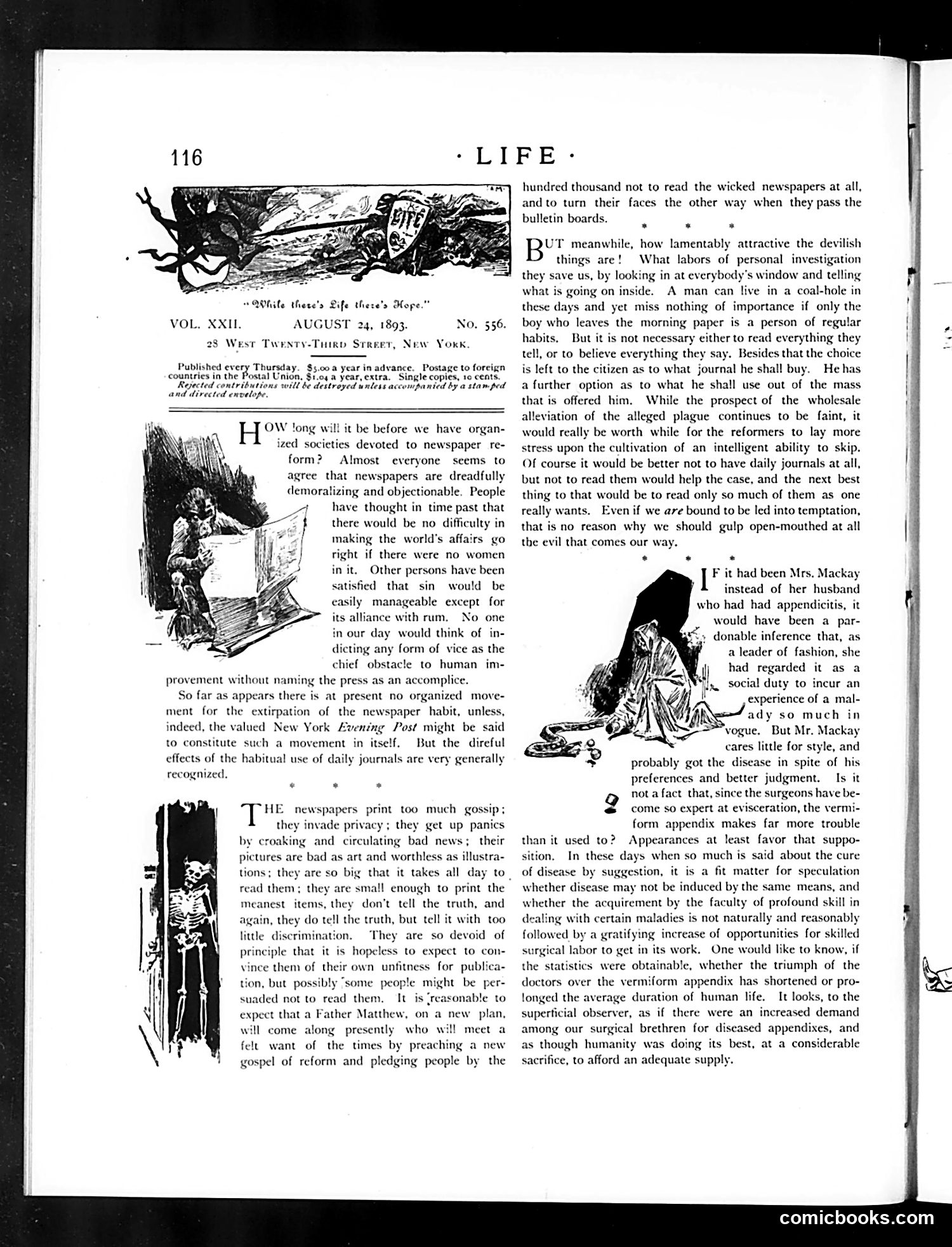
This page critiques sensationalist newspaper journalism of the 1890s. The editorial argues that newspapers print excessive gossip, invade privacy, and spread disease through suggestion—specifically referencing appendicitis diagnoses influenced by newspaper coverage. The illustrations show readers consuming newspapers compulsively. The text mocks papers for fabricating stories, circulating rumors, and using fear-mongering to boost circulation, while claiming moral authority. A notable reference mentions **Mrs. Mackay and appendicitis**, likely alluding to a prominent society figure's publicized surgery—a case where medical conditions became fodder for sensation-hungry press. The piece advocates for readers to develop "intelligent ability to skip" newspapers rather than consume everything printed, positioning editorial judgment as a citizen's responsibility against irresponsible media.
📄 Transcribed text from this page (OCR, searchable)
Machine-transcribed from the original scan — historical spelling and the odd misread are preserved.
‘LIFE: QWhile there's Life th VOL. XXII. AUGUST 24, 1893. 23 West Twenty-Tutrp Srreer, New York. No. 556. Published every Thursday. $5.00 a year in advance. countries in the Postal Union, $1.04 Rejected contribution. and directed envelope. Postage to foreign ear,extra. Single copies, 10 cents. will be destroyed unless accompanied by a stam ped OW long will it be before we have organ- ized societies devoted to newspaper re- form? Almost everyone seems to agree that newspapers are dreadfully demoralizing and objectionable. People have thought in time past that there would be no difficulty in making the world’s affairs go right if there were no women in it. Other persons have been satisfied that sin would be manageable except for its alliance with rum, No one in our day would think of in- dicting any form of vice as the chief obstacle to human im- provement without naming the press as an accomplice. So far as appears there is at present no organized move- ment ion of the newspaper habit, unle: indeed, the valued New York Evening Post might be said to constitute such a movement in its But the direful effects of the habitual use of daily journals are very generally casil for the extir recognized. HE they invade privacy; they get up pani newspapers print too much gossip; by croaking and circulating bad news; their pictures are bad as art and worthl tions; they read them; they | enough to print the meanest items, they don’t tell the truth, and again, they do tell the truth, but tell it with too little discrimination. They are so devoid of principle that it is hopeless to expect to con- $ as illustra- are ST vince them of their own unfitness for publica- ton, but possibly “some people might: be per- suaded not to read them. It is ‘reasonable to expect that a Father Matthew, on a new plan, will come along presently who wil! felt. want of the times by preaching a new gospel of reform and pledging people by the meet a are so big that it takes all day to. hundred thousand not to read the wicked newspapers at all, andto turn their faces the other way when they pass the bulletin boards. * * * UT meanwhile, how lamentably attractive the devilish things are! What labors of personal investigation they save us, by looking in at everybody's window and telling what is going on inside. A man can live in a coal-hole in these days and yet miss nothing of importance if only the boy who leaves the morning paper is a person of regular habits, But it is not necessary either to read everything they tell, or to believe everything they say. Besides that the choice is left to the citizen as to what journal he shall buy. He ha a further option as to what he shall use out of the mass that is offered him. While the prospect of the wholesale alleviation of the alleged plague continues to be faint, it would really be worth while for the reformers to lay more stress upon the cultivation of an intelligent ability to skip. Of course it would be better not to have daily journals at all, but not to read them would help the case, and the next best thing to that would be to read only so much of them as one really wants. Even if we are bound to be led into temptation, that is no reason why we should gulp open-mouthed at all the evil that comes our way, . * I F it had been Mrs. Mackay instead of her husband who had had appendicitis, it would have been a par- =, donable inference that, as a leader of fashion, she had regarded it as a "ix, social duty to incur an experience of a mal- ide aay so much in vogue. But Mr. Mackay cares little for style, and probably got the disease in spite of his preferences and better judgment. Is it not a fact that, since the surgeons have be- come so expert at evisceration, the vermi- form appendix makes far more trouble than it used to? Appearances at least favor that suppo- In these days when so much is said about the cure ase by suggestion, it is a fit matter for speculation sition. of dis whether disease may not be induced by the same means, and whether the acquirement by the faculty of profound skill in ng with certain maladies is not naturally and reasonably followed by a gratifying increase of opportunities for skilled surgical labor to get in its work, One would like to know, if the statistics were obtainable, whether the triumph of the doctors over the vermiform appendix has shortened or pro- longed the average duration of human life. It looks, to the superticial observer, as if there were an increased demand among our surgical brethren for diseased appendixes, and though humanity was doing its best, at a considerable sacrifice, to afford an adequate supply. comicbooks.com