
A complete issue · 16 pages · 1893
Life — August 10, 1893
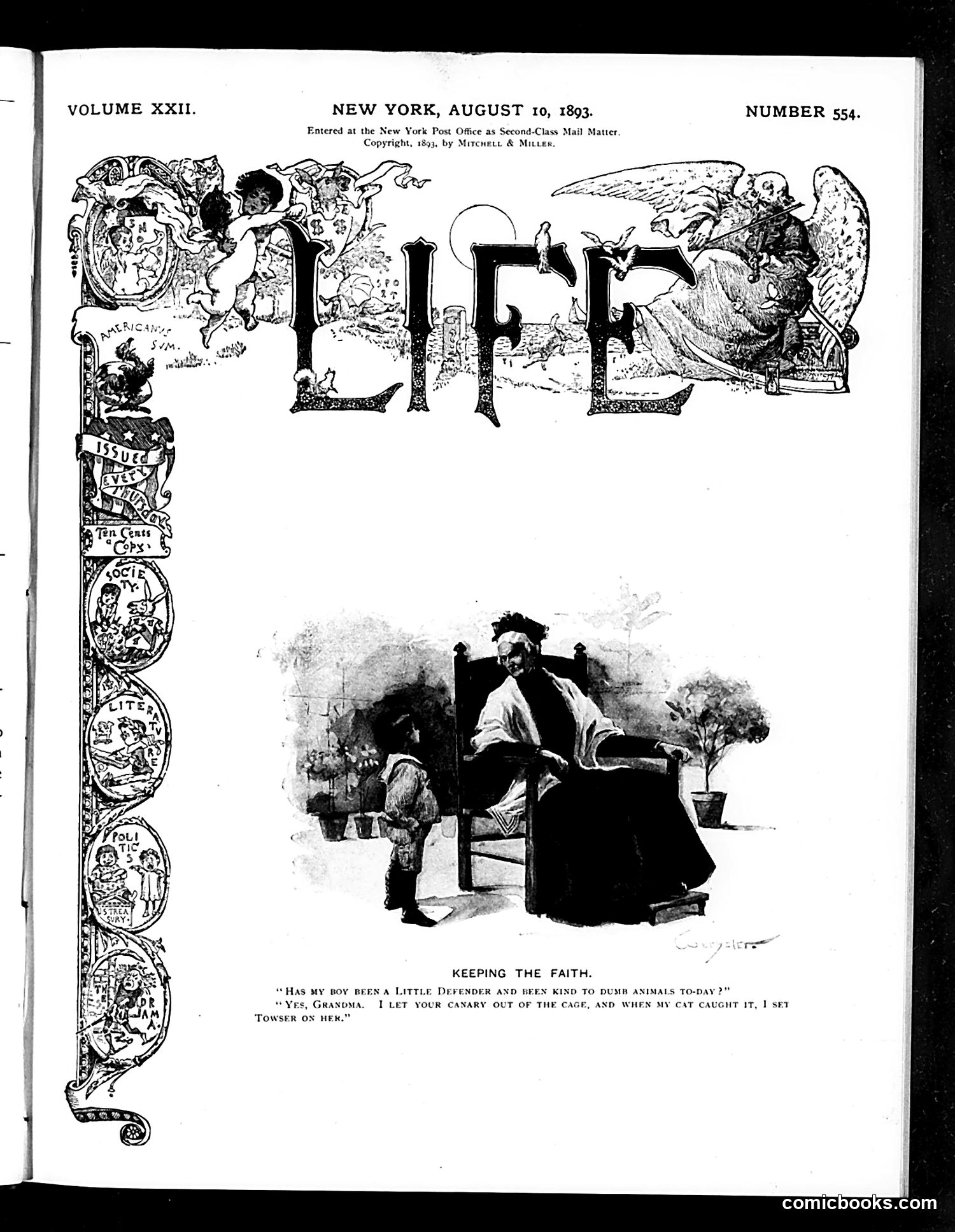
This cartoon satirizes grandparental indulgence and moral inconsistency. An elderly grandmother sits in a chair while a young boy stands before her. The caption records her boast: she claims to have raised her own children strictly (letting a canary out of its cage, then setting a cat on it as punishment for the child's cruelty), yet now she undermines discipline by being "a little defender" of her grandson and allowing him to be "kind to dumb animals." The joke exposes the hypocrisy of older generations who were harsh disciplinarians with their own children but become permissive grandparents. "Keeping the faith" ironically titles the piece—she's failed to maintain consistent moral standards between generations.
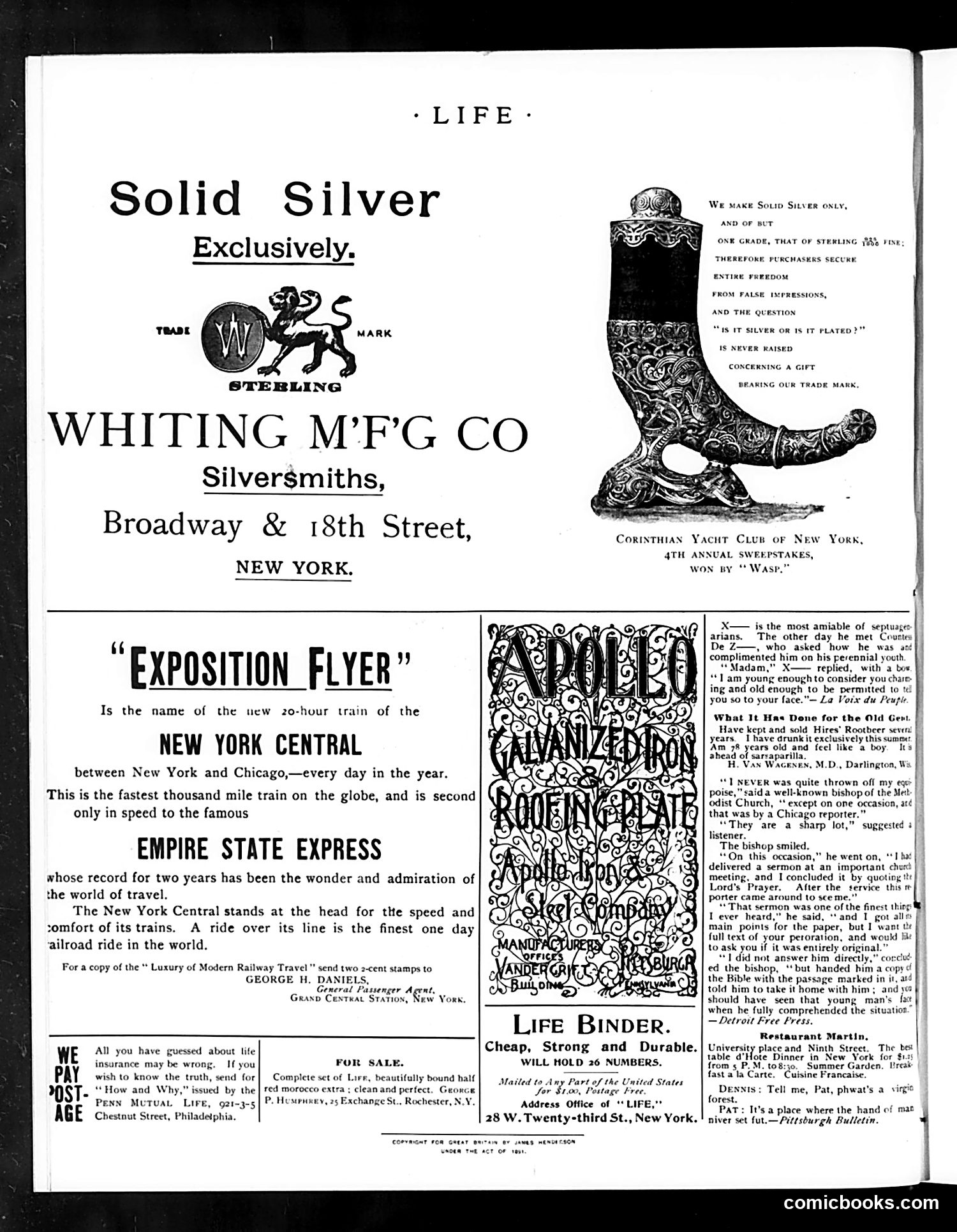
This page is primarily **advertising**, not political satire. The main content promotes: 1. **Whiting M'FG Co.** - A silversmith advertising solid silver goods, located at Broadway & 18th Street, New York 2. **New York Central Railroad** - Advertising two trains: the "Exposition Flyer" (a 20-hour daily service between New York and Chicago) and the "Empire State Express" (noted as the second-fastest thousand-mile train globally) 3. **Life Binder** - A durable product that holds 26 magazine issues 4. **Penn Mutual Life Insurance** - A Philadelphia-based insurance company The decorative central image appears to be an ornate silver vessel, likely showcasing the silversmith's craftsmanship. The page reflects early 20th-century American commercial advertising targeting affluent readers interested in luxury goods, modern transportation, and financial services. There is no apparent political commentary or satirical content on this particular page.
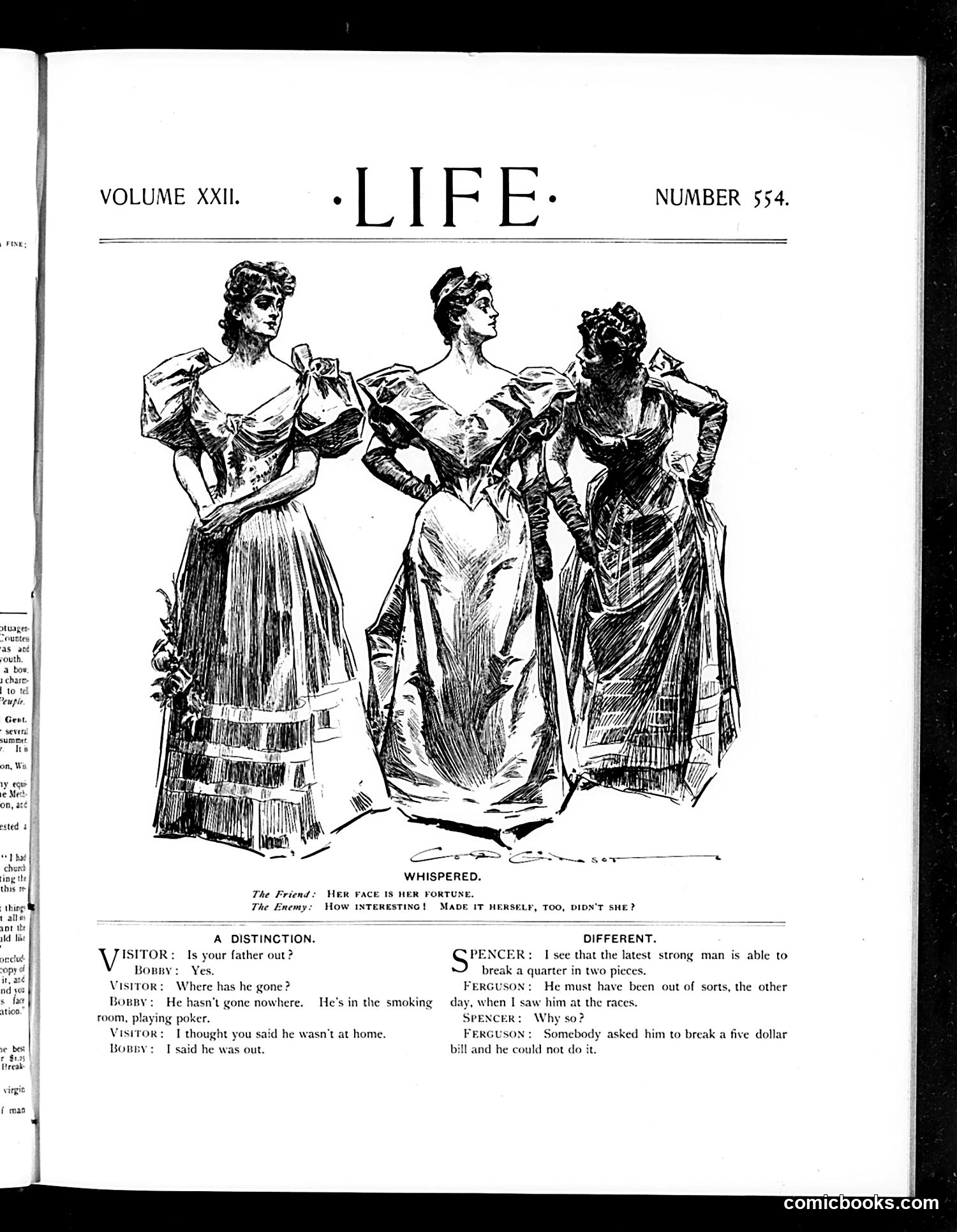
This page features three humor sketches typical of early 20th-century Life magazine. The top illustration titled "WHISPERED" shows three fashionably dressed women in 1890s-style gowns with prominent puffed sleeves. The caption suggests gossip about a woman's appearance or fortune, with one friend asking another if she "made it herself, too." Below are two brief comedic dialogues: "A DISTINCTION" plays on miscommunication—a visitor misunderstands Bobby's statement about the father being "out," creating confusion about location versus activity. "DIFFERENT" contrasts two men's strength: one breaks a five-dollar bill easily, while another cannot—suggesting social class or economic differences determine capability. These represent typical domestic humor and social satire of the era, focusing on upper-class manners, misunderstandings, and subtle class commentary rather than political content.
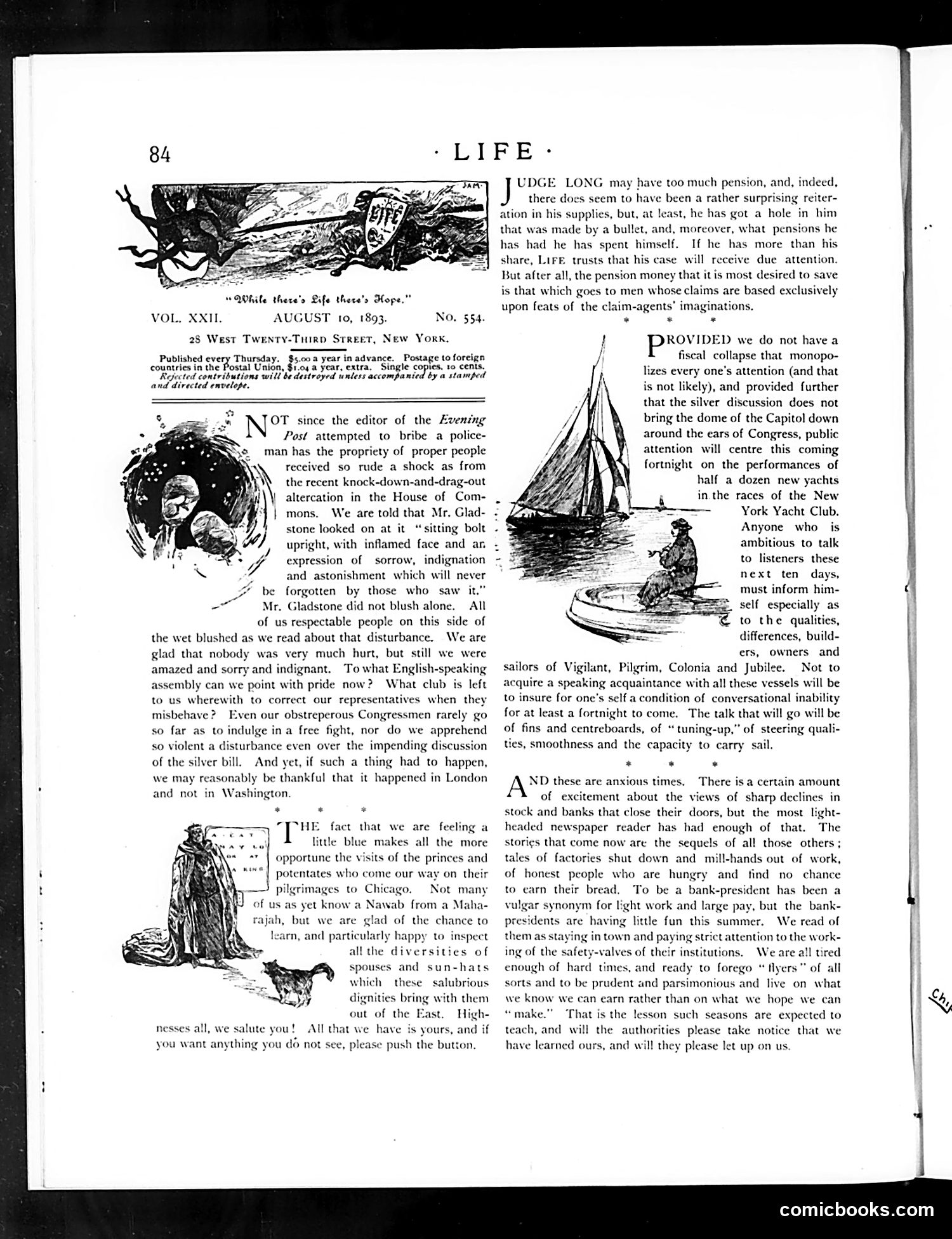
This page contains editorial commentary on recent political scandals rather than political cartoons. The text references a "knock-down-and-drag-out altercation in the House of Commons," mentioning Mr. Gladstone's angry response. The author criticizes how American newspapers covered this, suggesting they exaggerated British political turbulence. The illustrations appear to be decorative vignettes—a sailing vessel and a figure in Eastern dress—rather than satirical commentary on specific figures. The main satire is indirect: the editor mocks American news outlets' sensationalism in reporting British parliamentary discord, while defending American congressmen as generally more restrained. The piece emphasizes that such heated debates shouldn't overshadow serious political discussion.
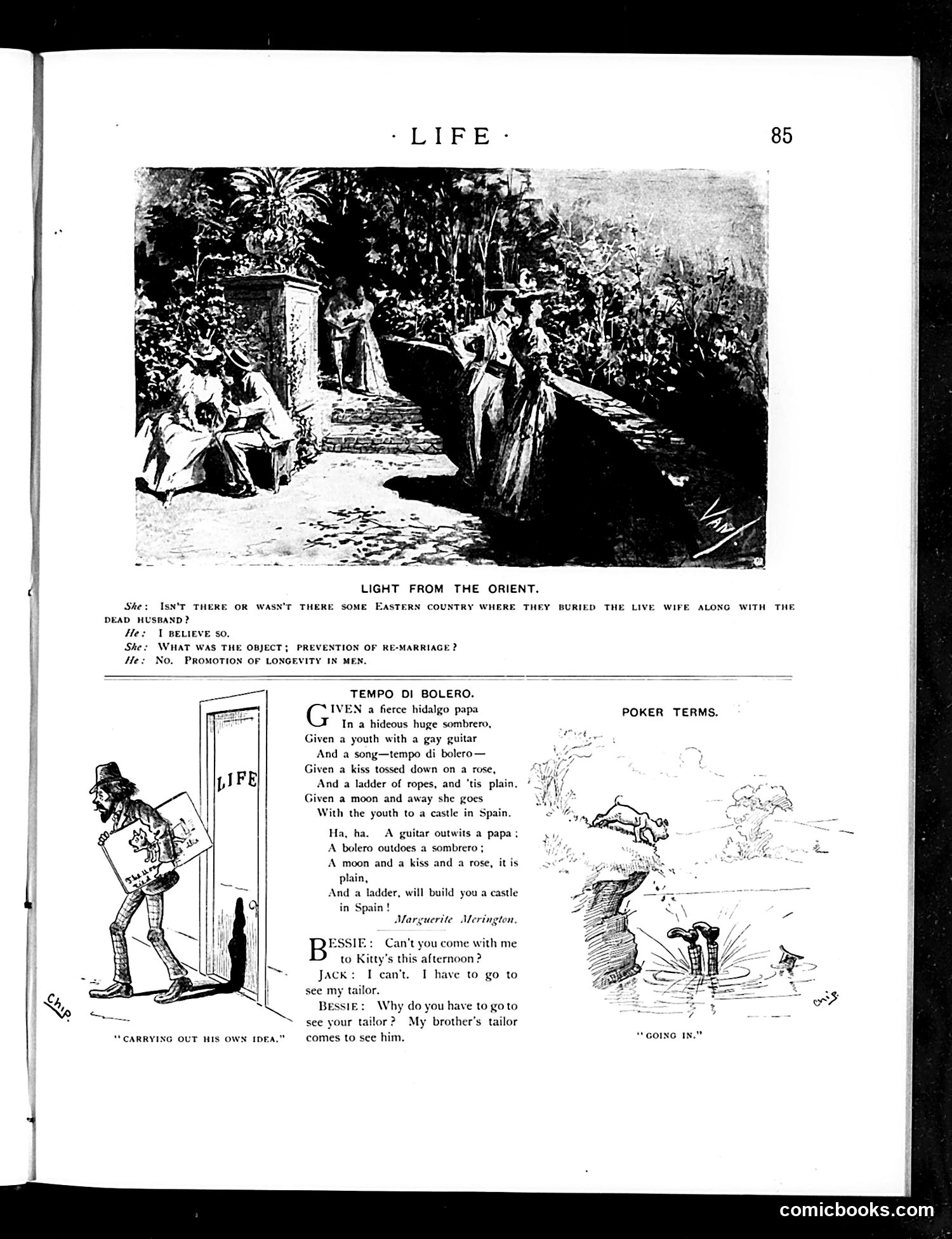
**Top section ("Light from the Orient"):** A dialogue-based cartoon about Eastern practices, specifically referencing sati (suttee)—the historical Hindu practice of widow immolation. The exchange critiques this custom and debates whether the actual purpose was preventing widow remarriage or promoting male longevity. This represents typical early 20th-century Western commentary on non-Western practices, blending moral criticism with satirical dismissal. **Lower sections:** - "Tempo di Bolero" presents a romantic poem about Spanish courtship, with lighthearted illustrations of lovers and guitars. - "Poker Terms" and "Going In" are humorous sketches about card games and fishing, using period slang and social commentary. The page reflects Life's mix of social satire, cultural critique, and domestic humor targeting its educated readership.
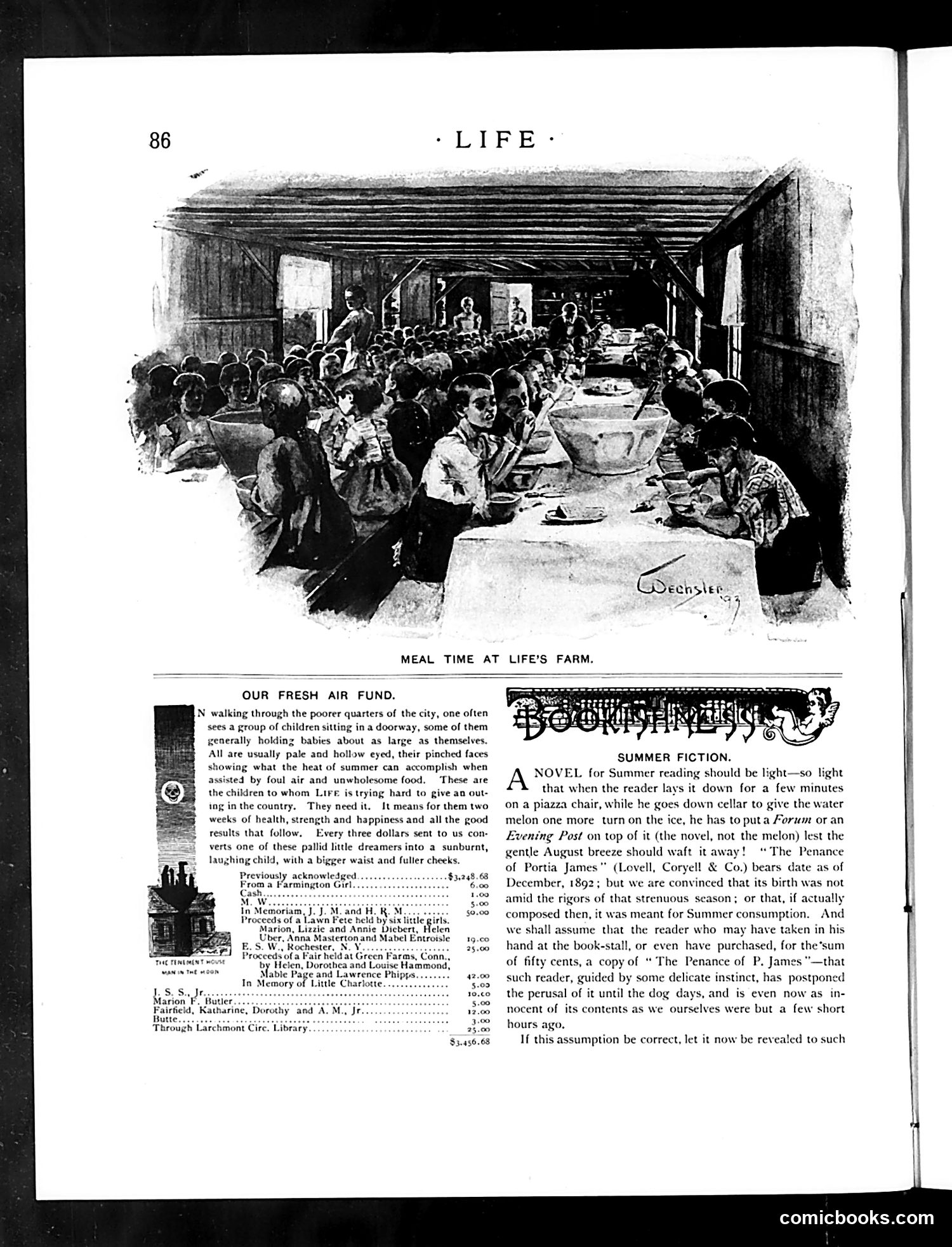
**Main Image:** "Meal Time at Life's Farm" shows a crowded indoor dining scene with many children and adults eating together in what appears to be a charitable institution or settlement house. **Context:** The accompanying text discusses LIFE magazine's charitable "Fresh Air Fund," which sent poor urban children to farms for health and recuperation during summer months. This was a genuine Progressive Era philanthropic initiative addressing child welfare and urban poverty. **The Point:** The illustration documents LIFE's social welfare efforts, depicting the tangible results of their fundraising (donations listed left). Rather than satire, this page celebrates the magazine's charitable work—feeding and improving health for disadvantaged city children through country exposure. The "Bookishly Yours" fiction section below is unrelated advertising content.
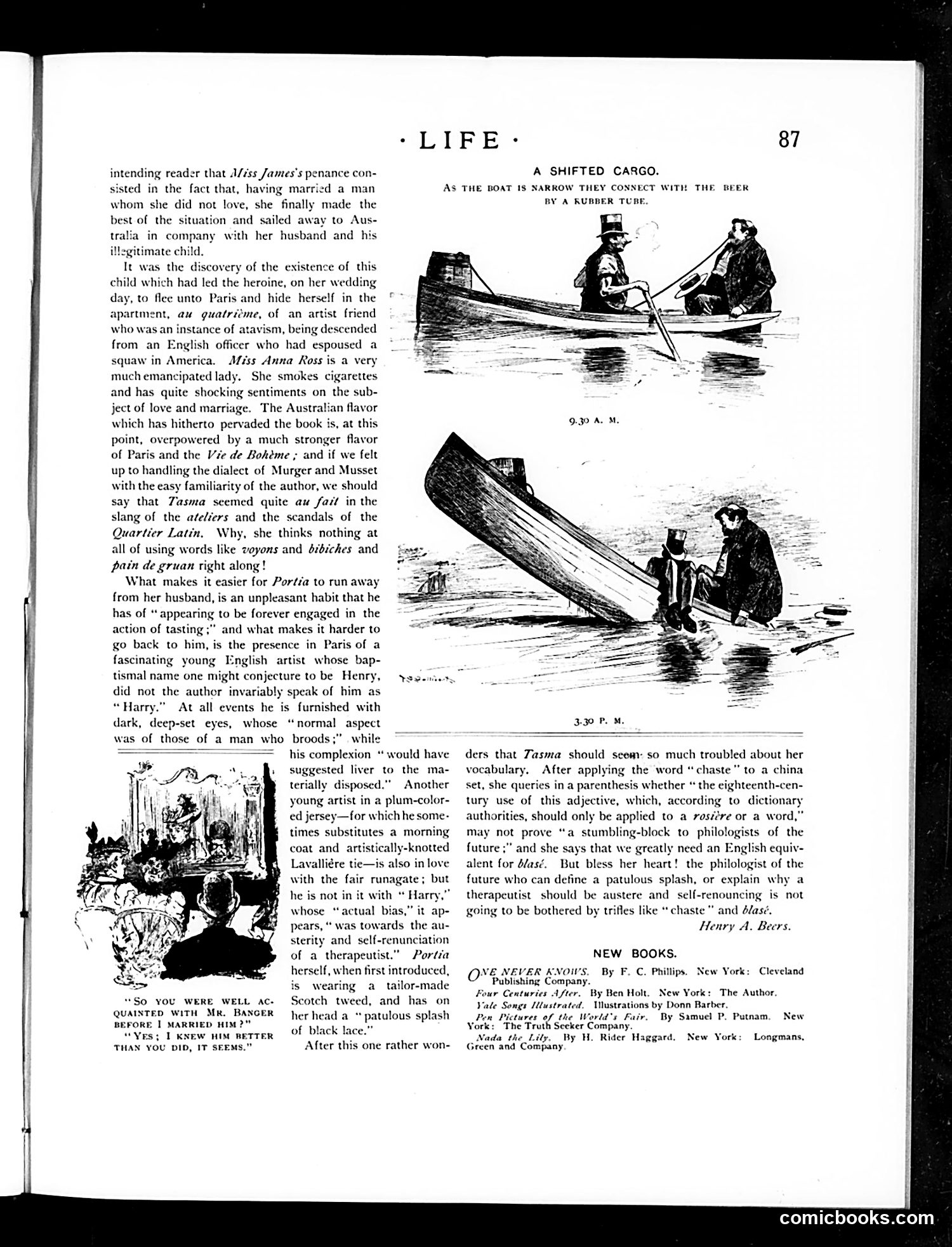
This page contains a literary review of a novel called *Taisma*, which the critic suggests is overly concerned with French bohemian attitudes and Parisian scandals. The review is sarcastical, criticizing the book's preoccupation with sophisticated but morally questionable behavior. The two illustrations appear to be scenes from the narrative being reviewed—depicting what seem to be characters in boats, likely illustrating dramatic moments from the story. The bottom left includes a small cartoon showing two figures, with accompanying dialogue: "So you were well acquainted with Mr. Banger before I married him?" / "Yes; I knew him better than you did, it seems." This is primarily a book review page with accompanying satirical commentary on contemporary literary trends, not political cartooning.
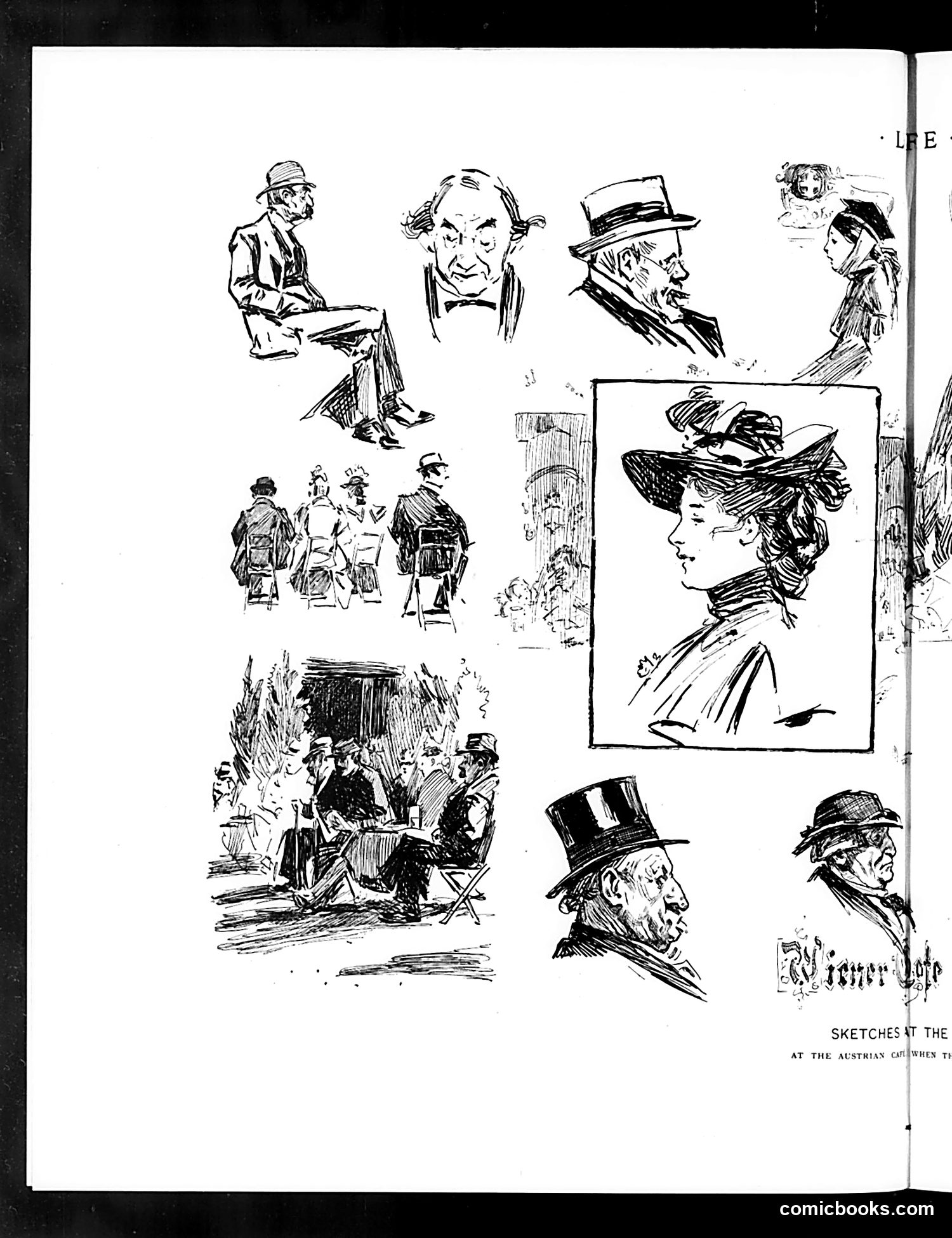
This page shows "Sketches at the Austrian Café" (text partially visible at bottom). The sketches are character studies—portraits and figures of what appear to be patrons or types observed at this establishment. The drawings display exaggerated facial features typical of Life magazine's satirical style: prominent noses, distinctive expressions, and period clothing (hats, formal wear). The larger framed portrait on the right shows a woman in a fashionable hat, suggesting the café attracted notable or eccentric characters worth caricaturing. Without clearer context or identifying labels visible in the image, I cannot specify which historical figures these represent or what social commentary Life intended. The satire appears aimed at the café's clientele rather than political events, capturing character "types" for comedic effect—a common Life magazine approach to urban social observation.
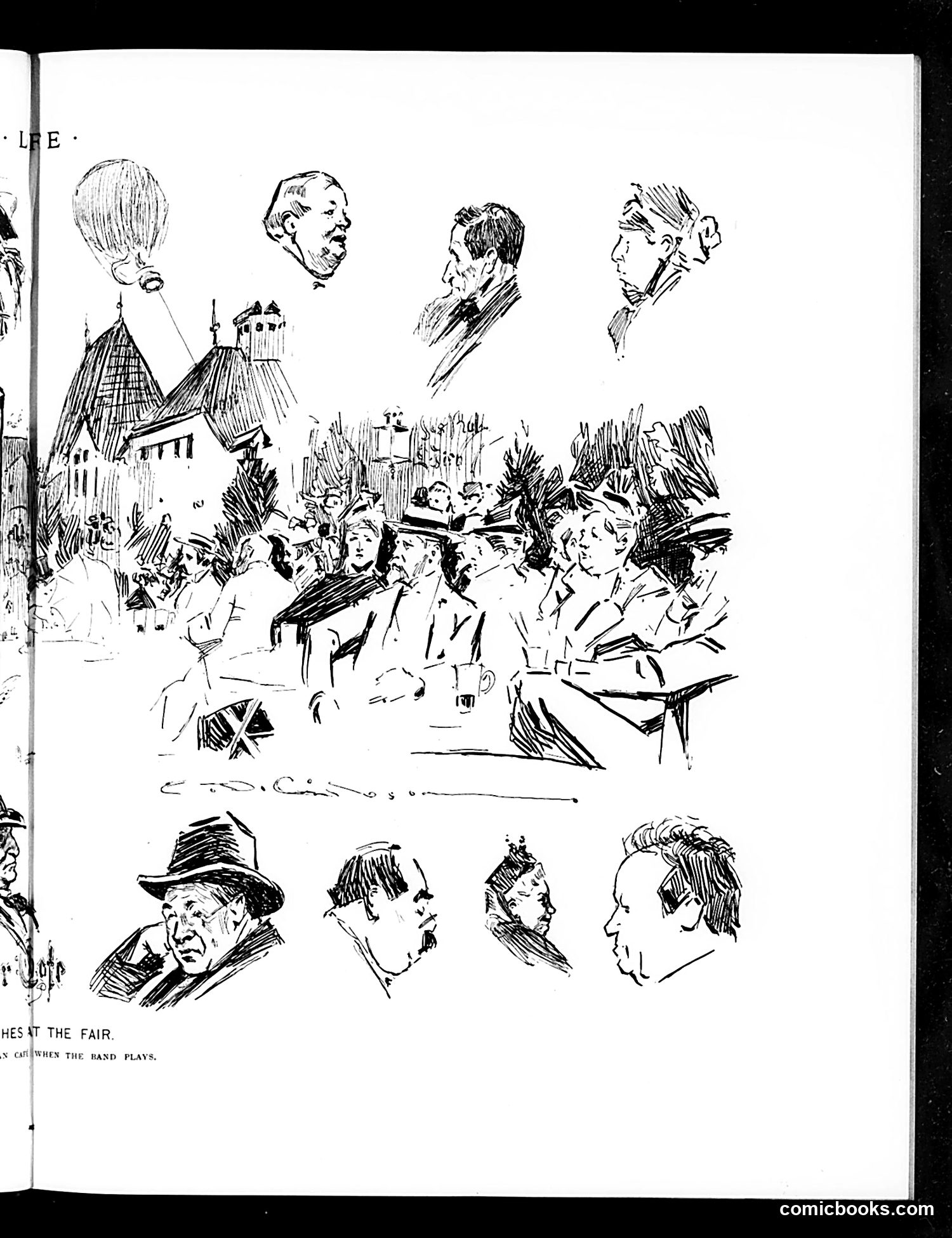
This page depicts "Scenes at the Fair" with a band playing, likely referencing an actual fair or public gathering from the publication's era. The central illustration shows well-dressed attendees listening to music, while surrounding character studies (head sketches) appear to be caricatures of notable attendees or society figures of the time. The satirical intent seems to capture the social dynamics of fair-goers—their reactions, fashion, and interactions during the band's performance. The exaggerated facial features in the sketches are typical of Life magazine's satirical style, mocking attendees' pretensions or distinctive characteristics. Without more specific text or date information visible, the exact identities of the figures remain unclear, though they appear to represent recognizable contemporary personalities or social types that readers of that era would have known.
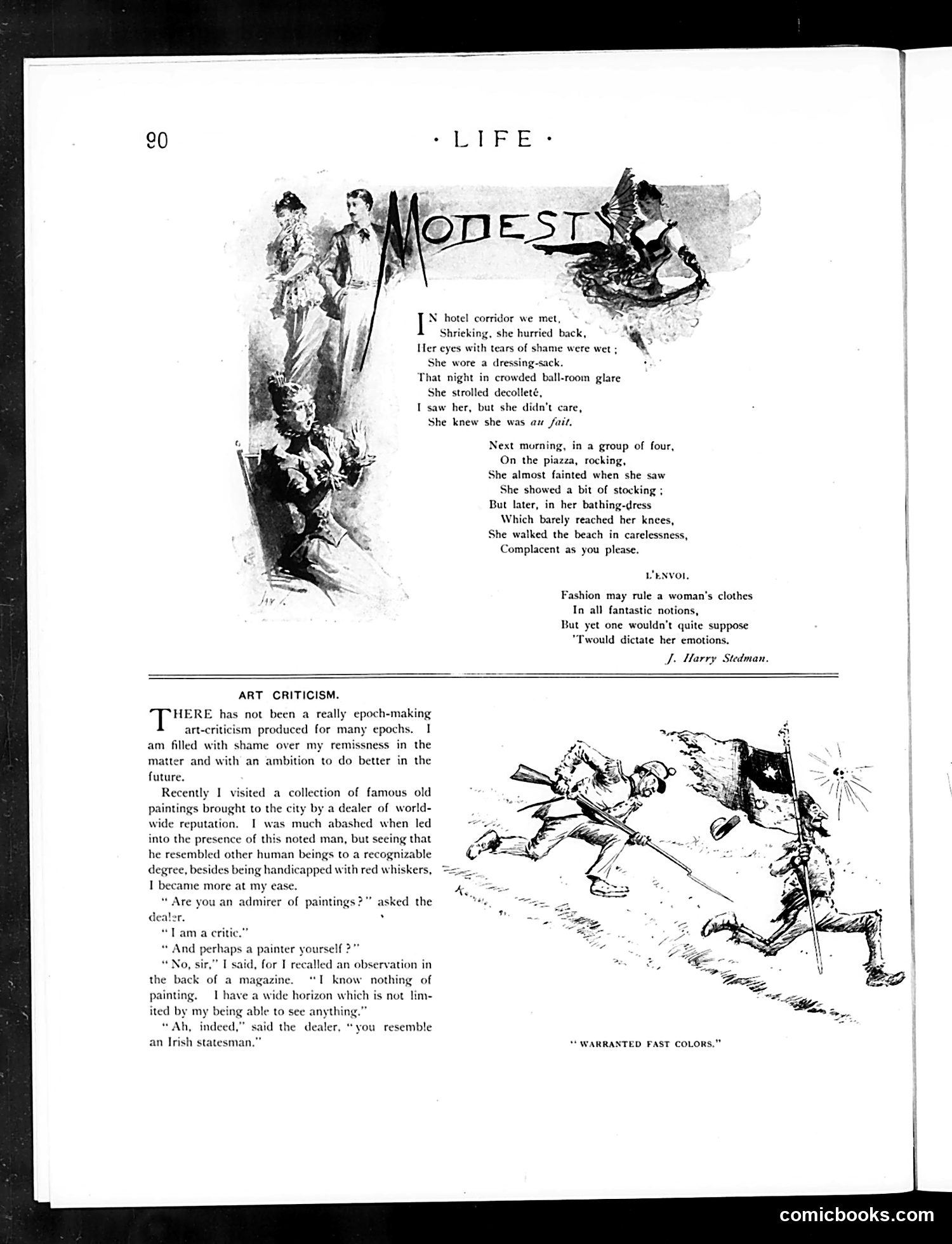
**"Modest" Poem Section:** This satirical poem describes a woman who, despite appearing modest and demure at a formal ball, reveals herself to be carefree and improper at the beach—walking in a revealing bathing dress "which barely reached her knees." The satire targets the hypocrisy of female propriety: women who maintain a facade of modesty in public settings but abandon social conventions elsewhere. **"Art Criticism" Section:** A dealer meets a self-proclaimed art critic who admits he knows nothing about painting but boasts of "a wide horizon which is not limited" by knowledge. The critic sarcastically compares the dealer to "an Irish statesman"—likely suggesting both are bluffing or incompetent. This mocks pretentious art criticism and fraudulent expertise.
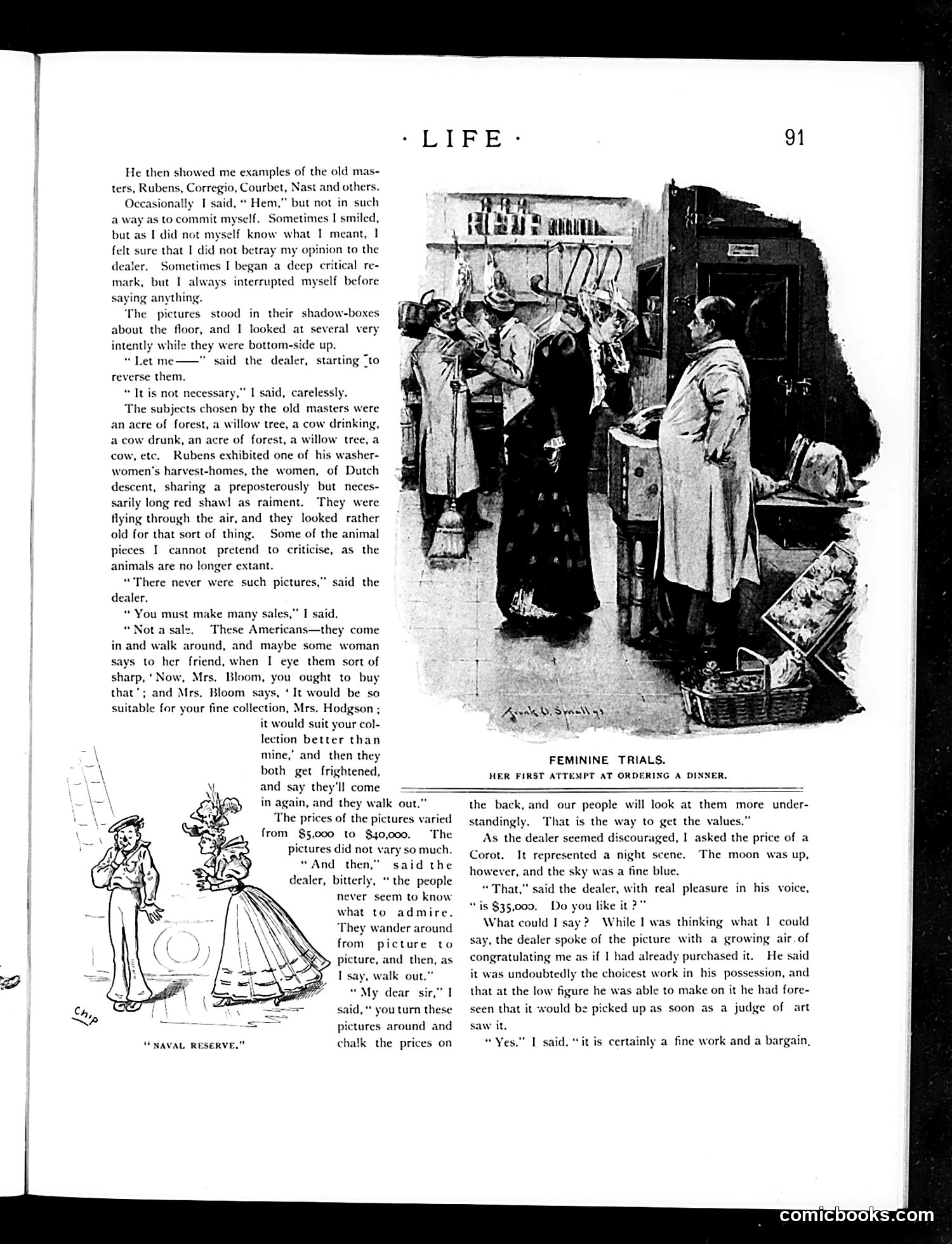
This page contains a narrative about art dealing paired with two satirical illustrations. **The main illustration** titled "FEMININE TRIALS: HER FIRST ATTEMPT AT ORDERING A DINNER" depicts a woman nervously attempting to order at a restaurant while male staff members gesture dismissively. The satire mocks women's supposed incompetence in public social situations—a common early 20th-century stereotype. **The smaller cartoon** labeled "NAVAL RESERVE" shows two figures in exaggerated dress, likely satirizing military preparedness or social pretension during a period of military concern. The text discusses an art dealer's cynical marketing tactics, suggesting that wealthy Americans lack genuine taste and can be manipulated into purchasing art through flattery and social pressure—a critique of emerging American wealth and cultural insecurity.
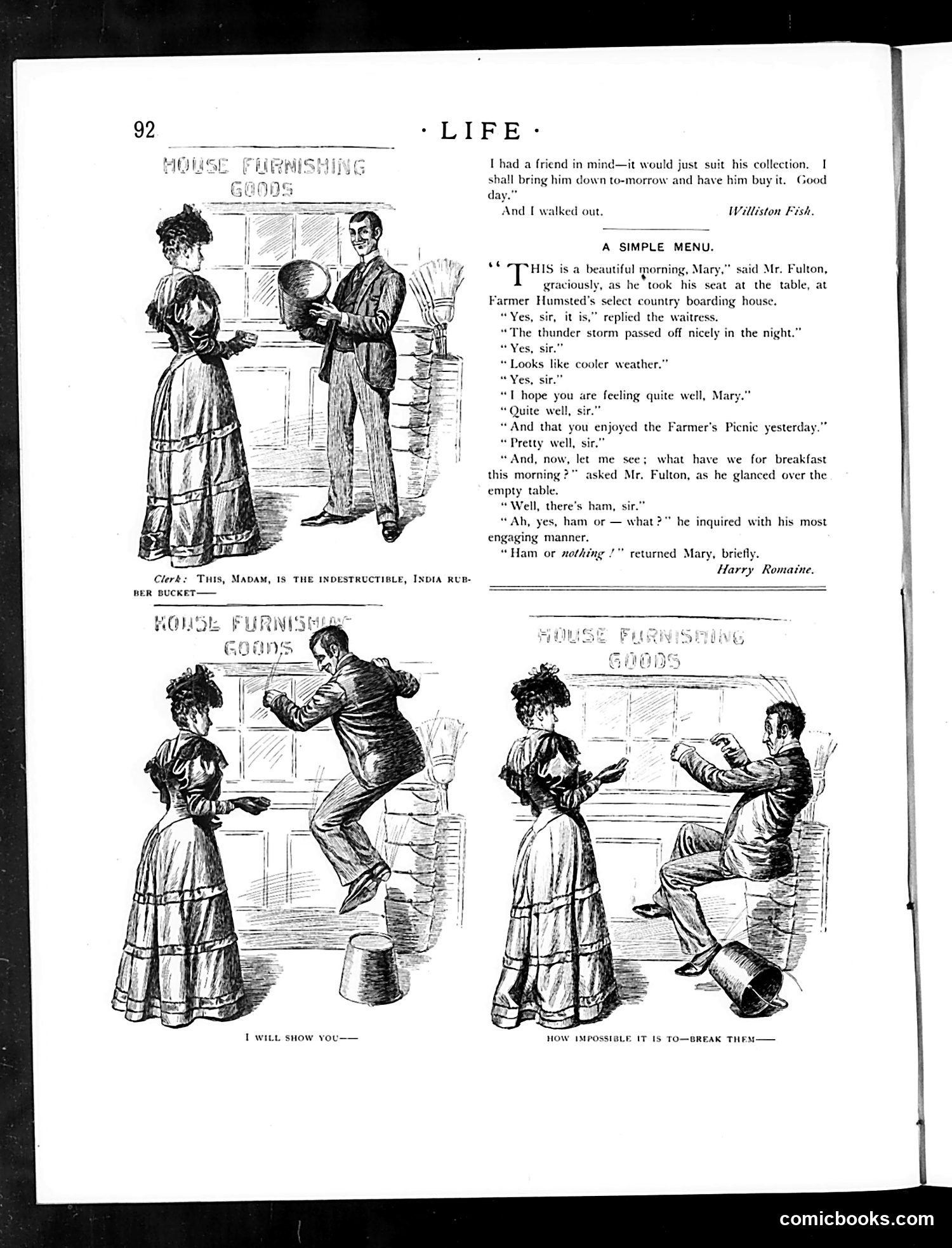
This page contains two satirical pieces about domestic life and servants: **"A Simple Menu"** depicts a boarding house breakfast scene where Mr. Fulton, a guest, engages the waitress Mary in polite small talk before asking about breakfast options. When he asks "ham or—what?" Mary bluntly replies "Ham or nothing!" The humor satirizes the contrast between his elaborate, affected courtesy and her no-nonsense practicality. It mocks both the pretentious politeness of upper-class diners and the reality of limited boarding house fare. **The "House Furnishing Goods" comic strip** (three panels) shows a domestic servant demonstrating an "indestructible, India rubber bucket" to a woman. The clerk performs increasingly violent acts—climbing shelves, kicking the bucket—to prove its durability. The satire critiques both exaggerated product advertising claims and the absurdity of destructibility tests. Both pieces use humor to poke fun at class interactions, consumer culture, and the gap between marketing promises and reality in turn-of-the-century America.
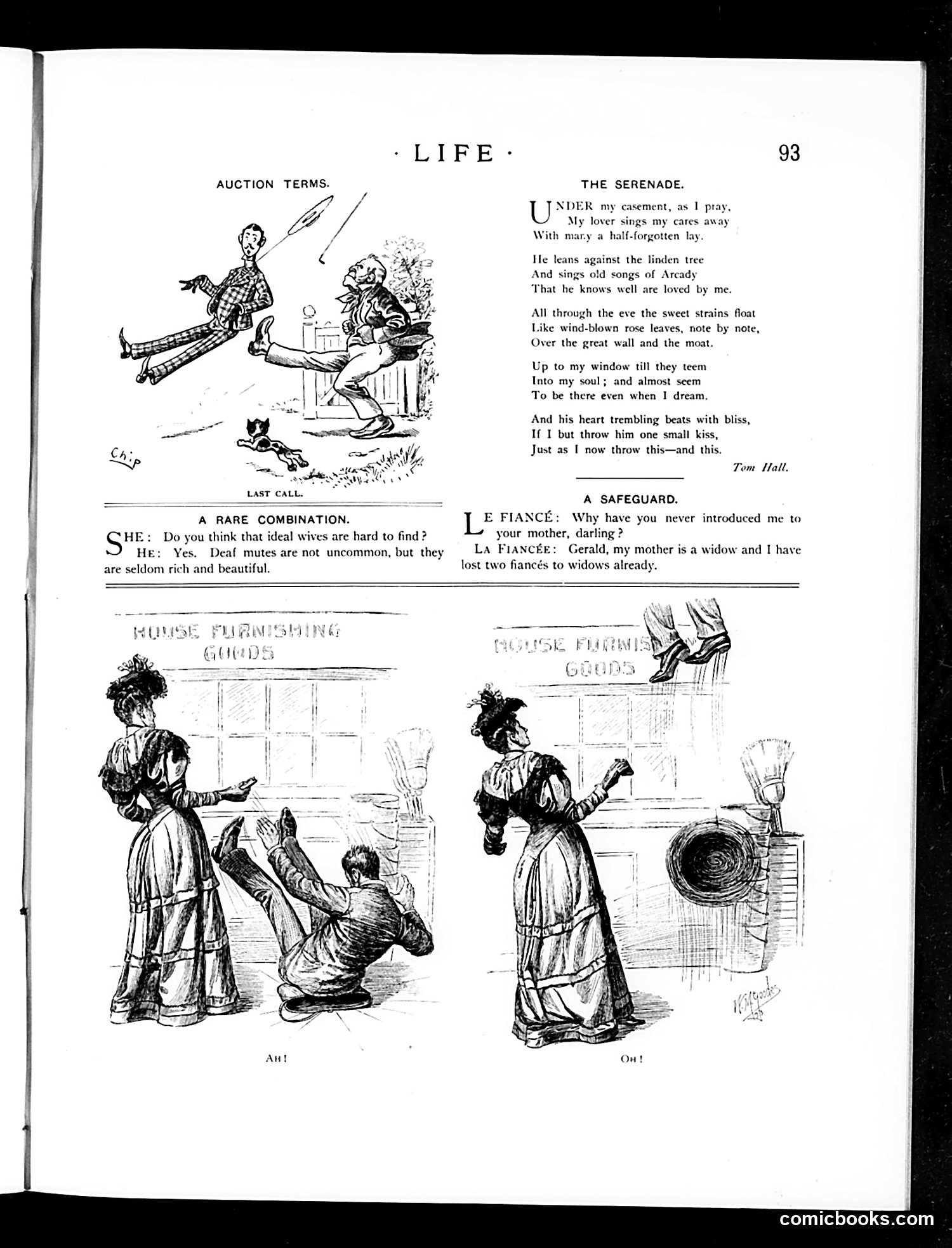
This page contains several brief humorous sketches typical of *Life* magazine's satirical approach: **"A Rare Combination"** mocks marriage ideals through dark humor—the joke being that "ideal wives" who are deaf mutes are desirable because they cannot speak, critiquing both male attitudes toward women and the impossible standards for wives. **"The Serenade"** is a romantic poem about a lover singing beneath a window, presented earnestly but likely meant as gentle mockery of sentimental courtship rituals. **"A Safeguard"** uses gallows humor about serial fiancée loss. A man refuses to introduce his fiancée to his widowed mother because she's already lost two previous fiancées to widowhood—implying the mother is somehow responsible for their deaths, played for dark comedic effect. The accompanying illustrations show domestic scenes and romantic scenarios. Overall, the page satirizes Victorian courtship conventions, marriage expectations, and gender relations through exaggeration and morbid jokes characteristic of early 20th-century American humor.
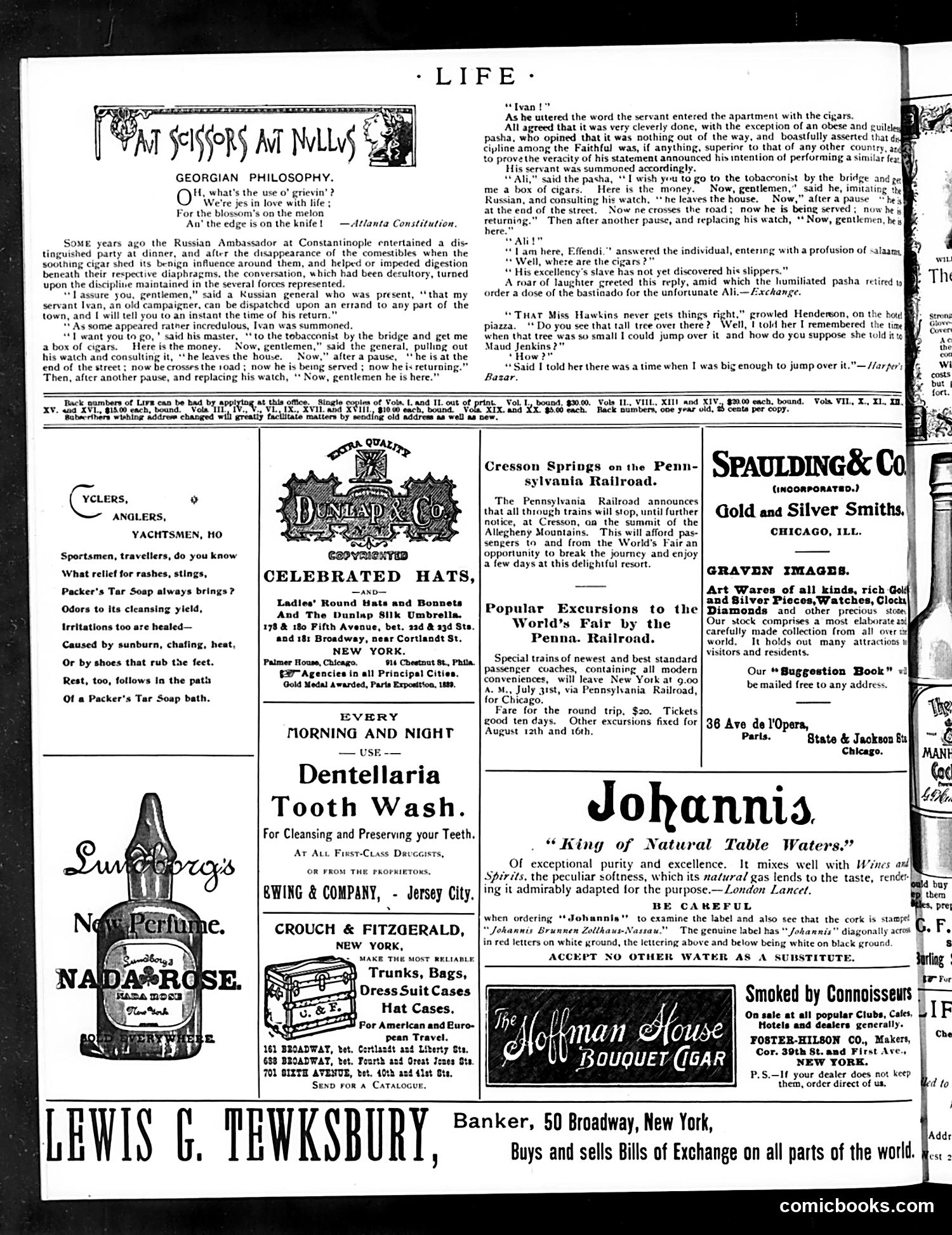
This page contains a humorous story contrasting Russian and Ottoman approaches to servant obedience. A Russian general at a dinner demonstrates his servant Ivan's discipline by dispatching him on an errand, then predicting his exact movements by consulting his watch—an impressive show of control. An Ottoman pasha attempts the same feat with his servant Ali, using identical language and gestures. However, Ali's return reveals the joke: the servant hasn't even left to get the cigars because he "has not yet discovered his slippers"—a subtle mockery of Ottoman discipline and authority. The satirical point: while the Russian general commands genuine obedience, the pasha's elaborate mimicry masks an inability to control even basic servant behavior. The pasha is humiliated, and—in stereotypical fashion—responds by ordering bastinado (beating). The satire likely reflects late 19th-century Western perceptions of Ottoman governance as ineffective despite outward formality.
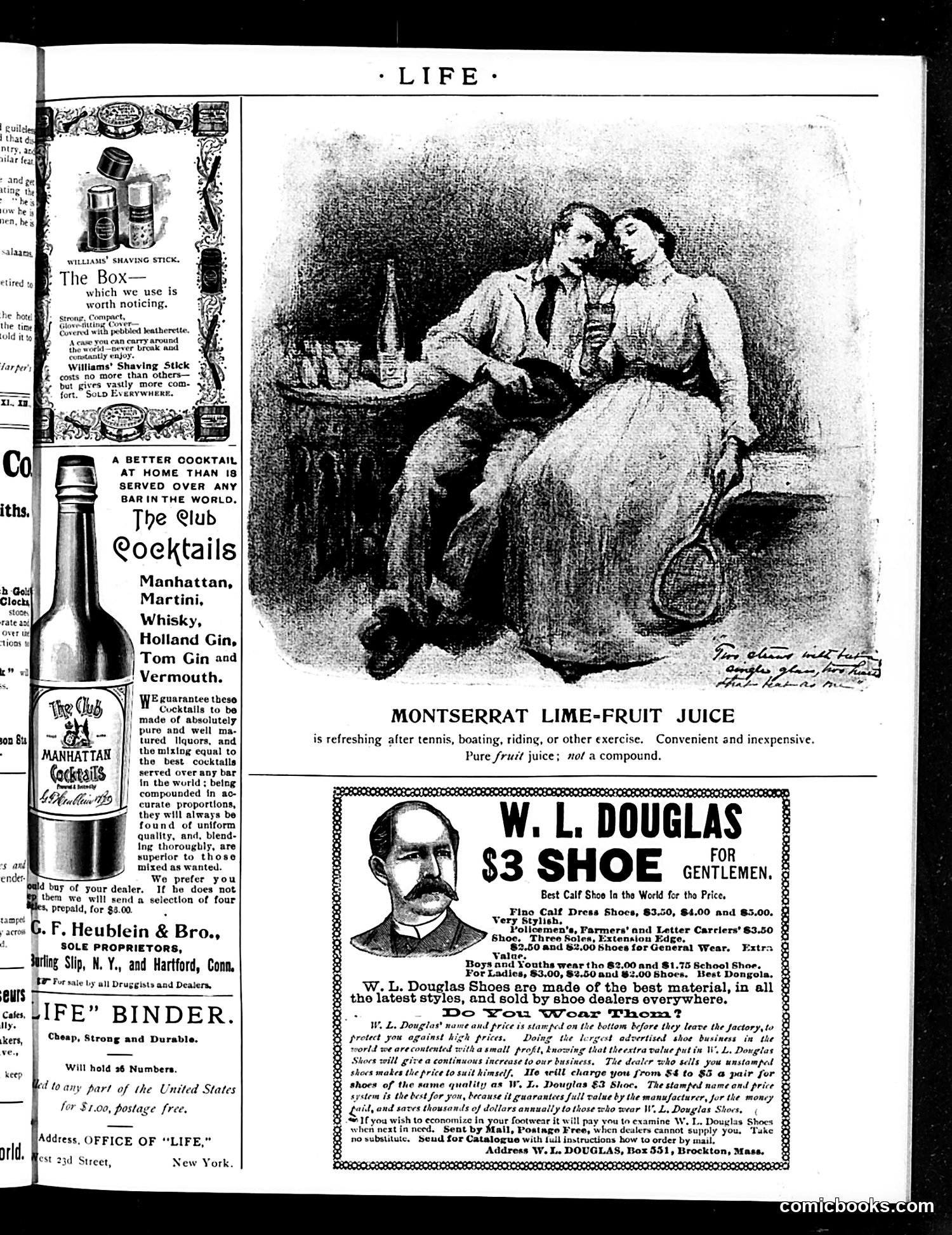
This page is primarily **advertisements**, not political satire. It features a generic romantic illustration (couple with tennis racket) captioned to promote Montserrat Lime-Fruit Juice as a refreshing beverage after exercise. The ads include: - **Williams' Shaving Stick** (grooming product) - **Club Cocktails** (pre-mixed spirits from Heublein & Bro., guaranteeing consistent quality) - **Montserrat Lime-Fruit Juice** (the main illustrated product) - **W.L. Douglas $3 Shoe** (prominent shoe manufacturer advertising affordability and factory-direct sales to avoid retailer markup) The Douglas shoe ad emphasizes that stamping the price directly on shoes protects consumers from inflated retail pricing—a consumer protection message relevant to early 1900s retail practices. The couple illustration serves as generic "lifestyle" marketing suggesting leisure and refinement associated with the products, rather than satirizing any political figure or event.
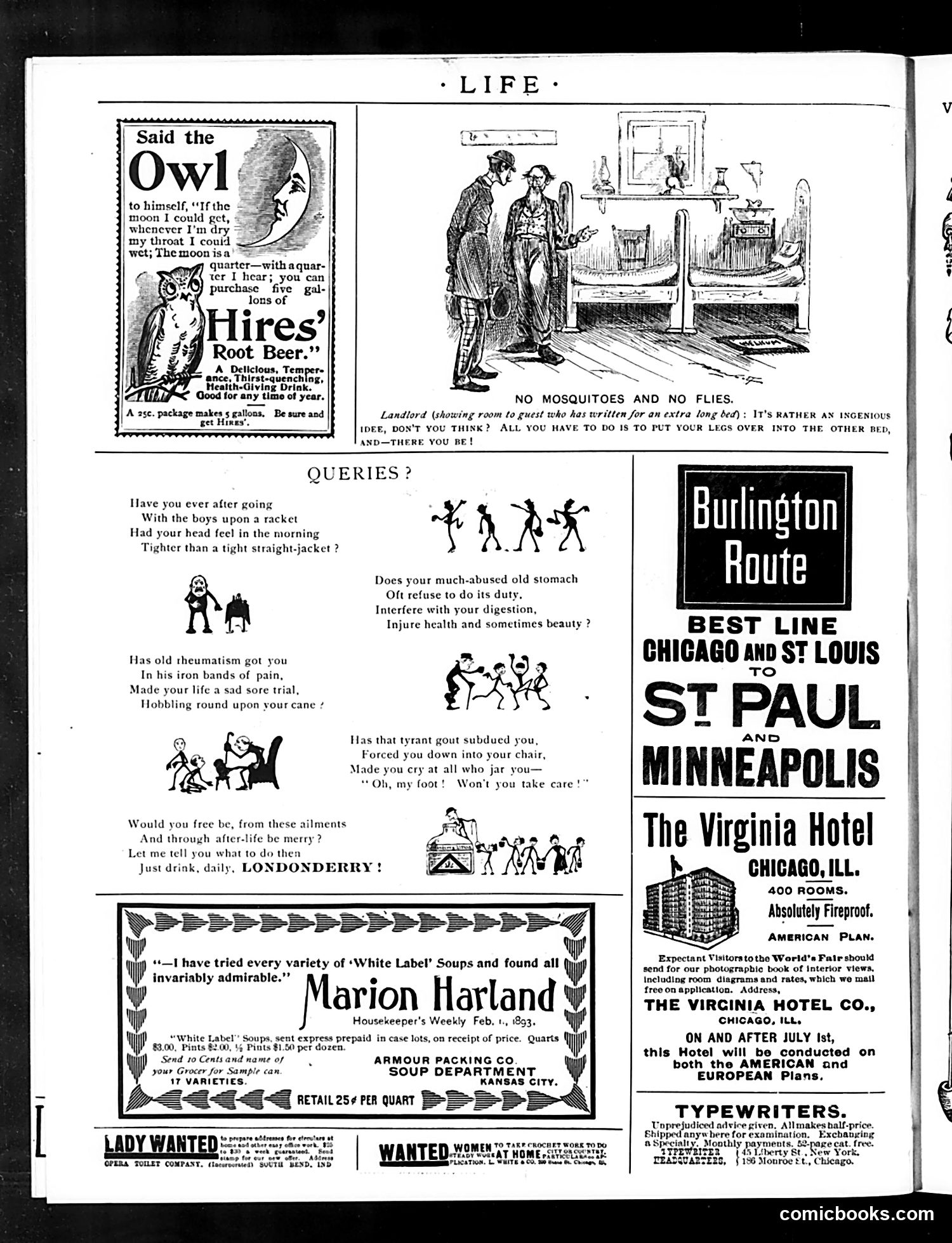
This page from *Life* (dated February 1, 1893) is primarily **advertising**, with one cartoon joke. The main cartoon depicts a **landlord and guest** at a hotel. The guest has requested an extra-long bed, and the landlord suggests an "ingenious" solution: simply extend your legs into the neighboring bed. The satire mocks both cheap hotel accommodations and the absurd, impractical "solutions" proprietors offer to cut costs rather than invest in proper furnishings. The page is dominated by product advertisements—root beer, soup, a Chicago hotel, typewriters, and employment notices. These ads reflect late-19th-century consumer culture and patent medicines marketed with exaggerated health claims (note "Londonderry" drink promising to cure rheumatism and gout). The owl mascot for Hires' Root Beer and Marion Harland's endorsement represent typical advertising strategies of the era: celebrity testimonials and memorable cartoon characters to build brand recognition.