
A complete issue · 16 pages · 1893
Life — July 13, 1893
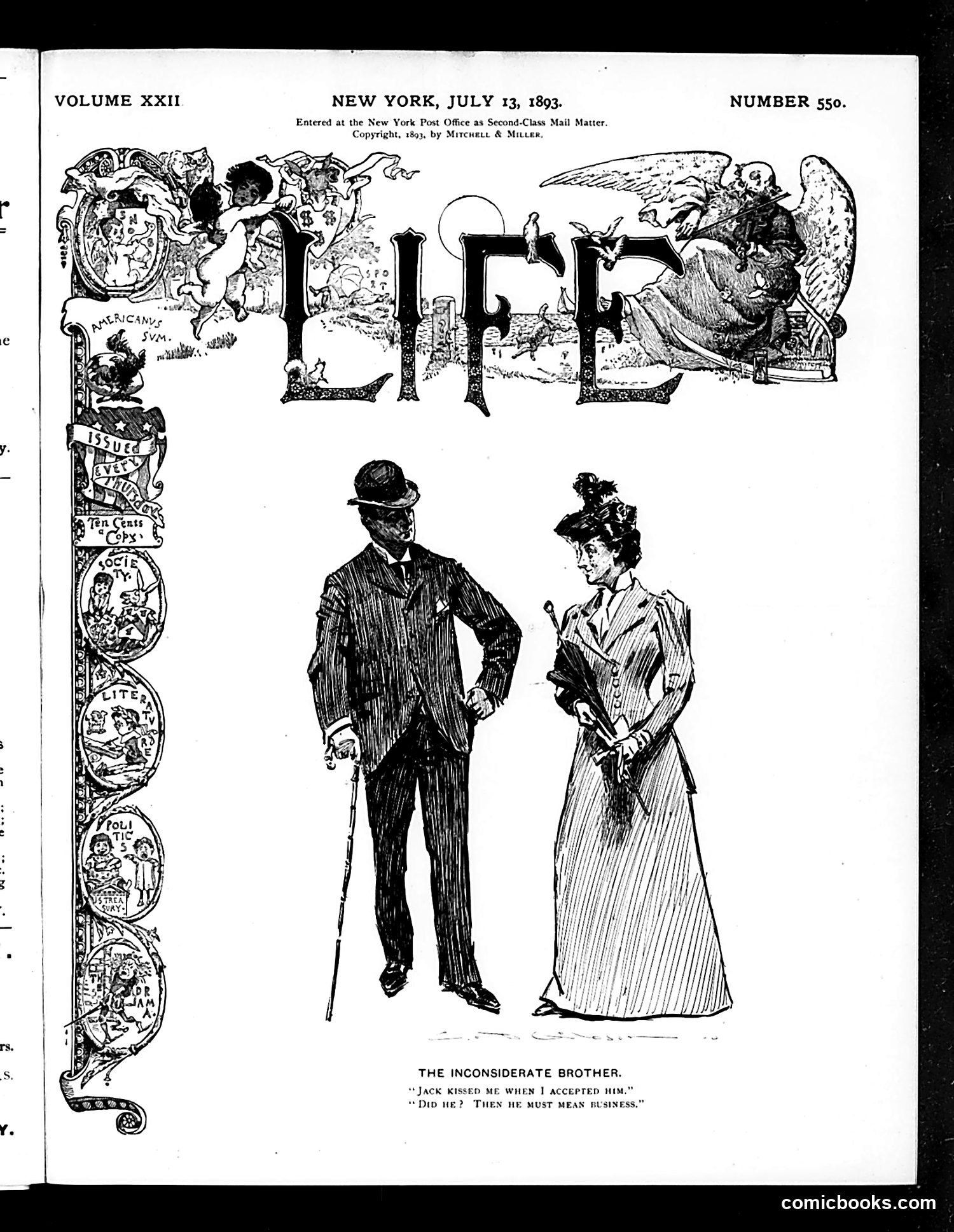
This illustration depicts a domestic dispute between a well-dressed man and woman from the 1890s era. The caption quotes: "Jack kissed me when I accepted him. Did he? Then he must mean business." The satire appears to target male courtship behavior and social expectations of the period. The joke hinges on the woman's interpretation—she suggests that a man's kiss upon engagement proposal indicates serious romantic intent ("mean business"), implying that such physical affection was significant and not casually given. The title "The Inconsiderate Brother" suggests the man (Jack) is being criticized for either his forwardness or his failure to follow proper courtship protocol. The cartoon mocks gender relations and the formalized rules governing romantic behavior in Victorian-era American society.
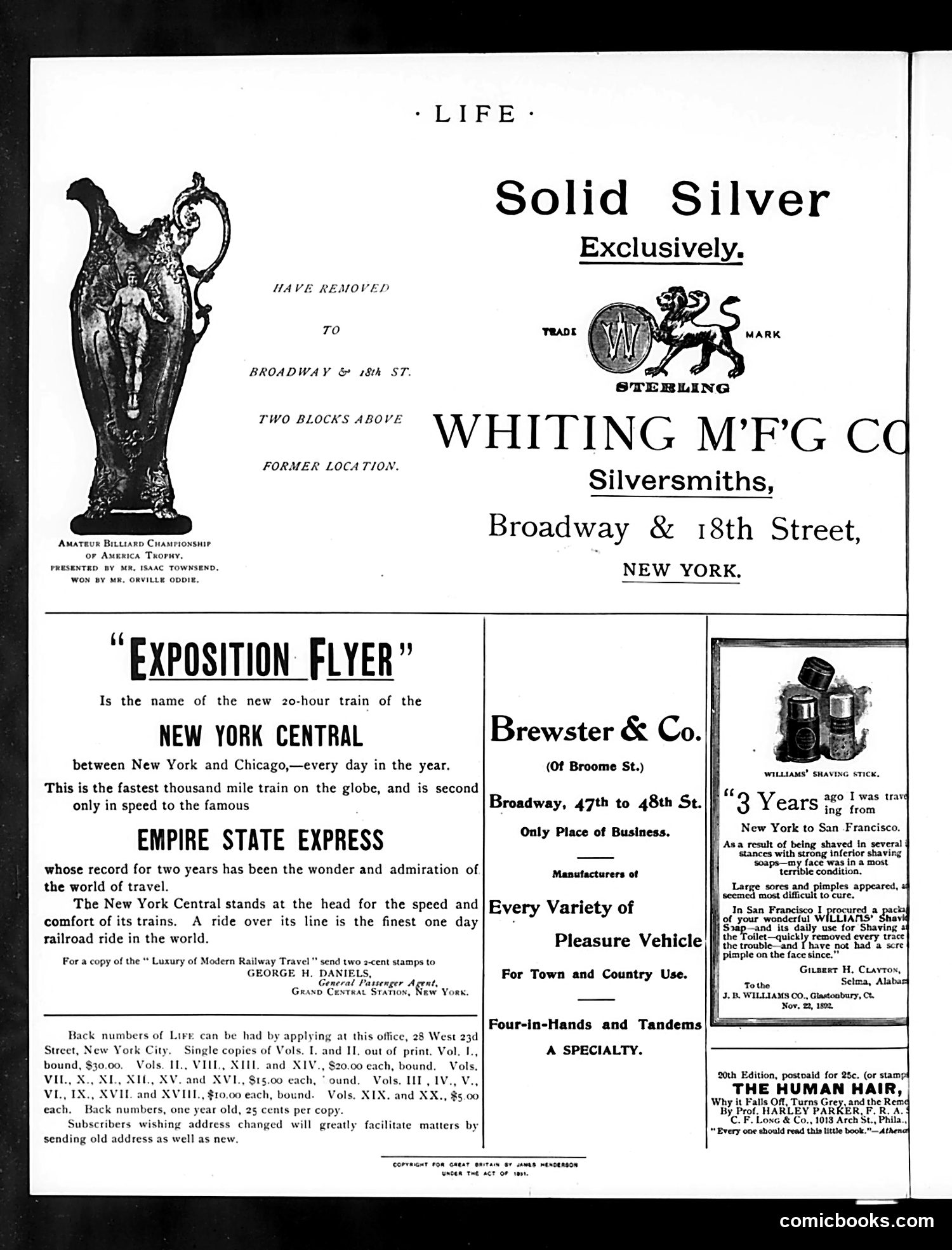
This page is **primarily advertising** for Gilded Age luxury goods and services, not political satire. The prominent content includes: - **Whiting M'FG Co.** advertisement for solid silver goods at Broadway & 18th Street - **New York Central Railroad** promotion for the "Exposition Flyer" and "Empire State Express," touting speed records between New York and Chicago - **Brewster & Co.** vehicle manufacturer advertising pleasure carriages for town and country use - **Williams' Shaving Stick** testimonial from San Francisco about skin condition improvement - Various other commercial notices The only non-advertising content is a small decorative image showing the "Amateur Billiard Championship of America Trophy." There is no discernible political cartoon or satire on this page—it represents typical late-19th century *Life* magazine revenue through paid advertisements.
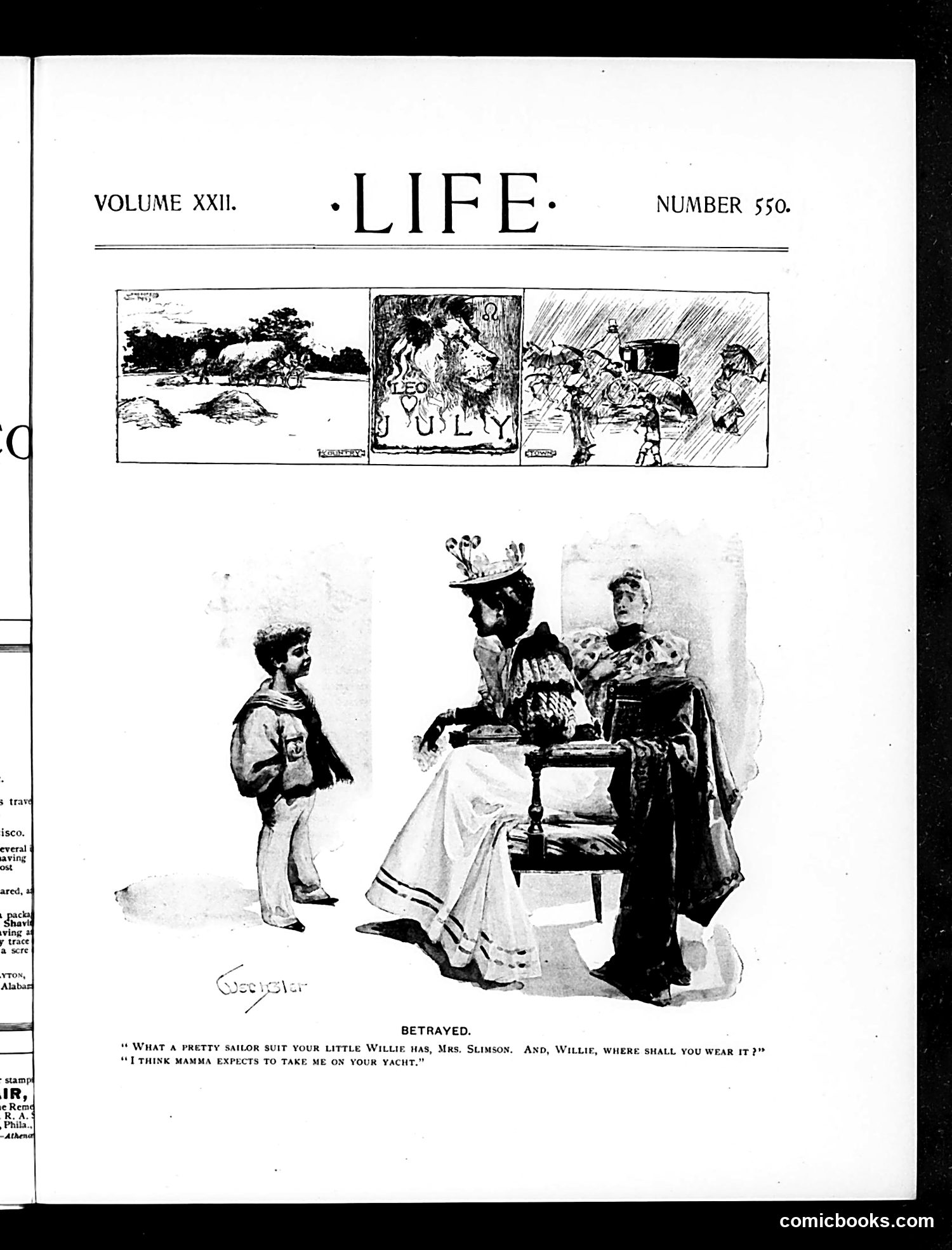
This cartoon satirizes broken promises about childhood expectations. A young boy in a sailor suit confronts two well-dressed women (apparently his mother and another society woman). The boy says he thought his mother expected to take him on a yacht, but Mrs. Simson is instead planning to wear his sailor suit herself—suggesting she intends to use the fashionable outfit as adult clothing rather than letting the child wear it as promised. The humor targets the vanity and self-centeredness of wealthy society women who appropriate children's fashionable garments for themselves, betraying the child's innocent expectations. It mocks the superficiality of Edwardian high society's obsession with fashionable dress over genuine maternal concern.
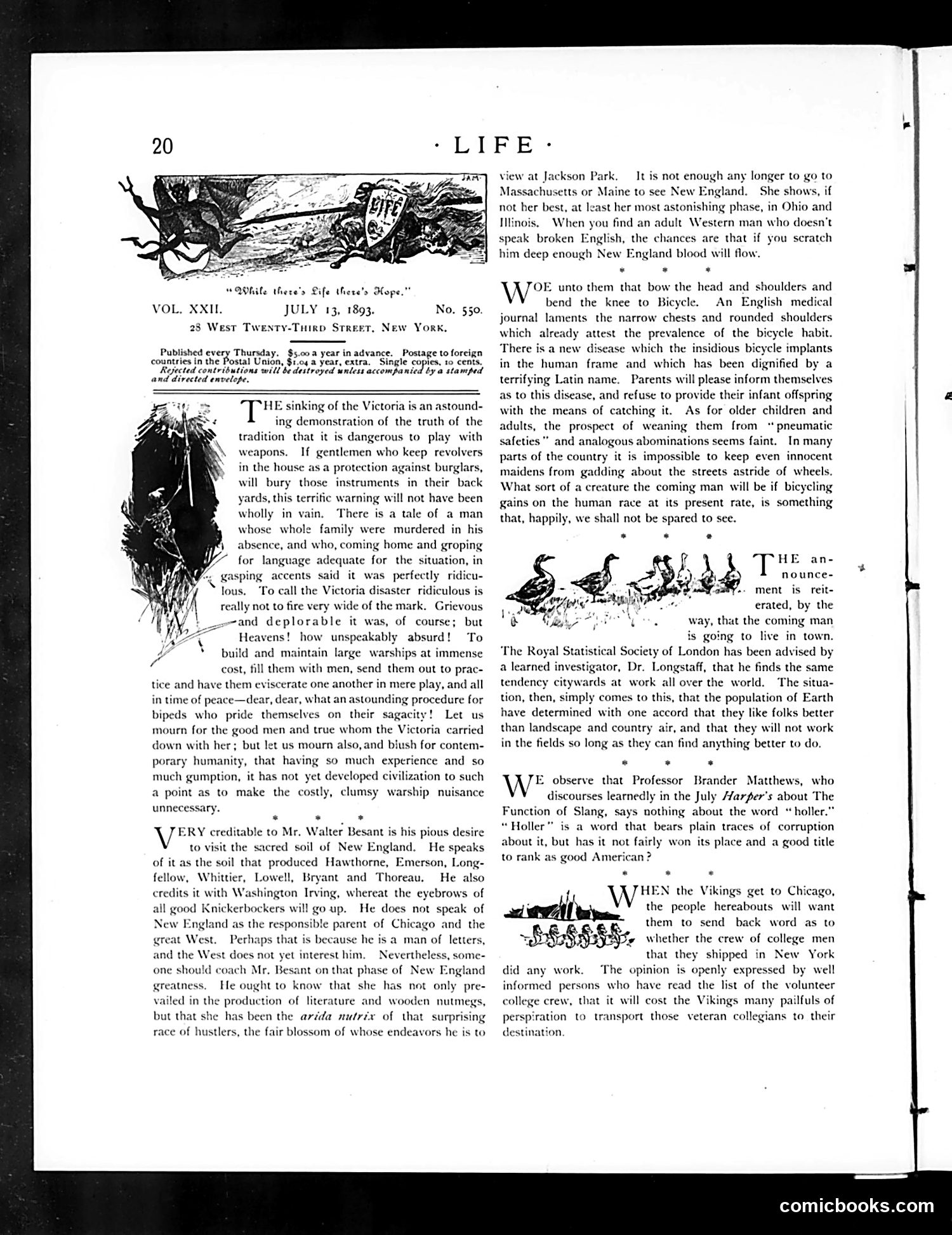
This page contains satirical commentary on contemporary social issues rather than a traditional political cartoon. The main topics include: 1. **The Victoria Shipwreck**: A lengthy editorial mocking the "tradition" of keeping revolvers aboard ships for protection against burglars, commenting sarcastically that maintaining expensive warships is absurd. 2. **Bicycle Safety Concerns**: Satirical criticism of medical warnings about bicycles causing disease in women, mocking narrow chests and rounded shoulders allegedly caused by cycling—a genuine Victorian-era health panic. 3. **Population Statistics**: Commentary on the Royal Statistical Society's findings about Earth's population and workers' reluctance to remain in countryside labor. 4. **Walter Besant's New England Pilgrimage**: Brief mention of the author's literary credentials and New England connections. The page reflects 1890s anxieties about technology, urbanization, and social change.
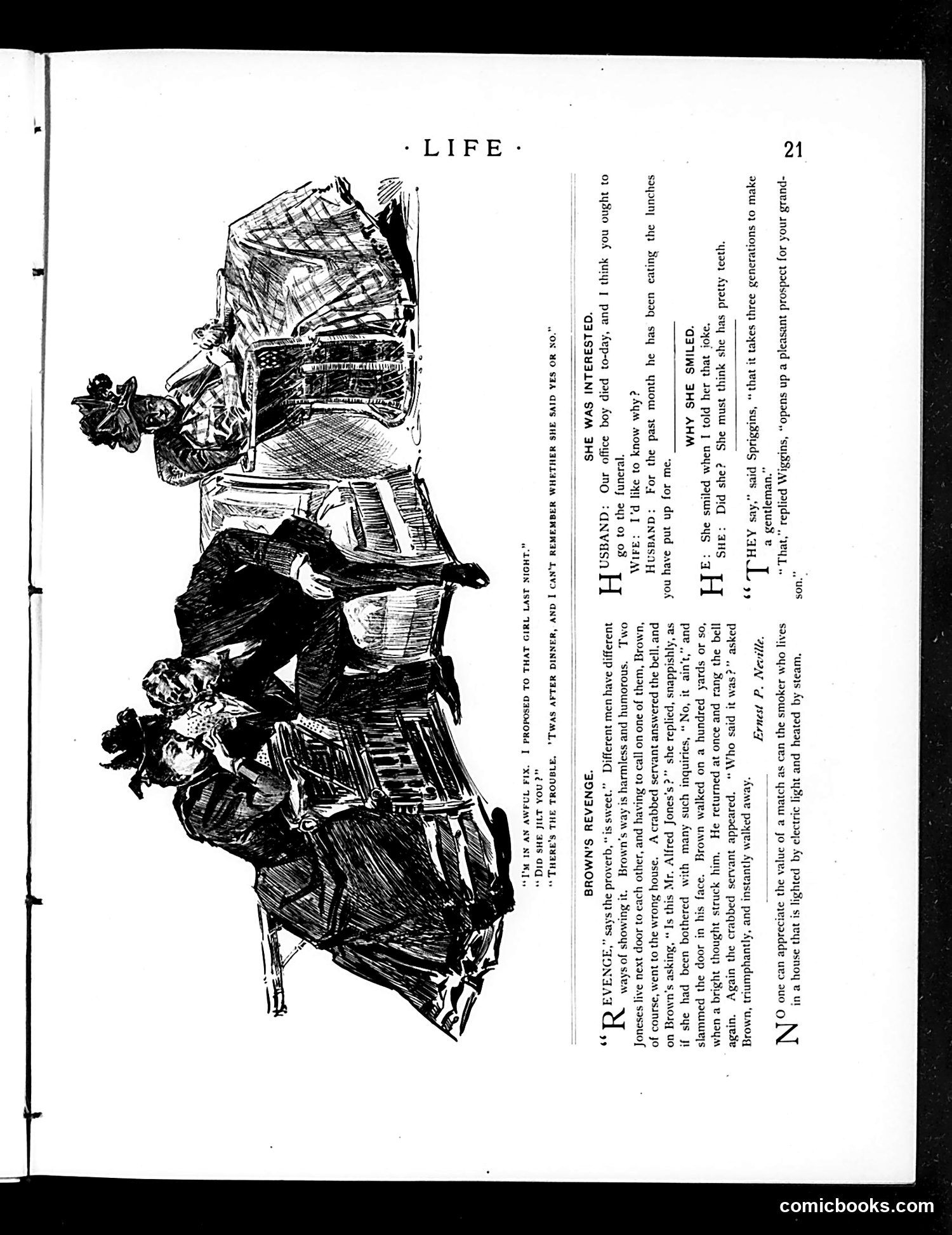
This page contains a satirical sketch titled "Brown's Revenge" accompanied by dialogue. The cartoon depicts what appears to be a domestic scene with figures in period clothing (likely early 1900s based on the artistic style). The text references "HUSBANDS" and discusses a wife who "was interested" in something, with dialogue about eating lunches and past months. The sketch's title "Brown's Revenge" suggests marital discord or a domestic conflict scenario, typical of Life magazine's humor focusing on middle-class domestic situations. However, without clearer image resolution or more complete text, I cannot definitively identify the specific individuals being caricatured or the exact social/political context being satirized. The humor appears to center on conjugal relations and domestic disputes rather than explicit political commentary.
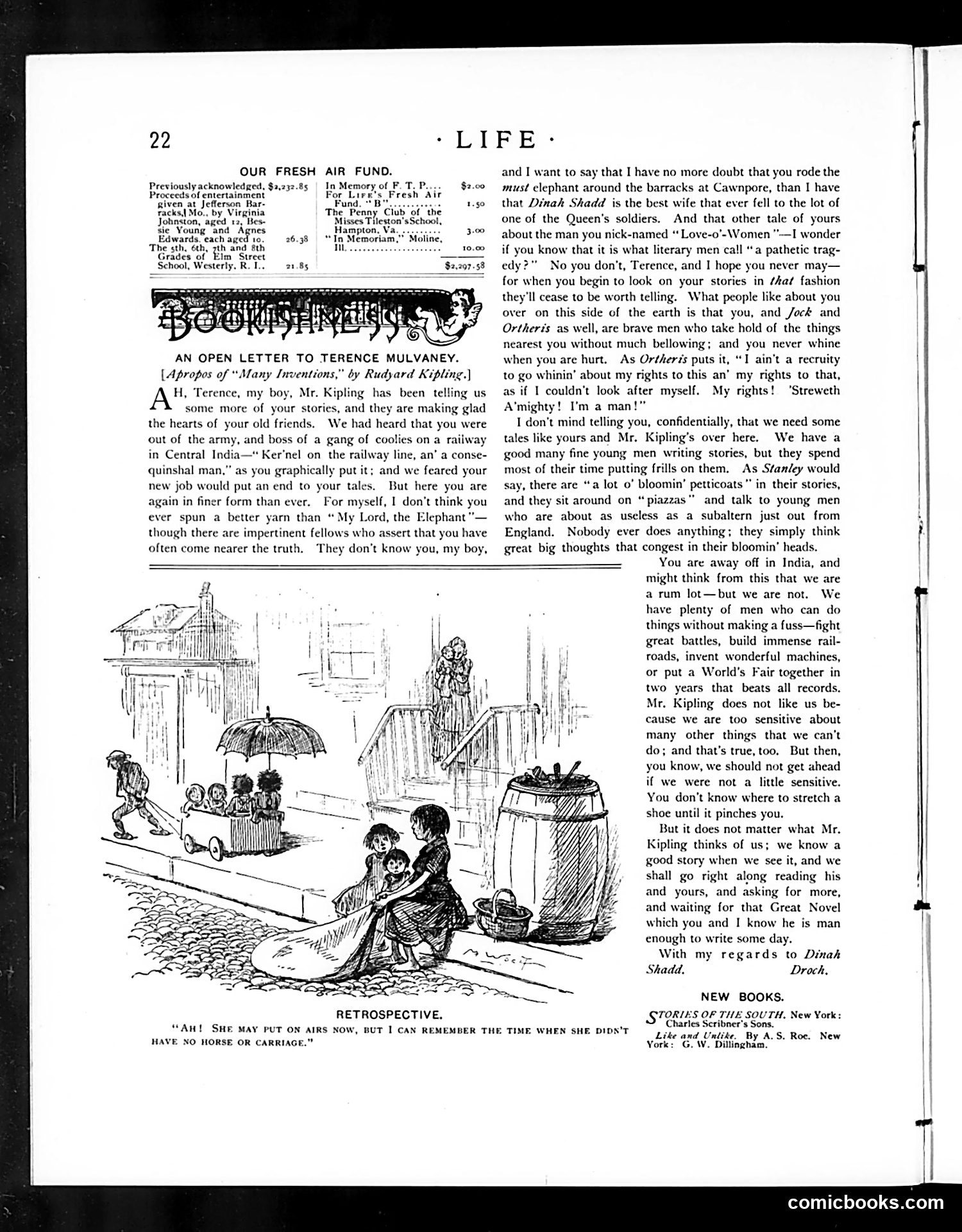
This page contains **"An Open Letter to Terence Mulvaney"** by Rudyard Kipling, addressed to a character from his military fiction. The letter praises Mulvaney as representing British soldiers' qualities—bravery, practicality, and resilience—contrasting them favorably with English civilians who accomplish little without complaint. The accompanying sketch, titled **"Retrospective,"** depicts a woman in Victorian-era dress riding in a modern automobile, with the caption joking: "Ah! She may put on airs now, but I can remember the time when she didn't have no horse or carriage." This is **social satire about class mobility and pretension**—mocking nouveau riche or socially aspiring women who adopt airs after acquiring automobiles, a relatively new luxury in the early 1900s.
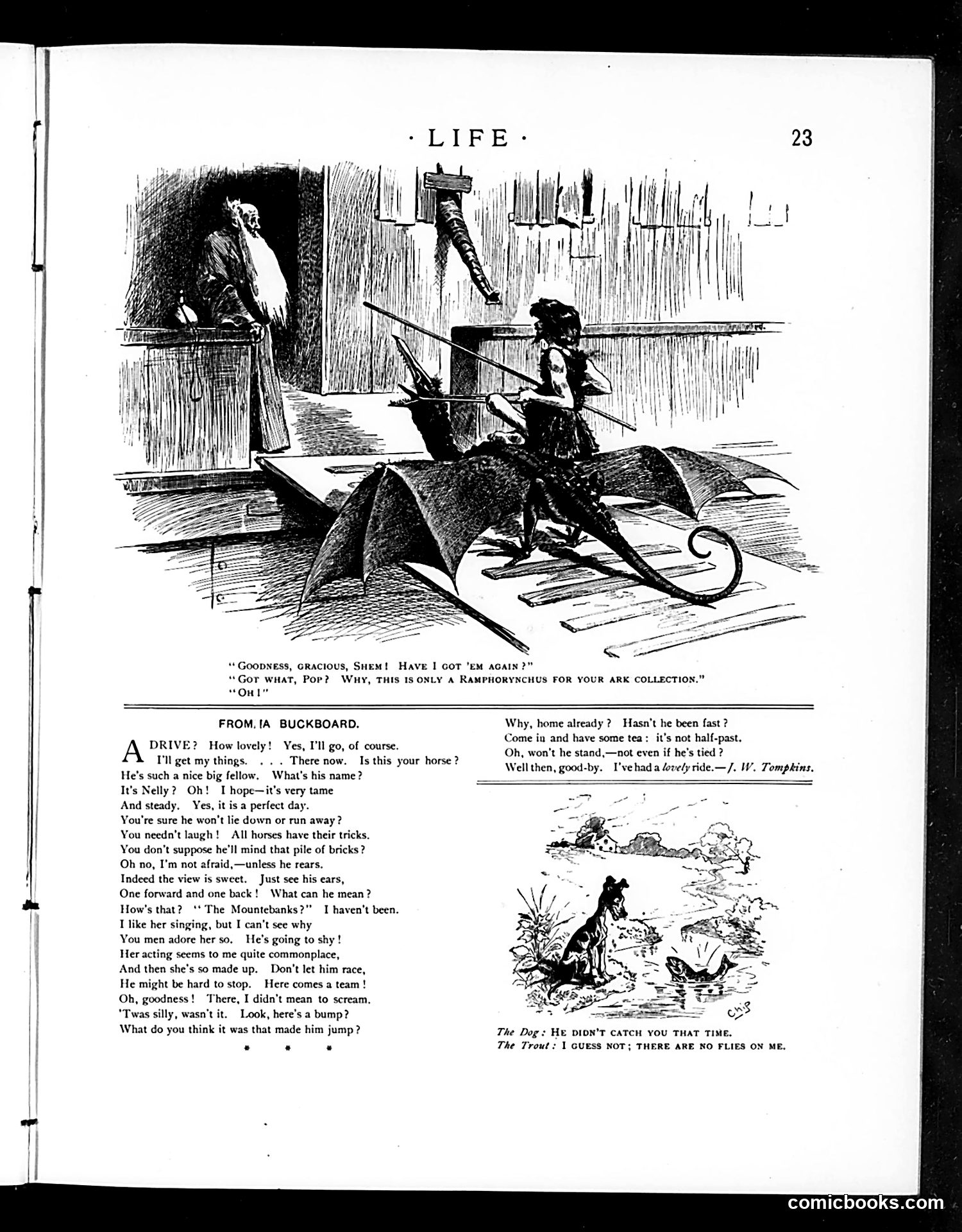
**Main Cartoon (Top):** A woman rides a large dragon-like creature while a man observes from a window. The caption reads: "Goodness, gracious, Shie! Have I got 'em again?" / "Got what, Pop? Why, this is only a Ramphornynchus for your ark collection." / "Oh!" This is a humorous domestic scene mocking collecting hobbyists. A "Ramphornynchus" is a pterosaur (extinct flying reptile). The joke: the husband has acquired yet another specimen, while the wife tolerates his obsessive ark collecting—treating prehistoric creatures as casual acquisitions. The satire targets overcollecting and domestic indulgence. **Bottom Section:** Contains a poem titled "From a Buckboard" and a small illustration of a trout and dog with dialogue about fishing. The page primarily contains lighthearted domestic humor rather than political satire.
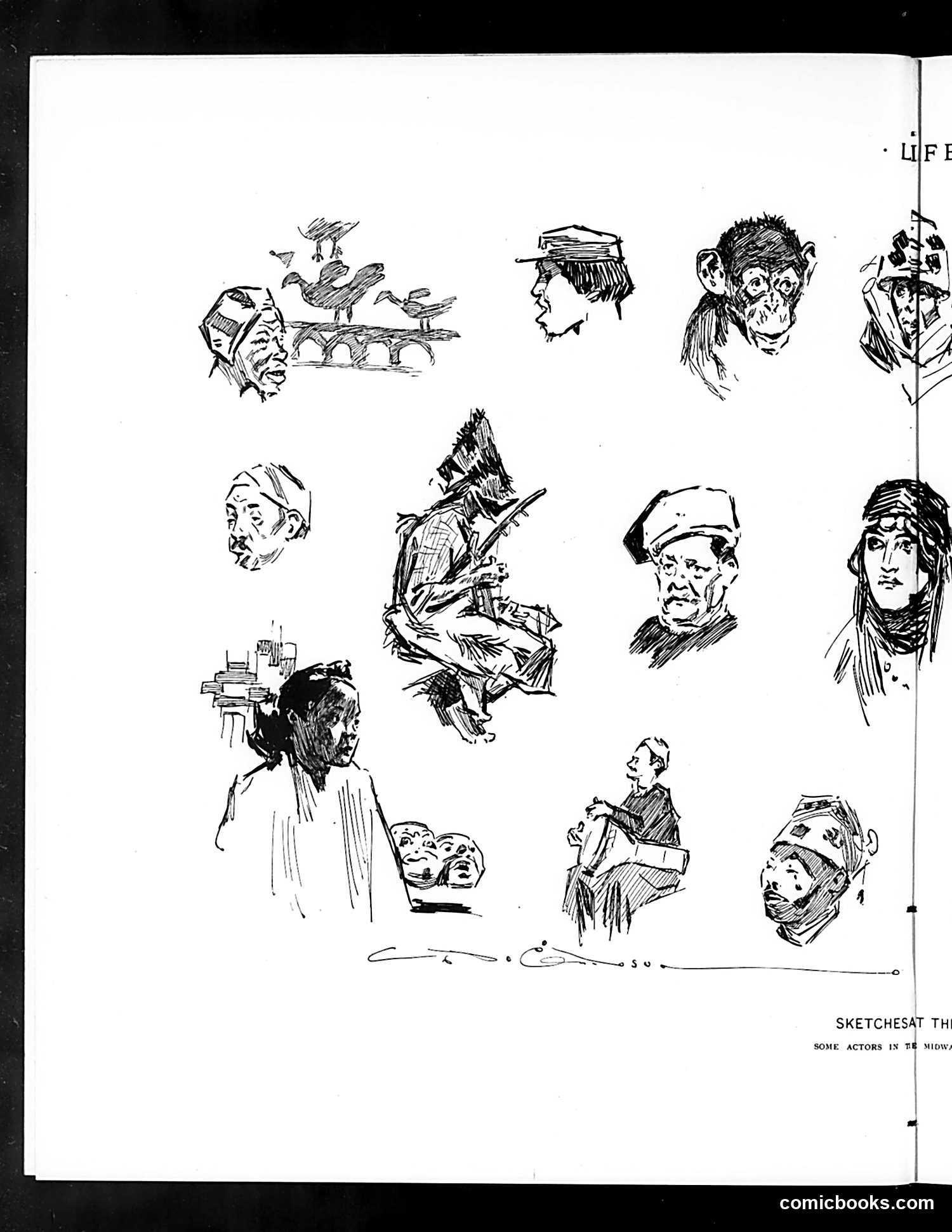
This page appears to be a collection of character sketches titled "Sketches at the Theatre: Some Actors in the Midway" (text partially visible at bottom). The ink drawings show various theatrical character types and facial expressions rather than specific identifiable figures. The sketches display exaggerated features typical of early 20th-century theatrical caricature—including what appears to be ethnic or character stereotypes common to vaudeville and theater performance of that era. One figure carries a rifle; another wears a military-style cap; several show theatrical makeup or distinctive headwear. Without clearer OCR text or date information, I cannot definitively identify specific actors, productions, or the precise satirical point. The page appears to document theatrical performers or character types rather than political satire, though the exaggerated styling reflects period illustration conventions.
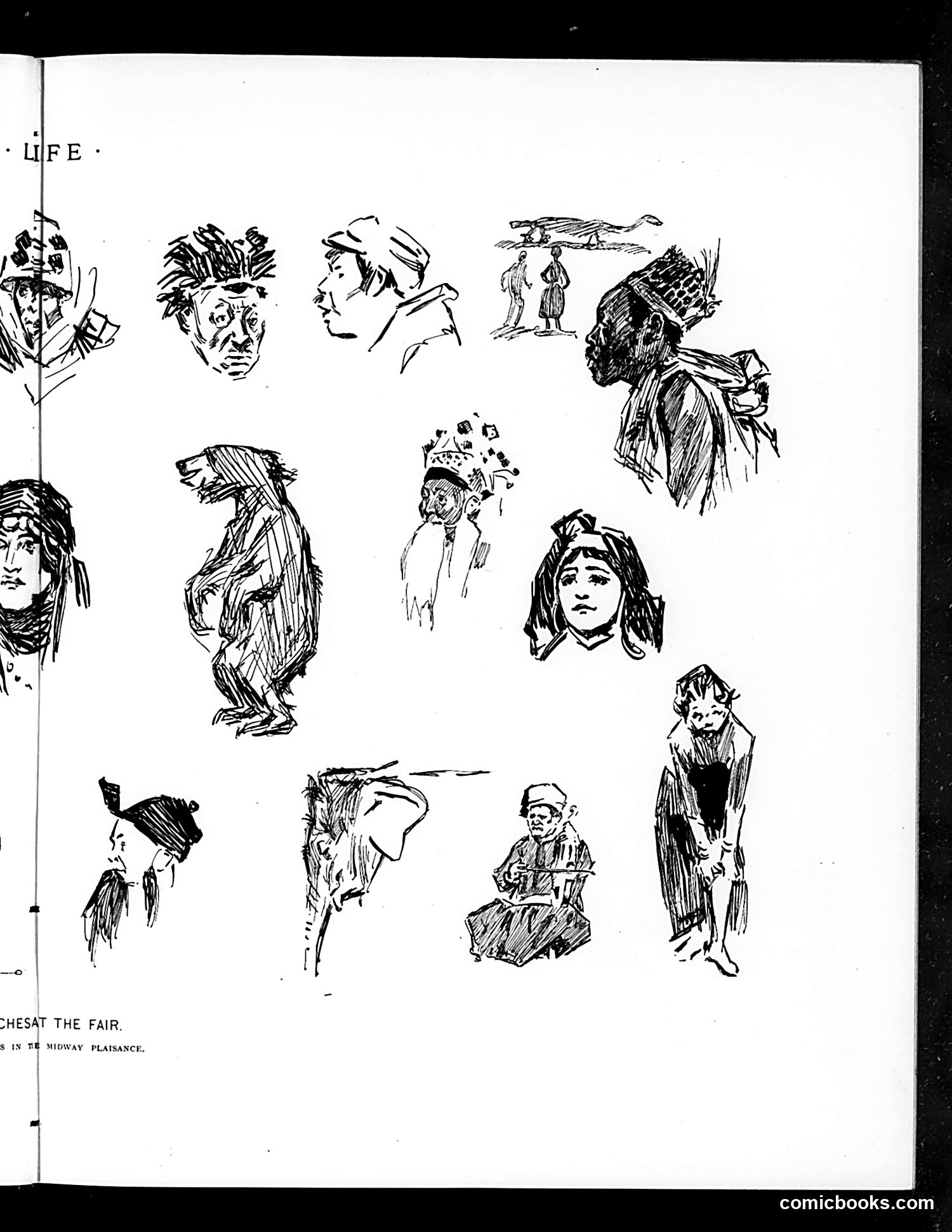
This page shows character sketches labeled "LIFE" at the top, appearing to be studies for a cartoon titled "CHEAT THE FAIR" (visible at bottom). The subtitle mentions "MIDWAY PLEASANCE," referring to the entertainment section of a major exposition or fair. The sketches depict various character types—including what appear to be con artists, carnival workers, and fair-goers of different ethnicities and classes. The style suggests late 19th or early 20th-century satirical commentary on fair culture. Without the complete cartoon, the exact joke is unclear, but the title "Cheat the Fair" suggests satire about dishonest carnival operators or schemes targeting fair visitors. The diverse character studies indicate social commentary on fair-goers or the seedier aspects of exposition entertainment. The specific fair and date remain uncertain from visible text alone.
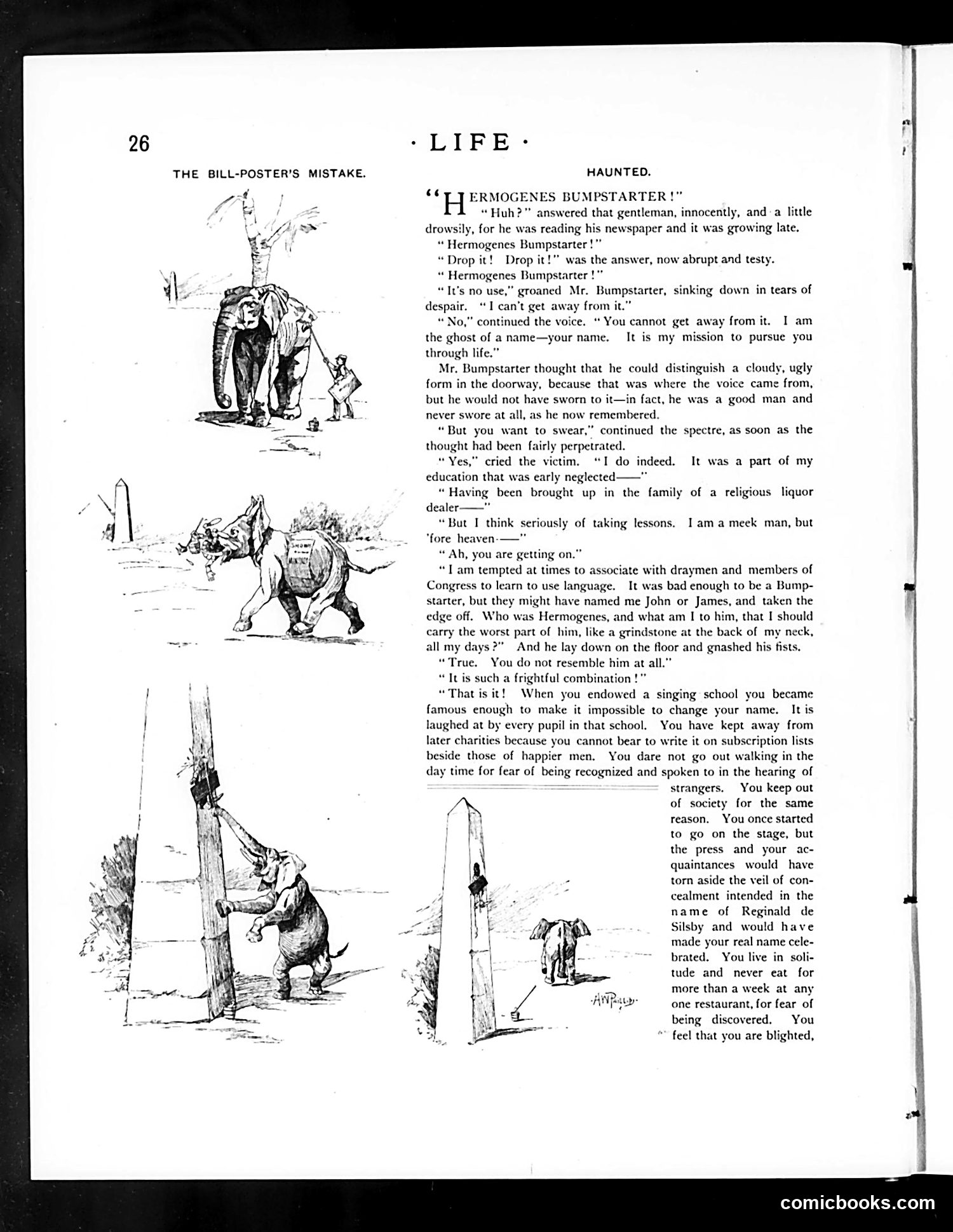
The left side shows three cartoon sketches of what appears to be a bill-poster or advertising worker struggling with large posters—likely satirizing the messy, chaotic nature of public advertising work. The right side presents a dialogue between Mr. Humpstarter and a ghost named "Hermogenes Humpstarter." The specter torments Humpstarter, revealing that his name has become so infamous (apparently from childhood—he was raised by a "religious liquor dealer") that it haunts him socially and professionally. The ghost catalogs the embarrassments: he cannot attend charity events, join society, or pursue public life without ridicule. The satire targets how an unfortunate name can permanently damage one's social standing and opportunities—a commentary on Victorian-era class consciousness and social exclusion based on factors beyond one's control.
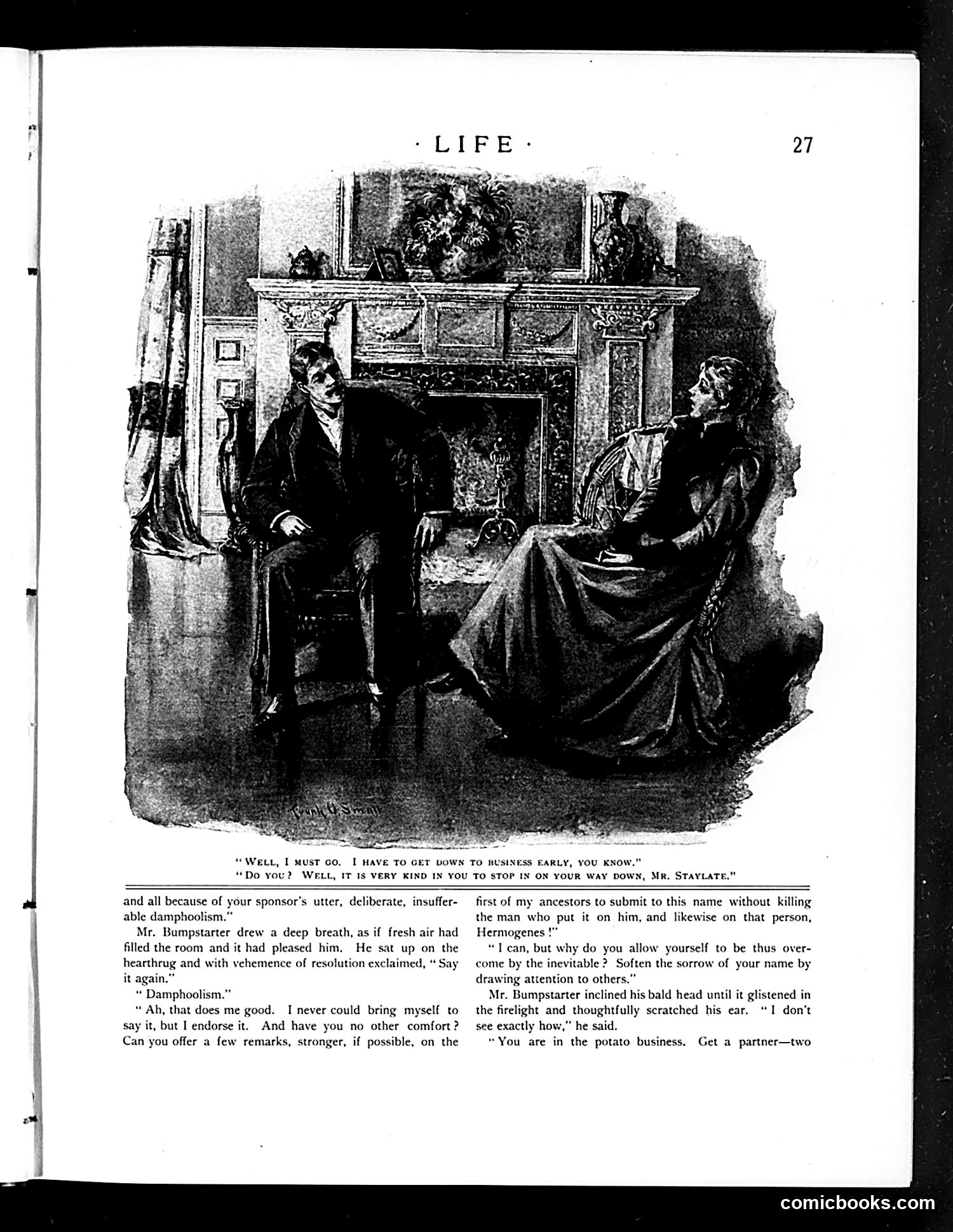
This page features a Victorian-era satirical illustration and dialogue about social class and occupational shame. Two men converse in a drawing room; one appears to be leaving ("I must go. I have to get down to business early"). The humor centers on a gentleman's embarrassment about his occupation in the potato business—a trade considered ungenteel for respectable society at that time. His companion tries to comfort him by suggesting he soften this "inevitable" shame through charitable work or finding a business partner. The satire mocks Victorian class anxieties: the rigid social hierarchy that deemed certain trades beneath gentlemen, and the absurd contortions the wealthy undertook to maintain respectability. The illustration's formal domestic setting emphasizes how seriously these social prejudices were taken.
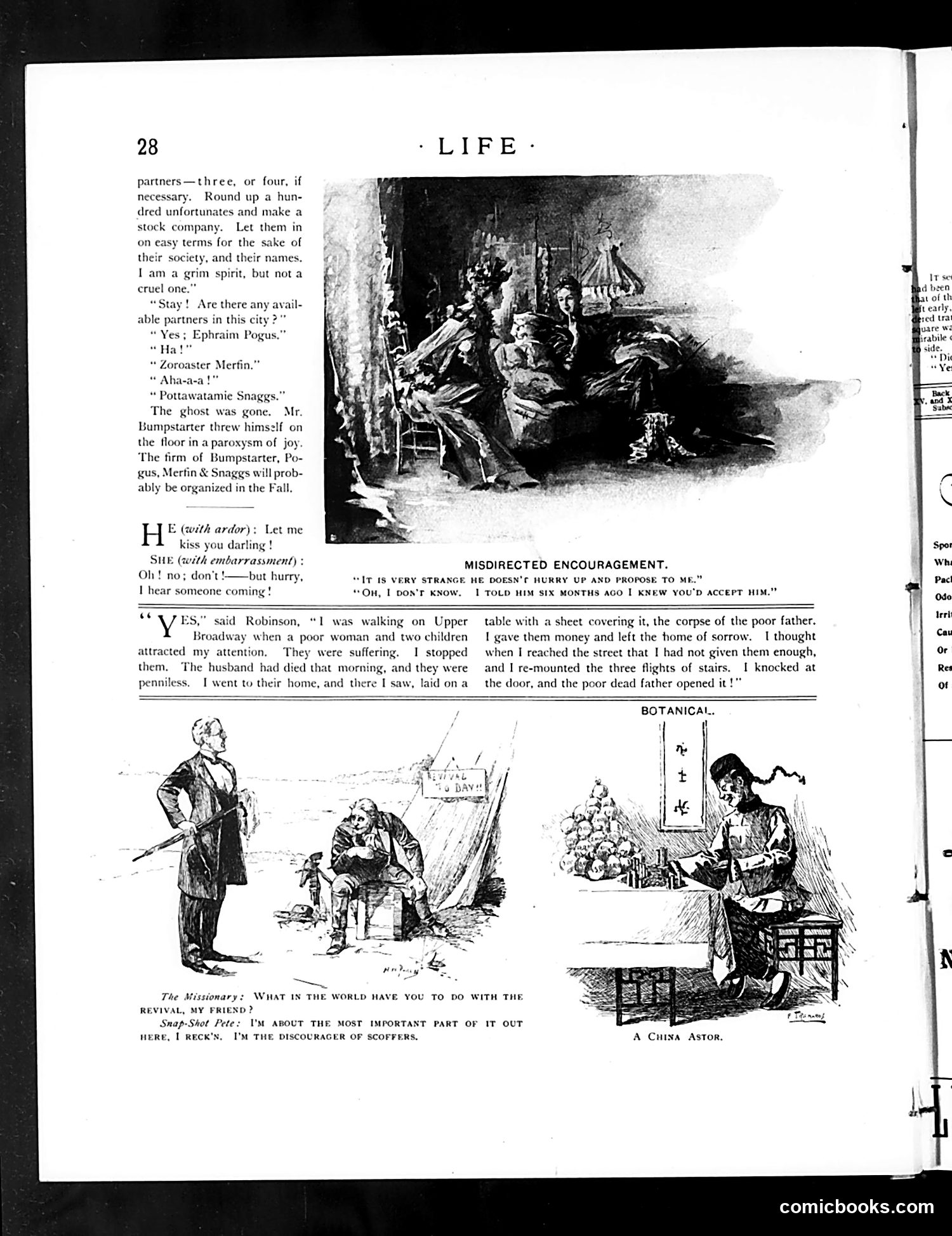
This page contains three distinct satirical pieces: **"Misdirected Encouragement"** (top): A couple's romantic moment is interrupted by the woman's friend arriving. The joke relies on the woman's contradictory behavior—she tells her suitor "don't" while saying "hurry," and her friend reveals she'd already told him six months ago she'd accept him. The satire mocks courtship conventions and female coyness. **Robinson's Story** (middle): A dark joke about charity. A man gives money to a poor widow and her children, then returns to give more—only to have the supposedly-dead father answer the door. The punchline suggests the man was duped or that the "dead" father faked his death for sympathy. **"Botanical"** (bottom right): Labeled "A China Astor," this appears to reference Mina Astor (a wealthy American socialite). "Snap-Shot Pete" claims he's crucial to missionary revival work by discouraging scoffers—satirizing how wealthy patrons claim importance in charitable enterprises despite minimal actual contribution. All three target human folly, deception, and social pretense.
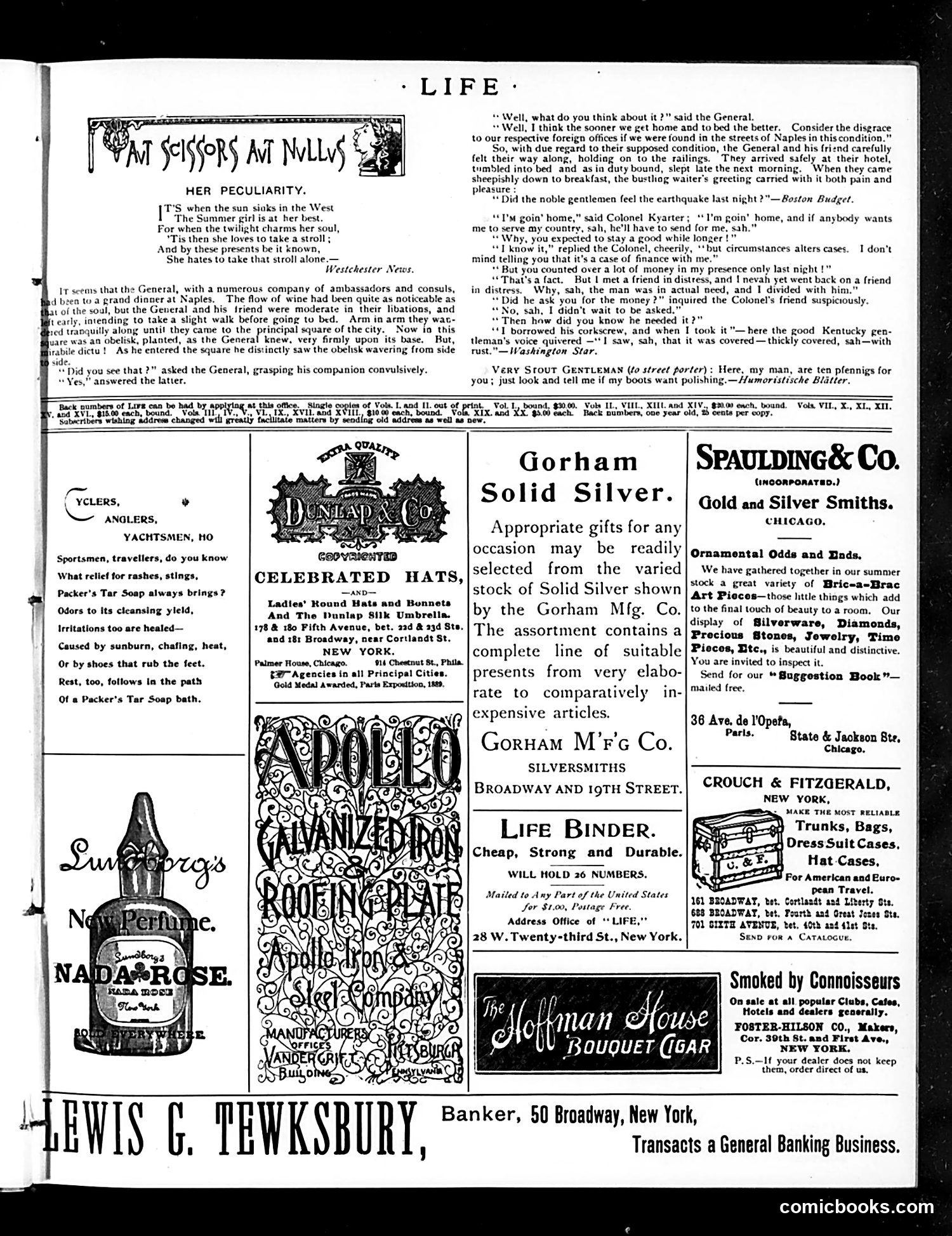
This page contains three separate humorous anecdotes rather than political cartoons: 1. **"Her Peculiarity"**: A brief poem mocking summer girls who refuse to take evening walks alone—poking fun at courtship customs and female dependence on male companions. 2. **The Earthquake Anecdote**: Two diplomats, drunk after a Naples dinner, see an obelisk appearing to sway. Believing it an earthquake, they rush home. At breakfast, a waiter reveals there *was* an earthquake—they experienced it while intoxicated but attributed the sensation to their condition. The joke: their drunkenness accidentally made them correctly perceive reality. 3. **Colonel Kyarter's Story**: A Southern gentleman explains he's leaving service due to "finance" problems. He admits borrowing money from a friend after noticing his corkscrew was rusty—using the rust as evidence of the friend's desperate poverty. The humor lies in this absurd logic for financial aid. The page is primarily **advertising** (Dunlap hats, Packer's Tar Soap, banking services), with these brief comic sketches interspersed—typical of Life magazine's format.
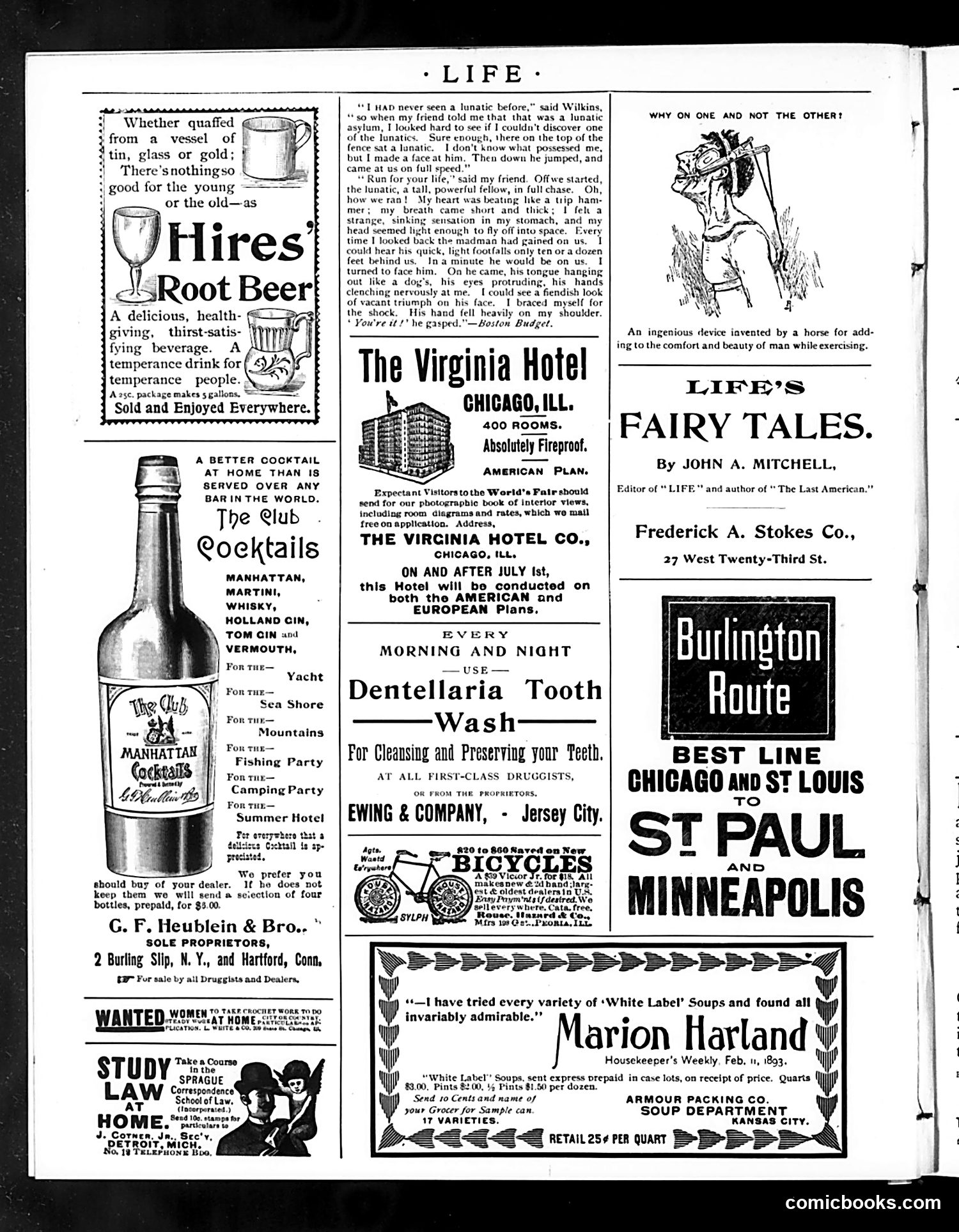
This is primarily an **advertising page** from *Life* magazine, but it contains one notable satirical cartoon and accompanying story. The main content is a **humorous anecdote** titled "Why on One and Not the Other?" featuring a cartoon of a running man. The story depicts a foolish encounter: a man mockingly gestures at what he's told is a lunatic peering from an asylum fence. The lunatic chases him in genuine panic (tongue hanging, eyes wild), creating physical comedy through role reversal—the supposed madman appears more rational than the prankster. The joke satirizes **thoughtless cruelty disguised as amusement**. The cartoon's caption then makes the broader social point: horses instinctively protect their backs while bearing loads; humans should exercise similar self-care and dignity. Surrounding this are typical period advertisements: Hires Root Beer, Club Cocktails, The Virginia Hotel, Dentellaria Tooth Wash, and various services—representing the magazine's commercial base rather than editorial content.
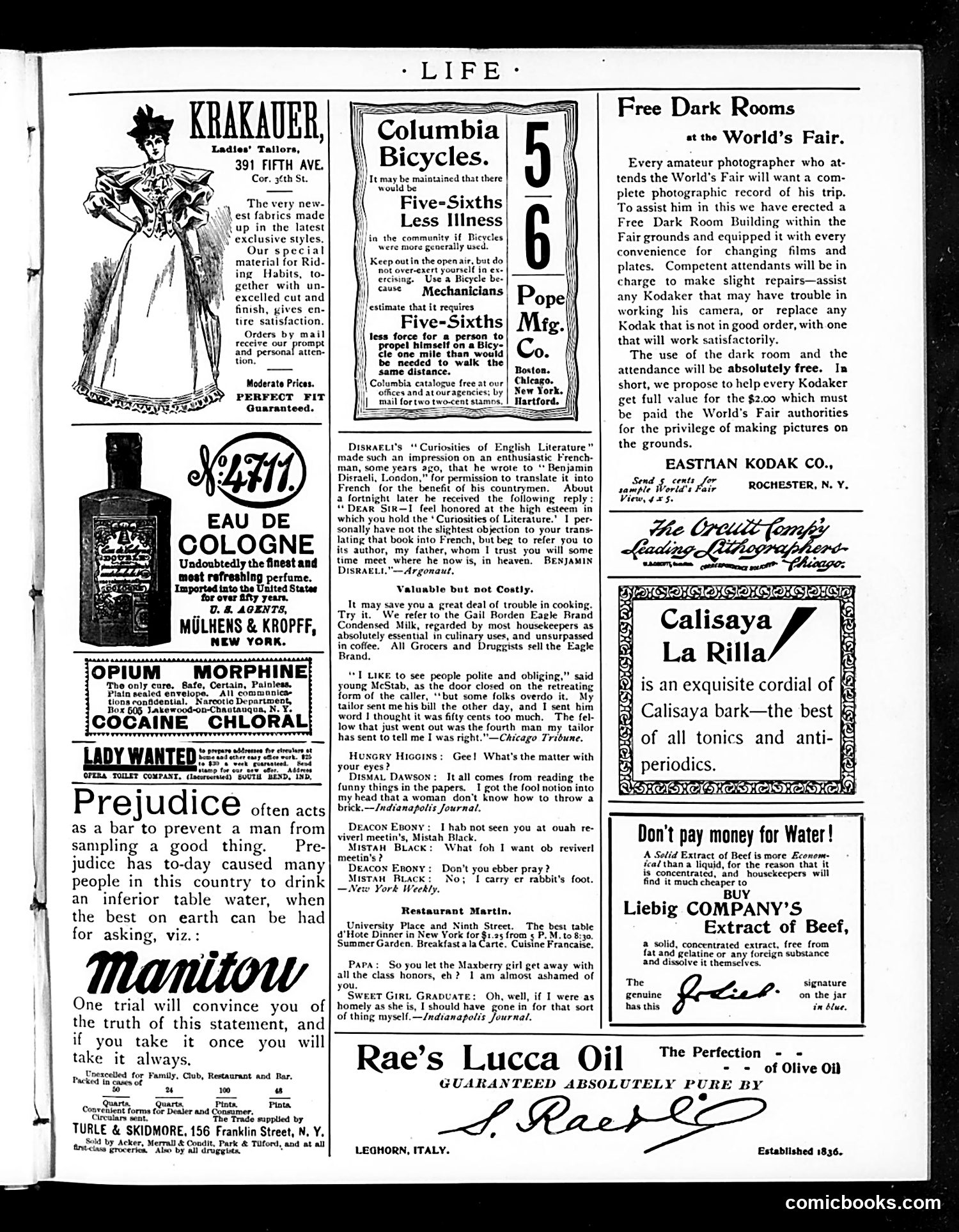
This page is primarily **advertisements** with small satirical dialogue snippets interspersed. The main content includes ads for ladies' tailoring, bicycles, cologne, and various patent medicines (including opium and morphine products—legal then, shocking now). The brief satirical exchanges at bottom mock social pretension and male foolishness. One joke about a tailor's bill suggests a man complains about overcharging, then feels vindicated when the tailor sends messengers to confirm he was right—satirizing male vanity. Another mocks a woman's inability to "throw a brick" based on newspaper humor, suggesting readers believed absurd stereotypes from popular media. The *Disraeli anecdote* is genteel Victorian humor: a French admirer seeks to translate the famous statesman's book, but receives a witty reply directing him to Disraeli's *deceased father*—a polite brush-off using heaven as the punchline. Overall, this reflects **Gilded Age America**: patent-medicine promotion, bicycle craze enthusiasm, and mild social satire targeting gullibility and vanity.
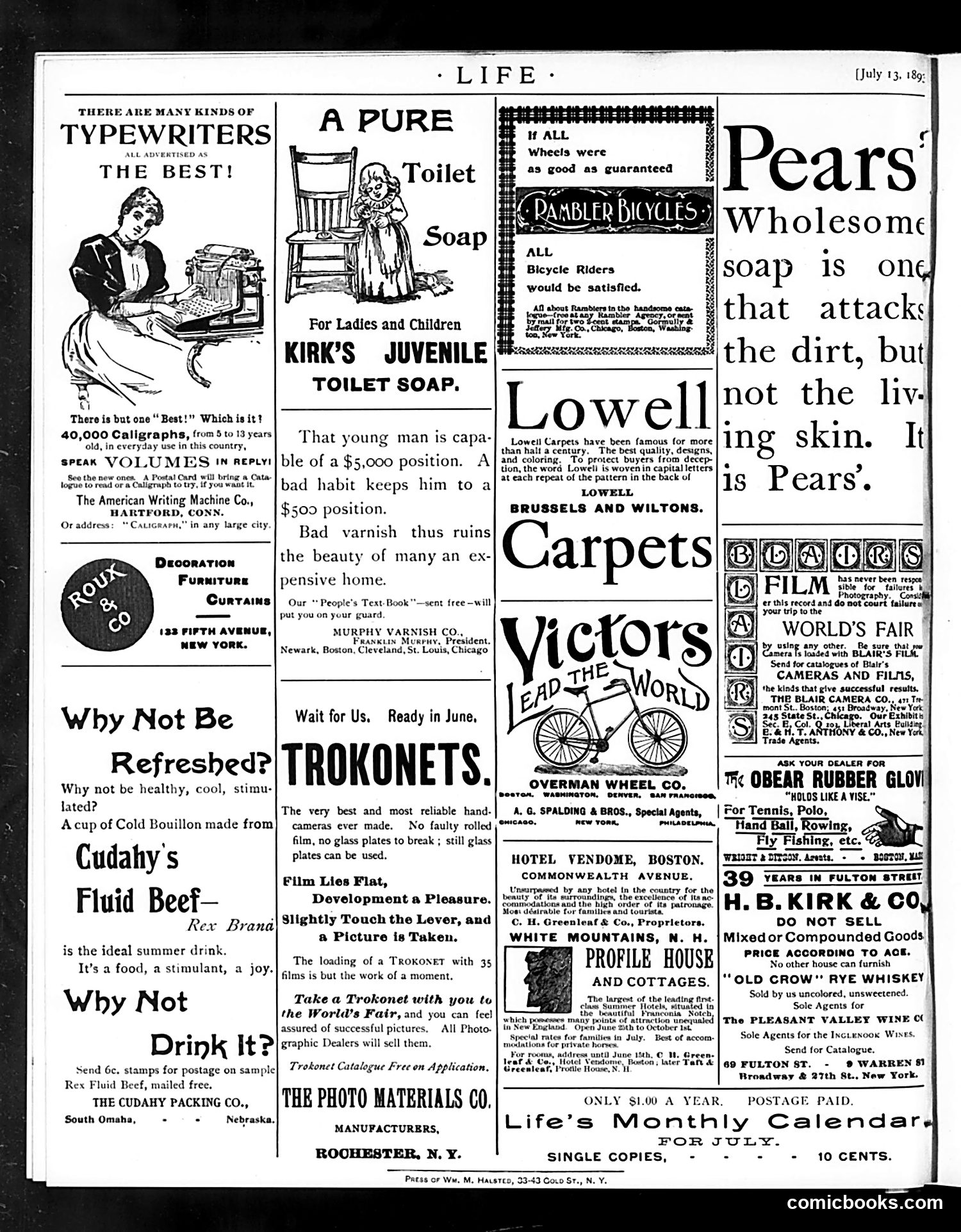
This is primarily a **commercial advertising page** rather than political satire. The layout features product advertisements typical of the 1890s era, including typewriters, bicycles, soap, cameras, carpets, and beverages. Notable content includes: - **Typewriter competition**: The Caligraph machine claims superiority with "40,000 in everyday use," reflecting fierce competition among early typewriter manufacturers. - **Social commentary ads**: One ad sardonically notes a man capable of earning $5,000 annually is stuck at $500 due to "a bad habit"—likely referring to alcohol or other vices, reflecting Victorian-era moralism. - **World's Fair promotion**: Multiple ads reference the 1892 World's Columbian Exposition in Chicago, encouraging consumers to bring products (cameras, bicycles) to the fair. - **Product claims**: Advertisements make exaggerated durability claims (Rambler bicycles, Pears soap attacking dirt without harming skin). The page reflects 1890s consumer culture and emerging mass-market advertising rather than political satire.