
Life, 1893-07-13 · page 6 of 16
Life — July 13, 1893 — page 6: what you’re looking at
What you’re looking at
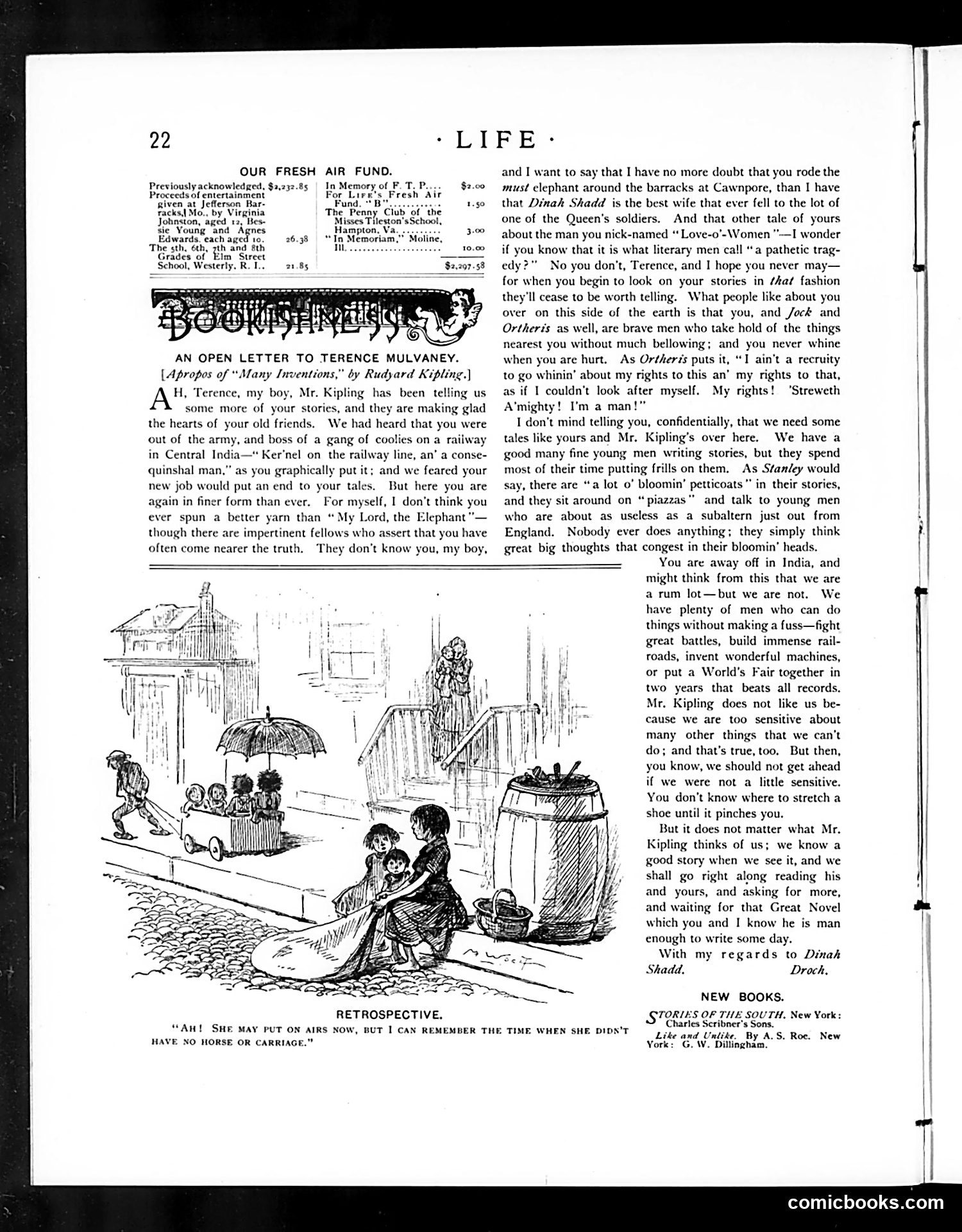
This page contains **"An Open Letter to Terence Mulvaney"** by Rudyard Kipling, addressed to a character from his military fiction. The letter praises Mulvaney as representing British soldiers' qualities—bravery, practicality, and resilience—contrasting them favorably with English civilians who accomplish little without complaint. The accompanying sketch, titled **"Retrospective,"** depicts a woman in Victorian-era dress riding in a modern automobile, with the caption joking: "Ah! She may put on airs now, but I can remember the time when she didn't have no horse or carriage." This is **social satire about class mobility and pretension**—mocking nouveau riche or socially aspiring women who adopt airs after acquiring automobiles, a relatively new luxury in the early 1900s.
📄 Transcribed text from this page (OCR, searchable)
Machine-transcribed from the original scan — historical spelling and the odd misread are preserved.
22 OUR FRESH AIR FUND. Previously acknowledged, $2,232.85 | In Memory of F.T.P.... $2.00 Proceeds of entertainment For Lire’s Fresh Air given at Jefferson Bar- Fund.“ B". fee Bg racks, Mo., by Virginia The Penny Club of ‘the Johnston, aged 12, Bes- Misses Tileston's School, sie Young and Agnes sesse 3200 Edwards. each aged 10. 26.38 “In M The sth, 6th, 7th and 8th 10.00 Grades of Elm Street ——- School, Westerly, RI. 21.85 $2,297.58 AN OPEN LETTER TO TERENCE MULVANEY. [Apropos of “Many Inventions,” by Rudyard Kipting.] H, Terence, my boy, Mr. Kipling has been telling us some more of your stories, and they are making glad the hearts of your old friends. We had heard that you were out of the army, and boss of a gang of coolies on a railway in Central India—* Ker'nel on the railway line, an’ a conse- quinshal man,” as you graphically put it; and we feared your new job would put an end to your tales. But here you are again in finer form than ever. For myself, 1 don’t think you ever spun a better yarn than “ My Lord, the Elephant”— though there are impertinent fellows who assert that you have often come nearer the truth. They don’t know you, my boy, - LIFE: and I want to say that I have no more doubt that you rode the must elephant around the barracks at Cawnpore, than I have that Dinak Shadd is the best wife that ever fell to the lot of one of the Queen's soldiers. And that other tale of yours about the man you nick-named “ Love-o’- Women "—I wonder if you know that it is what literary men call “a pathetic trag- edy?" No you don't, Terence, and I hope you never may— for when you begin to look on your stories in ¢hat fashion they'll cease to be worth telling. What people like about you over on this side of the earth is that you, and Jock and Ortheris as well, are brave men who take hold of the things nearest you without much bellowing; and you never whine when you are hurt. As Ortheris puts it, “1 ain't a recruity to go whinin’ about my rights to this an’ my rights to that, as if I couldn't look after myself. My rights! ’Streweth A’mighty! I'm a man!” I don’t mind telling you, confidentially, that we need some tales like yours and Mr. Kipling’s over here, We have a good many fine young men writing stories, but they spend most of their time putting frills on them. As Stanley would say, there are “a lot o’ bloomin’ petticoats” in their stories, and they sit around on “piazzas” and talk to young men who are about as useless as a subaltern just out from England. Nobody ever does anything; they simply think great big thoughts that congest in their bloomin’ heads. You are away off in India, and RETROSPECTIVE, HAVE NO HORSE OR CARRIAGE.” H! SHE MAY PUT ON AIRS NOW, BUT I CAN REMEMBER THE TIME WHEN SHE DIDN'T might think from this that we are a rum lot—but we are not. We have plenty of men who can do things without making a fuss—fight great battles, build immense rail- roads, invent wonderful machines, or put a World’s Fair together in two years that beats all records. Mr. Kipling does not like us be- cause we are too sensitive about many other things that we can't do; and that’s true, too, But then, you know, we should not get ahead if we were not a little sensitive. You don’t know where to stretch a shoe until it pinches you. But it does not matter what Mr, Kipling thinks of us; we know a good story when we see it, and we shall go right along reading his and yours, and asking for more, and waiting for that Great Novel which you and I know he is man enough to write some day. With my regards to Dinah Shadad. Droch. NEW BOOKS. STORIES OF THE SOUTH, New York: Charles Scribner's Sons. Like and Unlike. By A.S, Roc. New York: G. W. Dillingham, comicbooks.com