
A complete issue · 14 pages · 1893
Life — June 15, 1893
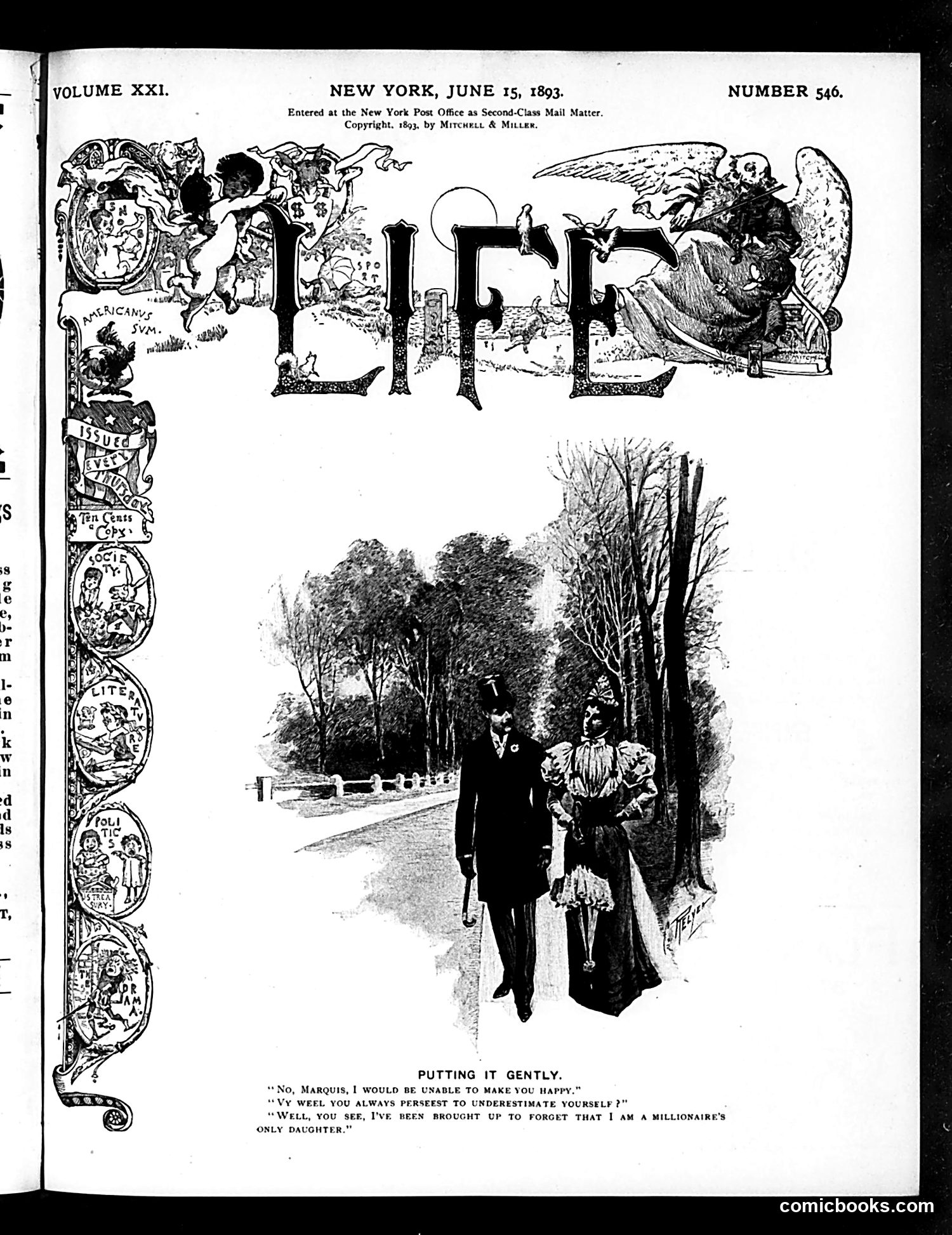
This 1893 *Life* magazine cartoon satirizes wealth and class anxiety during the Gilded Age. The illustration shows a well-dressed couple (man in dark suit, woman in fashionable dress) walking together, with dialogue revealing social tension. The woman reassures the man that she won't "underestimate" herself, apparently addressing concerns about her social status or spending habits. Her final line—that she's "a millionaire's only daughter"—appears to be either boastful or ironic commentary on wealthy families' assumptions about their daughters' worth and entitlement. The cartoon likely mocks both the pretensions of the newly rich and anxieties about women's financial independence and social positioning during this period of rapid industrialization and wealth accumulation.
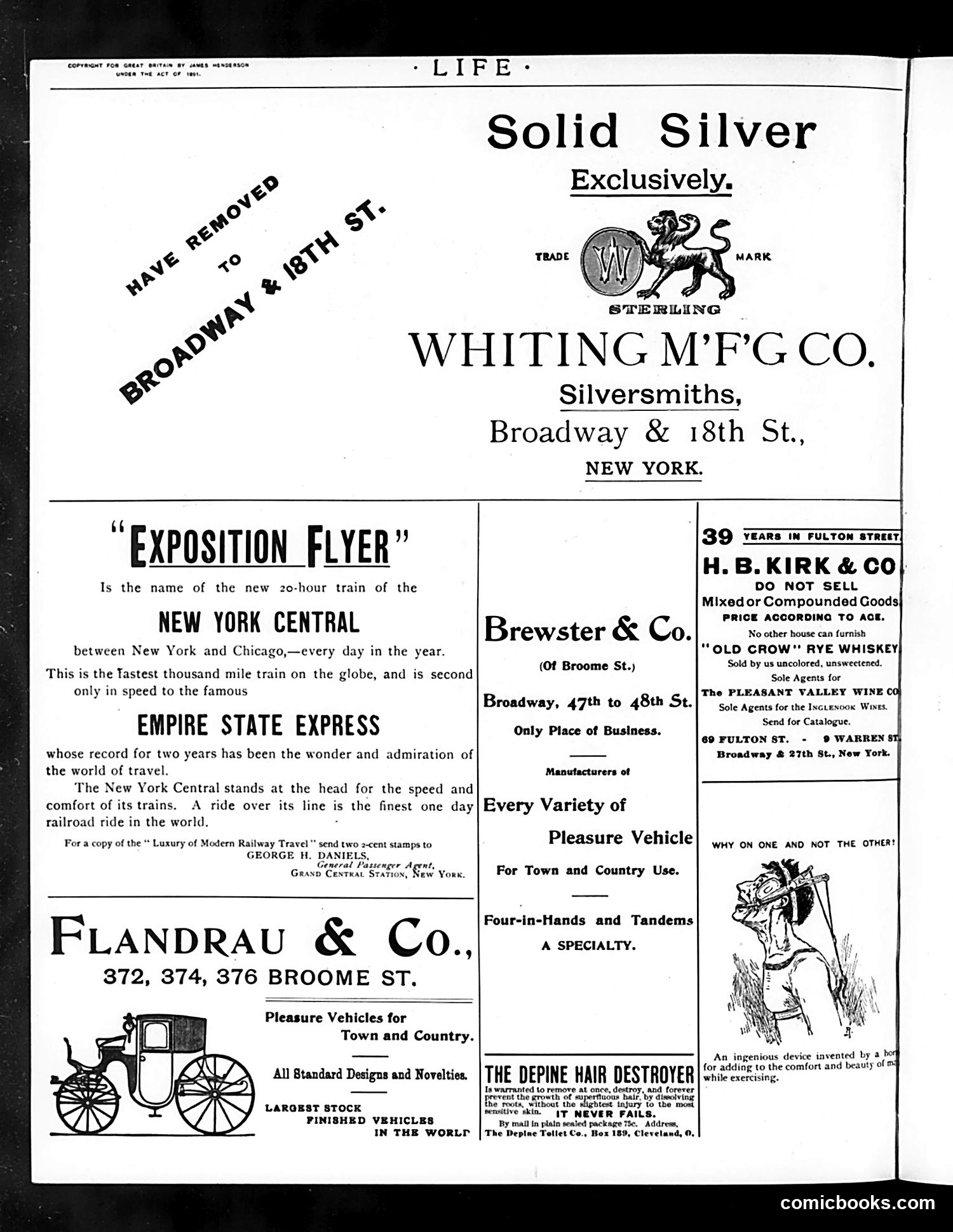
This page is **primarily advertising**, not satirical content. It contains commercial advertisements for: - **Whiting M'F'G Co.**: Sterling silver goods (top) - **New York Central Railroad**: Promoting the "Exposition Flyer" and "Empire State Express" trains between New York and Chicago - **Brewster & Co.**: Manufacturers of pleasure carriages/vehicles - **Flandrau & Co.**: Carriage maker at Broome Street, advertising "pleasure vehicles for town and country" with an illustration of a horse-drawn carriage - **H.B. Kirk & Co.**: Whiskey distributor - **The Depine Hair Destroyer**: Patent medicine for removing facial hair The single illustration shows a woman on a horse (right side), promoting exercise equipment. The page reflects early 20th-century commercial interests: luxury goods, transportation, carriages, and patent remedies.
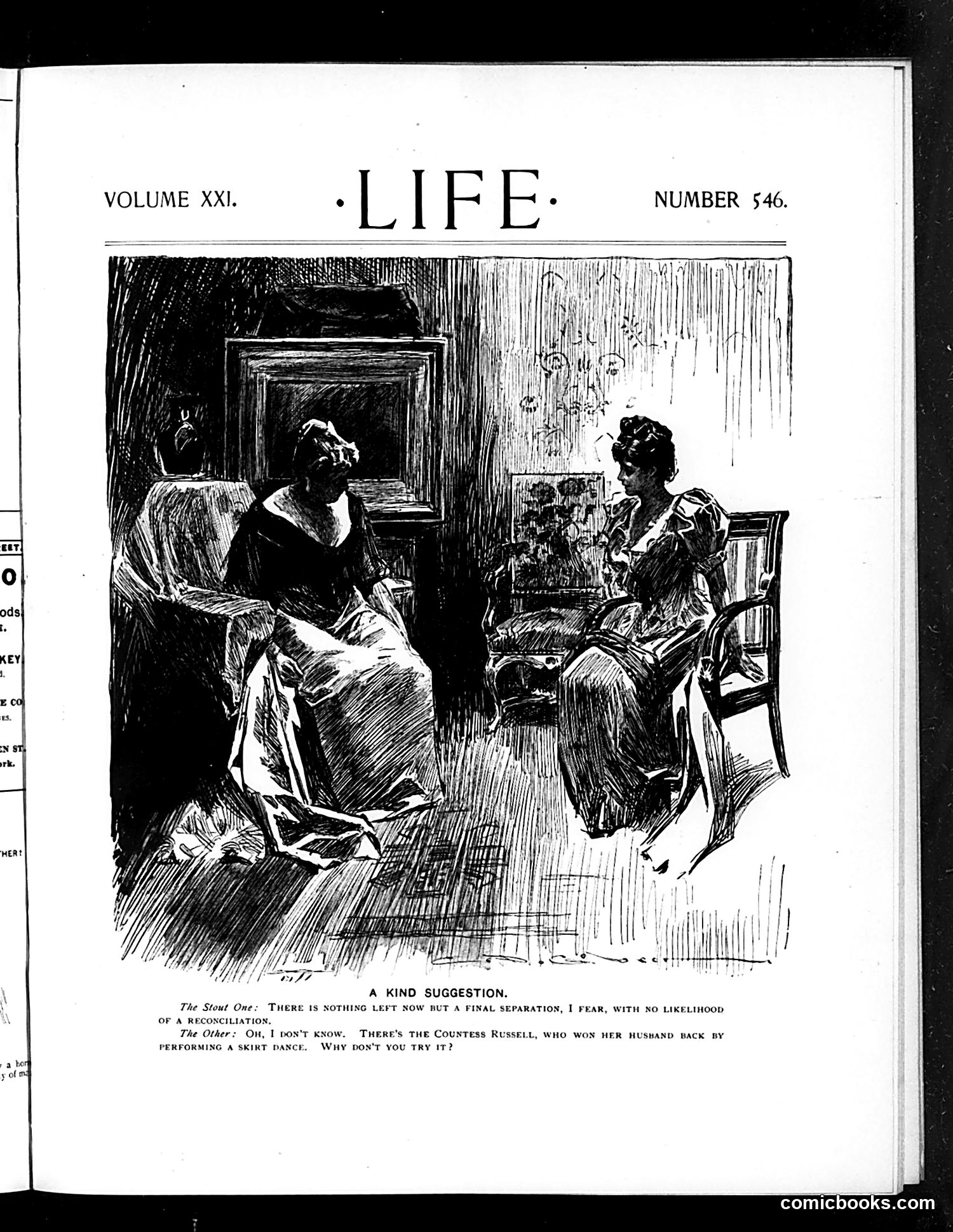
This cartoon depicts two women in what appears to be a domestic interior, with the caption revealing a conversation about marital reconciliation. The "Stout One" suggests a final separation is inevitable, while "The Other" proposes that the Countess Russell could win back her husband through performing a skirt dance—a popular theatrical performance of the era. This references a real scandal: Countess Russell's marital troubles, likely involving infidelity or incompatibility. The satire mocks both the suggestion (implying a woman must perform sexually to retain her husband) and the gossip surrounding aristocratic marriages. The joke plays on period anxieties about women's roles, marital duty, and the entertainments available to wealthy society figures.
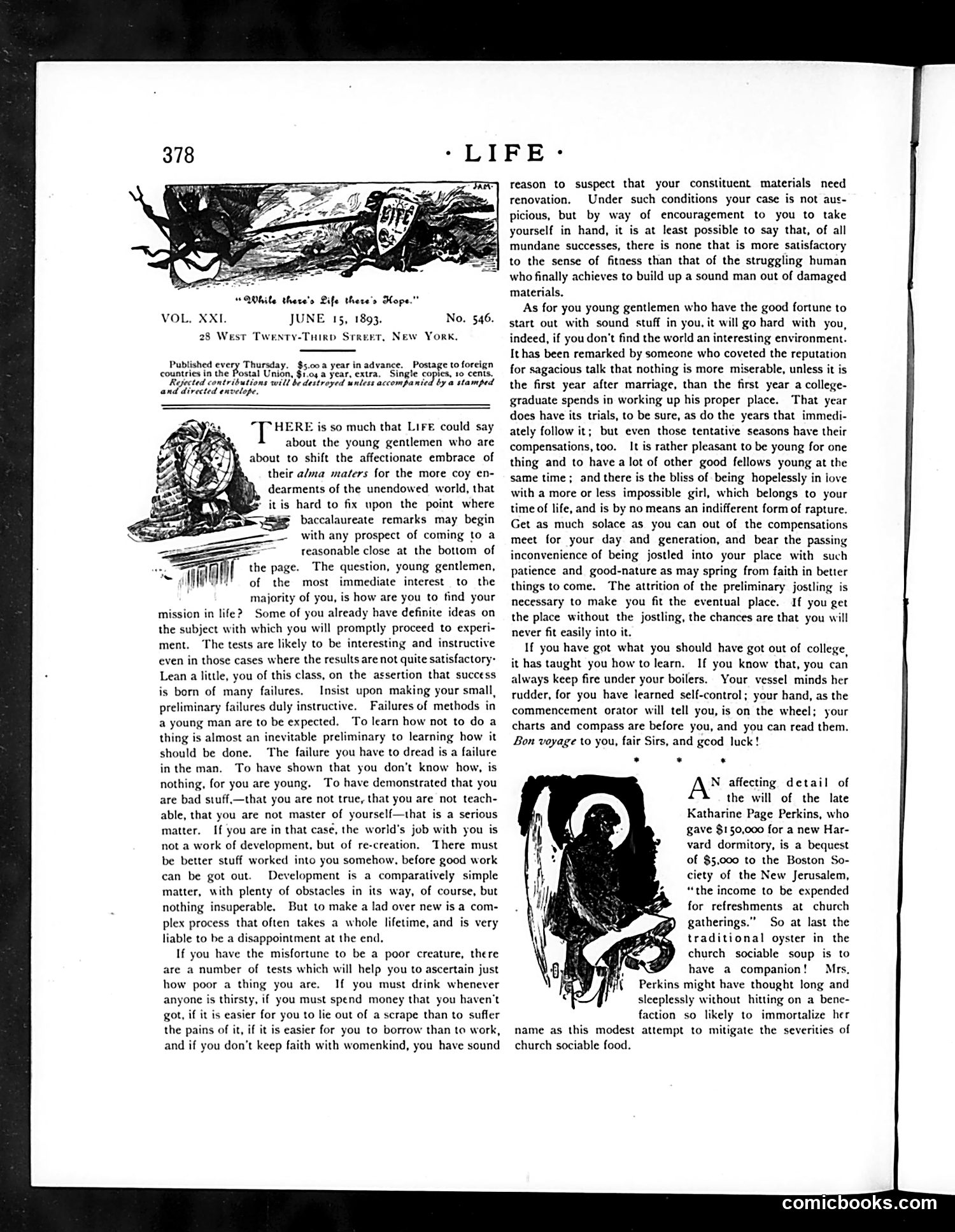
This page contains an editorial essay addressed to young gentlemen entering adulthood, with no political cartoon visible. The text discusses finding one's life mission and offers practical advice about handling early career failures, maintaining patience during difficult circumstances, and developing self-control. Two decorative illustrations accompany the text: a classical bust or head sculpture at the top left, and an ornamental capital letter "A" (decorated with scrollwork) at the bottom right. The page also includes a brief item about Katharine Page Perkins donating $150,000 for a Harvard dormitory, with $5,000 going to the Boston Society of the New Jerusalem for church refreshments—a humorous note about church sociable soup. There is no discernible satire or political commentary on this particular page.
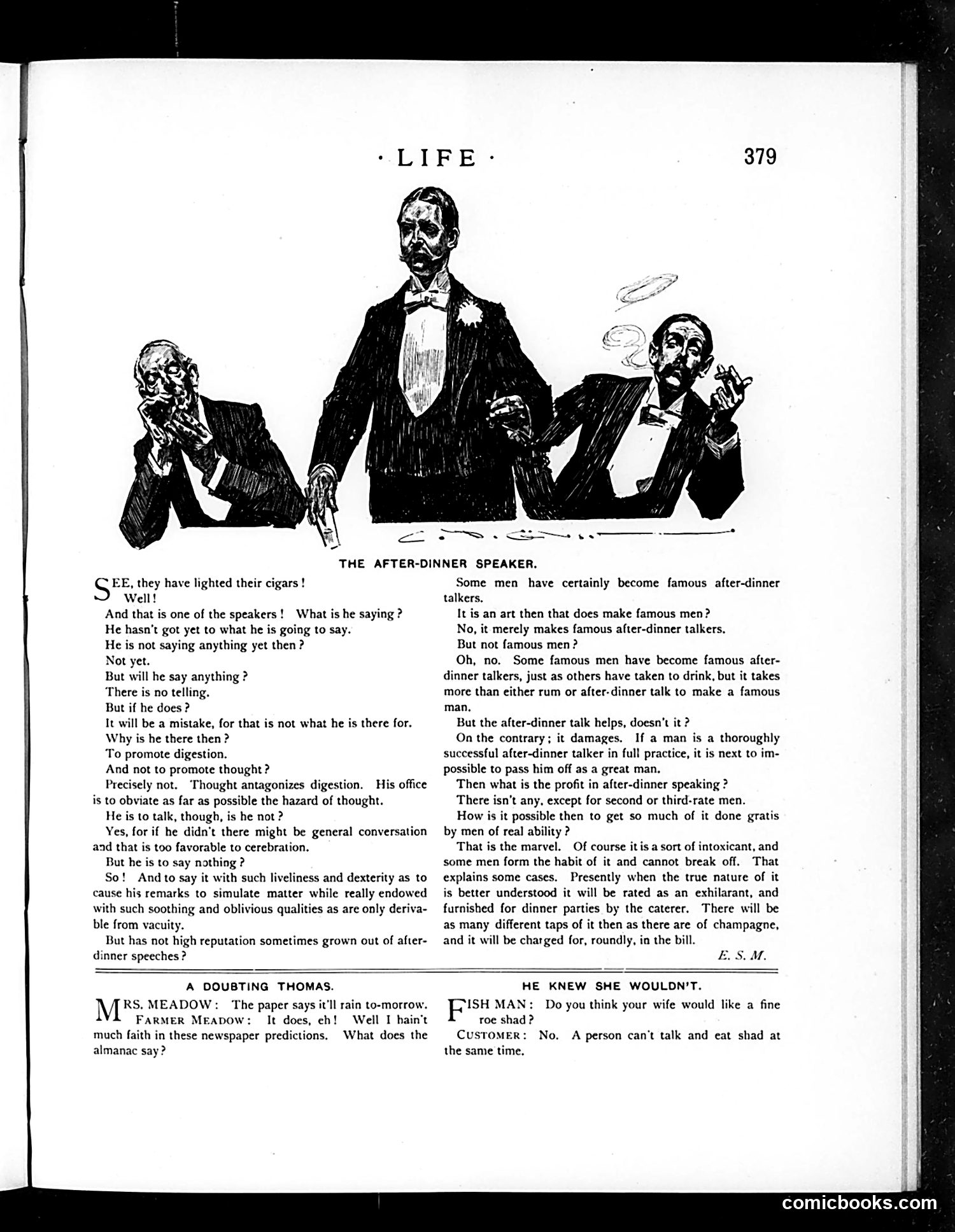
This page contains three separate humorous pieces satirizing social conventions of the era. **"The After-Dinner Speaker"** (top): The cartoon and accompanying text mock the paradox of after-dinner speeches. The illustration shows three men at a formal dinner, with the central figure as the speaker. The satire points out that while some men become "famous after-dinner talkers," this fame doesn't actually benefit them—it merely damages their reputation as genuine speakers. The text suggests that truly successful men *avoid* becoming known for this dubious skill. **"A Doubting Thomas"** (bottom left): Mrs. Meadows questions newspaper predictions about rain, humorously expressing skepticism toward meteorological forecasts. **"He Knew She Wouldn't"** (bottom right): A brief joke about a customer refusing to order shad because one cannot simultaneously talk and eat shad. All three pieces employ gentle, conversational satire typical of early 20th-century American humor magazines.
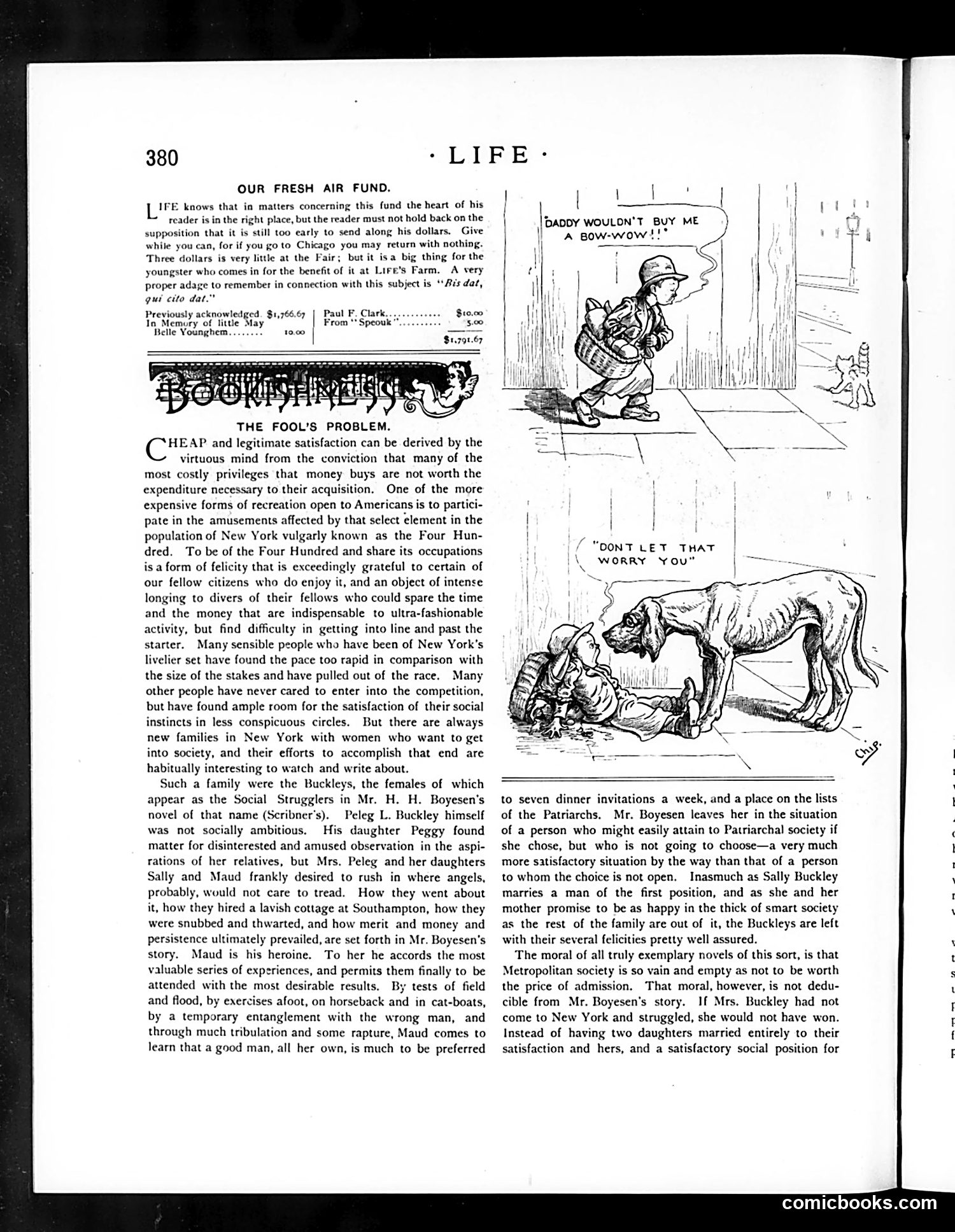
This page contains two editorial cartoons satirizing New York society's "Four Hundred" elite circle. **Top cartoon**: A man carrying a baby says "Daddy wouldn't buy me a bow-wow!!!" The satire targets wealthy parents who indulge children with expensive but trivial purchases—mocking the frivolous spending habits of New York's upper class. **Bottom cartoon**: A woman in fashionable dress pets a cow, saying "Don't let that worry you." This appears to mock the affectation of high-society women who romanticize rural life or adopt pastoral interests as entertainment, treating farm animals as accessories to their leisure pursuits. Both cartoons ridicule the disconnect between the wealthy elite and practical reality, suggesting their class engages in absurd, self-serving behavior that Life's editors found worthy of public mockery.
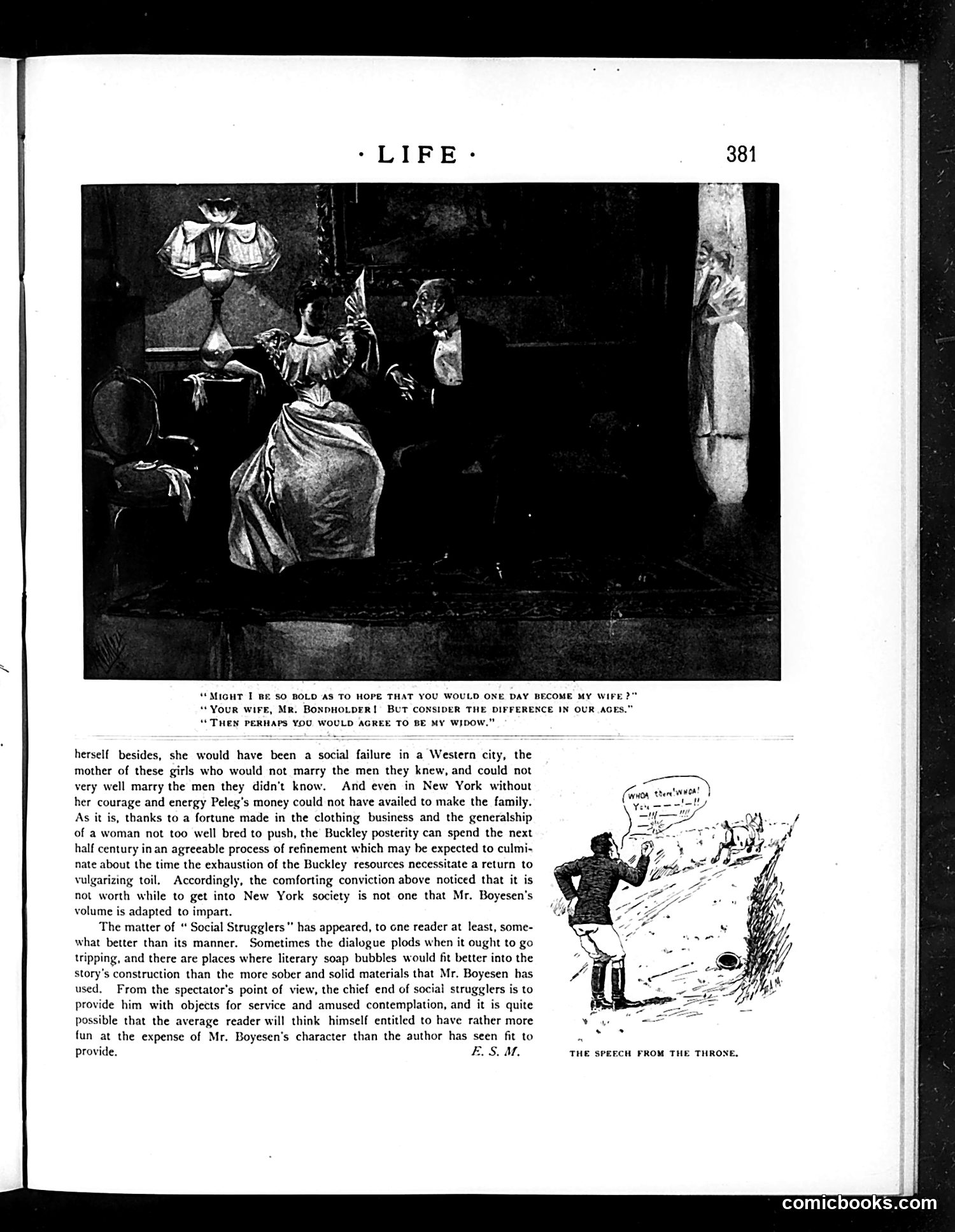
This page critiques a serialized story called "Social Strugglers" by author Mr. Boyesen. The upper photograph appears to show a theatrical scene depicting a marriage proposal, with dialogue about class differences—a man of means proposing to a woman of lower social status. The text review is skeptical of the story's literary merit, suggesting its dialogue is stilted ("literary soap bubbles") and that Boyesen uses social themes primarily to entertain rather than meaningfully explore them. The reviewer (signed E.S.M.) argues the work provides "objects for service and amused contemplation" rather than genuine social commentary. The small cartoon labeled "The Speech from the Throne" appears to be unrelated satirical content, likely political commentary on government.
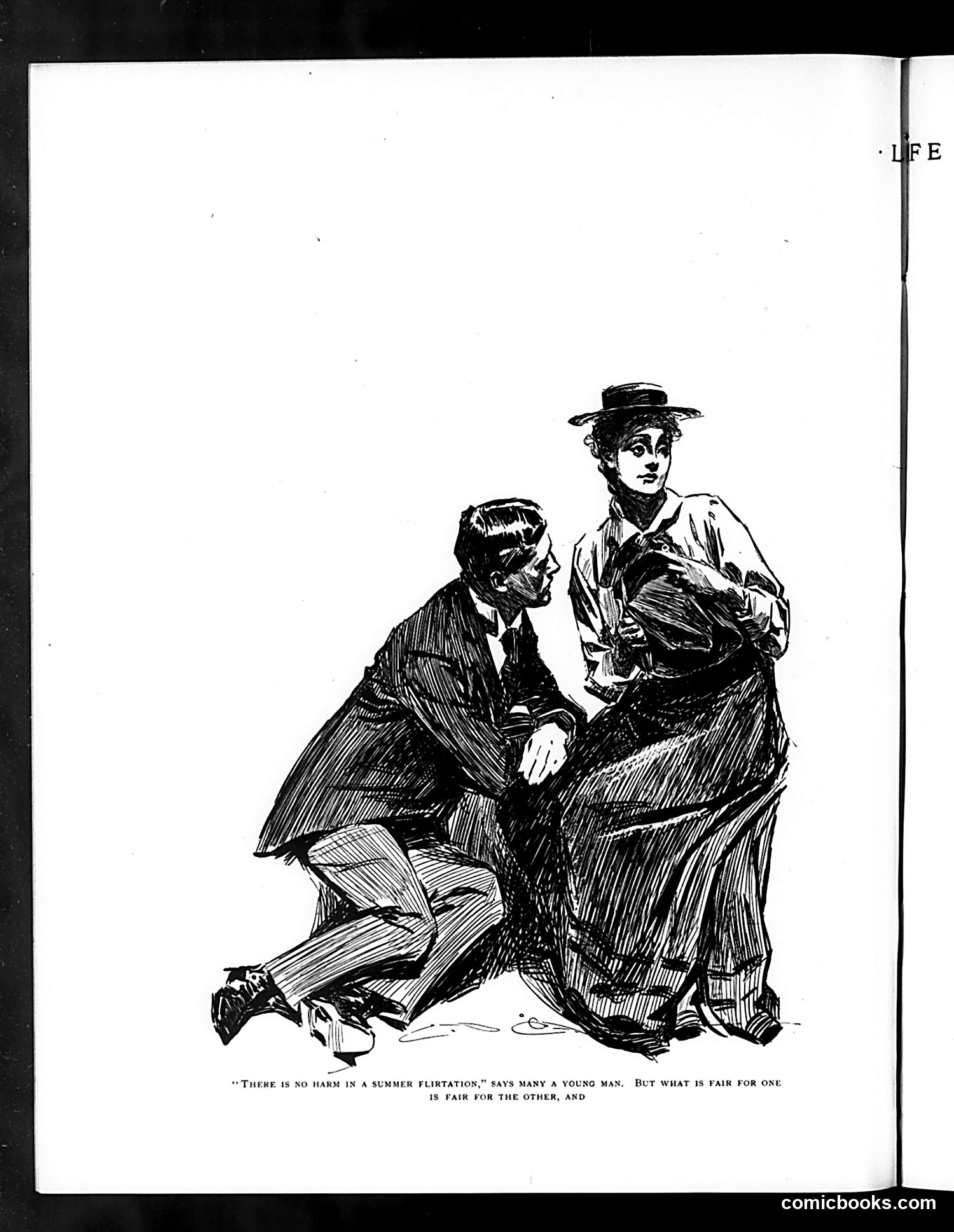
This illustration depicts a romantic or flirtatious encounter between two figures in early 20th-century dress. The caption reads: "There is no harm in a summer flirtation," says many a young man. "But what is fair for one is fair for the other, and—" The satire appears to comment on **double standards in courtship and romance**. A young man propositions a woman, claiming casual flirtation is harmless. The incomplete caption ("and—") suggests the punchline reveals the woman's counter-argument: if flirtation is acceptable for him, it should equally apply to her—a pointed critique of gender inequality in romantic conduct expectations. The ink-sketch style is typical of Life's early editorial illustration work, addressing social hypocrisy regarding acceptable behavior between genders.
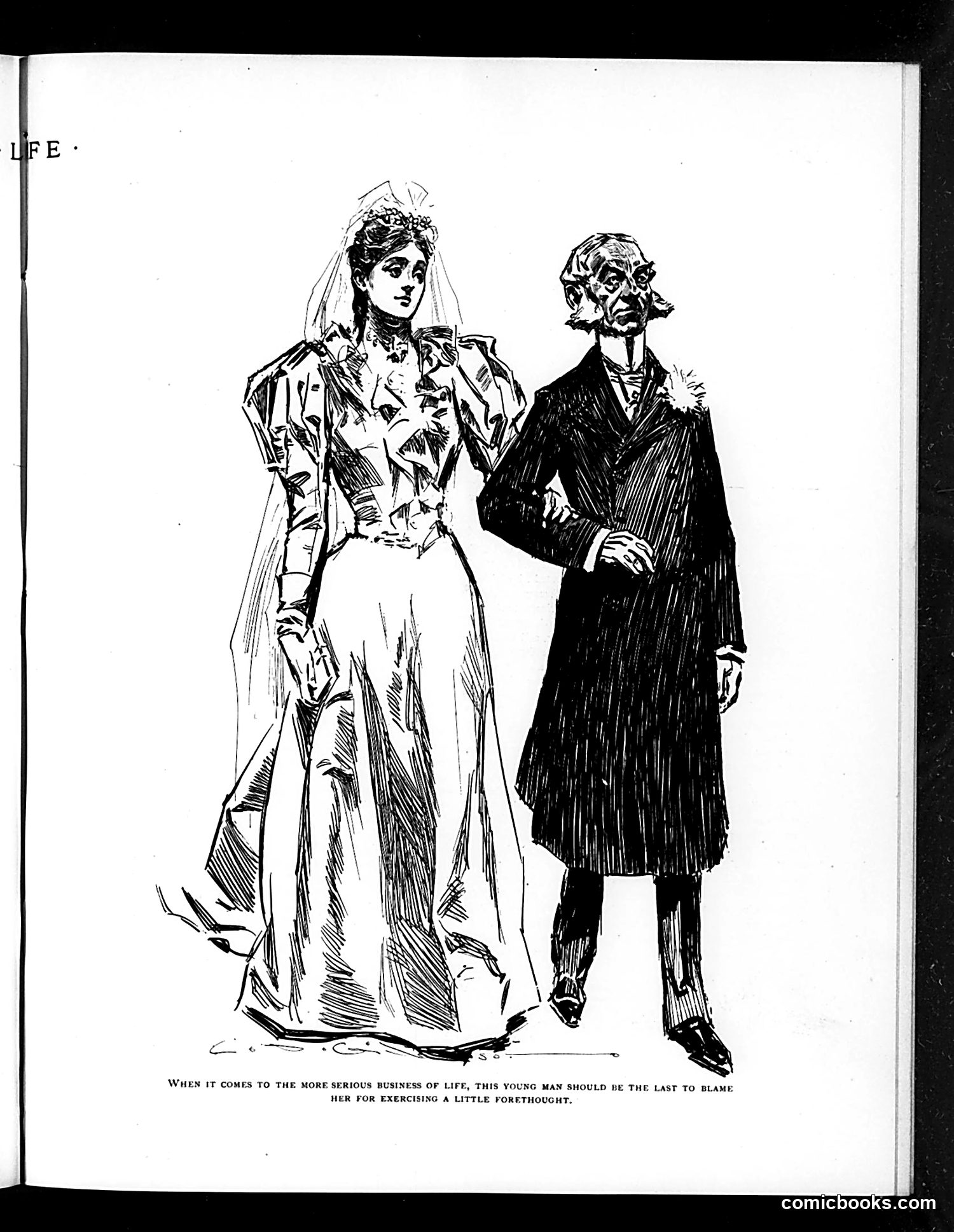
This satirical illustration shows a young couple: a woman in an elaborate wedding dress with veil, and a man in formal attire. The caption reads: "When it comes to the more serious business of life, this young man should be the last to blame her for exercising a little forethought." The joke targets a double standard about marriage and decision-making. The satire suggests that while young men might criticize women for being overly cautious or calculating about marriage, they should actually appreciate such "forethought"—a woman thinking carefully before committing to marriage is sensible, not blameworthy. The cartoon critiques male attitudes toward female judgment, implying men expect women to be serious about marriage while simultaneously mocking them for that very seriousness. It's commentary on gender relations and courtship expectations in early 20th-century American society.
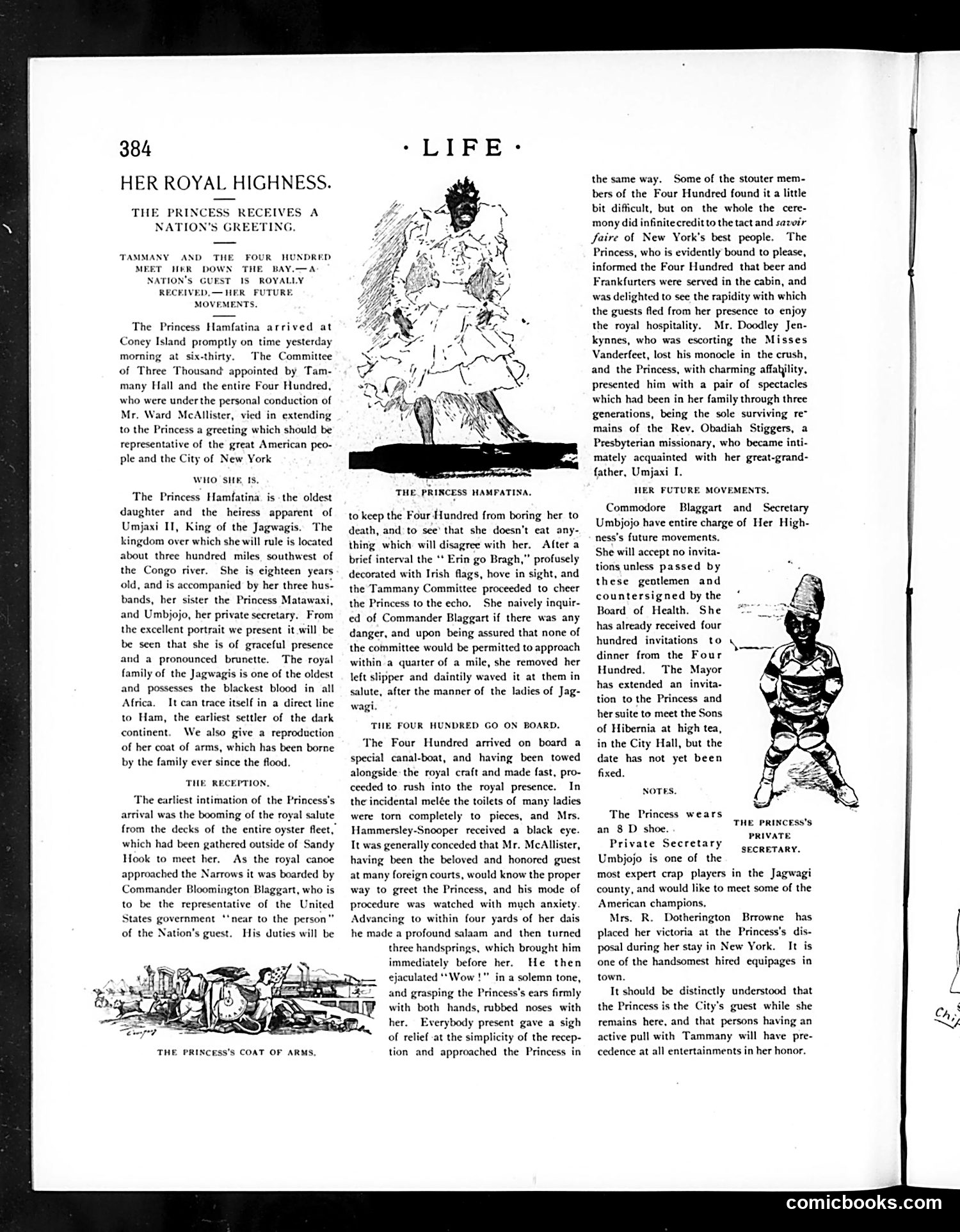
This page satirizes the visit of Princess Hampfatina to New York, where she receives an elaborate official reception. The cartoon depicts an ornately dressed princess figure, mocking her pretension. The satire targets the absurdity of New York society's obsequious treatment of foreign royalty. The text describes comic chaos: the "Four Hundred" (New York's elite social circle) scramble to entertain her, officials worry about protocol, and various dignitaries compete for her attention. The humor lies in portraying the princess as unremarkable—she requires constant entertainment to prevent boredom—while New York's supposedly sophisticated society degrades itself through excessive fawning. The piece mocks both aristocratic pretension and American social climbing, suggesting that receiving a visiting princess exposes the shallowness of high society.
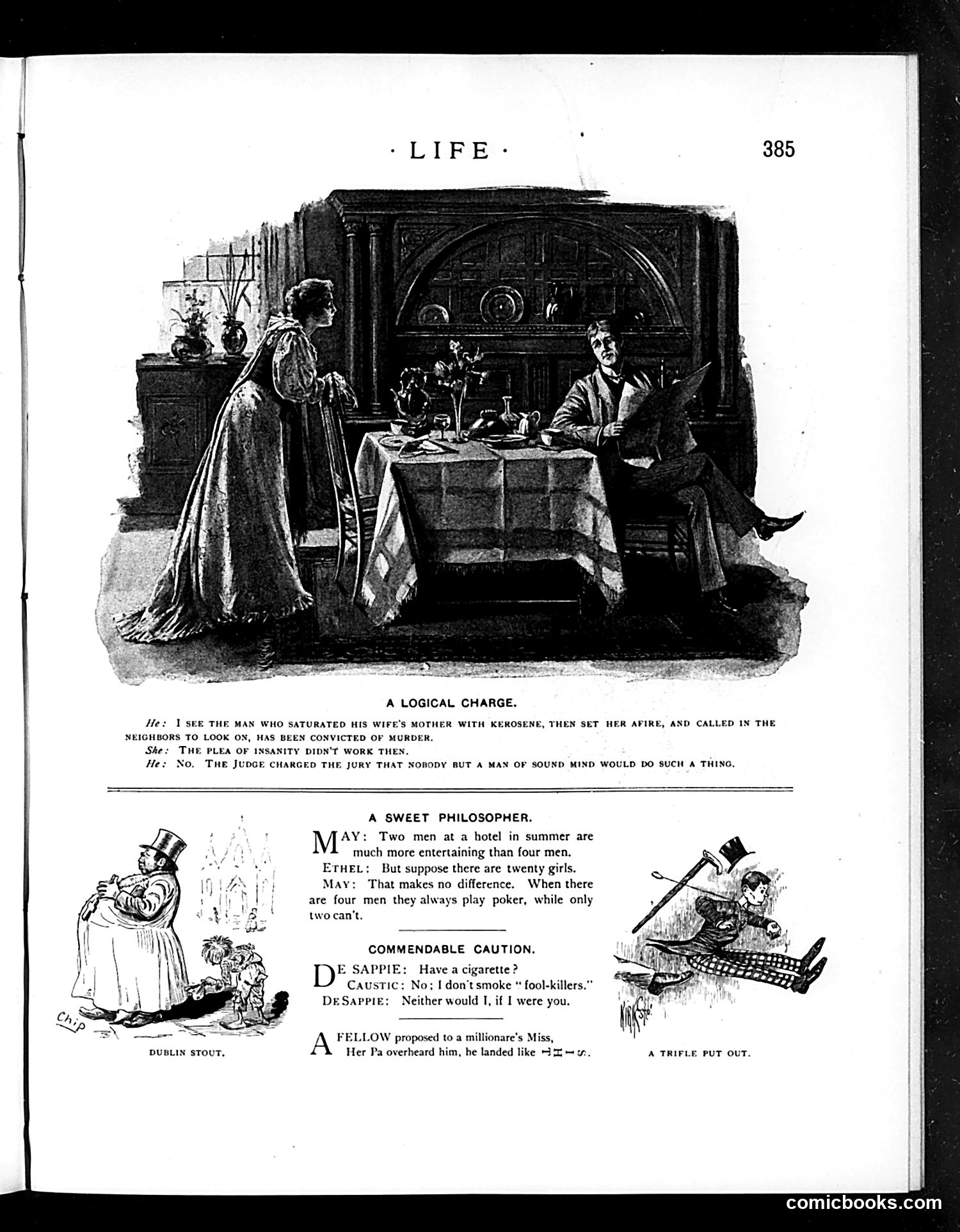
This page contains four brief satirical sketches typical of Life's humor section: 1. **"A Logical Charge"**: A domestic dispute sketch where a man poisoned his mother-in-law with kerosene, then claimed insanity as defense. The judge notes only a "sound mind" would commit such a crime—dark humor about legal absurdities. 2. **"A Sweet Philosopher"**: Two men debate whether four men and twenty girls provide better entertainment. The joke hinges on the observation that four men playing poker excludes half the group. 3. **"Commendable Caution"**: A smoker refuses "fool-killer" cigarettes, with a punchline about self-preservation. 4. **"A Trifle Put Out"** and **"Dublin Stout"**: Illustrated vignettes (unclear exact meaning without full context). The page exemplifies Life's style: short, punchy jokes with satirical illustrations targeting social behavior and relationships.
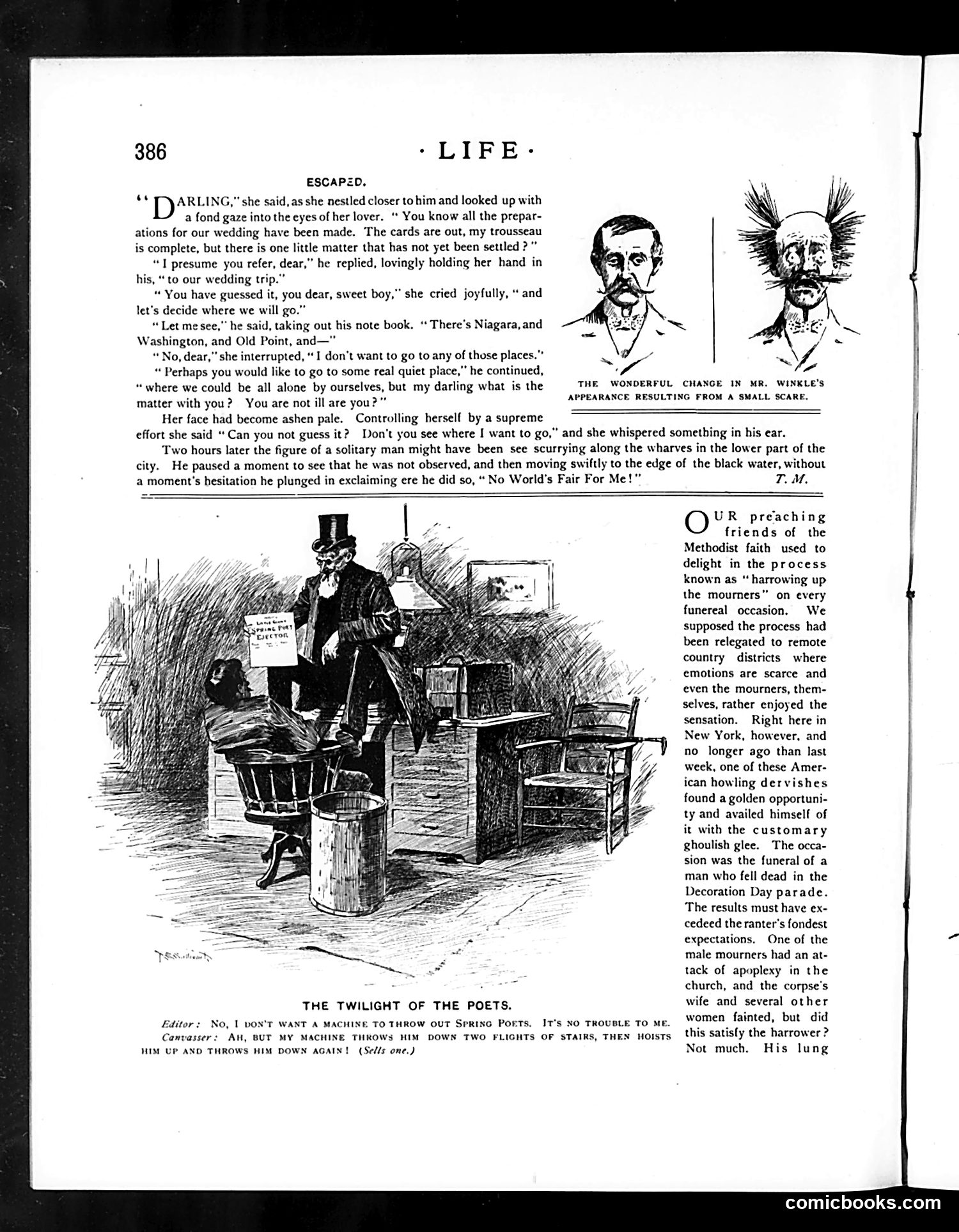
The main story "Escaped" is a dark comedy: a couple plans their honeymoon; the bride whispers her desired destination to her groom; horrified, he immediately rushes to the waterfront and drowns himself rather than comply—his final cry being "No World's Fair For Me!" The joke is that the bride wants to attend the 1893 World's Columbian Exposition in Chicago, which the groom finds so unbearable he prefers death. "The Twilight of the Poets" cartoon mocks a poetry magazine editor who rejects submissions, boasting his rejection process is so violent it physically assaults rejected poets—throwing them down stairs repeatedly. The right column satirizes Methodist preachers' practice of "harrowing the mourners" (emotionally manipulating funeral attendees into hysteria). A recent New York funeral featured such extreme preaching that mourners fainted and one suffered a stroke, yet the preacher remained unsatisfied with the emotional response. All three pieces mock excess and absurdity in contemporary American life.
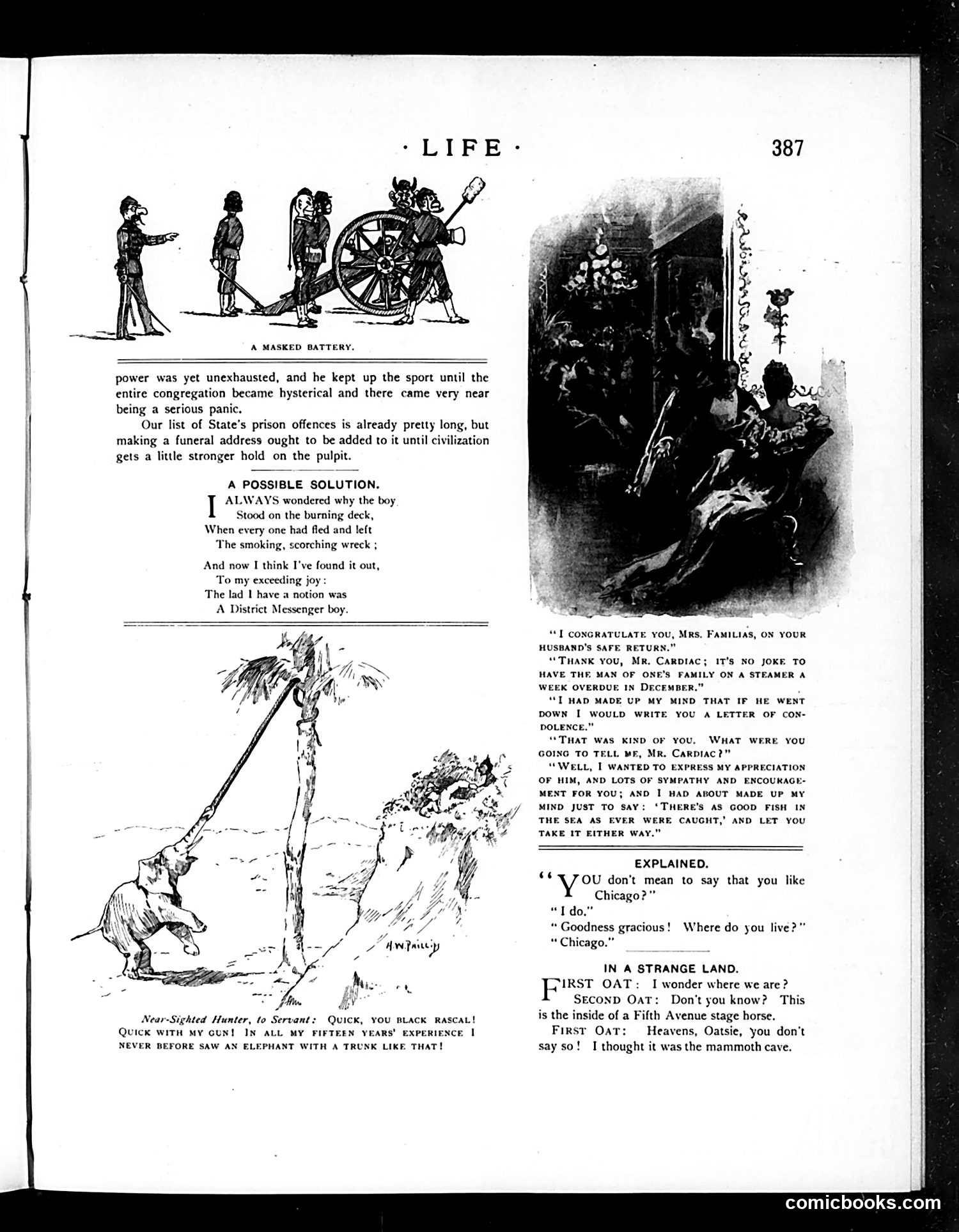
This page contains several unrelated humorous pieces typical of Life magazine's satirical format: **"A Masked Battery"** mocks overzealous clergy who deliver inappropriately dramatic funeral orations, suggesting such behavior should be a punishable offense until society becomes more civilized. **"A Possible Solution"** playfully explains the boy in the famous poem "Casabianca" (who stood on the burning deck) as a District Messenger boy—suggesting he'd stay at his post no matter what because messenger boys were known for rigid duty compliance. **"Explained"** satirizes Chicago's reputation, implying residents claiming to like the city are either from there themselves or being dishonest. **The Hunter cartoon** depicts a near-sighted hunter mistaking an elephant's trunk for a gun, mocking poor observation skills. **"In a Strange Land"** features two oats (horses) inside a Fifth Avenue carriage joking they're in a cave, poking fun at confined urban horse travel versus wilderness. The cartoons employ gentle, class-conscious American humor typical of early 20th-century satire.
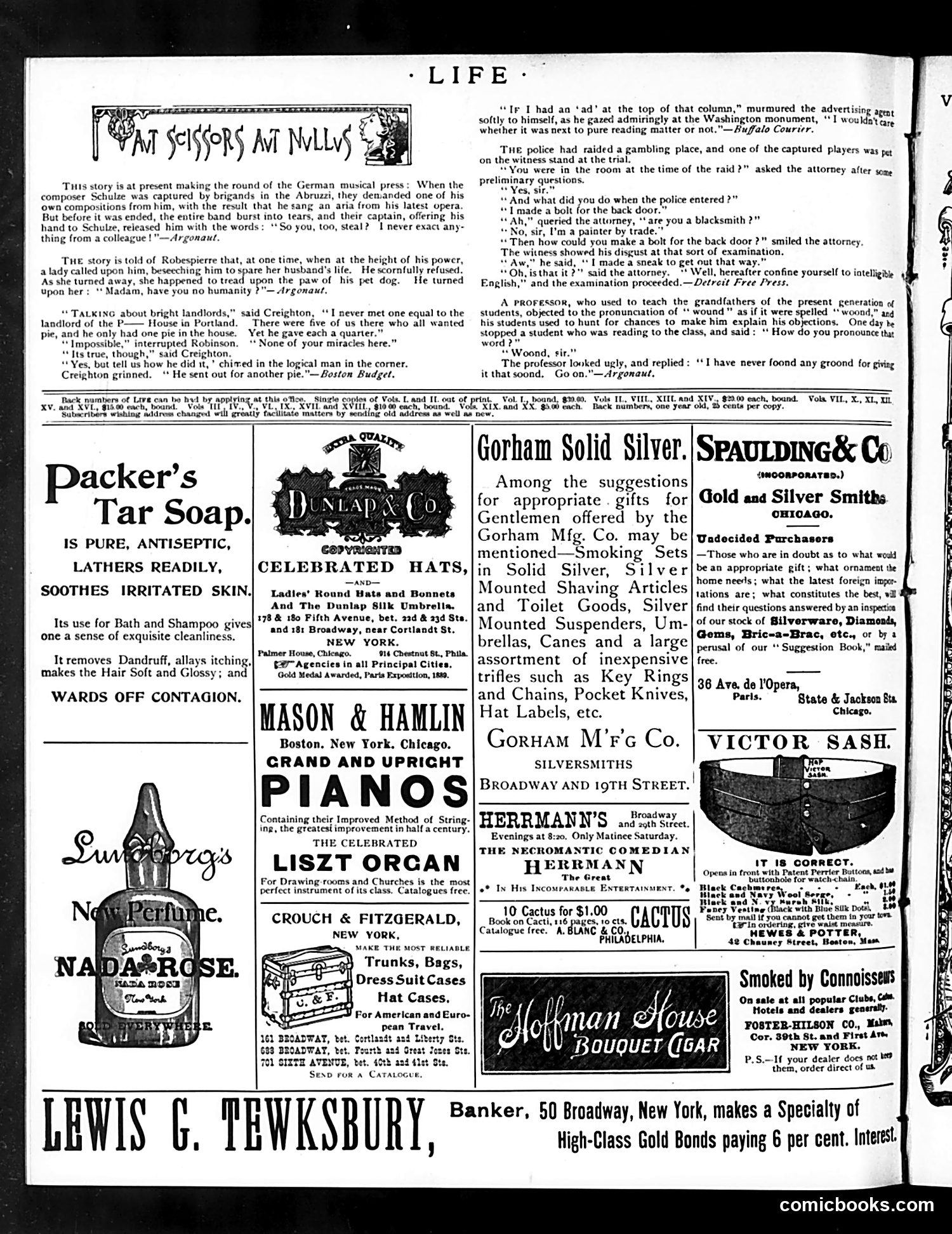
This page from *Life* magazine consists primarily of brief humorous stories rather than visual cartoons. The text presents several anecdotes meant to amuse readers: **Key stories include:** - A tale of brigands who release a composer after hearing his opera aria, then joke about stealing (satirizing both art and criminality) - A story about Robespierre's cruelty during the French Revolution - Various witty exchanges about landlords, painters, and professors - A commentary by an advertising agent wishing his ad appeared near the Washington Monument **The satire targets:** pretension in art, academic pedantry (a professor correcting pronunciation), and bureaucratic absurdity (a witness confused about terminology). The remainder is period advertising for products like Packer's Tar Soap, Mason & Hamlin Pianos, and Gorham silverware—typical commercial content from this era of *Life* magazine.