
Life, 1893-06-15 · page 6 of 14
Life — June 15, 1893 — page 6: what you’re looking at
What you’re looking at
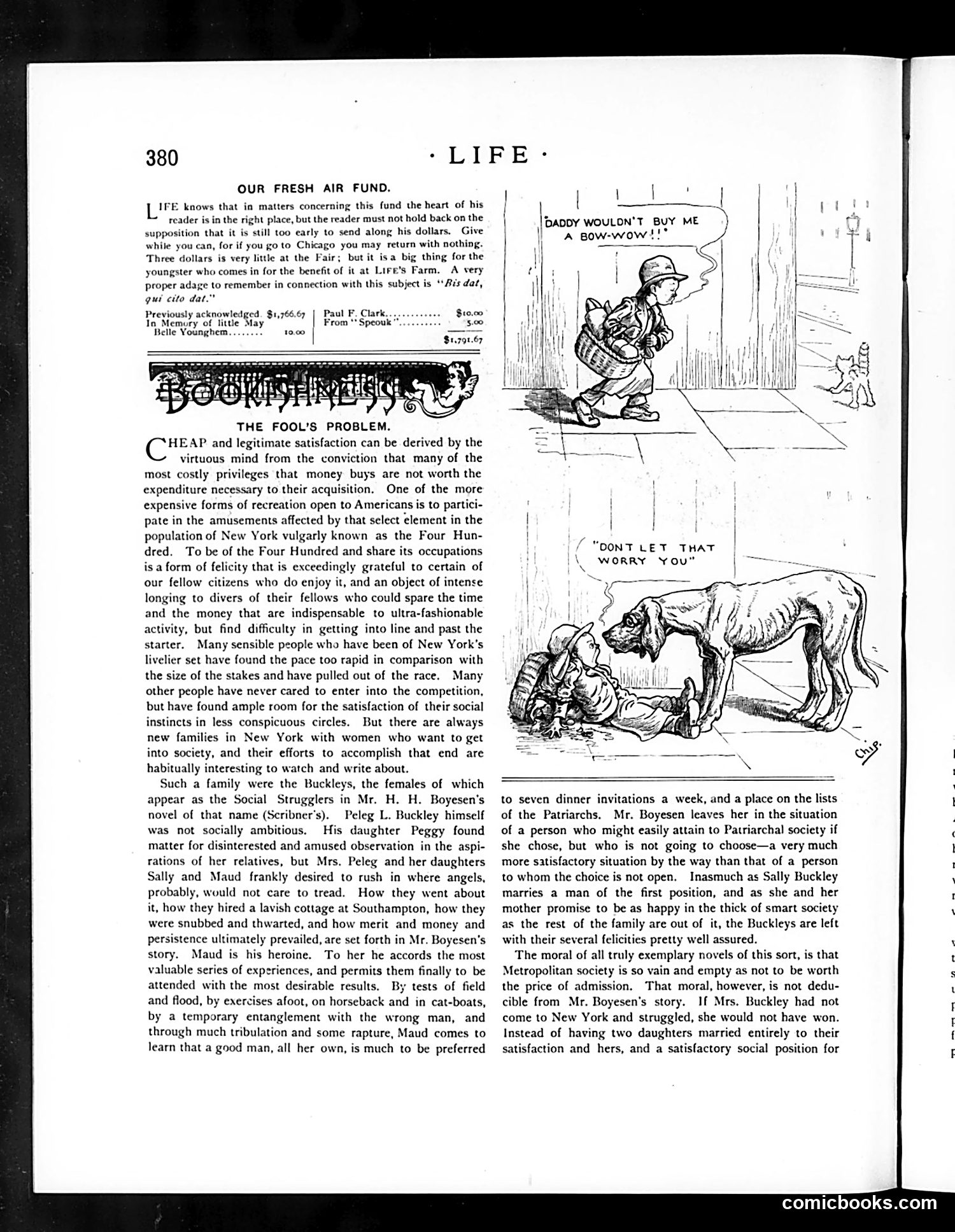
This page contains two editorial cartoons satirizing New York society's "Four Hundred" elite circle. **Top cartoon**: A man carrying a baby says "Daddy wouldn't buy me a bow-wow!!!" The satire targets wealthy parents who indulge children with expensive but trivial purchases—mocking the frivolous spending habits of New York's upper class. **Bottom cartoon**: A woman in fashionable dress pets a cow, saying "Don't let that worry you." This appears to mock the affectation of high-society women who romanticize rural life or adopt pastoral interests as entertainment, treating farm animals as accessories to their leisure pursuits. Both cartoons ridicule the disconnect between the wealthy elite and practical reality, suggesting their class engages in absurd, self-serving behavior that Life's editors found worthy of public mockery.
📄 Transcribed text from this page (OCR, searchable)
Machine-transcribed from the original scan — historical spelling and the odd misread are preserved.
380 ‘LIFE: OUR FRESH AIR FUND. FE knows that in matters concerning this fund the heart of his reader is in the right place, but the reader must not hold back on the supposition that it is still too early to send along his dollars. Give while you can, for if you go to Chicago you may return with nothing. Three dollars is very little at the Fair; but it isa big thing for the youngster who comes in for the benefit of it at Lire’s Farm. A very proper adage to remember in connection with this subject is Ais dat, gui cito dat. Previously acknowledged. $1766.67 | Paul F, Clark, In Memory of little May rom ** Speoul Belle Younghem........ 10.00 THE FOOL'S PROBLEM. HEAP and legitimate satisfaction can be derived by the virtuous mind from the conviction that many of the most costly privileges that money buys are not worth the expenditure necessary to their acquisition, One of the more expensive forms of recreation open to Americans is to partici- pate in the amusements affected by that select clement in the population of New York vulgarly known as the Four Hun- dred. To be of the Four Hundred and share its occupations isa form of felicity that is exceedingly grateful to certain of our fellow citizens who do enjoy it, and an object of intense longing to divers of their fellows who could spare the time and the money that are indispensable to ultra-fashionable activity, but find difficulty in getting into line and past the starter. Many sensible people who have been of New York's livelier set have found the pace too rapid in comparison with the size of the stakes and have pulled out of the race. Many other people have never cared to enter into the competition, but have found ample room for the satisfaction of their social instincts in less conspicuous circles. But there are always new families in New York with women who want to get into society, and their efforts to accomplish that end are habitually interesting to watch and write about. Such a family were the Buckleys, the females of which appear as the Social Strugglers in Mr. H. H. Boyesen’s novel of that name (Scribner's). Peleg L. Buckley himself was not socially ambitious. His daughter Peggy found matter for disinterested and amused observation in the aspi- rations of her relatives, but Mrs. Peleg and her daughters Sally aod Maud frankly desired to rush in where angels, probably, would not care to tread. How they went about it, how they hired a lavish cottage at Southampton, how they were snubbed and thwarted, and how merit and money and persistence ultimately prevailed, are set forth in Mr. Boyesen’s story. Maud is his heroine. To her he accords the most valuable series of experiences, and permits them finally to be attended with the most desirable results. By tests of field and flood, by exercises afoot, on horseback and in cat-boats, by a temporary entanglement with the wrong man, and through much tribulation and some rapture, Maud comes to learn that a good man, all her own, is much to be preferred | | \ | \baDDy WOULON'T BUY ME A Bow-wow!! (“OONT LET THAT WORRY You" to seven dinner invitations a week, and a place on the lists of the Patriarchs. Mr. Boyesen leaves her in the situation of a person who might easily attain to Patriarchal society if she chose, but who is not going to choose—a very much more satisfactory situation by the way than that of a person to whom the choice is not open. Inasmuch as Sally Buckley marries a man of the first position, and as she and her mother promise to be as happy in the thick of smart society as the rest of the family are out of it, the Buckleys are left with their several felicities pretty well assured. The moral of all truly exemplary novels of this sort, is that Metropolitan society is so vain and empty as not to be worth the price of admission, That moral, however, is not dedu- cible from Mr. Boyesen’s story. If Mrs. Buckley had not come to New York and struggled, she would not have won. Instead of having two daughters married entirely to their satisfaction and hers, and a satisfactory social position for comicbooks.com