
A complete issue · 18 pages · 1893
Life — March 23, 1893
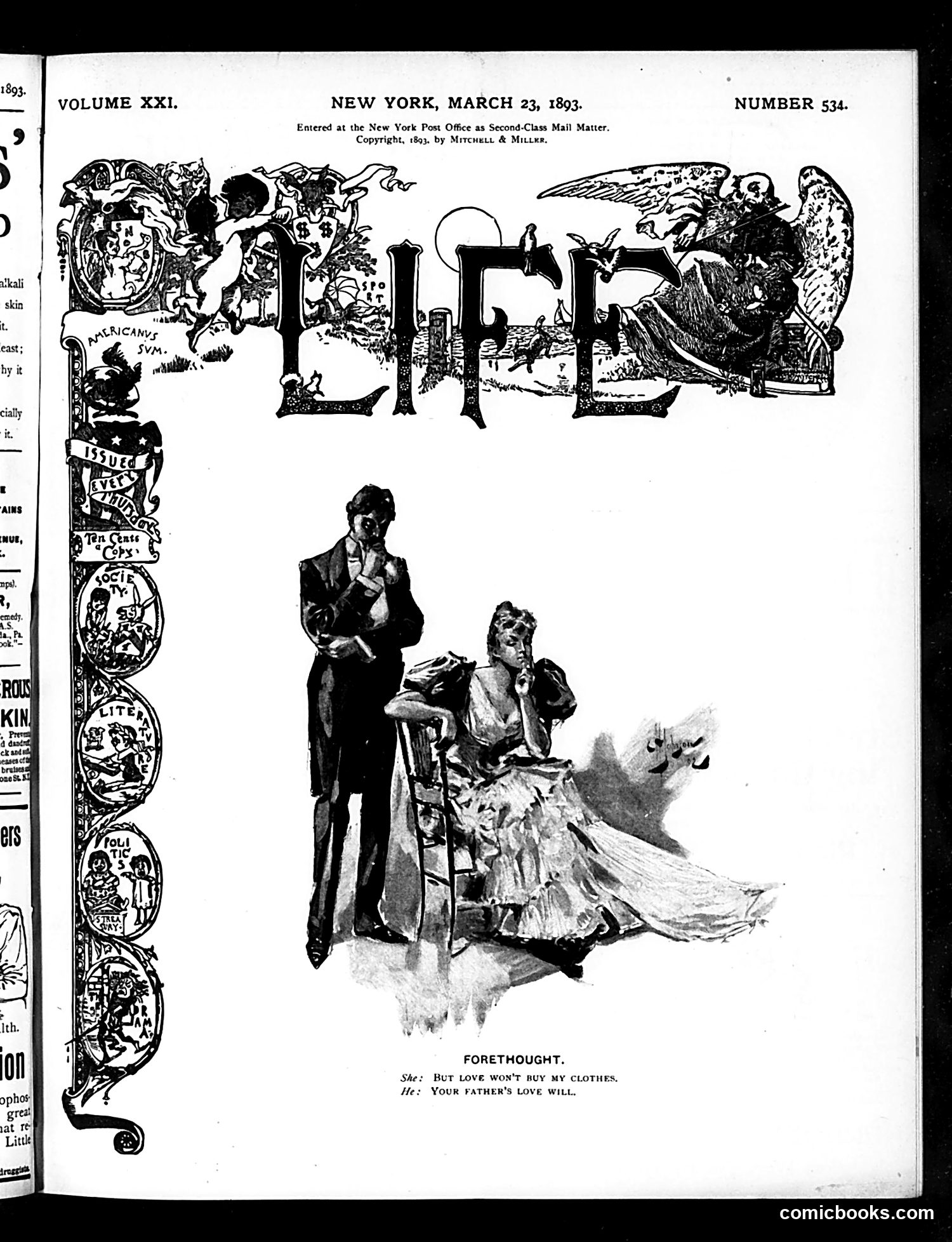
This page features a satirical cartoon titled "Forethought" depicting a romantic couple. The man stands pensively while a woman in an elaborate dress sits beside him. The caption reads: **She:** "But love won't buy my clothes." **He:** "Your father's love will." The satire targets marriage economics of the Gilded Age, specifically criticizing marriages arranged or influenced by financial considerations. The woman frankly acknowledges that romantic love alone cannot sustain her expensive lifestyle, while the man reassures her that her father's wealth (and presumably his willingness to support her) will compensate. The joke exposes the transactional nature of upper-class courtship, where women's financial security depends on marrying wealthy men or relying on paternal funds—a critique of both gender economics and class-based marriage practices of the 1890s.
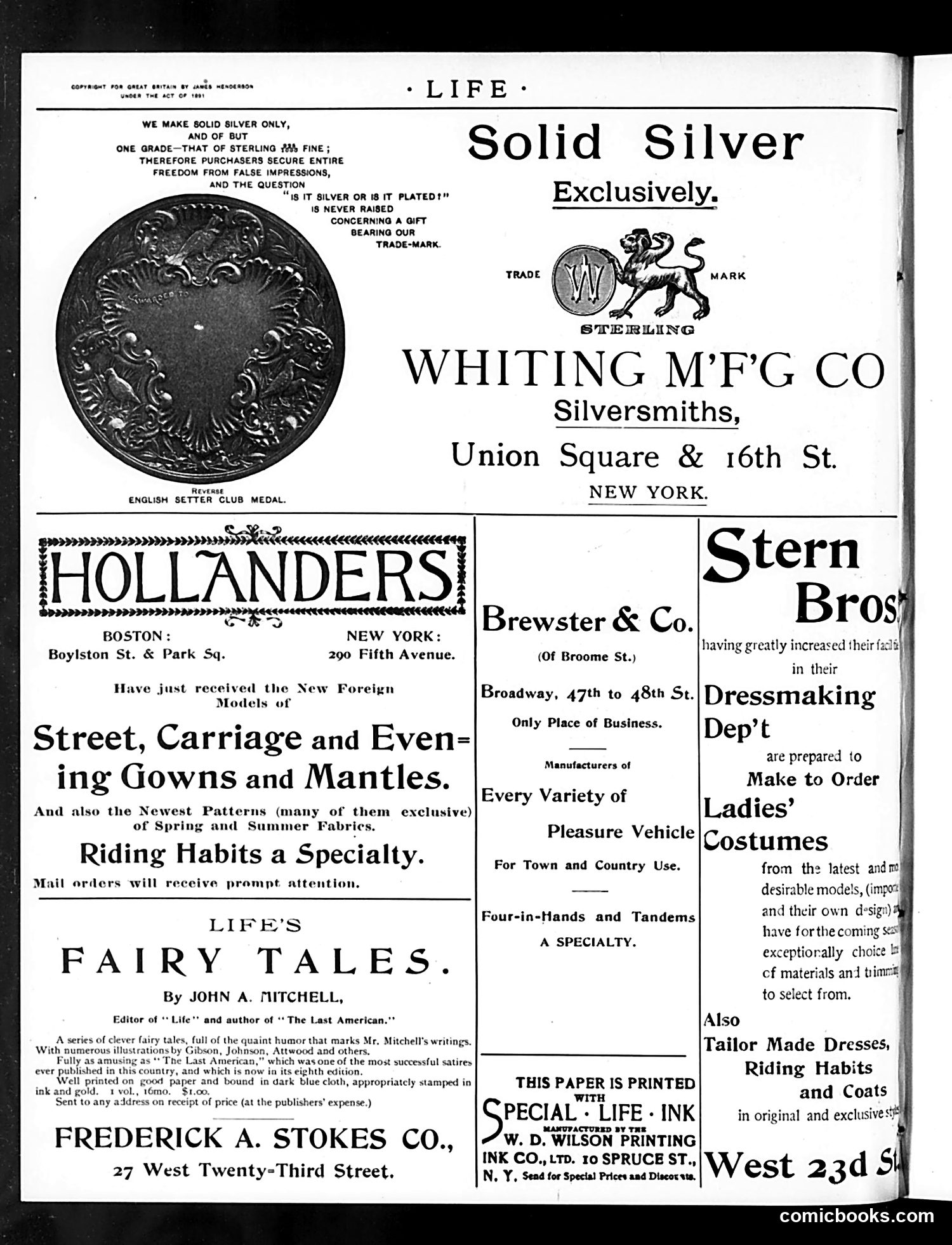
This page is **primarily advertising** for late 19th-century businesses, with no discernible political cartoon or satirical content visible. The advertisements promote: - **Whiting M'fg Co.**: Sterling silver goods (with a decorative medal image) - **Hollanders**: Women's clothing and riding habits - **Brewster & Co.**: Pleasure vehicles and carriages - **Stern Bros.**: Dressmaking services - **Frederick A. Stokes Co.**: "Life's Fairy Tales" book by John A. Mitchell The page also notes it was printed with special "Life Ink" by W.D. Wilson Printing. The only editorial content is a book advertisement for fairy tales, not political satire. This appears to be a typical issue page mixing commercial advertisements with minimal editorial material.
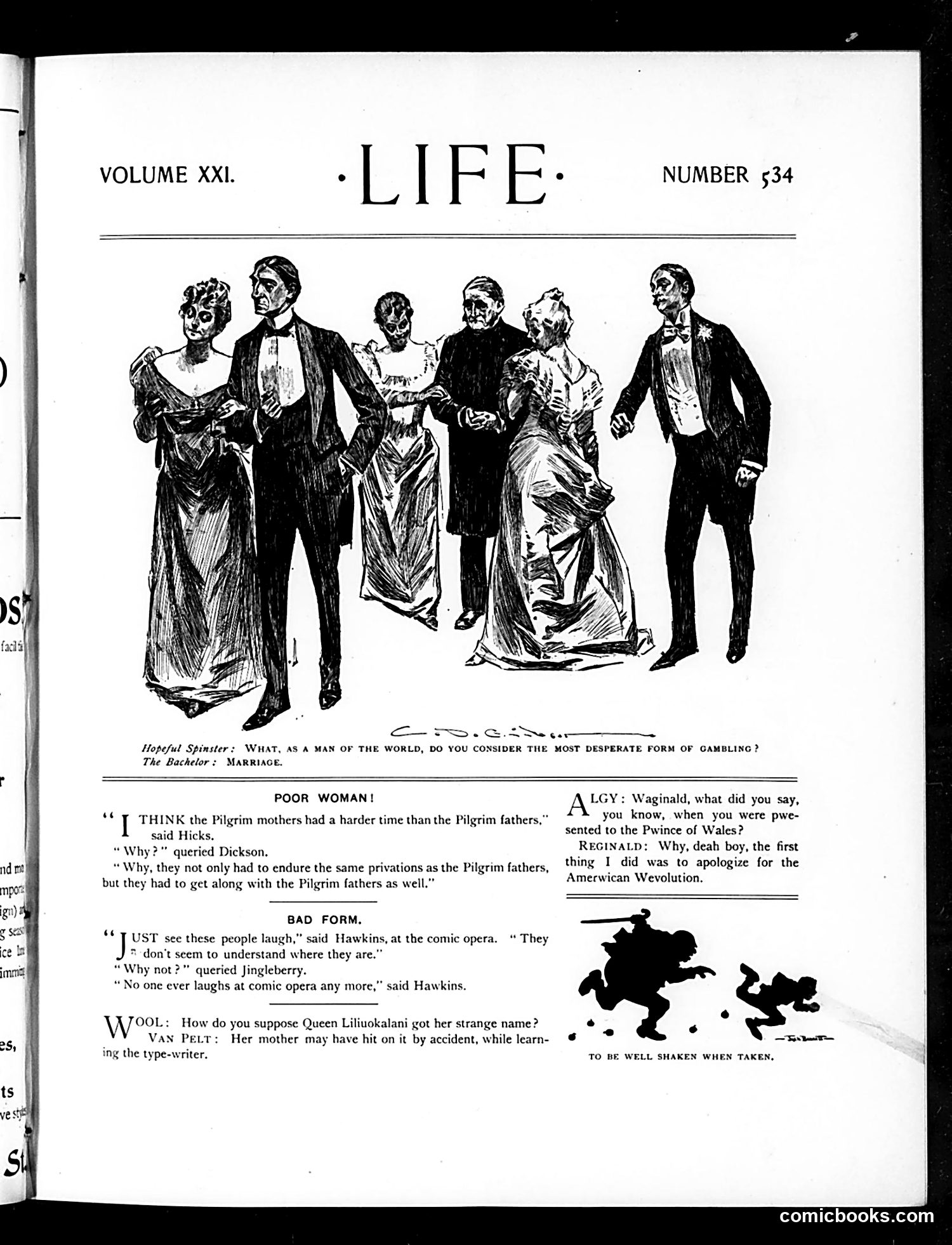
This *Life* magazine page contains three brief satirical jokes typical of early 20th-century humor: 1. **"Poor Woman!"** jokes about Pilgrim mothers having harder lives than Pilgrim fathers due to managing both domestic duties and privations. 2. **"Bad Form"** presents a man (Hawkins) at comic opera observing that audiences no longer laugh—suggesting either declining entertainment quality or changing audience behavior. 3. **"Wool/Van Pelt"** is a pun-based joke about Queen Liliuokalani's Hawaiian name, with Van Pelt humorously suggesting her mother accidentally created it on a typewriter. These represent *Life*'s characteristic light satirical commentary on social customs, contemporary entertainment, and wordplay—rather than hard political commentary.
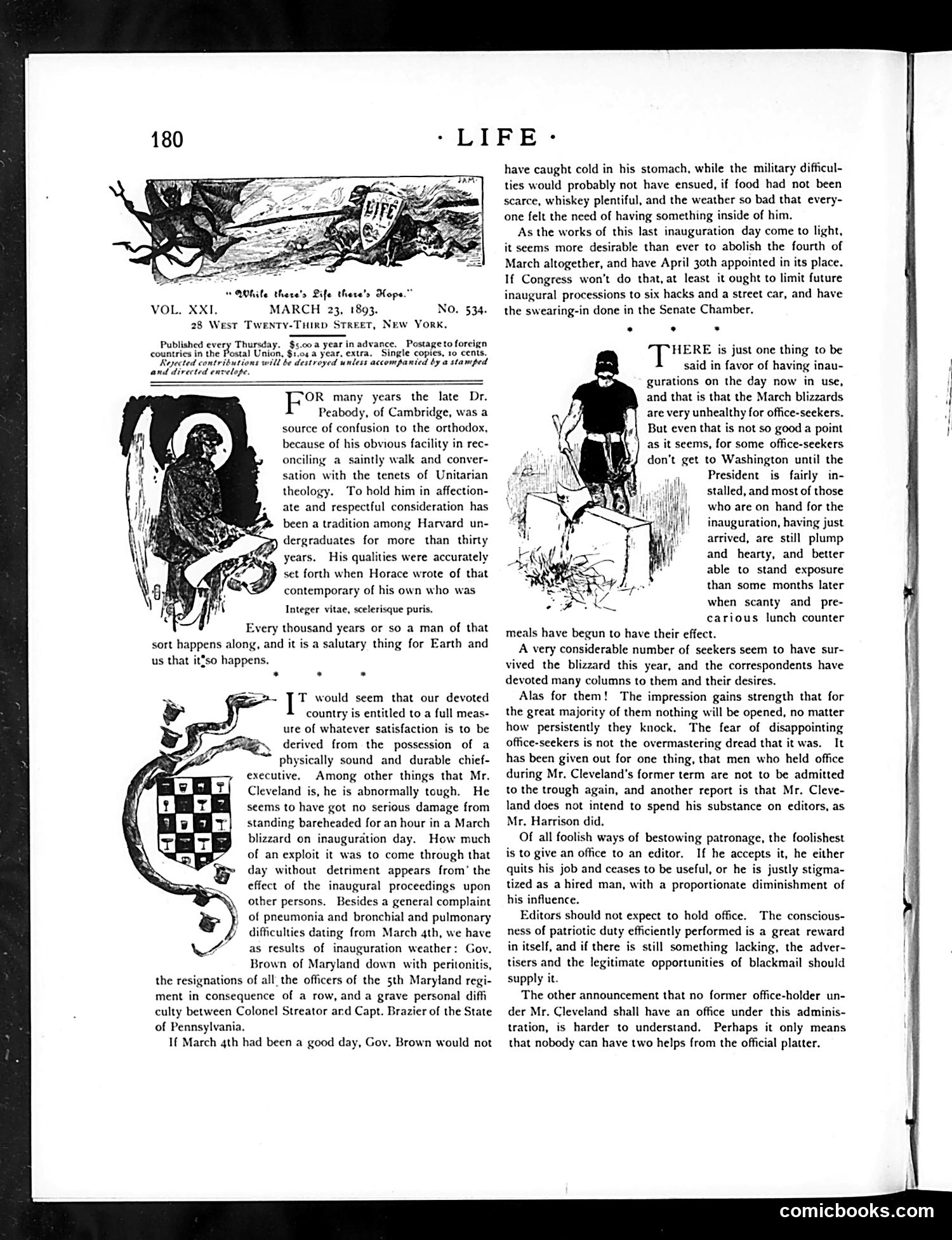
This page satirizes President Cleveland's second inauguration on March 4, 1893, during a severe blizzard. The main cartoon (top left) shows "While that's Life there's Hope"—depicting the harsh weather conditions that plagued the ceremony. The text criticizes Cleveland for standing in the March blizzard for an hour without apparent damage, sardonically noting his abnormal toughness. It mocks various inauguration day difficulties: resignations by Maryland officials, and office-seekers flooding Washington despite Cleveland's known hostility to patronage. The satire targets both the absurd weather circumstances and the persistent problem of job-seekers attempting to gain favor despite Cleveland's stated opposition to the "spoils system." The cartoon uses dark humor about the blizzard to frame broader political commentary about government patronage and incompetence.
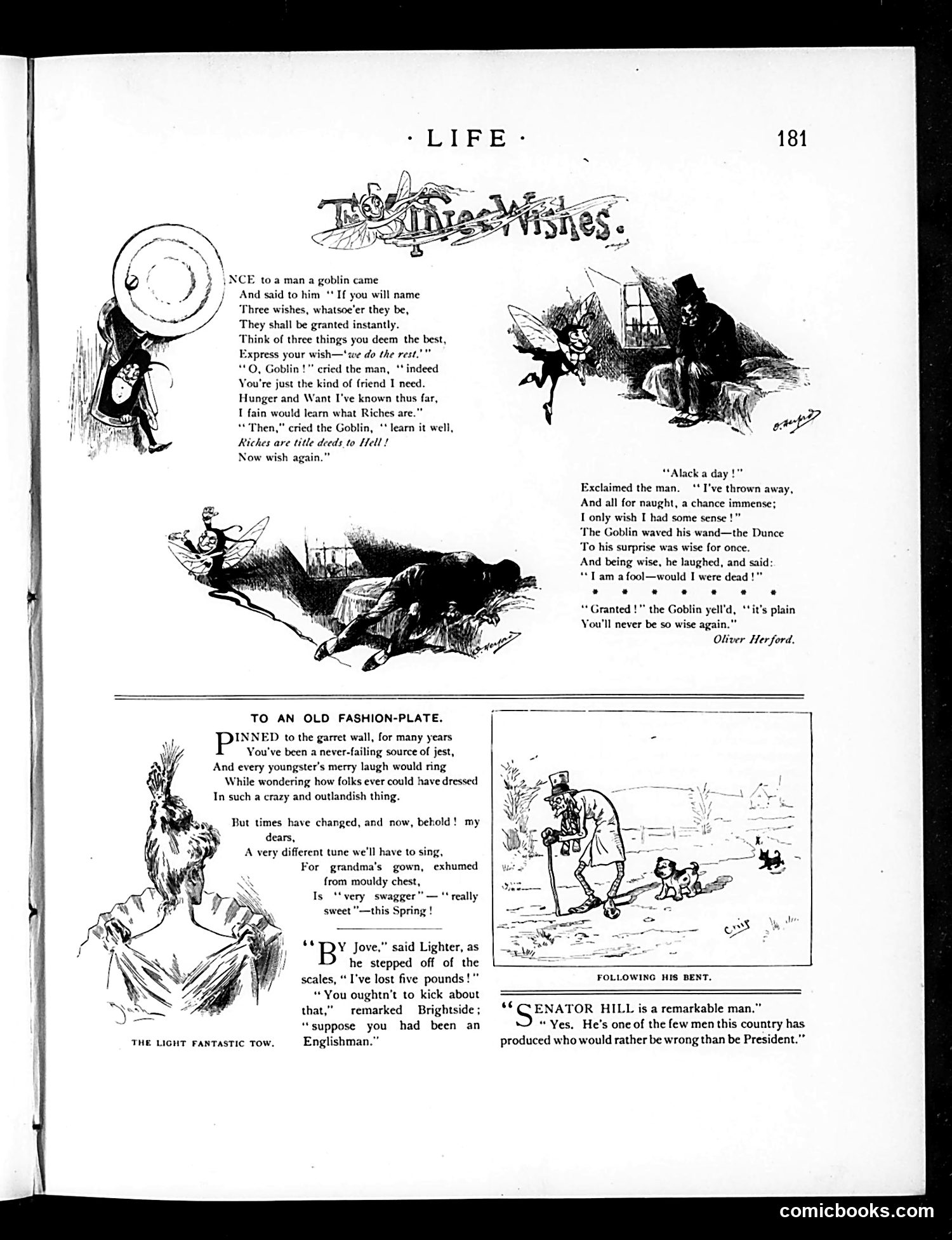
This page contains three separate humorous pieces: 1. **"Three Wishes"** (top): A fairy-tale styled story where a goblin grants a man three wishes. The satire critiques human folly—the man wastes his wishes on immediate desires (food, drink) rather than lasting happiness, then foolishly squanders his final wish. The moral: people are inherently unwise. 2. **"To an Old Fashion-Plate"** (bottom left): A poem mocking changing fashion standards. References "grandma's gown" becoming outdated, satirizing how quickly fashions shift and how previous generations' style choices become ridiculous to new ones. 3. **"Following His Bent"** (bottom right): A political cartoon about Senator Hill, presenting him as a man who would "rather be wrong than be President"—suggesting he prioritizes obstinacy over leadership.
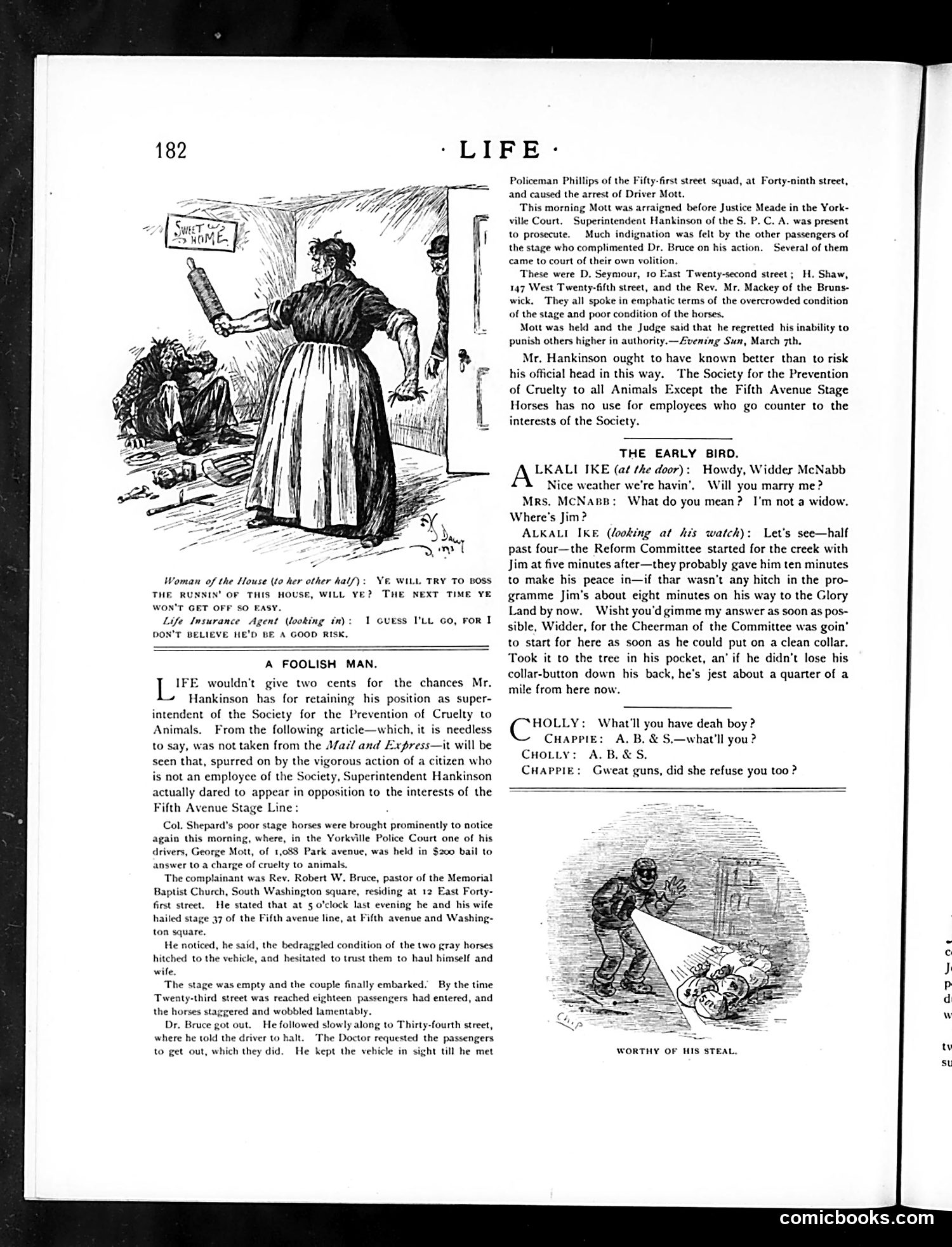
This page contains two distinct pieces of satire: **"A Foolish Man"** critiques **Mr. Hankinson**, superintendent of the Society for the Prevention of Cruelty to Animals. The article mocks his hypocrisy: while claiming to protect animals, he retained his position despite allegedly neglecting the Fifth Avenue Stage Line's horses. A citizen complained to police about the poor condition of two horses hitched to a stage coach, which broke down mid-journey. The satire argues Hankinson's failure to act against this mistreatment contradicts the Society's stated mission. **"The Early Bird"** is a comedic dialogue between characters negotiating a marriage proposal, using wordplay about timing and a "Committee" meeting. The accompanying illustration shows a small figure, though its connection to the dialogue remains unclear from the image alone. Both pieces reflect Progressive Era concerns about institutional accountability and animal welfare.
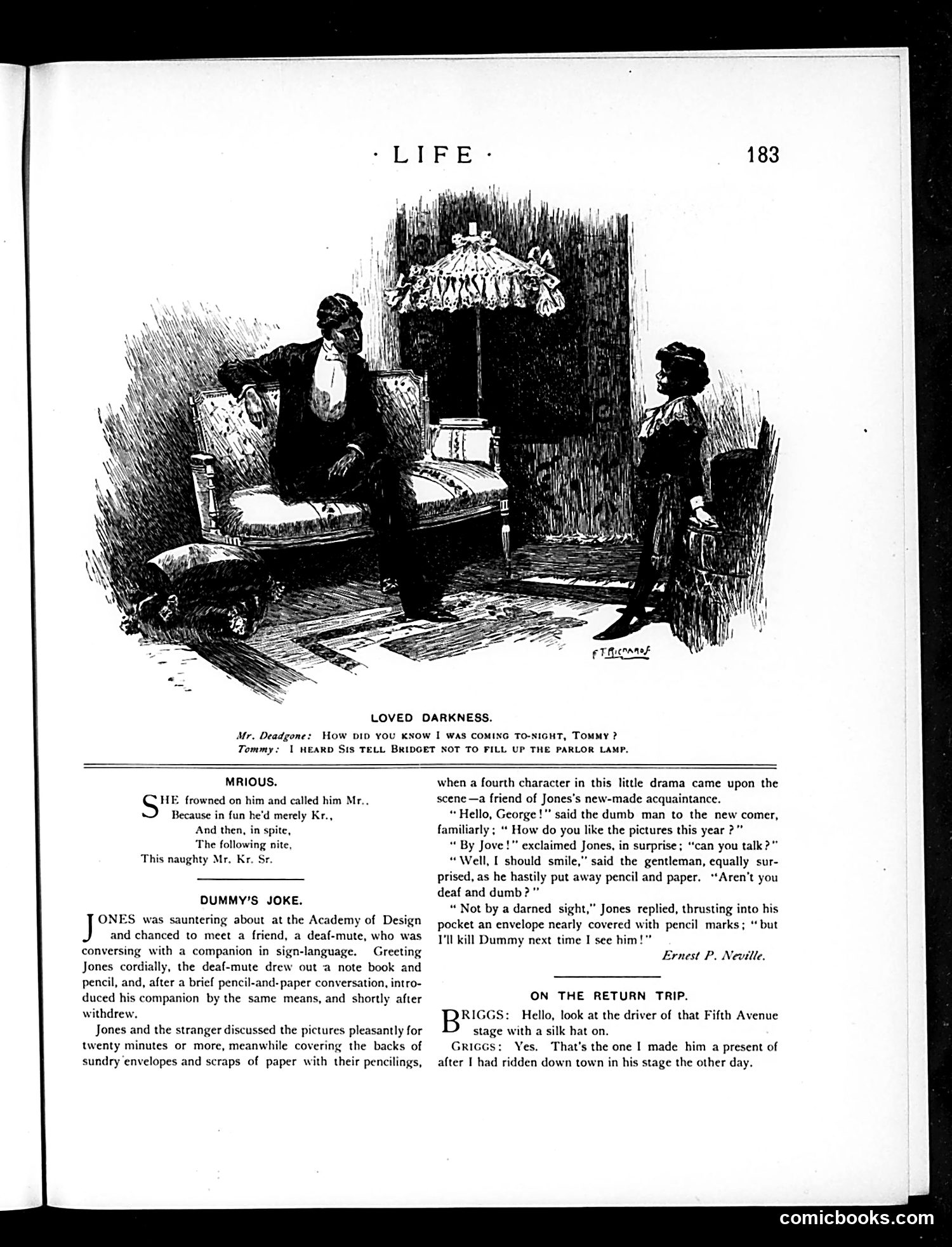
**The Main Cartoon: "Loved Darkness"** This sketch depicts a domestic scene where Mr. Deadzone arrives home to find his wife with another man present. The humor relies on a double meaning: Tommy (presumably their son) explains he knew of the visitor's arrival because "Sir Tell Bridget not to fill up the parlor lamp"—implying the couple preferred darkness for their meeting. The cartoon satirizes infidelity and Victorian propriety by suggesting illicit behavior conducted in dimly lit rooms. **The Text Sections Below** "Dummy's Joke" and "On the Return Trip" are separate humorous anecdotes about misunderstandings and social observations, unrelated to the main cartoon. These represent typical Life magazine short comedic pieces from the early 20th century. The overall page demonstrates Life's satirical approach to middle-class domestic situations and social hypocrisy.
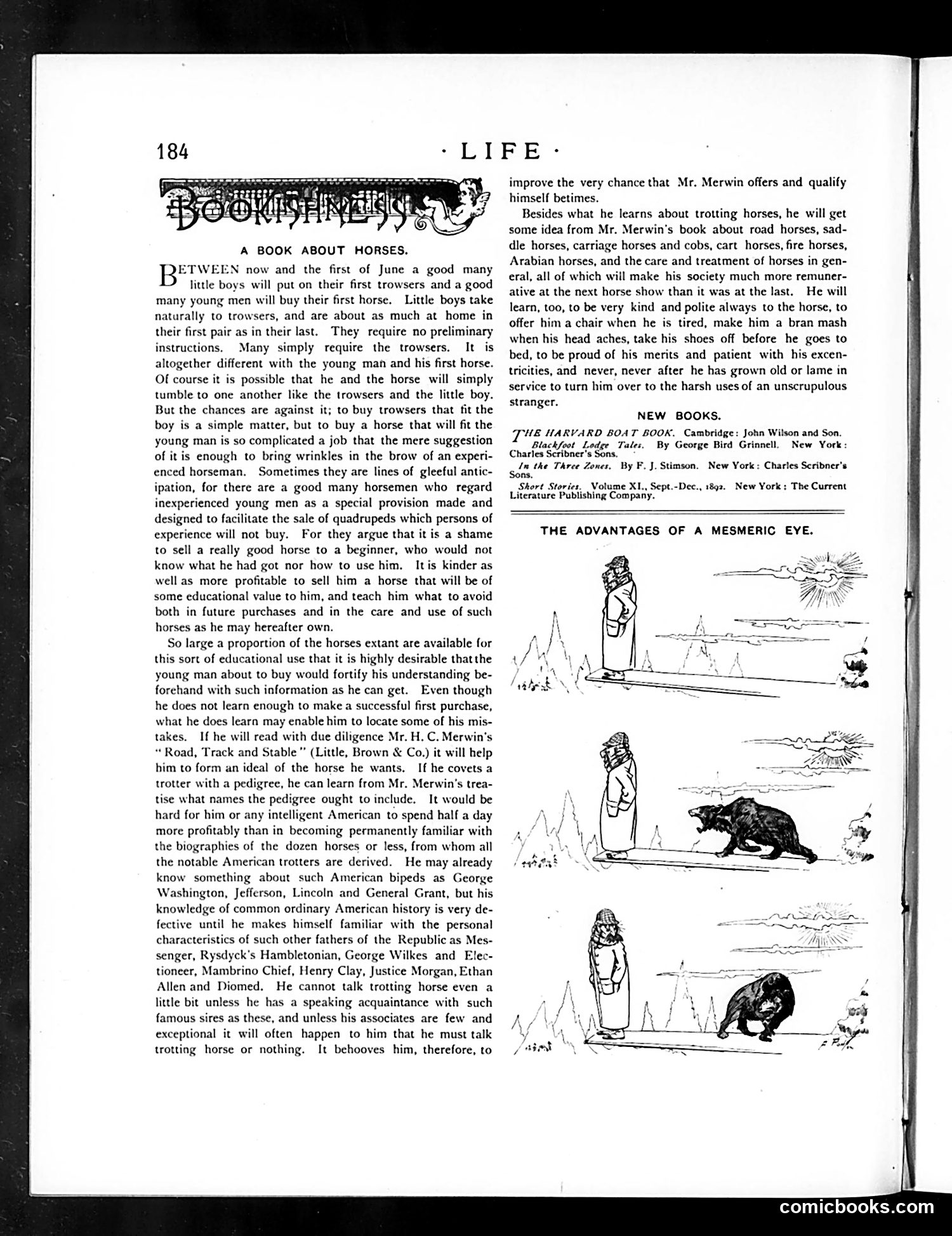
This page contains two distinct sections: **Left column:** A book review titled "A Book About Horses" discussing H.C. Merwin's work "Road, Track and Stable." The text argues young men should educate themselves about horses before purchasing one, recommending Merwin's book as instructional. **Right column:** A feature titled "The Advantages of a Mesmeric Eye" with three illustrations showing a person using hypnotic powers on a bear. The cartoons humorously depict someone mesmerizing/controlling a bear through eye contact alone—a satirical take on the then-popular pseudoscience of mesmerism (hypnotism). This appears to be gentle humor mocking the era's fascination with mesmerism's supposed supernatural powers. The page lacks overtly political content; it's primarily educational and entertainment-focused.
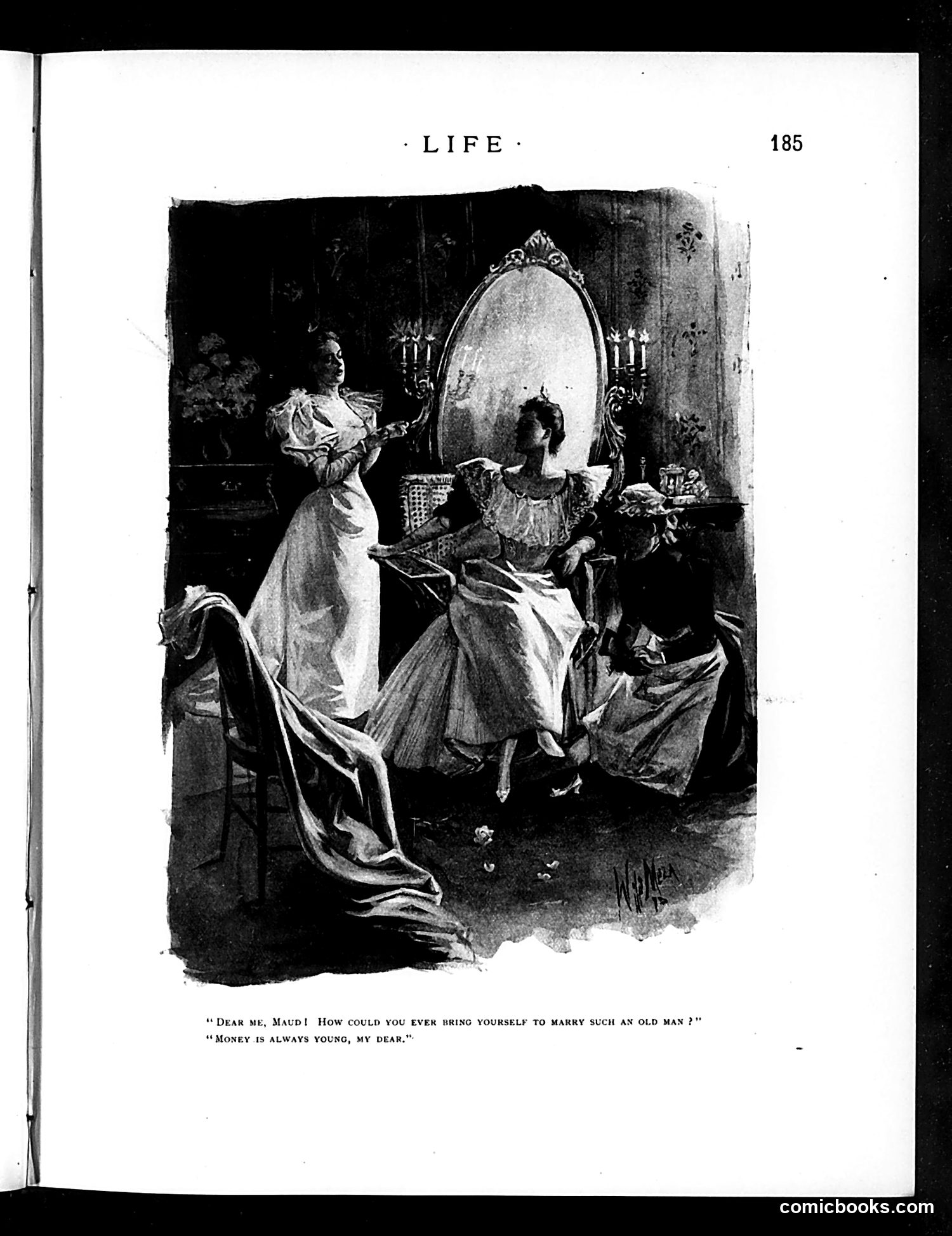
This is a satirical cartoon from Life magazine depicting a scene in a luxurious bedroom or dressing room. Three women in elaborate Edwardian-era clothing are shown, with one seated at a vanity mirror. The dialogue reads: "Dear me, Maud! How could you ever bring yourself to marry such an old man?" and the response: "Money is always young, my dear." **The satire**: This cartoon mocks women who marry wealthy older men for financial reasons rather than love or compatibility. It presents this as a cynical but pragmatic choice—suggesting that wealth itself remains eternally "young" and attractive regardless of the suitor's age. The joke critiques both mercenary marriage practices and the willingness of women to overlook such significant age gaps when substantial money is involved, reflecting early 20th-century attitudes about marriage, class, and gender.
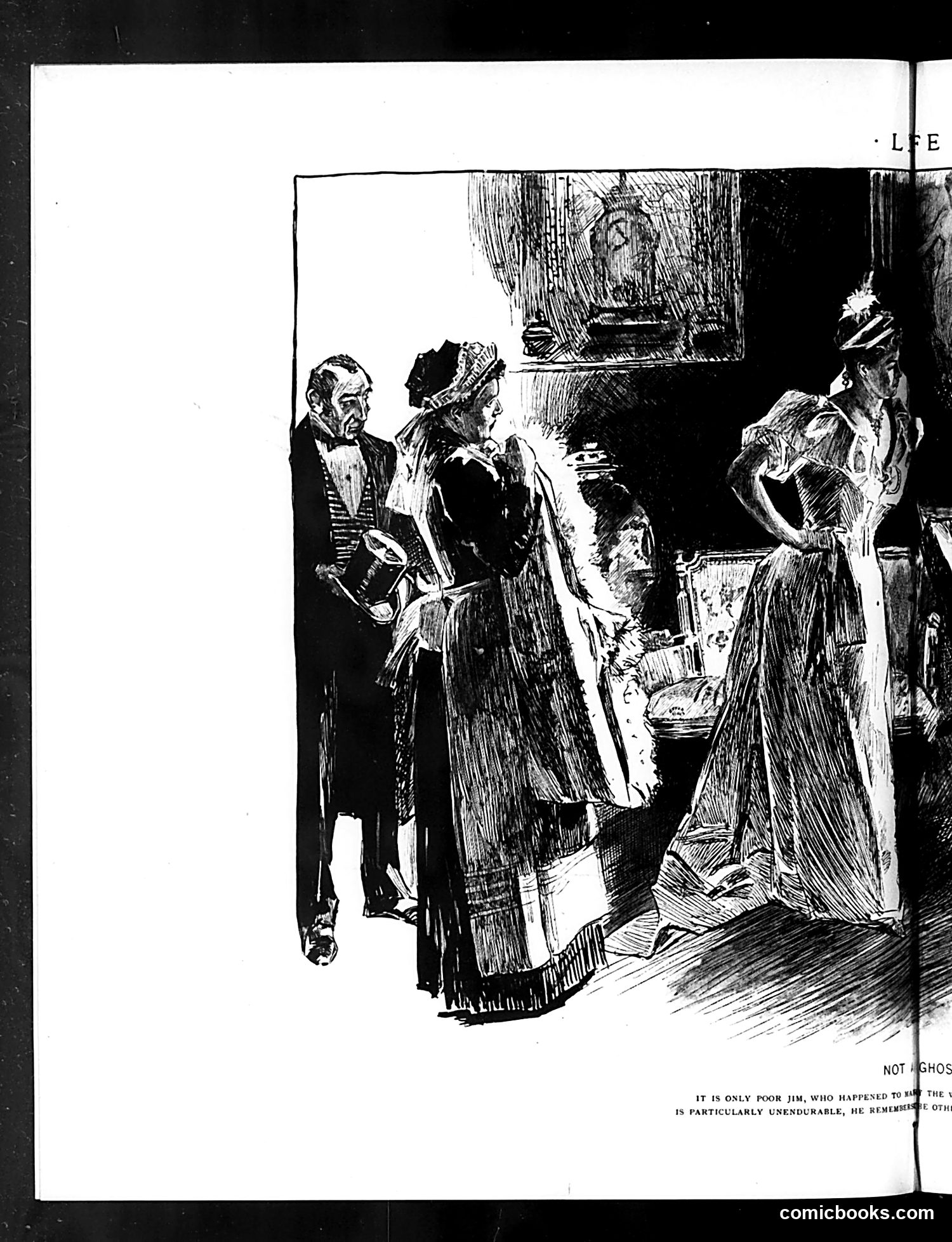
This appears to be a satirical illustration from *Life* magazine depicting a social scene at what looks like an elegant gathering or party. The caption indicates the humor centers on "Poor Jim," who is described as "particularly unbearable" and remembered for something by others present. The sketch shows formally dressed figures in an interior setting—a man in evening wear on the left, women in fashionable dress, and what appears to be military or formal dress on the right. The satire likely mocks social pretension or the awkwardness of encountering someone at a formal event who has an unfortunate reputation or past indiscretion. Without the complete caption or publication date visible, the specific identity of "Jim" or the particular social scandal referenced remains unclear, though the illustration effectively conveys social embarrassment through body language and composition.
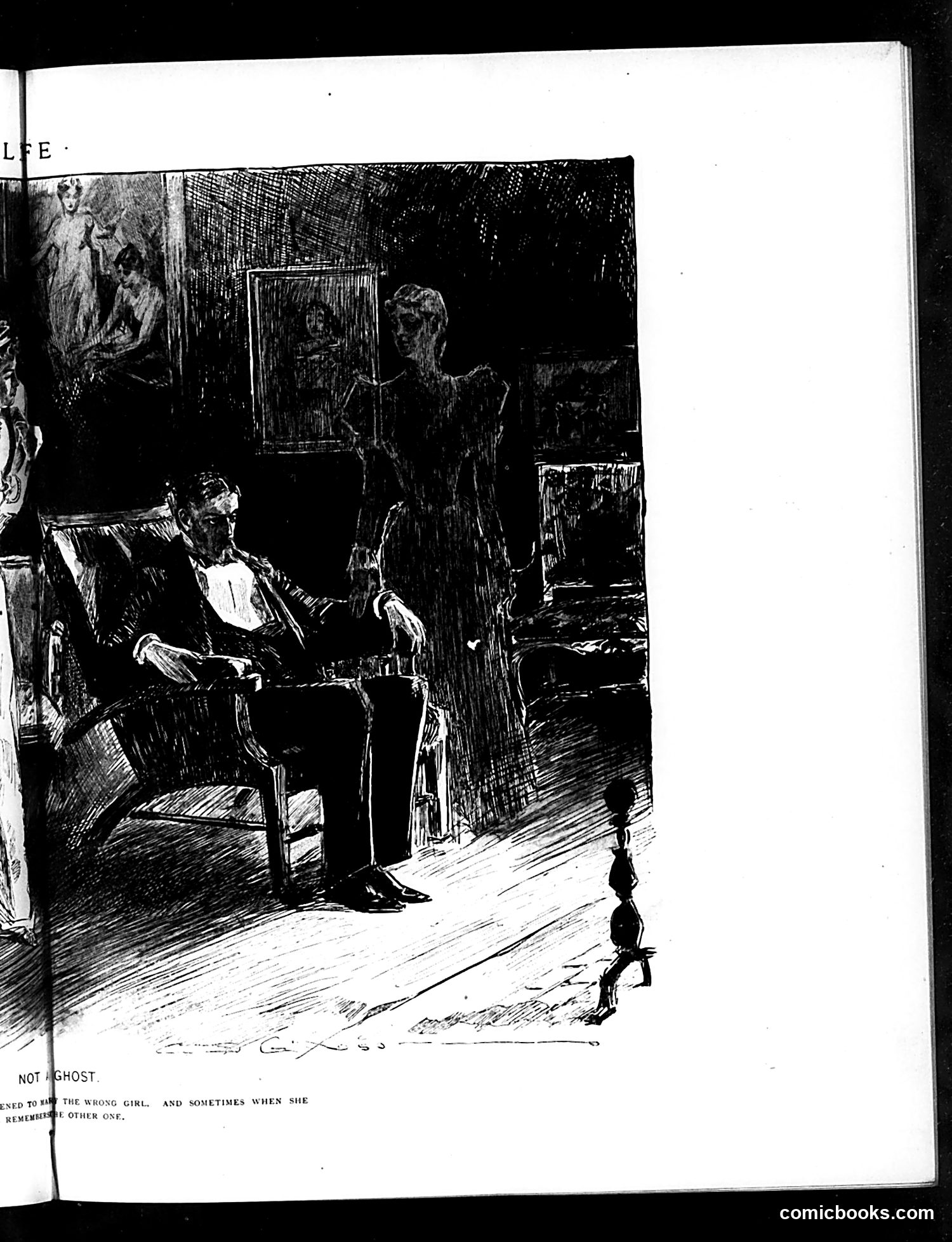
This illustration appears to be titled "Not a Ghost" and depicts an interior scene with two figures. Based on the visible OCR text fragment—"used to call the wrong girl. and sometimes when she remembered the other one"—the cartoon seems to satirize romantic confusion or mistaken identity. The scene shows a man seated while a woman stands, suggesting an awkward social encounter. The sketch's heavy crosshatching creates dramatic shadows, emphasizing discomfort or embarrassment. The caption implies the humor derives from a man confusing two women's identities, or a woman feigning amnesia about romantic entanglements. This reflects early 20th-century *Life* magazine's common satirical territory: relationship mishaps and the social awkwardness of courtship among the leisure classes.
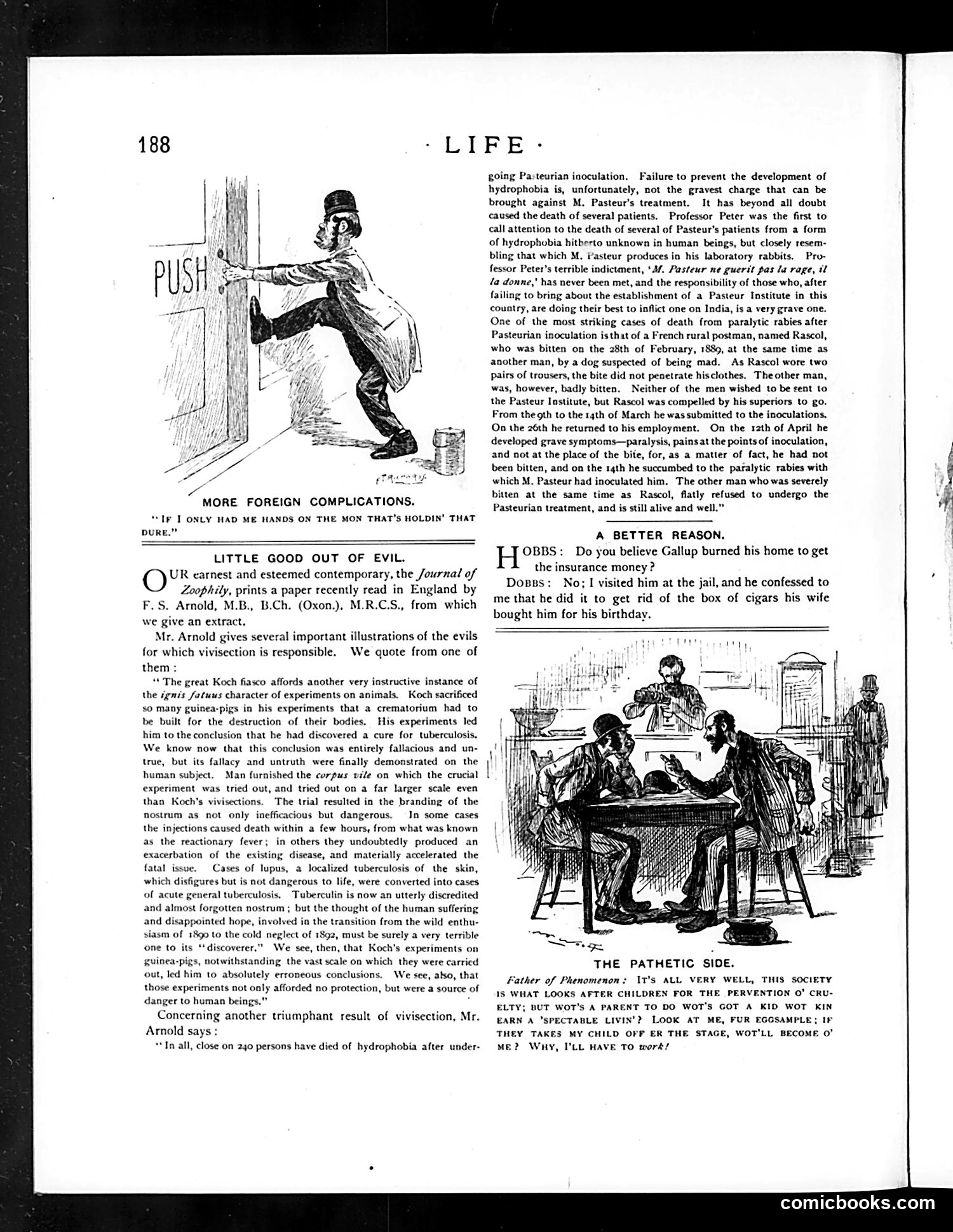
## Top Cartoon: "More Foreign Complications" The sketch depicts a man in formal dress pushing against a door labeled "PUSH," expressing frustration: "If I only had me hands on the mon that's holdin' that pure." This appears to reference **foreign policy frustrations**—likely American anger at another nation's actions regarding a disputed territory or resource ("that pure" possibly meaning "power" or a specific region). The cartoon satirizes American impotence in international affairs. ## Main Article: "Little Good Out of Evil" The page critiques **animal vivisection** (medical experimentation on animals), citing a paper by F.S. Arnold opposing the practice. It argues vivisection produces unreliable results, citing failures: - **Koch's tuberculosis experiments** on guinea-pigs led to a useless human treatment causing deaths - **Pasteur's rabies inoculation** allegedly killed patients and created new disease forms in rabbits The satire attacks the scientific establishment for claiming humanitarian benefit from animal testing while producing dangerous, ineffective treatments.
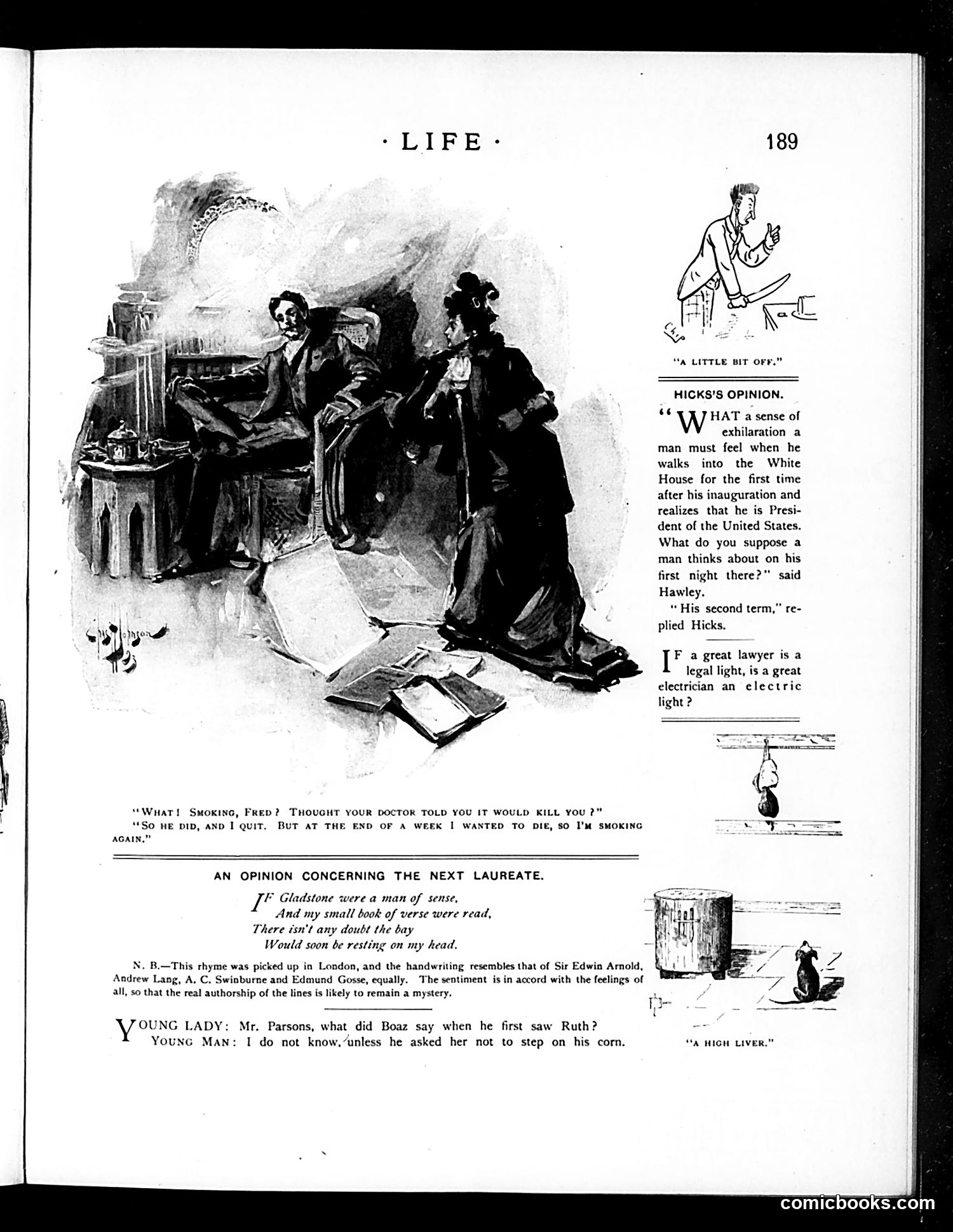
This page from *Life* magazine contains several satirical jokes targeting politicians and social pretensions: **Main cartoon (top left)**: Shows what appears to be a newly inaugurated president in the White House. The joke, attributed to "Hicks," mocks political ambition—when asked what a new president thinks about on his first night, Hicks replies "his second term," suggesting politicians immediately focus on re-election rather than their duties. **"A Little Bit Off"** (top right): A simple visual gag about a barber's work. **Lower section**: Contains wordplay and social humor—jokes about lawyers and electricians being "lights," a smoking joke about health, and a poetry commentary mocking British literary figures (Arnold, Lang, Swinburne, Gosse) for self-aggrandizing verse about merit. **Bottom joke**: A pun on the biblical Ruth and corns (foot ailments). Overall, the page satirizes political vanity, pretentious intellectuals, and wordplay humor typical of early 20th-century American satirical magazines.
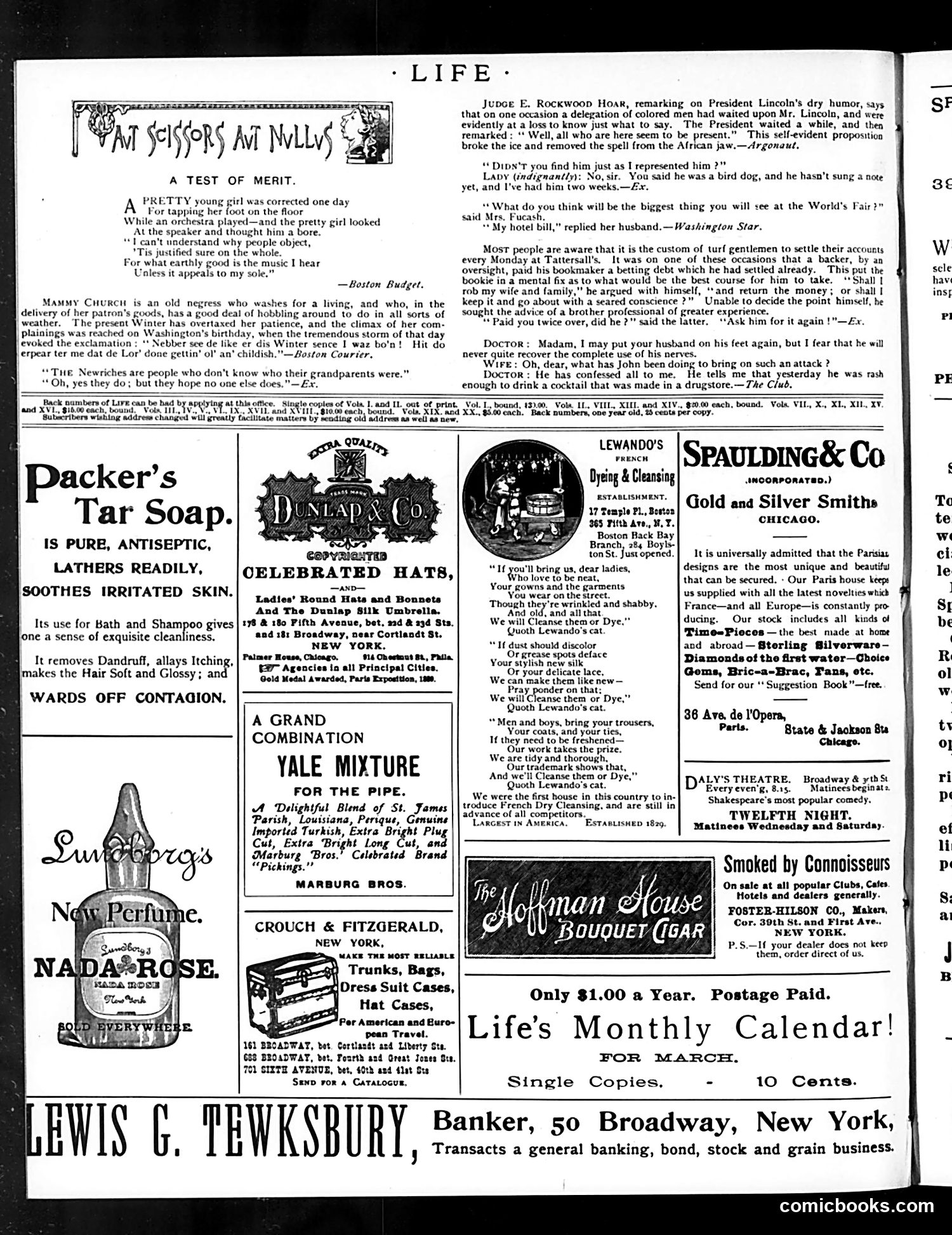
This page from Life magazine (a 19th-century American satirical publication) contains humor pieces and advertisements rather than political cartoons. The main content includes brief humorous anecdotes: - A story about a girl tapping her foot during orchestral music, criticized for poor behavior - A Lincoln anecdote about his dry wit with a delegation of Black visitors - Commentary on social climbing ("Newriches") and class pretensions - A joke about a wife's discovery of her husband's infidelity through his confession to a doctor The humor reflects Victorian-era concerns: proper decorum for women, social aspiration, marital fidelity, and class consciousness. The Lincoln reference uses period dialect ("African jaw") typical of the era's casual racism. The remainder is advertising for products like tar soap, hats, cigars, and banking services—standard for 19th-century magazines. The page demonstrates Life's mixed format of satirical social commentary aimed at educated, middle-class readers alongside commercial advertisements.
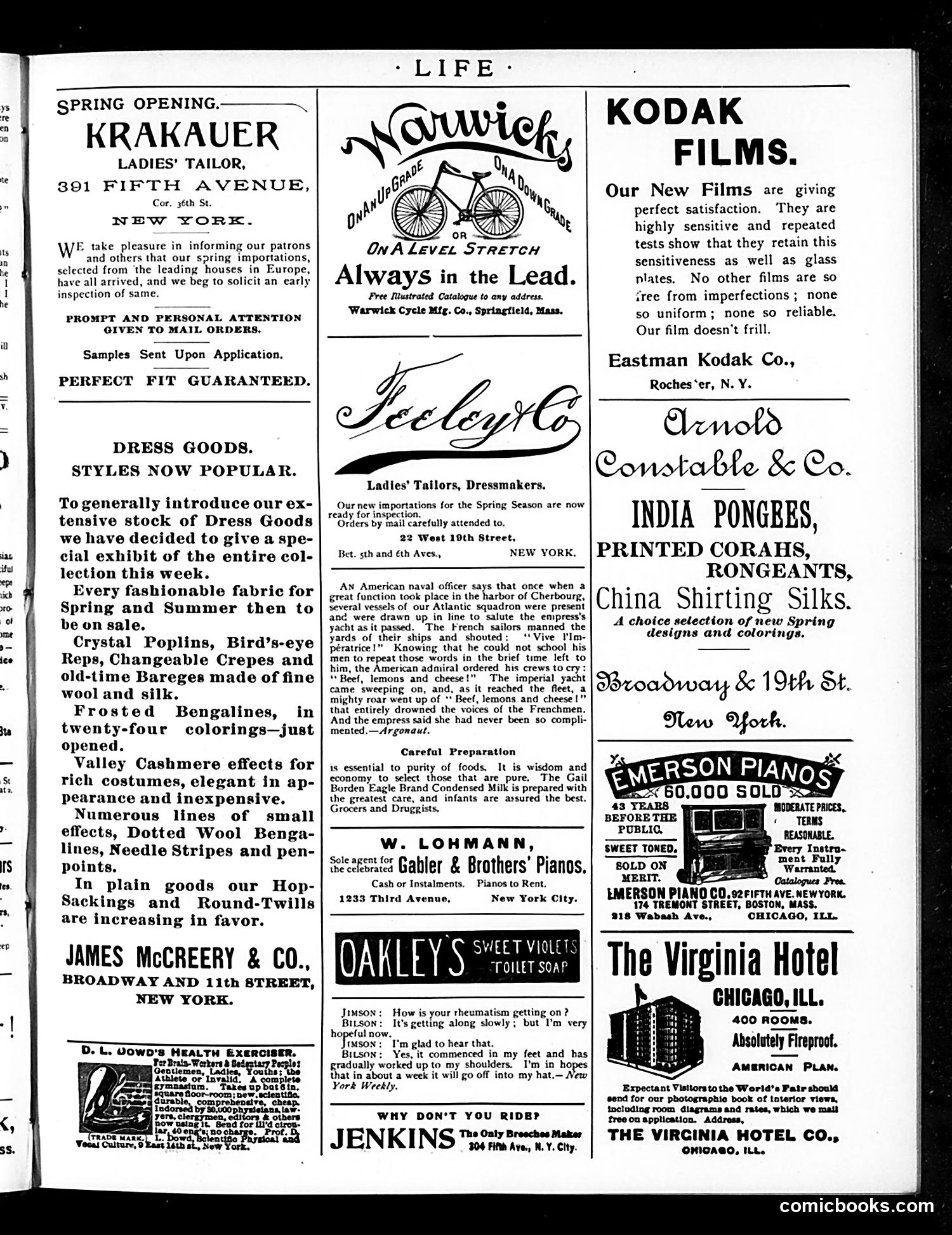
This page is primarily **advertising**, not political satire. It consists of late 19th-century commercial announcements for dress goods, tailors, pianos, bicycles, and hotels. The only humor piece is a brief joke about **rheumatism**. A man describes his illness "gradually" progressing upward from feet to shoulders, then hopefully jokes it will move into his hat and disappear—a absurdist gag playing on the literal progression of joint pain. The page contains no political cartoons or social satire. The one story excerpt ("An American naval officer") recounts a humorous anecdote about an American admiral ordering his crew to shout "Beef, lemons and cheese!" to mimic French sailors' tribute to the Empress, creating an unintentionally comical salute. This is mild period humor, not partisan commentary.
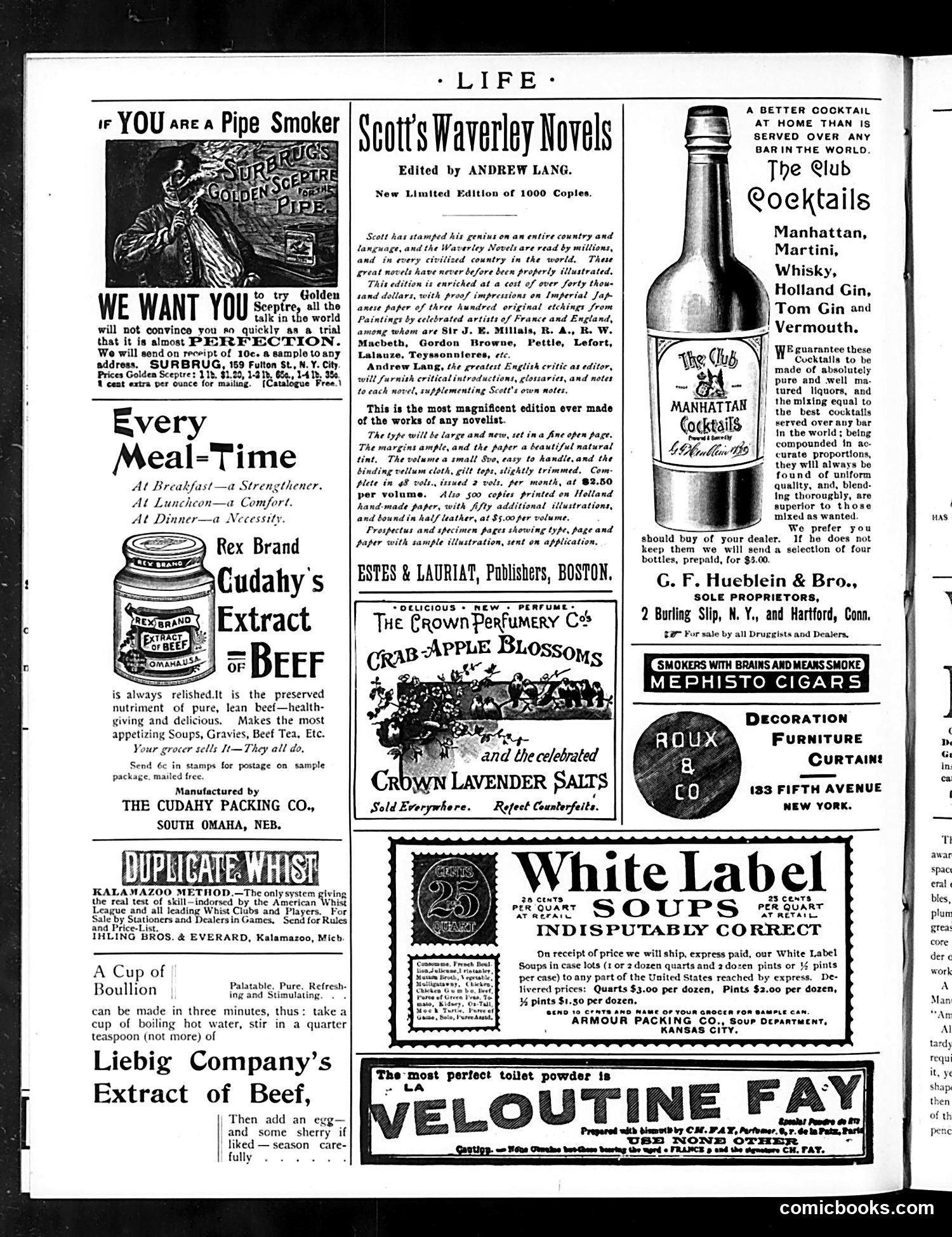
This page is primarily **advertisements**, not political satire or editorial cartoons. It contains various commercial ads from early 20th-century America: **Notable ads include:** - A **Golden Sceptre pipe tobacco** advertisement (top left) with text "WE WANT YOU" addressing pipe smokers - **Beef extract products** (Cudahy and Liebig brands) marketed as meal-time nutrition - A **deluxe edition of Scott's Waverley Novels** with elaborate illustrations - **The Club Cocktails** brand promoting pre-mixed cocktails as superior to bar drinks - **White Label Soups** and other food/household products - **Veloutine Fay** powder and various perfumes The page reflects consumer culture of the era, emphasizing convenience products, imported goods, and luxury items. There is **no political cartoon or satire visible**—it's a typical period magazine advertising section mixing product promotions with some editorial content about literature.
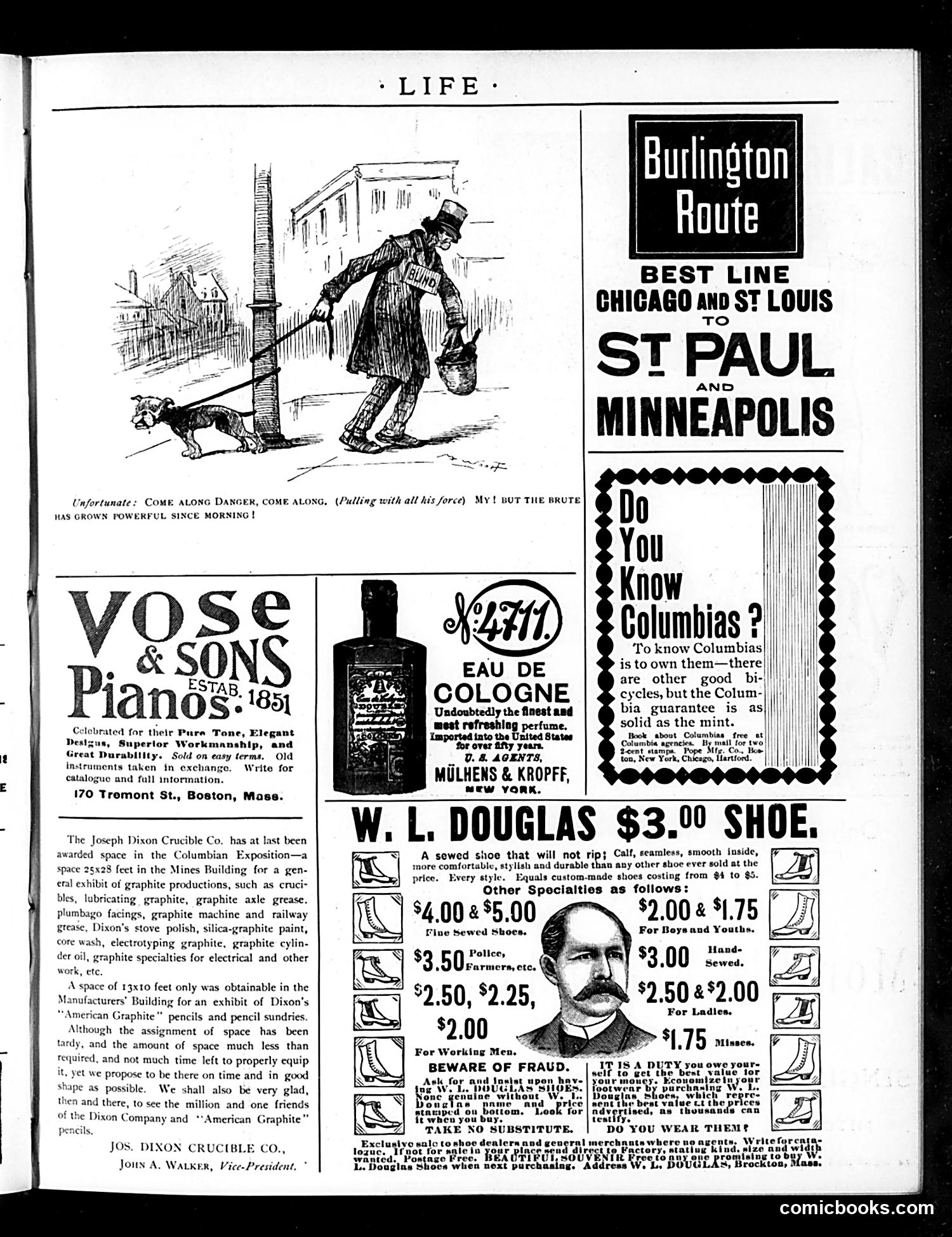
This page is primarily **advertising**, not political satire. The main cartoon shows a man struggling to pull a donkey labeled "Danger" that "has grown powerful since morning"—likely a generic joke about stubborn animals rather than specific political commentary. The page features various period advertisements: Vose & Sons pianos, eau de cologne, Joseph Dixon graphite products, Burlington Route railroad service, Columbia bicycles, and notably, W.L. Douglas shoes prominently displayed with multiple price points and styles. The Douglas shoe ad includes a "Beware of Fraud" warning about counterfeits, suggesting this was a well-known brand vulnerable to imitation. The extensive product line and repeated messaging indicate competitive market positioning. The content reflects early-1900s American commerce and consumer culture rather than political satire or social commentary.
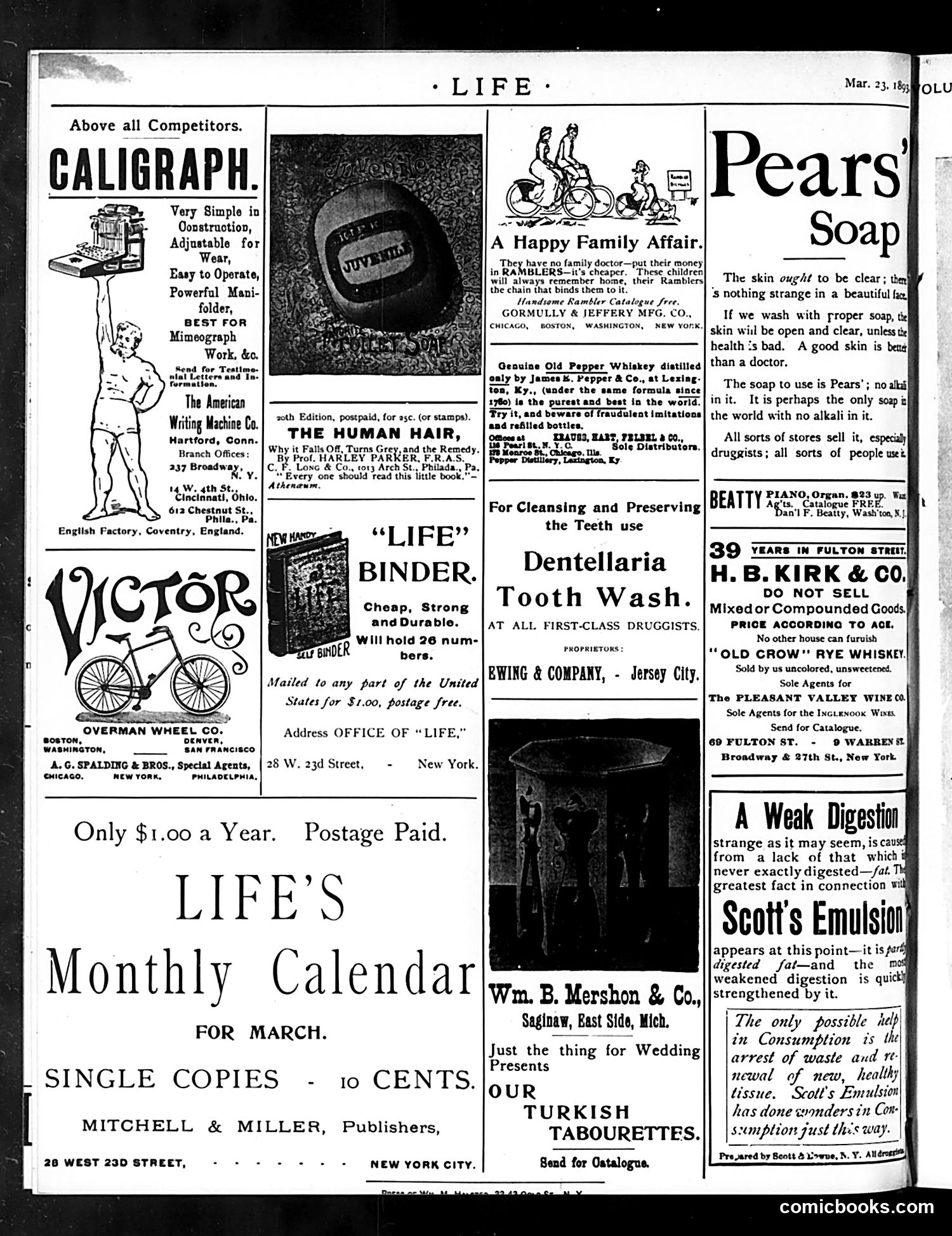
This is primarily an **advertising page** from Life magazine's March issue, not a satirical cartoon page. The layout contains numerous product advertisements typical of 1890s periodicals. Notable ads include: - **Caligraph typewriter** and Victor bicycles (left side) — reflecting the era's fascination with new technologies - **Rambler bicycles** promoting family cycling outings - **Patent medicines** (Scott's Emulsion, Dentellaria Tooth Wash) — common in this period before FDA regulations - **Whiskey advertisements** (Old Crow, Old Pepper) — openly marketed without restriction - **Pears' Soap** — emphasizing that proper soap creates clear skin and good health The page reflects **Gilded Age consumer culture**: bicycles as fashionable recreation, dubious health remedies, unregulated alcohol sales, and the equation of consumer goods with modern living. No political satire is evident—this is a straightforward commercial page showing what products Life's readers could purchase.