
A complete issue · 16 pages · 1892
Life — December 22, 1892
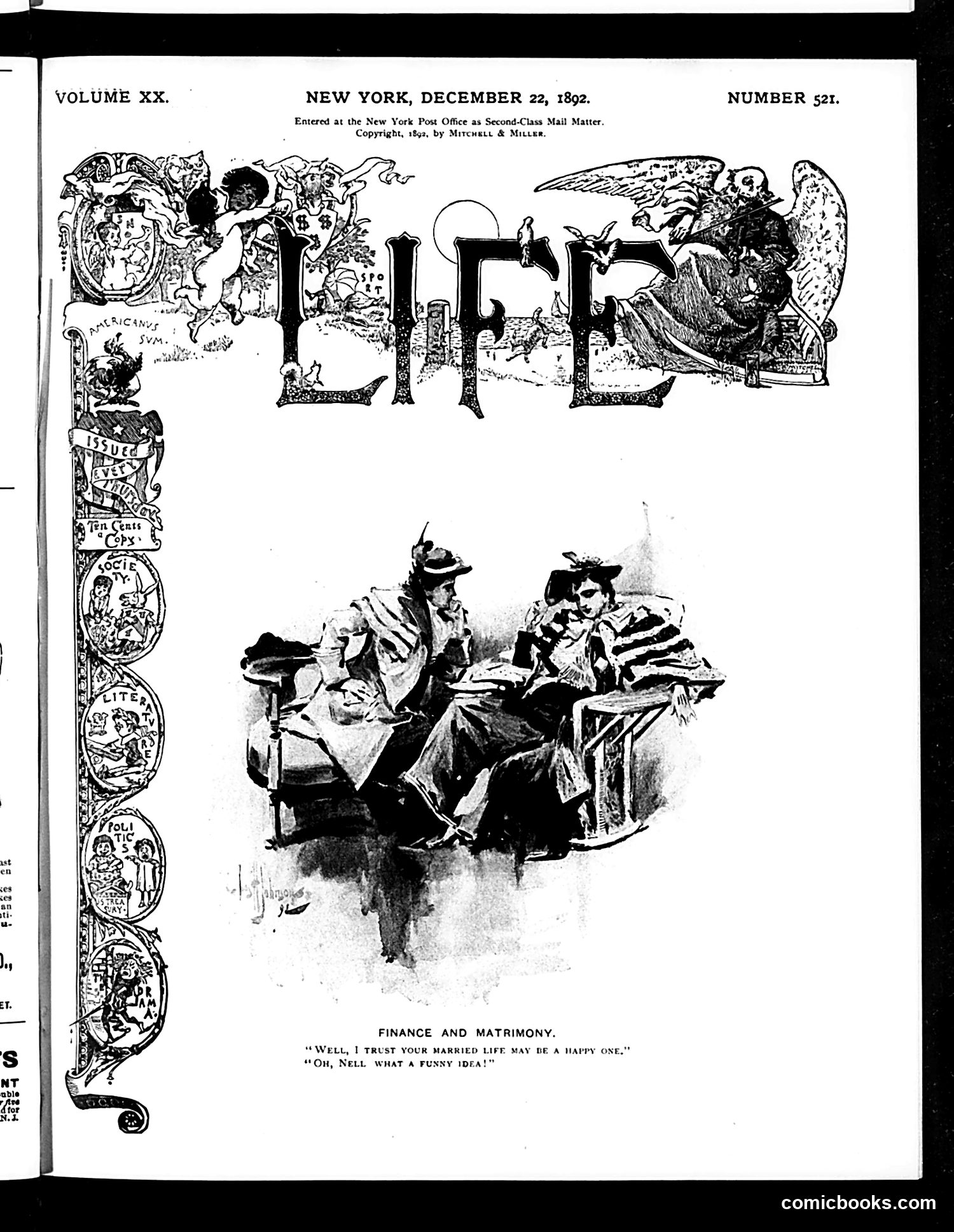
This page features a satirical cartoon titled "Finance and Matrimony" depicting two well-dressed figures in conversation. The caption reads: "Well, I trust your married life may be a happy one." / "Oh, Nell, what a funny idea!" The cartoon appears to satirize the relationship between money and marriage among the wealthy in the Gilded Age. The man's dismissive response to the suggestion of happiness—calling it "funny"—suggests that matrimony was viewed cynically as a financial transaction rather than an emotional partnership. The elaborate period clothing and the magazine's general satirical tone indicate this was social commentary on how wealthy individuals approached marriage primarily as a business arrangement, treating the notion of actual happiness as absurd or humorous.
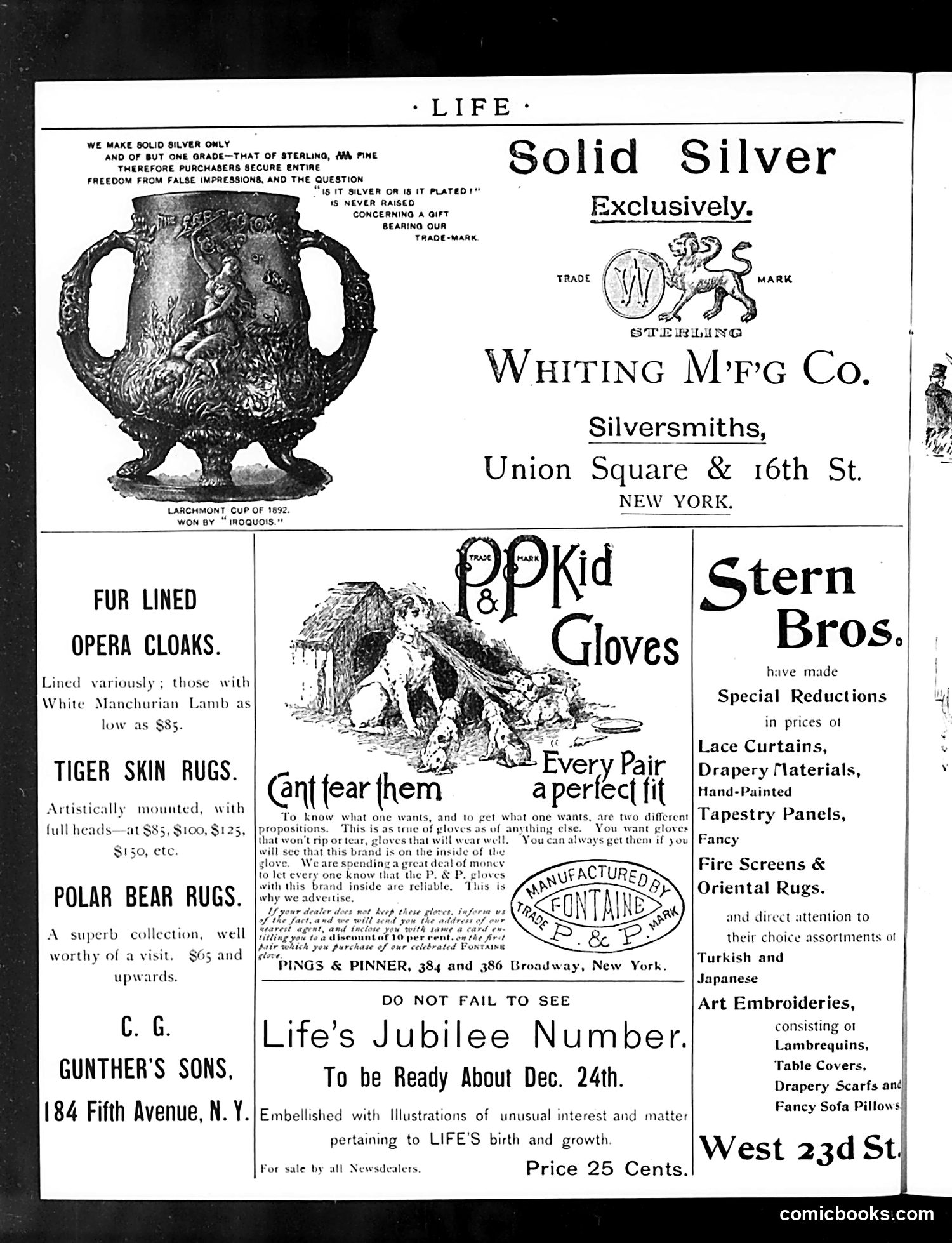
This page is primarily **advertisements** with no political cartoons or satirical content visible. The main featured ad is for **Whiting M'fg Co.**, a New York silversmith emphasizing they make "solid silver exclusively" — a quality assurance pitch addressing consumer concerns about plating versus genuine silver. Other ads include luxury goods typical of the era: fur-lined opera cloaks, tiger and polar bear rugs, kid gloves, and decorative textiles from Stern Bros. and other retailers. The only non-commercial element is a promotional notice for **Life's Jubilee Number** (appearing to reference a milestone anniversary issue), promised for December 24th at 25 cents. This represents a typical late 19th/early 20th-century magazine page mixing luxury consumer advertising with editorial promotion.
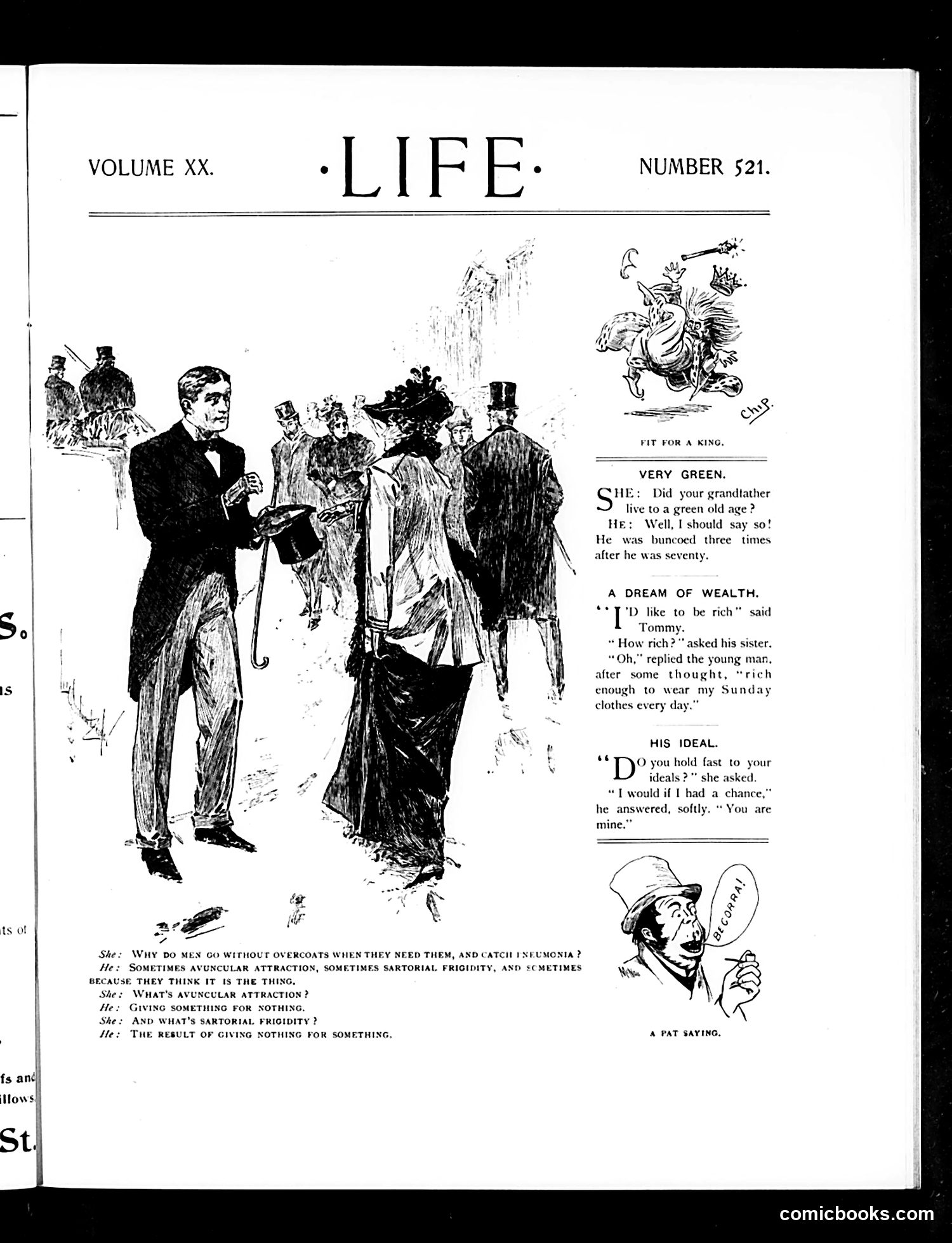
This page contains three separate humorous pieces typical of early 20th-century satirical magazines: **Main cartoon** (left): Shows well-dressed gentlemen in formal attire discussing fashion. The dialogue mocks men who wear overcoats unnecessarily, suggesting they do so for "avuncular attraction" or "sartorial frigidity"—implying vanity disguised as practicality. The satire targets fashionable pretension among upper-class men. **"Very Green"** and **"A Dream of Wealth"**: Brief comic dialogues poking fun at naiveté and working-class aspiration. **"His Ideal"**: A romantic exchange about holding fast to ideals. **"A Pat Saying"**: A small cartoon with unclear subject matter. The page exemplifies Life's focus on class-based humor and social commentary through visual satire and witty dialogue.
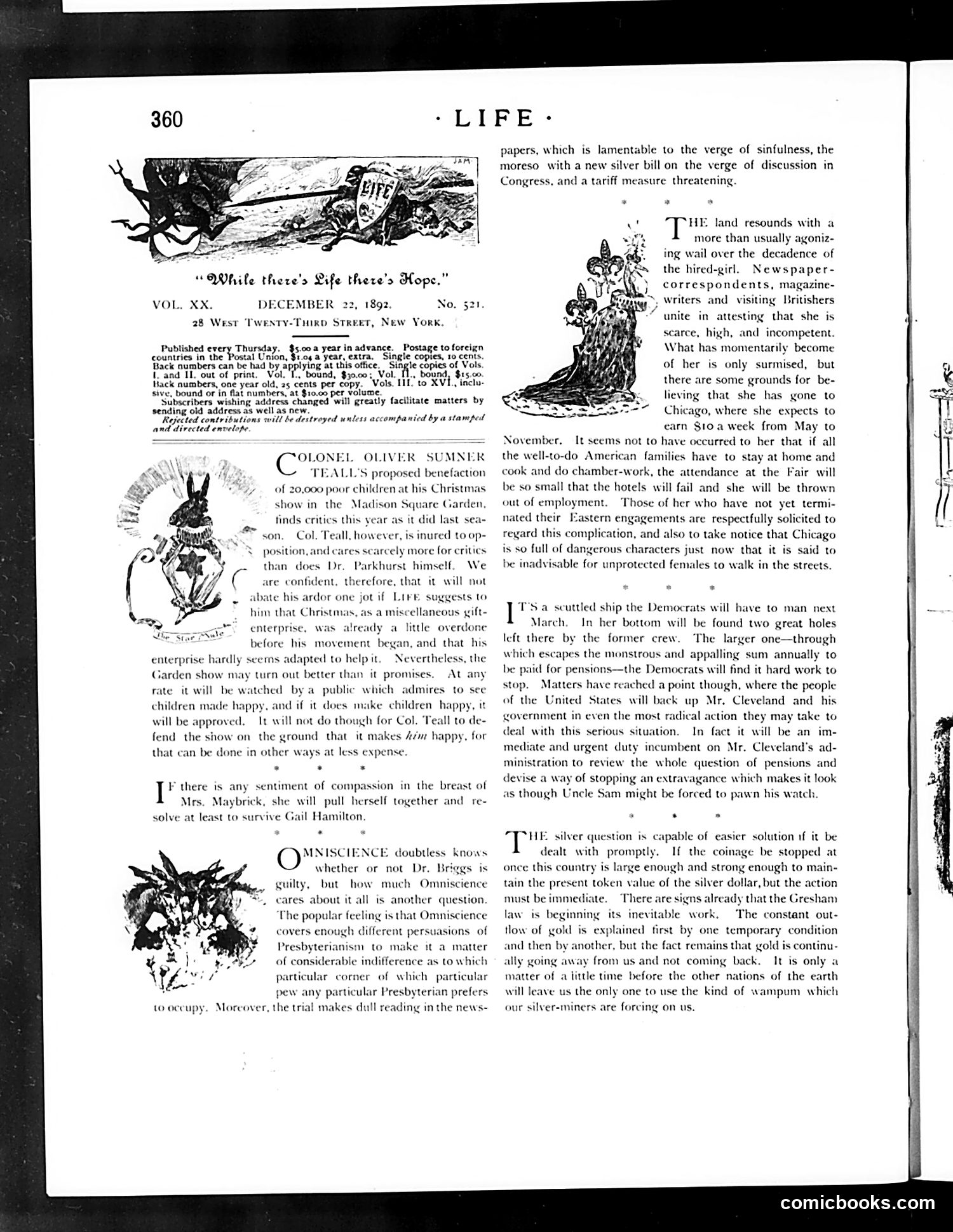
This page contains several satirical cartoons and commentary from late 19th-century America. The main visual elements include: **Left column cartoons:** Appear to depict social/political figures in exaggerated style typical of Life's satirical approach, though specific identities are unclear from the image alone. **Text content:** Discusses Colonel Oliver Sumner Drexel's proposed benefit Christmas show at Madison Square Garden, critiquing both the enterprise and its reception. The commentary suggests skepticism about wealthy philanthropists' motives. **Additional commentary** addresses contemporary issues: the "hired-girl" labor shortage, Democratic political prospects, pension policy debates, and currency/silver coinage controversies—all major political concerns of the era. The satire targets institutional hypocrisy, labor exploitation, and political indifference to working-class hardships typical of Gilded Age critique.
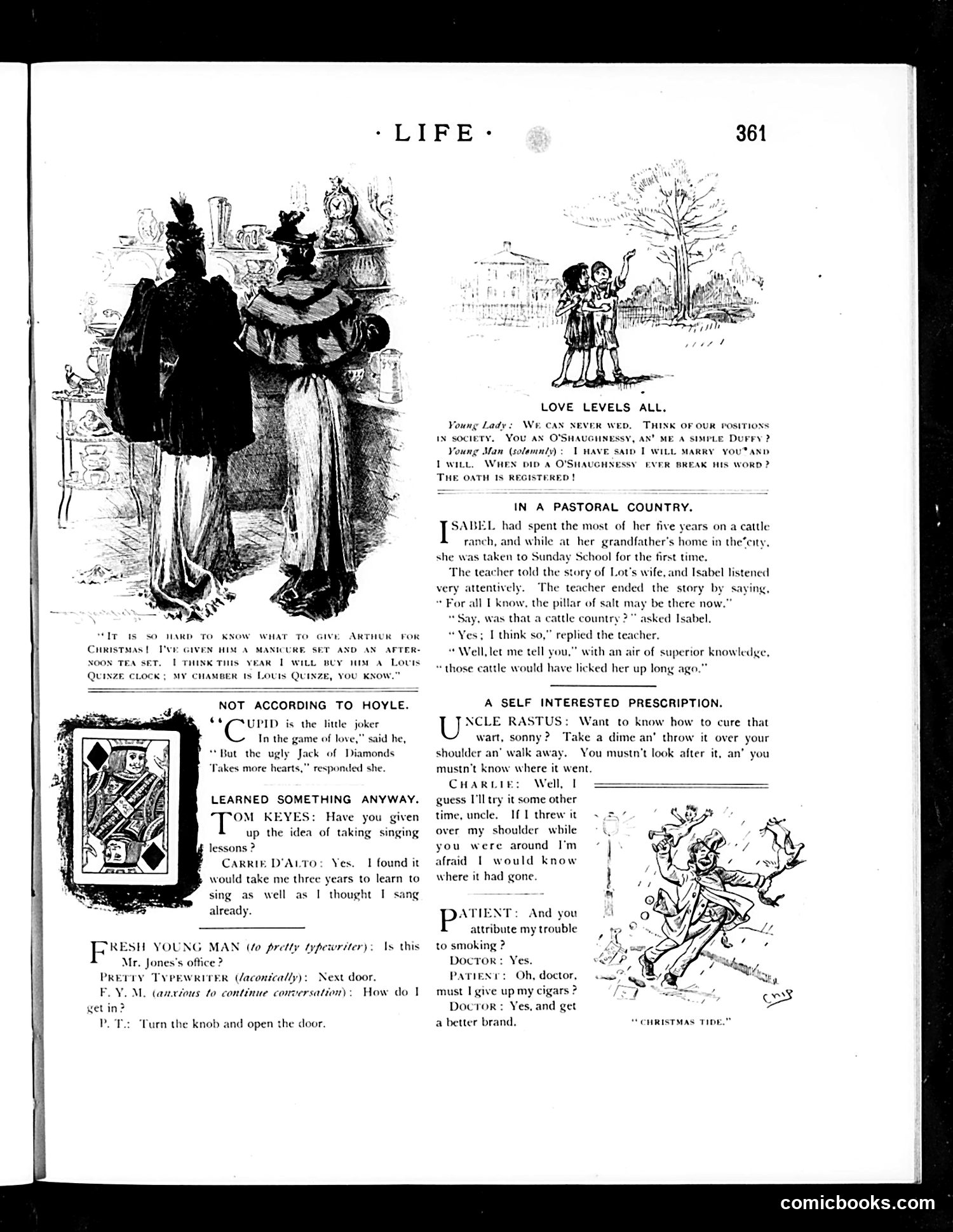
This page contains several unrelated humorous sketches typical of early 20th-century satirical magazines: **"Love Levels All"** depicts a young couple declaring eternal devotion despite class differences—social commentary on romance transcending social hierarchy. **"Not According to Hoyle"** references card-game rules, likely mocking improper conduct in courtship or society. **"In a Pastoral Country"** presents a rural schoolteacher story about Lot's wife, apparently contrasting urban and country knowledge. **"A Self Interested Prescription"** shows a doctor-patient exchange about cigars and health—typical period satire about contradictory medical advice or masculine habits. **"Fresh Young Man"** depicts an office scenario with a typewriter and clerical worker. The sketches use gentle humor about social conventions, relationships, and professional life rather than targeting specific political figures or events.
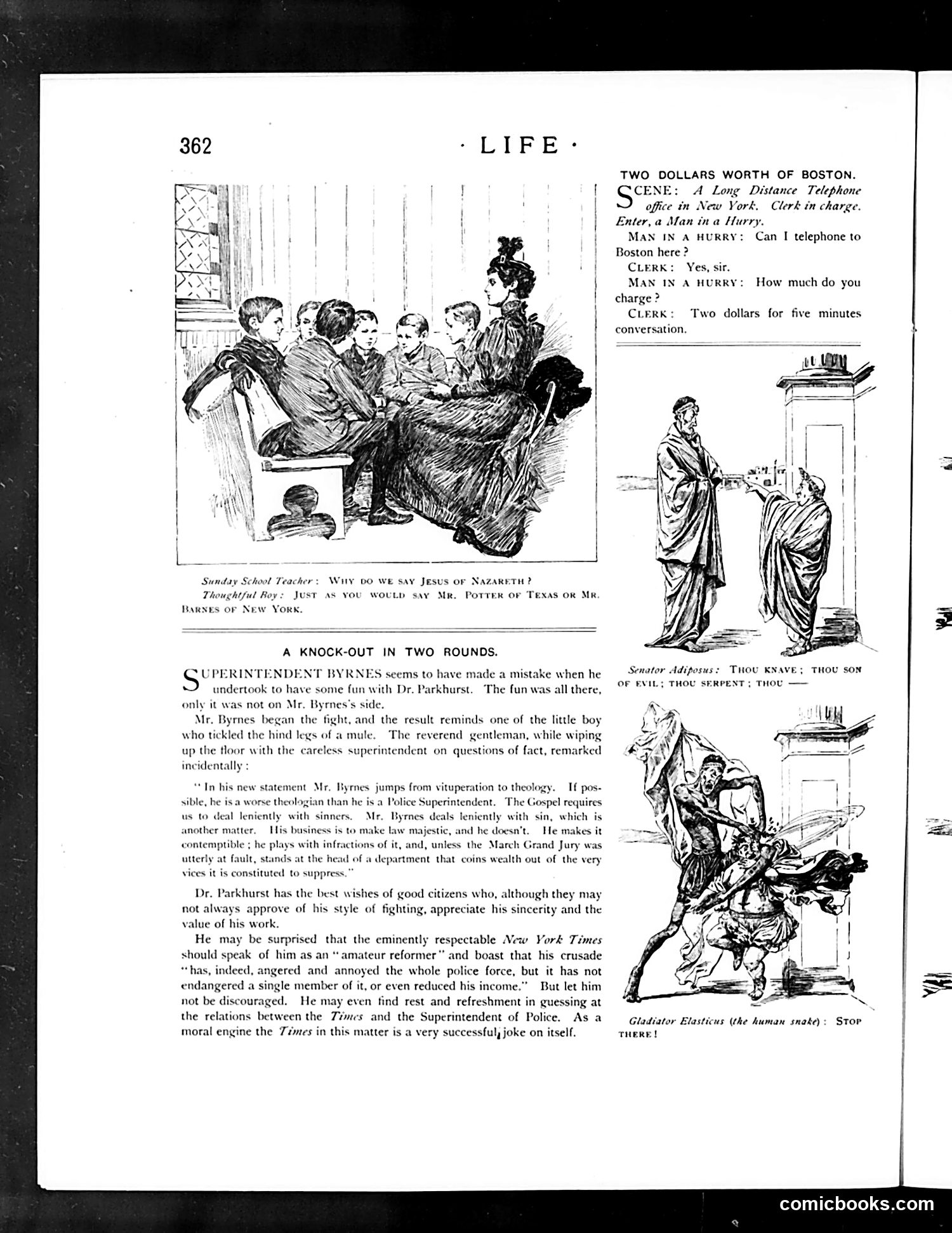
This page contains two satirical pieces critiquing New York police leadership around the early 1900s. **"Two Dollars Worth of Boston"** mocks the cost of long-distance telephone calls (two dollars for five minutes). **"A Knock-Out in Two Rounds"** targets Superintendent Byrnes of the police force. The text criticizes Byrnes for jumping "from vituperation to theology" when debating Police Superintendent Parkhurst about sin and morality. The piece suggests Byrnes's management is ineffective and questions why the *New York Times* calls him an "amateur reformer." The satirist argues Byrnes hasn't actually improved police effectiveness or reduced corruption despite reform rhetoric. The cartoon appears designed to embarrass Byrnes through public ridicule of his contradictions.
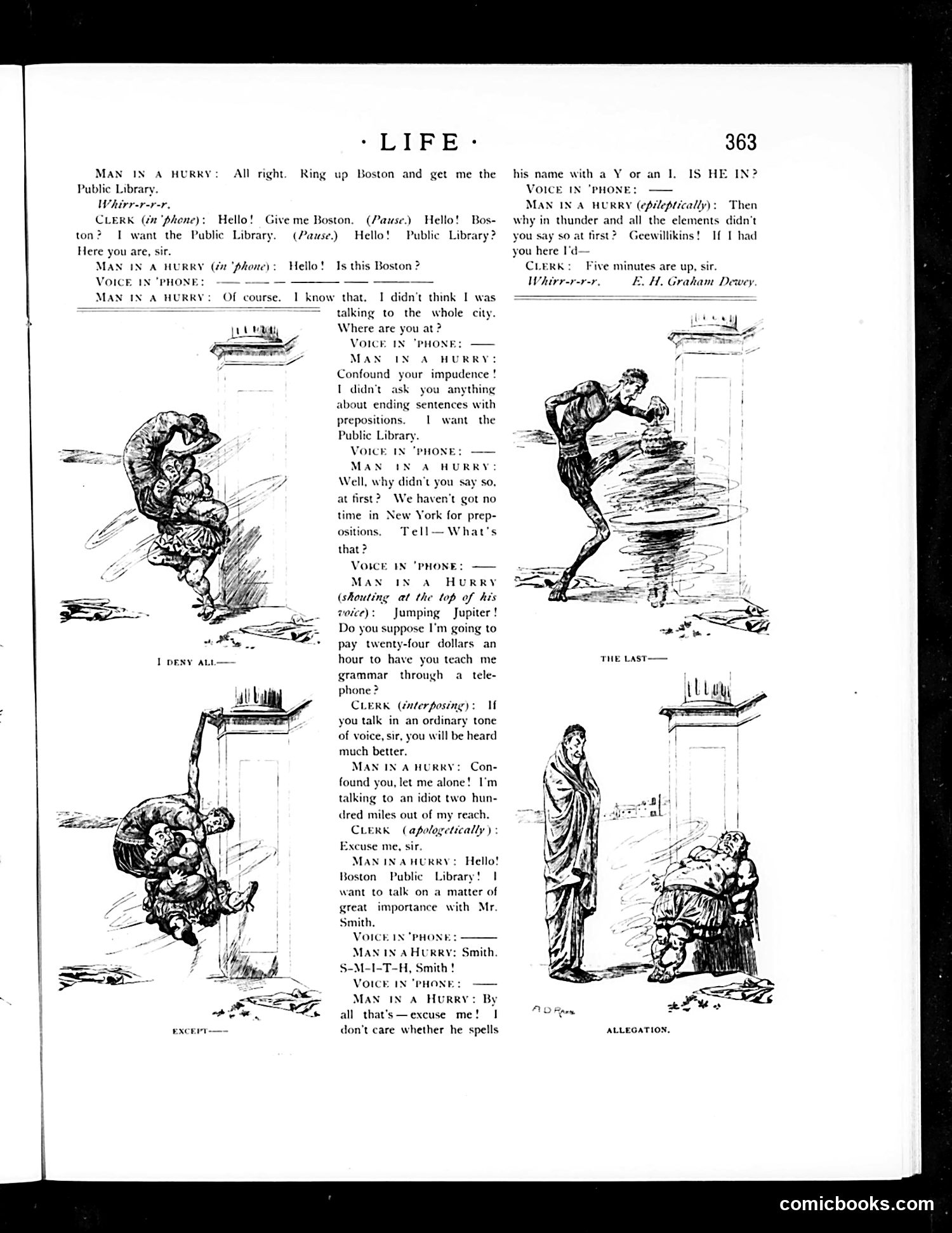
This page contains four satirical comic sketches about a man in a hurry attempting to call the Boston Public Library by phone. The humor works on multiple levels: 1. **The absurdity of phone communication**: The man's escalating frustration illustrates early telephone technology's limitations—difficulty hearing, confusion about connections, and the challenge of conducting serious business remotely. 2. **Impatience vs. civility**: The harried man repeatedly demands information rudely, while the clerk politely attempts to help. His exasperation at being asked to speak clearly or follow procedures mocks modern impatience. 3. **Visual comedy**: The sketches show the man's increasingly agitated physical state—contorting, jumping, and gesticulating wildly while on the phone. The satire targets both technological frustration and the clash between rushed modern life and institutional formality, likely dating to the early telephone era when this technology was still novel and unreliable.
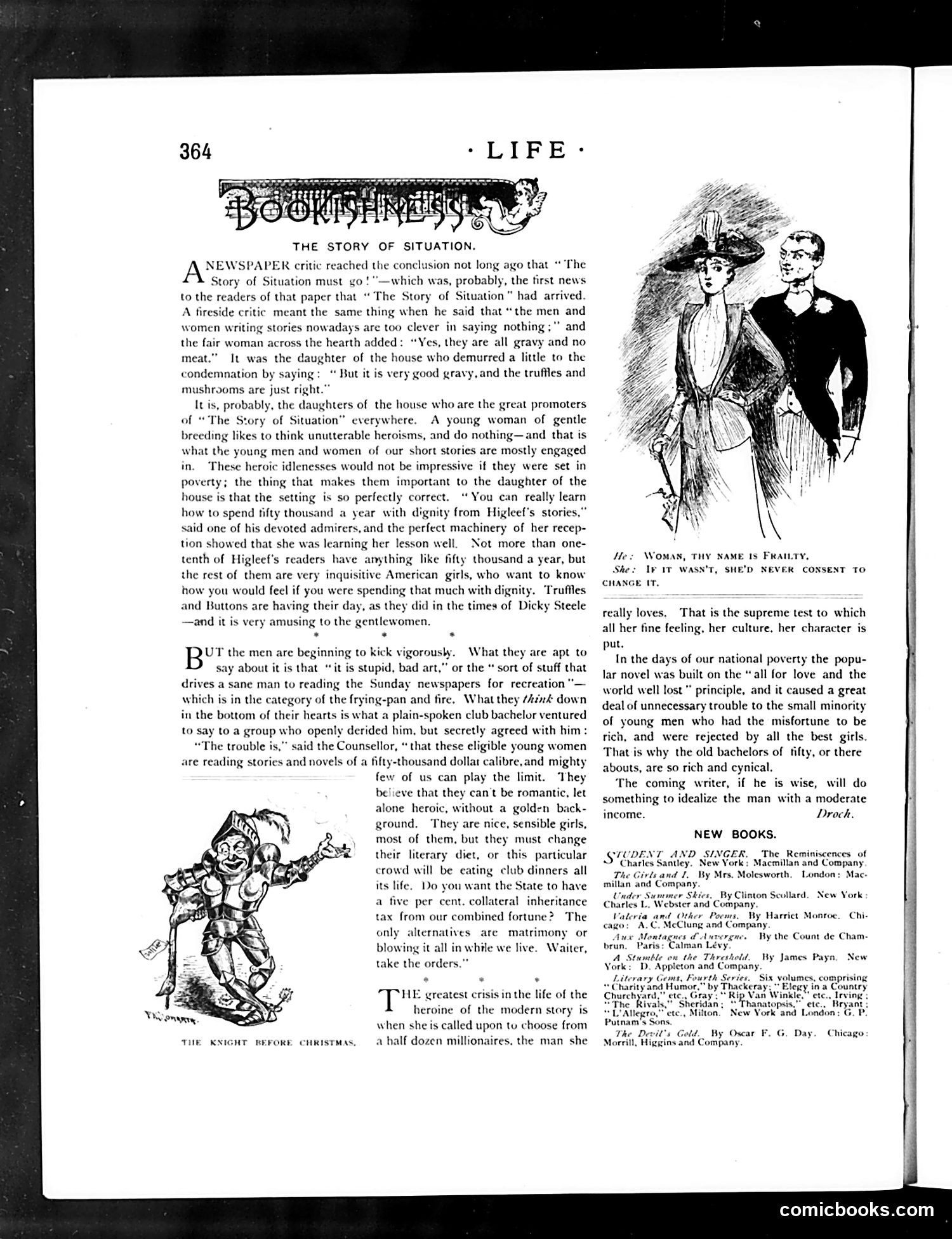
This page contains a satirical article titled "Boomerangs: The Story of Situation" critiquing popular short stories and novels of the era. The text mocks literary critics and story formulas, particularly the "fifty-thousand-a-year heroine" trope—poor but genteel women in fiction who somehow live luxuriously. The cartoons illustrate the satire: one shows a well-dressed couple (likely representing wealthy romance-novel characters), while another depicts "The Knight Before Christmas," referencing chivalric romance clichés. The satire targets how popular fiction promoted unrealistic wealth fantasies and romantic ideals to readers, particularly young women. The author advocates for writers to idealize moderate income instead, reflecting early 20th-century concerns about literature's social influence and class anxieties.
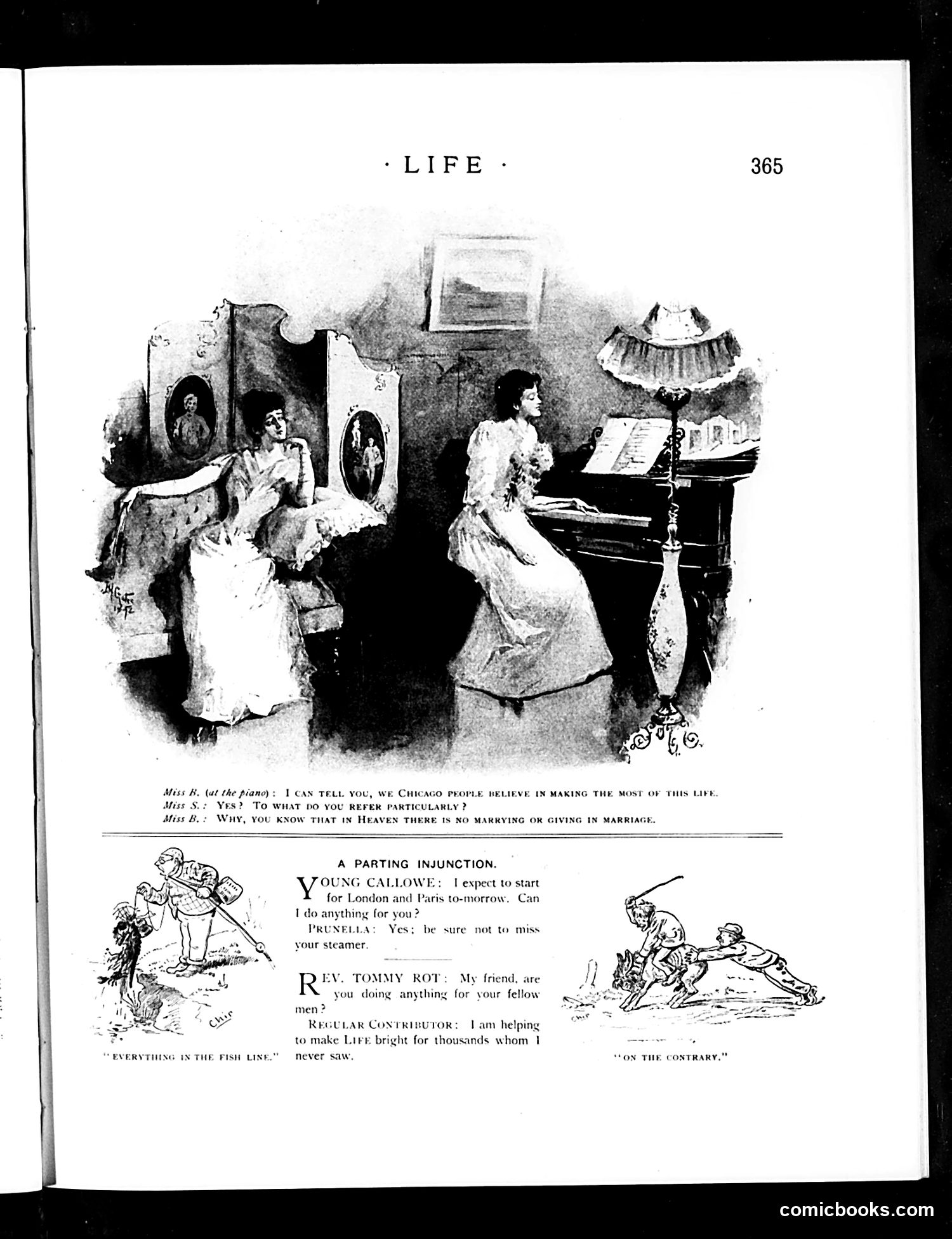
This page contains two satirical pieces from *Life* magazine (page 365). **Top cartoon:** Shows two women discussing making "the most of this life." One woman (Miss B) plays piano while another (Miss X) argues that in Heaven there's "no marrying or giving in marriage." The satire targets women's social ambitions and leisure pursuits—suggesting wealthy women prioritize earthly pleasures (music, socializing) over spiritual concerns. **Bottom section ("A Parting Injunction"):** Features brief comic vignettes with characters like Young Callowe, Prunella, Rev. Tommy Rot, and a Regular Contributor. The jokes play on departure scenarios and social absurdities. Captions like "Everything in the Fish Line" and "On the Contrary" suggest wordplay and situational humor typical of early 20th-century satirical magazines.
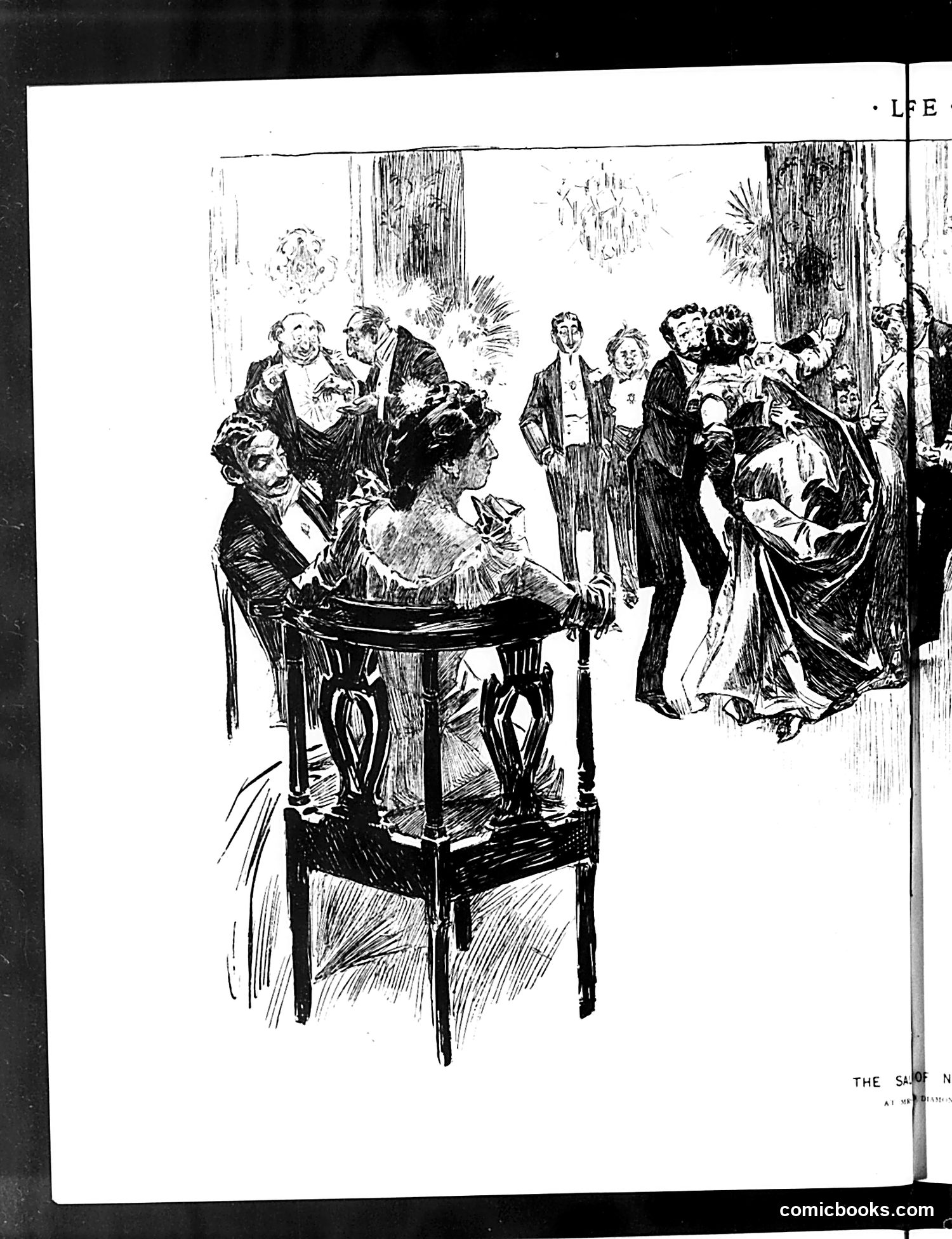
This sketch depicts a formal social gathering, likely a high-society salon or reception. The composition shows well-dressed figures in Victorian or Edwardian-era clothing arranged in a drawing room with classical columns. The satire appears to target social pretension and the artificial rituals of upper-class gatherings. The artist uses exaggerated facial expressions and body language to mock the posed formality and superficiality of such events. Figures cluster in small groups engaged in what appears to be hollow conversation, while attendees strike affected poses. The title "The Salon" and the ornate interior setting reference the exclusive social institutions where wealthy elites gathered. The sketch satirizes the vapidity and social climbing inherent in these gatherings, though specific individuals aren't clearly identifiable from the image alone.
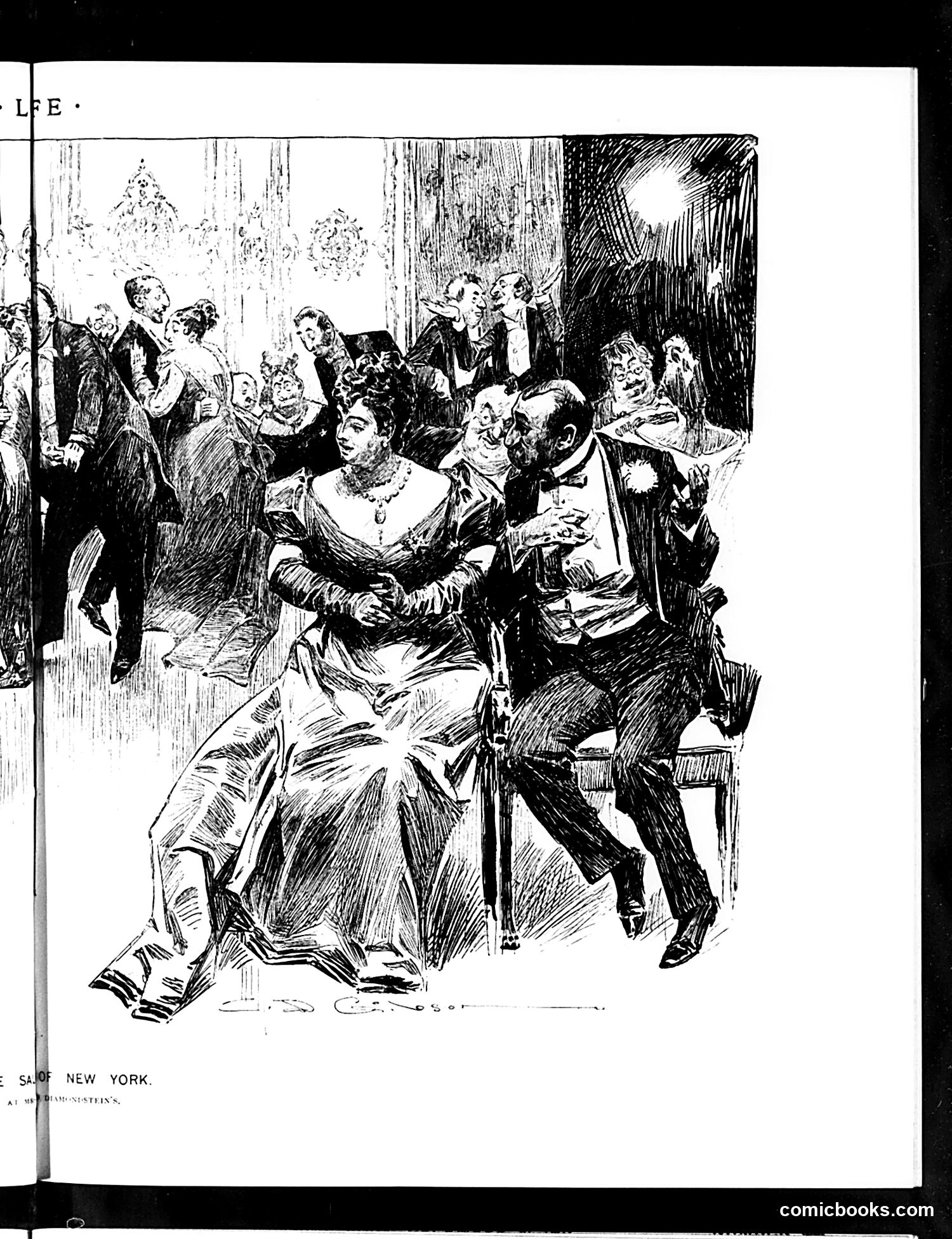
This pen-and-ink illustration depicts a formal evening social gathering or ball in New York, likely from the late 19th century based on the artistic style and formal attire. The scene shows elegantly dressed guests in a grand interior with chandeliers and decorative elements. The central figures appear to be a woman in an elaborate dark gown seated beside a man in formal evening wear. Other well-dressed attendees populate the background, suggesting high society. Without additional text visible on the page identifying specific individuals or providing satirical commentary, the precise political or social satire intended remains unclear. The caption reference to "NEW YORK" and what appears to be a publication attribution suggests this may comment on Manhattan's social elite or fashionable society, but the exact target or joke the cartoon makes cannot be determined from the image alone.
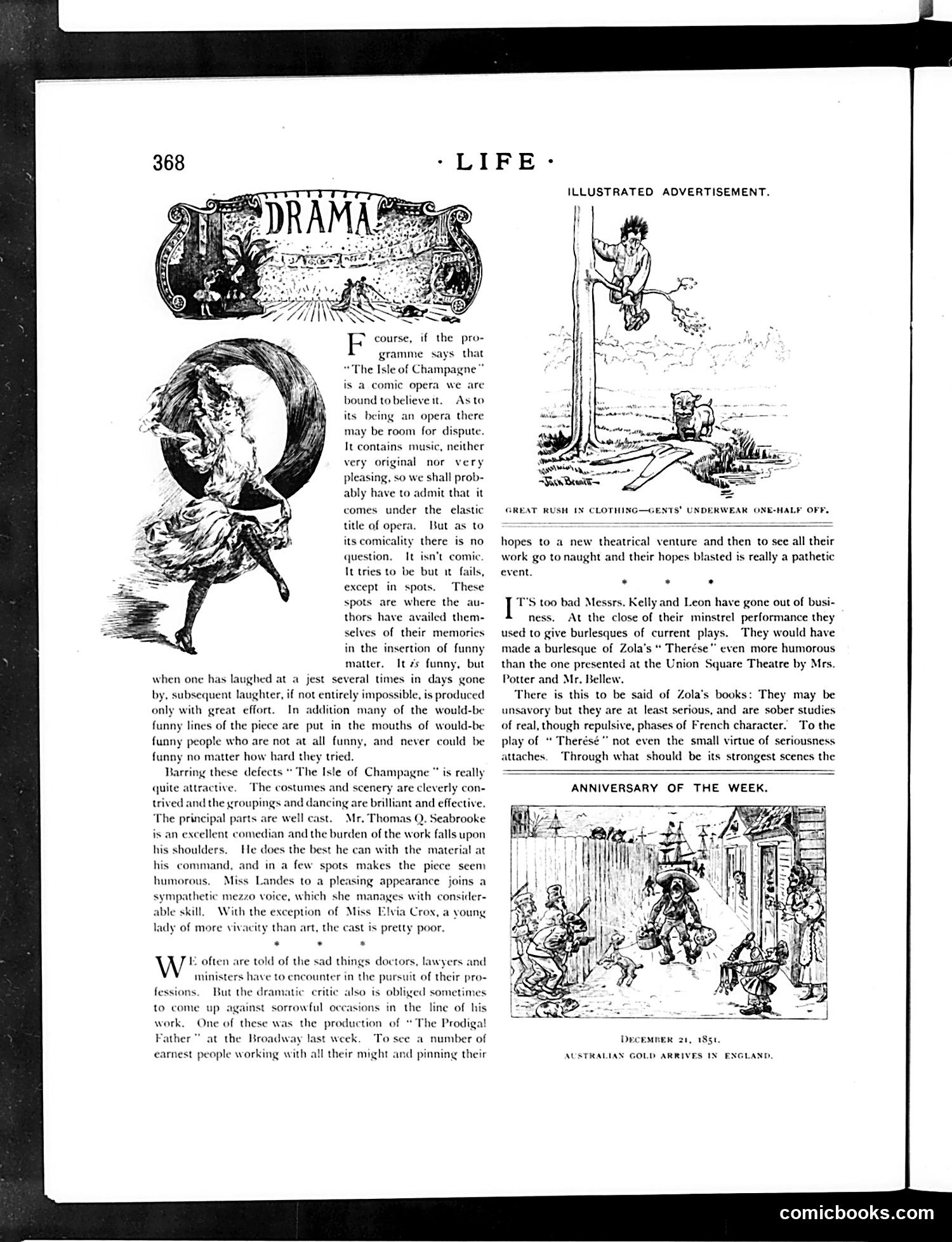
This page reviews "The Isle of Champagne," a comic opera at Broadway. The critic concludes it fails at comedy despite claiming that label—the humor relies on recycled jokes that lose effect with repetition, and unfunny actors deliver poorly written comedic lines. The review praises lead Thomas Q. Seabrooke's performance and Miss Landes's voice, but criticizes the overall cast quality. The piece then laments that performers Kelly and Leon have retired from their minstrel shows, which featured burlesques of current plays. The critic notes they could have made Émile Zola's serious novel "Thérèse" more amusing through parody, criticizing a Union Square Theatre production (by Mrs. Potter and Mr. Bellew) for lacking even basic seriousness. An illustration captioned "Great Rush in Clothing" advertises a sale on men's underwear. The "Anniversary of the Week" section depicts an 1851 event: Australian gold's arrival in England.
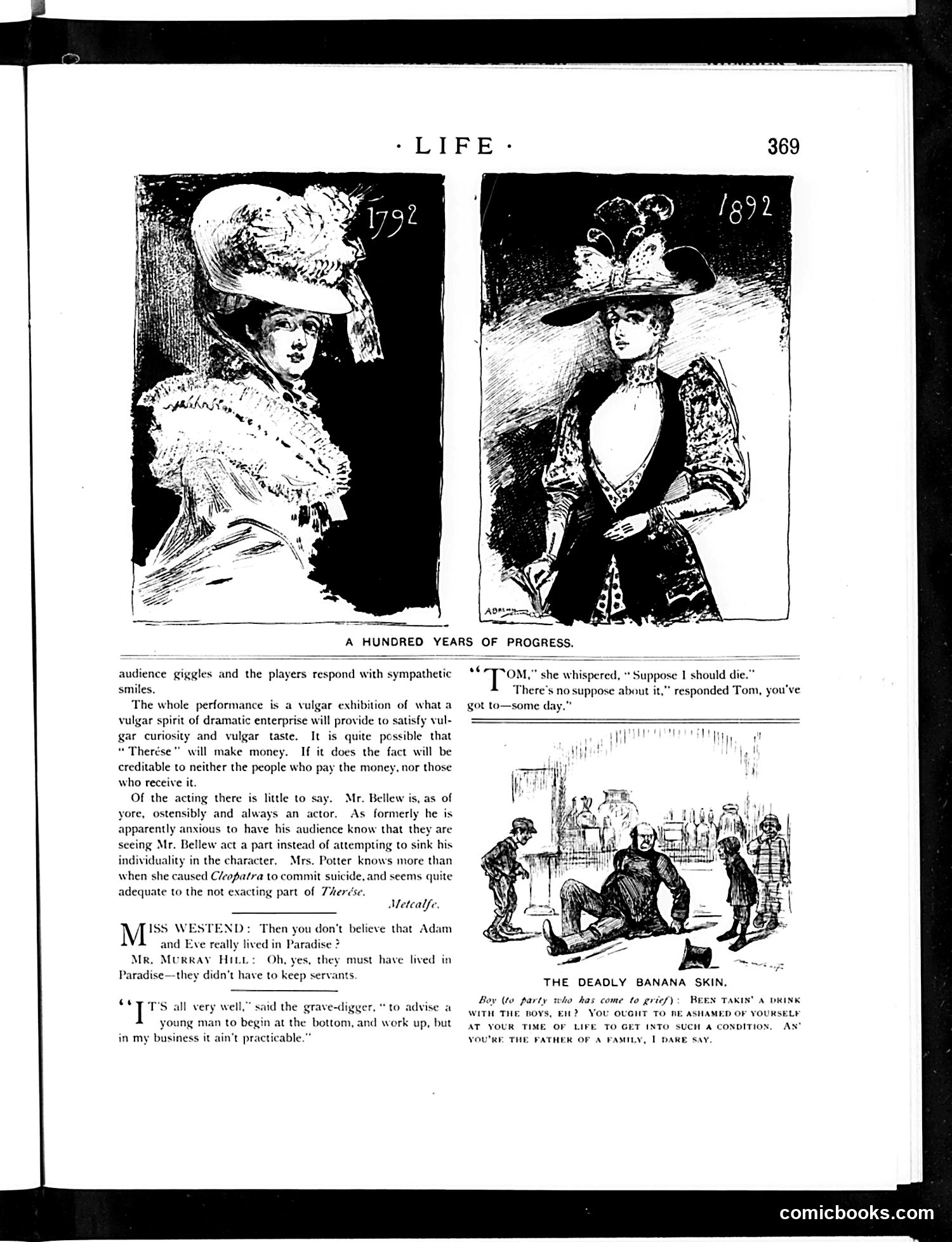
This page contrasts women's fashion from 1792 and 1892, illustrating how dramatically women's clothing had changed over a century. The 1792 image shows a woman in an elaborate hat with feathers and a high-necked, modest dress with puffed sleeves. The 1892 image depicts a woman in a wide-brimmed hat, low-cut bodice, and dramatically puffed sleeves—representing the "Gibson Girl" era's more daring silhouette. The satirical point appears to mock both the absurdity of fashion's constant evolution and perhaps the growing impropriety of women's clothing. The accompanying text discusses theatrical performances and morality, suggesting the page uses fashion as a lens to critique social "progress" and changing standards of propriety over the century.
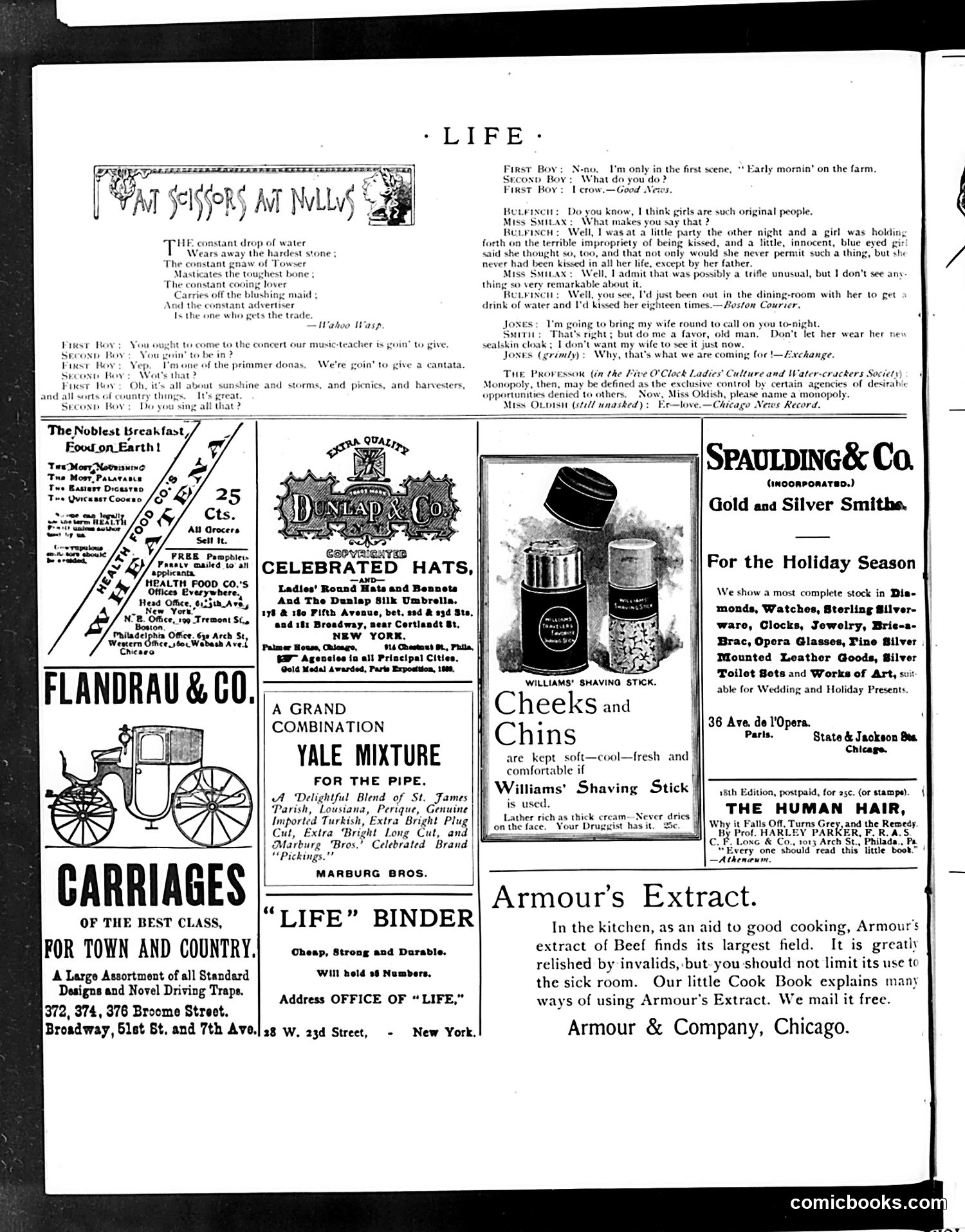
This page from *Life* magazine is primarily **advertising** with some satirical **dialogue snippets** interspersed. The cartoon/editorial content consists of brief humorous exchanges mocking social conventions: 1. **Boys' conversation** about a school cantata—satirizing childish earnestness and simple ambitions ("I crow"). 2. **"Girls are original people"** dialogue—a man recounts a woman's claim to have never been kissed except by her father, then reveals he kissed her eighteen times in one evening. The satire mocks both female affectation of innocence and male boasting. 3. **Monopoly definition joke**—a professor asks students to define "monopoly"; a woman answers "love," implying romantic/emotional exclusivity. This plays on contemporary economic debates about monopolies while making a mild romantic jest. The rest is **period advertising** for carriages, tobacco, hats, shaving products, jewelry, and food extracts—typical of a magazine's revenue model in this era.
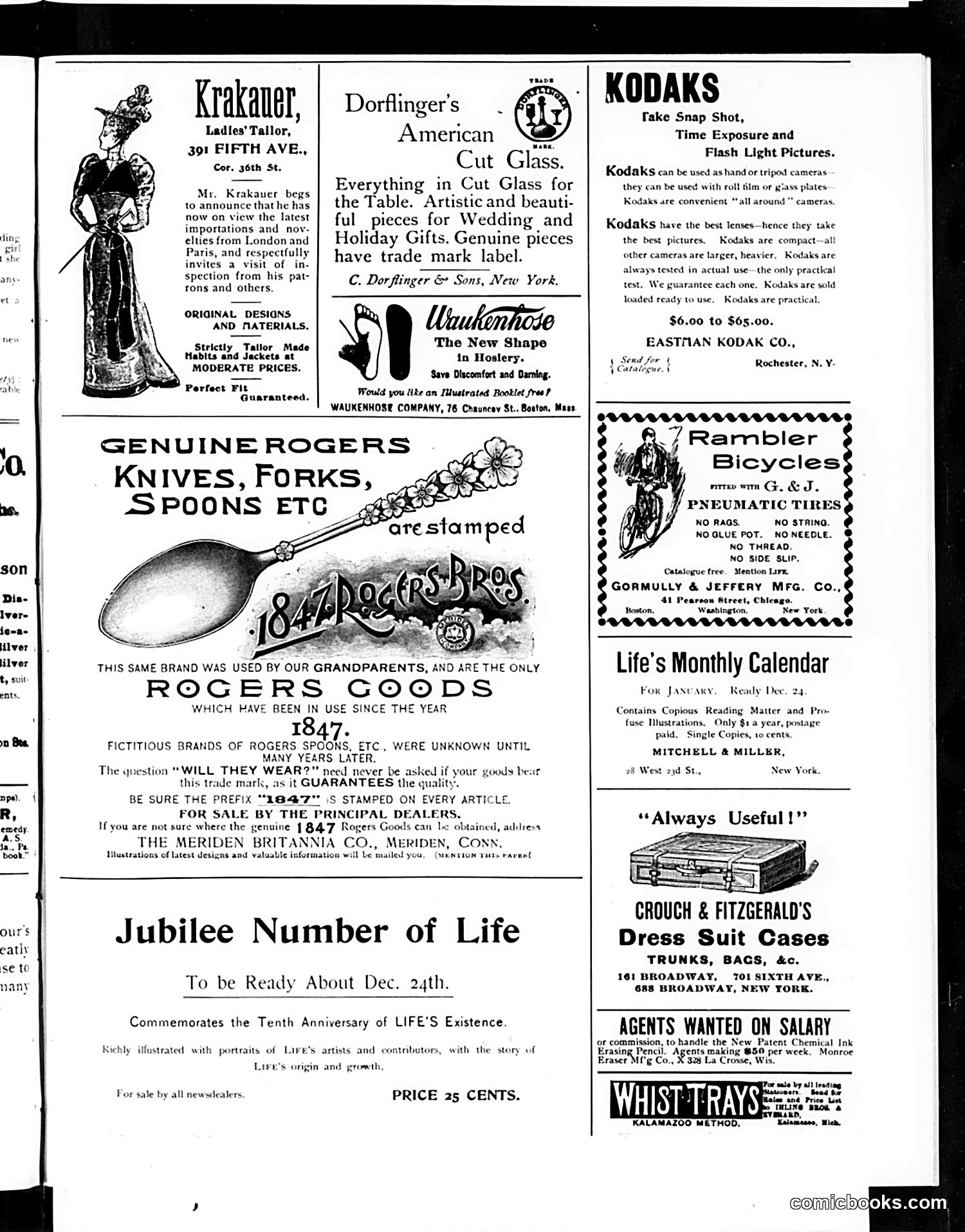
This is primarily an **advertising page** from Life magazine, not a satirical cartoon page. The content consists entirely of period product advertisements from approximately the 1890s. Notable ads include: - **Krakauer's tailor shop** featuring a fashionably dressed woman, promoting imported London and Paris fashions - **Dorflinger cut glass** for tables and gifts - **Rogers silverware** (1847 brand), emphasizing authenticity and guaranteeing quality through trademark verification - **Kodak cameras** ($6-$65), promoted as convenient "all around" cameras - **Rambler bicycles** with pneumatic tires - **Waukenhose hosiery** claiming ergonomic design The page also advertises Life's upcoming **Jubilee Number** (tenth anniversary issue), available December 24th for 25 cents. There is **no political satire or caricature** visible here—this is a straightforward commercial advertising section showcasing consumer products and services typical of the Gilded Age marketplace.
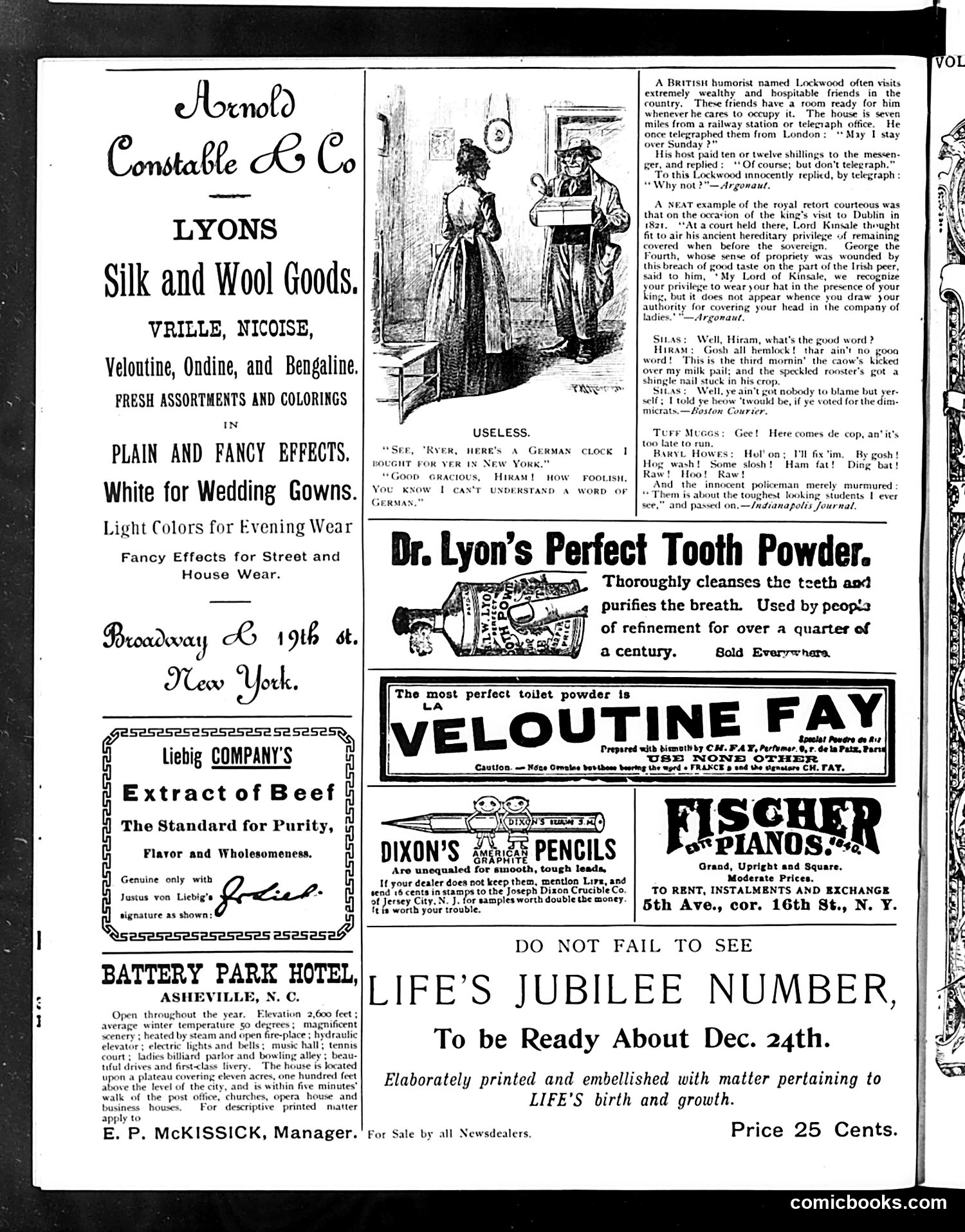
This page is primarily **advertising with embedded humor pieces**, typical of Life magazine's format. The main cartoon titled "USELESS" depicts a German immigrant trying to give a clock to an American, who responds that he can't understand German—the joke being that language barriers make the gift pointless. This reflects late-19th/early-20th-century anxiety about immigration and communication challenges. Below are three rural dialect jokes featuring characters like "Silas" and "Hiram," representing country folk complaining about farm problems (cows, roosters) and blaming Democrats. These capture period humor mocking rural Americans and political affiliation stereotypes. The page is dominated by **commercial advertisements**: Arnold Constable silk goods, Dr. Lyon's tooth powder, Liebig's beef extract, Battery Park Hotel, Fischer pianos, and Dixon's pencils. At bottom, an announcement promotes **Life's "Jubilee Number"** (25 cents), celebrating the magazine's anniversary with elaborate printing—essentially self-promotion within the magazine itself. The content reflects early-1900s consumer culture and genteel humor standards.