
Life, 1892-12-22 · page 8 of 16
Life — December 22, 1892 — page 8: what you’re looking at
What you’re looking at
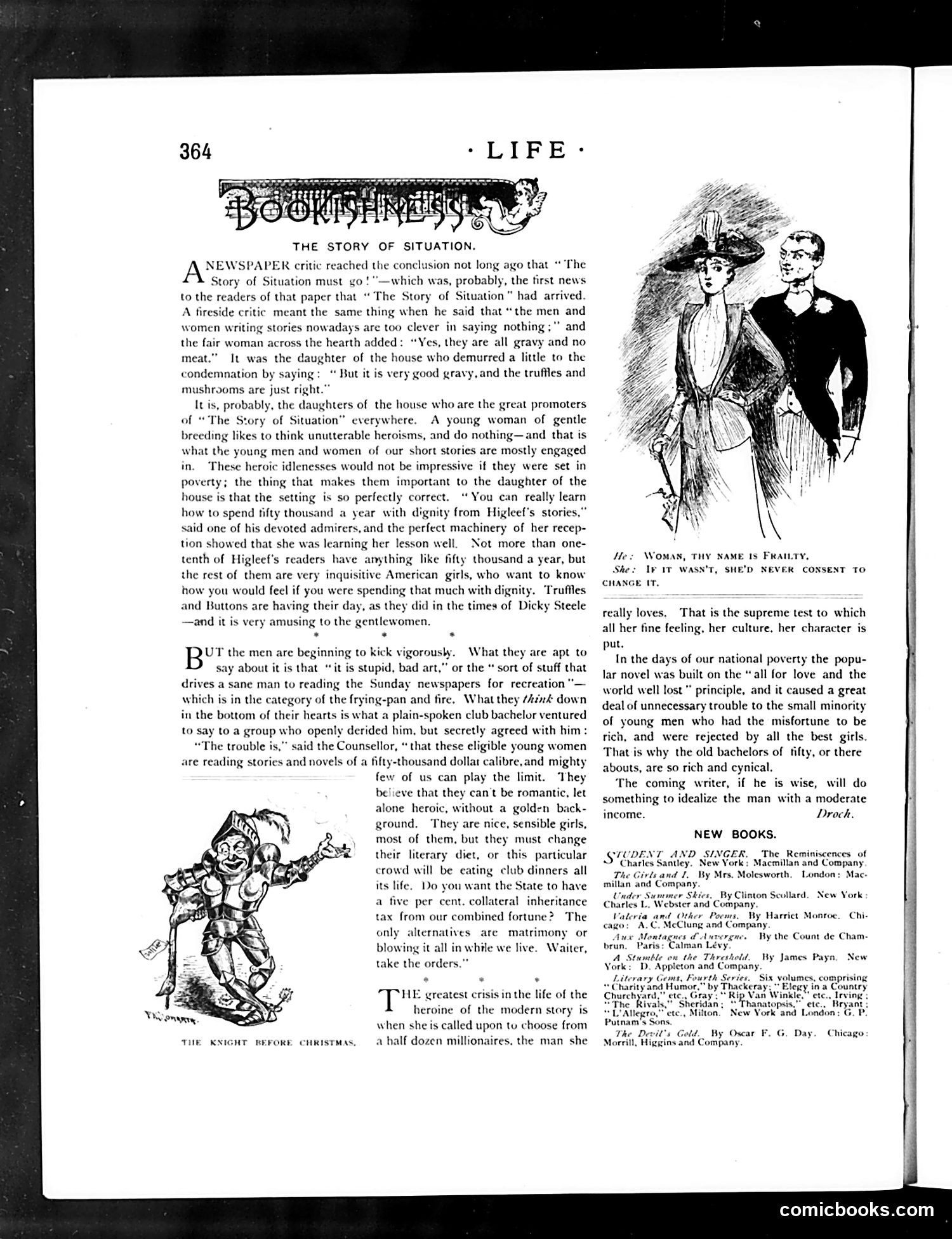
This page contains a satirical article titled "Boomerangs: The Story of Situation" critiquing popular short stories and novels of the era. The text mocks literary critics and story formulas, particularly the "fifty-thousand-a-year heroine" trope—poor but genteel women in fiction who somehow live luxuriously. The cartoons illustrate the satire: one shows a well-dressed couple (likely representing wealthy romance-novel characters), while another depicts "The Knight Before Christmas," referencing chivalric romance clichés. The satire targets how popular fiction promoted unrealistic wealth fantasies and romantic ideals to readers, particularly young women. The author advocates for writers to idealize moderate income instead, reflecting early 20th-century concerns about literature's social influence and class anxieties.
📄 Transcribed text from this page (OCR, searchable)
Machine-transcribed from the original scan — historical spelling and the odd misread are preserved.
Te THE STORY OF SITUATION. -APER critic reached the conclusion not long ago that “ The Story of Situation must go !""—which was, probably, the first news to the readers of that paper that he Story of Situation" had arrived. A fireside critic meant the same thing when he said that “the men and Women writing stories nowadays are too clever in saying nothing ;"" and the fair woman across the hearth added: “Yes, they are all gravy and no meat.” It was the daughter of the house who demurred a little to the condemnation by saying: “ But it is very good gravy, and the truffles and mushrooms are just right.” It is, probably, the daughters of the house who are the great promoters of “The Story of Situation” everywhere. A young woman of gentle breeding likes to think unutterable heroisms, and do nothing—and that is what the young men and women of our short stories are mostly engaged in. These heroic idlenesses would not be impressive if they were set in poverty; the thing that makes them important to the daughter of the house is that the setting is so perfectly correct, “You can really learn how to spend fifty thousand a year with dignity from Higleef's stories,” said one of his devoted admirers, and the perfect machinery of her recep- tion showed that she was learning her lesson well. Not more than one- tenth of Higleef's readers have anything like fifty thousand a year, but the rest of them are very inquisitive American girls, who want to know how you would feel if you were spending that much with dignity. Truffles and Buttons are having their day, as they did in the times of Dicky Steele —and it is very amusing to the gentlewomen. UT the men are beginning to kick vigorou: What they are apt to say about it is that ‘it is stupid, bad art,” or the “ sort of stuff that drives a sane man to reading the Sunday newspapers for recreation "— which is in the category of the frying-pan and fire. What they “zxé down in the bottom of their hearts is what a plain-spoken club bachelor ventured to Say to a group who openly derided him, but secretly agreed with him : The trouble said the Counsellor, “ that these eligible young women are reading stories and novels of a fifty-thousand dollar calibre,and mighty few of us can play the limit. They believe that they can't be romantic, let alone heroic, without a golden back- ground. They are nice, sensible girls, most of them, but they must change YZ) their literary diet, or this particular crowd will be cating club dinners all its life. Do you want the State to have a five per cent. collateral inheritance tax from our combined fortune? The only alternatives are matrimony or blowing it all in while we live. Waiter, take the orders.” HE greatest crisis in the life of the heroine of the modern story is - : PRN when she is called upon tu choose from a half dozen millionaires. the man she THE KNIGHT BEFORE CHRISTMAS, Womas, THY NAME IS FRAILTY, IF IT WASN'T, SHE'D NEVER CONSENT TO EIT. That is the supreme test to which all her fine feeling, her culture, her character is put. In the days of our national poverty the popu- lar novel was built on the “all for love and the world well lost" principle, and it caused a great deal of unnecessary trouble to the small minority of young men who had the misfortune to be tich, and were rejected by all the best girls. That is why the old bachelors of fifty, or there abouts, are so rich and cynical. The coming writer, if he is wise, will do something to idealize the man with a moderate income. Droch, NEW BOOKS. AND SINGER, ‘The Reminiscences of Santley. New York } Macmillan and Company The Girls and 1, My Mrs. Molesworth. London: Mac- millan and Company. Under Summer Skies, By Clinton Scollard Charles L. Webster and Company. aleria and Other Poems, By Harriet Monroe. Chi- >: A.C, MeClung and Company. tue Montag By the Count de Cham- brun, Paris: Calman Lévy. A Stumble on the Threshold. York: 'D. Appleton and Company. Literary Gems, Fourth Series. Six volumes, comprising +: Charity and Humor,” by Thackeray; Elegy in a Country Churchyard,” ete., Gray p Van Winkle,” etc. ving ivals,” Sheridan hanatopsis,”” ete.. Bryant : ¢., Milton.” New York and London: G. P. STUDENT Char New York Hy James Payn, New The Devit's Gold. By Oscar F. G. Day Chicago. Morrill, Higgins and Company comicbooks.com