
A complete issue · 16 pages · 1892
Life — November 10, 1892
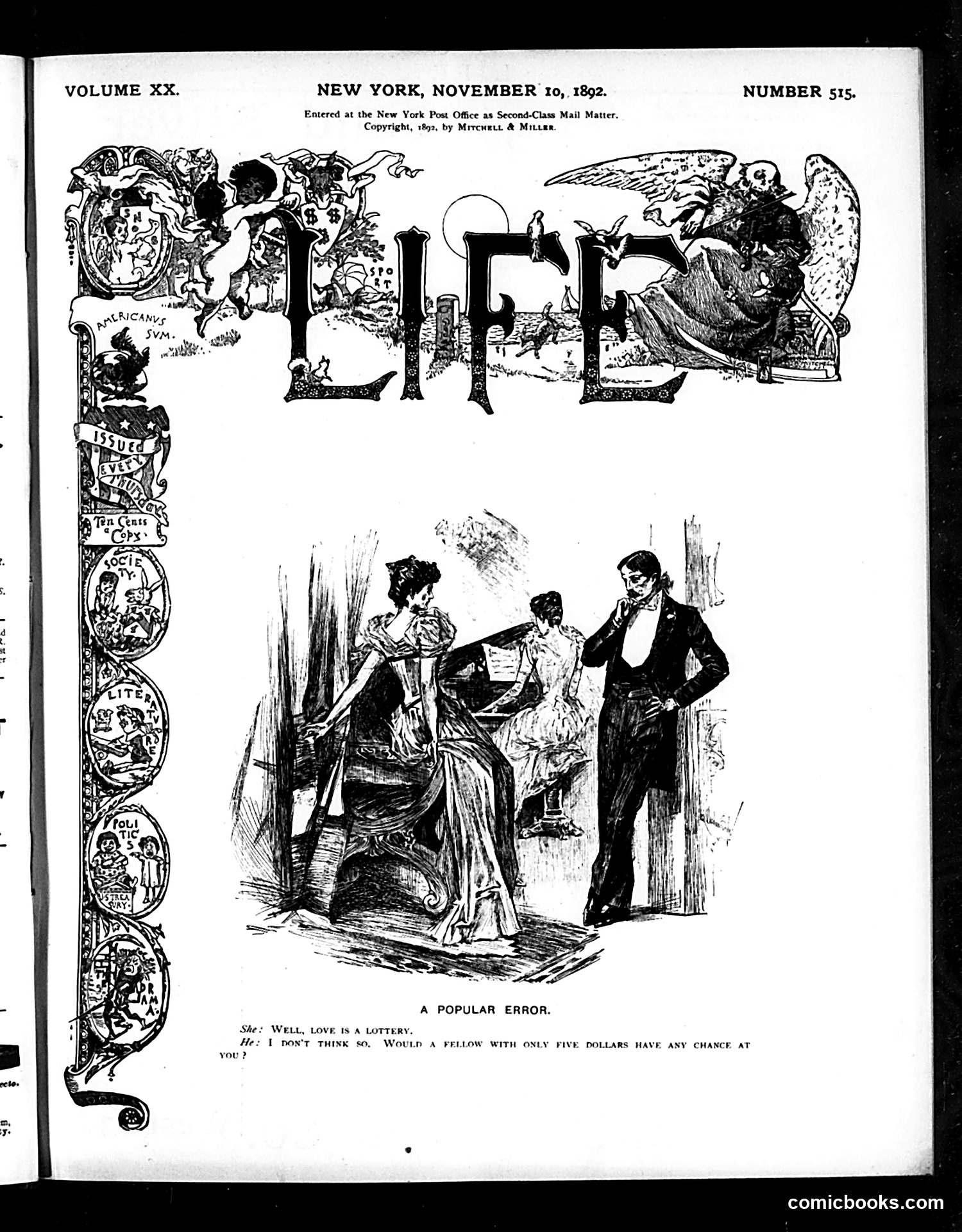
This cartoon satirizes romantic misconceptions about love and marriage among the wealthy. The scene shows a well-dressed couple in conversation with a gentleman caller. The caption presents a dialogue where the woman claims "love is a lottery," and the man responds skeptically, asking if "a fellow with only five dollars" would have any chance at winning. The satire targets the popular notion that love transcends class and money. The cartoon's point is that among the upper classes depicted here—evidenced by their formal dress and refined setting—love and marriage are actually transactional arrangements heavily dependent on wealth, despite romantic rhetoric suggesting otherwise. The "popular error" is believing love operates independently of financial status.
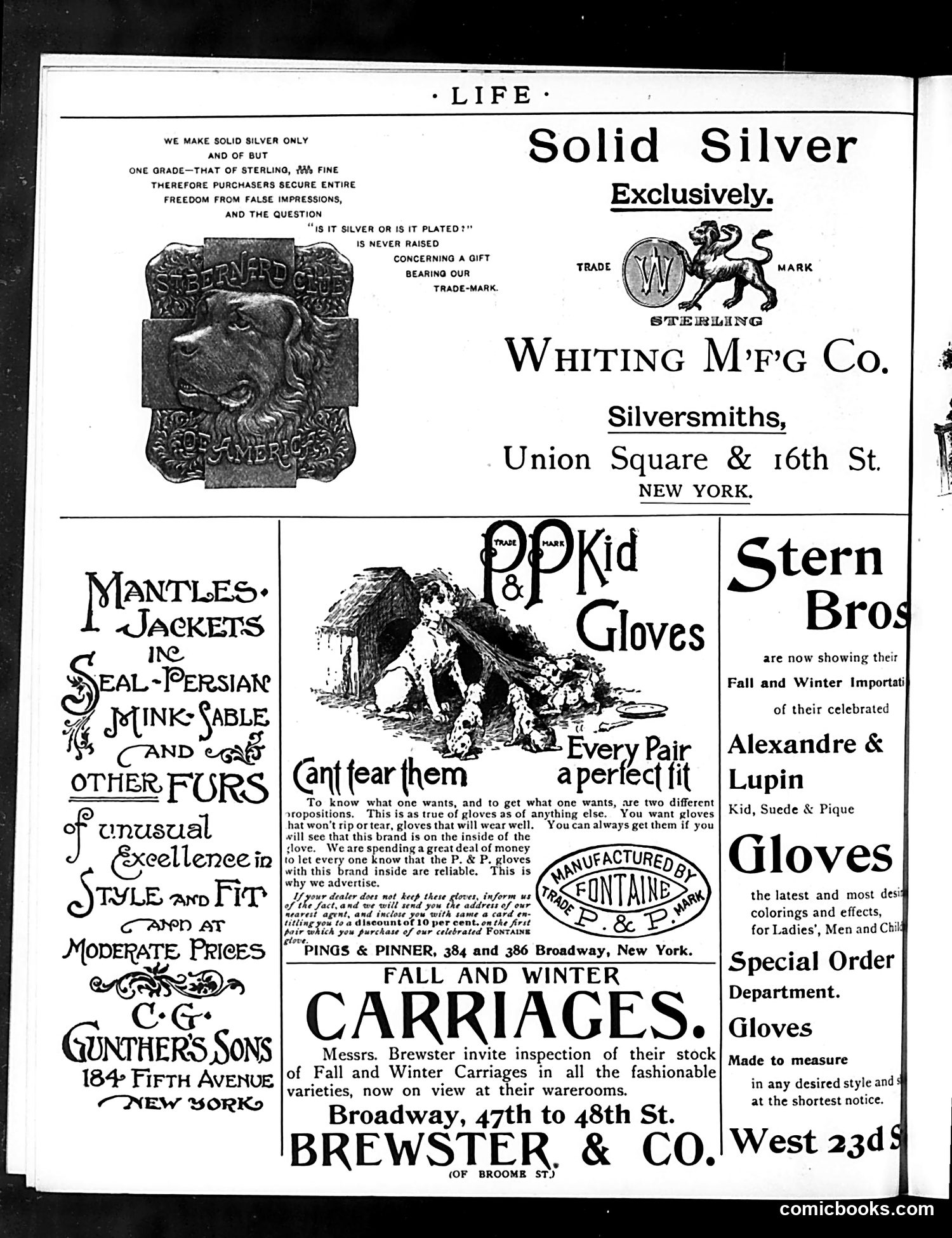
This page is **primarily advertising**, not satirical content. It contains multiple commercial advertisements from late 19th or early 20th-century New York businesses: - **Whiting Mfg Co.** (silversmiths) emphasizes their sterling silver is solid, not plated - **C.G. Gunthers Sons** advertises fur mantles and jackets - **P&P Kid Gloves** promotes their durability - **Stern Bros** showcases imported Alexandre & Lupin gloves - **Brewster & Co.** advertises fall/winter carriages The only visual element beyond advertisements is an illustration of a dog with **P&P Kid Gloves**, which appears designed to convey durability (the gloves withstand a dog's rough play). This is straightforward commercial promotion rather than political or social satire.
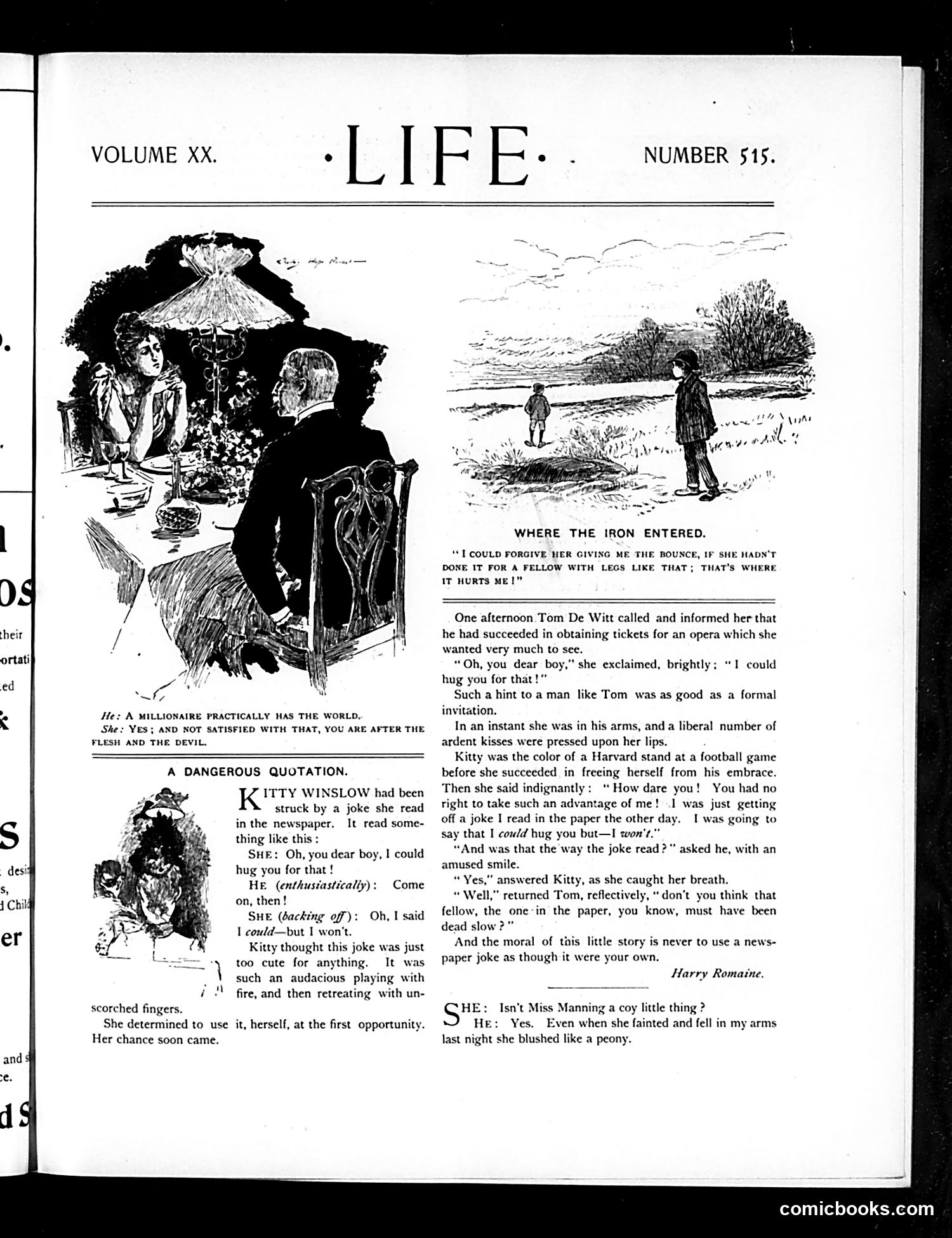
This page contains three separate satirical pieces rather than a unified political cartoon: 1. **"A Millionaire Practically Has the World"** - A dialogue cartoon mocking wealth inequality, where a rich man dismisses concerns about the poor, suggesting money solves everything. 2. **"A Dangerous Quotation"** - A humorous anecdote about Kitty Winslow reading a newspaper joke aloud, then using it to justify her own behavior to her boyfriend Tom. The satire targets how people selectively apply logic from media to excuse their own conduct. 3. **"Where the Iron Entered"** and bottom dialogue - A romantic narrative about Tom De Witt obtaining opera tickets, though the exact reference is unclear without additional context. The page emphasizes social commentary on wealth, gender relations, and human nature rather than specific political events.
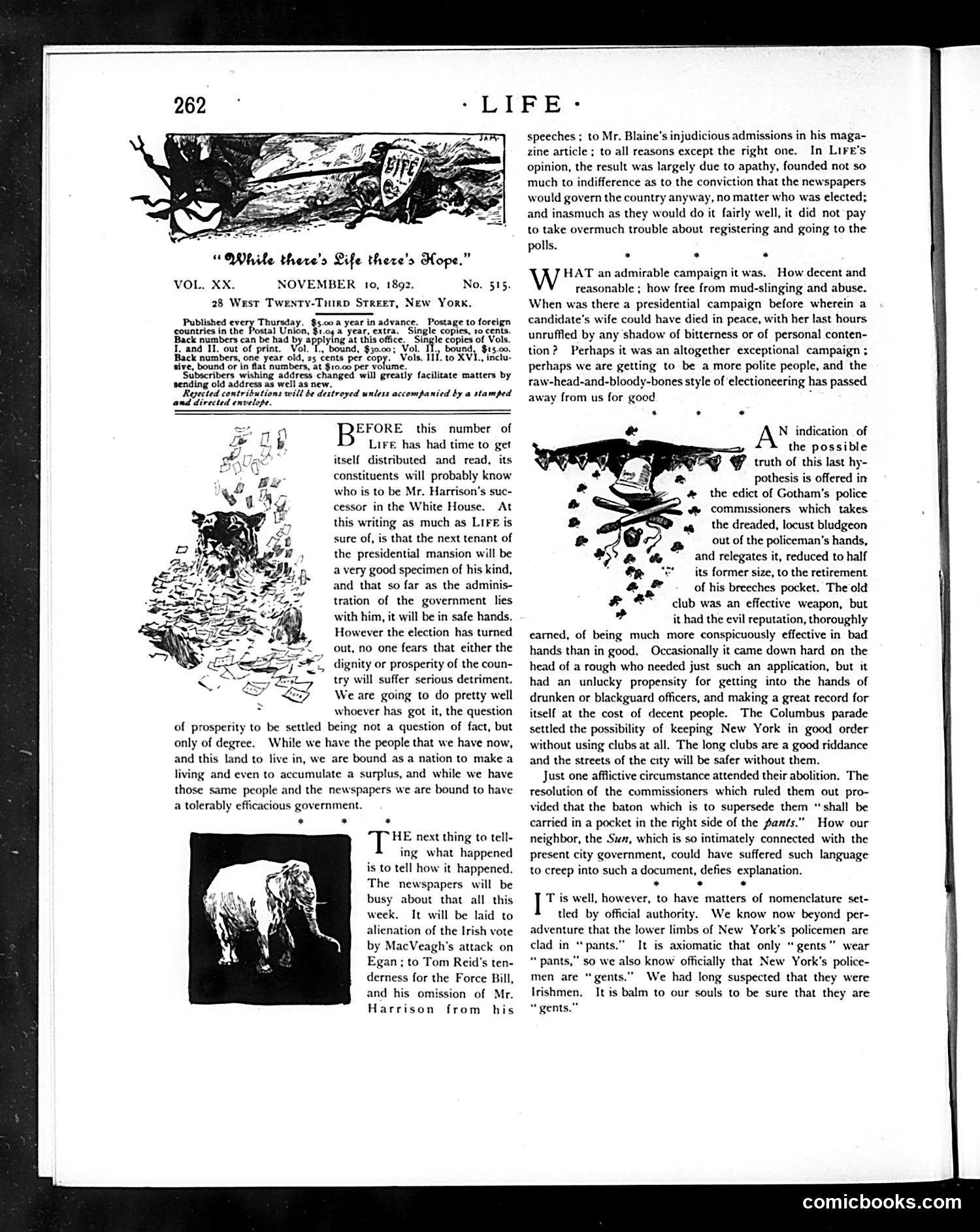
This page critiques the 1892 U.S. presidential election and its aftermath. The text dismisses newspapers' focus on alleged voter fraud and irregularities as overblown, attributing poor voter turnout instead to public apathy. The cartoons satirize New York City politics: one depicts chaos in city administration; another shows a police baton, referencing Gotham's police commission ruling that officers could no longer carry clubs as weapons—Life sarcastically suggests this "effective" tool should be retained. The text also mocks the designation of New York's police as "gents" (gentlemen), treating this as absurdly formal language for officers. Overall, the page lambastes political corruption, poor governance, and the newspapers' selective outrage about electoral integrity.
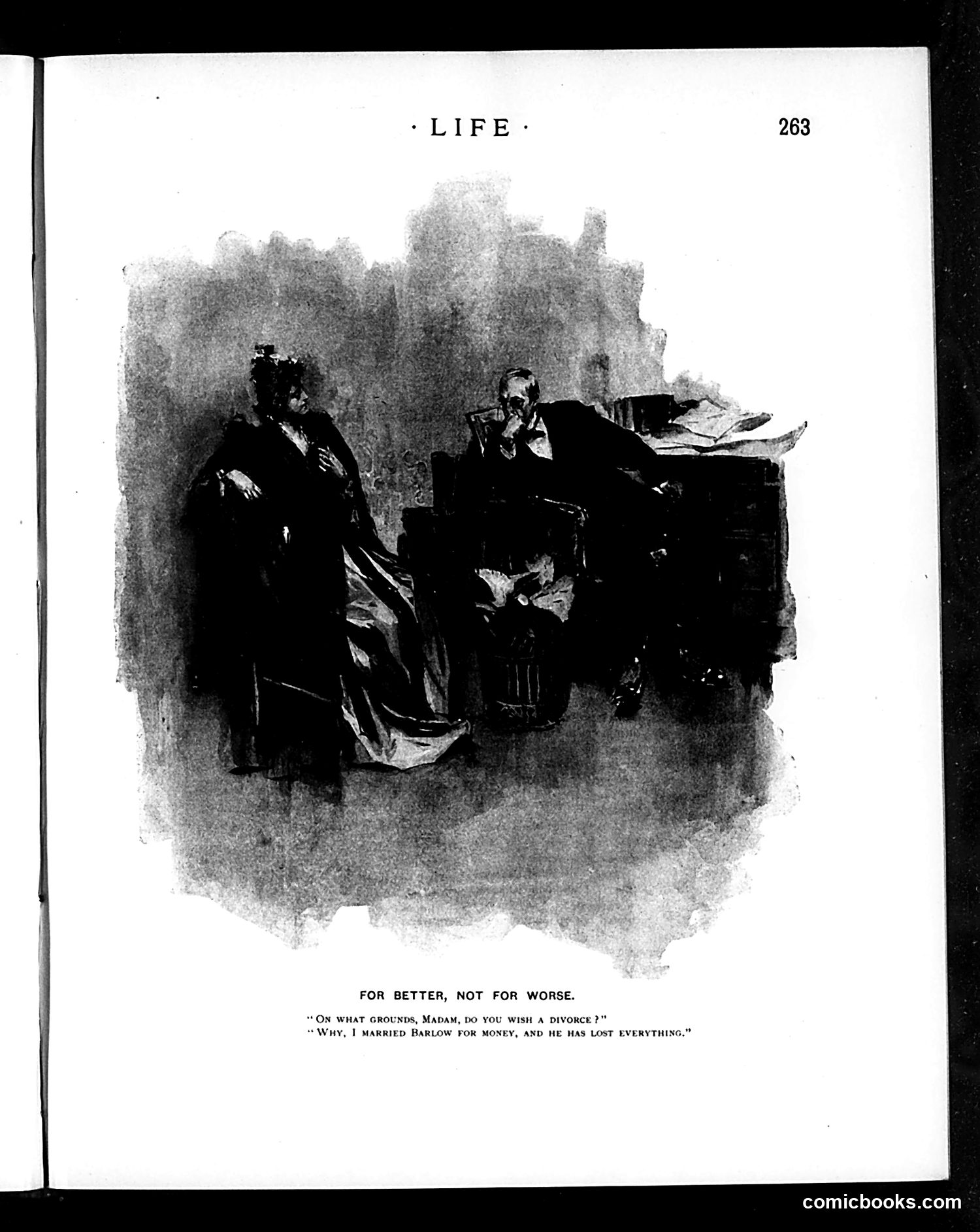
This cartoon satirizes a divorce proceeding, with the title referencing the marriage vow phrase "for better or for worse." The caption presents a dialogue between a judge (or legal official) and a woman seeking divorce: **Judge:** "On what grounds, Madam, do you wish a divorce?" **Woman:** "Why, I married Barlow for money, and he has lost everything." The satire mocks both parties: the woman for marrying purely for financial gain rather than love, and implicitly the husband (Barlow) for his financial failure. The joke exposes the mercenary nature of marriages among the wealthy, suggesting that without money, the marriage has no foundation. The artwork's dramatic chiaroscuro style emphasizes the serious legal proceeding contrasting with the trivial reasoning presented.
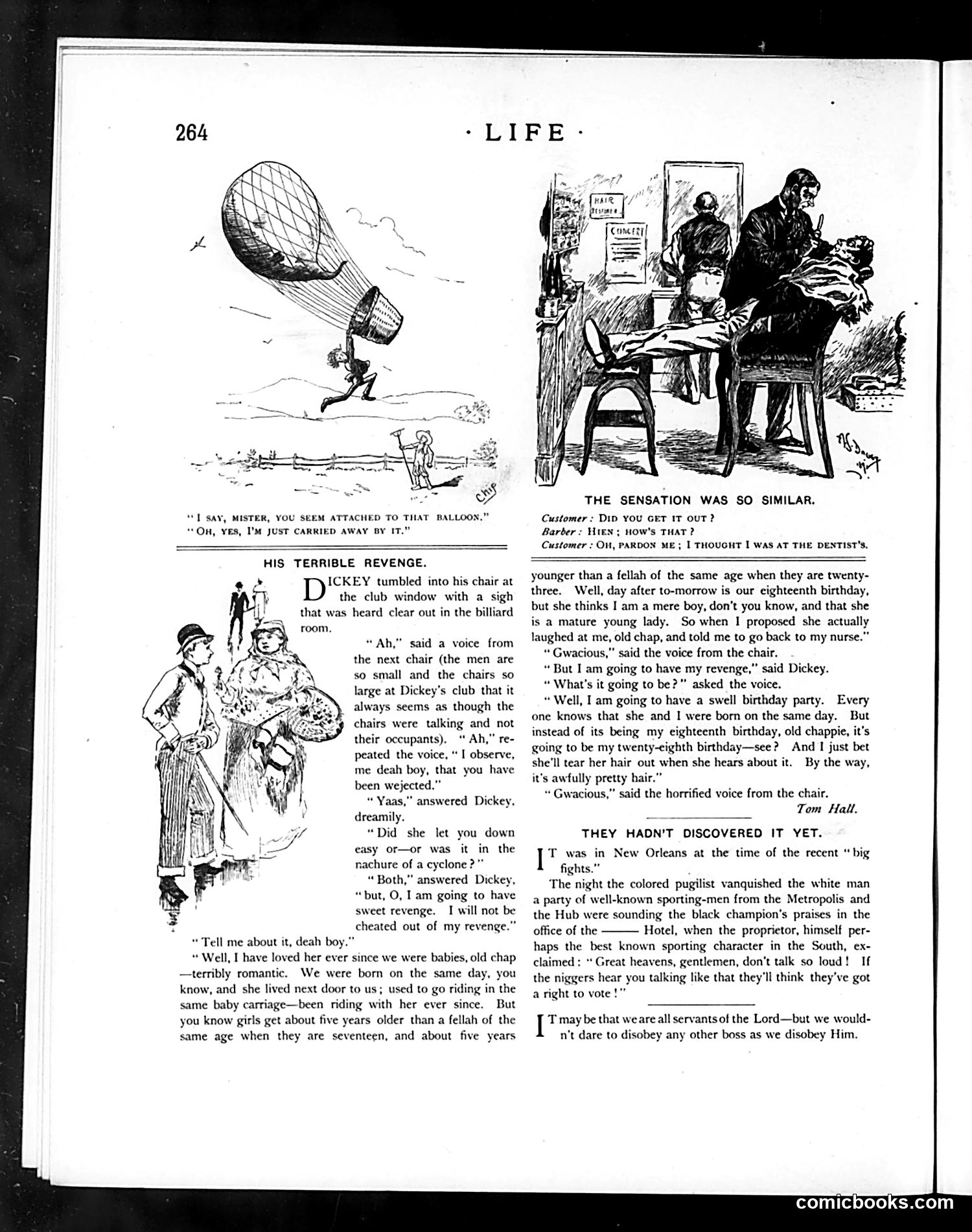
This page contains three humorous sketches typical of early 20th-century Life magazine satire: 1. **Top left**: A man struggling with a large hot-air balloon, captioned with dialogue about being "attached" to it—a visual pun on the difficulty of letting go of something unwieldy. 2. **"His Terrible Revenge"**: A club scene where a rejected man named Dickey plots revenge by proposing to his ex-girlfriend—forcing her into marriage as punishment rather than seeking actual reconciliation. The satire mocks masculine pride and the twisted logic of romantic "revenge." 3. **"They Hadn't Discovered It Yet"**: A New Orleans anecdote about racial tensions, referencing the "big fights" (likely boxing matches). The dialogue criticizes casual racist speech among sporting gentlemen. The page satirizes male vanity, romantic absurdity, and social prejudices of the era.
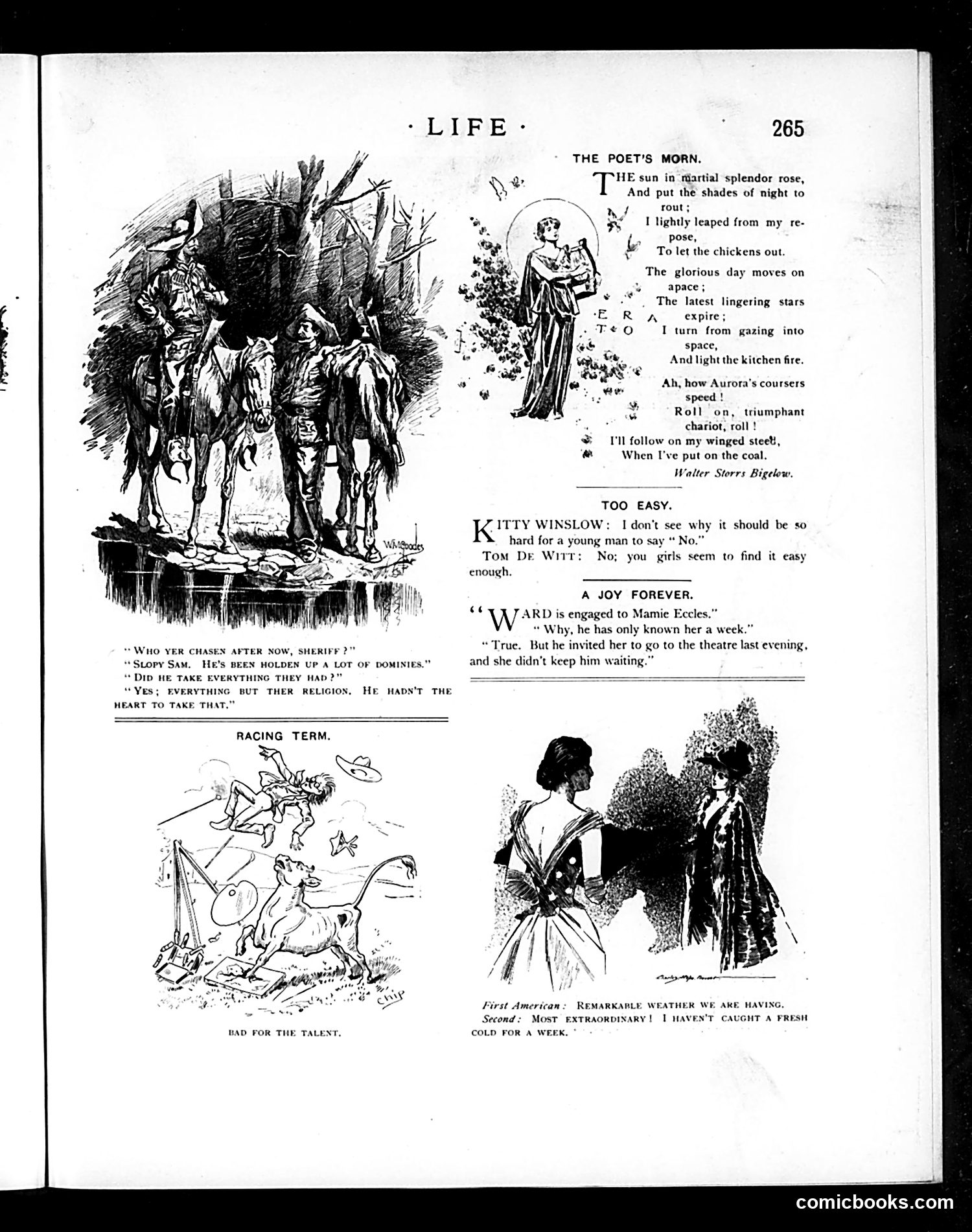
This page contains several distinct humor pieces rather than a cohesive political cartoon: **"The Poet's Morn"** - A poem by Walter Sierri Bigelow celebrating domestic morning routines (chickens, kitchen fire, Aurora's chariot), presented with a classical illustration. **"Too Easy"** and **"A Joy Forever"** - Brief comedic dialogue snippets about courtship, poking fun at young romance and gender dynamics of the era. **"Racing Term"** - A cartoon titled "Bad for the Talent" depicts horse racing mishaps, likely satirizing equestrian sports or gambling culture. **"Remarkable Weather"** - A final dialogue joke about catching a cold, presented with an illustration of two women. The page represents typical turn-of-century Life magazine humor: light social satire targeting courtship customs, domestic life, and leisure activities, with an emphasis on wordplay and visual gags rather than political commentary.
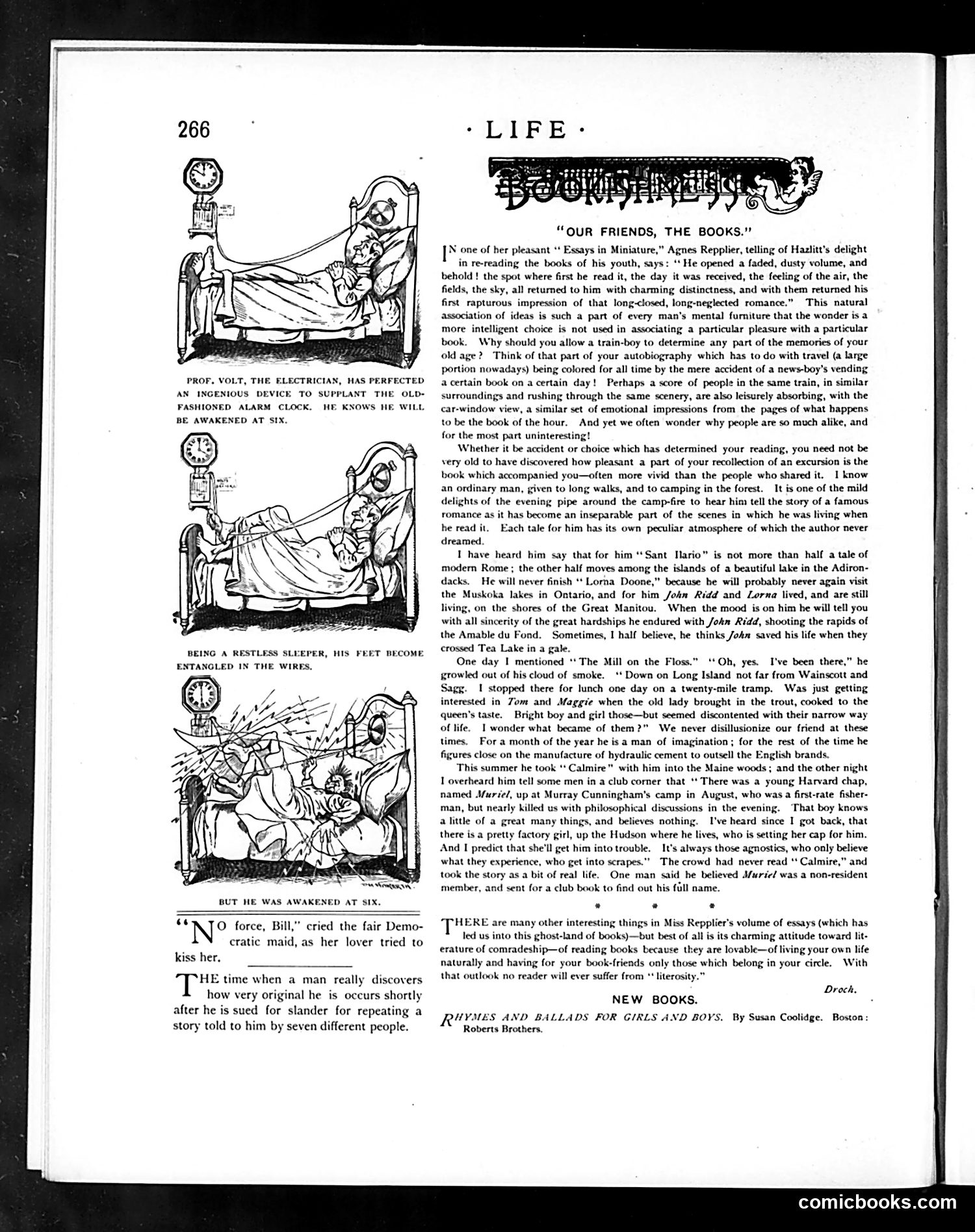
This page features an essay celebrating the value of reading and cherished books in one's life. The accompanying illustrations show a man repeatedly being awakened by an alarm clock at six o'clock—depicted as "restless" and with feet becoming "entangled in the wires." The satire appears to contrast the mundane reality of early rising with the escapism books provide. The essay argues that books offer irreplaceable emotional impressions and memories, becoming part of one's identity more meaningfully than chance encounters. It references specific titles like "Sant Ilario," "Lorna Doone," and "Tom and Maggie," suggesting that literary companions shape our lives more profoundly than temporary social circumstances. The piece advocates for valuing book-friendships over fleeting acquaintances.
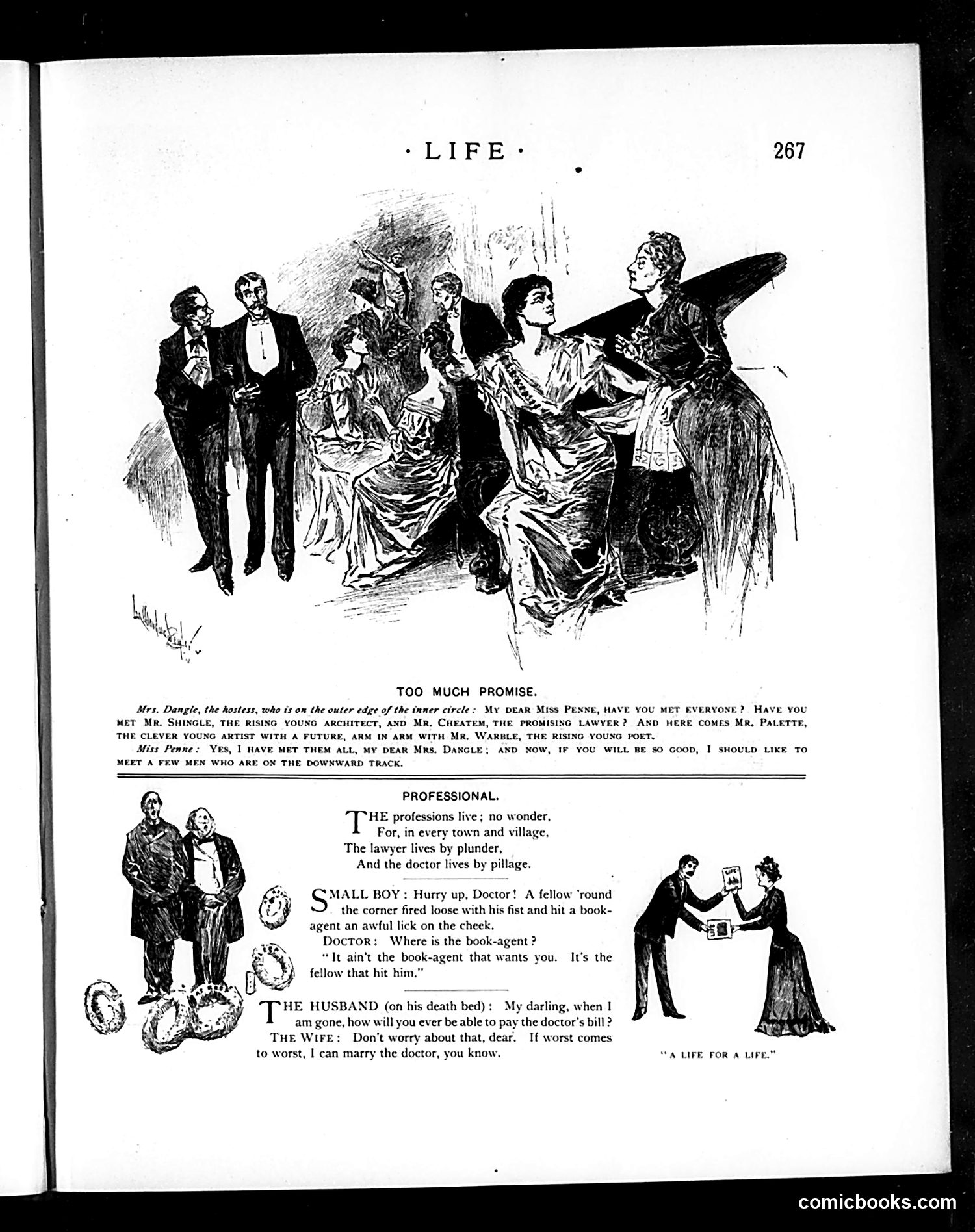
This page from *Life* magazine contains three separate satirical pieces about professions and social pretension. **"Too Much Promise"** (top) depicts a social gathering where Mrs. Dangle introduces Miss Penne to various "promising" young men—a lawyer, artist, and note—with the clear implication that these men are failures or frauds despite their reputations. The satire mocks how society invests hope in young men who never deliver. **"Professional"** (bottom) contains three jokes satirizing professions: lawyers "plunder," doctors "pillage," a careless doctor causes injury, and a dying husband worries about medical bills while his wife casually remarks she could marry the doctor. The humor targets professional greed and incompetence, particularly medical practitioners' financial exploitation of vulnerable patients.
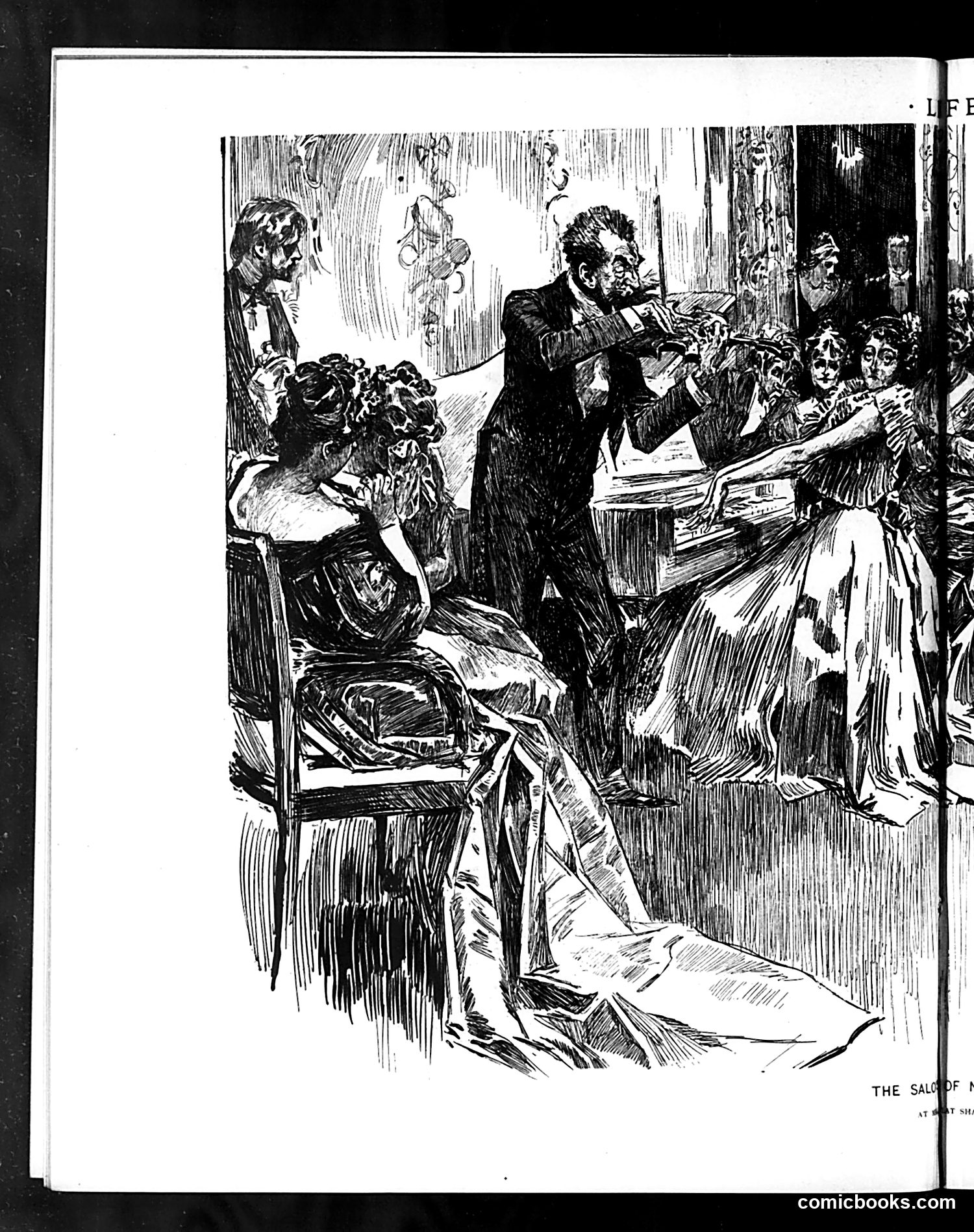
This satirical illustration depicts what appears to be an auction or transaction scene in a wealthy interior setting. A well-dressed man in the center conducts business with an elaborately dressed woman seated prominently, while onlookers observe from the background. The exaggerated physical caricature and the theatrical staging suggest social satire—likely commenting on marriage, wealth, or transactional relationships among the upper classes. The title begins "The Sale of a..." but the complete caption is cut off in this image, making it impossible to identify the specific target of the satire with certainty. However, the composition suggests Life magazine's typical commentary on Gilded Age society, wealth disparity, or marital arrangements treated as commercial transactions. The precise historical reference remains unclear without the full caption.
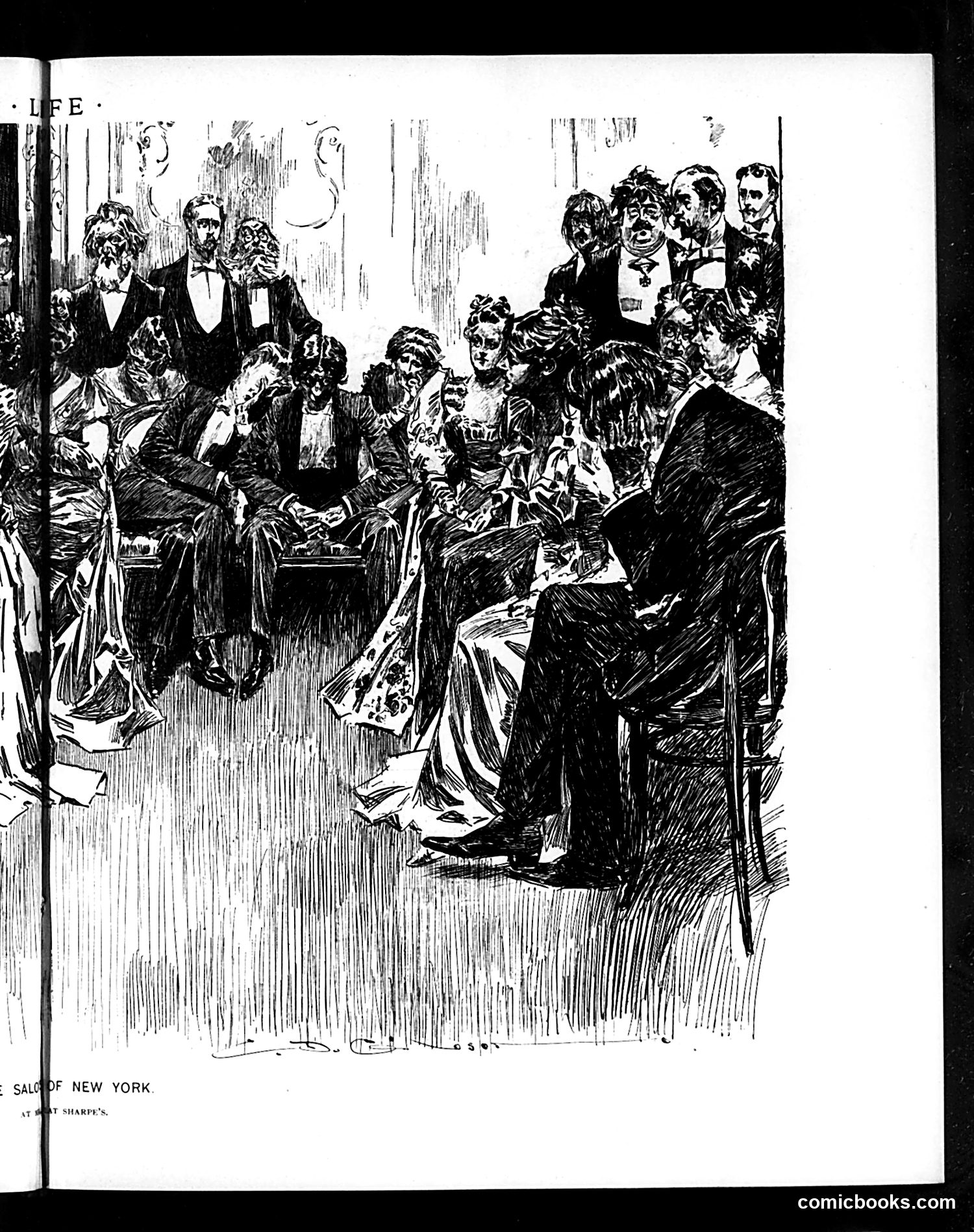
This illustration appears to depict a formal social gathering or salon in New York, showing well-dressed figures in late 19th or early 20th-century attire. The caption references "SALES OF NEW YORK" and credits "SHARPE'S," suggesting it's from Life magazine's satirical commentary on New York society. The sketch captures an interior scene with fashionably dressed women seated and men standing, rendered in the magazine's characteristic ink-line style. Without clearer identifying details or accompanying text, the specific satirical target—whether mocking high society pretensions, particular social figures, or a newsworthy event—remains unclear from the image alone. The composition suggests social commentary on New York's elite circles, but the precise point of satire cannot be definitively determined from what's visible here.
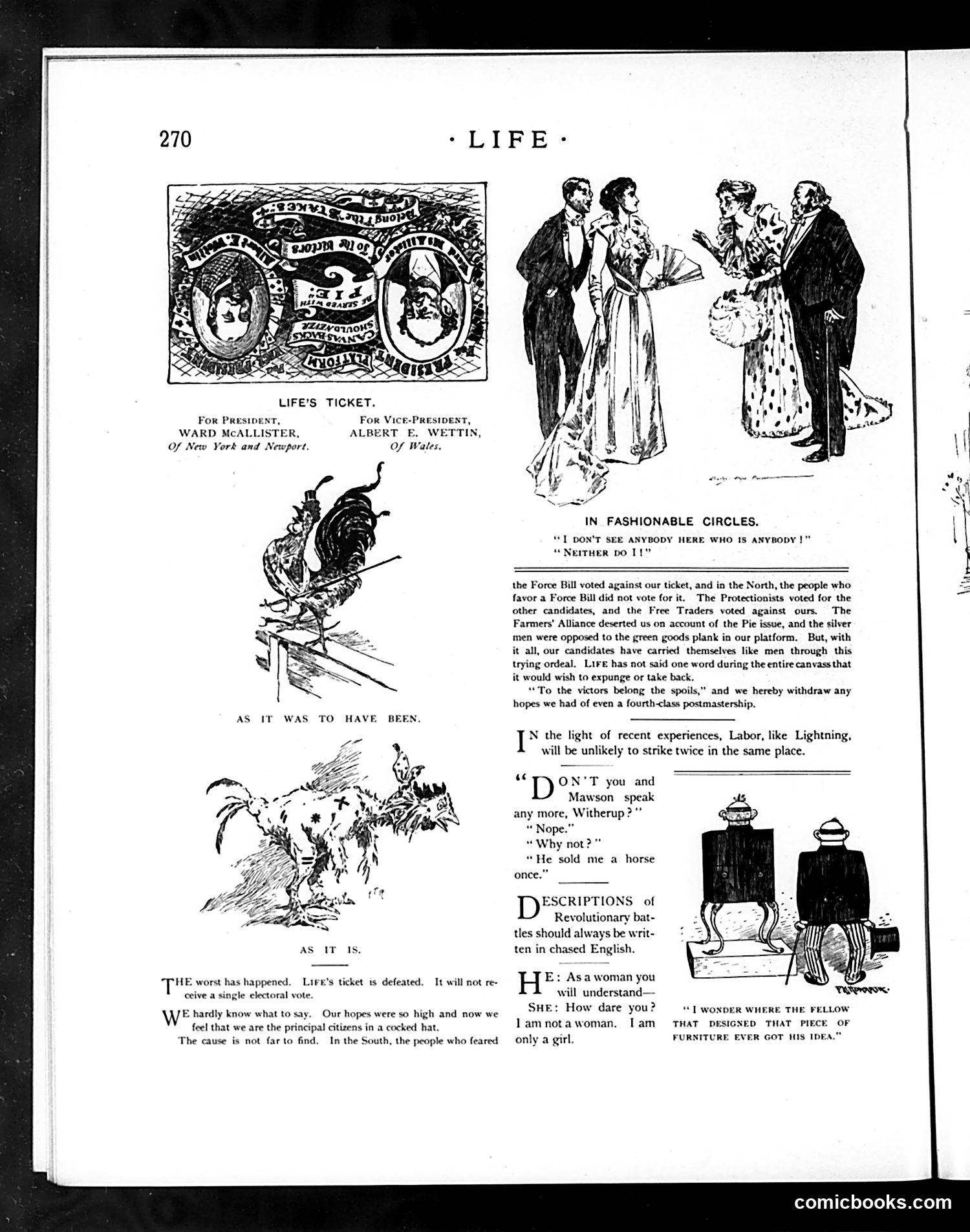
This page satirizes the 1884 presidential election. Life magazine's fictional "ticket" nominated Ward McAllister (a prominent New York socialite) for president and Albert E. Wettin for vice president—a joke about fashionable, out-of-touch elites. The main cartoon shows their imaginary defeat, with elaborate explanations of why various voting blocs rejected them: Southern voters opposed the Force Bill, Northern protectionists favored other candidates, the Farmers' Alliance split over currency issues ("Pie issue," likely silver coinage), and different factions pulled in opposite directions. The satire mocks both Life's own editorial positions and the fractious political climate where no coherent coalition could form. The secondary cartoons ("In Fashionable Circles," the Mawson anecdote, the gender-confusion joke) reinforce the theme of disconnected, foolish society figures—suggesting that elite socialites like McAllister were utterly unsuited to represent the nation's diverse economic interests.
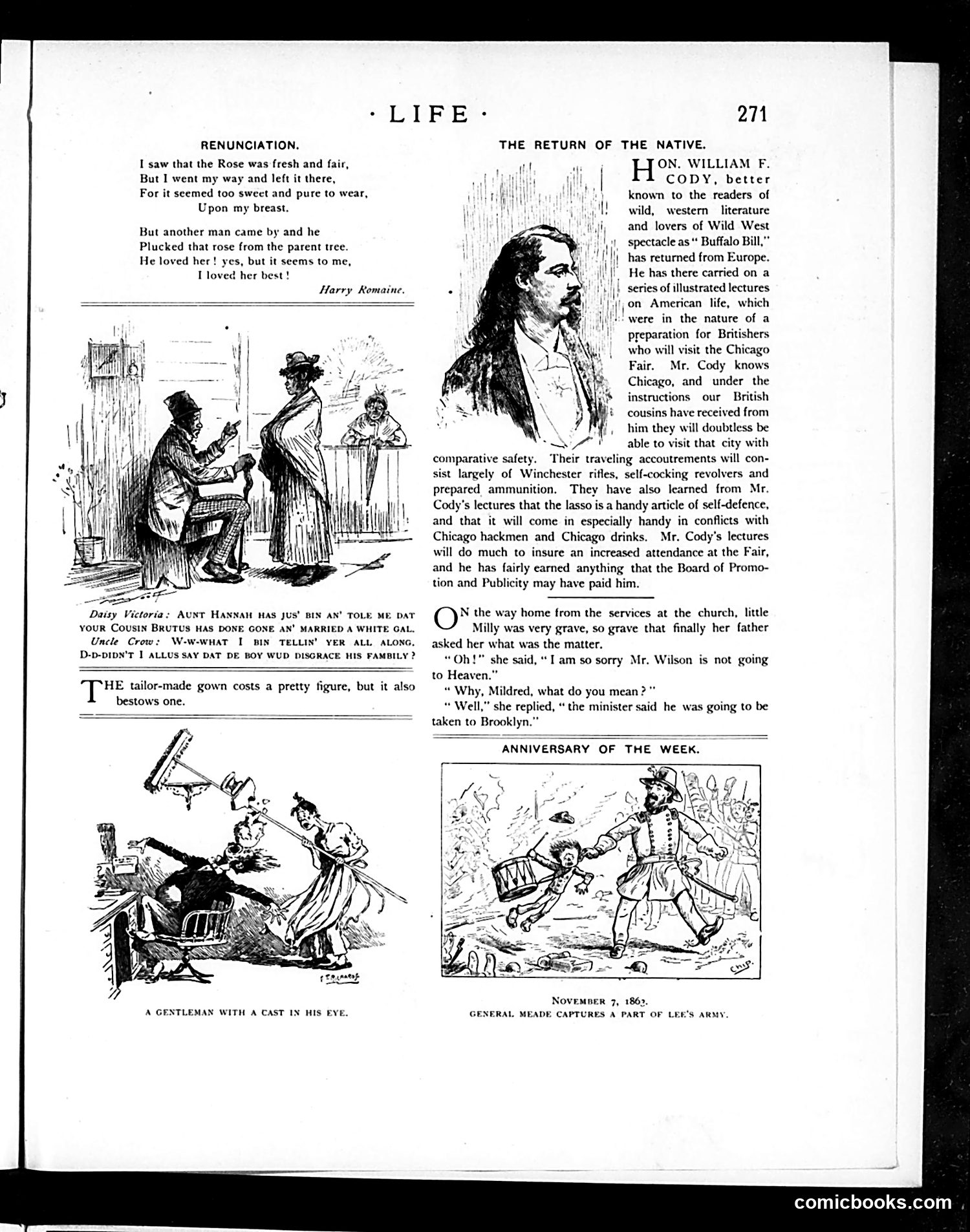
This page contains several satirical pieces typical of 1880s American humor: **"Renunciation"** is a sentimental poem about lost love—a man who nobly rejected a beautiful woman, only to watch another man claim her. It's likely mocking romantic melodrama popular in the era. **The "Daisy Victoria" cartoon** depicts racist humor common to the period: an elderly Black woman and man discussing a cousin's interracial marriage with disapproval, presented as comedy. This reflects the deeply prejudiced attitudes of the time. **"A Gentleman with a Cast in His Eye"** is a visual gag showing a man with an eye injury. **"The Return of the Native"** humorously reviews Buffalo Bill Cody's return from European lectures, joking that British visitors to Chicago's World's Fair will need weapons (Winchester rifles, lassos) to survive the city's dangers—treating Chicago as a lawless frontier town rather than a modern city. The bottom section references a Civil War battle anniversary (November 7, 1862).
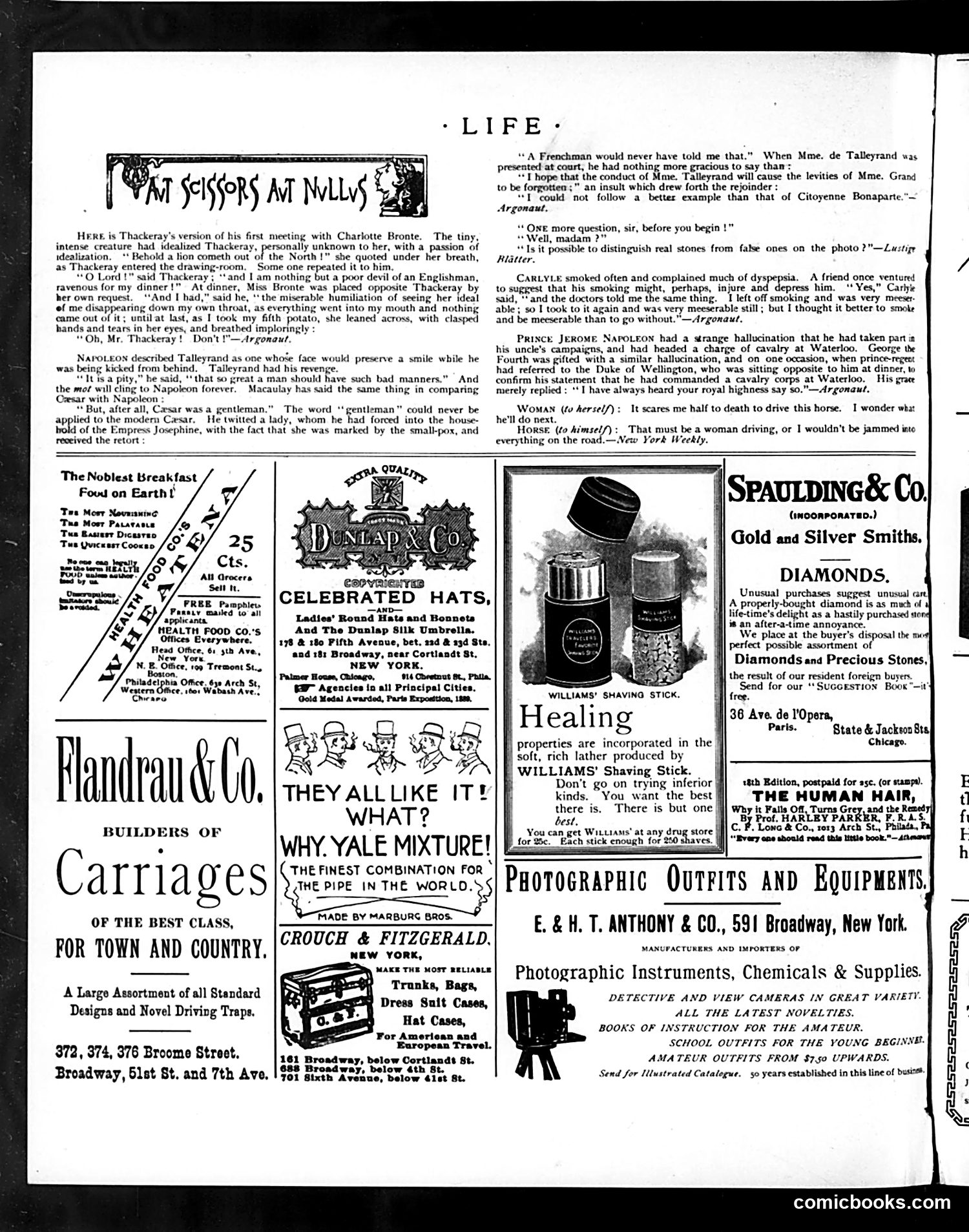
This page features literary anecdotes about famous figures' social awkwardness and wit. The main cartoon shows **Charlotte Brontë** meeting novelist **William Thackeray**. She had idealized him intellectually, but was mortified watching him eat messily at dinner—his repeated chomping and lack of refinement destroyed her romanticized image. The humor satirizes the gap between intellectual heroes and their mundane human reality. Below are brief witty stories about **Napoleon**, **Talleyrand**, **Carlyle**, and **Prince Jerome Napoleon**—mostly illustrating their blunt manners, contradictions, or social arrogance. A small cartoon about a woman nervous driving a horse completes the humor section. The rest of the page is **advertising**: carriages, breakfast food, celebrated hats, shaving products, diamonds, and photographic equipment. This was typical Life magazine layout—literary/satirical content mixed with commercial promotions.
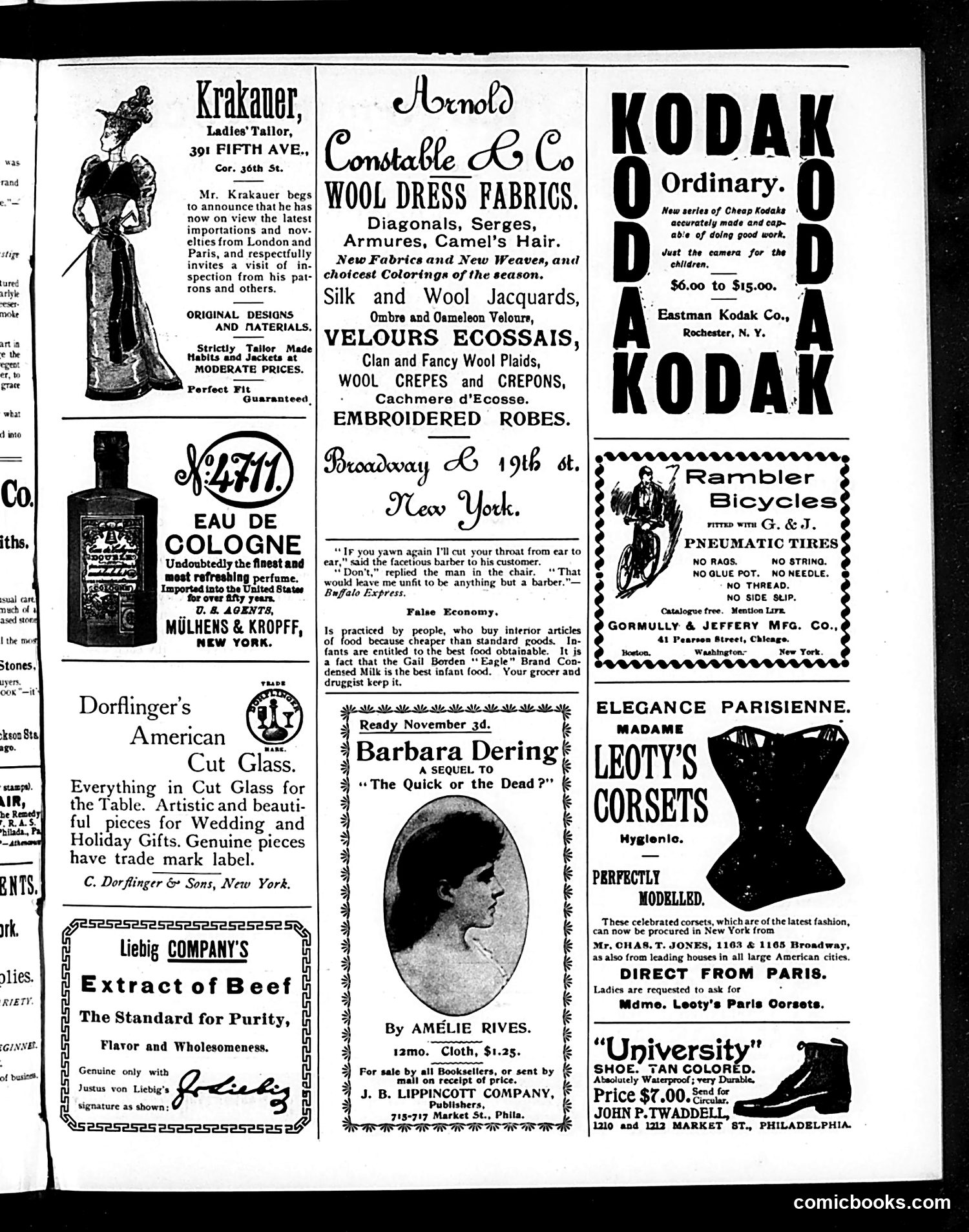
This is primarily an **advertising page** from Life magazine, with one embedded joke. The advertisements showcase luxury goods and services typical of the 1890s-early 1900s: imported fabrics, perfume, cut glass, corsets, and photography equipment—targeting affluent urban readers. The only satirical content is a brief **barber-shop joke** under "False Economy." A customer jokes that if the barber cut his throat, he'd become "unfit to be anything but a barber"—a class-based insult suggesting barbers occupy the lowest social rung. The humor relies on period attitudes about occupational hierarchy and the casual cruelty acceptable in "facetious" banter. The page otherwise demonstrates Life's dual function: satirical commentary in editorial content, advertising revenue from high-end merchants. The goods advertised (Parisian corsets, imported cologne, Kodak cameras) reflect consumer culture and growing American wealth in this era.
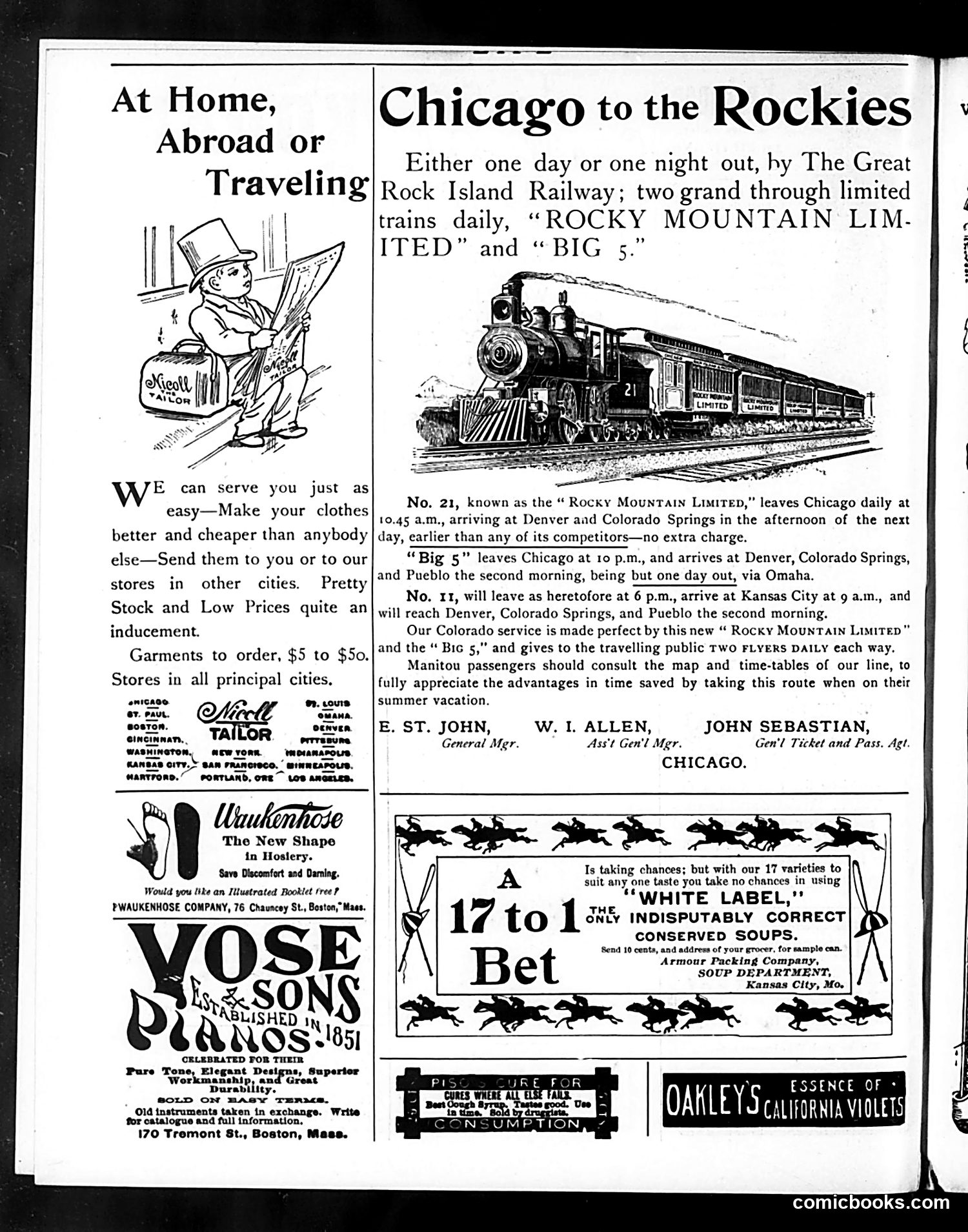
This page is primarily **advertisements**, not editorial satire. The content includes: **Left side:** Ads for a tailoring service (Stoll Tailor), hosiery (Waukenhose), and musical instruments (Vose & Sons pianos). **Center/Right:** A railroad advertisement for the Great Rock Island Railway, promoting two daily trains to Colorado—the "Rocky Mountain Limited" and "Big 5"—emphasizing speed and comfort for summer vacation travelers to Denver and Colorado Springs. **Bottom:** Food and consumer product advertisements: Armour canned soups ("White Label," marketed as "indisputably correct") and Oakley's California Violets essence. There is **no political cartoon or satirical content** visible on this page. It represents typical early-20th-century *Life* magazine advertising, targeting middle-class travelers and consumers with emerging convenience goods and transportation services. The railroad ad particularly reflects the era's enthusiasm for rapid railway expansion connecting urban centers to western destinations.