
Life, 1892-11-10 · page 4 of 16
Life — November 10, 1892 — page 4: what you’re looking at
What you’re looking at
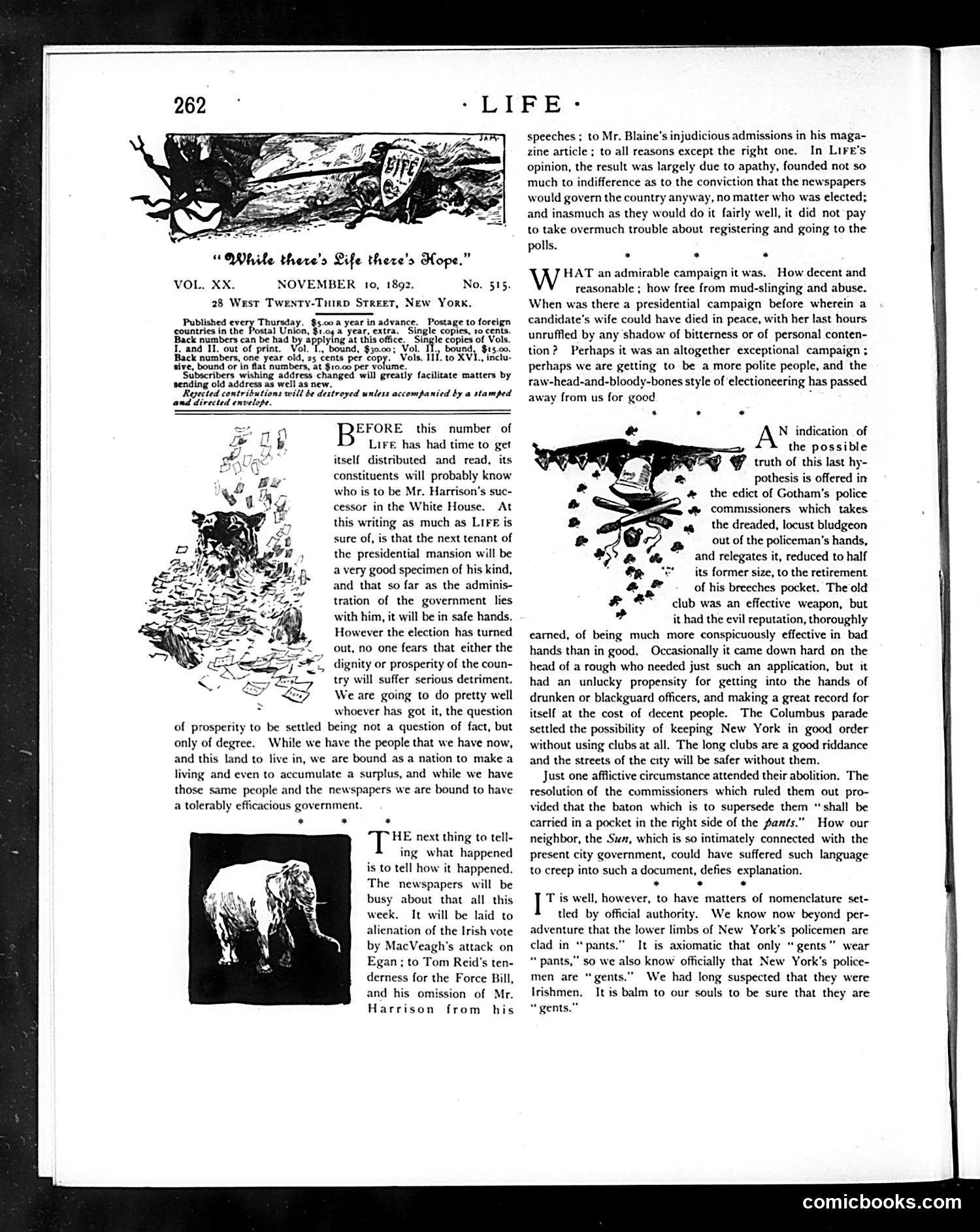
This page critiques the 1892 U.S. presidential election and its aftermath. The text dismisses newspapers' focus on alleged voter fraud and irregularities as overblown, attributing poor voter turnout instead to public apathy. The cartoons satirize New York City politics: one depicts chaos in city administration; another shows a police baton, referencing Gotham's police commission ruling that officers could no longer carry clubs as weapons—Life sarcastically suggests this "effective" tool should be retained. The text also mocks the designation of New York's police as "gents" (gentlemen), treating this as absurdly formal language for officers. Overall, the page lambastes political corruption, poor governance, and the newspapers' selective outrage about electoral integrity.
📄 Transcribed text from this page (OCR, searchable)
Machine-transcribed from the original scan — historical spelling and the odd misread are preserved.
LIFE “Mhile there's Life there's Hope.” VOL. XX. NOVEMBER 10, 1892. 28 West Twenty-Tuirp Street, New York, Published ever} $5.00 a year in advance. Postage to foreign countries in the Postal Union, $t.o4 a year, extra, Single copies, 10 cents. Back numbers can be had by appiring at at this office, Single copies of Vols. I, and Il, out of print. Vol. [., bound, $30.00; Vol. Back numbers, one year old, 25 cents per copy. to oxi sive, bound or in flat numbers, at $10.00 per volume. Subscribers wishing address changed will greatly facilitate matters by sending old address as well as new. Reyected contributions will be destroyed unless accompanied by a stamped and directed envelope. 515. Thursday $15.00. inclu: EFORE this number of Lire has had time to get itself distributed and read, its constituents will probably know who is to be Mr. Harrison's suc- cessor in the White House. At this writing as much as LIFE is sure of, is that the next tenant of the presidential mansion will be a very good specimen of his kind, and that so far as the adminis- tration of the government lies with him, it will be in safe hands. However the election has turned out, no one fears that either the dignity or prosperity of the coun- try will suffer serious detriment. We are going to do pretty well whoever has got it, the question of prosperity to be settled being not a question of fact, but only of degree. While we have the people that we have now, and this land to live in, we are bound as a nation to make a living and even to accumulate a surplus, and while we have those same people and the newspapers we are bound to have a tolerably efficacious government. . . . HE next thing to tell- ing what happened is to tell how it happened. The newspapers will be busy about that all this week. It will be laid to alienation of the Irish vote by MacVeagh's attack on Egan ; to Tom Reid's ten- derness for the Force Bill, and his omission of Mr. Harrison from his speeches ; to Mr. Blaine’s injudicious admissions in his maga- zine article ; to all reasons except the right one, In LiFE’s opinion, the result was largely due to apathy, founded not so much to indifference as to the conviction that the newspapers would govern the country anyway, no matter who was elected; and inasmuch as they would do it fairly well, it did not pay to take overmuch trouble about registering and going to the polls. HAT an admirable campaign it was. How decent and reasonable ; how free from mud-slinging and abuse. When was there a presidential campaign before wherein a candidate's wife could have died in peace, with her last hours unruffied by any shadow of bitterness or of personal conten- tion? Perhaps it was an altogether exceptional campaign ; perhaps we are getting to be a more polite people, and the raw-head-and-bloody-bones style of electioneering has passed y from us for good 2 AN indication of the possible pothesis is offered in # the edict of Gotham’s police #& commissioners which takes a the dreaded, locust bludgeon out of the policeman’s hands, and relegates it, reduced to half its former size, to the retirement. of his breeches pocket. The old club was an effective weapon, but it had the evil reputation, thoroughly earned, of being much more conspicuously effective in bad hands than in good. Occasionally it came down hard on the head of a rough who needed just such an application, but it had an unlucky propensity for getting into the hands of drunken or blackguard officers, and making a great record for itself at the cost of decent people. The Columbus parade settled the possibility of keeping New York in good order without using clubs at all. The long clubs are a good riddance and the streets of the city will be safer without them. Just one afflictive circumstance attended their abolition. The resolution of the commissioners which ruled them out pro- vided that the baton which is to supersede them “shall be carried in a pocket in the right side of the fants." How our neighbor, the Suv, which is so intimately connected with the present city government, could have suffered such language to creep into such a document, defies explanation. . . . T is well, however, to have matters of nomenclature set- tled_by official authority. We know now beyond per- adventure that the lower limbs of New York's policemen are clad in “pants.” It is axiomatic that only “ gents” wear “ pants,” so we also know officially that New York's police- men are “gents.” We had long suspected that they were Irishmen, It is balm to our souls to be sure that they are “ gents.” comicbooks.com