
A complete issue · 14 pages · 1892
Life — October 6, 1892
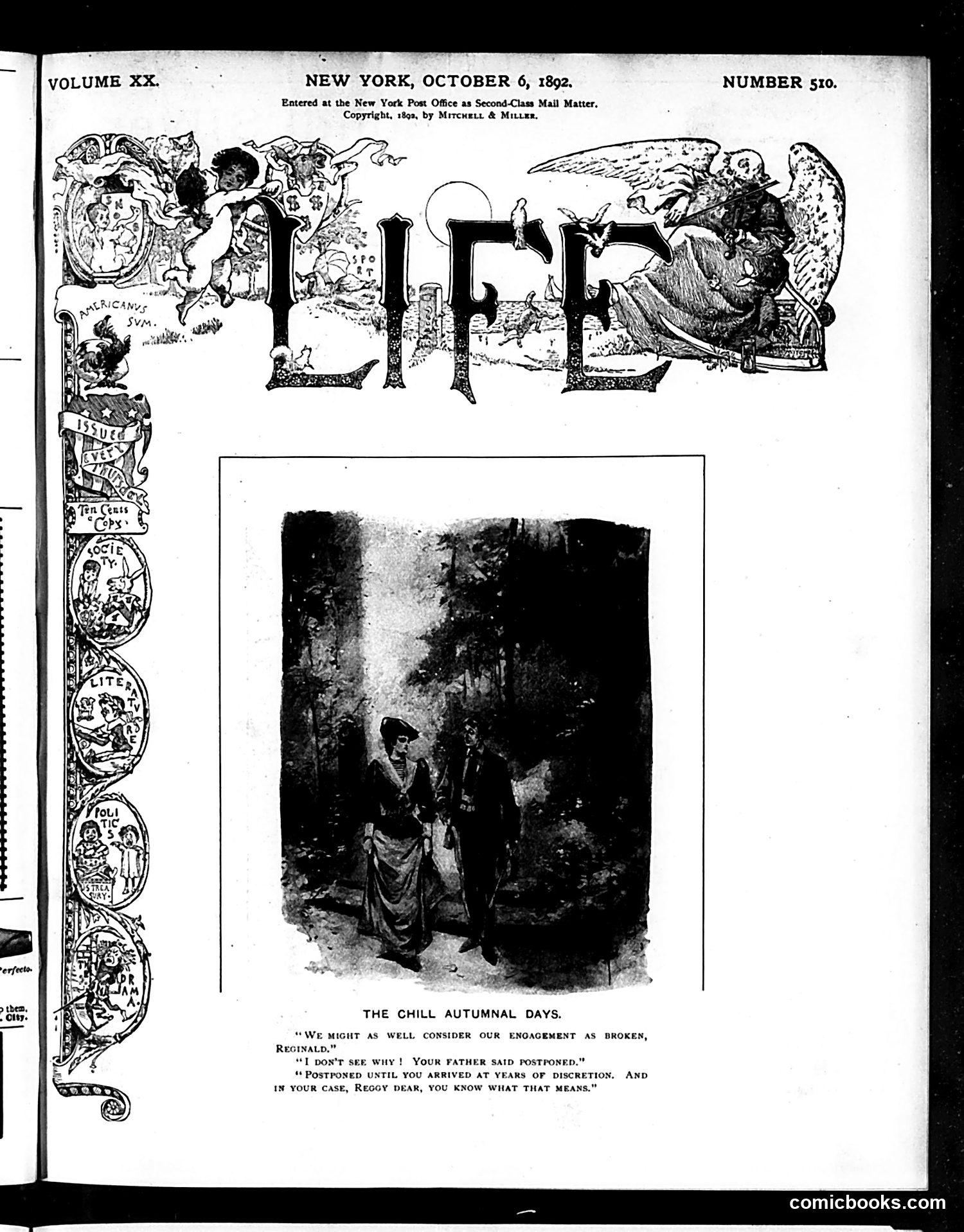
The main illustration depicts two figures in a darkened forest setting, apparently in emotional distress or conflict. The caption quotes dialogue suggesting a broken engagement: "We might as well consider our engagement as broken, Reginald" and references a father postponing marriage "until you arrived at years of discretion," concluding that the woman now understands "what that means." This appears to be satirical commentary on romantic entanglements and conditional marriage agreements of the 1890s era. The "chill autumnal days" likely metaphorically represent the cooling of romance or the passage of time affecting the relationship's viability. The darkened, melancholic illustration reinforces themes of disappointment and failed expectations in courtship and marriage arrangements of the period.
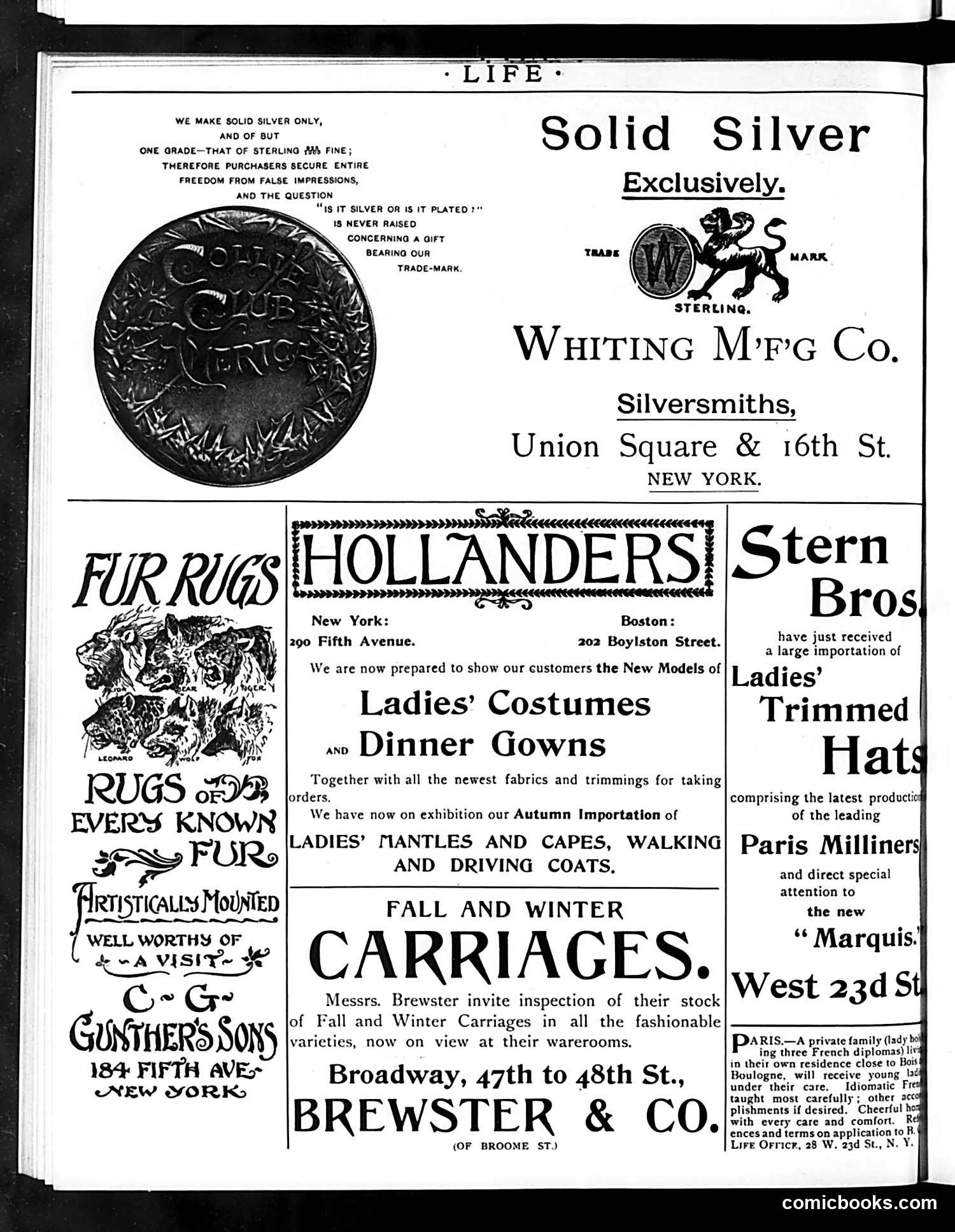
This page is primarily **advertising**, not political satire. It contains no identifiable political cartoons or social commentary. The ads promote luxury goods typical of the Gilded Age (late 1800s): - **Whiting Mfg Co.**: Sterling silver tableware, emphasizing "solid silver only" to assure quality - **Hollanders**: Ladies' fashions, dinner gowns, mantles, and capes - **Brewster & Co.**: High-end carriages for fall/winter - **Stern Bros**: Imported Paris millinery (hats) - **Gunthers Sons**: Fur rugs, artistically mounted The page reflects wealthy consumer culture and concerns about product authenticity (note the sterling silver company's emphasis on purity). There is no satirical commentary—just upscale merchants targeting affluent readers of *Life* magazine.
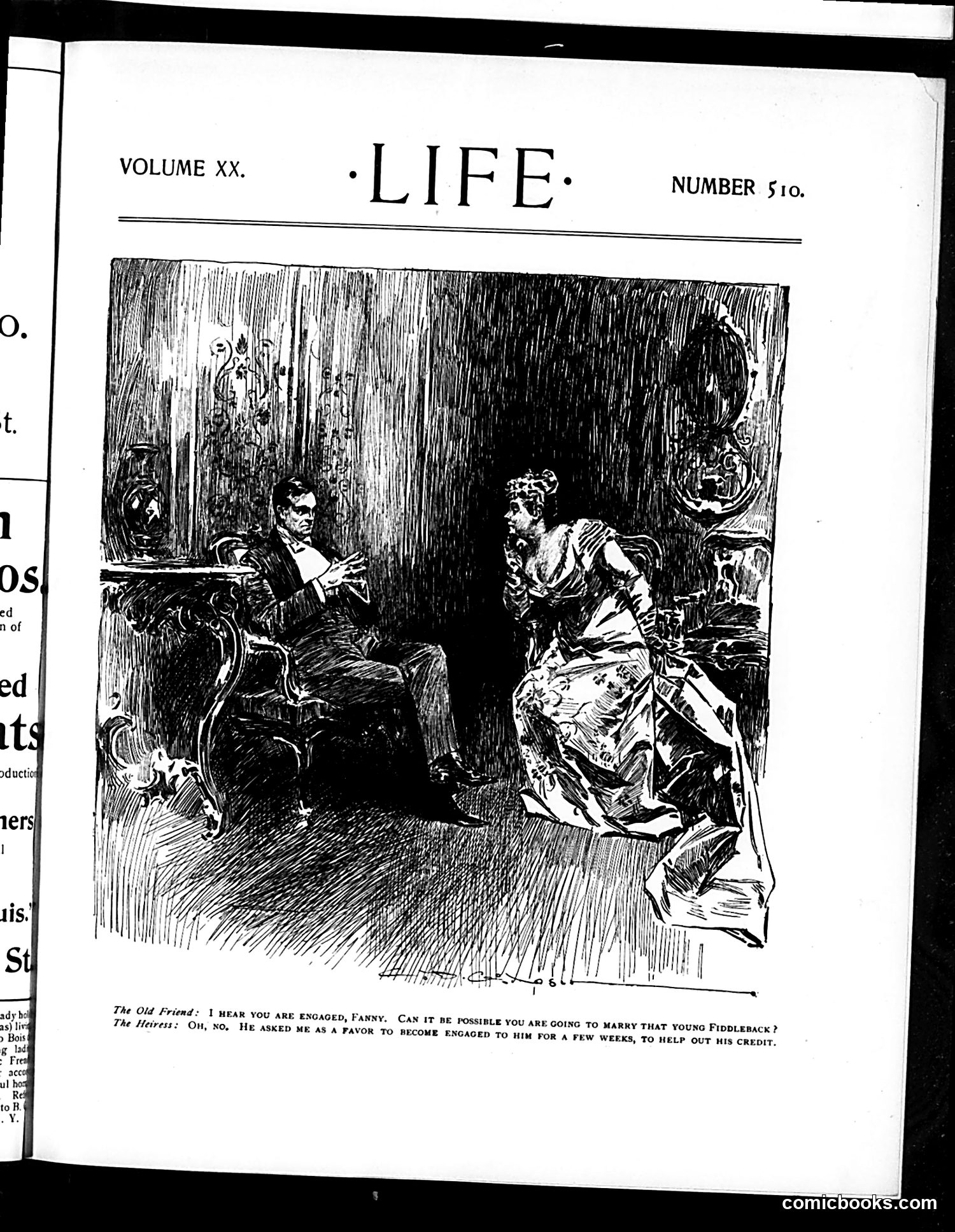
This is a satirical cartoon from *Life* magazine (Volume XX, Number 510) depicting a social comedy scene. An older gentleman (labeled "The Old Friend") converses with a young woman (labeled "The Heiress") in an ornate interior. The dialogue reveals the joke's premise: the old friend informs the heiress that a young man named Fiddleback has asked her to become temporarily engaged to him—as a favor to help restore his damaged financial credit. The heiress refuses. The satire targets both social pretension and financial desperation among the upper classes. It mocks the idea that a wealthy woman might temporarily pose as a suitor's fiancée to repair his reputation or finances, while also satirizing the audacity of such a request. The ornate setting emphasizes the social circles involved.
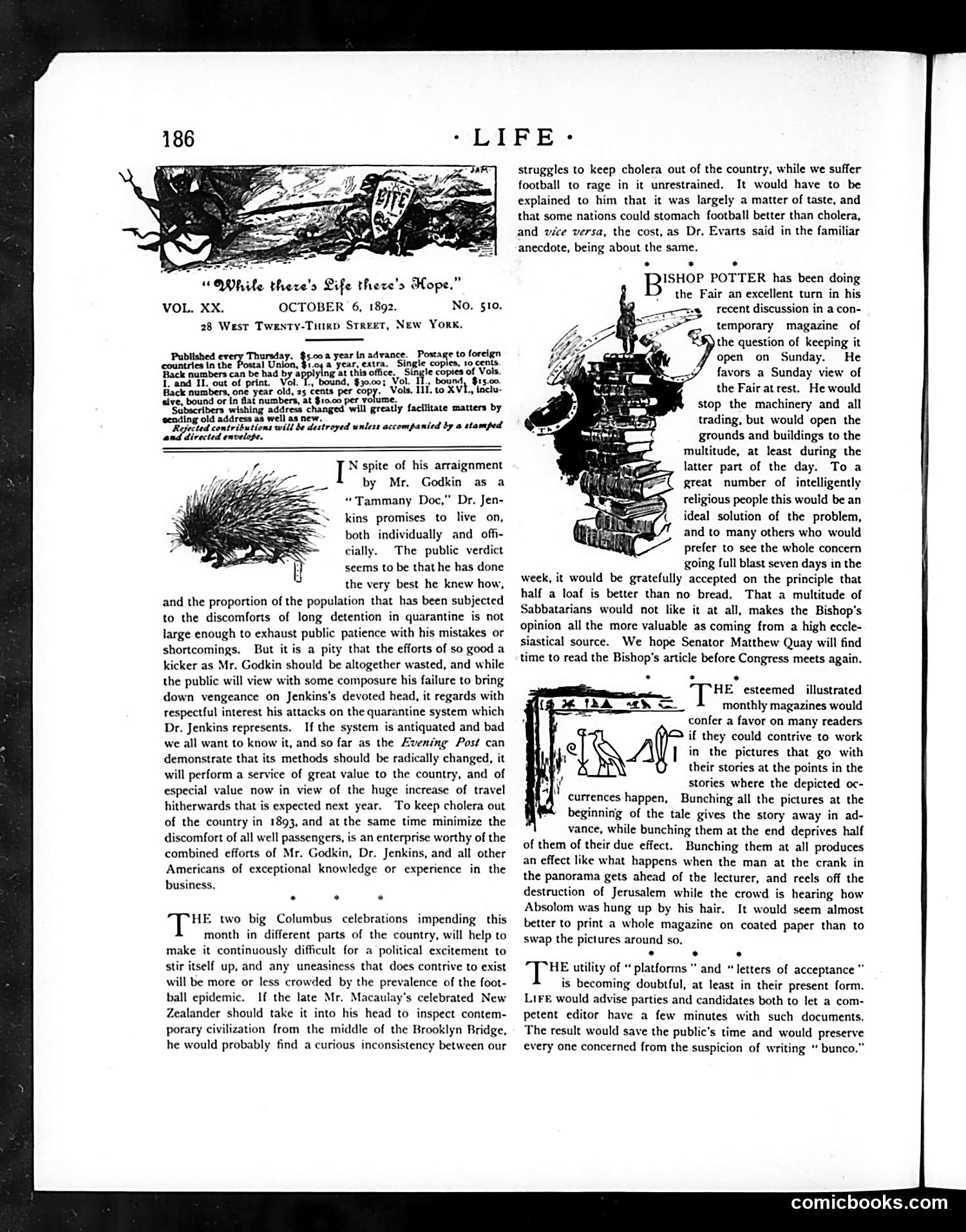
The main cartoon depicts a figure labeled "Cholera" as a spiky, menacing creature—a visual metaphor for the disease threat then facing America. The accompanying text discusses efforts to keep cholera out of the country while football remains "unrestrained," suggesting contemporary anxieties about public health versus popular entertainment priorities. The page also references Bishop Potter's debate about Sunday Fair operations—whether machinery should stop on Sundays for religious observance, or if grounds should open to the public. This reflects 1890s tensions between religious tradition and modern commercial/recreational practices. The smaller cartoon showing stacked books and machinery appears to satirize illustrated magazines' tendency to bunch pictures together, potentially spoiling narrative effect—a meta-commentary on magazine design choices of the era.
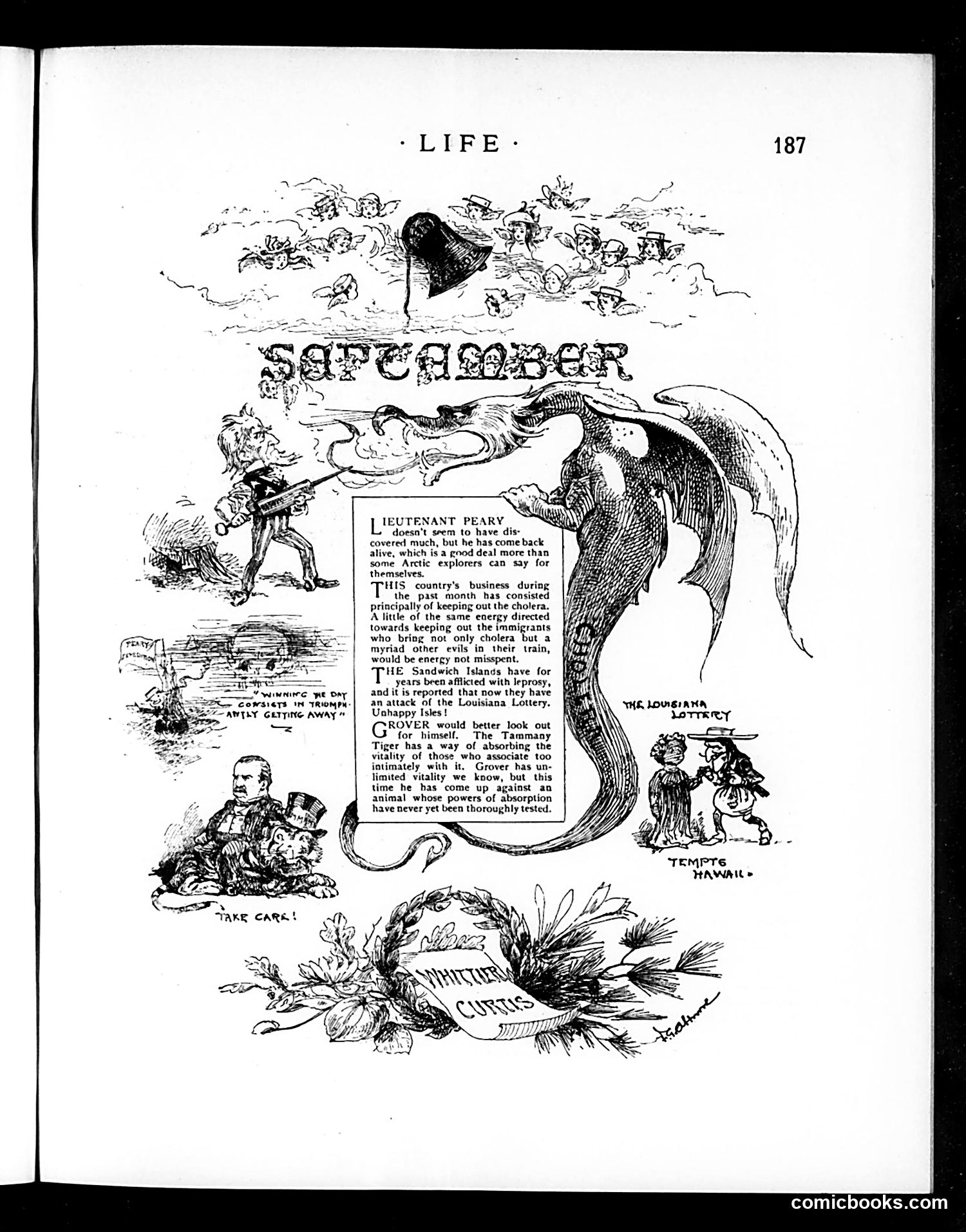
This page satirizes early 1900s American political and social concerns. The central Louisiana Lottery cartoon mocks a widespread gambling scheme that preyed on citizens. "Lieutenant Peary" references Arctic explorer Robert Peary's expeditions; the satire suggests his survival is "a good deal more than some Arctic explorers can say." The Tammany Tiger illustration references Tammany Hall, New York's notoriously corrupt Democratic political machine. The tiger symbolizes the organization's predatory power over citizens and governance. Various smaller vignettes address period ailments: cholera outbreaks, leprosy, and the "Louisiana Lottery" lottery scheme's harmful effects. The cartoons employ exaggerated figures and animals to mock both incompetent leadership and public gullibility toward dubious schemes and diseases.
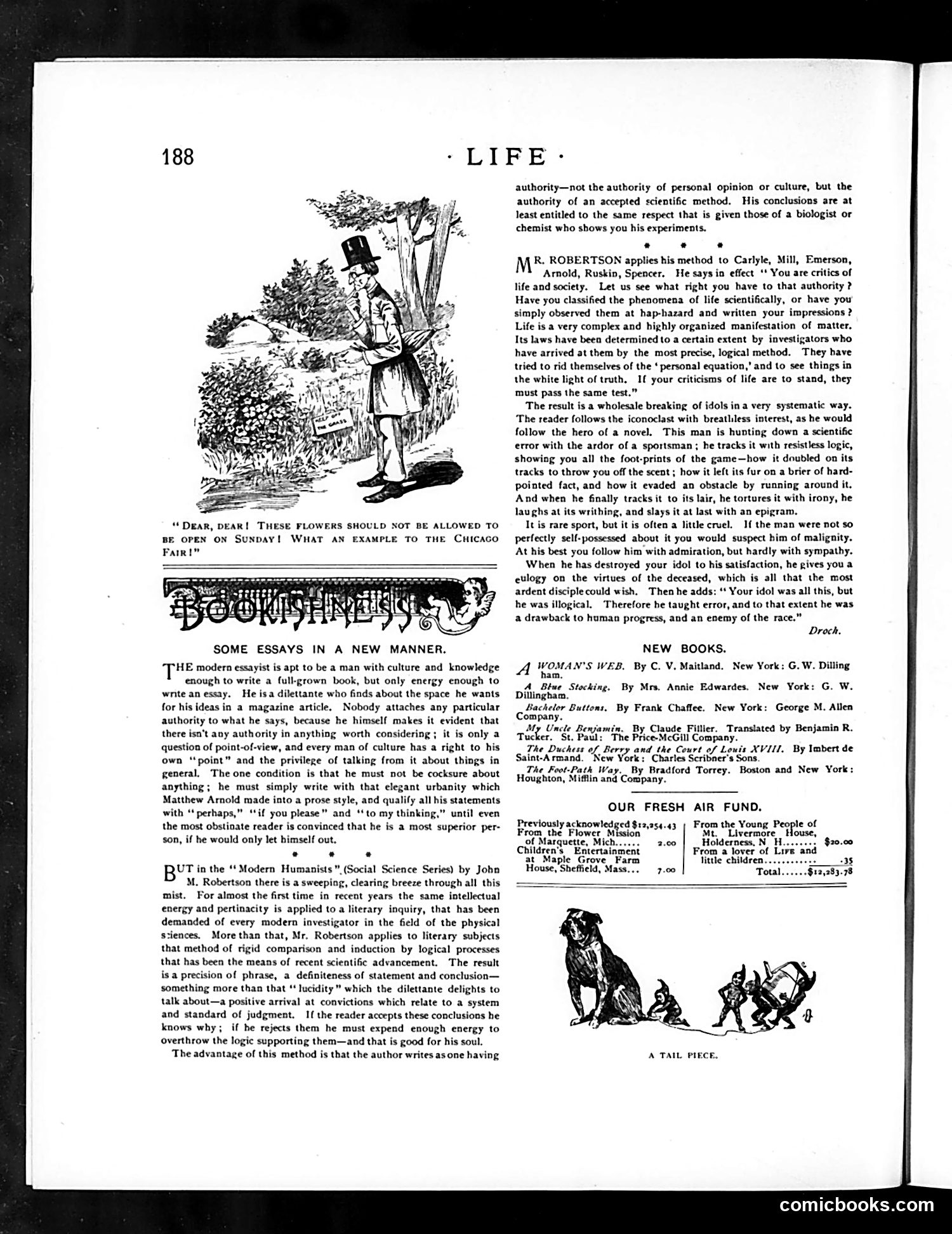
The main cartoon depicts a Victorian gentleman in a top hat addressing flowers, with the caption: "Dear, Dear! These flowers should not be allowed to open on Sunday! What an example to the Chicago Fair!" This satirizes religious conservatism of the era, likely referencing the 1893 World's Columbian Exposition in Chicago. The joke mocks strict Sabbatarian rules—the notion that even flowers opening naturally on Sunday violates religious propriety. The gentleman represents overzealous Victorian moralists who attempted to enforce Sunday closures of the fair, viewing it as desecration of the Sabbath. The accompanying essay discusses Mr. Robertson's analytical method applied to literary criticism, praising rigorous examination of ideas rather than personal opinion. The page includes book reviews and a small illustration labeled "A Tail Piece" showing animals in a humorous scenario.
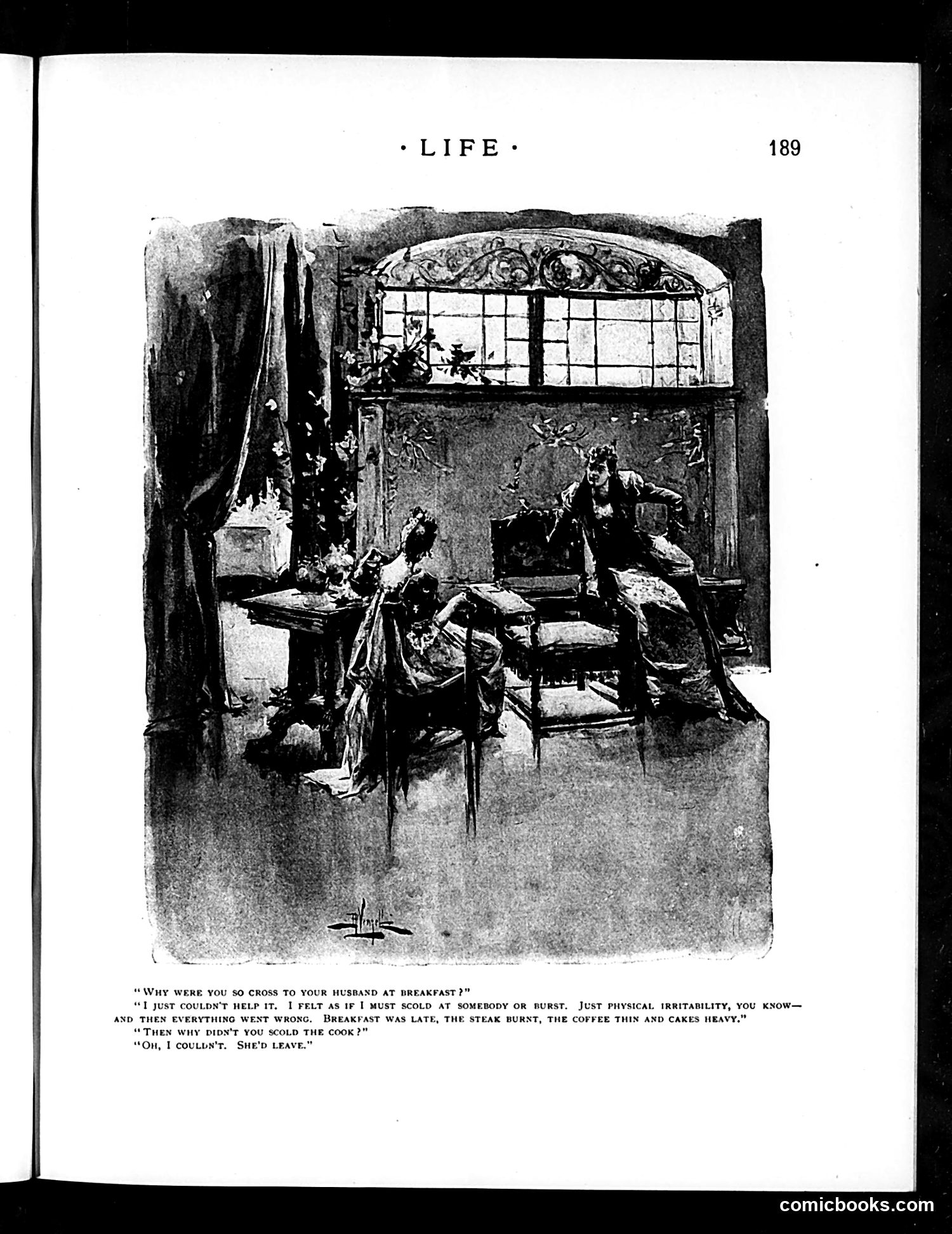
This early 20th-century domestic humor cartoon depicts a marital dispute. A woman explains her irritability to what appears to be a friend or confidante, attributing it to "just physical irritability, you know" rather than any real grievance with her husband. The satire targets both Victorian-era attitudes about women's emotions and domestic expectations. It mocks the dismissive explanation of female anger as merely hormonal ("physical irritability"), while simultaneously suggesting the husband's legitimate complaint about her cooking—the steak was burnt, coffee thin, and cakes heavy. The cartoon satirizes how both spouses use convenient excuses: she blames biology, he blames her cooking, avoiding actual communication about their marital dissatisfaction.
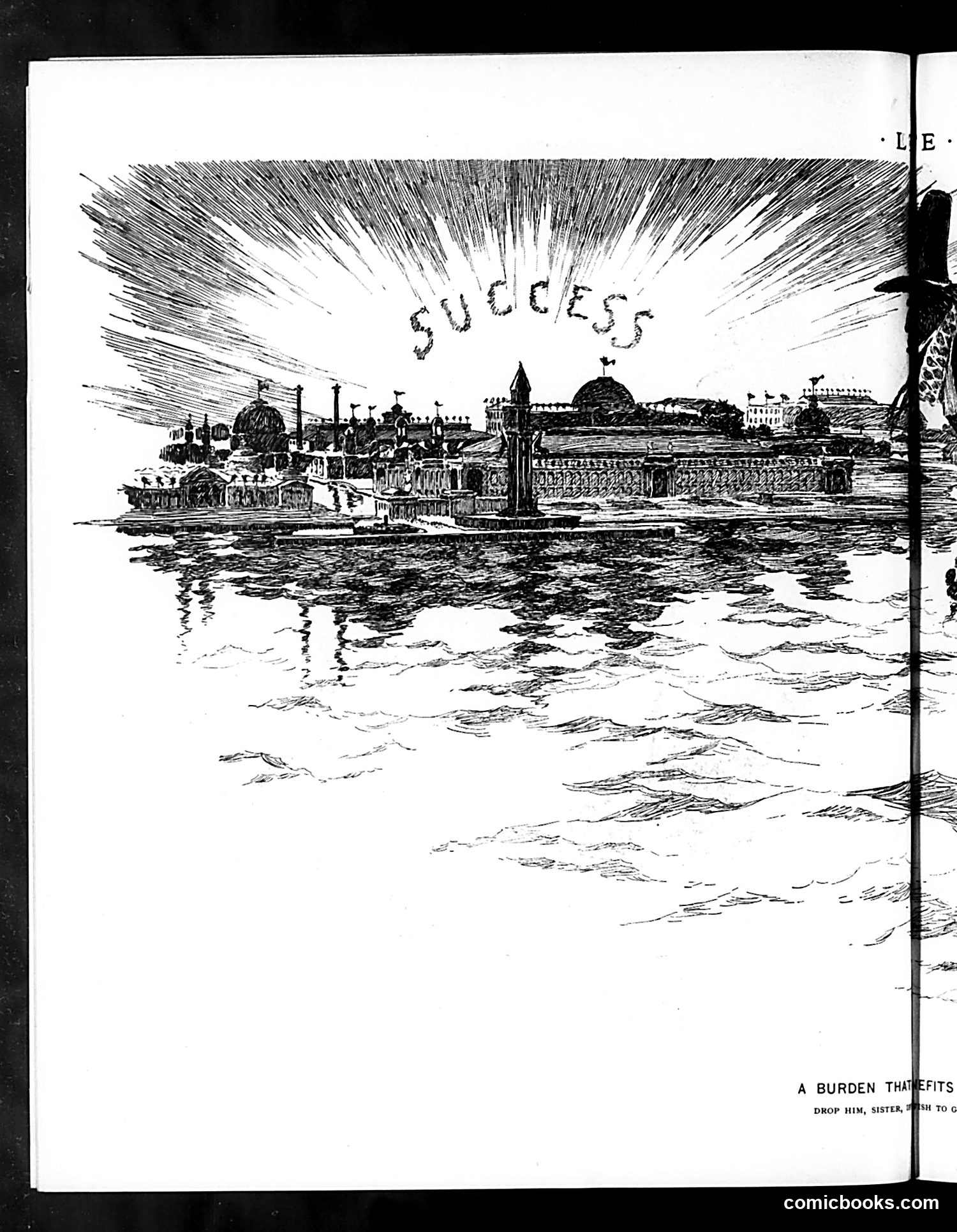
This page shows a satirical cartoon titled "Success" depicting an industrial cityscape across a body of water, with dramatic radiating lines suggesting prosperity or achievement emanating from the city. The partially visible text at bottom reads "A BURDEN THAT FITS / DROP HIM, SISTER, F[?] TO G," suggesting commentary on romantic relationships or social dynamics. The cartoon appears to be commentary on **industrial progress and urban development** — likely satirizing either the costs of such "success" or the hollow nature of material advancement. The dramatic artistic style and the cryptic caption suggest the "burden" referenced may relate to the human cost or social consequences of industrial growth. Without fuller context or dating information, the exact political target remains unclear, though the tone is distinctly critical of some aspect of modern industrial society.
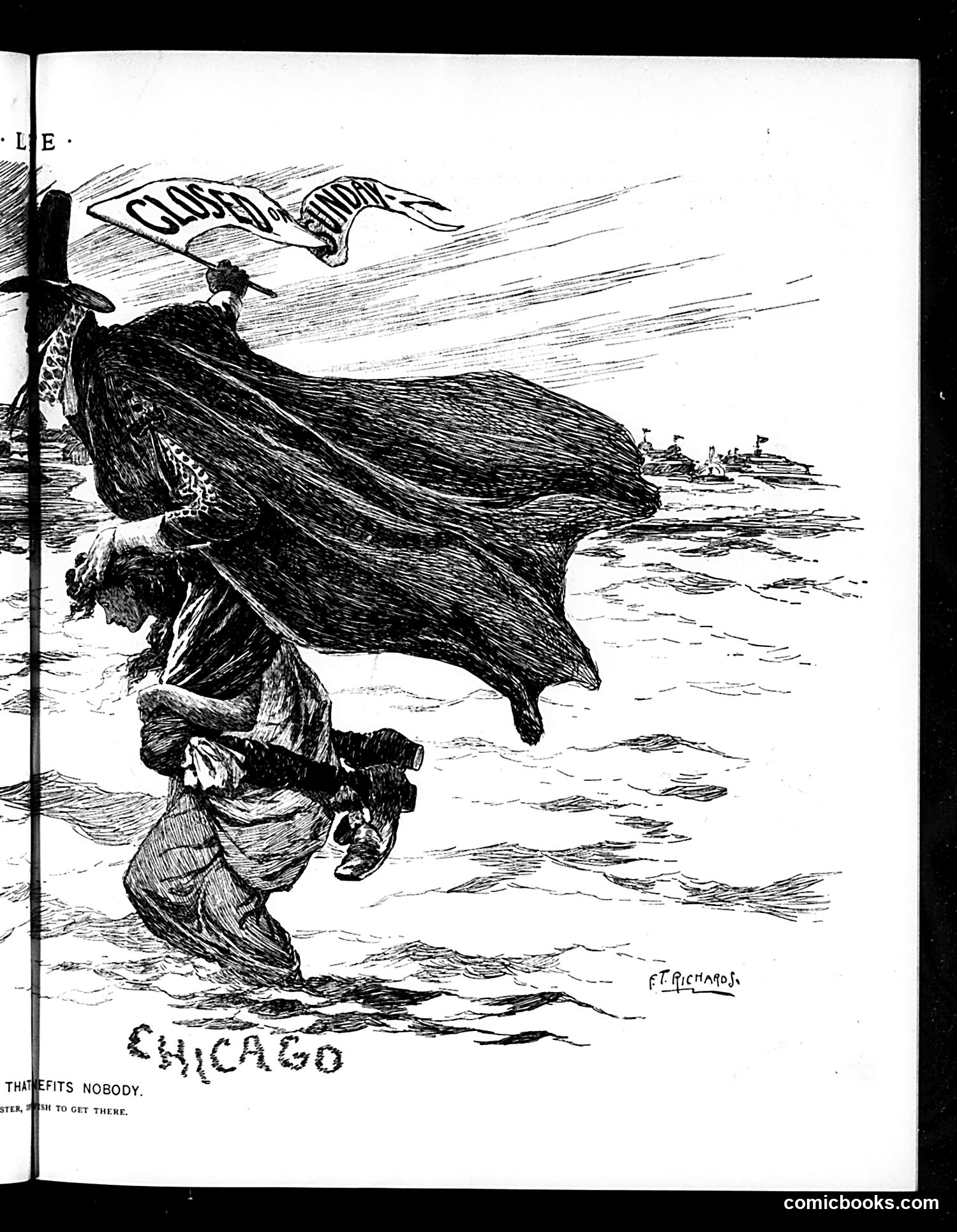
This political cartoon by F.P.Richmont depicts a figure struggling against strong winds while holding a tattered flag labeled "CHICAGO." The figure appears to be a personification of Chicago itself, being buffeted by adverse conditions. In the background, ships are visible on water. The caption reads "THAT BEFITS NOBODY, [?] TO GET THERE," though the complete text is partially obscured. The cartoon likely satirizes Chicago's difficulties—possibly economic hardship, corruption, or political instability during a specific crisis period. The struggling figure suggests the city is beleaguered or fighting against overwhelming forces. The flag indicates Chicago's civic identity is being tested or threatened. Without the full caption and precise historical date, the exact reference remains unclear, though the imagery suggests commentary on the city facing significant adversity.
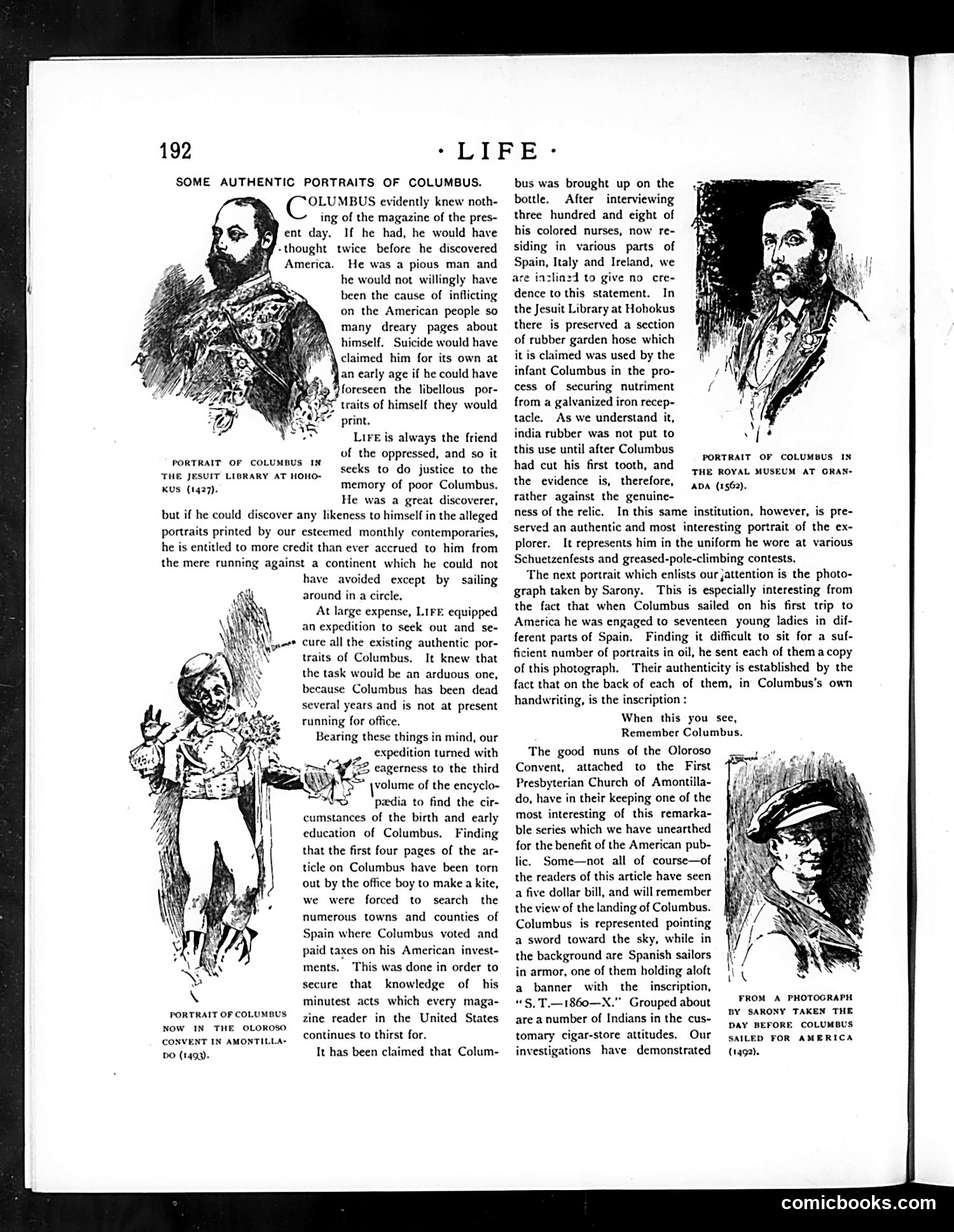
This page examines various historical portraits of Columbus, presenting them as authentic depictions from different sources—the Jesuit Library at Hohokus, a Granada portrait, and others. The satire appears to be about the *lack* of reliable Columbus imagery: the article notes Columbus died centuries ago and is "not at present running for office," making his true appearance unknowable. The humor lies in the magazine treating this historical absence seriously, as if Columbus were a contemporary political figure whose portrait authenticity matters for electoral purposes. The text mentions Columbus "engaged to seventeen young ladies" in Spain, adding absurdist biographical details. The central cartoon—Columbus as a caricatured figure—may mock how Columbus's image has been invented rather than documented.
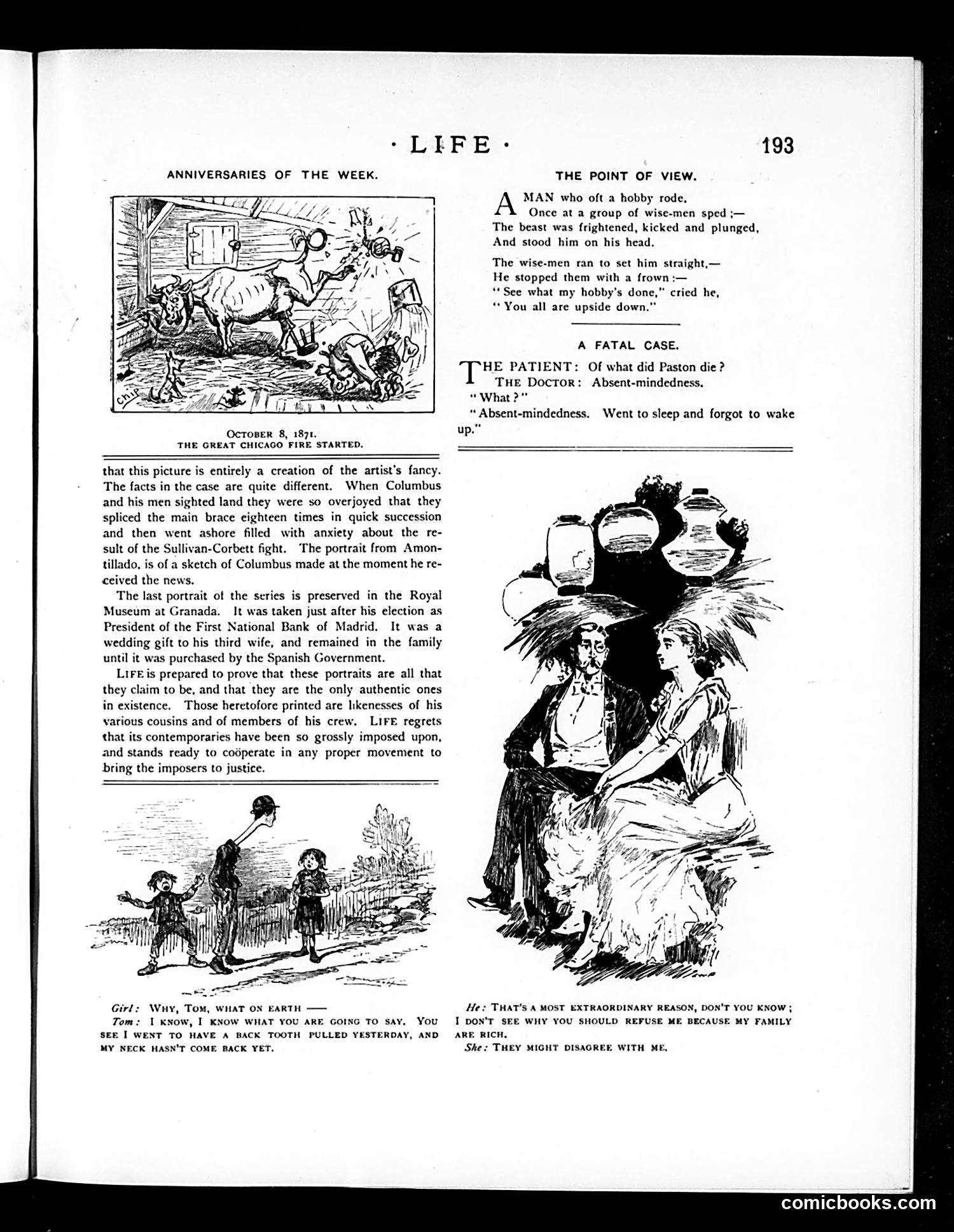
This page contains three distinct satirical items: **Top cartoon ("The Point of View"):** A man on a hobby horse frightens a real horse, which bucks and throws its rider. Wise men observe the chaos, noting the hobbyist has turned everyone "upside down." The satire critiques how hobby-riders (obsessive amateurs) cause disproportionate disruption. **"A Fatal Case":** A doctor-patient dialogue where a patient died from "absent-mindedness"—falling asleep and forgetting to wake up. This dark humor satirizes absent-mindedness as literally fatal. **Bottom illustration with caption:** A girl tells Tom she needs a tooth pulled and her neck won't come back. This appears to be a children's joke about dental work, playing on literal language misunderstanding. The page showcases Life's mix of adult satire and mild humor typical of late 19th-century American comedy.
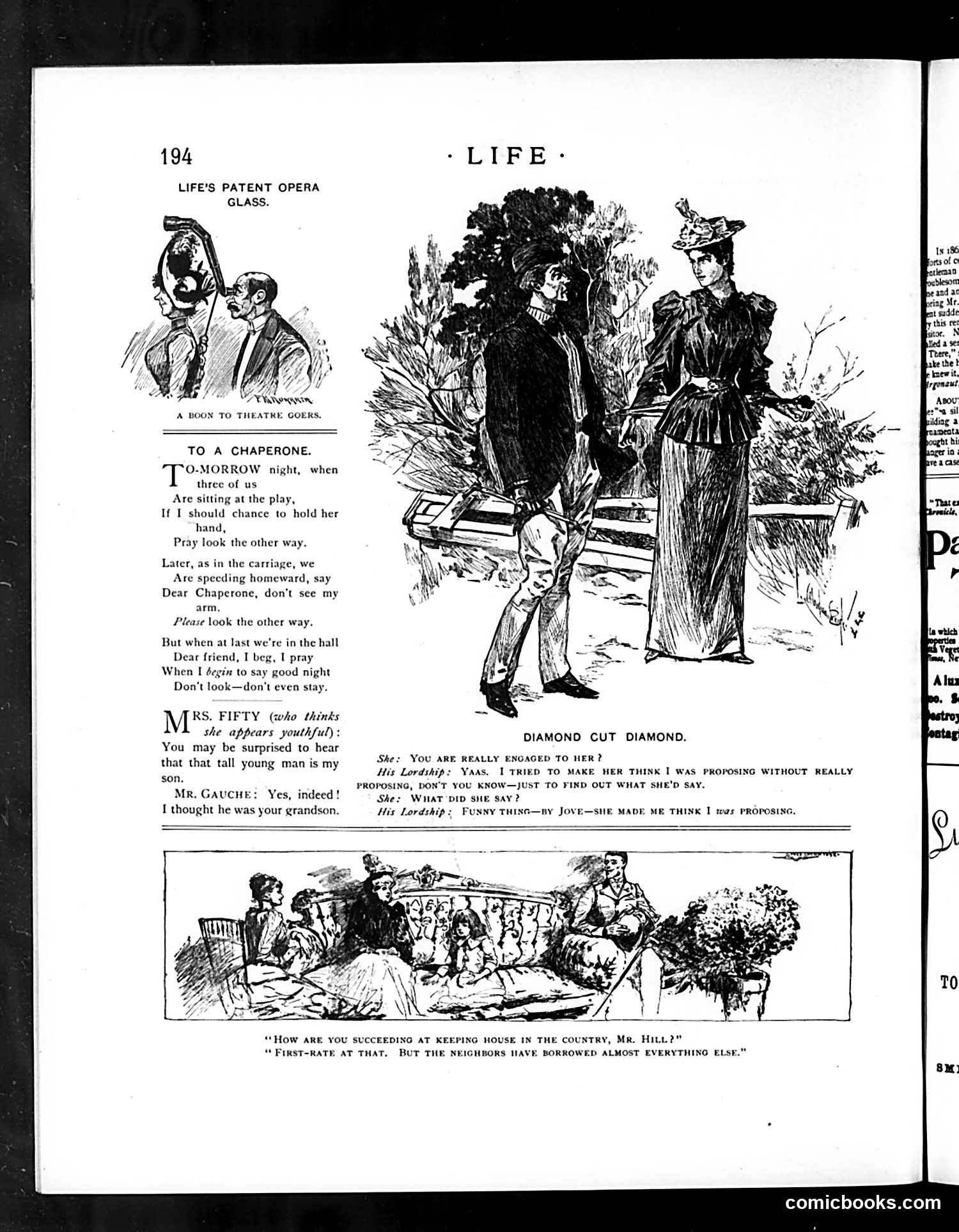
This page contains three separate satirical pieces mocking courtship and social conventions of the era: 1. **"To a Chaperone"** (poem): Satirizes the restrictive social rules requiring chaperones at courtship occasions. A young man pleads with a chaperone to deliberately ignore his romantic advances—holding hands at the theater, arm-linking in carriages, and final goodbyes—exposing the absurdity of pretending impropriety isn't happening while technically maintaining propriety. 2. **"Mrs. Fifty"**: Mocks vain older women who misrepresent their age. Mrs. Fifty claims a grown man is her son; Mr. Gauche's response that he assumed the man was her grandson is a cutting insult about her apparent age. 3. **"Diamond Cut Diamond"**: Satirizes deceptive courtship tactics. A lord attempts to fake a proposal to gauge a woman's interest, but she turns the tables—feigning acceptance to determine *his* true intentions. Both parties outsmart each other through dishonesty. The page's theme: courtship involves elaborate games, pretense, and mutual deception.
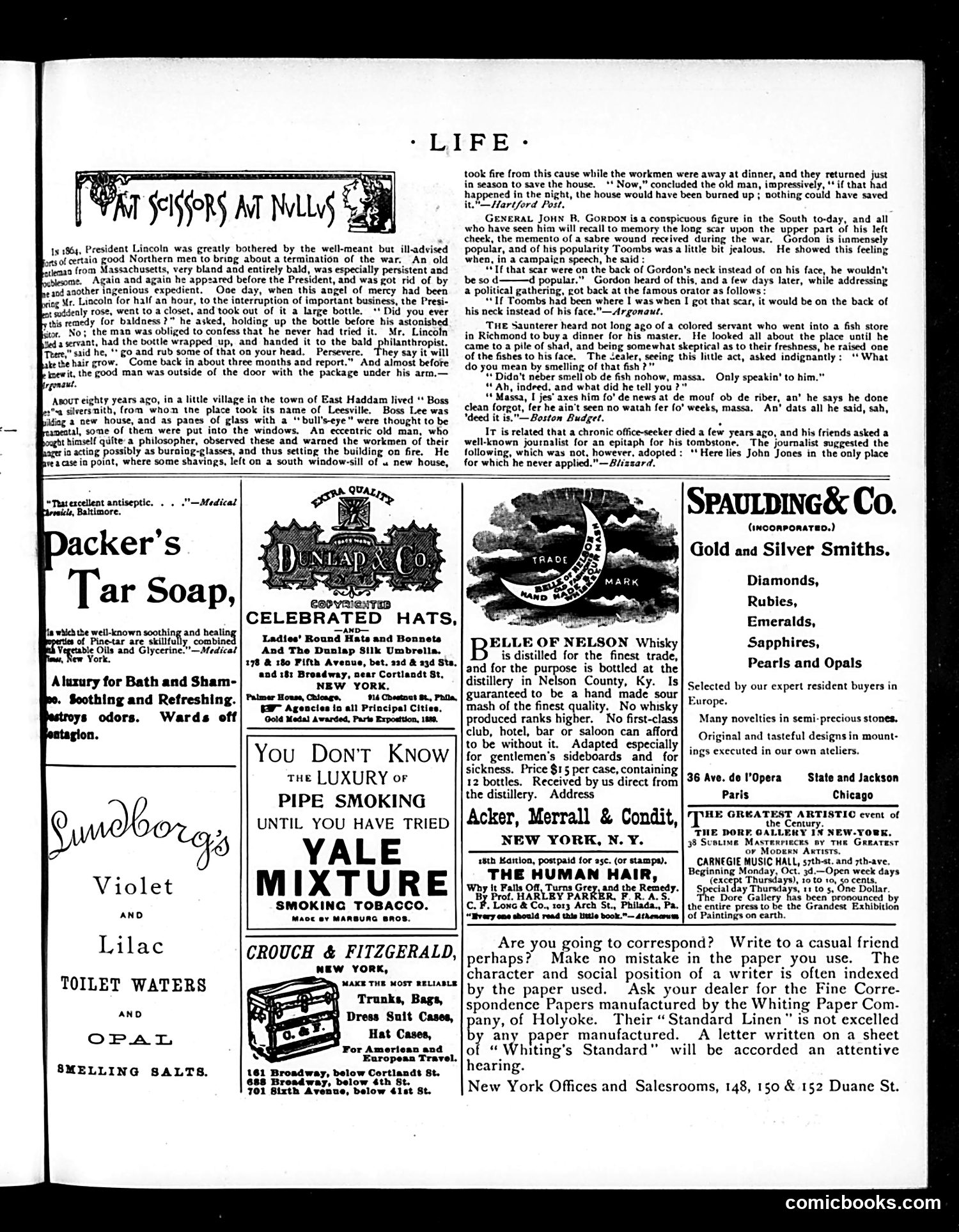
This page from *Life* magazine consists primarily of **humorous anecdotes** rather than political cartoons. The stories illustrate period humor through several short tales: 1. **Lincoln and baldness**: President Lincoln deflects an annoying peace advocate by giving him a bogus hair-growth remedy, a practical joke showing Lincoln's wit under wartime pressure. 2. **General Gordon's scar**: A rivalry between Southern political figures—Gordon (popular, bearing a visible war wound) and Toombs (jealous). Gordon cleverly retorts to Toombs's insult by suggesting Toombs would have been scarred differently had he been in combat, implying cowardice. 3. **The fish vendor anecdote**: A racial stereotype humor piece typical of the era, depicting a Black servant's dialect and supposed foolishness. The page is otherwise filled with **period advertisements** for soaps, hats, tobacco, and jewelry. The content reflects late 19th-century American values and humor conventions, including casual racism now recognized as offensive.
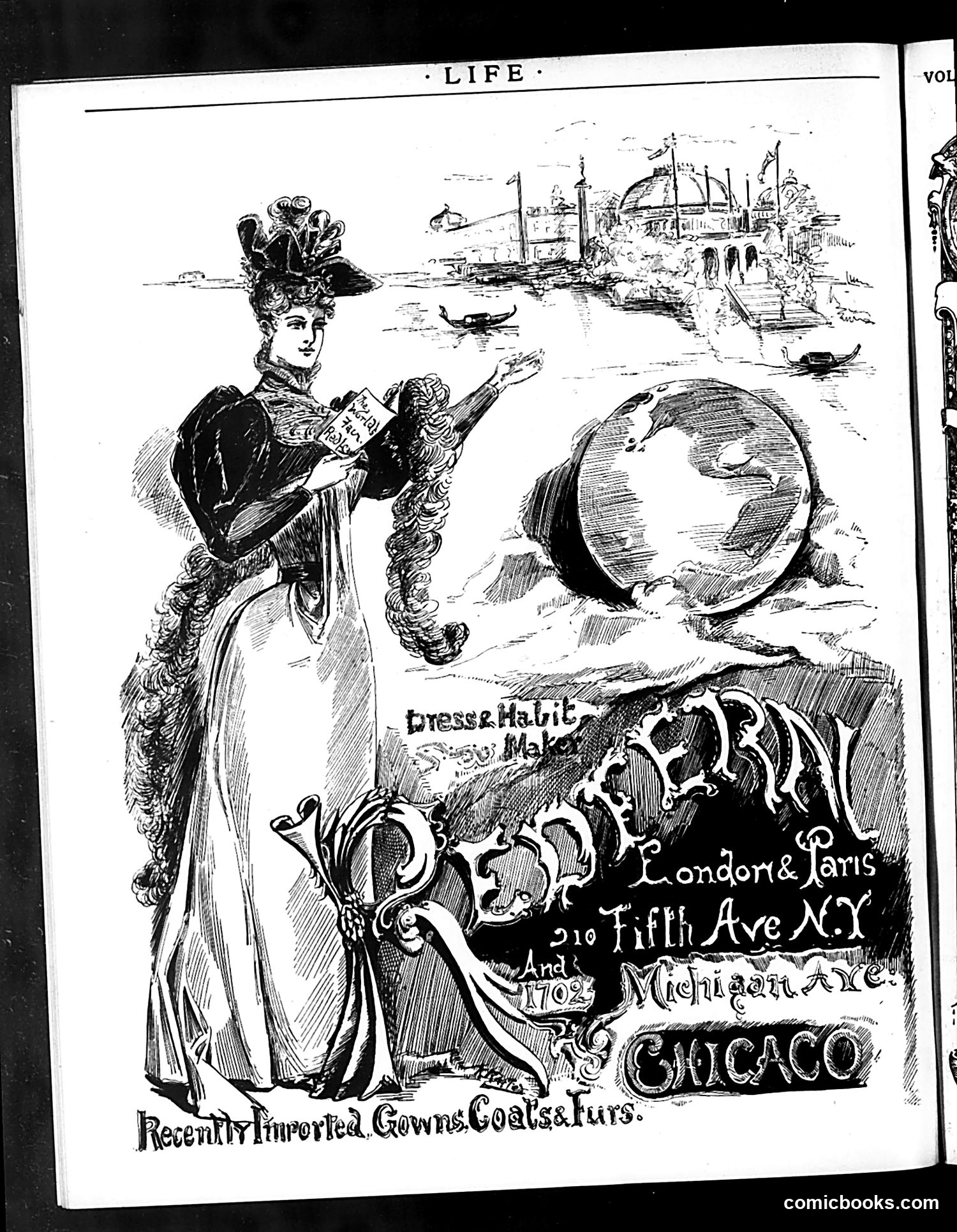
This page is primarily a **fashion advertisement** for a dress and habit maker. The central figure is an elegantly dressed woman in Edwardian-era attire, holding what appears to be a fashion catalog or advertisement. She gestures toward a globe, suggesting international sophistication. The ornate text advertises "Dress & Habit Maker" with locations in **London, Paris, New York, and Chicago**—emphasizing the business's cosmopolitan prestige. The tagline reads "Recently Imported Gowns, Coats & Furs," appealing to wealthy American customers who valued European fashion. The background sketch depicts what appears to be a **Venetian or Mediterranean harbor scene**, reinforcing the European glamour and continental style the advertiser wishes to associate with their products. This is primarily commercial rather than satirical content.