
A complete issue · 18 pages · 1892
Life — September 15, 1892
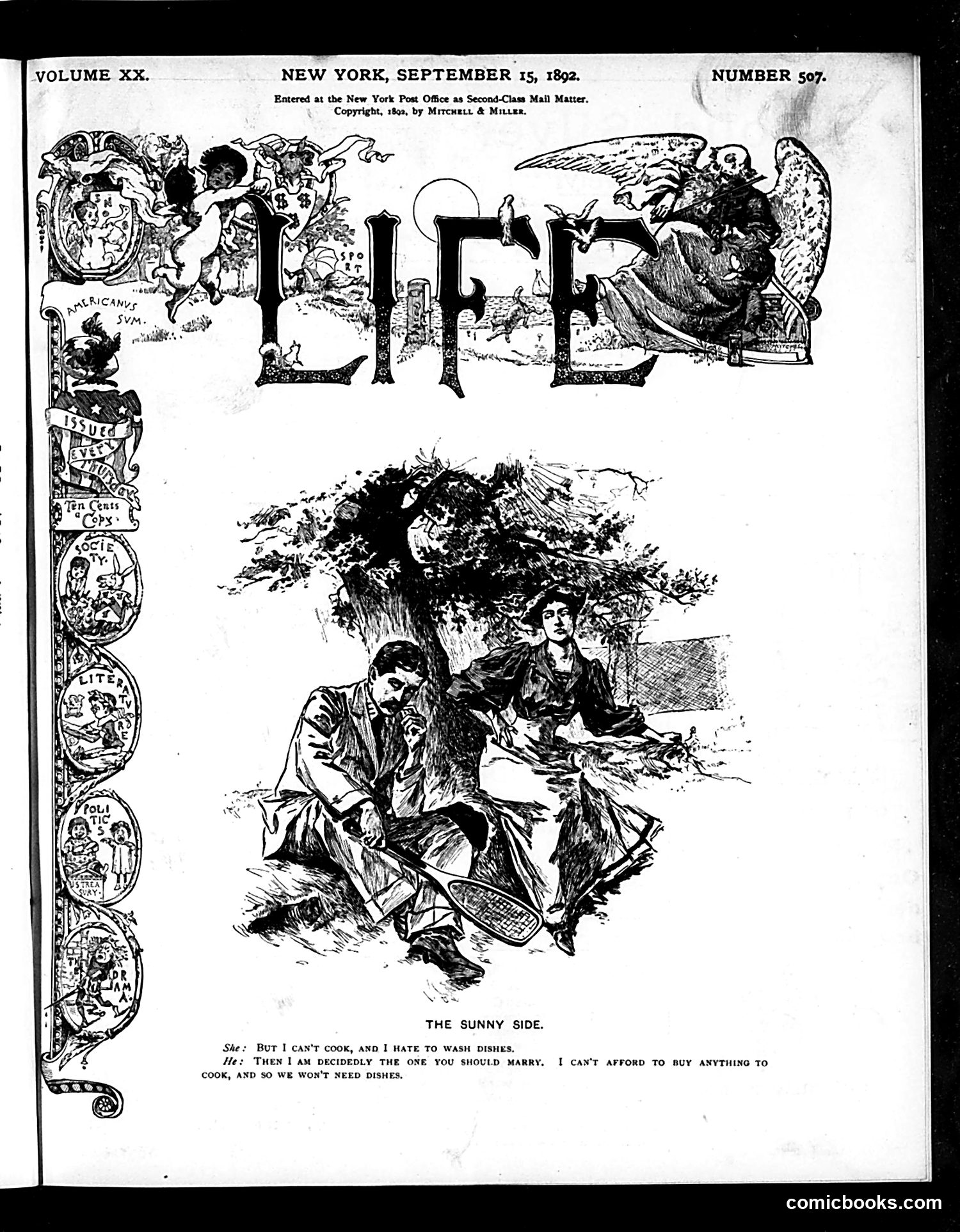
This cartoon satirizes traditional gender roles and marriage economics. The illustration shows a couple beneath a tree, with dialogue where the woman declares she cannot cook and refuses to wash dishes. She states the man should marry someone domestic. His retort emphasizes his inability to afford household help—so without her domestic labor, they cannot function as a couple. The satire targets the absurdity of marriage as an economic arrangement where women's unpaid domestic work is essential yet undervalued. The "sunny side" title ironically frames this domestic impasse as a lighthearted matter. The piece reflects late-19th-century anxiety about changing gender expectations and women's growing resistance to traditional domestic servitude.
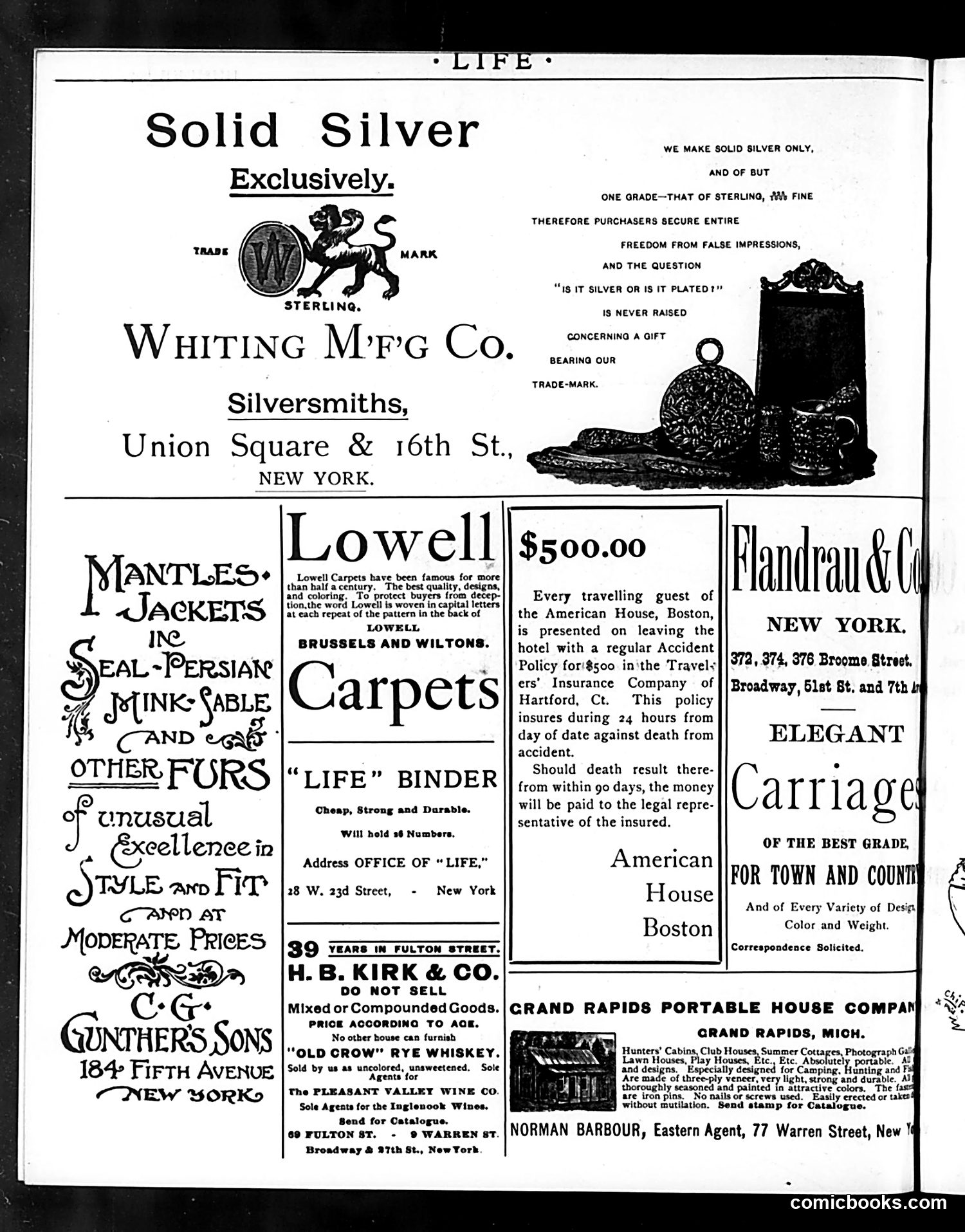
This page is primarily **advertising**, not satire or political cartoon. It contains multiple commercial advertisements from late 19th or early 20th century New York businesses: - **Whiting M'fg Co.** advertises sterling silver flatware and serving pieces, emphasizing their solid silver construction to counter concerns about silver-plated imitations - **C.G. Gunthers Sons** promotes furs (mantles, jackets, mink, seal-Persian) - **H.B. Kirk & Co.** sells wine - **Lowell Carpets** advertises their products - **Flandraw & Co.** markets carriages - **Grand Rapids Portable House Company** offers prefabricated homes The page reflects consumer concerns of the era: authenticity of materials, fashionable luxury goods, and emerging technologies. No political satire is present.
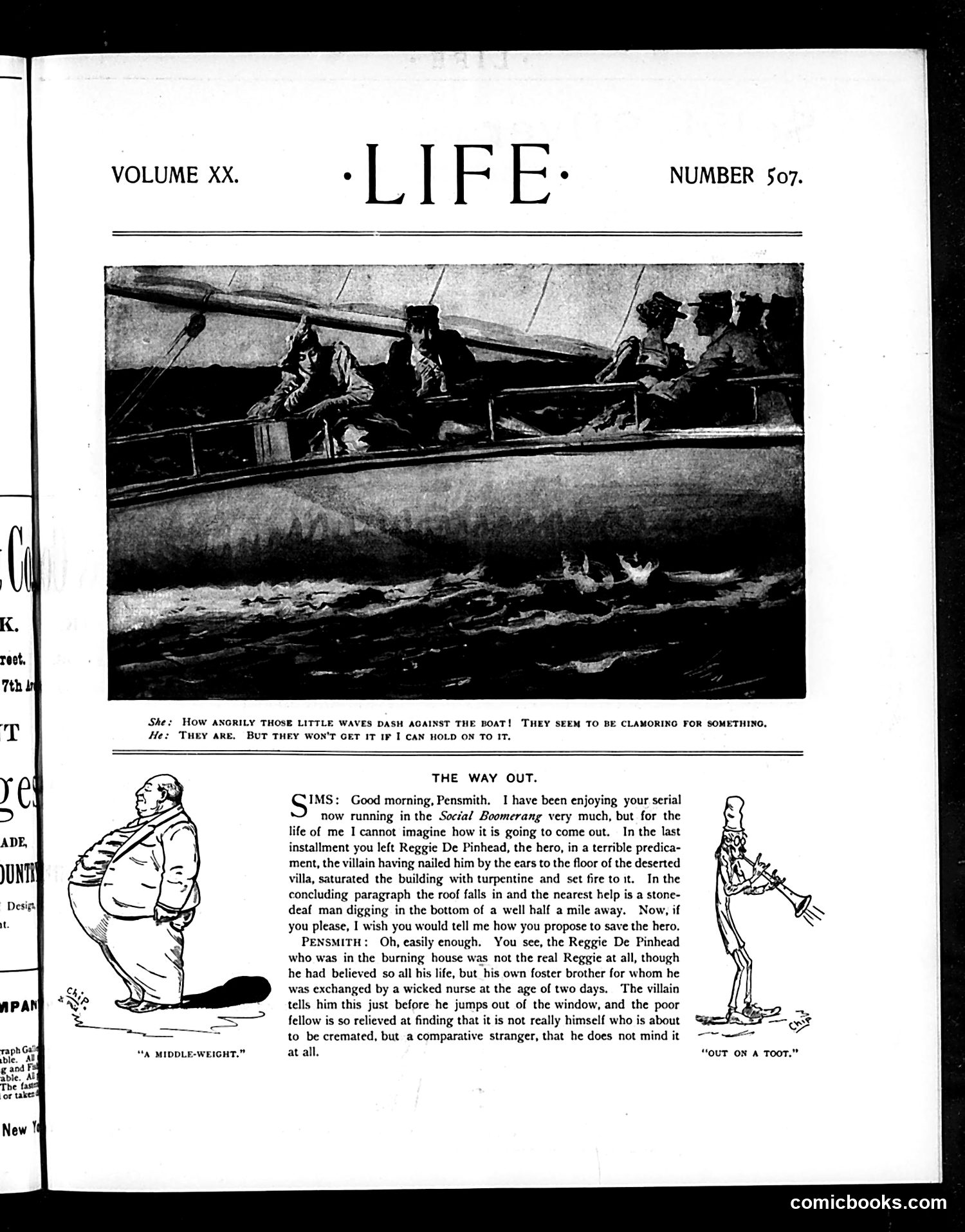
This page from *Life* magazine contains a conversation between characters named Sims and Pensmith discussing a serialized story called "Social Boomerang" running in the publication. The dialogue reveals plot details: the hero, Reggie De Pinhead, has been trapped in a burning villa by a villain who set it on fire. Pensmith proposes a solution—revealing that the "real" Reggie De Pinhead died in infancy and was secretly replaced by a foster brother via a wicked nurse. Therefore, the man about to be cremated is actually a stranger, making his death acceptable. The two cartoons flanking the text ("A Middle-Weight" and "Out on a Toot") appear to be unrelated satirical character sketches typical of *Life's* humor style, mocking contemporary social types rather than commenting on specific political events.
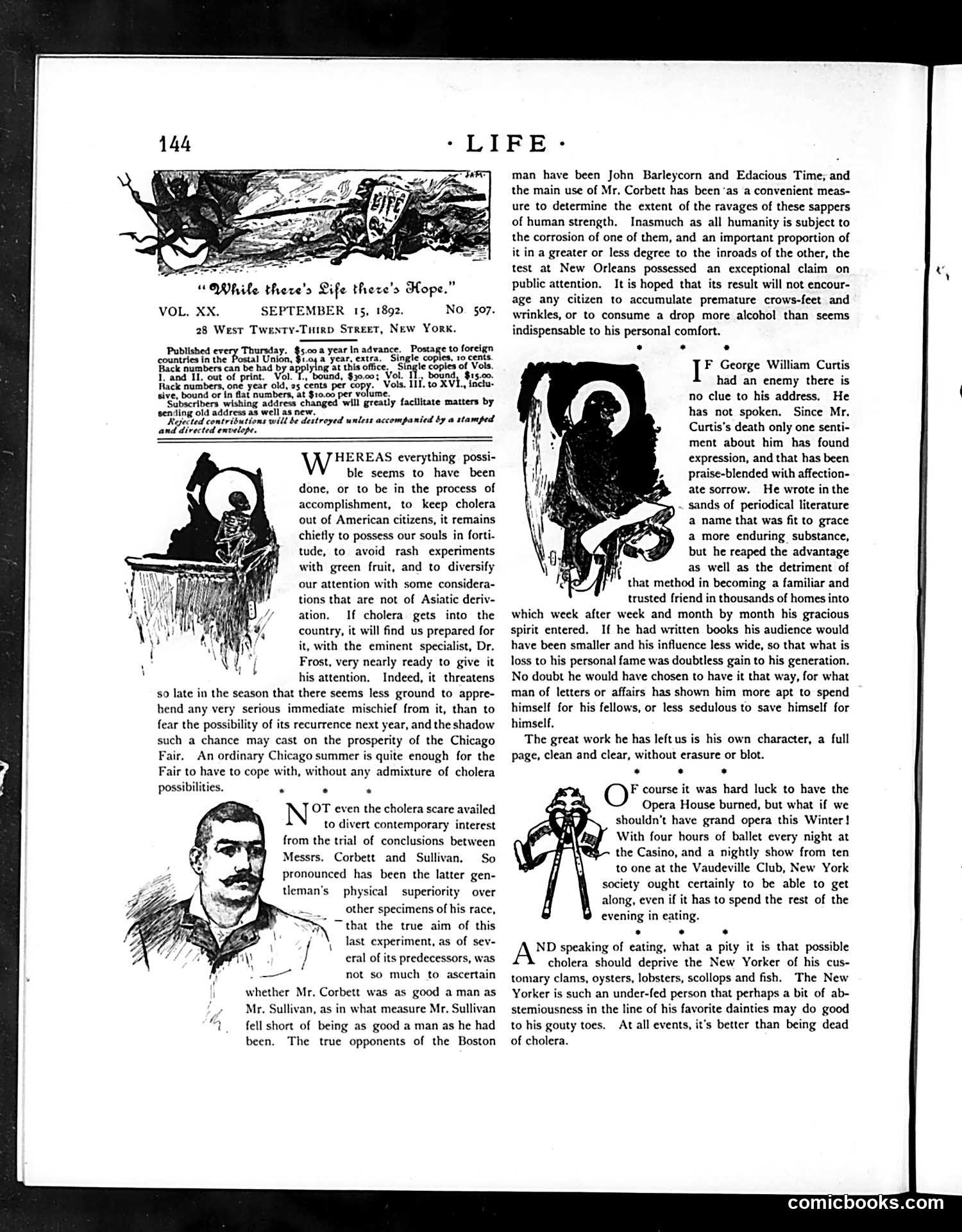
This page contains satirical commentary on the 1892 cholera outbreak in America. The text references a scientific experiment (likely the Sullivan-Corbett trial mentioned) examining whether cholera could be transmitted through fruit and diverse diet—suggesting contemporary uncertainty about disease transmission. The illustrations appear to depict death or disease personified, reflecting public anxiety about cholera's devastating spread. The satirical tone mocks both the medical uncertainty and New Yorkers' priorities: the author jokes that losing access to oysters, clams, and fine dining from the Opera House and Casino would be worse than cholera itself—a dark humor about class privilege during a public health crisis. The piece criticizes how the wealthy might suffer inconvenience from disease precautions while the broader population faced genuine mortality.
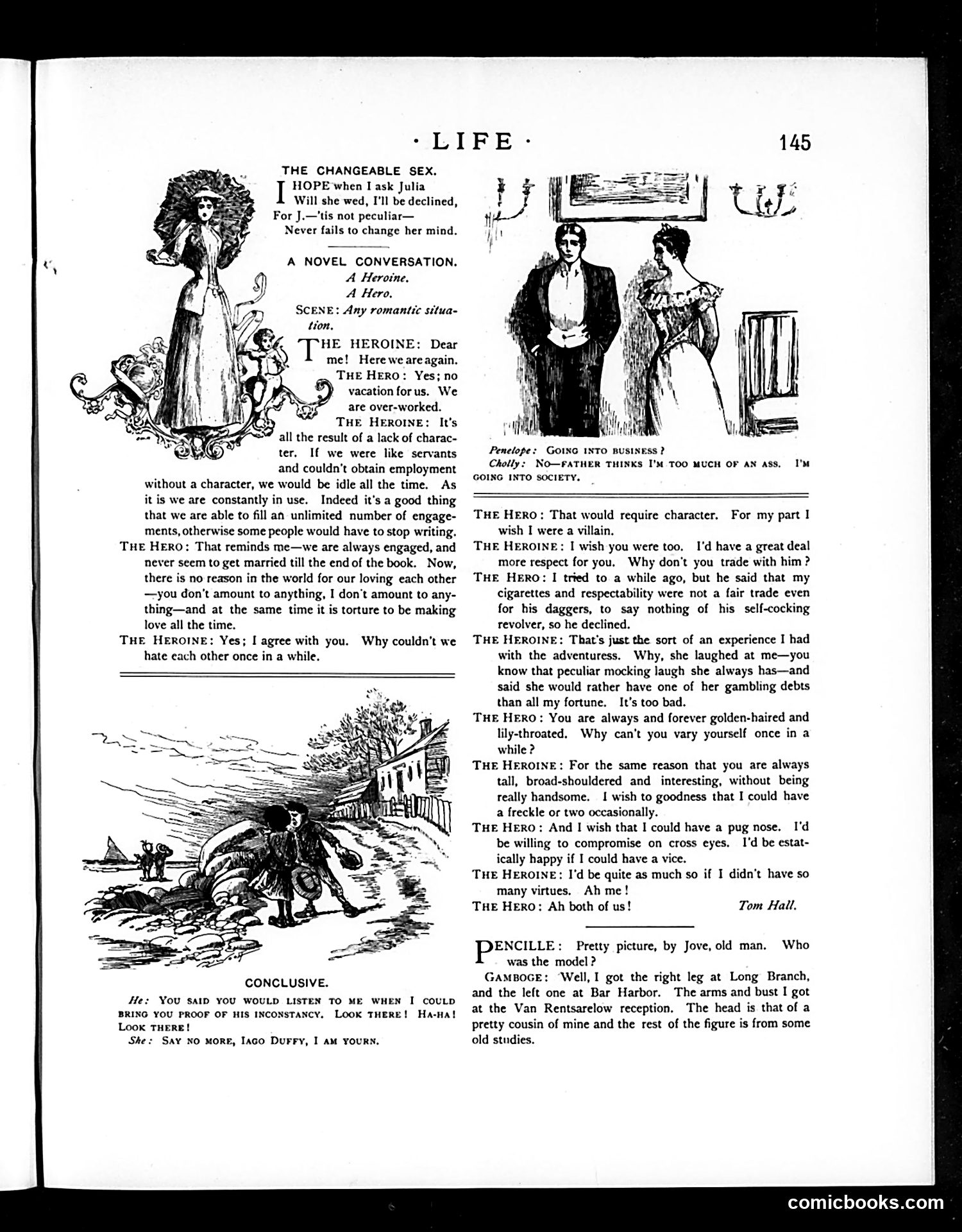
This page contains a satirical dialogue titled "The Changeable Sex" between a Heroine and Hero, mocking women's perceived inconsistency. The conversation ridicules female vanity—the Hero suggests the Heroine trades partners too easily, while she counters that he's equally fickle. Their exchange uses exaggerated compliments and insults as ammunition. The accompanying illustrations—a decorative woman figure and a couple in formal dress—support the domestic comedy theme. A lower vignette shows a slapstick scene of someone falling from a horse. At bottom, "Pencille" discusses a portrait's composition, combining different models' body parts. The satire reflects early 20th-century gender attitudes: women are portrayed as superficial, materialistic, and emotionally unstable, while men are depicted as equally shallow but more self-aware about their faults.
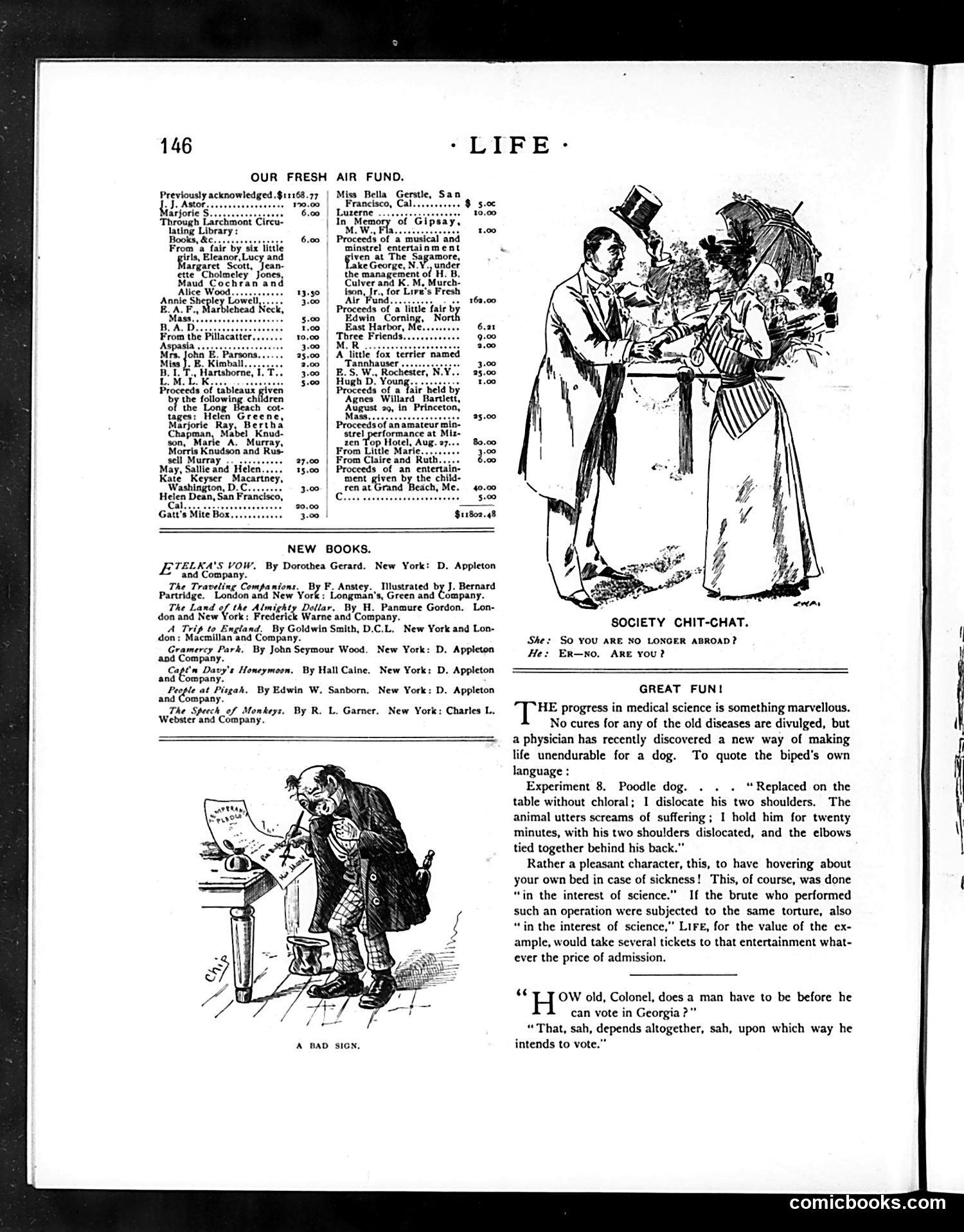
**"Society Chit-Chat"** cartoon depicts a man confronting a woman, with dialogue suggesting she has been abroad ("So you are no longer abroad?"). The satire targets social pretension—likely mocking women of leisure who travel for status and use foreign travel as a social marker. **"Great Fun!"** section satirizes medical experimentation on animals, specifically a vivisection procedure on a poodle dog. The text sarcastically compares subjecting animals to painful surgery "in the interest of science" to applying the same torture to wealthy subscribers. This is social criticism of both cruel scientific practices and the indifference of the wealthy to animal suffering. **"A Bad Sign"** cartoon (bottom left) depicts a figure reading a stock ticker—likely commentary on financial instability or market concerns of the era.
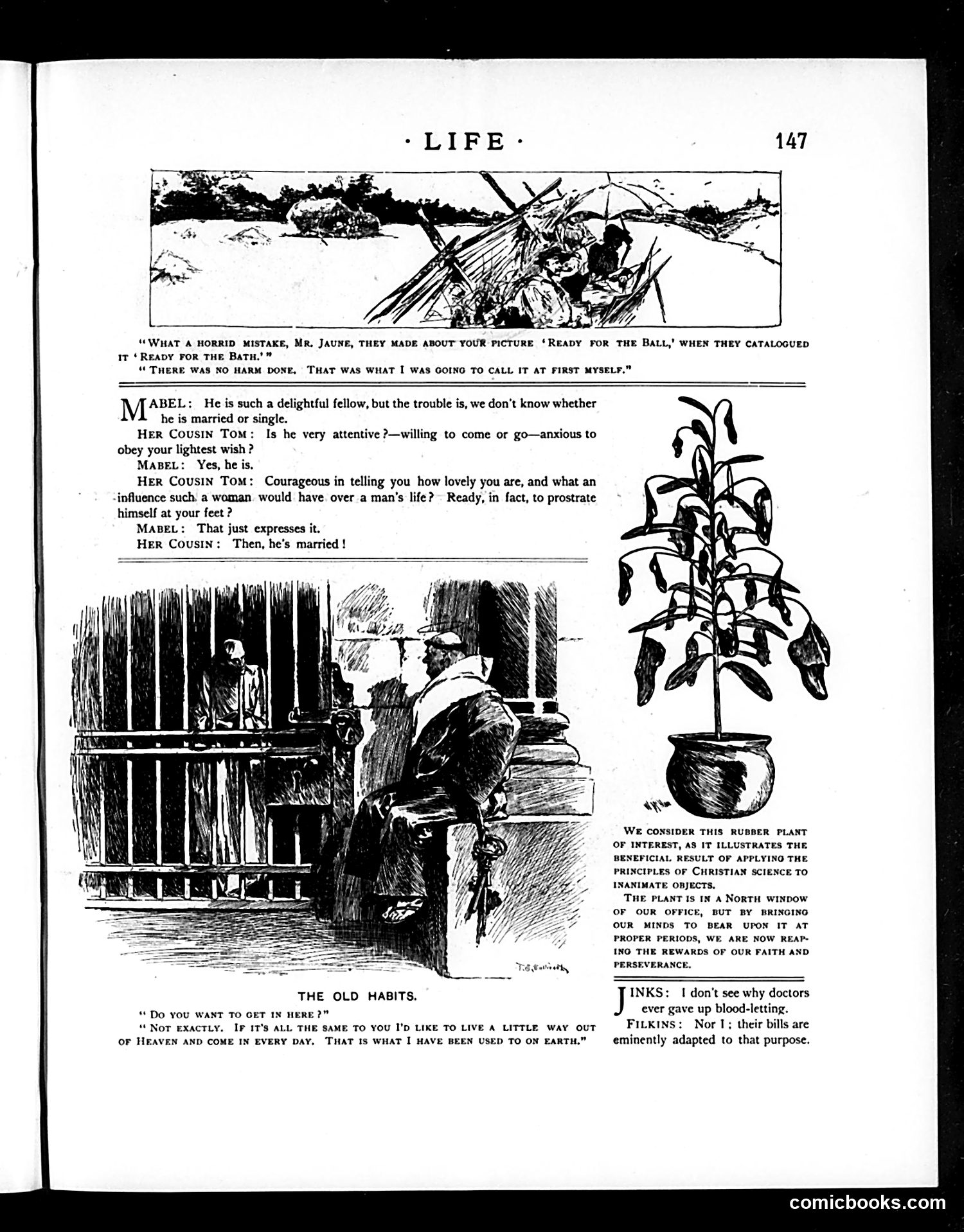
This page contains two distinct pieces: **Top dialogue**: A conversation between Mabel and her Cousin Tom about a man's marital status. The joke turns on whether his attentiveness and romantic declarations indicate he's married or single—Cousin Tom concludes he must be married, as only a husband would be that openly affectionate and complimentary. **Bottom cartoon ("The Old Habits")**: Shows a man at a window, seemingly trying to enter or escape. The caption references heavenly aspirations—the man claims he wants to enter heaven but has grown accustomed to earthly pleasures, so he's not changing his ways. It's a commentary on human resistance to moral improvement or religious reformation, suggesting people become too comfortable with their habits to reform. The rubber plant illustration appears unrelated commentary on Christian Science principles.
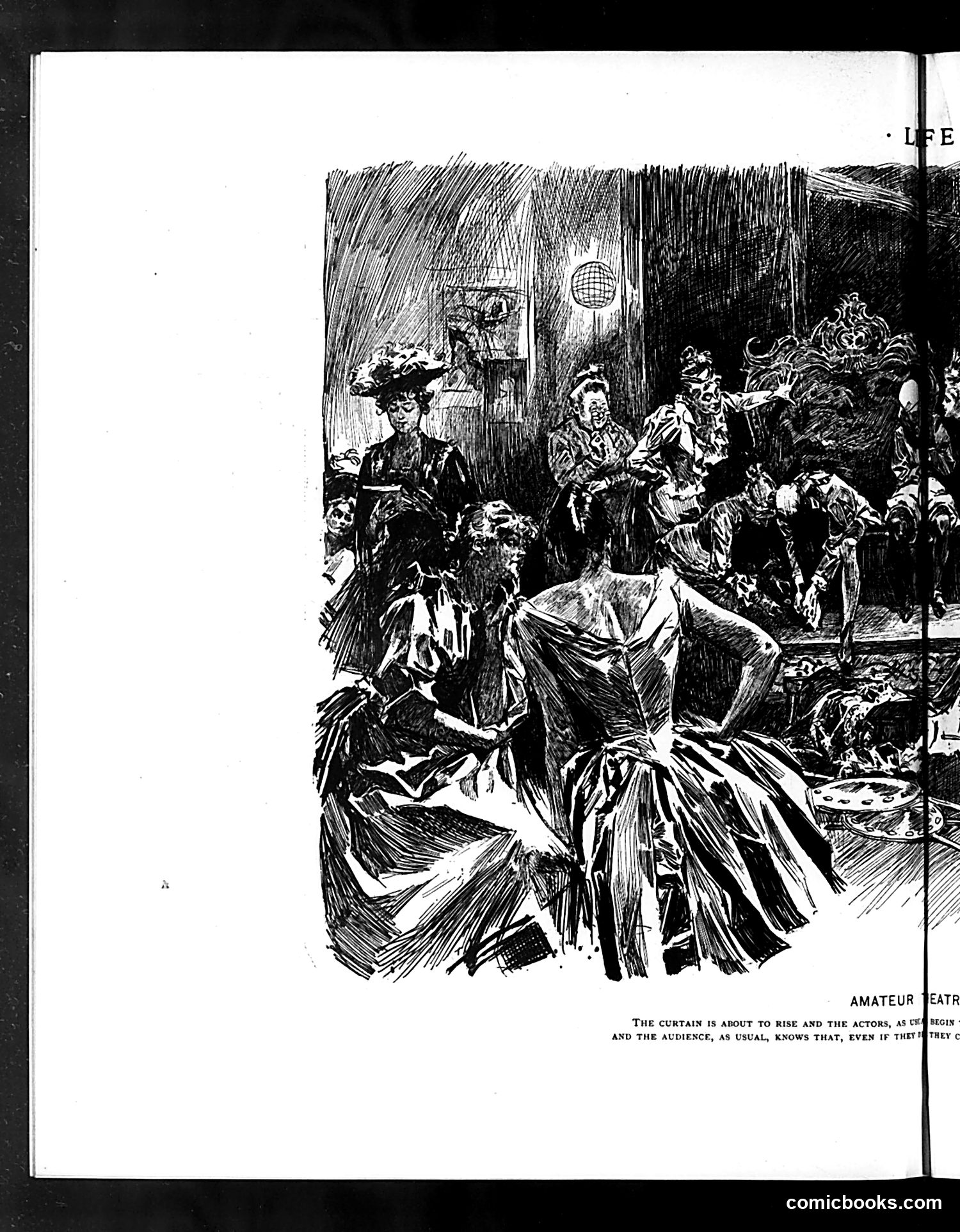
This illustration depicts a backstage theatrical scene during what appears to be a dress rehearsal or amateur production. The caption (partially visible) explains that "the curtain is about to rise and the actors, as usual, begin..." and references audience expectations. The sketch satirizes amateur theater—likely poking fun at the chaos, crowding, and theatrical pretensions of non-professional productions. The detailed cross-hatching shows multiple costumed performers in elaborate dress, suggesting overwrought staging. The composition captures the frantic energy backstage, with figures in various states of readiness. Without the complete caption visible, the specific satirical target remains somewhat unclear, but the overall tone mocks the grandiose ambitions versus chaotic reality of amateur theatrical productions.
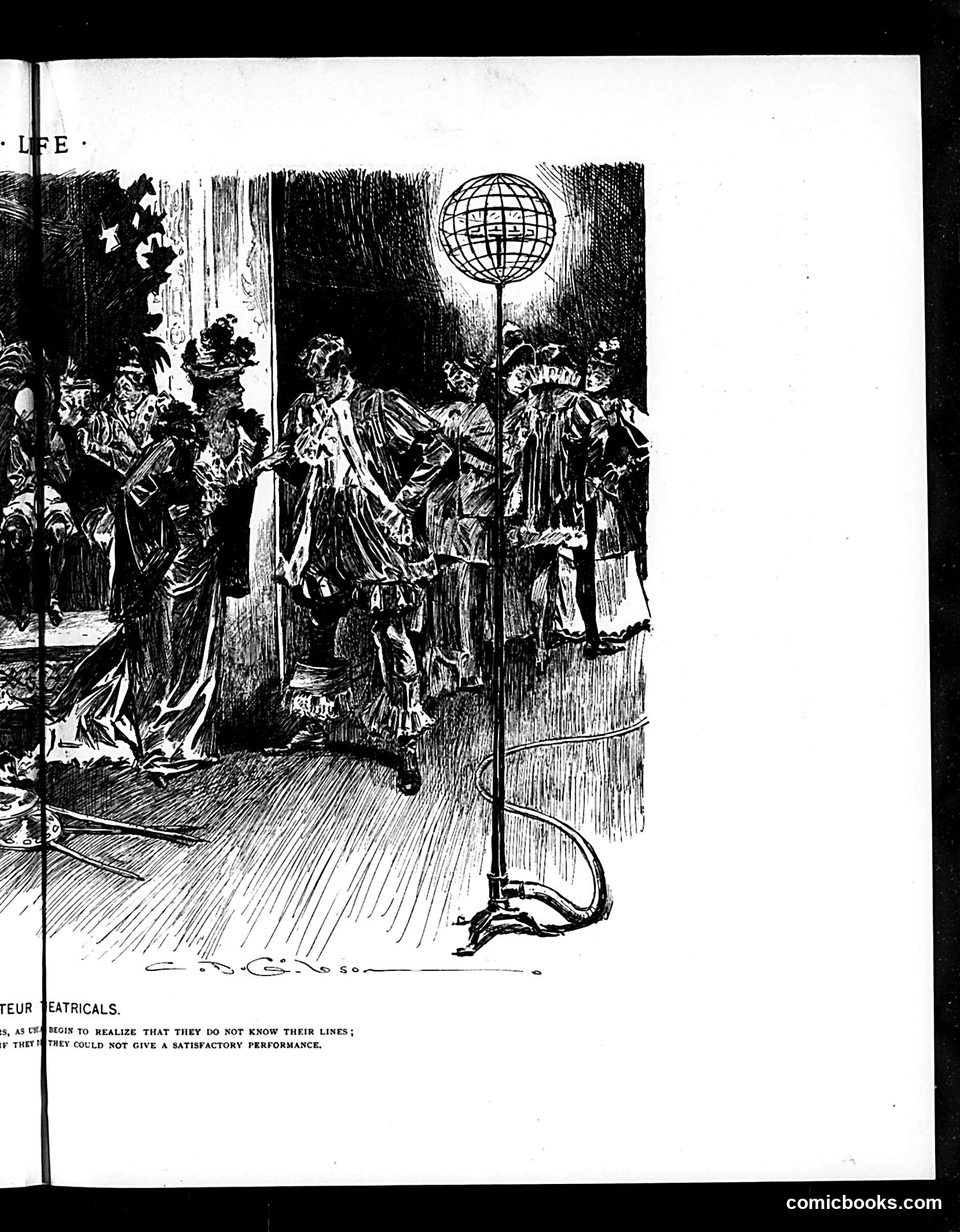
This is a theatrical satire from *Life* magazine. The image shows a stage scene with costumed performers gathered around a globe-topped prop, suggesting a theatrical production with international or world-themed subject matter. The partially visible caption discusses amateur theatrical performers who "do not know their lines" and therefore "could not give a satisfactory performance." The satire targets amateur actors' lack of preparation and professionalism—a common theme in early 20th-century theatrical criticism. The ornate costumes and formal staging suggest this mocks pretentious amateur theater productions attempting grandiose international or classical themes while lacking basic competence. The joke critiques the gap between ambition and ability in amateur dramatics.
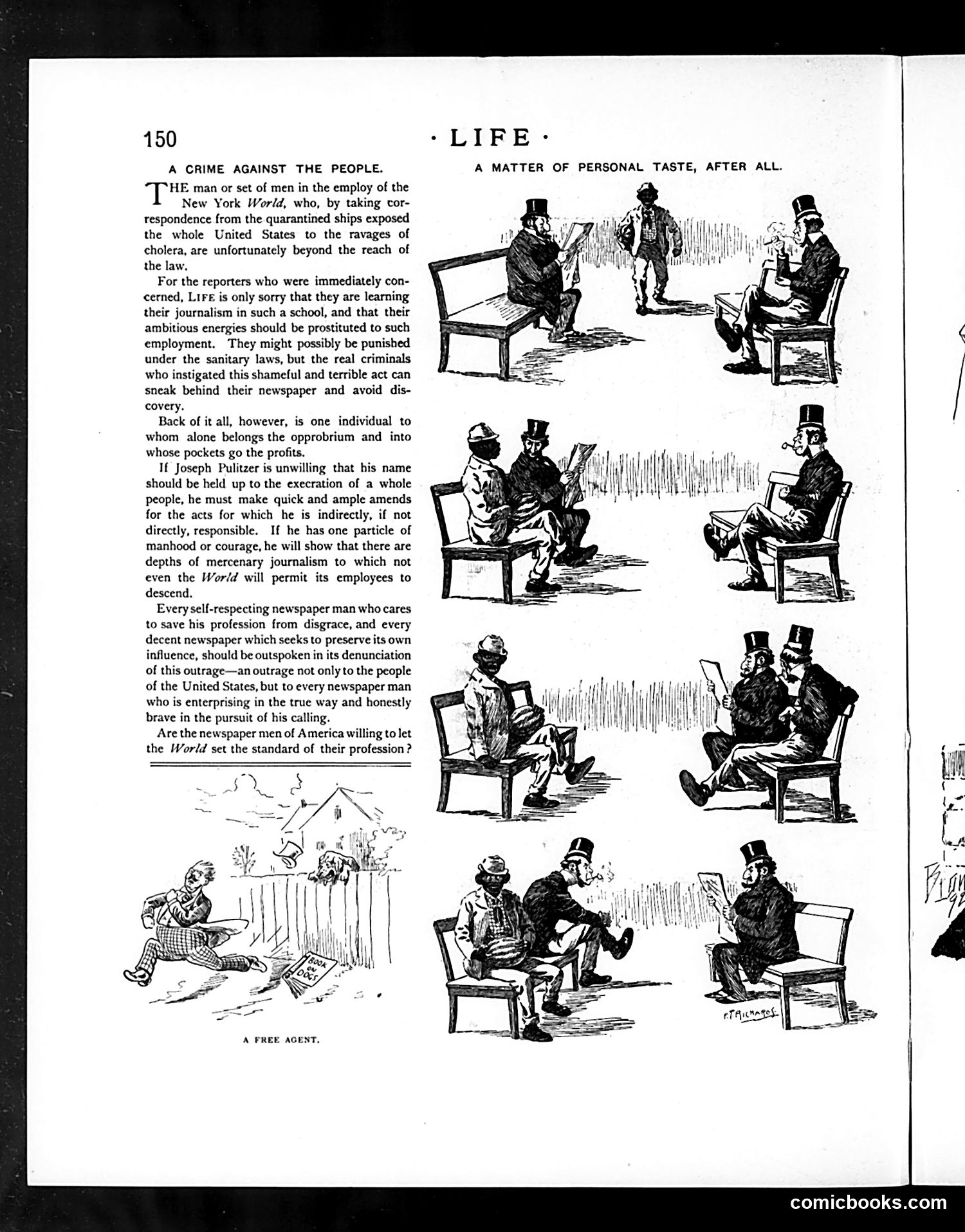
**Left Column ("A Crime Against the People"):** This editorial attacks Joseph Pulitzer and the *New York World* newspaper for exposing a cholera outbreak. The text argues that while the reporters involved deserve criticism, Pulitzer—who profits from the paper—bears primary responsibility. It calls for his prosecution and demands that American newspapers maintain professional standards rather than sensationalism. **Right Side ("A Matter of Personal Taste, After All"):** A series of cartoon panels depict well-dressed gentlemen having conversations, apparently illustrating different responses to journalistic scandal. The caption suggests that reactions to the *World's* conduct are matters of subjective opinion among the elite, likely satirizing their indifference to ethical journalism. The page criticizes both sensationalist reporting and society's complacent acceptance of it.
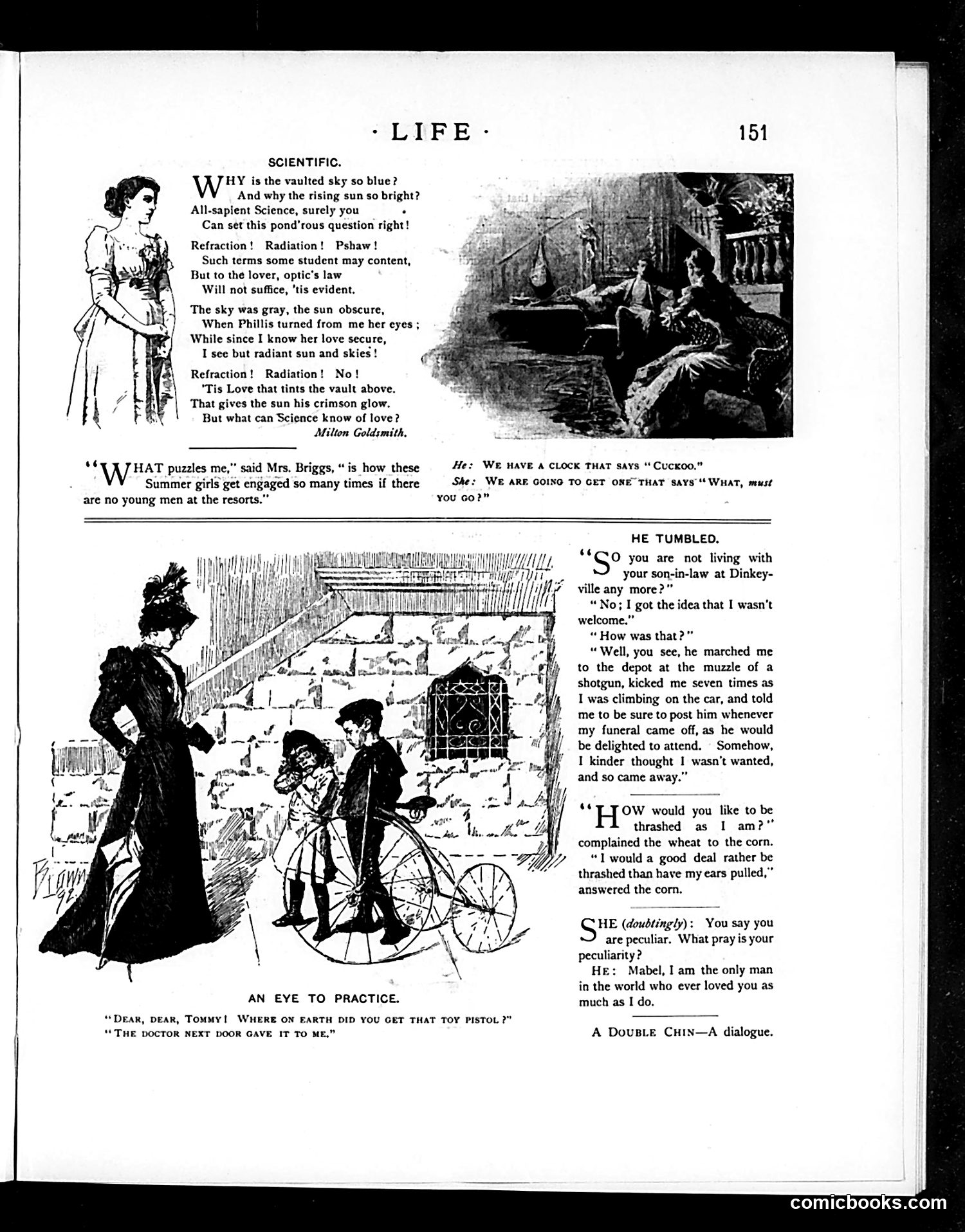
This page contains three distinct pieces of satirical humor: 1. **"Scientific"** — A poem mocking pseudo-intellectual explanations of natural phenomena. A woman quotes scientific jargon ("refraction," "radiation") to romanticize her lover's appearance, ultimately asking what science can reveal about love. The satire targets how people misuse scientific terminology. 2. **"An Eye to Practice"** — A cartoon showing a mother horrified that her young son obtained a pistol from "the doctor next door." The satire criticizes negligent adults giving dangerous items to children, likely reflecting contemporary concerns about irresponsible guardianship. 3. **"A Double Chin"** — A domestic dialogue where a man defends his love despite being unwelcome, and a woman questions his sincerity. The satire examines relationship dynamics and male persistence in courtship.
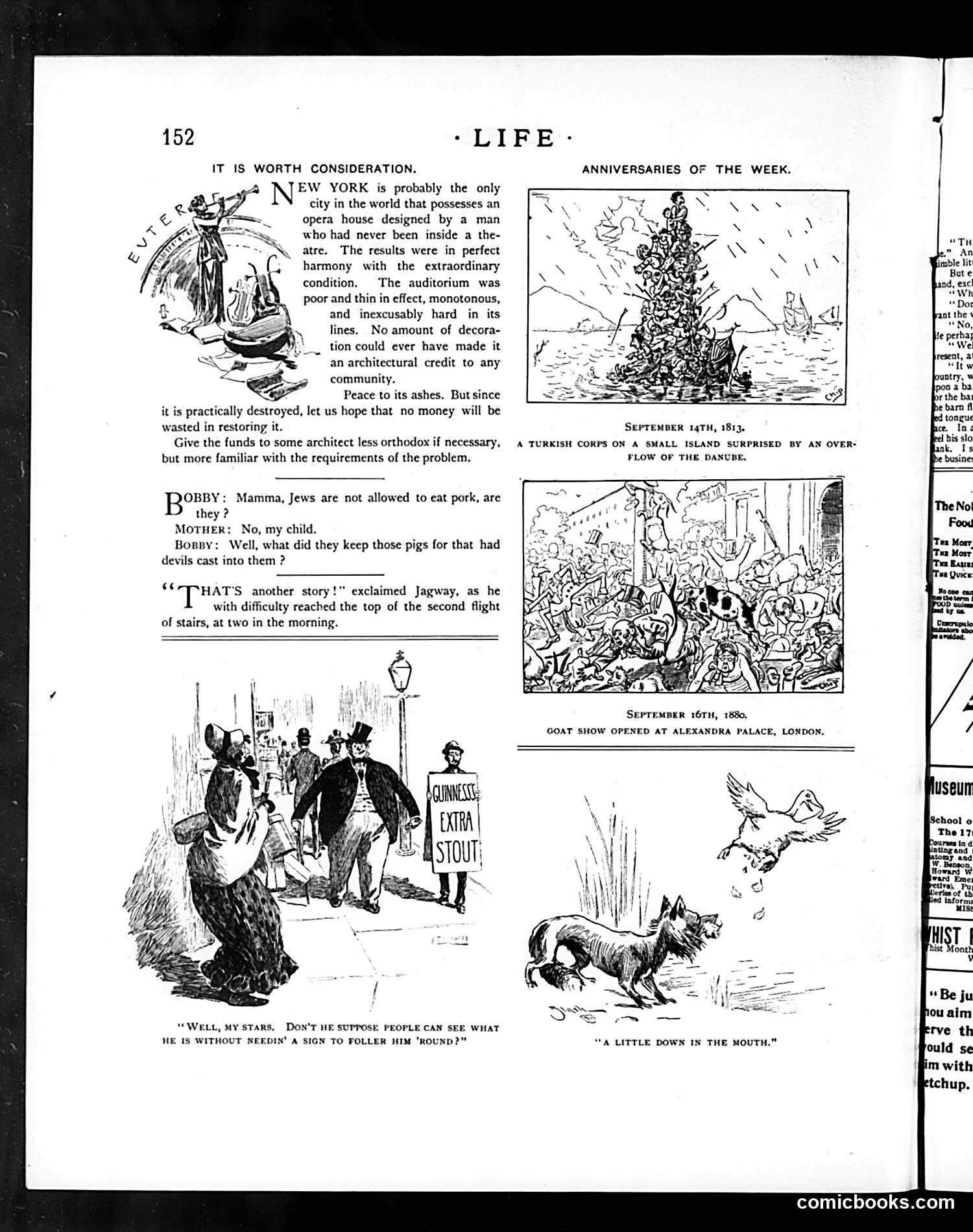
This page contains several satirical pieces typical of the 1880s American humor magazine: **Top section**: A serious critique of New York's opera house (likely the Metropolitan Opera House, completed 1883), designed by architect J. Cleaveland Cady who allegedly had no theater experience. The writer sarcastically suggests its poor acoustics and design warrant demolition rather than restoration. **Middle cartoons**: - A child's biblical question joke about pigs and demons (referencing the Gospel account of demon-possessed swine) - A drunk man climbing stairs at 2 AM—a common Victorian music-hall comedy scenario **Bottom cartoon**: A street vendor without signage, mocked by an onlooker for assuming his appearance alone identifies his wares—social satire about working-class commerce. **Sidebar**: Historical "anniversaries" note a 1813 Turkish military disaster and an 1880 London goat exhibition—filler content typical of the era. The page blends gentle domestic humor, architectural criticism, and working-class mockery characteristic of 19th-century satirical magazines.
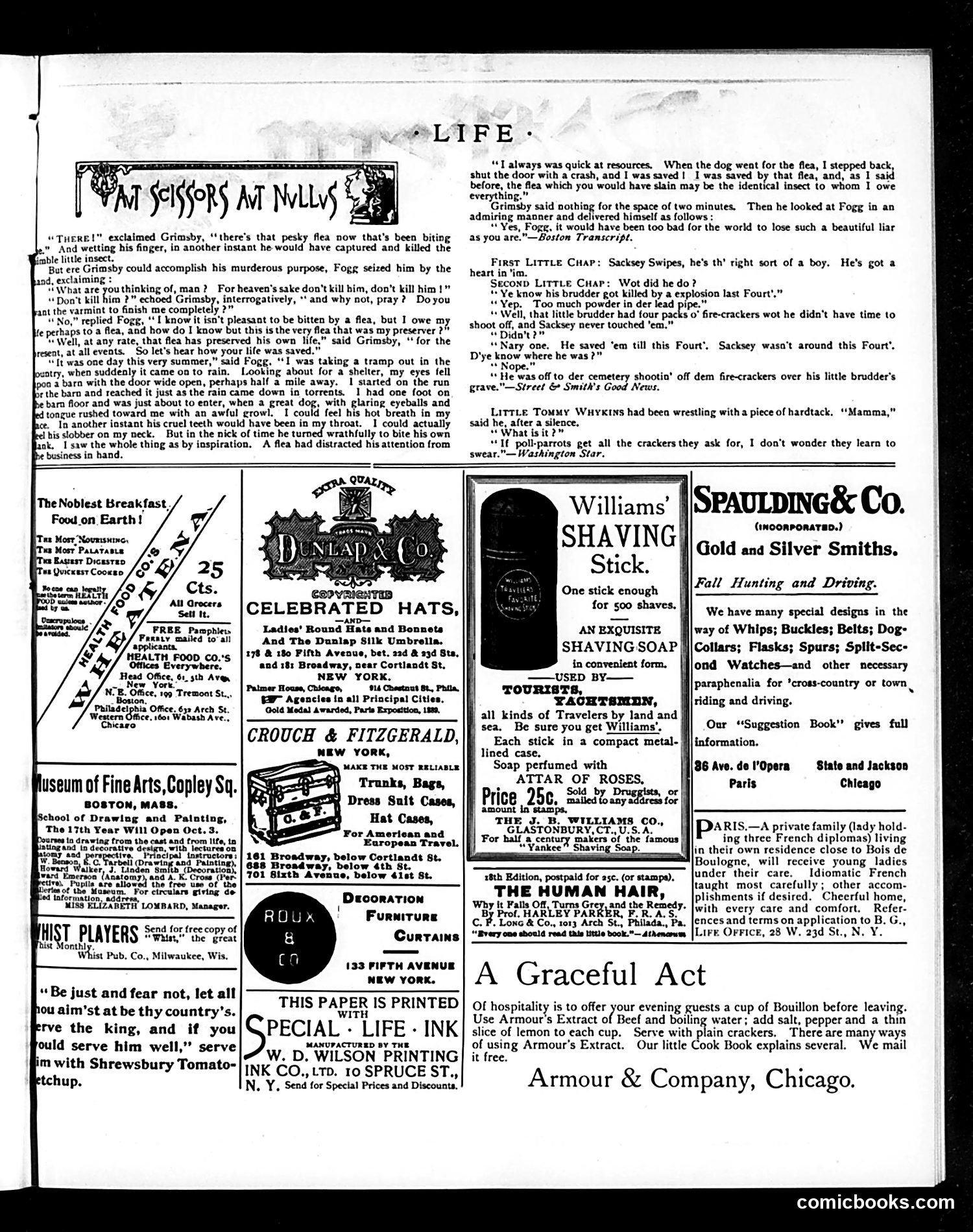
This page from *Life* magazine contains primarily **humorous short fiction and advertisements** rather than political cartoons. The main story, "I'm Scissors at Nulls" (likely "I'm Scissors at Nulls"), presents a tall tale: a man named Fogg claims a flea saved his life by distracting an attacking dog, therefore he cannot kill it. His companion Grimsby responds that Fogg is "a beautiful liar"—the joke being that the story is obviously fabricated. Below are brief comic anecdotes about working-class boys: one about a boy who saved firecrackers to place on his brother's grave (dark humor about a previous accident), and another where a child compares parrots eating "crackers" to learning to swear. The remainder consists of period advertisements for breakfast cereal, hats, shaving products, furniture, and other goods—typical of early-20th-century magazine content. **No significant political satire or social commentary is evident on this page.**
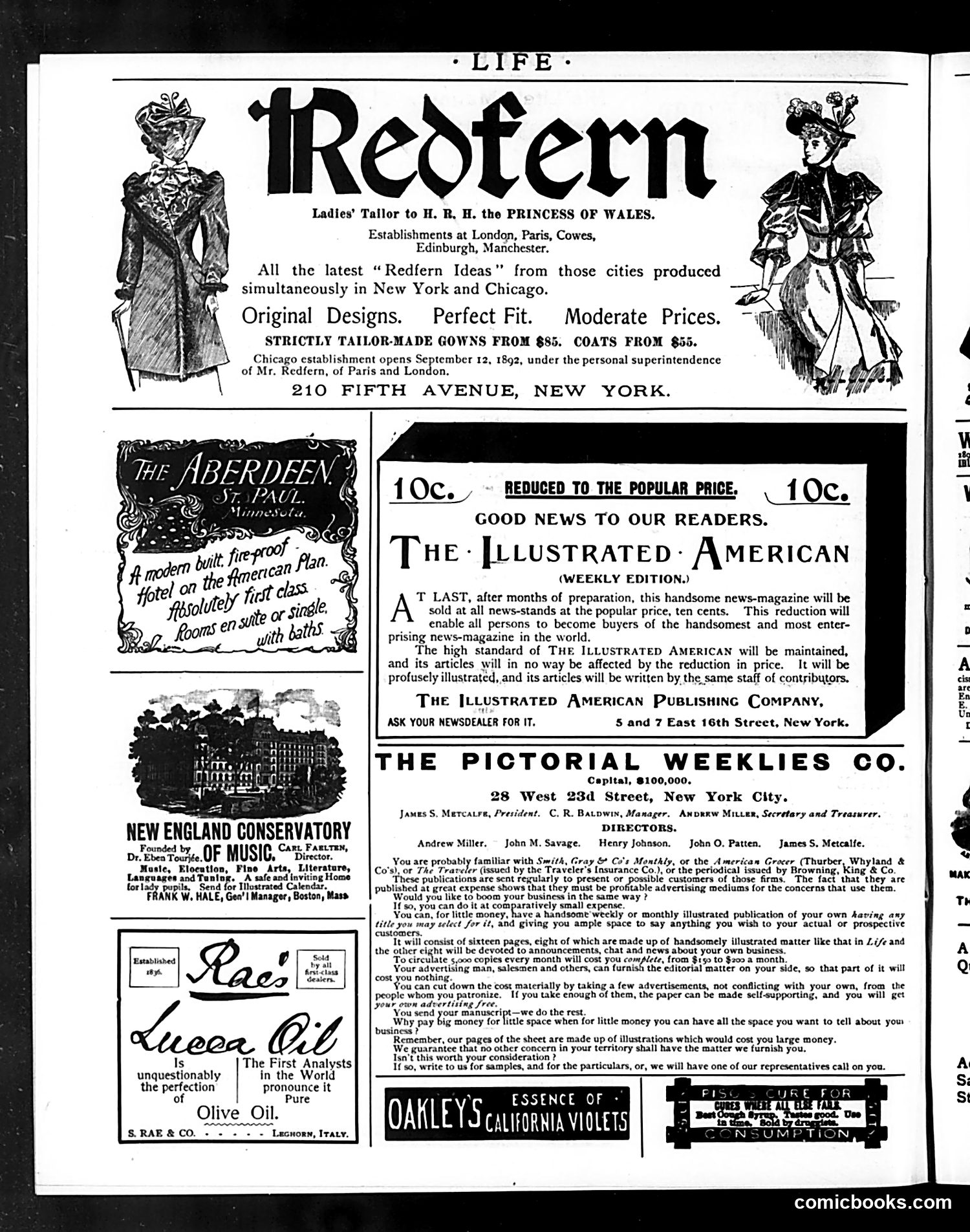
This is primarily a **advertisements and announcements page**, not a satirical cartoon page. The content consists entirely of commercial advertisements and business notices from the 1890s. **Notable ads include:** - **Redfern**: A high-end ladies' fashion house claiming to be "Tailor to H.R.H. the Princess of Wales," advertising tailored gowns from $85 and coats from $55—premium prices for the era. - **The Illustrated American**: A weekly news-magazine reducing its price to 10 cents to reach mass readership. - **The Pictorial Weeklies Co.**: Offering custom-published magazines for businesses seeking targeted advertising to customers. - **Rae's Lucca Oil**: Marketed as superior olive oil. - **New England Conservatory of Music**: Boston-based music school advertisement. The page reflects Gilded Age consumer culture and the emerging mass-market publishing industry, with no political satire present.
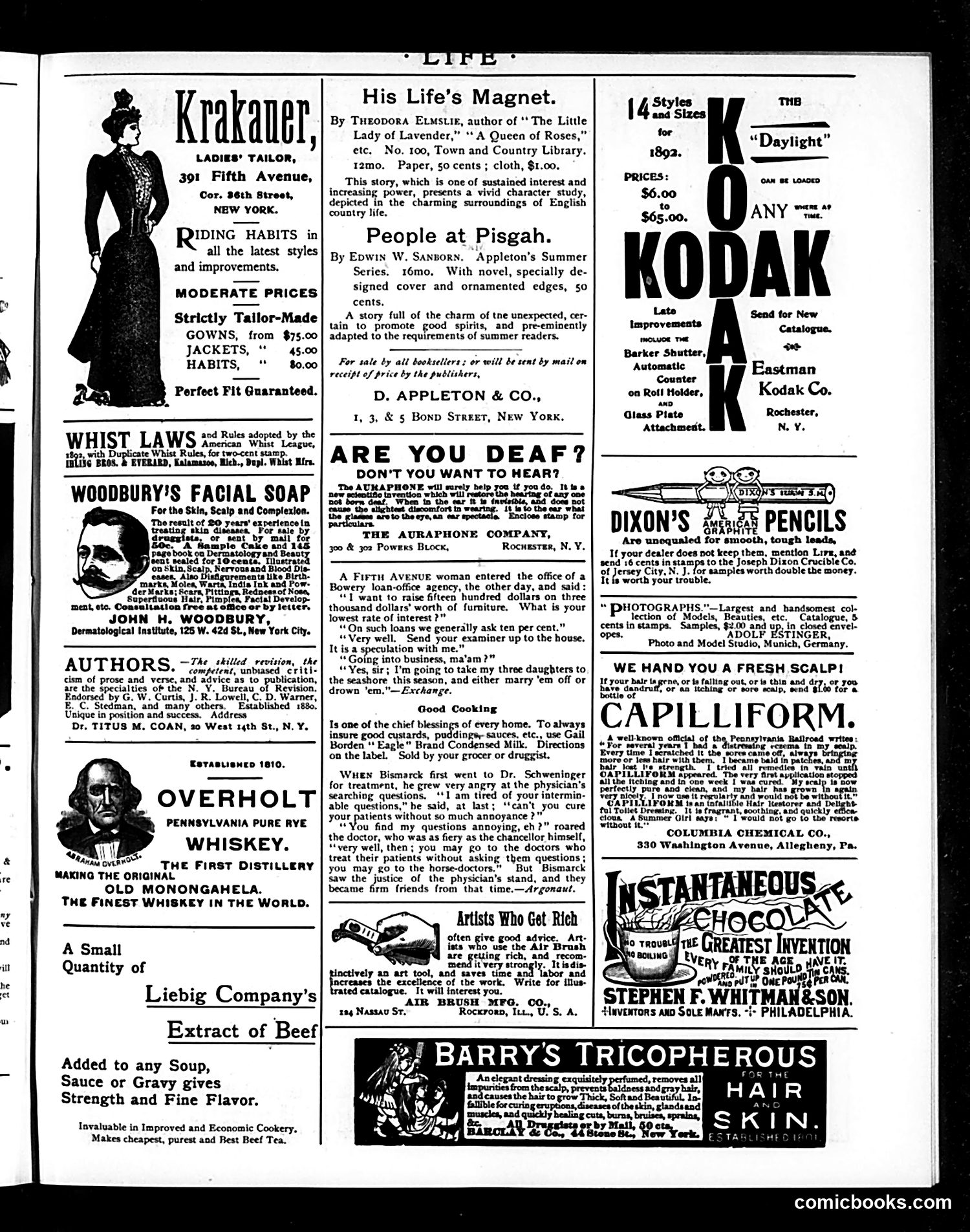
This is primarily an **advertising page** from Life magazine (circa 1893, based on the Kodak ad). There are no political cartoons or satirical illustrations here—instead, it features period commercial advertisements alongside two brief humorous anecdotes. The two joke pieces are: 1. **"Are You Deaf?"** — A satirical jab at a commercial hearing device (the "Auraphone"), suggesting it's ineffective through wordplay about not being able to hear properly. 2. **The Fifth Avenue/Bowery loan anecdote** — A social satire about wealthy women's frivolous spending: a Fifth Avenue socialite borrows money at high interest (10%) to take her three daughters to the seashore, casually remarking she'll either marry them off or "drown 'em." The joke mocks upper-class excess and dark humor about matrimonial desperation. 3. **The Bismarck anecdote** — Plays on the Prussian leader's famously gruff personality when confronted with a doctor's diagnostic questions. The ads themselves (Kodak, Whiskey, Soap, Hair treatments) reflect 1890s consumer culture targeting affluent readers.
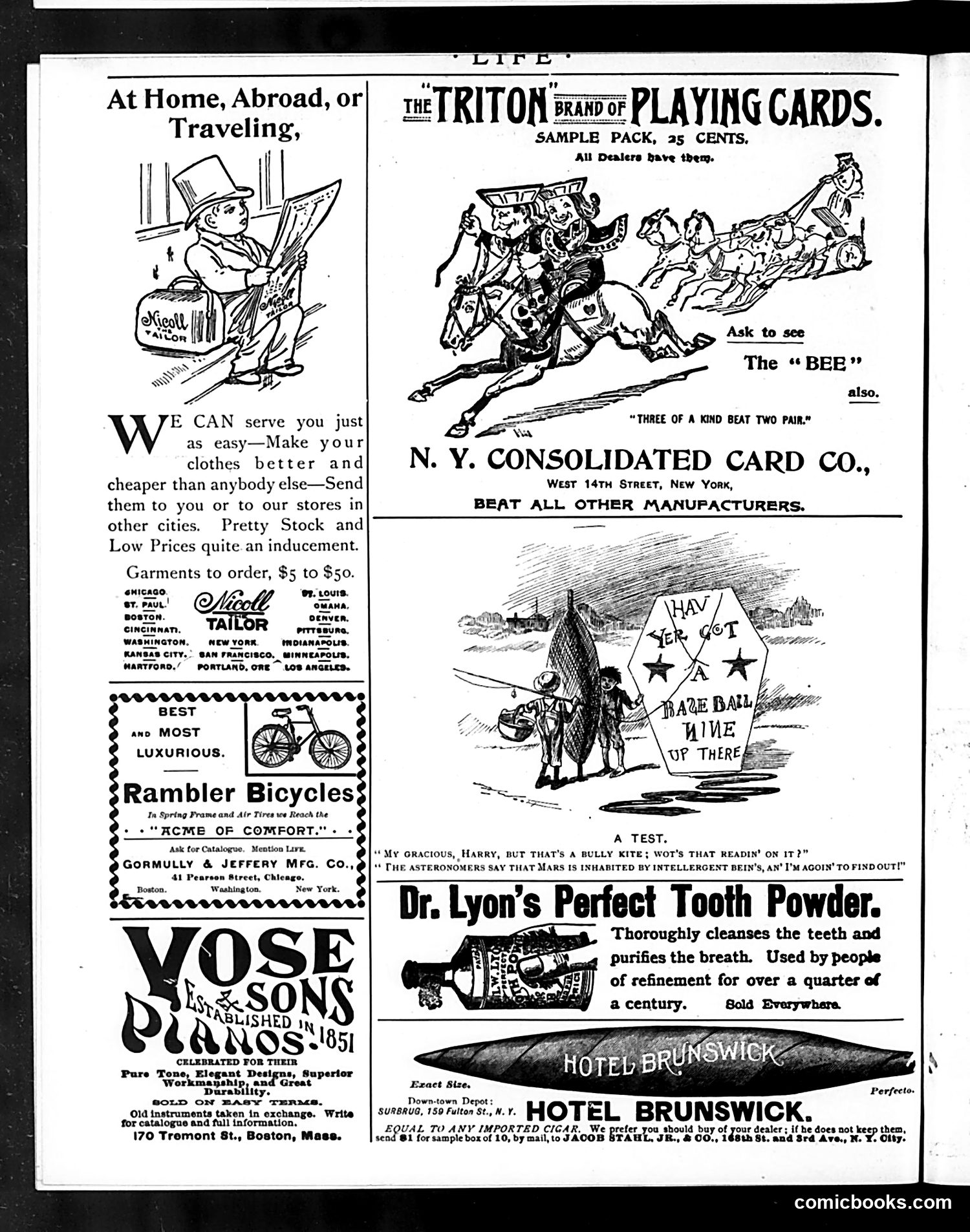
This page is primarily **advertisements**, but contains one small satirical cartoon titled **"A Test"** featuring two figures examining a kite. The cartoon depicts a dialogue about Mars and intelligent life. One character asks about the kite's markings, and the other responds with pseudo-scientific speculation: astronomers claim Mars is inhabited by intelligent beings, and he intends to find out by flying this kite. **The satire:** This mocks contemporary fascination with Mars and extraterrestrial life—popular topics in the 1890s-early 1900s. The joke is the absurdity of trying to contact Martians via kite, treating a childish activity as serious scientific inquiry. It gently ridicules both public enthusiasm for space speculation and the pretense of amateur "scientists" conducting foolish experiments. The cartoon's humor relies on the contrast between grandiose ambition (contacting alien intelligence) and comically inadequate method (a simple kite).
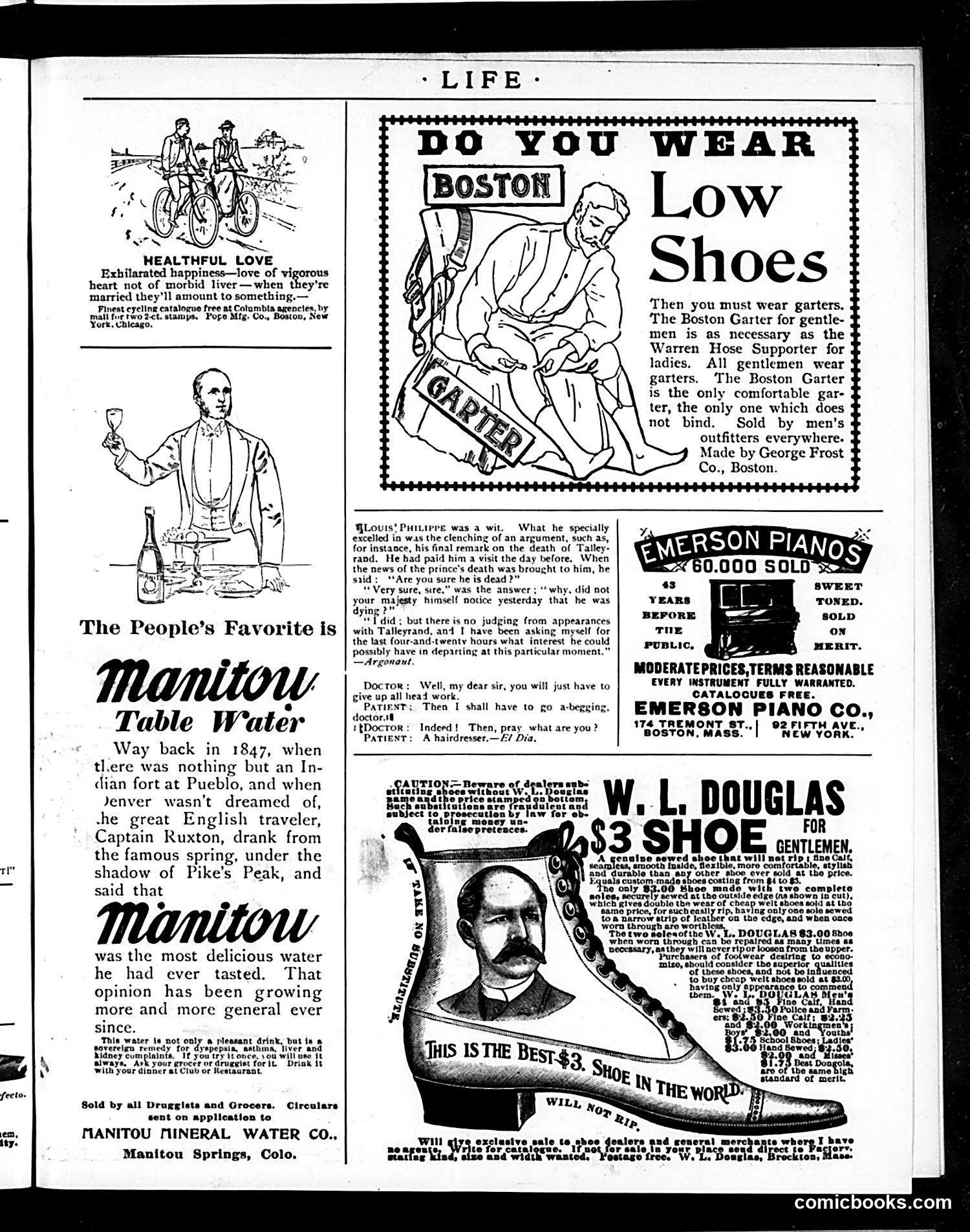
This is primarily an **advertising page** with several short satirical pieces interspersed. The main content includes: **"Healthful Love"**: A cycling advertisement presenting marriage and bicycling as promoting vigorous health—a common late-Victorian message. **"The People's Favorite"**: An advertisement for Manitou mineral water, invoking an English traveler's (Captain Ruxton's) 1847 endorsement as proof of the product's superiority and long-standing reputation. **Three brief jokes**, including one mocking Louis-Philippe (French political figure) for his witty remarks about Talleyrand's death, and a doctor-patient joke about a hairdresser needing to stop mental work. **Product advertisements** dominate: Boston Garters (for gentlemen), Emerson Pianos, W.L. Douglas shoes, and Boston Low Shoes—all claiming quality and value. The page reflects **Edwardian consumer culture**, where products were marketed through historical anecdotes, celebrity endorsement, and appeals to respectability and health. The scattered humor serves as editorial content between ads.
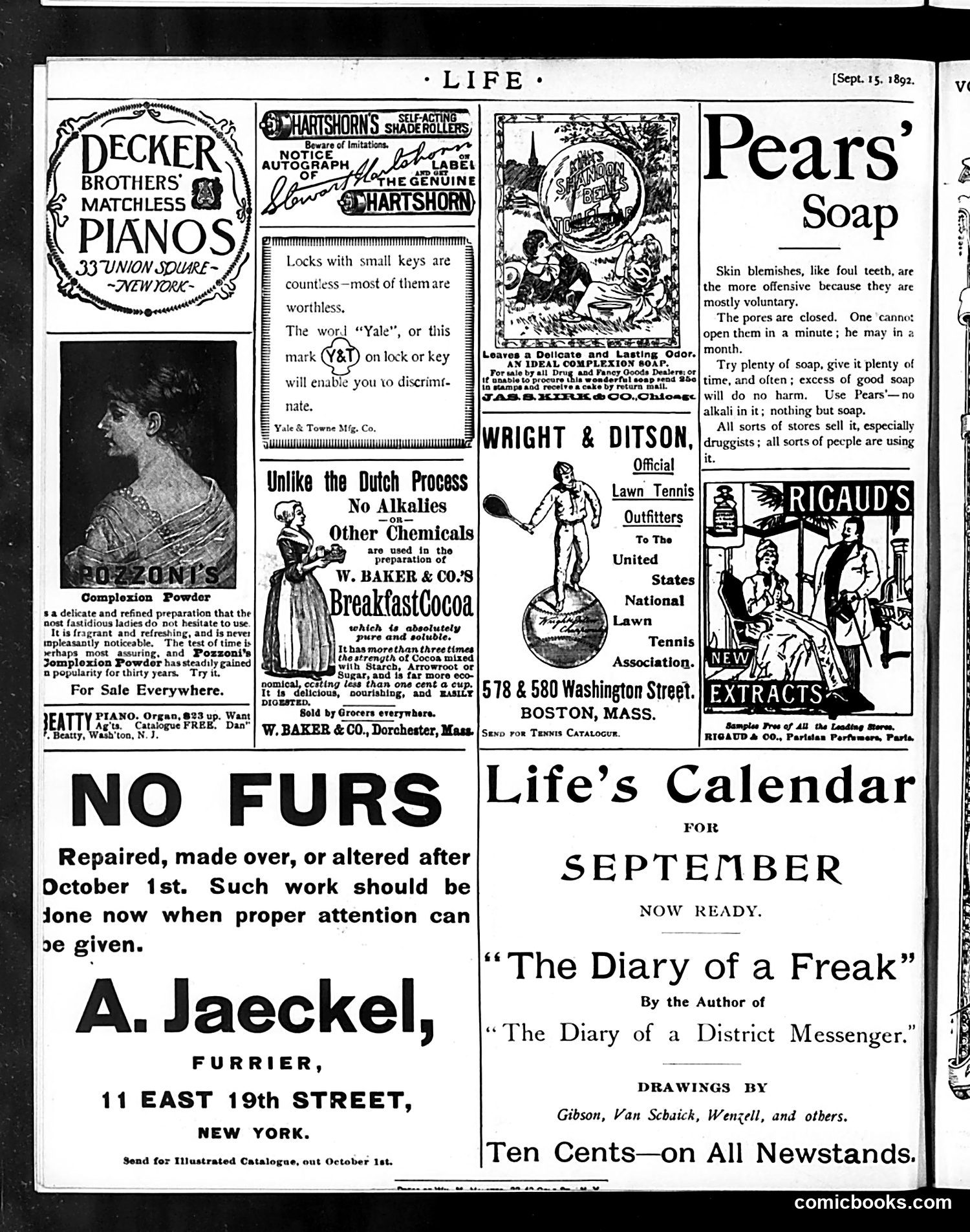
This page is **primarily advertising**, not satirical content. It's a collection of period product advertisements with minimal editorial material. The main items are: **Advertisements featured:** - Decker Brothers Pianos (New York) - Hartshorn shade rollers - Pozzoni's Complexion Powder (targeting women concerned with skin blemishes) - Yale locks - W. Baker & Co. Breakfast Cocoa - Wright & Ditson tennis equipment - Rigaud's perfume extracts - A. Jaeckel furrier services **Editorial content:** - "Life's Calendar for September" promoting "The Diary of a Freak," illustrated by Gibson and other notable cartoonists, sold for ten cents The page reflects **1890s consumer culture**: beauty products for women, luxury goods, and recreational sports equipment. The Pozzoni's powder ad is notable for its explicit focus on women's appearance anxiety—linking skin blemishes to moral character ("mostly voluntary"). No political satire is evident; this is a straightforward commercial page typical of Life's advertising revenue model.