
Life, 1892-09-15 · page 4 of 18
Life — September 15, 1892 — page 4: what you’re looking at
What you’re looking at
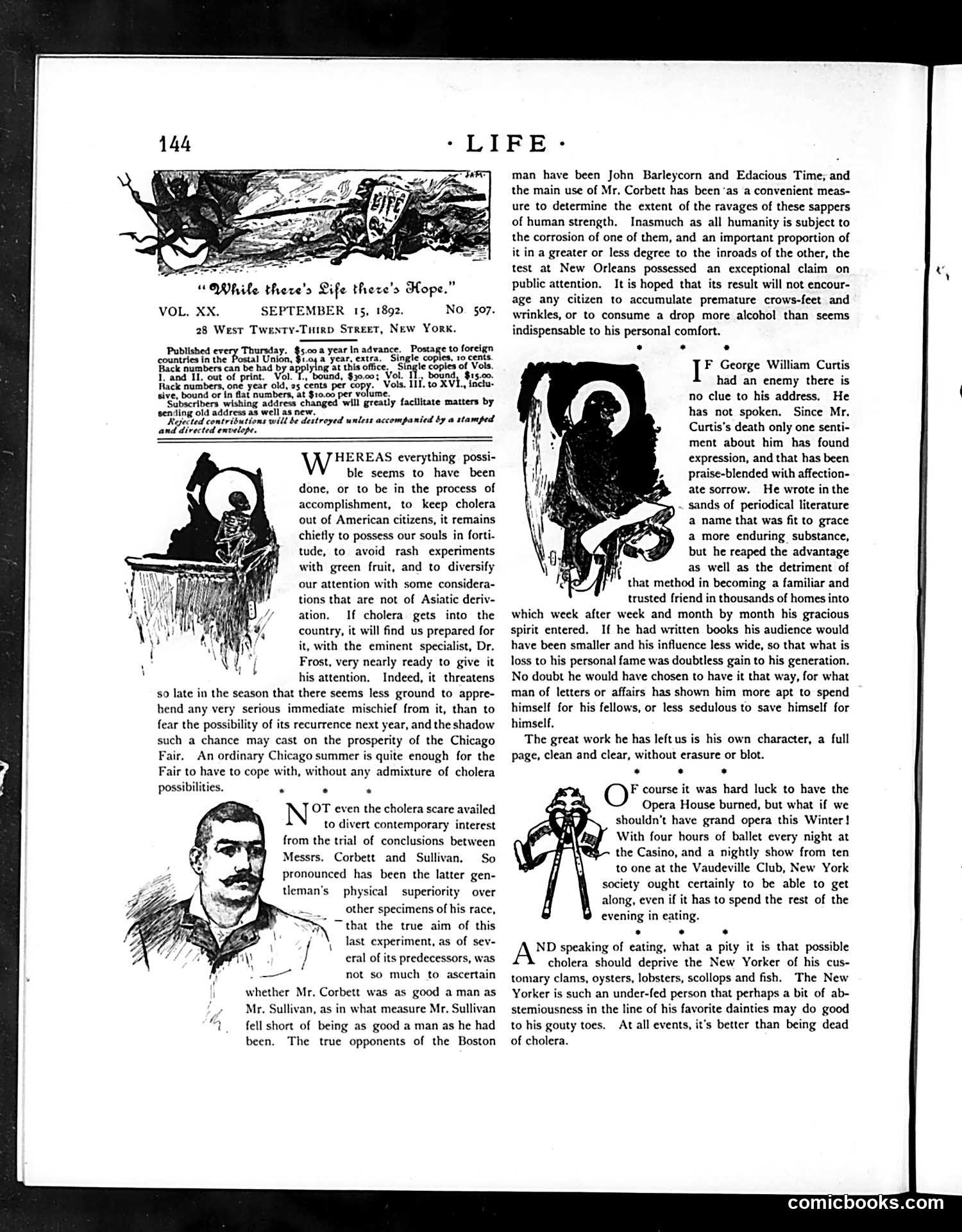
This page contains satirical commentary on the 1892 cholera outbreak in America. The text references a scientific experiment (likely the Sullivan-Corbett trial mentioned) examining whether cholera could be transmitted through fruit and diverse diet—suggesting contemporary uncertainty about disease transmission. The illustrations appear to depict death or disease personified, reflecting public anxiety about cholera's devastating spread. The satirical tone mocks both the medical uncertainty and New Yorkers' priorities: the author jokes that losing access to oysters, clams, and fine dining from the Opera House and Casino would be worse than cholera itself—a dark humor about class privilege during a public health crisis. The piece criticizes how the wealthy might suffer inconvenience from disease precautions while the broader population faced genuine mortality.
📄 Transcribed text from this page (OCR, searchable)
Machine-transcribed from the original scan — historical spelling and the odd misread are preserved.
-LIFE- “Mile there's Life there's Hope.” VOL. XX. SEPTEMBER 15, 1892. No. 507. 28 West Twenty-Tiirp Street, New York. Published every Thursday. y. $5008 year In advance, Postage to foreign countries in the Postal Union, a year, extra, Single copies, 10 cents. Back numbers can be had b; ing at this office, Single copies of Vols. 1, and II, out of print. ‘bound, $30.00; Vol. II., bound, $15.00. Finck numbers, one year old. 25 cents per copy.’ Vols. IIT. to XVI, inclu- sive, bound or in flat num! At $10.00 per volume. Subscribers wishing address changed will greatly facilitate matters by sending old address as well as new. 5 ‘Rejected contributions will be destroyed untess accompanied by a stamped and directed envelope. WHEREAS everything possi- ble seems to have been done, or to be in the process of accomplishment, to keep cholera out of American citizens, it remains chietly to possess our souls in forti- tude, to avoid rash experiments with green fruit, and to diversify our attention with some considera- tions that are not of Asiatic deriv- ation, If cholera gets into the country, it will find us prepared for it, with the eminent specialist, Dr. Frost, very nearly ready to give it his attention, Indeed, it threatens so late in the season that there seems less ground to appre- hend any very serious immediate mischief from it, than to fear the possibility of its recurrence next year, and the shadow such a chance may cast on the prosperity of the Chicago Fair. An ordinary Chicago summer is quite enough for the Fair to have to cope with, without any admixture of cholera possibilities. i Py * OT even the cholera scare availed to divert contemporary interest from the trial of conclusions between Messrs. Corbett and Sullivan, So pronounced has been the latter gen- tleman’s physical superiority over other specimens of his race, “that the true aim of this last experiment, as of sev- eral of its predecessors, was not so much to ascertain whether Mr. Corbett was as good a man as Mr. Sullivan, as in what measure Mr. Sullivan fell short of being as good a man as he had been. The true opponents of the Boston man have been John Barleycorn and Edacious Time; and the main use of Mr. Corbett has been ‘as a convenient meas- ure to determine the extent of the ravages of these sappers of human strength. Inasmuch as all humanity is subject to the corrosion of one of them, and an important proportion of it in a greater or less degree to the inroads of the other, the test at New Orleans possessed an exceptional claim on public attention. It is hoped that its result will not encour- age any citizen to accumulate premature crows-feet and wrinkles, or to consume a drop more alcohol than seems indispensable to his personal comfort. . . . F George William Curtis had an enemy there is no clue to his address. He has not spoken. Since Mr. Curtis's death only one senti- ment about him has found expression, and that has been praise-blended with affection- ate sorrow. He wrote in the ~ sands of periodical literature a name that was fit to grace a more enduring substance, but he reaped the advantage as well as the detriment of that method in becoming a familiar and trusted friend in thousands of homes into which week after week and month by month his gracious spirit entered. If he had written books his audience would have been smaller and his influence less wide, so that what is loss to his personal fame was doubtless gain to his generation. No doubt he would have chosen to have it that way, for what man of letters or affairs has shown him more apt to spend himself for his fellows, or less sedulous to save himself for himself. The great work he has leftus is his own character, a full page, clean and clear, without erasure or blot. * . . F course it was hard luck to have the Opera House burned, but what if we shouldn't have grand opera this Winter! With four hours of ballet every night at the Casino, and a nightly show from ten to one at the Vaudeville Club, New York society ought certainly to be able to get along, even if it has to spend the rest of the evening in eating. . . . AX? speaking of eating, what a pity it is that possible cholera should deprive the New Yorker of his cus- tomary clams, oysters, lobsters, scollops and fish. The New Yorker is such an under-fed person that perhaps a bit of ab- stemiousness in the line of his favorite dainties may do good to his gouty toes. At all events, it's better than being dead of cholera. comicbooks.com