
A complete issue · 14 pages · 1892
Life — August 25, 1892
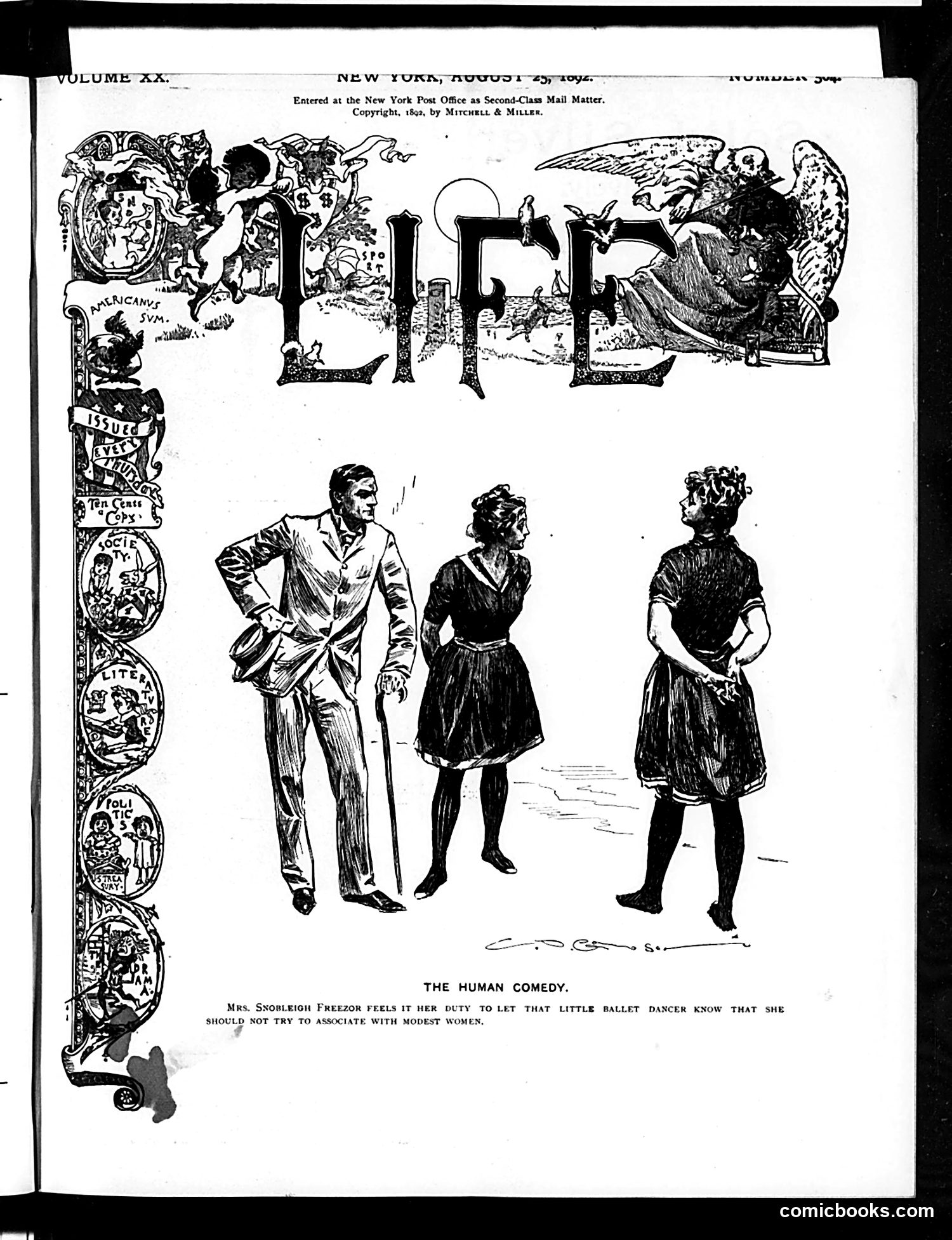
This satirical cartoon illustrates a social etiquette dilemma of the Gilded Age. The caption references "Mrs. Snobleigh Freezor" feeling duty-bound to prevent a "little ballet dancer" from associating with "modest women." The scene depicts class-based social anxiety: a well-dressed gentleman (left) appears caught between the ballet dancer (center) and respectable women (right). The satire mocks Victorian-era social hierarchies where professional performers—particularly female dancers—were considered morally suspect and unfit for association with "decent" society. The joke targets snobbish hypocrisy: the self-righteous protection of propriety that actually revealed rigid class prejudices and double standards regarding women's work and social status during the 1890s.
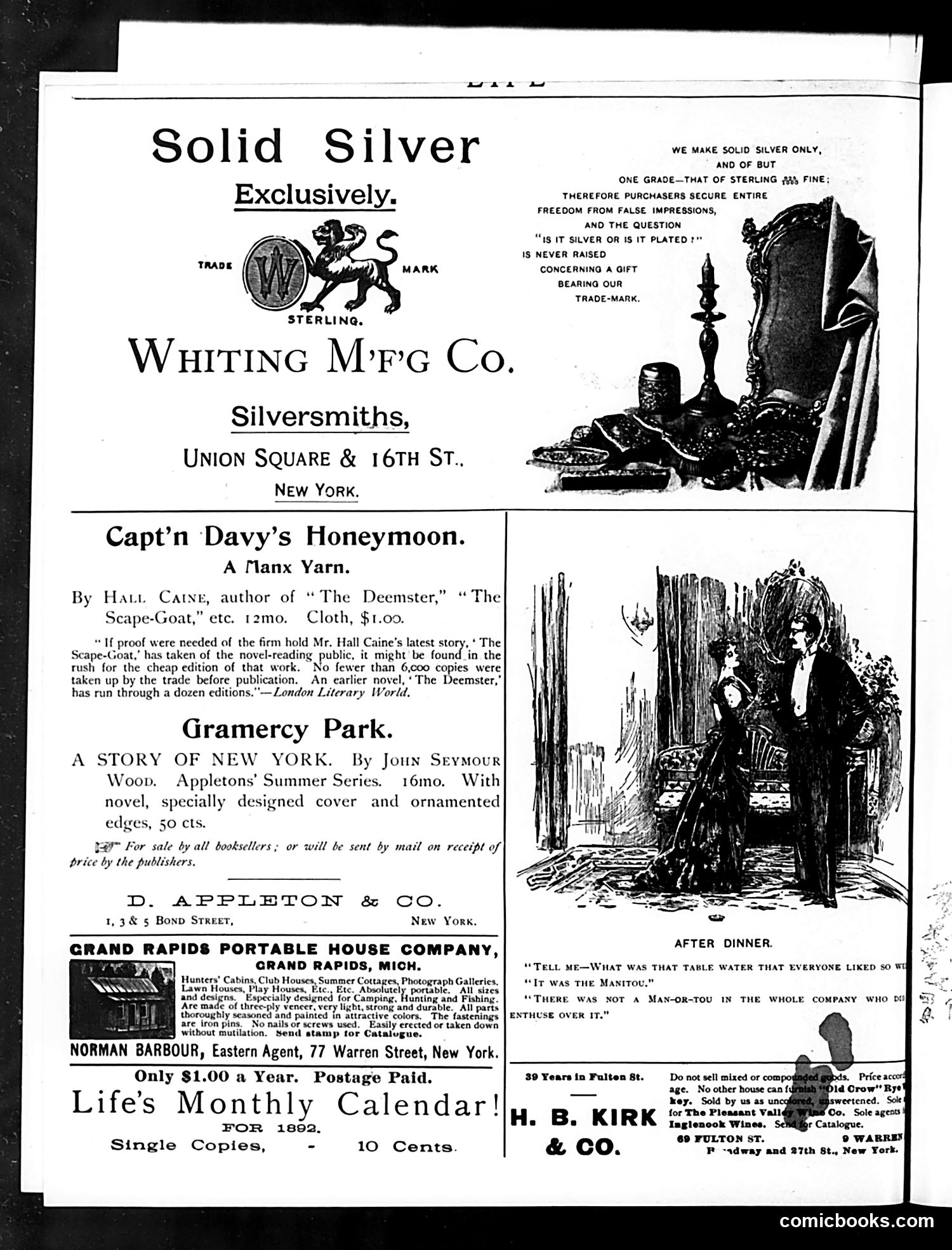
This page is primarily **advertising**, not political satire. The main content includes: 1. **Whiting Mfg Co.** advertisement for solid sterling silver goods, featuring their trade mark (a lion with a shield). 2. **Book advertisements** for titles by Hall Caine and John Seymour Wood, published by D. Appleton & Co. 3. **Grand Rapids Portable House Company** advertisement with an illustration of a prefabricated dwelling. 4. **Life's Monthly Calendar for 1892** promotion. 5. A small cartoon titled **"After Dinner"** showing a waiter and diners, with dialogue about a "Manitou" table waiter—appears to be a mild joke about waitstaff, though the exact reference is unclear. The page reflects 1890s commercial culture more than political commentary.
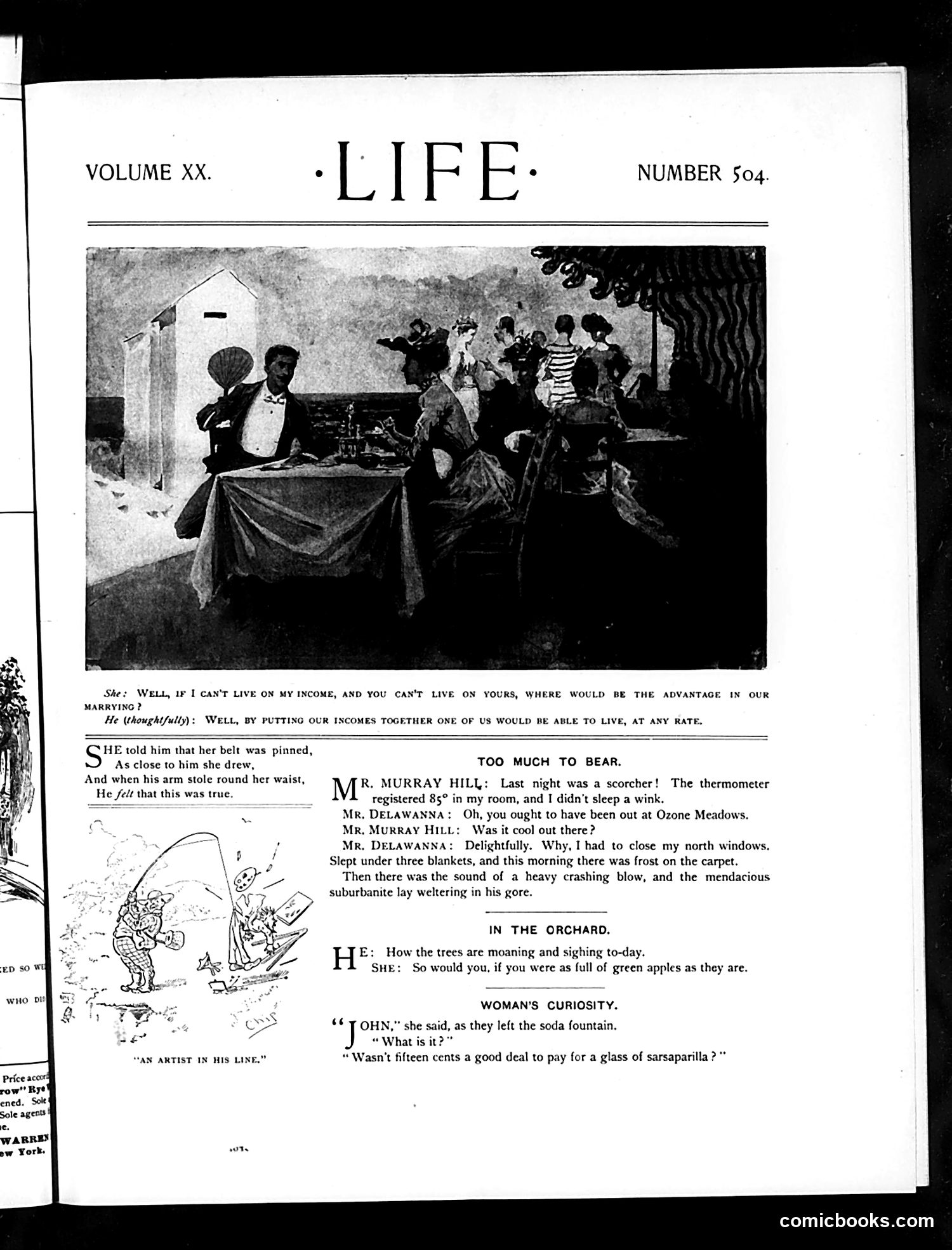
This page contains several unrelated satirical pieces typical of Life's format: 1. **Top photograph/caption**: A social scene showing people at what appears to be a garden party or outdoor gathering, with dialogue debating the financial practicality of marriage—a common early 20th-century satirical topic. 2. **"Too Much to Bear"**: A dialogue between Mr. Murray Hill and Mr. Delawanna about extreme heat (88°F) and cold weather, mocking wealthy men's complaints about minor discomforts. 3. **"In the Orchard"**: A brief exchange about autumn fruit, likely playing on seasonal observations. 4. **"Woman's Curiosity"**: A joke about a woman questioning the price of sarsaparilla at a soda fountain—playing on stereotypes about female frivolousness. 5. **Left illustration**: Labeled "An Artist in His Line," though details are unclear in reproduction. The page reflects early 20th-century satirical humor targeting class, gender, and domestic life.
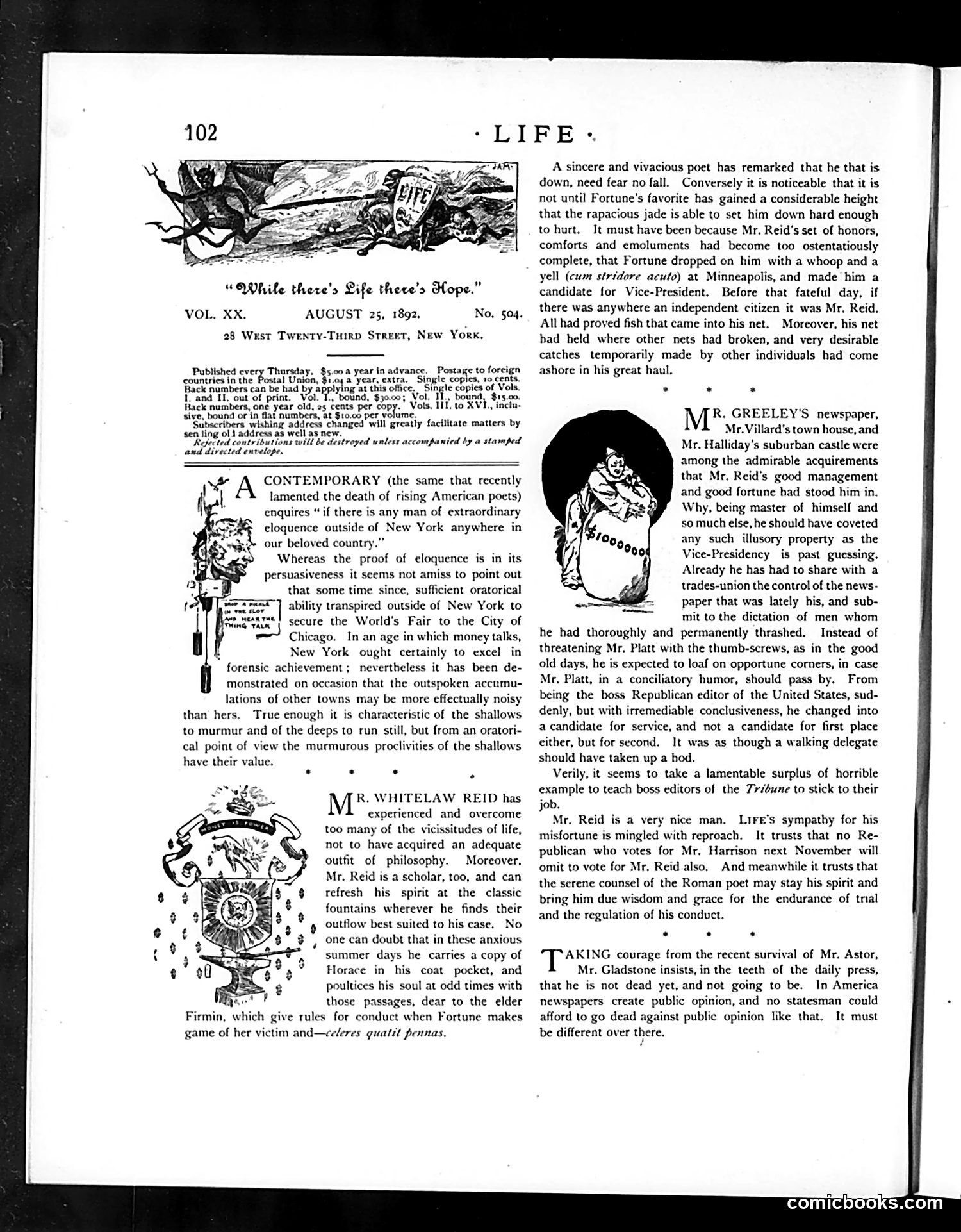
This page satirizes **Whitelaw Reid**, a prominent newspaper editor and political figure. The text mocks Reid's ambitions and recent misfortunes, suggesting he's experienced enough hardship that he shouldn't worry about further setbacks. The satire appears to reference Reid's failed vice-presidential candidacy (mentioned as recent) and his involvement with New York newspapers and politics. The magazine criticizes his management style and his submission to more powerful political figures, comparing him unfavorably to stronger political leaders. The Latin phrase "cedere quiit pennas" suggests the satirical tone concerns surrender or loss of dignity. The cartoon imagery (decorative emblems and illustrations) accompanies commentary on Reid's character and political standing, though the specific visual caricatures are difficult to interpret without additional context.
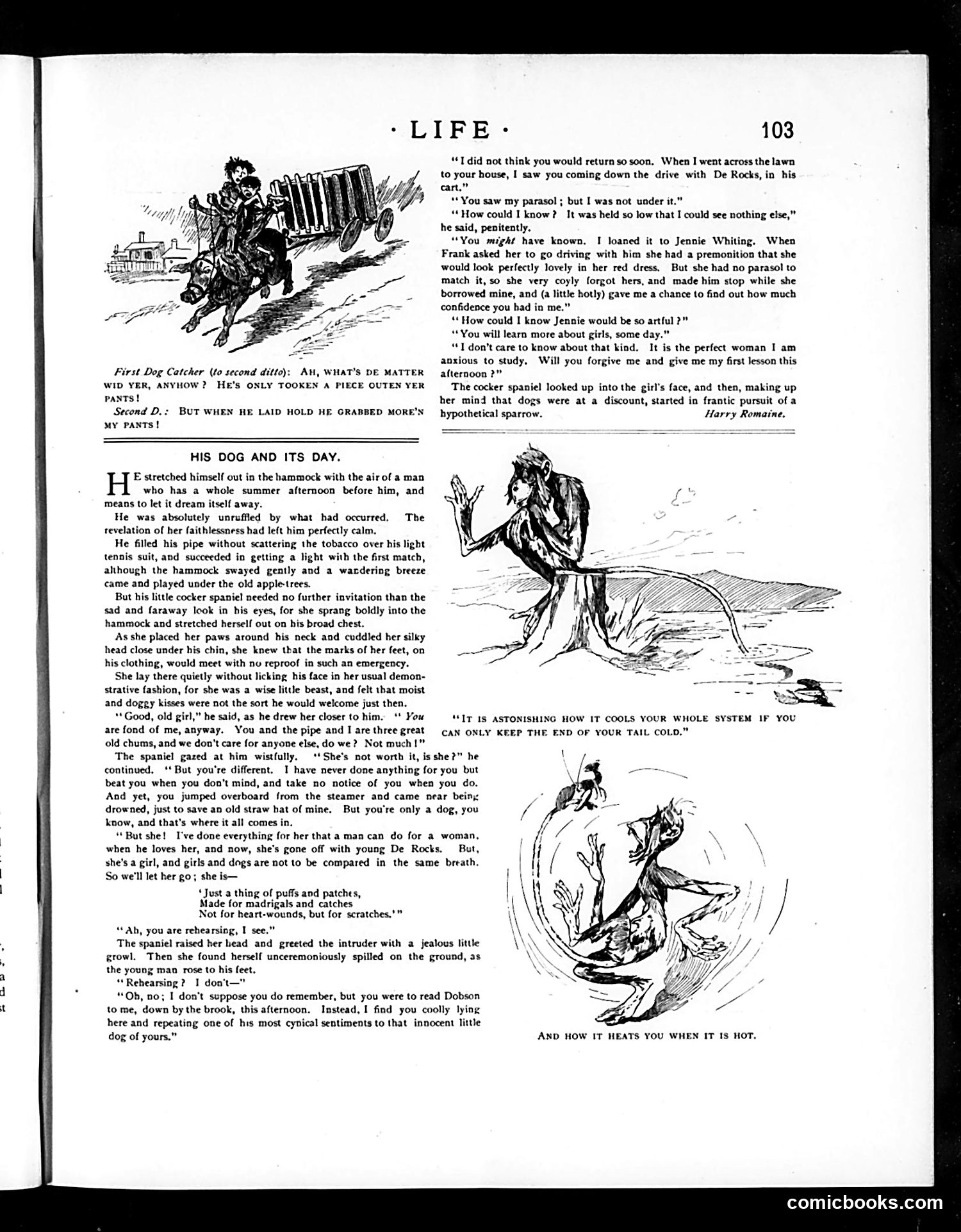
This page contains a humorous short story titled "His Dog and Its Day" rather than political cartoons. The narrative satirizes romantic entanglement and social pretense through dialogue between a man and woman, with illustrations of a cocker spaniel observing their interaction. The story mocks human relationship dynamics—specifically a man's transparent attempts to justify infidelity or divided attention by blaming a rival (De Rocks) and praising the dog. The woman's sardonic responses expose his excuses as transparent. The accompanying dog illustrations provide visual comedy, showing the spaniel's reactions to the absurd human drama. The satirical point targets masculine self-deception and the gap between what men claim versus their actual behavior in romantic situations.
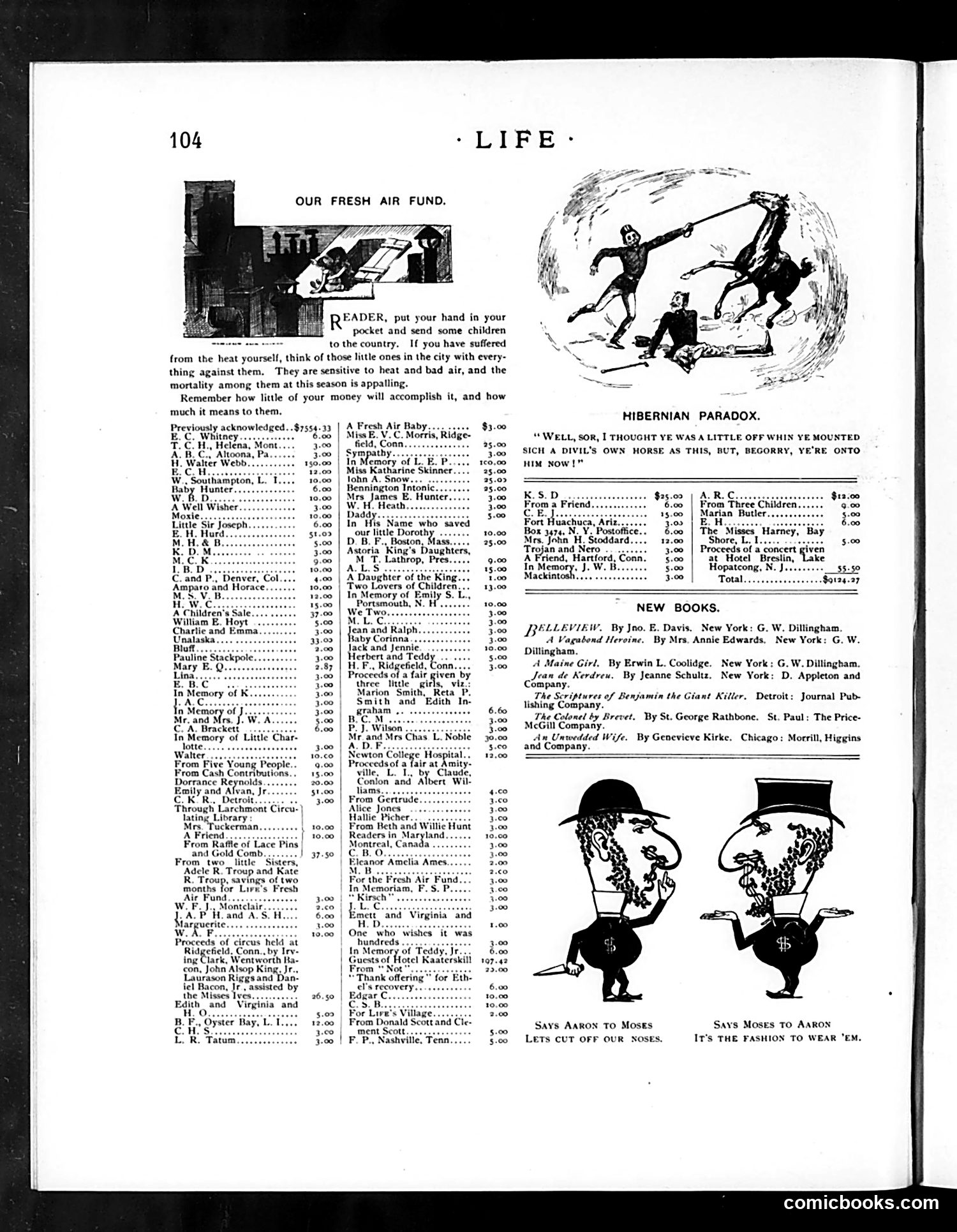
This page contains primarily **fundraising appeals and book advertisements** rather than political cartoons. The main content includes "Our Fresh Air Fund"—a charitable campaign asking readers to send money to provide country outings for poor city children exposed to urban heat and pollution. Multiple donors are listed by name and contribution amount. The "Hibernian Paradox" cartoon depicts someone falling from a horse with the caption referencing being "off" the horse. This appears to be a simple visual pun rather than political satire. Below that, the "Aaron to Moses" cartoon shows two caricatured figures in hats—likely ethnic stereotypes common to early 20th-century American humor—though the specific reference remains unclear without additional context. The page primarily serves a charitable/commercial function rather than political commentary.
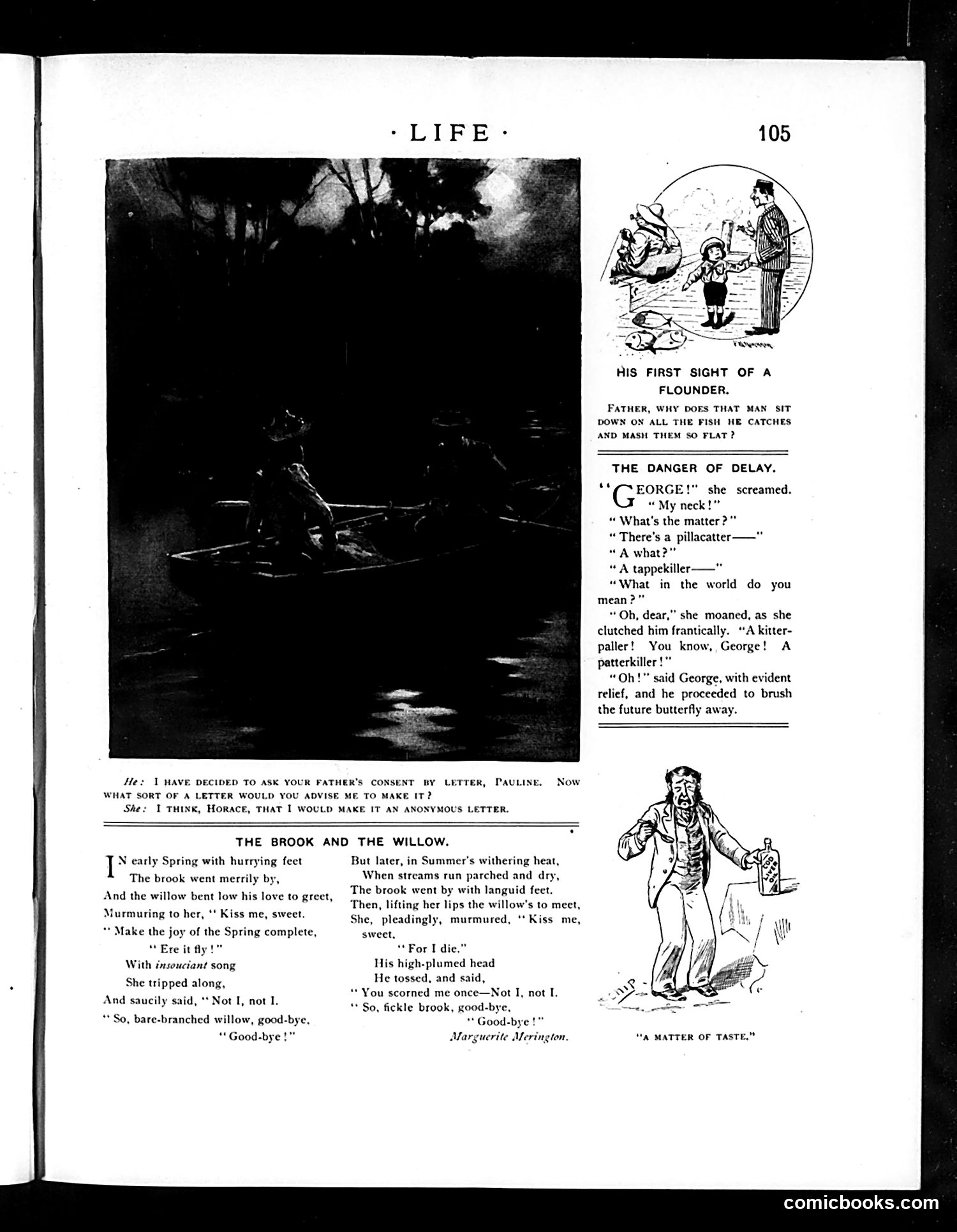
This page contains three separate pieces of humor: 1. **"His First Sight of a Flounder"** (top right): A child's question about why fishermen flatten fish, likely mocking children's literal interpretations of cooking methods. 2. **"The Danger of Delay"** (center): A domestic comedy sketch where a woman misidentifies a "pillpallaster" as a "kitterpaller" and "patterkiller." George's relief suggests the woman was alarmed about something trivial—satirizing domestic anxiety and marital miscommunication. 3. **"The Brook and the Willow"** (bottom): A sentimental poem with illustrated vignette titled "A Matter of Taste" showing a well-dressed man. The poem treats nature romantically, while the illustration suggests social satire about refined taste or manners. The page blends humor ranging from innocent wordplay to domestic satire.
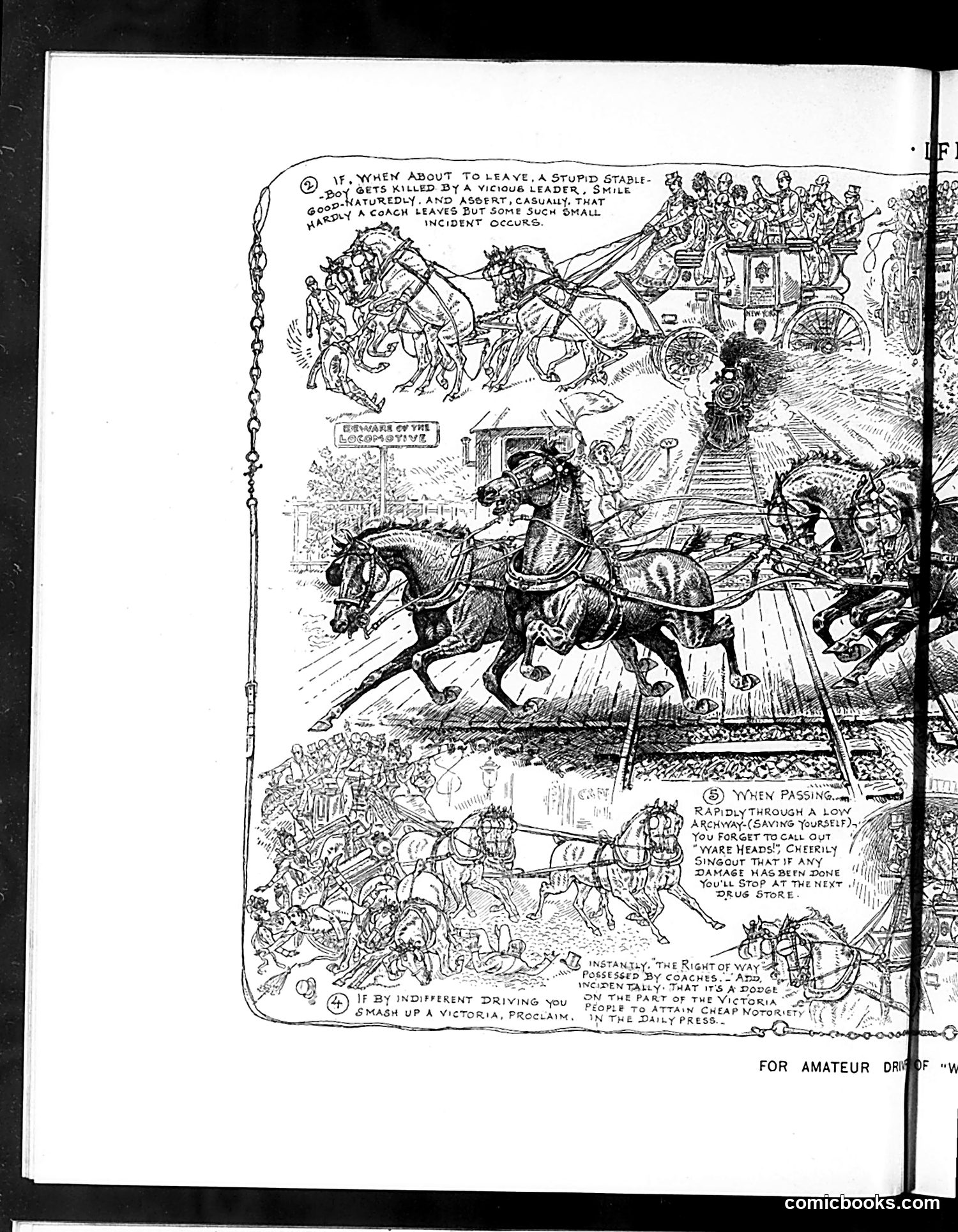
This page presents a satirical instructional cartoon about proper carriage driving etiquette, apparently mocking amateur drivers of the era. The numbered panels humorously depict "what NOT to do": 1. **Leaving a stupid stable** with a coach and poor horsemanship 2. **Passing through a narrow archway** carelessly, potentially damaging property 3. **Smashing up a Victoria** (a type of carriage) through reckless driving The satire targets wealthy amateur drivers—likely referring to early motorcar owners or carriage drivers—who operated vehicles without proper skill or consideration. The final text mentions proclaiming "cheap motoring" in the daily press, suggesting this mocks nouveau riche or pretentious drivers claiming expertise they lack. The detailed, intricate illustration style is typical of early 20th-century Life magazine's approach to social commentary through humor.
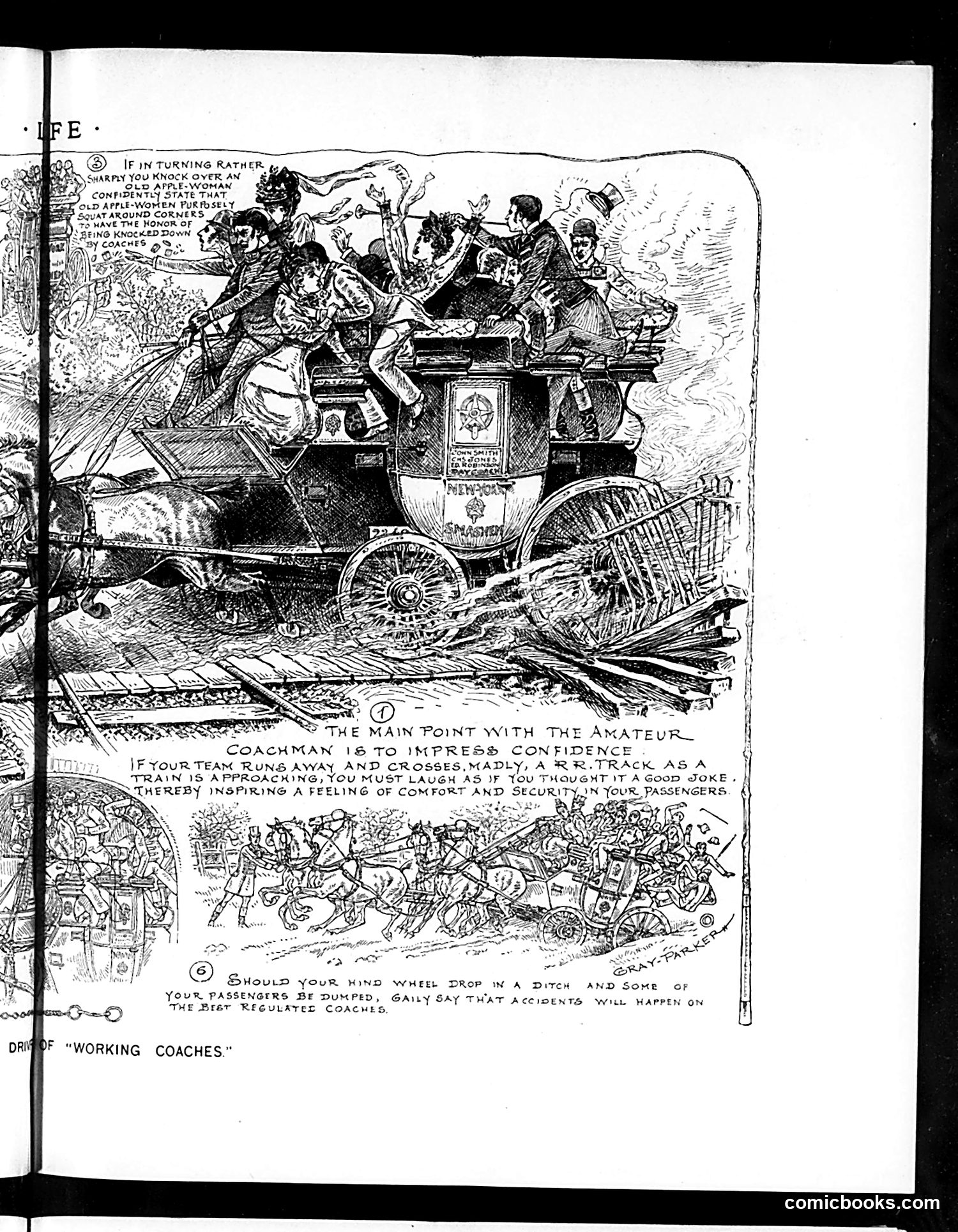
This page satirizes amateur coachmen—wealthy dilettantes who operated horse-drawn coaches as a hobby or social pursuit. The top illustration depicts a chaotic scene where inexperienced "amateurs" operating a coach wildly mishandle their vehicle, with passengers tumbling about dangerously. The accompanying text mockingly advises amateurs on "impressing confidence": if your team runs away and crashes badly onto railroad tracks, you should laugh it off so passengers feel comfortable—the satire being that catastrophic incompetence is being masked by false cheerfulness. The bottom illustration shows a similar disaster unfolding. The satire targets wealthy hobbyists playing at being professional coachmen while endangering actual passengers through their reckless inexperience. It's commentary on class privilege and dangerous amateurism.
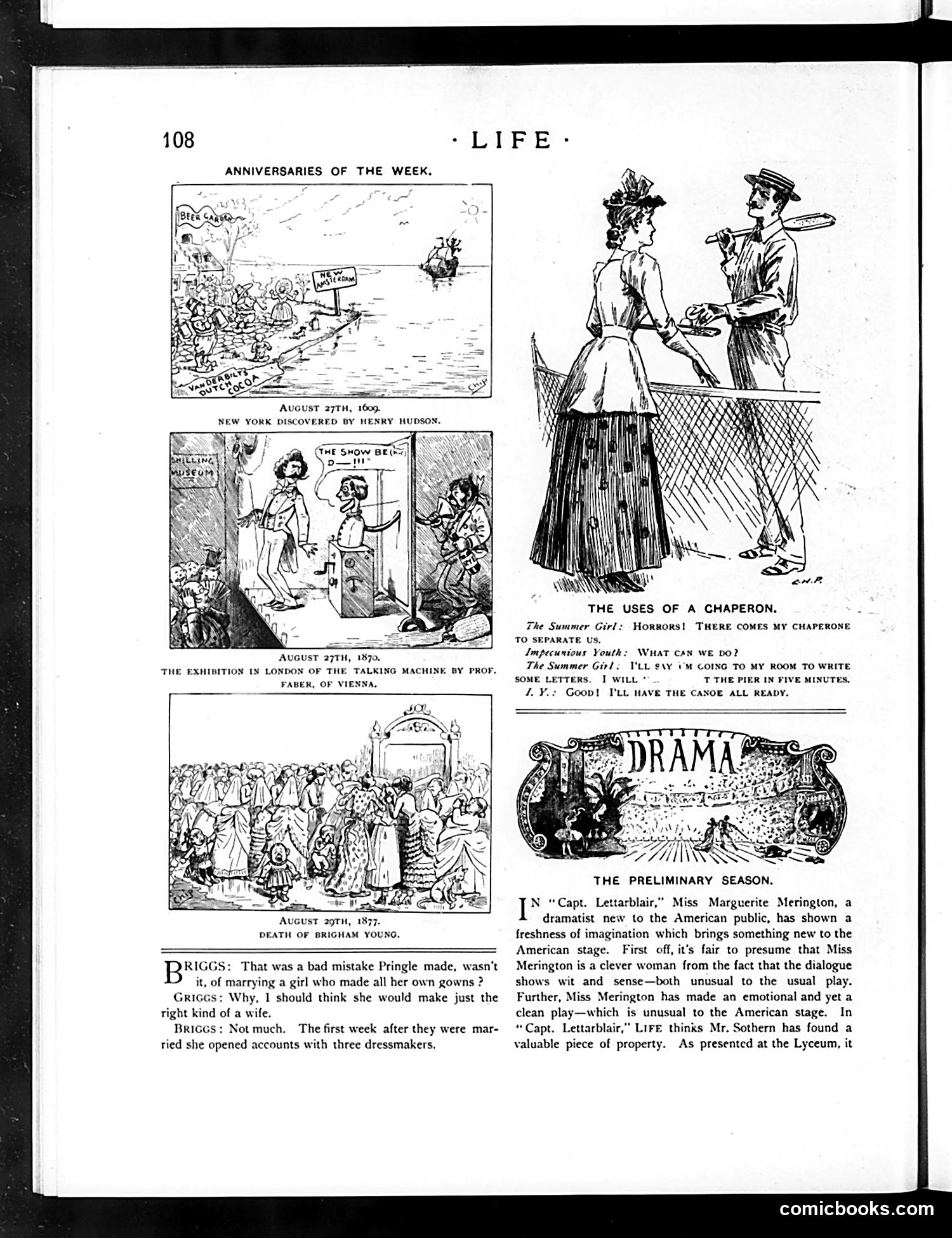
This page contains historical commemorative cartoons and a drama review. The top cartoon depicts **Henry Hudson's 1609 discovery of New York**, showing a crowded shoreline with a ship. Below that is an 1870 cartoon about **Professor Faber's talking machine exhibition in London**—an early mechanical speech device that fascinated Victorian audiences. The third cartoon shows a large crowd gathered for the **1877 death of Bethlehem Young** (the Mormon leader). On the right, "The Uses of a Chaperon" is a humor comic about summer romance and propriety—a young man and woman cannot be alone together without adult supervision, a strict social convention of the era. The drama section reviews "Capt. Letterblaire," praising actress Marguerite Merington's fresh approach to American theater.
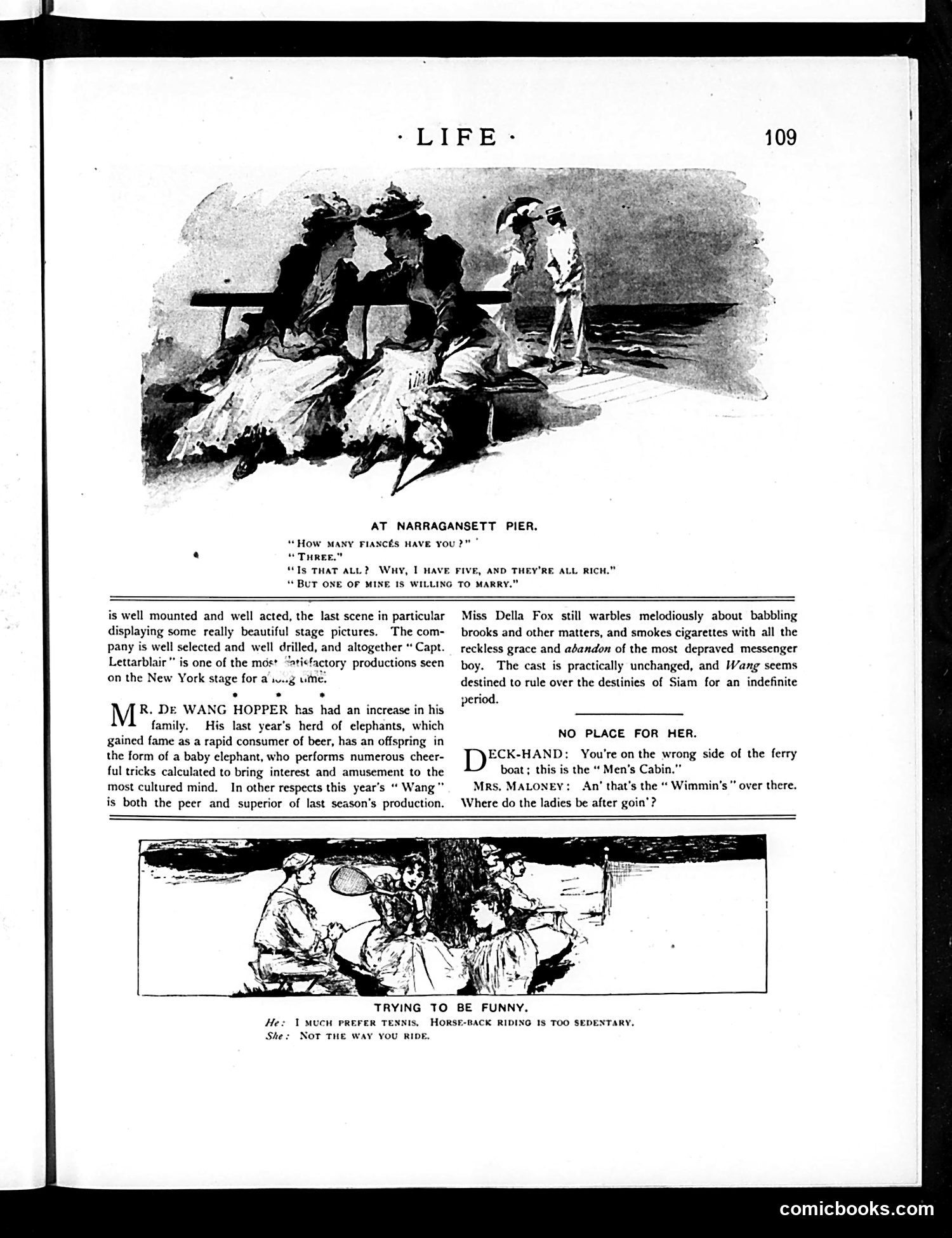
This page contains two theatrical sketches satirizing early 20th-century social pretensions: **Top illustration ("At Narragansett Pier"):** Shows wealthy women discussing their daughters' marriage prospects. The joke centers on class anxiety—one woman boasts of five rich fiancés for her daughter, while another admits her daughter has only one suitor, but he's "willing to marry." This mocks upper-class obsession with marrying daughters to wealthy men. **Bottom illustration ("Trying to Be Funny"):** Depicts a couple disagreeing about horseback riding etiquette. He prefers tennis as "not too sedentary," while she critiques his riding style. This gentle humor targets couples' bickering over social propriety and masculine/feminine deportment. Both sketches reflect Life's focus on satirizing affluent American social customs and domestic gender dynamics of the era.
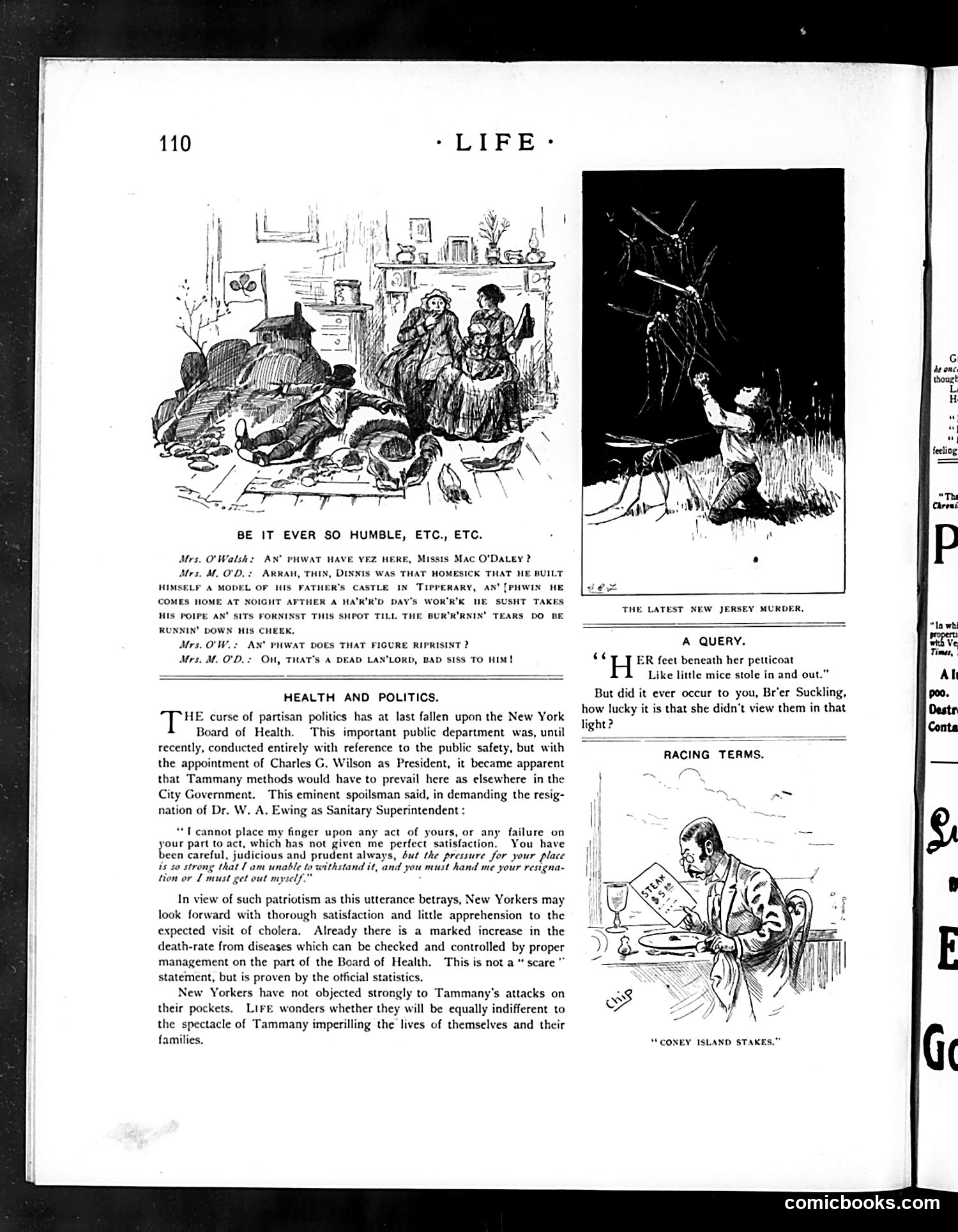
**Top Cartoon ("Be It Ever So Humble"):** Irish immigrant characters discuss a homesick coworker who built a model of his father's Irish castle. The joke satirizes Irish nostalgia and immigrant homesickness—the punchline reveals the "dead landlord" figure represents the Irish peasant's bitter memory of exploitative landlords in Ireland, suggesting deep class resentment embedded in immigrant culture. **"Health and Politics" Article:** Attacks Charles G. Wilson's appointment to New York's Board of Health as a Tammany Hall (corrupt Democratic machine) political favor. The quoted admission that Dr. Ewing is being fired despite perfect performance—solely due to political pressure—exemplifies machine corruption. Life warns this politicization of public health endangers citizens by replacing competent officials with party loyalists, especially threatening during cholera epidemics. **Bottom Cartoons:** Two unrelated satirical sketches—one about a woman's petticoat ("Query") and "Coney Island Stakes" (likely horse racing satire).
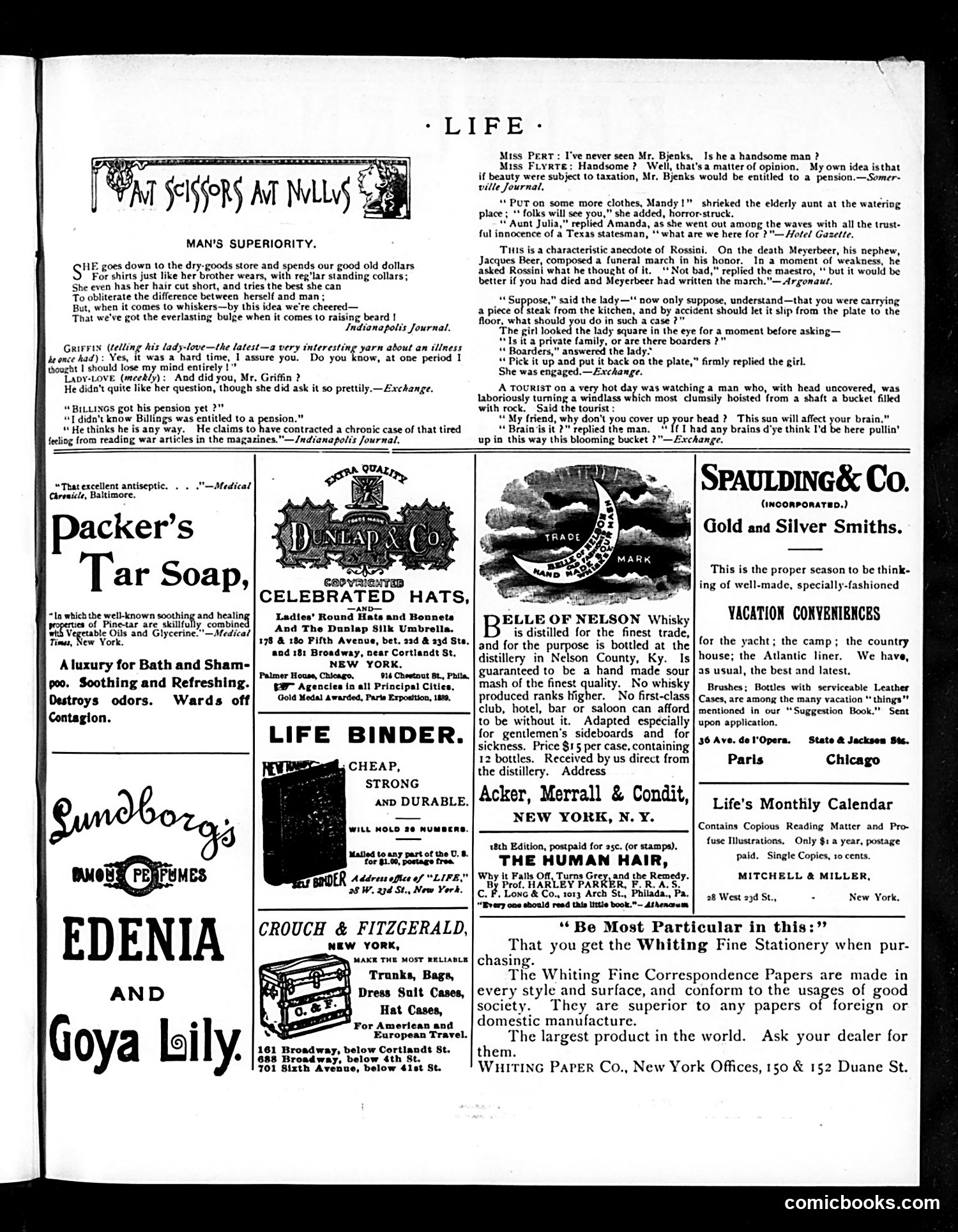
This page from *Life* magazine (a 19th-century satirical publication) contains several brief humorous pieces mocking gender roles and contemporary absurdities: **"Man's Superiority"** opens with heavy sarcasm: women now dress like men and cut their hair short, obliterating differences—*except* men can grow beards, which the author treats as the sole remaining proof of male superiority. The joke ridicules how trivial this distinction is. **Other brief jokes** mock romantic disappointment, pension fraud (a man claiming disability from reading war articles), and absurd situations (a servant deciding whether to return dropped steak based on whether boarders are present—implying lower standards for non-family). The page is primarily **advertisements** for luxury goods (soap, hats, whiskey, stationery), reflecting the magazine's commercial nature. Overall, the satire targets gender confusion of the era, male vanity, and working-class pragmatism—typical *Life* humor of its period.
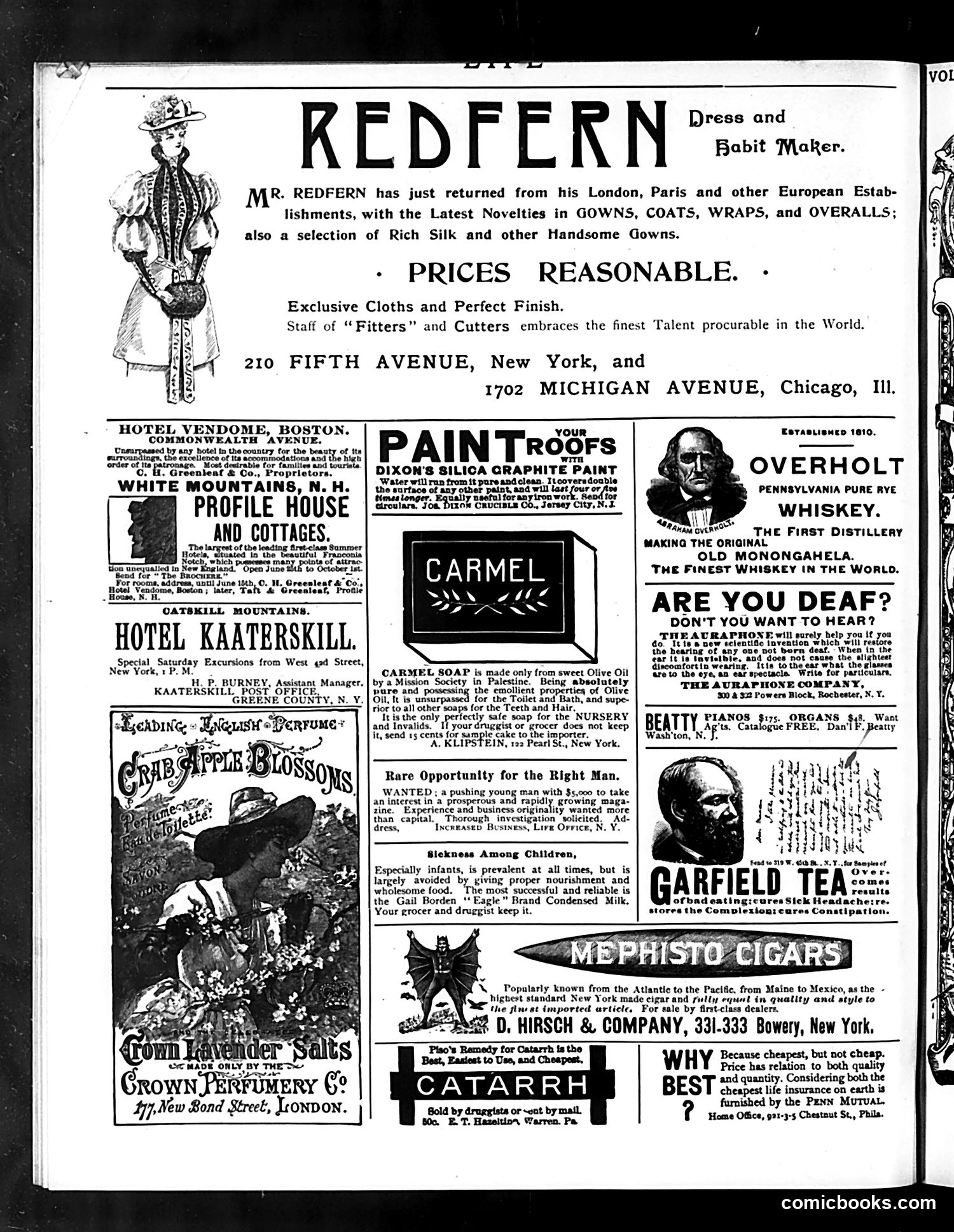
This is primarily an **advertising page** with no political cartoons or satirical content. The page consists entirely of commercial advertisements from circa early 1900s, featuring: **Notable ads include:** - **Redfern** (dress/habit maker) — a high-end fashion house returning from European trips - **Hotel advertisements** (Vendome Boston, Profile House, Kaaterskill) - **Product ads** for soap, whiskey, pianos, cigars, hearing aids, and patent medicines The only item approaching satire is the **"Are You Deaf?" hearing aid advertisement**, which uses somewhat sensational language typical of period medical marketing. **Historical context:** These ads reveal early-1900s consumer culture—luxury travel, fine clothing imported from Europe, and aggressive patent medicine marketing. The whiskey ad's emphasis on being "the finest in the world" and the cigar ad's boasts of quality "from Maine to Mexico" reflect American commercial confidence of the era. This is a straightforward **commercial page with no political commentary or cartoons to analyze.**