
Life, 1892-08-25 · page 4 of 14
Life — August 25, 1892 — page 4: what you’re looking at
What you’re looking at
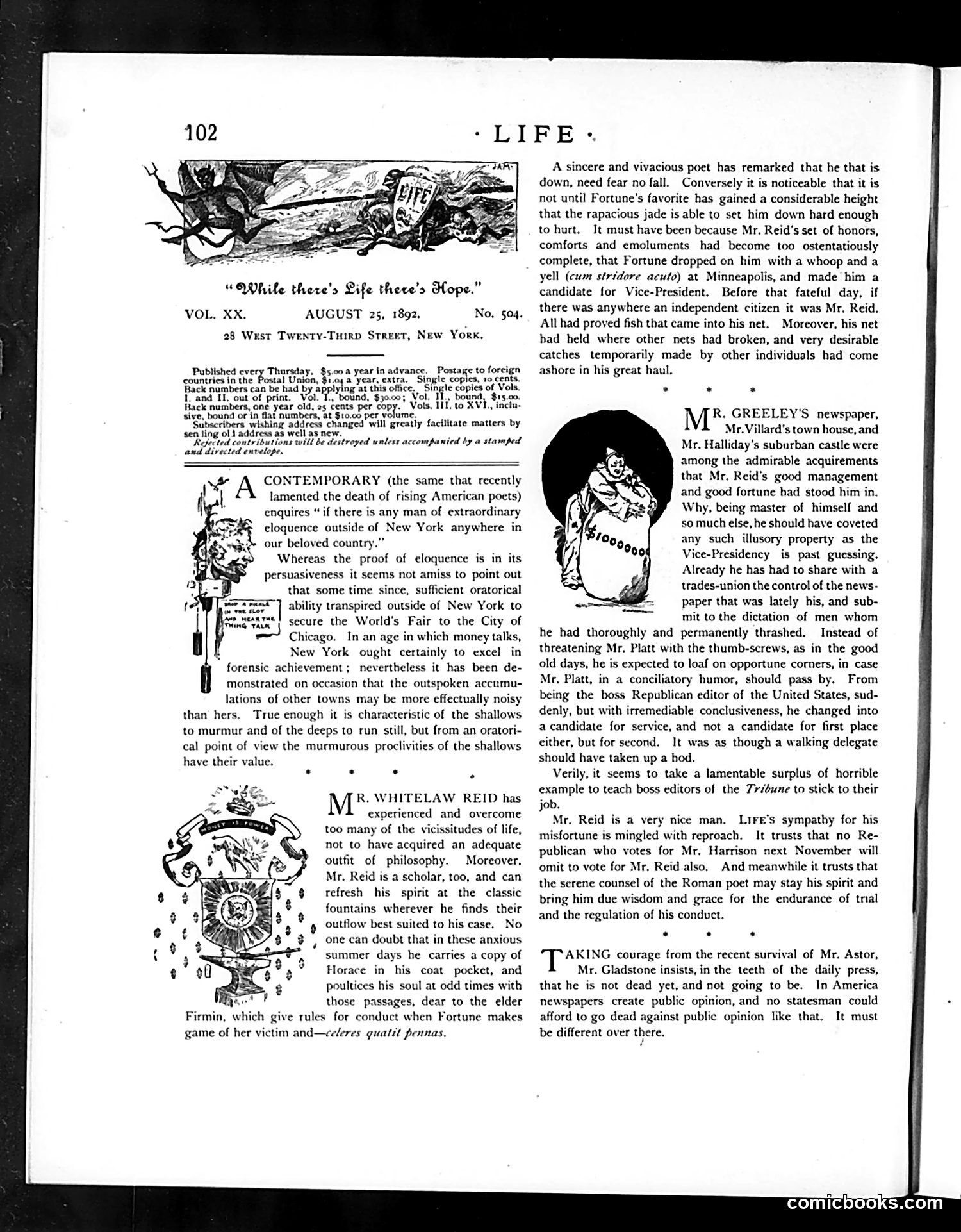
This page satirizes **Whitelaw Reid**, a prominent newspaper editor and political figure. The text mocks Reid's ambitions and recent misfortunes, suggesting he's experienced enough hardship that he shouldn't worry about further setbacks. The satire appears to reference Reid's failed vice-presidential candidacy (mentioned as recent) and his involvement with New York newspapers and politics. The magazine criticizes his management style and his submission to more powerful political figures, comparing him unfavorably to stronger political leaders. The Latin phrase "cedere quiit pennas" suggests the satirical tone concerns surrender or loss of dignity. The cartoon imagery (decorative emblems and illustrations) accompanies commentary on Reid's character and political standing, though the specific visual caricatures are difficult to interpret without additional context.
📄 Transcribed text from this page (OCR, searchable)
Machine-transcribed from the original scan — historical spelling and the odd misread are preserved.
LIFE “Mile there's Life there’s Hope.” OL. XX. AUGUST 25, 1892. No. 504. 28 West TweNty-THirD Street, New York. Published every Thursday. $5.00 year in advance. Postage to foreign countries in the Postal Union, $toy a year, eatea, Single copies, 10 cents Back numbers can be had by applying at this office, Single copies of Vols Tand IL, out of print. Vol. 1, bound, $30.00; Vol. Il.. bound. $15.00, Hack numbers, one year old. 2 cents per copy. Vols Ili. to XV. cha: sive, bound or in flag numbers, at $10.09 per ¥ imecribers wishing adaresa changed will greatly facilitate matters by sen ling ol 1 address as well as ne Rejected contributions will be and directed envelope. stroyed unless accompanied by a stamped CONTEMPORARY (the same that recently ry A f lamented the death of rising American poets) 4 enquires “ if there is any man of extraordinary eloquence outside of New York anywhere in our beloved country.” Whereas the proof of eloquence is in its persuasiveness it scems not amiss to point out that some time since, sufficient oratorical ability transpired outside of New York to secure the World’s Fair to the City of Chicago. In an age in which moncy talks, New York ought certainly to excel in " forensic achievement ; nevertheless it has been de- monstrated on occasion that the outspoken accumu- lations of other towns may be more effectually noisy than hers. True enough it is characteristic of the shallows to murmur and of the deeps to run still, but from an oratori- cal point of view the murmurous proclivities of the shallows have their value. . . . R. WHITELAW REID has experienced and overcome too many of the vicissitudes of life, not to have acquired an adequate outfit of philosophy. Moreover, Mr. Reid is a scholar, too, and can refresh his spirit at the classic fountains wherever he finds their outflow best suited to his case. No one can doubt that in these anxious summer days he carries a copy of Horace in his coat pocket, and poultices his soul at odd times with those passages, dear to the elder Firmin, “which give rules for conduct when Fortune makes game of her victim and—celeres guatit pennas, A sincere and vivacious poet has remarked that he that is down, need fear no fall. Conversely it is noticeable that it is not until Fortune’s favorite has gained a considerable height that the rapacious jade is able to set him down hard enough to hurt. It must have been because Mr. Reid's set of honors, comforts and emoluments had become too ostentatiously complete, that Fortune dropped on him with a whoop and a yell (cum stridore acuto) at Minneapolis, and made him a candidate for Vice-President. Before that fateful day, if there was anywhere an independent citizen it was Mr. Reid. All had proved fish that came into his net. Moreover, his net had held where other nets had broken, and very desirable catches temporarily made by other individuals had come ashore in his great haul. ° . * ] R. GREELEY’S newspaper, Mr.Villard's town house, and Mr. Halliday’s suburban castle were among the admirable acquirements that Mr. Reid's good management and good fortune had stood him in. Why, being master of himself and so much else, he should have coveted any such illusory property as the Vice-Presidency is past guessing. Already he has had to share with a trades-union the control of the news- paper that was lately his, and sub- mit to the dictation of men whom he had thoroughly and permanently thrashed. Instead of threatening Mr, Platt with the thumb-screws, as in the good old days, he is expected to loaf on opportune corners, in case Mr. Platt, in a conciliatory humor, should pass by. From being the boss Republican editor of the United States, sud- denly, but with irremediable conclusiveness, he changed into a candidate for service, and not a candidate for first place either, but for second. It was as though a walking delegate should have taken up a hod. Verily, it seems to take a lamentable surplus of horrible example to teach boss editors of the 7rzbune to stick to their job. Mr. Reid is a very nice man. LiFE’s sympathy for his misfortune is mingled with reproach, It trusts that no Re- publican who votes for Mr. Harrison next November will omit to vote for Mr. Reid also. And meanwhile it trusts that the serene counsel of the Roman poet may stay his spirit and bring him due wisdom and grace for the endurance of tnal and the regulation of his conduct. AKING courage from the recent survival of Mr. Astor, Mr. Gladstone insists, in the teeth of the daily press, that he is not dead yet, and not going to be. In America newspapers create public opinion, and no statesman could afford to go dead against public opinion like that. It must be different over there.