
A complete issue · 14 pages · 1892
Life — August 18, 1892
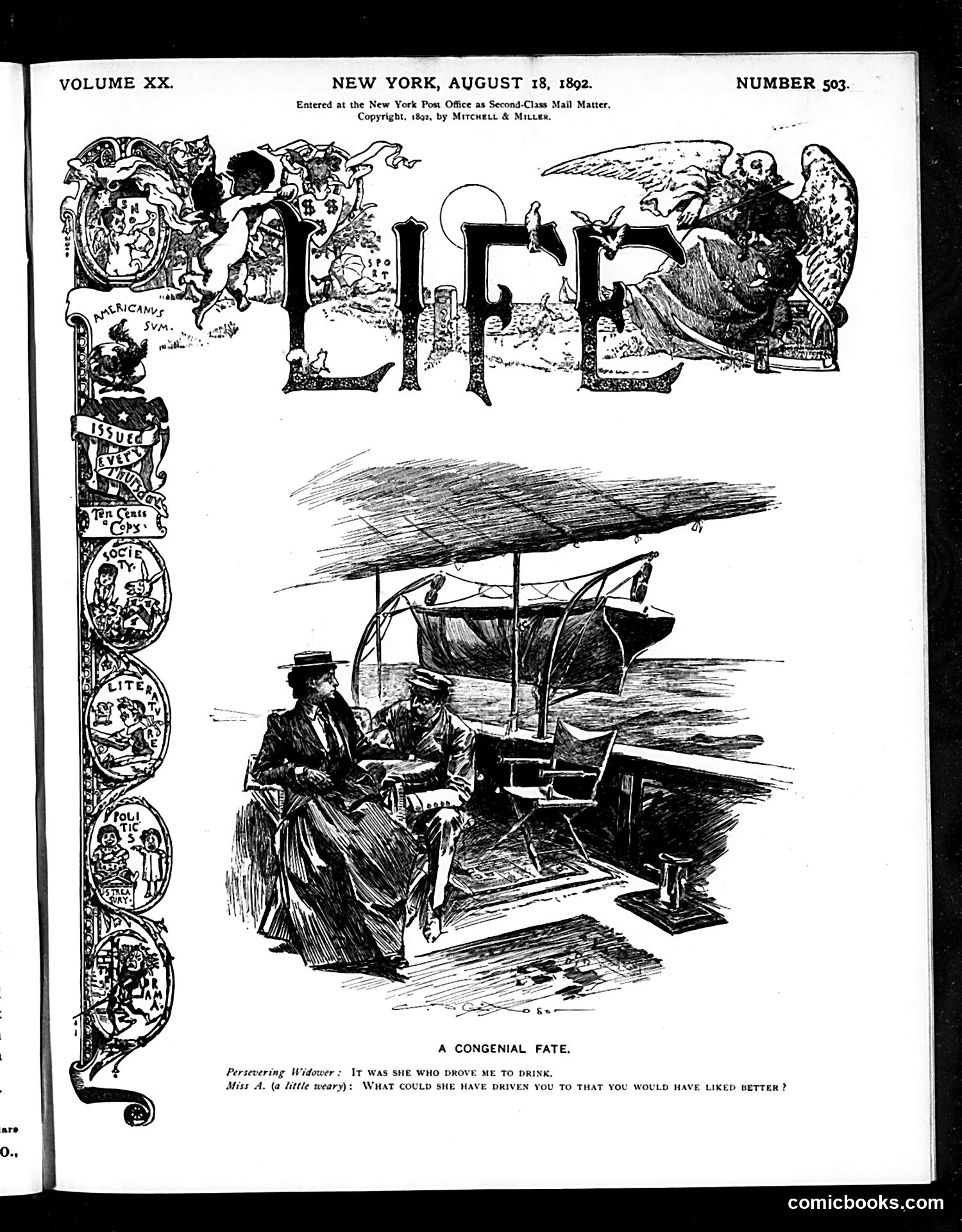
This cartoon satirizes a couple in a horse-drawn carriage. The caption presents a domestic dispute: a "Persevering Widower" complains that "It was she who drove me to drink," while "Miss A (a little weary)" responds sarcastically, "What could she have driven you to that you would have liked better?" The joke relies on marital tension humor—a common theme in 1890s satirical magazines. The "widower" and his companion appear to be in an uncomfortable ride together, with the woman portrayed as tired or resigned. The humor comes from her witty retort suggesting his drinking problem existed regardless of her influence, and implying whatever alternative activity he might have preferred would likely be equally undesirable to her.
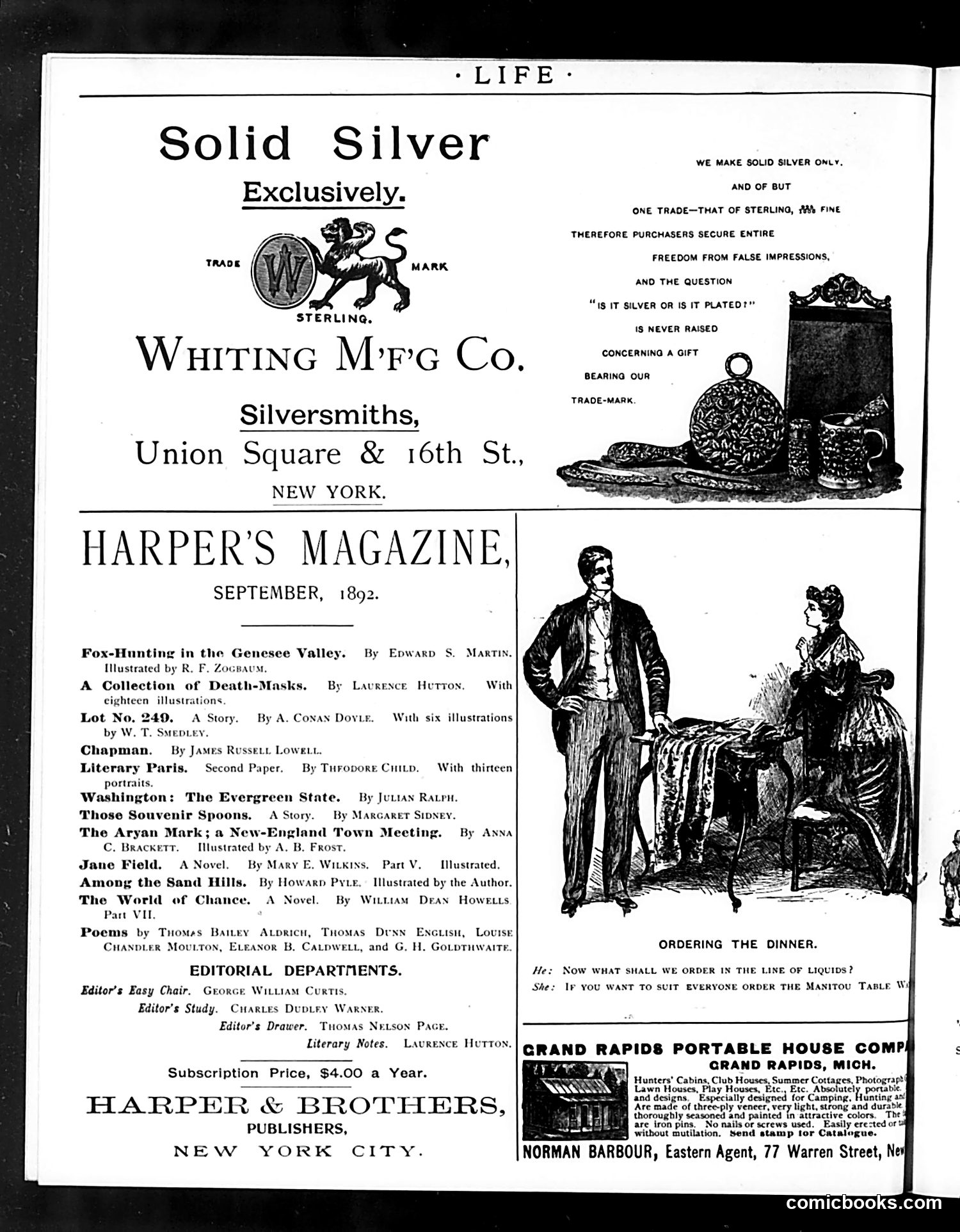
This page is primarily **advertising and magazine contents**, not political satire. The top half features an ad for **Whiting Manufacturing Company**, a New York silversmith promoting solid sterling silver tableware. The ad emphasizes their goods are genuine silver, not plated—a consumer reassurance pitch addressing contemporary fraud concerns about silver products. The lower section lists contents for Harper's Magazine (September 1892), including fiction by Conan Doyle and others. The illustration labeled "**Ordering the Dinner**" depicts a man and woman in period dress discussing meal selections—likely humorous domestic dialogue matching a featured story. Below that is an advertisement for portable houses from Grand Rapids, Michigan. The page contains **no political cartoons or satire**—it's standard magazine advertising and contents listing.
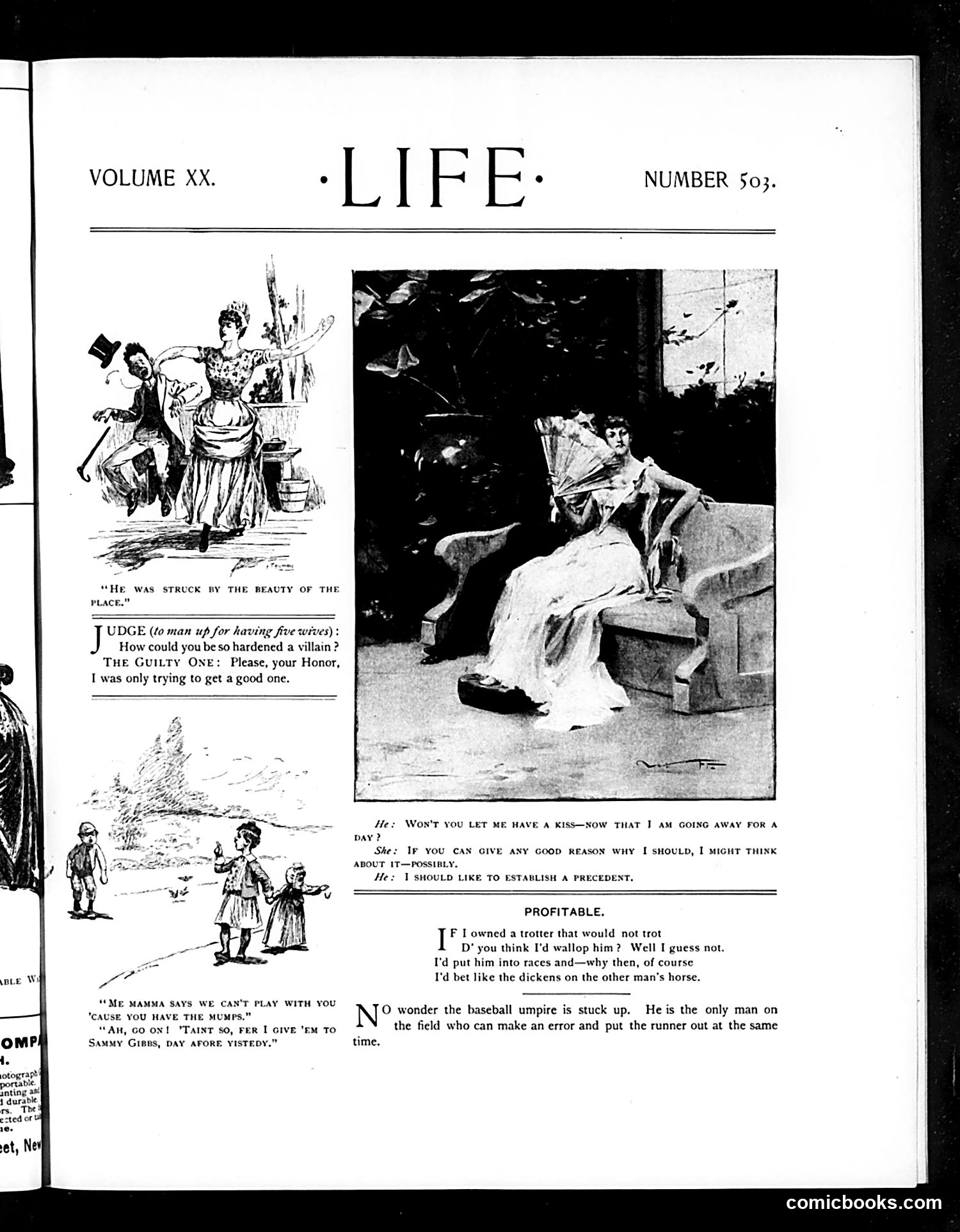
This page contains three separate humorous items typical of early 20th-century satirical magazines: 1. **Top cartoon**: A judge questions a villain about hardening, with the guilty party claiming they were "only trying to get a good one" — likely commentary on moral corruption or failed rehabilitation. 2. **Photograph with dialogue**: A domestic scene where a man seeks a kiss before leaving, negotiating terms with a woman. The humor derives from the transactional nature of affection. 3. **Bottom section ("Profitable")**: A joke about horse racing, where owning a non-trotting horse leads to betting losses, with wordplay about "races" and horses. 4. **Baseball umpire joke**: Commentary on umpires' power to change game outcomes through simultaneous errors. The content reflects era-typical humor about relationships, gambling, and sports.
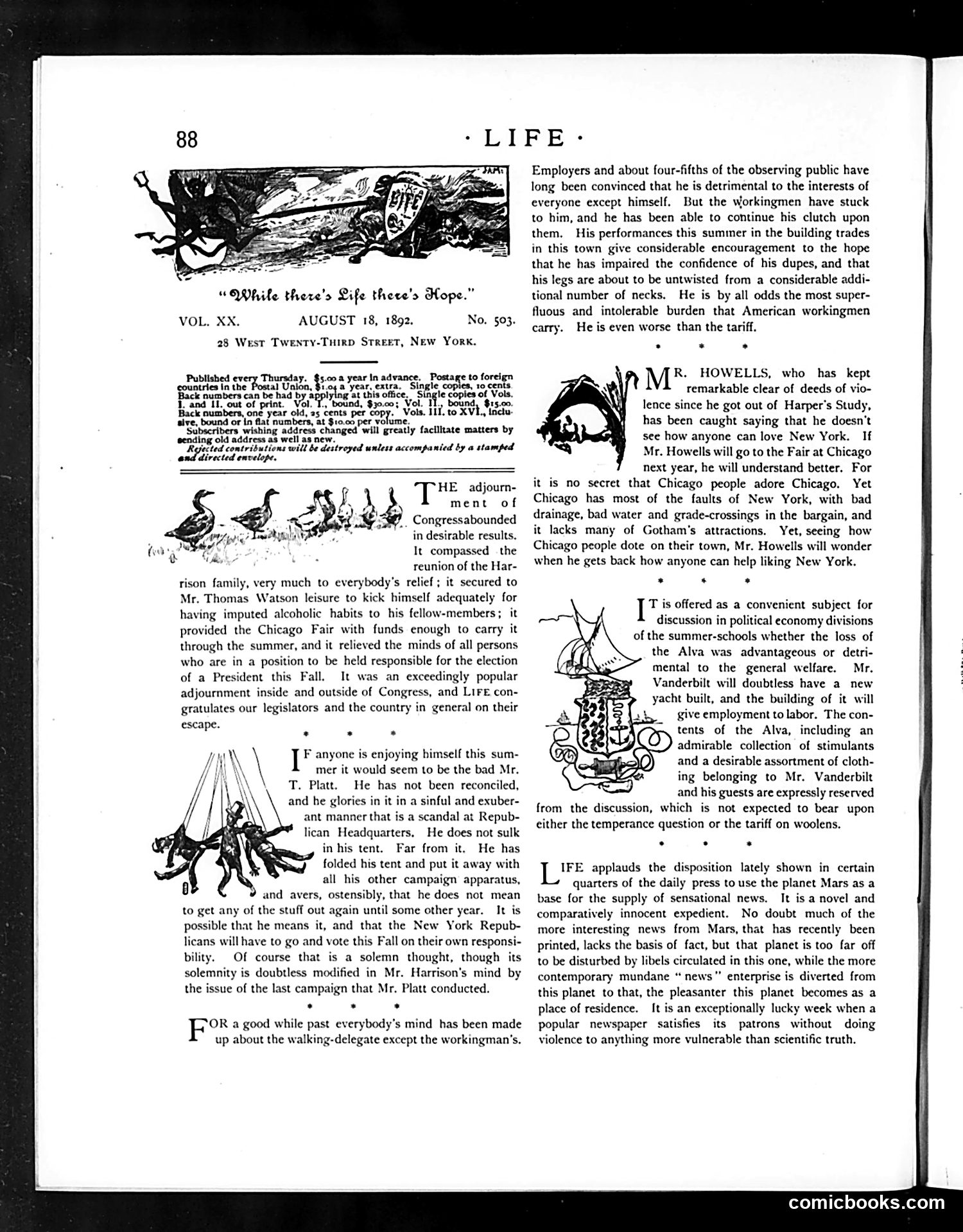
This page contains editorial commentary rather than a political cartoon. The text criticizes several figures and situations: 1. **An unnamed workingman** whose poor performance in construction work has damaged employers' confidence and caused physical deterioration—described as "a superfluous and intolerable burden." 2. **Mr. Howells** (likely William Dean Howells, the prominent writer), who apparently criticized New York after visiting Chicago, missing how Chicago itself has serious infrastructure problems. 3. **Mr. T. Platt**, a Republican politician accused of questionable conduct at party headquarters—the text suggests he's folding away his campaign apparatus while denying involvement in unethical activities. 4. References to debate over tariffs on woolens and the Vanderbilt yacht, presented as worthy discussion topics. The satirical tone targets political hypocrisy and failing workers through editorial critique rather than visual caricature.
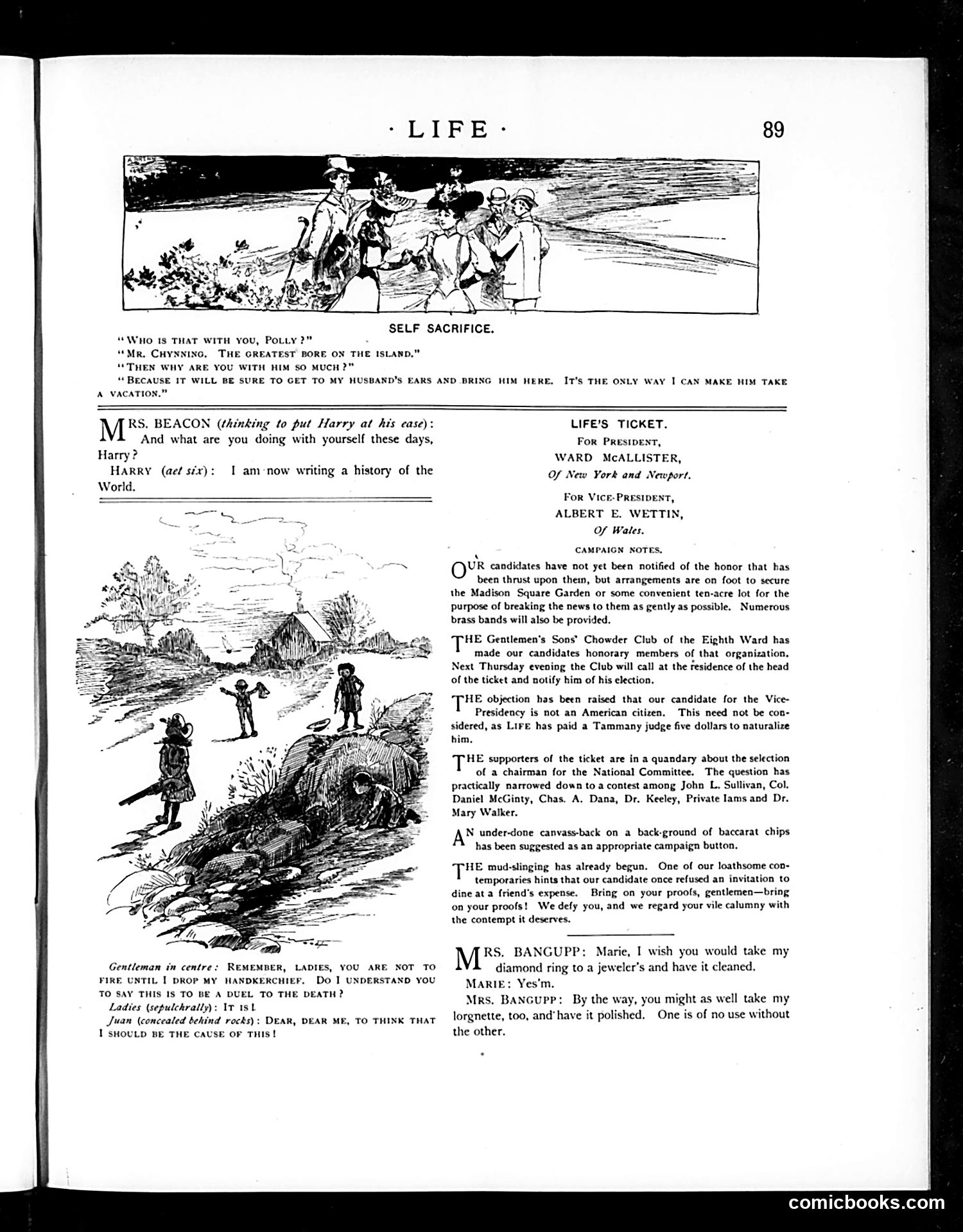
The top cartoon titled "Self Sacrifice" depicts a scene where a woman (Polly) is dragging her reluctant husband (Mr. Chysning, described as "the greatest bore on the island") along for a vacation. The satire mocks husbands who avoid leisure time, with Polly forcing her husband away despite his resistance—illustrating the domestic power dynamic where wives compel reluctant spouses into social activities. Below is a sketch-style illustration showing people in a natural landscape, accompanying dialogue between Mrs. Beacon and Harry about writing a history of the world. The right column contains "Life's Ticket"—campaign notes for political candidates Ward McAllister (President) and Albert E. Wettin (Vice-President), with satirical commentary on campaign procedures and objections to the candidates' qualifications.
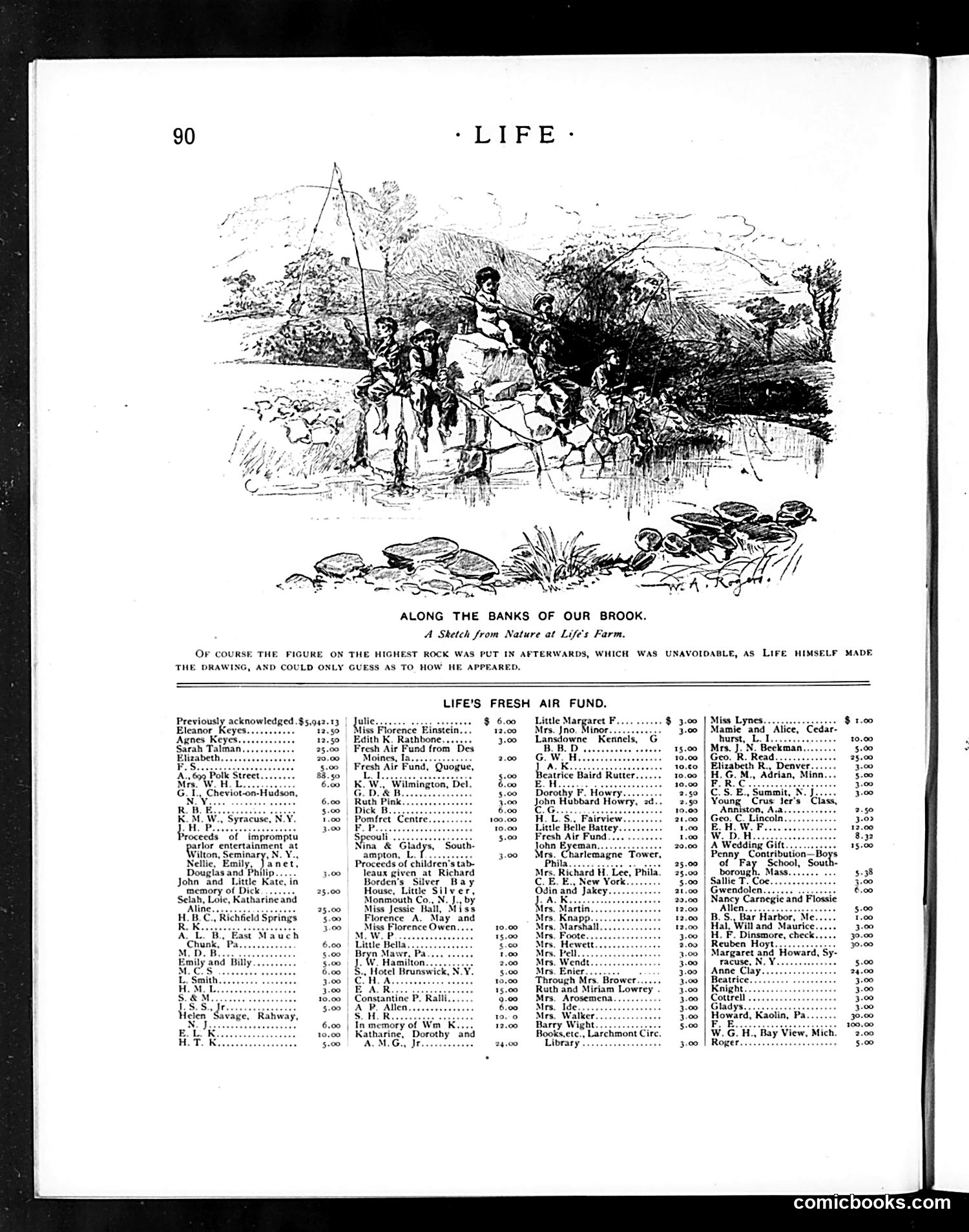
This page contains a sketch titled "Along the Banks of Our Brook: A Sketch from Nature at Life's Farm," depicting a pastoral scene with figures fishing or wading by a stream. The accompanying caption notes that "the figure on the highest rock was put in afterwards, which was unavoidable, as Life himself made the drawing, and could only guess as to how he appeared." The humor appears self-referential: Life magazine personifies itself as an artist unable to accurately depict its own appearance, requiring guesswork. This is a gentle, meta-joke about the magazine's own nature and limitations. The bulk of the page consists of "Life's Fresh Air Fund"—a fundraising list acknowledging donations and donors, suggesting this was a charitable initiative by the publication supporting outdoor recreation or relief activities.
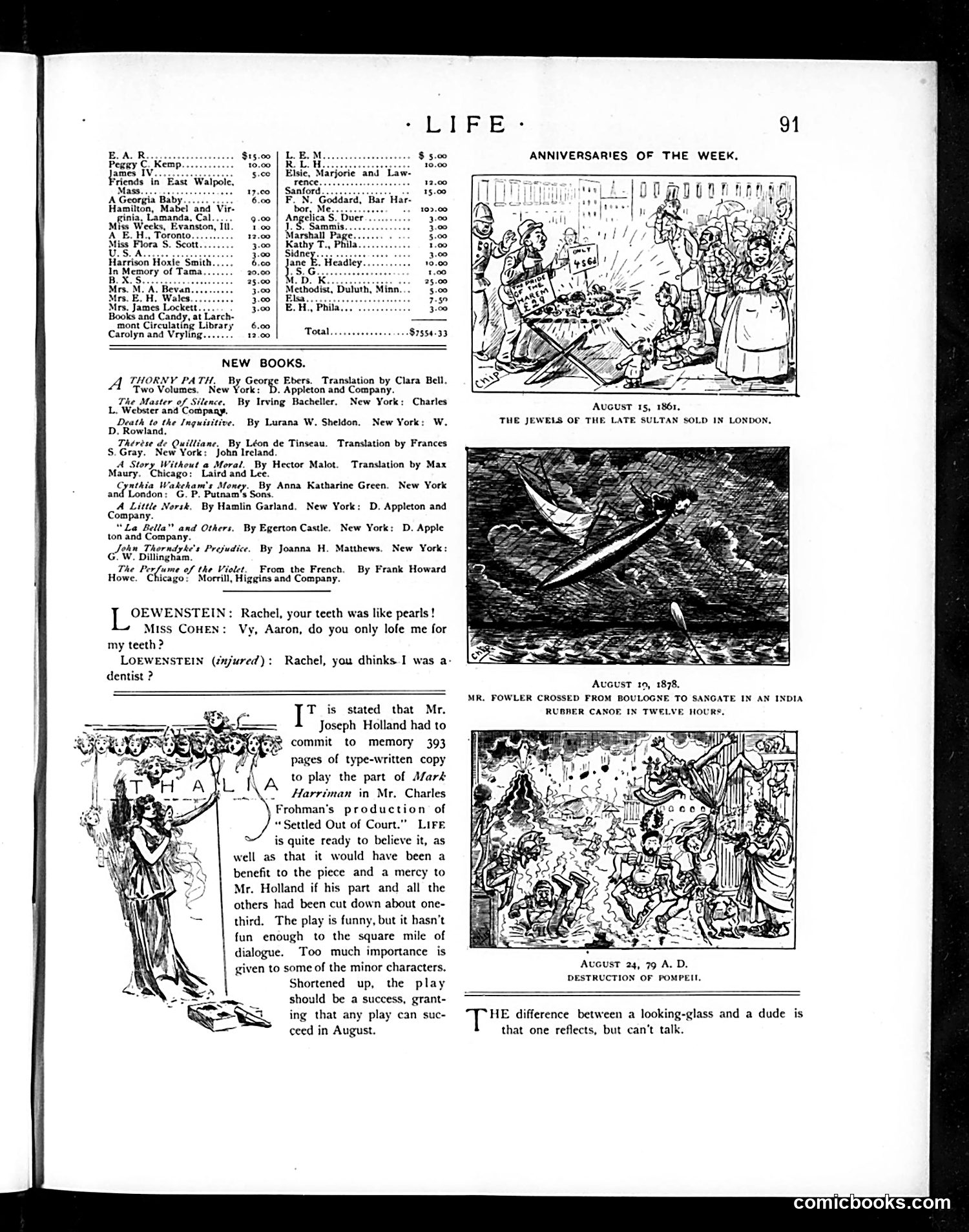
This page contains three main elements: 1. **"Anniversaries of the Week"** (top cartoon): A chaotic street scene depicting what appears to be a public disturbance or celebration, though the specific historical event referenced is unclear without additional context. 2. **Historical engravings**: Three illustrations labeled with historical dates (August 15, 1861; August 10, 1898; August 24, 79 A.D.), depicting events including the sale of Sultan's jewels in London, Mr. Fowler crossing from Boulogne to Sangate in a rubber canoe, and the destruction of Pompeii. 3. **Theatrical dialogue**: A brief exchange between characters Loewenstein and Miss Cohen about teeth, likely a vaudeville-style joke. The page primarily celebrates historical anniversaries through text and period engravings rather than contemporary political satire.
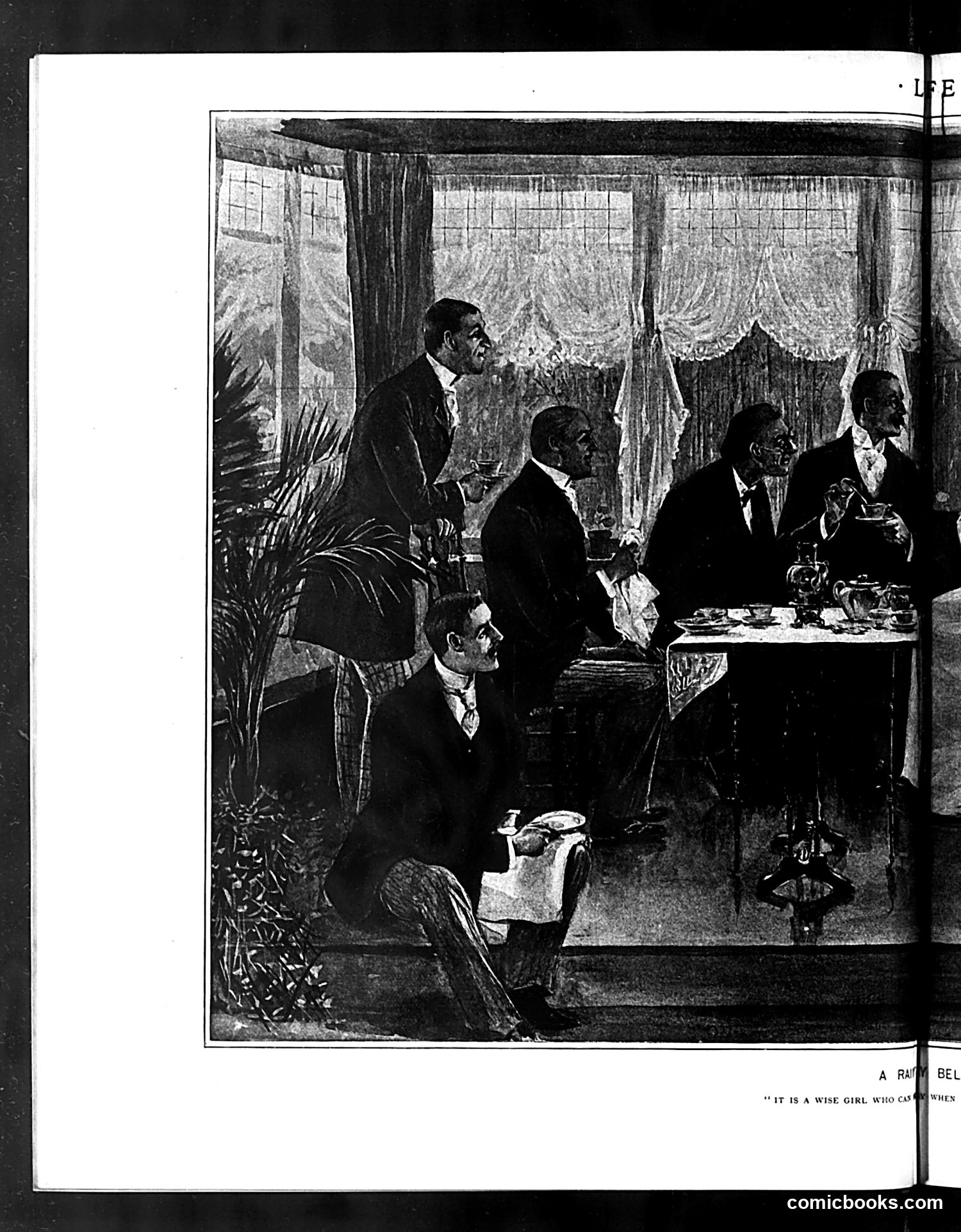
This appears to be a satirical illustration depicting a formal dining or social scene in an elegant room with draped windows and potted plants. Five well-dressed men in formal attire are shown - one standing and gesturing while speaking, others seated or standing around what appears to be a table with dining items. The visible caption reads: "IT IS A WISE GIRL WHO CAN'T WHISPER" (though the text is partially cut off at "A RARE BEL"). Without clearer identification of the specific figures or complete caption text, I cannot definitively identify who these men represent or what particular political or social scandal this satirizes. The scene suggests commentary on upper-class society or politics, but the specific historical reference remains unclear from this image alone.
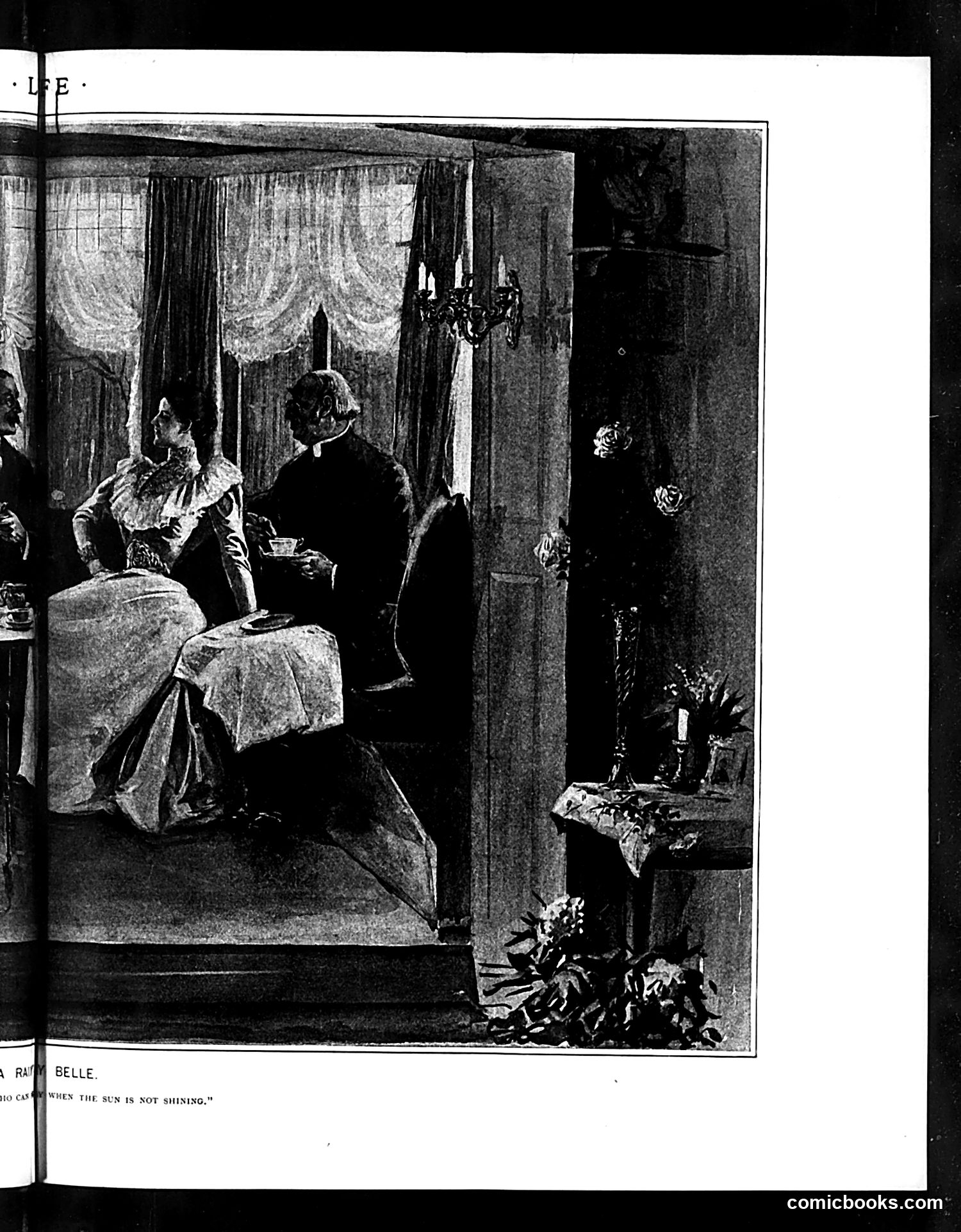
This appears to be an illustration from Life magazine titled "A Belle" with a caption referencing "When the Sun Is Not Shining." The image shows an interior scene with two figures—a woman in elaborate dress seated on the left, and a man in dark formal attire standing/conversing with her on the right. The room features ornate furnishings, draped curtains, flowers, and candlesticks, suggesting an upper-class domestic setting. The satire likely comments on social courtship or romantic behavior among the wealthy, with the caption suggesting ironic contrast between public propriety and private conduct. Without additional context about the specific date or historical moment, the precise political or social target remains unclear, though the scene appears to satirize elite social customs or romantic conventions of the period.
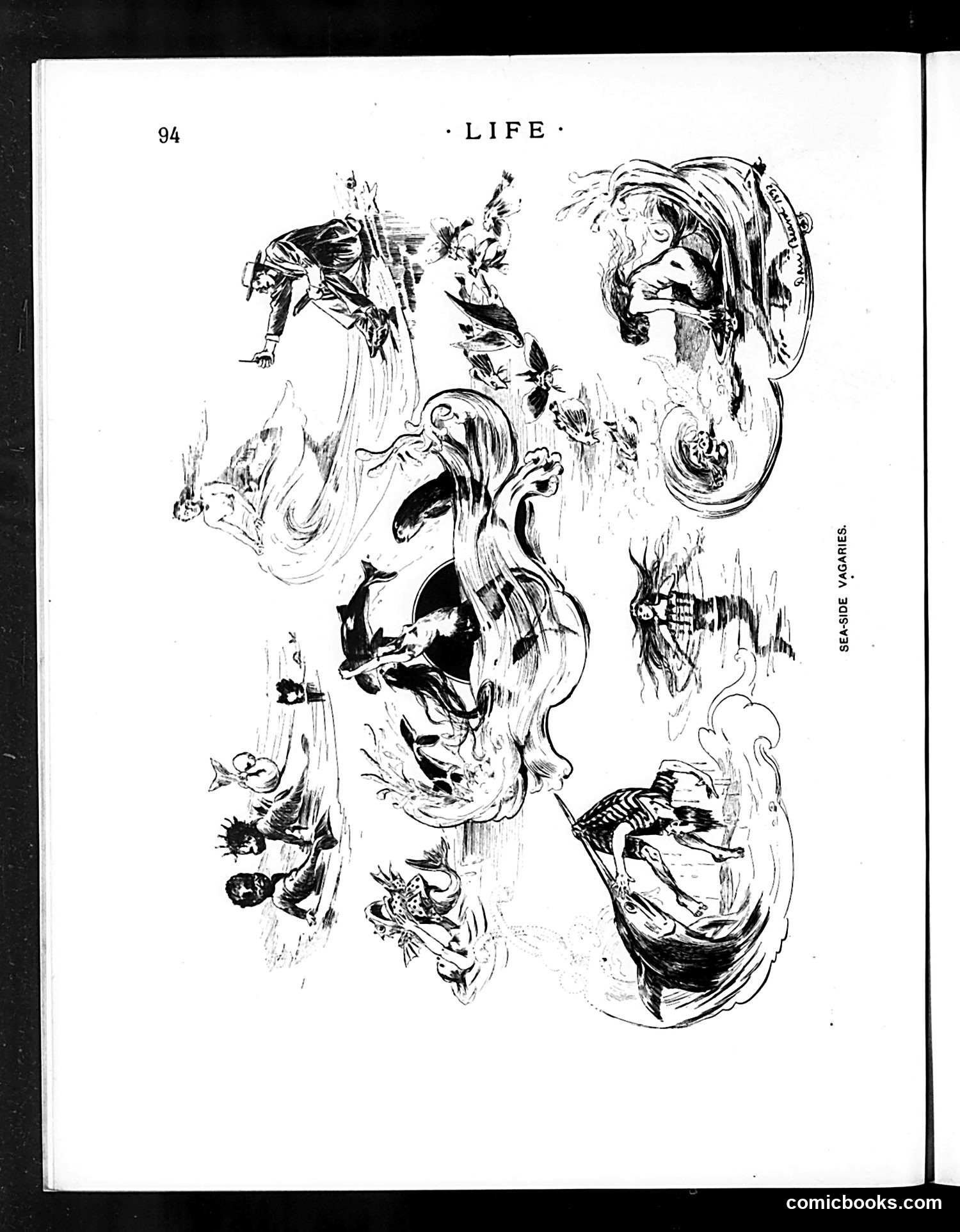
This page from *Life* magazine (page 94) shows a collection of ink sketch caricatures labeled "SEA-SIDE GAMBOLS" along the right margin. The drawings appear to depict people engaged in seaside leisure activities—swimming, wading, and recreational pursuits typical of beach vacation scenes. The sketches use exaggerated physical features characteristic of early satirical cartooning. Without identifying text for specific figures, the cartoonist appears to be satirizing contemporary beachgoers and their behaviors during seaside recreation. The style and technique suggest this is likely from the late 19th or early 20th century, when *Life* regularly published humorous illustrations of social customs and leisure activities. The "gambols" (playful activities) being mocked are typical vacation-season social observations rather than political commentary.
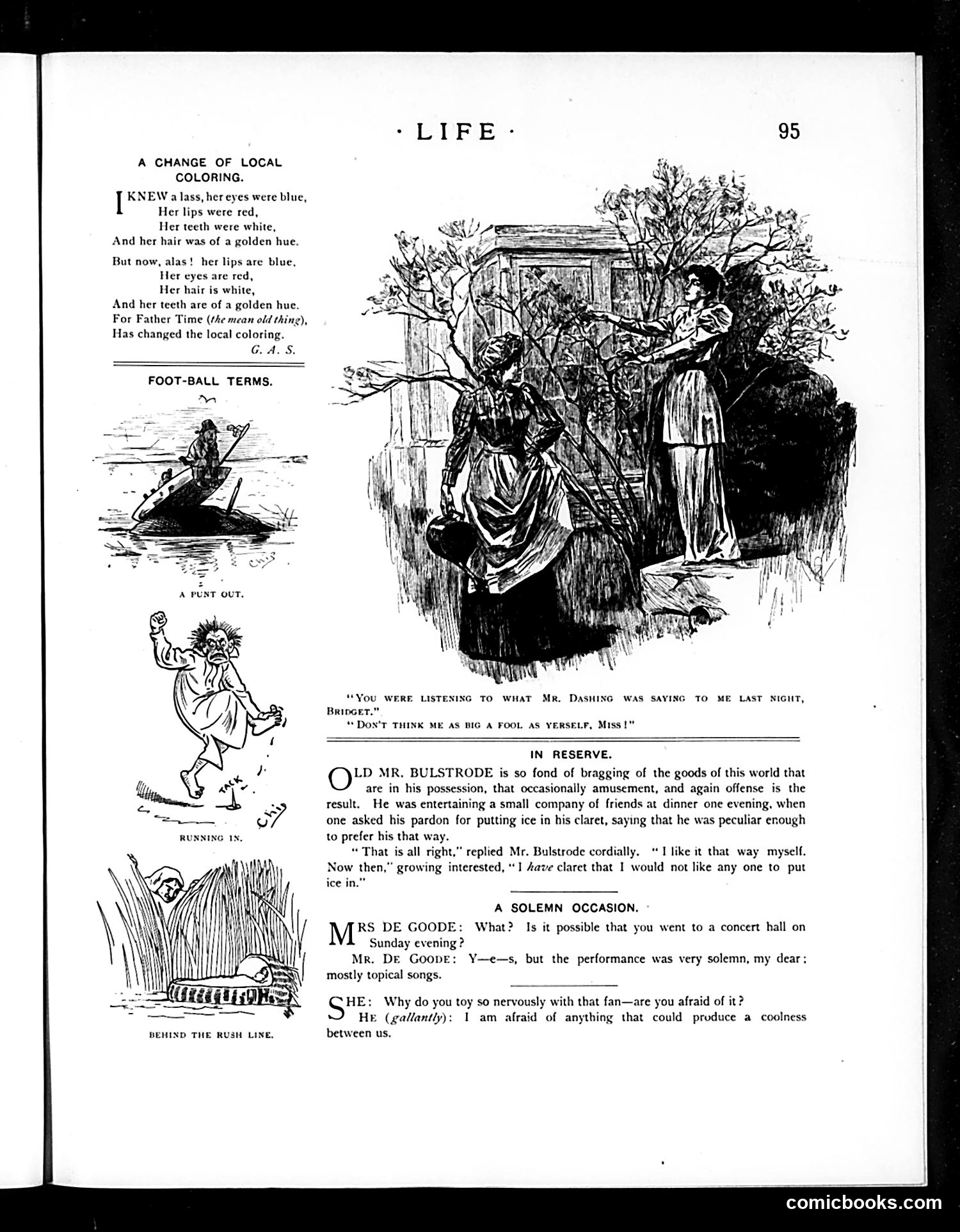
This page contains several brief humorous sketches typical of *Life* magazine's satirical format: **"A Change of Local Coloring"** mocks aging through a poem about a woman whose physical features (blue eyes, red lips, white teeth, golden hair) have all faded with age—attributed to "Father Time" changing "the local coloring." **"Football Terms,"** "A Punt Out," "Running In," and "Behind the Rush Line"** appear to be visual puns using sports terminology with unrelated domestic or everyday scenes for comedic effect. **"In Reserve"** satirizes Mr. Bulstrode's vanity about his possessions—he objects to ice in his claret on principle, claiming it's too common, though he admits liking it personally. **"A Solemn Occasion"** jokes about concert-hall nervousness: a man fidgets with a fan, explaining he fears anything creating "coolness" between himself and his companion.
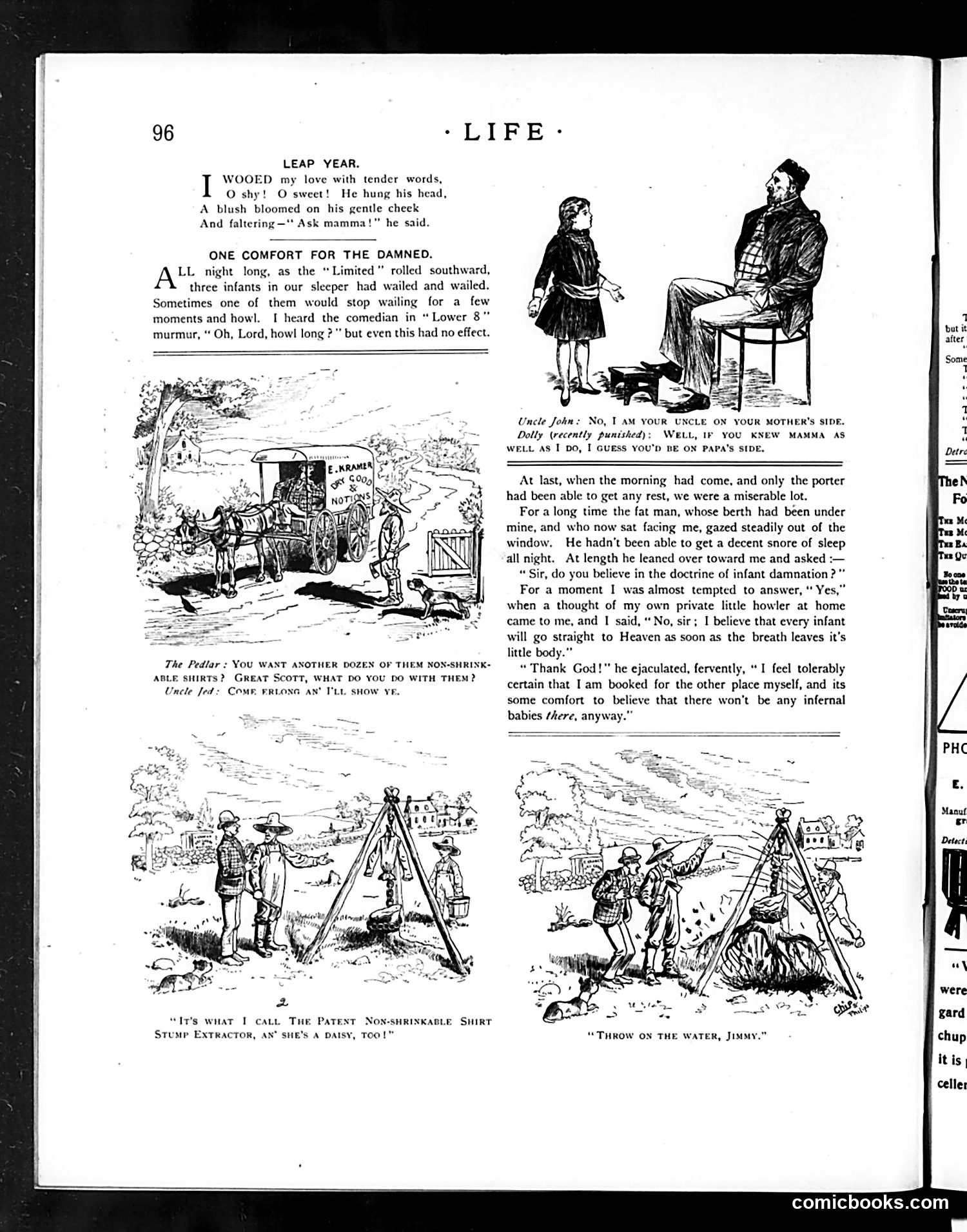
This page contains several satirical pieces: **"Leap Year"**: A poem mocking male timidity in courtship, where a suitor's romantic advances are undermined by his dependent, childish response ("Ask mamma!"). The joke plays on gender role expectations during the "Leap Year" tradition (when women supposedly propose). **"One Comfort for the Damned"**: A humorous anecdote about a train journey where screaming infants prevent sleep. The punchline relies on Victorian-era religious debate about infant damnation—a fat man, sleep-deprived and miserable, finds comfort in the (then-controversial) belief that babies go to Heaven, meaning he won't encounter crying infants in Hell. **Bottom cartoons**: Two camping scenes appear to illustrate a dialogue about a "Patent Non-Shrinkable Shirt Stump Extractor"—likely mocking the period's dubious patent medicines and gadgets marketed to solve everyday problems. The humor comes from presenting absurd "solutions" to ordinary domestic tasks. Overall, the page satirizes contemporary anxieties: romantic incompetence, religious doctrine, and the era's craze for commercial "solutions."
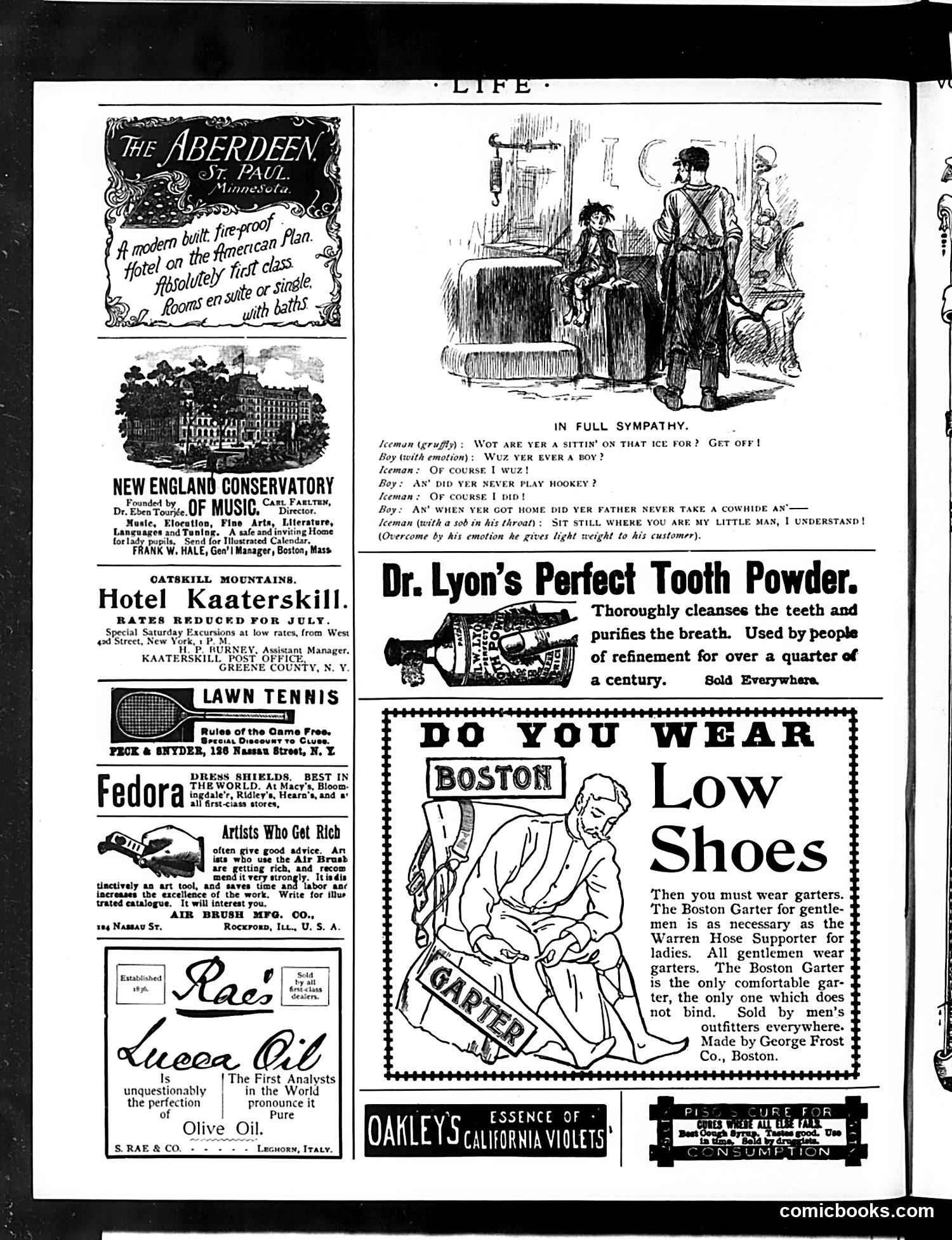
This page is primarily **advertising**, with one small cartoon titled "In Full Sympathy." ## The Cartoon The cartoon depicts an **iceman** (a working-class laborer who delivered blocks of ice before refrigeration) discovering a boy sitting on ice. Rather than simply removing him, the iceman becomes emotionally moved when the boy reveals his own childhood mischief—playing hookey, receiving beatings from his father for it. The iceman, overcome by shared memory and sympathy, allows the boy to stay and even gives him "light weight" (a heavier block of ice, benefiting the customer). **The joke**: Working-class solidarity and nostalgia. Both men experienced harsh discipline and truancy. The iceman's empathy for the boy's plight softens his initial gruffness, suggesting that shared working-class experience creates human connection despite their different stations. The page also features period advertisements for hotels, music conservatories, tooth powder, and notably the "Boston Garter"—suggesting this is early 20th century.