
Life, 1892-08-18 · page 4 of 14
Life — August 18, 1892 — page 4: what you’re looking at
What you’re looking at
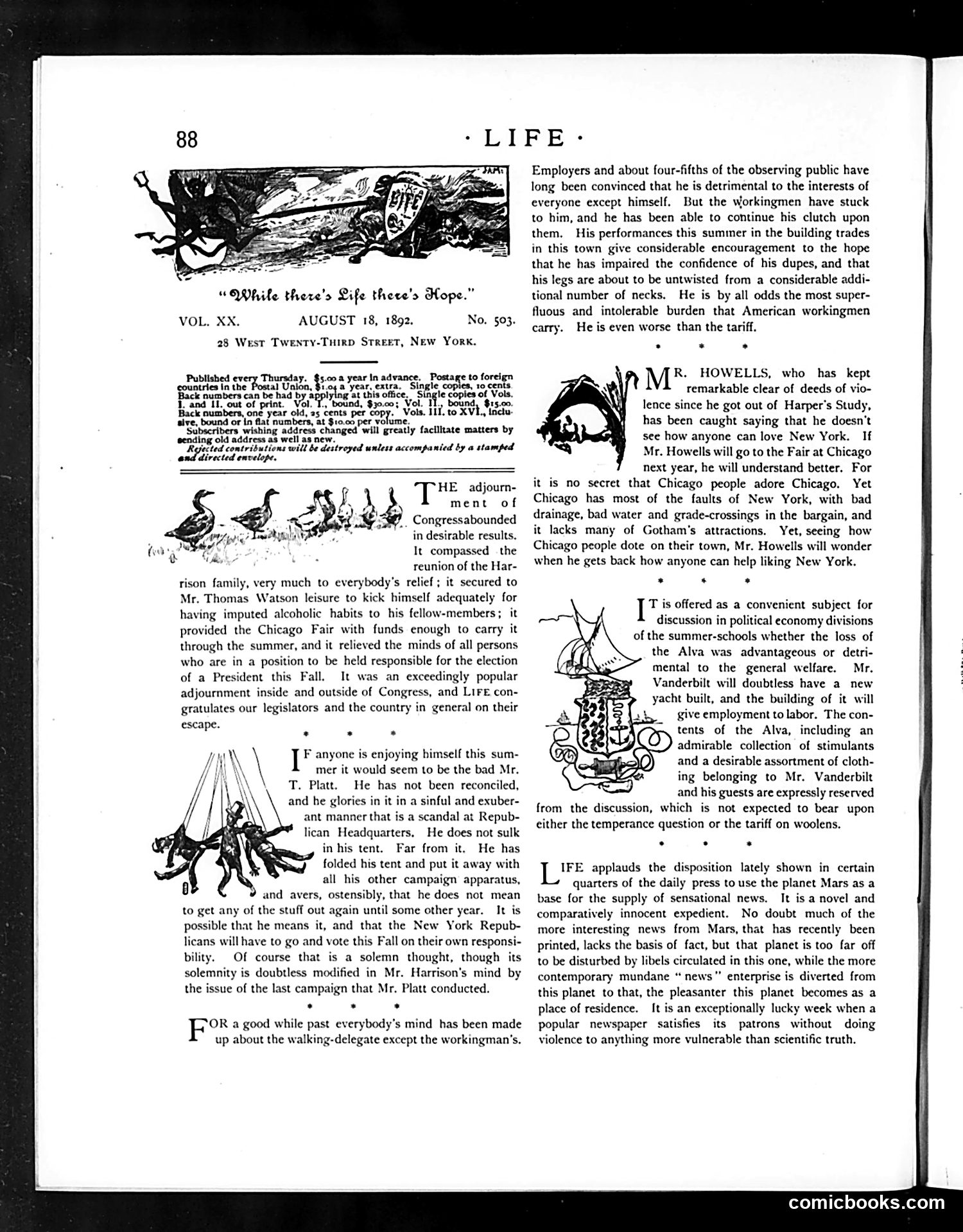
This page contains editorial commentary rather than a political cartoon. The text criticizes several figures and situations: 1. **An unnamed workingman** whose poor performance in construction work has damaged employers' confidence and caused physical deterioration—described as "a superfluous and intolerable burden." 2. **Mr. Howells** (likely William Dean Howells, the prominent writer), who apparently criticized New York after visiting Chicago, missing how Chicago itself has serious infrastructure problems. 3. **Mr. T. Platt**, a Republican politician accused of questionable conduct at party headquarters—the text suggests he's folding away his campaign apparatus while denying involvement in unethical activities. 4. References to debate over tariffs on woolens and the Vanderbilt yacht, presented as worthy discussion topics. The satirical tone targets political hypocrisy and failing workers through editorial critique rather than visual caricature.
📄 Transcribed text from this page (OCR, searchable)
Machine-transcribed from the original scan — historical spelling and the odd misread are preserved.
LIFE “Mhile there's Life there's Hope.” VOL. XX. AUGUST 18, 1892. 28 West Twenty-Tuirp Street, New York. No. 503. Published every Thurada Postage to foreign gountries in the Postal U Year, extra. Sane ro.cents ir qumbers can be had b eile ar this oes, "Single copies of Vols J, and If. out of print. $30.00; V Back numbers, one year Ai ‘a5 cents per copy. * Vals Ili. to ex Sigg sire, bound or in dat numbers, af $10.0 per vo tecribers wishing address changed will greatiy facilitate matters by ecniling old address as well as new. ‘Rejected contributions will be destroyed unless accompanied by a stamped directed envelope. tae year In advance. HE adjourn- ment of ? Congressabounded in desirable results. It compassed the reunion of the Har- rison family, very much to everybody's relief; it secured to Mr. Thomas Watson leisure to kick himself adequately for having imputed alcoholic habits to his fellow-members; it provided the Chicago Fair with funds enough to carry it through the summer, and it relieved the minds of all persons who are in a position to be held responsible for the election of a President this Fall. It was an exceedingly popular adjournment inside and outside of Congress, and LiFe con- gratulates our legislators and the country in general on their escape. . . F anyone is enjoying himself this sum- mer it would seem to be the bad Mr. I Platt. He has not been reconciled, and he glories in it in a sinful and exuber- ant manner that is a scandal at Repub- lican Headquarters. He does not sulk in his tent. Far from it, He has folded his tent and put it away with all his other campaign apparatus, % and avers, ostensibly, that he does not mean to get any of the stuff out again until some other year. It is possible that he means it, and that the New York Repub- licans will have to go and vote this Fall on their own responsi- bility. Of course that is a solemn thought, though its solemnity is doubtless modified in Mr. Harrison's mind by the issue of the last campaign that Mr. Platt conducted. . . . ‘OR a good while past everybody's mind has been made up about the walking-delegate except the workingman’s. Employers and about four-fifths of the observing public have long been convinced that he is detrimental to the interests of everyone except himself. But the wWorkingmen have stuck to him, and he has been able to continue his clutch upon them. His performances this summer in the building trades in this town give considerable encouragement to the hope that he has impaired the confidence of his dupes, and that his legs are about to be untwisted from a considerable addi- tional number of necks. He is by all odds the most super- fluous and intolerable burden that American workingmen carry. He is even worse than the tariff. . . M® HOWELLS, who has kept remarkable clear of deeds of vio- lence since he got out of Harper's Study, has been caught saying that he doesn’t see how anyone can love New York. If Mr. Howells will go to the Fair at Chicago next year, he will understand better. For it is no secret that Chicago people adore Chicago. Yet Chicago has most of the faults of New York, with bad drainage, bad water and grade-crossings in the bargain, and it lacks many of Gotham’s attractions. Yet, seeing how Chicago people dote on their town, Mr. Howells will wonder when he gets back how anyone can help liking New York. * . . T is offered as a convenient subject for discussion in political economy divisions of the summer-schools whether the loss of the Alva was advantageous or detri- mental to the general welfare. Mr. Vanderbilt will doubtless have a new yacht built, and the building of it will give employment to labor. The con- tents of the Alva, including an admirable collection of stimulants and a desirable assortment of cloth- ing belonging to Mr. Vanderbilt and his guests are expressly reserved from the discussion, which is not expected to bear upon either the temperance question or the tariff on woolens. . . . LT applauds the disposition lately shown in certain quarters of the daily press to use the planet Mars as a base for the supply of sensational news. It is a novel and comparatively innocent expedient. No doubt much of the more interesting news from Mars, that has recently been printed, lacks the basis of fact, but that planet is too far off to be disturbed by libels circulated in this one, while the more contemporary mundane “ news” enterprise is diverted from this planet to that, the pleasanter this planet becomes as a place of residence. It is an exceptionally lucky week when a popular newspaper satisfies its patrons without doing violence to anything more vulnerable than scientific truth. comicbooks.com