
A complete issue · 14 pages · 1892
Life — August 11, 1892
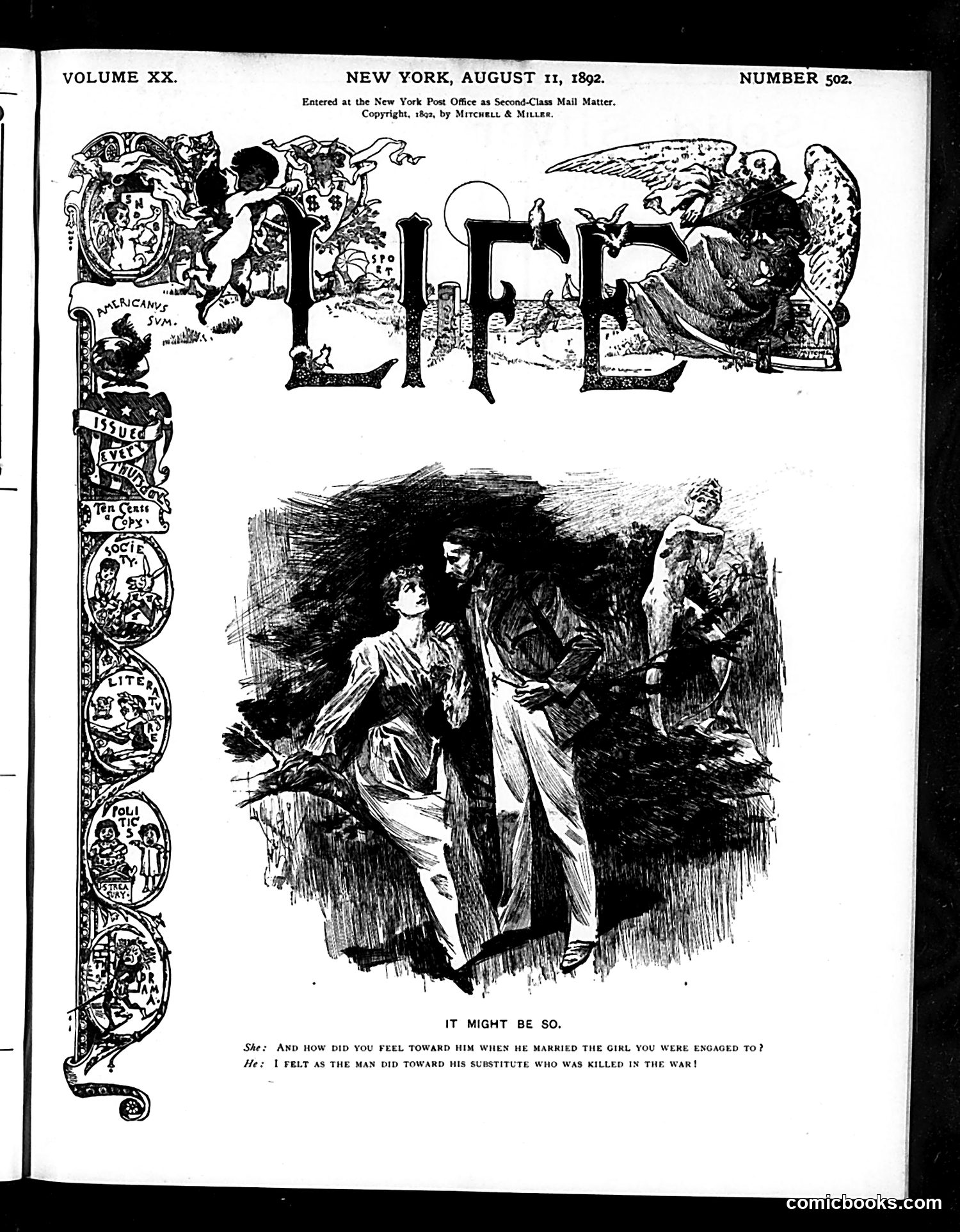
This single-panel cartoon satirizes romantic jealousy and wartime loss. The sketch shows a domestic scene where a woman questions a man about his feelings when he married another woman—the one the questioner was supposedly engaged to. His response is darkly humorous: he felt like "the man did toward his substitute who was killed in the war." This references the Civil War practice of hiring substitutes to serve in one's place, a system that allowed wealthy men to avoid military service. The joke relies on bitterness: the man compares his emotional displacement to literally replacing a dead soldier—suggesting his rival marriage was as unwelcome and unjust as losing a soldier to war substitution. The satire targets both romantic betrayal and the era's class-based military exemptions.
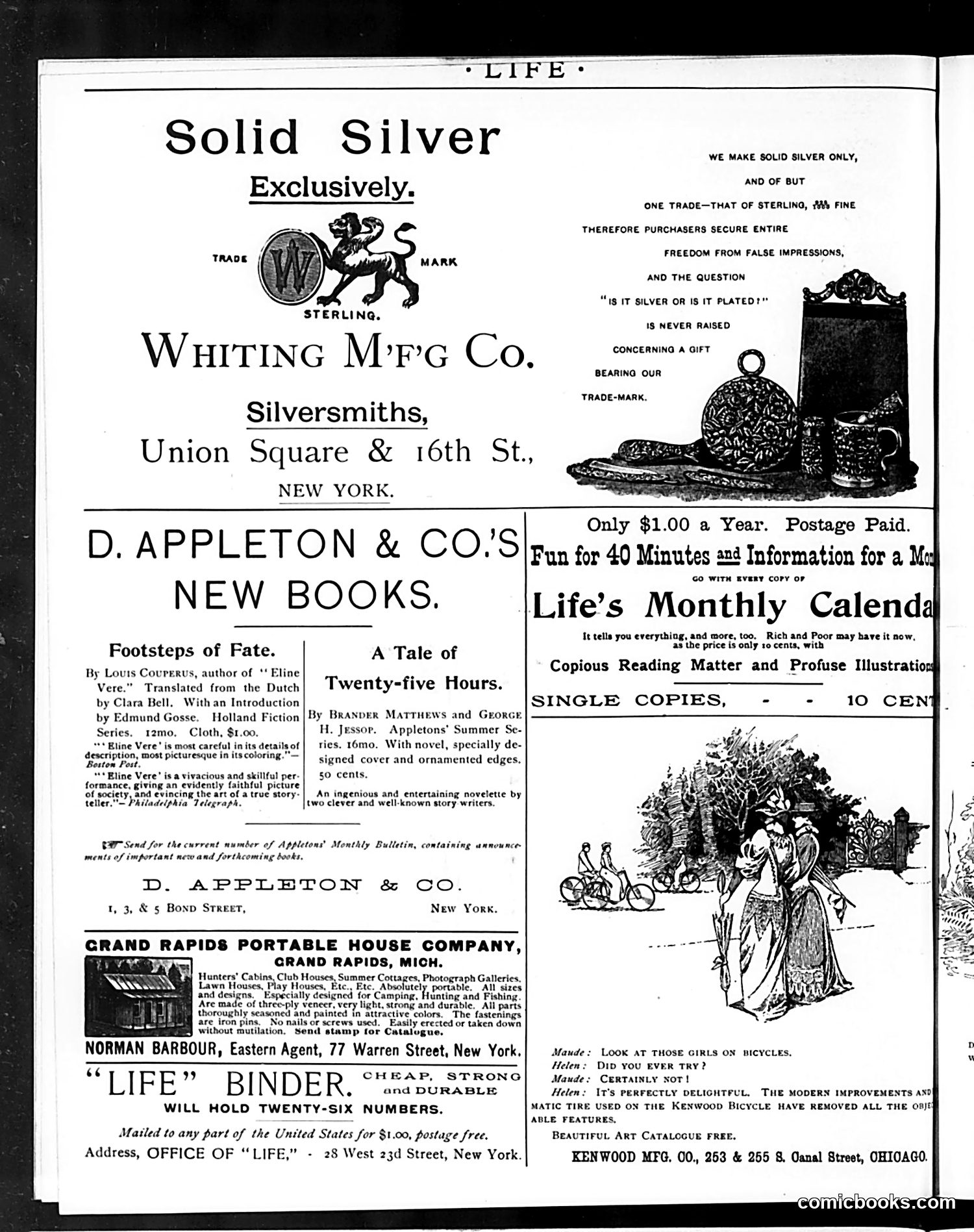
This page is **primarily advertising**, not political satire. It contains multiple commercial advertisements from the 1890s era: - **Whiting M'FG Co.**: promoting sterling silver goods, emphasizing their products are solid silver, not plated - **D. Appleton & Co.**: advertising new books including "Footsteps of Fate" and "A Tale of Twenty-five Hours" - **Grand Rapids Portable House Company**: selling portable structures for camping and hunting - **Life Binder**: promoting a magazine binding service - **Kenwood Mfg. Co.**: advertising bicycle art catalogs The only illustration with potential satirical content is a sketch of a woman on a bicycle with accompanying dialogue about "girls on bicycles"—this likely reflects contemporary social commentary about the "New Woman" and cycling's role in female independence, a topic Life magazine frequently addressed.
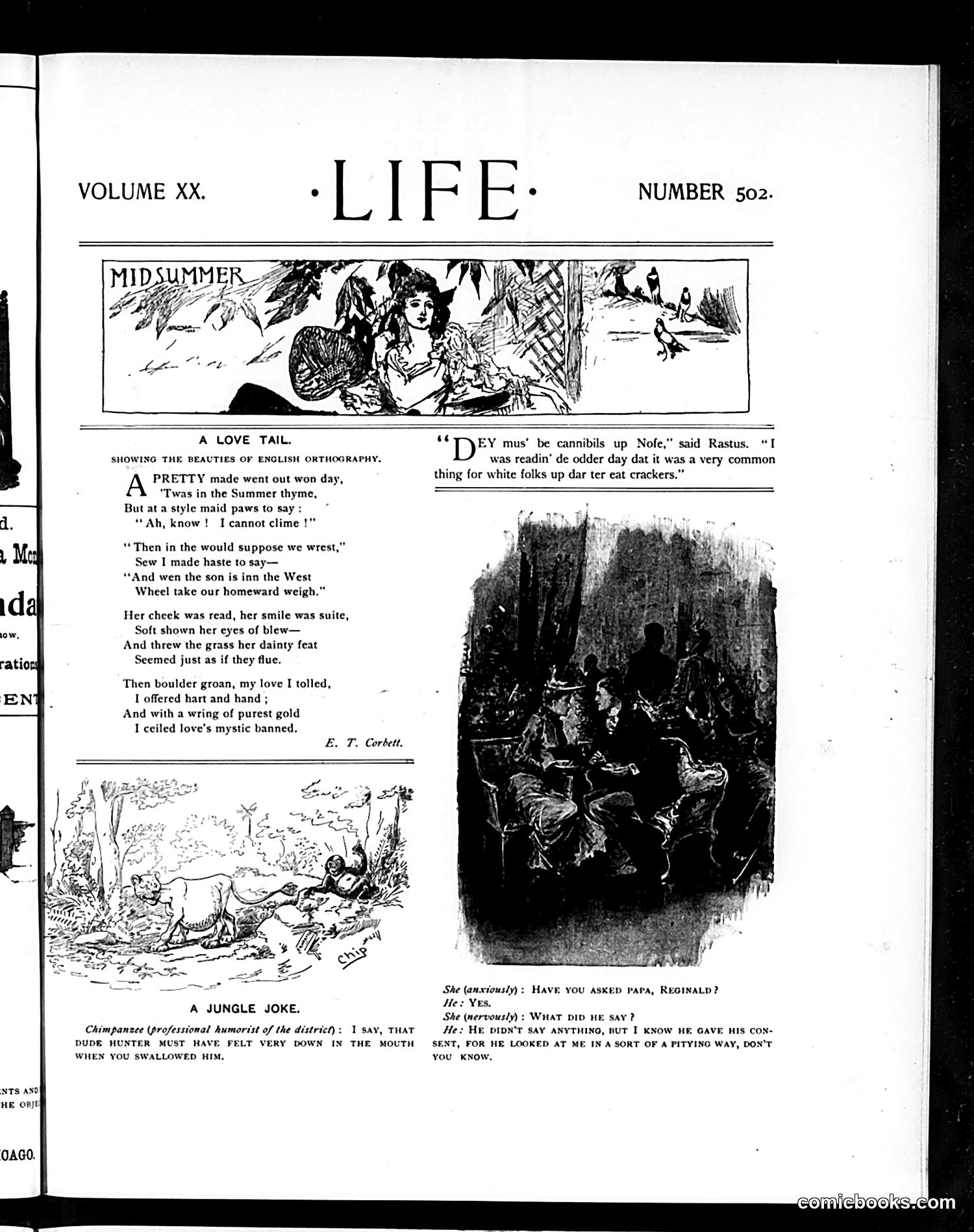
This page contains three separate humorous pieces rather than political commentary: 1. **"A Love Tail"** — A romantic poem by E.T. Corbett about courtship, presented as "showing the beauties of English orthography" (likely satirizing spelling or poetic conventions). 2. **"A Jungle Joke"** — A single-panel cartoon with a chimpanzee, featuring a pun about a "dude hunter" feeling "very down in the mouth" after swallowing the chimp—a play on the phrase's double meaning. 3. **A dramatic illustration** with dialogue between characters named Papa, Reginald, and She, discussing consent and a man's pitying expression. The page is primarily **entertainment-focused** rather than political satire, offering light humor and romantic content typical of early-20th-century American magazines.
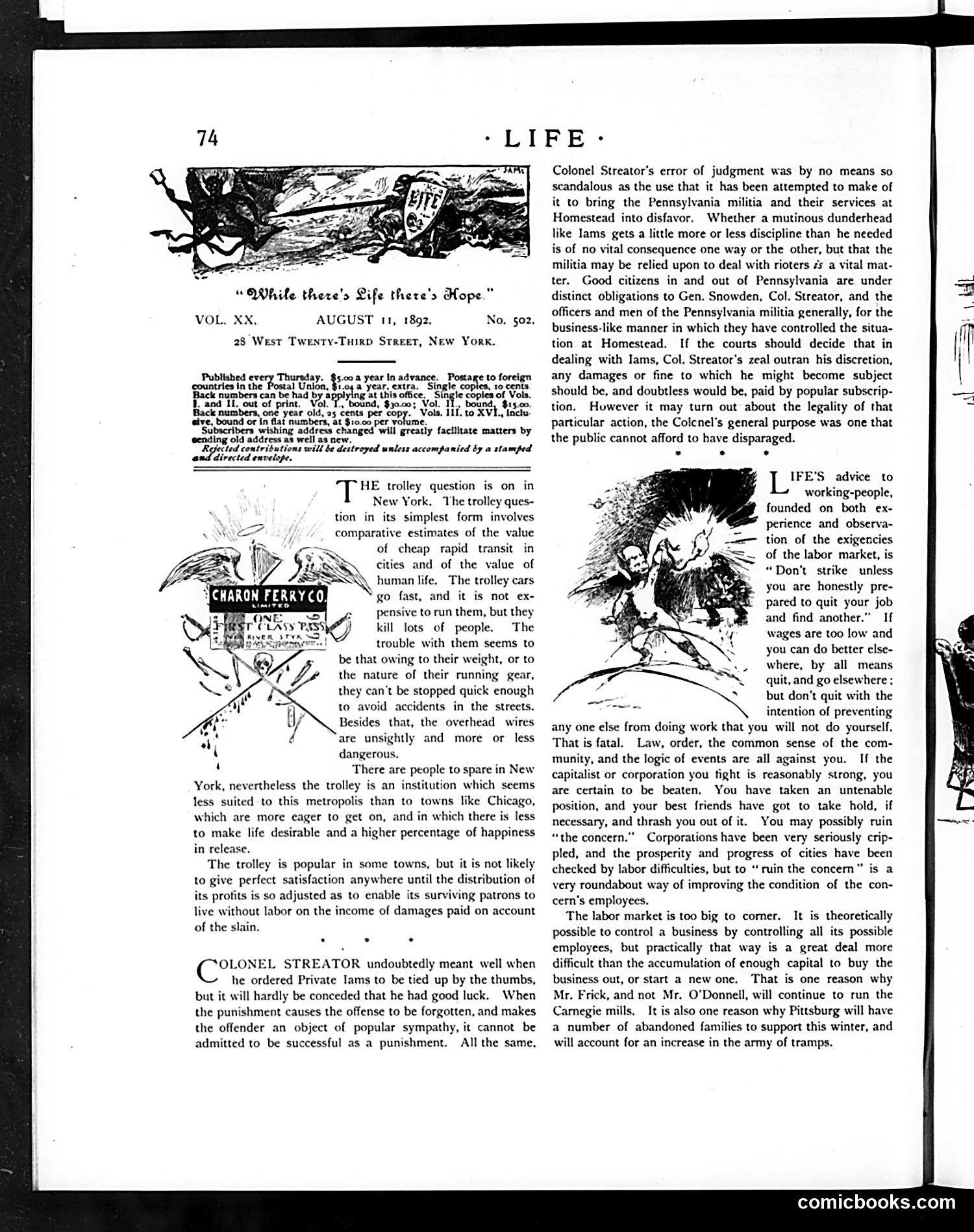
This page contains two distinct sections: **Left Column:** Discusses the "trolley question" in New York—the safety and practicality of electric streetcars. The text notes trolleys are cheap transit but dangerous, killing many people due to mechanical failures and design flaws that prevent quick stopping. **Right Column:** Offers labor advice to working people, warning against striking unless prepared to find alternative employment. It argues that while low wages justify leaving, strikes attempting to prevent others from working are counterproductive and will be defeated by corporate power. The text suggests the labor market is too large to control through such tactics. **Cartoons:** The Charon Ferry Company advertisement (left) appears to be gallows humor about trolley deaths, while the right illustration (unclear subject) accompanies the labor discussion. The page reflects 1890s concerns about industrial safety and labor conflict.
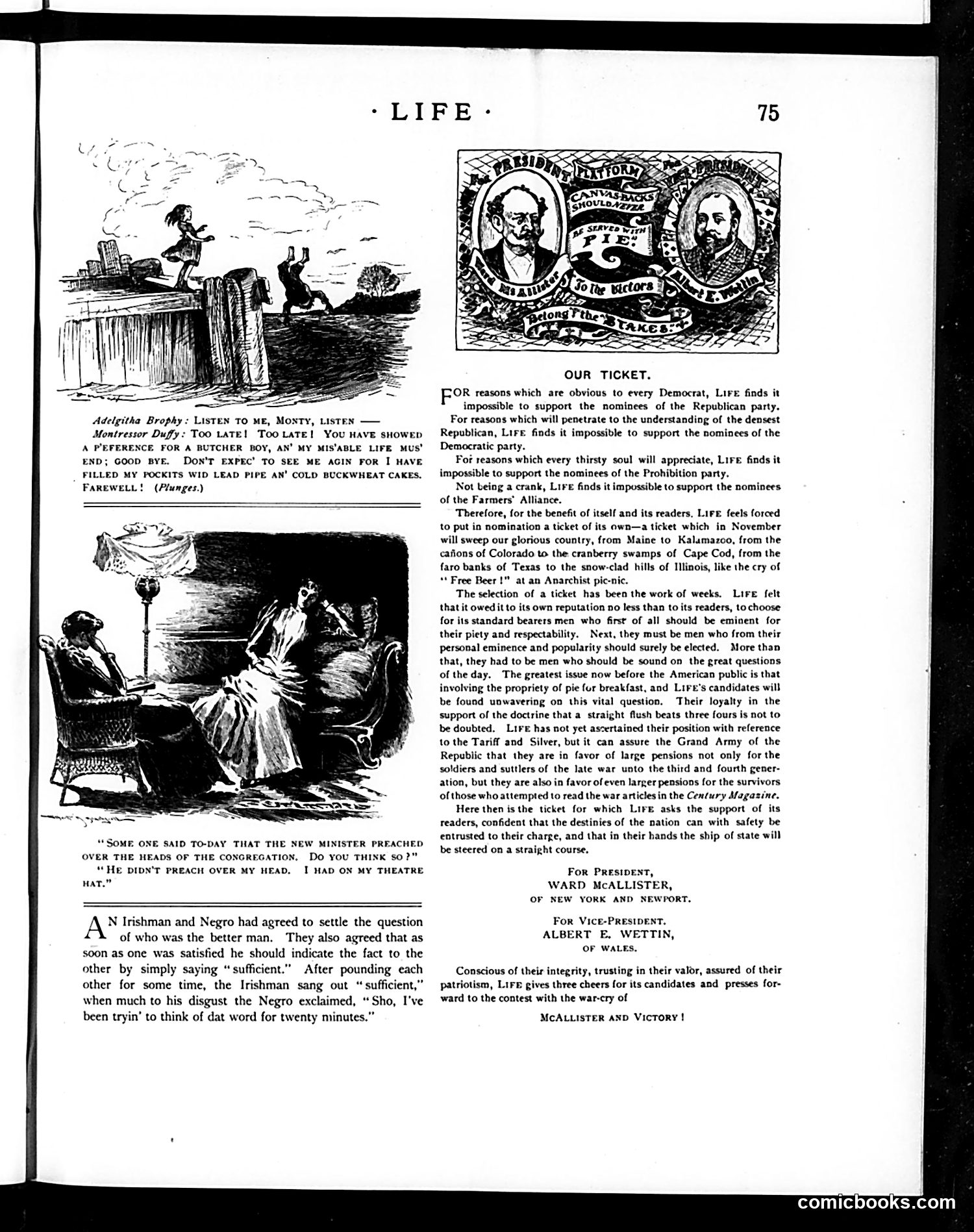
This page presents **Life magazine's 1884 presidential endorsement** for Ward McAllister (VP candidate Albert E. Wettin). The cartoons mock competing candidates through humor. The top illustration shows a butcher's preference anecdote—likely satirizing a political rival as unsuitable. The middle engraving depicts two figures in conversation, possibly referencing political debate or backroom dealings. Most significantly, the lengthy right-column text endorses McAllister while critiquing other parties' positions on tariffs, pensions, and prohibition. The magazine positions itself as a serious political voice despite its satirical format. The bottom anecdote about an Irishman and Black man settling disputes via repetition of "sufficient" appears to mock political rhetoric's hollow repetition rather than substantive argument—a commentary on campaign discourse itself.
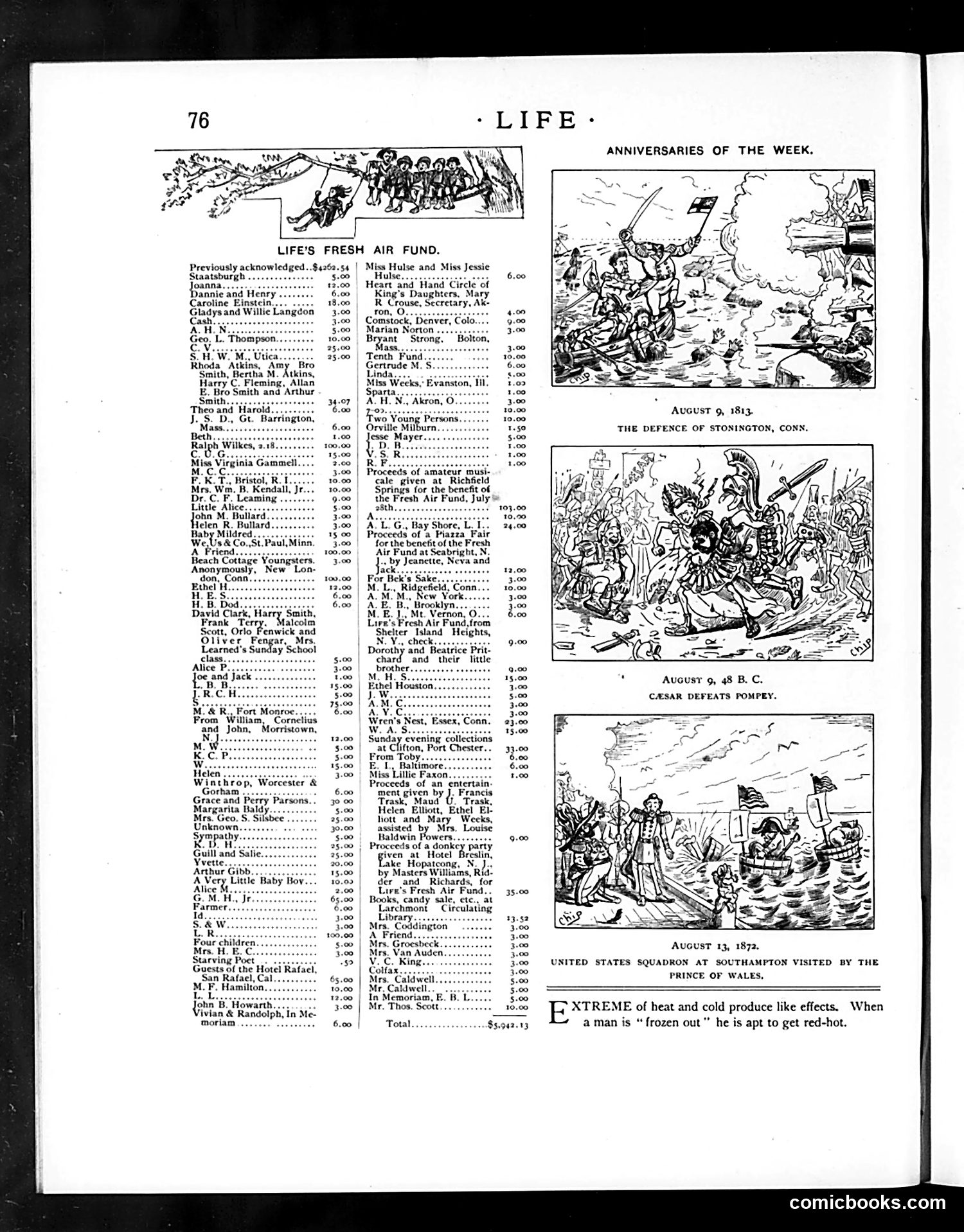
This page features three historical illustrations labeled as "Anniversaries of the Week": 1. **August 9, 1813 - The Defence of Stonington, Conn.**: A detailed battle scene showing American forces defending against what appears to be British naval attack during the War of 1812. 2. **August 9, 48 B.C. - Caesar Defeats Pompey**: A classical military scene depicting the famous Roman civil war battle. 3. **August 13, 1872 - United States Squadron at Southampton Visited by the Prince of Wales**: A maritime scene showing American naval vessels receiving a royal British visitor. The left column lists donations to "Life's Fresh Air Fund"—a charitable program providing outdoor relief. These historical illustrations serve as educational/patriotic content alongside the fundraising appeal, connecting American military heritage to contemporary charitable work.
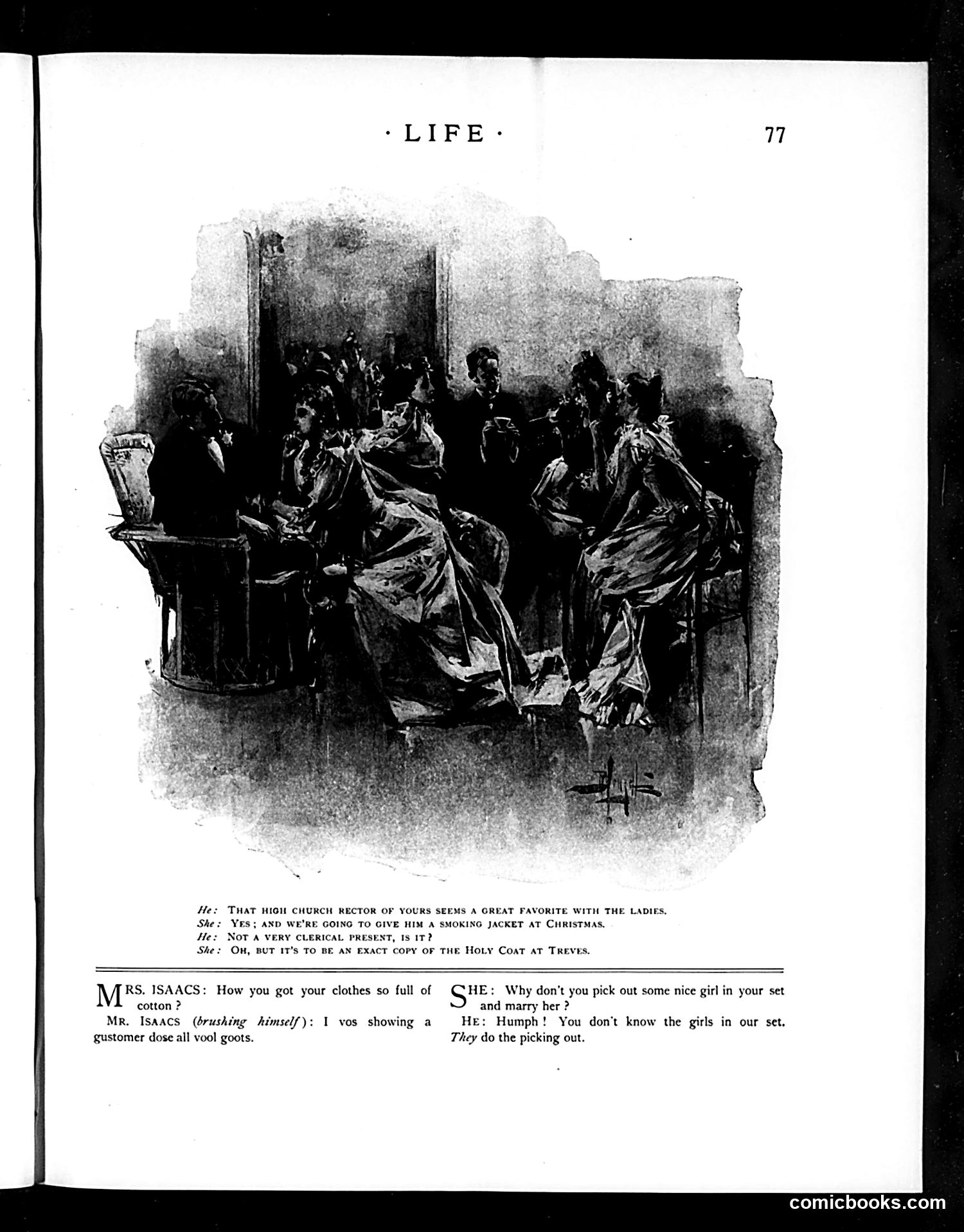
This page contains two separate jokes about class and courtship in early 20th-century society. The **top cartoon** depicts well-dressed men and women in formal evening wear. The caption satirizes social climbing and gift-giving: a church rector is apparently popular with ladies, so the speaker plans to give him a "smoking jacket" for Christmas—described as "an exact copy of the Holy Coat at Treves" (a famous religious relic). The joke mocks both the pretentiousness of expensive gifts and irreverent comparisons between sacred relics and fashion. The **bottom dialogue** features Mrs. Isaacs and Mr. Isaacs discussing clothes and marriage prospects. When she asks why he doesn't find a nice girl to marry, he responds that he doesn't know eligible women—implying "they do the picking out," reversing traditional expectations of male courtship. It's light social commentary on changing gender dynamics in mate selection.
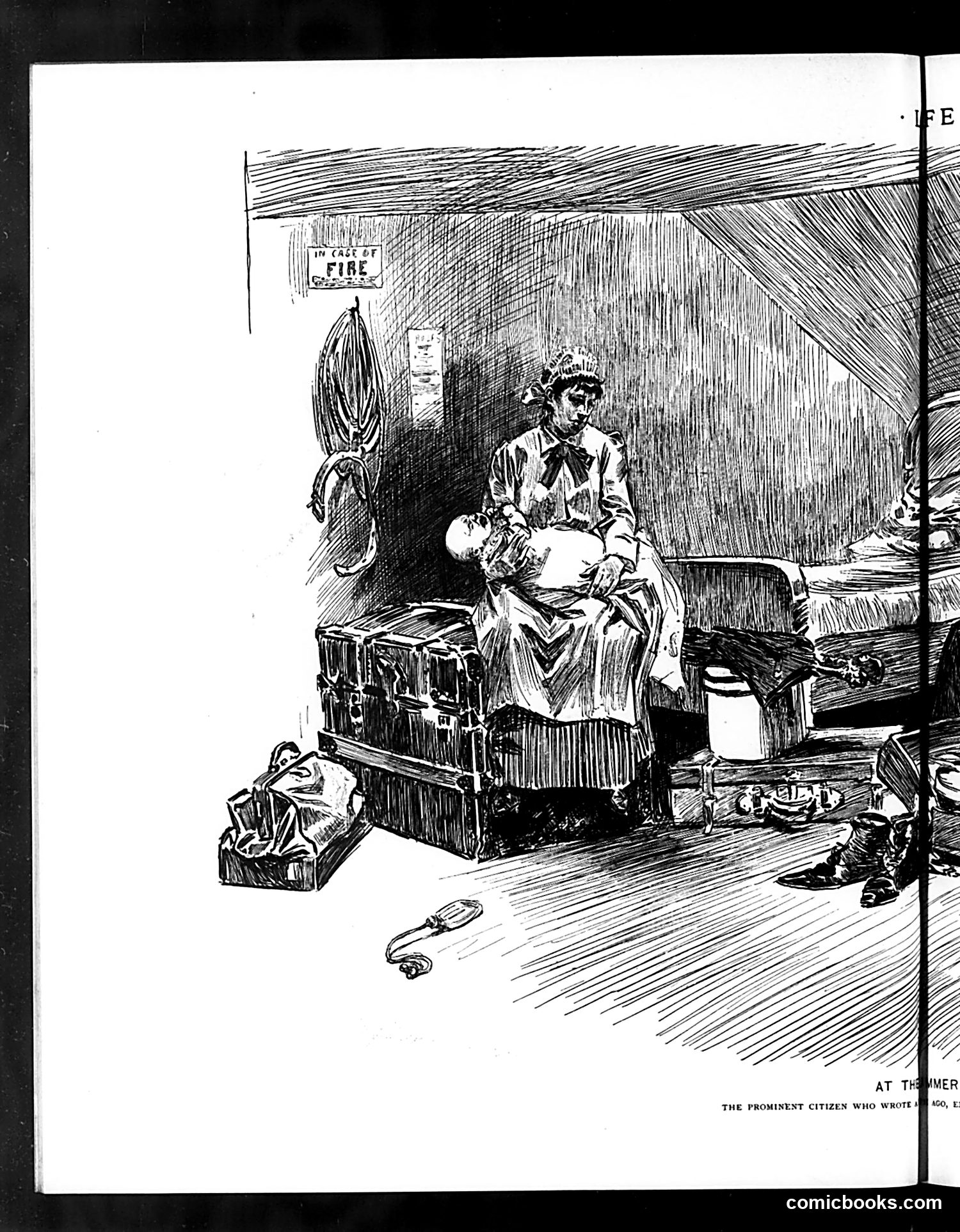
This appears to be a satirical illustration from *Life* magazine depicting a dramatic bedside scene. A nurse or caretaker tends to an ill or injured person lying in bed, while other figures observe from the room. A "Fire" exit sign is visible on the wall, and various medical or domestic items are scattered on the floor. The caption references "the prominent citizen who wrote" something (text is cut off), suggesting this is political satire about a notable public figure's illness or vulnerability. The fire exit sign may ironically comment on the subject's character or situation. However, without the complete caption and publication date, I cannot identify the specific figure being mocked or the particular event being referenced. The satire appears to mock someone's credibility or expose hypocrisy during a moment of weakness.
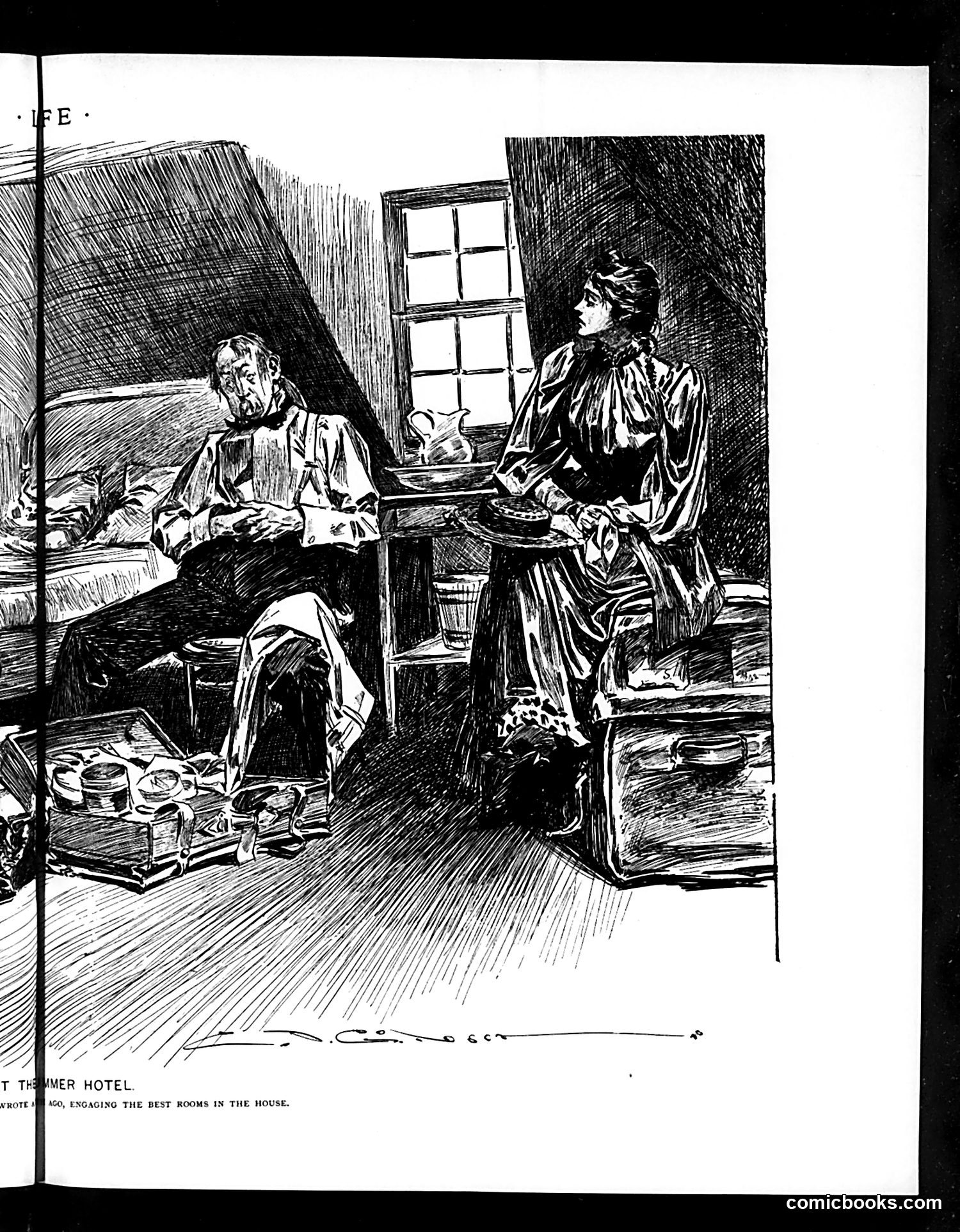
This illustration depicts a scene at what the caption identifies as "The Summer Hotel," showing two people in a modest bedroom. The OCR text mentions "engaging the best rooms in the house," suggesting satirical commentary on hotel accommodations and their quality claims. The sketch uses exaggerated linework typical of early Life magazine satirical art. The scene appears to mock the discrepancy between a hotel's advertised amenities and reality—the "best rooms" appear sparse and poorly furnished, with simple furnishings visible. The two figures' expressions and body language suggest resignation or disappointment. This likely satirizes common hotel proprietor practices of overselling room quality to guests, a recurring target of satirical commentary in the era. The specific date and publication details remain unclear from the visible text.
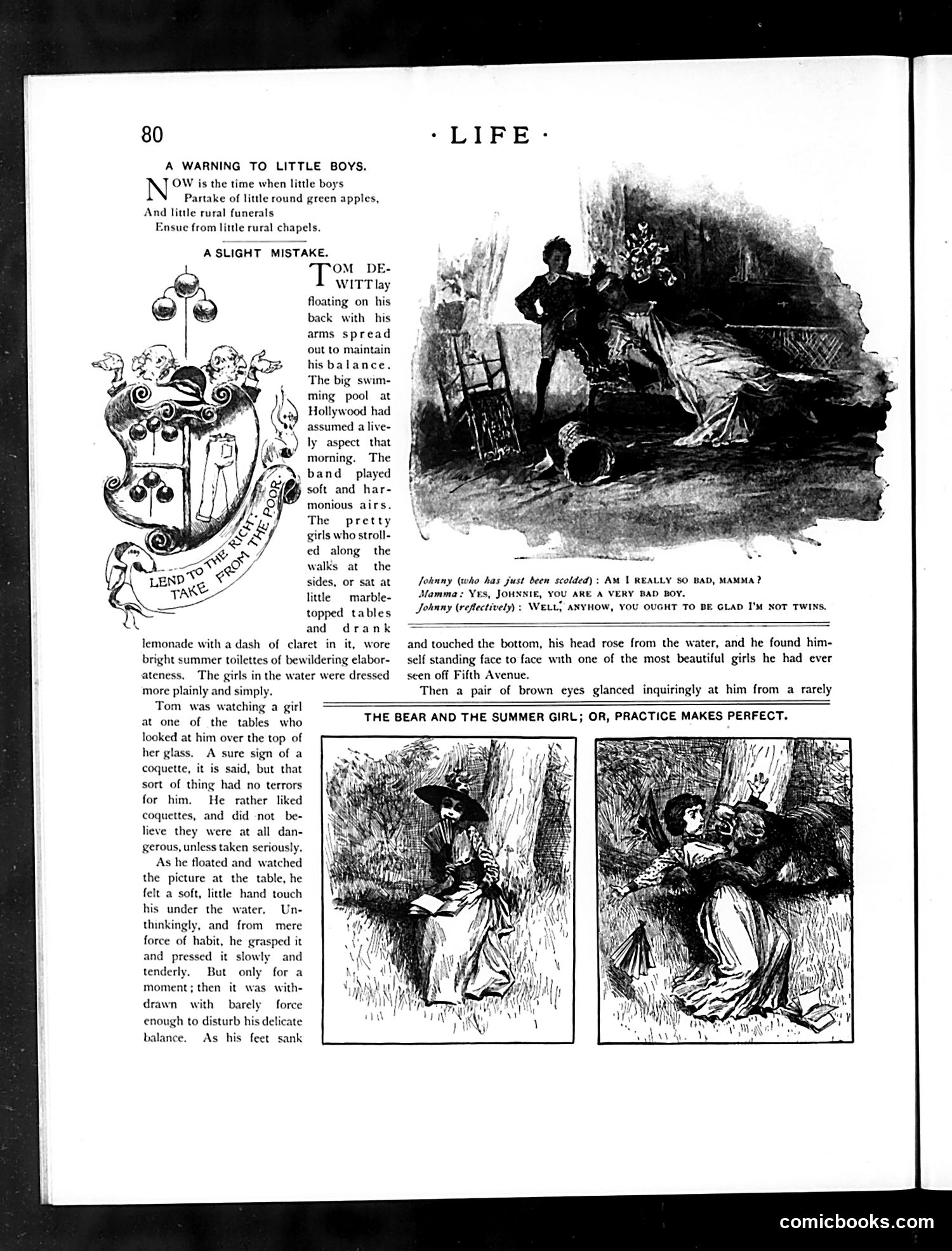
This page contains three separate humorous stories targeting children's behavior and social expectations of the era. **"A Warning to Little Boys"** mocks the seasonal tradition of boys eating unripe apples and attending rural chapels, with an ornate decorative initial. **"A Slight Mistake"** depicts Tom DeWitt floating in a swimming pool, observed by a girl. The humor centers on gender-based coquetry and Tom's misinterpretation of her interest—he assumes her glance signals romantic interest when it doesn't, a common satirical theme about boys' misreading of female attention. **"The Bear and the Summer Girl"** (illustrated in two panels) appears to show a girl practicing with a bear, satirizing the notion that "practice makes perfect" through an unexpected, humorous scenario. The overall theme emphasizes social awkwardness and youthful misunderstandings.
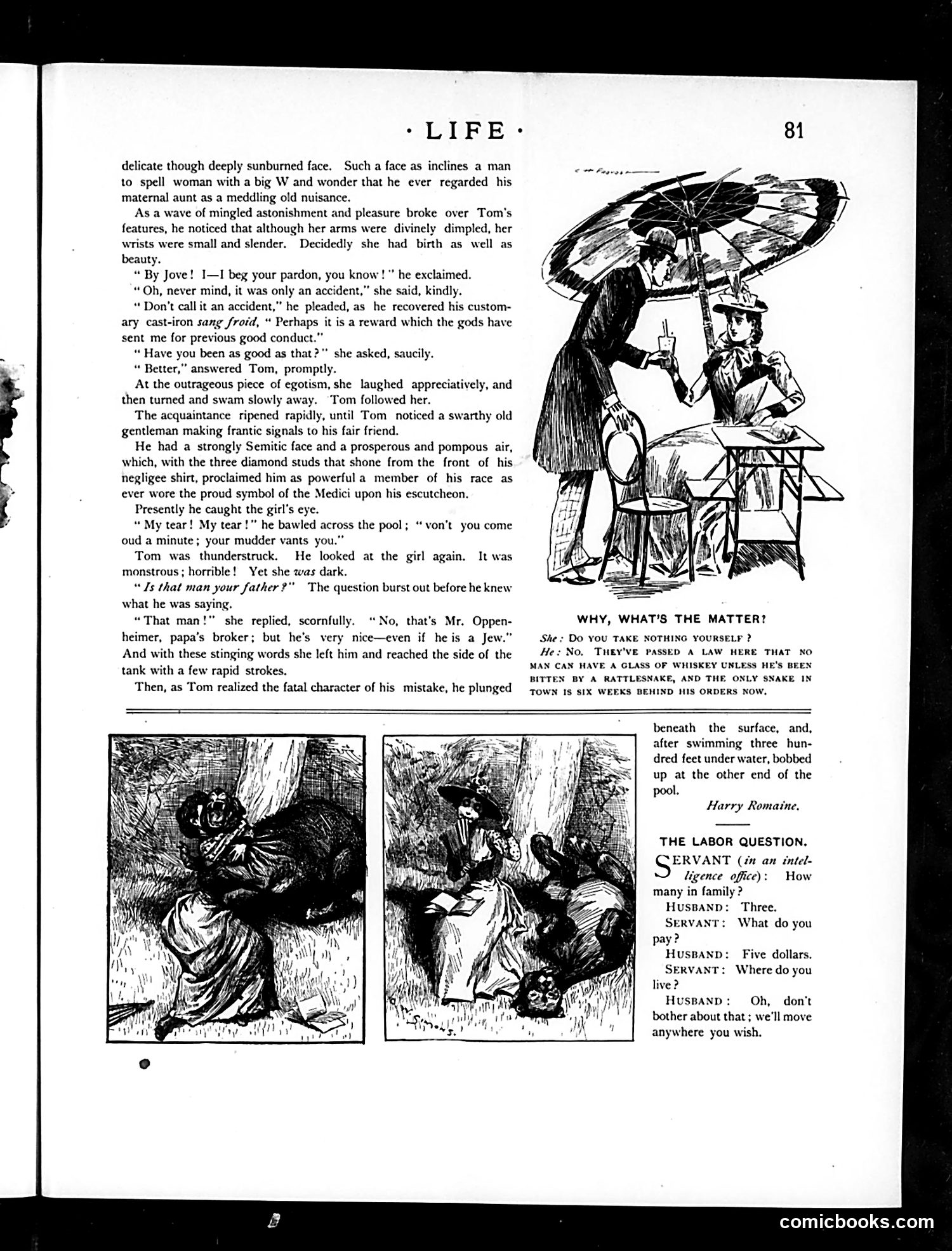
This page contains a serialized story with accompanying illustrations rather than political cartoons. The narrative depicts a social encounter at a swimming pool involving a woman named Tom and a man with a "strongly Semitic face" described as "pompous" and claiming membership in an exclusive club (the Medici). The story illustrates early 20th-century class and ethnic tensions: a gentleman makes antisemitic remarks and attempts to intimidate the woman by invoking his social status and implying her companion is Jewish. The illustrations show figures near the pool in confrontational poses. At page's bottom, "The Labor Question" presents a brief comedic dialogue between a servant and husband about wages and living arrangements—satirizing servant employment dynamics of the era. The content reflects period attitudes toward class, ethnicity, and labor that modern readers would recognize as dated and offensive.
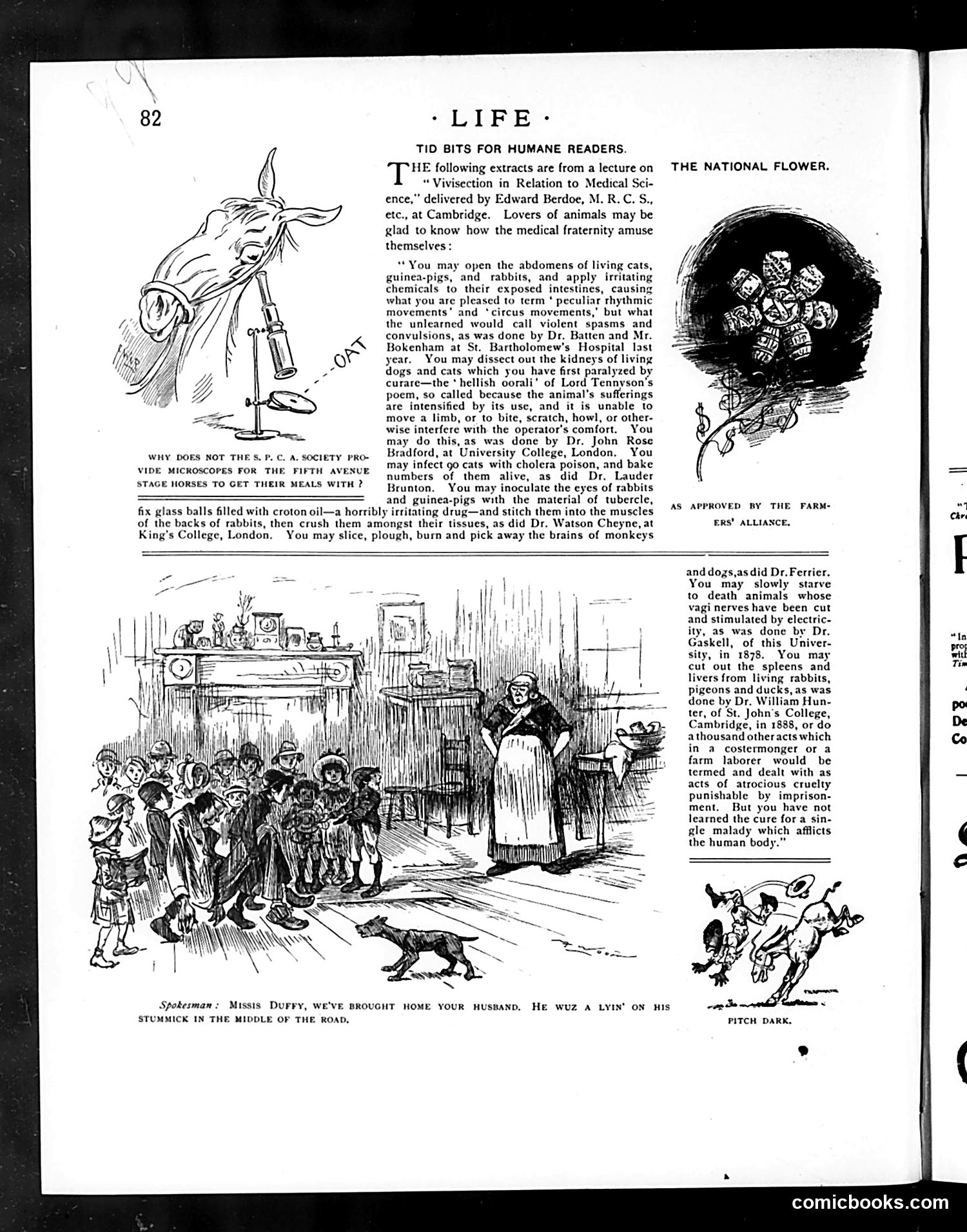
This page contains two distinct satirical pieces attacking animal cruelty in Victorian society. **"Tid Bits for Humane Readers"** excerpts a Cambridge lecture documenting brutal vivisection practices by medical researchers—cats, rabbits, dogs, and monkeys subjected to organ removal, poisoning, starvation, and brain dissection while conscious. The satire's bite: these experiments yield no medical cures, yet would constitute criminal cruelty if performed by ordinary laborers. **"Why Does Not the S.P.C.A. Society Provide Microscopes..."** sarcastically critiques the hypocrisy of animal welfare advocates. The S.P.C.A. (Society for the Prevention of Cruelty to Animals) ostensibly protects animals, yet stage horses on Fifth Avenue were notoriously starved and overworked. The joke: microscopes would let horses see their meager food rations. The accompanying cartoon shows a dead husband delivered home, captioned "The National Flower" and "As Approved by the Farmers' Alliance"—likely mocking rural political movements while suggesting widespread societal callousness extends beyond animals to human welfare.
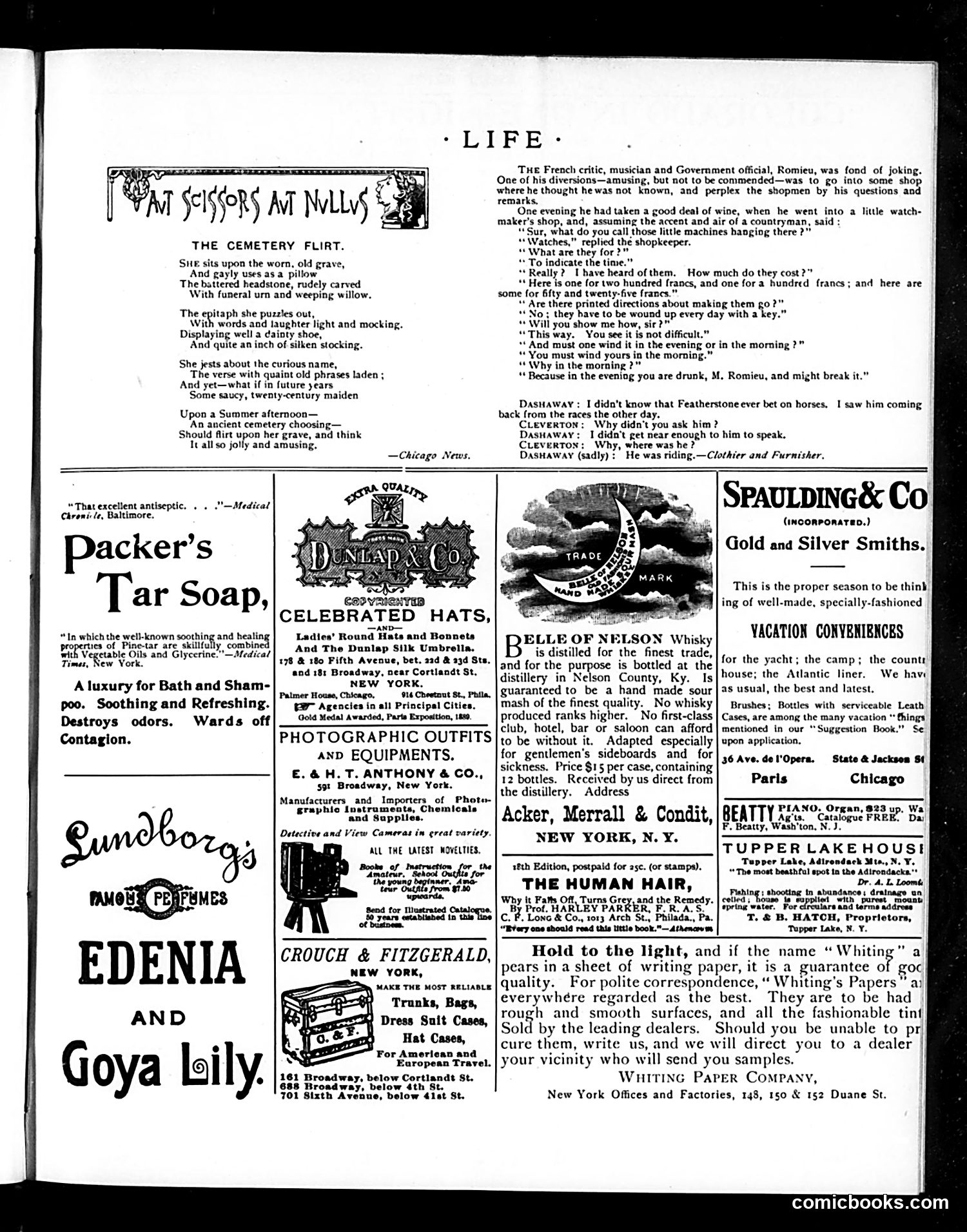
This page contains two satirical humor pieces. "The Cemetery Flirt" is a poem mocking a young woman who flirts and jokes while sitting on gravestones—the satire suggests her frivolous behavior in a solemn place may be repaid when future generations disrespect her own grave. The main prose piece recounts an anecdote about Romieu, a French critic, who drunkenly enters a watchmaker's shop pretending ignorance to perplex the shopkeeper. After asking absurd questions about watches, the exasperated shopkeeper finally insults him directly, suggesting Romieu winds his watch in the morning because "in the evening you are drunk, M. Romieu, and might break it." The humor relies on the shopkeeper's sharp comeback exposing Romieu's pretense through frank rudeness—a common satirical device mocking someone of status. The page is otherwise filled with period advertisements for soap, hats, photographic equipment, and whisky—typical of *Life* magazine's format.
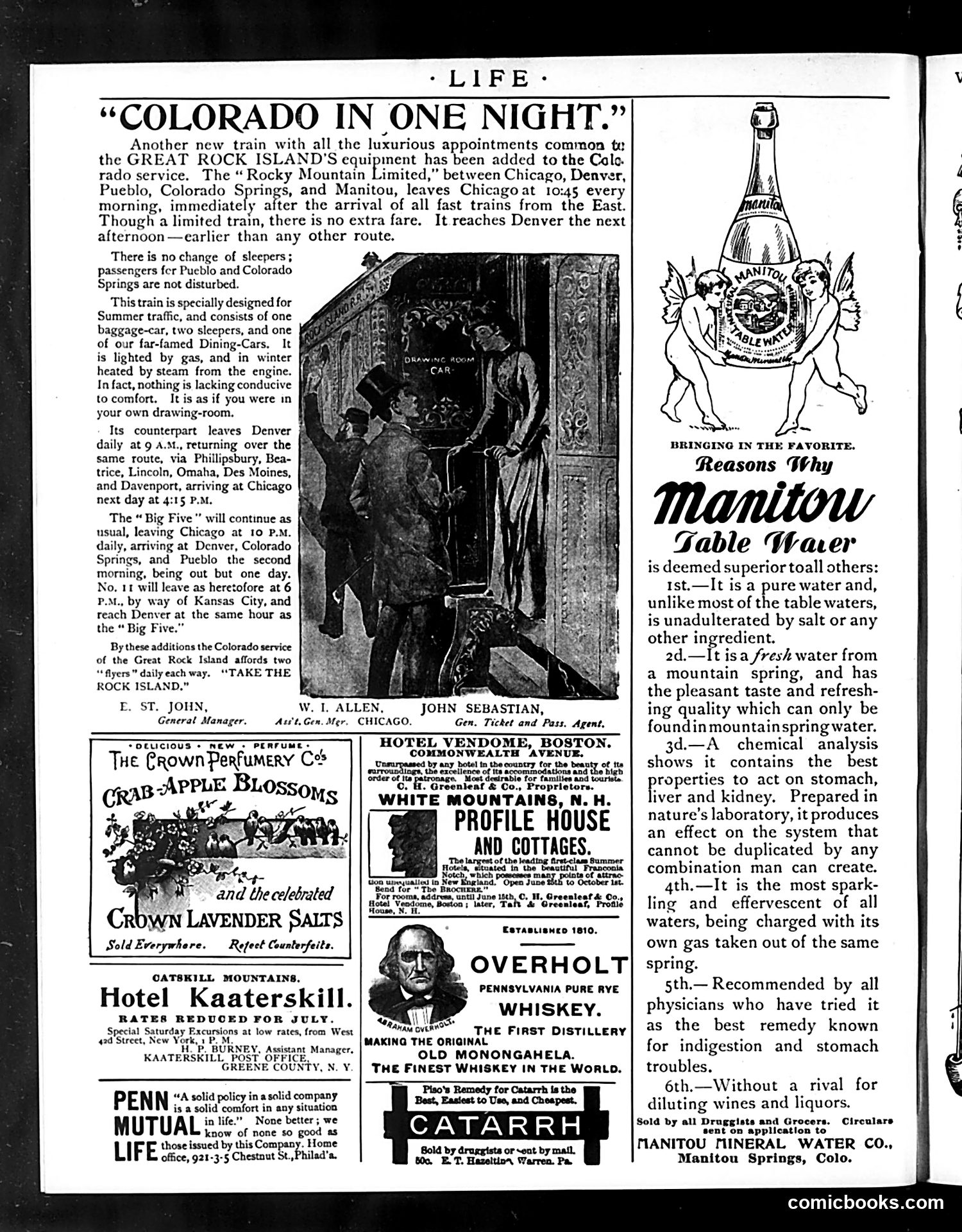
This page is primarily **advertising**, not political satire. It showcases railroad and consumer product advertisements from the late 19th/early 20th century. The main content advertises the **"Rocky Mountain Limited"** train service on the Great Rock Island line, emphasizing luxury accommodations and speed (reaching Denver from Chicago overnight without changing sleepers). This reflects the era's fascination with rail travel and western expansion. The decorative header features **two cherubs promoting Manitou Table Water**, a Colorado spring water brand. The accompanying text makes health claims typical of the period—that the water aids digestion and stomach issues, a common marketing tactic before FDA regulations. Other advertisements include hotel destinations (White Mountains, Catskill Mountains), perfumes, and whiskey. The page reflects **Gilded Age consumer culture** and American tourism to newly accessible western destinations, not political commentary.