
Life, 1892-08-11 · page 4 of 14
Life — August 11, 1892 — page 4: what you’re looking at
What you’re looking at
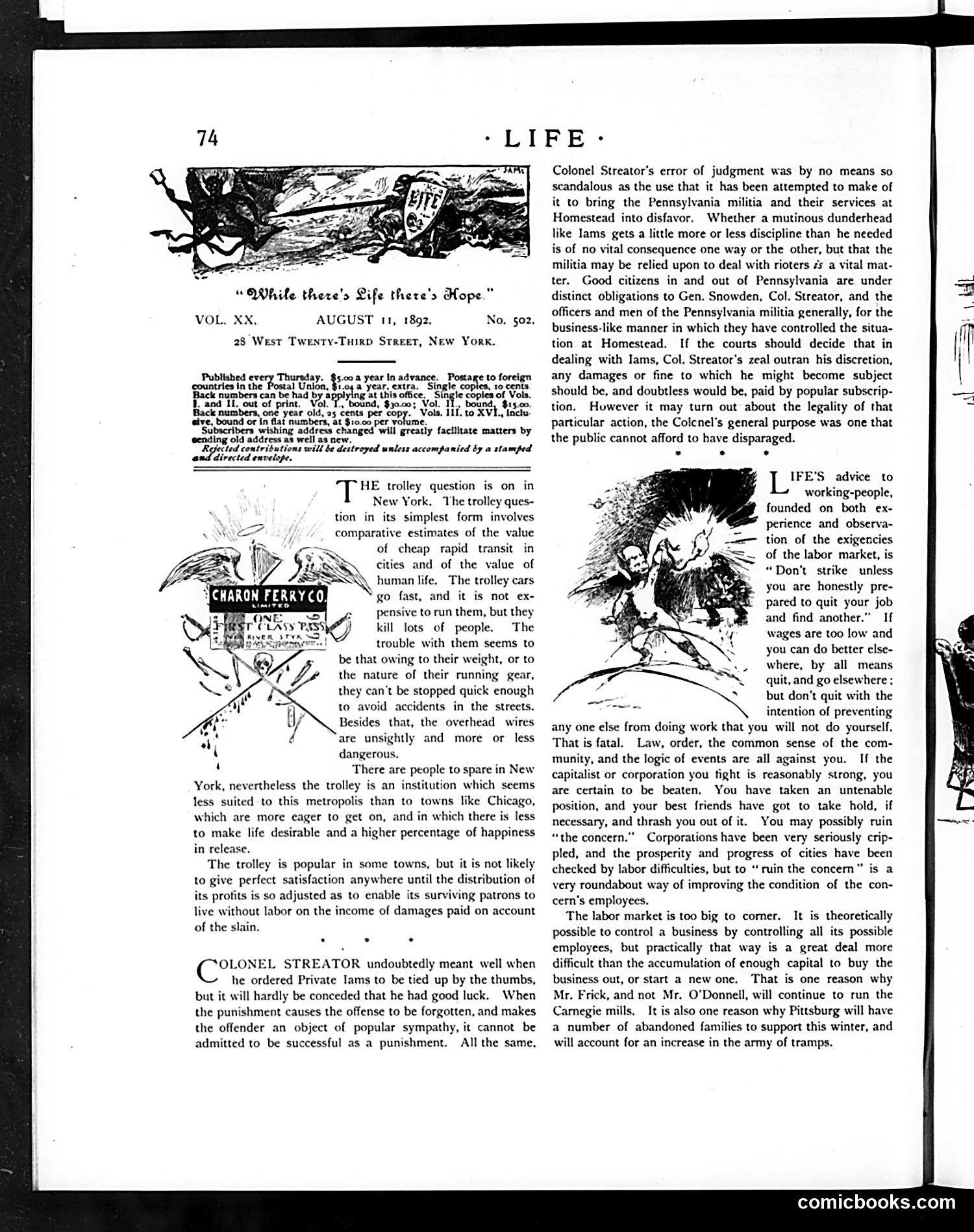
This page contains two distinct sections: **Left Column:** Discusses the "trolley question" in New York—the safety and practicality of electric streetcars. The text notes trolleys are cheap transit but dangerous, killing many people due to mechanical failures and design flaws that prevent quick stopping. **Right Column:** Offers labor advice to working people, warning against striking unless prepared to find alternative employment. It argues that while low wages justify leaving, strikes attempting to prevent others from working are counterproductive and will be defeated by corporate power. The text suggests the labor market is too large to control through such tactics. **Cartoons:** The Charon Ferry Company advertisement (left) appears to be gallows humor about trolley deaths, while the right illustration (unclear subject) accompanies the labor discussion. The page reflects 1890s concerns about industrial safety and labor conflict.
📄 Transcribed text from this page (OCR, searchable)
Machine-transcribed from the original scan — historical spelling and the odd misread are preserved.
LIFE “While there's Life there's Hope.” VOL. XX. AUGUST 11, 1892. 28 West Twenty-Tiirp Street, New York. No, 502. Published broet Sie countries in the Postal Unie, Back numbers can be had by appl I. and Il. out of print. Vol. 1, bound, Sooo: Vol Back numbers, one year old, 25 cents vote Ht. xv ive, bound or in flat numbers, at $10.00 per vol Subscribers wishing address changed will greatly facilitate matters by sending old address as well as new. eattected contributions will be destroyed unless accompanied by a stamped directed envelope. oa year in advance. Post: a year. extra. Single, coples, 1o.cents gat thi ice. tec Ae to foreign HE trolley question is on in New York. The trolley ques- tion in its simplest form involves ‘somparae estimates of the value of cheap rapid transit in cities and of the value of . human life. The trolley cars S go fast, and it is not ex- . _ pensive to run them, but they ret Ky P55 i) kill lots of people. The SSnee trouble with them seems to OK be that owing to their weight, or to Sl vy" the nature of their running gear, if ; they can’t be stopped quick enough to avoid accidents in the streets. Besides that, the overhead wires are unsightly and more or less dangerous. here are people to spare in New York, nevertheless the trolley is an institution which seems less suited to this metropolis than to towns like Chicago, which are more eager to get on, and in which there is less to make life desirable and a higher percentage of happiness in release. The trolley is popular in some towns, but it is not likely to give perfect satisfaction anywhere until the distribution of its profits is so adjusted as to enable its surviving patrons to live without labor on the income of damages paid on account of the slain. OLONEL STREATOR undoubtedly meant well when he ordered Private Iams to be tied up by the thumbs, but it will hardly be conceded that he had good luck. When the punishment causes the offense to be forgotten, and makes the offender an object of popular sympathy, it cannot be admitted to be successful as a punishment. All the same, Colonel Streator’s error of judgment was by no means so scandalous as the use that it has been attempted to make of it to bring the Pennsylvania militia and their services at Homestead into disfavor. Whether a mutinous dunderhead like Iams gets a little more or less discipline than he needed is of no vital consequence one way or the other, but that the militia may be relied upon to deal with rioters ¢s a vital mat- ter. Good citizens in and out of Pennsylvania are under distinct obligations to Gen. Snowden, Col. Streator, and the officers and men of the Pennsylvania militia generally, for the business-like manner in which they have controlled the situa- tion at Homestead. If the courts should decide that in dealing with Iams, Col. Streator’s zeal outran his discretion, any damages or fine to which he might become subject should be, and doubtless would be, paid by popular subscrip- tion. However it may turn out about the legality of that particular action, the Colenel’s general purpose was one that the public cannot afford to have disparaged. . IFE’S advice to working-people, founded on both ex- perience and observa- tion of the exigencies of the labor market, is “Don't strike unless you are honestly pre- pared to quit your job and find another.” If wages are too low and you can do better else- where, by all means quit, and go elsewhere ; but don’t quit with the intention of preventing any one else from doing work that you will not do yourself. That is fatal. Law, order, the common sense of the com- munity, and the logic of events are all against you. If the capitalist or corporation you fight is reasonably strong, you are certain to be beaten. You have taken an untenable position, and your best friends have got to take hold, if necessary, and thrash you out of it. You may possibly ruin “the concern.” Corporations have been very seriously crip- pled, and the prosperity and progress of cities have been checked by labor difficulties, but to “ruin the concern” is a very roundabout way of improving the condition of the con- cern’s employees. The labor market is too big to corner. It is theoretically possible to control a business by controlling all its possible employees, but practically that way is a great deal more difficult than the accumulation of enough capital to buy the business out, or start a new one, That is one reason why Mr. Frick, and not Mr. O'Donnell, will continue to run the Carnegie mills. It is also one reason why Pittsburg will have a number of abandoned families to support this winter, and will account for an increase in the army of tramps. comicbooks.com