
A complete issue · 16 pages · 1892
Life — June 23, 1892
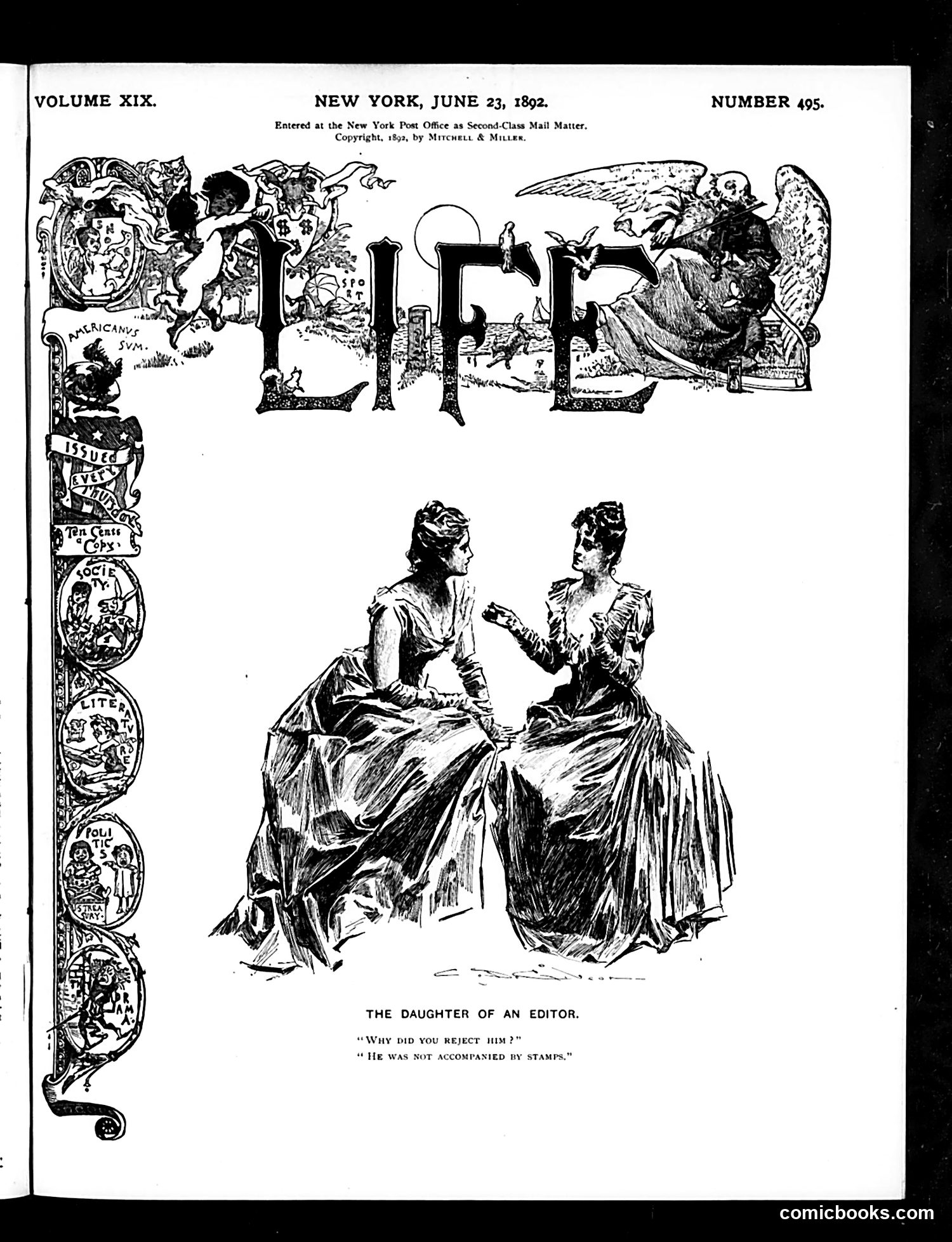
This satirical cartoon from *Life* magazine (June 23, 1892) depicts two women in conversation. The caption reads: "Why did you reject him?" / "He was not accompanied by stamps." The joke targets the practice of editors receiving unsolicited manuscripts. The humor suggests that a young woman rejected a suitor because he lacked the postage stamps necessary to submit his proposal—treating romantic courtship as if it were a manuscript submission process. This is a playful jab at both the editorial profession (implying editors are obsessed with proper submission procedures) and at the father's profession influencing his daughter's values. The joke relies on the absurdity of applying publisher requirements to marriage proposals.
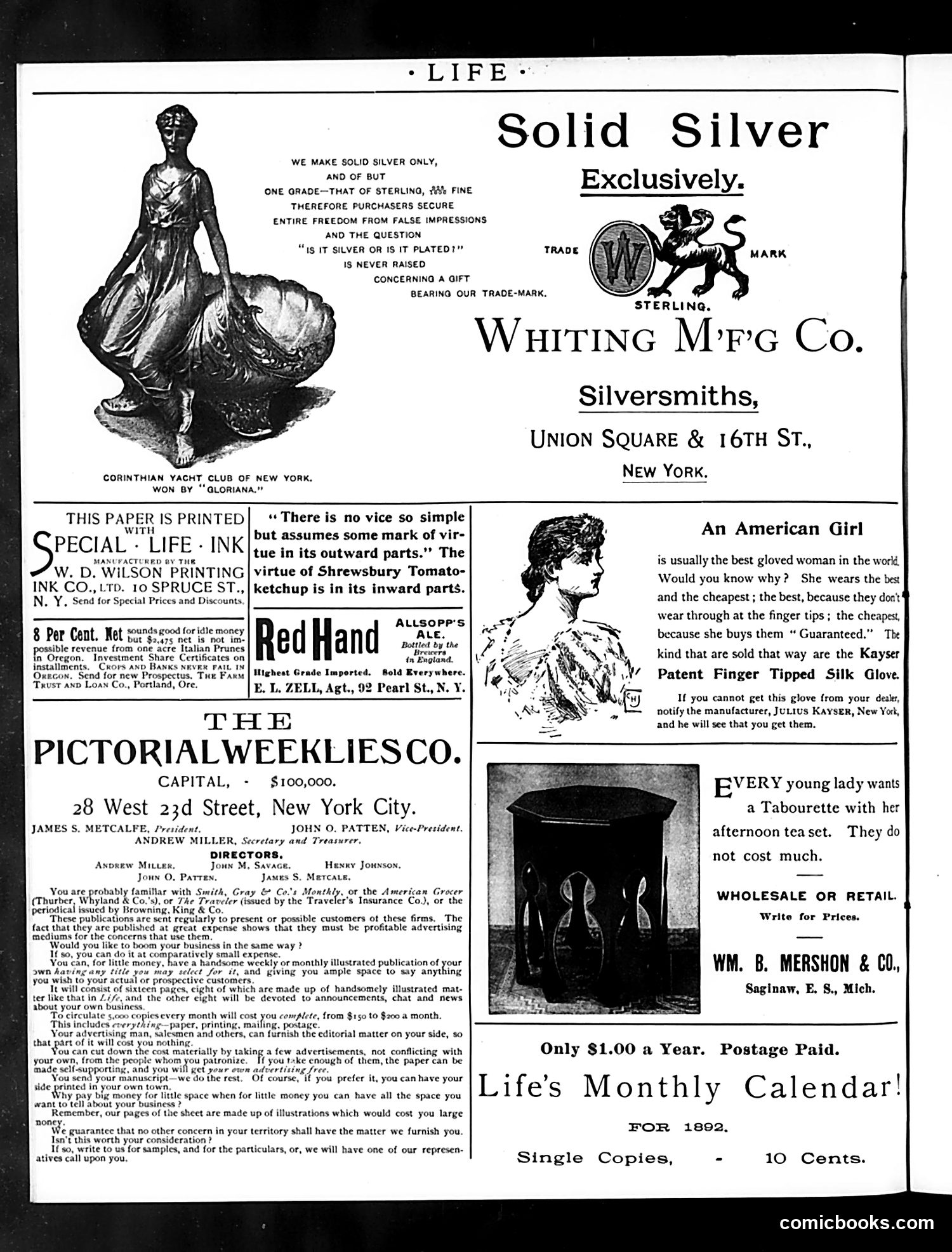
This page is primarily **advertisements** rather than political cartoons. The dominant content includes: 1. **Whiting M'fg Co.** - A sterling silverware company advertisement featuring a classical female figure with a large vessel, emphasizing their "solid silver exclusively" products. 2. **Red Hand** - An advertisement for tomato ketchup, claiming "highest grade imported." 3. **Kayser Patent Finger Tipped Silk Glove** - An ad for women's gloves featuring a sketch of a young woman's hand. 4. **Life's Monthly Calendar** - A subscription advertisement for 1892. 5. **The Pictorial Weeklies Co.** - Publishers offering magazine subscription services. The single illustrated element with potential satirical content is the small sketch accompanying the glove advertisement, but it appears to be primarily promotional rather than satirical commentary.
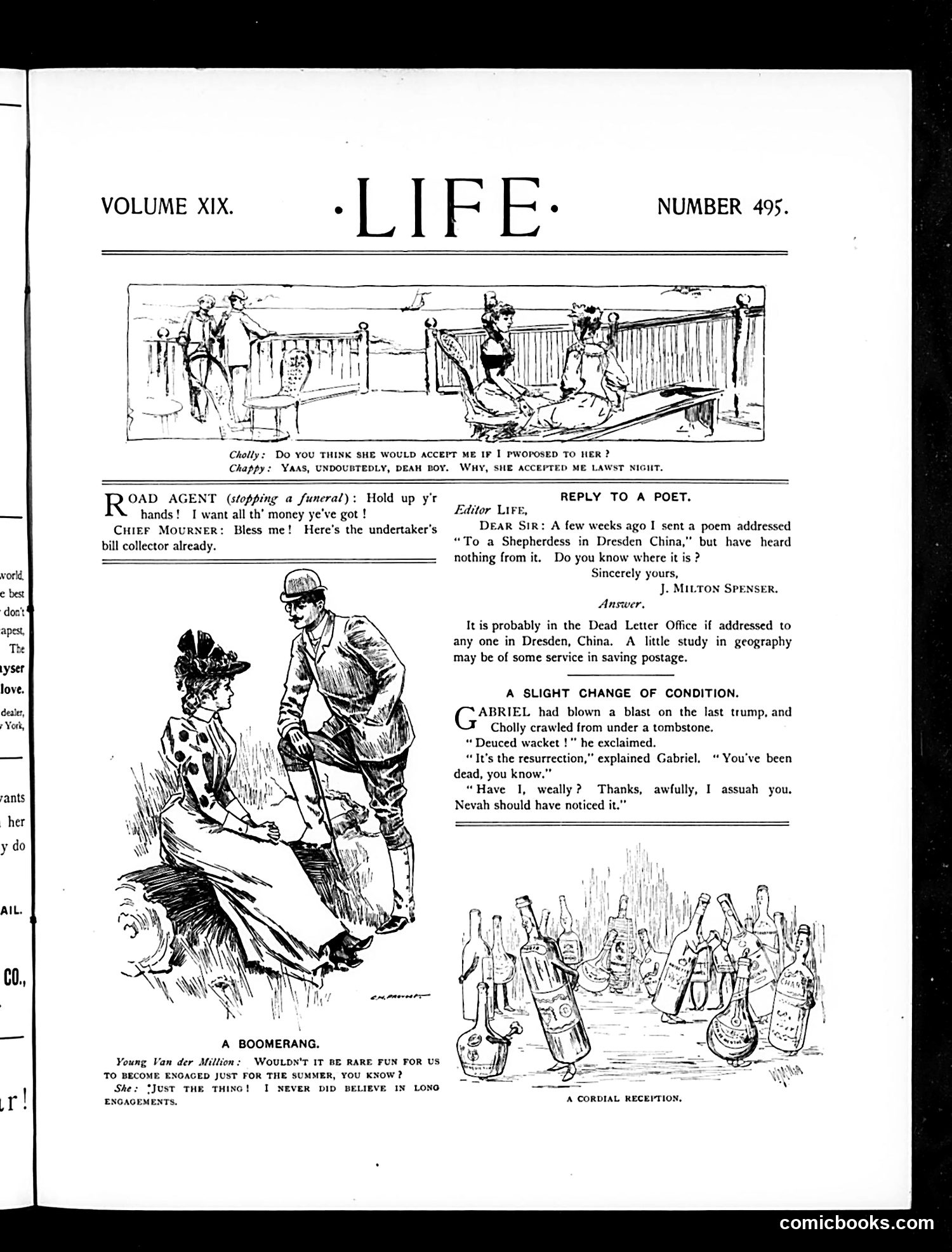
This page contains three distinct humor pieces: **"A Boomerang"** (left cartoon): Shows a man and woman in period dress. The caption suggests satire about long engagements—a man questions why a woman would accept his proposal, and she responds that she accepted him "last night," implying he's already proposed repeatedly. **"Reply to a Poet"** (upper right): An editorial response to a reader who sent a poem addressed to "a Shepherdess in Dresden China" that went undelivered. The magazine humorously suggests it's probably in the Dead Letter Office. **"A Cordial Reception"** (lower right): An illustration showing animated bottles celebrating, titled "A Slight Change of Condition." It's a pun about bottles being "resurrected" or refilled, playing on resurrection themes. The page demonstrates Life's characteristic blend of social commentary, wordplay, and gentle satire typical of early 20th-century American humor magazines.
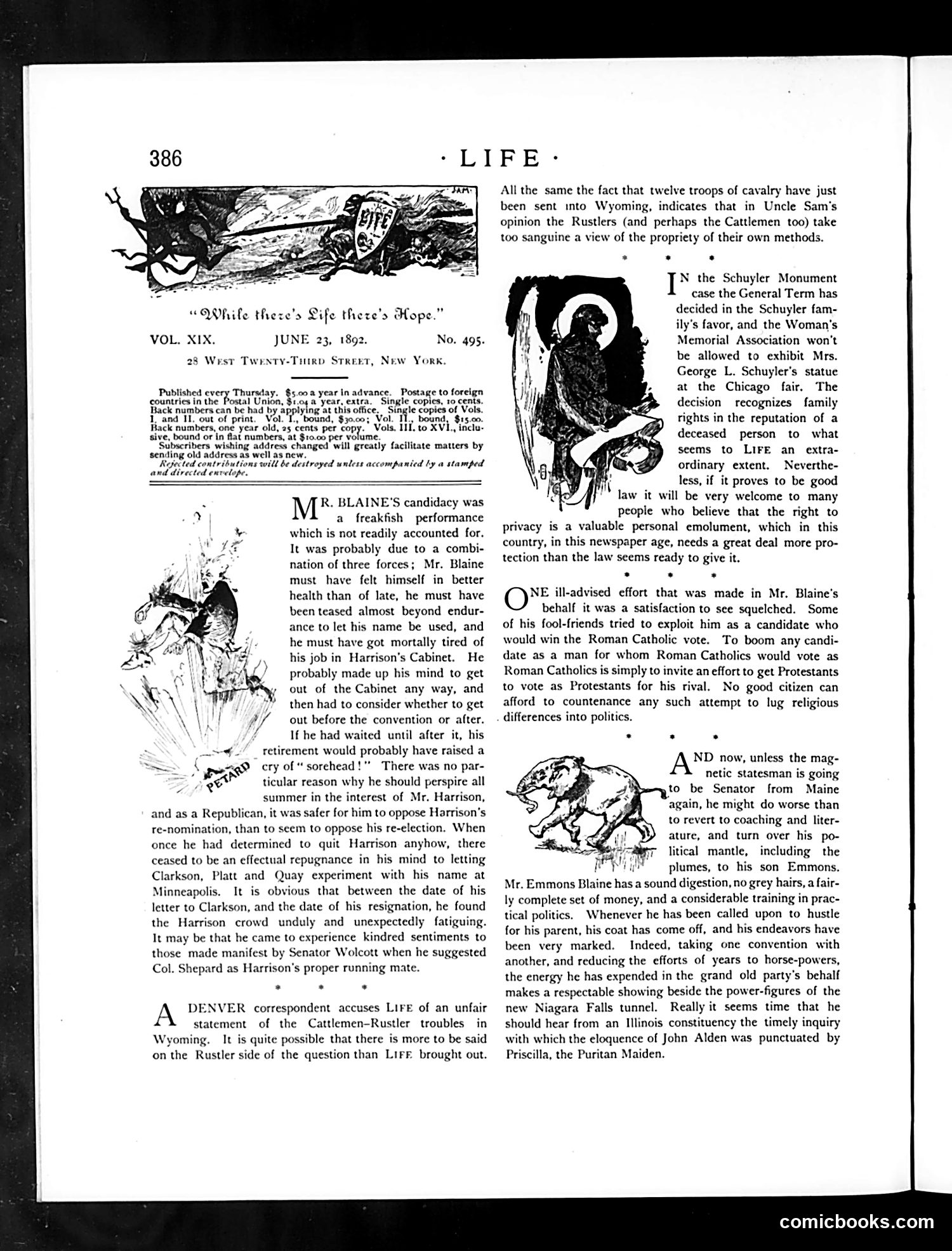
This page contains three editorial segments criticizing political figures and events of 1892: **Blaine's Candidacy:** The text mocks James G. Blaine's potential presidential run, suggesting his ambition exhausted him and he should retire rather than appear before another nominating convention. The cartoon shows a caricatured figure in distress. **Wyoming Rustler-Cattleman Conflict:** Life criticizes their Denver correspondent for unfairly blaming rustlers, suggesting cattlemen bear responsibility for ongoing violence in Wyoming. **Schuyler Monument Controversy:** The editorial defends family privacy rights regarding General Terrence Schuyler's statue at the Chicago fair, siding with the Schuyler family against the Woman's Memorial Association's exhibition plans. The satirical tone targets political ambition, journalistic bias, and institutional overreach.
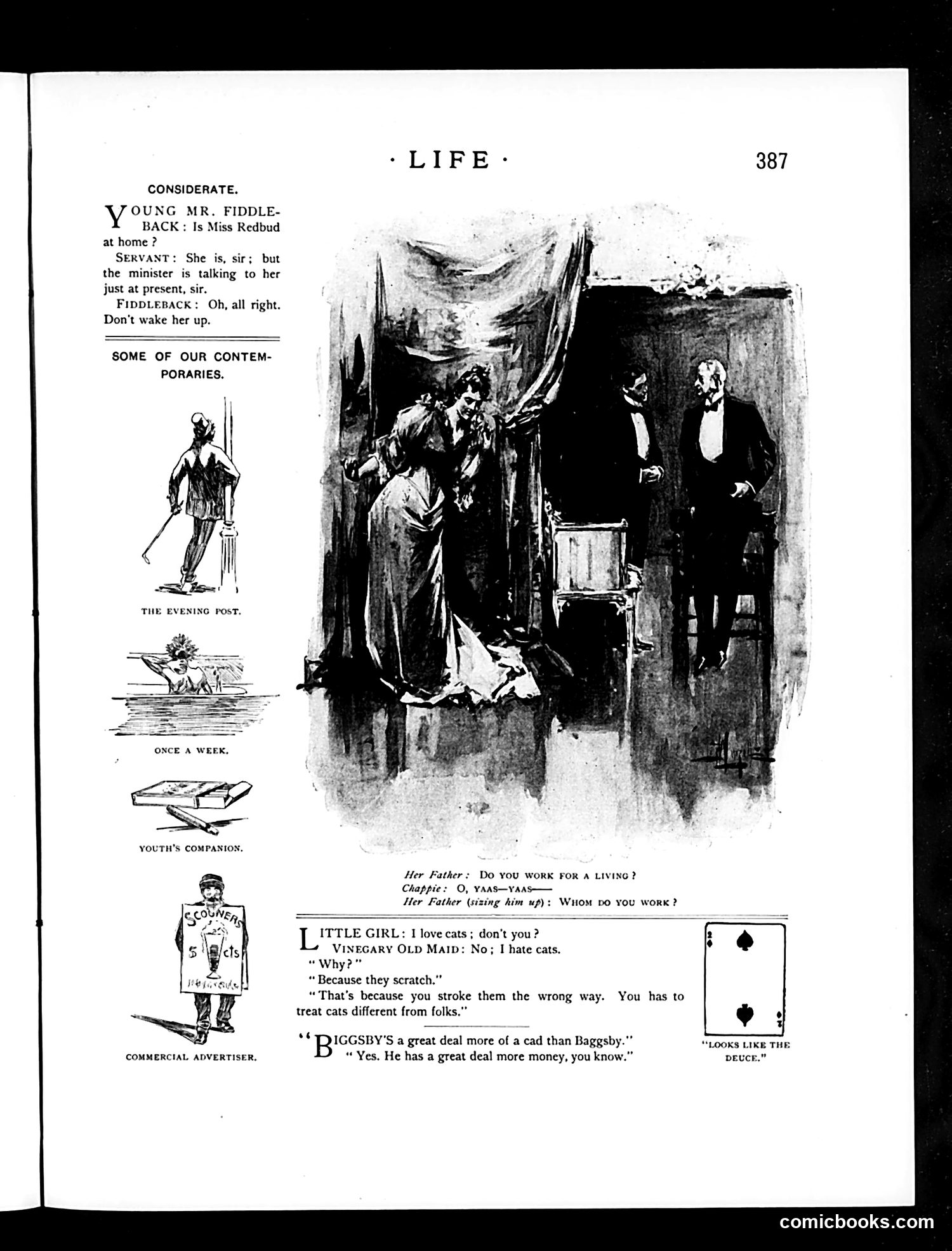
This page contains several satirical sketches about contemporary social types ("Some of Our Contemporaries"), plus unrelated comedic dialogue and advertisements. The main large illustration depicts what appears to be a social gathering or party scene with well-dressed figures, though the specific satirical target is unclear from the image alone. The smaller sketches on the left mock recognizable social archetypes: "The Evening Post" (a man in formal dress), "Once a Week" (a figure in water), and "Commercial Advertiser" (a uniformed figure). Below is humorous dialogue about a "Little Girl" and a "Vineyard Old Maid" debating cats, followed by a joke comparing "Biggsby" and "Baggsby"—apparently contrasting wealth and status. The playing card ("looks like the deuce") suggests additional wordplay or visual humor. Without more historical context, the specific contemporary figures or events referenced remain unclear.
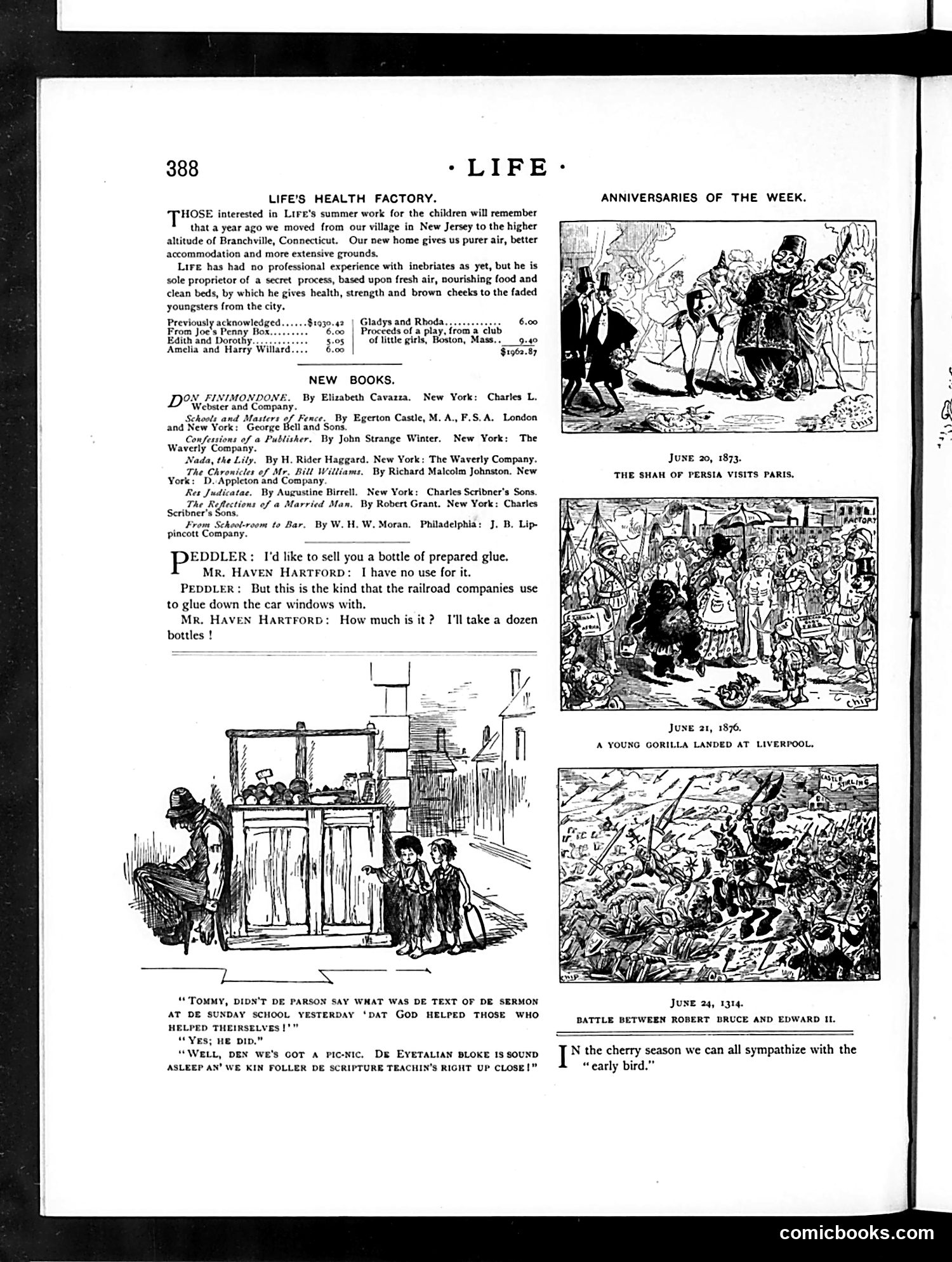
The main cartoon depicts a dialogue between a peddler and Mr. Haven Hartford about "prepared glue." The peddler claims railroad companies use it to glue down car windows. Hartford, interested in buying, asks the price. This is a joke about a useless product—gluing windows shut would be impractical and absurd. The humor relies on the peddler's con-artist pitch and Hartford's gullible response, satirizing either credulous buyers or the peddler's deceptive sales tactics common to the era. The page also features "Anniversaries of the Week" with historical illustrations (Shah of Persia visiting Paris, a gorilla landing in Liverpool, and a battle between Robert Bruce and Edward II), plus book reviews and other editorial content typical of Life's satirical magazine format.
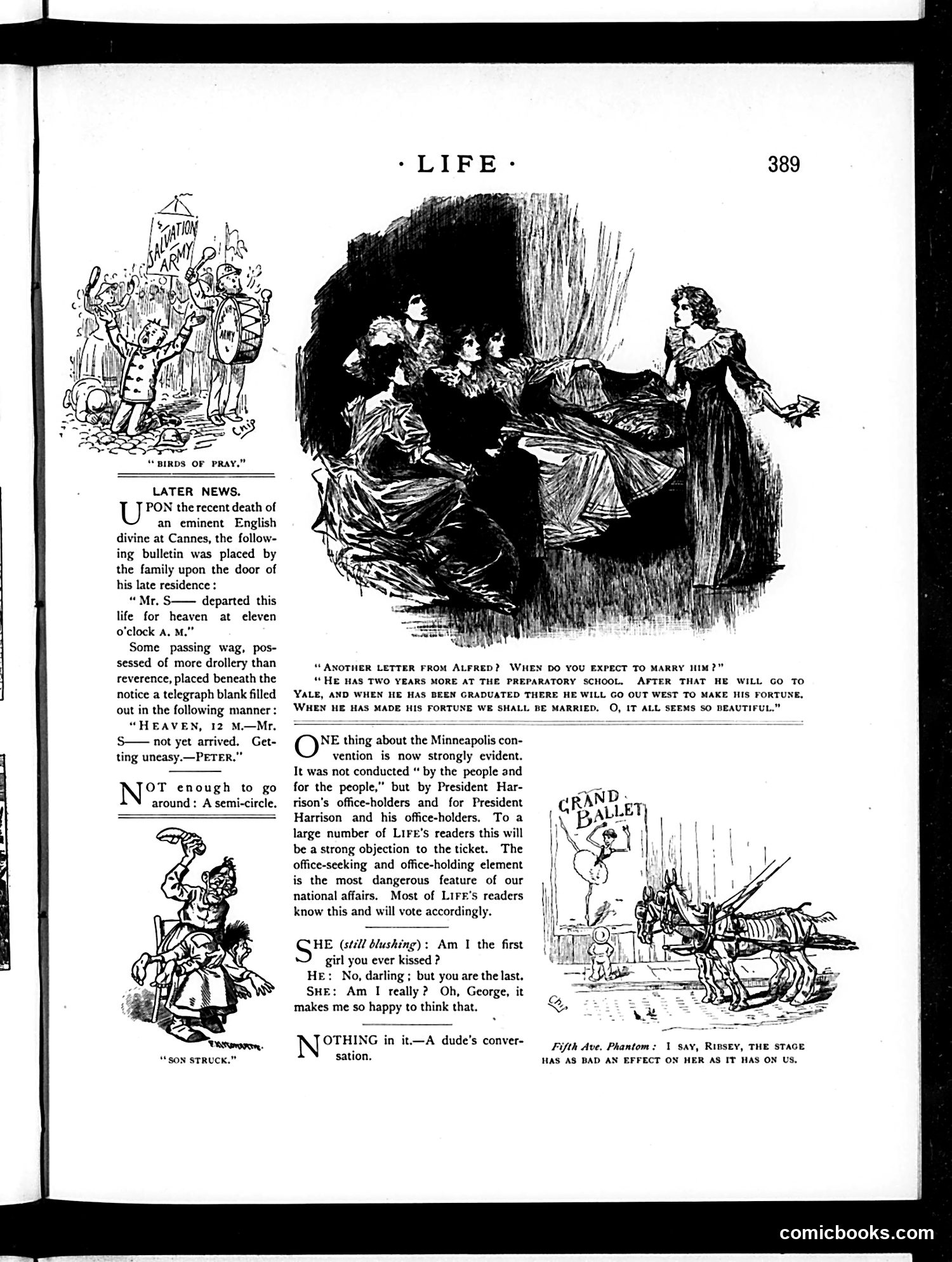
This page contains several satirical pieces typical of Life magazine's humor: **"Later News"** section mocks death notices with darkly comic telegrams about an English clergyman's passing. **"Not Enough to Go Around"** appears to critique the Minneapolis convention (likely the 1892 or 1896 Democratic/Republican convention), arguing it was controlled by President Harrison's office-seekers rather than "the people." The satire suggests the political machine prioritized patronage over genuine democratic participation. **Other humor** includes a flirting dialogue between a couple and a stage-related joke about theatrical phantom effects. The illustrations are typical Period line-drawings depicting Victorian-era social situations and political commentary. The magazine's primary purpose here is satirizing both social conventions and political corruption through humor.
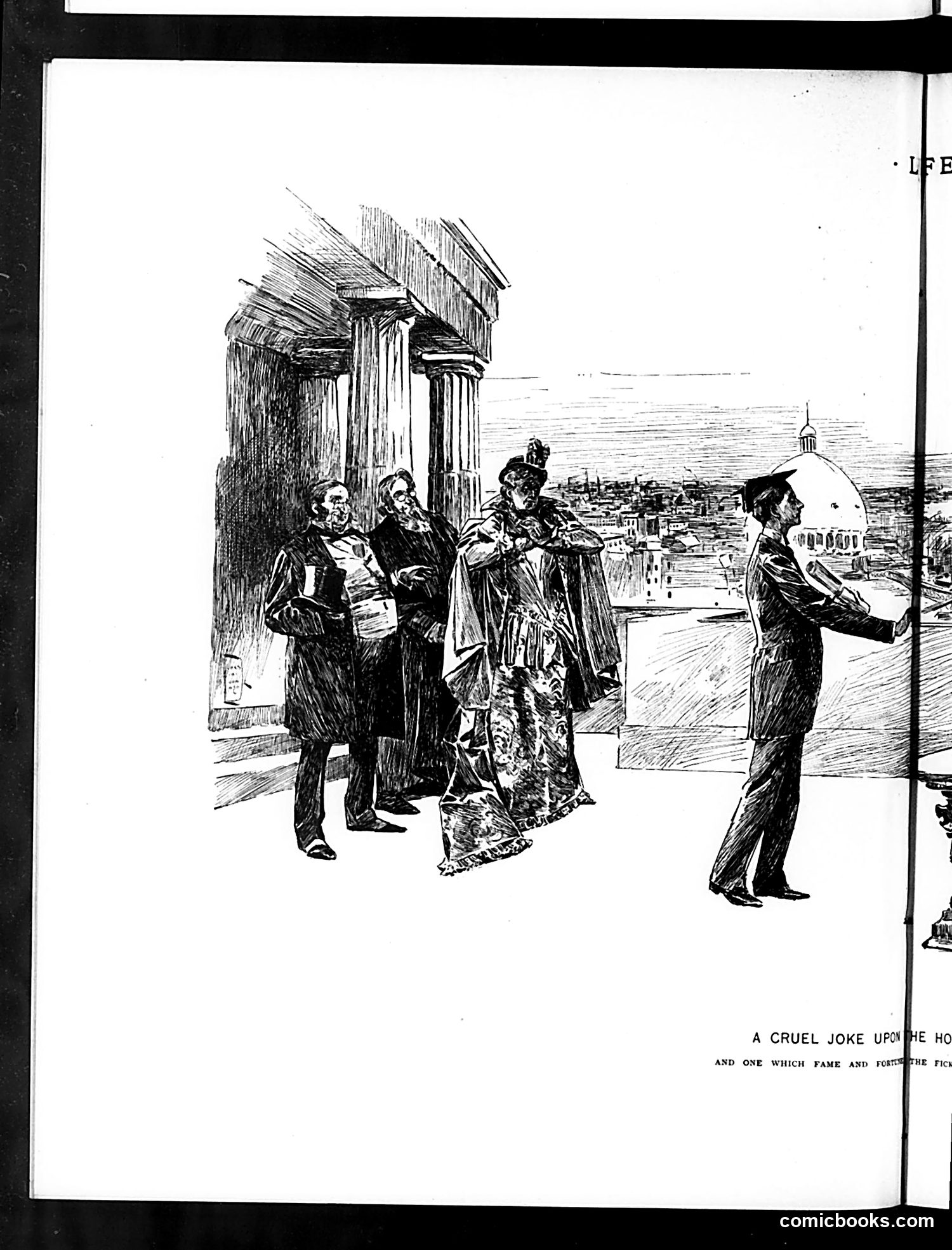
This appears to be a satirical illustration from *Life* magazine depicting a scene at what looks like a classical building with columns overlooking a cityscape (possibly Washington D.C., given the domed building visible in the background). The image shows several formally-dressed men and a woman in elaborate dress standing near classical columns, with one figure gesturing or pointing. The caption references "a cruel joke upon the house" and mentions "fame and fortune" in partially visible text below. Without the complete caption and publication date visible, the specific political target remains unclear. However, the classical architectural setting and formal dress suggest this satirizes political hypocrisy or pretension among Washington elites, likely mocking their claims to greatness or their treatment of someone or some issue as a "joke."
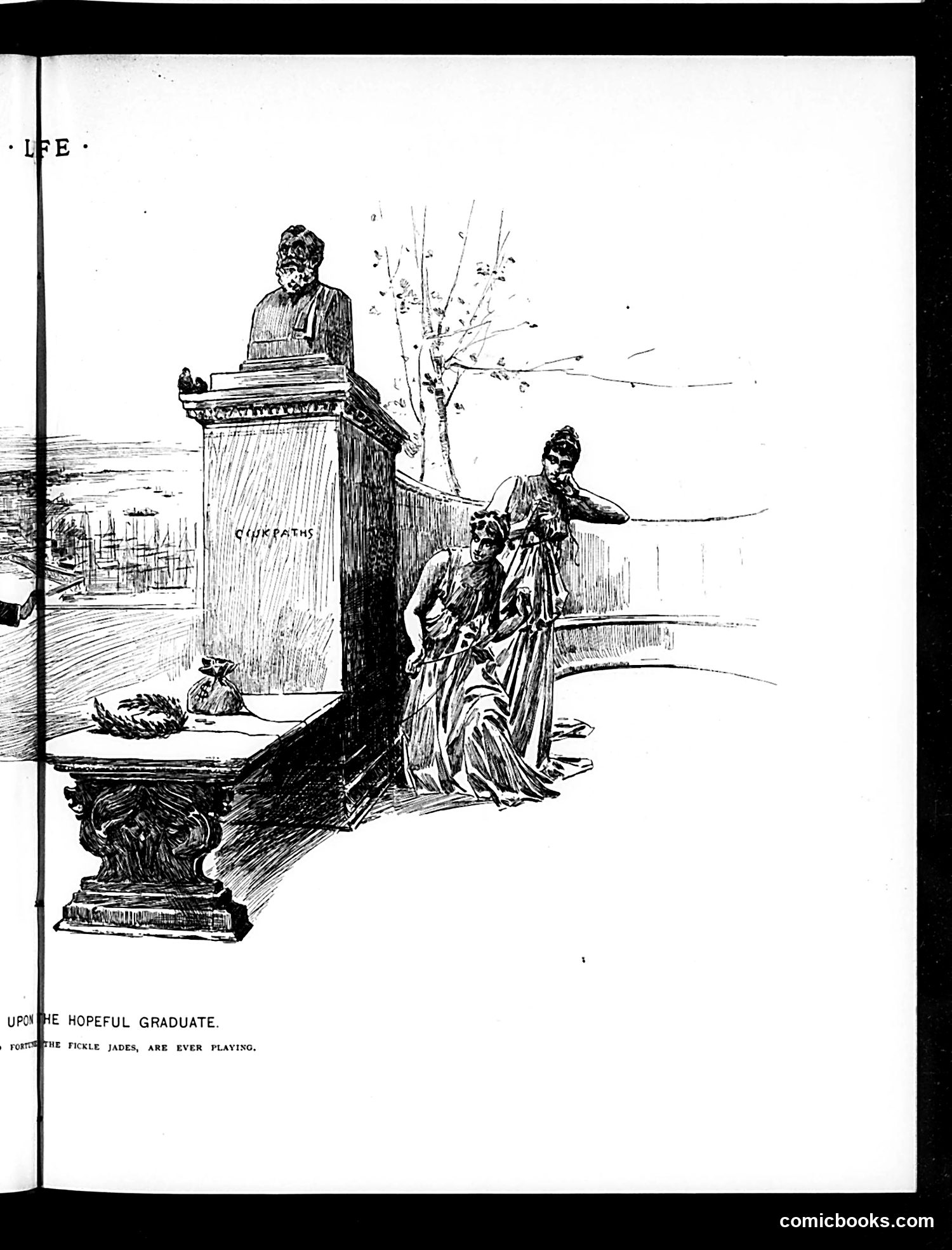
This illustration depicts a classical allegorical scene with a robed male figure (appearing to represent a mentor or authority figure) standing on a pedestal labeled "GRIFFATHS" [sic], observing two draped female figures below. The caption reads "UPON THE HOPEFUL GRADUATE" with a subtitle mentioning "THE FICKLE JADES, ARE EVER PLAYING." The satire appears to target the fate of young graduates entering the world, with the classical female figures ("Jades") likely representing Fortune, Fate, or Temptation—forces beyond the graduate's control. The artist suggests that despite education and idealistic aspirations, life's unpredictable and capricious forces will ultimately determine outcomes. The tone is cynical about post-graduation prospects, warning that external circumstances ("fickle jades") will continue their mischievous "playing" regardless of the graduate's hopes.
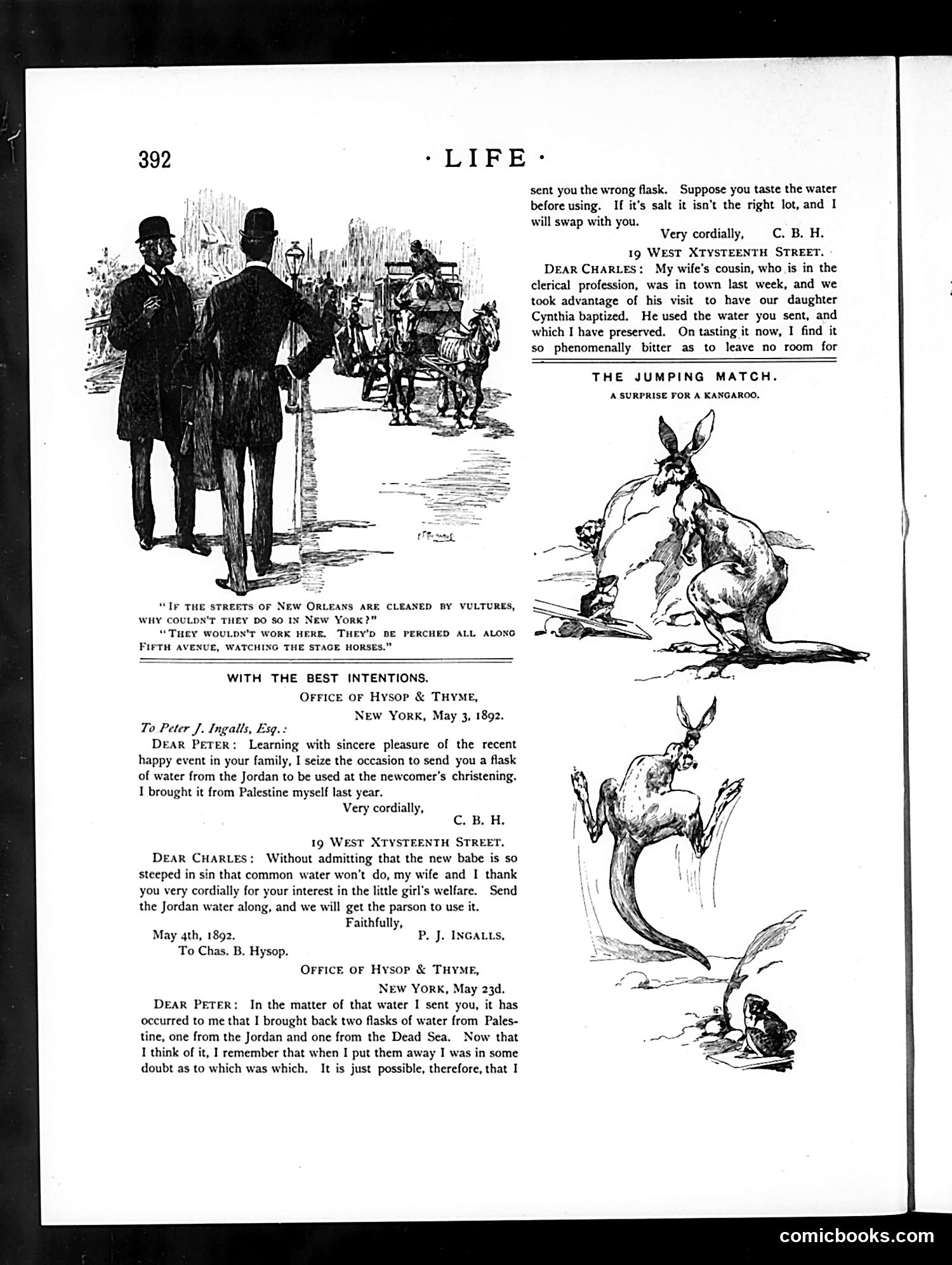
This page contains **humorous letters to the editor** rather than political cartoons. The correspondence concerns a flask of Palestinian water sent as a christening gift, which C.B.H. then forwarded to P.J. Ingalls. A mix-up occurs—C.B.H. had brought back two flasks from Palestine (Jordan River water and Dead Sea water) and cannot remember which is which. The joke satirizes the earnestness of religious sentiment combined with practical absurdity: using "holy water" for a baby's christening while dealing with the mundane problem of mislabeled containers. The accompanying illustrations titled "The Jumping Match: A Surprise for a Kangaroo" show kangaroos jumping, likely a separate humorous piece unrelated to the letters.
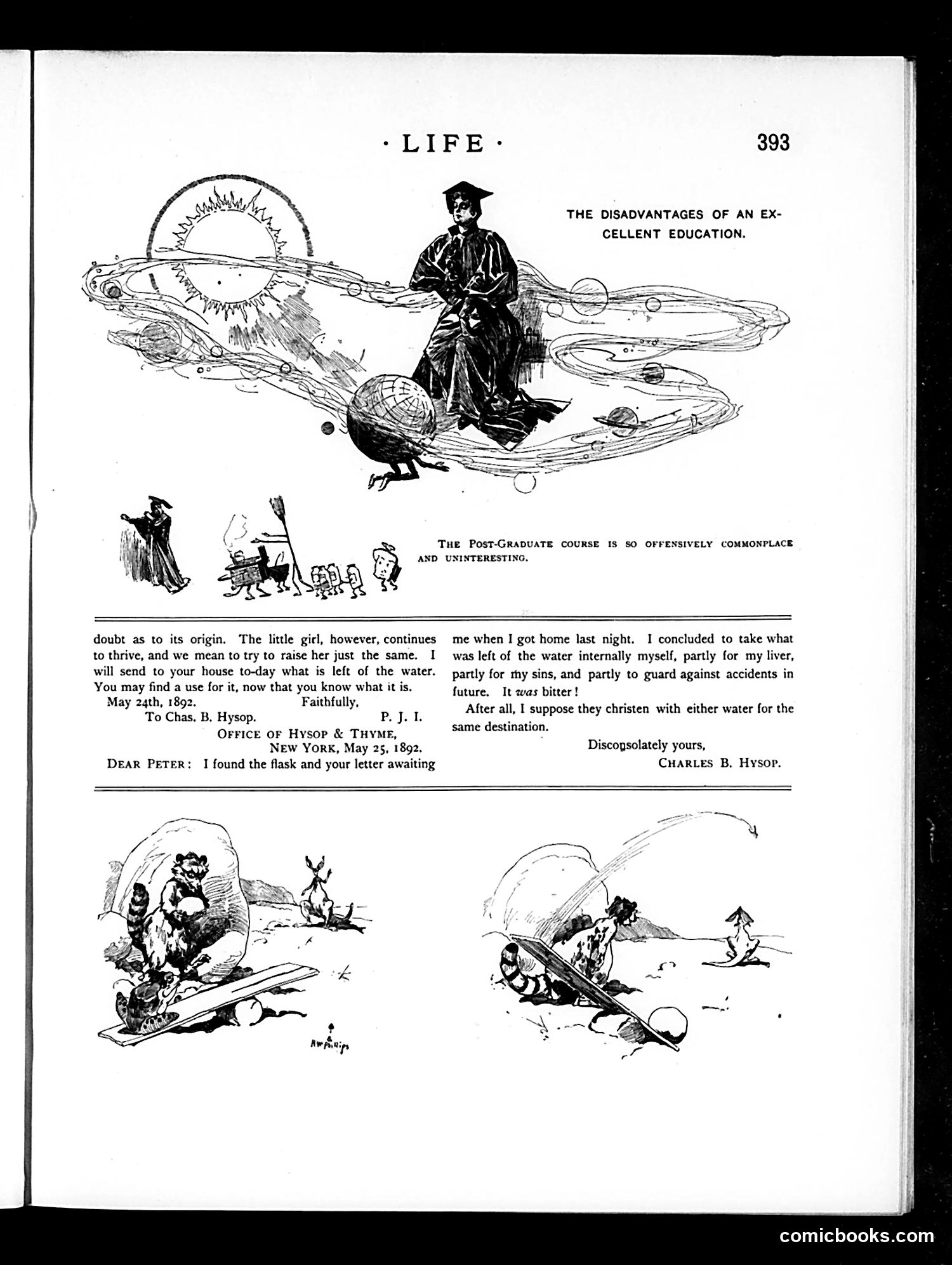
The main cartoon satirizes "The Disadvantages of an Excellent Education." It depicts an over-educated graduate in academic robes, seated amid celestial bodies and cosmic imagery, appearing disconnected from practical reality. The caption states "The Post-Graduate Course is so Offensively Commonplace and Uninteresting." The satire suggests that advanced education produces scholars so absorbed in abstract, theoretical knowledge that they become impractical and disconnected from ordinary life. The cosmic imagery ironically contrasts with the "commonplace" real world they've supposedly transcended. Below are two smaller sketches of mishaps, likely reinforcing that the highly educated are incompetent at everyday tasks. The page also includes a letter from Charles B. Hysop dated May 25, 1892, humorously discussing christening water—apparently a recurring joke in the magazine.
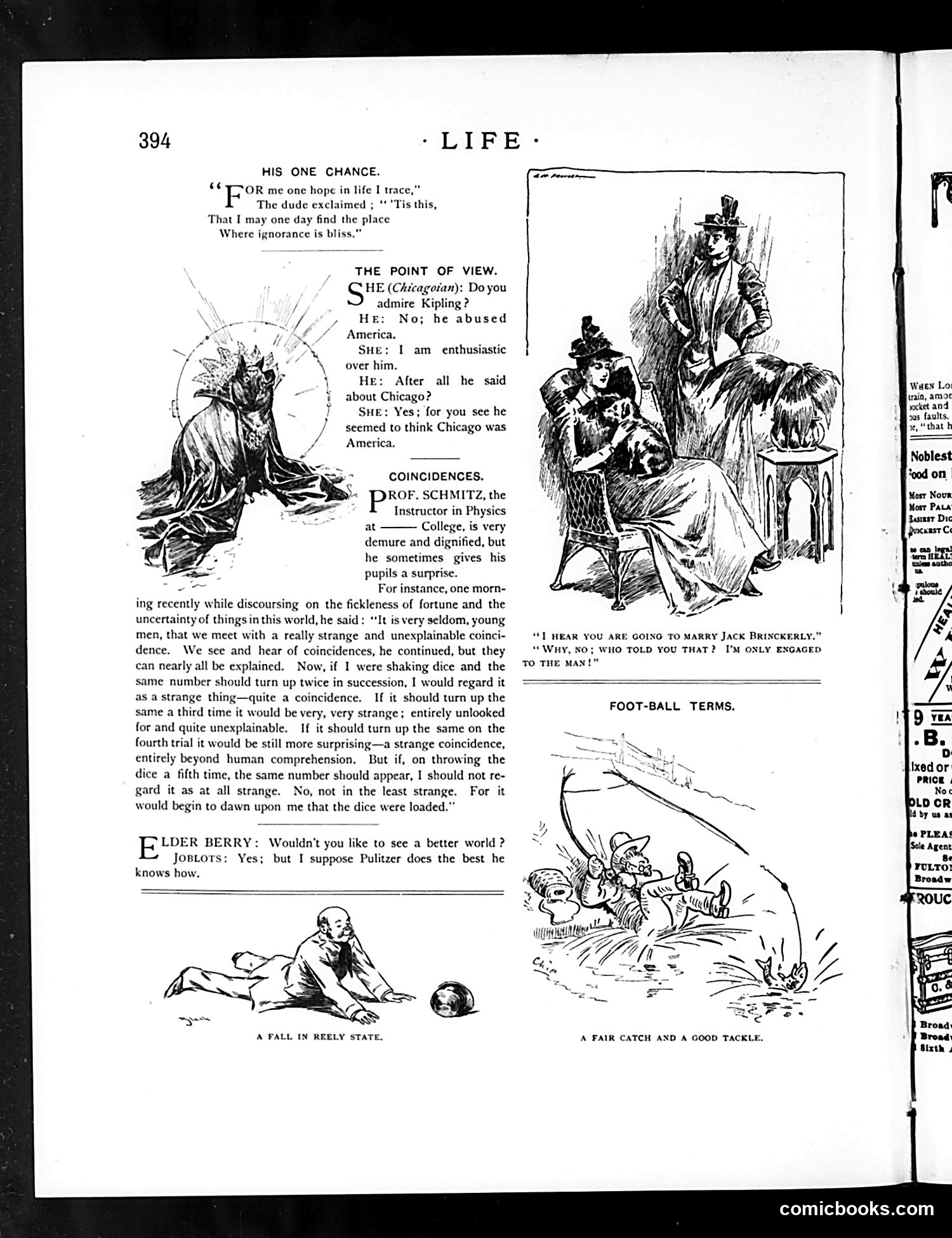
This page collects several short satirical pieces typical of Life's format: **"His One Chance"** mocks pretentious young men ("dudes") seeking ignorance as bliss. **"The Point of View"** satirizes Chicago civic pride. A Chicagoan criticizes Rudyard Kipling for "abusing America," but the woman points out Kipling's real offense was suggesting Chicago *represented* all of America—implying Chicago was insufficiently representative of the broader nation. **"Coincidences"** features Professor Schmitz explaining probability through loaded dice—a joke about how repeated identical outcomes suggest cheating rather than chance. **"Elder Berry"** contains a dig at newspaper magnate Joseph Pulitzer (founder of the New York World), implying he shapes public opinion. The remaining items are visual gags: an engagement announcement with a football metaphor ("tackle"), and football-related cartoon illustrations without additional context visible on this page.
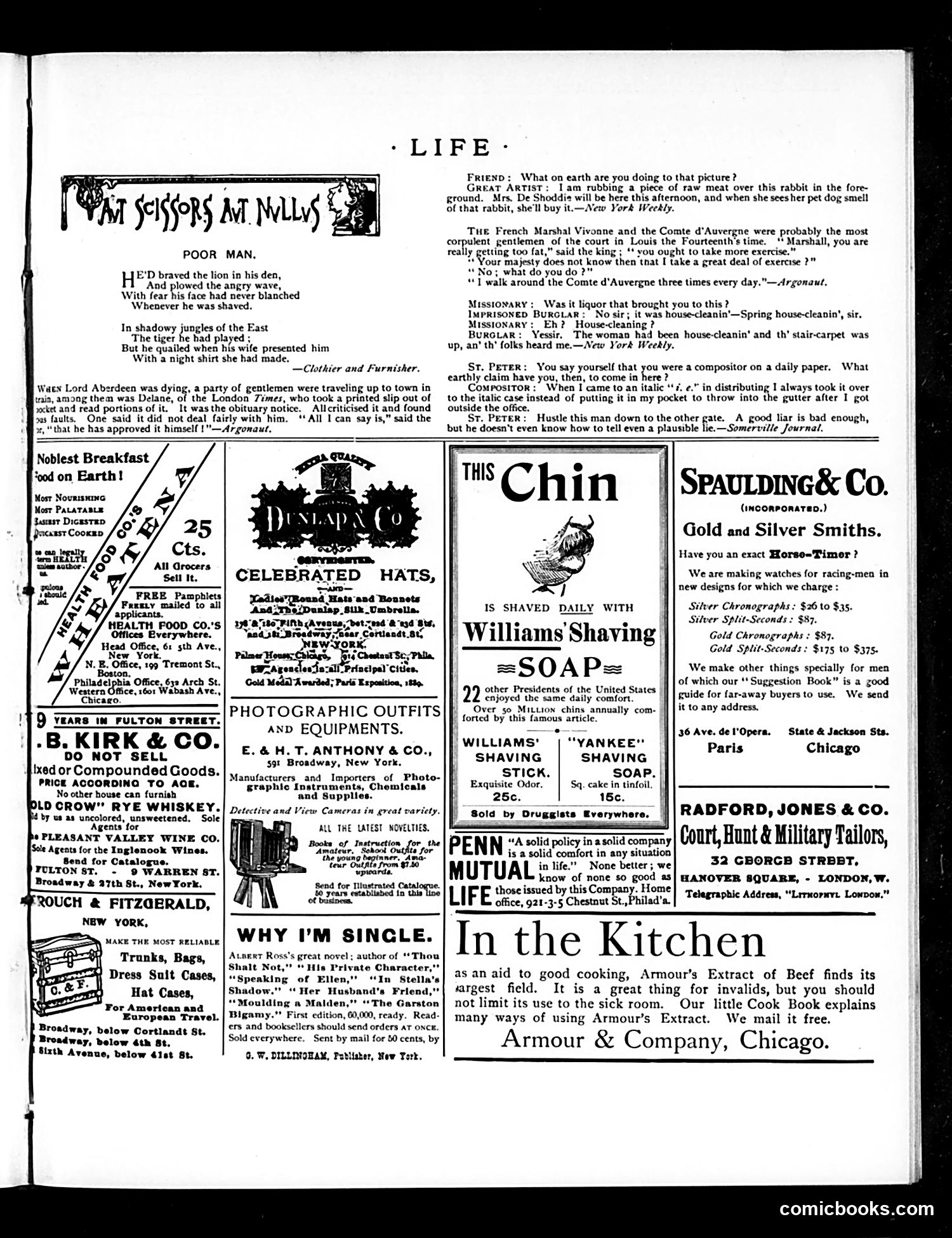
This page contains several short humorous anecdotes typical of *Life*'s satirical style: **"Poor Man"** mocks masculine pretense—a man brave enough to face lions and tigers cowers when his wife presents him a homemade nightshirt, undermining his heroic image. **The "Raw Meat" cartoon** satirizes art dealing and consumer gullibility: an artist rubs raw meat on a rabbit painting to attract a wealthy woman's pet dog, banking on her buying the picture based on her dog's reaction rather than artistic merit. **The Compositor joke** ridicules workplace dishonesty with ironic twist: a printing worker claims moral superiority for returning a misplaced letter to the correct type case—St. Peter rejects him for being a "bad liar" who doesn't even lie convincingly. **The Burglar anecdote** uses ironic understatement: a burglar attributes his crime to spring house-cleaning exposing him, not criminality. These pieces reflect *Life*'s focus on middle-class follies, hypocrisy, and social pretension through brief, punchy narratives rather than visual caricature.
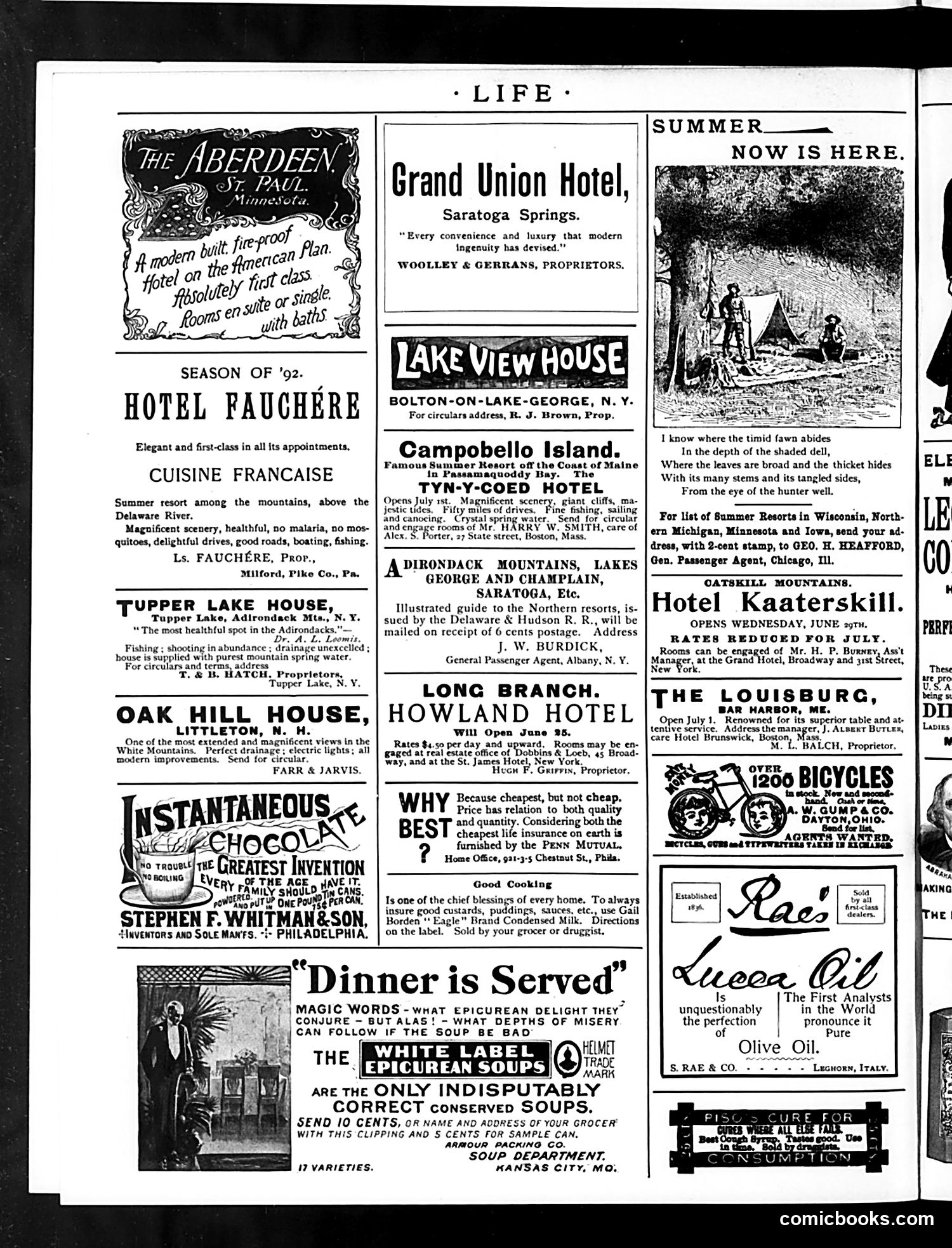
This is primarily an **advertising page** from Life magazine's 1892 season, featuring hotel and resort promotions rather than satirical cartoons. The page reflects the era's leisure culture for affluent Americans. **Content highlights:** The advertisements promote upscale summer resorts across northeastern United States—the Adirondacks, Catskills, Saratoga Springs, and coastal destinations. These venues catered to wealthy vacationers seeking "elegant" accommodations with modern amenities (electric lights, fine cuisine, fishing, boating). **Notable ads include:** - Hotel Fauchere (Pennsylvania mountain resort) - Grand Union Hotel (Saratoga Springs) - Howland Hotel (Long Branch, New Jersey) - Kaaterskill Hotel (Catskills) Interspersed are product advertisements for **Instantaneous Chocolate**, **Penn Mutual Life Insurance**, **White Label Epicurean Soups**, and **Rae's Lucca Oil**. There is one small **poetic illustration** about a "timid fawn" in woodland settings, likely promoting Catskill Mountain resorts. The page demonstrates Life's dual nature: satirical magazine with revenue-dependent advertising targeting the upper classes.
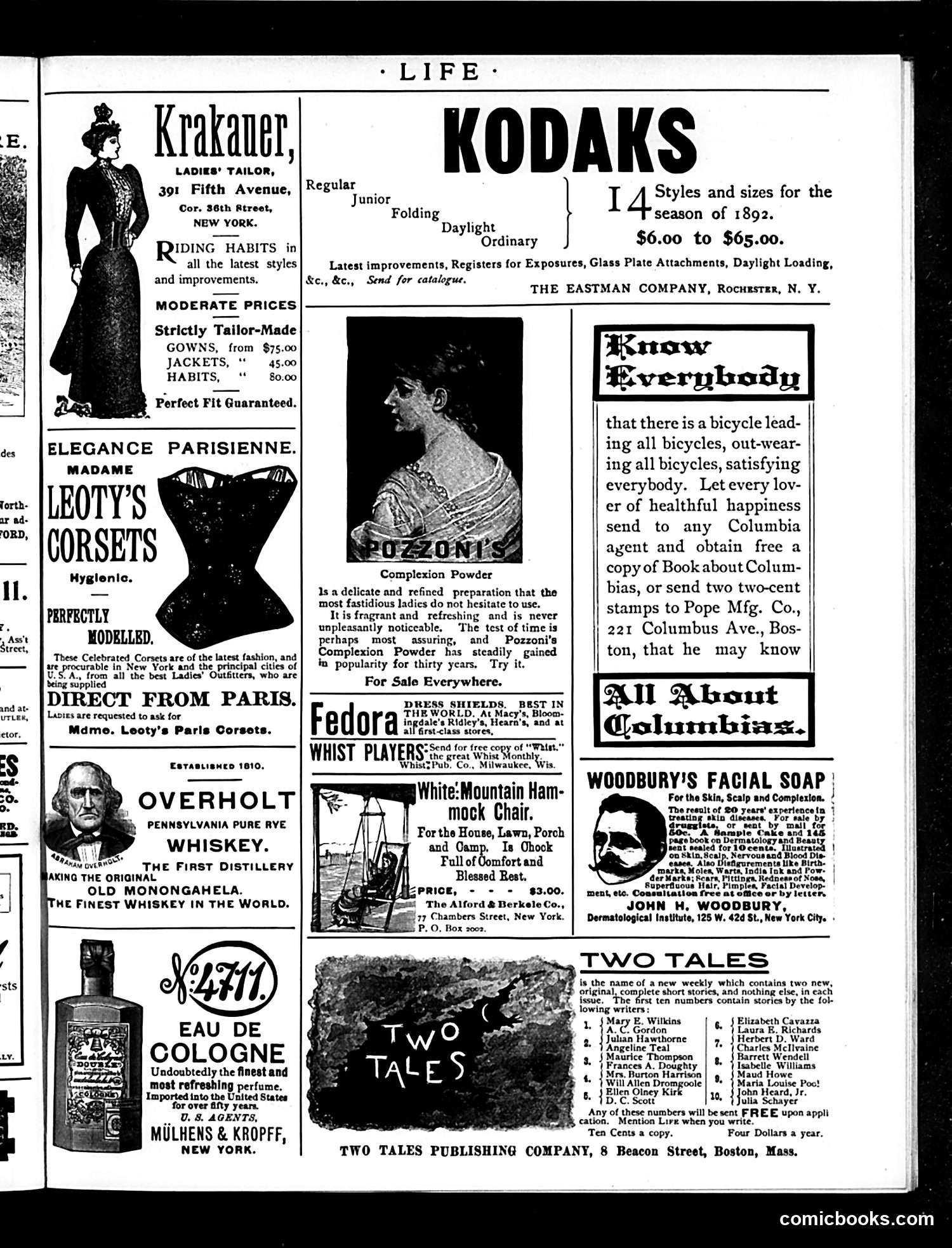
This is primarily an **advertising page** with no political cartoons or satirical content. It features commercial advertisements typical of 1890s America: **Key Advertisements:** - **Kodaks** (Eastman Company): Cameras ranging $6-$65, promoting the new consumer photography market - **Fashion/Clothing**: Krakauer tailoring, Leoty's corsets, riding habits - **Personal Care**: Pozzoni's complexion powder, Woodbury's facial soap - **Spirits**: Overholt whiskey, Eau de Cologne - **Furniture/Recreation**: White Mountain hammock chairs, whist player guides - **Publications**: "Two Tales" weekly magazine featuring short stories by contemporary writers **Historical Context for Modern Readers:** This page reflects 1890s consumer culture: the rise of branded products, mail-order commerce, photography as an emerging hobby, and women's fashion/beauty industries. The advertisements target middle and upper-class consumers with disposable income. Names like Dromgoole, Hawthorne, and Scott indicate the literary prestige associated with the magazine. No satire or political commentary is present—this is straightforward commercial content.
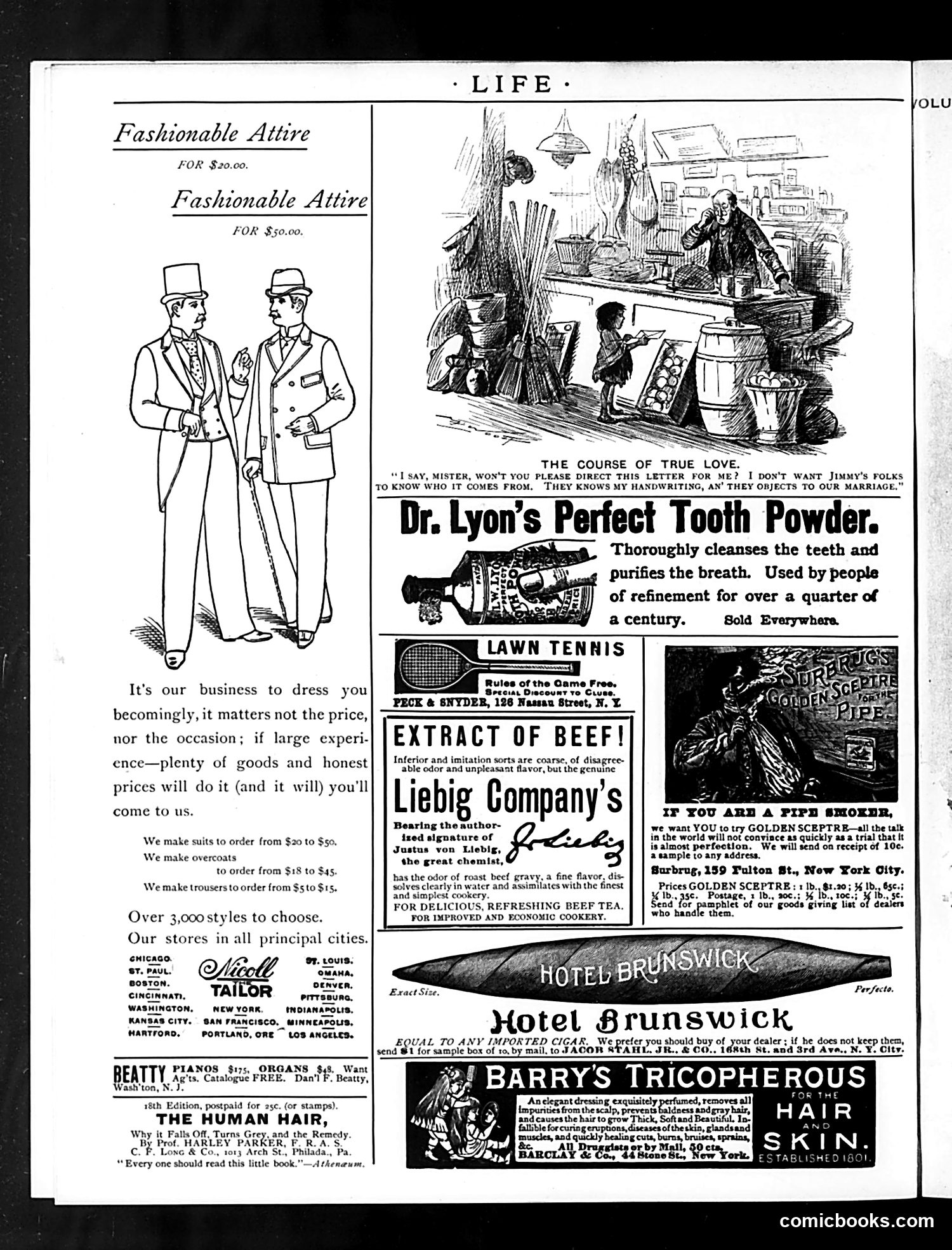
This page is primarily **advertisements with one satirical cartoon**. The main content is "The Course of True Love," a small comic illustration showing a young woman asking a man to redirect her letter so her suitor's family won't recognize her handwriting—she wants to hide their correspondence because "they objects to our marriage." The joke satirizes the social reality of the era: parental control over courtship was so strict that young couples had to conduct secret correspondence. The woman's request to disguise her handwriting reflects the rigid class or social barriers that made their relationship socially unacceptable to his family. The surrounding advertisements (tooth powder, beef extract, cigars, tailoring, pianos) are typical period marketing and provide context for Life's middle-class readership. The page itself contains no political cartoons—just this single, gentle social satire about courtship restrictions and family interference in romance.