
Life, 1892-06-23 · page 4 of 16
Life — June 23, 1892 — page 4: what you’re looking at
What you’re looking at
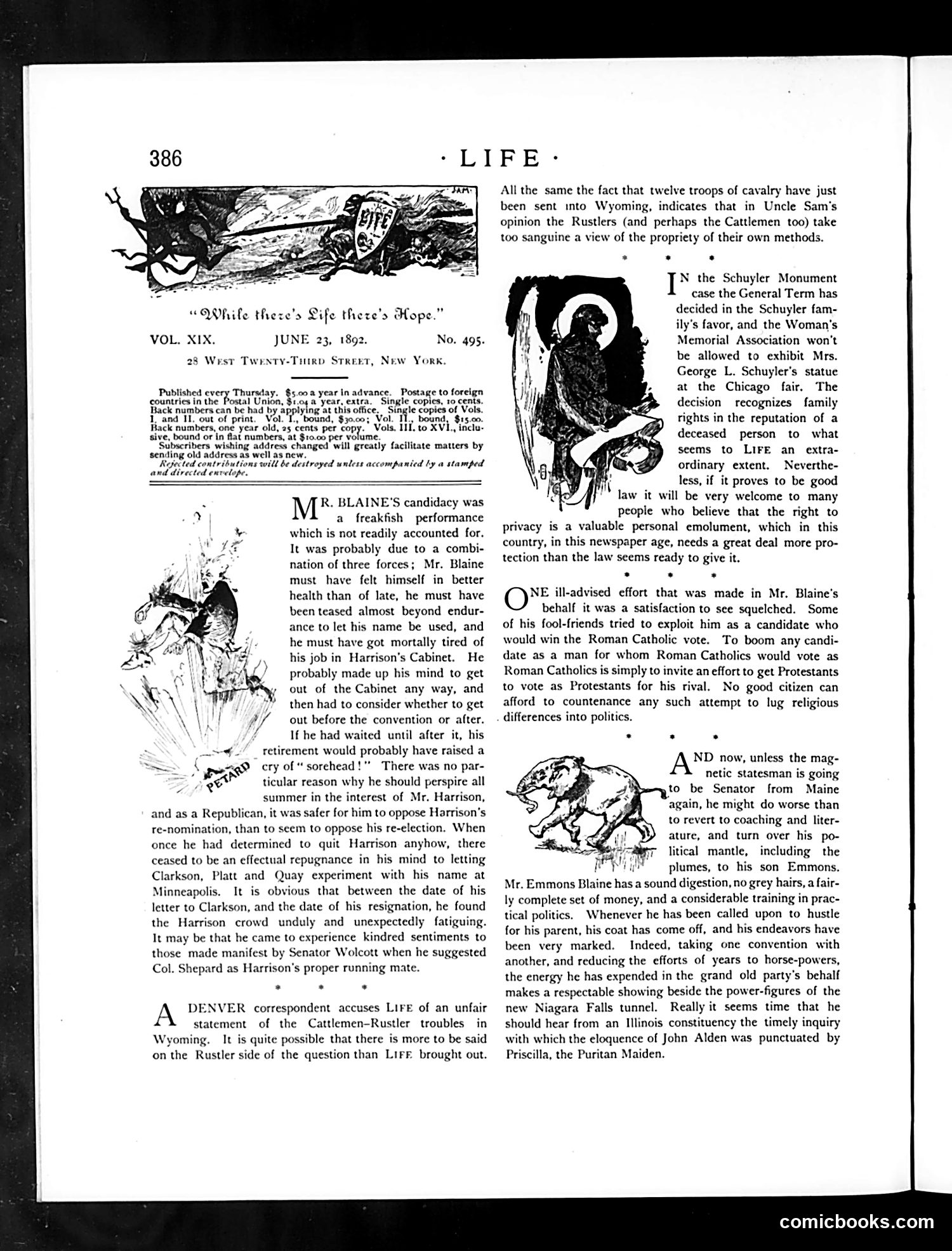
This page contains three editorial segments criticizing political figures and events of 1892: **Blaine's Candidacy:** The text mocks James G. Blaine's potential presidential run, suggesting his ambition exhausted him and he should retire rather than appear before another nominating convention. The cartoon shows a caricatured figure in distress. **Wyoming Rustler-Cattleman Conflict:** Life criticizes their Denver correspondent for unfairly blaming rustlers, suggesting cattlemen bear responsibility for ongoing violence in Wyoming. **Schuyler Monument Controversy:** The editorial defends family privacy rights regarding General Terrence Schuyler's statue at the Chicago fair, siding with the Schuyler family against the Woman's Memorial Association's exhibition plans. The satirical tone targets political ambition, journalistic bias, and institutional overreach.
📄 Transcribed text from this page (OCR, searchable)
Machine-transcribed from the original scan — historical spelling and the odd misread are preserved.
LIFE “While treze’s Life there's Hope.” . XIX. JUNE 23, 28 West Twenty-Titrp STREET, 1892. No. 495. New York. Published ever countries in the Thurstay. $5.00 year in advance opal Union, S04 a year, extra. Postage to foreign Single copies, 10 cents. Back numbers can be had by applying at this office, Single copies of Vols 1, and II, out of print. Vol. I, bound 3 Vol. IL, bound, $15.00. Flack numbers, one year old, 25 cents per a avo Uf. to XVI, inclu: sive, bound or in flat numbers, at $10.00 per volum! Subseribers wishing address changed will greatly facilitate matters by sending old address as well as new Rejected contributions will be destroyed untess accompanied by a stamped and directed envelope. R. BLAINE'S candidacy was a freakfish performance which is not readily accounted for. It was probably due to a combi- nation of three forces; Mr. Blaine must have felt himself in better health than of late, he must have been teased almost beyond endur- ance to let his name be used, and he must have got mortally tired of his job in Harrison's Cabinet. He probably made up his mind to get out of the Cabinet any way, and then had to consider whether to get out before the convention or after. If he had waited until after it, his retirement would probably have raised a cry of “ sorehead!"" There was no par- ticular reason why he should perspire all summer in the interest of Mr. Harrison, and as a Republican, it was safer for him to oppose Harrison's re-nomination, than to scem to oppose his re-election. When once he had determined to quit Harrison anyhow, there ceased to be an effectual repugnance in his mind to letting Clarkson, Platt and Quay experiment with his name at Minneapolis. It is obvious that between the date of his letter to Clarkson, and the date of his resignation, he found the Harrison crowd unduly and unexpectedly fatiguing. It may be that he came to experience kindred sentiments to those made manifest by Senator Wolcott when he suggested Col. Shepard as Harrison's proper running mate. DENVER correspondent accuses LiFe of an unfair atement of the Cattlemen-Rustler troubles in Wyoming. It is quite possible that there is more to be said onthe Rustler side of the question than LIFE brought out. All the same the fact that twelve troops of cavalry have just been sent into Wyoming, indicates that in Uncle Sam’s opinion the Rustlers (and perhaps the Cattlemen too) take too sanguine a view of the propriety of their own methods. . . . N the Schuyler Monument case the General Term has decided in the Schuyler fam- ily’s favor, and the Woman's Memorial Association won't be allowed to exhibit Mrs. George L. Schuyler’s statue at the Chicago fair, The decision recognizes family rights in the reputation of a deceased person to what seems to LIFE an extra- ordinary extent. Neverthe- less, if it proves to be good law it will be very welcome to many people who believe that the right to privacy is a valuable personal emolument, which in this country, in this newspaper age, needs a great deal more pro- tection than the law seems ready to give it. . . . NE ill-advised effort that was made in Mr. Blaine’s behalf it was a satisfaction to see squelched. Some of his fool-friends tried to exploit him as a candidate who would win the Roman Catholic vote. To boom any candi- date as a man for whom Roman Catholics would vote as Roman Catholics is simply to invite an effort to get Protestants to vote as Protestants for his rival. No good citizen can afford to countenance any such attempt to lug religious differences into politics. A ND now, unless the mag- netic statesman is going to be Senator from Maine again, he might do worse than to revert to coaching and liter- ature, and turn over his po- litical mantle, including the plumes, to his son Emmons. Mr. Emmons Blaine has sound digestion, no grey hairs, a fair- ly complete set of money, and a considerable training in prac- tical politics. Whenever he has been called upon to hustle for his parent, his coat has come off, and his endeavors have been very marked. Indeed, taking one convention with another, and reducing the efforts of years to horse-powers, the energy he has expended in the grand old party's behalf makes a respectable showing beside the power-figures of the new Niagara Falls tunnel. Really it seems time that he should hear from an Illinois constituency the timely inquiry with which the eloquence of John Alden was punctuated by Priscilla, the Puritan Maiden. comicbooks.com