
A complete issue · 16 pages · 1892
Life — June 16, 1892
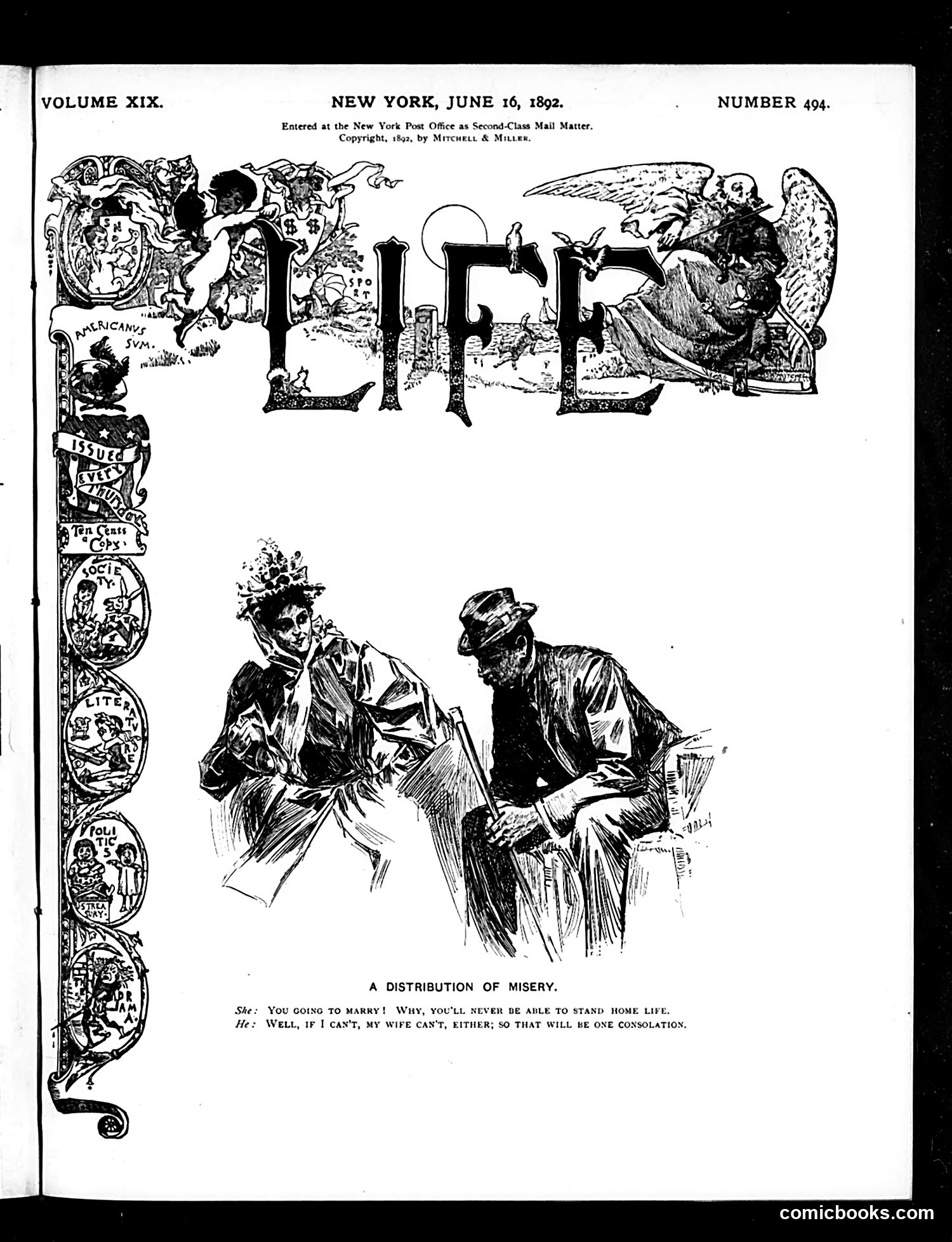
This page features a cartoon titled "A Distribution of Misery" depicting two men in conversation. The dialogue suggests a domestic dispute: the woman says she's going to marry, claiming her husband can't support home life. The man responds that if he can't, his wife can't either—"so that will be one consolation." The satire targets 1890s marriage dynamics and economic anxieties. It mocks the financial pressures on working-class husbands and the limited options available to unhappy wives. The "consolation" joke darkly suggests that mutual misery in marriage is inevitable—a cynical commentary on matrimonial prospects, particularly for those without wealth. The ornate left border contains Life magazine's typical decorative emblems and logos.
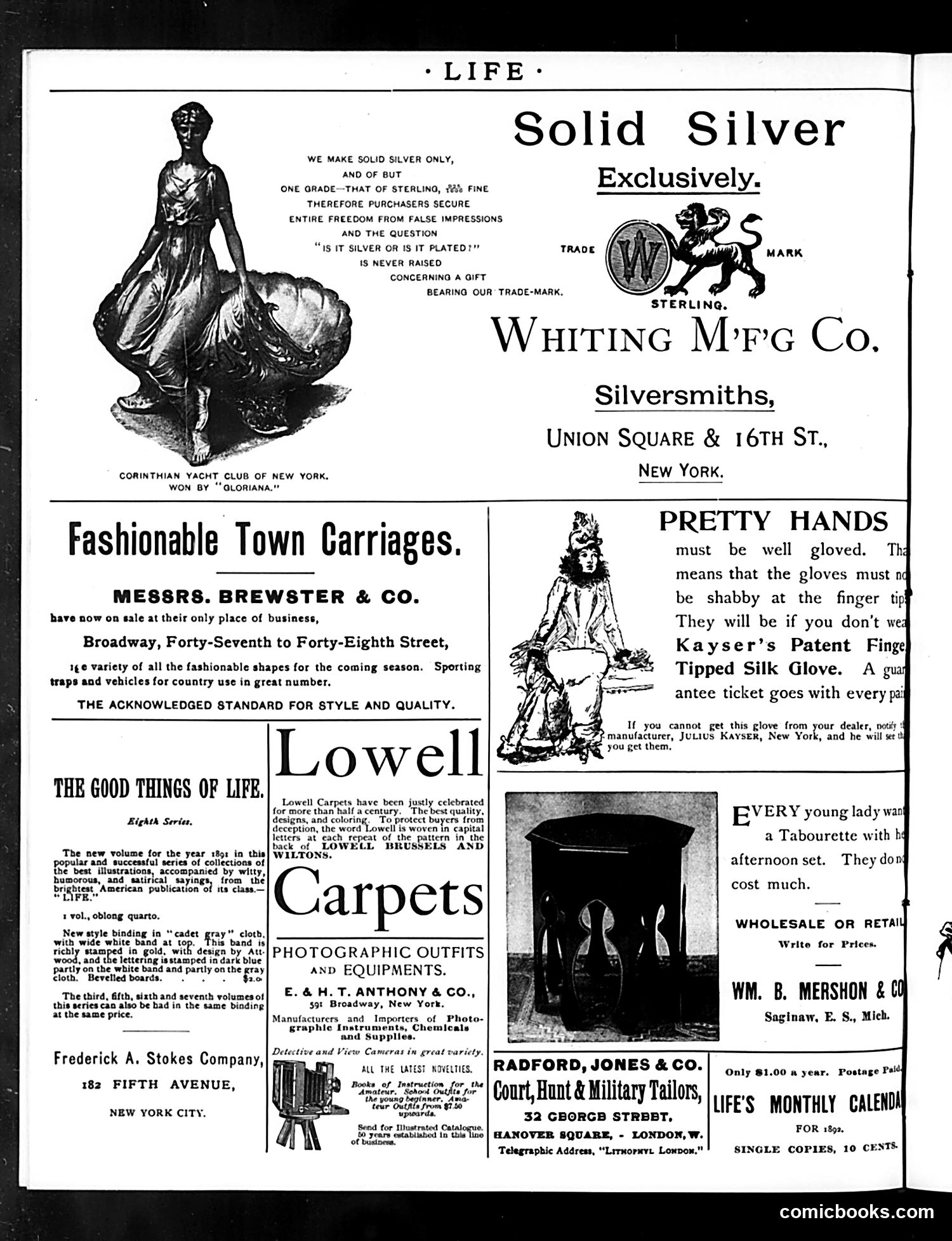
This page is primarily **advertisements** rather than political satire or commentary. The content includes: 1. **Whiting M'FG Co.** — Sterling silver product advertisement emphasizing quality and authenticity 2. **Brewster & Co.** — Fashionable carriages for the wealthy 3. **Lowell Carpets** — Advertisement with a photographic outfit image 4. **Frederick A. Stokes Company** — Publishing/photography equipment 5. **Kayser's Patent Finger-Tipped Silk Gloves** — Women's fashion accessory 6. **Radford, Jones & Co.** — Tailoring services in London 7. **Life's Monthly Calendar** — Magazine subscription promotion The single illustration (a woman with a large sphere) appears to be a Corinthian Yacht Club emblem, likely celebrating the yacht "Gloriana," but lacks explanatory context. The page serves primarily as a commercial vehicle for luxury goods targeting wealthy, fashionable readers.
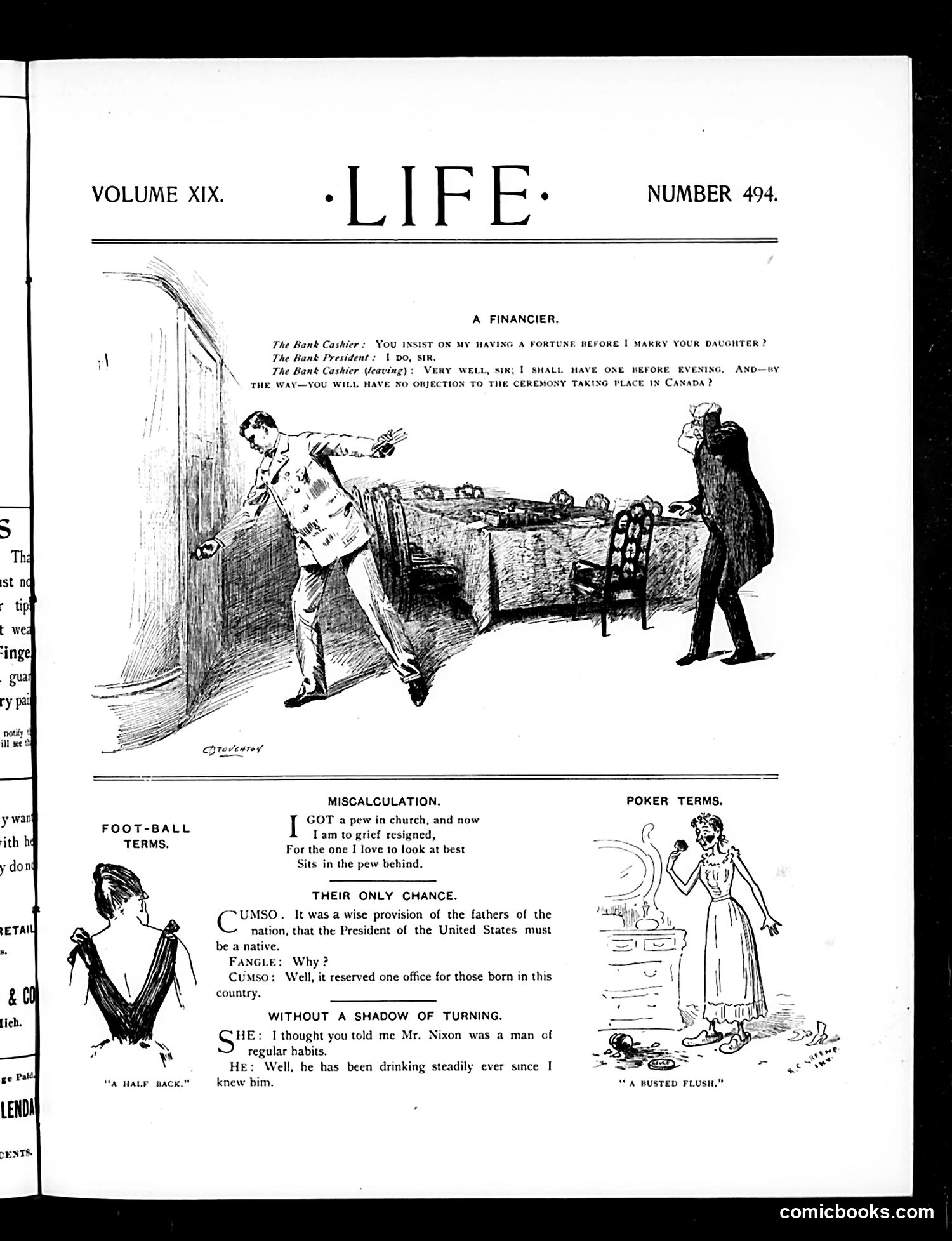
The main cartoon depicts a confrontation between a "Bank Cashier" and "Bank President" over marriage conditions. The President demands the Cashier have a fortune before marrying his daughter; the Cashier agrees, provided the wedding occurs in Canada. This satirizes the American financial establishment's mercenary attitudes toward marriage—where a banker's daughter requires monetary qualification rather than character. The Canada reference likely mocks the idea of eloping to escape such conditions. The page's other brief jokes ("A Half Back," "Miscalculation," "A Busted Flush") employ wordplay and domestic humor typical of Life magazine's satirical style, poking fun at social pretension and marital misadventures among the middle and upper classes.
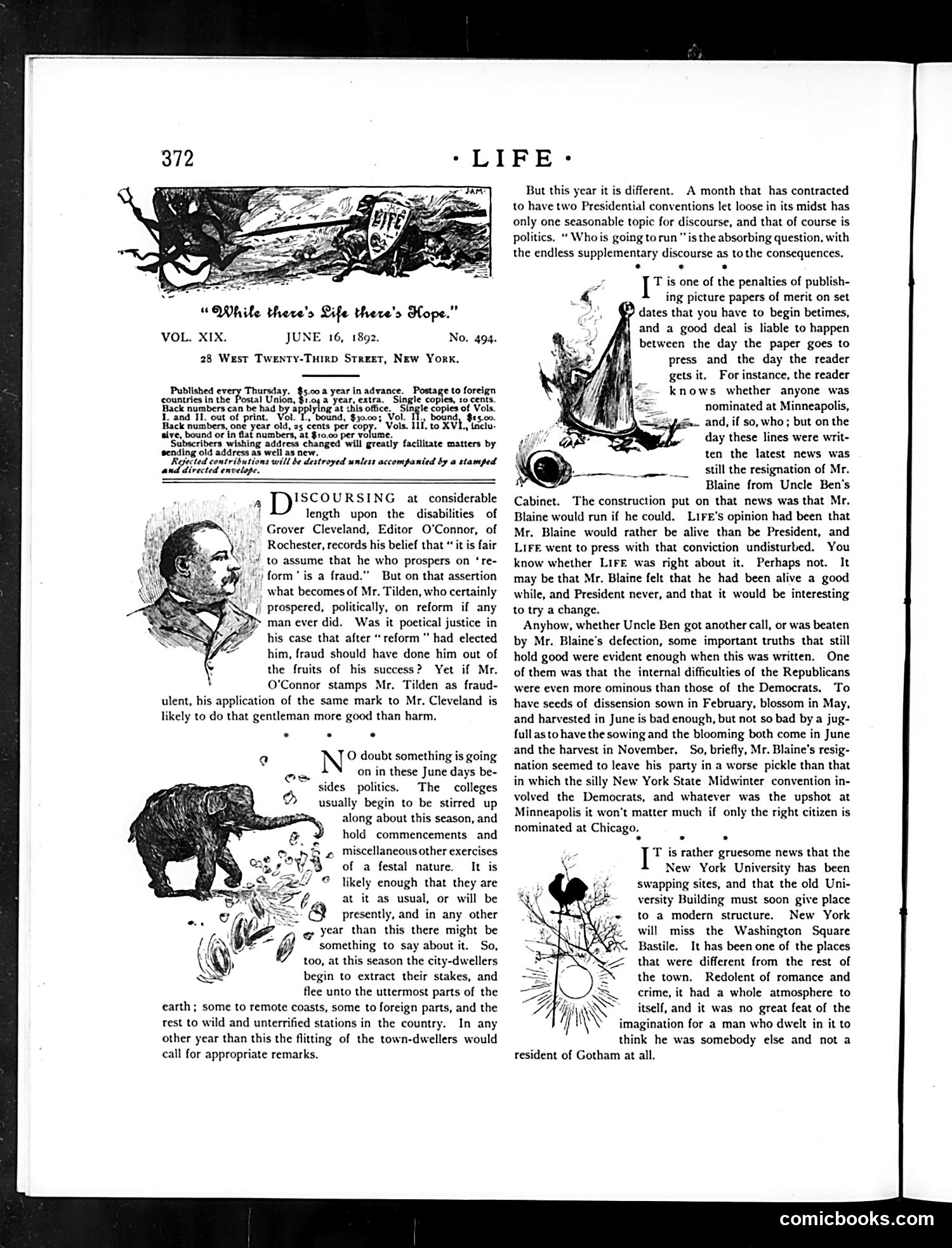
This page discusses the 1892 Presidential election season. The main political cartoon depicts **Grover Cleveland** (identifiable by context) and Editor O'Connor debating Cleveland's fitness for office. The satire critiques O'Connor's hypocrisy: he attacks Cleveland as unfit for "reform," yet applies the same fraudulent tactics to Cleveland that Cleveland supposedly used to succeed. The cartoon suggests O'Connor's claims lack principle. The text also references internal Republican Party turmoil leading into their convention, contrasting their worse divisions with Democratic troubles. Additionally, a brief item notes **New York University's relocation** from Washington Square, lamenting the loss of the area's historic character and romance.
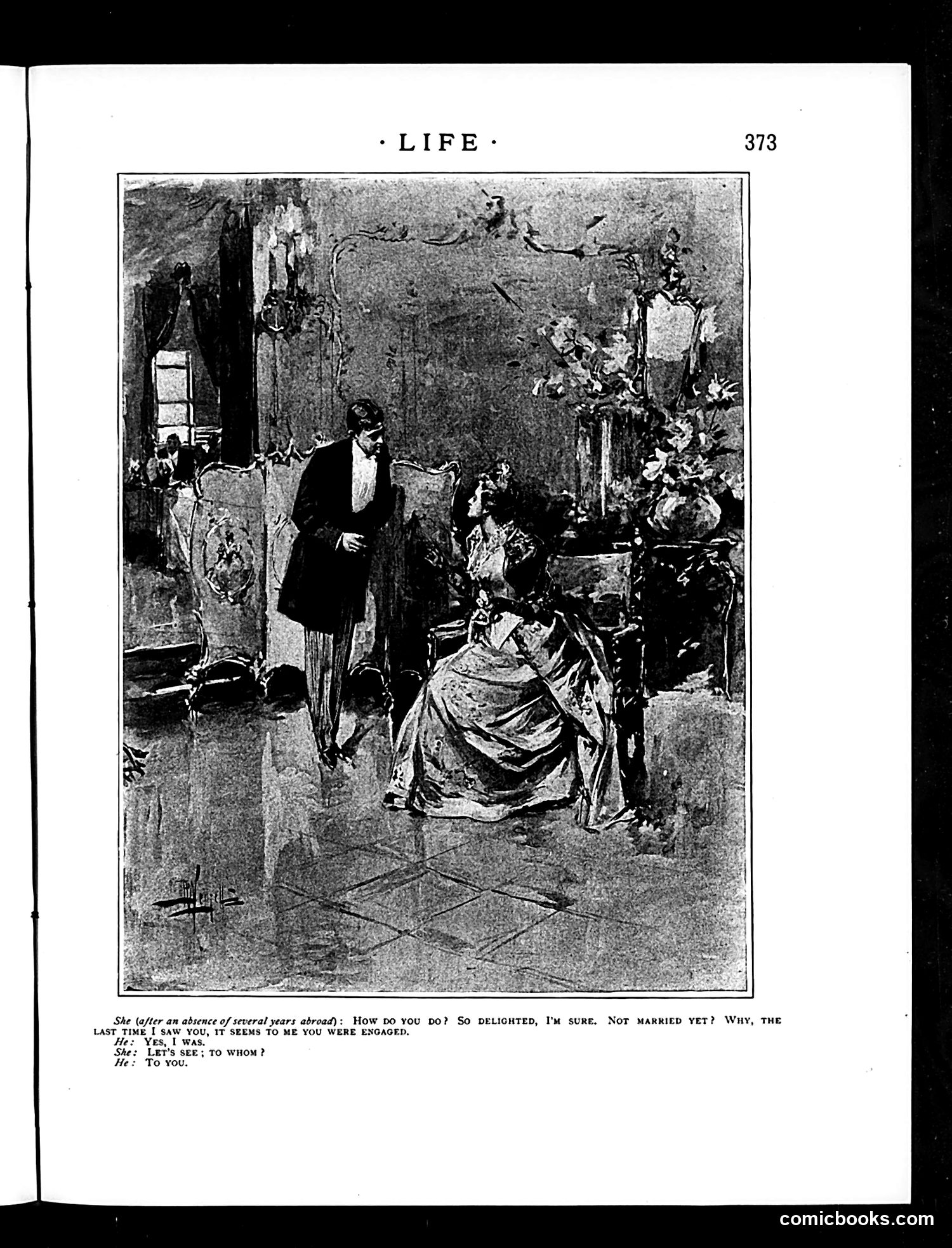
This illustration depicts a social encounter between a well-dressed man and a seated woman in an elegant interior. The dialogue reveals the situation: they haven't seen each other in years, and she mentions being engaged. The man then asks to whom she's engaged, and she replies "to you." The humor lies in a romantic misunderstanding or forgotten commitment. The joke suggests the man had proposed marriage to this woman years earlier but apparently forgot about it entirely. Her casual revelation that their old engagement still stands—implying she's been waiting or holding him to his word—creates an awkward, comedic moment. This reflects early 20th-century social satire about courtship, marriage promises, and the consequences of male forgetfulness in romantic matters.
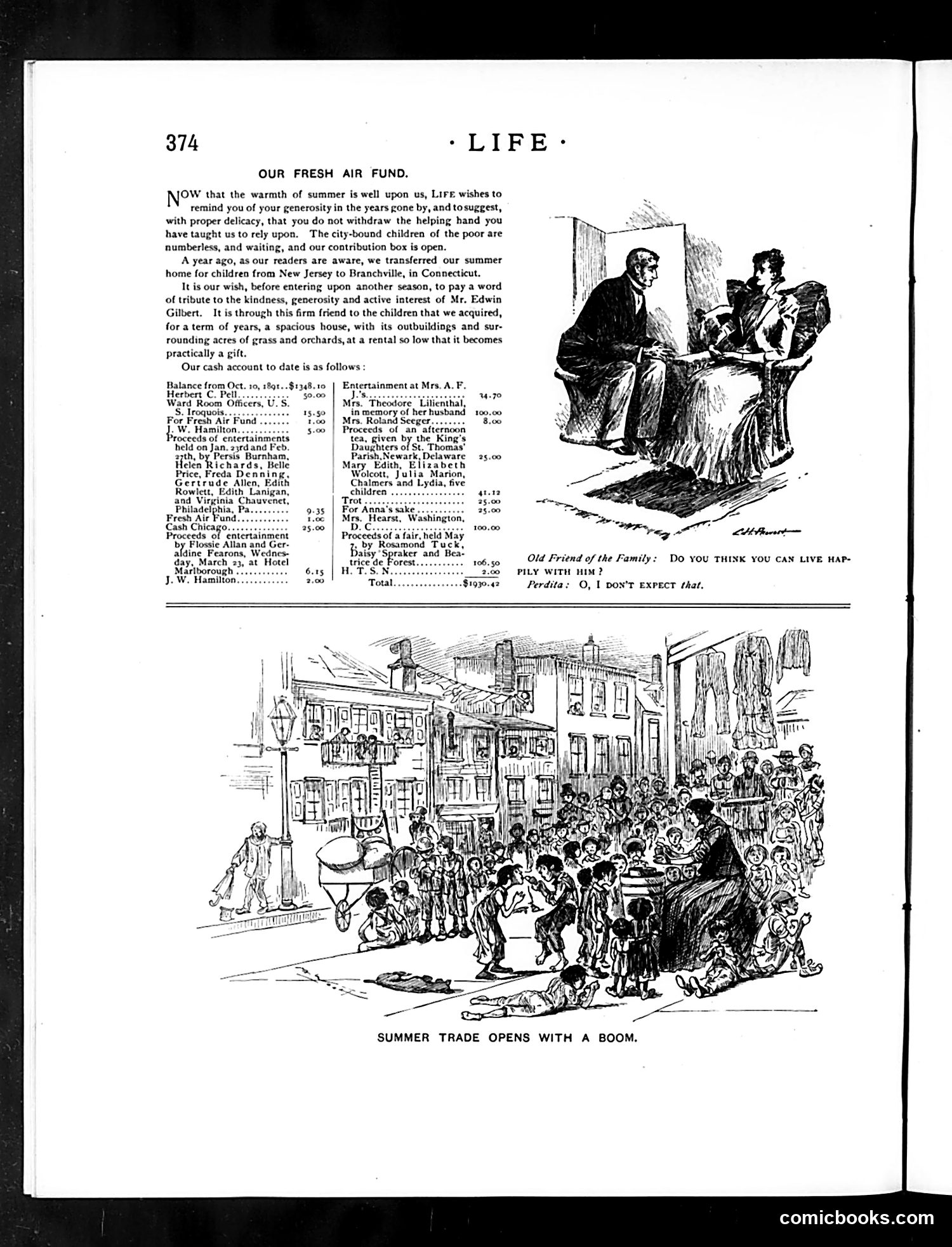
This page announces a "Fresh Air Fund" charitable initiative supporting poor urban children. The top illustration shows two well-dressed figures (likely Life magazine editors or wealthy donors) discussing their philanthropy—a common satirical subject in Life magazine. The caption "Old Friend of the Family: Do you think you can live happily with him?" and the response "O, I don't expect that" suggests gentle mockery of how wealthy benefactors view charity work: as obligatory rather than genuinely fulfilling. The lower illustration depicts "Summer Trade Opens with a Boom," showing crowded city streets—contrasting the urban poverty the fund aims to address with the commercial bustle surrounding it. The satire critiques how summer charitable programs operate amid indifferent commercial activity, rather than addressing systemic urban poverty.
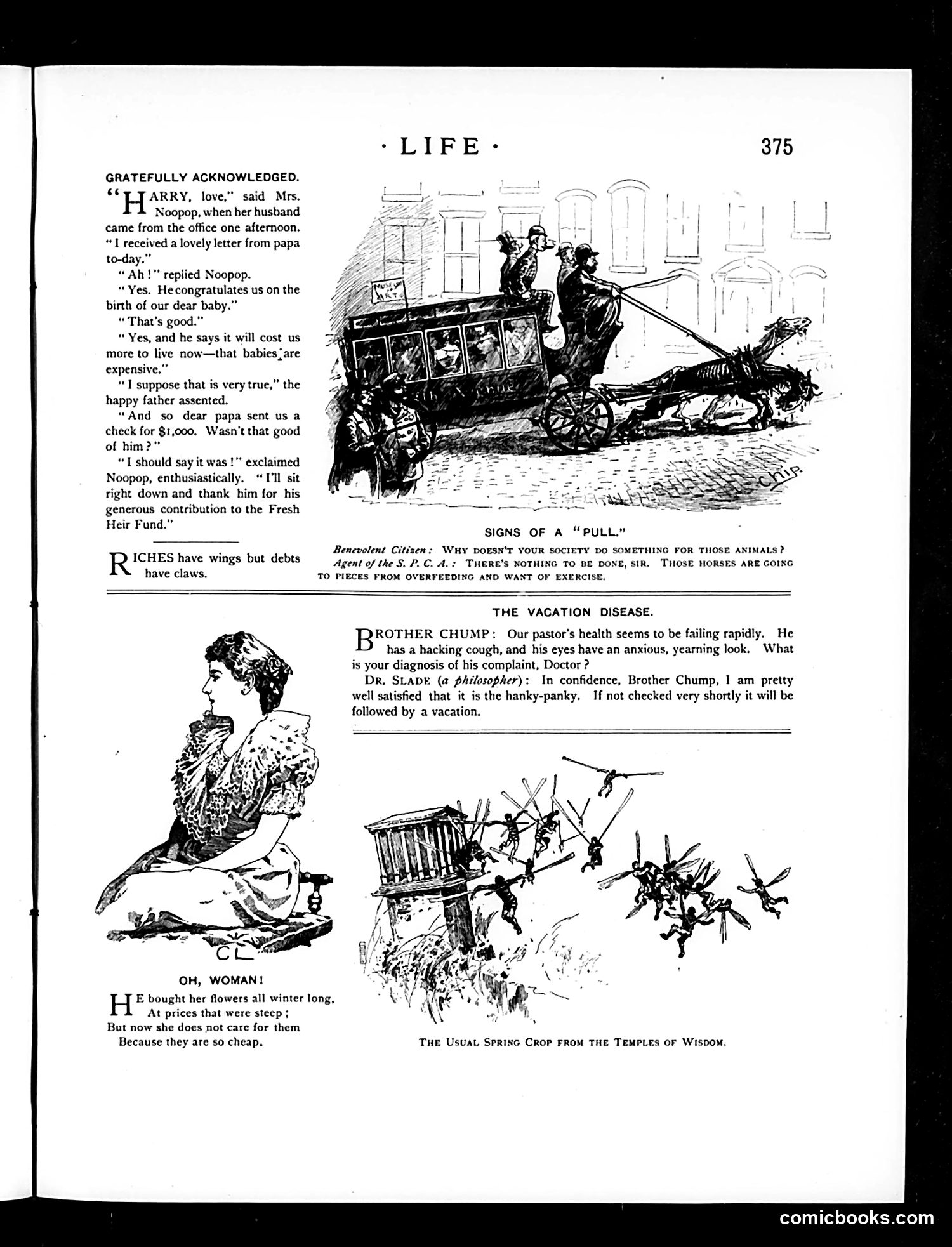
**Top Section - "Gratefully Acknowledged":** This depicts a humorous domestic scene where Mr. Noopop receives congratulations on his newborn. A father jokes that a $1,000 gift check is generous, noting babies are expensive. Noopop replies he'll "sit right down and thank him for his generous contribution to the Fresh Heir Fund"—a pun on "Fresh Air Fund," a real charity helping poor children. **Middle Section - "Signs of a Pull":** A cartoon criticizes animal welfare, showing overworked horses pulling an overloaded omnibus. The S.P.C.A. (Society for Prevention of Cruelty to Animals) agent argues these horses need rest and exercise, not more labor. **Bottom Section - "The Vacation Disease":** A humorous medical exchange: Brother Chump's pastor appears ill; Dr. Slade diagnoses "hanky-panky" requiring vacation as cure—satirizing the era's belief that rest cures solved various ailments.
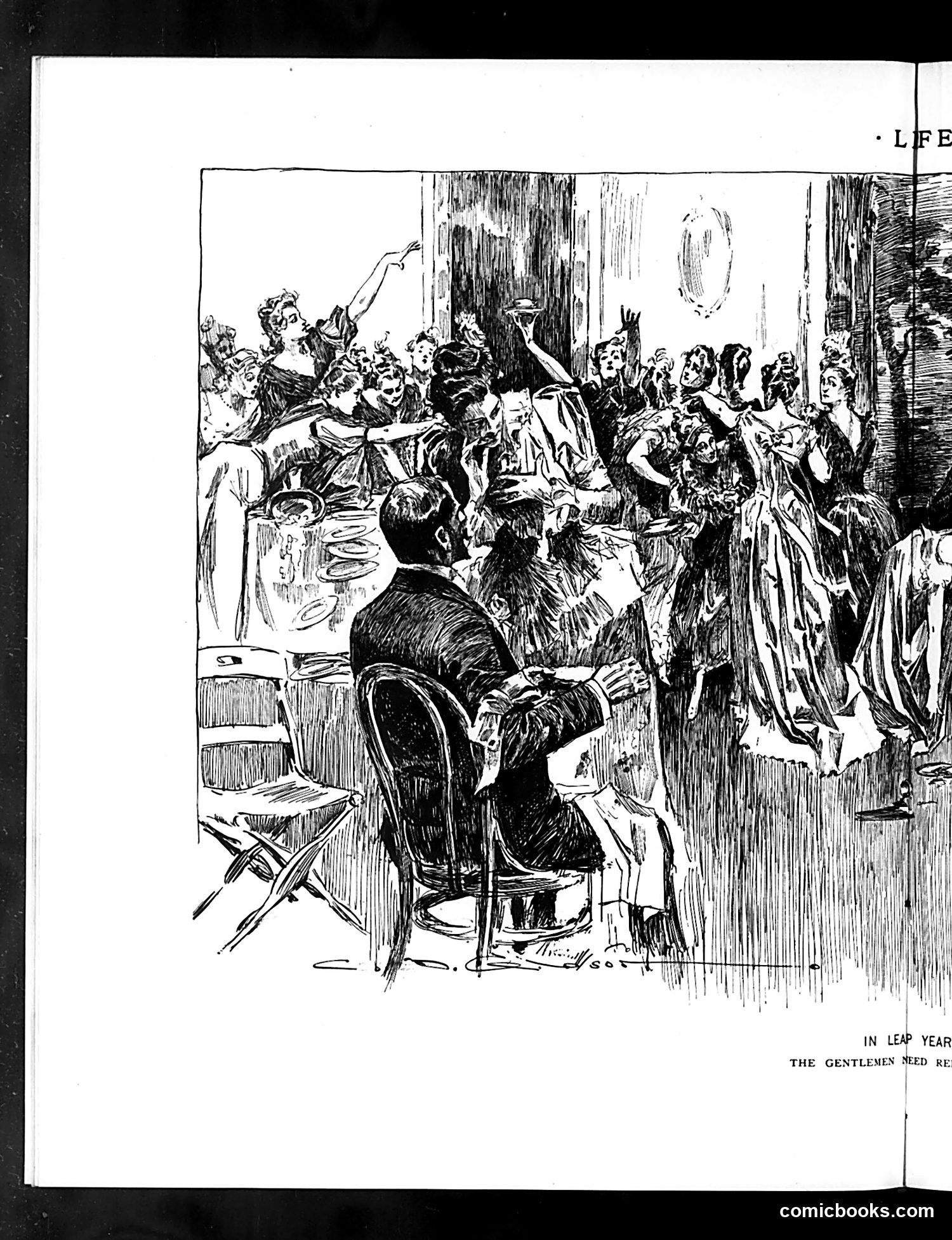
This is a satirical illustration depicting a social gathering or party scene. The visible text fragment at bottom reads "IN LEAP YEAR / THE GENTLEMEN NEED RE-" (text cuts off), which references leap year traditions—specifically the custom that in leap years, women were permitted to propose marriage to men rather than the reverse. The cartoon shows a man seated and surrounded by women in elaborate period dress, appearing to be besieged or overwhelmed by their attention and advances. The artistic style and clothing suggest this is from the early 20th century. The satire mocks the reversal of traditional courtship roles during leap year, portraying the man as defensive or uncomfortable with female initiative in romance. It's humor based on contemporary gender norms and anxieties about women taking active roles in courtship.
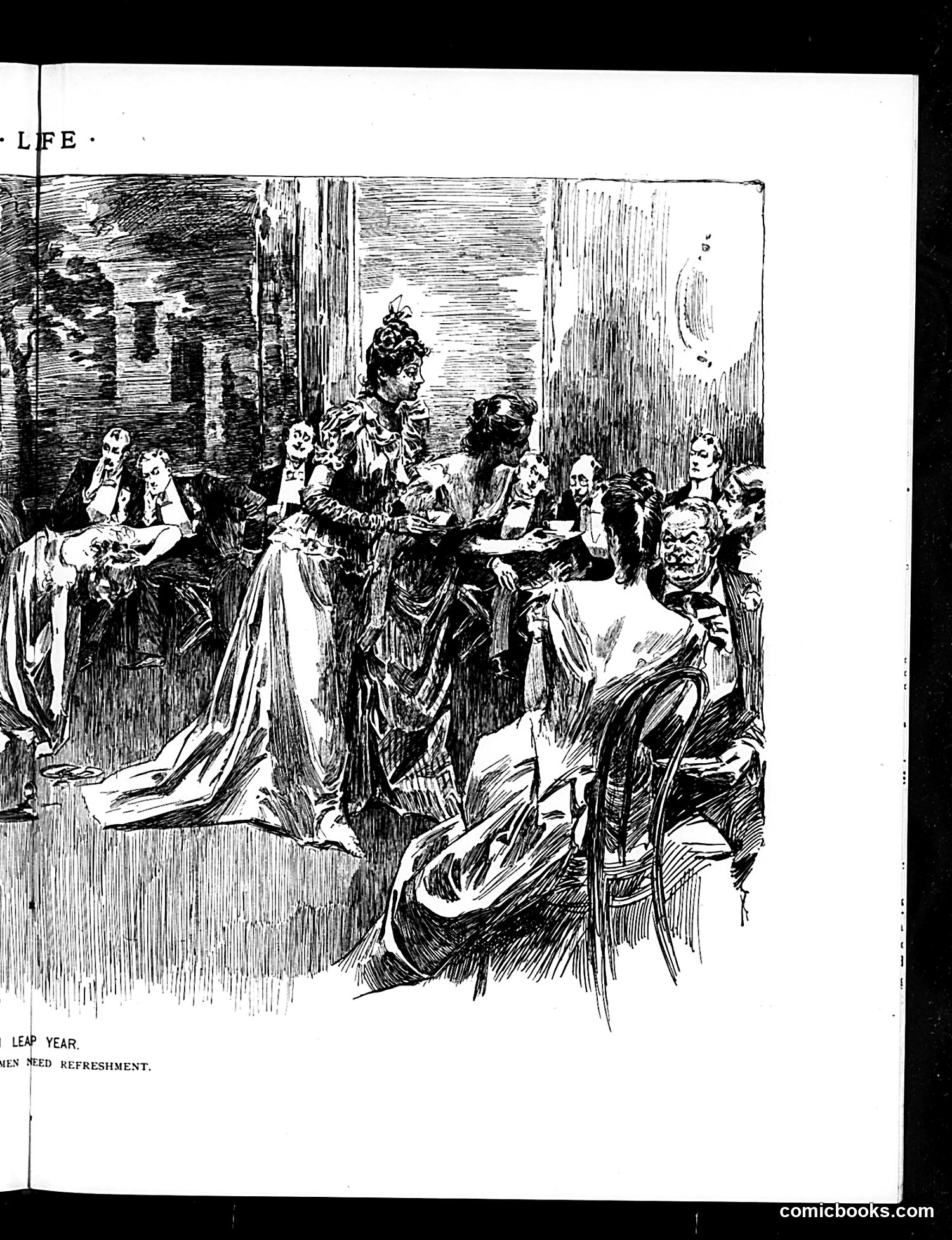
This page from *Life* magazine shows an elaborate social gathering with well-dressed figures in formal 19th-century attire. The partially visible caption at bottom reads "LEAP YEAR" and "...MEN NEED REFRESHMENT." The satire appears to reference **Leap Year traditions**, specifically the social convention that allowed women to propose to men during leap years (occurring every four years). The scene depicts an elegant parlor gathering where women appear to be hosting or pursuing male guests. The joke likely mocks this gender-role reversal—showing women in the active social position while men appear passive or overwhelmed, suggesting that men "need refreshment" (recovery) from the unusual experience of female assertiveness in courtship. This satirizes both the artificiality of strict Victorian gender roles and anxieties about women's social agency.
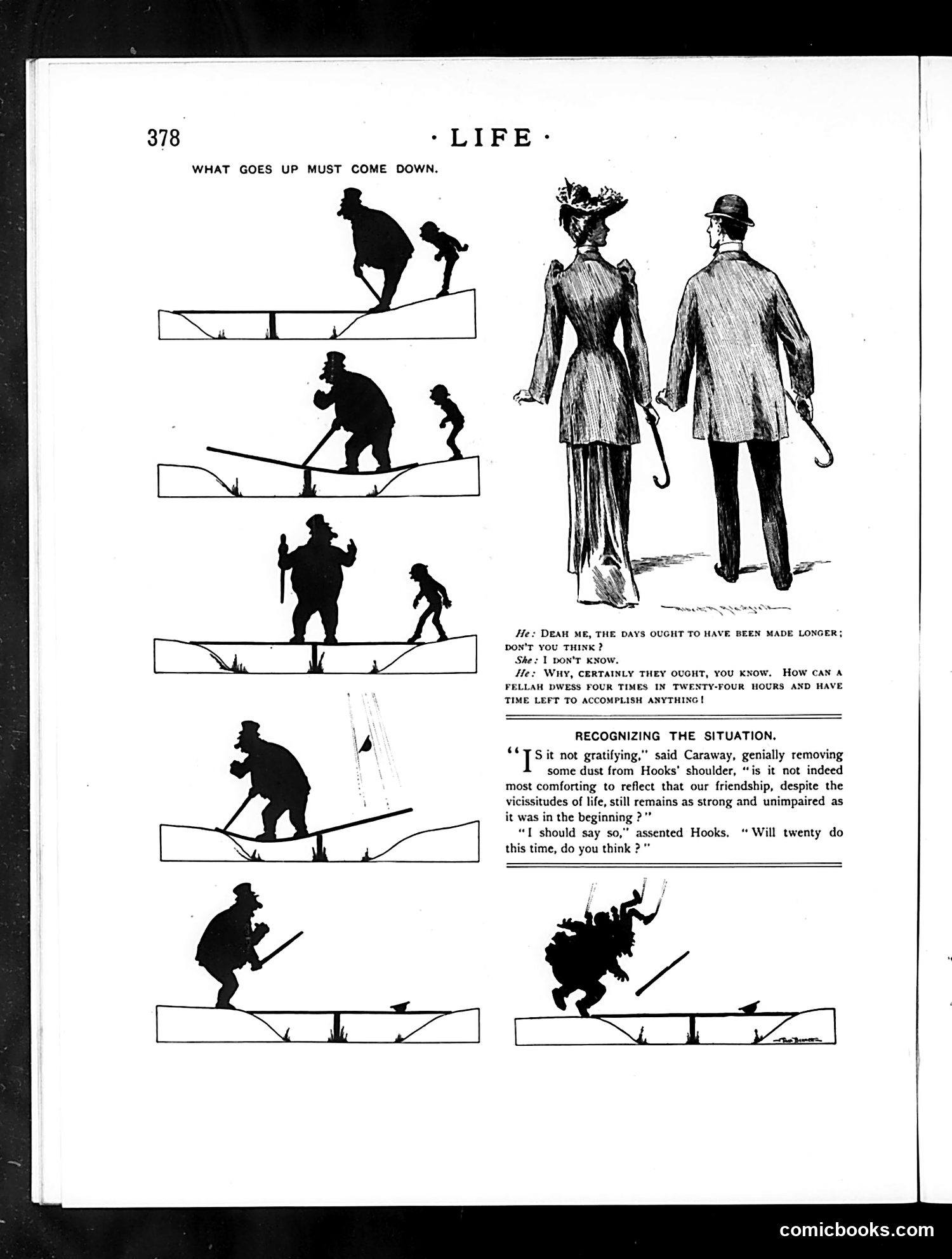
This page from *Life* magazine contains a sequential cartoon showing two figures on increasingly unstable seesaws, illustrating the proverb that what rises must fall. The left panel depicts the physical principle through silhouettes of adults and children on tilting planks. The right panel shows a well-dressed couple with umbrellas, with dialogue suggesting frustration about time constraints—a man complains that days should be longer to accomplish tasks in a 24-hour period. The section "Recognizing the Situation" presents a brief dialogue between characters named Caraway and Hooks, discussing enduring friendship despite life's difficulties. The final panels show the seesaw principle escalating to comic extremes, with figures being violently catapulted upward as the plank tips. The satire appears to mock human complaints about temporal limitations and the inevitable consequences of unstable circumstances.
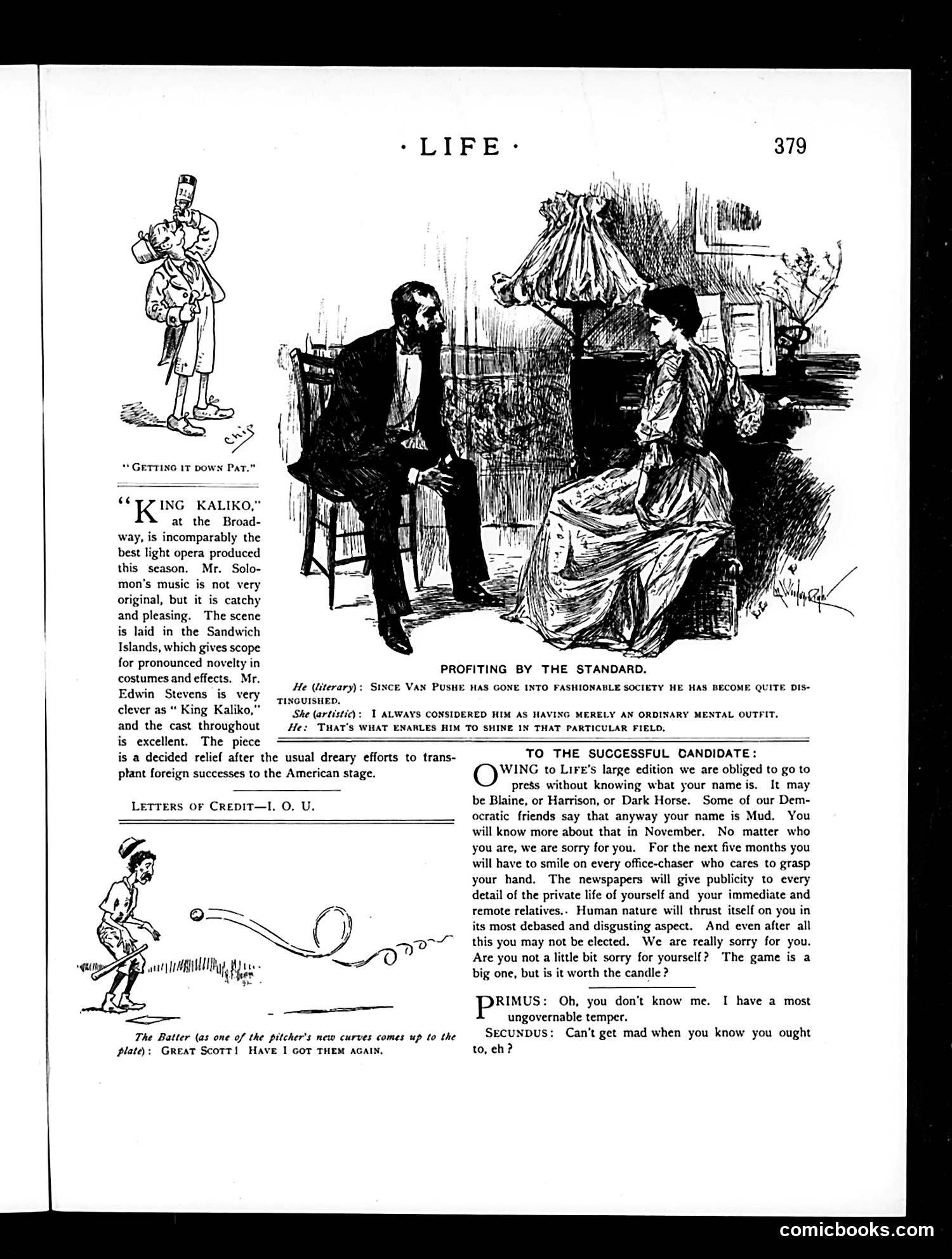
This page contains theater reviews and satirical commentary typical of Life's entertainment coverage. **Top section:** Reviews "King Kaliko," a light opera by Mr. Solomon. The cartoon depicts a scene from the Sandwich Islands setting, praising the production as a relief from "dreary efforts to transplant foreign successes to the American stage." **Bottom cartoon:** A baseball illustration captioned "The Batter (as one of the pitcher's new curves comes up to the plate): GREAT SCOTT! HAVE I GOT THEM AGAIN." This is a visual pun about pitcher's curves, suggesting the batter's vulnerability to deceptive pitching. **Right section:** "To the Successful Candidate" humorously addresses an unnamed political candidate, warning that newspapers will expose private details about him and his family during campaigning—satirizing the invasive nature of electoral politics and media scrutiny.
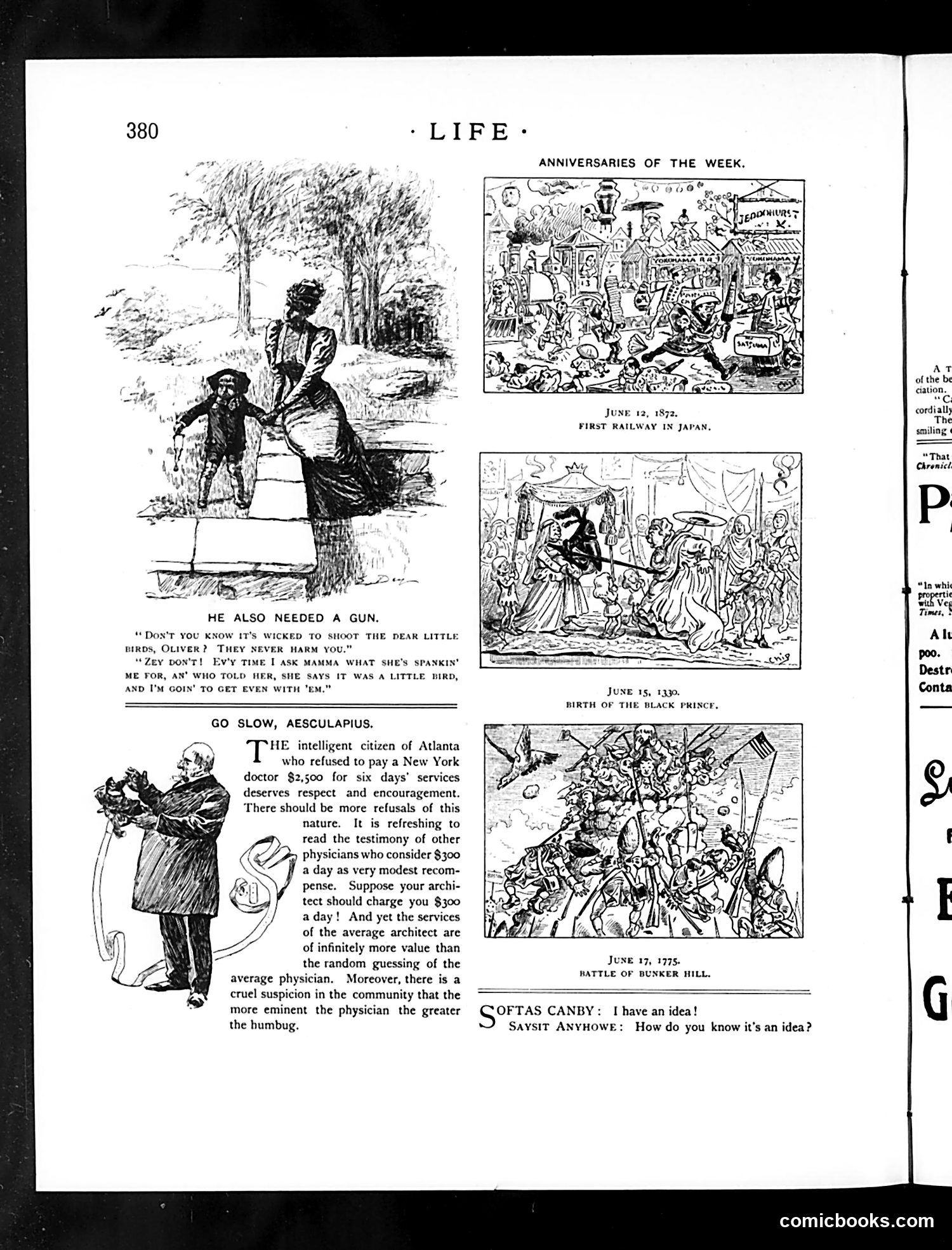
This page contains several distinct items: **"He Also Needed a Gun"** (top left): A domestic humor comic where a child named Oliver justifies shooting birds by saying his mother told him a "little bird" caused her to spank him, so he wants "revenge." It's sentimental Victorian humor about childhood mischief. **Anniversaries section** (right): Historical illustrations marking June dates—Japan's first railway (1872), Birth of the Black Prince (1330), and Battle of Bunker Hill (1775). **"Go Slow, Aesculapius"** (bottom left): Social satire mocking physicians' inflated fees. An Atlanta man refused to pay a New York doctor $2,500 for six days' work. The piece sarcastically argues architects provide more value yet charge less ($300/day), and suggests physicians are essentially charlatans ("guessing") despite their eminence. **Bottom dialogue**: A brief joke about distinguishing ideas from mere thoughts. The medical fee critique reflects Gilded Age frustration with professional pricing practices.
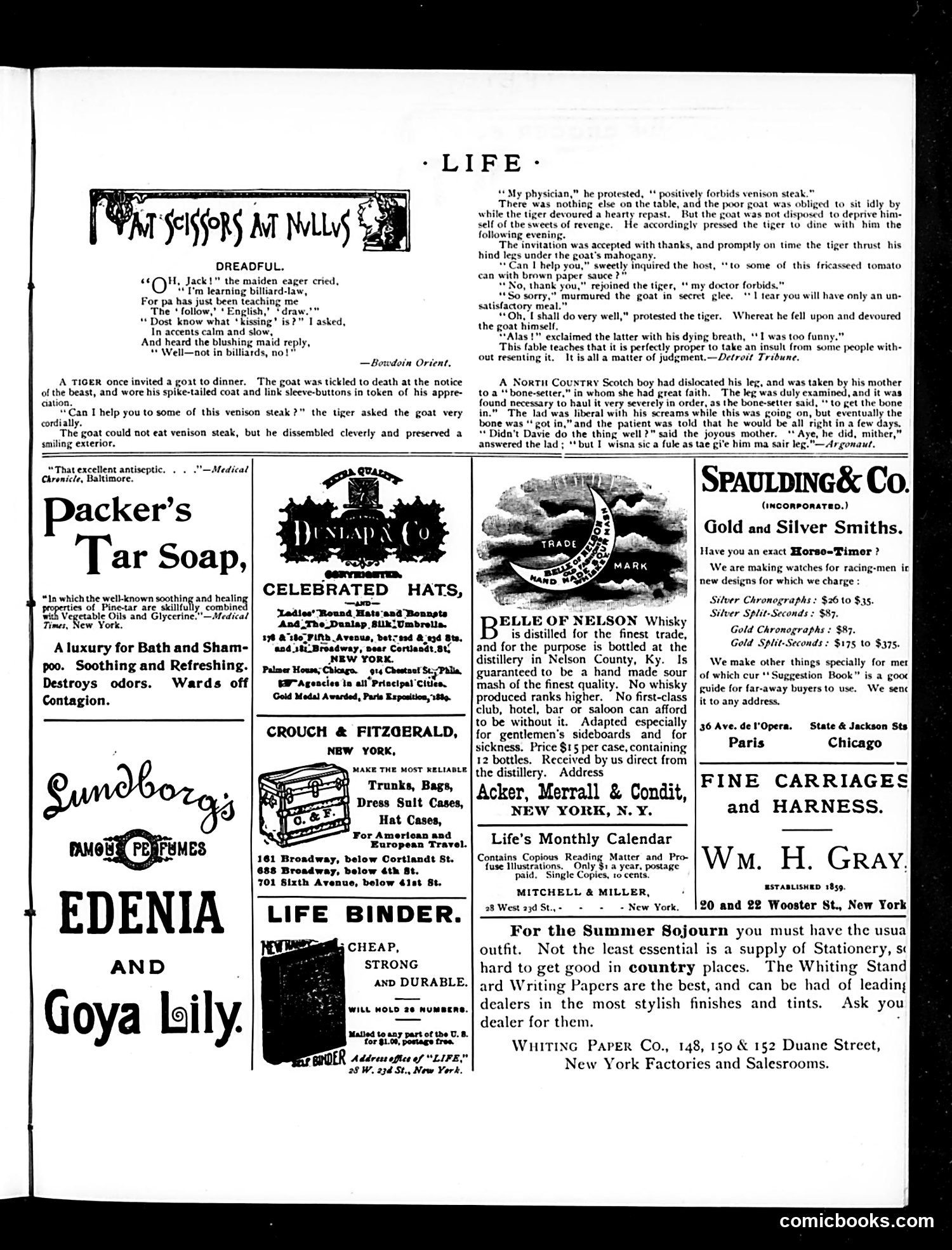
This page combines three humorous short stories with period advertisements. The satirical content includes: **"Dreadful"** (top left): A billiards-themed flirtation where a young woman, learning billiards terminology, misunderstands "kissing" as a billiards term rather than romantic intent—a mild Victorian-era joke about female innocence. **The Tiger and Goat Fable** (center): A moral tale about revenge and politeness. When a goat cannot eat venison at a tiger's dinner, it later invites the tiger for a meal with inedible "fricasseed tomato." The tiger eats the goat anyway. The "moral" cynically suggests accepting insults from powerful people is merely "a matter of judgment"—satire on class hierarchies and powerlessness. **Scottish Bone-Setter Story** (right): Humorous regional dialect humor about a boy's stoicism during a painful medical procedure. The remaining content is **advertising** for soaps, hats, trunks, whisky, and paper products—typical of Life's revenue model. No identifiable political figures or contemporary events appear on this page.
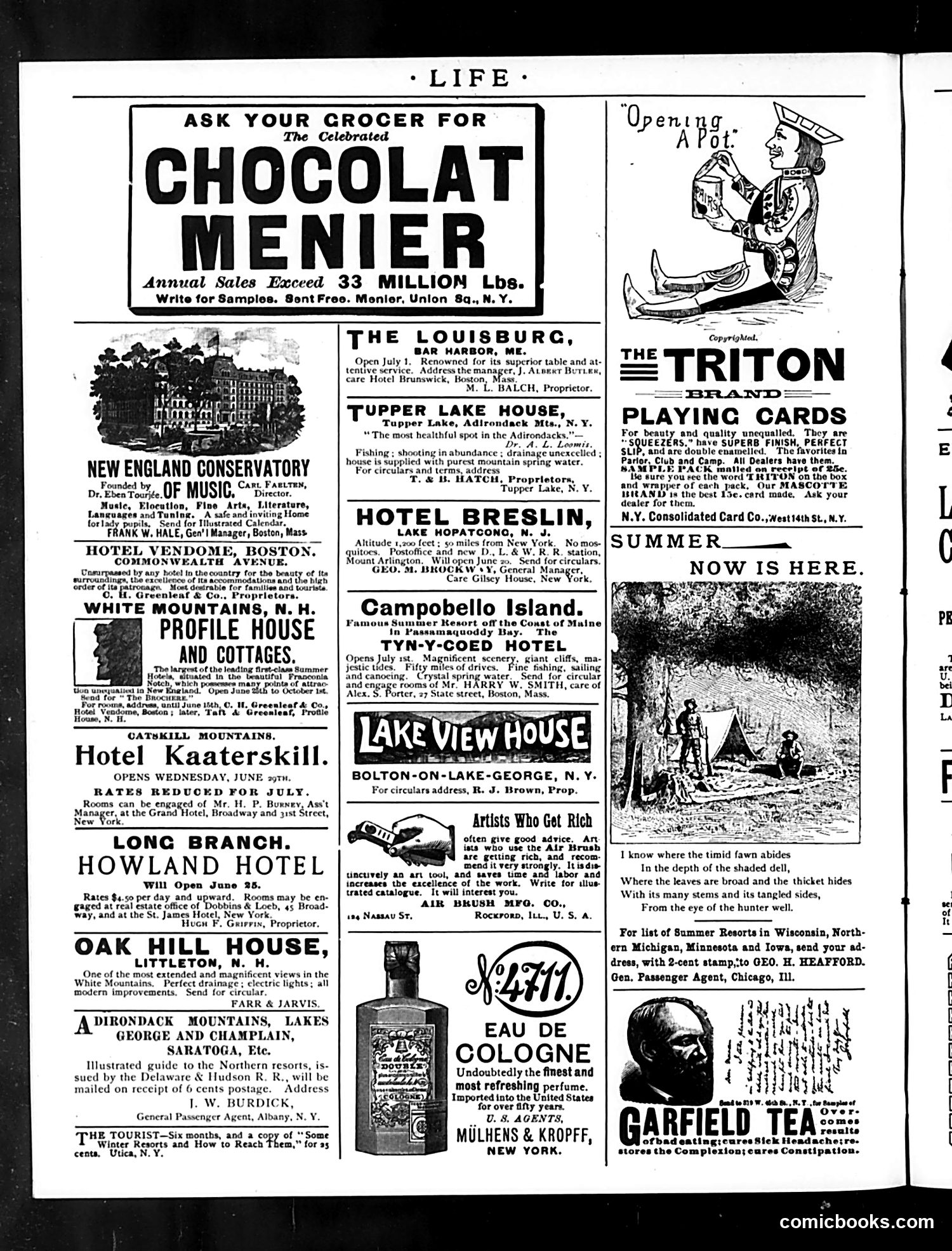
This page is **primarily advertising** for American summer resorts and consumer products, typical of late 19th-century Life magazine. The small cartoon in the upper right ("Opening, Apol.") appears to be a satirical sketch of an opening day ceremony—likely poking fun at some contemporary event or social pretension, though the specific reference is unclear without additional context. The bulk of the page features hotel and resort advertisements (Catskill Mountains, Adirondacks, Bar Harbor, etc.), reflecting the era's flourishing leisure industry for wealthy Americans. Notable product ads include Chocolat Menier (chocolate), Air Brush art tools, and Garfield Tea (marketed as a constipation remedy—a common advertorial concern of the period). A poem titled "Summer. Now is Here" appears with a pastoral illustration of camping. The page lacks overt political satire; instead, it represents Life's primary function as a vehicle for advertising to affluent readers while entertaining them with light humor and social commentary.
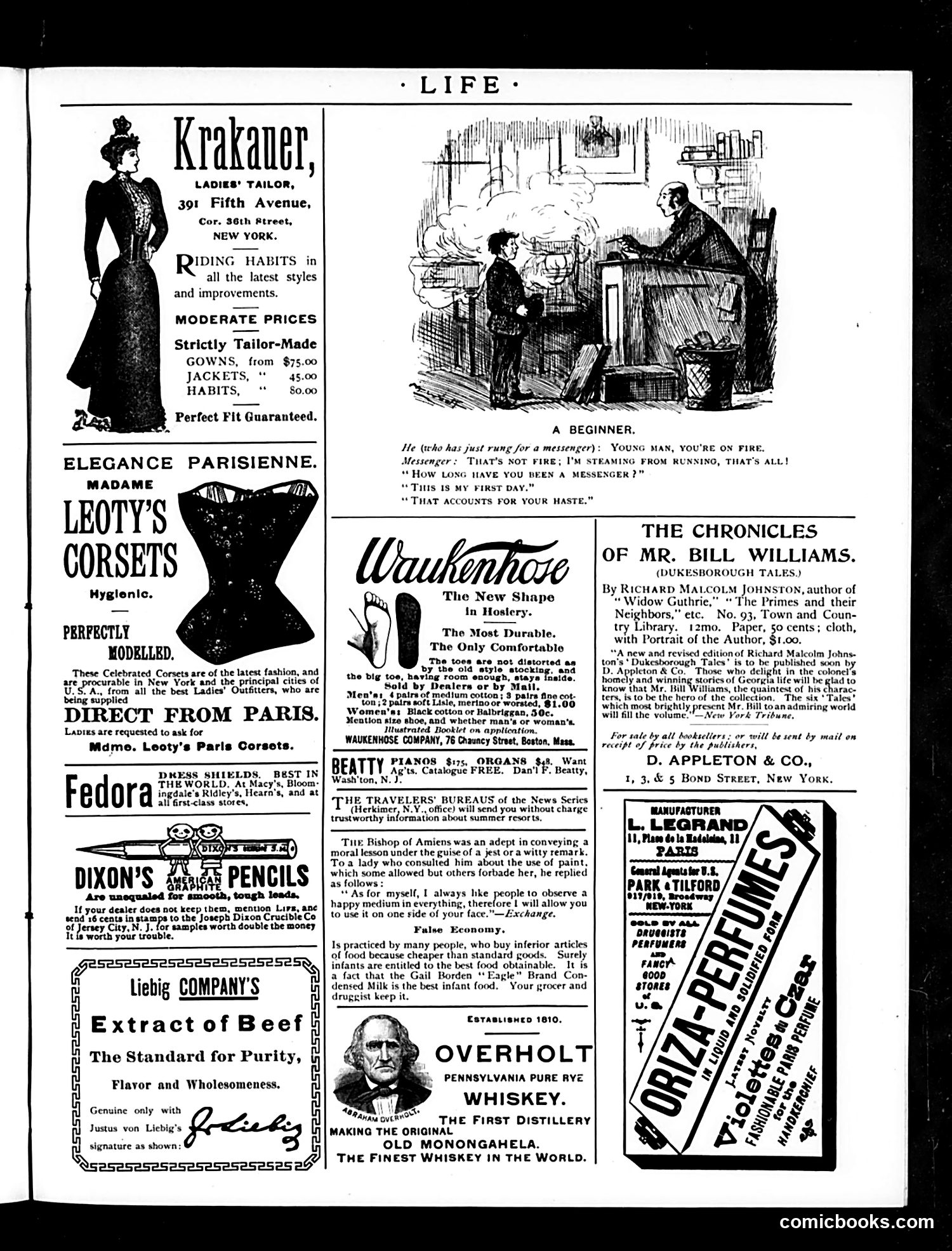
This page consists primarily of **advertisements and brief humor** rather than political cartoons. The main cartoon is titled "A Beginner," depicting a comedic workplace misunderstanding: a young messenger, flushed and breathless from rushing on his first day, assures his employer he's "not on fire"—he's just hot from running. The employer assumes the boy is literally on fire due to his haste and appearance. The joke satirizes the inexperience and overeagerness of new workers trying to impress on their first day, contrasting the messenger's misplaced urgency with the employer's bemused skepticism. The page is otherwise filled with period advertisements for ladies' tailoring, corsets, pianos, whiskey, and food products—typical of early 20th-century Life magazine's revenue model. A brief anecdote about the Bishop of Amiens using humor to teach moral lessons about moderation completes the content.
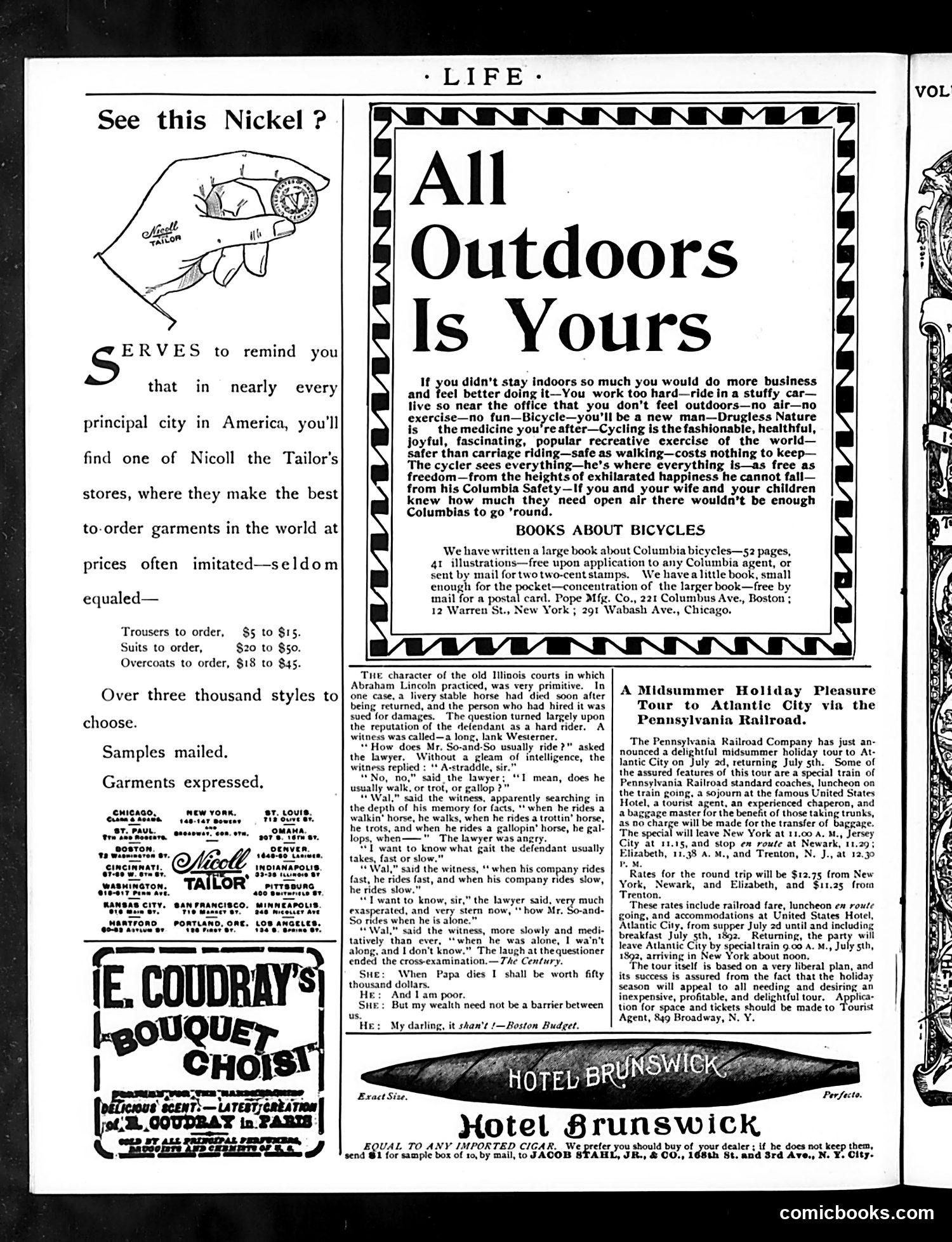
This page is primarily **advertising with minimal editorial content**. The main elements are: **Advertisements:** - **Nicoll the Tailor**: Promotes custom-made suits and trousers at various price points, emphasizing quality at competitive rates - **Columbia Bicycles**: A lengthy pitch arguing that cycling provides health benefits and outdoor recreation—targeted at sedentary office workers ("You work too hard—ride in a stuffy car") - **E. Coudray's Bouquet Choise**: Perfume advertisement - **Hotel Brunswick**: Lodging advertisement - **Pennsylvania Railroad**: Summer holiday tour to Atlantic City **Humor Content:** A brief anecdotal joke about Abraham Lincoln-era Illinois courts features a dense witness describing a defendant's riding style in circular, unhelpful terms ("when he rides a walkin' horse, he walks"). The joke satirizes frontier simplicity and legal absurdity. Another joke involves a poor man and wealthy woman discussing marriage, with the woman assuring him her wealth "shan't" be a barrier. The page reflects turn-of-century commercial culture and the bicycle craze of that era.