
A complete issue · 14 pages · 1892
Life — June 2, 1892
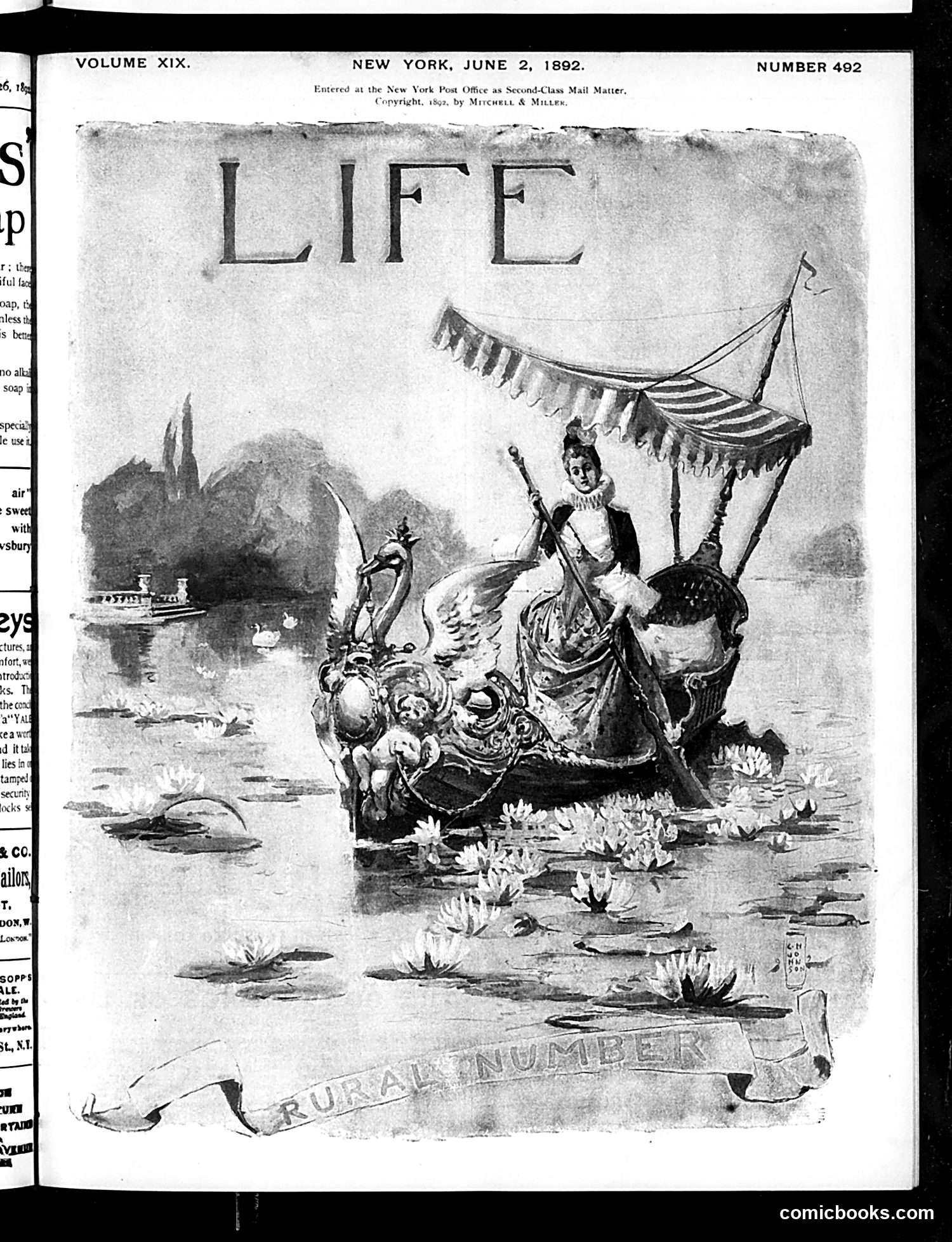
This is the cover illustration for Life's "Rural Number" issue. The image depicts an elaborate river barge or boat carrying elegantly dressed figures under an ornate canopy, moving through a marshland filled with water lilies. A steamboat appears in the background. The satire likely comments on **rural leisure and leisure culture** — contrasting the sophisticated, almost aristocratic river excursion with the humble rural landscape. The ornate, theatrical staging of the barge suggests mockery of how urban elites romanticized or performed "rural" experiences, treating nature as theater rather than actual working countryside. The "Rural Number" subtitle indicates this was a special themed issue, probably satirizing contemporary attitudes toward rural life and tourism during the Gilded Age.
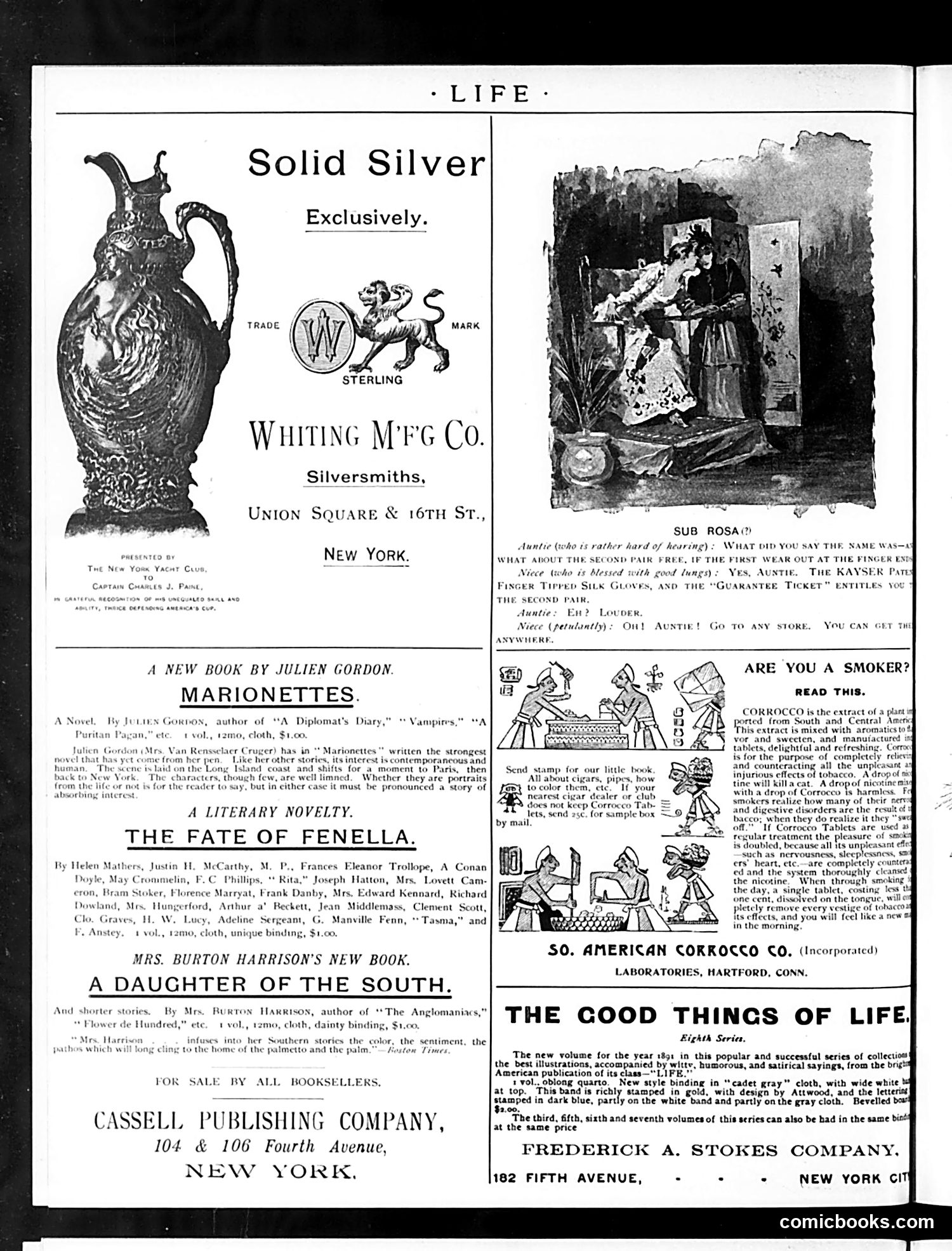
This page is primarily **advertising and literary announcements** rather than political satire. The left side features ads for Whiting Manufacturing Company's sterling silver goods and book announcements from Cassell Publishing Company. The right side contains a **"Sub Rosa" cartoon dialogue** about fashion—specifically women's accessories like gloves and "Garter Pins"—presented as gossip between women. Below that is an advertisement for Corrocco (a tobacco extract product) claiming health benefits, and a book announcement for "The Good Things of Life" from Frederick A. Stokes Company. There is **no clear political cartoon or satirical commentary** on this particular page. It reflects turn-of-the-century consumer culture and period humor about women's fashion and social conventions.
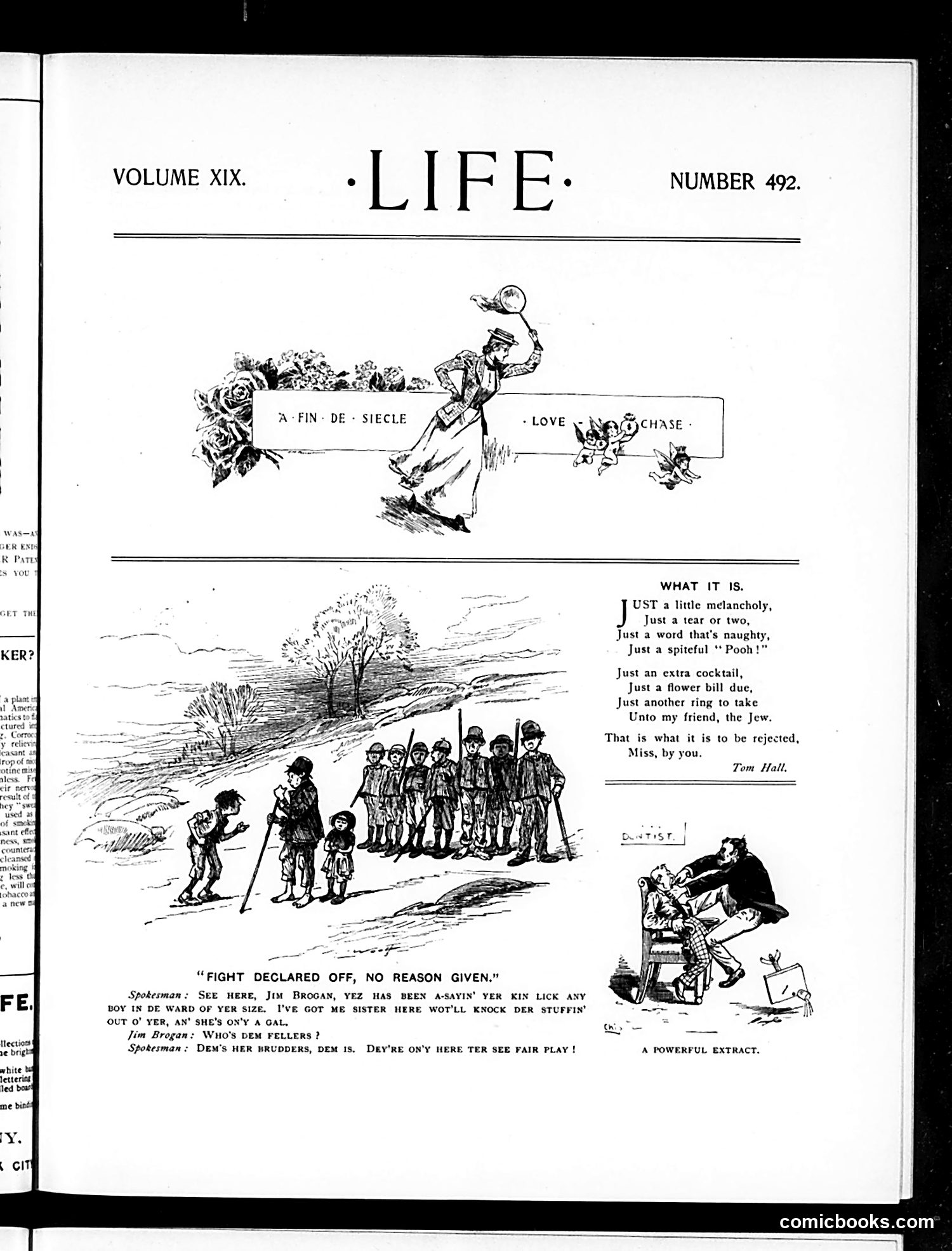
This page from *Life* magazine (Volume XIX, Number 492) contains satirical cartoons about rejection in romance and social situations. The top illustration shows a figure chasing love while holding a banner reading "A FIN DE SIECLE LOVE CHASE," depicting romantic pursuit as a fin-de-siècle (end-of-century) social game. The main cartoon, titled "FIGHT DECLARED OFF, NO REASON GIVEN," depicts a street scene with working-class figures (appears to reference immigrant or tenement communities based on the dialect dialogue). The caption includes Irish-accented speech ("yez," "kin lick any boy"), suggesting ethnic stereotyping common to early 20th-century American humor. The poem "WHAT IT IS" by Tom Hall on the right philosophically muses on rejection in romance—"Just a tear or two, / Just a word that's naughty"—concluding that rejection itself defines romantic love. The bottom right cartoon, "A POWERFUL EXTRACT," shows physical comedy involving romantic rejection.
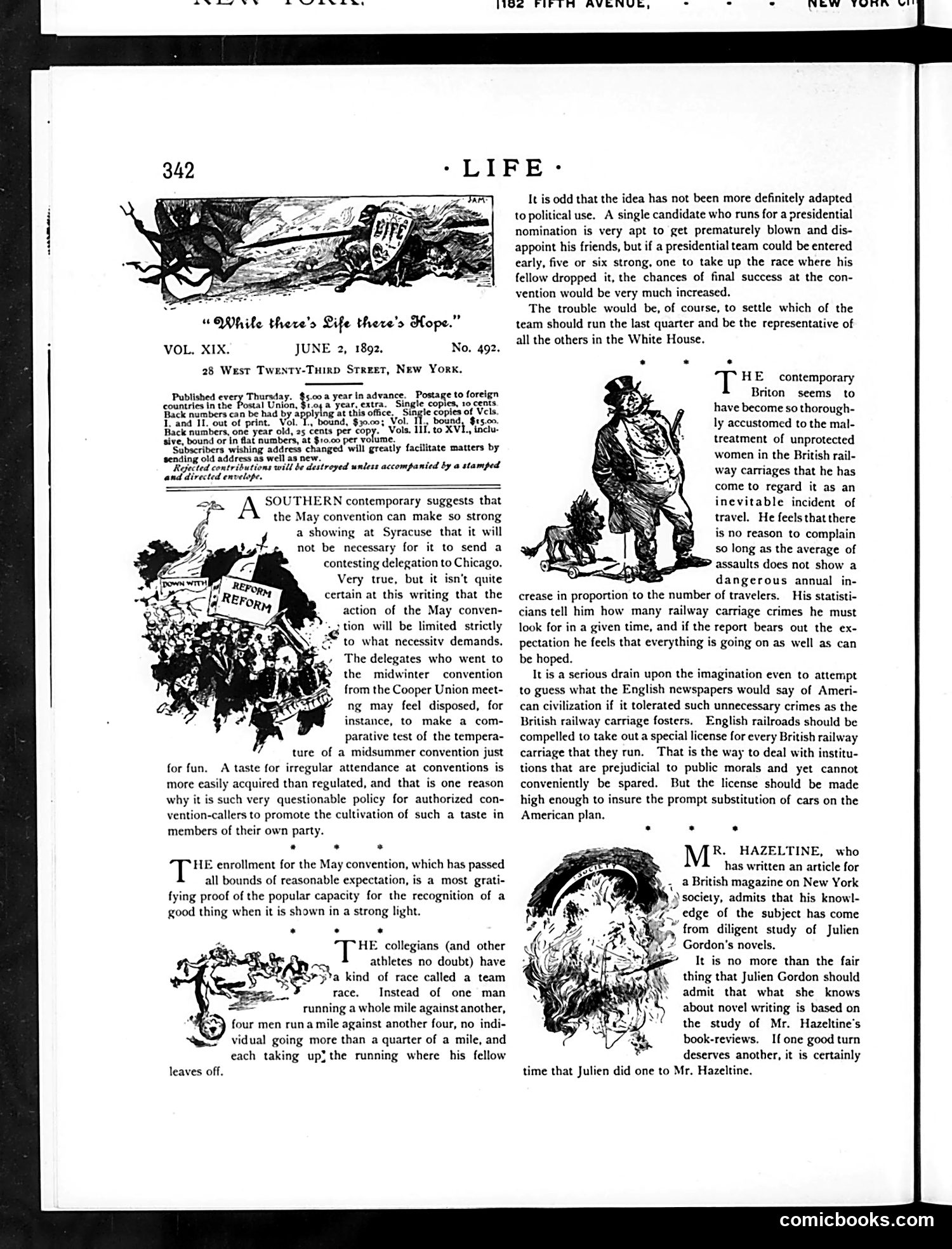
The page contains two editorial cartoons addressing contemporary political conventions. **Left cartoon**: Depicts the "Southern convention" regarding the May convention in Syracuse. It shows delegates marked "SOUTH" and "REFORM" in apparent conflict, satirizing tensions over whether the May convention would limit its actions to necessary demands or expand beyond them. **Right cartoon**: Features a caricatured figure (labeled "MR. HAZELTINE") discussing British railway customs. The text criticizes how British railways treat unprotected women passengers as an "inevitable incident of travel," arguing that American standards should not tolerate such assault. The cartoon advocates licensing stricter regulations to prevent similar behavior in American railway cars. Both cartoons reflect 1892 concerns: Democratic party fracturing and women's safety in public spaces.
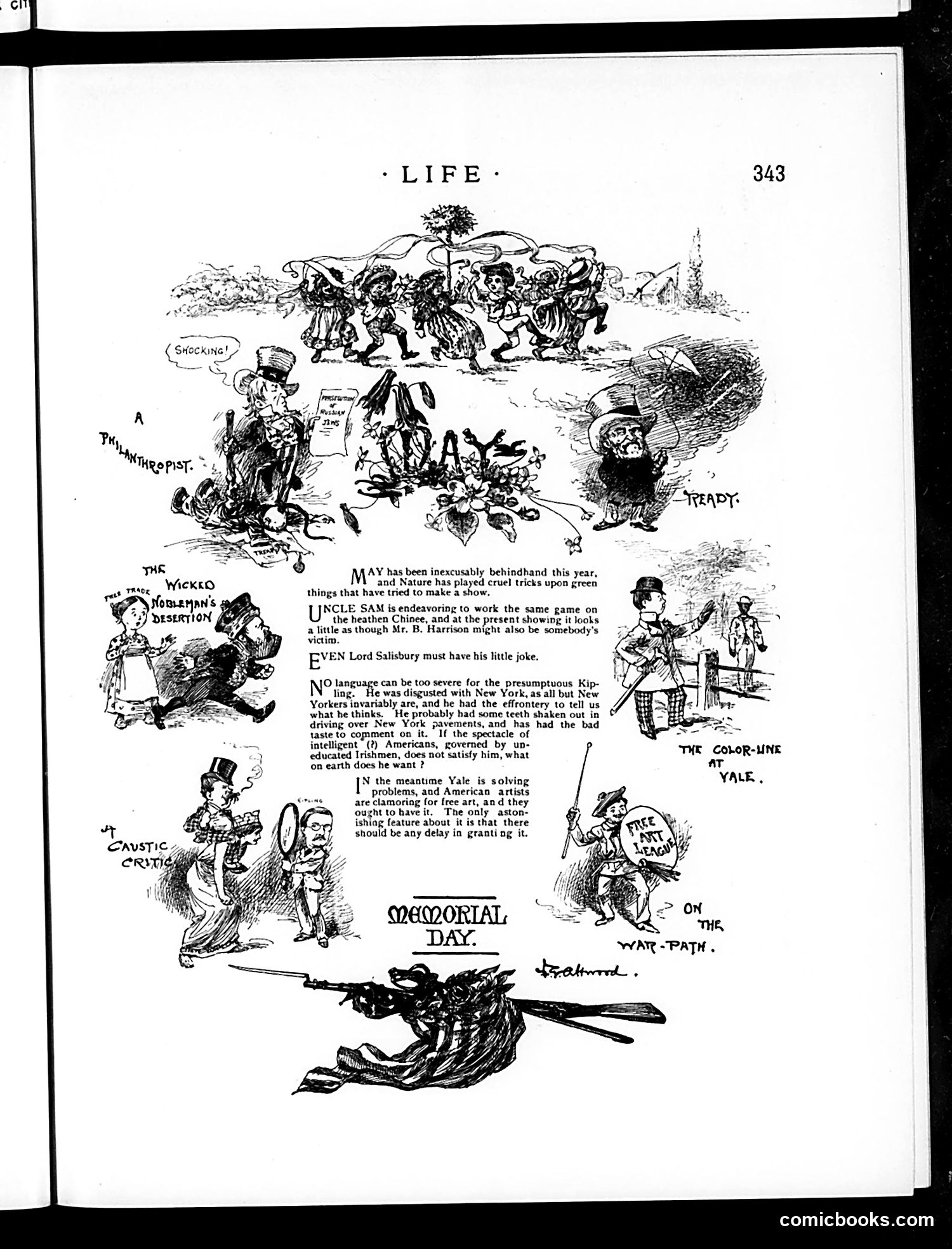
This satirical page critiques American cultural and political figures circa early 1900s. The cartoons mock: **"The Philanthropist"** - appears to criticize wealthy donors presenting themselves as charitable while engaging in questionable practices. **"The Wicked Monopolist's Description"** and **"A Caustic Critic"** - likely skewer business titans and their media critics. The main text discusses Lord Salisbury (British politician), Uncle Sam representing America, and references to "Kippling" (possibly Rudyard Kipling), Yale University, and American artists demanding free art support. **"Memorial Day"** section satirizes how the holiday is observed, with illustrations suggesting hypocrisy or superficial commemoration. The cartoons employ exaggerated facial features and physical caricatures typical of early-1900s editorial satire, targeting wealth inequality, monopolies, and nationalist pretensions.
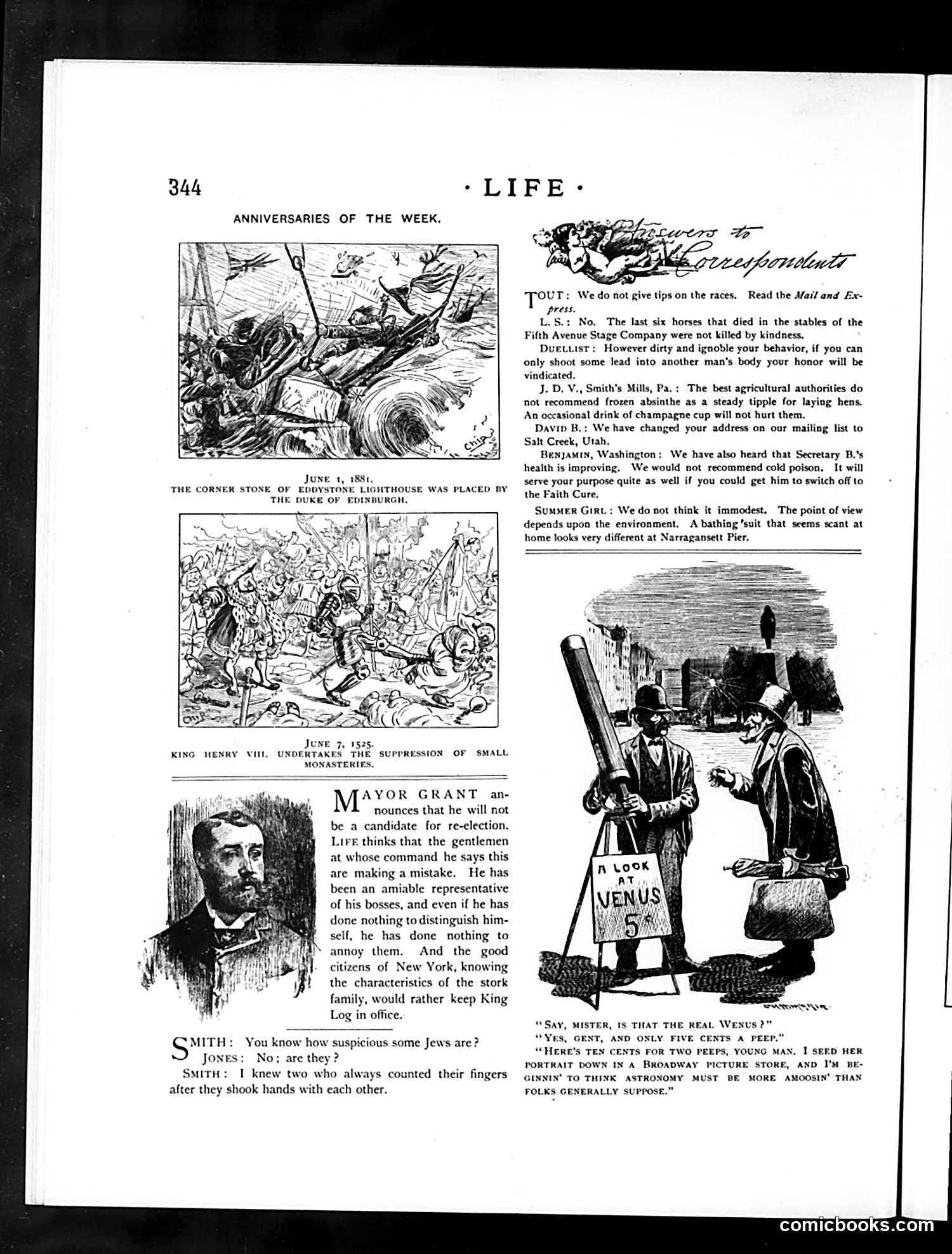
**The Main Cartoon (bottom right):** This depicts a street vendor selling portraits labeled "A Look at Venus" for five cents. The joke plays on the double meaning: the vendor is actually selling pictures of an attractive woman (Venus as goddess of beauty), but customers might expect an astronomical image of the planet Venus. The caption's punchline suggests the vendor's "portrait" is more amusing than actual astronomy. **The Historical Vignettes (top and middle left):** These commemorate anniversary dates: the 1858 Eddystone Lighthouse cornerstone and King Henry VIII's 1525 suppression of monasteries. **The Editorial Section (right side):** Contains a brief item about Mayor Grant declining re-election, with LIFE's commentary suggesting his leadership hasn't been particularly notable or objectionable. **The Offensive Dialogue (bottom left):** A stereotypical joke about Jewish people and finger-counting—representative of period anti-Semitic content common in early 20th-century American publications.
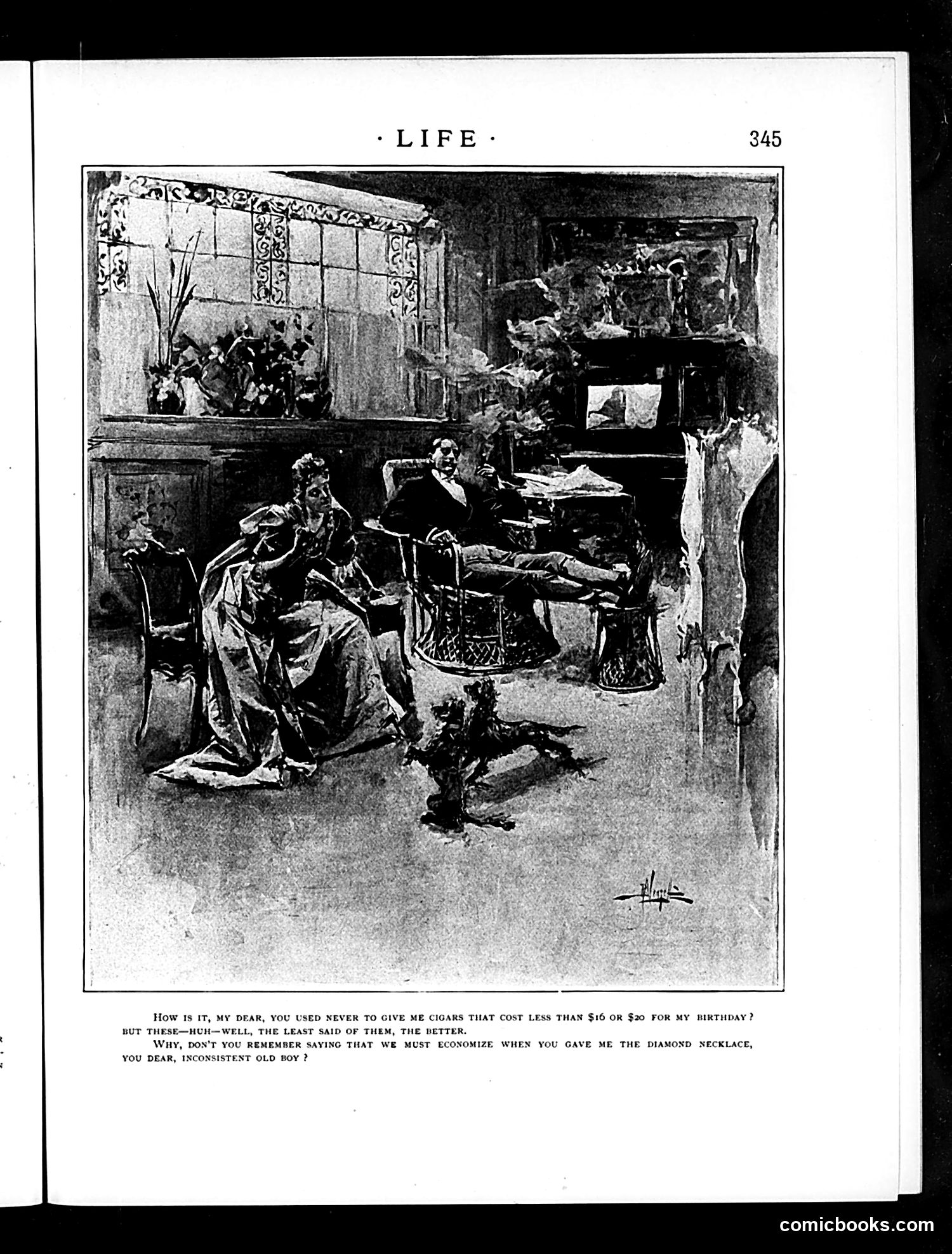
This page depicts a domestic argument between a husband and wife. The woman (left) confronts the man (center, reclining) about his spending habits, specifically his gift of expensive cigars costing $16-20 for her birthday. The satire targets masculine inconsistency: the husband claims financial constraints when his wife received a diamond necklace previously, yet he freely spends lavishly on his own luxuries (cigars). The wife's sarcastic tone exposes the hypocrisy—he invokes "economizing" selectively. The cartoon satirizes early 20th-century gender dynamics around household finances, where husbands controlled spending decisions while maintaining double standards about what constituted "necessary" expenditure. The joke ridicules male self-indulgence masked as financial responsibility.
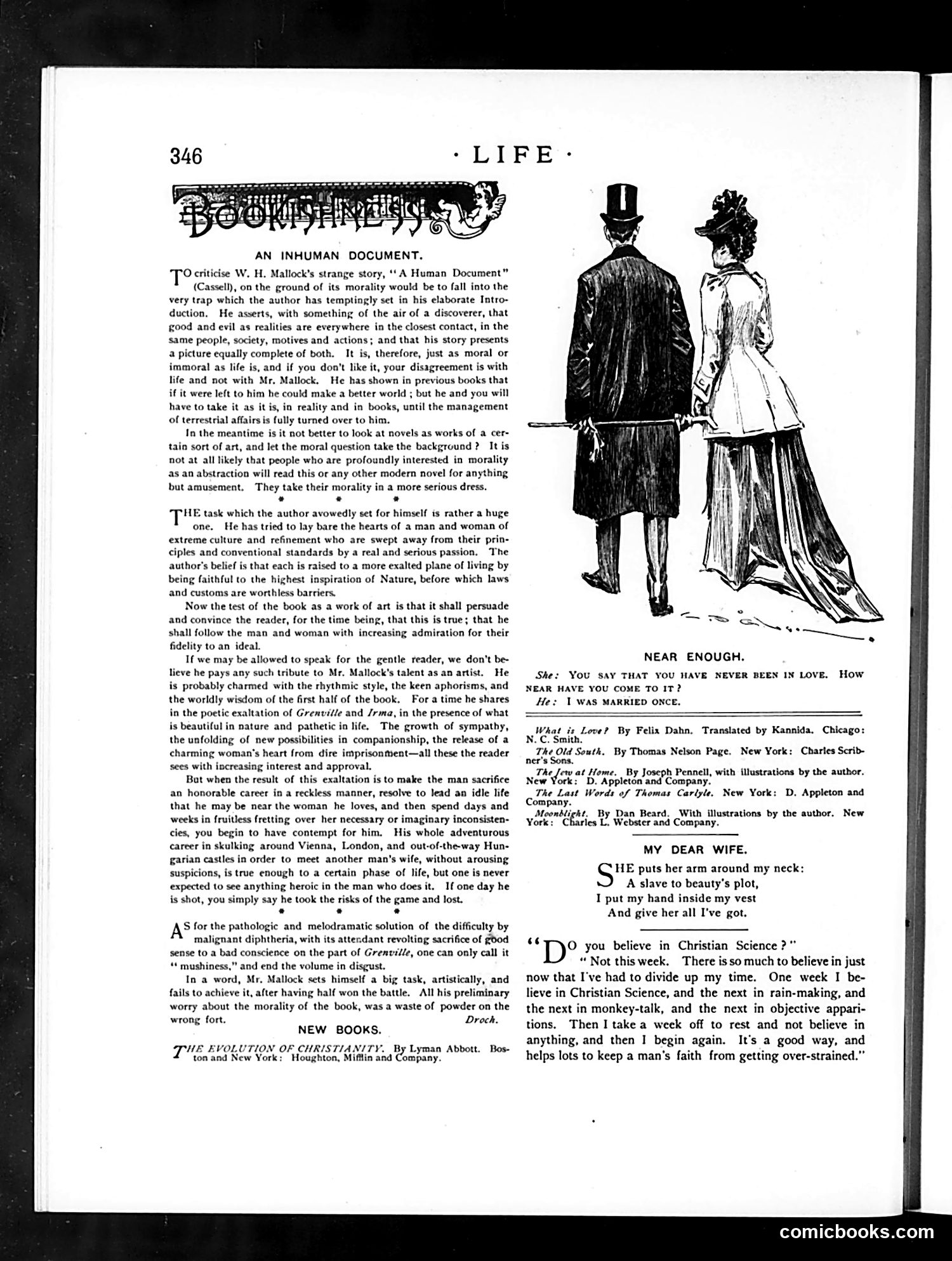
This page contains a book review section and satirical content rather than political cartoons. The main illustration shows two figures from behind—a man in a top hat and coat with a woman—captioned "NEAR ENOUGH," accompanying a dialogue joke about never being in love. The page primarily reviews W.H. Mallock's novel "A Human Document," which the critic defends against morality-based criticism. The reviewer argues that novels can present moral questions as legitimately as life itself does. Below is a separate humorous dialogue titled "MY DEAR WIFE," where a husband discusses his rotating belief system—alternating weekly between Christianity, rain-making, and other pursuits—as a way to manage stress and prevent over-strain on his faith. The content reflects turn-of-the-century satirical commentary on both literature and casual religious skepticism.
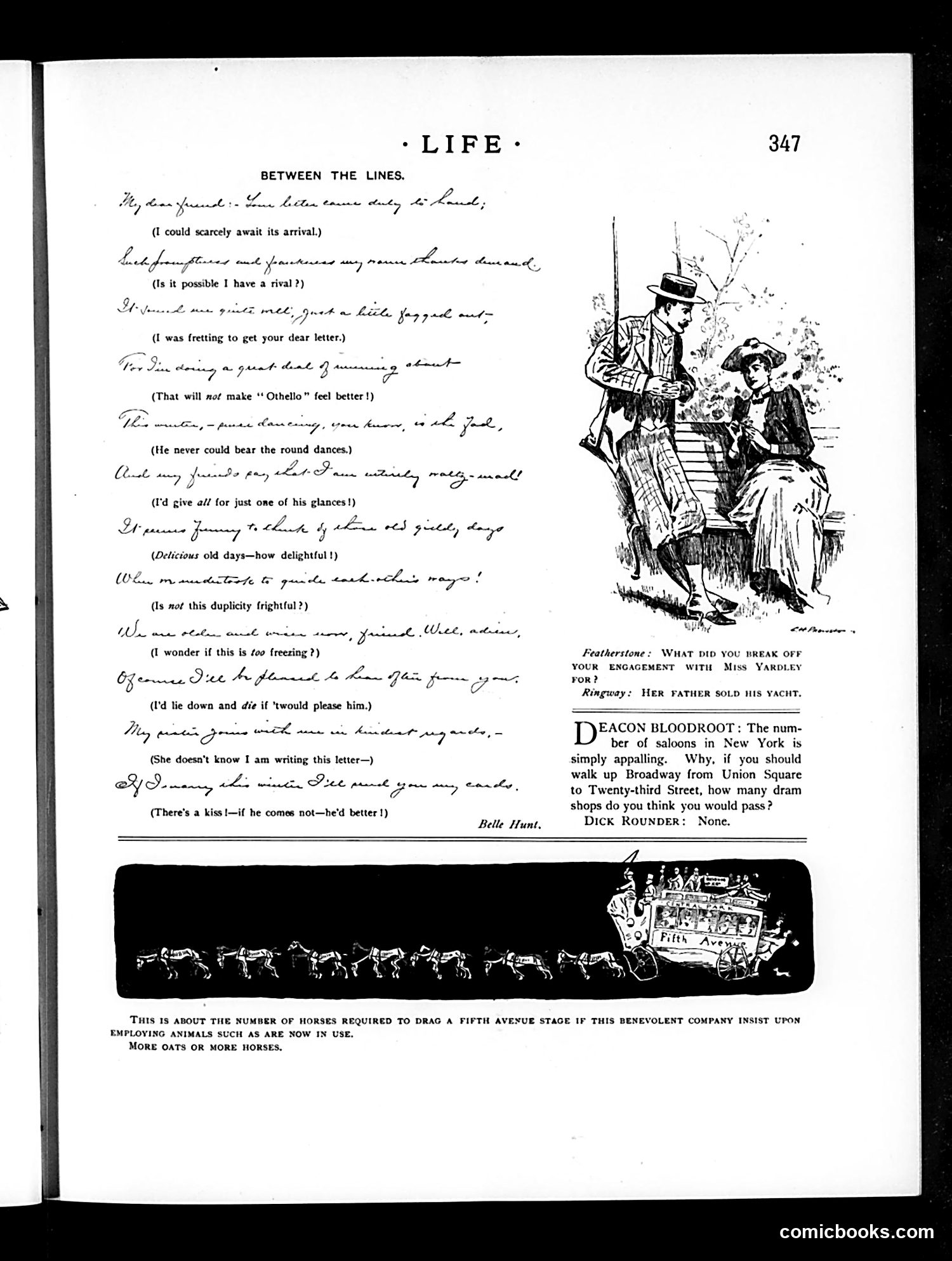
**Main Content**: "Between the Lines" is a humorous poem by Belle Hunt presenting romantic laments written as if between the lines of a letter. The handwritten-style verses express jealous, anxious musings about a rival, attendance at dances, and yearning for the addressee's attention. **The Illustration**: Shows two men seated outdoors—one elderly gentleman in a top hat speaking with a younger man. This illustrates a joke about a broken engagement: "Her father sold his yacht." **The Satire**: The humor relies on class anxiety—the implication that the engagement was contingent on the woman's father's wealth. Once that wealth disappeared (yacht sold), so did the engagement prospects. **Bottom Panel**: References New York saloons between Union Square and Twenty-third Street, mocking their prevalence in the urban landscape.
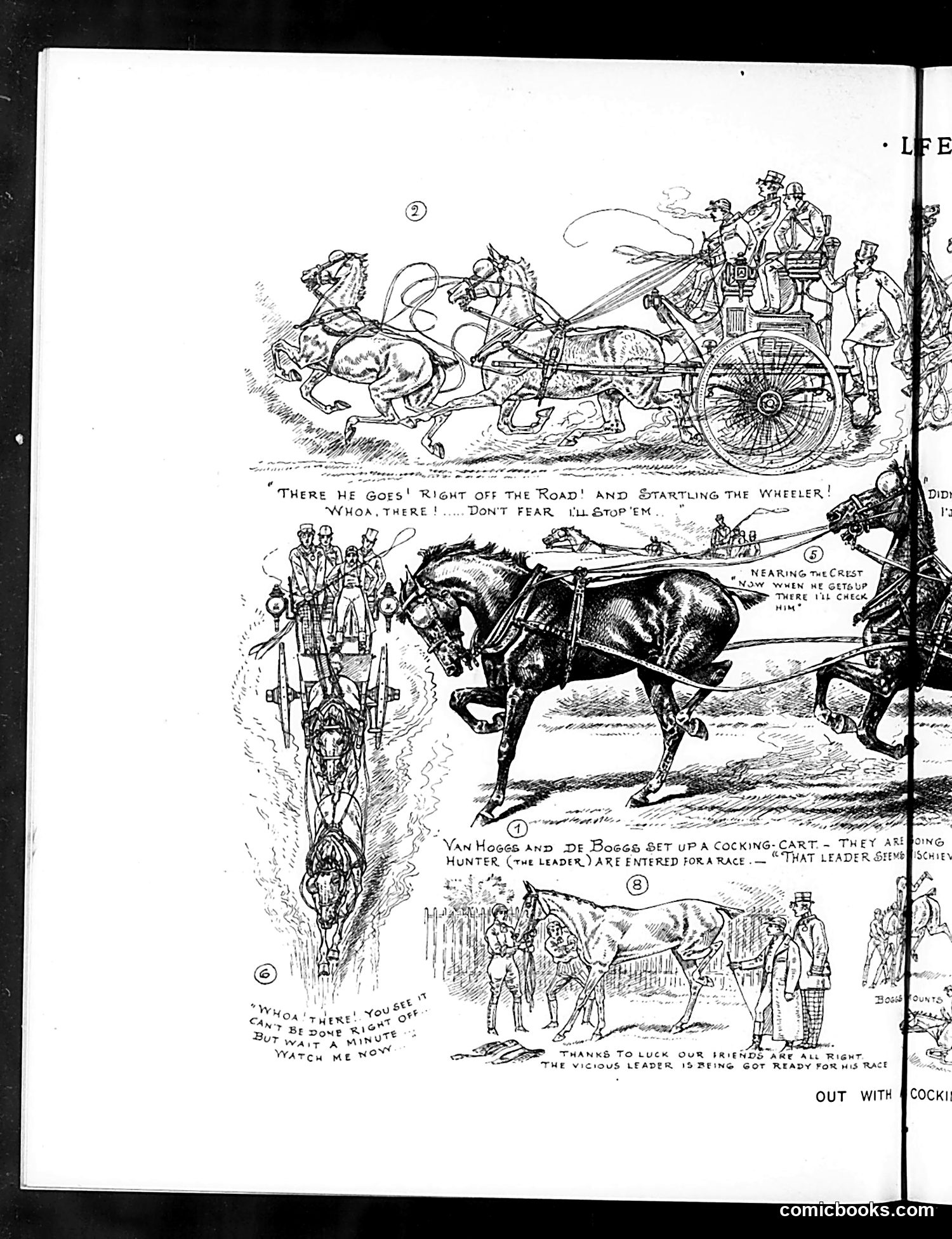
This appears to be a humorous multi-panel comic strip about horse-drawn transportation, likely from the early 1900s. The narrative follows characters named Van Hoggs and De Boggs who enter a racing competition with a "cocking cart" (a light, open carriage). The satire centers on the chaos and unpredictability of horse racing with makeshift vehicles. Panel captions show the driver confidently controlling a spirited horse ("There he goes! Right off the road!"), followed by mishaps and commentary from observers. The final panels suggest the horse and cart are difficult to manage despite the driver's bravado. The humor targets overconfident sporting enthusiasts and the comedic contrast between their intentions and results. The detailed pen-and-ink illustrations emphasize the action and slapstick nature of the scene.
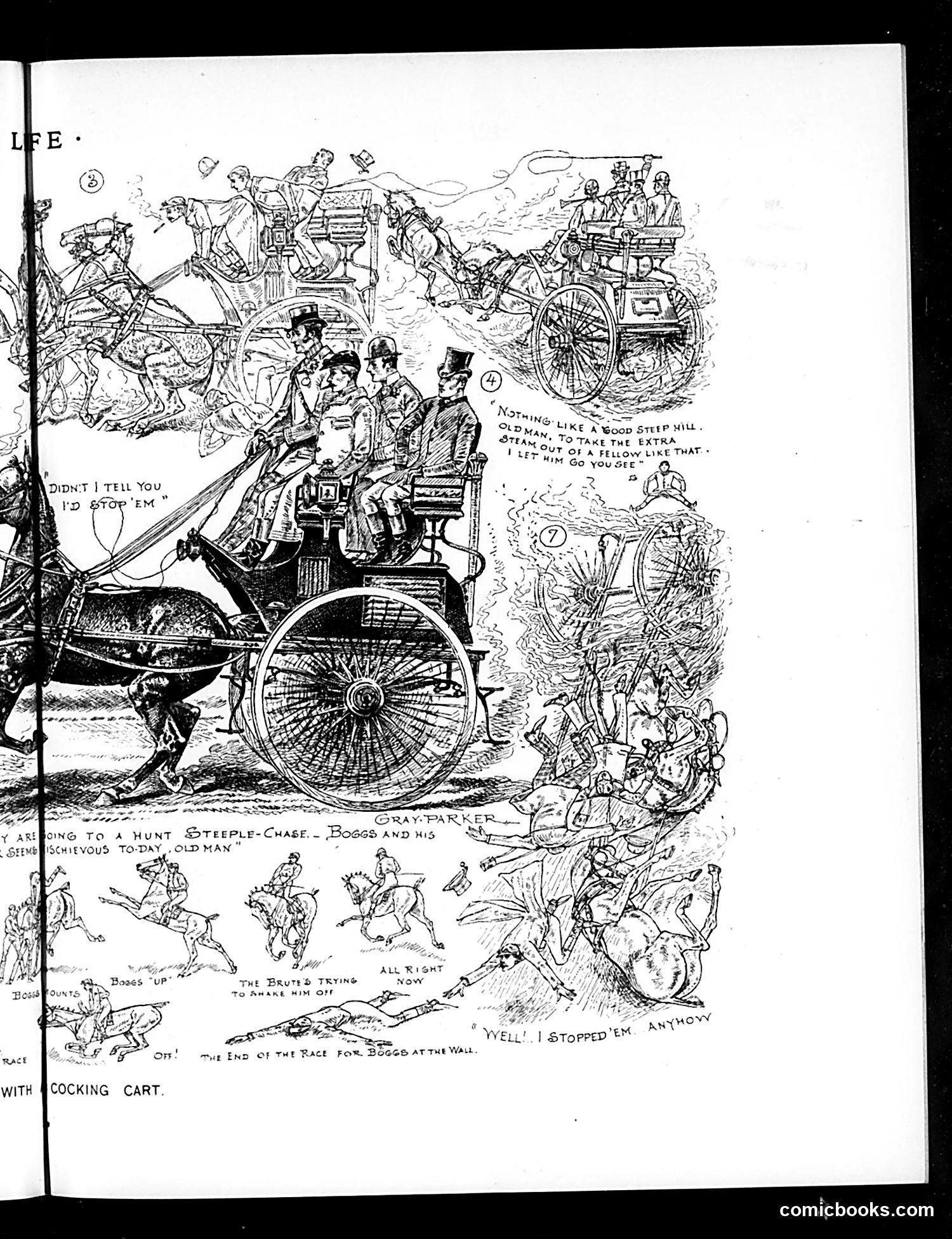
This is a satirical cartoon by Gray Parker titled "A Hunt Steeplechase" mocking what appears to be a political or social chase. The main scene shows well-dressed gentlemen in a carriage being pursued by mounted riders in a chaotic steeplechase race. The dialogue "Didn't I tell you I'd stop 'em" and references to "a good steep mill" and taking "the extra lift" suggest the cartoon satirizes some form of pursuit or scheme where someone attempts to stop or obstruct competitors. The surrounding smaller panels show various riders and horses in disarray and collision, labeled with fragments like "All right now," "The brute's trying to shake him off," and "Well! I stopped 'em anyhow"—depicting the comedic chaos of an uncontrolled chase where stopping proves difficult and accident-prone.
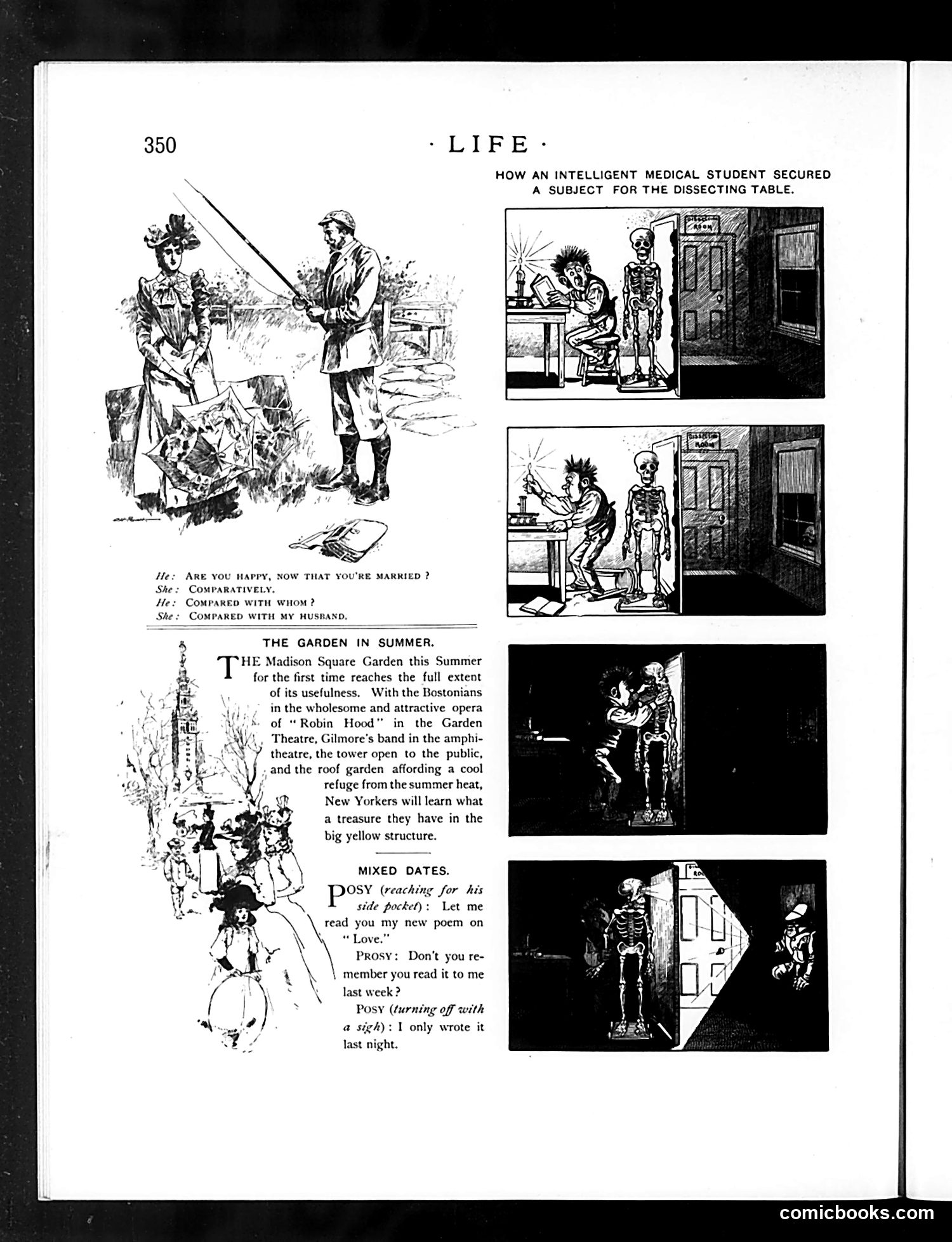
This page contains several distinct satirical pieces typical of Life's humor: **Top cartoon**: A dark joke about a medical student acquiring a cadaver for dissection. The skeleton figure represents a corpse, suggesting the student manipulated circumstances to obtain a body—likely through marriage or a relationship, given the skeleton's prominent placement. **Marriage joke**: A husband-wife exchange mocking marital unhappiness. When asked if she's happy being married, the wife says "comparatively"—meaning she's happy compared to her husband, implying he makes her miserable. **Madison Square Garden piece**: Straightforward promotional content praising the venue's summer offerings (opera, band performances, roof garden), describing it as a "big yellow structure." **Mixed Dates joke**: Mocks an aspiring poet ("Posy") who claims to have just written a poem, but his friend points out he read the same poem last week—suggesting the poet recycles or steals work. The page exemplifies Life's satirical style: cynical takes on marriage, professional ethics, and artistic pretension.
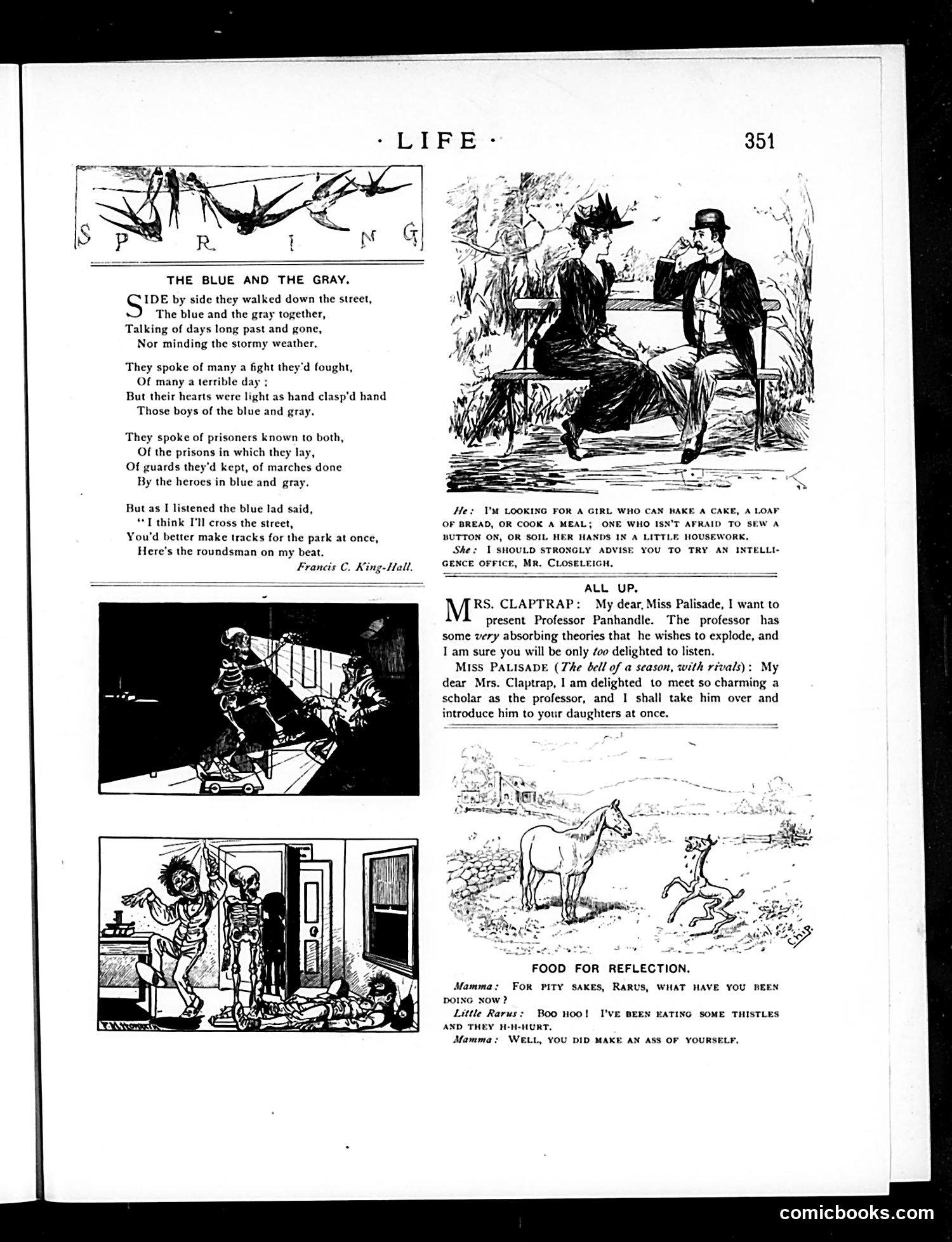
This page contains multiple satirical cartoons and humorous sketches typical of early 20th-century Life magazine: **"The Blue and the Gray"**: A sentimental poem about Civil War veterans (Union blue, Confederate gray) reuniting as friends, undermined by the punchline—the Union soldier must flee because a police officer (roundsman) is approaching, suggesting he's engaged in some petty crime. **The domestic cartoon** satirizes modern women's independence: a man seeks a traditional housewife willing to cook and clean, but the woman directs him to an employment agency—mocking both his outdated expectations and the "new woman" of the era. **"All Up"** ridicules social pretension: Mrs. Claptrap introduces a charlatan "Professor Panhandle" with fake theories to Miss Palisade, who immediately monopolizes him to impress her daughters. **"Food for Reflection"**: A child ate thistles and got pricked; the mother's pun ("make an ass of yourself") plays on the animal association. The page satirizes hypocrisy, social climbing, changing gender roles, and pretension.
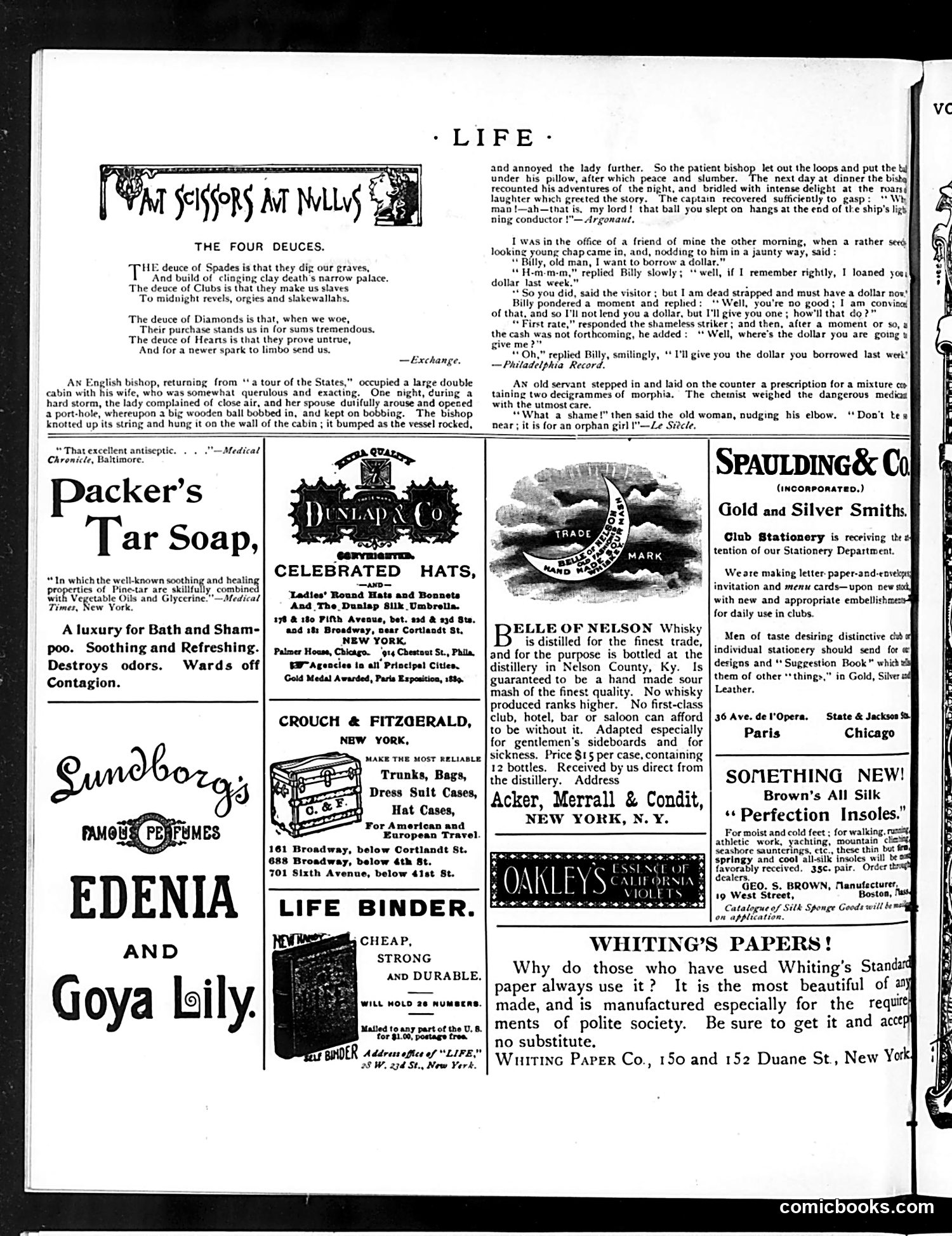
This page is primarily **advertisements and short humorous anecdotes** rather than political cartoons. The main content consists of four brief joke-stories: 1. **"The Four Deuces"** — a card-themed poem about life's misfortunes (death, slavery, debt, infidelity) 2. **The Bishop's Story** — an English bishop hangs a buoy on his cabin wall, mistaking it for a sleeping aid. The joke relies on the bishop's confusion and the captain's amusement. 3. **The Borrowed Dollar** — a tale of circular debt where a borrower asks for another dollar, claiming he can't repay the previous one, yet receives one anyway through twisted logic. 4. **The Morphine Prescription** — a pharmacist notes the tragedy of preparing dangerous medicine for an orphan girl. The page is dominated by **period advertisements** (Packer's Tar Soap, Dunlap Hats, Whiting's Papers, etc.). The humor is gentle and moralistic rather than satirical or political—typical of Life magazine's genteel comedic style during this era.