
Life, 1892-06-02 · page 4 of 14
Life — June 2, 1892 — page 4: what you’re looking at
What you’re looking at
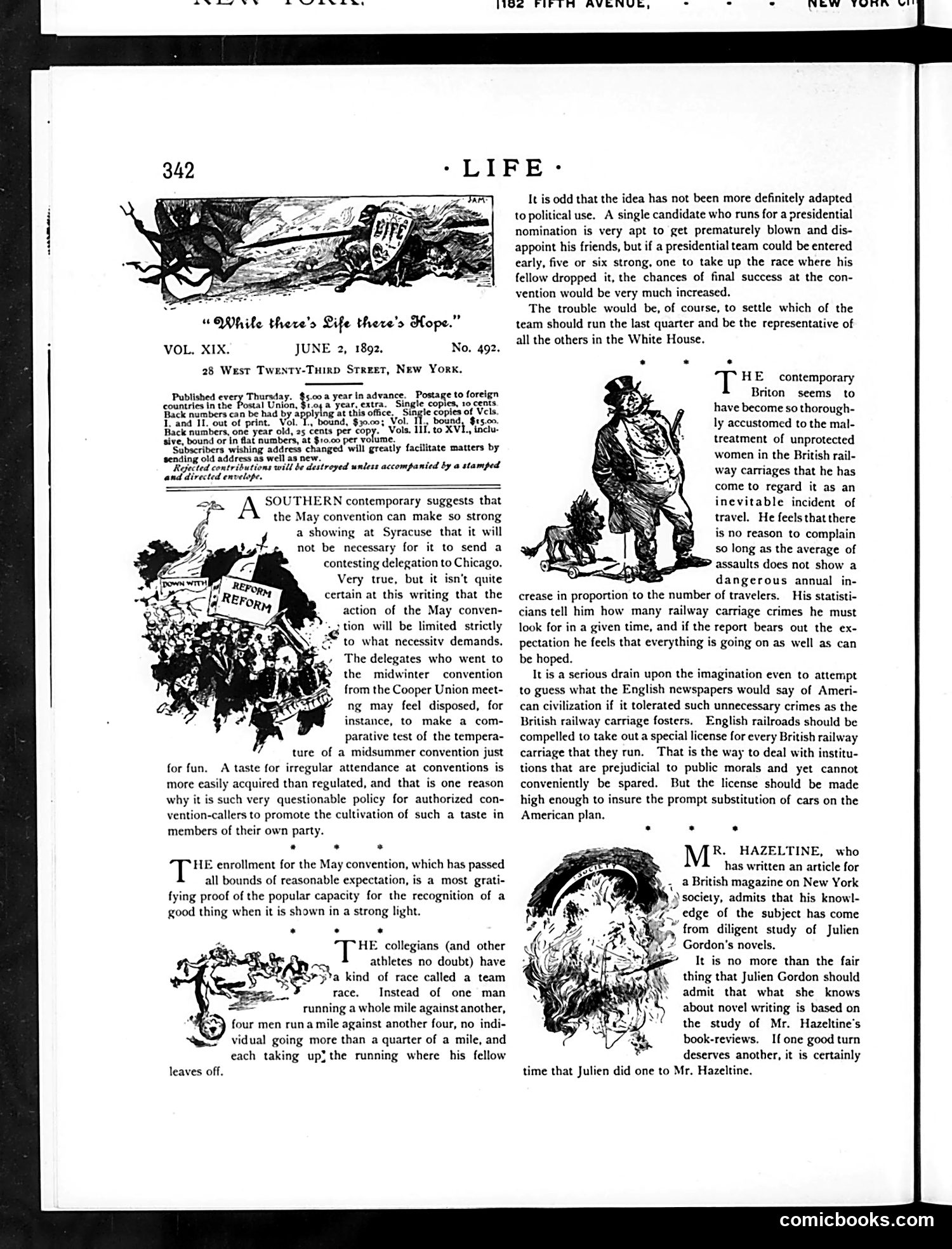
The page contains two editorial cartoons addressing contemporary political conventions. **Left cartoon**: Depicts the "Southern convention" regarding the May convention in Syracuse. It shows delegates marked "SOUTH" and "REFORM" in apparent conflict, satirizing tensions over whether the May convention would limit its actions to necessary demands or expand beyond them. **Right cartoon**: Features a caricatured figure (labeled "MR. HAZELTINE") discussing British railway customs. The text criticizes how British railways treat unprotected women passengers as an "inevitable incident of travel," arguing that American standards should not tolerate such assault. The cartoon advocates licensing stricter regulations to prevent similar behavior in American railway cars. Both cartoons reflect 1892 concerns: Democratic party fracturing and women's safety in public spaces.
📄 Transcribed text from this page (OCR, searchable)
Machine-transcribed from the original scan — historical spelling and the odd misread are preserved.
a ee ee aw =e We FIFIM AVENVE, ui ' ht LIFE “OW@hile there's Life there's Hope.” VOL, XIX. JUNE 2, 1892. No. 492. 28 West Twenty-Tuirp Street, New York. Published ev: Thursday. 5.00 a year in advance. Fostage to foreign countries in the Postal Union, $1.04 a year, extra. Single coples, 10 cents Back numbers can be had ey, peplies. ing at = ofice, te Sing cr copies: “ Vels. 1, and IT. out of print. Vol. $30.00; Vi bound, $t5.00. Back numbers, one year old, 25 cents ~ ‘copy. Vora. Ill, to XVI, inclu- sive, bound or in flat numbers, at $10.00 per volume. becribere wishing soiree Se changed will greatiy facilitate matters by sending old address as wi Reevted contributions will be destreyed unless accompanied by a stamped and directed envelope. SOUTHERN contemporary suggests that the May convention can make so strong a showing at Syracuse that it will not be necessary for it to send a contesting delegation to Chicago, Very true, but it isn’t quite certain at this writing that the action of the May conven- ~, tion will be limited strictly to what necessity demands, The delegates who went to the midwinter convention from the Cooper Union meet- ng may feel disposed, for instance, to make a com- parative test of the tempera- ture of a midsummer convention just for fun, A taste for irregular attendance at conventions is more easily acquired than regulated, and that is one reason why it is such very questionable policy for authorized con- vention-callers to promote the cultivation of such a taste in members of their own party. . . . HE enrollment for the May convention, which has passed all bounds of reasonable expectation, is a most grati- fying proof of the popular capacity for the recognition of a good thing when it is shown in a strong light. . . . HE collegians (and other athletes no doubt) have ERS. kind of race called a team Instead of one man running a whole mile against another, four men runa mile against another four, no indi- vidual going more than a quarter of a mile, and each taking up}the running where his fellow leaves off. = It is odd that the idea has not been more definitely adapted to political use. A single candidate who runs for a presidential nomination is very apt to get prematurely blown and dis- appoint his friends, but if a presidential team could be entered early, five or six strong, one to take up the race where his fellow dropped it, the chances of final success at the con- vention would be very much increased. The trouble would be, of course, to settle which of the team should run the last quarter and be the representative of all the others in the White House. HE contemporary Briton seems to have become so thorough- ly accustomed to the mal- treatment of unprotected women in the British rail- way carriages that he has come to regard it as an inevitable incident of travel. He feels that there is no reason to complain so long as the average of assaults does not show a dangerous annual in- crease in proportion to the number of travelers. His statisti- cians tell him how many railway carriage crimes he must look for in a given time, and if the report bears out the ex- pectation he feels that everything is going on as well as can be hoped. It is a serious drain upon the imagination even to attempt to guess what the English newspapers would say of Ameri- can civilization if it tolerated such unnecessary crimes as the British railway carriage fosters. English railroads should be compelled to take out a special license for every British railway carriage that they run. That is the way to deal with institu- tions that are prejudicial to public morals and yet cannot conveniently be spared. But the license should be made high enough to insure the prompt substitution of cars on the American plan, . . R. HAZELTINE, who has written an article for ;_ 2 British magazine on New York 53 2 society, admits that his knowl- a “ edge of the subject has come ‘from diligent study of Julien é} Gordon's novels. It is no more than the fair thing that Julien Gordon should admit that what she knows about novel writing is based on the study of Mr. Hazeltine’s book-reviews. If one good turn deserves another, it is certainly time that Julien did one to Mr. Hazeltine. comicbooks.com Wwew vurnn wi