
A complete issue · 18 pages · 1892
Life — April 21, 1892
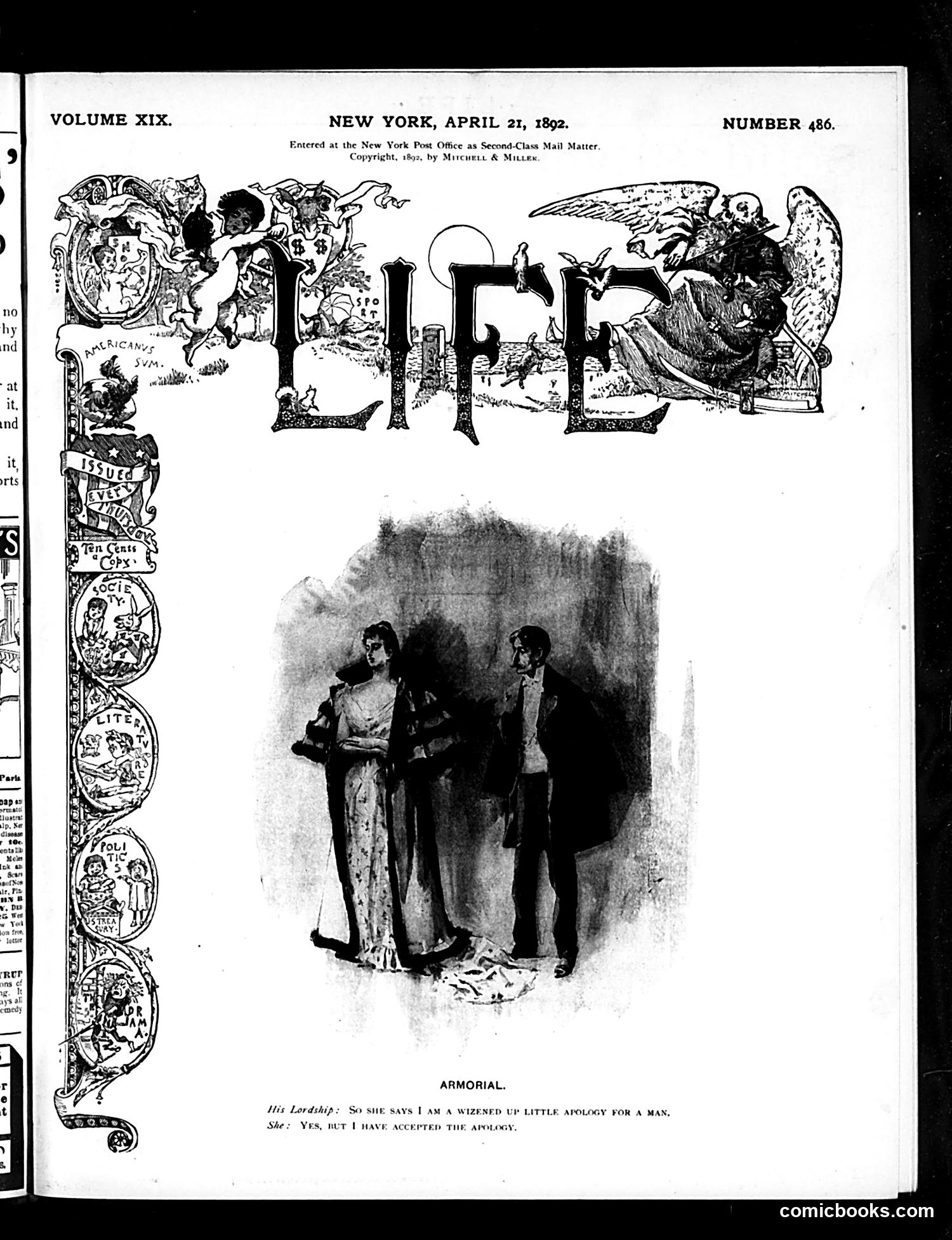
This single-panel cartoon depicts a social interaction between a well-dressed man and woman. The caption reads: **His Lordship:** "So she says I am a wizened up little apology for a man." **She:** "Yes, but I have accepted the apology." The humor appears to target aristocratic pretension and courtship dynamics of the Gilded Age. The woman has insulted the man severely, calling him inadequate, yet she's accepted his apology anyway—suggesting she either doesn't take her own criticism seriously or is willing to overlook his flaws for his social status ("His Lordship"). The satire mocks shallow upper-class romance where rank matters more than genuine regard. The title "Armorial" likely references heraldry and inherited nobility, reinforcing the critique of empty aristocratic values.
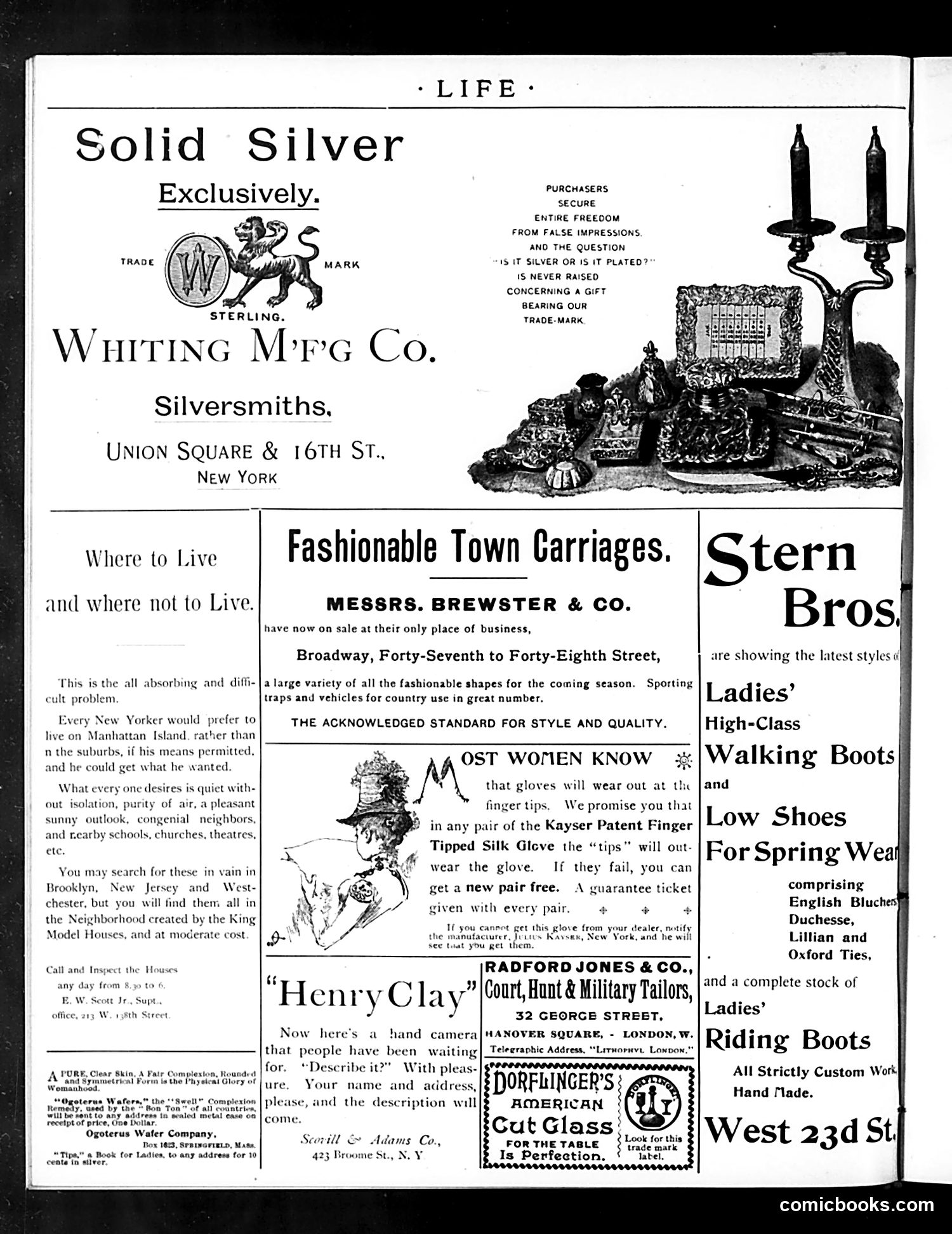
This page is primarily **advertising**, not political satire or comics. It contains multiple commercial advertisements from what appears to be an early 20th-century issue of *Life* magazine. The main content includes ads for: - Whiting M'fg Co. (sterling silver goods) - Brewster & Co. (carriages) - Stern Bros. (women's boots and shoes) - Radford Jones & Co. (tailors in London) - Henry Clay cameras - Morehead's American Cut Glass The only editorial content is a brief piece titled "Where to Live and where not to Live," discussing Manhattan Island housing preferences. There are no political cartoons, caricatures, or satirical commentary visible on this page. It functions primarily as a commercial vehicle.
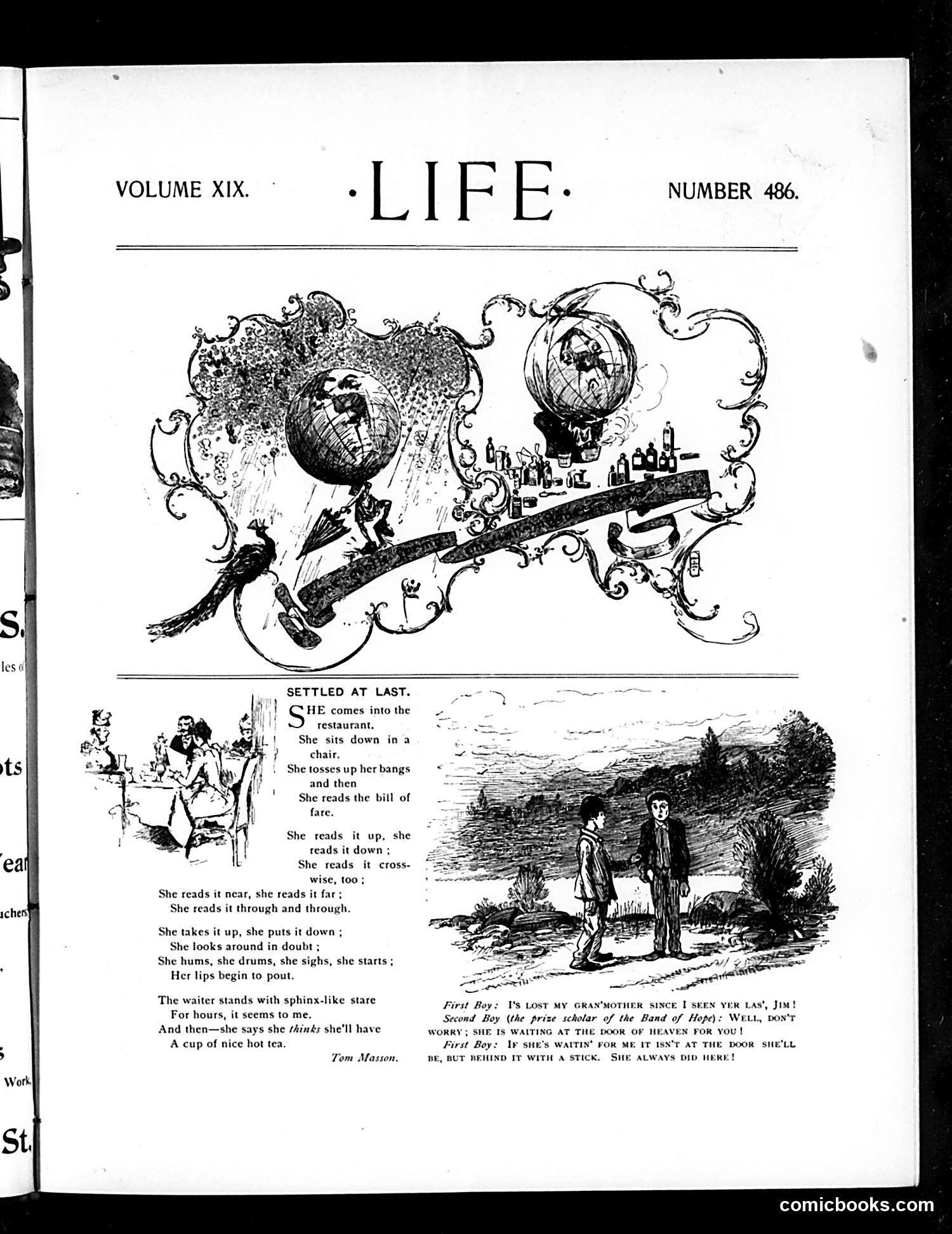
This page depicts a humorous domestic scene titled "Settled at Last." A woman enters a restaurant, sits down, tosses her hat and bangs aside, and reads a bill of fare (menu). The accompanying poem by Tom Mason describes her reading habits—fast, slow, wise, near and far—before finally ordering "a cup of nice hot tea." The accompanying illustration shows two boys outdoors discussing the woman's patience while waiting. One boy references "Ran'mother since I've been las'" while the other responds with a joke about a mother waiting at "the door of heaven" with a stick. The satire appears to mock women's indecisiveness, particularly regarding dining choices. The specific historical context of this Life magazine issue (Volume XIX, Number 486) is unclear without additional dating, but the genteel domestic humor was typical of early 20th-century American satire.
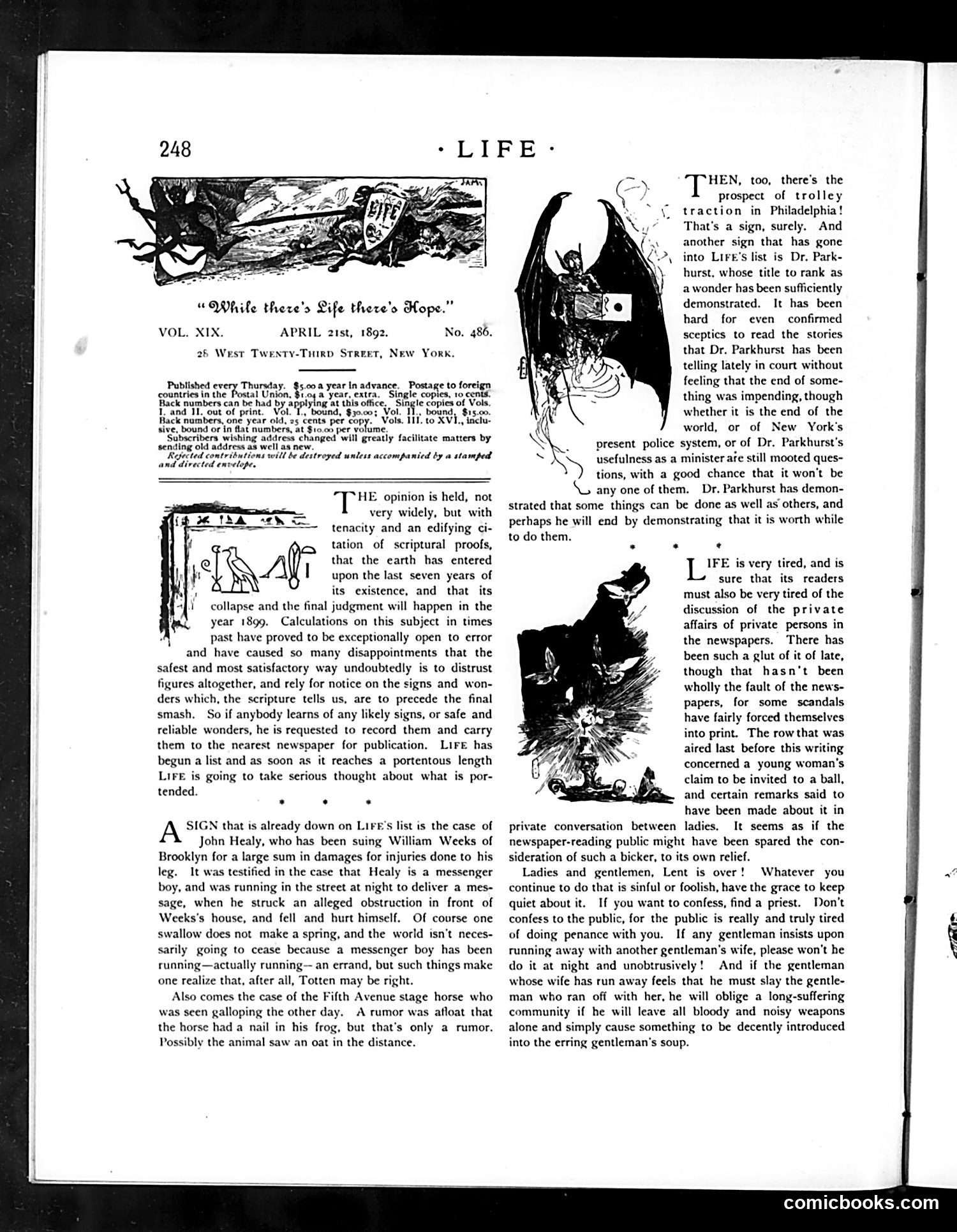
This page contains editorial commentary rather than political cartoons. The main illustration shows a demonic or skeletal figure, likely representing Death or apocalyptic prophecy, accompanying discussion of end-times predictions. The text discusses "Dr. Parkhurst," whose legal testimony apparently raised skepticism about impending catastrophe (possibly the predicted world-ending in 1899). The editors mock sensationalist doomsaying while criticizing newspapers for publishing private scandals, particularly regarding "a young woman's claim to be invited to a ball" and improper remarks about her. The page satirizes both apocalyptic fearmongering and tabloid journalism's invasion of privacy—suggesting both distract from substantive issues. The tone is weary exasperation with public discourse fixated on scandal and sensation.
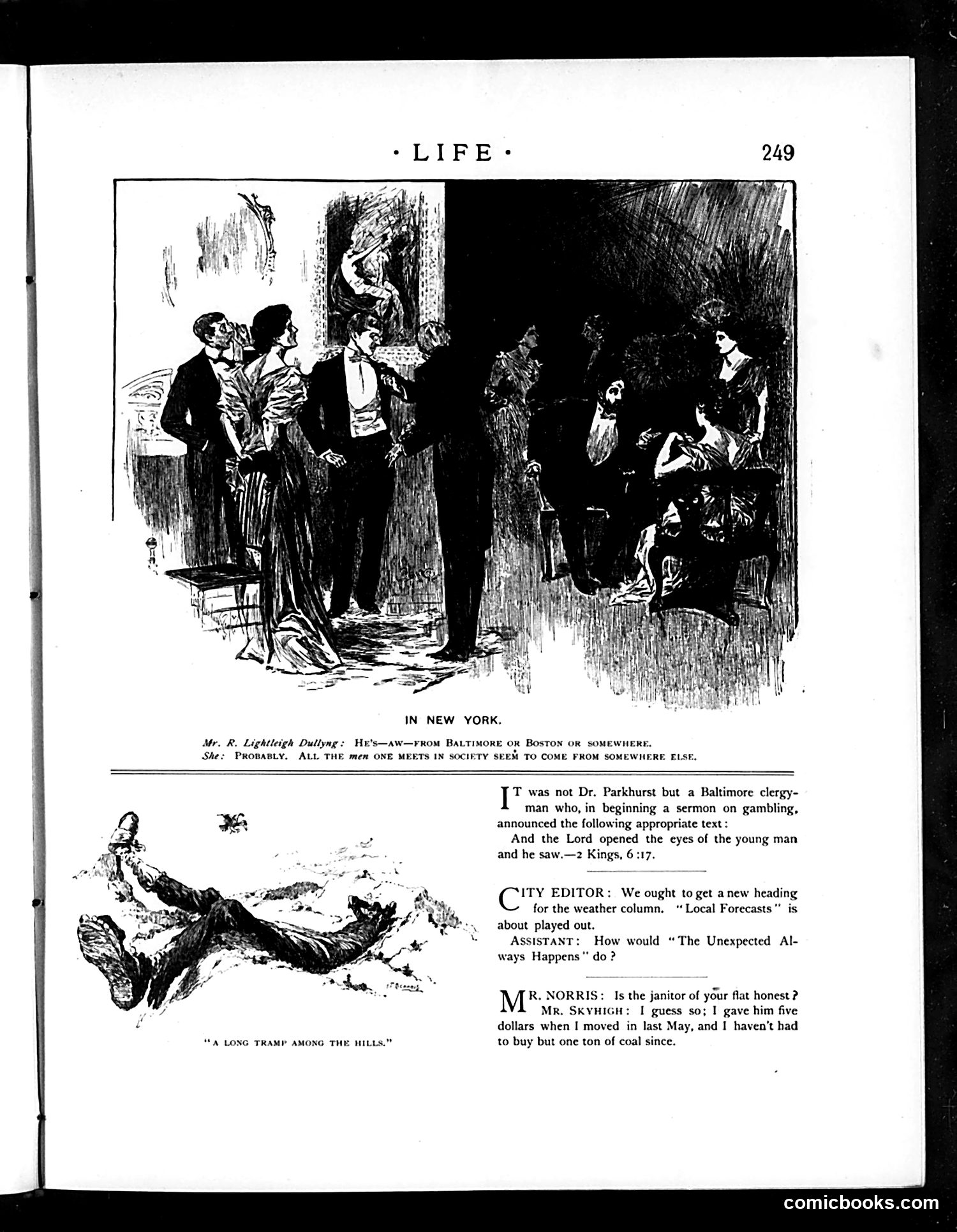
**Top Cartoon: "In New York"** This depicts a social scene where well-dressed men from Baltimore or Boston encounter New York society. The caption's joke hinges on the observation that in New York's high society, "all the men one meets seem to come from somewhere else"—satirizing New York's transient upper class and suggesting that native New Yorkers are absent from fashionable circles, or that the city attracts wealth from elsewhere. **Bottom Section:** Contains unrelated satirical dialogue exchanges about a janitor and coal expenses, mocking petty domestic disputes and financial complaints among urban residents. **Overall**: The page satirizes class distinctions, geographic snobbery, and the pretensions of urban society circa early 20th century.
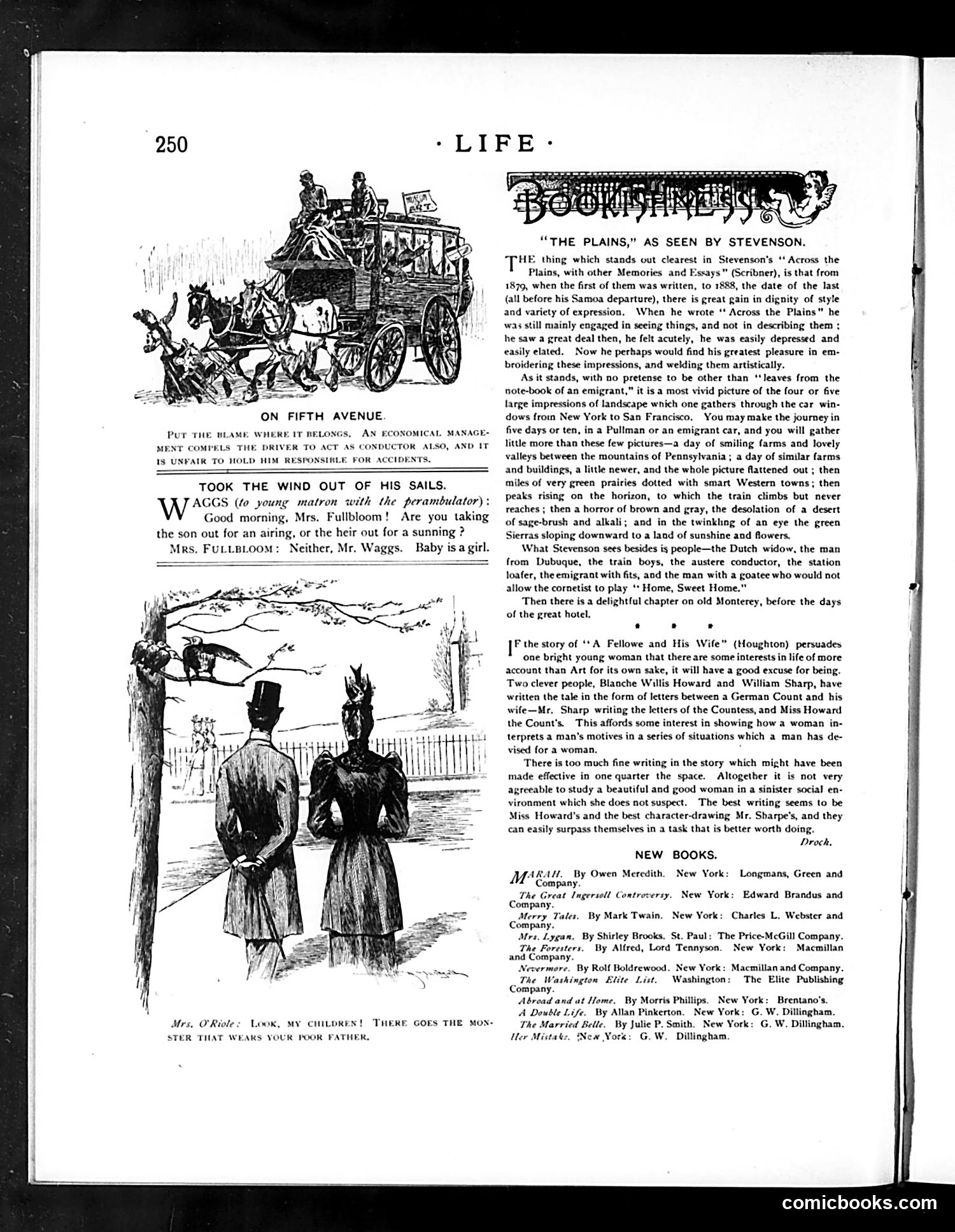
This page contains **two separate satirical cartoons** unrelated to each other. **Top cartoon ("On Fifth Avenue")**: A driver operates a horse-drawn carriage while passengers ride atop. The caption critiques incompetent management, suggesting the driver should also act as conductor—satirizing inefficient organizational structures of the era. **Bottom cartoon**: Two well-dressed women encounter each other on a street. Mrs. O'Brien's comment—"Look, my children! There goes the monster that wears your poor father"—appears to satirize marital infidelity or a rival woman, using "monster" mockingly. The remaining content is a **book review section** discussing Stevenson's travel writing and contemporary novels. These cartoons employ the genteel humor typical of Life magazine's social satire from this period.
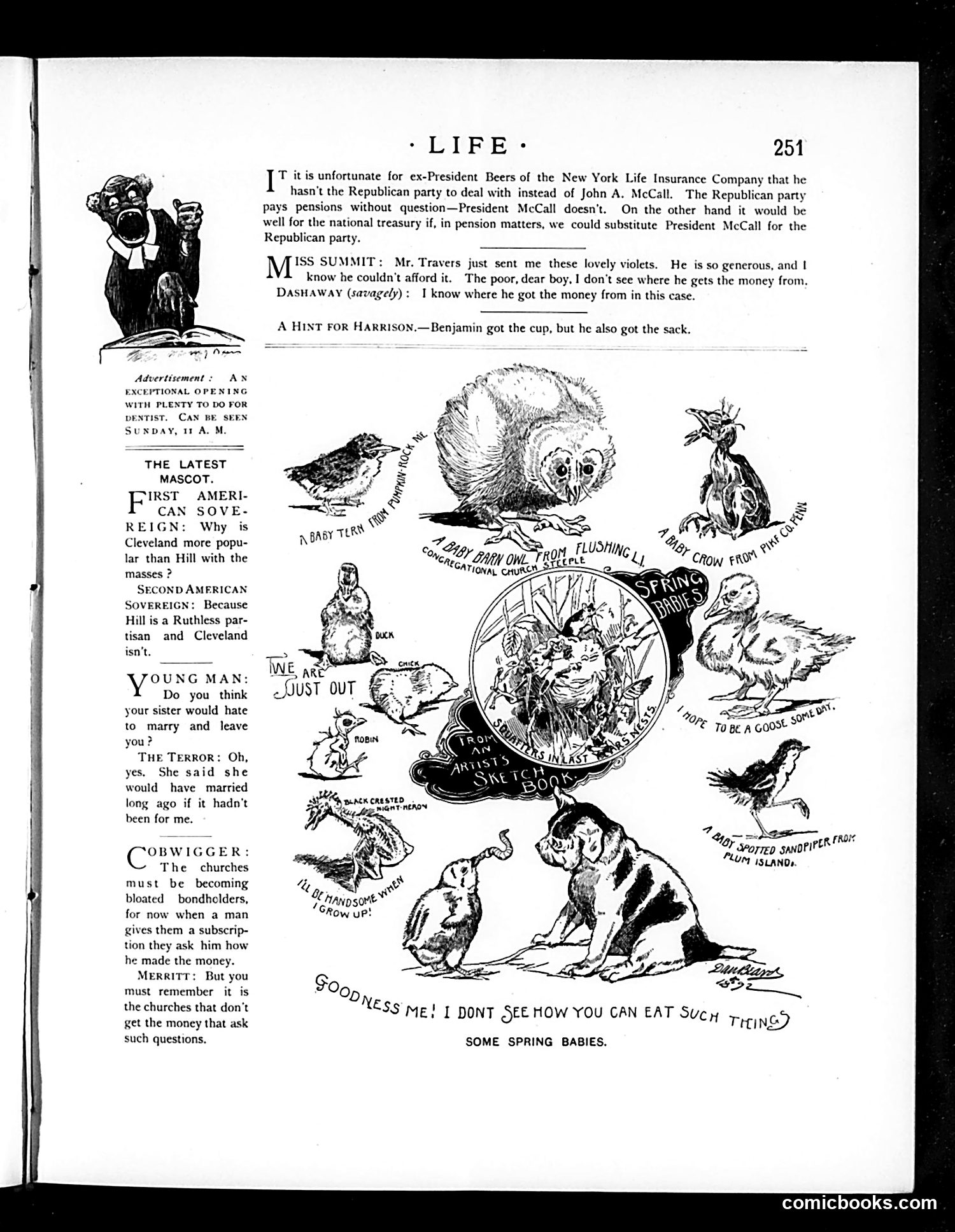
This page contains several satirical items from *Life* magazine (page 251). The top section criticizes ex-President **John A. McCall** of the New York Life Insurance Company, suggesting the Republican party should replace their leader with McCall—a jab at Republican leadership during what appears to be the early 1900s. The main illustration, titled "Some Spring Babies," depicts various birds and animals with captions suggesting evolutionary or developmental themes. This appears to be commentary on contemporary social or political figures depicted as animals, though specific identifications are unclear from the image alone. The sidebar contains dialogue snippets mocking social pretensions and church hypocrisy, typical of *Life's* satirical humor targeting wealthy elites and institutional authority.
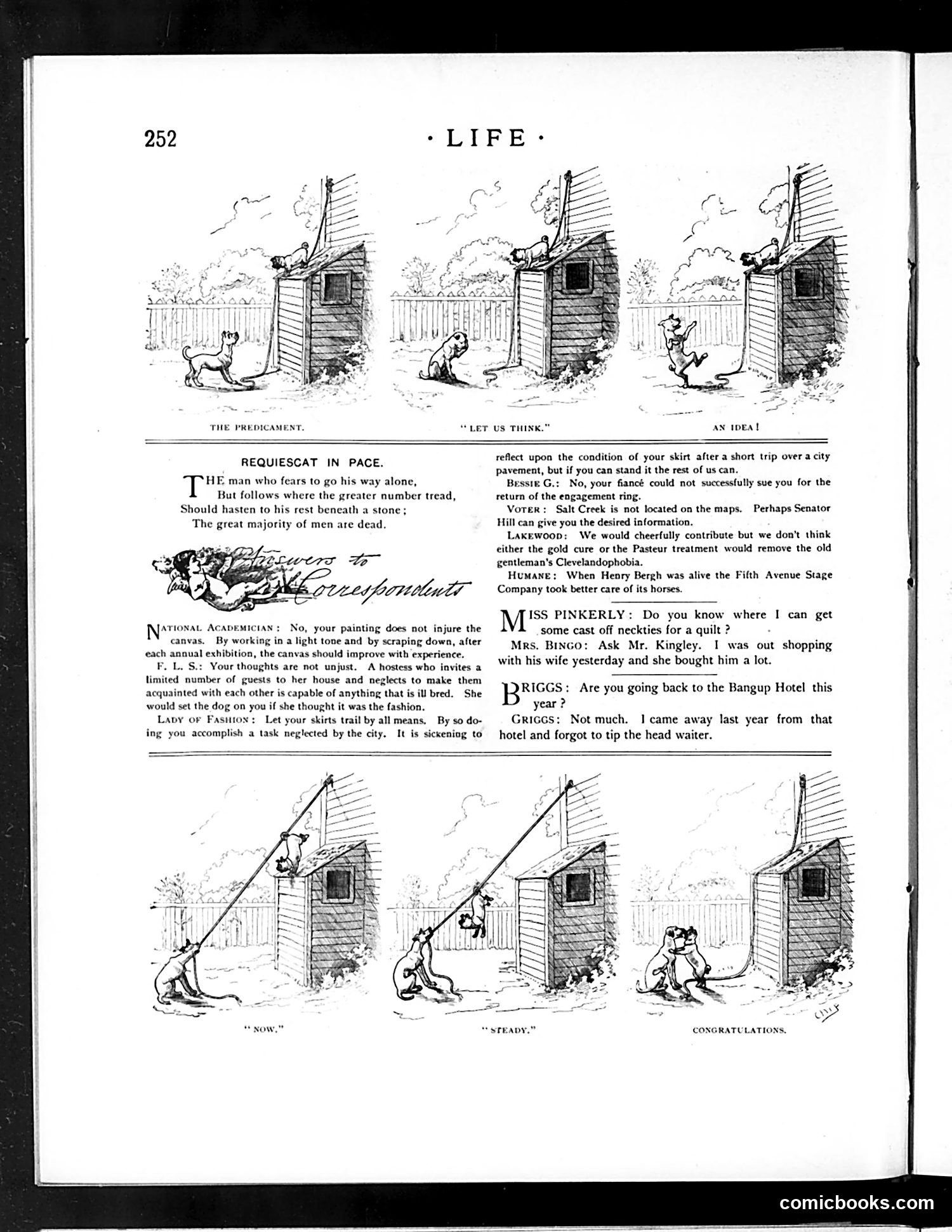
This page contains two distinct elements: **Top Section**: A six-panel comic strip showing a man attempting to climb a drainpipe toward a window of a small building (appears to be an outhouse). The progression shows him planning ("The Predicament"), considering ("Let Us Think"), getting an idea, then executing the climb through stages ("Now," "Steady," "Congratulations"). **Bottom Section**: "Requiescat in Pace" — a humor column of brief exchanges between named contributors discussing social topics: painting exhibitions, house guests, shopping for quilts, the Hangtop Hotel, and tipping etiquette. The comic strip is visual slapstick humor about someone's desperate bathroom situation. The column represents typical early 20th-century satirical banter about genteel social conventions and urban/small-town life. Both reflect *Life* magazine's blend of visual comedy and witty social commentary.
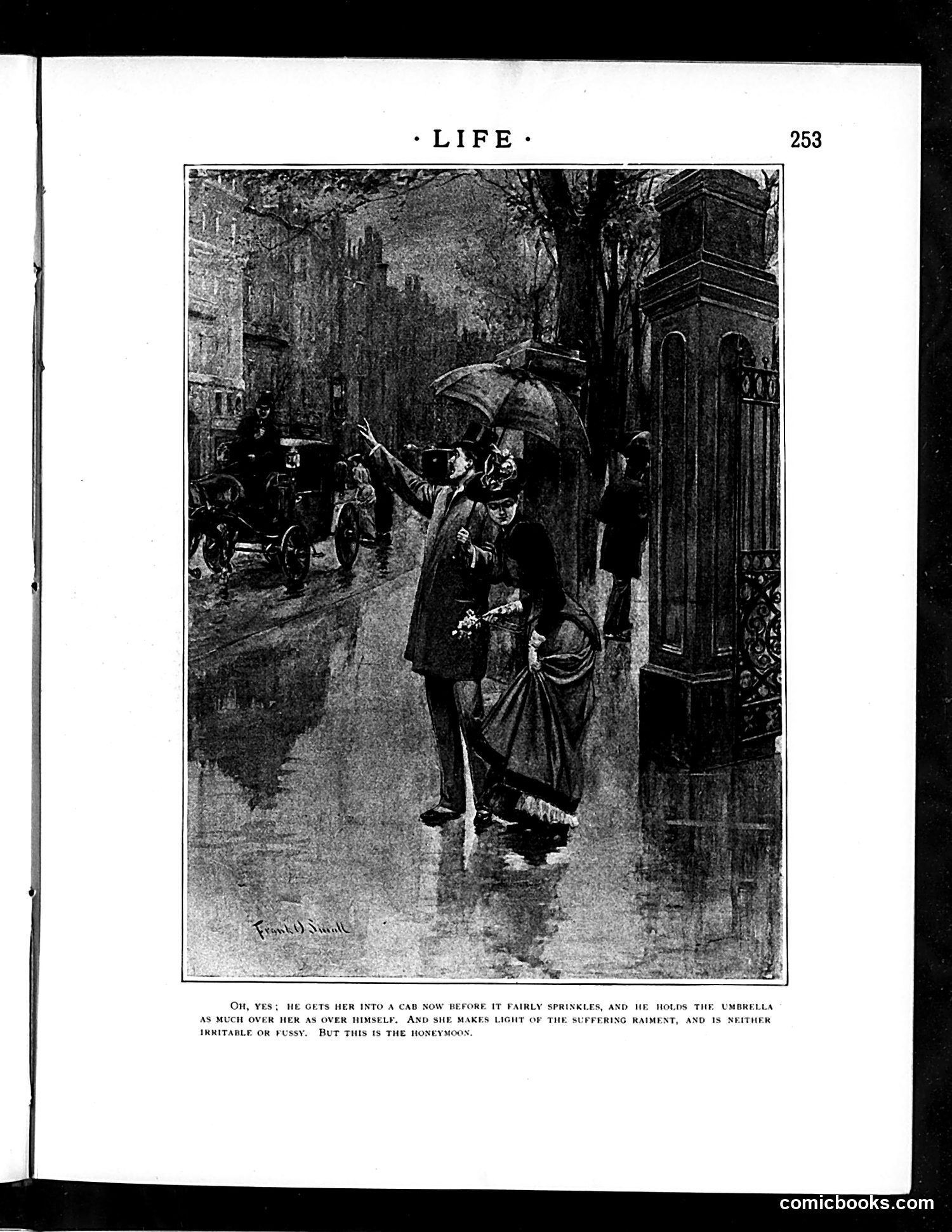
This is a satirical illustration from *Life* magazine depicting a romantic scene on a rainy street. The caption describes a gentleman holding an umbrella over a woman during a rainstorm, protecting her from the wet weather while remaining unconcerned about his own soaking. The satire targets the honeymoon period of marriage. The caption concludes: "But this is the honeymoon"—suggesting that such attentive, self-sacrificing behavior is characteristic only of newlyweds. The joke implies that once the honeymoon phase ends, husbands become less gallant and considerate toward their wives. The illustration's romantic mood contrasts with the cynical commentary, creating humor through this gap between courtship ideals and marital reality.
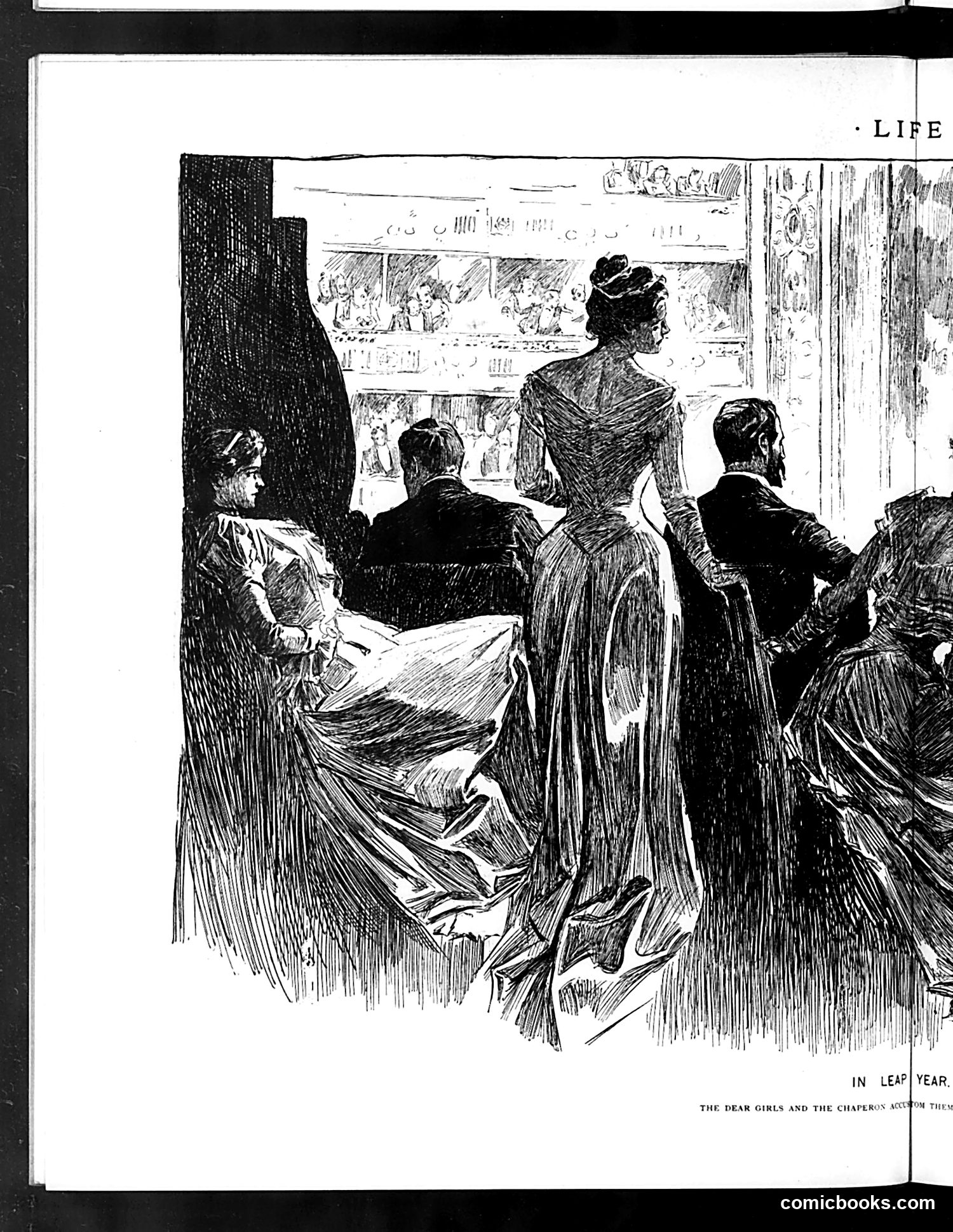
This appears to be an illustration titled "The Dear Girls and the Chaperon Accost Them" from a story or serial called "In Leap Year." The sketch depicts a social scene, likely from the early 1900s based on the clothing styles and artistic technique. The image shows several young women in long dresses approaching what appears to be a window display or shop front. The caption references a "chaperon"—an older woman assigned to supervise unmarried women in public, a Victorian-era social convention. The humor likely plays on "Leap Year" traditions where women were permitted to propose to men (role reversal), combined with the constraint of needing a chaperon. The exact satirical point requires viewing the complete story, but it appears to mock courtship conventions and propriety of the era.
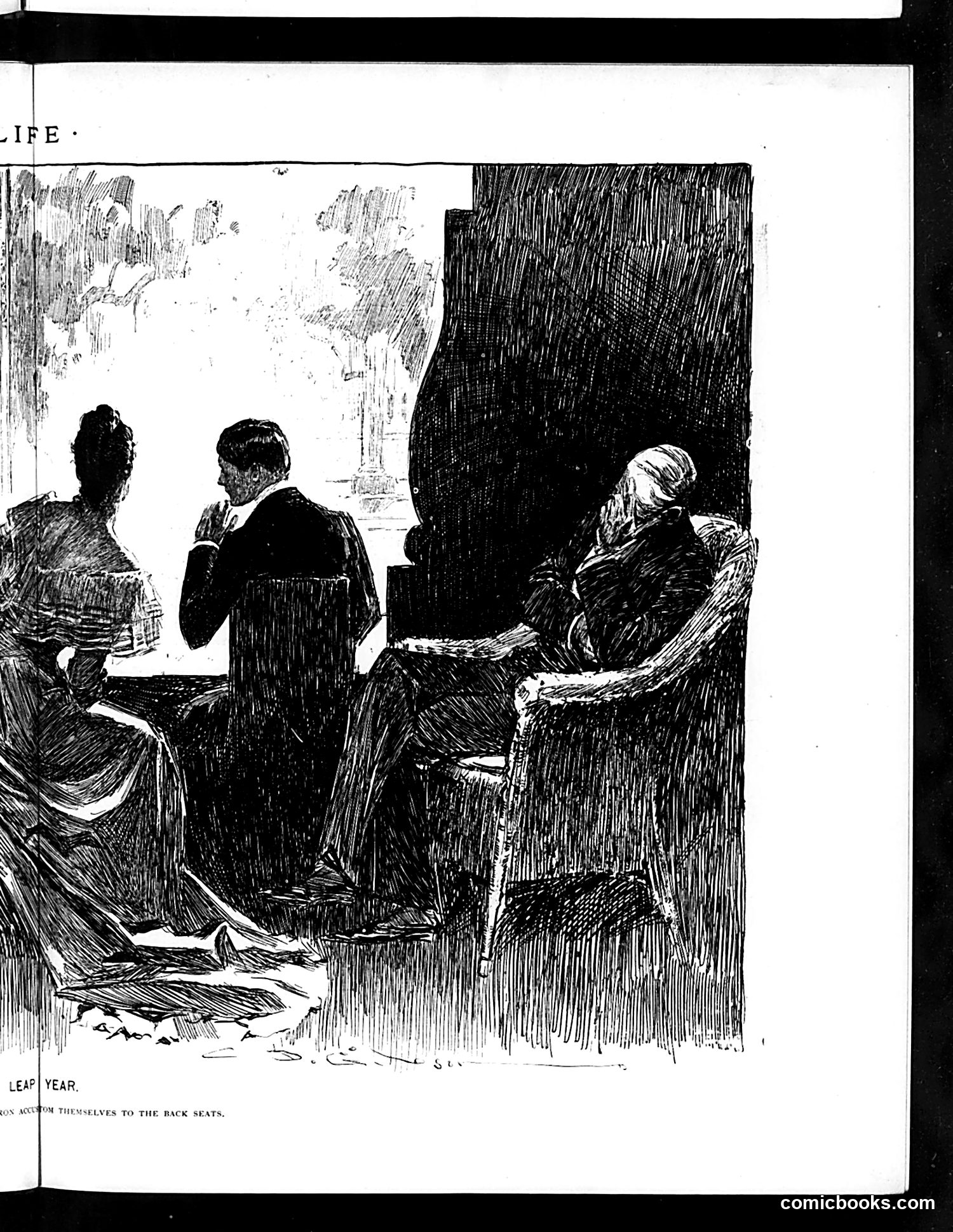
This appears to be a satirical illustration from *Life* magazine showing a social scene. The partial caption reads "...ON AWRY THEMSELVES TO THE BACK SEATS," suggesting commentary on seating arrangements or social hierarchy. The sketch depicts four figures in what appears to be an interior setting—possibly a theater, salon, or formal gathering. The figures display varying degrees of attention and engagement, with one elderly person seated on the right appearing notably removed or isolated from the central conversation among three other figures. The artistic style employs heavy crosshatching typical of late 19th or early 20th-century magazine illustration. Without the complete caption text visible, the exact satirical point remains unclear, though it likely comments on social positioning, class distinctions, or the treatment of elderly individuals in social settings.
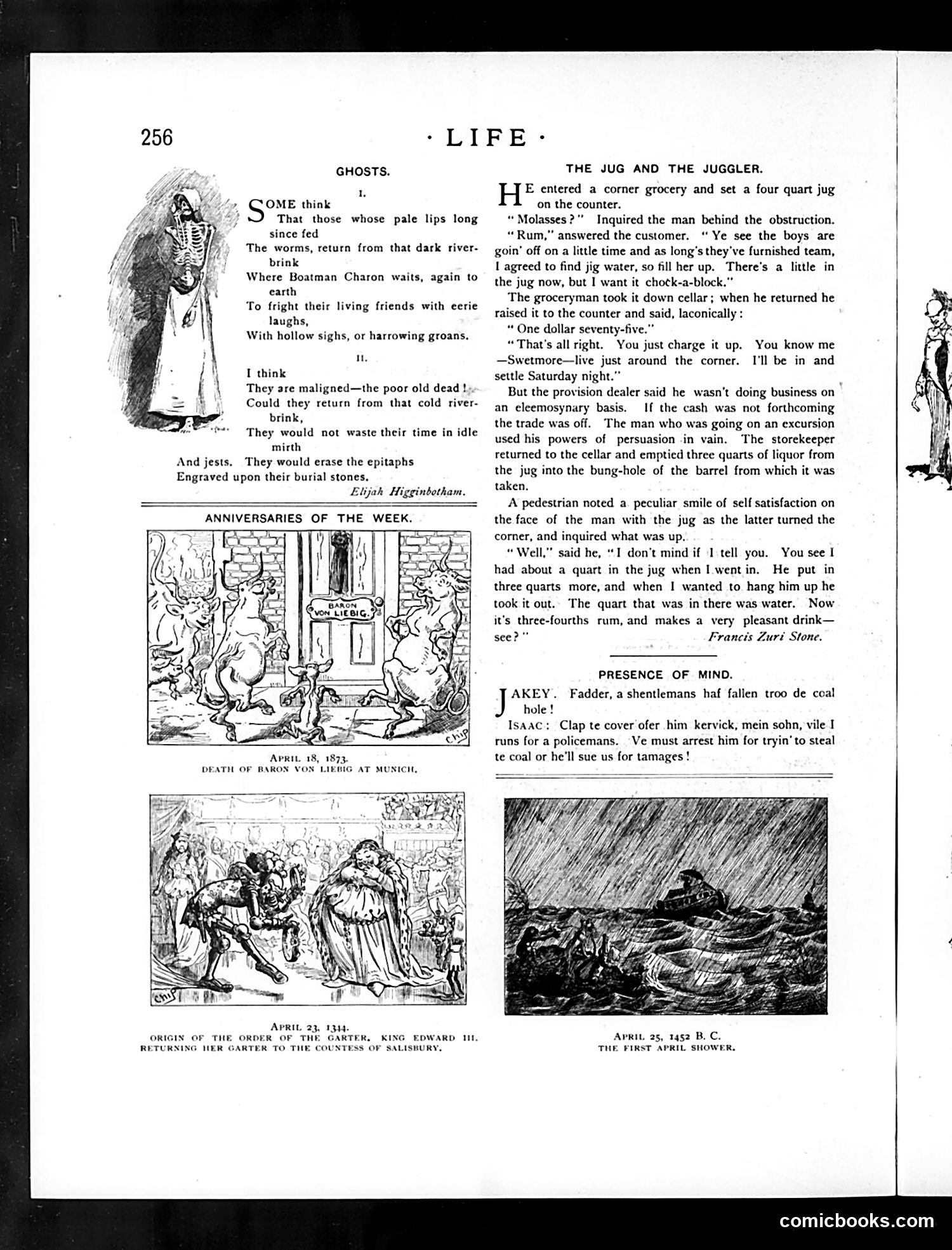
This page contains three satirical pieces typical of 19th-century American humor: **"Ghosts"** (poem): A philosophical reflection questioning whether the dead actually return to haunt the living. The speaker argues the deceased wouldn't waste time with "idle mirth" but instead would erase false epitaphs from their tombstones—a gentle jab at pretentious memorial inscriptions. **"The Jug and the Juggler"** (story): Social satire about a farmer trying to buy rum on credit. The grocer refuses, so the farmer tricks him: the jug contained water. The grocer unwittingly fills it with three quarts of rum, thinking he's being clever by removing liquor. The farmer leaves with mostly rum and outsmarts the merchant—celebrating working-class cunning over commercial dishonesty. **"Presence of Mind"** (brief sketch): A comedic ethnic stereotype featuring Jewish characters using broken English. When someone falls in a coal hole, they humorously prioritize preventing lawsuit/theft claims over actual rescue—dark humor about immigrant communities and bureaucratic absurdity.
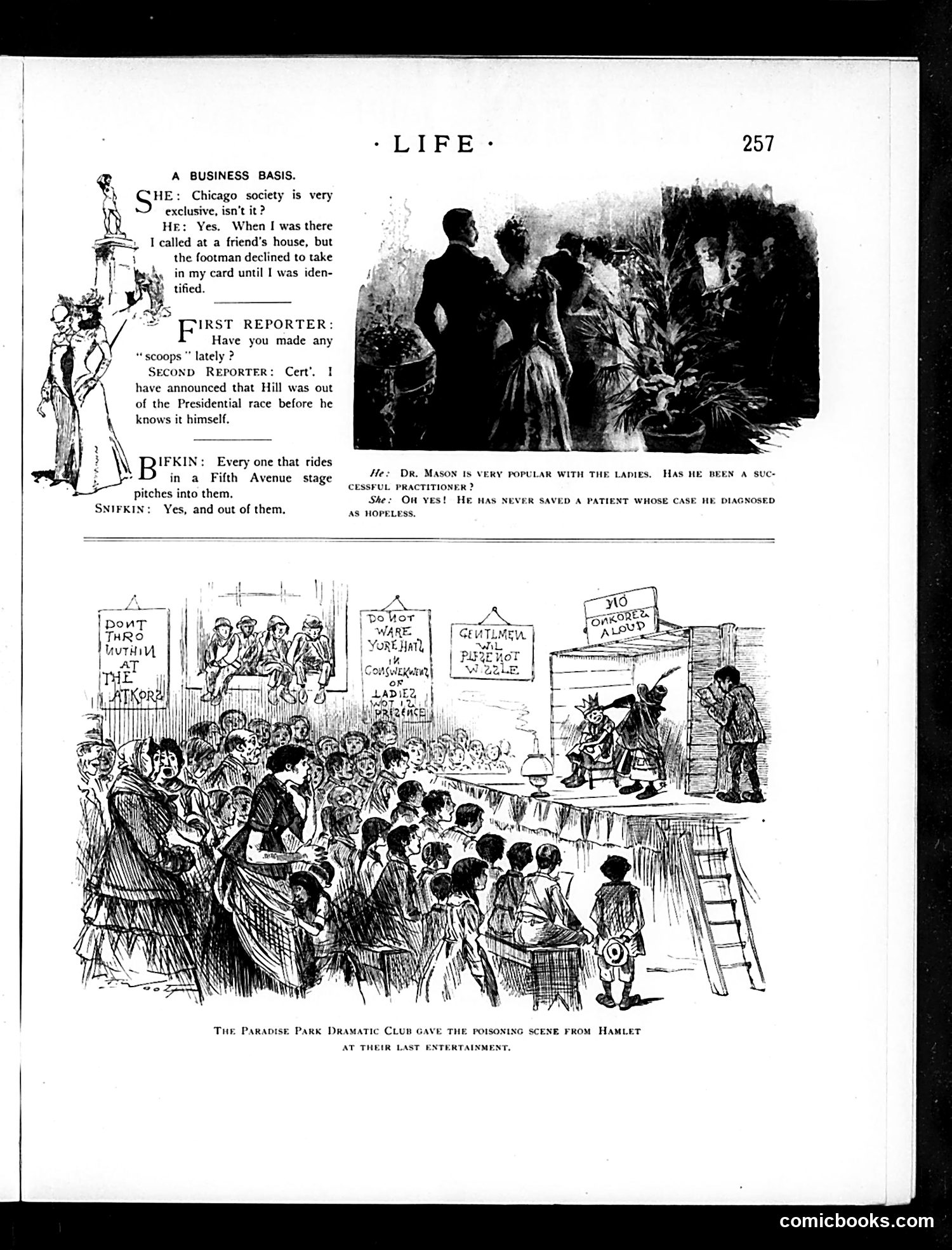
This page from *Life* magazine contains several brief satirical jokes about early 20th-century American society: **"A Business Basis"** mocks Chicago's exclusivity—a footman won't deliver a calling card without identification, treating social access like a business transaction. **The Reporter Exchange** jokes about journalism ethics: one reporter claims to have "scooped" news about Hill withdrawing from a Presidential race before Hill himself knew it, satirizing sensationalism and unreliable reporting. **The Fifth Avenue/Doctor Jokes** are quick quips: one about stage passengers misbehaving; another suggesting Dr. Mason is popular because he only treats hopeless cases (dark humor implying he can't be blamed when they die). **The Bottom Cartoon** depicts an amateur dramatic club performing Hamlet's poisoning scene, apparently with such poor execution or chaotic staging that it became unintentionally comedic—the visual shows a crowded, disorderly performance setup mocking amateur theatrical productions. The overall tone is satirical commentary on social pretension, journalistic unreliability, and amateur culture.
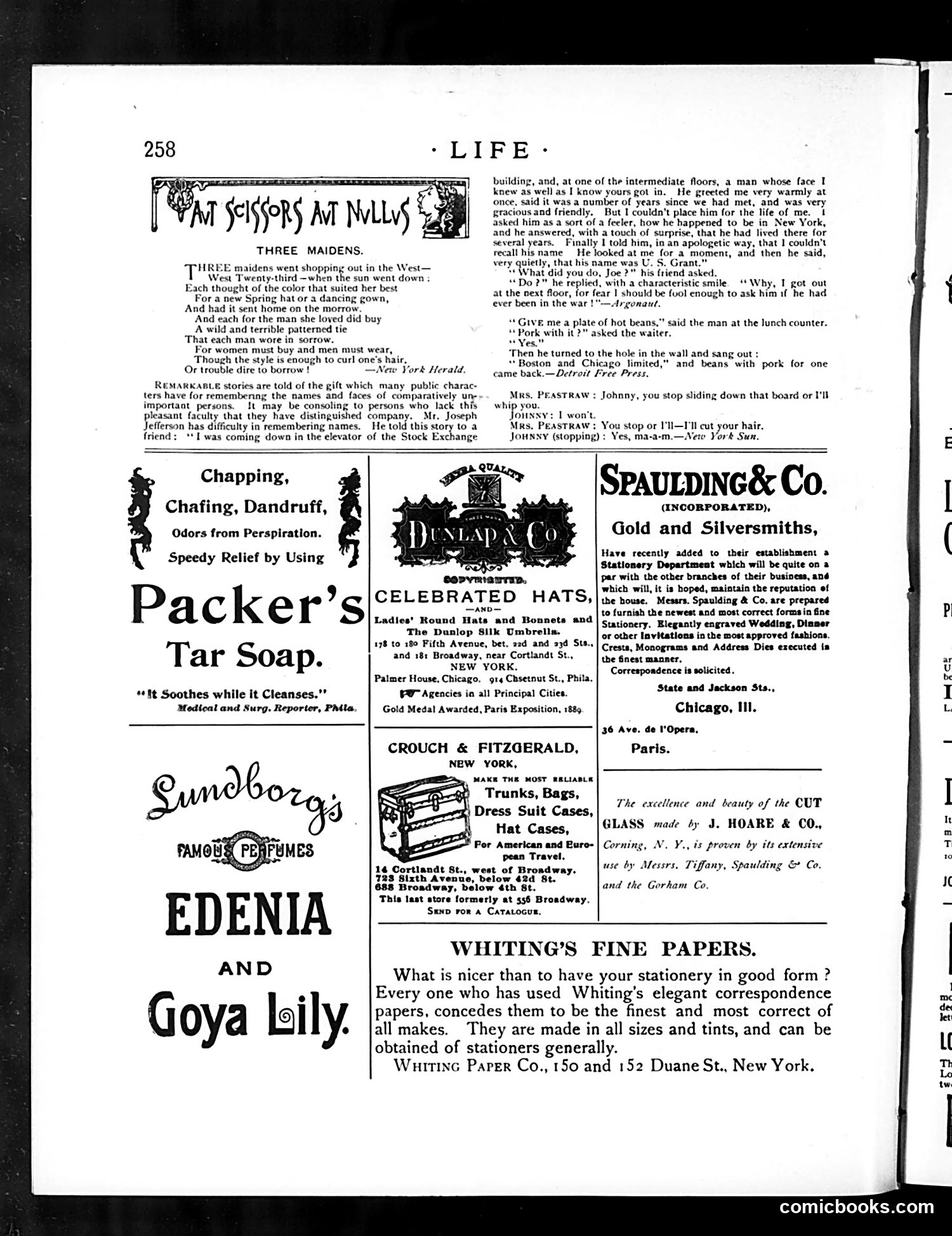
This page is primarily advertisements with brief humorous anecdotes at the top. The notable "cartoon" is actually a short story: Joseph Jefferson (a famous 19th-century actor) recalls encountering General Ulysses S. Grant in an elevator and failing to recognize him, then getting out at the next floor embarrassed. The joke relies on Grant's quiet fame and the irony of meeting a celebrated military figure without recognizing him. The other brief pieces are simple jokes about women buying gaudy ties for men, confusion at lunch counters, and a child misbehaving. None employ political satire—they're genteel humor typical of *Life* magazine's comedic style of this era (likely 1880s-90s, given the Paris Exposition 1889 reference). The page is otherwise filled with period product advertisements for hats, soap, luggage, and stationery.
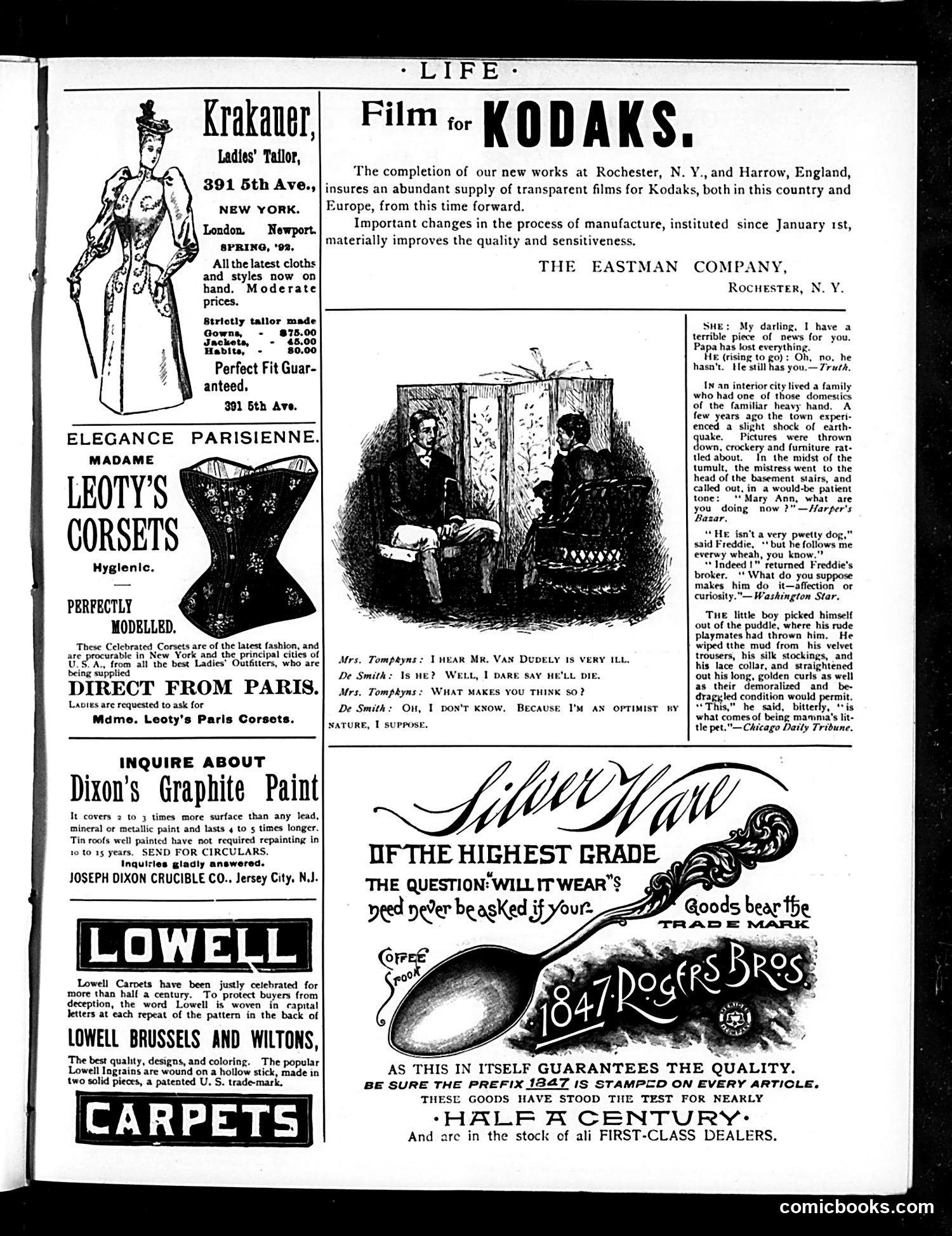
This is primarily an **advertising page** with one satirical cartoon and several humorous anecdotes. The main cartoon depicts two women discussing a sick neighbor, Mr. Van Dudely. One woman remarks she expects him to die, and when asked why, replies it's because she's "an optimist by nature"—the joke being that optimists expect the worst (darkly ironic reversal of the word's meaning). The page also includes several brief comic vignettes: a romantic couple where the woman confesses her father lost everything, and the man responds he still has her (sentimental humor); a story about a maid causing household chaos during an earthquake; and anecdotes about a boy's homely but loyal dog and a child muddied by playmates. **The dominant content is advertising**: corsets, tailoring, paint, carpets, and notably **Eastman Kodak film**—the new photography technology of the era. This reflects Life's function as both satirical publication and commercial vehicle for emerging consumer goods.
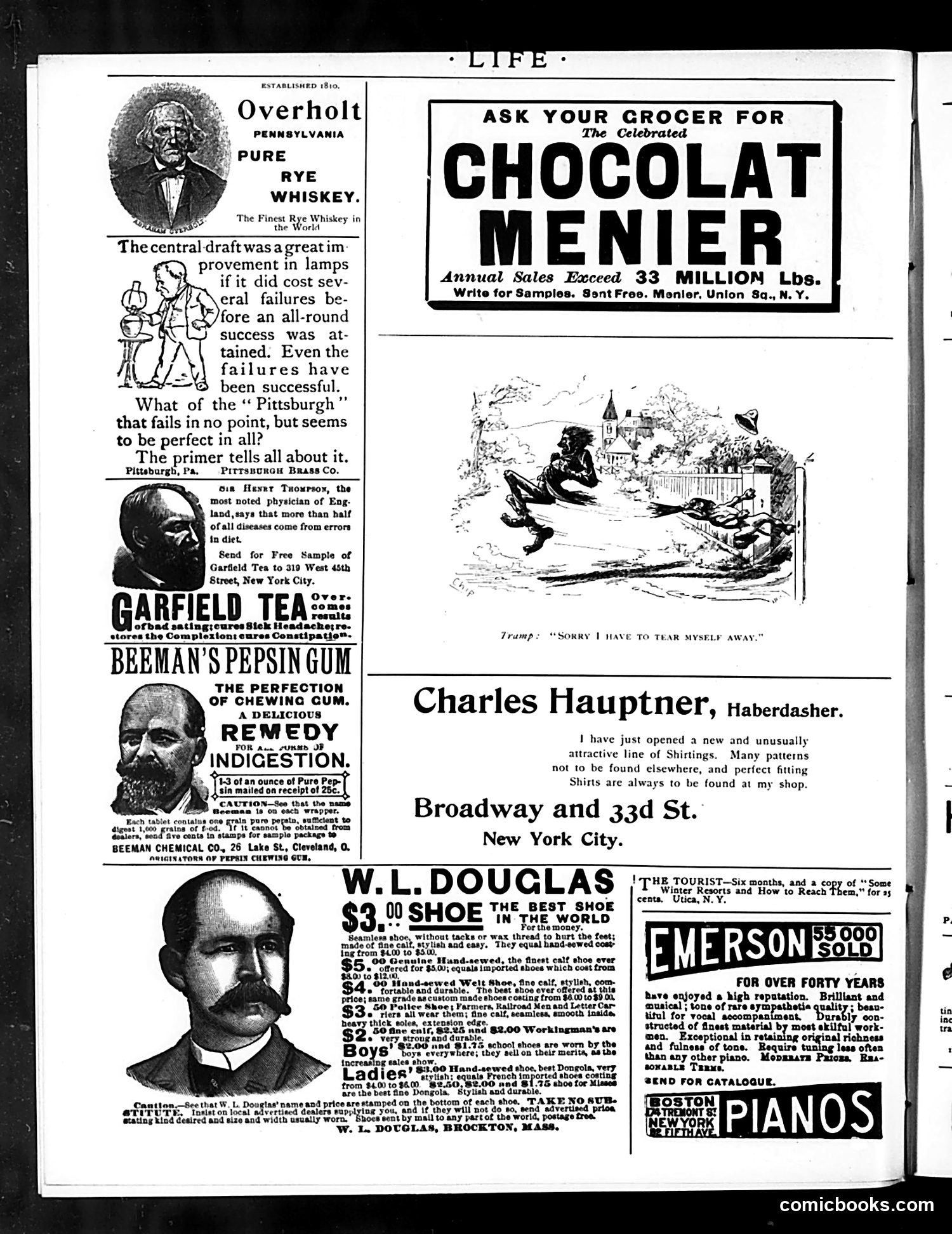
This page is primarily **advertising**, typical of Life magazine's revenue model. The cartoons are minimal. The single cartoon shows a tramp saying "Sorry I have to tear myself away" while departing a suburban house—a gentle joke about a vagrant's reluctant departure, likely after receiving food or shelter. The bulk of the page features period product advertisements: Overholt whiskey, Garfield Tea (promoted by citing a physician's authority on diet), Beeman's Pepsin Gum (marketed as an indigestion remedy), W.L. Douglas shoes (emphasizing quality-for-price), Chocolat Menier (chocolate), and Boston Pianos. Notable is the advertisement style: testimonials from authority figures (doctors, manufacturers), health claims now considered dubious, and explicit price competition. Charles Hauptner's haberdashery and an Emerson piano company also advertise. The page reflects early 20th-century consumer culture, where medical remedies were loosely regulated and advertising relied heavily on celebrity endorsement and unverified health claims—practices that would later face regulatory scrutiny.
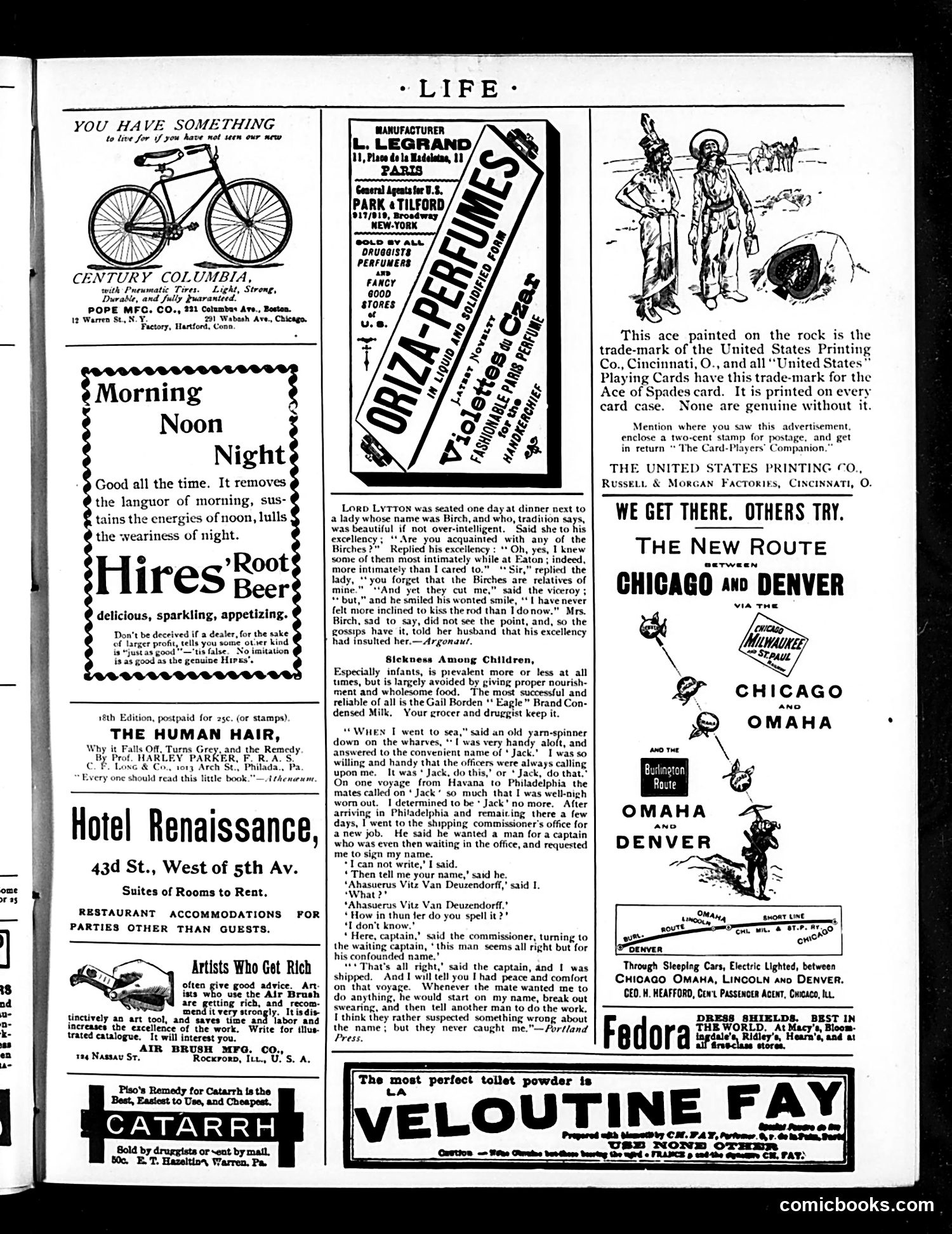
This is primarily an **advertising page** from Life magazine, not a political cartoon. The page contains numerous commercial advertisements for products like bicycles, root beer, hotels, and patent medicines typical of the early 1900s. The only narrative content is two humorous **anecdotes**: 1. A story about Lord Lytton making a sexual innuendo to a woman named Mrs. Birch (playing on "birch" as a rod used for beating), which she fails to understand—satirizing female lack of wit. 2. A yarn-spinner's tale about a sailor named "Jack" who avoids being overworked by adopting an unpronounceable name ("Ahasuerus Vitz Van Deuzendorff"), frustrating officers trying to give him orders. These are genteel, Victorian-era humor pieces mocking both women's intelligence and poking fun at working-class cunning. The page reflects early 20th-century advertising and entertainment standards rather than political satire.
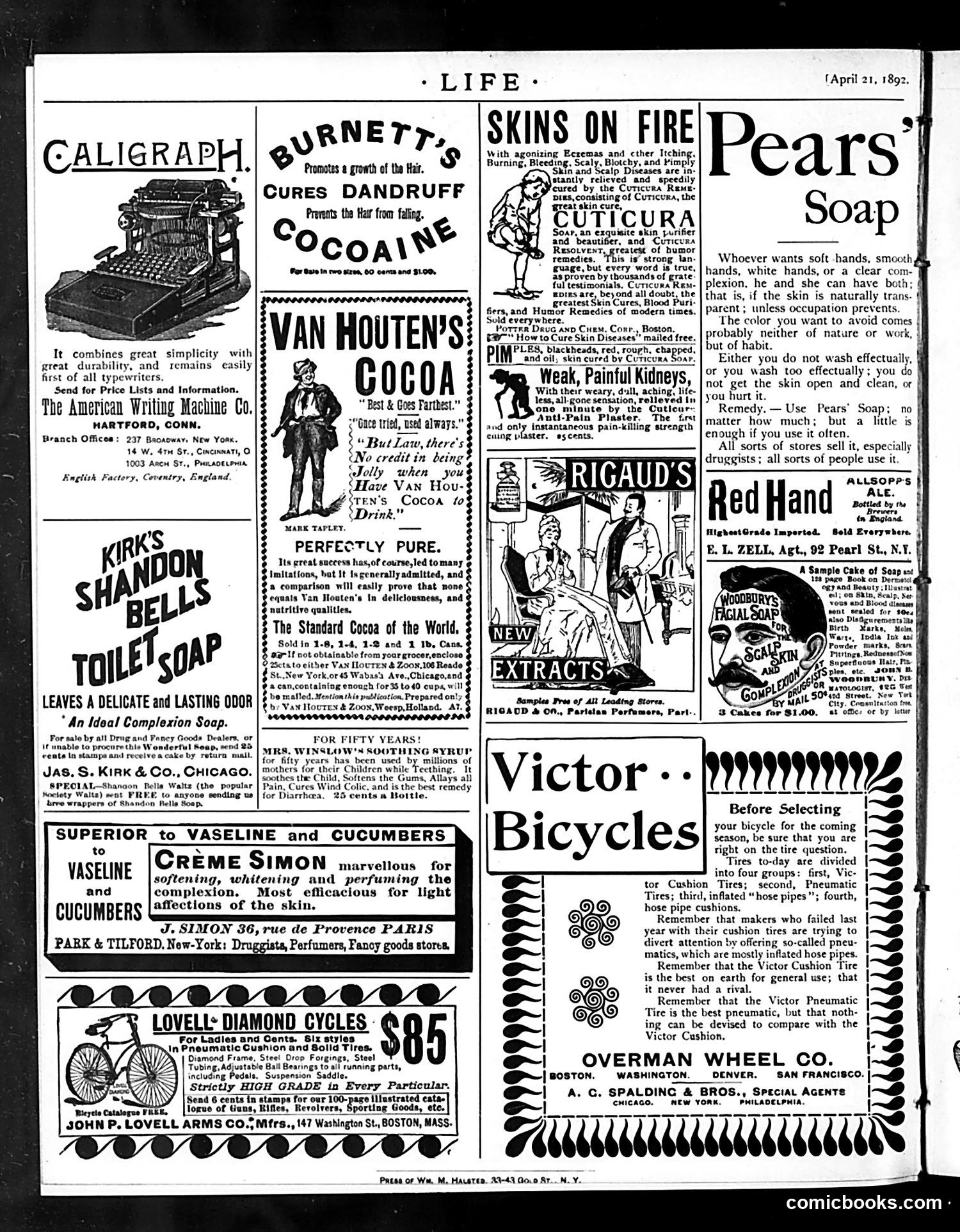
This page is primarily **advertisements**, not editorial content or satire. It showcases late-19th-century consumer products typical of the era. Key advertisements include: - **Typewriters and bicycles** (Caligraph, Lovell Diamond Cycles, Victor Bicycles)—representing industrial-age technology - **Patent medicines and toiletries** (Cuticura remedies, Pears' Soap, Van Houten's Cocoa, Kirk's Toilet Soap)—typical of an era before FDA regulation, when makers claimed dramatic cures for skin diseases, dandruff, and kidney ailments without scientific proof - **Mrs. Winslow's Soothing Syrup**—a popular (and now infamous) teething product once containing opiates The ads reflect Victorian consumer culture and the era's acceptance of extravagant health claims. Modern readers would recognize the dubious medical promises and unregulated marketing as the page's most notable historical feature—products later deemed ineffective or dangerous by modern standards.